Slashdot Mirror
Domain: nasa.gov
Stories and comments across the archive that link to nasa.gov.
Stories · 2,550
-
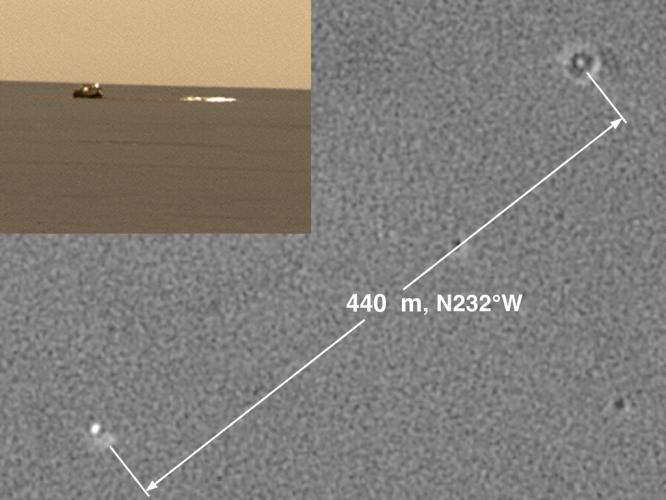
Terrestrial Garbage On Mars
An anonymous reader writes "The garbage left behind by the twin Mars rovers was highlighted this week by the close-up view in panorama of the Spirit rovers' heatshield. Not including the various Viking, Pathfinder and some crippled probes, the human contribution of rover hardware to the martian surface now includes a few odd nicknacks, parachutes, heatshields, back shell,landing petals and many wheel tracks. It may be September before the rovers themselves become part of the red planet's debris field." -
X-43A Hits Mach 7
quiggy writes "As previously reported, NASA tested the X-43A yesterday. The results are in, and the scramjet hit Mach 7, setting a new speed record. CNN is also reporting the story, with a note that a similar jet could be tested by the end of the year, hopefully reaching Mach 10." -
NASA Tests X-43A
An anonymous reader writes "NASA TV has live coverage of the launch of the X-43A scram jet flight. Hopes are that the unmanned vehicle will reach speeds in excess of mach 7-10. The last flight a few years ago failed." Stephen Watts sends this link for X-43A background information. -
Earth Acquires a Quasi-Moon
richard_za writes "Earth has acquired a so called quasi-moon, an asteroid: 2003 YN1, which will encircle us for the next couple of years while it orbits the sun on a horse-shoe shaped path. Full story on News24. It was found by team led by Paul Chodas, an asteroid specialist at Nasa's Jet Propulsion Laboratory in California. An orbit simulation can be seen in this Java applet." -
Earth Acquires a Quasi-Moon
richard_za writes "Earth has acquired a so called quasi-moon, an asteroid: 2003 YN1, which will encircle us for the next couple of years while it orbits the sun on a horse-shoe shaped path. Full story on News24. It was found by team led by Paul Chodas, an asteroid specialist at Nasa's Jet Propulsion Laboratory in California. An orbit simulation can be seen in this Java applet." -
Testing Relativity
MGDruss writes "NASA are proposing an empirical measurement on the ISS which would test general relativity to a precision within the bounds of superstring (and other) theories to predict deviation." We mentioned the Cassini experiment last year. -
Second Test of X-43A Scramjet Tomorrow
pinkUZI writes "NASA says its new Hyper-X, a jet capable of flying some 5,000mph - seven times the speed of sound - will be ready to take a test cruise across the Pacific this Saturday. This is actually NASA's second attempt; the first, in 2001, failed when stabilizing fins flew off the plane's booster rocket and controllers ordered the craft destroyed. CNN has the story." NASA's mission web page has more information, photos, etc. -
NASA's X-43A Vehicle Ready for Flight
Aielman writes "NASA has set March 27 as the date for testing the X-43A vehicle over a Navy range in the Pacific. It will be testing a non-rocket air breathing scramjet engine at approximately 5,000 mph. This is the second attempt, the first ending in intentional destruction due to course deviations shortly after launch." -
NASA Says Mars Rocks Formed in a Salty Sea
NASA has made another announcement, live on NASA TV, regarding the discoveries of the Spirit and Opportunity rovers. They believe that the rocks examined by Opportunity were actually formed in water; that those rocks were actually sediments laid down in a shallow salty sea. They've already had outside scientists examine their data and those scientists concur with the conclusions. NASA has a story with explanations and some photos. -
NASA Says Mars Rocks Formed in a Salty Sea
NASA has made another announcement, live on NASA TV, regarding the discoveries of the Spirit and Opportunity rovers. They believe that the rocks examined by Opportunity were actually formed in water; that those rocks were actually sediments laid down in a shallow salty sea. They've already had outside scientists examine their data and those scientists concur with the conclusions. NASA has a story with explanations and some photos. -
Is {pluto|sedna} A Planet?
Dr. Zowie writes "NASA's announcement last week of Sedna's discovery reignited the debate over whether Pluto is a planet. Dr. Alan Stern a noted planetary scientist and leader of the New Horizons mission to Pluto, pours on some gasoline with this article in which he skewers the various arguments against Pluto-as-planet. Choice quotes include 'You wouldn't deny a chihauhau a place among dogs because it is too small,' and 'if your brain was so completely full of names of people that it just couldn't take any more, would anyone new who you met after that, therefore not be a person?'" -
Is {pluto|sedna} A Planet?
Dr. Zowie writes "NASA's announcement last week of Sedna's discovery reignited the debate over whether Pluto is a planet. Dr. Alan Stern a noted planetary scientist and leader of the New Horizons mission to Pluto, pours on some gasoline with this article in which he skewers the various arguments against Pluto-as-planet. Choice quotes include 'You wouldn't deny a chihauhau a place among dogs because it is too small,' and 'if your brain was so completely full of names of people that it just couldn't take any more, would anyone new who you met after that, therefore not be a person?'" -
Debunking the Trillion-Dollar Space Myth
jfoust writes "When the President and NASA announced the agency's new space initiative, including sending humans back to the Moon and on to Mars, many news reports claimed that the plan could cost as much as $1 trillion. According to this Space Review article, that trillion-dollar price tag is a myth: it was based on erroneous data and analysis, in large part by a single Associated Press reporter, and propagated by many other reporters too busy -- or too lazy -- to check on the facts. Could this kill the plan before it has a chance to start?" -
Monday's Planet Views Best Until 2036
An anonymous reader writes "NASA is reporting that Monday night, March 22nd, offers a rare, naked-eye glimpse of our five prominent astronomical neighbors--Saturn, Jupiter, Mars, Venus, and the Moon--in close proximity in the night sky, near to the familiar Orion constellation. This contrasts with the picture of the 'Fab Five' shot by Voyager looking back on the inner solar system. Monday's aligned view is not likely to appear in this configuration again until 2036." -
Worlds Largest Scale Model Solar System?
Richard_at_work writes "As the BBC is reporting, the UK is to attempt to create the worlds largest scale model of the solar system ever attempted. At a scale of 1:15million, this brings the distance between the Sun (positioned in Cheshire at the Jodrell Bank Telescope site) and the Earth to 15km or 10 miles, although you will need to travel the entire length of the UK to visit all of the planets. Interesting to note is the distinct lack of a 10th planet :) As well as the 9 planets and the sun, also shown on the model will be Halleys Comet and several asteroids. Would have been great if they had included probes such as Voyager 1." Maybe this claimant for world's largest solar system model will have to expand to keep up. -
Asteroid to Make Closest Recorded Pass to Earth
unassimilatible writes "A 100-ft diameter asteroid will make the closest (26,500 miles, or about 3.4 Earth diameters) pass of earth ever detected in advance today, NASA reports. Asteroid 2004 FH's point of closest approach with the Earth will be over the South Atlantic Ocean. Using a good pair of binoculars, the object will be bright enough to be seen during this close approach from areas of Europe, Asia and most of the Southern Hemisphere. While we are in no danger this time, it is good to know NASA's LINEAR guys are on the job, for when that Death Star-sized object pays us a visit." -
Sedna May Have A Moon
ArrayIndexOutOfBound writes "The newly found planet Sedna may have a moon. It appears that most astronomers argue that Sedna is only another proof that neither Sedna nor Pluto are really planets. Interestingly, the planet has been found by an 'automated sky survey telescope'..." SYSS Mouse points to a NASA page with more information about "our potential 10th planet. ... It is 130 billion miles away from the sun (900 times Earth's distance from the sun) and has a 10,500 years orbit, compared to Pluto's 230 years around the sun." -
Planetary Defense: Protecting Earth from Asteroids
securitas writes "Space.com has published a feature about developing a planetary defense against catastrophic comet and asteroid impacts. The story arises from the aptly named 'Planetary Defense Conference: Protecting Earth from Asteroids' held in California February 23-26. The article discusses potential methods to prevent an impact, the need for study missions to comets and asteroids, the to-date haphazard approach to monitoring Near Earth Objects (NEOs), and the NASA/US Air Force Spaceguard Survey, which aims to discover and track 90% of 'Near Earth Asteroids (NEAs) with a diameter greater than 0.6 miles (1-kilometer) by 2008.' Some ideas for anti-impact technologies to develop include gas blasts, nuclear detonations, ramming microsatellites, lasers, mass drivers and gravitational tractor beams. The most disturbing message from the conference? 'It may take a celestial body hit to Earth' before governments take any meaningful steps to address this danger. Mirror at USA Today." -
The Sun's 10th Planet... Sedna?
dsanfte writes "While NASA remains intentionally vague, promising only a news conference Monday, The Australian has the details. The new planet, dubbed Sedna after the Inuit goddess of the sea, is 3 billion km further from the sun than Pluto, and is slightly smaller at 2000km in diameter. This discovery has apparently reignited the debate as to how big a solar object must be in order to qualify as a 'planet', but it is significant nonetheless." -
Spirit Takes Snapshot of Earth
ControlFreal writes "On its 66th Sol on Mars, Mars Exploration Rover Spirit has obtained its first full view of crater Bonneville. In doing so, Spirit achieved its primary travel destination, as set out in its initial itinerary. Furthermore, Spirit has now travelled more than 300 meters, thereby fulfilling its minimum mission success criteria. With this, and Opportunity halfway through its primary mission, and having discovered very strong indications of a wet Martian past, NASA has truly many an astonishing interplanetary succes story! See the overview at the Mars Rover site for more details." Another reader writes "Among the 'money-shots' from the Mars rovers would have to rank the 'pale blue dot' image released today--a view looking back towards Earth. The larger image also includes the horizon and Sun, which because the Earth is seen as an inner planet closer in towards the Sun from a martian perspective, is difficult to photograph without saturation by solar glare." -
Spirit Takes Snapshot of Earth
ControlFreal writes "On its 66th Sol on Mars, Mars Exploration Rover Spirit has obtained its first full view of crater Bonneville. In doing so, Spirit achieved its primary travel destination, as set out in its initial itinerary. Furthermore, Spirit has now travelled more than 300 meters, thereby fulfilling its minimum mission success criteria. With this, and Opportunity halfway through its primary mission, and having discovered very strong indications of a wet Martian past, NASA has truly many an astonishing interplanetary succes story! See the overview at the Mars Rover site for more details." Another reader writes "Among the 'money-shots' from the Mars rovers would have to rank the 'pale blue dot' image released today--a view looking back towards Earth. The larger image also includes the horizon and Sun, which because the Earth is seen as an inner planet closer in towards the Sun from a martian perspective, is difficult to photograph without saturation by solar glare." -
Spirit Takes Snapshot of Earth
ControlFreal writes "On its 66th Sol on Mars, Mars Exploration Rover Spirit has obtained its first full view of crater Bonneville. In doing so, Spirit achieved its primary travel destination, as set out in its initial itinerary. Furthermore, Spirit has now travelled more than 300 meters, thereby fulfilling its minimum mission success criteria. With this, and Opportunity halfway through its primary mission, and having discovered very strong indications of a wet Martian past, NASA has truly many an astonishing interplanetary succes story! See the overview at the Mars Rover site for more details." Another reader writes "Among the 'money-shots' from the Mars rovers would have to rank the 'pale blue dot' image released today--a view looking back towards Earth. The larger image also includes the horizon and Sun, which because the Earth is seen as an inner planet closer in towards the Sun from a martian perspective, is difficult to photograph without saturation by solar glare." -
Spirit Takes Snapshot of Earth
ControlFreal writes "On its 66th Sol on Mars, Mars Exploration Rover Spirit has obtained its first full view of crater Bonneville. In doing so, Spirit achieved its primary travel destination, as set out in its initial itinerary. Furthermore, Spirit has now travelled more than 300 meters, thereby fulfilling its minimum mission success criteria. With this, and Opportunity halfway through its primary mission, and having discovered very strong indications of a wet Martian past, NASA has truly many an astonishing interplanetary succes story! See the overview at the Mars Rover site for more details." Another reader writes "Among the 'money-shots' from the Mars rovers would have to rank the 'pale blue dot' image released today--a view looking back towards Earth. The larger image also includes the horizon and Sun, which because the Earth is seen as an inner planet closer in towards the Sun from a martian perspective, is difficult to photograph without saturation by solar glare." -
Spirit Takes Snapshot of Earth
ControlFreal writes "On its 66th Sol on Mars, Mars Exploration Rover Spirit has obtained its first full view of crater Bonneville. In doing so, Spirit achieved its primary travel destination, as set out in its initial itinerary. Furthermore, Spirit has now travelled more than 300 meters, thereby fulfilling its minimum mission success criteria. With this, and Opportunity halfway through its primary mission, and having discovered very strong indications of a wet Martian past, NASA has truly many an astonishing interplanetary succes story! See the overview at the Mars Rover site for more details." Another reader writes "Among the 'money-shots' from the Mars rovers would have to rank the 'pale blue dot' image released today--a view looking back towards Earth. The larger image also includes the horizon and Sun, which because the Earth is seen as an inner planet closer in towards the Sun from a martian perspective, is difficult to photograph without saturation by solar glare." -
Spirit Takes Snapshot of Earth
ControlFreal writes "On its 66th Sol on Mars, Mars Exploration Rover Spirit has obtained its first full view of crater Bonneville. In doing so, Spirit achieved its primary travel destination, as set out in its initial itinerary. Furthermore, Spirit has now travelled more than 300 meters, thereby fulfilling its minimum mission success criteria. With this, and Opportunity halfway through its primary mission, and having discovered very strong indications of a wet Martian past, NASA has truly many an astonishing interplanetary succes story! See the overview at the Mars Rover site for more details." Another reader writes "Among the 'money-shots' from the Mars rovers would have to rank the 'pale blue dot' image released today--a view looking back towards Earth. The larger image also includes the horizon and Sun, which because the Earth is seen as an inner planet closer in towards the Sun from a martian perspective, is difficult to photograph without saturation by solar glare." -
Hubble's Deepest Pictures Yet
MrBook2 writes "NASA have just released the Ultra Deep Field (UDF). This image took 800 exposures and clocked in at 11.3 days (!) of exposure time. This image is deeper than the Hubble Deep Field which has yielded a vast amount of knowledge. So, why exactly was it that NASA wanted to scrap the Hubble?" -
Free Associating On The Surface Of Mars
jdaily writes "Apparently, while NASA scientists are busy analyzing the more than 10 gigabits of data returned by the rovers thus far, earnest space enthusiasts are dissecting the images and reporting discoveries of fossils, letters of the alphabet, and a white bunny. The 'Net really needs a kook hall of fame." -
Tumbleweed Rover for Marathon Martian Journeys
An anonymous reader writes "A prototype Mars rover, the Tumbleweed, has completed its 40 mile trek across the Antarctic, driven only by winds even in rough terrain over eight days. While the current rovers are designed for flat, equatorial regions, the tumbleweed design is geared to cover longer distances across what many consider the more interesting and dangerous polar regions on Mars." -
Tumbleweed Rover for Marathon Martian Journeys
An anonymous reader writes "A prototype Mars rover, the Tumbleweed, has completed its 40 mile trek across the Antarctic, driven only by winds even in rough terrain over eight days. While the current rovers are designed for flat, equatorial regions, the tumbleweed design is geared to cover longer distances across what many consider the more interesting and dangerous polar regions on Mars." -
Tumbleweed Rover for Marathon Martian Journeys
An anonymous reader writes "A prototype Mars rover, the Tumbleweed, has completed its 40 mile trek across the Antarctic, driven only by winds even in rough terrain over eight days. While the current rovers are designed for flat, equatorial regions, the tumbleweed design is geared to cover longer distances across what many consider the more interesting and dangerous polar regions on Mars." -
Tumbleweed Rover for Marathon Martian Journeys
An anonymous reader writes "A prototype Mars rover, the Tumbleweed, has completed its 40 mile trek across the Antarctic, driven only by winds even in rough terrain over eight days. While the current rovers are designed for flat, equatorial regions, the tumbleweed design is geared to cover longer distances across what many consider the more interesting and dangerous polar regions on Mars." -
Tumbleweed Rover for Marathon Martian Journeys
An anonymous reader writes "A prototype Mars rover, the Tumbleweed, has completed its 40 mile trek across the Antarctic, driven only by winds even in rough terrain over eight days. While the current rovers are designed for flat, equatorial regions, the tumbleweed design is geared to cover longer distances across what many consider the more interesting and dangerous polar regions on Mars." -
NASA Says Mars Once "Drenched With Water"
NASA is currently holding a press conference (carried live on NASA TV) where they are discussing findings from the Mars rovers. They are saying that the crater that the second rover has landed in has convincing evidence that it was once drenched or covered in liquid water. They cite the tiny spherules, odd holes in the rocks, sulfur in the spectrometric analyses, and evidence of an iron sulfate hydrate (a hydrate is a chemical compound which includes water molecules in the crystal lattice). Update: 03/02 19:45 GMT by M : CNN has a story, or see the NASA press release. -
NASA Mars Press Briefing & "Significant Findings"
An anonymous reader writes "NASA will have a press briefing today at 2 p.m. EST to announce "significant findings". Salty liquid water maybe? Bacteria? This meeting will also be broadcast on NASA TV." -
NASA Mars Press Briefing & "Significant Findings"
An anonymous reader writes "NASA will have a press briefing today at 2 p.m. EST to announce "significant findings". Salty liquid water maybe? Bacteria? This meeting will also be broadcast on NASA TV." -
Saturn Rings But No Spokes
An anonymous reader writes "Scientists continue to ponder why images of Saturn's rings today lack the 'spokes' or dark radial bands radiating outward and first observed on the Voyager flyby. The Boulder-based Cassini Image Team describes 5 visible moons, plans for the descent probe going into the Titan moon's hydrocarbon-rich atmosphere and the expected orbital entry around Saturn less than 4 months from now." -
Audit Finds Problems with ISS Management
SuperBanana writes "According to an AP story carried by the Boston Globe, an internal audit released yesterday by NASA found numerous problems with management of the station, in some ways similar to the problems in the shuttle program. This includes missing, inconsistent, or outdated technical drawings; inadequately trained staff, and analysis of failure trends that is 'severely lacking'. Despite the report's length(172 pages) no specifics are cited. The report is not yet available in the press section of NASA's site." -
Mars Rovers Update
BoldAC writes "CNN is reporting that engineers will upload a software hack to decrease the recent power drain plaguing the rover Opportunity. The hack works by reducing the power supply to a poorly functioning switch." p3tersen writes "Opportunity has photographed a blue martian sunset (it's blue because of the optical scattering properties of dust in the martian atmosphere). In other news, the rovers are beginning to experience power supply problems due to the accumulation of dust on their solar panels." -
Exploding Neutron Star
Mick Ohrberg writes "According to NASA News, scientists at NASA and CITA are watching a neutron star (4U 1820-30, 25,000 light years from Earth) explode. Or rather - watch an explosion happen just a few miles above the surface of this immensely dense body. What happens is that matter (mostly helium) from a companion star is by the gravity of the neutron star and collected on the surface until a layer is formed and sufficient pressure is generated. This will cause the helium to fuse into carbon and other elements, releasing enormous amounts of energy in the X-ray band. The event was caught using NASA's Rossi X-ray Timing Explorer. More details can be found here." -
Exploding Neutron Star
Mick Ohrberg writes "According to NASA News, scientists at NASA and CITA are watching a neutron star (4U 1820-30, 25,000 light years from Earth) explode. Or rather - watch an explosion happen just a few miles above the surface of this immensely dense body. What happens is that matter (mostly helium) from a companion star is by the gravity of the neutron star and collected on the surface until a layer is formed and sufficient pressure is generated. This will cause the helium to fuse into carbon and other elements, releasing enormous amounts of energy in the X-ray band. The event was caught using NASA's Rossi X-ray Timing Explorer. More details can be found here." -
Exploding Neutron Star
Mick Ohrberg writes "According to NASA News, scientists at NASA and CITA are watching a neutron star (4U 1820-30, 25,000 light years from Earth) explode. Or rather - watch an explosion happen just a few miles above the surface of this immensely dense body. What happens is that matter (mostly helium) from a companion star is by the gravity of the neutron star and collected on the surface until a layer is formed and sufficient pressure is generated. This will cause the helium to fuse into carbon and other elements, releasing enormous amounts of energy in the X-ray band. The event was caught using NASA's Rossi X-ray Timing Explorer. More details can be found here." -
Exploding Neutron Star
Mick Ohrberg writes "According to NASA News, scientists at NASA and CITA are watching a neutron star (4U 1820-30, 25,000 light years from Earth) explode. Or rather - watch an explosion happen just a few miles above the surface of this immensely dense body. What happens is that matter (mostly helium) from a companion star is by the gravity of the neutron star and collected on the surface until a layer is formed and sufficient pressure is generated. This will cause the helium to fuse into carbon and other elements, releasing enormous amounts of energy in the X-ray band. The event was caught using NASA's Rossi X-ray Timing Explorer. More details can be found here." -
Exploding Neutron Star
Mick Ohrberg writes "According to NASA News, scientists at NASA and CITA are watching a neutron star (4U 1820-30, 25,000 light years from Earth) explode. Or rather - watch an explosion happen just a few miles above the surface of this immensely dense body. What happens is that matter (mostly helium) from a companion star is by the gravity of the neutron star and collected on the surface until a layer is formed and sufficient pressure is generated. This will cause the helium to fuse into carbon and other elements, releasing enormous amounts of energy in the X-ray band. The event was caught using NASA's Rossi X-ray Timing Explorer. More details can be found here." -
Venus: The Forgotten Planet
Anonymous Coward from Winnipeg writes "These days many of us are consumed by daily batches of spectacular images from our twin Marsbots and international fleet of Mars-orbiting craft. But we should not forget our sister planet, Venus, which has undergone significant exploration in years past. Don P. Mitchell's home page features an intriguing refinement of Soviet surface images using modern reprocessing techniques. Don also includes a terrific overview of the Soviet Venus exploration program. Complete radar mapping of Venus was provided by Magellan ten years ago. Sadly, according to the Venus Exploration Timeline, only two new missions to Venus are envisioned: ESA's Venus Express (using leftover Mars Express and Rosetta equipment) and JAXA's Planet-C orbiter. Apparently, no landings on Venus are planned - is this another case of humanity losing advanced space travel capability due to neglect, like Apollo?" (We've mentioned Mitchell's reworked images before -- amazing stuff.) -
Venus: The Forgotten Planet
Anonymous Coward from Winnipeg writes "These days many of us are consumed by daily batches of spectacular images from our twin Marsbots and international fleet of Mars-orbiting craft. But we should not forget our sister planet, Venus, which has undergone significant exploration in years past. Don P. Mitchell's home page features an intriguing refinement of Soviet surface images using modern reprocessing techniques. Don also includes a terrific overview of the Soviet Venus exploration program. Complete radar mapping of Venus was provided by Magellan ten years ago. Sadly, according to the Venus Exploration Timeline, only two new missions to Venus are envisioned: ESA's Venus Express (using leftover Mars Express and Rosetta equipment) and JAXA's Planet-C orbiter. Apparently, no landings on Venus are planned - is this another case of humanity losing advanced space travel capability due to neglect, like Apollo?" (We've mentioned Mitchell's reworked images before -- amazing stuff.) -
Venus: The Forgotten Planet
Anonymous Coward from Winnipeg writes "These days many of us are consumed by daily batches of spectacular images from our twin Marsbots and international fleet of Mars-orbiting craft. But we should not forget our sister planet, Venus, which has undergone significant exploration in years past. Don P. Mitchell's home page features an intriguing refinement of Soviet surface images using modern reprocessing techniques. Don also includes a terrific overview of the Soviet Venus exploration program. Complete radar mapping of Venus was provided by Magellan ten years ago. Sadly, according to the Venus Exploration Timeline, only two new missions to Venus are envisioned: ESA's Venus Express (using leftover Mars Express and Rosetta equipment) and JAXA's Planet-C orbiter. Apparently, no landings on Venus are planned - is this another case of humanity losing advanced space travel capability due to neglect, like Apollo?" (We've mentioned Mitchell's reworked images before -- amazing stuff.) -
Venus: The Forgotten Planet
Anonymous Coward from Winnipeg writes "These days many of us are consumed by daily batches of spectacular images from our twin Marsbots and international fleet of Mars-orbiting craft. But we should not forget our sister planet, Venus, which has undergone significant exploration in years past. Don P. Mitchell's home page features an intriguing refinement of Soviet surface images using modern reprocessing techniques. Don also includes a terrific overview of the Soviet Venus exploration program. Complete radar mapping of Venus was provided by Magellan ten years ago. Sadly, according to the Venus Exploration Timeline, only two new missions to Venus are envisioned: ESA's Venus Express (using leftover Mars Express and Rosetta equipment) and JAXA's Planet-C orbiter. Apparently, no landings on Venus are planned - is this another case of humanity losing advanced space travel capability due to neglect, like Apollo?" (We've mentioned Mitchell's reworked images before -- amazing stuff.) -
Brine on Mars?
Bagels writes "A new article on MSNBC (coming originally from Space.com) reports that the both Rovers may have struck water in the form of brine. The Opportunity rover found hints of salty water in the trench that it dug, and scientists note that the Spirit rover is currently digging a trench of its own to investigate the soil that clings to its treads, suggesting the possibility of moisture. The brine would only be small amounts of water mixed with salt, which can exist in liquid form at very low temperatures. More images are available over at NASA's rover site." Reader frovingslosh would like to add: "I'm just hoping that when you get around to posting one of the many stories that the rover has found mud on Mars that you might include a link to the slashdot article where I predicted this but got moderated as 'funny'." Done! -
Chandra Sees Black Hole Rip Star Apart
beeplet writes "Nasa just sent out this press release titled about an exciting Chandra observation. It states: "Thanks to two orbiting X-ray observatories, astronomers have the first strong evidence of a supermassive black hole ripping apart a star and consuming a portion of it. The event, captured by NASA's Chandra and ESA's XMM-Newton X-ray Observatories, had long been predicted by theory, but never confirmed." There is more information on the Chandra home page, including the x-ray and optical observations that were involved in the discovery." Note that the star-ripping pictured on the front page is labeled an illustration, rather than an recorded image. -
Interplanetary Network (IPN) Tested
CETS writes "Slim on detail but...USA Today reports of the first test of an Interplanetary Network. 'In a sign of cosmic communications to come, last week mission controllers sent signals to a Mars-orbiting European spacecraft, which relayed the instructions to NASA's Spirit rover on the surface, and a signal was returned to Earth back along the same path.'" NASA also has a press release.