Slashdot Mirror
Domain: nasa.gov
Stories and comments across the archive that link to nasa.gov.
Stories · 2,550
-
2004 Venus Transit In Pictures
oneiros27 writes "For those astronomy fans out there -- pictures are starting to come in from the 2004 Venus Transit (where Venus passes in front of the sun). Times of the transit will vary by city, but make sure you use safe techniques for viewing the sun if you want to look for yourself." Anonymous Coward writes "Check out the transit of Venus webcast from Australia. It starts at 4.50 UTC on June 8." Update: 06/07 04:03 GMT by T : Linked webcast link updated to a URL projected to better handle the load, thanks to reader Tom Minchin. -
2004 Venus Transit In Pictures
oneiros27 writes "For those astronomy fans out there -- pictures are starting to come in from the 2004 Venus Transit (where Venus passes in front of the sun). Times of the transit will vary by city, but make sure you use safe techniques for viewing the sun if you want to look for yourself." Anonymous Coward writes "Check out the transit of Venus webcast from Australia. It starts at 4.50 UTC on June 8." Update: 06/07 04:03 GMT by T : Linked webcast link updated to a URL projected to better handle the load, thanks to reader Tom Minchin. -
2004 Venus Transit In Pictures
oneiros27 writes "For those astronomy fans out there -- pictures are starting to come in from the 2004 Venus Transit (where Venus passes in front of the sun). Times of the transit will vary by city, but make sure you use safe techniques for viewing the sun if you want to look for yourself." Anonymous Coward writes "Check out the transit of Venus webcast from Australia. It starts at 4.50 UTC on June 8." Update: 06/07 04:03 GMT by T : Linked webcast link updated to a URL projected to better handle the load, thanks to reader Tom Minchin. -
Mars Rovers on New Missions
mycro writes "According to CNN, the Mars rovers are on a brand new mission. Because the Mars Spirit and Opportunity rovers are in such great condition and 'keep going and going', NASA will be using them for a longer period of time to study water, rocks, and formations on Mars." An anonymous reader writes "Today NASA has given its Opportunity rover a green light to enter the steep Endurance crater. Looking at deeper martian bedrock layers is considered now a rich enough science payoff to weigh favorably against the real chance that the rover cannot get back out of the crater." -
Mars Rovers on New Missions
mycro writes "According to CNN, the Mars rovers are on a brand new mission. Because the Mars Spirit and Opportunity rovers are in such great condition and 'keep going and going', NASA will be using them for a longer period of time to study water, rocks, and formations on Mars." An anonymous reader writes "Today NASA has given its Opportunity rover a green light to enter the steep Endurance crater. Looking at deeper martian bedrock layers is considered now a rich enough science payoff to weigh favorably against the real chance that the rover cannot get back out of the crater." -
NASA Seeks Proposals For Hubble Robotic Servicing
hcg50a writes "SpaceFlight Now has an article about NASA asking for proposals to mount a robotic mission to service the Hubble Space Telescope. Such a Hubble-servicing mission would occur toward the end of calendar year 2007. If you like politics mixed with your spaceflight, you can read NASA Administrator O'Keefe's speech in which the announcement was made." -
Cassini Alters Path. Phoebe Now In Sight!
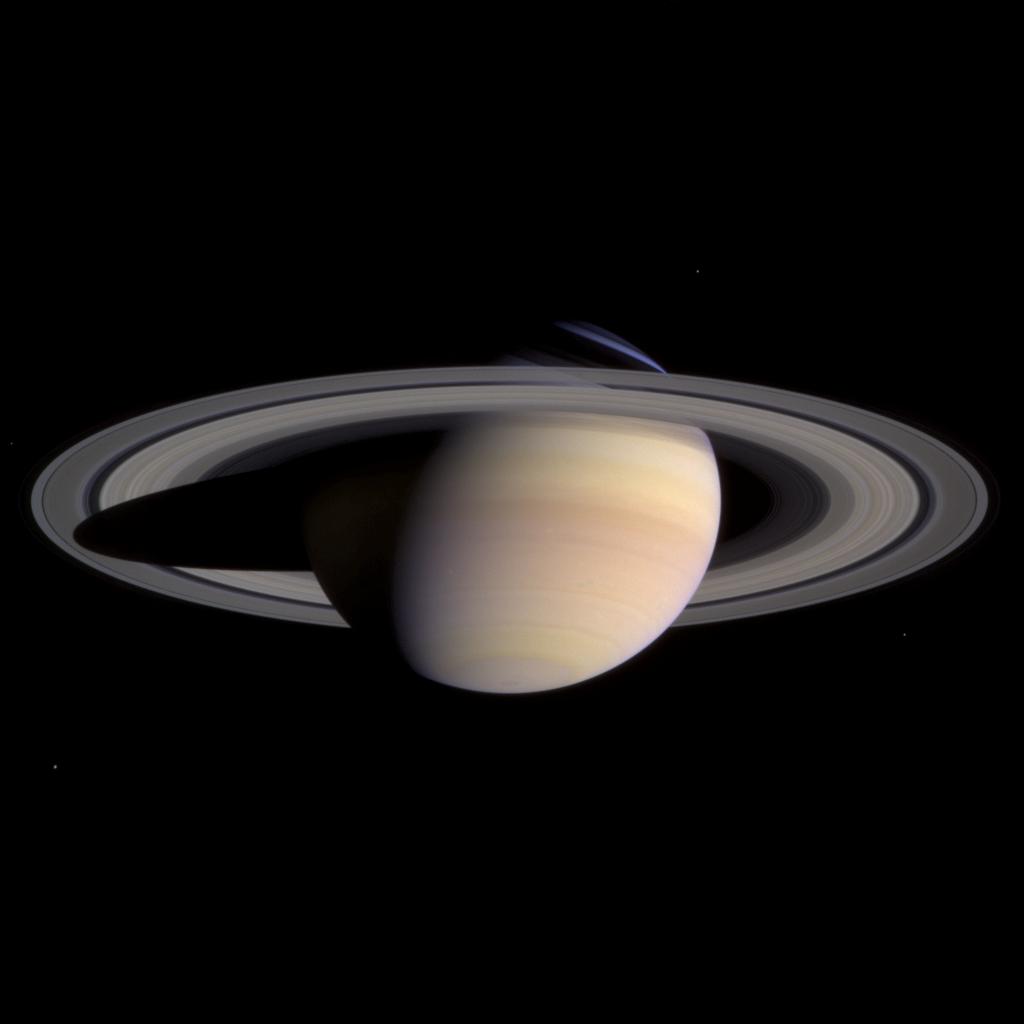
Anonymous Explorer writes "This week the Cassini-Huygens Spacecraft finally entered the Saturn system and made its first main-engine burn in five years in preparation of for the Phoebe flyby. This long journey has been one filled with much promise and peril. Launched in 1997, Cassini is expected to have a rendezvous with the moon Phoebe on June 11. For those of us who are lazy, that's just a tad under two weeks away. After the Phoebe flyby, it's on to the ringed planet, with an anticipated July 1 ground orbit insertion. The ESA's Huygens probe will descend into the atmosphere of Titan a few months after Cassini is inserted into orbit. This mission promises to be one that brings a very psychedelic and beautiful area of our solar system into clearer focus. This multinational mission is one the most ambitious scientific explorations yet undertaken and promises some truly otherworldly images in the near future. With 31 moons/natural satellites thus far discovered orbiting Saturn, there should be a lot to keep us occupied. Anyone else excited about the journey to a ringed world? Lets all enjoy this ride. It promises to be a unique one as much as for the scenery as for the science. Informal discussion regarding the Cassini-Huygens mission can be found at #cassini on irc.freenode.net." -
Cassini Alters Path. Phoebe Now In Sight!
Anonymous Explorer writes "This week the Cassini-Huygens Spacecraft finally entered the Saturn system and made its first main-engine burn in five years in preparation of for the Phoebe flyby. This long journey has been one filled with much promise and peril. Launched in 1997, Cassini is expected to have a rendezvous with the moon Phoebe on June 11. For those of us who are lazy, that's just a tad under two weeks away. After the Phoebe flyby, it's on to the ringed planet, with an anticipated July 1 ground orbit insertion. The ESA's Huygens probe will descend into the atmosphere of Titan a few months after Cassini is inserted into orbit. This mission promises to be one that brings a very psychedelic and beautiful area of our solar system into clearer focus. This multinational mission is one the most ambitious scientific explorations yet undertaken and promises some truly otherworldly images in the near future. With 31 moons/natural satellites thus far discovered orbiting Saturn, there should be a lot to keep us occupied. Anyone else excited about the journey to a ringed world? Lets all enjoy this ride. It promises to be a unique one as much as for the scenery as for the science. Informal discussion regarding the Cassini-Huygens mission can be found at #cassini on irc.freenode.net." -
Cassini Alters Path. Phoebe Now In Sight!
Anonymous Explorer writes "This week the Cassini-Huygens Spacecraft finally entered the Saturn system and made its first main-engine burn in five years in preparation of for the Phoebe flyby. This long journey has been one filled with much promise and peril. Launched in 1997, Cassini is expected to have a rendezvous with the moon Phoebe on June 11. For those of us who are lazy, that's just a tad under two weeks away. After the Phoebe flyby, it's on to the ringed planet, with an anticipated July 1 ground orbit insertion. The ESA's Huygens probe will descend into the atmosphere of Titan a few months after Cassini is inserted into orbit. This mission promises to be one that brings a very psychedelic and beautiful area of our solar system into clearer focus. This multinational mission is one the most ambitious scientific explorations yet undertaken and promises some truly otherworldly images in the near future. With 31 moons/natural satellites thus far discovered orbiting Saturn, there should be a lot to keep us occupied. Anyone else excited about the journey to a ringed world? Lets all enjoy this ride. It promises to be a unique one as much as for the scenery as for the science. Informal discussion regarding the Cassini-Huygens mission can be found at #cassini on irc.freenode.net." -
Cassini Alters Path. Phoebe Now In Sight!
Anonymous Explorer writes "This week the Cassini-Huygens Spacecraft finally entered the Saturn system and made its first main-engine burn in five years in preparation of for the Phoebe flyby. This long journey has been one filled with much promise and peril. Launched in 1997, Cassini is expected to have a rendezvous with the moon Phoebe on June 11. For those of us who are lazy, that's just a tad under two weeks away. After the Phoebe flyby, it's on to the ringed planet, with an anticipated July 1 ground orbit insertion. The ESA's Huygens probe will descend into the atmosphere of Titan a few months after Cassini is inserted into orbit. This mission promises to be one that brings a very psychedelic and beautiful area of our solar system into clearer focus. This multinational mission is one the most ambitious scientific explorations yet undertaken and promises some truly otherworldly images in the near future. With 31 moons/natural satellites thus far discovered orbiting Saturn, there should be a lot to keep us occupied. Anyone else excited about the journey to a ringed world? Lets all enjoy this ride. It promises to be a unique one as much as for the scenery as for the science. Informal discussion regarding the Cassini-Huygens mission can be found at #cassini on irc.freenode.net." -
Cassini Alters Path. Phoebe Now In Sight!
Anonymous Explorer writes "This week the Cassini-Huygens Spacecraft finally entered the Saturn system and made its first main-engine burn in five years in preparation of for the Phoebe flyby. This long journey has been one filled with much promise and peril. Launched in 1997, Cassini is expected to have a rendezvous with the moon Phoebe on June 11. For those of us who are lazy, that's just a tad under two weeks away. After the Phoebe flyby, it's on to the ringed planet, with an anticipated July 1 ground orbit insertion. The ESA's Huygens probe will descend into the atmosphere of Titan a few months after Cassini is inserted into orbit. This mission promises to be one that brings a very psychedelic and beautiful area of our solar system into clearer focus. This multinational mission is one the most ambitious scientific explorations yet undertaken and promises some truly otherworldly images in the near future. With 31 moons/natural satellites thus far discovered orbiting Saturn, there should be a lot to keep us occupied. Anyone else excited about the journey to a ringed world? Lets all enjoy this ride. It promises to be a unique one as much as for the scenery as for the science. Informal discussion regarding the Cassini-Huygens mission can be found at #cassini on irc.freenode.net." -
Cassini Alters Path. Phoebe Now In Sight!
Anonymous Explorer writes "This week the Cassini-Huygens Spacecraft finally entered the Saturn system and made its first main-engine burn in five years in preparation of for the Phoebe flyby. This long journey has been one filled with much promise and peril. Launched in 1997, Cassini is expected to have a rendezvous with the moon Phoebe on June 11. For those of us who are lazy, that's just a tad under two weeks away. After the Phoebe flyby, it's on to the ringed planet, with an anticipated July 1 ground orbit insertion. The ESA's Huygens probe will descend into the atmosphere of Titan a few months after Cassini is inserted into orbit. This mission promises to be one that brings a very psychedelic and beautiful area of our solar system into clearer focus. This multinational mission is one the most ambitious scientific explorations yet undertaken and promises some truly otherworldly images in the near future. With 31 moons/natural satellites thus far discovered orbiting Saturn, there should be a lot to keep us occupied. Anyone else excited about the journey to a ringed world? Lets all enjoy this ride. It promises to be a unique one as much as for the scenery as for the science. Informal discussion regarding the Cassini-Huygens mission can be found at #cassini on irc.freenode.net." -
Cassini Alters Path. Phoebe Now In Sight!
Anonymous Explorer writes "This week the Cassini-Huygens Spacecraft finally entered the Saturn system and made its first main-engine burn in five years in preparation of for the Phoebe flyby. This long journey has been one filled with much promise and peril. Launched in 1997, Cassini is expected to have a rendezvous with the moon Phoebe on June 11. For those of us who are lazy, that's just a tad under two weeks away. After the Phoebe flyby, it's on to the ringed planet, with an anticipated July 1 ground orbit insertion. The ESA's Huygens probe will descend into the atmosphere of Titan a few months after Cassini is inserted into orbit. This mission promises to be one that brings a very psychedelic and beautiful area of our solar system into clearer focus. This multinational mission is one the most ambitious scientific explorations yet undertaken and promises some truly otherworldly images in the near future. With 31 moons/natural satellites thus far discovered orbiting Saturn, there should be a lot to keep us occupied. Anyone else excited about the journey to a ringed world? Lets all enjoy this ride. It promises to be a unique one as much as for the scenery as for the science. Informal discussion regarding the Cassini-Huygens mission can be found at #cassini on irc.freenode.net." -
Cassini Alters Path. Phoebe Now In Sight!
Anonymous Explorer writes "This week the Cassini-Huygens Spacecraft finally entered the Saturn system and made its first main-engine burn in five years in preparation of for the Phoebe flyby. This long journey has been one filled with much promise and peril. Launched in 1997, Cassini is expected to have a rendezvous with the moon Phoebe on June 11. For those of us who are lazy, that's just a tad under two weeks away. After the Phoebe flyby, it's on to the ringed planet, with an anticipated July 1 ground orbit insertion. The ESA's Huygens probe will descend into the atmosphere of Titan a few months after Cassini is inserted into orbit. This mission promises to be one that brings a very psychedelic and beautiful area of our solar system into clearer focus. This multinational mission is one the most ambitious scientific explorations yet undertaken and promises some truly otherworldly images in the near future. With 31 moons/natural satellites thus far discovered orbiting Saturn, there should be a lot to keep us occupied. Anyone else excited about the journey to a ringed world? Lets all enjoy this ride. It promises to be a unique one as much as for the scenery as for the science. Informal discussion regarding the Cassini-Huygens mission can be found at #cassini on irc.freenode.net." -
NASA Detects Baby Planet
neema writes "Yesterday, NASA's Spitzer Space Telescope (web site here) detected the youngest planet, at less than 1 million years old, known to exist. The planet, for those of you who want to visit or something, is 420 light years away circling the star CoKu Tau 4. According to astronomer Dan Watson of the University of Rochester, the discovery of this "Baby Planet" "really causes problems for the major theories of planetary formation." Arist conception pictures and more info can be found at the Planetary Photojournal." -
Blimps... In... Space...
LandGator writes "MSNBC reports a California company with an alternate launch site in Texas, JP Aerospace, is on their third test of a blimp system specifically designed to fly to space. Blimps. To Space. At payload costs around a dollar a ton to LEO. Their concept, first unveiled at the Space Access '04 conference in Phoenix last month (with a blog report here, include the Ascender, a ground-to-near-space blimp, which docks to a helium-inflated two-mile-long station at the edge of space, over 20 miles up. Another ship, also a blimp but specifically designed to reach orbit, takes the payload from there to LEO, using well-proven electric propulsion (AKA 'ion drive'). That trip to LEO would take up to nine days, but that's a good thing; for, what goes up fast, must come down fast, and speed is energy which must be bled off by either massive amounts of expensive and explosive rocket fuel, or through ablative heat transfer which has its own problems (as we have seen before). JP Aerospace has flown many PongSats -- micropayloads the size of a ping-pong ball -- for balloon or rocket-launch. Over 1,500 PongSats have flown to date, which demonstrates a track record in near-space few of the X-Prize contenders can approach. Oh, yes, the Air Force is interested." -
NASA's New 'Exploration' Insignia
colonist writes "NASA has a new insignia for the program set by the Vision for Space Exploration. This UPI article describes it: "Three spheres--Earth, the moon and Mars--are arrayed in sequence, with the streak of a rocket passing through each. A Latin inscription on the emblem says 'Audentes Fortuna Juvat,' which, translated into English, says 'Fortune Favors the Bold.'" Compare it with other space mission insignia." -
Chandra Provides Support For Dark Energy
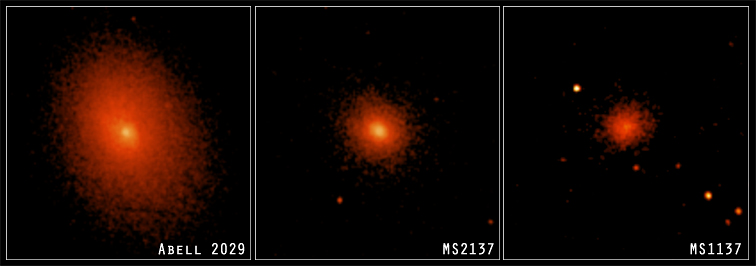
starannihilator writes "The Chandra X-Ray Observatory has provided new evidence supporting the existence of dark energy, the force causing the acceleration of universal expansion. The new findings support the theory that the universe will expand forever, provided there is enough dark matter. CNN and Newsday are running the story, originally reported by NASA. Chandra's site has some good images and information on the three galaxies clusters studied (Abell 2029, MS2137.3-2353, and MS1137.5+6625)." -
NASA's Finances in Disarray
mwolff writes "Yahoo News has an article about the 'financial disarray' NASA seems to be in after a recent audit showed horrible documentation of funding. 'As NASA sets course for the moon and Mars, the space agency's finances are in disarray, with significant errors in its last financial statements and inadequate documentation for $565 billion posted to its accounts, its former auditor reported.'" -
ISS to Eclipse Jupiter
MasterLock writes "If you are in the Eastern US take a moment tonight (13 May 2004) around 9:30 PM EDT to step outside and watch an eclipse of Jupiter by the International Space Station. Details at NASA." -
Terrestrial Planet Finder
solarlux writes "The Terrestrial Planet Finder has taken one step closer to reality as two architectures have been approved by NASA. The first, TPF-c, will be a single optical telescope which employs a coronograph to block starlight for planet detection. TPF-i will be a flotilla of infrared telescopes flying in formation to form a interferometer. TPF-i will analyze the planets identified by TPF-c for life signatures. The telescopes are to be launched within the next 10-15 years." -
A Moment Of Reckoning for Cassini
No_Weak_Heart writes "The NASA/ESA Cassini-Huygens probe has caught sight of Titan and is now returning images that 'rival anything scientists have seen before - and that includes images from the Hubble telescope.' See more detailed images at the mission homepage." -
A Moment Of Reckoning for Cassini
No_Weak_Heart writes "The NASA/ESA Cassini-Huygens probe has caught sight of Titan and is now returning images that 'rival anything scientists have seen before - and that includes images from the Hubble telescope.' See more detailed images at the mission homepage." -
Second Opportunity For Mars Rover
An anonymous reader writes "The Mars Opportunity rover faces a challenging survey around the rim of the stadium-sized Endurance Crater. In addition to what was previously described as the critical choice to go into the steep crater at the risk of not being able to get back out, this "most spectacular view we've seen of the Martian surface" may aid in answering how deep an ancient sea or lake might have been and how long it lasted. Endurance Crater appears much older and thus may pre-date arrival of significant standing water." -
Build Your Own Jet Engine
jgarland79 writes "Have you ever wanted your very own jet engine? Build one at home in your own garage. The guys over at www.garagejet.com have done just that. Their jet engine is made from an automotive turbo, spark plugs, and some scrap metal. I have made a mirror site here." We've had a couple of previous stories about a guy building pulsejet engines - the type of engine described above is a turbojet. -
NASA Needs Prize Contest Ideas
Michael Huang writes "If you like the idea of tech contests--think ANSARI X PRIZE and DARPA Grand Challenge--and you also like space, then NASA wants you. It needs ideas (and rules) for the Centennial Challenges, prize contests with $20 million funding in 2005. Current ideas (download Excel spreadsheet) include: Mars and asteroid microspacecraft missions, lunar robotic landing, robotic triathalon, rover survivor, Antarctic rover traverse and extreme environment computer. Wikipedia has good coverage." -
NASA Needs Prize Contest Ideas
Michael Huang writes "If you like the idea of tech contests--think ANSARI X PRIZE and DARPA Grand Challenge--and you also like space, then NASA wants you. It needs ideas (and rules) for the Centennial Challenges, prize contests with $20 million funding in 2005. Current ideas (download Excel spreadsheet) include: Mars and asteroid microspacecraft missions, lunar robotic landing, robotic triathalon, rover survivor, Antarctic rover traverse and extreme environment computer. Wikipedia has good coverage." -
New Satellite Data Confirms Global Warming
starannihilator writes "Researchers at the University of Washington have analyzed satellite data using a new and more accurate method (using channel 4 on the Microwave Sounding Unit satellite) to show that the troposphere has been warming faster than the Earth's surface for more than two decades. Nature reports that previous interpretations (using MSU channel 2) did not indicate such dramatic tropospheric warming because the data were compromised by stratospheric conditions. For years, the debate over global warming raged largely as a result of an incongruency between trends in surface and tropospheric temperatures. The new data gained by MSU channel 4 are consistent with the surface temperature's rising trends and indicate that global warming is, in fact, occuring in the troposphere. Read the full article in Nature, or similar stories in the Seattle Times and Newswise." -
City-Sized Asteroid to Pass Earth This Fall
FiniteLoop sends a collection of links about a city-sized asteroid named Toutatis which will approach - but miss - Earth this September. MSNBC also has a story, and JPL and the Near Earth Object program have more information. -
City-Sized Asteroid to Pass Earth This Fall
FiniteLoop sends a collection of links about a city-sized asteroid named Toutatis which will approach - but miss - Earth this September. MSNBC also has a story, and JPL and the Near Earth Object program have more information. -
Opportunity Rover Arrives at Endurance Crater
Mean_Nishka writes "After weeks of driving, the Mars Exploration Rover Opportunity has arrived at 'Endurance Crater.' It's a scientific treasure trove with an extensive outcrop of layered bedrock, and scientists will have to decide whether or not to send Opportunity inside for a closer inspection without getting it stuck forever - there's more information via a Monterey Herald/AP article." -
Going Back to the Moon and Mars
An anonymous reader writes "An interesting three-part interview with author Dr. Andrew Chaikin discusses whether humans or machines could best explore the moon or Mars and even whether a crew could get along with each other for three years on an extended mission. His Mars planning draws on Apollo mission transcripts, and he cites mishaps with the Apollo 15 lunar rover almost sliding catastrophically down a mountain, an astronaut argument as to who took the most famous earthrise picture and what after 14 months in space, the Russian record-holder uses to recover his land legs: 'One vodka, one sauna'." -
Meteor May Be From Martian Moon Phobos
An anonymous reader writes "Russian and NASA scientists published in the March journal of Solar System Research, the proposition that a 1980 Yemenite meteorite originated from the martian moon, Phobos. It would be the first moon rock from another planet. New Scientist has a short description and Astrobiology Magazine has the picture. Unique among the 20,000 meteorites collected, this is similar to heat-shocked charcoal and shows several mineral phases not found terrestrially." -
The Lyrids Are Coming!
SeaDour writes "The year's first meteor shower, the Lyrids, will peak in the pre-dawn hours of April 22nd when the Earth plows through the debris trail of Comet Thatcher at a relative velocity of 49 km/s (110,000 mph). Lyrids usually aren't as numerous as other showers (such as the famed Leonids), but they're well-known for their spectacular tails; you can expect to see about 5-20 meteors per hour, depending on the severity of your local light pollution. Unfortunately, my current location in the midwest under stormy skies puts me at a bit of a disposition, but hopefully some other Slashdotters can share their observations with us tomorrow." -
Our Man In Black
bot writes "A recent Slate article covers the onerous responsibilites of the Planetary Protection Officer. He is tasked with preventing contamination of earth by alien organisms, and 'forward contamination' (contamination of other planets with earth germs). There is also a published protocol (PDF link) for avoiding Martian bugs." -
Our Man In Black
bot writes "A recent Slate article covers the onerous responsibilites of the Planetary Protection Officer. He is tasked with preventing contamination of earth by alien organisms, and 'forward contamination' (contamination of other planets with earth germs). There is also a published protocol (PDF link) for avoiding Martian bugs." -
NASA Gravity Probe Launched
ping pong writes "Forty-five years in the making and 24 hours late, NASA launched the $700 million satellite into orbit today to test Albert Einstein's general theory of relativity. The satellite, which was inserted into a polar orbit, will spend two months getting ready, then 16 months making measurements." NASA's mission news has more. -
Summer Comet Update
-
FIRST Robotics Championship Underway
Bob Moretti writes "The annual FIRST robotics championship is underway at the Georgia Dome in Atlanta. 295 of the best high school teams from North America and beyond have brought close to 20,000 students. 130 pound, 5 foot tall robots compete for pride and national recognition. NASA is providing a webcast. An explanation of the somewhat complicated rules can be found here. Any event that puts science and engineering in the spotlight for thousands of high school kids, many of them from low income or inner city areas, is a must-see. <shameless promotion> My team is currently in 20th place in the Galileo division. </shameless promotion>" -
FIRST Robotics Championship Underway
Bob Moretti writes "The annual FIRST robotics championship is underway at the Georgia Dome in Atlanta. 295 of the best high school teams from North America and beyond have brought close to 20,000 students. 130 pound, 5 foot tall robots compete for pride and national recognition. NASA is providing a webcast. An explanation of the somewhat complicated rules can be found here. Any event that puts science and engineering in the spotlight for thousands of high school kids, many of them from low income or inner city areas, is a must-see. <shameless promotion> My team is currently in 20th place in the Galileo division. </shameless promotion>" -
Gravity-Bent Starlight Reveals a New Planet
dfab writes "The first experimental proof of Einstein's general theory has been revamped to discover planets around distant stars. Yesterday astronomers announced that a new technique called gravitational microlensing has found a star that hosts a roughly Jupiter-sized planet in a roughly Jupiter-sized orbit by observing its effect on the light from a bright star beyond that planetary system. See the NASA report or the gory details." -
Hubble Photo of Sedna Suprises Astronomers
waynegoode writes "Soon after the announcement of the discovery of Sedna, the solar system's furthest object and planet wanna-be, the Hubble Space Telescope was pointed at it to answer some of the many questions its discovery generated. The photos were released today and are surprising for what they don't show--a moon. Astronomers were certain it had a moon because of its slow rotation. "I'm completely baffled at the absence of a moon," says Michael Brown, Sedna's discoverer. Story and photo at Universe Today, hubblesite and NASA press release." -
NASA Extends Rover Occupation of Mars
iocat writes "Reuters reporting that NASA is extending the Rover missions on Mars by another five months. However, they point out that while the rovers look poised to greatly exceed their planned life cycle, they could basically die at any time. Still, it will be cool to see a little more exploration." -
A Black Box for People
lightwaveman writes "Developed for astronauts, a small device called 'the CPOD' does for people what black boxes do for airplanes. It's a compact, portable, wearable device -- a single piece of equipment that gathers a wide variety of vital signs. About the size of a computer mouse, a CPOD is worn around the waist. It's comfortable enough to be worn while sleeping. It's non-invasive. It takes only minutes to don. Importantly, it can track a person's physiologic functioning as they go about their normal routine -- they don't have to be tethered to some stationary device. It can store data for eight-hour periods for later downloading; alternatively, it can send it wirelessly, in real time, to some other device." -
A Completely Separate Ecosystem on Earth
Suman writes "A lake hidden beneath 19 meters of ice and gravel has been found near the bottom of the world that might contain an ecosystem completely separate from our own. In a modern version of Sir Arthur Conan Doyle's classic book Lost World, NASA funded scientists are now plotting a mission to drill down into the lake and remove a sample of water from the lake for analysis. Lake Vida, buried under Antarctic ice for over 2,500 years, is liquid only because of a high salt content that results from salt being expelled from water above as it turns to ice. Previously, scientists drilled to within a few meters of the lake and indeed found frozen microbes. Their existence bolsters speculation that similar microorganisms could be found in frozen brine beneath the surface of Mars. If living organisms are found in Lake Vida, they may give an indication that life might even still exist under similar frozen ice-sheets, such as under the larger Lake Vostok, parts of Mars, and even moons of Jupiter such as Europa. Pictured above, a robot meteorological station continues to monitor surface conditions over the ice-sealed lake." We've mentioned this lake before. -
Titanic Saturn
barakn writes "Using the Crab Nebula as an x-ray source, scientists have observed Titan's x-ray shadow to get a preliminary estimate of the extent of its outer atmosphere. On the same page, another article discusses the possibility that the hydrocarbon seas of Titan bear waves, albeit slow-moving and widely spaced, 7 times higher than waves on Earth (additional wave links here, here, and here). And Cassini-Huygens has snapped a photo of Saturn showing "two small, faint dark spots" in the southern hemisphere (this link has convenient arrows pointing at them, or here). Cassini-Huygens will achieve Saturn orbit insertion on July 1st. Huygens will detach and enter Titan's atmosphere in January, 2005." -
Terrestrial Garbage On Mars
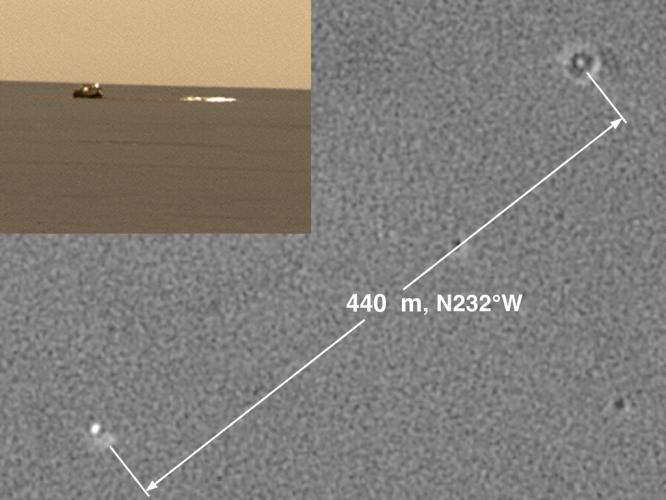
An anonymous reader writes "The garbage left behind by the twin Mars rovers was highlighted this week by the close-up view in panorama of the Spirit rovers' heatshield. Not including the various Viking, Pathfinder and some crippled probes, the human contribution of rover hardware to the martian surface now includes a few odd nicknacks, parachutes, heatshields, back shell,landing petals and many wheel tracks. It may be September before the rovers themselves become part of the red planet's debris field." -
Terrestrial Garbage On Mars
An anonymous reader writes "The garbage left behind by the twin Mars rovers was highlighted this week by the close-up view in panorama of the Spirit rovers' heatshield. Not including the various Viking, Pathfinder and some crippled probes, the human contribution of rover hardware to the martian surface now includes a few odd nicknacks, parachutes, heatshields, back shell,landing petals and many wheel tracks. It may be September before the rovers themselves become part of the red planet's debris field." -
Terrestrial Garbage On Mars
An anonymous reader writes "The garbage left behind by the twin Mars rovers was highlighted this week by the close-up view in panorama of the Spirit rovers' heatshield. Not including the various Viking, Pathfinder and some crippled probes, the human contribution of rover hardware to the martian surface now includes a few odd nicknacks, parachutes, heatshields, back shell,landing petals and many wheel tracks. It may be September before the rovers themselves become part of the red planet's debris field." -
Terrestrial Garbage On Mars
An anonymous reader writes "The garbage left behind by the twin Mars rovers was highlighted this week by the close-up view in panorama of the Spirit rovers' heatshield. Not including the various Viking, Pathfinder and some crippled probes, the human contribution of rover hardware to the martian surface now includes a few odd nicknacks, parachutes, heatshields, back shell,landing petals and many wheel tracks. It may be September before the rovers themselves become part of the red planet's debris field."