Slashdot Mirror
Domain: nasa.gov
Stories and comments across the archive that link to nasa.gov.
Comments · 16,365
-
Re:Plants grow in microgravity.
Where have you been for the last decade.
There is an International Space Station orbiting the earth. You might have heard of this when you weren't trolling here on SlashDot.
If not, or you have been off-planet for the last many years, here is a link for you:
http://quest.nasa.gov/events/cotf/webquest/index.html -
Re:Doomsday situation
They go boom, they get replaced or otherwise repaired. The situation if so drastic would right itself due to economic forces that encourage such.
What part of 12 months to build them is so hard to understand? Even if that timescale could be shortened do you think the infrastructure exists to produce large numbers of these items in a short period of time? Yes the situation would eventually right itself through economic and other factors. Yes the human race would survive. But you'd still have hundreds of millions of people without power and the benefits of modern civilization for months. Almost every single piece of technology that supports civilization (particularly high population density civilization) depends on the electrical grid
I could imagine alongside you all day, but it won't ever come to pass. Have fun RTFA.
It has come to pass in the past. Within the last 200 years as a matter of fact. If a similiar event happened today (the whole point of the article that you apparently refuse to read) it would wreck havoc with modern infrastructure. In 1859 all that existed to disrupt were telegraph networks. Today our entire civilization depends on infrastructure that is vulnerable.
Sticking your head in the sand and refusing to even read the article might be typical
-
Solar Cycle 24has recently begun. From the link:
The onset of a new solar cycle is significant because of our increasingly space-based technological society. "Solar storms can disable satellites that we depend on for weather forecasts and GPS navigation," says Hathaway. Radio bursts from solar flares can directly interfere with cell phone reception while coronal mass ejections (CMEs) hitting Earth can cause electrical power outages. "The most famous example is the Quebec outage of 1989, which left some Canadians without power for as much as six days."
Scientists also say this is the worst one in decades.
-
Re:No Subject
It's certainly a good image, but not the best. This image of Ralf's, for instance, is noticeably more clear. He has many more amazing images though on his site here.
Holy shit. There's a picture of his on that site which actually managed to capture an astronaut on a spacewalk. Talk about impressive.
Thanks for the link, there's a whole lot of very interesting shots there.
-
No Subject
-
Matell, are you taking notes??
There have been rumblings about this sort of thing in various crackpot circles for years. A good reference is the following from NASA's breakthrough propulsion project:
http://www.grc.nasa.gov/WWW/bpp/overview.html
See "Podkletnov Gravity Shield"I hope someone a lot smarter than myself starts taking this crap seriously because I want my damn hoverboard!!
-
Original NASA press release
-
Original NASA press release
-
Re:Colbert trumps Scientology; everyone wins.
Xenu was beaten out by Colbert, MyYearBook, and Gaia, so it wasn't even second.
http://www.nasa.gov/externalflash/name_ISS/index.html -
Re:NASA won
Good, while their messing with tourists we can do real research. Here's the list of experiments done on each expedition.
http://www.nasa.gov/mission_pages/station/science/experiments/Expedition.html
And no, just because these don't mean anything to you does not mean they mean nothing to anyone else.
-
Re:Not so fast...
Colbert just made the top of the list of the "Top Ten Suggestions". NASA is naming it Serenity with 70% of the official votes.
I'm sure Joss Whedon fans may have had something to do with it, but naming Node 3 'Serenity' after Node 1 was named 'Unity' and Node 2 was named 'Harmony' doesn't seem that odd. -
Serenity eon
Colbert won the write-in vote. Serenity won the vote
-
Re:NASA won
Yeah! What the fuck have we ever gotten from NASA? Pretty pictures?
http://en.wikipedia.org/wiki/NASA_Spinoff
http://spaceplace.nasa.gov/en/kids/spinoffs2.shtml -
Re:In effect, what they are saying, is
I was 10 when I watched Armstrong land on the moon, every kid was into space and I had read "grown up books" in the library with pictures of water canals on Mars and rainforests on Venus. Since then astronomy has been fully digitised and we have mapped most of the EM spectrum. I'm not saying it won't continue to improve (especially in the area of corrective optics) but I think it will be slower now that the spectrum land rush is coming to an end and digitization is well and trully complete.
The long term limiting factor with all astronomical technology is signal to noise, there have been huge advances in my lifetime concerned with the accuracy of finding and ploting the signal, but you still have to collect the photons. Mirror making tech is old tech but even it took a big jump in the seventies, I remeber reading how they made the mirror for Hubble sometime in the late 70's. It's the gold standard for mirrors (~1mm deviation over an area the size of Australia), I know, pity it was the wrong shape.
Thing is, the electronics are now that good that we no longer need large mirrors with that degree of accuracy, we can larger less accurate mirrors and then correct for known distortions, even real-time chaotic ones such as atompospheric wobbles.
I don't think Kepler will be a situation where someone announces "the answer", the best "iconic image" we will have to print on our T shirts will be a spectrum. How long it takes to get to the T shirt stage depends on how many candidate planets, their orbits, the number of photons we can catch and plot, and most of all, how confident do you want to be about yes/no. -
Re:No comment?
-
Re:Build It in Space
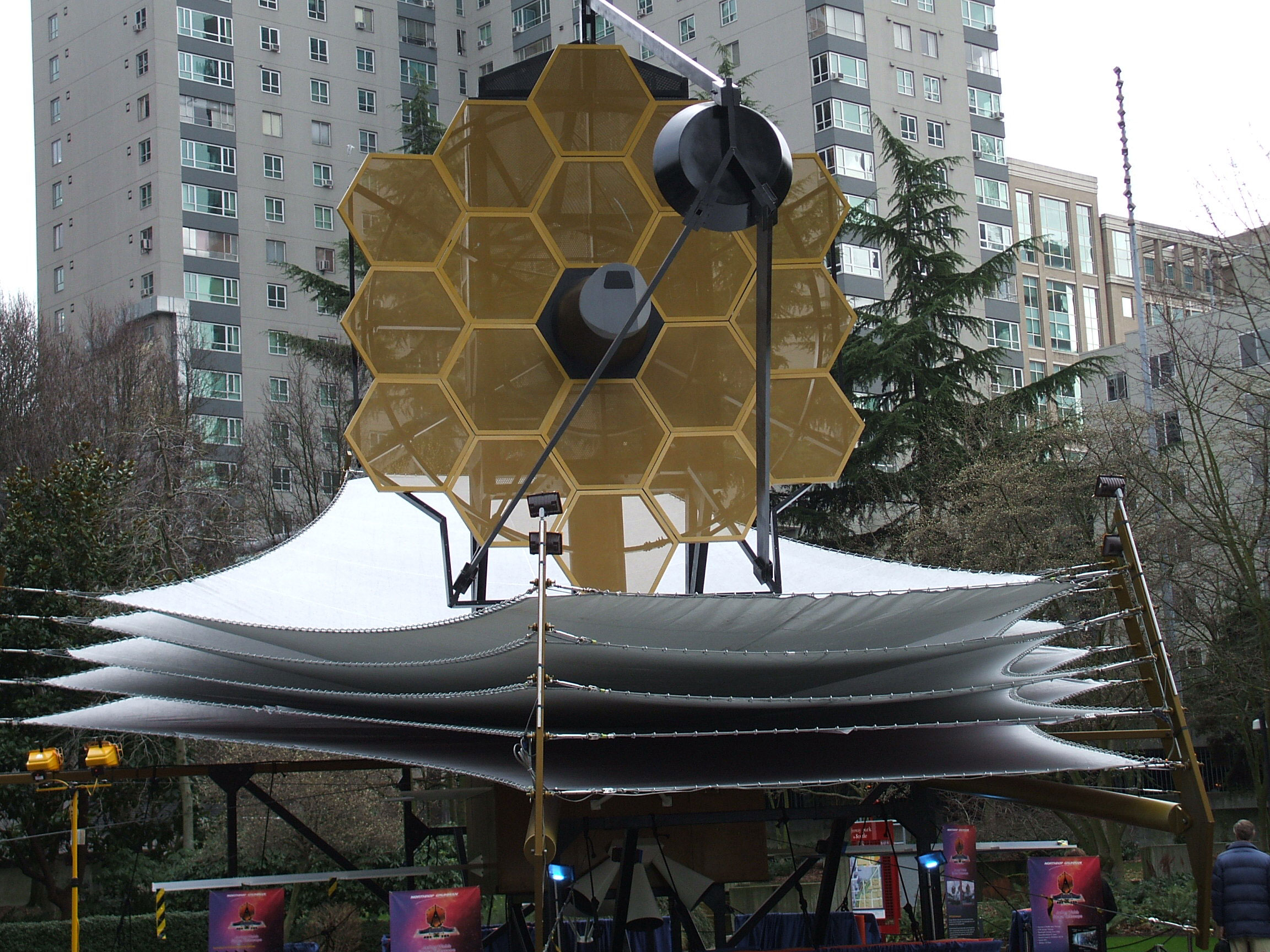
Look at the size of that thing. (Seriously, it's absolutely bloody enormous; that's a scale engineering model, with handy nearby humans for scale. Yes, those little black dots on the ground around it are humans...
Cut the chatter, Cal-3. Accelerate to attack speed!
(OK, it's no Death Star, but it does bear a pretty cool resemblance to an Imperial Star Destroyer... I like it.)
-
Re:Build It in Space
Look at the size of that thing. (Seriously, it's absolutely bloody enormous; that's a scale engineering model, with handy nearby humans for scale. Yes, those little black dots on the ground around it are humans...
-
No comment?
I had to reply to this thread, seeing only 9 hidden comments so far. That's a bit sad, since the JWST will be one of the most important science events since the Hubble. It will be an infrared telescope like the Spitzer, but it will effectively be an optical telescope for the distant universe because of red shift! And it will be able to peer into the distant past unlike any telescope prior.
In the sense of being a "space race" this is one area where the US really shines. There's no other nation that really is in the running, although there are lots of international contributions (yay Canada!). Maybe it's because of the language barrier, but I can't think of a single Russian space telescope. I can name a half dozen US scopes and one or two from the ESA. (Be sure to look up the Chandra, Fermi, Spitzer, XMM-Newton)
But then it's not really a space race, it's about science, so maybe it's a little boring for the general public. I only hope Slashdotter's are more aware that this is one of the great scientific adventures of our time.
-
Re:Whirlpool thread
This was first mentioned on Whirlpool, I was reading the thread. It appears to be deleted now however
Ironically, the Whirlpool page is still available in the google cache of the thread.
What I want to know is why the CVV numbers were there and for what merchants, as they are not supposed to be cached according to the Payment Application Data Security Standard (PA-DSS). -
Explorer troop balloonsAs I noted when the article was posted on NASAwatch, the students in Explorer post 632 at NASA Glenn also do launches of a balloon payload, to the same altitude, and including cameras, so they're also doing "DIY Space Photography" if you count 20 miles altitude as "space". And they've been doing this since 2004.
(I'll also note that they don't use NASA equipment to do this; they buy or build their own hardware).
-
Re:Somehow I doubt it
Sorry, wrong stage. From stage 1: "To keep the dynamic pressure on the vehicle below a specified level, on the order of 580 pounds per square foot (max q), the main engines are throttled down at approximately 26 seconds and throttled back up at approximately 60 seconds."
http://spaceflight.nasa.gov/shuttle/reference/shutref/events/1stage/ -
Re:Somehow I doubt it
don't they have to power down a little as they break the sound barrier?
"The main engines are throttled down at approximately seven minutes 40 seconds into the mission to maintain 3 g's for physiological and structural constraints." Space Shuttle ref manual: http://spaceflight.nasa.gov/shuttle/reference/shutref/events/2stage/ -
Re:External Tank
MECO is around 185,000 feet (35 miles).
No, that's more like the altitude at which the external tank breaks up after falling back down, according to this Shuttle reference page: Second Stage.
The same site doesn't give a clear answer to where MECO occurs, but the example given in Orbit Insertion is 80 nautical miles (148 km, 92 miles), which is definitely in space.
-
Re:External Tank
MECO is around 185,000 feet (35 miles).
No, that's more like the altitude at which the external tank breaks up after falling back down, according to this Shuttle reference page: Second Stage.
The same site doesn't give a clear answer to where MECO occurs, but the example given in Orbit Insertion is 80 nautical miles (148 km, 92 miles), which is definitely in space.
-
Re:Evolution
No not really. It simply means that the octopus has not been "challenged" by its ocean environment or catastrophe, and therefore not forced into extinction or modification.
Turn the earth into a giant snowball, and then we'll see how quickly the octopus dies out. - http://nai.nasa.gov/newsletter/03182005/#9
-
Re:Atmosphere of Venus?
I might have been living under a rock, but I never thought that the possibility of bacteria living in the atmosphere far from the ground and from most of the organisms, was a real possibility. I did a quick search and I couldn't find how high we assume that the biosphere extends at the moment, but I suspect that these bacteria are living almost isolated up there. If that is true, it opens the possibility for life in the atmosphere of Venus, and in the atmosphere of the gas giants. Some people have suggested that the latter is possible....
Also the former:
Astrobiology: the Case for Venus -
Re:Atmosphere of Venus?
-
Re:Fly-over times
NASA, surprise, surprise.
-
Re:would u fly on that bird
if you are an astronaut an the mission has been rescheduled like 3 times because of failiures on the ship would you fly on that? i wont, i guess that bird its to old to fly any more.
Yes, but NASA also has Astronuts, many of whom have been flying quite frequently.
-
Useless Discussion? Not any more!
Wow a much more useless discussion than usual. Is it 2nd or 18th mostest brightiest thingy, what about iridium flares? what about UFOs? What about that infernal Police helicopter circling overhead??
Would you like to judge for yourself? This NASA webpage has a nifty javascript that will tell you when it might be visible to you.
http://spaceflight.nasa.gov/realdata/sightings/
It's multi-platform, it's calculation intensive, it's got azimuths and elevations. Newton F'ing invented calculus for this sort of thing, but I can do it by typing in my zip code and clicking "Next Sighting." Now THAT's news for nerds! -
Re:Not the only time
NASA was still flying them, as they were, and still are as far as I know, the highest flying and fastest aircraft available. That article I linked to says the last flight was in 1999.
Incidentally, regarding lost war tech., I had always heard that the U.S. no longer has the ability to cast the shells for the large 16" guns on the iowa class battleships, I have no idea if it's true though. -
Re:babylon 5
Heh, yeah right. It never cease to amaze me how people expect rapid technological advancement, when all the historical evidence shows that most of these innovations are decades old, but the equipment wasn't available back then. I saw a photo from the first V2s sent up with a camera yesterday on NASAs site, and that was dated 1948. How long until Google Earth hit the mainstream ? 2005 ? The reason for the delay was computing power, access to images, and satellites. Satellites have changed the world in so many ways, they are part of almost everything we do. TV, telephone, data, science all rely on satellites somewhere in the chain. But in the 1960s they were ground breaking and so that 1969 film could be seen as possibly true. We had no way to determine if a planet really was diametrically opposite us in our orbit of the sun. This is the way it goes, some sci-fi is born out by scientific discoveries, and other stuff is provably impossible. This is why modern sci-fi is mostly dreck, hardly any science is left to the imagination. Back when the best sci-fi was written (due to our ignorance) it was an amazing journey into the possible. Now we're left with existential dilemmas rather than technological ones, which doesn't have the same zing on screen.
Sometimes you have to look at the way it *was*, to better appreciate the way it *is* and I fear that aspect is lacking in todays world. It seems to be all "now" and "next" and disappointment when it doesn't happen immediately. Newsflash - it never did. -
Intersting Orbit
Instead of a low Earth orbit like Hubble, Kepler is going to use an "Earth-trailing heliocentric orbit with a period of 372.5 days.": http://kepler.nasa.gov/sci/design/orbit.html
-
Working link to poll
Actual working link to NASA's poll page (the one in the summary isn't one):
http://www.nasa.gov/externalflash/name_ISS/index.html -
Re:Reliability.
a bit unrelated, but wth: when installing raised floors, take care of what they were made of, whiskers from the metal could wreck your hardware.
-
Re:More Climate Change-balls....
That may be true, but arctic sea ice extent is not a function of the minor movements one way or another of atmospheric temperatures. How can it be, it's so far below freezing any small increase will have little effect.
Arctic sea ice is more regulated by variable atmospheric perturbations and oceanic currents (the "Arctic Oscillation"). Even NASA have said that "not all the large changes seen in Arctic climate in recent years are a result of long-term trends associated with global warming" (NASA) and NASA host the activist Scientist and serial statistics abuser James Hansen. -
Re:Where did it go?
Ok, I'll bite.
Someone else pointed out this site, I'll post the link and pull some references from it:
http://science.nasa.gov/headlines/y2001/ast31jan_1.htm
Where did it go?
"New evidence from NASA's Mars Global Surveyor (MGS) spacecraft supports a long-held suspicion that much of the Red Planet's atmosphere was simply blown away -- by the solar wind."
So... according to NASA, Mars has been screwed for about 4 billion years:
"How do scientists know when the dynamo turned off? "Mars has been kind to us," explains Mitchell. "There are two large impact basins, Hellas and Argyre, about four billion years old that are demagnetized. If the dynamo was still operating when those impact features formed, the crust would have re-magnetized as they cooled. The dynamo must have stopped before then.""
According to the following link, life started on earth 3.8 billion years ago:
http://en.wikipedia.org/wiki/Timeline_of_evolution
According to the following link our solar system is about 4.6 billion years old:
http://www.universetoday.com/guide-to-space/the-solar-system/how-old-is-the-solar-system/
So... this gives Mars approximately 600 million years to come up with "some" form of life before its magnetosphere stopped working (because after that, the environment probably became very inhospitable). Considering it took earth 2.2 billion years to create life... we are gambling that Mars had life sooner than Earth?
Would it even be possible for a planet to have life on it within 500 million years of its creation? From what I understand, Earth was awfully uninhabitable to life in its first billion years (fire and brimstone kinda stuff, Venus like). Why would Mars be any different?
-
Re:Where did it go?
Those are all speculations, the truth is that we don't really know why Mars dynamo stopped working.
According to this article:
Earth's global magnetic field comes from an active dynamo -- that is, circulating currents at the planet's liquid metallic core. A similar dynamo once churned inside Mars, but for reasons unknown it stopped working four billion years ago.
Given that the Solar System has an estimated age of 4.6 billion years, Mars dynamo stopped very early, thus the reasons you listed aren't enough to explain it. -
Re:That's no moon... it's target practice
Well, if they're doing target practice, they stole our plans and got a cheap knockoff "moon impactor weapon" out before we did:
Ours will make bigger splash. Potentially visible to the naked eye (or at least binoculars) type splash.
-
Actual bushfire science from September 2007
By the Bushfire CRC and the CSIRO:
http://www.bushfirecrc.com/research/downloads/climate-institute-report-september-2007.pdfFrom the concluding remarks:
"In this study, the potential impact of climate change on southeast Australia is estimated. Simulations from two CSIRO climate models using two greenhouse gas and aerosol emissions scenarios are combined with historical weather observations to assess the changes to fire weather expected by 2020 and 2050. In general, fire weather conditions are expected to worsen.
The number of "extreme" fire danger days generally increases 5-25% for the low scenarios and 15-65% for the high scenarios. By 2050, the increases are generally 10-50% in the low scenarios and 100-300% for the high scenarios. The seasons are likely to become longer, starting
earlier in the year.
These results are placed in the context of the current climate and its tendencies. During the last several years in southeast Australia, including the 2006-07 season, particularly severe fire weather conditions have been observed. In many cases, the conditions far exceed the projections in the high scenarios of 2050. Are the models (or our methodology) too conservative or is some other factor at work?"Add to this, the fact that the place is tinder dry precisely because of the preceding 12 years of extreme drought AND the cutbacks to brush clearing and back-burning ("green" policies are an excuse for councils and state governments spending less $$$ - just like every other service they've cut), and you've got the "perfect (fire) storm" conditions we had on Black Saturday.
Given that climate change isn't going away, and that all the models indicate SE Australia will get drier and hotter, and given that governments aren't going to be increasing spending in this area any time soon (OK - maybe they'll be shamed into doing something for a couple of years before the new programmes get cut back again), it is HIGHLY LIKELY that this sort of thing will become a frequent occurrence (say every 2-3 years somewhere in SA, VIC, NSW).
By the way, NASA have a fantastic pic showing how anomalous the heatwave leading up to Black Saturday was against recent summer averages:
http://earthobservatory.nasa.gov/IOTD/view.php?id=36900Of course, while we were burning down south, the banana benders up north were setting new records for floods.
-
What a politically loaded question.
1. [strike]Global warming[/strike] Climate change is not a fact. It's a theory. A bad one at that since it does not predict the current climate much less the near and far future and is not consistent with the data.
2. Climate change is now the fad since earth is not warming globally anymore. In fact, the ocean has been cooling since 2003 and the ice in the Arctic sea is now back at the same level as in 1979 and Alaskan Sea Glaciers are advancing for the first time in 250 years. Hey, those AGW fanatics are now shifting the goal post and make those facts proof of a climate change.
3. Bushes and forests have been burning since the dawn of time. The Australian fire was more fierce due to the idiots who "protected the environment" by banning clearing of vegetation.
Sydney Mornding Herald:
Last week angry fire survivors in Victoria pointed the finger at local authorities who prevented clearing of vegetation. At a public meeting in Arthurs Creek, Warwick Spooner, who lost his mother and brother in the Strathewen fire, stood up criticise the Nillumbik council."We've lost two people in my family because you dickheads won't cut trees down." Then of course, there is Liam Sheahan, the Reedy Creek home owner whose house is the only one in a two-kilometre area which survived the fires. In 2004 he was fined $50,000 for removing 247 trees around his hilltop house to protect it from fire. His two-year court battle against the Mitchell Shire Council cost him $50,000 in legal fees.
-
Re:Good To See Grownups In Charge
"Why does no one care about ISS or a permanent moon base? Are they inherently dullsville, or has the space science community done a lousy job selling itself to the public?"
Because we have shorted the incredible potential of robotic exploration in the pointless rush to send meat tourists into space. Meat explorers were cost-effective on Earth because we could afford to expend many men and many ships, and in those days it was accepted that many of them would not come back.
Now we can explore and learn from afar, and the development of better and better robots is of more value then sending fixed-capability meat tourists on short trips in transport systems that cannot rapidly evolve due to overwhelming crew safety considerations!
We can wait a hundred years to send tourists, meanwhile sending out many cheap probes which we do not need to get back. We should evolve our tech so far that we don't need people on the spot anywhere for anything.
Have some Voyager, and consider how many, MANY more such we could launch if we weren't jerking off sending tourists into Earth orbit:
-
Re:Been there, done that.
Good points but either way my ass is covered
The picture is of Cernan but if you look carefully you can see the reflection of Schmitt in the center of his visor. -
Surveyor 3
Surveyor 3 recorded a fuzzy image of an eclipse from the lunar surface in 1967.
http://science.nasa.gov/headlines/y2009/25feb_kaguyaeclipse.htm
-
Re:POV changes, name doesn't.
(posted AC because i've already moderated in this discussion)
You may be right; there was a lunar eclipse on Feb 9 2009 (see http://eclipse.gsfc.nasa.gov/OH/OH2009.html and other sources). In fact, TFM is headlined "...Earth at the Time of a Penumbral Lunar Eclipse...", so this is an error on the part of Slashdot.
It makes sense to call it a solar eclipse, from the moon's POV, because it's the sun being eclipsed there. But thinking about it geometrically, I don't think there's a case where a solar-eclipse-from-the-moon occurs when there's not a lunar-eclipse-from-the-earth. Since the event can be observed from both places, it makes more sense to name it according to where most observers are.
-
Re:even better
Slightly older, also showing an eclipse and the earth, but taken from the shadow of saturn is this Astronomy picture of the day.
-
Conspiracies-R-Us...
Apollo 12 went through a solar eclipse on the way back from the Moon, shortly after leaving Lunar Orbit.
Yeah, and we almost had it on video too, until some moron opened the emergency exit door on the lunar studio and ruined the whole shoot...
-
Apollo 12 saw this first
Apollo 12 went through a solar eclipse on the way back from the Moon, shortly after leaving Lunar Orbit.
-
Re:Nice antenostication there, guys
You're right:
http://ssd.jpl.nasa.gov/sbdb.cgi?ID=dK07N030;orb=1;cov=0;log=0#orbThe commet will still be near Earth, but it is already saying goodbye.
-
NASA on TwitterIt's kind of weird, interesting, and depressing to watch this history be made through NASA's Twitter updates:
- The countdown has begun in California for the launch of NASA's Orbiting Carbon Observatory in less than 1 hour. The stars are out tonight!
- Orbiting Carbon Observatory (OCO) update: Weather is perfect for launch in less than half an hour.
- OCO launch update: Liftoff is now set for 4:55 EST. Catch it on www.nasa.gov/ntv
- OCO launch update: WE HAVE LIFTOFF!
- OCO launch update: We have Stage 3 ignition. The mission is off to a great start!
- OCO launch update: We have a mission failure. Press briefing to be held at Vandenberg in approximately 2 hours.