Slashdot Mirror
Domain: nature.com
Stories and comments across the archive that link to nature.com.
Comments · 2,953
-
Re:BS
But, this article is about a single, uniform, unchanging temperature that is slated to be 'perfect' for everyone.
But the original article, which the posted article was based on, was not.
-
Re:Proposed solution is more sexist
I'd also be interested in where this data comes from.
TFA linked in TFS is not so great, but it does contain a link to the original article original article which is more informative.
-
Re:What did friday come late or early ?
no matter how many times you say, it still wont be true.
Ironic considering your signature
http://www.nature.com/scitable...
Current evidence suggests that that the concentrations of atmospheric CO2 predicted for the year 2100 will have major implications for plant physiology and growth. Under elevated CO2 most plant species show higher rates of photosynthesis, increased growth, decreased water use
Just how many ways do people need to point out to you that you are lying ?
-
Re:So 30% of 4% is 1.2%. What is attractive here?
Well, how else should the propaganda artists fallaciously link climate change with the eating of meat? They want us all to be eating insects someday, after all. Of course, by 'all' they mean us commoners. I am sure the wealthy elite ruling class will still have their steak, regardless of party and regardless of country.
Last century, we tried the national socialist we're-better-than-everyone-else tact to cajole people into slavery. Now we're going for the self-loathing, guilt tripping INTERnational socialism that replaces educated, intelligent, successful and free societies with masses of uneducated, easily indoctrinated, socially dependent, easily enslaved immigrants! Hurrah Comrades! Now eat your mealworms and like it. Those who resist must check their privilege.
http://www.washingtonpost.com/...
http://www.nature.com/scitable...
http://www.newsweek.com/why-en...
etc ad nauseum -
Re:Dangerous power
Unorthodox treatments are being developed, however. One of the new/experimental treatments for bipolar is ketamine (yes, the same anesthetic commonly used recreationally as a dissociative). It's particularly useful for helping with treatment-refractory depressive phases in bipolar patients, while not making the manic phases any worse. There are a few papers; here's one: http://www.nature.com/tp/journ... There are also recent and ongoing studies using psylocybin (magic mushrooms) to treat major depression and PTSD, as well as at least one study treating PTSD with MDMA (Ecstasy). The interesting thing about these approaches is not that they're also recreational drugs, but that there is indication that these are not indefinite supportive treatments but something more akin to a cure. In the case of psylocybin, specifically, a Johns Hopkins study showed that a single dose in a therapeutic setting can bring on permanent positive personality changes.
-
Re:This legislation brought to you by..
This mixing of genes between completely different plants or plants and bacteria is actually quite common in nature. For example, take the sweet potato, which contains bacterial genes naturally.
See http://www.nature.com/nature/j...
http://www.npr.org/sections/go... -
Re: WHAT radioactive materials?
Laser initiated fusion works just fine. It's just not net energy positive. But you don't need it to be when you're just using it as a neutron source. The fission reaction it kicks off is enthusiastically energy positive.
For some extremely unusual definitions of "fine" perhaps. At least it exists, which may be the very low bar you are setting for "fine".
This paper reports on the current state of the art of laser initiated fusion. The accomplishment was to get slightly more energy (about 14 kJ) out the D-T fuel (~30% more) that was deposited in the fuel itself. This was less than 1/10 the laser beam energy delivered to the capsule though (150 kJ).
Although fission, produced by a fusion neutron, produces more energy than the fusion reaction itself, the ratio is about 17-fold, which just barely compensates for the current low yield relative to the laser pulse. Meanwhile the best available lasers for this type (ultra-short tailored pulses) are 0.5% efficient, and the ability to convert fission heat into electricity to drive the laser in the aircraft would be on the order of 10%, and then we need this system to perform at much larger than system break-even levels to drive an actual aircraft. Fusion energy schemes typically assume a yield advantage larger than 10-1 (usually 100-1) to make the system a viable energy producer. So we are short by a factor of 100,000 or so in terms of system capability (fusion explosion round trip back to laser pulse generation) to support the concept. There are plans to upgrade the laser using diode pumps, which should improve its efficiency by a factor of 6, which helps, but that hardly puts a major dent in the short fall.
Oh, and the laser currently is as large as a sports stadium, and can only fire a few shots a day, instead of hundreds per second (a 1,000,000-1 repetition rate shortfall) and the fusion target is made out of gold and costs $10,000 per shot (the amortized cost per shot given the cost of the whole facility to do it is on the order of a million dollars). Factoring in the enormous decrease in target costs (factor of 100,000 say) and size of the laser (lets say a factor of 10,000 to fly it), we are looking at a figure-of-merit short fall of something like 20 orders of magnitude to turn the concept into reality. But other than that laser fusion works just fine.
-
Re:Let me guess.
Increases in CO2 will cause lower yields for our staple crops, meaning more will have to be planted to maintain the supply.
Basic biology tells you that that is implausible, and experimental data contradicts what you are saying.
http://www.sciencedirect.com/s...
Probable effects of increasing global atmospheric CO2 concentration on crop yield, crop water use, and world climate are discussed. About 430 observations of the yields of 37 plant species grown with CO2 enrichment were extracted from the literature and analyzed. CO2 enrichment increased agricultural weight yields by an 36%. Additional analysis of 81 experiments which had controlled CO2 concentrations showed that yields will probably increase by 33% with a doubling of atmospheric CO2 concentration. Another 46 observations of the effects of CO2 enrichment on transpiration were extracted and averaged. These data showed that a doubling of CO2 concentration could reduce transpiration by 34%, which combined with the yield increase, indicates that water use efficiency may double.
http://www.nature.com/srep/201...
We evaluated how soybean yields have been enhanced by historical atmospheric [CO2] increases in three major soybean-producing countries. The estimated average yields during 2002–2006 in the USA, Brazil, and China were 4.34%, 7.57%, and 5.10% larger, respectively, than the average yields estimated using the atmospheric [CO2] of 1980.
We will lose a lot more than coral.
Yes we will.
I love how you put "mitigation and migration" in there as if they would take an afternoon's work to sort out.
No, they will take centuries to "sort out". But that's OK because climate change takes centuries and because humans tend not to even notice change on the scale of centuries.
You really are not too interested in being accurate, are you?
It is impossible to "be accurate" about the effects of climate change. Anybody who pretends to be able to "be accurate" about the effects of climate change a charlatan and a liar.
-
Re:Proxy studies- still no correlation [Re:Little
So, what you're now saying is that the little ice age is not due to the Maunder minimum, but you're hypothesizing that it might have been due to some other sunspot minimum for which we have only proxy data.
No, I'm saying that we have some evidence that the Little Ice Age (Wikipedia indicates this should be capitalized) was contemporary with unusually low solar output over a span of time including the Maunder minimum (up to the weaker Dalton minimum which included the Tambora eruption in 1815). That would be necessary for an actual cause and effect between reduced solar output and a cooler climate.
Further, sunspot minimums do appear to correlate with reduced solar output, so it is possible that there were a series of several such episodes over those centuries in question and that they caused the cooler climate of the Little Ice Age in the first place.(1) proxy data on solar activity is somewhat harder to interpret
Than what? Sure, proxy data for solar output is much harder to interpret than direct observation. But nothing back then was directly observed. It's all proxies.
(2) nobody looking at the record of proxy reconstruction has been able to find a firm correlation to global climate (although there are some regional climate correlations),
Well, maybe they have and they're just choosing not to interpret it that way. I don't buy that our temperature proxies are good enough to determine the difference between regional and global climate once you get beyond the 19th century - especially given what I see as significant ideological and institutional biases towards exaggerating the effects of anthropogenic global warming. Downplaying global effects of solar output over the past millennium (especially during both the Little Ice Age and the Medieval Warm Period) would be consistent with that.
(3) there still isn't any accepted mechanism connecting sunspot number to climate,
For the solar activity of the past couple of centuries, higher sunspot number corresponded to a slightly brighter and hotter Sun (the lower output of sunspots is countered by the brighter regions around the sunspots). Even if there is no other effect than to reduce solar output for a few decades to the level of solar output between sunspot cycles, that's still half a watt less per square meter which is about a third to half the heating thought to be contributed from carbon dioxide.
All of the scientists doing the actual studies of this sort say the effects seen are far too small to explain the current warming trend: see, for example Solanki et al. 2004 study of sunspot numbers over the past 11,000 years and climate: http://www.nature.com/nature/j... "we point out that solar variability is unlikely to have been the dominant cause of the strong warming during the past three decades", or the review of dozens of studies here: http://www.skepticalscience.co...
I couldn't help but notice that the study you linked to concludes that the Sun is at an exceptionally high level of activity compared to the past 11,400 years.
We find that during the past 11,400 years the Sun spent only of the order of 10% of the time at a similarly high level of magnetic activity and almost all of the earlier high-activity periods were shorter than the present episode. Although the rarity of the current episode of high average sunspot numbers may indicate that the Sun has contributed to the unusual climate change during the twentieth century, we point out that solar variability is unlikely to have been the dominant cause of the strong warming during the past three decades.
I'm a lukewarmist, I believe there is some effect. But this is a huge factor to downplay.
-
Proxy studies- still no correlation [Re:Little ...
And when you dismiss all data that doesn't agree with you-- which is what you're doing-- then it is completely impossible to ever overturn your conspiracy theory that all the science ever done on climate happens to be wrong.
Let me also note that apparently, it is possible to observe solar activity prior to direct observation by measuring carbon 14 in tree rings as a proxy. As a result, it is claimed that there were other periods of lowered solar activity from about 1000 AD through to the Maunder minimum.
So, what you're now saying is that the little ice age is not due to the Maunder minimum, but you're hypothesizing that it might have been due to some other sunspot minimum for which we have only proxy data.
Unfortunately,
(1) proxy data on solar activity is somewhat harder to interpret (see, for example, review article here: http://solarphysics.livingrevi... )
(2) nobody looking at the record of proxy reconstruction has been able to find a firm correlation to global climate (although there are some regional climate correlations),
(3) there still isn't any accepted mechanism connecting sunspot number to climate,For example, there were periods of alleged reduced solar activity between 1280 and 1350 and between 1460 and 1550.
This analysis looks like you have a result you want, and you're going back through the data trying to select data to try to fit the result. If this were actual science, you would need a correlation coefficient. How well does the variation in (proxies for) sunspot number fit the variation in (proxies for) climate?
All of the scientists doing the actual studies of this sort say the effects seen are far too small to explain the current warming trend: see, for example Solanki et al. 2004 study of sunspot numbers over the past 11,000 years and climate: http://www.nature.com/nature/j... "we point out that solar variability is unlikely to have been the dominant cause of the strong warming during the past three decades", or the review of dozens of studies here: http://www.skepticalscience.co...
But, returning to the topic, we seem to agree: the little ice age cannot be attributed to the Maunder minimum.
-
More BS
Yea, global warming. It has not thing to do with the neoniconoids http://www.nature.com/nature/j... . So now we're willing to kill our bees on the global warming alter? What a load of crap. As if bees can't take change. They live from the equator all the way up to the arctic circle.
Don't believe it. More man made global warming BS. Yes, we are warming up. Check out Venice in the 1300s, the Adriatic was coming in way back then. No man made GW back then - obviously. None now. Just a way to take money from all of us and give it to guys like Al Gore and Maurice Strong.
-
Not news
This is at least a bit over a year old.
Nature had a good publication on this a bit (same research group) over a year ago.
http://www.nature.com/news/fir... -
Re: Coral dies all the time
As to the added effect of CO2, you'll still talking about a very thin spectrum of the EM band and I've found nothing to suggest that that band is special in anyway.
Also, I've found some indication that this notion of heat trapping assumes a vacuum between the lower atmosphere and the upper atmosphere. Because after all, heat can move freely through the atmosphere simply by one gas touching another.
Lets say I had something that was hot... and I put that hot thing in a transparent bubble of CO2... are you suggesting that the hot thing would cool off or lose its heat more slowly than if the bubble were filled with nitrogen or oxygen or helium? Because I don't think that matters.
I mean, what we're really talking about here is light captured from the sun rays reflecting off the earth and being turned into heat before they can be make it out of the atmosphere. Right?
How much of the Earth's reflectivity is even in that spectrum in the first place? Because we're not talking about sunlight at that point. We're talking about Earth light.... like moonlight... just whatever the earth emits when the sun shines on it.
So we're looking at very narrow spectrum... how much of the earth's reflected light is even in that band? how much energy are we talking about?
And if some significant amount of energy is turned into heat by CO2... it would seem that the heat could just work its way through the atmosphere to emit into space. I saw several people complaining about the way this issue is discussed talking about how the treatment of this heat trapping effect assumes a vacuum between the lower atmosphere and the upper atmosphere. I think I cited the scientific term for the effect in play before. I can do it again.
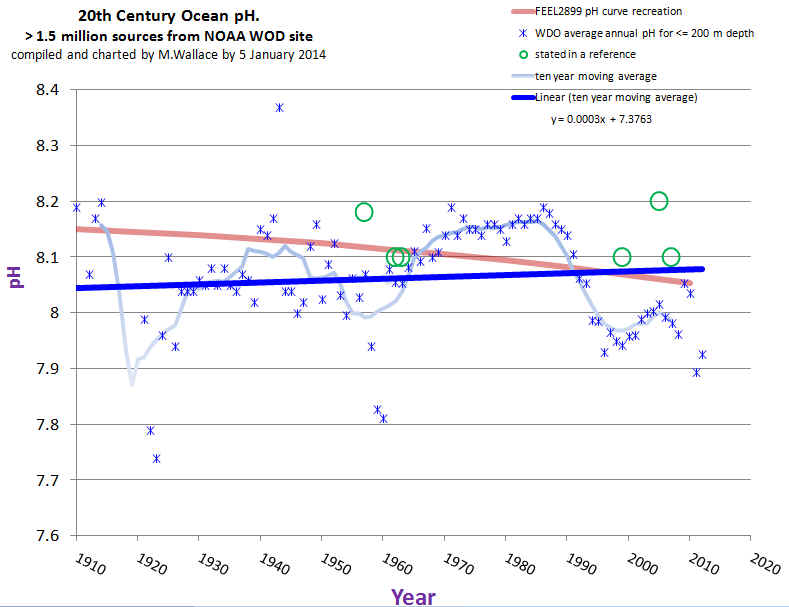
As to Ocean acidification, I'm not sure about that as well. Apparently only records since 1988 are considered valid and if you look at record that go back an additional 60 years you don't see the same trend line. The data before that is not counted apparently because it isn't considered accurate. But absent a longer trend line I don't know if you can claim what is and is not the ocean's baseline.
Would you mind citing an ocean acidification graph that goes back more than 20 years? Ideally as far back as possible.
Here is one thing I found that is sort of interesting to me anyway:
http://www.abeqas.com/wp-conte...I'm actually downloading the data he's citing from the NOAA. There is a site I didn't know about where any jerk can query data from an automated system. It apparently takes hours for the data to be pulled. So I'll wait for the email and then I'll have a download link for some giant excel files.
This is a thing I see a lot... cherry picking the beginning of trend. So if you back out you'll see some graph that shoots up and down and up and down all over the place. But the graph as cited in many contexts will start at some arbitrary year that perfectly allows them to show a clean linear trend line that would be unsupportable if you showed a slightly longer time scale and noticed that before going up or down it was going down or up by some equal measure.
I feel more comfortable with longer trend lines.
As to how heat leaves our atmosphere, the CO2 isn't in the upper atmosphere pretty much at all. So... I don't know why you're saying the CO2 is relevant up there. If the heat is transferred to the upper atmosphere then its going to emit it the same way it always did. The CO2 isn't even up there. Just like the water vapor, the CO2 is mostly concentrated in the lower atmosphere.
As to this energy budget thing... this is interesting:
http://www.nature.com/ngeo/jou...Examine figure 1...
I mean... when your margin of error exceed your value... you bas
-
Re:That is not necessarily true
http://www.theguardian.com/com...
http://www.nature.com/news/why...
http://www.cnn.com/2015/03/18/...
http://www.mirror.co.uk/news/a...
http://www.businessinsider.com...
http://www.mysterypollster.com...
http://www.examiner.com/articl...
http://blogs.lse.ac.uk/general...
http://www.outsidethebeltway.c...
http://nautil.us/blog/why-were...
http://www.nytimes.com/2014/07...
http://articles.economictimes....
First few links from the search engine typing in "why are election polls often wrong"...
http://www.bbc.com/news/uk-pol...
http://time.com/3558932/pollin...
http://www.huffingtonpost.co.u...
http://www.cnn.com/2015/05/08/...
http://www.kansas.com/news/loc...
Shut up. Just close your stupid mouth. Sit down. And don't speak again until addressed. You're an idiot. It has been officially noticed.
-
Re:Critical Thinking FAIL
I didn't just cite one source, half wit.
I cited a lot of things. And mostly recently I cited a peer reviewed paper.
Choke on it.
Did you say check on it? OK! Here's a complete list (as of this writing) of your citations in this thread in chronological order:
https://www.youtube.com/watch?v=yvfAtIJbatg (no mention of the Cook paper)
http://www.populartechnology.n... (Site is a one man operation that doesn't identify the operator or his alleged "staff". Attempts to debunk Cook paper by cherry-picking results from a nebulous survey.)
http://www.nature.com/news/pub... (no mention of the Cook paper)
http://www.washingtonpost.com/... (no mention of the Cook paper)
http://articles.mercola.com/si... (no mention of the Cook paper)
http://arstechnica.com/science... (no mention of the Cook paper)
http://www.the-scientist.com/?... (no mention of the Cook paper)
http://www.nytimes.com/2013/04... (no mention of the Cook paper)
http://www.forbes.com/sites/ja... (opinion piece written by a lawyer (who doesn't appear to have ever practiced law) who claims to be a "trained scientist". The article relies exclusively on research done by unnamed "investigative journalists" at populartechnology.com - a blog that by all appearances is operated by a single unidentified individual.)
http://wattsupwiththat.com/201... (first mention of a legitimate source rebutting the Cook paper)
http://link.springer.com/artic... (legitimate source debunking Cook)So what have we got here...looks like a bunch of citations that have nothing to do with the Cook paper, one citation from a clearly bogus website, One citation written by a hack lawyer relying exclusively on the aforementioned bogus website, one citation from a pop-sci website alluding to an authoritative source, and (finally) a citation pointing to a legitimate source. And guess what? I've recognized your final source's potential legitimacy multiple times. You should probably take that as a win and call it a day.
In any event, don't you think you could've saved yourself a lot of time, effort, aggravation and ridicule if you'd have just kept your mouth shut until you actually come across a legitimate source? Instead, your process (if you can call it that) of supporting your arguments is to link to sources that you haven't subjected to any scrutiny whatsoever. It's a textbook example of a lack of critical thinking skills.
As to your claim that there is only one peer reviewed paper refuting your peer reviewed paper...
You're making things up again. I made no such claim. And for the last time, Cook's paper isn't MY paper. The only time I addressed it's validity I expressed skepticism of it's conclusions. Since you're having trouble remembering, here, let me help you:
"To be honest, I
-
Re: Coral dies all the time
And yet it happened:
http://www.forbes.com/sites/ja...Also this notion that peer review catches all frauds is laughable:
http://www.nature.com/news/pub...http://www.washingtonpost.com/...
http://articles.mercola.com/si...
http://arstechnica.com/science...
http://www.the-scientist.com/?...
http://www.nytimes.com/2013/04...
As to your point about reading the abstracts. That's not enough. You need to actually have the study itself vetted. And peer review does not do that.
These studies are getting busted all the time for making things up or using really sloppy methodology that could be "interpreted" to mean anything... often transparently the author had a conclusion they wanted before even starting the study.
That isn't real science. That's what creationists do. You have to do your study with an open mind and accept whatever the study might say. No forming your theory before the data comes in and no shaping the data to fit your theory. It is FINE to have a hypothesis before you start the study. But it can't go beyond that until you've actually got the data in... and then you base the theory on the data... you do not shape the data to equal your hypothesis.
And that is frequently what is going on.
-
Re:My BrainYou know that dream you had about being at work and logging into your admin system? Well... http://www.nature.com/news/sci...
Using auditory clues to induce dreams about a given topic is not impossible, and if the visual cortex activity can be decoded the simpler motor cortex that plays back your typing movements during password entry could also be decoded.
Your brain is hackable, with tools other than an axe.
-
Re:The Dark Age returns
Scientists believe things all the time. How could you possibly say otherwise?
Here is a sampling peer-reviewed scientific papers where scientists state what they believe. All I did was search Google Scholar for "we believe".
"We believe that these carcinogens have in common a ring system sufficiently planar for a stacking interaction with DNA base pairs and a part of the molecule capable of being metabolized to a reactive group: these structural features are discussed in terms of the theory of frameshift mutagenesis." http://www.pnas.org/content/70...
"We believe these data thus demonstrate unambiguously that carboxyl groups are exposed at the ends of nanotube tips, and that these groups can be covalently modified to produce probes with very distinct chemical functionalities." http://www.nature.com/nature/j...
"We believe that the material which gives the X-ray diagrams is the salt, not the free acid." http://www.nature.com/physics/...
I really like that last one. Watson and Crick weren't scientists when they had that paper published?
-
Re:The Dark Age returns
Scientists believe things all the time. How could you possibly say otherwise?
Here is a sampling peer-reviewed scientific papers where scientists state what they believe. All I did was search Google Scholar for "we believe".
"We believe that these carcinogens have in common a ring system sufficiently planar for a stacking interaction with DNA base pairs and a part of the molecule capable of being metabolized to a reactive group: these structural features are discussed in terms of the theory of frameshift mutagenesis." http://www.pnas.org/content/70...
"We believe these data thus demonstrate unambiguously that carboxyl groups are exposed at the ends of nanotube tips, and that these groups can be covalently modified to produce probes with very distinct chemical functionalities." http://www.nature.com/nature/j...
"We believe that the material which gives the X-ray diagrams is the salt, not the free acid." http://www.nature.com/physics/...
I really like that last one. Watson and Crick weren't scientists when they had that paper published?
-
inbreeding beneficial?
From TFA summary:
Dr Warren Booth, an evolutionary biologist at the University of Tulsa, who previously discovered an instance of parthenogenesis in snakes, said: "This is basically a very extreme form of inbreeding. Most people think of inbreeding as bad, but it could be helpful in purging deleterious mutations from a population."
Most people think of inbreeding as bad, because it almost always is bad. Inbreeding depression is a very well documented, and well understood, phenomenon that can increase the extinction risk of critically endangered species. The idea that inbreeding can somehow be "helpful in purging deleterious mutations" has been discussed before, but a recent study found that even if small (e.g., endangered) populations are actively managed to control both inbreeding and outbreeding, the negative effects of inbreeding depression generally outweigh the benefits of removing harmful alleles. And that is a best case scenario, with reproduction carefully controlled to produce an optimal genetic outcome, which obviously does not happen naturally.
For these sawfish, asexual reproduction is most likely a desperation strategy used when the population has gotten so small that it is difficult or impossible to find mates. It is extremely unlikely that it will somehow improve the population's genetic fitness; more likely, it will lead to further decreases in genetic diversity and a corresponding loss of overall fitness.
-
Re:I predict nothing will come of this
So far the treatments of tinnitus have been effective, but with a few caveats (as with all medical interventions).
Here is the original animal study regarding tinnitus: http://www.nature.com/nature/j...
And a review paper: http://www.sciencedirect.com/s...
Here is a clinical trial that happened: http://onlinelibrary.wiley.com...
And another clinical case study: http://journals.lww.com/otolog...
And here is a clinical trial currently happening: https://clinicaltrials.gov/ct2...To sum up the clinical trial that has already been published: researchers found that VNS did improve tinnitus, but only in patients that were not on drugs that affected neuromodulators such as acetylcholine and norepinephrine.
-
Re:Editorial incompetence strikes again!
The device footprint is 2.8x2.8m2
The actual measurement, from TFA, is 2.8x2.8 square micrometers.
Yes, it is square MICRO-meters - (1 micro-meter = 1/1000000 of a meter; ~0.00004 of an inch, for our friends in USA who... but, don't get me started... just adopt the damn metric, you... you...!)
Apparently timothy is too busy burying unflattering stories about his employer to bother reading what he's posting to the front page.
Is it true "timothy"? Well, shame on you - not so much for failing to understand the metric system (or is it just because this site is not able yet to display unicode? The micrometer use the Greek "m" before the Latin "m"...), but because you bury a story with NEWS FOR NERDS, THINGS THAT MATTERS...
-
Editorial incompetence strikes again!
The device footprint is 2.8x2.8m2
The actual measurement, from TFA, is 2.8x2.8 square micrometers.
Apparently timothy is too busy burying unflattering stories about his employer to bother reading what he's posting to the front page.
-
Xenharmonism
The most urgent deficiency in most music software and the MIDI protocol itself is the fixation on the 12-TET scale.
The new MIDI HD protocol fixes this issue with its "Direct Pitch" feature that lets you define arbitrary notes.
However most composing software still offers no practical way to edit music in other scales.https://www.youtube.com/watch?...
https://www.youtube.com/watch?...It's time for music to evolve. The grim reality however is that popular music has been getting more bland for the last 50 years:
http://www.nature.com/srep/201... -
Re:Maybe science went off the rails...
I don't suppose you even looked at the author of the article you linked?
Yes I have. I don't suppose you've even looked at the contents ?
I did in fact, I even suffered through Mann's own angry blog post. Did you read just his blog post, or did you read the actual published discussion by the authors and publishers as well? If you did, it seems pretty clear the complaints against McShane and Wyner don't substantially refute any of their main criticisms. Might want to read the journals and discussion and not just Mann's own editorializing on his blog.
ALL his methods systematically underestimate recent warming.
That has been well known for a long time.
If you notice the trend, of Manns peers and Mann himself is to repeatedly republishing more and more moderated versions of his original extreme results as his original work is put in check.
The results from the 2013 PAGES 2k Consortium research still look very much the same as the original Mann graph.
http://www.nature.com/ngeo/jou...Funny, they don't look anything like Mann's original graph to me. If you view the full article the 30 yea weight means since 1900 are matched for a large portion of the time from 1AD through 1000AD.
-
Re:Maybe science went off the rails...
I don't suppose you even looked at the author of the article you linked?
Yes I have. I don't suppose you've even looked at the contents ?
ALL his methods systematically underestimate recent warming.
That has been well known for a long time.
If you notice the trend, of Manns peers and Mann himself is to repeatedly republishing more and more moderated versions of his original extreme results as his original work is put in check.
The results from the 2013 PAGES 2k Consortium research still look very much the same as the original Mann graph.
http://www.nature.com/ngeo/jou... -
Re: Why not just kill them all?
Slash dot ate the Nature link. It's here: http://www.nature.com/news/201...
-
Re:Any materialized predictions? (Re:Sudden?)
they predicted that Antarctic sea ice would increase in a warming world
But they DIDN'T predict growing sea ice in a world that is NOT warming, did they? [Jane Q. Public, 2015-05-22]
Good grief, Jane. They also didn't predict growing sea ice in a world that's infested with leprechauns. But neither of those silly objections are relevant, because the real world is warming. Remember?
"We know the Earth is warming, you idiot. That's not the issue here." [Lonny Eachus, 2010-07-01]
Since these conditions are not the conditions presumed in the model, in fact they have not predicted anything. You are just a master at inappropriately shifting contexts, as I have pointed out many time. You don't get to say that they predicted a result given THESE conditions, then say the same result under OTHER conditions constitutes a "prediction". Especially given the uncertainties involved. That's bullshit. [Jane Q. Public, 2015-05-22]
Nonsense, Jane. Manabe et al. 1991 predicted that increasing atmospheric CO2 warms the planet and causes a slight increase in Antarctic sea ice. This certainly constitutes a prediction because these conditions are happening. After all, as you've said, nobody is denying it's warming.
The next time you want to keep ignoring the predictions of Manabe et al. 1991 and all these other confirmed predictions, it might be more honest to just say that you reject all those confirmed predictions, rather than trying to pretend that they never happened.
You aren't using "all the available data". Once again, you are using the data that is convenient to you.
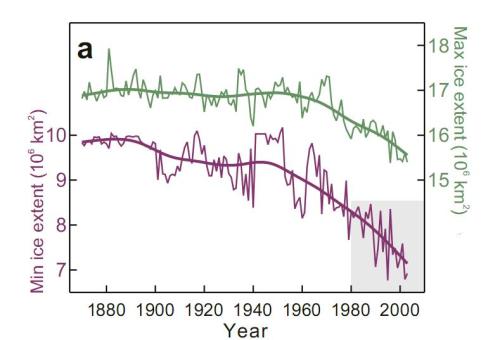
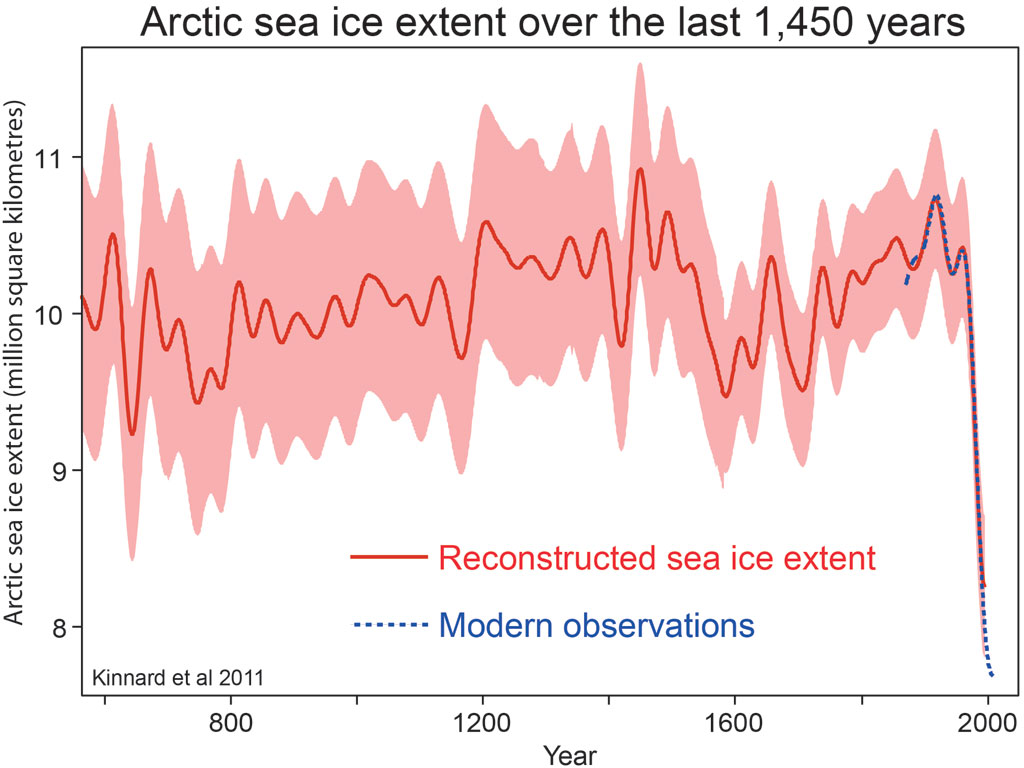
That's absurd, Jane. I've repeatedly linked to Polyak et al. 2010 and Kinnard et al. 2011. Polyak et al. reconstructs Arctic sea ice back to 1870, and Kinnard et al. goes back 1,450 years.
... I will ask you again: would the slope be the same if you chose 2000 for a starting point, or 1850? No, it would not. I made a simple comment based on a simple fact: 1981 was at or near a local maximum, and using it for a starting point of your "average" is questionable at best. That is an accurate statement. If you chose 1930 instead, as another local maximum you would again have to justify that as a starting point. You don't get to weasel out of that. [Jane Q. Public, 2015-05-22]
I don't have to "weasel out" of anything, because despite your baseless accusation I've always advocated using all the available data. In the context of using a single dataset, that means not cherry-picking the starting point, and instead using the entire dataset.
That's why it was so baffling when Jane baselessly accused Layzej of cherry-picking when he loaded the entire UAH d
-
Re:Any materialized predictions? (Re:Sudden?)
That doesn't explain record sea ice extents at a time when it is claimed that ocean, not particularly land, temperature is increasing. I'm not trying to claim it's irrelevant. But it certainly does not seem sufficient. [Jane Q. Public, 2015-05-22]
There are reasons to doubt the land ice melting connection to Antarctic sea ice, but I don't think that's one of them. I mentioned real reasons by citing Swart and Fyfe 2013, Polvani and Smith 2013 and referencing fig. 2 and fig. 4(e) from Parkinson and Cavalieri 2012 (PDF).
But ocean warming is sufficient to thin West Antarctic ice sheets, as I've explained:
"West Antarctica is among the most rapidly warming regions on Earth, with an ice sheet that's vulnerable to the warming oceans because it's mainly grounded below sealevel."
"Because West Antarctica juts out into the Antarctic Circumpolar Current (ACC), those warming waters are thinning its ice sheet at an accelerating rate.
The fact that West Antarctica is mainly grounded below sealevel means that ocean warming causes rapid land ice thinning there. Also, the fact that the bedrock is deeper farther inland from the grounding line has "interesting" consequences. See Rignot et al. 2014 and Joughin et al. 2014.
-
Deducing Fe-Ga
Looks like I can deduce Fe73.9–Ga26.1 from one of the images attached to the abstract.
-
Deducing Fe-Ga
Looks like I can deduce Fe73.9–Ga26.1 from one of the images attached to the abstract.
-
Better Crowdfunded Science Article Rejected
A reposted article deserves a reposted reply.
Which would you rather read about, Slashdot?
a) An already-completed crowdfunded study in the hard sciences that resulted in a major discovery about a widely-known and supposedly well-understood chemical reaction, published in Nature Chemistry, or
b) this unfinished study asking all of us for money, complete with glorious slashdot video, pointlessly spread out over two days?
repost that sums it up:
-----
I know how it sounds to complain that your one submission (out of the many
But
This is why things like Gamergate (and Slashdot's atrocious coverage of it) matter, even if you yourself don't personally care about videogames; it is a fight against neo-puritans who want to filter ALL types of content (not just games, comics, music, movies, etc) you're allowed to see, and refuse to acknowledge the work of those who don't buy into the "narrative."
P.S. Clearly I'm biased, so if any of you think that my article submission is unworthy for some other reason, let me know (seriously). -
Crowdfunded Science Not UniqueWhat made the editors to go to all the effort to post even one article about this?
its funding is unique; the money for this study is coming, at least in part, from crowdfunding.
This isn't unique. In fact, three times I've submitted news of a crowdfunded, already completed, ground-breaking scientific discovery published in Nature Chemistry, and
So, would
repost that sums it up (don't feel like typing it all again):
-----
I know how it sounds to complain that your one submission (out of the many
But
This is why things like Gamergate (and Slashdot's atrocious coverage of it) matter, even if you yourself don't personally care about videogames; it is a fight against neo-puritans who want to filter ALL types of content (not just games, comics, music, movies, etc) you're allowed to see, and refuse to acknowledge the work of those who don't buy into the "narrative."
P.S. Clearly I'm biased, so if any of you think that my article submission is unworthy for some other reason, let me know (seriously). -
Re: News for nerds
I don't have polling data, but it does pass the sniff test to assume that one form of magical thinking, inculcated from birth, would tend to make the personality more at-risk of accepting other magical-thinking proposals.
Well, there are some studies which suggest what you say is true, but there are other scientists and psychologists who have claimed that supernatural beliefs and superstitions are "hard-wired" into humanity. Many anthropologists have argued that some sort of supernatural beliefs were necessary for the foundation of complex societies, but there's disagreement about the exact role or types of beliefs and their effects.
On the other hand, regardless of upbringing, there seem to be specific psychological traits that are highly correlated with religiosity, such as lower intelligence or various personality traits. There have been literally hundreds of studies on this stuff, and your proposal that various superstitious thinking may be related to and/or substituting for religious thinking has been studied for close to 40 years.
There seem to be no clear answers and a lot of contradictory studies about whether paranormal/supernatural beliefs are basically innate or mostly affected by psychological traits or intelligence, or whether nurturing children affects those tendencies in significant ways.
The only thing I can say is that people have believed weird nonsense throughout history, and even if you expunge various myths and bogey men, people will find other weird nonsense to believe -- whether it's aliens or conspiracy theories or whatever. You can even look at demographic stats and polls for other countries -- participation in institutional religion is very low in Europe, and many countries have relatively high numbers there of people who are nominally atheists, but various other types of occult and superstitious elements are exceptionally popular.
Bottom line: decreasing religious indoctrination of youth may have some impact on overall belief in "magical thinking," but many people will still find various weird things to buy into as adults. Aside from natural cognitive tendencies of humans to "ascribe meaning" to random or natural phenomena and such, religion is historically about defining social groups as well as beliefs, and there's a lot of evidence that people will buy into all kinds of weird crap if it seems like the stuff that most of the people around them are into.
-
Re:Deniers
Ah, sharing the science of your gut feelings is it? Very rigorous. Your gut doesn't beat scientific models which make predictions which have so far agreed with the data (and are also tested by making sure they can predict past changes in the climate too). http://arstechnica.com/science... http://arstechnica.com/science...
" Oh by the way, more CO2, more for plants to breath, better crops."
This is hopelessly naive. Yes, crops can photosynthesise more, but there are other implications on crops and the environment more generally. Specifically, nutrient levels are reduced in tests:
"Effects on human nutrition are likely as well. In FACE experiments, protein concentrations in grains of wheat, rice and barley, and in potato tubers, are decreased by 5â"14% under elevated CO2 (Taub et al. 2008). Crop concentrations of nutritionally important minerals including calcium, magnesium and phosphorus may also be decreased under elevated CO2 (Loladze 2002; Taub & Wang 2008)."
http://www.nature.com/scitable...
so it's a mixed picture. But that isn't the real issue with crops. Some regions may have gains in production, but a larger share will lose production: http://www.ipcc.ch/pdf/assessm... pg 488A major issue for crops is that an increasing frequency of droughts etc is having and will have an increasingly major impact on food supplies:
http://www.epa.gov/climatechan... http://www.ipcc.ch/pdf/assessm...
and those areas affected by droughts will be hit even more (particularly Africa) http://www.epa.gov/climatechan... . Of course, this is still one narrow area of the impacts from climate change."We WANT the greenhouse effect."
The greenhouse effect is the warming that follows an increase in the concentration of greenhouse gases. You managed to balls that up and confuse it with the increase in CO2. -
Re:Deniers
Multiple studies have shown that the climate models are wrong.
So will you accept science, or is the cognitive dissonance giving you problems if it disagrees with your pre-determined world view?
George Box famously said (not an exact quote) "All models are wrong but some are useful."
Your 2nd cite to the Nature article does not support your argument that models are wrong. There are a lot of quasi-cyclical phenomena that are unpredictable ahead of time (with our current state of knowledge but maybe never) but that show up as emergent properties with random timing in climate model runs. The article shows that when you pick the model runs where by chance the emergent Interdecadal Pacific Oscillation timing matched the real world that the model matched real world temperatures much better. That is solid evidence that the models do a good job of modeling the real world.
-
Re:Deniers
While I can't speak to the newer generations of models, but climate models from the 1990's have already been tested in the way that you describe:
"UN climate change projections made in 1990 'coming true'
http://www.cbc.ca/newsblogs/yo...
The news article is based on: http://www.nature.com/nclimate...
We already know that some of the climate models in the 1990's have made two decades worth of accurate predictions. -
Re:Deniers
Multiple studies have shown that the climate models are wrong.
So will you accept science, or is the cognitive dissonance giving you problems if it disagrees with your pre-determined world view?
They were wrong.
-
Re:Deniers
Multiple studies have shown that the climate models are wrong.
So will you accept science, or is the cognitive dissonance giving you problems if it disagrees with your pre-determined world view? -
Re:Is anyone really surprised?
The science is settled
Yes. And the skeptics turned out to be right.
“By comparing our model against theirs, we found that climate models largely get the ‘big picture’ right but seem to underestimate the magnitude of natural decade-to-decade climate wiggles,” Brown said. “Our model shows these wiggles can be big enough that they could have accounted for a reasonable portion of the accelerated warming we experienced from 1975 to 2000, as well as the reduced rate in warming that occurred from 2002 to 2013.”
“Comparing the Model-Simulated Global Warming Signal to Observations Using Empirical Estimates of Unforced Noise,” Patrick T. Brown, Wenhong Li, Eugene C. Cordero and Steven A. Mauget; Scientific Reports, April 21, 2015. DOI: 10.1038/srep09957
-
Re:Price won't come down
Don't forget about valence electrons which affect net ion charge you can transport in a chemical bond - it's 1 Li vs 3 Alu. The reason why alu sucks weight wise is first and foremost unfavourable chemistry for cathode counterpart, not atomic number.
Alu does have interesting properties, though:
http://www.nature.com/nature/j...
While it indeed have a magnitude less specific capacity, these cells can serve as interesting interim in place of ultra capacitors (regenertive braking etc). Li reactivity is both blessing and curse. -
Is it too late to rename the Laniakea Supercluster
The name Laniakea means "immeasurable heaven" in Hawaiian, from lani for "heaven" and akea for "spacious" or "immeasurable". The name was suggested by Nawa'a Napoleon, an associate professor of Hawaiian language at Kapiolani Community College. The name honors Polynesian navigators who used heavenly knowledge to navigate the Pacific Ocean.[3][7]
And perhaps more importantly, the Nature letter and preprint
-
Re:What? - Question Solved.
Okay, 39/100 is an absolute, total and complete failure in all possible regards. Legitimate scientific fields don't get recognized for being able to backup 39% of there research.
Yes, that's why we abandoned the pseudo-science of medicine ages ago. Oh, wait...
Given the little data we have, psychology is 'average'. We won't know if they're doing exceptionally well, or exceptionally poorly, until more studies are done not only on reproducibility in psychology, but in other fields as well.
Reproducibility problems aren't often investigated, and very few fields are actively studying the issue. I suspect that we'll find serious problems in virtually all branches of science as these studies continue. Nature has already taken action. I expect this crisis to hit even physics which is certainly not immune to controversy.
There's also the question of fraud, to which no branch of science is immune. It would be difficult to determine, but very helpful, if reproducibility problems could be divided between methodological problems and fraudulent or falsified results. It's difficult enough to stop computer generated articles from slipping through. How much more difficult would it be to find "real" papers with falsified data?
If nothing else, this should stress the importance of replication in all fields. Scientists are humans, after all, not the purely objective machines you imagine them to be. It's a dangerous belief, often held by non-scientist "science fans", which ultimately undermines the whole enterprise in the minds of the public.
-
Re:What? - Question Solved.
Okay, 39/100 is an absolute, total and complete failure in all possible regards. Legitimate scientific fields don't get recognized for being able to backup 39% of there research.
Yes, that's why we abandoned the pseudo-science of medicine ages ago. Oh, wait...
Given the little data we have, psychology is 'average'. We won't know if they're doing exceptionally well, or exceptionally poorly, until more studies are done not only on reproducibility in psychology, but in other fields as well.
Reproducibility problems aren't often investigated, and very few fields are actively studying the issue. I suspect that we'll find serious problems in virtually all branches of science as these studies continue. Nature has already taken action. I expect this crisis to hit even physics which is certainly not immune to controversy.
There's also the question of fraud, to which no branch of science is immune. It would be difficult to determine, but very helpful, if reproducibility problems could be divided between methodological problems and fraudulent or falsified results. It's difficult enough to stop computer generated articles from slipping through. How much more difficult would it be to find "real" papers with falsified data?
If nothing else, this should stress the importance of replication in all fields. Scientists are humans, after all, not the purely objective machines you imagine them to be. It's a dangerous belief, often held by non-scientist "science fans", which ultimately undermines the whole enterprise in the minds of the public.
-
Re:What? - Question Solved.
Okay, 39/100 is an absolute, total and complete failure in all possible regards. Legitimate scientific fields don't get recognized for being able to backup 39% of there research.
Yes, that's why we abandoned the pseudo-science of medicine ages ago. Oh, wait...
Given the little data we have, psychology is 'average'. We won't know if they're doing exceptionally well, or exceptionally poorly, until more studies are done not only on reproducibility in psychology, but in other fields as well.
Reproducibility problems aren't often investigated, and very few fields are actively studying the issue. I suspect that we'll find serious problems in virtually all branches of science as these studies continue. Nature has already taken action. I expect this crisis to hit even physics which is certainly not immune to controversy.
There's also the question of fraud, to which no branch of science is immune. It would be difficult to determine, but very helpful, if reproducibility problems could be divided between methodological problems and fraudulent or falsified results. It's difficult enough to stop computer generated articles from slipping through. How much more difficult would it be to find "real" papers with falsified data?
If nothing else, this should stress the importance of replication in all fields. Scientists are humans, after all, not the purely objective machines you imagine them to be. It's a dangerous belief, often held by non-scientist "science fans", which ultimately undermines the whole enterprise in the minds of the public.
-
Re:Seems he has more of a clue
Yeah those damn skeptics, publishing their peer-reviewed denialism in reputable journals
"climate models [...] underestimate the magnitude of natural decade-to-decade climate wiggles [...] big enough that they could have accounted for a reasonable portion of the accelerated warming we experienced from 1975 to 2000"
"Comparing the Model-Simulated Global Warming Signal to Observations Using Empirical Estimates of Unforced Noise,” Patrick T. Brown, Wenhong Li, Eugene C. Cordero and Steven A. Mauget; Scientific Reports, April 21, 2015. DOI: 10.1038/srep09957
-
Metres not Miles
LInk to the original publication: Deep groundwater and potential subsurface habitats beneath an Antarctic dry valley
-
Re:200 miles underground is really deep!
far deeper in fact, than we've ever cored. That number must be wrong -- I'm guessing it should read 200m. It's in the original story, I know, but it just can't be right.
It's worse than that. The origional article says 350m. 200 miles is about 350 kilometers, so I think they confused m and km and then converted to miles.
-
Re:200 miles underground is really deep!
Yeah, 200m. Go to the source.
-
Re:The study was flawedYour are factually incorrect. The directly linked article in Chemistry World linked to an article published in Nature entitled Bees prefer food containing neonicotinoid pesticides
The Nature article examined the neurophysiological response of bees to three of the most common neonicotinoid pesticides. They determined that the bee taste system cannot detect these chemicals, and additionally the chemicals have no influence on the bee's ability to recognize sugar. This means the bees preference for food with these substances results from interaction with their central nervous system. Considering that nicotine is a CNS stimulant, this makes perfect sense.
You didn't like the conclusion of the article, so you read it with the single intent of refuting it. When you found one thing that you thought you could use as an attack, you picked on that. It did not occur to you that the people who do this kind of research are extremely knowledgeable and would would never make that kind of foolish error.
You have revealed your true colors. You are willfully ignorant and have no regard for the truth. You were effectively accusing the authors of fraudulent research. Accusing others of lying to achieve their goals shows that you are a dishonest yourself, because that is the logic of habitual liars.