Slashdot Mirror
Domain: nature.com
Stories and comments across the archive that link to nature.com.
Comments · 2,953
-
Much better article in _Nature_
http://www.nature.com/news/artificial-spleen-cleans-up-blood-1.15917
Key points:
* The coating on the nanobeads binds to many different things, so it's useful even if you don't know in advance what is making the patient sick.
The device uses a modified version of mannose-binding lectin (MBL), a protein found in humans that binds to sugar molecules on the surfaces of more than 90 different bacteria, viruses and fungi, as well as to the toxins released by dead bacteria that trigger the immune overreaction in sepsis.
* The device can process about 1 litre of blood per hour; compare with about 5 litre blood volume for a typical human, thus this should be able to completely process a person's blood about once every 5 hours. If a faster rate is needed, multiple devices could be used in parallel.
* This has been successfully tested on rats. They infected rats with bacteria and 89% of the rats treated with the "artificial spleen" survived, while only 14% of the control group survived.
* This could move to human clinical trials relatively soon.
Nigel Klein, an infection and immunity expert at University College London, says that the biospleen could also allow diagnosticians to collect samples of a pathogen from the blood and then culture it to identify it and determine what drugs will best treat it. As blood transfusion and filtration are already common practices, he expects that the biospleen could move into human clinical trials within a couple of years.
Read the whole article. It's not long and all of it is interesting.
-
Re:What ? That's not biologically possible
Toxin are released by bacteria not virus, and antibiotic do diddly squat against virus, they are used against bacteria.
The original article gets this right. You were expecting a clickbait peddler like IBT to even copypasta it correctly?
-
Fresh water freezes faster than salt
"Here we show that accelerated basal melting of Antarctic ice shelves is likely to have contributed significantly to sea-ice expansion. Specifically, we present observations indicating that melt water from Antarctica’s ice shelves accumulates in a cool and fresh surface layer that shields the surface ocean from the warmer deeper waters that are melting the ice shelves. Simulating these processes in a coupled climate model we find that cool and fresh surface water from ice-shelf melt indeed leads to expanding sea ice in austral autumn and winter." http://www.nature.com/ngeo/jou...
-
Innovation
I feel medical publishing needs to move away from the current paradigm even more than the open-access journals that have been discussed so widely. The company that made this advance, Agios doesn't seem to be a typical "big pharma" company: They are running lean on market cap (350 million in outstanding shares) and big dreams. Imagine a world with a hundred more companies like this could be creating equally innovative solutions. Then realize that the biggest drug company has a market cap that could be funding over 500 Agios's.
Given advertising costs that number is a little deceptive. Nevertheless we are talking about human trials in the US, an enormously expensive process. It's popular to be conservative about medicine, especially in the US and there's a good reason for that but there's a line between looking for more likely results and wasting money on almost exclusive focus on incremental improvements. We've crossed that line.
Medicine is science and science is moving faster all the time. As a society we need to keep up by focusing capital on smaller, more agile companies, not only to prevent the tragedy of unaddressed new problems but to move the state of the art forward as fast as possible. There are lives to be saved.
-
Re: +-2000 deaths?
Okay, here's a link to the research paper from 2012.
-
Re:This ignores the big problem of hydrogen, leaka
This ignores the big problem of hydrogen, leakage. Currently about 10% to 20% of all hydrogen produced is lost to leakage. This has serious environmental ramifications. Hydrogen leakage will cause bigger and longer lasting holes in the ozone layer. By making hydrogen production cheaper and easier it just makes the leakage problem worse. http://www.nature.com/news/200...
Your own article says "Although its environmental benefits would still far outweigh any drawbacks.", so maybe you're overreacting a bit.
-
This ignores the big problem of hydrogen, leakage
This ignores the big problem of hydrogen, leakage. Currently about 10% to 20% of all hydrogen produced is lost to leakage. This has serious environmental ramifications. Hydrogen leakage will cause bigger and longer lasting holes in the ozone layer. By making hydrogen production cheaper and easier it just makes the leakage problem worse. http://www.nature.com/news/200...
-
Re: finds little...
We know that the most important distinctions between humans and other animals are in RNA genes, that most of the genome is transcribed as RNA genes and that the brain modifies itself using them and that malfunctions in them cause disease. This study ignored RNA genes entirely, AFAICT. Its mindset is about ten years out of date and simply reaffirms what everyone already assumed: proteins aren't everything. Intelligence probably still has a significant genetic component, this study just looks in the wrong place. (Psst: SNP studies are snake oil in almost all unsolved diseases.)
-
abstract is rather different
The AT article seems to try to put a spin on it, but the actual abstract sounds quite different:
We identify common genetic variants associated with cognitive performance using a two-stage approach, which we call the proxy-phenotype method.
It's clear from twin studies that IQ has a strong genetic component, about as strong as height: both have a heritability of around 0.8 (on a scale from 0 to 1, with 1 being variability being entirely genetically determined). Here's a bit more info on heritability from Nature: http://www.nature.com/scitable...
Failing to find the genes responsible in this study means nothing since the current SNPs we test for are quite limited. Ultimately, these questions can only be resolved by full genome sequencing of large numbers of people. Until then, we may get lucky in identifying genes in these kinds of studies, but failure to find something means little. And, actually, they did find something interesting.
-
I thought this was solved by Korn et al.
http://www.nature.com/nature/j... Can any astro-types chime in on this?
-
Re:Talking Point
There is no hiatus, but a slowing down of warming. The warming is still happening, but at a slightly slower rate than predicted. So yeah, it's deniers who point out the hiatus, as it doesn't exist.
So deniers like the authors and editors of peer reviewed journals like The National Academy of Sciences and Geophysical Research Letters and Nature. Nature in particular publishing an article with the 'denier' skewed title of "Strengthening of ocean heat uptake efficiency associated with the recent climate hiatus".
Nothing burns me more than somebody faking as though they are all for the scientific process and defending it's 'findings' while at the same time totally ignoring the actual science. The reality as pointed out in the 3 linked articles, and many, many, many more is that since 1998 the rate of warming has dropped off heavily enough it no longer matches most predictions or modelling very well. Something in the predictions and modelling was missed that is happening in the real world, and has caused an apparent 'hiatus' in the rate of warming that was expected. Tracking, identifying and understanding that is important science, and thankfully they haven't stopped to listen to people like you who would prefer to deny that reality.
-
Re:Science creates understanding of a real world.
The 1998 starting date is always used by AGW deniers. Always.
Here is a "denier" graph using a starting date other than 1998. That was very easy to find. I suppose you will complain about the data set they are using. (The RSS data shows the least amount of warming.) Fair enough. Here's a "denier" graph showing where the trend lines hit zero for the various datasets. You will note that not one of them uses 1998 as a start point.
What if we take into account the margin of error, where we can't rule out a trend of zero? (from here)For UAH: Since March 1996: CI from -0.001 to 2.341
For RSS: Since December 1992: CI from -0.015 to 1.821
For Hadcrut4: Since November 1996: CI from -0.003 to 1.184
For Hadsst3: Since August 1994: CI from -0.014 to 1.666
For GISS: Since October 1997: CI from -0.002 to 1.249I don't see 1998 anywhere.
What about mainstream sources? Here is a link to the journal Nature that acknowledges the "mysterious" 16 year pause.
Judith Curry writes: "Depending on when you start counting, this hiatus has lasted 16 years. Climate model simulations find that the probability of a hiatus as long as 20 years is vanishingly small. If the 20 year threshold is reached for the pause, this will lead inescapably to the conclusion that the climate model sensitivity to CO2 is too large. Further, 20 years is approaching the length of the warming period from 1976-2000 that is the main smoking gun for AGW." -
Re:Science creates understanding of a real world.
People claim that climate skeptics cherry pick 1998 as a start date, warping what would otherwise be an upward trend. And it sounds plausible, it fits their beliefs, so people seem to believe it uncritically. But it's simply not true; it's a myth. Most skeptics choose 1997 as their start date. If you don't like 1998 (I don't like it either) then pick another start date: 1997, 1999, 2000, 2001. You'll get the same result: no significant warming. The RSS data shows no significant warming since 1993
Nature magazine published an article that tries to explain the "mysterious global-warming hiatus". Nature magazine accepts it. The IPCC accepts it. The "pause" is real and is easily shown in the data sets. You are the one who is misinformed and in denial it seems. -
Re:Talking Point
The pause is real.
Summary:
"The slowdown in the rate of global warming in the early 2000s is not evident in the multi-model ensemble average of traditional climate change projection simulations..."
"The loss of predictive skill for six initial years before the mid-1990s points to the need for consistent hindcast skill to establish reliability of an operational decadal climate prediction system."
In other words...whoops! we left some pretty important shit out and if we'd did our due diligence by seeing if these things worked on the past, we'd have been able to predict this. One wonders what else they've left out.
-
Re:Science creates understanding of a real world.
Personally, I rarely stray from the IPCC reports and the temperature data. Most people are unaware of what the science actually says. It does not support many of the beliefs held by global warming activists.
Much research is done by scientists who don't identify as skeptics, but whose work supports what skeptics have been saying for a long time, such as this paper on climate sensitivity, or this one by Nick Lewis.
I recommend Judith Curry's blog as a good place to start if you are truly interested in engaging with skeptics and lukewarmers. (Judith Curry does "actual research" by the way.) -
Re:Science creates understanding of a real world.
The warming has plainly "paused" in recent years. Even the IPCC now admits this. That is why Nature publishes articles explaining why "sixteen years into the mysterious ‘global-warming hiatus’, scientists are piecing together an explanation." If the warming between 1976 and 1998 was so significant (the warming the IPCC attributes to humans - responsible for more than half of it they say) then why is the lack of warming from 1997 - present (depending on which dataset you use) not significant?
How much longer does the current "no warming" trend have to continue before the climate models are falsified? (Some climate scientists have said that 15-20 years of no warming would call their models into question.)
CO2 by itself does not cause net harmful warming. The harmful part comes from how the atmosphere is predicted to *react* to the additional warming. The models predict the atmosphere will react by amplifying the CO2 warming by an additional 2-3 degrees. This "climate sensitivity" is at the heart of the debate.
As I pointed out, the global warming "hiatus" is real. You can see it for yourself by looking at the data. So how could it have been debunked hundreds of times here on Slashdot? Who exactly is peddling bullshit? (And I'm not American btw.) -
Original article in Nature
See the calorie-rich article in Nature. sciencehabit appears to be consistently pimping sciencemag.org. Most of its posts appear to link to far more detailed articles.
-
Re:The diet is unimportant...
My guesses:
1. More walking/cycling.
"The average distance travelled per person per year by car ranges from 6,190 km in Japan to 23,130 km in USA."
( http://www.fiafoundation.org/p... - p.3)
Of course, this could also mean that stuff is generally closer to the average Japanese person than to the average USian."The data collected showed that Americans, on average, took 5,117 steps a day, far short of the averages in western Australia (9,695 steps), Switzerland (9,650 steps) and Japan (7,168 steps)."
( http://well.blogs.nytimes.com/... )
I'm not sure about obesity rates and diet in Australia and Switzerland, though.2. Societal pressure
Very few words need to be said about the pressure of Japanese society on its inhabitants. Be(com)ing fat is probably not easy in Japan.3. Portion sizes
It takes quite some effort to go from 'eat until your plate is empty or you absolutely cannot eat more' to 'eat until you feel satisfied'. It can be done, but it is much easier to just start out with less on your plate. As I believe the Japanese do.4. Different food flavoring
Very interesting and easily grokked graph:
http://www.nature.com/srep/201...Not an exhaustive graph, but it's fairly clear that traditional Asian cuisine uses very different ways to add flavour to dishes. I wouldn't be surprised if the effects of consuming higher levels of soy (sauce) affects some obesity-causing mechanisms (insulin production, feelings of satiety, etc.).
When it comes to insulin production, milk also has a special place:
" In one study (PDF), milk was even more insulinogenic than white bread, but less so than whey protein with added lactose and cheese with added lactose. Another study (PDF) found that full-fat fermented milk products and regular full-fat milk were about as insulinogenic as white bread."
( http://www.marksdailyapple.com... )"The daily per capita consumption of milk is about 105g, roughly one third of the daily per capita consumption in England and Denmark, and less than one-half of that in the U.S. and Australia"
( http://www.dairy.co.jp/eng/eng... ) -
Re:Two dimensional?
You would think that scientists would be more accurate with their articulation of complex concepts.
Well, apparently they've defined a plane to be 3 atoms thick, and have grossly understimated the collective anal retentiveness of the people reading the article.
Dude, seriously, it's a dumbed down metaphor written for a press release.
From the parts of the paper which are available without subscription:
The junctions, grown by lateral heteroepitaxy using physical vapour transport7, are visible in an optical microscope and show enhanced photoluminescence. Atomically resolved transmission electron microscopy reveals that their structure is an undistorted honeycomb lattice in which substitution of one transition metal by another occurs across the interface.
I'm quite sure they're not idiots who really think this is a freakin' 2D plane.
TFA isn't the actual scientific paper, it's the press release intended for the public.
Now, unclench a little, you're gonna hurt yourself.
-
Re:In other news...
Your argument regarding killing people is absurd, you don't seem to be able to accept the fact that wind is cheap and solar is about to get very cheap too.
There is currently $5 trillion invested into fossil fuels, I happen to think that renewables can do just as good as job especially if we invested 5 trillion.Where Can The Fossil Fuel Investments Go?
Places where USA has no control? China has some good reasons to cut down coal usage, not least because half their population is choking to death.
Chinaâ(TM)s Coal Consumption Has Finally DecreasedCutting down on coal use cuts CO2 emissions, cutting down on gas use cuts CO2 emissions, cutting down Diesel use cuts CO2 emissions.
Different forms of power emit largely different amounts of CO2.
According to Sovacool's analysis, nuclear power, at 66 gCO2e/kWh emissions is well below scrubbed coal-fired plants, which emit 960 gCO2e/kWh, and natural gas-fired plants, at 443 gCO2e/kWh. However, nuclear emits twice as much carbon as solar photovoltaic, at 32 gCO2e/kWh, and six times as much as onshore wind farms, at 10 gCO2e/kWh.
http://www.nature.com/climate/...
We need to be careful with the environment in all respects,
I agree.
-
Re:Public cynicism about fusion
Just wanted to remind: http://www.nature.com/nature/j...
-
Re:Global Warming?
a) What hiatus? The hiatus only appears when you use incomplete data. citation [slate.com]
It's cute using something like Slate as a citation to demonstrate the state of scientific research. Regrettably for your argument, actual scientific journal articles like these ones in Nature, IOPScience and Science all contradict your statement. These articles all note "Despite the continued increase in atmospheric greenhouse gas concentrations, the annual-mean global temperature has not risen in the twenty-first century" with multiple citations to yet other scientific journal articles that demonstrated this.
... and that's assuming any positive feedback loops don't override it (look at the "clathrate gun hypothesis" for an example of what could happen).
And that's assuming any negative feedback loops don't override it (look at the Iris hypothesis for an example of what could happen).
The global mean temperature trend for the last decade has fallen outside the error bars of the climate model projections gathered by the first IPCC assessment. Go ahead and deny that all you like, but the actual scientists are looking at the why and trying to sort out what they got wrong, in articles like those I've linked above.
-
Re:electrodes take up space in the brain regions
Are 76 micrometers thin enough? http://www.nature.com/nmat/jou...
-
Ocean warming is not news
This isn't really new. It's been well established that ocean and atmosphere warm at different rates, have their own heat exchange dynamics, and in particular that ocean heat content has been rising continuously while surface temperatures have plateaued.
See, for example: http://www.epa.gov/climatechan...
And a quote from this 8 month old article http://www.nature.com/news/cli...
"NCAR researchers showed that more heat moved into the deep ocean after 1998, which helped to prevent the atmosphere from warming"It's well known that the heat storage of the oceans is massively greater than the heat storage of the atmosphere. Hence surface temperatures will sooner or later reflect the ongoing increase in heat content of the earth-ocean system.
It's great to have new studies that confirm this - but why tout it as somehow "new"?
-
Cool research, strange conclusion
It's too bad that this very interesting research - cancer in hydra! - is being overshadowed by sweeping statements about cancer. There are a number of species which experience little to no cancer, from naked mole rats to some whale species. There are a number of different ways that different species reduce or prevent cancer, from additional cell-death signalling via hyaluronan in naked mole rats to additional cell-death signalling via p53 pathways in blind mole rats to replicative senescence in many large mammals, to who-knows-what in eastern grey squirrels and elephants and whales.
The cancer-fighting idea in each case is something that should be near and dear to systems administrators: Redundancy. The more cell-death pathways there are, the harder it is for a series of mutations to result in immortal cancer cells. Redundant Arrays of Immortality Suppression, if you will.
This doesn't mean that we'll ever get rid of cancer in humans, mind you, because evolving a new cancer-prevention signalling pathway takes a couple of million years. But the fact that hydra get cancer doesn't have anything to do with whether we'll ever get rid of cancer in humans, either.
-
Tag #WhereIsTheFuckingPaper
Oh, here it is: Pre-Columbian mycobacterial genomes reveal seals as a source of New World human tuberculosis (Paywall -- free Nature summary article here).
Modern strains of Mycobacterium tuberculosis from the Americas are closely related to those from Europe, supporting the assumption that human tuberculosis was introduced post-contact. This notion, however, is incompatible with archaeological evidence of pre-contact tuberculosis in the New World. Comparative genomics of modern isolates suggests that M. tuberculosis attained its worldwide distribution following human dispersals out of Africa during the Pleistocene epoch, although this has yet to be confirmed with ancient calibration points. Here we present three 1,000-year-old mycobacterial genomes from Peruvian human skeletons, revealing that a member of the M. tuberculosis complex caused human disease before contact. The ancient strains are distinct from known human-adapted forms and are most closely related to those adapted to seals and sea lions. Two independent dating approaches suggest a most recent common ancestor for the M. tuberculosis complex less than 6,000 years ago, which supports a Holocene dispersal of the disease. Our results implicate sea mammals as having played a role in transmitting the disease to humans across the ocean.
-
Tag #WhereIsTheFuckingPaper
Oh, here it is: Pre-Columbian mycobacterial genomes reveal seals as a source of New World human tuberculosis (Paywall -- free Nature summary article here).
Modern strains of Mycobacterium tuberculosis from the Americas are closely related to those from Europe, supporting the assumption that human tuberculosis was introduced post-contact. This notion, however, is incompatible with archaeological evidence of pre-contact tuberculosis in the New World. Comparative genomics of modern isolates suggests that M. tuberculosis attained its worldwide distribution following human dispersals out of Africa during the Pleistocene epoch, although this has yet to be confirmed with ancient calibration points. Here we present three 1,000-year-old mycobacterial genomes from Peruvian human skeletons, revealing that a member of the M. tuberculosis complex caused human disease before contact. The ancient strains are distinct from known human-adapted forms and are most closely related to those adapted to seals and sea lions. Two independent dating approaches suggest a most recent common ancestor for the M. tuberculosis complex less than 6,000 years ago, which supports a Holocene dispersal of the disease. Our results implicate sea mammals as having played a role in transmitting the disease to humans across the ocean.
-
Re:Did I miss the breakthrough?
I'm pinning all my hopes on this project.
From the updates:
In a July 23 editorial, Nature magazine has joined the calls to redirect fusion funding to aneutronic fusion—fusion that produces no radioactive waste. Speaking of the difficulties facing the ITER tokamak program, the editorial urged that, “Given these realities, the prudent course for the world’s funding agencies would be to support research into alternative fusion fuels, such as deuterium-helium-3, or proton-boron-11—which require higher temperatures to ignite, but produce very few neutrons—as well as alternative reactor designs that would be simpler, cheaper and more in line with the kind of plant that power companies might buy.”
Nature specifically urged that one of the projects that should be considered for government funding is “Lawrenceville Plasma Physics in Middlesex, New Jersey, which is trying to exploit a configuration known as a dense plasma focus to build an extremely compact reactor that does not emit neutrons.” Read more here.
-
Re:I hope it's just me
The idea is to get people to invest emotional capital in the term "misogynist" so that it becomes powerful. The end goal is to have it be as good as or better than "racist".
Larry: "Sarah Palin is a freaking retard!"
Faux PC person: "OMG you are a misogynist!"The problem is that with the power it has gained, it is not used properly. It is now applied to anyone who says anything against a specific group of women or even a single woman.
Larry: "Those white supremacist women are a group of evil bitches"
Faux PC person: "OMG you are a misogynist!"Even better it is used when disagreeing with something a group of women or single woman says.
Larry: "Candice is completely wrong that everyone on the planet should be eating organic food. There is simply not enough land to feed everyone organic food. Here is my citation: http://www.nature.com/nature/j..."
Faux PC person: "OMG you are a misogynist!"The idea is to create something powerful enough that it stops people from thinking and leaves them emotionally responding. Create a mob and control it. A simple but too effective Jedi mind trick.
As for the real misogyny, just exile those people to 4chan and Youtube comments and be done with them. Heck, exile Diana Moon Glampers and the people who misuse misogynist along with them.
It is working so well, one needs to post something like this as AC.
-
4.4 trillion frames per second, and
high pixel resolution (450×450 pixels).
http://www.nature.com/nphoton/...Will I need to update my TV to 4K to play it? Enough said.
-
Re:Oddly nobody factors in risk and after costs
http://www.edf-er.com/AboutWin...
EDF say 20-25 years but then go on to say that the wind turbines built 30 years ago are still going strong. Thankfully unlike nuclear there isn't a risk of the turbines going catastrophically wrong and polluting half the planet.
Forbes on carbon footprint:
http://www.forbes.com/sites/am...Nature on carbon footprint:
http://www.nature.com/climate/...Like the Brookings Study you seem to ignore the large amount of energy that mining, transporting and processing the nuclear fuel requires.
Humans have shown themselves to utterly incapable of handling nuclear power without making a mess of it. Sooner or later renewables will be the only option, we might as well start big with it now whilst we still have alternatives as a temporary backup
Over 50 years of nuclear power and still the wrangling over what to do with the waste.
Renewables are cheaper in the long run, far greener, more predictable, capable of running the planet 10x over for possibly billions of years to come.
-
Re:This probably ignores cost of decommissioning
The Brookings Institute guy is completely wrong, garbage in/garbage out AKA his inputs were all wrong.
Thoroughly debunked here:
http://www.forbes.com/sites/am...And Here
http://www.nature.com/climate/...According to Sovacool's analysis, nuclear power, at 66 gCO2e/kWh emissions is well below scrubbed coal-fired plants, which emit 960 gCO2e/kWh, and natural gas-fired plants, at 443 gCO2e/kWh. However, nuclear emits twice as much carbon as solar photovoltaic, at 32 gCO2e/kWh, and six times as much as onshore wind farms, at 10 gCO2e/kWh.
-
Re:And when you include end-of-life costs?
I don't think they even included uranium processing costs.
-
Bullshit, Brookings institute can't count.
They obviously left several stages out of their calculations.
According to Sovacool's analysis, nuclear power, at 66 gCO2e/kWh emissions is well below scrubbed coal-fired plants, which emit 960 gCO2e/kWh, and natural gas-fired plants, at 443 gCO2e/kWh. However, nuclear emits twice as much carbon as solar photovoltaic, at 32 gCO2e/kWh, and six times as much as onshore wind farms, at 10 gCO2e/kWh. "
-
Re:I am still waiting...
Back when the accident happened, a significant number of Slashdotters were saying that no meltdown had occurred, that there was no significant structural damage, that no radioactive material would reach the sea, that the incident was overblown and that the plant would be largely still operational.
God, we're sure lucky to have someone so intelligent as you to save us from ourselves... lets review the first article on slashdot about Fukushima so we can let you revel in our combined humiliation:
http://hardware.slashdot.org/s...What's this? The post had meltdown right in the title? How could this be?!!?
Oh that's right, you're full of shit.
And just to make it clear, if you read through those posts... the Slashdot consensus at the time was the same as yours: The worlds over... big corporations just killed us all.The current death toll of the disaster: 0
With 1 worker who died of esophageal cancer... so maybe 1
http://en.wikipedia.org/wiki/F...Long term affects:
Predicted future cancer deaths due to accumulated radiation exposures in the population living near Fukushima are predicted to be extremely low to none.
http://blogs.nature.com/news/2...
Your reactionary statements are not based in fact.
Nuclear power is fairly safe, modern reactors literally CANNOT melt down.
The nuclear industry is prevented from upgrading their plants to safer models because people like you panic and protest.
Japan moved to coal to replace the power lost due to the loss of nuclear power:
http://www.bloomberg.com/news/...
24,000 people per year died because of polution from coal fired power plants:
http://www.catf.us/fossil/prob...get a clue
-
Re:The FGPA is still closed source
There has been some work done recently.
Finally, we show that photochemical etching can be used in combination with epi-DPM imaging to controllably vary the etch rate across the sample and thereby fabricate 'gray-scale' structures, e.g., microlenses. Thus, the use of a computer projector to display different optical masks combined with real-time feedback from epi-DPM allows for the fabrication of structures with arbitrary topographic profiles, without the need for iterative or multistep etching or expensive gray-scale lithography masks.
-
Re: Huh?
If it works for birds, it should work for humans too:
http://www.nature.com/news/swa... -
Re:Expert:Ebola Vaccine At Least 50 White People A
-
Re:Men are obsolete
Oh damn, got so off track replying to parent / grandparent, I didn't have a chance to make the post I wanted.
http://www.nature.com/nature/j...
Testosterone is the hormone which is responsible for aggressiveness and individuality, right? Except when it's not. It's the 'everybody knows' kind of wisdom that is bunk -> I've been studying this off and on for a while, and the hormone in both males and females that is responsible for aggression, IMHO, is progesterone; think of your wife / gf who gets PMS, this hormone is in play, and men have some of it in their systems as well. Testosterone seems to get a bad rap, with half the research saying this, and half saying that. Read up on it...the scary thought is, if one half is right, then chemical castration of sex offendors actually makes things worse, rather than better.
-
Re:Actually they ARE working on some treatments.
Actually there ARE some experimental treatments and antivirals, both general and specific to Ebola, being worked on. At Emory, in particular. (It's their business.)
In fact, according to previous reports, THIS GUY was working on them. And he had ONE dose of one of them WITH him.
Unfortunately, when he and a colleague both started showing symptoms, THIS GUY gave the ONE DOSE to the OTHER GUY.
Actually, the infected doctor, Kent Brantly, gave the treatment to another missionary, Nancy Writebol, and she's also being evacuated on that plane. http://www.washingtonpost.com/... They haven't announced what the treatment is, but it might have been IgG blood serum http://www.livescience.com/471... separated from the blood of one of the other victims. Or it might have been a new untested adenovirus vaccine, which works (on monkeys) even after they're infected. Or it might have been a monoclonal antibody. Or it might have been an experimental RNA virus. http://www.nature.com/news/ebo... I can't understand why they're keeping it a secret.
These untested treatments are all desperate measures. From what I've read in the New England Journal of Medicine clinical cases, these are the kind of treatments that they use when everything else fails, the patient is dying, they don't know what else to do, and there's nothing to lose.
As I understand it, the odds are against it, but they're the best doctors in the world, and I hope it works.
I also don't understand why they're bringing them to the U.S. The only treatment is supportive care. I think they also have planes that are set up with a transportable ICU, so they should be able to treat them on site.
There is a risk of the virus getting out, no matter how careful they are. They're doing this all for the first time. One problem is that handling a case like this is so complicated, and you only have to make one mistake. An ICU is full of equipment. Since ebola can't be treated, an epidemic spreads until it kills off so many of its victims that there's nobody left to infect, and it burns itself out.
With SARS, a lot of medical workers, particularly nurses, got infected, and they were a large number of the fatalities.
-
Re:Yes, let's do this.
Except it might... Ebola is one of the few diseases, like Anthrax, remains contagious after host death:
http://www.foreignpolicy.com/a...
Similarly, despite the media stating otherwise, it can be transmitted through the air:
http://www.nature.com/srep/201... -
Small sample size but powerful results?
I'll just leave this here: http://www.nature.com/news/scientific-method-statistical-errors-1.14700
-
Re:Because nobody reads TFA
Profit doesn't mean that your privacy has been invaded.
Patents on genetic tests already exist. This program is a way of developing more tests that can be patented and profited from.
That said, my opinion is that allowing patents on human genes was a bad idea that should have never been allowed to happen, but that's an entirely different issue that has nothing to do with privacy.
-
Is that all?
Becquerels are tiny units. In the first 3 months after the accident 14 Quadrillion (1.5x10^16) becquerels were released. For comparison Chernobyl released 14 Quintillion (1.4x10^19) becquerels in total. (source).
Compared to that, 1 trillion (1.1x10^12) becquerels is a big improvement in rate of release and according to Wolfram Alpha represents around 300mg of Cs-137.
-
It's been done
It's been done already. Open access.
That is, non-toxic transfection and organelle targeting of a combination "marker & delivery vehicle" into live cells, confirmed by both optical and electron imaging. Special nanodiamonds in this case.
(Full disclosure: It was me.) -
Re:Could have picked a better field
But research funds are still low. There's been a big push to spend money on what the summary is talking about for about a decade. I'm wondering if the government spending money on moving stuff from the lab to the doctors office has simply convinced private industry they don't need to spend their own money to do that. I mean, people frustrated with "death valley" aside, I don't think we were previously ignoring valuable, profitable science go to waste anyway.
-
Re:CAGW is a trojan horse
You are flailing around without a clue. You have no shame and will just say anything, no matter how baseless, no matter how nonsensical. It would be fun to watch if it wasn't so embarrassing.
Here the link to the code they released. They made it available to Zeke Hausfather who made it available to everyone else.
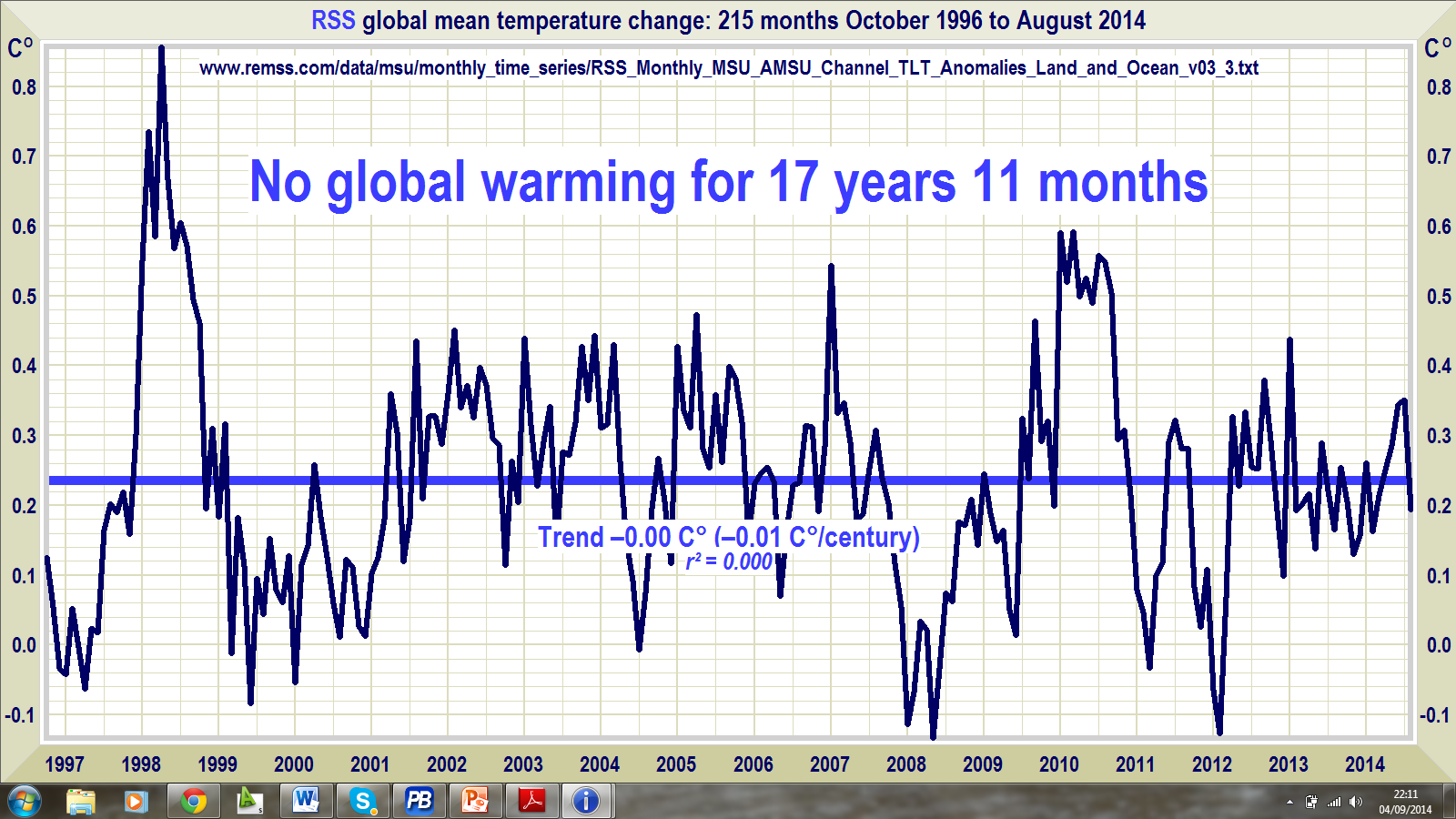
Regarding the 17 year "plateau" that you deny, apparently you can't interpret a graph, don't know what 'statistical significance' means, and Nature isn't good enough for you either. Right off the top of my head, here's a paper that tries to explain the "hiatus". According to your insightful analysis there is nothing to explain.
I've provided links directly to the temperature data, yet you accuse me of making it up and plucking those figures out of my ass. It is obvious that you are in a state of denial. How ironic that a global warming supporter denies what the data says and denies the scientific journals (when it suits him). Your behaviour here contributes to my thesis. Thank you for your time. -
Re:CAGW is a trojan horse
a) Readiing comprehension. They released the code on July 8th in response to all the controversy. I've pointed that out to you at least twice now.
b) You seem intellectually dishonest and childish, who cares so much about "winning" a meaningless debate you can't admit when you're clearly wrong. But that's a personal statement, and why start getting personal? If you think I am "angry", you are projecting.
Again, the code was kept private until July 8th. Why would they go to the trouble of releasing code that was already available (according to you - which you have not substantiated). If you have evidence that the code was released prior to July, I'm all ears.
You are saying the reason that I couldn't find the unreleased code is because of my own ignorance. It should be easy for you to substantiate that accusation. You won't because you can't. Instead you will continue to insist that I prove a negative. Logic 101... Maybe you can answer this: What evidence could I provide that would prove that the code hadn't been released prior to July?
c) Clearly you do not know what "statistical significance" means. Why do you show me a graph purporting to debunk my claim of no trend for the last 17 years that uses a trend-line that starts in 1950? Pretty sloppy. Here is what the trend looks like from 1997, using various datasets, including your GISS temps. The average temperature increase from the five models is about 4 one-hundredths of a degree per decade. That is not a statistically significant amount. Ie: it is well within the margin of uncertainty. In other words: there is no discernable trend. Or to put it another way: the planet has not warmed in 17 years. If you believe otherwise you should point it out to the Journal Nature. They say there has been a 16 year plateau. I'm sure they will be embarrassed by their amateur error once you point it out to them. -
Re:CAGW is a trojan horse
Reading comprehension is important.
a) I never said there wasn't a methodology, just that they hadn't released it at the time. You seem to be deluding yourself into believing that the code was always publicly available.
b) I was not angry, but I disagreed with their decision to keep the information private. Good for them for changing their tune. You apparently see nothing wrong with keeping scientific data hidden away from prying eyes.
c) Interesting that you still deny the recent lack of warming. The HADCRUT4 warming trend since 1997 is a statistically insignificant 5 one-hundredths of a degree per decade. I find it interesting how people react when confronted with plain facts that challenge their views. Maybe you should contact the Journal Nature and explain to them how they made a big, amateur blunder when they said there was a 16 year "hiatus" in global warming. -
Re:Wait, did $Deity announce a do-over?
17 years is too short? You were fine utilizing the trend between 1979-1997 when the results showed a warming trend.
17 years is too short, not because of any magic about "17 years" but because the "trend" is much smaller than the possible error:
HADCRUT4 1997-2014 Trend: 0.048 ±0.112 C/decade (2 sigma)
The trend could be anything between +0.160 and -0.064. We don't have enough information to know what the actual trend is.
By contrast for 1976-1998 the trend is:
1976-1998 HADCRUT4 Trend: 0.163 ±0.083 C/decade (2sigma)
So there is clearly a warming trend (of between +0.246 and 0.80)
And. even clearer, from 1976-2014 the trend is:
HADCRUT4 1976-2014: Trend: 0.164 ±0.037 C/decade (2 sigma).
The 1946-1980 trend is also statistically insignificant.
True:
HADCRUT4 1946-1980 Trend: -0.004 ±0.047 C/decade (2sigma)
By your logic that means the "trend estimation is poor" and that therefore the "period is too short to estimate a statistically significant trend."
If you want to quibble I'd say that "given the data the trend we calculated is smaller than the uncertainty". In general the uncertainty will be smaller if the period is longer.
Maybe you are having difficulty expressing yourself, but it appears as though your thinking is not being applied consistently. And I don't think you know what "statistically insignificant" means.
I think I'm being consistent - If the calculated trend is larger than the uncertainty I assume the trend is statistically significant. (Yes I know the real definition is more complicated, but this is slashdot FFS)
The OLS method is useful in this case to show (you guessed it) a linear trend, but can be misleading when applied to non-linear data, ie: curves. I've adjusted the dates so the curve is easier for you to spot.
So. how do you explain that the 1977-2001 trend is exactly the same as the 1977-2014 trend.
Your posts above serve as a good example, showing why long term trends can't disprove claims of short term trends. At best you can try to argue that the long term trend shows that the 17 year pause is not that meaningful. But in this case the pause is almost as long as the recent warming period itself, and [some] climate scientists themselves have said that a 17 year pause is meanigful (although some are now trying to change the goalposts.)
You're trying to claim that short term trends that are by your own admission not statistically significant can disprove statistically significant long term trends.
Anyways, if you still have doubts, take it up with Nature. If you are correct, they have made a big, amateur blunder. You should let them know.
I don't have to let them know. They already know. From the article you keep quoting in your attempted appeal to authority:
The simplest explanation for both the hiatus and the discrepancy in the models is natural variability.