Slashdot Mirror
Domain: noaa.gov
Stories and comments across the archive that link to noaa.gov.
Comments · 2,602
-
Re:Where are the Guardsmen?
You don't have to be a liberal to know that Louisiana had to be prepared for the worst then then or even earlier.
I don't think they were. The Governor even admitted that it was George Bush that phoned her and asked her to call for a mandatory evacuation. From an article published here:
The mayor called the order unprecedented and said anyone who could
leave the city should. He exempted hotels from the evacuation order
because airlines had already cancelled all flights.
Gov. Kathleen Blanco, standing beside the mayor at a news
conference, said President Bush called and personally appealed for
a mandatory evacuation for the low-lying city, which is prone to
flooding.
If you're the Mayor or the Governor and your city is about to get smashed, you don't wait for the president to tell you to get the hell out of there. These people had information available to them, if they were paying attention Friday, that the city was in trouble, yet waited until George Bush asked them to declare a mandatory evacuation. Imagine that: George Bush had more clue than they did, apparently. That by itself proves they're idiots.
A new meme that's spreading in right wing blogs is that the mayor should have started evacuating the city on (Saturday/Sunday) using fleets of schoolbusses that are, today, sitting in water. There are logistical problems with that "solution", obviously. Some of it's a matter of getting fuel, drivers, and places to go. Some of it is that, as you and I as people that have lived through this before (you said in another post you live in Florida, I live in Stuart - Frances made landfall 15 miles south of here, Jeanne made landfall here) know, a huge proportion of the public simply wouldn't have left.
And yet someone actually did take a school bus and drove 100 people to Houston -all without needed the Mayor's or the Governor's or the president's say-so.
So you go ahead and ridicule the idea of using school buses to evacuate, but there were some people that took the idea seriously are are better for it. If one kid can steal a bus and carry 100 people to safety, then it must be possible for the government of New Orleans to have done the same in an organized way.
Over 200 buses were available. With 100 people on each bus, that's 20,000 that could have gotten out.
So the five days comment is perfectly reasonable.
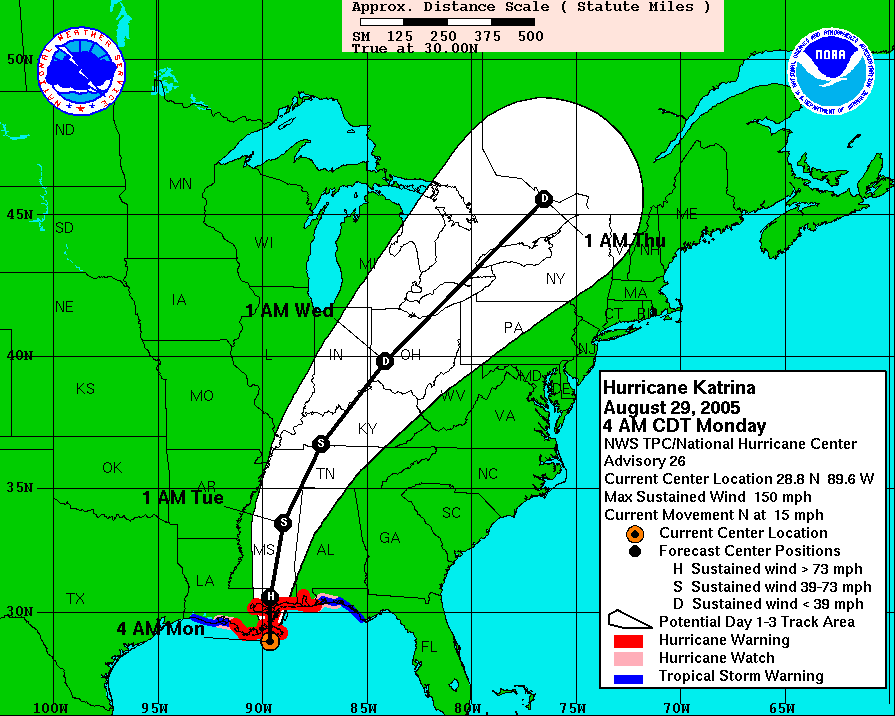
No. It was a lie by congresspeople trying to score political points. And it's an easy lie to detect since it's well documented that Katrina was still in Mississippi Tuesday morning. That means there was about 3 days, not 5 days, delay. -
Re:Why not just machine gun the refugees?
We had advanced warning (36+ hours) that this was going to happen. Where were FEMA, the NG, Homeland Security, etc?
The first forecast that put the likelihood of the eye of the hurricane passing within 65 nautical miles of New Orleans above 50% was issued by NOAA at10 PM CDT Sunday. The hurriance made landfall at about 4 AM CDT Monday morning. -
Re:Why not just machine gun the refugees?
We had advanced warning (36+ hours) that this was going to happen. Where were FEMA, the NG, Homeland Security, etc?
The first forecast that put the likelihood of the eye of the hurricane passing within 65 nautical miles of New Orleans above 50% was issued by NOAA at10 PM CDT Sunday. The hurriance made landfall at about 4 AM CDT Monday morning. -
Re:Where are the Guardsmen?
Everything you read in the news is true! And correct! Especially when it's a politician trying to attack Chimpy McBushHaliburtonHitler!
The fact is was it was in the Gulf of Mexico. Whether you want to come to grips with that is your decision. See the link from the other response. This isn't something that is even open to debate. -
Re:We can't even agree on global warming
Looking at this Vostock ice core chart you can see that we're *long* overdue for the next ice age. 5-10k years - hard to blame man for that. Is this a cycle larger than the (geologically) short cycles from the Vostoc data asserting itself? We know there are drivers for CO2 levels far greater than what Man is doing, but on very long cycles.
Changing the pH of the ocean even slightly would make a huge difference in atmospheric CO2, for example (oddly, CO2 concentration in the ocean doean't feed back into the pH significantly - in fact, this is the most complicated feedback system I've ever looked at, and no one really understands it). But what drives that?
We have data for the 100kya-100mya range that seems related to temperature, but nothing certain. Climate 100mya was clearly very different than current patterns: http://www.ngdc.noaa.gov/paleo/ctl/cliscibeyond.ht ml with temperatures hardly varying with lattitude. -
Re:don't know who to blame...or if it is necessaryAnyways when a majorj catastrophe like this strikes 5 days to start to fully deploy is unacceptable
The hurricane was still in Mississippi Tuesday morning. They certainly could not move in earlier than that. They arrived Friday. Is 3 days too long? Maybe. But considering they need to get men and equipment to a city that's flooded and nearly surrounded by destroyed bridges, it's not slow at all.
That aside, the blame really should be placed in the hands of the Mayor and Governor. They had since Friday night to begin getting food and water into the shelters and into the dome. They even had over 200 school buses they could have employed to help evacuate people, but they left them to get flooded.
You want someone to blame? Blame the Mayor and Governor. They should have been the most interested in protecting their city, but seem to have been the least interested until it was too late. -
Re:Where are the Guardsmen?So prior to each and every hurricane, we should crank up a carrier battle group? And put it where? IN the Gulf? Yeah...thats exactly the place you DON'T want your fleet. Right in the path of the storm.
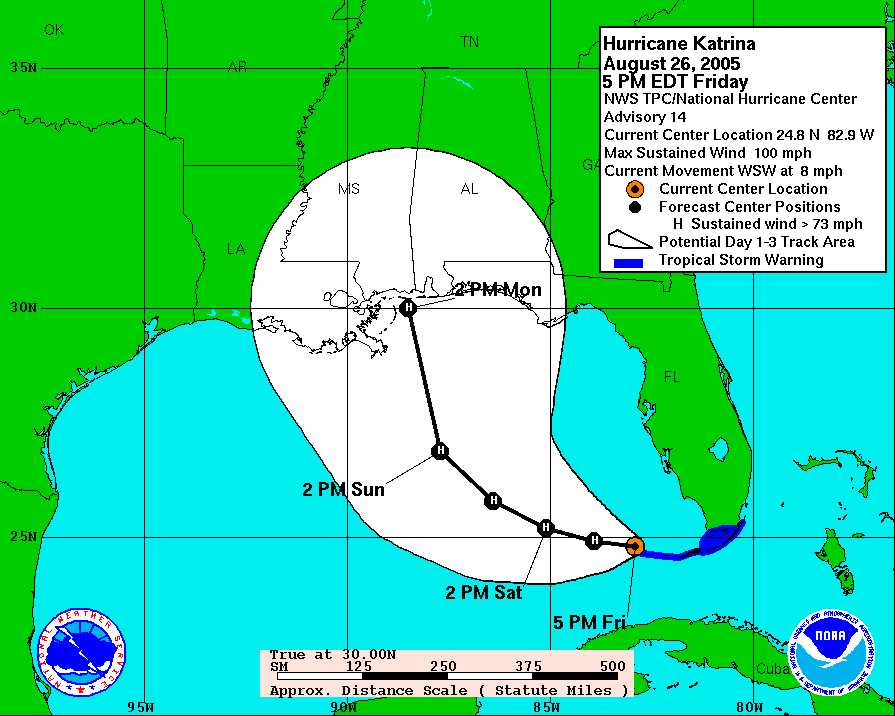
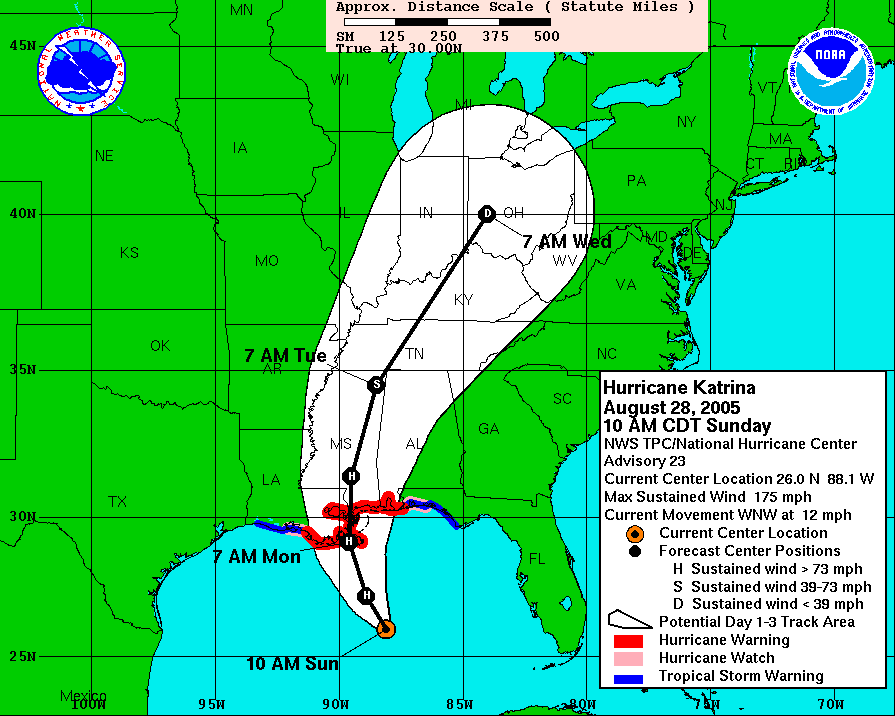
Where and when would you have put a CVN group for this hurricane? Here is the track and strength prediction since last Tuesday, when it was north of Cuba, and still avery minor hurricane. Saturday night, it was still a Cat 2/3.
Where, specifically, would you have put a carrier group. And when? Which carrier group, coming from where, and loaded with supplies when?
-
Re:don't know who to blame...or if it is necessary
don't know who to blame, but the federal government were definitely slow in acting (why the f*ck was Bush on vacation until Wednesday when he declared Louisiana a disaster area before the hurricane hit Louisiana?).
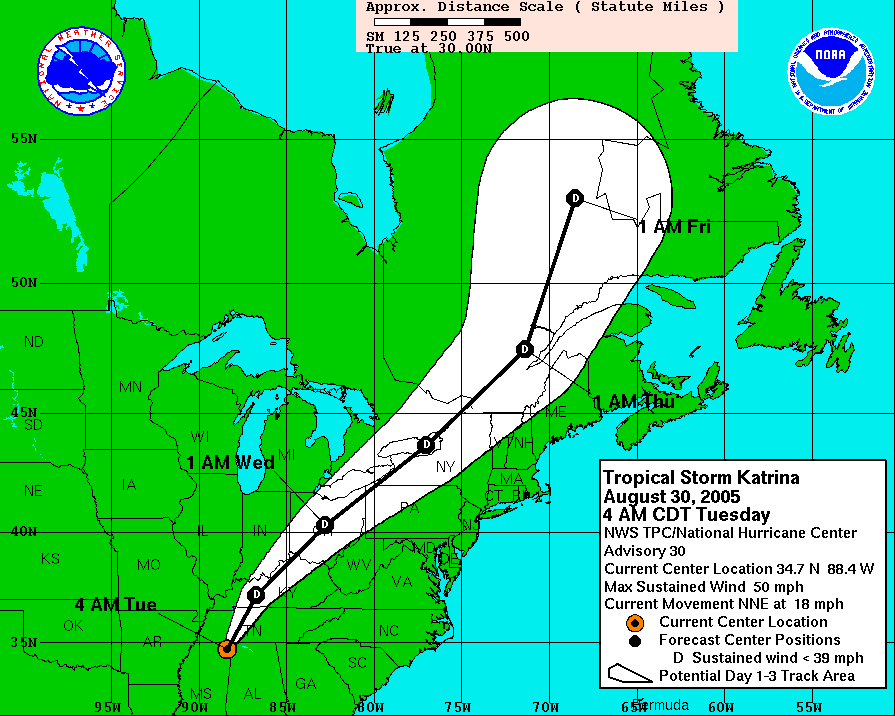
Slow? The storm was still in Mississippi Tuesday morning and still a depression in Ohio Wednesday. Just how quickly do you think they can move in with the storm still working it's way through the country? There were probably still guardmens in their homes Wednesday riding out the storm.
And don't forget that the federal government can't just yell "emergency" and send troops in to take over a state. It doesn't work that way. It's the governor that's mostly in control. -
Re:Where are the Guardsmen?Have you watched the news at all? All people questioning the slow federal response make mention of the 5 days.
For example, take the following snippet from a Bloomberg news article :
" In Congress, Democrats including House Democratic Caucus Chairman Robert Menendez are stepping up their criticism, and the Democratic National Committee today issued a statement under the title, ``Where is the leadership, Mr. President.'' ``Why is it that five days after hurricane Katrina ravaged the Gulf Coast many of our fellow Americans are still without food and water, living in squalor in dangerous, inhumane conditions?'' the statement said. "
The funny thing about this is how you go through the trouble to cite an article that cites congressmen that made an obviously "incorrect" statement.
It's very easy to check where Katrina was 5 days ago and it was in the Gulf of Mexico.
It was still in Mississippi Tuesday morning. -
Re:Where are the Guardsmen?Have you watched the news at all? All people questioning the slow federal response make mention of the 5 days.
For example, take the following snippet from a Bloomberg news article :
" In Congress, Democrats including House Democratic Caucus Chairman Robert Menendez are stepping up their criticism, and the Democratic National Committee today issued a statement under the title, ``Where is the leadership, Mr. President.'' ``Why is it that five days after hurricane Katrina ravaged the Gulf Coast many of our fellow Americans are still without food and water, living in squalor in dangerous, inhumane conditions?'' the statement said. "
The funny thing about this is how you go through the trouble to cite an article that cites congressmen that made an obviously "incorrect" statement.
It's very easy to check where Katrina was 5 days ago and it was in the Gulf of Mexico.
It was still in Mississippi Tuesday morning. -
We can guess? We can guess?!!
You guys are all being willfully ignorant. If you wanted to know when the ozone hole appeared you could have just looked it up.
http://www.al.noaa.gov/WWWHD/pubdocs/Assessment98/ faq5.html
Jesus Christ. You're just parroting what has been said up-thread. -
Re:Police doing the looting...Government SNAFU
Heartless bastard reporting for duty.
New Orleans has been sinking into the swamp for years. The city is essentially a hole in the ground, surrounded by water. You know why the cemetaries have above ground caskets? They're 15 feet below sea level. The hole fills up with water as fast as they can dig it.
If we rebuild, it *will* happen again. And then what? We pay to have it rebuilt again? If the city was next to an active volcano, would you be saying we should rebuild it?
ok.. another thing about all of this... people rebuild in areas like this all the time.. look at california...
now really.... look at the location of new orleans... it is a MAJOR PORT... in a good agracultural area... this city is needed... it has taken the brunt of MANY hurricanes... hell we even have a drink named after it... damn good drink.. thank you Pat O'Brians... lets look at some other things with all of this... this hurrican was a catagory 5... people DO NOT understand what this means...
from wikipedia.org
Categories and ranking
Hurricanes are ranked according to their maximum winds using the Saffir-Simpson Hurricane Scale. A Category 1 storm has the lowest maximum winds, a Category 5 hurricane has the highest. The rankings are not absolute in terms of effects. Lower-category storms can inflict greater damage than higher-category storms, depending on factors such as local terrain and total rainfall. In fact, tropical systems of less than hurricane strength can produce significant damage and human casualties, especially from flooding and landslides.
The U.S. National Hurricane Center classifies hurricanes of Category 3 and above as Major Hurricanes.
ok.. so we had a cat5... now what exactly does that mean?
taken from the national weather service website
Category Five Hurricane:
Winds greater than 155 mph (135 kt or 249 km/hr). Storm surge generally greater than 18 ft above normal. Complete roof failure on many residences and industrial buildings. Some complete building failures with small utility buildings blown over or away. All shrubs, trees, and signs blown down. Complete destruction of mobile homes. Severe and extensive window and door damage. Low-lying escape routes are cut by rising water 3-5 hours before arrival of the center of the hurricane. Major damage to lower floors of all structures located less than 15 ft above sea level and within 500 yards of the shoreline. Massive evacuation of residential areas on low ground within 5-10 miles (8-16 km) of the shoreline may be required. Only 3 Category Five Hurricanes have made landfall in the United States since records began: The Labor Day Hurricane of 1935, Hurricane Camille (1969), and Hurricane Andrew in August, 1992. The 1935 Labor Day Hurricane struck the Florida Keys with a minimum pressure of 892 mb--the lowest pressure ever observed in the United States. Hurricane Camille struck the Mississippi Gulf Coast causing a 25-foot storm surge, which inundated Pass Christian. Hurricane Andrew of 1992 made landfall over southern Miami-Dade County, Florida causing 26.5 billion dollars in losses--the costliest hurricane on record. In addition, Hurricane Gilbert of 1988 was a Category Five hurricane at peak intensity and is the strongest Atlantic tropical cyclone on record with a minimum pressure of 888 mb.
just something to keep in mind with all of this -
Re:Ozone HoleGah, I thought I replied at length to this. Here's the short version: Parent post is utterly wrong.
For one thing the ozone hole was discovered in 1980.
Lots of other nonsense here, probably recycled from a right wing political magazine.
-
Re:We can't even agree on global warming
First off, previewing is a good idea, but I'm sure you realized that after the fact.
from what?
The early 1970s. Yes, we don't have long-term historical data on its size, but the physics of it are very apparent: we've 5x'ed the amount of Cl- ions in the stratosphere from what they naturally are, so unless nature decided to vary Cl- ions *5fold* before the 1970s, we're doing tremendous damage.
It's the climate change theory that hinges on it
It distinctly *Does Not*. It is a single graph from a single study, no matter how you try and portray it. There are many thousands of studies on global warming in existence. Here's cites for just a few of them.
There are dozens of ice cores alone that have been analyzed for temperature, CO2, and methane. I'm aware of two oceanic sediment cores (a 10,000 year and a 20,000 year) which have been studied, and two lake sediment cores (8,000 years and 13,000 years) - there's probably a heck of a lot more. There are thousands of direct worldwide temperature readings from the mid-1800s to millions in modern times that have been factored in. That covers the entire historical record back to about 180,000 years ago with extensive overlap, with wide precision on the old records and narrow precision on the modern records. What the heck more do you need?
Do these ice cores give us a strong indication of how much CO2 was in the air?
How many times do I have to tell you that they do? CO2 is easy to study in the cores because bubbles of the atmosphere are actually trapped within. Same with methane. Temperature is determined from oxygen isotopic ratios, as oxygen-heavy water evaporation rates as opposed to regular water evaporation are very temperature dependant (there are also other correlating factors on temperature, but lets keep it simple for now).
Anywhere where we have:
A) Trapped gas, and
B) A date on the volume that is trapping it,
We can determine the full atmospheric record from the time, barring leakage (which would throw off ratios, determinable by a concordia/discordia plot). We have trapped gas for very long periods of history. -
Perfect example of lazy lay person's arguments...So what? I can come up with a half dozen possible explanations and I'm not even formally educated.
All of which proposed reasons are silly to the point of not needing to be aired or refuted (except apparently for on Rush Limbaugh's show where he's continued to confuse prehistoric volcanoes with ones that erupted in the 1990s), and none of which do anything whatsoever to address the enormous weight of peer-reviewed science on the topic of global warming.
So, you know, you just did prove that point, by making arguments on the level of low-attention-span rubes and the news machines that feed them.
I hear a lot of people pointing at hurricanes lately as a result of global warming who don't even understand how a hurricane is formed. Warmer ocean water and cooler air. The claim with global warming is that the air is getting warmer. You can't have it both ways.
Boy, it's funny -- that idea has been getting zero play in the popular media, which is what we're talking about, and I haven't heard person one making that connection. Also hilariously oversimplified argument about the warm air. Nice straw man. It flies in the face of what the geophysical fluid dynamics laboratory at NOAA (for one example) says about Global Warming and Hurricanes. Sample:
Although we cannot say at present whether more or fewer hurricanes will occur in the future with global warming, the hurricanes that do occur near the end of the 21st century are expected to be stronger and have significantly more intense rainfall than under present day climate conditions. This expectation... is based on an anticipated enhancement of energy available to the storms due to higher tropical sea surface temperatures.
Oops! Your "cold air vs. warm air" argument turns out to be, again, an oversimplified silliness committed by a lay person who cares about making plausible-sounding arguments rather than about the truth.
But let's discuss global warming, you seem to want that. Imagine that the sea level has risen, and that New Orleans is hit by a more intense hurricane. Does this sound like it's worth avoiding? Relative to the risk of nuclear war in the 1980s, which we spent untold billions to address, how much is it worth to us to prevent global warming -- which essentially every reputable scientist believes is already happening? I'm not looking for sophisms like the goofy ones you offered before. I'd rather have you face the real risks. Take a look at the images from New Orleans, and tell me again how a few degrees hotter would just mean Minnesota was more like Kansas.
-
Barton & Whitfield, Gilbert and MooneyPerhaps this confusion may soon be put to rest through the current efforts of Barton & Whitfield.
The enhanced strength of Katrina has been attributed to the 90+ temperatures in in the gulf at present which are supposedly up significantly compared to recent times. Do wonder what the temps were way back in 1988 for Gilbert at 175 mph with gusts over 200, and just how strong it might've been today.
Chris Mooney's War on Science might provide some additional perspective.
-
I'll bite (a little)There are serious (peer reviewed) articles from NOAA (see http://www.gfdl.noaa.gov/reference/bibliography/2
0 04/tk0401.pdf and references in it, for example ) that certainly make for a plausible correlation between rising CO2 levels and increasingly severe hurricanes. It is quite a stretch to blame this on GW personally. But his administration is doing practically everything in its power to deny global warming and to delay any action that may be harmful to economics interests. I think he is placing himself squarely on the wrong side of history. Future generations will marvel at our denial of sustainability as a foundation for stable economic systems.Herbert Hoover wasn't personally responsible for the Great Depression, but he is forever associated with the Crash of '29. In a similar way, Lois XIV is associated with the excess of the French Aristocracy. I hope that Bush isn't associated with the end of the American Century, but I have a sinking feeling that the US is courting disaster. It will not be GW's fault, but he isn't going to be part of the solution either.
-
Re:Water City
You may get wind storms, but you (and a large percentage of Americans who are directly threatened by them) are grossly underestimating the power of a Katrina-size hurricane. Selected statistics from Noaa:
http://www.aoml.noaa.gov/hrd/tcfaq/tcfaqHED.html
Sustained winds of 120+ KPH over a 350-km wide circle; sustained winds of 250 KPH over a 50-km wide circle, with gusts even higher; as much as two meters of rain in one day; a 6-meter storm surge (akin to a tsunami); a total dissipated power of 6.0 x 10^14 Watts.
People foolish enough to weather out even a modest hurricane are often severely traumatized by the experience. If you think you are tough, you are welcome to come try one out this month. Our national guardsmen would be proud to rescue you.
CV -
Re:How about blaming Louisiana?
So, I guess that you'll make an exception and pay real quick like to keep the oil infrastructure disaster coverage federalized? OK, then, what about the roads, bridges, and rail that lead to the oil refineries? OK, then, what about the destroyed schools that give enough (sometimes, *only* enough) education to local people so that they can work on the oil infrastructure - should the feds not pay to help rebuild that?
What I'm trying to impart to you is that you *DO* benefit when other parts of the country outside your own are kept viable and are well insured against future damage. I live in Cali, but I sure do like them Georgia Peaches, Kansas Grains, Pennsylvania Coal, Washington Electricity, etc. etc., and I'd like to know that the people there have can access the aggregated purchasing and logistical power of FEMA when needed. Don't businesses ever waste money? And would the "waste" of the Feds be less than the profit margins of a privatized emergency response infrastructure? And would it be there when it is needed?
Oh, and, yes, I think I'd like to help Denver out when they have flash floods and tornadoes.
-
Exactly.Other ways of rephrasing the question might be:
- Why can't the system not fail in an event that releases around 200 times as much energy as the human species produces electricity?
- Why can't the system not fail in the face of an event with an energy release roughly equivalent to a 10 megaton bomb every 10 minutes?
-
Exactly.Other ways of rephrasing the question might be:
- Why can't the system not fail in an event that releases around 200 times as much energy as the human species produces electricity?
- Why can't the system not fail in the face of an event with an energy release roughly equivalent to a 10 megaton bomb every 10 minutes?
-
Re:A Rather Prescient Article
There is also some karma in play here that an intense hurricane which was probably intensified by CO2 induced global warming, thanks to abnormally warm temperatures in the Atlantic and Gulf, would lead to devastation in Louisiana which is at the heart of the oil and gas part of the fossil fuel industry in the U.S. and is responsible for much of America's CO2 pollution capacity.
Hurricanes are powered by the differential in temperature between the water and the atmosphere. Since global warming increases the temperature of both the water and air the affects on hurricanes are small compared to the natural variablity of hurricanes according to NOAA's faq. Here is NOAA's page listing the number of tropical storms, hurricanes, and major hurricanes going back to 1850. The data from 1944 onwards is considered accurate with data on storms that actually strike the U.S. East and Gulf Coasts considered to be accurate back to 1899. They have graphs of 1944 to near present of the number of named storms, hurricanes, and major hurricanes. Note that these graphs do not resemble monotonically increasing functions, but instead are closer to periodic funcions. Here is the NOAA faq page stating the increase in number and strength of Atlantic hurricanes since 1995 is due to the hurricane cycle. Note that 1991-94 are the quietest four years in the post-1944 record. -
Re:A Rather Prescient Article
There is also some karma in play here that an intense hurricane which was probably intensified by CO2 induced global warming, thanks to abnormally warm temperatures in the Atlantic and Gulf, would lead to devastation in Louisiana which is at the heart of the oil and gas part of the fossil fuel industry in the U.S. and is responsible for much of America's CO2 pollution capacity.
Hurricanes are powered by the differential in temperature between the water and the atmosphere. Since global warming increases the temperature of both the water and air the affects on hurricanes are small compared to the natural variablity of hurricanes according to NOAA's faq. Here is NOAA's page listing the number of tropical storms, hurricanes, and major hurricanes going back to 1850. The data from 1944 onwards is considered accurate with data on storms that actually strike the U.S. East and Gulf Coasts considered to be accurate back to 1899. They have graphs of 1944 to near present of the number of named storms, hurricanes, and major hurricanes. Note that these graphs do not resemble monotonically increasing functions, but instead are closer to periodic funcions. Here is the NOAA faq page stating the increase in number and strength of Atlantic hurricanes since 1995 is due to the hurricane cycle. Note that 1991-94 are the quietest four years in the post-1944 record. -
Re:A Rather Prescient Article
There is also some karma in play here that an intense hurricane which was probably intensified by CO2 induced global warming, thanks to abnormally warm temperatures in the Atlantic and Gulf, would lead to devastation in Louisiana which is at the heart of the oil and gas part of the fossil fuel industry in the U.S. and is responsible for much of America's CO2 pollution capacity.
Hurricanes are powered by the differential in temperature between the water and the atmosphere. Since global warming increases the temperature of both the water and air the affects on hurricanes are small compared to the natural variablity of hurricanes according to NOAA's faq. Here is NOAA's page listing the number of tropical storms, hurricanes, and major hurricanes going back to 1850. The data from 1944 onwards is considered accurate with data on storms that actually strike the U.S. East and Gulf Coasts considered to be accurate back to 1899. They have graphs of 1944 to near present of the number of named storms, hurricanes, and major hurricanes. Note that these graphs do not resemble monotonically increasing functions, but instead are closer to periodic funcions. Here is the NOAA faq page stating the increase in number and strength of Atlantic hurricanes since 1995 is due to the hurricane cycle. Note that 1991-94 are the quietest four years in the post-1944 record. -
Re:A Rather Prescient Article
There is also some karma in play here that an intense hurricane which was probably intensified by CO2 induced global warming, thanks to abnormally warm temperatures in the Atlantic and Gulf, would lead to devastation in Louisiana which is at the heart of the oil and gas part of the fossil fuel industry in the U.S. and is responsible for much of America's CO2 pollution capacity.
Hurricanes are powered by the differential in temperature between the water and the atmosphere. Since global warming increases the temperature of both the water and air the affects on hurricanes are small compared to the natural variablity of hurricanes according to NOAA's faq. Here is NOAA's page listing the number of tropical storms, hurricanes, and major hurricanes going back to 1850. The data from 1944 onwards is considered accurate with data on storms that actually strike the U.S. East and Gulf Coasts considered to be accurate back to 1899. They have graphs of 1944 to near present of the number of named storms, hurricanes, and major hurricanes. Note that these graphs do not resemble monotonically increasing functions, but instead are closer to periodic funcions. Here is the NOAA faq page stating the increase in number and strength of Atlantic hurricanes since 1995 is due to the hurricane cycle. Note that 1991-94 are the quietest four years in the post-1944 record. -
Re:A Rather Prescient Article
There is also some karma in play here that an intense hurricane which was probably intensified by CO2 induced global warming, thanks to abnormally warm temperatures in the Atlantic and Gulf, would lead to devastation in Louisiana which is at the heart of the oil and gas part of the fossil fuel industry in the U.S. and is responsible for much of America's CO2 pollution capacity.
Hurricanes are powered by the differential in temperature between the water and the atmosphere. Since global warming increases the temperature of both the water and air the affects on hurricanes are small compared to the natural variablity of hurricanes according to NOAA's faq. Here is NOAA's page listing the number of tropical storms, hurricanes, and major hurricanes going back to 1850. The data from 1944 onwards is considered accurate with data on storms that actually strike the U.S. East and Gulf Coasts considered to be accurate back to 1899. They have graphs of 1944 to near present of the number of named storms, hurricanes, and major hurricanes. Note that these graphs do not resemble monotonically increasing functions, but instead are closer to periodic funcions. Here is the NOAA faq page stating the increase in number and strength of Atlantic hurricanes since 1995 is due to the hurricane cycle. Note that 1991-94 are the quietest four years in the post-1944 record. -
Re:A Rather Prescient Article
There is also some karma in play here that an intense hurricane which was probably intensified by CO2 induced global warming, thanks to abnormally warm temperatures in the Atlantic and Gulf, would lead to devastation in Louisiana which is at the heart of the oil and gas part of the fossil fuel industry in the U.S. and is responsible for much of America's CO2 pollution capacity.
Hurricanes are powered by the differential in temperature between the water and the atmosphere. Since global warming increases the temperature of both the water and air the affects on hurricanes are small compared to the natural variablity of hurricanes according to NOAA's faq. Here is NOAA's page listing the number of tropical storms, hurricanes, and major hurricanes going back to 1850. The data from 1944 onwards is considered accurate with data on storms that actually strike the U.S. East and Gulf Coasts considered to be accurate back to 1899. They have graphs of 1944 to near present of the number of named storms, hurricanes, and major hurricanes. Note that these graphs do not resemble monotonically increasing functions, but instead are closer to periodic funcions. Here is the NOAA faq page stating the increase in number and strength of Atlantic hurricanes since 1995 is due to the hurricane cycle. Note that 1991-94 are the quietest four years in the post-1944 record. -
Re:Not a global warming issue.
Don't think 90 degree water surface temperatures in the Gulf of Mexico are normal, even cyclically though I'd be curious if anyone can point me to a historical record of Gulf water temperatures.
http://www.nodc.noaa.gov/dsdt/cwtg/egof.html
http://www.nodc.noaa.gov/dsdt/wtg12.html
Mid to upper 80's averages. -
Re:Not a global warming issue.
Don't think 90 degree water surface temperatures in the Gulf of Mexico are normal, even cyclically though I'd be curious if anyone can point me to a historical record of Gulf water temperatures.
http://www.nodc.noaa.gov/dsdt/cwtg/egof.html
http://www.nodc.noaa.gov/dsdt/wtg12.html
Mid to upper 80's averages. -
Re:Global Warming
This particular hurricane cannot of course be specifically blamed on global warning.
Much as the boneheaded "GW is a liberal myth" posts here piss me off, you sir, are not helping. Some references:- NHC's 2005 Atlantic Hurricane Outlook.
This confluence of optimal ocean and atmosphere conditions has been known to produce increased tropical storm activity in multi-decadal (approximately 20-30 year) cycles. Because of this, NOAA expects a continuation of above-normal seasons for another decade or perhaps longer. NOAA's research shows that this reoccurring cycle is the dominant climate factor that controls Atlantic hurricane activity. Any potentially weak signal associated with longer-term climate change appears to be a minor factor.
- Storms and Climate Change. Attempts to find such linkages are very controversial.
- Storms and Global Warming II. Same here. A weak signal related to intensity is currently undergoing peer review.
I agree that it seems plausible, but there are a lot of factors influencing hurricane formation (e.g. wind shear keeps them from forming in the South Atlantic most of the time).
It is tempting to want Mother Nature to bash some sense into the right wingnuts in Florida, but I suspect that the melting of Greenland (which is happening faster than the models predict) will do that RSN. - NHC's 2005 Atlantic Hurricane Outlook.
-
Re:Global Warming
Hurricanes form when passing over 80F water not 94F. Systematic aircraft reconnaissance of tropical storms and hurricanes in the Atlantic basin starts in 1944. Data on tropical storms and hurricanes which hit the US East and Gulf Coasts is beleived to be reliable back to 1899. Here is the data on the number of named storms, hurricanes, and major hurricanes since 1851. Note that one does not observe a continuous increase in any of those categories, that the largest number of hurricanes occured in 1969 and the largest number of major hurricanes in 1950. Here is NOAA's faq page on how global warming might affect hurricanes. They state any change in the number of tropical storms and hurricanes when one assumes global warming will occur is small when compared to the natural variability. Finally here is NOAA's faq page discussing the hurricane cycle. Note that 91-94 are the four quietest post-1944 years on record which blows quite a big hole in the global warming causing increase in hurricanes hypothesis. Testability indeed.
-
Re:Global Warming
Hurricanes form when passing over 80F water not 94F. Systematic aircraft reconnaissance of tropical storms and hurricanes in the Atlantic basin starts in 1944. Data on tropical storms and hurricanes which hit the US East and Gulf Coasts is beleived to be reliable back to 1899. Here is the data on the number of named storms, hurricanes, and major hurricanes since 1851. Note that one does not observe a continuous increase in any of those categories, that the largest number of hurricanes occured in 1969 and the largest number of major hurricanes in 1950. Here is NOAA's faq page on how global warming might affect hurricanes. They state any change in the number of tropical storms and hurricanes when one assumes global warming will occur is small when compared to the natural variability. Finally here is NOAA's faq page discussing the hurricane cycle. Note that 91-94 are the four quietest post-1944 years on record which blows quite a big hole in the global warming causing increase in hurricanes hypothesis. Testability indeed.
-
Re:Global Warming
Hurricanes form when passing over 80F water not 94F. Systematic aircraft reconnaissance of tropical storms and hurricanes in the Atlantic basin starts in 1944. Data on tropical storms and hurricanes which hit the US East and Gulf Coasts is beleived to be reliable back to 1899. Here is the data on the number of named storms, hurricanes, and major hurricanes since 1851. Note that one does not observe a continuous increase in any of those categories, that the largest number of hurricanes occured in 1969 and the largest number of major hurricanes in 1950. Here is NOAA's faq page on how global warming might affect hurricanes. They state any change in the number of tropical storms and hurricanes when one assumes global warming will occur is small when compared to the natural variability. Finally here is NOAA's faq page discussing the hurricane cycle. Note that 91-94 are the four quietest post-1944 years on record which blows quite a big hole in the global warming causing increase in hurricanes hypothesis. Testability indeed.
-
Re:Investiment Opportunities
Yes, the current boundaries of year-round farming are pushed farther to the north and south as temperatures moderate in the extreme latitudes. However the current bread basket of america will become dryer and be less productive so the lands considered today as bread baskets of the world are left with drought and severely reduced crop yields.
-
Investiment OpportunitiesGlobal warming is here. There are those who will attempt to disagree but the evidence is growing.
So the question is how to strategically pick investments that will pay off with the trend. Sounds greedy and selfish but the tragedy of the commons will not be denied. So ideas
- Short ski resort stocks in fringe areas.
- Short insurance companies since hurricanes will tend to be more prevasive
- Short northern europe in general since the gulf stream will cool the area
- Buy energy stocks as more energy will be required to cool and heat with more temperature extremes
- Buy Wind, Wave, Solar, Nuclear energy stocks as the public will eventually demand more emphasis on non-green house gas sources.
Firefox users get Hot Sauce at a discount. -
Re:Sony Describes DS As Gimmick
Which reminds me of something my mom asked me about. She wondered, if aspirin can prevent heart attacks, then why do they also say it is bad for you (I don't remember what bad effect she referenced)? I was having to tell her that (besides the occasional good-hearted independent study) there is business involved. I somehow doubt Florida Orange Juice commercials (e.g.) just come on because doctors make them; I'm sure there's some commercial promotion intended too. (That bitch Katrina doesn't help matters there...)
-
How does this get modded up?
Please tell me this is a troll.
If you can PROVE Global Warning beyond a doubt just as the laws of physics are, then do so, otherwise shut up about it.
The laws of physics aren't proven beyond a doubt. In fact, quantum physics and general relativity outright contradict each other -- does this mean that all physicists should just "shut up about it"?
When we have a planet that is 4 BILLION years old and we have a record of perhaps 1-5 Million years, that is NOT significant.
Global warming is a short-term phenomenon, on the order of centuries or even decades. The life of the planet is an irrelevent time scale.
Also look at this chart: ftp://ftp.ncdc.noaa.gov/pub/data/anomalies/land_o_ C.all You'll see that the raw data and you can see there is very little to indicate a warming. The data goes up and down, with overall a tiny positive trend but not significant.
a) Do you even know how much change per decade is considered "significant"? (clue: obviously not, given the quote you used just before this)
b) I look at that chart, and the numbers are overwhelmingly positive since 1979
atmospheric CO2 levels do not fit changes in the CET [Central England Temperature] at all well
So what? Global warming is defined as the change in the global average temperature. CET is irrelevant. Some places in the world are actually cooling currently, but that doesn't change the fact that the world, on average, is warming.
And the amount that the world's climate is changing coincides very closely with our current models of CO2's effect on the atmosphere (along with all other climate forcings such as sunspots and volcano eruptions). -
Re:But how much fuel does it use?
My "2" key is a bit sticky and does not work. I didn't see the missing 2 until I posted it. It's bad form to reply to my own post, I know some smarty pants would correct it. If you can PROVE Global Warning beyond a doubt just as the laws of physics are, then do so, otherwise shut up about it. When we have a planet that is 4 BILLION years old and we have a record of perhaps 1-5 Million years, that is NOT significant. Ice Core samples, volcanic rocks, etc give some readings but you only see data published to support GW, never does anyone tout results that disprove it since that would cut off thier research funds. It is a self-perpetuating lie. Here is a quote from the Global Hydrology and Climate Center, University of Alabama - Huntsville, USA who have been running experiments from 1978 to present refining thier techniques and publishing peer reviewed papers on the data and analysis. "The new global trend from Dec 1978 to July 2005 is +0.123 C/decade, or +0.035 C/decade warmer than v5.1. This particular error is within the published margin of error for LT of +/- 0.05 C/decade (Christy et al. 2003)." Also look at this chart: ftp://ftp.ncdc.noaa.gov/pub/data/anomalies/land_o
_ C.all You'll see that the raw data and you can see there is very little to indicate a warming. The data goes up and down, with overall a tiny positive trend but not significant. In case you live in the UK here is something about warming there: Tony Blair appears convinced by the enhanced greenhouse hypothesis but atmospheric CO2 levels do not fit changes in the CET [Central England Temperature] at all well. For example, from 1695 to 1733, the annual mean temperature rose from 7.25 C to 10.47 C at a time when there was negligible change in atmospheric CO2 - the running mean did not return to such readings until the 1990s. On the other hand, annual mean temperatures fell from 10.62 C in 1949 to 8.47 C by 1963, a period when atmospheric CO2 levels were measurably rising. Greenhouse does not appear to be exerting a strong influence on the CET. -
Re:Global warming, eh?
You may wish to retake some classes on how to read graphs and stats. When you have a spike up high for 1-2 years that is not a warming trend. When you have a decade, going on to 2 decades, with all temperatures above average, that is a trend. As long as it stays above the average, it is warmer, not cooler. When local minimas and maximas still occur on the warm side of average, is a sign that we are still warming, not cooling.
And what is missing is still 2004 and 3/4 of 2005 (you got to dig it out). According to NOAA, 2004 was the 24th warmest year at 53.5 F and with almost 3/4 of 2005 in, it is is shaping up to be on the hot side. -
Re:Global warming, eh?
You may wish to retake some classes on how to read graphs and stats. When you have a spike up high for 1-2 years that is not a warming trend. When you have a decade, going on to 2 decades, with all temperatures above average, that is a trend. As long as it stays above the average, it is warmer, not cooler. When local minimas and maximas still occur on the warm side of average, is a sign that we are still warming, not cooling.
And what is missing is still 2004 and 3/4 of 2005 (you got to dig it out). According to NOAA, 2004 was the 24th warmest year at 53.5 F and with almost 3/4 of 2005 in, it is is shaping up to be on the hot side. -
Re:Global warming, eh?
You may wish to retake some classes on how to read graphs and stats. When you have a spike up high for 1-2 years that is not a warming trend. When you have a decade, going on to 2 decades, with all temperatures above average, that is a trend. As long as it stays above the average, it is warmer, not cooler. When local minimas and maximas still occur on the warm side of average, is a sign that we are still warming, not cooling.
And what is missing is still 2004 and 3/4 of 2005 (you got to dig it out). According to NOAA, 2004 was the 24th warmest year at 53.5 F and with almost 3/4 of 2005 in, it is is shaping up to be on the hot side. -
Re:on what grounds?
Humans produce about eight billion [metric] tons of carbon per year total through fossil fuel burning and deforestation in the tropics,
From CMDL Testimony on Terrestrial Carbon Dioxide Uptake to US Senate Subcommittee -
Re:Global warming, eh?
Well, apparently, you wish to disregard the fact that I said 50s,60s,and 70s.
But even with that, your graph stopped in the 90's. here is one that is at 2002. While there is one large spike in the 50's, the average for it is still quite a bit below current stuff. In fact, it would probably match up with the rest of the decade. But the 90's and 200x is quite a bit higher. More interesting is that 2003 and 2004 continue to be on the high end.
And from some of my friends working at NOAA in Boulder/Ft. Collins, 2005 is shaping up to be high as well. -
Re:Global warming, eh?
Well, apparently, you wish to disregard the fact that I said 50s,60s,and 70s.
But even with that, your graph stopped in the 90's. here is one that is at 2002. While there is one large spike in the 50's, the average for it is still quite a bit below current stuff. In fact, it would probably match up with the rest of the decade. But the 90's and 200x is quite a bit higher. More interesting is that 2003 and 2004 continue to be on the high end.
And from some of my friends working at NOAA in Boulder/Ft. Collins, 2005 is shaping up to be high as well. -
Re:on what grounds?
One more thing, I find it very interesting that historically (using the graph you linked to), that CO2 levels so closely correlated to temperature throughout history.
Until now, of course, when they are 50% higher than ever before and don't even fit on that graph.
It's not like the CO2 level changes and their is an immediate change in temperature the same day. If CO2 levels go up by 50%, at least according to that graph, it doesn't seem reasonable to assume there will be no affect on temperature. -
Re:on what grounds?
Using a graph from another poster. http://www.ncdc.noaa.gov/oa/climate/carbdiox.html
/
This shows 5 separate changes in excess of 6 Degrees C in 450 thousand years. This graph is supplied by the AGW crowd.
I don't know where you get the 1 degree change in a million years, I don't know of any scientific study that would claim such a thing. We regularly see greater changes than that in any time scale greater than a minute. Day, hour, month, year, decade, Century, Millennium. In fact we saw a change greater than 1 degree from 1850 to 1900.
As to the permafrost comment. A recent glacier receded in Greenland. They talked about how it had been there since the last Ice Age. They also mentioned that under the Ice was revealed a Viking Church. I don't know how to correlate the two comments, as the Vikings weren't around 10,000 years ago, since the church is tangible, and the comments is un-substantiated. I would go with the fact that the glacier was not there during Viking times, since I don't believe they would go through the trouble to build a church under a glacier.
As to the permafrost. The concern is the decomposing of the Peat underneath. Since peat is made of plants that cannot grow in permafrost, I would reckon that there never was much "perma" in permafrost. I would be greatly interested in any carbon dating of said peat. -
Re:Global warming, eh?
Yep, what a radical change from the 50's.
-
Re:on what grounds?
A. Sun (I know it's a crackpot theory, but some people actually do think the sun has something to do with Earths Climate, and the Suns output does vary
Wouldn't they be able to tell if the sun was having some kind of effect? Aren't they able to measure these kinds of things?
B. Water vapor (Much greater greenhouse gas than either Methane or CO2, also dictated by the laws of Physics, also increasing over time through natural means)
I would think they could measure this also. If they can tell how many parts per million of CO2 is in the air, I would think they could do the same thing for water vapor.
C. Natural variation (Entropy, ringing)
I don't know what this has to do with global warming, so I can't comment on it.
D. Loss of cloud cover
Wouldn't the loss of cloud cover be a result of other things? The loss of cloud cover wouldn't really cause global warming. It would merely be the byproduct of something else that was causing it.
E. Natural emissions of greenhouse gasses (Volcanoes, deepwater CO2 and Methane out-gassing)
Have there really been enough volcanoes in the last hundred years or so to produce the kind of effect that is happening?
Do you honestly think that's mans carbon emissions are the ONLY thing that effects climate. Do you think that the earth had no climate variations before man?
The climate has certainly changed many times before mankind was around. The question is, has it ever changed as drastically as has been reported?
If we know that CO2 can cause the greenhouse effect, and we know that our CO2 output has increased since the start of the industrial age, isn't it a safe bet to think that we are indeed changing the climate? Here are some graphs that show CO2 concentrations: The last 60 years. and the last 420,000 years. -
Re:on what grounds?
A. Sun (I know it's a crackpot theory, but some people actually do think the sun has something to do with Earths Climate, and the Suns output does vary
Wouldn't they be able to tell if the sun was having some kind of effect? Aren't they able to measure these kinds of things?
B. Water vapor (Much greater greenhouse gas than either Methane or CO2, also dictated by the laws of Physics, also increasing over time through natural means)
I would think they could measure this also. If they can tell how many parts per million of CO2 is in the air, I would think they could do the same thing for water vapor.
C. Natural variation (Entropy, ringing)
I don't know what this has to do with global warming, so I can't comment on it.
D. Loss of cloud cover
Wouldn't the loss of cloud cover be a result of other things? The loss of cloud cover wouldn't really cause global warming. It would merely be the byproduct of something else that was causing it.
E. Natural emissions of greenhouse gasses (Volcanoes, deepwater CO2 and Methane out-gassing)
Have there really been enough volcanoes in the last hundred years or so to produce the kind of effect that is happening?
Do you honestly think that's mans carbon emissions are the ONLY thing that effects climate. Do you think that the earth had no climate variations before man?
The climate has certainly changed many times before mankind was around. The question is, has it ever changed as drastically as has been reported?
If we know that CO2 can cause the greenhouse effect, and we know that our CO2 output has increased since the start of the industrial age, isn't it a safe bet to think that we are indeed changing the climate? Here are some graphs that show CO2 concentrations: The last 60 years. and the last 420,000 years. -
Re:only worry about infrastructure now
2x6 studs don't always make sense (at least in terms of thermal insulation). We looked into it when we built our house, and determined the extra cost did not justify the energy savings. You need to determine the degree days per year, and figure out the right answer for you. Degree day info is found here: http://www.cpc.ncep.noaa.gov/products/analysis_mo
n itoring/cdus/degree_days/ and a google search ought to help you find the rest.