Slashdot Mirror
Domain: nooface.net
Stories and comments across the archive that link to nooface.net.
Comments · 18
-
Relational interfaces inefficient?
"Our current computers are organised into files, but future computers may well abandon the idea of discrete files for more abstract agglomerations of information. At which point, using a GUI to interact with them will pretty much consist of a graphical "Enter query" text box which functions just like a command line."
Not really. -
Re:They weren't paying attention to Jurassic Park
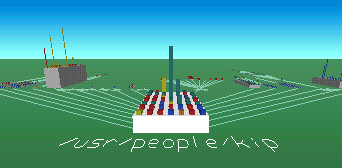
That program does exist. It is called "3D File System Navigator for IRIX 4.0.1+"
More information on this page
Similar systemes do exist like the linux clone called fsv -
I love it-Being Branded.
"Combined together these factors have lead to some amazing corporate frauds and espionage."
Yup. The virtual world is becoming more like the real one. -
Assuming that I got educated tomorrow.
Questions, questions. The first degree is obviously psychology (either alone or as part of another degree. Usually a M.S.)
http://www.si.umich.edu/msi/hci-reqs.htm
http://informatics.iupui.edu/academics/hci/hci_ms_ requirements.php
"I've always been fascinated by HCI but have yet to be able to pursue this in a work-related setting (where I tend to write backend code, basically as far away from users as you could possibly get)."
You may already have some of the requirements (see above). Fill in the rest, either self-study, or part-time schooling. But you have to be serious about this field. It's a LOT of work to become good.
Here's an example of some of the things HCI produces. -
Re:It's not just 3D
"One could readily imagine many uses for immersive 3D environments from remote medical procedures to collaborative architecture to interior design to automobile sales to video games to many other things."
This bibliography is organized to provide a structured introduction to graphical interfaces to information systems.
Geospatial Decision Making Blends 3D World Visualizations With Background Data
IMPROVING HUMAN SPATIAL COGNITION OF BUILT ENVIRONMENTS USING COMPUTER GAMING TECHNOLOGY -
Re:3D not for Web but perhaps for file system
-
Re:3D not for Web but perhaps for file system
-
Go for it!-Serious Games
"But here is the deal.... We are not looking for people to help administer our systems. That is relatively easy to do, particularly with operating systems like OS X. You have to be bright and willing to work on *new* problems particularly those dealing with data management and visualization. Many comp-sci students want to go create games and there is a market for that, but where the technology for games really comes from is basic science research dealing with real-world problems. And in fact, some games and game engines are now being applied to real world problems."
Here's a question I'm certain no one will see. I've been researching various game engines for the purpose of serious games and I have a small collection. The question is, what engine(s) are the best for the purposes of "serious games", and what about the new ones coming out this year? Second how is the "middleware" market for tools that sit on top of these engines, and cater to serious games? And last how do games fit into the alternative visualization field?
"There are a couple of exciting projects I am working on in these fields, namely I have just been asked to sit on the board of a media group that will deal with some of these issues and real world application of games and other digital media. Alexander Seropian (of Bungie fame) is also on this board and it should be interesting to see where this goes. Additionally, our research in a new area of bioscience called metabolomics looks ready to take off and we are working with a number of comp-sci graduate students, post-docs and faculty to create tools to deal with the types of data we use to pick out signatures of cells much like the CIA and NASA use to determine signatures of "things" they are interested in. Also data management and communication is another field that is very much in demand and we are working with groups to help us create databases that can be mined and used interactively to collaboratively annotate and discuss data with multiple users."
Data Mining Solutions: Methods and Tools for Solving Real-World Problems covers some of that. A side-avenue is alternative means of displaying that data. BTW you don't need to be a computer scientist to get into the "application of" some of these tools. -
V-Chat and Tablet PC MSN
V-Chat was a program from about 1999 where you could hover around as a sprite based avatar in a bland 3D world. It was really just like IRC but with a 3d area to walk around.
One plus with this program was that you could make your own avatars, upload them to your personal web space, and link to them from the client. Voila! Everybody saw your custom avatar for free. The saddest thing was that people made humps with eachother by walking up to them and ducking and standing repeatedly... i know from experience
For those of us with Tablet PCs, MSN Messenger automatically offers ink as an option for chatting. All MSN Messenger users with a new-enough (ver 5+, i think) version of the program can see the ink.
By the way, does anybody ever remember the 3d web browsers? They never seemed to get popular at all, and they were usually free! -
More 3d UI's
It contains applications that are mostly file system representations but interesting nonetheless.
Nooface - 3D UIs -
Re:Another Linux 3D file manager
My site has been collecting 3D UIs for some time.
Here are links to some of the 3DUIs that are available today:
- FSN (pronounced "fusion") produces a cyberspace rendering of a file system. This was the original 3D file system navigator shown in Jurassic Park ("Hey, this is UNIX. I know this!").
[Screenshot] | [Download] (IRIX)
- FSV is modelled after FSN, but runs on Linux. FSV lays out files and directories in 3D, geometrically representing the file system hierarchy to allow visual overview and analysis.
[Screenshot] | [Download] (Linux)
- Xcruise lets you fly through a filesystem in 3D as if it were interplanetary space. Directories are represented as galaxies, files are represented as planets (whose mass is determined by the file size), and symbolic links are represented as wormholes.
[Screenshot] | [Download] (Linux)
- TDFSB is a 3D filesystem browser for Linux. Take a walk through your filesystem!
[Screenshot] | [Download] (Linux)
- Visual File System is a 3D file system visualizer for Windows. The tool scans a drive selected by the user, and then models the contents of the drive in 3D, based on the directories that are selected in a tree browser on the side of the display.
[Screenshot] | [Download] (Windows)
- 3Dtop is an extension for Windows that represents desktop icons in 3D, letting you to fly around your desktop. You can create coloured spotlights, background and floor textures, "paintings" (bitmaps), clocks, and "flags" that represent shortcuts.
[Screenshot] | [Download] (Windows)
- ROOMS turns a Windows desktop into a 3D world. You can see the world either through a first person perspective or with a map view, and you can populate the world with sounds, animated images, and 3D icons.
[Screenshot] | [Download] (Windows)
- CubicEye organizes windows into a navigable cube. Cubes can be arranged by thematic or functional subject matter, and can be explored either individually or collectively as part of a more comprehensive structure of multiple cubes representing various areas of interest.
[Screenshot] | [Download] (Windows)
- Vizible WorldViewer distributes windows across the exterior and interior surfaces of spheres, providing the means to visualize and navigate large numbers of web pages and data sources simultaneously.
[ -
Theres ALOT more than just those two.
Theres dozens, theres a few that are pretty good, no they arent as good as Doom3(until ID releases the source) or Turbines engine, but they dont have to be, they just have to be good enough to make PS2 quality games.
Most of these games would look better than anything on the PS2. There is an open source game repository but are you willing to donate money to make these games good? Or will you complain about quality when you dont pay?
Well here are some engines.
Genesis3d
Nooface
WorldForge
Reality FactoryM
Ogre
Obsidian
More at LinuxGames -
NooFace.net
Cruise on over to NooFace to check out some news on UI design. This guy started this Slashdot cloned space so that we could discuss alternate user interfaces. It looks pretty promising, just needs a few more users.
One thing I am interested in is getting rid of WIMP. I don't know what to replace it with (if I did, I would probably be a rich/famous man!), but I tend to like the zooming interface concept. This is where everything is all laid out in a single plane and you just zoom in and out on different areas to get where your going. -
Re:Interesting Work
What will the next major user interface metaphor be? You might want to check out NooFace.net.
-
Great site for this stuff
There's a great Slash-based site with loads of articles examining potential next-gen interfaces. Not a huge amount of traffic yet, but the editor seems to be consistently putting up new articles. Check out Nooface.
--LP -
Zooming User interfaces and othersThere is some work done on Zooming User Interfaces. A bunch of links, along with Java demos and toolkits, can be found on this site: http://nooface.net/.
A number of other possibilities are discussed in Jef Raskin's book The Humane Interface.
Then there is the whole Lifestream concept.
-
New discussion site for post-WIMP interfaces
This is exactly the topic of the new Slash site that I just set up at http://nooface.net. The goal of the site is to promote out-of-the-box thinking about truly next-generation user interfaces that are designed for new types of users and computing devices, and go beyond the WIMP (Windows, Icons, Menus, Pointing Device) method that most current interfaces are based on.
Nooface
In Search of the Post-PC Interface -
New discussion site for post-WIMP interfaces
This is exactly the topic of the new Slash site that I just set up at http://nooface.net. The goal of the site is to promote out-of-the-box thinking about truly next-generation user interfaces that are designed for new types of users and computing devices, and go beyond the WIMP (Windows, Icons, Menus, Pointing Device) method that most current interfaces are based on.
Nooface
In Search of the Post-PC Interface