Slashdot Mirror
Domain: nsidc.org
Stories and comments across the archive that link to nsidc.org.
Comments · 236
-
I'd take those odds
If there was anyway to definitely prove it. We don't know anything about the entire passage prior to 400 years ago, but people have been interested in trying to find a way through continuously since then. If the passage in the last 400 years was ever as wide as it is now, it would have been easily spotted. Have you seen the satellite pictures? Here's a source that has a history for this summer.
-
Tell me, Mr Anderson......what good is a vast prairie covered in ($biofuel) when you have no... rainfall?
2007 arctic sea-ice is an unprecedented 20% smaller than the previousrecord low year - 2005.
http://www.latimes.com/news/printedition/opinion/la-oe-macdonald13jul13,1,4424613.story?coll=la-news-comment&ctrack=1&cset=true *shrug*
-
Re:A solution to all of this FUD...> that as more and more analysts take a gander
And produce a report like, say, the upcoming IPCC synthesis report? Where lots of analysts "took a gander"?
Or just the selection of NOAA climate data that's free? Or, did you want to look at, for example, sea ice data?
Reallly, people. There's boats of data out there. Sure, it may not be in a "trusted" place (btw, who exactly would the contrarians consider trusted here?).
Have at it.
-
Hello, Spiegel
But it quickly became apparent that the horrific tale of a melting South Pole was nothing but fiction. The average temperature in the Antarctic is -30 degrees Celsius. Humanity cannot possibly burn enough oil and coal to melt this giant block of ice.
Hello, Spiegel. Let me introduce my friend, the Larsen B ice shelf, along with Journalistic Integrity. No, you haven't met. -
Re:Global warming?
-
Re:Someone should tell the car companies
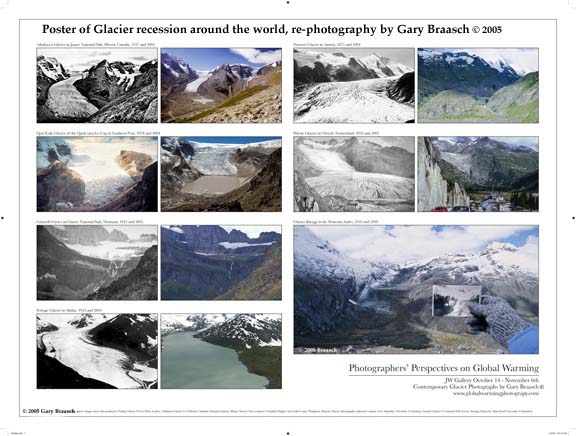
Speaking of "An Inconvenient Truth," this reminded me of all the before and after pictures of glaciers and such. Here are a few: melt
-
Re:Risk assessment is lowered, politics apart
certainly possible. We have what? 140,000,000 square miles of ocean? To raise the sea level by 1 foot suddenly means an event involving 28,000 cubic miles of surface ice falling into the ocean in a short timespan (a year or less, perhaps). Assuming a 100 foot thick ice sheet, we're talking 1,400,000 square miles. Somehow, I don't see that as a reasonable event, GIVEN CURRENT CONDITIONS.
Yes, the conditions will change. But they are unlikely to change in such as a way that a piece of ice 100 feet thick and half the area of CONUS (CONtinental US == USA minus Alaska and Hawaii) might fall from land to sea without a significant warning - decades, most likely. Which gives us the decades needed to do the planning required to deal with it. (Bold emphasis mine)
In 2002, 3250 square km fell off the Larsen B Ice shelf over a 35 day period. That converts to about 1255 square miles while the thickness is hard to determine. Assuming there are 100 feet of ice above sea level, thats a little over half an inch in 35 days from a single ice shelf. Also, that article goes on to explain how the most likely cause of the break is climate change. There are other articles about the Ross Ice Shelf and its possibility of sudden collapse. As I'm sure you know, current conditions aren't the only factors that influence the ice. The 2005 deterioration of the B-15 iceberg off the Ross Ice Shelf is suspected to have been caused by a storm near Alaska that produced waves strong enough to break up the ice. The faster icebergs deteriorate, the faster the their ice is turned to water and added to the ocean's volume. I'm not trying to say that this iceberg could raise the sea level by a foot, I'm just trying to demonstrate how it is surely possible for these things to happen relatively quickly compared to decades or a century, and that 2 billion more industrialized people are not needed to cause it.
Even more so, these icebergs are similar to ice or snow on a roof (think 10 inches). As they melt, the edges fall off first. As the edges melt, due to a variety of reasons including internal temperature, mass, gravity and surface area , the rest of the snow melts and falls off at increasing speeds. The icebergs will not melt at a constant rate.
I'm much more concerned that the changes in salinity caused by massive amounts of land-ice going into the oceans will cause - shutdown of the thermohaline conveyer is not totally impossible.
I agree with you, this is a serious concern. Its also hard to know what the effects would be of combining global warming with a potential ice age due to the conveyer shutting down, or any other effects that might come from that.
Now, do you have a solution?
No, and I don't claim to have one. Again, I was just trying to show why I don't think that an increase in global temperature will produce more habitable and fertile land.
I think its important to again point out how this thread started. I'm not saying that I'm completely right on all of this. My goal to show that he was wrong. If you look at the initial post, I don't think you'll agree with that much of what he said anymore, or at least you won't say that he is right with high certainty. -
Re:Crazy weather
Three days of unseasonable weather in a single location is now proof for a theory that encompasses an entire planet's climate change that would last for (at least) centuries?
What the fuck has happened that real science being discarded for knee-jerk reactions is commonplace and winked at around here? Knee-jerk? I think people just add it to the already mounting evidence that global warming is as real as it gets. Less anyone else around here thinks that losing 720 billion tons of ice from Antartica in 35 days is natural -
Really? Where?
-
The effect is negligibleWhile technically you are correct, practically the effect is irrelevant.
In a paper titled "The Melting of Floating Ice will Raise the Ocean Level" submitted to Geophysical Journal International, Noerdlinger demonstrates that melt water from sea ice and floating ice shelves could add 2.6% more water to the ocean than the water displaced by the ice, or the equivalent of approximately 4 centimeters (1.57 inches) of sea-level rise.
So if all floating sea ice melted sea level would increase just 4 cm. In contrast, if the glaciers in Greenland melted (which you would think would have to happen if all floating sea ice melted), sea level would increase by an estimated 6.5 meters. Losing the Antarctic ice masses (which again would have to happen for all floating sea ice to melt) would increase sea levels by nearly 75 meters. The 4 cm contribution you point out is completely negligible except from an academic standpoint.
-
Re:Language and assumption troubles
"We can extract ice cores and easily date the layers."
No, actually, we can't. You're thinking _ANTARCTIC_ ice layers, not Arctic. Arctic ice is _sea ice_ and as sea ice, it melts and refreezes and it _moves_ all over the damn place.
Arctic sea ice oscillates twice a day.
"Contrary to historical observations, sea ice in the high Arctic undergoes very small, back and forth movements twice a day, even in the dead of winter. It was once believed ice deformation at such a scale was almost non-existent."
http://www.jpl.nasa.gov/releases/2004/107.cfm
And there are larger circulations at work, too.
http://nsidc.org/seaice/processes/circulation.html
And ice cores? The ice at the Arctic was 9 feet thick _at its thickest parts_ back in 1958. Just where are you going to get ice cores?
"http://www.agu.org/sci_soc/prrl/prrl9935.html"
"the rate of change is unprecedented"
Prove it. You just pulled that statement _right out of your behind_.
The rate is unprecedented, because _nobody has measured it before_. We've only been measuring since 1958. We don't know if this is a long term cycle or not. There's _not enough data_. Using your thought process, the "Little Ice Age" was "unprecedented"
too, and were that happening today, you'd be screaming about how we're all going to die because we'll all freeze to death.
I stand by my statements, as they're backed up by fact. Your post, however, certainly _is_ handwaving.
--
BMO -
Re:dumbass!
Okay, so let's see. We have data on both sides of the balance. What can we make of it?
On the one hand, we have ONE group of west Himalayan glaciers which are remaining constant or maybe even growing a bit. Meanwhile, the other NINETY FIVE PERCENT of Himalayan glaciers are retreating. http://observer.guardian.co.uk/international/story /0,6903,1646656,00.html Also, note that the Himalayas (east and west) have a total of 34000 sq km of glaciers.
On the other hand:
There are 1834000 sq km of glaciers in Greenland, which are shrinking. Oh, and the rate of melt is ACCELERATING. Greenland showed a record melt in 2002m ap
And of course there's Antarctica, with the world's largest ice mass, which has been losing thousands of sq km each year. http://nsidc.org/iceshelves/
Hmm, but those are just individual parts of the world. We can't possibly draw a conclusion from such limited data without viewing the overall picture... http://images.google.com/images?q=glacier+mass+bal ance+global+OR+cumulative
So, according to Fragmer, thousands of data points confirming loss of glaciers can be counterbalanced by one study that showed the POSSIBILITY of one glacier growing. What a convenient way to view the world.
Great subject line, by the way, and thanks for finding those WMDs. -
Re:That boat has sailed
We as a race of beings are totally insignificant. period. We possibly could change the climate of the world in a rapid fashion if that was the sole goal of all humanity. But one random belch of unusual solar activity or a volcanic eruption could undo all our efforts, or do the job far better, in half the amount of time.
We as a race of beings have more biomass than any large animal that has ever walked on Earth and we change our environment to suit our desires on an unprecedented scale. Of course there are other aspects of nature that can cause massive change (and occasionally do). That does not mean we should ignore the effects of the part of nature called humanity.Other areas that are classic fear tools (such as the polar ice caps) are seeing a net increase in that surface feature which is contrary to public desire/opinion/fear
Over what timescale? Looks like a downward trend to me. -
It's a Glacial formation!
Hey that that kind of looks like the rocks here or here or here or here.
and check out these regularily "cut" bad boys here.
But how do you explain natural pyramids?
Oh I don't know maybe this quote:
"If the glacier erodes three or more cirques on different sides of the mountain, a peak will begin to form. The peak may be a steep pyramid shaped rock, which is known as a horn. The Matterhorn in the Swiss Alps is a well known horn."
Yah! -
Re:WSJ, say no more.
The majority opinion isn't always right, this is true.... but anyone who has seen anything at all about, say, receding glaciers link to photo compares (there are several of these sites from the USGS and other associated government groups on the web) knows that something is happening, just not what the consequences of it will be....
-
Re:Open and ShutThe guy's area is climatology. And as I see it, he was just talking about his research and making it relevant as scientists are wont to do. NASA people have been talking about climate change in meetings and in departmental lectures at LEAST since the early 1990's when I went to American Geophysical Union meetings and studied space physics. What has changed is this:
- There is an administration in power that is heavily invested in oil.
- Said administration has a history of suppressing scientific data - in fact they have taken it to a new level. Ask the Union of Concerned Scientists what they think.
- Said administration has defined this man's science as policy. It never used to be policy to state such things.
The evidence is getting more and more clear that what I was hearing about climate change in the early 1990's was, in fact, true see here for example. You can also read National Geographic, which does a story about how climate change affects real people every month. Last month, an author went to the Alps and found that the glaciers were melting and that businessmen were concerned that in 30 years many low lying resorts would have to close. This month there is an article on how traditional peoples of the Arctic are worried about drowning. The Arctic ice is melting more than ever before. Every country but the US seems to "believe" in climate change. The evidence is also getting more and more clear that we are the cause of this warming.It seems to me that the Bush administration is upset with this scientist because he is interfering with their policy of keeping the truth about climate change from the American public.
-
Re:Look at the balance points
That requires accurate measurement of precipitation across (sometimes) many square miles of glacier - something we are not doing. So your 'control' is loose at best.
The precision of the data constrains the precision of the conclusion, yes that is true in all science. It does not necessarily invalidate all conclusions. Estimating your potential error is part of doing research.
No, this means that less snow is falling than is required to replenish the glacier. The historical average is meaningless in this instance.
Actually it does not necessarily mean that--did you read what I wrote? A glacier can shrink regardless of how much snow falls on it, if the rate of melting exceeds the rate of replenishment.
Further, the rate of down-valley movement, location of the terminus, location of firn line, and the shape of the glacier can tell you a lot about what is causing the retreat. A glacier with a low firn line, thin firn, and low rate of advance is probably retreating because of decreased precipitation. A glacier with a high firn line and high rate of advance, but retreating terminus and losing mass, is more likely to be retreating due to increased melting.
Certainly it's a clue that something is changing. The question confronting scientists is this; what is changing in the local enviroment and is it representative of a change in the global enviroment? Is is part of a trend? Is it part of a cycle? Once cannot simply say; "the glaciers are retreating! the sky is falling!"
All good questions if you are considering one glacier. But the data shows that alpine glaciers all over the world are retreating. The Global Glacier Mass Balance shows negative mass change for all but 3 of the years since 1960! There is simply no way you can ask if there is a global trend if you're aware of the data. It's blatantly obvious--across the world, alpine glaciers are in retreat.
And I'll point that I did not say anything like "the sky is falling." I said alpine glaciers are retreating, and they're doing it in a way that points the finger at melting due to higher temps.
And in the Year Without A Summer there were hundred of reports of crops freezing, rivers frozen in unexpected places and times, etc... Layman's testimony is essentially meaningless as human memory is extremely plastic
Memory may be plastic but photographs and printed climbing route descriptions are not. I have a copy of Climbing Magazine from the early 90's with an article about climbing in Peru's Cordilla Blanco. Many of those routes are now unclimbable because what was clean ice and snow fields is now crumbly exposed rock. This is also occurring in the Alps, in North America, in New Zealand, in Africa (where the "snows of Kilimanjaro" are almost gone), and even in Asia, where the Khumbu glacier on Mt. Everest is in retreat.
If scientists were really as responsible as they claim - there would be calls from them for $MEGA dollars for increased research. There would be concrete plans being laid for a global monitoring network in order to provide the fine grained data we need.
Instead we get articles about Kyoto and simulations. No wonder even intelligent people don't trust them anymore.
Uh, there ARE those calls and plans. The problem isn't that the scientists aren't ringing the warning bell, the problem is so-called "intelligent people" like yourself who refuse to educate yourself and who ignore the problem. Try digging a little deeper and caring a little more. -
Re:Let me be the first troll to say
"Massive flooding along costal areas "
Well of your un-substantiated claims lets look at this one.
http://nsidc.org/sotc/sea_level.html
So we are looking at 0.42mm a year, due to glacial melt. To reach the claimed 80 Meters of sea level rise that is bandied about for all the claims of coastal flooding it would take 190,000 years to reach that level, since your worried about warming to increase, let's halve that to 95,000 years.
EVERYONE RUN WE'RE GOING TO FLOOD, YOU ONLY HAVE 94,999 years, 11 MONTHS AND 364 DAYS LEFT!!!!!!!
Hell in 100 years we are going to have 4 CENTIMETERS RISE IN SEA LEVELS!!!!!!!!
I'm not worried about it. I expect we'll have evolved gills or wings or something by then, and I'm sure we'll run out of fossil fuels by then, unless Gold is right.
And to shrinking food supplies. Can I ask why food output has steadily increased during the supposed dangerous warming for the 20th century. Hint: Plants love CO2 and warmth, expect bumper crop report again this year, and as we go forward into the future. -
Re:Sea ice will not make any difference in sea lev
The volumes are not the same, due to density differences. See http://nsidc.org/news/press/20050801_floatingice.
h tml
This URL has a couple of photos demonstrating it it--ice cube in a beaker.
Also from that URL: "In a paper titled "The Melting of Floating Ice will Raise the Ocean Level" submitted to Geophysical Journal International, Noerdlinger demonstrates that melt water from sea ice and floating ice shelves could add 2.6% more water to the ocean than the water displaced by the ice, or the equivalent of approximately 4 centimeters (1.57 inches) of sea-level rise." -
Re:It won't work, and why bother anyway?
-
Re:This != Global warming
Ice drilling polar bears?
Actually, that's what it was.
But climate scientists are covering it up because as everyone knows, there's a lot more money to be earned scaremongering in universities than reassuring multinational oil companies that everything's just dandy.
Incidentally, here's a groovy NASA animation of the Larsen B ice shelf breaking up and floating out to sea. -
A Few things that did happen.
A few things that you may have missed:
1) Record high temperatures in Europe causing drought and an estimated 35,000 deaths.
2) Global mean surface temperatures have increased 0.5-1.0F since the late 19th century. see here
3) Sea level has risen 4-8 inches over the past century, not good for coastal habitats (Same source at #2).
4) The Larsen B Ice Shelf Collapsed dumping some 720 Billion Tons of Ice into the sea.
Based upon these, arguing that nothing has or will happened is a little foolish don't you think?
As others have pointed out the term Global Warming connotates a rise in average temperature overall not a rise in every local temperature. The 'fact' that it may or may not be colder in some parts of the world now than it was previously does not disprove the theory by any means.
If you have references for your assertions I would be glad to see them. -
Re:Mr. Vice President, a Piece of Ice the size of.
the movie was quoting something that actually happened
-
Re:Terrific!
Hate to disappoint you, but Antarctica has been cooling for years:
It ain't that simple. The pole seems to have cooled slightly, and most of Antarctica seems to show a statistically insignificant warming trend, but the Antarctic Peninsula is showing warming of about 2.5 degrees over the last 50 years (take a look at the graph on this page). Which is why Antarctic ice shelves been retreating for 30 years. -
That's where the Arctic haze comes fromI'm not surprised about the concentrations of pollution in Northern China and Siberia. The Soviets put quite a lot of industry in Siberia (why?) and it pollutes a lot. After all, the folks in Moscow were never going to smell it.
In Alaska, we often see a hazy sky, caused by pollution from Siberia and points east.
For the long term, we should probably be more worried about the Soviet nuclear waste the Soviets and now the Russians have accumulated in the Arctic and Pacific Oceans. Then there's the nuclear plants, two of them in Siberia, that we're down wind of. They were built by the same government which brought us Chernobyl.
If you're looking for things to worry about, you'll never run out.
-
I'll say it again...
Like I said before, the Larsen B Ice Shelf in Antarctica collapsed in 2002, and exposed glaciers have had accellerated movements and melting. Could all this melted ice have affected the carbon sink capacity of the oceans, since this unexplained leap in CO2 coincidentally started around the same time?
Oh, and I just watched The Day After Tomorrow on DVD, and it was all about cataclysmic natural disasters, and the movie began with the collapse of the Larsen B Ice Shelf. Coincidentally, I watched it after my previous post about the ice shelf, without knowing the movie was going to mention it. Kind of wierd.
-
I'll say it again...
Like I said before, the Larsen B Ice Shelf in Antarctica collapsed in 2002, and exposed glaciers have had accellerated movements and melting. Could all this melted ice have affected the carbon sink capacity of the oceans, since this unexplained leap in CO2 coincidentally started around the same time?
Oh, and I just watched The Day After Tomorrow on DVD, and it was all about cataclysmic natural disasters, and the movie began with the collapse of the Larsen B Ice Shelf. Coincidentally, I watched it after my previous post about the ice shelf, without knowing the movie was going to mention it. Kind of wierd.
-
Ice shelves
Could this have something to do with the increasing collapse of ice shelves in the Antarctic? Perhaps there is some relationship between the Ozone hole beginning to shrink and the collapse of the Larsen B Ice Shelf, which both coincidentally happened in 2002. Maybe the collapse and accellerated glacier movements triggered some environmental chain reaction that affected the Ozone hole, but in a superficial way that temporarily masks a continued climate change.
-
Ice shelves
Could this have something to do with the increasing collapse of ice shelves in the Antarctic? Perhaps there is some relationship between the Ozone hole beginning to shrink and the collapse of the Larsen B Ice Shelf, which both coincidentally happened in 2002. Maybe the collapse and accellerated glacier movements triggered some environmental chain reaction that affected the Ozone hole, but in a superficial way that temporarily masks a continued climate change.
-
Ice shelves
Could this have something to do with the increasing collapse of ice shelves in the Antarctic? Perhaps there is some relationship between the Ozone hole beginning to shrink and the collapse of the Larsen B Ice Shelf, which both coincidentally happened in 2002. Maybe the collapse and accellerated glacier movements triggered some environmental chain reaction that affected the Ozone hole, but in a superficial way that temporarily masks a continued climate change.
-
snow job
When the ice shelf breaks off, we'll have bigger problems than a new Antarctic base. Like Manhattan transformed into a 3rd Millennium Venice.
-
Re:Vector analysis
-
Re:I you have to wonder thatI present
The Warming
starring CO2, the Earth and the Humanssince we started measuring (~100 years)
420,000 years BP
Particularly interesting is perhaps this bit:The recent completion of drilling at Vostok station in East Antarctica has allowed the extension of the ice record of atmospheric composition and climate to the past four glacial-interglacial cycles. The succession of changes through each climate cycle and termination was similar, and atmospheric and climate properties oscillated between stable bounds. Interglacial periods differed in temporal evolution and duration. Atmospheric concentrations of carbon dioxide and methane correlate well with Antarctic air-temperature throughout the record. Present-day atmospheric burdens of these two important greenhouse gases seem to have been unprecedented during the past 420,000 years.
Emphasis mine.Nature has published a lot of interesting reports on the subject over the years and they have an excellent search engine. Give it a shot.
Bonus info on the recession of the world's glaciers. Just because you asked nicely.
And I leave you with this:
These ice cores show a 20th century isotopic enrichment that suggests a large scale warming is underway at low latitudes. The rate of this isotopically inferred warming is amplified at higher elevations over the Tibetan Plateau while amplification in the Andes is latitude dependent with enrichment (warming) increasing equatorward. In concert with this apparent warming, in situ observations reveal that tropical glaciers are currently disappearing.
Tropical glacier and ice core evidence of climate change on annual to millennial time scales.. -
more galleries
-
Re:About Time!
At least they didn't put the highway across the Larsen ice shelf. Then it would become the mickey mouse water show.
-
You got to be kidding me....
After seeing this Ice Berg from Ross Shelf I'm not sure thats such a good idea at that location if things keep warming up.