Slashdot Mirror
Domain: nycsubway.org
Stories and comments across the archive that link to nycsubway.org.
Comments · 42
-
Re:OSHA violation of the day
Of course, these tunnels are blatant violations of all tunnel safety regulations: They don't comply with railroad tunnel safety requirements, highway tunnel safety requirements, or even the most lax of mine safety requirements.
There are no Federal train tunnel safety requirements whatsoever. The Federal Railroad Administration "determined that regulating bridge or tunnel structural conditions or requiring inspections would not be cost-effective to FRA when considering the cost of implementation and enforcement."[Page 22] What little Federal oversight of railroad bridges and tunnels exists happens only as part of track inspection, and there is no Federal standard to which those inspectors work.[Page 23]
There are no Federal highway tunnel safety requirements either. The only thing that exists are preliminary recommendations from the NTSB and a committee to conduct research about the possibility of issuing guidelines from a group of state departments of transportation representatives, the American Association of State Highway and Transportation Officials T-20 Tunnels committee. Neither of those existed before the ceiling collapse in the I-90 connector tunnel in Boston in 2006.
What voluntary, industry association guidelines exist are intended to deal with designs where internal combustion engines are allowed to operate inside them and, in the case of highways, where every vehicle uses its own independent steering to navigate the tunnel. Neither is the case in a Boring Company tunnel. Boring Company tunnels are effectively subway tunnels. The New York City subway system tunnels are just 18 feet high at the center, less at the edges. Boring Company tunnels are 14 feet high. You're telling me that 4 foot difference is the difference between life and death? I call bullshit. Whether or not you can walk out of a 14 foot tunnel in the event of a fire depends entirely on the ventilation system and fire safety systems in the tunnel. There is no public information whatsoever about what those systems may be in Boring Company tunnels, so no conclusion is possible at this time.
Stop blathering about things you know nothing about.
-
Re:Useless
Possibly of use to you:
http://images.nycsubway.org/maps/spui_nyc_subway_map_1224px.pngThat is what I think the maps should more resemble. YES, it know it isn't very polished. Please assume the actual map fit for publishing was cleaned up a bit. Look over a city road map and you'll see more detail then even in that map without crude elements that make this map look bad. Just look at the information.
Ideally, I would super impose or integrate this map with a regular city map so that you could very easily see where you were in the city AND the subway system just by looking at ONE map.
-
Re:Current map?
This is a few years old, but a pretty good example. It's the first thing I looked for too.
I'm not a native NY-er, but I'm pretty familiar with the city and I'm good with maps. If I need to go from Manhattan to Brooklyn, I know in my head where I'm going on the map. This thing distorts a traditional map so that geographically you're all messed up.
Probably the best thing the MTA can do would be to make separate maps for the different lines or even just the different boroughs. Or just have a friggin' touch-screen kiosk that will tell you what train to get on. -
First "user interface" with any smarts
He was also the Father of the User Interface. He was the first to take human factors into consideration in the design or products.
No, that goes back at least to the Gilbreths. Frank Gilbreth created time and motion study for industrial work. His wife, Lillian Gilbreth was more on the product side. She is responsible, among other things, for kitchens with long continuous counter space with cooking surfaces and sinks at the same level.
The first "intelligent user interface" is hard to pinpoint. Railroad interlocking control boards were close. They prevented the operator from doing anything that would cause a collision (that's why they're called interlockings) but didn't help set up routes. The General Railway Signal NX system in 1936 was probably the first automatic intelligent user interface. Routes were set up by pressing a button to indicate where a train was going to enter the controlled area. Lights on a track model board would then light up indicating all the places it could exit. The operator would select one, push one exit button, and all the switches and signals for the route would be set accordingly. The control system took into account all trains present, and all routes already set up, so only safe routes could be set. The operator could even set track or switches out of service and the system would route trains around the area of trouble.
-
Re:Isn't this an old idea?
Since you obviously know more about their system than me (seriously, not sarcastically), where does the power come from? Oh, never mind, I found the answer.
The NYC subway system is amazing. I, like most people who have used it, know that we get from Point A to Point B rather efficiently.
-
Usual obvious stuff
The article re-hashes the obvious.
There's a whole history of early graphical user interfaces from the pre-computer and early computer era.
One of the neater ones was the Panama Canal lock control boards, built by General Electric in 1913. This was a long desk with a symbolic model of the locks. The water level in each lock is represented by the tall indicators. The lock gate positions are represented by aluminum pointers. The protective chain lifted into position to protect the first lock gates from a runaway ship was represented by a little metal chain. The locks themselves are represented by a long strip of blue-grey stone. (The first GUI theme!) The valves are controlled by water faucets, and the gates by handles.
All this is interlocked mechanically, so, for example, that the lock gates can't be opened unless the water levels are equal on both sides. The handles will physically not turn. That technology was borrowed from railroad signalling.
Another system of historical interest is General Railway Signal's NX interlocking system., from 1936. This is the very beginning of "user-friendly" GUIs. Previously, interlocked systems in railroad signalling, and the Panama Canal system, just prevented the operator from doing prohibited operations. NX was the first system which showed the operator all the currently valid options, let the user select one, and took care of the details of making it happen. It's well worked out. The operator selects the entrance point where a train is entering the interlocking. The system figures out all the currently valid exit points, taking into account other trains currently present, conflicting routes, etc., and lights up illuminated buttons on the track diagram for each currently allowed exit point. The operator then selects one exit point. The system then moves all the track switches as necessary, waits until they're set and locked in the correct position, then sets the signals along the route to clear. As the train passes through the interlocking, the signals change to "stop" behind it, and the track sections and switches are automatically freed up for other trains. At all times, there's at least one stopping distance of red-signaled track between any two trains, and any switch in a green-signaled section cannot be moved until the train clears it. The New York City subway system still uses this technology, along with mechanical train stop devices at every signal which, if up, will hit an air valve on each subway car and stop the train. There's a simulator if you're interested.
It's worth understanding the big display-board systems of the past. Many of them had better human interfaces than modern systems.
-
Argument similar to automated NYC subway trains.
This is similar to the fate of automated trains in New York City during the 1960s. GE and Westinghouse rolled out a two-car consist and demoed the technology on the 42nd Street shuttle. It worked for about four years (with passengers not noticing much difference other than harder braking), but a fire near a switch on the line (that wasn't caused by the cars) caused a huge uproar against the project, forcing the MTA to scrap the idea completely. The closest concepts we have to this today are one-person train operation, which the elevated's in Chicago have been doing for years. See here for a better read.
I would imagine that the same issues apply here, even more so considering that cars cause way more deaths than trains/planes/etc do. -
Previous tube systems.
Several cities once had sizable pneumatic tube systems. London, Paris, Berlin, Prague, and New York City all had extensive systems. Tube diameters were small, though, in the 2" to 3" range. The Prague system was the last to shut down, in 2002. Prague is repairing their system, and it may come back up.
The London system had the ability to automatically transfer carriers to and from from public tubes to "house systems" within a building. So it could provide end to end service. Most of the other systems were post office to post office only.
The Chicago tunnel system had almost full coverage of downtown Chicago a century ago, with small electric trains in freight tunnels under most of the downtown streets. Goods were transferred from full-sized rail cars to tunnel cars, which were then delivered to buildings in the city and carried upward in special elevators. That system ran until 1959.
Maintaining the infrastructure for such systems is expensive for the amount of traffic, though.
-
Pre-1950 systems with configurable defaults.
I'm trying to think of something prior to 1950 that had an overridable, configurable default. It's hard. Business telephone systems had some configurable defaults, but setting them up required physical wiring. The same was true of Plan 55-A Teletype message switching. IBM plugboard-wired tabulators didn't really have defaults as we think of them today. Machine tools had adjustable speeds and feeds, but no real defaults. Jacquard looms didn't have defaults. Linotypes didn't have defaults. Chain-programmed embroidery machines - no.
The closest thing I can think of was General Railway Signal's NX signaling system for controlling railroad interlockings. This 1930s system may have been the first "user-friendly interface". An NX system controlled multiple switches and signals in an area (an "interlocking") preventing conflicts. Interlocked signal controls had been around for years, and they handled the safety issue, but before NX, it was the user's responsibility to figure out the desired path from A to B. With an NX system, you selected an "entry" point where a train was going to enter the interlocking, and all the reachable "exit" points would light up. The "reachable" logic took into account other trains that were in the interlocking area. When the operator selected an "exit", the NX system would pick a path between the entry and exit, routing around other trains or even track locked out of service.
A default "best" routing was hard-wired into the system, but the operator could override the default routing manually, by picking some intermediate point along the path as the "exit", then selecting that as an "entry" and picking the final "exit".
That's the oldest system I know of with a real "default" mechanism.
-
Quite topical considering....
The complaints of taxes on downloads in NY that were made today. NYC has had an unsustainable population since the early 1900s. From this story
Probably it had not been for the blizzard the people of the city might have ignored one for an indefinite time enduring the nuisance of electric wires dangling from poles, of slow trains running on the trestlework, and slower cars drawn by horses in the streets dangerous with their center tearing rails. Now two things tolerably certain that a system of a really rapid transit which cannot be made inoperable by storms must be straightaway devised and as speedily as possible constructed and that all the electric wires -- telegraph, telephone, fire alarms, and illuminating -- must be put underground without any delay.
At some point it will become nearly impossible to import enough food and merchandise to sustain the population of NYC as it is dispersed currently. Increasing the volume of locally produced food stuff will definitely decrease the cost of living there by some degree... if enough is produced there. Unfortunately, as the story details it, such efforts are also vulnerable to the elements if not encased inside the buildings themselves. In the terms of climate change I think this is necessarily appropriate to think of. The closer that NYC comes to being a city in a bubble, the closer we are to many science fiction themes... interesting.
-
Re:What is really wrong with trains?
I want a driver who can stop a train if there's damage ahead or a cow lying on the tracks.
And I want to get rid of the drivers, who don't exactly have a great "track" record.
-
Re:Give them to another city instead!
The redbirds were long past the end of their useful lives. Read this: http://www.nycsubway.org/cars/r262829.html
While still reliable given their age, it was no longer cost effective maintaining them. At a certain point, it becomes more affordable to buy new cars than to keep maintaining the old ones. These cars would bankrupt any city that couldn't afford to buy new cars. If a city can't afford to buy new cars, then they couldn't afford to maintain these ones.
They were also just not very nice anymore by any standard. They were at least 40 years old and had several million miles on them. The ride quality was similar to a soapbox racer. Seat comfort was an oxymoron. They lacked safety features such as electronic door obstruction indicators, which resulted in several well-publicized draggings down subway platforms and one or two near fatalities in just the last few years of service life. (The MTA actually flat-out refused to fix this problem towards the end, because they knew they were retiring these cars and saw no point in spending the money for the upgrade.)
They were "refurbished" in the 1980's but all that did was put them mostly back to the way they were in the 1960's. They did get air conditioning at that time, but by the end, it seemed like most cars' air conditioners were broken and the MTA again specifically declined to spend the energy fixing any problems that didn't result in trains being taken out of service. Keep in mind a broken air conditioner in these cars meant *hot* air was being blown into the car, not regular air or no air. A redbird with a broken air conditioner in summer is probably the last place on Earth I'd want to be. I'd be surprised if temperatures didn't reach 125 degrees on a regular basis in those cars.
At this point, 20 years on from their last refurbishment (and a couple million miles), they would have required another one to keep going. It costs about half as much to refurbish a car as it does to buy a new one.
So these "free" cars would have really only saved about 50% up front for any city that wanted them, then would have required a lot of ongoing maintenance. After probably only 3-4 years, that city would be behind where they would have been had they just bought new cars. And they'd be stuck with cars that were a borderline embarrassment and on which nobody wanted to ride. (New Yorkers rode them because we had to, not because we liked them.)
There comes a time when junk is junk. -
Re:Great idea
I wish there were some underwater photos showing what the subway cars are like after spending several years underwater.
Here are some from the reef in New Jersey: http://www.nycsubway.org/cars/redbird-scrap.html -
Re:More to it that speed
Or better yet:
http://images.nycsubway.org/trackmap/detail-soferry.png
Two loops for the price of one! The 'outer loop' is the 1 train's South Ferry Station, as well. -
Re:More to it that speed
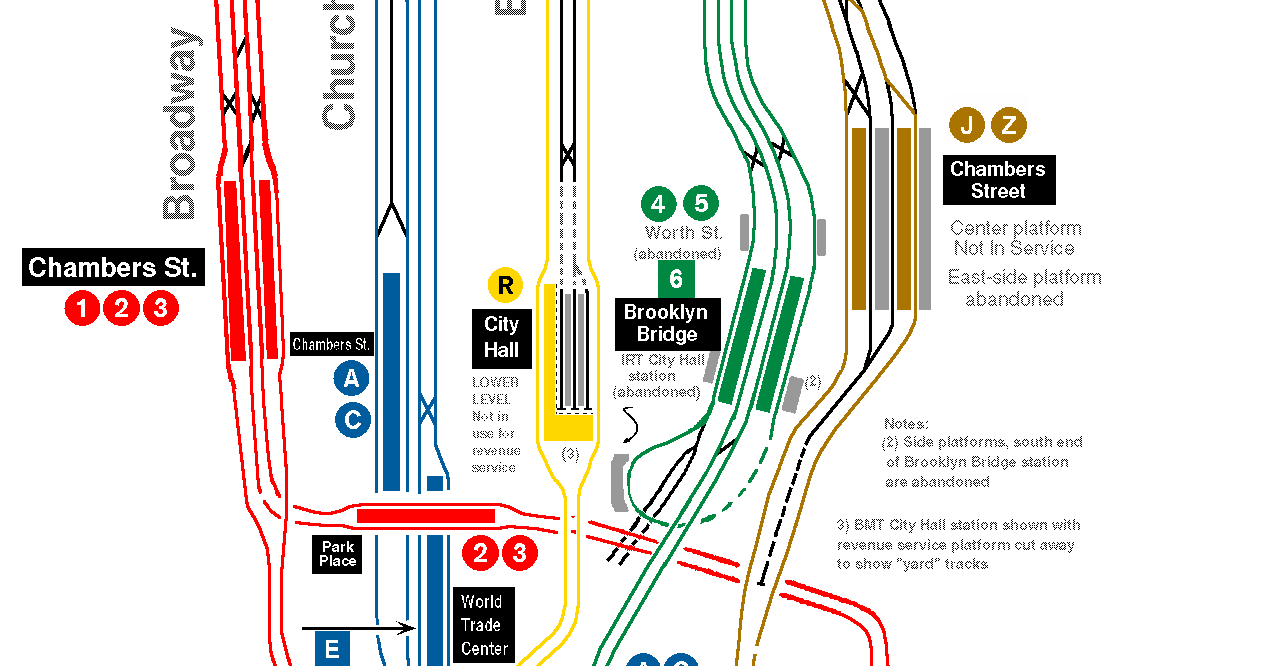
That's a fair point, but I don't see how the fact that it's done that way in Europe, has any effect on how it's done in NYC. Here's proof for you: Brooklyn Bridge-City Hall stop Area. Better yet, please come visit my city, and check out the Brooklyn Bridge-City Hall stop on the 6 line for yourself; then you'll see it turns around. With the dollar being so weak, the trip won't cost you much, and I'm sure you'll have fun here.
I guess my point is that the simple fact that they do it one way in one place, or most places, doesn't mean that all places are that way. After all, most of the world uses the metric system, but the US still does not.
By the way, like I said in my last post, my father walked those tracks for over 20 years maintaining the closed circuit telephone system that is there for emergency and maintenance workers. So, while I myself have not seen them, my father has walked through those turnarounds. Still it's pretty obvious to anyone who's visited here and walked into one of the end of line stations. For the record, the S or shuttle line that goes between Grand Central Terminal, not Grand Central Station as most folks incorrectly say, and Time Square station does not turn around. The conductor does not need to leave the train to change direction though. -
Subterranean cross-country trains
When I need to get to Europe from New York, I take the subway to a special terminal that connects me to a train that shoots under the Atlantic at thousands of miles per hour in a vacuum.
That brings back memories: I saw a variation of this idea in an Encyclopaedia Britannica annual special edition book, which I think was from the late '70s. I just googled for it and found a description on this page:Physicists told symposium attendees of the American Association for the Advancement of Science that trains consisting of 200 cars would rocket passengers across the country underground at speeds of up to 14,000mph. The "subway cars" would be large vacuum tubes and would ride a wave of magnetic fields in a manner similar to surfboards riding waves. The fare would be about $1 a minute (there would never be any delays) and one main line with two feeder lines was proposed - from New York to Los Angeles via Dallas, with feeder lines from Chicago and Cleveland. The trip from New York to Los Angeles was estimated at 54 minutes costing $54, running at about 6,000mph, such that people's weight would not increase at the higher speed.
There was only one stop in Dallas because the cars were supposed to accelerate continuously until they reached the point where they had to start braking for their next stop. If there were more stops, the trains couldn't have gone as fast without acceleration being uncomfortably high.
It would be kind of fun (for a while) to be able to commute from New York to LA... -
Comparable to 1904 steam engine technology
In terms of mere size, this is comparable to steam engines of 1904. The Interborough Rapid Transit Company (the "IRT" to New Yorkers) built a plant in 1904 with a total output of 132,000 horsepower. The compound steam engines had bigger cylinders than this Diesel; 42 inches and 86 inches, compared to 38 inches for the new marine Diesel.
That was the high point of piston engines. Electrical generation was already converting from pistons to turbines, and even that 1904 IRT plant had a few smaller steam turbines.
There have been much more powerful marine powerplants than this, but they're usually multi-engine turbine systems. There's an annoying tendency in commercial shipping to have only one engine on large ships, which occasionally leads to accidents.
-
Re:Sensationalist, but effectively correct
Easy UPS too, if the servers use DC then batteries can easily be hooked right to the power bus that feeds them. No ac-dc dc-ac ups systems. If you have a 48V server you get 4 12v lead acid batteries hook em in series and hook them in parallel with a charging resistor and discharge diode. I know its a little too simple but at least it could be easily rigged up in case of emergency.
Thing is how much more efficent is it to have one large ac-dc converter and then smaller dc-dc converters(http://www.nycsubway.org/tech/power/rot ary.html)? You are still converting ac-dc and then dc-dc again just like a normal power supply in a computer. If they oversize the main ac-dc then over size the dc-dc then I can see how it might be better.
LoL It would be fun to get the DC from old rotary converters for a data center. Big mountain of spinning cast iron with slip rings, commutator, brushes and plenty of copper windings. Put in an old marble switch board with carbon arc breakers , synchro scope, volt/amp meters and knife switches. You then have yourself a turn of the century power system running new millenium computers -
Re:Factors in our favor
If the disease is highly infectious, and if they're on the Shinkansen (not the normal Tokyo subway line, for this demonstration), a standing sick person could aerosolize virus-infused particles into a car packed with up to 100 standing people (scroll down to the bottom). The Ministry of Land, Infrastructure and Transport posts guidelines to congestion in Tokyo subway cars; according to local sources many trains run at over 200% capacity. Tokyo subway cars are roughly the same size as the average-sized New York subway car (save for the large R143 mega-cars, which while Japanese-designed are not suitable for use in Japan). A narrow-width New York City subway car can fit a hundred people in rush hour; the comparatively smaller Japanese (who also cram more tightly into the cars) can reach 150% that capacity.
-
Re:4 railway lines and 6 auto lanes
Forgotten by many is that the Bay Bridge to Oakland (mentioned in another thread) was built with 2 tracks to carry the Key System rail cars between San Francisco and Oakland. Up into that point, they ran part way across on the bay on a pier, and then people road a ferry the rest of the way to San Francisco.
http://world.nycsubway.org/us/sf/keysystem.html
The system lasted until 1958.
Of course, this is commuter rail, not heavy freight rail. The dead weight of a train requires a much more sturdy bridge.
Another reason would be that railroads in the US are privately owned businesses and vehicle bridges are built by the government. -
Re:Feh
It would be nice if he did draw his own. It would be even nicer if he drew one that was accurate to the actual geography of NYC. The mta maps are grossly distorted, making it difficult to use them to do things like say... choose the subway line closest to a given location.
The MTA has this little problem with confusing the concepts: ""art" and "map". -
Looks like NXSYSIf you like driving through a dark world, try NXSYS, the New York City subway simulator.
NXSYS is interesting for historical reasons - the user interface it emulates is the very first "intelligent user interface". From 1937.
-
Re:You know...
Paparazzi photographing celebrities fall under the newsworthy exception. Try it with the average guy on the street and see what happens. (Hint: Put some money away for legal fees. Lots of money.)
According to Bert Krage, he summarizes what you can and cannot photograph. People in public have very little privacy rights, unless they move to a secluded area such as a bathroom. Another website talks it being ok as long as it isn't being used for commercial purposes. I even found a site where they explicitly say you can take pictures on the New York City subway.
For example, say I was taking pictures at Disneyworld. I do not have to get permission of every single person that might be in the picture, as long as I'm not doing it for commercial gain. It would be nearly impossible to take pictures if you had to get permission from everyone that might be in the picture.
-
The real first GUIsThe first "intelligent graphical user interface" was probably General Railway Signal's NX system, in 1937. Interlocking systems, which prevented setting signals and switches in incorrect ways, predated NX, but NX was the first system that went beyond interlocking to actually helping the user do things. The dispatcher selected a train, and NX would light up all the potential routes the train could take, taking into account all conflicts. The dispatcher could then select a route, and NX would set and lock all the switches and signals for that route, releasing the resources as the train passed. This was the birth of "user-friendly" systems.
The first computerized system with a GUI was SAGE, the air defense system. This had CRTs and pointing devices in 1958. The pointing device was a light gun, and it really looked like a gun. This was appropriate, because, in the appropriate modes, pulling the trigger on the light gun could launch a surface to air missile.
There were a number of graphical CAD systems well before the PARC effort. Sutherland's Sketchpad, in 1963, was the first prototype. The General Motors DAC-1, in 1964, was the first commercial one.
The PLATO system, a very early computer-based instruction system, was demoed in 1960, but, like most of the other systems of that era, tied up a whole mainframe for one user. Plato was gradually scaled up - by 1967, there were special plasma flat panel displays (red only) and time-shared access.
So by the early 1970s, there were quite a few GUI projects that worked. They just cost too much.
Getting the cost down took a while. The early minicomputer-based workstations like the Alto were in the $25-50K range. The UNIX workstations of the early 1980s (Sun, Apollo, PERQ) were in that price range. The original Apple Lisa, a good but expensive machine, cost $10K. The original cost-reduced Macintosh was around $2500, and, lacking a hard drive, it really wasn't very useful. Not until the Macintosh was built up to a reasonable hardware level (512K and a hard drive) could you really get any work done with it.
By then, in the late 1980s, the hardware was finally ready. You could get a megabyte of memory, a bit-mapped display, a reasonable CPU, and a hard drive in a desktop box for under $3K. At which point Microsoft moved into the field.
-
Re:Vancouver had an automated train since 1986.Big friggin' whoop. The JFK Airtrain is fully automated and runs via linear induction motors. The 42nd St. Shuttle experimented with automated trains all the way back in 1962... 24 years before your precious Vancouver train.
I, for one, welcome our northern neighbors' ignorant statement and incorrect feeling of superiority, eh?
-
NXSYS - NYC subway signalling simulatorIf you want to see classic relay-based signalling, as used in the NYC subways, download NXSYS, a Windows-based simulator for the NYC subway signalling system.
This is an incredibly detailed simulator, going all the way down to the relay level. You can work the control panels, look at the relay schematics, and see the signals from the train operator's perspective in OpenGL.
The system simulated, developed by General Railway Signal in the 1940s, is the first "intelligent user interface" ever developed. There were many earlier signal systems, and by 1914 or so they were routinely interlocked against operator errors for safety. But this one, NX, for "entry-exit" signalling, was the first one that offered intelligent assistance to the signal operator.
The train dispatcher selects a train entering a junction full of switches, signals, and trains. The NX system will then light up all the currently valid "exits", places the train can exit the junction, checking for conflicts with other trains and timing constraints. When the operator selects an "exit", with one button push, the NX system does everything else. It sets the track switches, verifies that they're in position and locked, turns the appropriate signals green, lowers the appropriate train stops (alongside the track are mechanical devices that, if raised, will be hit by an air brake valve on any passing subway car, bringing the train to a stop), and tracks the train as it moves through the junction. As the train clears each signal, switch or crossover, that resource is released so another train can use it.
The train stops come back up behind each train (and the signalling system verifies that they do so), so that separation between trains is maintained. Even speed control is enforced. There are timers all through the system, so that when a train passes one signal, there's a minimum time before it can pass the next one. An overspeeding train will be tripped and stopped.
It's all done with relays. Big relays, with silver contacts to prevent corrosion. It's fail-safe in a formal sense - no relay coil failure, power failure, or broken wire will result in an unsafe condition. Everything is designed to "fail to red". The designers trusted gravity and solid metal, and not much else.
Situations programmer types never think of are handled. For example, a train stop might become jammed due to ice. That's not only detected, it's handled properly. If a train stop protecting a switch won't go to the up (stop) position, the signalling system won't let the switch move. (And the gear is rugged enough that when someone goes out with a blowtorch to unfreeze the thing, it will be unharmed.)
This is a very safe technology. But it requires a huge, highly trained maintenance force.
-
Re:Vancouver had an automated train since 1986.
I for one welcome New York to 20'th century technology while we live in the 21'st century.
Your snarky comment sounds impressive to those who don't understand the differences (and who are probably anti-US anyhow)... But it's unmitigated bullshit.It's easy (as these things go) to build a fully automated line when it's fairly small and pretty much a simple loop or point-to-point built all at once. (Yes, I know the two lines were built at separate times, but each was built all at once.) It's ignorant in the extreme to believe that 'proves' anything about a system a hundred times or more larger and orders of magnitude more complex.
Compare the Skytrain routes with the New York subway routes.
-
Re:Vancouver had an automated train since 1986.
I for one welcome New York to 20'th century technology while we live in the 21'st century.
Your snarky comment sounds impressive to those who don't understand the differences (and who are probably anti-US anyhow)... But it's unmitigated bullshit.It's easy (as these things go) to build a fully automated line when it's fairly small and pretty much a simple loop or point-to-point built all at once. (Yes, I know the two lines were built at separate times, but each was built all at once.) It's ignorant in the extreme to believe that 'proves' anything about a system a hundred times or more larger and orders of magnitude more complex.
Compare the Skytrain routes with the New York subway routes.
-
Re:The S shuttle - Here ya go
http://www.nycsubway.org/irt/shuttle/
Auto part is at the bottom -
Re:Power Grid Setup
only 600? Ah, it appears so Though, I think all ethernet over power line and/or internet is over AC.
-
Park & RideThat's where park & ride comes into play. You drive while in the outskirts (where public transit is not very present, and traffic is still bearable). As soon as you reach the beltway, and traffic gets denser, you park your car and continue by metro. Best of both worlds.
Or at least, that's the theory...
Unfortunately, stupid WMATA has the metro run at half the frequency at the Greenbelt station (which has a huge parking lot, and is almost directly on an offramp from the beltway). Full schedule only starts at College park, the next station. Incidentally, it only has a tiny parking lot, and is quite inside Washington already. (At least, that's how it was when I visited a couple of years ago)
I never understood what the thinking behind that was. Why not do full service from/to the station where (presumably) most people would get on/off.
-
Re:Internet access
Good point, everyone claims "Well trying to shelter the kids is pointless, they will find out about it sooner or later and then all you have done it make it more desirable by forbidding it."
Dern right!When I was a kid, I had all the access I would want to my father's pr0n (pretty lame by today's standards).
On the other hand, my mother strictly forbade me to take the subway.Guess what? I'm a subway freak nowadays. I travel to faraway & exotic places just to have a look at their wierd subways.
-
Is this the one?
I never heard of such a thing. I think this is the subway in question. Some pictures and a movie on that site. Pretty cool, but then again, nobody has yet bid on ebay which should tell ya something
-
No need to go to London...
If abandoned subway stations are your thing, you can find plenty of them right here in New York City.
One of them is even a national historic monument. -
NYC abandoned stations.
For more of the same, here's a great web site about abandoned stations in the New York City subway system, including a just gorgeous station directly underneath City Hall that sadly cannot be returned to service due to some minor technical issues (in addition to it being considered a security risk in this day and age).
-
NYC abandoned stations.
For more of the same, here's a great web site about abandoned stations in the New York City subway system, including a just gorgeous station directly underneath City Hall that sadly cannot be returned to service due to some minor technical issues (in addition to it being considered a security risk in this day and age).
-
Re: disCourageMentWhat we need is to have the courage to invest in our future.
Let's take this disastrous sentence apart:
The second word is we, one of the great weasel words of the politician. "We" don't need courage, because "we" can't have courage. Only individuals can be courageous and have courage. A government collective can spend a lot of money, not spend a lot of money, create useless transportation "projects" or let the free market provide transportation. But a government collective cannot have, or exhibit "courage." Lots of people have "need" of many things. I, for example, "need" a Gulfstream G550, because it's fast, fun, and I'd enjoy flying it. But unless a very large meteorite full of platinum lands in my patio, I'm not going to get one, because I haven't (yet) given enough service to my fellow humans to warrant getting together enough money to pay for a G550. Spending 1.4 Billion for a monorail from nowhere to nowhere is a similar "need". Why not think a litte more out of the box and spend the $1.4 billion on a fleet of helicopters that fly over everything? (oh, I forgot, that d*** Seattle weather, sigh) It'd almost certainly be cheaper in the long run. There is no such thing as courageously spending someone else's money. Courage is taking money you've worked hard for, and investing it in some risky project that might or might not prove profitable. If profit (somehow a "dirty" word to most people who think collectively) were allowed by the PUCs of the world, transport solutions would spring up overnight. And taxpayers, exhausted and nearly bankrupted as it is, wouldn't have to pay a cent. Governments do not "invest", they spend, usually into a black hole like "public" transportation or the infamously disastrous "drug war." True investment (see above, re: courage) is individuals risking their money and their lives in projects directed by the free market (not politicians) that may or may not produce a profit. But if there is no possibility of a profit (because a PUC has decreed a monopoly, for example), no such investment will occur. To repeat: governments do not, should not, and cannot "invest." That was the "American System" that Henry Clay devised, and Abraham Lincoln imposed, with a lot of help from another disastrously damaging war. Governments are not prescient, and they almost always choose a possible "future" that turns out to have been wrong, or at least useless. The business of government should be only the protection of life, liberty, and property. All the rest should be left up to the free market choices of individuals. Even the much vaunted New York City subway system was built as a private, profit-making instution that leased the property from the city, but was expected to make its own profit, not be a continuing burden on the taxpayers.
Let's have the courage to get rid of "public" (read: government) solutions to problems cause by government overregulation. -
Re:Regenerative braking
That's how the system works, yes. The MTA has 214 substations around the city, which are fed something between 11-27 kV AC, transformed to 400 V AC, and rectified to 600 V DC.
It's only within the last ten years that they finally retired all of the old pre-solid-state rotary converters in the system - running power backwards through them would have actually worked.
The new cars actually have AC motors - the DC third rail powers a battery on board, I'm not sure exactly what the AC conversion tech is. There's still a couple thousand DC-motored cars riding the rails, so I'm not expecting to see the system switch over to AC distribution.... -
NYC Subway is a DC system.
See here: Rotary Converters Very cool info about 1900-era technology used to convert AC to DC power for use on the subway lines.
-
nycsubway
I love the NYC Subway system. It smells bad at times, but its an engineering marvel. So many people, tunnels, electrical, mechanical systems. a good website is http://www.nycsubway.org
-
Re:The third water tunnel is really going well.
I can't even imagine what the city will do when this project will be done
The 2nd Avenue Subway, of course. -
Author's lack of research == dead technologyWhat? Electric trolleys are dead?! I wish people would tell me these things sooner... So then what are those things that go by my office in the median of Tasman Drive (in Silicon Valley) every 5 minutes? I thought they were trolleys! The flashing signs at intersections even say "Trolley Coming". But I guess they're not trolleys because this article says they're dead.
Seriously though... The author made some obvious research errors on this. Though many trolley systems were dismantled decades ago, in more recent decades, they've been slowly building them back in places. But the marketing guys now call it... " light rail ". They're still trolleys.
Actually, on several of these things, the technology continues to exist. It just moved on from the original implementation as technology tends to do. Amiga inspired many current desktop video production systems. WordStar is the ancestor of features found in most word processors today.
Then again, he's also getting nostalgic about some technologies that had good reason to fade away. Like airships... Set aside the Hindenburg for a moment and realize that the US Navy had already given up on them before that accident because, even when filled with Helium, they're very sensitive to bad weather. Nearly all the Navy's airships (which were flying aircraft carriers) went down in storms.
I could go on. But it's pretty obvious that the author is calling things dead just because he hasn't followed where the technology went. Or he gets nostalgic about things that he didn't bother to look up the reasons why other technologies left them behind.
It's just another case of a so-called journalist failing to do his homework before writing about technology. Happens all the time.