Slashdot Mirror
Domain: orbital.com
Stories and comments across the archive that link to orbital.com.
Comments · 80
-
Re:Historic?
Think you might want to check (and cite) those numbers again. I think you've confused launch mass with cargo mass. http://www.spacex.com/news/2013/03/03/happy-berth-day - Dragon delivers 2300 lbs (1045 kg) cargo to ISS. http://www.orbital.com/NewsInfo/Publications/Cygnus_fact.pdf - Cygnus delivers 2000 kg (standard) or 2700 kg (enhanced) to ISS. The vehicles serve two very different purposes upon reentry. Dragon brings back garbage and recoverable cargo, Cygnus just takes out the trash. That's one of the reasons that Cyngus carries a much greater payload to the ISS. So if you are going to do any kind of back-of-the-envelope calculation about which one is a better value for NASA, then you have to include the value of bringing the wanted & unwanted cargo back versus disposal. Your argument reminds me of the old "which is better, Mac or PC" arguments we used to have in the 20th Century. The answer is "two players are always better than one." Now, how can we extend that analogy to SLS
-
Re:Wow
I should add that the items in the Cygnus spacecraft is mainly a bunch of food, what amounts to be toilet paper for the sanitary facilities in the ISS, personal items for the astronauts on this and future missions, and a new computer printer to replace one that broke down on board the station as well as some minor spare parts needed for station maintenance.
You would be hard pressed to find this whole load of cargo to be worth more than a hundred thousand dollars, although its value is important for the people on the ISS and the fact that it is so expensive to haul anything up to that altitude. Hopefully a competitive cargo delivery service can improve that cost as an issue.
-
Re:WTF?
Well, you have the first Orbital Sciences Antares launch to resupply the ISS, currently scheduled for September 17. That is a bigger rocket I believe and also should be quite a show.
Orbital's Antares team is targeting a launch time of 11:16 a.m., which is at the opening of an available 15-minute launch window.
Damnit that time is no good for me can we change it to later that day? I will watch for that one... thanks for the info. still need to login and figure out how far I am. I might have been off but I could have seeen it I'm sure....
-
Re:WTF?
Well, you have the first Orbital Sciences Antares launch to resupply the ISS, currently scheduled for September 17. That is a bigger rocket I believe and also should be quite a show.
Orbital's Antares team is targeting a launch time of 11:16 a.m., which is at the opening of an available 15-minute launch window.
-
Orbital Sciences Warp Drive
At least that's their address...I pass it all the time in Dulles, VA.
-
Re:Coming of the true Space Age?
While it's a nice achievement, I'm not sure this has much to do with a new space age. Orbital Sciences already has a number of working launch options, which they regularly use to launch both commercial and NASA payloads. This is adding one which can launch larger payloads than their current options (such as the Minotaur) are able to do, but it's not for going to Mars or anything like that.
-
Re:Find Your Why (Iridium?)
What you say is significant, but I'd not be worried too much in this orbit. It's so low that atmospheric drag will get the thing down within one year (remember the space station needs tons of ergols yearly just to maintain it where it is, in the same surroundings).
What worries me more is the disappointment of you all people when you'll realize within 1 litre or two you'll just not be able to fit actual pointing (so no images) and this orbit will leave your beast in ground sight just a couple of minutes per day (so no contact nor relay at will).
One thing that may be efficient is a large collection of radio relay, commonly shared. But then you'll quickly find it's too costly to deploy.To end in a more positive note: besides Cubesats you have a slightly costlier but *much* more efficient alternative: Iridium passenger payloads.
There, you have much more space allowed, a power plug and an optical-compatible pointing provided by the host, along with optional high-throughput links *all the time* along the whole orbit, so indeed this starts providing an actual experiment potential...
http://investor.iridium.com/releasedetail.cfm?ReleaseID=547289
http://www.orbital.com/HostedPayloads/ -
Re:Too cool
Ugh
Maryland - Goddard Space Flight Center
New Mexico - AF Research Lab - Space Vehicles, Sandia Labs, Los Alamos Labs
Colorado - Ball, Raytheon, etc
California - JPL, Livermore Labs and way too many others to list
Virginia - Navy Research Lab, Wallops Island
Texas - UT Dallas, Texas A&M, Johnson Space Center, many more
Arizona - Orbital Sciences Corp., GD, etc
Tennessee - Oakridge
Alabama - U.S. Space and Rocket Center
Utah -Space Dynamics Laboratory, L3
Florida - Kennedy, ATK and many more
Alaska - Kodiak Island
The space industry is spread out over the entire country. This list could go on and on. Saying it is only Florida and Texas that benefit is mildly absurd. I agree with the idea, but it isn't nearly as narrow as that. -
Re:Finally the private sector is allowed to take o
You may want to check out Orbital Sciences Corporation (OSC).
-
Re:Finally the private sector is allowed to take o
You may want to check out Orbital Sciences Corporation (OSC).
-
Re:Most Excellent
OSC is competing with SpaceX on the ISS flights with their Antares launcher and Cygnus supply vehicle.
-
Pegasus XL scaled up
It is Pegasus XL scaled up. Orbital has moved away from the air launched Pegasus in favor of the land launched Taurus. Handling LOX at altitude will be non-trivial. Basically a dumb idea. SpaceX would be wiser to develop solid rocket boosters to heave the F9 to altitude. But if they are only investing private funds, more power to them.
-
Re:Orbit
I'm not sure if you can build (conventional) jet planes big enough to carry a rocket large enough to reach escape velocity even after being released at high altitudes and speed.
We've been doing it for more than 20 years, and could launch much bigger rockets with a purpose-built carrier.
Jets only work up to a certain altitude and speed, problems rockets don't have at all.
But jets use atmospheric oxygen as an oxidizer, so they're much more efficient. That's the whole reason we're spending money on scramjets at all. Jet engines are more complicated than rocket engines, but as long as you're in the atmosphere the extra complication is a small price to pay for not having to drag around a tank full of LOX.
There are other advantages, too. With a jet carrier you have maneuverability, and can fly to where you'd like to launch the rocket. Launching satellites into geostationary orbit is much more efficient if you can start at the equator. Also, with a jet carrier as your first stage, a first stage abort is no more complicated than turning the jet around and landing without launching the rocket.
-
Have we forgotten about Pegasus?
Have we forgotten about Pegasus from Orbital?
http://www.orbital.com/SpaceLaunch/
It's important to note the existing, efficient commercial solutions out there. The government-supplied rockets can be replaced with commercial versions.
-
Re:False Hopes.
...is a friggin' sensationalist claim that has no place in science reporting, either on a primary site or on a news aggregation site. Should the first Falcon 9 fail, they will learn from it and launch better designs in the future. Orbital still is working on its Taurus rocket. The EELV program (Atlas and Delta) are still pushing strong in the commercial market. If the first Falcon 9 flight fails, it will not be the end all be all of either Obama's current NASA vision, nor America's role in the space program. So please, keep the hyperbole out of the damned summaries guys.
I totally agree. I'm a huge fan of SpaceX and have a lot of hope for them, but even if they suddenly disappeared into the ubiquitous ether the new NASA plan would still be going strong. As you mentioned, there's quite a few other companies getting fixed-price milestone-based funding from NASA to develop launch vehicles and spacecraft for crew. A quick summary:
Launch vehicles:
* SpaceX Falcon 9 (vehicle mentioned in summary): medium development risk, low-cost
* Lockheed/ULA Atlas V: low-risk (development risk, that is), high cost, but still drastically lower cost than Space Shuttle or Constellation (has been operating for a number of years now, with all 20 launches so far successful)
* Boeing/ULA Delta IV Heavy: low-risk, high cost (could potentially lift Orion spacecraft)
* Orbital Taurus II: medium-risk, medium-cost, although probably better suited for cargo than crewSpacecraft (potentially launched on a variety of different launch vehicles):
* SpaceX Dragon: capsule is pretty much ready, with a number of test articles, but the development "long pole" is a to-be-developed launch escape system
* Boeing/Bigelow capsule: sometimes termed the "Orion Lite", Bigelow's also interested in this as a way to get to his private space station modules
* Blue Origin: composite capsule, also designing a novel push-based (instead of the traditional tractor-based) escape system adaptable to other capsules
* Sierra Nevada/SpaceDev Dream Chaser: more novel design, using a lifting-body based on the well-tested HL-20; this sort of design provides a gentler reentry from LEO (and potentially upgrades well to lunar/Lagrangian return); the company has already spent at least $10M of its own funds developing the design and building test articles
* Orbital Cygnus: optimized for cargo deliveries to ISS, but can potentially be extended to crewIt's also worth noting that Blue Origin, ULA, Boeing, and Sierra Nevada are all being funded on CCDev contracts (in addition to a certain amount of private funding, which they're all required to have). With these contracts, they only get the full payment if they meet all of their pre-determined milestones (building test articles, performing tests, etc.) by September of 2010. IMHO, this September is when we'll get a better idea of which companies will be competing for crew/cargo delivery in the future, and
-
Re:Maintenance in GEO would be a game changer...
3 There have been a few sucessful commercial launches
No, there's a plenty of commercial satelittes launches every single year. ULA, EADS Astrium, Orbital to name a few.
I don't know where to get statistics for this but a commercial launch is something very common place.
-
Re:getting to orbit cheaper, X-33 (VenturStar)
Has everybody forgotten this Slashdot Article, where SpaceX & Orbital have pending contracts to resupply the Space Station once their much further progressed vehicles are ready?
-
Re:The big deal here: launch costs getting cut in
Agree! Those costs don't include NASA's incredible infrastructure costs. Orbital and SpaceX have to create and pay for their own infrastructure (launch site and data communications). All they get is some real estate on a launch campus. In general, seems most folks in this thread have never worked on rockets or spacecraft. It really IS rocket science and it really IS hard... and it really IS very expensive. The hardest part about CRS is the business model... matching the loft capabilities of a brand new rocket (Orbital's Taurus-II and SpaceX's Falcon-9) to the unknown mass (weight) of a brand new SET of spacecraft while leaving room for the stuff that you get paid for (the cargo). Keep in mind the design teams have to develop a spacecraft that can accommodate unpressurized and pressurized cargo... with capabilities to accommodate a return vehicle as well. Also, in contrast to comments above, the government is not supplying anything other than specifications for operations near the ISS. Orbital and SpaceX have developed both rocket and spacecraft designs in-house with no help from NASA. I can't speak for SpaceX, but Orbital has some of the best rocket designers in the world. From http://www.orbital.com/SpaceLaunch/: "Combined, our space launch vehicles have launched over 115 satellites into orbit in the last 18 years." This does not include the interceptor or target systems developed by orbital (in-house). Watch out ULA (United Launch Alliance - Lockheed and Boeing's rocket business) there's some new kids on the block
-
Re:Why?
huh? whatever happened to Orbital as a stopgap. Did they get too expensive?
-
Pegasus info instead of lame Wikipedia links
Orbital Sciences has much better information on the Pegasus and its launch aircraft.
(Damn, I've got to do something with the L1011 and Pegasus that are sitting in my 'to build' pile of scale models)
-
Pegasus info instead of lame Wikipedia links
Orbital Sciences has much better information on the Pegasus and its launch aircraft.
(Damn, I've got to do something with the L1011 and Pegasus that are sitting in my 'to build' pile of scale models)
-
Re:I would have competed
Low earth orbit is around 2000km up.
No, it's 200 km up.
If you want a multi-stage design, you'd be better off looking at jet and scramjet technologies than balloons.
That's been done already: Orbital Sciences offers the Pegasus which can launch up to 450 kg into a 200 km orbit. The Pegasus weighs 23 tons at launch.
To scale this up, you'd probably need a specialized aircraft: Pegasus is about the limit for launching from underneath the fuselage (larger-diameter rockets just won't fit), so you'd need to launch from a wing pylon, and I think there are no aircraft in service that have wing pylons rated for that much weight.
If you could modify an Antonov 124 to carry its full payload (150 tons) on a wing pylon, you'd get about 450x6=2700 kg in LEO. -
Re:What A Bunch Of Fuckups
considering that no other private space-flight company has ever achieved an orbit in space
That's not true: Orbital Sciences been doing this from a long time. SpaceX is the first creating all the stack, from the motors to the launch vehicle. United Launch Alliance also has Delta and Atlas too.
Spaceflight is not limited to governmental agencies since a long time.
-
Re:How to do things differently
Who precisely do you think actually builds, services and maintains these craft? Thats right, the OEMs and not NASA. The Shuttle was built by Rockwell, now maintained by Boeing. Orion will be built by private sector companies (Lockheed as prime contractor, with a whole bunch of others as subcontractors), Ares will be built by private sector companies (Alliant and Boeing as prime contractors) - so what do you propose to do differently?
A couple things:
* don't use cost-plus contracts, which reward waste
* Instead of specifying a single design and essentially giving one company a monopoly over manned spaceflight, do things like the rest of the transportation market and commercial satellite launches -- just purchase individual rides or payload deliveries. SpaceX , Orbital, and Lockheed Martin are all currently working on orbital manned spaceflight systems. As it is now, it looks like they're going to have to end up competing against NASA's Ares I. Instead of competing against them, NASA should ditch Ares I and just offer transportation contracts to give these companies the financial incentive to speed development of their vehicles.
NASA's Commercial Orbital Transportation Systems program is a huge step in the right direction -- it's only getting a fraction of the budget (total is less than a single shuttle flight) that Ares I is getting, but is already showing much more progress and promise.
-
Mostly true...
But it would be a tragedy if Orion replaced the Shuttle's current functionality. The whole point of Ares/Orion should be exploration, not the menial (and uninspiring) resupply of low-Earth orbit. That's where I'd like to see broader use of commercial options, like SpaceX, Blue Origin, Orbital Sciences, or an assortment of others.
-
Re:Recent NASA announcement on ISS resupplyI also just came across some interesting related commentary here:
http://www.hobbyspace.com/nucleus/index.php?itemid=5989&catid=49 NASA needs the Falcon 9/Dragon combo to attain crew service capability if the agency is to have a US based option for sending astronauts to the ISS sometime during the period between the end of the Shuttle program in 2010 and the start of Ares I/Orion operations in 2015. So far, all the designs reviews (e.g. here, here, and here) have found no fundamental flaws in either the Falcon 9 or Dragon designs. Assuming aerospace engineering does not involve black magic, this should mean something. Currently COTS is funding F9/Dragon (and also the Orbital Taurus II) only for cargo services. Increasing COTS funding to accelerate development of the Dragon for crew transport would seem a reasonable gamble, especially considering it would cost a fraction of what is going into the Ares/Orion program.
On the other hand, if Falcon 9/Dragon succeeds there will most likely arise overwhelming pressure to kill Ares I/Orion to save billions dollars in further development and operational costs. (NASA could alter its lunar exploration architecture to use the Dragon instead of Orion, e.g. see this powerful option.) Jeff Foust and Rand Simberg comment on recent statements from Mike Griffin as he tries to deal with this situation:
[Update: Jon Goff also discusses the gap and COTS issues: Gap Math - Selenian Boondocks - Apr.8.08.] -
FYI: Orbital Science is the contractor
Orbital Science is the manufacture of the Orion CEV Launch Abort System
Nice to see NASA try to give the Astronauts a way out of a potentially deadly situation. Please give them credit for that much.
This is also good for the people in Southern New Mexico that live and work near White Sands Test Facility and White Sands Missile Range . As well as Tuscon Arizona, where Orbital is located, as it helps the economies of both regions.
-
Re:types of failure; 4 contestants
NASA wants two separate companies to develop two separate vehicles capable of unmanned resupply of the ISS in a very short time frame. Now, this is an agency that has access to literally DOZENS of off the shelf rockets. None of them will do.
Actually, two of the four finalists are proposing to use those already-existing off-the-shelf rockets you mention. If I understand correctly, both Spacehab and PlanetSpace have partnered with Lockheed Martin in order to use their currently-existing rockets.
For future reference, since it wasn't mentioned in the original submission, here are the four finalists (info from rlvnews.com:
- Spacehab
- Andrews Space
- Orbital Sciences
- PlanetSpace -
Re:On getting it into space...
The very first non-government satellite was AMSAT's own OSCAR-1.
The very first secondary payload was OSCAR-1. When other people thought they might be able to hitch a ride in to orbit the way AMSAT did, the Authorities suggested they look at how AMSAT did it.
The free rides in to orbit aren't as plentiful as they once were, but are based on one of two things: either stuff little satellites in to areas of the launch vehicle where "real" satellites won't fit, or take advantage of launch vehicles having excess capacity, since it's easier to build a really big rocket and launch a few tonnes of sand in to orbit along with your satellite than to have to reengineer your rockets every couple of years as satellites get bigger.
The launch system manuals are all available on line and make interesting reading - lobbing a satellite in to orbit is not trivial. You can read about little ones like Pegasus or great big ones like Ariane 5.
There are also people who make payloads that look and behave like satellites, but send them up on balloons instead.
...laura
-
Re:hmm
-
Re:Time to reevaluate the whole program
So far the launch of SpaceShipOne was a non-event, and nothing but grandstanding. Now when the actualy start doing something profitable we may have something, but its still pretty much a
h tml and hasn't put NASA out of business yet.As for big science failing, its a failing of congress and the president, not NASA. Sure NASA has issues, so does private industry; I'm quite familar with both. But big science fails because congress and the president find a bigger-better-deal and divert funding from one large project to pay for the new one. The old one then fails, and all the funding goes into the bigger-better-deal a few years later the cycle repeats. The POTS and COTUS need to show some genuine leadership, and stay the course or even ramp-up rather than looking for the next bigger-better-deal and cutting the current one.
Another reason for problems with NASA is NASA is always needing o prove itself to COTUS and POTUS. Because of this need to prove itself the politics work into every minute detail. NASA probably spends as much effort tracking what its doing to avoid being cut as it does actually doing.
-
Re:Actually
The only spacecraft EVER which have NOT been vtol are the shuttles, the russion ones are retired and dead and the american ones have had their share of problems lately.
I can think of a few other non-VTOL spacecraft. The Pegasus rocket (in active use today), some other Spaceship One, or even some of the early US ASAT. -
Liek Pegasus
Maybe its better than firing rockets straight up.
Indeed. The Pegasus launch vehicle has been proving this for years. Being hauled to 40,000 ft by a carrier aircraft and having wings to provide lift in the lower atmosphere atmosphere dramatically shrink the size of the launch vehicle. Only program is the idea doesn't scale very well. Pegasus can only carry about 1000 lbs to LEO. There aren't any jets that can carry a much larger vehicle.
I am a little suprised at the naivete of the Mr. Nair's comments. The quote could have come from a NASA administrator back in 1969 when they proposed the Space Shuttle. The idea of reusable, winged launch vehicle has been pretty well discredited, both by the US with the shuttle and by the Russians with Buran.
-
The key to the space doorHelium 3 is worth $40,000 per ounce and there is lots of it naturally occuring on the moon and none of it naturally occuring on the earth from.
http://www.popularmechanics.com/science/space/128
3 056.html?page=1&c=y/What I suggest is a helium3 fusion reactor is built on the moon by telepresence (hands at a distance), part of the infrastructure would have to be transport. I would guess the helium3 would be in a different place (where the moon gets the most sunlight?) to the deuterium (the moon's poles?).
The first payload to the moon could be a fission reactor, coupled to a telepresence machine shop and a seed supply of raw materials. This would construct mobile mining technology and once the necessary minerals have been acquired the production of solar panels which would facilitate more distance travelled by the remote mining equipment. If it was done correctly it would grow exponentially
The Columbia tragedy shows that entering the earths atmosphere at 17,000 miles an hour in the equivalent of a flying brick is not a very good idea. De-orbitting space craft should be powered if reusable, otherwise we are stuck with the Russian method, crude but tried and tested.
The only way to have an economic and *safe* powered de-orbit method, is for rocket fuel to be manufactured in space, the obvious place for this is the moon.
We must manufacture the requisite materials for a biosphere in space before we send up wetware, all the right ingredients exist in space they just need assembling in the correct order.
We could send up wetware like this
http://www.orbital.com/SpaceLaunch/Pegasus/
One at a time please
-
Orbital not NASA
Orbital Designed, Manufactured, and launched DART.
It's mostly their fault.
http://www.orbital.com/NewsInfo/MissionUpdates/dar t.html -
Re:Research boonThere are already relatively cheap launch vehicles for sub-orbital and orbital missions. Orbital Sciences Corporation offers several vehicles; the Pegasus places a payload in LEO for about $30 million. Eurockot (no, that's not a typo) uses Russian SS-19 ballistic missiles to send objects into LEO; the Canadian MOST satellite, for example. In the near future, the SpaceX Corp. will offer vehicles with launch costs between $6 and $20 million.
For sub-orbital flights, NASA (and others) offer sounding rockets for just a few hundred thousand dollars per flight.
University researchers already have a number of options. The astronomical research (in which I am involved) will certainly NOT be helped by adding a human to the payload, so this news story is irrelevant to us.
-
Web sites of interest
Griffin is currently the head of the Space Department at the Johns Hopkins University Applied Physics Laboratory. Previously, he was at In-Q-Tel, Orbital Sciences Corporation, NASA and the Strategic Defense Initiative Organization.
-
Re:Begs the question...
Orbital Systems does this with the Pegasus, which is launched from a Lockheed L-1011 airliner.
-
ICBM re-use
Both the US and the former-Soviets have programs to dispose of ICBMs through commercial-use conversions. The US turns Peacekeeper ICBMs into Taurus launch vehicles. Stanford University launched a bunch of picosats on the first Minotaur - a hybrid of the Minuteman ICBM and Pegasus upper stages. The DNEPR has launched a couple of small satellites already, and has a number of Cubesats on-deck. You can coordinate getting a Cubesat on a DNEPR launch through OSSS or TransOrbital.
-
Re:DaVinci and Canadian Arrow
" The next phase is likely going to be a private satellite launch system. "
....Hmmmm, I think someone thought that up already. -
Look at the numbers on this
Laser launch is a nice idea, but the power requirements are huge. The current altitude record is 71 meters [space.com] (not kilometers), with a 51 gram (not Kg) craft and a 10 kilowatt laser.
Kare, who's been plugging this idea for decades, writes "A rule of thumb for laser launchers is that the unit payload is 1 kg per MW of laser power." The Apollo lunar module (all the stuff that went to the moon) massed about 6500 Kg, of which 2500Kg made the round trip. So we're going to need several gigawatts of laser power for a moon shot.
Kare is talking about using continuous diode lasers in the 1KW range. These don't exist, but 60W units are available, so this isn't totally unreasonable. Kare proposes to use maybe 150 of these future 1KW units in a prototype. That only launches a 150g craft.
Launching something the size of the Apollo lunar module would take six million such units, and about 12 gigawatts of electrical power for several minutes. This is twice the power output of Grand Coulee Dam, the biggest single power source in the US.
The power storage problem might be overcome using ultracapacitors. You can get 2600 farad capacitors (not ufd, farads) at 2.5V today, and you can take current out fast. Auto engines can be started with six of these things, weighing a total of about 3Kg. With a big budget, a laser launch system could have enough energy storage to do the job.
Six million lasers, though, is a bit much. The prototype doesn't put enough mass in orbit to be useful, and the real version is too big.
If you want to launch a microsat, you call Orbital Sciences Corporation, and they launch a Pegasus rocket from a L-1011 for you. The X-prize guys get all the press, but Orbital actually puts stuff in orbit. They've launched 45 payloads so far. Click here for their user manual. -
Look at the numbers on this
Laser launch is a nice idea, but the power requirements are huge. The current altitude record is 71 meters [space.com] (not kilometers), with a 51 gram (not Kg) craft and a 10 kilowatt laser.
Kare, who's been plugging this idea for decades, writes "A rule of thumb for laser launchers is that the unit payload is 1 kg per MW of laser power." The Apollo lunar module (all the stuff that went to the moon) massed about 6500 Kg, of which 2500Kg made the round trip. So we're going to need several gigawatts of laser power for a moon shot.
Kare is talking about using continuous diode lasers in the 1KW range. These don't exist, but 60W units are available, so this isn't totally unreasonable. Kare proposes to use maybe 150 of these future 1KW units in a prototype. That only launches a 150g craft.
Launching something the size of the Apollo lunar module would take six million such units, and about 12 gigawatts of electrical power for several minutes. This is twice the power output of Grand Coulee Dam, the biggest single power source in the US.
The power storage problem might be overcome using ultracapacitors. You can get 2600 farad capacitors (not ufd, farads) at 2.5V today, and you can take current out fast. Auto engines can be started with six of these things, weighing a total of about 3Kg. With a big budget, a laser launch system could have enough energy storage to do the job.
Six million lasers, though, is a bit much. The prototype doesn't put enough mass in orbit to be useful, and the real version is too big.
If you want to launch a microsat, you call Orbital Sciences Corporation, and they launch a Pegasus rocket from a L-1011 for you. The X-prize guys get all the press, but Orbital actually puts stuff in orbit. They've launched 45 payloads so far. Click here for their user manual. -
Look at the numbers on thisLaser launch is a nice idea, but the power requirements are huge. The current altitude record is 71 meters (not kilometers), with a 51 gram (not Kg) craft and a 10 kilowatt laser.
Kare, who's been plugging this idea for decades, writes "A rule of thumb for laser launchers is that the unit payload is 1 kg per MW of laser power." The Apollo lunar module (all the stuff that went to the moon) massed about 6500 Kg, of which 2500Kg made the round trip. So we're going to need several gigawatts of laser power for a moon shot.
Kare is talking about using continuous diode lasers in the 1KW range. These don't exist, but 60W units are available, so this isn't totally unreasonable. Kare proposes to use maybe 150 of these future 1KW units in a prototype. That only launches a 150g craft.
Launching something the size of the Apollo lunar module would take six million such units, and about 12 gigawatts of electrical power for several minutes. This is twice the power output of Grand Coulee Dam, the biggest single power source in the US.
The power storage problem might be overcome using ultracapacitors. You can get 2600 farad capacitors (not ufd, farads) at 2.5V today, and you can take current out fast. Auto engines can be started with six of these things, weighing a total of about 3Kg. With a big budget, a laser launch system could have enough energy storage to do the job.
Six million lasers, though, is a bit much. The prototype doesn't put enough mass in orbit to be useful, and the real version is too big.
If you want to launch a microsat, you call Orbital Sciences Corporation, and they launch a Pegasus rocket from a L-1011 for you. The X-prize guys get all the press, but Orbital actually puts stuff in orbit. They've launched 45 payloads so far. Click here for their user manual.
-
Look at the numbers on thisLaser launch is a nice idea, but the power requirements are huge. The current altitude record is 71 meters (not kilometers), with a 51 gram (not Kg) craft and a 10 kilowatt laser.
Kare, who's been plugging this idea for decades, writes "A rule of thumb for laser launchers is that the unit payload is 1 kg per MW of laser power." The Apollo lunar module (all the stuff that went to the moon) massed about 6500 Kg, of which 2500Kg made the round trip. So we're going to need several gigawatts of laser power for a moon shot.
Kare is talking about using continuous diode lasers in the 1KW range. These don't exist, but 60W units are available, so this isn't totally unreasonable. Kare proposes to use maybe 150 of these future 1KW units in a prototype. That only launches a 150g craft.
Launching something the size of the Apollo lunar module would take six million such units, and about 12 gigawatts of electrical power for several minutes. This is twice the power output of Grand Coulee Dam, the biggest single power source in the US.
The power storage problem might be overcome using ultracapacitors. You can get 2600 farad capacitors (not ufd, farads) at 2.5V today, and you can take current out fast. Auto engines can be started with six of these things, weighing a total of about 3Kg. With a big budget, a laser launch system could have enough energy storage to do the job.
Six million lasers, though, is a bit much. The prototype doesn't put enough mass in orbit to be useful, and the real version is too big.
If you want to launch a microsat, you call Orbital Sciences Corporation, and they launch a Pegasus rocket from a L-1011 for you. The X-prize guys get all the press, but Orbital actually puts stuff in orbit. They've launched 45 payloads so far. Click here for their user manual.
-
Re:Question
Not quite. Orbital science has been launching small satellites on modified cruise missiles dropped from a plane for quite a few years now. I know for a fact that they do make it to orbit. The weight of the pegasus launch vehicle compared with SpacePlaneOne are not that different so there won't be a huge leap to get them to orbit. Keep in mind that atmospheric density increases exponentially as you approach the ground so flying a rocket to 30K or 50K feet using an efficient aircraft with lots of lift saves you a considerable amount of rocket fuel.
-
Re:Launch services!
Titan: NASA
While the Titan 2 has been retired and the Titan 4 is being phased out, those vehicles are not operated by NASA, nor are they commercially avaiable. They are built by Lockheed Martin for the US Air Force.
Delta: NASA
The Delta is built and operated by Boeing.
Ariane: unreliable, and run by a baby NASA that speaks French
Ariane is operated by Arianespace, although they do receive some funding from ESA to support development of the Ariane 5.
Pegasus: NASA
Pegasus is built and operated by Orbital Sciences Corporation.
Russian launchers: you're kidding right?
Russian launch vehicles, built by a number of Russian firms, are often an economically-attractive alternative to US and European boosters. Nothing funny about it.
-
Re:Why?
Customers are actually pushing the envelope on the other end. Maybe a 25 ton launcher...
There is actually not much demand for vehicles as large as described above. The growth in communications satellite mass has levelled off given technical issues with the latest series of large satellites (notably the Boeing 702), as well as overcapacity in the satellite communications market in general. (In fact, there is a small but profitable niche market for small communications satellites, like Orbital's STAR series.)
The article "The myth of heavy lift" offers some strong arguments against the development of heavy-lift vehicles, particular those that could only serve NASA's exploration programs. ("The cost of medium lift" offers a counterpoint.)
-
Original design
Here is the U.S. rocket it is supposed to imitate. At least the paint job seems original.
-
Re:Don't worry too much
I doubt that Scaled will need to build SpaceShipTwo to make their attempt. (Barring some loss-of-vehicle accident with SS1.)
If it was anybody else, I'd wonder about their ability to make their first prototype reach the target. Supersonic high-altitude flight is not exactly an easy environment to simulate on the ground.
But as it happens, Scaled has previous experience in this very environment. They were involved in the engineering and production of structural flight components for Orbital Sciences' Pegasus booster. No other X-Prize competitor that I'm aware of has flown components into orbit, let alone components that are so similar to their X-Prize effort.
This leads me to believe that they have the engineering experience to design the SS1 for the X-Prize and get it right the first time.
And even if they don't, the same problem applies to all the teams. If Scaled doesn't have the expertise to get it right the first time, there's no reason to think that Armadillo (or anyone else) will have better luck. -
Re:Some of this already exists...
Too late for karma, but actually we've had a missle designed to destroy satilites in orbit for quite a while its called peguses, launched from an F-15 at about 60k feet if I remember correctly.
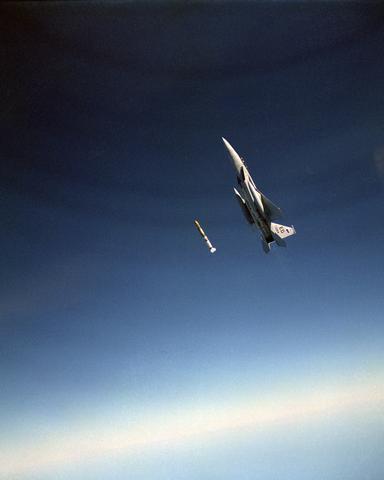
The Pegasus is not a weapon, nor is it launched from an F-15. It's a small payload, air-launched rocket, built by Orbital Sciences. They were first launched by B-52s in early testing, but now by a specially modified L-1011.
The weapon F-15s tested were part of the ASAT (anti-satellite) program. Officially known as the Air-Launched Miniature Vehicle (ALMV), it's more commonly known as just ASAT. There's a good picture of an F-15 launching one here