Slashdot Mirror
Domain: pnas.org
Stories and comments across the archive that link to pnas.org.
Comments · 713
-
Re:A Related Story
>Humans are omnivores as far back as anyone can detect,
Untrue - it's been debated a lot, but the recent nitrogen isotope research shows forebears were strictly carnivore.
Adapting to tolerate plants certainly happened and was a good survival trait when you run out of big animals to eat.Check out the research of Miki Ben Dor. He pulled together a lot of the data.
Paper here: https://www.pnas.org/content/1...
Discussion here: https://twitter.com/KetoCarniv...Interesting stuff.
-
Re:five seconds
Out of date. More recent studies show a six-fold increase in net Antarctic ice loss, to 252 ± 26 Gt/y.
-
The actual "Hockey Stick" data
Everyone knows the hockey stick is bogus manipulation of data
Nope, the hockey stick graph has been confirmed by several studies. You can find plenty of references in the wikipedia page above. And if you dismiss all of the data, then what are you going to use to show that "we are still coming out of an ice age" as GP tried to claim?
Try looking at the actual findings in the actual studies though. The distinctive Hockey Stick shape in Michael Mann's original graph came about by showing 2 disparate datasets on the same graph, the reconstructed temperatures for the last couple thousand years, and then the instrumental record appended on the end. The immediate deviation from the trend for the past millenia doesn't just correspond to the start of the industrial era, it corresponds to a change in datasets. You don't get a more obvious red flag than that.
Now, absolutely, followup studies have been done since, and they have largely confirmed the flat/static trend from Mann's original work. They've also recreated the hockey stick at the end the same way by introducing the instrumental record.
Fine, you'll then say if that is all as sketchy and iffy as it sounds, you'd expect the proxy reconstructions to have troubles recreating recent warming, right? Here's an updated study by the same Michael Mann of fame for the first hockey stick graph. If you just read the overall conclusions, Mann mostly says that with new data and new methods they largely validate their previous work. However, if you look close the article also notes:
However, in the case of the early calibration/late validation CPS reconstruction with the full screened network (Fig. 2
A ), we observed evidence for a systematic bias in the underestimation of recent warming. This bias increases for earlier centuries where the reconstruction is based on increasingly sparse networks of proxy data. In this case, the observed warming rises above the error
bounds of the estimates during the 1980s decade, consistent with the known ‘‘divergence problem’’ (e.g., ref. 37), wherein the tempera-
ture sensitivity of some temperature-sensitive tree-ring data appears to have declined in the most recent decades. Interestingly, although the elimination of all tree-ring data from the proxy dataset yields a substantially smaller divergence bias, it does not eliminate
the problem altogether (Fig. 2B). This latter finding suggests that the divergence problem is not limited purely to tree-ring data, but
instead may extend to other proxy records. Interestingly, the problem is greatly diminished (although not absent—particularly in
the older networks where a decline is observed after 1980) with the EIV method,If you then look down to Fig. 3, you'll notice that the EIV reconstruction doesn't just do a better job tracking recent warming, it also is by far the warmest reconstruction, with historic peaks exceeding anything but the big red instrumental record tacked on again.
So to summarize, your declaration that "the hockey stick graph has been confirmed by several studies" is true in the sense that they've recreated the historic trend many times. However, even the original author(Mann) as linked above notes that the methodology for recreating a fairly flat/cool historic reconstruction, also fails to reconstruct current warming. So much so as to fall outside the "error bars", and even mentions that this is the "known divergence problem", meaning it is well known that without attaching the instrumental record on the end, you don't get your nice hockey stick graph.
-
Re:Solution looking for a problem?
You think I have a misplaced sense of loyalty to... what, blue light? The companies that manufacture devices that emit it? Or do you think the concept that the burden of proof lies upon the one who accuses someone else of not being innocent constitutes Stockholm syndrome? No, you're right! Fox News causes cancer. They should prove me wrong if I'm not right. You're an idiot.
Not sure what Fox News has to do with this... but I guess you're easily confused... maybe caused by blue light toxicity? Evening use of light-emitting eReaders negativelyaffects sleep, circadian timing, andnext-morning alertness
-
Re:Solution looking for a problem?
Backing down to a claim of the novelty and unnaturalness of "light", as if there was no research or empirical evidence to build from is not really a convincing proposition.
The frequency spectrum of light is unimportant? That's quite a claim to have to prove.
Evening use of light-emitting eReaders negativelyaffects sleep, circadian timing, andnext-morning alertnessNope, my claim is that light is neither novel or unnatural and that there is research and empirical evidence available to build from.
I have also previously in the thread claimed that with a minimal amount of research you should be sceptical about Kruse.Posting links to other peoples research has not changed my mind about any of my previous claims, in fact it seems to validate at least one of them.
-
Re:Solution looking for a problem?
Backing down to a claim of the novelty and unnaturalness of "light", as if there was no research or empirical evidence to build from is not really a convincing proposition.
The frequency spectrum of light is unimportant? That's quite a claim to have to prove. Evening use of light-emitting eReaders negativelyaffects sleep, circadian timing, andnext-morning alertness
-
Re:Solution looking for a problem?
"The burden of proof of safety are on those introducing the novelty."
https://yourlogicalfallacyis.com/burden-of-proof
The burden of proof is is on Jack Kruse who is making these claims. If he'd proven his claim then there would be a burden on the manufacturer to prove their product is safe.
The manufacturer is implicitly claiming that artificial blue light is safe... Evening use of light-emitting eReaders negativelyaffects sleep, circadian timing, andnext-morning alertness
"When unsure, defaulting to Nature may be the safer bet."
https://yourlogicalfallacyis.com/appeal-to-nature
Nature is a set of random outcomes. Being natural confers no tendency to be better, safer, or to have better outcomes. Also, humans are natural and the electrical properties exploited to produce LED lighting is also natural.
Good grief... Appeal to Nature fallacy applies in the domain of ethics, not in the domain of risk.
The most natural light would be sunlight, which burns you and damages your DNA, causing aging and cancer.
Which part of your statement is the observation and which part is your false concept? You can google vitamin D & cancer.
-
Re:Solution looking for a problem?
Burden of proof is on the extraordinary claim. If "LED are deadly" then we should see that in health outcomes n countries starting when LED bulbs became popular there. If we don't see that, then you are likely a fool.
Absence of evidence is not the evidence of absence... the extraordinary claim is that artificial blue light is not harmful... prove it, because we have evolved without it.
-
Re:Only low and constant levels.
Actually (presuming your genetics is typical of the population and you don't already live on a high mountain, in an otherwise high radiation area, or spend much of your time on airliners in flight), a low level of additional ionizing radiation IS good for you.
Do you have a source for this? A bit of googling turned up nothing to support it, and quite a bit from scientists who disagree, including this paper: https://www.pnas.org/content/1... Excerpt (emphasis mine): "High doses of ionizing radiation clearly produce deleterious consequences in humans, including, but not exclusively, cancer induction. At very low radiation doses the situation is much less clear... First, what is the lowest dose of x- or y-radiation for which good evidence exists of increased cancer risks in humans? The epidemiological data suggest that it is 10–50 mSv for an acute exposure and 50–100 mSv for a protracted exposure. Second, what is the most appropriate way to extrapolate such cancer risk estimates to still lower doses? Given that it is supported by experimentally grounded, quantifiable, biophysical arguments, a linear extrapolation of cancer risks from intermediate to very low doses currently appears to be the most appropriate methodology."
-
Re:Loss of insect species is very alarming
The insect loss rate is a grossly inaccurate, and covers tiny little chunk of land.
What do you mean by "grossly inaccurate"?
As in plus or minus how much?
The authors seem to have data for 19 years (1993 to 2011, inclusive) for the walking sticks, and each of those was taken with 5 days of sampling over 10 traps for 50 samples to get each of the 19 points.
So there's some evidence of statistical rigour. How small is the "tiny little chink" of land?
As in what area?
Do you have any reason to suspect that this area isn't representative?The 98% ground insect loss" between 1976 and 2012 was taken from a research plot of land in the Luquillo Mountains.
This plot of land was DESTROYED in 1990 by Hurricane Hugo, as was the insect and animal populations.
As you can see from figure 5 C, the walking stick population was declining overall since 1991. The decline is correlated with temperature (figure 5 D, same link as 5 C, above). It does not show a flat or recovering population as if the 1990 even had destroyed the population.
The paper attempts to blame this on an increase in temperature and max/min temperatures without any conclusive evidence, without any good data points
No they don't. They show that that is the likely cause using multiple regression, and discuss the alternative hypothesis of the effect of clear-cutting, showing to be not the case in the study area.
Oh, you're one of those conspiracy theory crackpots that think that climate scientists simply do 25 years of education, then get pathetically lowly paid positions as post docs rather than getting a highly paid job in the private sector, so that they can compete for grants that barely fund their research, and they do not get to pocket any of, because that's a sensible route to personal enrichment by deception?
Not a wonder you had so many misconceptions about the paper. Which science-denial website did you pick up your opinions from, if you don't mind be asking?FYI, the only data points that are year on year contiguous that they have (2012 and 2013) actually show a small growth in the population.
Nope. As you can see from the figure I link, they have data for every year from 1993 to 2011 for walking sticks as well. Decreases occurred on 10 of those sequential years.
Climate Change is real and terrible, but the science behind this crap is utterly disgraceful.
Irony (adj): a bit like an iron.
-
Re:Alarmist propaganda based on anecodtal evidence
Not it's not. It's a scholarly paper with many observations of insect biomass and local tempertature..
Umm...
Insect biomass has 6 plots, 2 in 1970 and the other 4 in 2012/2013. I'm guessing you opened it and just looked at the first graph, which is just a temperature over time. No correlation to the insects.
-
Re: Loss of insect species is very alarming
Insects aren't going to disappear.
When they say Four aquatic taxa are imperilled and have already lost a large proportion of species, that means that some of them have already disappeared. They are not saying that they will all disappear. But in Luquillo where there have been large population drops observed, these have been accompanied by parallel decreases in Luquillo’s insectivorous lizards, frogs, and birds.
It's not worth the hyperbole and panic.
The observed collapse of a food web in some areas. It's not hyperbole, and panic is justified, unless you're already in your late 80s or have terminal cancer.
-
Re:Alarmist propaganda based on anecodtal evidence
Lets talk for a minute, objectively, about alarmist fake-news.
Okay.
The above is anecdotal evidence; one person, one observation.
Not it's not. It's a scholarly paper with many observations of insect biomass and local tempertature..
Am I going to seriously make a change to my lifestyle because the never fallable Brad Lister, scientist extraordinair, made an observation? No. The bar of evidence is a study. I need hard data.
The data are decribed in the paper linked above. Knock yourself out.
Lowest price I can find for me to get copies was around $6k.
So there's two possibilities here; either this is fake news and I have a publication so desperate they need to post clickbait, or this isn't fake news and the rich are keeping vital information from the public because, most likely, we're screwed as a species.There's a third possilbilty. This research was published in a scientific journal that isn't open access.
-
Re:Unexpected results
I studied some of the mechanical and contractile properties of smooth muscle. In spite of vast morphological differences between smooth muscle and striated (skeletal) muscle, smooth muscle demonstrated qualitatively similar results as striated muscle. https://www.pnas.org/content/7.... The surprise here is that form and function do not necessarily follow each other.
Sounds like research into Fleshlights.
ok I'll bite. How is this related to Fleshlights? Did you look at the link I posted or any of the citations?
-
Re:Unexpected results
I studied some of the mechanical and contractile properties of smooth muscle. In spite of vast morphological differences between smooth muscle and striated (skeletal) muscle, smooth muscle demonstrated qualitatively similar results as striated muscle. https://www.pnas.org/content/7.... The surprise here is that form and function do not necessarily follow each other.
Sounds like research into Fleshlights.
-
Unexpected results
I studied some of the mechanical and contractile properties of smooth muscle. In spite of vast morphological differences between smooth muscle and striated (skeletal) muscle, smooth muscle demonstrated qualitatively similar results as striated muscle. https://www.pnas.org/content/7.... The surprise here is that form and function do not necessarily follow each other.
-
Re:Deja Vu
Of course - the author (who has been there and observed the changes personally) is deliberately hiding the truth. The peer reviewers, chosen for their expertise in the field, are all in on it with him. The similar results in other studies elsewhere in the world and cited in TFA are all part of the global conspiracy.
Only you, armed just with Google and your layman's knowledge, have revealed that "water withdrawn from streams draining the forest watersheds" is the REAL cause - despite having no information about where the insect sample positions were relative to the water intakes, how dependent the many species involved are on the water table (rather than rainfall), what the relative stresses are from the increases in temperature extremes or other factors cited in the study, etc etc.
And yet, despite your having so little detailed information about the real situation, you can assure us that it's absolutely the scientists who are the theologians here.
-
Re:Oops
As far as I can tell from the original PNAS article, they found evidence of two sets of mtDNA (parental and maternal), but no recombination in a single mitochondrium.
That makes sense based on why paternal mtDNA is not generally passed on.
Sperm jettison their mitochondria before fusing with the ovum but if this is incomplete, paternal mitochondria will be included but why are steps taken to preserve only one set of mitochondria?
In species where the two gametes both contribute their mitochondria, the mitochondria duke it out for who gets passed on and this process is naturally rather disruptive to the new cell so it is better to discard one set in favor of the other. Since the female made a larger contribution with a larger egg and perhaps other greater investments, it makes sense that she would win this war anyway.
-
Re:Oops
As far as I can tell from the original PNAS article, they found evidence of two sets of mtDNA (parental and maternal), but no recombination in a single mitochondrium.
-
Re:Changing climate?
Agreed that habitat loss is not the problem in these studies, as they are going to heavily forested areas to look at trends. Germany is showing 76% flying insect loss in German nature preserves?!?! They have a ton of forests, 32% of Germany is covered in forest.
https://en.wikipedia.org/wiki/...
Anecdotally, from 30 years back to today we have I'd estimate about 1/20 the amount of bees in the three forested areas I frequent in my state (relatives live in the sticks). Butterflies are less than half. Mosquitoes are probably 1/5 of what they used to be. There are no new roads or change in human population in these areas... I assumed it was mostly pesticides that get sprayed for mosquitoes... but is it something more insidious? They aren't spraying to kill bugs in German forests or in Puerto Rico rain forests. This has me worried. If the insects die out, we are screwed. Insects and other arthropods by biomass, make up way more than say the billions of us big humans. They outweigh us easily... we are estimated at about 0.06 their mass. If that declines to 1/4 of what it used to be, shit is going to get messed up.
Number of species per organism category:
https://manoa.hawaii.edu/seale...The biomass distribution on Earth graphic:
http://www.pnas.org/content/pn...The biomass distribution on Earth:
http://www.pnas.org/content/ea... -
Re:Changing climate?
Agreed that habitat loss is not the problem in these studies, as they are going to heavily forested areas to look at trends. Germany is showing 76% flying insect loss in German nature preserves?!?! They have a ton of forests, 32% of Germany is covered in forest.
https://en.wikipedia.org/wiki/...
Anecdotally, from 30 years back to today we have I'd estimate about 1/20 the amount of bees in the three forested areas I frequent in my state (relatives live in the sticks). Butterflies are less than half. Mosquitoes are probably 1/5 of what they used to be. There are no new roads or change in human population in these areas... I assumed it was mostly pesticides that get sprayed for mosquitoes... but is it something more insidious? They aren't spraying to kill bugs in German forests or in Puerto Rico rain forests. This has me worried. If the insects die out, we are screwed. Insects and other arthropods by biomass, make up way more than say the billions of us big humans. They outweigh us easily... we are estimated at about 0.06 their mass. If that declines to 1/4 of what it used to be, shit is going to get messed up.
Number of species per organism category:
https://manoa.hawaii.edu/seale...The biomass distribution on Earth graphic:
http://www.pnas.org/content/pn...The biomass distribution on Earth:
http://www.pnas.org/content/ea... -
Re:I am not defending him but ...
The Obama era limitation amounted to no more than 6 grams (0.013 pounds) per gigawatt-hour. There, feel enlightened?
Why did they set that particular limit?
At the time the mercury limits were set (2011), there was considerable uncertainty about the exact impact in the population, although there was good reason to suspect mercury emissions were a problem. Mercury and mercury compounds found in combustion by-products are potent neurotoxins and can have a very long half-lives in the human body, in some cases nearly thirty years. This, along with its ability to bioaccumulate through the food chain, makes the economic effects of mercury emissions a serious concern.
Children exposed to the kind of mercury compounds found in coal plant emissions have reduced intellectual capacity. The net impact on the US economy in lost productivity due to lost intellectual capability alone has been estimated at 87 billion year 2000 dollars (soruce). Naturally if you put error bars around that figure they would be huge.
So given the uncertainty, why 0.013 pounds/GWh? Why not 0.02, or 0.005? Probably because it was as much as technologically feasible without forcing coal plants then operating to shut down. Since that point there have been measurable effects in population mercury levels, and the net long term benefits of the restrictions have been estimated at 43 billion annually (source).
Nonetheless, there are uncertainties. Nobody can tell you what the precise effect of a 6 gram limit has been, particularly in an era when coal-fired electricity plants have been closing due to competition with natural gas; still there isn't much doubt that coal-based mercury emissions are a bad thing.
Given the natural economic decline of coal, this regulatory change probably won't have much measurable economic impact. Will it harm people? Well, it's reasonable to assume that some children and infants downwind from the remaining coal plants might be harmed, but you won't be able to point to any one person with high mercury levels and quantify precisely how many IQ points he's lost or say with certainty his behavior control issues wouldn't have happened anyway. That was the status quo under the Obama era MATS regulations anyway.
-
Re: How's that work
If you are familiar with that hit piece from people funded by Exxon, Ford Motors, and other fossil and nuclear fuel advocates, etc. then you should also be familiar with Jacobsons reply.
http://www.pnas.org/content/11... -
Re: How's that work
Citing Jacobson eh? You do know he is a snake oil salesman? The National academy of sciences has discredited his work. Read the article here
In particular, we point out that this work used invalid modeling tools, contained modeling errors, and made implausible and inadequately supported assumptions. Policy makers should treat with caution any visions of a rapid, reliable, and low-cost transition to entire energy systems that relies almost exclusively on wind, solar, and hydroelectric power.
Jacobson is a con man.
-
Re:Humans Need to Leave Nature the Fuck Alone
Seriously, Is it too much to ask that slashdotters keep up with the professional literature?
-
It sure does
How can anyone respect, admire, follow, or in any way support this overfed cesspool of ignorance and corruption defies science.
It would help if the cesspool had published this policy beforehand, so that people wouldn't get the wrong impression.
One problem with all of this is that the ranking algorithms are largely opaque - things that happen for completely legitimate and reasonable reasons can be seen to be the child of ignorance and corruption.
A very good example of the way people can take something completely innocent the wrong way is Google's treatment of Trump and Clinton in the last election. The examples show the Google suggestions for various search completions, against those same searches on Yahoo and Bing.
For example, searching for "Hillary Clinton is " shows many results of "is awesome", "is winning", and so on for Google, while that same search on Yahoo and Bing results in many disparaging completions.
All of this, despite "Hillary Clinton is a liar" versus "Hillary Clinton is awesome" shows that the former search term has a much higher relevance.
The Google search term "crooked " returned "smile", "smile lyrics", and "creek" at the time, while the same search on Yahoo and Bing returned "Crooked Hillary" despite *that* phrase having an obvious trend relevance during the election cycle.
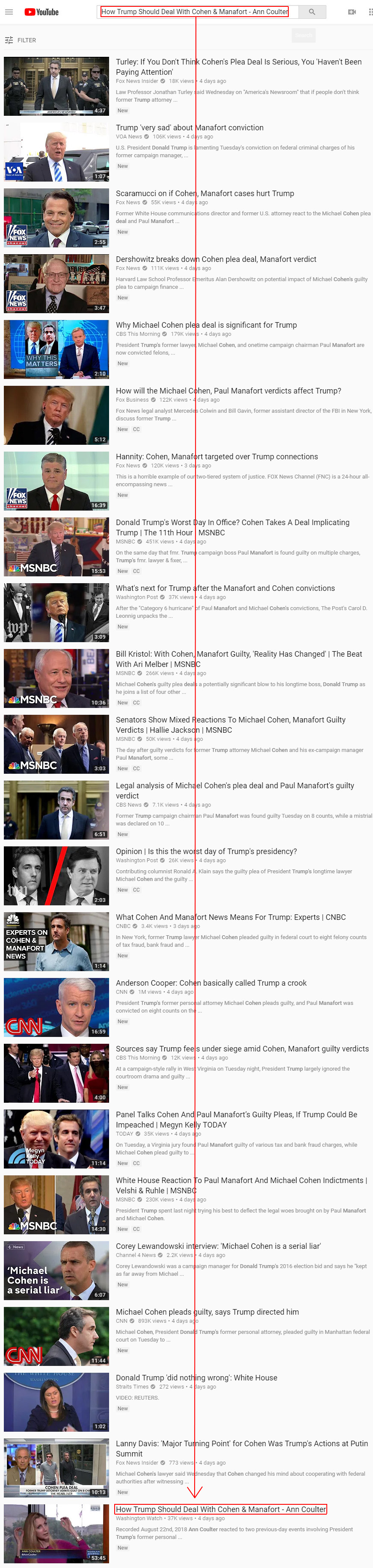
On a more recent note, searching YouTube for "How Trump Should Deal With Cohen & Manafort – Ann Coulter", the *exact* title of a video by Anne Coulter, puts the exact match far below a list of dissenting videos that google thinks you should see instead.
It all boils down to Robert Epstein's published paper that shows that search engine results can sway an election.
Google is making use of their position in light of that paper.
Wouldn't you?
This effect has been well documented for the last couple of years or so.
Even the Google search "when is the election" shows a smiling image of Hillary Clinton, as if her presidential opponent didn't exist. That page clearly (and subliminally) associates the smiling image of Hillary with the upcoming election.
All these results *seem* to be statistically and scientifically valid.
This is the sort of thing our president is complaining about.
And it seems that there is, in fact, a problem here.
-
Re:But.. they're *Scientists!*
If we take something obvious like starvation, its extremely rare in the USA (as an example) and in almost all western countries.
So low that it doesn't have its category in USA yearly deaths. Probably below HIV which is 6500 per year according to this : http://drugwarfacts.org/chapte...
And to cover the extremes, according to this study, there was no increase in starvation related deaths during the great depression either. http://www.pnas.org/content/10...
However there was an increase in Suicides, so that should be calculated, but also negligible compared to starvation in communist/Marxists countries.
Also notable is the great depression was not caused by free markets, but government manipulation of these markets. One of the worst being the creation of the Federal Reserve.
Now, I agree, I'll have to dig and dont have time right at this moment to see if there are studies that cover historical deaths that could be related to capitalism. But the truth is, it is unlikely that you can calculated them, because capitalism creates wealth. Im not sure what kind of deaths you could count as being directly related to capitalism, that you would not also find in a socialist system.
Which is why Im concentrating on starvation... because it is obvious. Others would be direct killings of people who do not follow the "party" line in communist China, Russia, etc...
-
Re:emissions determine warming.
Let's look at the other end. Any chance he included this 1989 study showing an increase of 1.6 C for the instantaneous doubling case and 0.7C for the transient forcing case? No way. Low estimate in the past. Doesn't fit the narrative.
How about this one from 1967 with an estimate of 2.3C for a doubling of CO2. Low estimate in the past? No good.
How about this one from 1997 which suggests sensitivity may be as small as 0.3–0.5C for a doubling of CO2, Better exclude that one!
etc etc etc. If you select studies from the past with higher sensitivities and more recent ones with lower sensitivity then you can show a trend towards lower sensitivity. Not to mention the fact that many of his sources aren't from the scientific literature at all but rather just references to other blogers. That's why you should look to the literature to understand the science rather than some trickster on the internet.
-
Wrong paper
The link doesn't even go to the right journal - it goes to a paper in Nature when it says it is a PNAS paper - and the paper doesn't have anything to do with bending any kind of rod. The correct paper is Controlling fracture cascades through twisting and quenching.
-
Re:FUD
We're not currently seeing mass extinctions
Are you sure?
-
Re:I want Google to be very 'diverse'
> There are plenty of examples of companies calling in John for an interview and not calling in Susan (or Enrique or Javon) even though they have duplicate resumes
This might be true of some industry, but there's no compelling case for it existing in software development.
> "Oh, this is all low-level device driver stuff. Not something a woman would be good at, so I won't waste my time"
If you think anyone would NOT hand this off to someone else, regardless of gender, I would love to know where you're swimming in so many candidates who understand the context that you can afford to discount anyone.
After 25 years, I've never even HEARD about gender discrimination (in hiring or tasking, within California), because finding a useful candidate is hard enough that nobody realistically cares about gender in software development. I've also never seen it, but have seen the opposite (men passed over in favor of young women) without the identical resume constraint. But sometimes it's obviously a chauvinistic preference for image, a prelude to predation, or a failure in competence.
> http://www.insyncsurveys.com.a...
This is not proof.> https://www.reuters.com/articl...
http://www.pnas.org/content/11... - This is not proof, but it is a study.vs
> That contradicts a 2012 study in which academics gave higher ratings to hypothetical job candidates with male names than those with female names (and identical resumes).
http://www.pnas.org/content/10... - This is not proof, but it is a study.I mean, I don't see a lot of studies and not a lot of example companies that demonstrate anything either way.
-
Re:I want Google to be very 'diverse'
> There are plenty of examples of companies calling in John for an interview and not calling in Susan (or Enrique or Javon) even though they have duplicate resumes
This might be true of some industry, but there's no compelling case for it existing in software development.
> "Oh, this is all low-level device driver stuff. Not something a woman would be good at, so I won't waste my time"
If you think anyone would NOT hand this off to someone else, regardless of gender, I would love to know where you're swimming in so many candidates who understand the context that you can afford to discount anyone.
After 25 years, I've never even HEARD about gender discrimination (in hiring or tasking, within California), because finding a useful candidate is hard enough that nobody realistically cares about gender in software development. I've also never seen it, but have seen the opposite (men passed over in favor of young women) without the identical resume constraint. But sometimes it's obviously a chauvinistic preference for image, a prelude to predation, or a failure in competence.
> http://www.insyncsurveys.com.a...
This is not proof.> https://www.reuters.com/articl...
http://www.pnas.org/content/11... - This is not proof, but it is a study.vs
> That contradicts a 2012 study in which academics gave higher ratings to hypothetical job candidates with male names than those with female names (and identical resumes).
http://www.pnas.org/content/10... - This is not proof, but it is a study.I mean, I don't see a lot of studies and not a lot of example companies that demonstrate anything either way.
-
Might wanna check those preconceptions...
Unless there is something VERY special about Norway, a wide-spread trend that cannot be attributed to education, gender, religion, or other environmental factor has pretty good predictive qualities, since the sample size is large, and unbiased (Only males tested most likely, but the service is compulsory, not voluntary.
Service in Norway is NOT compulsory.
https://en.wikipedia.org/wiki/...About 60,000 Norwegians are available for conscription every year, but only 8,000 to 10,000 are conscripted.[2] In earlier times, up until at least the early 2000s, all men aged 19â"44 were subject to mandatory service, with good reasons required to avoid becoming drafted.
Besides that decline in conscription, actual numbers of conscripts are around 14% of eligible Norwegian males, cause "the number of applicants each year exceeds the needs of the Armed Forces".
Further, researchers aren't showing a decline of IQ in Norway, nor anywhere else.
They are working with a presumption of a decline in IQ and trying to hammer their "observation" peg into that presumed roundish hole.Using administrative register data with information on family relationships and cognitive ability for three decades of Norwegian male birth cohorts, we show that the increase, turning point, and decline of the Flynn effect can be recovered from within-family variation in intelligence scores.
This establishes that the large changes in average cohort intelligence reflect environmental factors and not changing composition of parents, which in turn rules out several prominent hypotheses for retrograde Flynn effects.I.e. They claim that they can explain presumed IQ decline by extrapolating measured in-family IQ decline.
Problem is - they don't actually have the data to show that. And they are blind to their own biases regarding all the preconceptions they are juggling.From study's appendix it's pretty obvious that the IQ sample was both changing in structure AND reducing in sample size over the years.
Number of recruits born between 1964 and 1972 varied between 30440 and 32148.
1973-1980 we see a drop from 29159 down to 23900.
1981-1989 rises slowly from 23317 up to 26484.But far more important is the fact that they are NOT ACTUALLY FINDING THE IQ DECLINE AMONG THE NORWEGIAN CONSCRIPTS.
All that they ARE accurately finding is that the number of IQ tests among conscripts has declined by 10 percentage points, over a decade.From TFS:
Conscription test coverage declined substantially for cohorts born after 1980, with coverage rates falling from 93% in 1980 to 83% in 1991 (Fig. 3A).
So not only is the number of conscripts declining, number of conscripts taking IQ tests has declined even more.
Which they then take to consideration - and pull the following nonsense out of the thin air.Focusing on families with sons in the first two parities and plotting the share of unscored younger siblings by the observed IQ score of the older brother, lower scoring firstborns were more likely to have unscored younger brothers (Fig. 3B).
The problem is exacerbated toward the end of our data window: Among the 198-1991 birth cohorts, fully 30% of those whose older sibling scored in the bottom IQ bracket have missing IQ scores.
As sibling scores are correlated, this implies that low-ability males are less likely to be scored, and that the selection was stronger for the cohorts born in the late 1980s than for those from the 1960s and 1970s.I.e. Not only are they ASSUMING correlation between IQs of sibli
-
Might wanna check those preconceptions...
Unless there is something VERY special about Norway, a wide-spread trend that cannot be attributed to education, gender, religion, or other environmental factor has pretty good predictive qualities, since the sample size is large, and unbiased (Only males tested most likely, but the service is compulsory, not voluntary.
Service in Norway is NOT compulsory.
https://en.wikipedia.org/wiki/...About 60,000 Norwegians are available for conscription every year, but only 8,000 to 10,000 are conscripted.[2] In earlier times, up until at least the early 2000s, all men aged 19â"44 were subject to mandatory service, with good reasons required to avoid becoming drafted.
Besides that decline in conscription, actual numbers of conscripts are around 14% of eligible Norwegian males, cause "the number of applicants each year exceeds the needs of the Armed Forces".
Further, researchers aren't showing a decline of IQ in Norway, nor anywhere else.
They are working with a presumption of a decline in IQ and trying to hammer their "observation" peg into that presumed roundish hole.Using administrative register data with information on family relationships and cognitive ability for three decades of Norwegian male birth cohorts, we show that the increase, turning point, and decline of the Flynn effect can be recovered from within-family variation in intelligence scores.
This establishes that the large changes in average cohort intelligence reflect environmental factors and not changing composition of parents, which in turn rules out several prominent hypotheses for retrograde Flynn effects.I.e. They claim that they can explain presumed IQ decline by extrapolating measured in-family IQ decline.
Problem is - they don't actually have the data to show that. And they are blind to their own biases regarding all the preconceptions they are juggling.From study's appendix it's pretty obvious that the IQ sample was both changing in structure AND reducing in sample size over the years.
Number of recruits born between 1964 and 1972 varied between 30440 and 32148.
1973-1980 we see a drop from 29159 down to 23900.
1981-1989 rises slowly from 23317 up to 26484.But far more important is the fact that they are NOT ACTUALLY FINDING THE IQ DECLINE AMONG THE NORWEGIAN CONSCRIPTS.
All that they ARE accurately finding is that the number of IQ tests among conscripts has declined by 10 percentage points, over a decade.From TFS:
Conscription test coverage declined substantially for cohorts born after 1980, with coverage rates falling from 93% in 1980 to 83% in 1991 (Fig. 3A).
So not only is the number of conscripts declining, number of conscripts taking IQ tests has declined even more.
Which they then take to consideration - and pull the following nonsense out of the thin air.Focusing on families with sons in the first two parities and plotting the share of unscored younger siblings by the observed IQ score of the older brother, lower scoring firstborns were more likely to have unscored younger brothers (Fig. 3B).
The problem is exacerbated toward the end of our data window: Among the 198-1991 birth cohorts, fully 30% of those whose older sibling scored in the bottom IQ bracket have missing IQ scores.
As sibling scores are correlated, this implies that low-ability males are less likely to be scored, and that the selection was stronger for the cohorts born in the late 1980s than for those from the 1960s and 1970s.I.e. Not only are they ASSUMING correlation between IQs of sibli
-
Re:They weren't old..
From evolutionary point of view, the ones who reproduces the most before dying are the winners. During millions of years life expectancy was around 40 years, to think about age above 40 year old is a bad reproductive investment, focusing in your most likely reproductive years is a far better strategy and give yo u a reproductive advantage on those who invest in old age (instead of focusing on short term). This can be linked with midlife crisis that seems programmed in our genes.. Recently (for a little more 1 century), humans are living older and nobody is prepared to have forty... Short term planing is in our genes because it used to give a reproductive advantage...
-
Re:Can't wait for this to get loose
The summary and the article don't say that, but I have no doubt you are right. It's hard to beat Mother Nature, so let's co-opt her!
No one bothered to link the paper, which is a PDF here:
http://www.pnas.org/content/pnas/early/2018/04/16/1718804115.full.pdf
The story did mention that the enzyme was not optimized (do to young age of the whole process no doubt) and suggested a transplant of the mutant enzyme into an “extremophile bacteria” for a greater range of temperature resistance... I can hear Jeff Goldberg saying "Yes Yes, make it hard to kill! -
Re:A hard fact.
I hate to tell you this, but most pharmaceutical R&D is already done by the U.S. government. Every single drug approved between 2010 and 2016 was at least partially funded by NIH grants.
Most drugs today are initially researched by academic institutions, most of which rely heavily on NIH grants to cover their costs. Then, those patents get sold to small businesses, who do the next phase of trials. Then, they get sold to bigger businesses that fund the final phases of trials and manufacturing. Businesses do the development, but government does the actual research.
-
Re:Wrong.
No problem, and thanks for reading and replying.
I was confused on that, too, and neurobiology is pretty far from my regular work. Part of the problem is that there's a lot going on here: plasticity and differentiation (cell adaptations, transformations from one phenotype to another, differentiation, etc.), cell proliferation, tuning of connections, etc. It's a messy area with lots of new and sometimes contradictory data coming out.
From what I understand, there's a lot of plasticity in the brain as an adult: far more than was originally appreciated. I thought that we "knew" there were no new brain cells, and then we "knew" there were, and now we may "know" there aren't. That's the nature of evolving science, as others point out. And imprecise science communication--and imprecise English--doesn't help, either. Even biologists can get tripped up: we talk about tumor growth and cancer cell population growth, but we really primarily are talking about cell division there.
And there are all sorts of neat surprises. It was found that glial cells (a type of brain cell responsible for maintaining brain structure) can transdifferentiate into endothelial cells (which make blood vessels). See this PNAS paper and this one. This has all sorts of implications for gliomas and other brain cancers. And God only knows what other surprises are waiting to be found.
I suppose that's another reason they looked at the "new neuronal cell" marker: to see whether other cells could become new neuronal cells by transdifferentiation or other plastic processes. Biology is weird.
-
Re: And 300-400 workers less
-
Re:It's the Knights Templar!
http://www.pnas.org/content/ea... Acceleration? Are you on crack? Seth is a hack, period.
-
Analyze all of the data
No. It shows a more rapid rise in the last couple of decades, but it does not show an acceleration overall. If you can cherry-pick a 20-25 year period, so can I.
Just for reference, the 25 years of data was not cherry picked. The article being discussed analyzed satellite altimetry data, and the first of the satellite altimetry missions being discussed was TOPEX/Poseidon, which started giving data 25 years ago. 25 years is all the data that exists.
When they analyze all the data that exists, that's the opposite of cherry picking.
-
Satellite measurements [Re:Oh good]
And there's no way those same currents could have affected the previous measurements we used to declare sea level was rising. I mean, there's no way they could have been eroding for some period and we thought it was the sea level rising. Climate only works one way!
That's why satellite altimetry measurements-- what the article being discussed here is about-- are important. You can measure the entire globe, not just the places that have tide gauges, and you can separate out the local effects from the sea level rise.
-
Re:25 Years
25 years of data? Why not 26 years of data?
Because the earliest data set came from the TOPEX/Poseidon satellite altimetry mission, which launched in 1992, and the paper was received for review in 2017. 2017-1996 = 25 years.
Paper under discussion: http://www.pnas.org/content/ea...
The scientists were unable to use satellite data taken before the satellite launched because that data does not exist.
-
Re: An interesting prospect, but also an edge cas
Skeptical science dot com? You might as well have posted from dailykos or Fox News for all those biased jerks are worth reading.
My comment stands. Oceans have continued to rise at same slow pace since last ice age (despite false claims from faked up pseudo science web sites).
Its a pop science, not pseudo-science site. Its accurate, but simplified, and its widely respected in the scientific community as a reliable and accurate public science site.
However. You want actual papers huh?
http://www.pik-potsdam.de/~ste...
http://www.meteo.psu.edu/holoc...
http://www.meteo.psu.edu/holoc...
http://science.sciencemag.org/...
http://www.pnas.org/content/pn...I'm sure theses others, but those where just some of the references off the *very* page you dishonestly try to handwave as 'pseudoscience".
You can't just throw mud like that at widely respected sources of information without at least justifying who so much of the scientific community is wrong, but random AC on the internet is right
-
Re:Eletrical grid Energy doesn't come from oil
Can you elaborate? Your argument sounds suspiciously like "Jacobson's bias is acceptable because I agree with it, theirs is not because I disagree with them".
Jacobson et al. investigated the criticisms of Jacobson et al. and found that Jacobson et al. were totally in the mainstream (liberal) academic/quasi-governmental-organizational mindset, and so the criticisms of Jacobson et al. must be wrong. They investigated themselves and found no wrongdoing! Could they not find anyone else willing to defend their work?
-
Re:Eletrical grid Energy doesn't come from oil
I think this past year has had a long list of studies concerning confirmation bias in science. Right here on this website too. - Cholesterol in food = Cholesterol in your arteries = heart disiease https://www.researchgate.net/p... One of the studies on Confirmation bias: http://www.pnas.org/content/11...
-
Re:Eletrical grid Energy doesn't come from oil
Jacobson's work has been thoroughly debunked. After failing to argue his position based on sound science, he sued the journal which published both his work and the extensively peer-reviewed response.
It is understandable that many people want to be believe, but the 100% renewable road-map is a dangerous myth.
-
Re:Let's move into the modern era...
Completely and totally false. http://www.pnas.org/content/10.... From the abstract:
The analysis indicates that a network of land-based 2.5-megawatt (MW) turbines restricted to nonforested, ice-free, nonurban areas operating at as little as 20% of their rated capacity could supply >40 times current worldwide consumption of electricity, >5 times total global use of energy in all forms.
-
Re:Not counting the cost of storage
I do not see a fundamental problem going to 100% renewables.
You might not, but that national academy of sciences does. They have rejected the feasibility of the leading 100% renewable plan. Many of the worlds top climate scientists have repeatedly said nuclear power is the only viable path forward on climate change
-
Not counting the cost of storage
The problem is the cost of storage. Renewables are intermittent meaning we need storage or baseload backup. 96% of our current storage is done thru pumped hydro. All of our current storage will last less then a hour. It is not feasible to scale that up to a 100% percent renewable grid. Batteries are even more expensive and less feasible for grid level storage.
Given the realities of climate change, it is immoral to oppose nuclear power