Slashdot Mirror
Domain: politicalcompass.org
Stories and comments across the archive that link to politicalcompass.org.
Comments · 422
-
Re:Vermont.
... which helps those already infected or dead because of non-vaccinations of others exactly how?
The problem is that your system only starts kicking in when the catastrophe has already happened.
The may be, but the wisdom of his system is that it doesn't impinge upon the civil liberties of the individual. It also doesn't preemptively punish individuals for taking risks and managing those risks and/or remaining fortuitous in avoiding their natural, probabilistic consequences. Finally, it provides a legal motivation (in addition to extant or potential motivators, e.g., societal, medical, ethical, financial, etc.) to do what is beneficial for society, without purposefully engaging in the catastrophe that is the rapid, wholesale destruction our civil liberties.
Franklin's quote on security and liberty needn't only be applied in the context of state bogeymen de jour. I find the concept of criminalizing actions due to (real or perceived) risks to be morally questionable, authoritarian, and ripe expansion and abuse with no end in sight. The popular target for legislation these days is driving, and what we may or may not do in our vehicles. Perhaps medicine will be the next target for a while.
As a liberal, it concerns me that so few on the left see a problem with this, let alone get on board with some of these ideas.
-
Re:Historically, all politicians like to impose ru
In the USA left and right...
Sorry, but in the USA you don't have left and right. You have right and further-right. (On a world scale, anyway.)
But anyway, economic left/right views should be considered separately from the social authoritarian/libertarian views. Have a look at http://www.politicalcompass.org/
-
Re:From the text.
Interesting graph here: http://www.politicalcompass.org/uselection2012
-
Re:I don't think so.
believe me, there's one just as bad on the left
False equivalency, there absolutely is no comparison. The evidence is in the direction of the county, which has been shifting right ever since LBJ. The idiot of the right wing is a plurality or maybe even a majority of the party. A group that routinely denies the scientific method in favor of super natural explanations and are extremely well represented in government. I'd like to see any evidence that the radical (science denying ) left has similar influence in their party or representation in government. I'd be looking for anti-wifi, anti-vaccine, or anti-GMO to dominate the debate (on the scale of AGW, evolution) and have 50-200 member congressional delegation of self-avowed socialists calling for an end to capitalism. Instead I see a few fringe moderate-socialists, a large majority of capitalist/fiscally conservative social liberals, and republican-democrats. Here's BHO, "the radical leftist:" http://www.politicalcompass.org/uselection2012 . Of course, I'm open to evidence that political compass is communist propaganda and in fact there is true "leftist" representation in government and the dramatic 40 yr shift toward the right wing is a hallucination.
a lot of conservatives are concerned that the scientific method is properly being followed.
I doubt there are "a lot" (whatever that means) of any non-technical group that could even articulate acceptable scientific procedure. I am open to evidence supporting your claim before I write it off as a self-selection bias among a small, technically minded libertarian minority.
-
Re:This is why we need to improve science educatio
... what? I assumed you were a troll, but skimming through your recent comments you seem to be a plenty reasonable person.
The United States is certainly further to the left politically compared to the start of the 20th centry (see: The Jungle), but it very far to the left compared to, say, most of Europe. Barack Obama is barely to the left of the Republican nominees, although I suppose you might believe they are also too far to the left. Anyway, I don't know what the heck "leftist slavery" is unless you mean higher taxes=slavery or something like that.
-
Re:Some background
Acording to Political compass the NDP are almost exactly in the centre the Liberals are to the right and the Conservitives are far right, According to that site everyone has moved substantial to the right, to the point that the NDP are nearly where the Libs were 10 years ago and the Libs are where the Cons were 10 years ago. Intrestingly, it actually puts the Liberals right of Barak Obama.
http://politicalcompass.org/canada2011 -
Political Compass
But not in the way many slashdotters might think.
Little appreciated here on Slashdot is the fact that SOPA was as unpopular on the right side of the spectrum as it was on the left.
It's more accurate to model political affiliation in 2 dimensions [1], authoritarian/liberal vs. conservative/progressive. If you look at Congress, the problem is that most elected representatives on both sides of the spectrum are authoritarian despite whether they're conservative or progressive... meaning there are almost no true liberals (free love AND free trade, ie, left-libertarians) representing us (one could say they don't represent the people anymore).
By this measure, SOPA was a full-on authoritarian bill. It was popular in DC, because it catered to big business which loves authoritarian legislation (removes uncertainty and easy to game) and it was fully business friendly.
It also highlights the fact that the Internet as it currently stands is a true bastion of liberalism. For all it's warts and dangers, it is a bulwark against the 1984-style authoritarian singularity. We must defend it.
-
Re:Consider voting third party
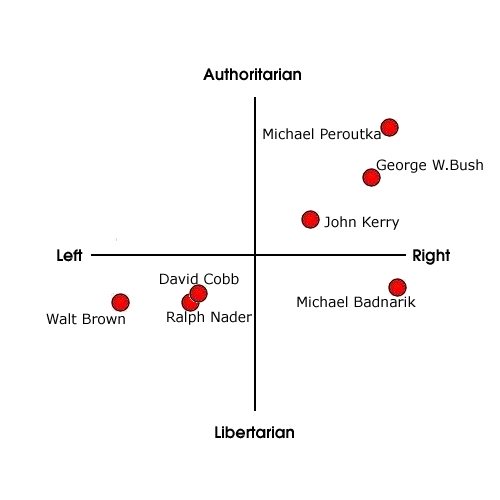
The Ds who seem to think it would've been better for the Greens to have voted for Gore rather than Nader, probably saw Nader slightly to the left of Gore, and both of thoe miles from Bush; while the people who voted for Nader saw it very differently: http://www.politicalcompass.org/images/USelection2004.gif (that's 2004, not 2000, but the positions are close).
Nader voters realized that Gore was slightly closer to what they wanted than Bush, but that slight difference didn't matter considering how far away these voters were from the two plutocratic sociopaths.
Given the choice between unpopular Gandhi, and the much more popular candidates Stalin and Hitler; Greens would vote for Gandhi. It's an ethical thing: it's better to do the right thing by voting for what you consider good and then be defeated, than it is to vote for the slightly lesser evil and help that evil win.
-
Re:Good in theory
Nixon was not as much of a right-wing extremist as he's often portrayed. He was a skilled manipulator and liar. He was smart enough to see the way that things were going, and he acted as an advocate of those ideas. He knew how to take something like environmentalism, pacifism, and other leftist causes and give them a conservative spin, so that he could walk a centrist road and give lip service to whatever people wanted to hear. Don't like the Vietnam War? No problem. Nixon will end it. Want a strong Asia that can stand up to the Communists? No problem. Nixon isn't going to cut and run -- he's staying until the job is done. Nixon had a promise for every centrist stance, with enough spin that it could mean whatever was necessary at that point. He was a realist. A realist doesn't choose sides in an ideological battle; instead, he courts the middle while chastising the extremists, even though his own sympathies may very well lie with one of the extreme positions. Nixon was an authoritarian centrist, though he certainly was willing to support "states' rights" (and other Conservative talking points), as long as it didn't impede his own power. I think he legitimately believed that he could handle the power and make the best decisions for the country, though history proved that wrong.
Most Democrats are center-right. A few are centrists. The few that actually are on the left usually get vilified as extremists. Certainly, if you're on the far right, the centrists must seem like socialists, and the center-left must seem like communists. However, an actual Marxist would be horrified by the Democrats' policies. Lenin reserved much scorn for social democrats (which are more to the left than the Democratic party), allegedly calling them "useful idiots" (which has been disputed, of course). Lenin thought that social democrats were sissies who couldn't handle Big Ideas and clung to the old ways (capitalism), trying to reform a broken system that couldn't be fixed. I don't share Lenin's views, and I view social democrats very sympathetically. However, it just goes to show that there's always someone so ideologically pure, so unwilling to compromise, that he's willing to dismiss an entire spectrum of opinion. The challenge is to avoid falling into that trap. Thus, if you're a Libertarian, you should recognize that not every Marxist is going to be stark raving mad, and vice versa for the Marxist.
While I have my own opinions on the validity of the test, the Political Compass expresses this rather well. Check out how far the right almost every political party is. Very few can legitimately profess to hold leftist views. This tends to annoy people on the right, who view any amount of regulation to be socialist.
-
Re:obligatory
I think they're acting like spoiled brats among other things plus the don't go to the police if raped instead let the "leaders" of protest sort it out by kicking the rapist out of the camp bullshit didn't help my opinion of some of the OWS crowd at all.
This is sort of what I mean by my political leaning...
http://www.politicalcompass.org/printablegraph?ec=0.12&soc=-0.56 -
Re:You know what would be a good idea? Slavery.
You're right - it's authoritarian (another poster mentioned communism). The authoritarian/liberal axis is orthogonal to the left/right economic one.
My conception of progressive fits with liberal/left, but others may differ.
http://www.politicalcompass.org/ is useful
-
left vs right; that is how democracy dies
There is no left and right side based on seating in the french assembly centuries ago:
wake up: http://politicalcompass.org/ -
educate yourself
slashdot isn't on the left.
-
Re:Debates are like NASCAR
The problem is that these uninformed people then go and vote based on their impressions. I don't mind people voting for a different candidate to me - that's one of the risks of democracy - but I wish they'd vote based on their interests or ideals, not based on propaganda. There was a survey after the 2000 US election which showed a staggering proportion of the surveyed electors had voted for a candidate who stood for almost the exact opposite of what they thought that he stood for. We saw the same thing in the UK - so many people voted for Labour because they were 'on the side of the working man', even thought they've been moving steadily into the authoritarian/right corner for a long time, and were largely run by rich lawyers and old money since the early '90s.
-
Re:Enjoy.
-
Re:We worship the blowhard
Left / right is an overly simplistic approach. The Political Compass isn't perfect either, but breaks it down better. I would imagine most slashdotters will score well below the authoritarian / libertarian line, but vary considerably in their left / right (economics) scores. I'm here.
-
Re:We worship the blowhard
Left / right is an overly simplistic approach. The Political Compass isn't perfect either, but breaks it down better. I would imagine most slashdotters will score well below the authoritarian / libertarian line, but vary considerably in their left / right (economics) scores. I'm here.
-
Re:Moderate and libertarian candidates .... so the
No, we definitely have those parties as well, but much like the Libertarian party, they don't get much coverage or traction. Also, stop portraying Europe as some bastion of far-left politics. It's not nearly as far to the left as you're portraying. There are certainly more far-left political parties, but they're usually not the ones leading the coalitions forming the government. Here's the political compass chart for the major candidates in the last U.S. presidential election. Here's the political compass chart for the European governments as of 2008. They're not too terribly different.
None of the listed countries are even left of center. The Scandinavian countries are some of the closest to that line, but what really separates them is the gap on the Authoritarian-Libertarian between them and the rest of the pack. If the broad range of European parties is similar to the ones for the 2007 Irish election there certainly is more choice available, but your governments as a whole tend to be quite similar to the U.S. There are also several far-left groups that get even less media coverage than the Green party. Many states still have candidates that run under the Socialist party and there are a number of different anarchist parties, some of which don't choose to participate in the system. You almost never hear about any of these on the news.
I can see how you might come away with your impression if you watched Fox news, where almost anything is lambasted for being "socialist" regardless of whether it has anything to do with socialism. The other American news networks aren't really any better about promoting third party candidates or policies, possibly due to the vicious circle that only effectively allows for a two-party system. I don't follow European politics so I have no way of knowing how much media coverage some of the smaller parties manage to garner, but I don't expect it's as much as the major parties get. The only reason the Libertarian party has been getting any coverage is because it got lumped in with the Tea Party, to which I think several Libertarians would object. -
Re:Moderate and libertarian candidates .... so the
No, we definitely have those parties as well, but much like the Libertarian party, they don't get much coverage or traction. Also, stop portraying Europe as some bastion of far-left politics. It's not nearly as far to the left as you're portraying. There are certainly more far-left political parties, but they're usually not the ones leading the coalitions forming the government. Here's the political compass chart for the major candidates in the last U.S. presidential election. Here's the political compass chart for the European governments as of 2008. They're not too terribly different.
None of the listed countries are even left of center. The Scandinavian countries are some of the closest to that line, but what really separates them is the gap on the Authoritarian-Libertarian between them and the rest of the pack. If the broad range of European parties is similar to the ones for the 2007 Irish election there certainly is more choice available, but your governments as a whole tend to be quite similar to the U.S. There are also several far-left groups that get even less media coverage than the Green party. Many states still have candidates that run under the Socialist party and there are a number of different anarchist parties, some of which don't choose to participate in the system. You almost never hear about any of these on the news.
I can see how you might come away with your impression if you watched Fox news, where almost anything is lambasted for being "socialist" regardless of whether it has anything to do with socialism. The other American news networks aren't really any better about promoting third party candidates or policies, possibly due to the vicious circle that only effectively allows for a two-party system. I don't follow European politics so I have no way of knowing how much media coverage some of the smaller parties manage to garner, but I don't expect it's as much as the major parties get. The only reason the Libertarian party has been getting any coverage is because it got lumped in with the Tea Party, to which I think several Libertarians would object. -
Re:Moderate and libertarian candidates .... so the
No, we definitely have those parties as well, but much like the Libertarian party, they don't get much coverage or traction. Also, stop portraying Europe as some bastion of far-left politics. It's not nearly as far to the left as you're portraying. There are certainly more far-left political parties, but they're usually not the ones leading the coalitions forming the government. Here's the political compass chart for the major candidates in the last U.S. presidential election. Here's the political compass chart for the European governments as of 2008. They're not too terribly different.
None of the listed countries are even left of center. The Scandinavian countries are some of the closest to that line, but what really separates them is the gap on the Authoritarian-Libertarian between them and the rest of the pack. If the broad range of European parties is similar to the ones for the 2007 Irish election there certainly is more choice available, but your governments as a whole tend to be quite similar to the U.S. There are also several far-left groups that get even less media coverage than the Green party. Many states still have candidates that run under the Socialist party and there are a number of different anarchist parties, some of which don't choose to participate in the system. You almost never hear about any of these on the news.
I can see how you might come away with your impression if you watched Fox news, where almost anything is lambasted for being "socialist" regardless of whether it has anything to do with socialism. The other American news networks aren't really any better about promoting third party candidates or policies, possibly due to the vicious circle that only effectively allows for a two-party system. I don't follow European politics so I have no way of knowing how much media coverage some of the smaller parties manage to garner, but I don't expect it's as much as the major parties get. The only reason the Libertarian party has been getting any coverage is because it got lumped in with the Tea Party, to which I think several Libertarians would object. -
Re:Hope and...
let me help you with this:
http://politicalcompass.org/ -
Re:sad
... on the left's alliances with groups that "confused leftists" don't understand
The only inevitable confusion results from the simplistic definitions like 'left' and 'right' (which is why I hate using them but which it seems is unavoidable in any discussion).
Movements like the Black Panthers have a lot of elements to them and I am sure that some of them could be somehow part of the so-called-'left'. But then again there are some parts that belong to the 'right'. That is why I focus on the supposed 'main' mission of the group, which was strictly race-centric.
The truth is that there is no monolithic 'left' or 'right'. That is why ideas like the political compass were thought up in an attempt to better measure the actual positions people hold in respect to individual issues and which provide a much more accurate understanding.
-
Re:Here's a comes a 5-4 Supreme Court ruling
Could be the far left of the American political spectrum. Here's the political compass map for all the US states based on Senators which should give you a fairly good idea about the range we're looking at. Everything falls right of center and above the mid-line for authoritarian/libertarian.
The candidates that tend to become President in the US tend to fall along that line. Too much deviation from it and doesn't work for whatever reason. America is for the most part a pretty centrist country. Might be why politicians accuse each other of being far-left or far-right. It makes them appear closer to the center, which is what the majority of the population seems to want.
Another funny story; The majority of European governments fall into that same band as well. I always hear Europeans posting comments about how they're actually a real indication of the political left, but even the most politically left-leaning countries in Europe are still to the right of the center line.
Would be interesting if the site ranked countries from other parts of the world as well and had a longer time-line. Maybe things really have changed since the 60's, but I somehow doubt it. -
Re:Here's a comes a 5-4 Supreme Court ruling
Could be the far left of the American political spectrum. Here's the political compass map for all the US states based on Senators which should give you a fairly good idea about the range we're looking at. Everything falls right of center and above the mid-line for authoritarian/libertarian.
The candidates that tend to become President in the US tend to fall along that line. Too much deviation from it and doesn't work for whatever reason. America is for the most part a pretty centrist country. Might be why politicians accuse each other of being far-left or far-right. It makes them appear closer to the center, which is what the majority of the population seems to want.
Another funny story; The majority of European governments fall into that same band as well. I always hear Europeans posting comments about how they're actually a real indication of the political left, but even the most politically left-leaning countries in Europe are still to the right of the center line.
Would be interesting if the site ranked countries from other parts of the world as well and had a longer time-line. Maybe things really have changed since the 60's, but I somehow doubt it. -
Re:Retest
I was trying to be moderate
In the most recent election I voted Liberal Democrat, since the Green party candidate was a nutcase (I met him) and I hoped the Lib Dems would push through voting reform, which is very important to me. I did vote Green for the previous one, and various other (non-Parliamentary) elections.
-
Re:More obvious stories
FWIW, I ended up being one point more Right and one point more Libertarian than center. Apparently, I'm pretty wacky in comparison to the US.
-
Re:More obvious stories
If American Democrats are "right of center"
Slightly to the left of most Democrats. A lot of people in the US like to call Obama a socialist. These are people that have never looked at European politics, where you can see real socialists. Take a look at the political compass and count how many 2008 candidates were left of center.
-
Re:Same is true of Big Media (TV)
The TV companies are dominated by "leaning left" liberals, and therefore their reporting is also left-leaning. ABC, CBS, NBC, PBS, CNN.
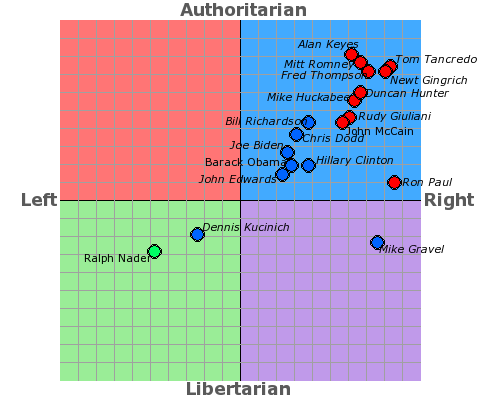
Why do you think that is? Has it ever occurred to you that the majority of the US population might in fact be liberal? Why do you think that in at least 10 states during this election cycle that the number of "independent" voters are actually the majority, where there are more independents than both Ds and Rs? The majority of the population does not identify with either major party. Since both parties are on the right of the global political scale, it would stand to reason that many of the people who do not identify with either party are in fact left of both of them. Take a look at this, are the blue and red folks on the left or right of center:
http://politicalcompass.org/uselection2008
It looks to me like the entire political system in the US is on the right, and so to anyone standing on the right, someone standing in the center looks "liberal" and "left", when in fact they're just in the center.
-
Re:Retest
The Political Compass website demonstrates this well. I suggest taking the test before reading the rest of the website.
(My result: -9.25, -8.21.)
-
Re:Big business corruption and greed is anti-scien
There's an American Left? Really? Because what it really looks like is that there's a Right and an Ultra-Right
And can we please stop bringing up George Soros like he's some kind of counterbalance? As a very wealthy person who advocates for economic (not social, there's a difference) left-wing he is very, very much the exception to the rule, and vastly outnumbered. -
Re:Big business corruption and greed is anti-scien
There's an American Left? Really? Because what it really looks like is that there's a Right and an Ultra-Right
And can we please stop bringing up George Soros like he's some kind of counterbalance? As a very wealthy person who advocates for economic (not social, there's a difference) left-wing he is very, very much the exception to the rule, and vastly outnumbered. -
Re:Hilarious
He's more likely one of the 25-30% of people who's opinion on governmental authority lies in the "Authoritarian loving" quadrant of the Political Compass.
They have a mind set that craves a strong authoritarian figure or government in their lives, regardless of its morals or lack of same.
I don't understand the mindset, but I know it exists.
-
Re:What...
Greetings from Europe. Your congress is neither moderate nor left-wing. It is also not socially liberal, which would be the more precise term for what you want to say.
To substantiate, I recommend you take a look at politicalcompass.org to learn about the political coordinate system in a more objective light. -
Re:conservatives
Lumping all conservatives into one pile is probably the dumbest and most counterproductive thing you can do. First of all even basic political classification works on two axis. For a basic test that shows more then one axis go here. http://www.politicalcompass.org/
"Your political compass
Economic Left/Right: 1.88
Social Libertarian/Authoritarian: -1.18"
I always get classified as a libertarian right which is in the same quadrant as Milton Friedman. Now the problem is we are stuck with a Two party system where neither party represents me. However if I have to choose a side I lean way more with the GOP. Not all of their candidates are attractive to me but many of them are. Many of them are actually calling for less Government Spending, less needless laws and regulations, but more smart legislation that is well planned and thought out. -
Re:No Surprise...
The only moderate democrat is Dennis Kucinich. Every one else is right wing.
Moderate? The man is a whack job.
-
Re:No Surprise...
The only moderate democrat is Dennis Kucinich. Every one else is right wing.
-
Re:China is the model the west wants to emulate
"far-left progressives" do not exist in America, at least not by any definition of "left" that the rest of the world is used to. The Overton Window has shifted Americans so far to the right they no longer know what is left unless it is so extreme as to have a Hammer and Sickle stamped on it.
It's really telling that, according to politicalcompass.org at least, the perennially quixotic (and about as much as a leftist as you can get in national-level US politics) Dennis Kucinich is overall more libertarian (or less authoritarian) than either other Democrats or any Republicans candidates during the 2008 primaries!
-
Re:China is the model the west wants to emulate
Meanwhile in Sweden we for once have a "right" government, something we rarely have, but the explanation for that is fairly easy to figure out using the same webpage:
http://www.politicalcompass.org/euchart(Over (current) "right" is very left for an American.)
-
Re:China is the model the west wants to emulate
"far-left progressives" do not exist in America, at least not by any definition of "left" that the rest of the world is used to. The Overton Window has shifted Americans so far to the right they no longer know what is left unless it is so extreme as to have a Hammer and Sickle stamped on it.
-
Re:History is the most important subject
No, I believe that all political discourse should be considered in the context of the culture it occurs in. And I believe that all proposed political solutions should be evaluated in the context of the current situation because any attempt at moving a society to some sort of "ideal state" inevitably leads to ruin.
But this rules out any scientific quantisation of the thing being discussed - since we cannot place in the larger context of all political opinion.
From a scientific viewpoint we can easily create a set of axes (personal freedom, economic freedom, moral freedom and so on) and then grade all parties within such a space. It won't be exact, but will give us a rough guide to where parties sit. See the political compass website for one such example.
I'm well aware of this fact, but I'm also not aware of any societies where political discourse doesn't occur along a 1-dimensional subspace of that multi-dimensional space. The line along which debate is organized shifts over time, but at any given time all of the mainstream factions are collinear.
If you look at countries like the Netherlands + Belgium (ones that come to mind) you have a multiplicity of parties involved in the political process - there isn't "left" or "right" labels applied to them since there are so many parties. They populate the multi-dimensional political space in different places. That's not to say the general populace in these countries don't use "left" or "right" - they have this educational issue too
You misunderstand the problem. "Left" and "right" in America, or their counterparts in any country, are simply masks over people's emotional responses to the problems in society. I agree that the polarization is problematic and railed against it in another post. The only real way forward is to understand what people feel, change some attitudes if possible, and seek the simplest compromise between opposing emotions.
I'm not sure I agree with you here - if anything it shows how mal-educated the general populace is that they need societies complex problems boiled down into 2 choices. And it is tough luck if your political opinion doesn't fall into one of these two choices....
This is my beef with "left" vs "right". It is basically dumbing down politics and making people polarised.
-
Re:Not all officials are bad
Any attempt to classify all political views along a simple left-right access will get some things badly wrong, because things just aren't that simple.
Here's one example of trying to open things up:
http://www.politicalcompass.org/although of course you can add as many dimensions as there are different things to hold political views about.
-
Re:Both, of course
Bullshit. Anyone who would ever accept the name "liberal" in the U.S. is already buying into the idea that there is only one possible spectrum of ideas, which goes from "conservative" to "liberal."
Some of us just live in the real world and can indicate which is the closest approximation (YMMV) to their high level beliefs. If you don't feel they represent you, that is fine, but there is no reason to disparage people who feel like they can.
Ex: If someone is asked for their political ideology and they say they are a conservative, would you chastise them for not articulating each and every belief? Sounds like a lot of fun for everyone. (eye roll)
I agree that people should think more critically, but name calling isn't going to win over people who just don't care as much about politics.
FYI - if you don't think the links below are propaganda, then I question your ability to think openly.
http://www.politicalcompass.org/analysis2
http://www.theadvocates.org/quiz_result?e=30&i=70_30.gif&p=70 (A 'perfect score' = libertarian) -
Re:It's not really that bad
Are you sure you are speaking of America? Obama (a left wing party member) is president and "the right" are a minority in the Senate and House. Get your facts straight... The left is in charge in America now.
Take a look at the Political Compass. How many dots do you see to the left of the vertical axis? For that matter, there aren't many dots below the horizontal axis, either. As has been said many times, both major parties are pretty much the same, the Republicans are just more extreme than the Democrats.
-
Re:WTH
I'm getting the impression that political theory is a one dimensional line for you.
Don't know if you've ever seen it, but http://www.politicalcompass.org/ is a good starting point to begin to understand that freedom of various forms makes this a multi-dimensional thing.
I'm not convinced it's as simple as political compass make it either, but for sure you can't put these things along a one dimensional line of "left" vs "right". That's just dumming down for dumming downs sake.
There are marked differences between fascism and socialism. Do some study so you don't look like so badly informed
-
Re:Topsy Turvy World We Live In
Maybe my political analysis toolset needs to move out of the 20th century....
Indeed. You have shown yet another example of why "right" and "left" are meaningless ways to compare philosophies.
-
Re:Leftists
The right/left division is somewhat flawed. I came across with this some years ago:
http://www.politicalcompass.org/test
It explains the thing in terms of two axes. It decouples the right/left aspect from the liberal/authoritarian aspect. Your political position is represented as a pair of coordinates in a quadrant. I got X;Y = -9.12;-7.13.
This means I'm a very liberal, very leftist guy. But the free-market rock-star economist Milton Friedman is also liberal, only on the opposite side. And it's his recipes that are being applied throughout the world since the 80s.
-
Re:Leftists
The right/left division is somewhat flawed. I came across with this some years ago:
http://www.politicalcompass.org/test
It explains the thing in terms of two axes. It decouples the right/left aspect from the liberal/authoritarian aspect. Your political position is represented as a pair of coordinates in a quadrant. I got X;Y = -9.12;-7.13.
This means I'm a very liberal, very leftist guy. But the free-market rock-star economist Milton Friedman is also liberal, only on the opposite side. And it's his recipes that are being applied throughout the world since the 80s.
-
Re:Politicial labels are relative
Okay...but isn't Obama an *American* politician? Thus an American, using the American relative scale of right and left, would be perfectly fine in calling Obama a "leftist."
And also, might Political Compass itself not be the greatest benchmark? If you look at their chart of EU governments, not a single one is shown to be to the left of center. Not a single one. So it comes as no surprise that they'd think Obama is to the right of center- because everybody else is too! -
Re:What they NEED to hear!? Goebbels quotation??
a graph I saw a while ago... which showed the political leanings of blogs in the US, and their breakdown according to left, right, or balanced (in the middle). The vast majority were at the two extremes, hardly anyone in the middle
The US political scene (in terms of Dem OR Rep choice that Americans can choose between) is an excellent example of framing. When you take these two United states political "extremes" out of the US political frame, you find they are both very far into the Authoritarian Right compared to politics worldwide One ref of many available summed up in a nice graph of the 2008 presidential elections: http://www.politicalcompass.org/uselection2008
Due to the global nature of the internet and the trend towards non hierarchical news sources I would wage that any normal young person growing up with internet news is much more likely to be exposed to this idea/reality at some time, than any previous generation who's only news source was corporate media.
For further information on this theme, see "Too polemical or too critical? - study of the news media and US foreign policy". Ref google scholar.
from the research article:
"While the US news media are adversarial towards the US government on foreign policy, institutional filters operate to ensure that the criticisms made generally stay within narrow bounds set by the US political elite... The institutional tendency to filter out anti-elite perspectives applies not only to the news media but also to academia."
propaganda model: "It explains why the agenda and framing of news reports on US foreign policy rarely deviate from those set by US corporate and political elites. Five filters function to shape news media output, which we label in turn the corporate, advertising, sourcing, flak and ideological filter. First, the ‘size, ownership and profit orientation of mass media’ and their shared ‘common interests with other major corporations, banks, and government’ creates a clash of interest between the media’s supposed role as a watchdog of the elite and the interests of that elite. Consequently news stories that run contrary to those vested interests are, on balance, less likely to surface than those consistent with the world view of major corporate conglomerates. Second, media reliance on advertising revenue introduces a further constraining link between the news media and the interests of commerce. This reliance shapes media output in order to appeal to affluent audiences, in whom the advertisers are most interested. It also limits the amount of critical and controversial programming because advertisers generally want ‘to avoid programs with serious complexities and disturbing controversies that interfere with the “buying mood”’. Hence, money does not only talk: it also silences. Third, journalists rely overwhelmingly on elite sources when constructing the news. The need to supply a steady and rapid flow of ‘important’ news stories combined with the vast public relations apparatus of government and powerful interests more broadly means that journalists tend to become heavily reliant on public officials and corporate representatives when defining and framing the news agenda. Fourth, whenever controversial material is actually aired it generates a disproportionate degree of ‘flak’ from individuals connected with powerful interests including ‘corporate community sponsored institutions’s such as the Center for Media and Public Affairs, and Accuracy in Media (AIM) and government ‘spin doctors’. Such criticism serves to caution editors and journalists against putting out news stories that -
Re:sigh
An extra axis may be helpful: The Political Compass
I'd add a 3rd axis: resistance to change. One can observe political movements that would lie roughly on the same scale on the authoritarian and left-right axes, but with a radically different outlook on how to achieve their version of utopia. Preparing for revolution now or wanting to revert to some mythical past when society was supposedly perfect.