Slashdot Mirror
Domain: potaroo.net
Stories and comments across the archive that link to potaroo.net.
Comments · 117
-
Re:Seems like FUD
Haven't we heard about the "impending" exhaustion of IP addresses now for what, at least a decade?
We have, and we've run out. Completely. No new address spaces are being issued. All gone. All allocations are in private hands, and so we have been dicing and splicing and NATing, and then NATing the already NATed just to keep the internet functional. However even that is breaking if you look at BGP table growth: https://bgp.potaroo.net/
By the way there's a magic number in there that when the BGP table hits will obsolete some older and very VERY expensive gear that is keeping the internet running.
-
Re:Seems like FUD
3 Feb. 2011: ICANN allocates the final
The RIRs in turn are running out too (ARIN is the RIR for North America.)
New ISPs are simply out of luck. They can try to buy IPv4 addresses from someone else or they have to do without (they can still get a very small allocation from the RIR, as address space is sometimes returned to the RIR and the remaining scraps are reserved for IPv6 transition mechanisms, but this does not cover general IPv4 use).
-
IPv6 is here, deployment doing very well
Sorry to burst the bubble of your narrative, but IPv6 deployment stands at around 25% now, averaged across the world. That's specific to Google users, but they constitute a very broad and representative demographic. Looking at countries individually, IPv6 adoption among nations leading the charge is of course substantially higher:
- Belgium 56.42%
- India 45.98%
- USA 43.79%
- Germany 38.85%These are huge percentages already despite your allegations of slow adoption. In any case, your cited time interval is incorrect.
World IPv6 Launch day was on June 6, 2012, so the transition has been ongoing for 6 years, not 15 or more. Backdating it to the start of IPv6 design and development only makes sense to those trying to fabricate some kind of anti-IPv6 point out of thin air, and isn't rational. Transitioning your company to a new protocol stack before it is officially launched for production is not what a professional engineer would do.
Considering the large costs in equipment and manpower involved in IPv6 deployment, 25% world and 56% leading national deployments in just 6 years is pretty damn amazing.
And in the nick of time too, as IPv4 is on the edge of a precipice. And just to make the growth of new enterprises looking for IPv4 addresses even less attractive, the market price of IPv4 addresses is now around $18 each, and rising.
Your narrative is falling apart. IPv6 is arriving much faster than anyone reasonably expected.
-
Re:Take back some of those Class A assignments
Lots of private companies have Class A's and I just don't think Ford needs a Class A. Just like I don't think Apple needs one, nor HP needs two class A's.
-
Re:Slashdot crying wolf again...
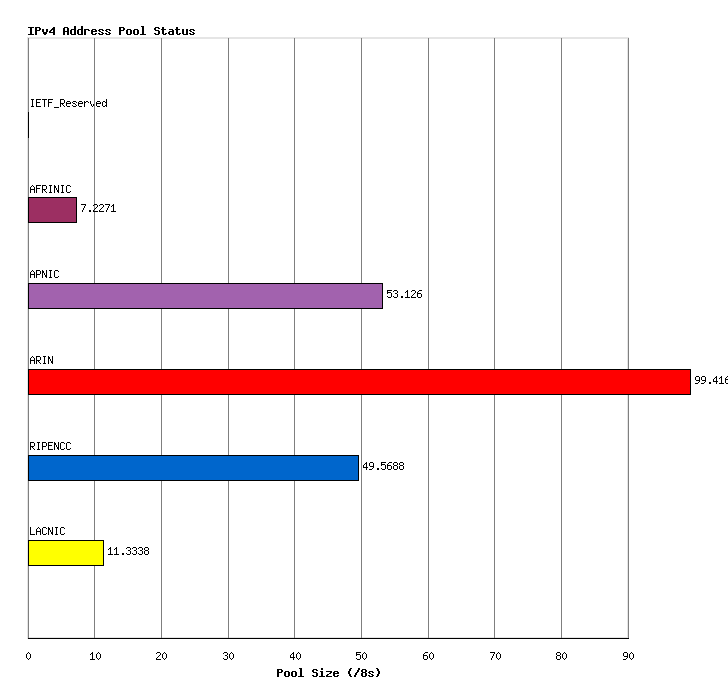
Check out the IPv4 address space consumption graphs at http://www.potaroo.net/tools/i..., there is no new space for you in North America. In fact the only place there is still new space for you is in the African region.
See the 1
Noone is going to make anyone give up their old
It's all over man.
-
Re:Africa has all the addresses
http://www.potaroo.net/tools/ipv4/fig02.png, from http://www.potaroo.net/tools/ipv4/
Short history lesson: On 3rd of February 2011, ICANN allocated the last five
-
Re:Africa has all the addresses
http://www.potaroo.net/tools/ipv4/fig02.png, from http://www.potaroo.net/tools/ipv4/
Short history lesson: On 3rd of February 2011, ICANN allocated the last five
-
Subadditive costsGeoff Huston, Chief Scientist at APNIC, sums up and resolves this debate better than anyone: http://www.potaroo.net/ispcol/... It's a long post, but worth the read for anyone interested in the subject. Here's a few excerpts:
The issues around network neutrality and the tensions about who owes who and how much between content and carriage are perhaps superficial manifestations of a more fundamental issue about public and private roles in the provision and maintenance of common public infrastructure. But doing little other than hoping that Adam Smith’s invisible hand will solve all of this through the actions of competitive suppliers to an open market is probably just wishful thinking. It makes as little sense to festoon our streets with a myriad of cables from competing access carriers, as it does to lay down parallel railway tracks for competing railway service providers. In economic study, this is a case of the subadditivity of costs where the economies of scale do not compensate for the high level of sunk capital in duplicated infrastructure investment. It implies that the costs of service delivery from only one supplier is socially less expensive in terms of average costs than costs of production of a fraction of the original quantity by an number of competing suppliers. In general, an observation that a market has a property of subadditive costs is a necessary and sufficient condition to lead to the formation of natural monopolies is that market.
~
The Internet access market is not a market that naturally tends towards strong competition. The tyranny of sunk capital investment in infrastructure leads to a market that naturally aggregates, and such aggregation has an inevitable outcome in the formation of local monopolies. The “light touch” framework to Section 706 in Title I is just not an adequately robust regulatory framework for this space.
~
At its heart, the Internet access business really is a common carrier business. So my advice to the FCC is to take a deep breath, and simply say so.
-
Subadditive costsGeoff Huston, Chief Scientist at APNIC, sums up and resolves this debate better than anyone: http://www.potaroo.net/ispcol/... It's a long post, but worth the read for anyone interested in the subject. Here's a few excerpts:
The issues around network neutrality and the tensions about who owes who and how much between content and carriage are perhaps superficial manifestations of a more fundamental issue about public and private roles in the provision and maintenance of common public infrastructure. But doing little other than hoping that Adam Smith’s invisible hand will solve all of this through the actions of competitive suppliers to an open market is probably just wishful thinking. It makes as little sense to festoon our streets with a myriad of cables from competing access carriers, as it does to lay down parallel railway tracks for competing railway service providers. In economic study, this is a case of the subadditivity of costs where the economies of scale do not compensate for the high level of sunk capital in duplicated infrastructure investment. It implies that the costs of service delivery from only one supplier is so
-
Re:Arin is alone
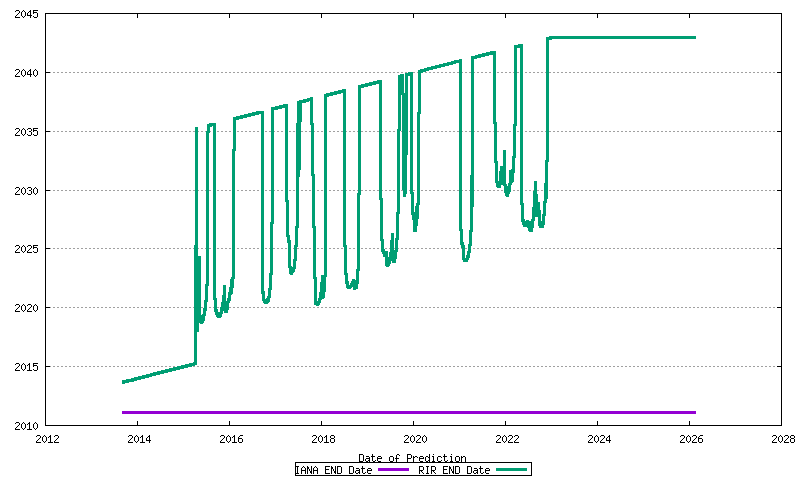
Put your seats in the upright position and brace for impact: http://www.potaroo.net/tools/ipv4/plotend.png
-
Bad summary
Unsurprisingly, address exhaustion still going on. APNIC and RIPE are down to their last
There's a finite number of addresses, guys. They're not going to magically stop running out.
-
Re:Port block allocation & PCP
Port control protocol is also very close to being reality. It's a bit like a combination of UPnP and DHCP that allows static IPv4 ports to be requested by and allocated to an end user like IP addresses are now.
Humans' ability to create complex and convoluted workarounds for problems that have been foreseen for 20 years and have had a solution for equally as long simply waiting for a bit of investment in infrastructure amazes me. If people spent even half the amount of effort in implementing IPv6 as they do finding assbackwards workarounds to easily solvable problems then the world would be a much better place.
-
Port block allocation & PCP
Your ISP should at least be giving you a block of static ports on a static public IPv4 address so that you can just map them on your home router afterwards. It's called "port block allocation". See this slide deck for more details.
Port control protocol is also very close to being reality. It's a bit like a combination of UPnP and DHCP that allows static IPv4 ports to be requested by and allocated to an end user like IP addresses are now.
You should pester your ISP about these two services monthly until they have a satisfactory response for you. Frankly it's irresponsible on their part if they don't have a FAQ explaining this stuff and a policy for helping customers deal with these things. To do otherwise is demeaning to their customers.
-
Re:My Rant....
How the hell does slashdot.org not support IPV6,
In a way, it does seem hypocritical: Slashdotters regularly complaining about IPv6 not being adopted quickly enough, while the Slashdot site itself is still not available via IPv6 despite carrying such reports for over a decade.
However, the problem may have at least as much to do with their hosting provider, Savvis, which AFAIK still does not offer their customers native IPv6 support. Of course, Slashdot could decide to set up an IPv6-over-IPv4 tunnel instead, but the traffic involved would probably be substantial and lead to complications and expenses that they and their corporate masters would rather avoid.
I suspect that Savvis and other US providers will only start to improve their support for IPv6 after ARIN's pool of IPv4 addresses has been depleted, an event that currently looks set to take place in the first half of 2014.
-
Re:spammers
Just about every statistic you might want to know about IPv4 allocations is at http://www.potaroo.net/tools/ipv4/
Yes, that first graph predicts that ARIN (North America) will be down to the last
Reserved, unadvertised and pool addresses total 101 times 2^24 addresses. The last five years have seen the number of allocated addresses grow roughly by 10 times 2^24 addresses per year. Reclaiming unused address space and using all previously reserved address space could prolong the suffering another 10 years, but most of the unadvertised addresses are in legacy allocations with unclear legal status (these addresses may well be unreclaimable) and using the reserved addresses as unicast addresses would cause clashes with hard coded expectations. 2013 will either be the year the big networks start to put their users behind NAT or it will be the year of IPv6 entering the mainstream. I expect the former.
-
Re:86% of IPv4 addresses are not used
Very not true. See here: At the time of writing, 153.38
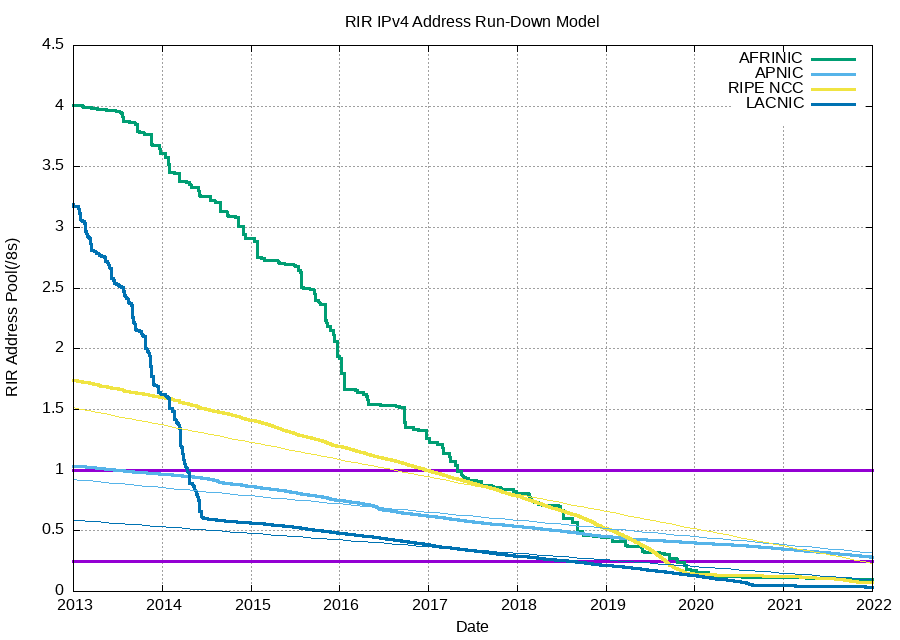
There are no addresses left to be assigned to the RIRs. APNIC has "run out", meaning it's down to the address space that it reserved for IPv6 transition measures. RIPE is going to run out before the end of the year, with ARIN following not much later. ISPs are already using NAT for big chunks of their user base (mostly the mobile networks). An increasing number of internet users can only choose between no public IP address (and NAT) or an IPv6 address.
-
Re:Here come the bottom feeders
Not yet in North America. However in the Asia Pacific region you're out of luck. If an ISP there runs out of addresses, and in China they do, they have to NAT and/or provide IPv6. Now I grant you that the west doesn't use many Chinese webservices. But Australia is in the same boat. So in the not so distant future you will find yourself unable to use some Australian webservices if you don support IPv6.
Also the BGP tables will reach 512k entries within two years. As this is the maximum for hardware forwarding tables in many (older) routers be prepared for an IPv4 slowdown as these routers will forward IPv4 traffic over the slow path. Or unreachable sites as ISP's will start to filter all prefixes longer thanThe nice status of IPv4 can be found at http://www.potaroo.net/tools/ipv4/index.html
-
Re:IPv4 forever?
It seems that we have been running out of addresses for 10 years or something and everyone has been talking about moving to IPv6 since the late ninteties ?
When the internet was initially developed it used a simple but horriblly wasteful system known of as classfull routing. Addresses were divided into classes and from each of three classes* blocks of a particular size were allocated. This system meant that many organisations ended up with a block far bigger than they really needed (many of which are being sold now) and it meant that a particular size of block could run out before all addresses did.
In the early ninties it became clear that if this system was continued addresses would quickly run-out and it was replaced in the ninties (afaict the actual replacement was somewhat gradual) by the more efficient classless system we have today where blocks of any power of two size can be allocated anywhere in the unicast address space. This improved efficiency and combined with many institutions choosing to use NAT rather than public IPs for most of their systems it bought us some time.
Unfortunately rather than spending that time ensuring that all new network equipment was suitable for** IPv6 and pushing IPv6 to customers as soon as the infrastructure was ready most providers sat on their hands waiting for everyone else to move first. CPE vendors also formed a blockage to getting IPv6 to end users natively.
So here we are, it's 2012, the IANA and APNIC have run out of v4 addresses for regular allocation. RIPE and ARIN still have some supply but will be running out within the next couple of years if current trends continue [1]. AFRINIC and LACNIC have longer projections but once RIPE and ARIN run out i'd expect to see some "RIR shopping" action deplete their pools as well . Meanwhile a large proportion of end users either lack access to the IPv6 internet or have it through the fragile nat poking automatic tunnelling system known as teredo.
Worse due to microsofts refusal to backport SNI support to XP and google inexplicablly not including it in andriod 2.x SSL websites still require dedicated IPs (which as mentioned above need to be IPv4).
Given the current levels of IPv6 penatration and the time it takes to push major changes through there will still be a real need for V4 addresses in hosting when RIPE and ARIN run out of addresses. At that point the only real option for hosting will be to buy IPs on the open market at gradually increasing prices (I wonder just what price it will take to make it worthwhile for the end-luser ISPs to deploy ISP level NAT to free up addresses for sale)
I am sure there is a limited range of numbers and the issue is real but also seems like fodder for sensationalist tech journal articles.
Well yeah that is what journalists do, the sky isn't going to fall tomorrrow but if you are planning a new network deployment or an extention to an existing one you should be thinking about this stuff and in particular you should be thinking that if your plans require new V4 IPs that you may find them difficult and costly to obtain.
* There were two other classes, one for multicast and one reserved (which can't be used because a lot of software will reject such addresses).
** As comcast found out [2] a vendor claim of IPv6 support was not sufficient to make the equipment suitable for IPv6, actual acceptance testing was (and probablly still is) required.
*** Note: because of the way IP allocation works it's not in an ISP's interest to start doing this until AFTER the pool of addresses at their RIR runs out. If they do it today they will just end up with a smaller slice of the pie in the end.[1] http://www.potaroo.net/tools/ipv4/index.html
[2] http://www.nanog.org/meetings/nanog37/presentations/alain-durand.pdf -
Re:Werent we supposed 2 run out of ips a while bac
RIPE (Europe) is down to about 40 million addresses, including the last 16 million which will be assigned under a different, more stringent policy
Its worth noting that most (all?) the RIRs have similar
The idea of this last
So, RIPE is about 26 million addresses away from the last
A useful graph of allocations by RIR
When those are depleted, it's going to be NAT all the way down.
I keep hearing ISPs say "we're not implementing IPv6 yet, we've got loads of IPv4 addresses so we're not worried". But at the end of the day, I don't think the ISPs are going to be the driving force - I think they really do have plenty of spare IPv4 addresses, and even when they run out, they can NAT most of their customers and charge a premium to anyone who needs an un-NATted connection. The people who are going to be really hit by the crunch are content providers - at some point, a content provider is going to want to add a new server, a new HTTPS site, etc; and they're going to get the answer "no" when they ask the datacentre for some more IPv4 addresses. Thats when things are going to get messy. Of course, the ISPs saying "we don't need IPv6 since we've got loads of addresses" is totally bogus - it doesn't matter how many v4 addresses they have, if the ISPs' customers want to access content hosted by people who _don't_ have v4 addresses, they are going to need v6 connectivity, and eventually any ISP that doesn't provide it is going to lose out because some content isn't going to work. What ISP wants to tell their customers that they don't allow connections to Facebook's new service, or Google's new product?
One thing that would be nice to see is more v6-only content *before* crunch-time to try and pressure the ISPs to act. This could be done without seriously impacting the bottom-line of content producers: for example, Google always likes to "soft-launch" their new products, often by doing an invitation-only thing. But they could soft-launch them by initially making them v6-only. Same effect for them (no massive influx of new users, whilst getting a steady str
-
Re:Silly
APNIC ran out 19 April 2011: http://www.potaroo.net/tools/ipv4/index.html
-
Re:And the net is already full
I'm still charged 1€ per month for an extra IP address
And I got 10 from my ISP, at no additional cost.
don't think Europe is running out of addresses any time soon
Ok, so because you are paying 1€ per month for an extra IP address, that means these numbers are wrong?
-
Re:IPv6
I thought there was an announcement that the IPv4 address space is now totally exhausted. Or at least there are no new blocks to be assigned. The tunnel broker, Hurricane Electric indicates that IPv4 is exahusted.
The announcement - http://www.nro.net/news/ipv4-free-pool-depleted - was made when IANA, the central authority, ran out of addresses to give to the five regional internet registries. These regional registries will run out at different speeds. Geoff Huston's graph is very useful to see how fast this will happen - http://www.potaroo.net/tools/ipv4/plotend.png
-
Re:IPv6 day using IPv4 addresses?
See, for example, this: http://www.potaroo.net/ispcol/2011-05/ip6test.html
-
Re:Where is the Google test?
Safari, for example, had a bug until recently that caused page loads to fail if the site has an IPv6 address but the client doesn't have connectivity. In addition, there are a bunch of autoconfigured tunnel technologies that can cause problems. See, for example, APNIC's chief scientist's report on Teredo: http://www.potaroo.net/ispcol/2011-04/teredo.html
-
Re:Thanks EU
The whole point of a hierarchical addressing scheme is that you DON'T randomize the addresses. That's, incidentally, the problem IPv6 was supposed to solve (before, of course, politics got in the way).
Why ? A hierarchical routing table only needs to contain your own clients, and a single upstream route. That's maybe 10-20 routes for any "normal" point in the network. 50 at the most.
Randomizing addresses, for political reasons, got us to
345750 network entries using 41835750 bytes of memory
(and of course, rising fast). The difference ? A 10000 route switch is $2000, one that can take one million routes (the minimum you'll risk if you're smart) costs around $50000 (that's per device).
-
Re:I don't think they care.
http://www.potaroo.net/tools/ipv4/rir.jpg
APNIC will be first.
-
Re:ISP
Too much could change between now and then (then probably being in about a decade or so).
Current predictions for the RIRs running out of IPv4 space is August this year , same solutions may help keeping the v4-only net running for a bit longer, but the decade you mention seems a bit unreasonnable.
Until my home ISP or the ISP for the company I work for offers IPv6, I think it's going to be very easy to ignore IPv6.
I'm with OP, when my ISP gives me one.. i'll deal with it.
The main issue, which is far from being new and, as far as I'm concerned, is one of the main causes of lack of IPv6 deployments yet, is that it's a chicken and egg problem. ISPs do not implement IPv6 because their customers don't ask for it, and customers don't care to ask (and why should they, in most cases). Maybe the first step to “deal with it” is to ask your ISP about their plans, and when you'll get connectivity. It's not much, and doesn't even require technical skills.
After all, even ComCast has started a large scale <cough> deployment.
-
Re:O M G
This is a pretty good image from 2008 onwards at least. The predicted time has varied by a few months but the money has been on 2011 at least for the last three years.
-
Re:Yahoo! is relying on old, incomplete data.
Geoff Huston wrote an article about comparing 6to4 to IPv4 in terms of failure rate - and found out that about 0.2% of IPv4 connections to his web server were also broken. Geoff's article also provides insight why exactly a large percentage of 6to4 connections to his web server failed: routing packets around the planet just because a lack of 6to4 gateways and in three out of four issues, some broken firewall dropping 6to4 packets.
Issues A and B also doesn't necessarily mean that IPv4 is permanently broken but "occasionally".
For example, every mobile carrier in my country deploys Large Scale NAT/Carrier Grade NAT for IPv4, but in order to max out those boxes, they're running with very low session timeout settings. Their NAT routers silently drop my session when a tcp connection is idle for longer than a few seconds. While web browsing "usually" works, things like IMAP sessions very often do break and reconnect, for interactive use I'm forced to run ssh-sessions with "ServerAliveInterval 7". One of those carriers even temporarily blocks access to Apple's iTunes store - maybe because the iTunes store is known to eat up to 300 parallel NAT sessions for a single user (compared to roughly 20-30 for "usual" web surfing). When accessing some very slow web server, the NAT session timeout also kicks in, resulting in my browser "endlessly" loading the same page.Right now, the same carriers don't yet offer IPv6, so technically, they're forcing me to issue "A". Once they do offer IPv6, my mobile internet access is likely to be issue "B".
-
Re:can we have a moratorium on ip v6 scare stories
Yep, they have beeing saying that it was 2012 for years. But I disgress, I made a mistake replying with data I remembered, and not checking my sources. It seems somewhen recently (I remember that) the forecast crossed the barrier of 2012, being now december 2011. By the way, some 8 or 9 years ago, when I was studing that thing at my undergrad, it was forecasted to durate for more 20 years. Forecasters always get it wrong.
Also, the IPv6 was created with a migration path in mind. It is just that people didn't use it (yet?).
-
IPv6 is important.
Every time this discussion comes up, people fail to see the significance of IPv4 running out. It's 2010, and folks still get confused.
The significance is this: There are massive growth regions in the world that will only be able to purchase IPv6 addresses within the next year or two. And if you aren't playing the IPv6 game, then you're shutting you and your customers off from all those various markets that will open up in years to come.
There's only so much can be squeezed out of IPv4. But regardless of how much can be squeezed out of the existing space, the regional registries are likely to run out of
You're shooting yourself in the foot if you refuse to bring yourself up to date.
-
Re:Someone help me out here
Whoever was telling you that we were going to run out in one year five years ago was probably smoking methamphetamines at the time.
The IANA free pool will run out next year, probably before mid year.
The point at which you can't actually receive any more addresses won't come until the RIRs exhaust the blocks that they have received from IANA which might not be for another year after that.
-
Re:Bull
Speaking of which, two
Maybe you've been listening to too many different people's "one year" predictions too much, at different times, or something. However, the potaroo IPv4 report has been very consistent with the Jun-Jul 2011 IANA exhaustion prediction and Spring 2012 RIR exchaustion prediction. In 2010 it has predicted those dates, back in 2009 and 2008, it was still predicting 2011
Your contention that the runout date is always being moved to "next year" does not hold water.
-
Re:Hasn't it already?
I don't know where you have been getting your predictions. It is pretty certain that IANA is going to run out of space about the middle of next year.
We have 14
Are you betting on the ipv4 space usage magically decreasing ( right when everyone will start freaking out about getting their last allocations )?
-
Re:Already Run Out
we aren't,
-
Re:poorly informed
I suggest you check these reports instead, it is a lot easier as they do all the prediction for you, and they are both updated daily:
-
Re:I have read it...
I have been hearing people say we are running out of IP addresses for 15 years so am getting a bit skeptical.
That you've been hearing about it for 15 years sounds about right, since the problem was acknowledged in 1994. But how many end-of-days predictions actually gave you a date, other than Real Soon Now (tm)? I'm asking because I've been watching the IPv4 Address Report for a few years now, and in that time the end-date has only moved towards us (from the end of 2012 to February 2012).
If you bother to follow the link, please take a look at figure 6 which shows the history of address allocations over time. You'll see that the allocation rate has dropped significantly in the last 15 years compared to the 10 years before that (actually, there were as many allocations in the 8 years leading up to 1995 as there were in the 15 years that followed). You can also see (figure 9) that the most growth over the past five years has been in Asia (APNIC), and that the growth is accelerating. There are also now more addresses claimed in Asia than in Europe (RIPE). Starting from figure 18, you can see various predictions that show the global pool to be exhausted before this year is over.
So be skeptical for all your wish, but we're nearing the endgame.
-
There's a killer app allright...
You can find it here: http://www.potaroo.net/tools/ipv4/
-
Denial in not a river in EgyptTFA is bad enough, but the comments to the thread are simply stunning in the level people will go to to avoid dealing with something new. Every old obsolete or never valid saw about IPv6 is getting re-hashed. None will make any difference.
To be very, very clear, IPv6 will happen. There is no way around it. There is almost no IPv4 address space left. The folks who are at the top of the structure that assigns addresses will run out in the middle of next year. The next tier, call Regional Internet Registries may have addresses available for another year. By the end of 2012, there will be no address space available to assign. For the gory details, see the IPv4 Countdown Page. Especially, look at Figure 35. That is reality.
As an end users, you may not care. Comcast is already beta testing IPv6 to its customers. I assume others are or soon will be doing so soon, but this should be mostly transparent to users as their system will only require IPv4 and that will be NATed behind an IPv6 address. But it must happen or people will not be able to get new addresses. That is the bottom line. IPv4 will remain in use for many years, but the net will start getting smaller and smaller for those who don't implement IPv6.
-
Denial in not a river in EgyptTFA is bad enough, but the comments to the thread are simply stunning in the level people will go to to avoid dealing with something new. Every old obsolete or never valid saw about IPv6 is getting re-hashed. None will make any difference.
To be very, very clear, IPv6 will happen. There is no way around it. There is almost no IPv4 address space left. The folks who are at the top of the structure that assigns addresses will run out in the middle of next year. The next tier, call Regional Internet Registries may have addresses available for another year. By the end of 2012, there will be no address space available to assign. For the gory details, see the IPv4 Countdown Page. Especially, look at Figure 35. That is reality.
As an end users, you may not care. Comcast is already beta testing IPv6 to its customers. I assume others are or soon will be doing so soon, but this should be mostly transparent to users as their system will only require IPv4 and that will be NATed behind an IPv6 address. But it must happen or people will not be able to get new addresses. That is the bottom line. IPv4 will remain in use for many years, but the net will start getting smaller and smaller for those who don't implement IPv6.
-
There's a killer app alright...
You can find it here: http://www.potaroo.net/tools/ipv4/
-
Re:Mac Issue Or IPv6 Issue?
Almost certainly the latter.
The article, and the accompanying 'raw' data, are not sufficiently detailed to draw the conclusion that OS X is at fault. The observation is that browsers with Mac OS X in the User-Agent string are more commonly using 6to4 addresses. The faulty assumption is that Mac OS X prefers 6to4 addresses to RFC1918 addresses.
The reality is that getaddrinfo() on several platforms prefers IPv6 addresses over IPv4, if the host OS has an active IPv6 service. This is not unique to OS X, nor is it a bug.
The interesting part is that the only CPE devices which support IPv6 are Apple Airports - the Extreme and Express models. They use 6to4 if there is no native IPv6 address provided. No ADSL modems available to consumers support IPv6 out of the box, ergo, almost every Airport user has 6to4 enabled. If one assumes that most Airport users are also Mac users, then the observation that excluding Mac OS X User-Agents from the result set also excludes the bulk of IPv6 users is not surprising.
If Apple has an issue, it's that they enable 6to4 by default on a consumer device, when 6to4 is a known-bad mechanism that should be avoided.
If one is running dual stack services, one should be aware of the most common pitfalls: see http://www.potaroo.net/ispcol/2010-05/v6hints.html for details.
-
Re:Auction?
There are a few. See figure 5 of Geoff Huston's IPv4 Address Report.
-
Re:The sky is falling...again?
The "drop dead date" for running out of address space keeps getting pushed out....
These are the archive.org history for the potaroo.net automated IPv4 exhaustion counter. The two dates are "Projected IANA Unallocated Address Pool Exhaustion" and "Projected RIR Unallocated Address Pool Exhaustion".
2006-08-23 : 2011-03-30 , 2012-07-14
2007-01-25 : 2011-07-24, 2012-07-19
2007-08-27 : 2011-06-10, 2012-03-19
2008-01-29 : 2011-06-02, 2012-08-05
2008-07-30 : 2011-02-01, 2011-12-25
2010-01-25 : 2011-09-09, 2012-09-01I can't seem to find this so called "pushing out" that you are talking about.
-
Re:The end is near
We are going to run out of IPv4 addresses in March next year (422 days from today)
http://ipv4depletion.com/?page_id=4Or September 2012: http://www.potaroo.net/tools/ipv4/index.html
-
Re:Ill bet this will happen
As a side curiosity, I wonder how many public IPv4 IPs are actually in use.
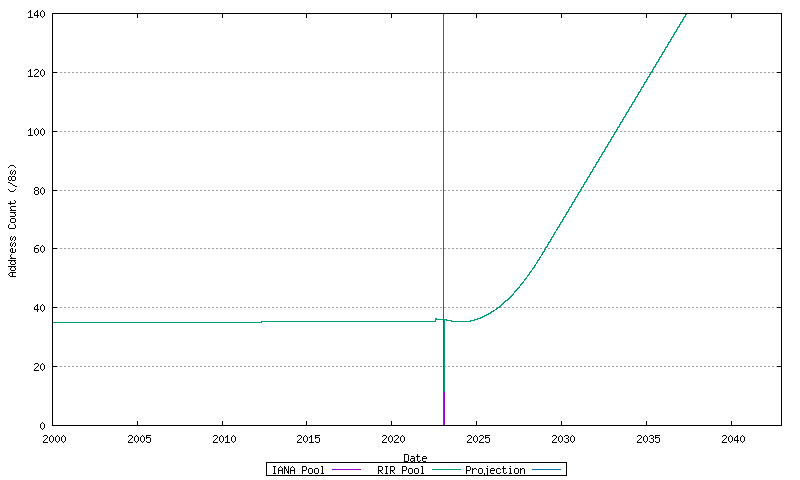
Check out figure 36 on this page: http://www.potaroo.net/tools/ipv4/ The green line is what has been assigned, the blue line is what is actually announced on the public internet. There are about 50
-
Re:Panic Averted - Resume Doing Nothing
Except that if you read between the lines, this is all a subtle stab at the 2 year estimate. "A couple of years ago" we were slated to run out of addresses by 2010. Now they're estimating 2 more years.
It has? This is where the internet wayback machine is so nice
2007-01-25: Projected IANA Unallocated Address Pool Exhaustion: 24-Jul-2011
2008-01-29: Projected IANA Unallocated Address Pool Exhaustion: 02-Jun-2011
Now: Projected IANA Unallocated Address Pool Exhaustion: 30-Sep-2011As these are automated momentary estimations, they are fluctuating all the time, depending on current allocation rates which seems to depend on time of year. Generally, the numbers are the best during the winter with exhaustion dates being somewhat further away, around the midlde or end of 2011, while summer estimations move towards the earlier 2011 or even 2010. I don't see any evidence about your assertion that the exhaustion estimation date has been getting much further away.
-
Re:Trends
No, this sums [potaroo.net] it up. If you'd bother to read this or an estimation done by someone else, then you'd know that the uncertainty is less than 3 months with high confidence.
One thing is certain though - we _will_ run out of IPv4 addresses soon. It doesn't much matter how soon at this point - it's soon enough that people should be seriously thinking about implementing IPv6 networks. And anyone writing network software would be very foolish to not have already implemented and tested IPv6 support at this point.
-
Re:Trends
No, this sums it up. If you'd bother to read this or an estimation done by someone else, then you'd know that the uncertainty is less than 3 months with high confidence. Of course the 625 days thing is bullshit, but saying 1.5 years +-3 months is probably what will happen, unless something really major changes don't start happening in the IPv4 process, which I wouldn't say is too likely based on the fact that it would require immediate global cooperation (see how well that went in Copenhagen).
-
Guess we'll just going to have to have...
...another financial crisis. Because that's the reason there was a slump in allocation rates. The current best projection for IANA pool exhaustion is Sep/Oct 2011. Without the financial crisis that would have been end of 2010. The IANA guys would have been dead on, if not for a once in a 100 years financial event.
The tone of the submission is really silly. There wasn't 4.3B allocatable addresses in the first place. Out of the 256 "/8s" only 219.914
Also, it's "not the next 2 or 3 years", based on the available number of addresses 1.5 years for the IANA pool and 2,5 years are hard bars until RIRs (regional internet registries) run out.