Slashdot Mirror
Domain: princeton.edu
Stories and comments across the archive that link to princeton.edu.
Comments · 1,515
-
A mishmash of half-truths over-simplifications
There's a lot of merit in this story I think, but ultimately it muddies the waters. Certainly, it's claim that government-funded research played a less than key role in the development of internetworking seems to be just plain false.
First of all, the work Xerox did that most resembles the Internet protocols was not Ethernet, but PARC Universal Packet (PUP), which is indeed quite directly comparable to the IP in TCP/IP. Ethernet, while a terrific piece of work, mostly served to facilitate networking within a single site.
The article also says implies that the Government-funded ARPANET wasn't really the precursor of the Internet. I think that's an over-simplification. Arpanet wasn't the very first packet switching network (see the work of Baran and Davies), and it certainly wasn't an Internet (network of networks), but it really was the direct antecedent of the Internet as we know it. Arpanet connected universities and other research establishments. It proved the viability of a packet-switching network with all the application smarts at the periphery of the network. In almost all cases, what had been Arpanet connections among the early sites evolved (sometimes by way of NSFnet) to TCP/IP Internet connections, running essentially the same applications and services. So, in all those ways, Arpanet was a crucial step on the way to our TCP/IP-based Internet, and of course, ARPANET was government funded.
A much less sensationalist but much more balanced history of all this can be found at: http://www.nethistory.info/History%20of%20the%20Internet/origins.html . The record there strongly suggests that Bob Kahn and Vint Cerf were discussing approaches to internetworking (connecting networks) in spring of 1973. Interestingly, the official PARC Research Report on PUP actually cites the Internet work of Cerf and Kahn, specifically their 1974 A Protocol for Packet Network Intercommunication.
So, the government-funded work on internetworking seems to have started before the Xerox work, and the Xerox research time explicitly cited Cerf and Kahn as sources of inspiration for the Xerox work on internetworking. Wouldn't it be nice of the WSJ article made all that clear before everyone started using these over simplifications to prove the futility of government-funded research?
-
Re:And what is the Internet?
Right, I guess the problem really is that you have a poor comprehension of English.
The question was to provide a definition for the internet. My response was:
"An international network of devices."
I said nothing about naming, or anything like that, I provided a completely correct answer. You don't seem to be able to understand that, but it's not really my fault you don't know English very well. You're now twisting your whole argument to base it on some premise that never actually existed, so kindly stop making shit up, you're still wrong however you try and twist it.
Regardless, I still want to point out how utterly lacking in knowledge of the subject you are, as it's the only hope that people like you will get a clue, rather than laughably making a fool of yourself by demonstrating repeatedly how wrong you are:
"Exactly my point
If you interconnect a railway network with a river network, what do you get then? Certainly not a standard bigger network."Yes you do, this was exactly my point, so I don't know why you've said "exactly my point" and then completely failed to grasp the point. If you combine the river and rail network then yes, you do get a bigger network, you get whatever that network is defining, it may be a boat/rail transportation network for example. You still completely fail to grasp what networks are, and well, I guess that sucks for you.
"What you get is pretty simple: you get a network with two nodes. And each of those nodes is a network in itself. Just like the internet, an interconnection of networks, where every node of the network is not a computer!! but a subnetwork! This is what you fail to grasp."
No you still don't get it. You have two networks, made up of say for example, 30 computers, you connect them together, and you now have a larger network of 60 computers, which is comprised of two subnetworks. Those subnetworks can be treated as networks in themselves, but ultimately the internet still remains an international network of devices, even if those devices are themselves subdivided into subnetworks. It's really not rocket science, I don't know why you struggle to badly to grasp the concept.
"Claiming that I Iack understanding regarding networks is plain stupid, as you see at my signature I'm very involved in all kinds of networks
Great, but you still don't know what the fuck you're on about. See this definition from Princeton for example:
http://wordnetweb.princeton.edu/perl/webwn?s=internet
But I suppose you'll come back and tell me that people at Princeton don't know as well as you or something either.
Just admit it, you are wrong, trust me, it's much easier than continuing to make a fool of yourself.
-
Re:Fall, really?
First, we've established that there is a cabal, and we know its name.
So is the the local tree house gang. The real question is: what can they do? But I guess we agree on that.
I don't know what data you're referring to, but it would be damned hard to imagine any data proving that point.
Uh, yes. It's in the price of oil, and the price of oil that OPEC has repeatedly tried to set. The fact that you don't even know what the data would look like that could falsify your position tells me you have actually never looked at the data.
When you have a single unified entity controlling half the world's production
And this is how I know you have no idea what you're talking about: http://www.princeton.edu/~pcglobal/conferences/environment/papers/colgan.pdf, as well as this: http://www.washingtonpost.com/business/economy/opec-fails-to-ratify-proposal-to-boost-the-oil-cartels-output/2011/06/08/AGrHSzLH_story.html These are just a few, small instances of the general failure of OPEC to do much coordination.
a handful of about 5 companies controlling all the refining
And again, you show your total ignorance. Here's a quick link: http://en.wikipedia.org/wiki/List_of_oil_refineries#United_States. And that's just the US.
unless we are to pretend that 1974 didn't actually happen
Number 1: that's a single data point. There's no trend to be made of it. Number 2: that was almost 40 years ago, and the oil landscape, as the world, has changed significantly.
Larger point is, if you think oil is a completely untainted free market
Last point is, if you want to argue, you might want to make sure you actually have your facts straight, or you come across as the living embodiment of truthiness, and just as much of a joke.
-
Rationales in the bills
They'd probably have to convince a judge and/or jury
I'm aware of at least one law on the books in at least one U.S. state (Indiana) that includes an explicit purpose. If a legislature seeks to impose "formalities, conditions, restrictions or penalties" on speech, a bill could include a preamble that mentions to which interest each restriction appeals and why. Until case law develops around a particular statute, such an explicit rationale would help convince a judge of the legislature's intent.
-
Re:OMG TPM
It also is a good place to store hard disk encryption keys, because the TPM chip makes it extremely difficult to do brute force attacks on your password. I simply can not imagine why anybody would intentionally buy a modern computer without these wonderful capabilities.
Actually, a TPM makes it easier to steal your keys if the thief has physical access to your computer, because the thief knows exactly where the keys are stored. See the famous paper at
http://citp.princeton.edu/research/memory -
Tipping points include
The positive feedback loop of a previously sequestered source of greenhouse gas causing yet more release of same.
The mass die off in the seas of the base of the food chain and the sudden follow on of all other species that depend no that food chain.
The outbreak of nuclear or biological war as a result of governments toppling under food and or water scarcity pressures.
The breakdown of civil order owing to the bankrupting of nearly all nations in a now-too-late, and ultimately futile effort to avert climate change. A tipping point is reached regarding the human acceptance of climate change and all it entails, including any and all of the above. Just as in the stock market, the full event doesn't even have to happen before the force of the disaster is felt - that happens as soon as a tipping-point consensus understanding of what is inevitable takes hold amongst observers.
It's not too late now, or at least , it's not certain it's too late now.
By the time the symptoms become indisputable, then.. then it will really be too late.
The Princeton Stabilization Wedges concept. An idea we can all benefit from, however you feel today about the certainty of climate change:
-
Re:Any 8 character password?
Looks like it's time to change my password to "password1".
I know this is just a joke, but we really need to stop propagating the idea that memorable passwords are weak.
The brute force search space of "password1" is 486 times larger than "password" (36^9 versus 26^8). Increasing the length of a password is one of the best ways to strengthen it. Intuitively, a randomized string is better than a structured one. This is correct, but only when the strings have equal length. Humans cannot remember long randomized strings. A lengthy, structured password is stronger against computerized attacks since the search space is significantly larger.
According to Princeton's WordNet there are at least 117,000 English nouns. A memorable four-noun phrase has a search space 2600 times larger than a randomized 7-bit ASCII eight-character password (117000^4 versus 128^8).
An obligatory XKCD with discussion can be found here.
-
Soda isn't the problem
Corn syrup and sugar are[1]. SO, if you want to curb obesity, it's pointless to take out only soda. Even fruit juice[2] contains levels of concentrated sugars which cause all sorts of problems. Yes, even juices without added sugar. Candy bars, licorice, gooey sweets -- most anything you can find in a convenience store is going to be just as bad, if not worse than soda.
Also, many of the products containing corn syrup are made from extracts of the same corn used for large scale meat production; engineered to put on lots of pounds quickly. Corn syrup (and many corn products) are simply a blatant disregard for people's health in many ways.
[1] - http://www.princeton.edu/main/news/archive/S26/91/22K07/
[2] - http://blog.fooducate.com/2009/11/13/orange-juice-is-just-as-bad-as-cola-really/ -
HFCS is POISON (FTFY)
Sugar is a needed and necessary nutrient for our bodies. But, much like anything else, the poison is in the dose. For example, our bodies are mostly made up of water. Good old H2O, necessary for all life on Earth. But drink too much water in too short an amount of time and you can die from electrolyte imbalance. By and large it's the dose, not the substance that is poisonous.
Our bodies were designed to take in small amounts of natural sugars from fruits and vegetables. Large amounts of sugars will, as you said, be converted to fat. and can make you lethargic and ill-feeling.
Ironically, (at least in the US) Most soft drinks and other "sugary" foods don't actually have any sugar in them. Instead they use a far more dangerous substance, High Fructose Corn Syrup, or HFCS.
HFCS is a cheap (due to corn subsidies) easy to transport, slow to spoil, and highly soluble in water, making it an ideal sugar substitute for much of the food industry. The downside is that HFCS in any significant amount causes the human body to react in some very adverse ways. HFCS causes thirst, liver damage, diabetes and as has been recently discovered by researchers at Princeton University causes extreme weight gain and obesity far in excess of what simple sugar can do. In particular, HFCS causes weight gain in the belly and torso. HFCS also causes significant increases in the amount of triglycerides in the bloodstream, a major factor in heart disease, the number one killer of adults in the US.
So it's good that you are cutting out the soft drinks and other "sugary" things, but unless you live somewhere that doesn't use HFCS (South America, parts of Europe, China) make sure you are blaming the right thing. otherwise, i think your diet change is a sound one. Lots of fresh meats, fresh vegetables, small amounts of fruit and grains and an absolute minimum of "sweet snacks". (This is basically the "maintenance" portion of the Atkins diet, btw.)
Also, if you live in the US, be sure to join a group lobbying for the repeal of corn subsidies of all kinds. It's the subsidies that make HFCS so cheap. eliminate them, and the food industry will go back to using much more benign sugar.
-
LONG PAST TIME
Are you kidding? Long past time that our government started framing the issue in this way since, in reality that's just exactly what it is.
While virulent teabagging " Nixon and Reagan were too far left / let's end-the- EPA ! " narcissists who compromised their rationality by coke-snorted their way through the 80s go apoplectic over some poor NAFTA-shafted Mexican coming over to trim their freaking hedges, the specter of massive uncontrolled global destabilization borne of crop failures, oceanic dead-zones and mass population migrations is hurtling towards reality.
Think carbon trading is going to cost you money? Try ponying up for perpetual, open-ended colossal military and intelligence efforts that dwarf the Iraq and Afghanistan efforts combined.
If the fundie freaks want to think they inhabit a child-like universe characterized by a perfect moral justice personally overseen by Santa-God then that's their business
Inhofe:
Well actually the Genesis 8:22 that I use in there is that âoeas long as the earth remains there will be springtime and harvest, cold and heat, winter and summer, day and night.â My point is, Godâ(TM)s still up there. The arrogance of people to think that we, human beings, would be able to change what He is doing in the climate is to me outrageous.
There's a strong argument to be made that democracy has already failed. It's possible that we've waited so long we cannot stop runaway greenhouse gas emissions.
No one really knows with certainty if the methane-sequestering perma-frost will go into a positive feedback loop or not.
Whatever the probability of that or some other unforeseen positive feedback loop accidentally being invoked, like the runaway acidification of the oceans wiping out marine life and toppling the food chain- the fact is we've - strike that - CONSERVATIVES - have brought us so close to what we knew to be the edge of disaster that it's now possibly nothing more than a matter of chance whether we live or die.
A system of government that permits its nation and people to be brought to the brink of a known, well understood and scientifically proven extinction process- save for luck- is pretty much the definition of a failed system of government. We may be in for a future in which our civil liberties and standard of living are simply going to be greatly curtailed, whether we like it or not.
The first organizing principle of any society is not democracy, not "freedom of speech" or "freedom of religion" or any specific set of freedoms at all. It's survival.
Rest assured that whether we survive or not, we WILL implement a form of government that maximizes our chances of doing so at the expense of everything else. Have no doubt about that at all.
We need to act right now. Right this very second. Right this very election. We can do a lot worse than implementing the set of recommendations known as the Princeton Wedges.
http://cmi.princeton.edu/wedges/
This approach is distinguished by it's immediate implementability. It doesn't rely on any single silver bullet. It doesn't rely on merely possible future technological advances. The cost is bearable, even minimal and the benefits are not just ecological long term ones but also immediate economic ones.
It's time for America to man-up, get up, shake off the dreamlike, narcissistic just-so fairy-tales promulgated by the sociopathic and mentally enfeebled forces in our society and do what it
-
Re:Paywall ...
And it is a paywall to a blog. What kind of world are we living in these days? Anyway, I suppose this: https://www.princeton.edu/main/news/archive/S33/52/89I01/ is the news the article was supposed to link to.
-
Re:While we're all accidental...
-
+5 Insightful - weeping vaginas orbit the Earth!
there's a lot to be said about running The Tor Browser Bundle in an encrypted container (TrueCrypt) on a LiveCD, with the hard drive UNPLUGGED and UNUSED!
(just take the hard drives out and never use them again, USB thumb drives are cheap and can be encrypted with TrueCrypt, too, as an encrypted containter, partition, or the whole drive itself, just never use a proprietary OS like Windows or Mac OS X)
As a primer, read:
#Tor OPSEC - Operational Security - Great Resource of Information!
http://cryptome.org/0005/tor-opsec.htm
And:
#Lest We Remember: Cold Boot Attacks on Encryption Keys
https://citp.princeton.edu/research/memory/
If the keys (TC passwords) are in my head, complex enough, and never written down...
With the amount of RAM present in new computers, I see no logical reason to use a hard drive again when Linux LiveCDs, encryption, and thumb drives are on the cheap or free.
No unsafe hardware sex, either, this means no plugging your Tor/Truecrypt thumb drive into another system, any system, except for your Tor/Truecrypt system.
Run audits on your system, verify LiveCDs, make sure your router isn't backdoored like many or maybe all of the Cisco routers. Keep up to date if you use open source firmware for your routers. Consider replacing proprietary routers with an older PC as a router with an open source OS like OpenBSD or a prerolled firewall distro.
Test your connection with remote nmap, dabble with Snort, Tripwire and other monitoring tools.
Don't use external hard drives.
RAM is your friend, always.
-
Hurricane in my vagina!
there's a lot to be said about running The Tor Browser Bundle in an encrypted container (TrueCrypt) on a LiveCD, with the hard drive UNPLUGGED and UNUSED!
(just take the hard drives out and never use them again, USB thumb drives are cheap and can be encrypted with TrueCrypt, too, as an encrypted containter, partition, or the whole drive itself, just never use a proprietary OS like Windows or Mac OS X)
As a primer, read:
#Tor OPSEC - Operational Security - Great Resource of Information!
http://cryptome.org/0005/tor-opsec.htm
And:
#Lest We Remember: Cold Boot Attacks on Encryption Keys
https://citp.princeton.edu/research/memory/
If the keys (TC passwords) are in my head, complex enough, and never written down...
With the amount of RAM present in new computers, I see no logical reason to use a hard drive again when Linux LiveCDs, encryption, and thumb drives are on the cheap or free.
No unsafe hardware sex, either, this means no plugging your Tor/Truecrypt thumb drive into another system, any system, except for your Tor/Truecrypt system.
Run audits on your system, verify LiveCDs, make sure your router isn't backdoored like many or maybe all of the Cisco routers. Keep up to date if you use open source firmware for your routers. Consider replacing proprietary routers with an older PC as a router with an open source OS like OpenBSD or a prerolled firewall distro.
Test your connection with remote nmap, dabble with Snort, Tripwire and other monitoring tools.
Don't use external hard drives.
RAM is your friend, always.
-
Wide Vulva for President!
there's a lot to be said about running The Tor Browser Bundle in an encrypted container (TrueCrypt) on a LiveCD, with the hard drive UNPLUGGED and UNUSED!
(just take the hard drives out and never use them again, USB thumb drives are cheap and can be encrypted with TrueCrypt, too, as an encrypted containter, partition, or the whole drive itself, just never use a proprietary OS like Windows or Mac OS X)
As a primer, read:
#Tor OPSEC - Operational Security - Great Resource of Information!
http://cryptome.org/0005/tor-opsec.htm
And:
#Lest We Remember: Cold Boot Attacks on Encryption Keys
https://citp.princeton.edu/research/memory/
If the keys (TC passwords) are in my head, complex enough, and never written down...
With the amount of RAM present in new computers, I see no logical reason to use a hard drive again when Linux LiveCDs, encryption, and thumb drives are on the cheap or free.
No unsafe hardware sex, either, this means no plugging your Tor/Truecrypt thumb drive into another system, any system, except for your Tor/Truecrypt system.
Run audits on your system, verify LiveCDs, make sure your router isn't backdoored like many or maybe all of the Cisco routers. Keep up to date if you use open source firmware for your routers. Consider replacing proprietary routers with an older PC as a router with an open source OS like OpenBSD or a prerolled firewall distro.
Test your connection with remote nmap, dabble with Snort, Tripwire and other monitoring tools.
Don't use external hard drives.
RAM is your friend, always.
-
Moist Labia for President!
there's a lot to be said about running The Tor Browser Bundle in an encrypted container (TrueCrypt) on a LiveCD, with the hard drive UNPLUGGED and UNUSED!
(just take the hard drives out and never use them again, USB thumb drives are cheap and can be encrypted with TrueCrypt, too, as an encrypted containter, partition, or the whole drive itself, just never use a proprietary OS like Windows or Mac OS X)
As a primer, read:
#Tor OPSEC - Operational Security - Great Resource of Information!
http://cryptome.org/0005/tor-opsec.htm
And:
#Lest We Remember: Cold Boot Attacks on Encryption Keys
https://citp.princeton.edu/research/memory/
If the keys (TC passwords) are in my head, complex enough, and never written down...
With the amount of RAM present in new computers, I see no logical reason to use a hard drive again when Linux LiveCDs, encryption, and thumb drives are on the cheap or free.
No unsafe hardware sex, either, this means no plugging your Tor/Truecrypt thumb drive into another system, any system, except for your Tor/Truecrypt system.
Run audits on your system, verify LiveCDs, make sure your router isn't backdoored like many or maybe all of the Cisco routers. Keep up to date if you use open source firmware for your routers. Consider replacing proprietary routers with an older PC as a router with an open source OS like OpenBSD or a prerolled firewall distro.
Test your connection with remote nmap, dabble with Snort, Tripwire and other monitoring tools.
Don't use external hard drives.
RAM is your friend, always.
-
Re:Working within the rules can still work
Read an article about what BS.
Fellow Earthians is classic, utter nonsense. It's quasi-religous craziness. Just call people people. Say you want to improve the environment.
For substance. The Australian Greens desire to restrict free speech in the media is beyond the pail. It's totalitarian. It's the opposite of what the Pirate Party and Assange stand for.
-
Charles Tart, The End of Materialism:
How Evidence of the Paranormal is Bringing Science and Spirit Together http://www.paradigm-sys.com/
"Charles T. Tart is internationally known for his more than 50 years of research on the nature of consciousness, altered states of consciousness (ASCs) and parapsychology, and is one of the founders of the field of Transpersonal (spiritual) Psychology. His and other scientists' work convinced him that there is a real and vitally important sense in which we are spiritual beings, but the too dominant, scientistic, materialist philosophy of our times, masquerading as genuine science, dogmatically denies any possible reality to the spiritual.And see:
http://en.wikipedia.org/wiki/Robert_G._JahnSee also, on group think (could apply either way):
http://www.princeton.edu/~rbenabou/papers.html
http://disciplined-minds.com/And on LENR / Cold Fusion as another example:
http://nickelpower.org/2011/12/30/replicators-as-if-december-30-2011/#more-227And:
"From www.lenrforum.eu / How is it possible so many scientist be wrong ignoring LENR"
http://184.171.250.170/~lenrforu/lenrforum/viewtopic.php?f=3&t=40#p48It's one thing to say you don't have good evidence about something; it is another to generalize from that lack of evidence that something does not exists or can never exist. A really good scientist knows the difference and so can acknowledge the limits of the scientific method as a way of appreciating the universe.
-
Re:Not surprising
You mean like this experiment?
"I. Human-Machine Anomalies"
http://www.princeton.edu/~pear/experiments.html -
Re:Social Psychology?
> if physicists are so interested why are they not researching it?
Because it is easier to ignore the evidence then to be honest and admit there is something here we don't understand.
i.e.
http://www.princeton.edu/~pear/publications.html -
Re:Not smart Enough?
What's the problem with that?
It is 2012, not 1962. Am I seriously reading someone asking what the problem would be with disenfranchising "impoverished and minority voters"?
Ad hominem and begging the question. Just because something was supposed to be an improvement, doesn't mean it's beyond discussion now.
Personally, I do have a problem with disenfranchising minorities just for being minorities. Laws should be evenhanded and fair. But sometimes, when you judge people for the content of their character, you find that you're judging a bunch of people in a politically incorrect way. I think that behavioral problems are learned, not hereditary, but saying that a problem is environmental doesn't make it go away. (Also, I think a lot of judges are judging minorities more harshly than whites for the same crimes, but that's another problem.)
But on the average, poor people have been shown to have bad decision-making skills.
By whom? Citations please, preferably to studies that show that middle- and upper-income people are significantly better at making decisions. (Because it sure looks like a lot of rich folk have made some pretty shitty decisions recently. It wasn't poor people who invented subprime mortgages!)
Do you ignore the word, "average"? The most recent study I can think of is the one showing how being poor depletes your decision-making energy, so you have less energy to make good decisions.
Or do you mean that it's self-evident from the fact that they're poor? Because that would be your privilege talking, not your brain.
Haha, no, I'm not anywhere near rich. And I'm not judging the rest of the poor based on myself, either, even if I'm spending time responding to you instead of doing something profitable.
You're playing the structural racism card, and that's not a healthy way to play.
Why not? Structural racism is a thing. Pointing out that the policy you are advocating would be a terrible idea because it would disproportionately disenfranchise people who already suffer from the racism endemic in this nation is hardly unhealthy.
Structural racism is an unhealthy excuse against implementing a policy because it's used as an excuse against self-improvement. Or, "Darn that Clarence Thomas, how dare he adopt white culture to acquire prosperity for himself."
It's also intermingled with the idea that there is no redeeming quality in white American culture, what the Right calls "cultural relativism." Besides being a cause of political strife, this idea is an existential threat to the United States as a sovereign entity. When you train yourself to think of your country as being dominated by negative circumstances outside your control, you tend not to put much care into maintaining and strengthening it. I prefer to live in a country that's strong against enemies.
...
More ad hominem attacks, straw men, boring.
In San Francisco, Lowell Alternative High School, the public high school with the highest test scores, is 64% Asian, compared with 33% average for the city. (It's also 14% white, compared with 48% for the city. The whites must be idiots.) Kids get in based on high test scores and "other" figures of merit. One of the figures used to be race, but it was abolished in a court decision. Immediately, Lowell turned into an Asian school. After that, they tried adding proxies for race, but it turns out that the high-achievers among the poor are also Asian. I'm not sure what they're doing now to try to increase their diversity.
Played another way, why don't we extend the franchise to undocumented Hispanics, who may have just as much stake in our
-
Re:"Rigorous peer review"
You forgot to include the actual paper, although your comment also appears to state that you haven't actually read it. It's chock-full of bad puns.
-
This is terrorism
The fact is that this is terrorism by any other name. This is Charles Manson directing the activities of his Family. The Heartland Institute, the Heritage Foundation, the Cato Institute and all the rest of the rogues gallery of Koch Instruments are effectively building a bomb - a bomb named inaction- that will kill every one of us and our children, and they are fully intent on setting that bomb off.
These individuals are a clear and present danger to the national security of the United States of America and they need to be dealt with within that defining context and no other. It is directly because of their actions that steps needed to preserve our civilization against catastrophic climate change have not been taken despite the fact they're well within our ability:
http://cmi.princeton.edu/wedges/
I understand that many reading this will not see advocating for provably suicidal policies and conspiring to influence society to take suicidal steps as a crime. To them I say- the definition of what is criminal does and must change because criminals adapt and change. The means they have to effect their ends change and the scope of devastation they can effect enlarges. The purpose of a system of laws is to protect society against the self chosen behaviour of criminals, whatever that behaviour may be. Criminals should not expect that they can evade justice by gaming the law.
It's criminals themselves who force society's and and decide what laws will come to exist. In a free society that seeks to protect the greatest freedom for each individual and which values liberty, the rule of law is by nature reactionary. But that cannot mean that society will permit criminals to leverage that permissive attitude into an act of world wide homicide.
There is ONE objective reality, not many. This conservative Post Modernist bullshit whereby YOU have YOUR reality but conservatives get THEIR OWN version of reality is cultural and planetary suicide.
There is ONE reality and human caused climate change is a fact of that reality.Continued inaction will lead directly to the extinction of civilization. Those are facts. Anyone advocating for that course of non-action is acting as a terrorist against everyone in every nation who is alive now or will be at all times forward.
That is a fact, not an opinion.
Remember, it really didn't matter that the Nazis "really believed" their load of scientific crap they used to justify their genocidal policies. We still prosecuted them in Nuremberg , then we found them guilty and then we hung them.
This is exactly what needs to be done with the individuals and funders of these denier organizations. No one cares if you *really believe* your bullshit or you know you're lying through your teeth. Neither does it matter that in your view your *rights* include to the *right* to yell "no fire!!" in a burning theater.
It's amusing to see that people who are attempting to implement policies which we know will lead to mass death on a scale which will dwarf the body count and social upheaval of WWII think they can get away with it because they've found a worm hole in the rule of law to squeeze through on the other side of which no one can touch them.
In Nuremberg, the Allies faced a similar problem. Because the victims of the Nazis were not enemy troops, the Geneva Convention did not apply.
Similarly because the victims were under Nazi rule at the time, they were subject to German law and no Nazi broke any German law.
This was the first thrust of the defense the Nazis raised- "hey, we broke no law..."
And what was the solution the Allies came up with in Nuremberg? We just made up- ex post facto- the crimes we decided the Nazis had committed- something we called Crimes Against Humanity .
Then we tried them for those crimes. Then we found them guilty. Then we hung them.
Before Nuremberg the concept of Crimes Agains
-
Re:What if the content is no longer retrievable
Here ya go.
Lest We Remember:
Cold Boot Attacks on Encryption Keys -
Re:Isn't that anti-science?OK here is one such scientist:
The Princeton Wedges concept is a path to get us from where we are to where we are going with as little disruption as possible to the status quo and using only available technology.
As part of this, they lay out where we are, where we are going to be by what date and what we need to do to get where we need to be .
Maybe this is something like what you're looking for.
-
Re:The feds can't mandate openness, but...
You don't seem to understand the wording of the bill. Federal agencies are barred from mandating open access policies -- in the context of TFA they are talking about funding bodies like the NIH which award grant money to other institutions who perform the research. This leaves the institutions receiving the grant money, usually universities which aren't attached to the federal government, free to do as they please. Lastly, publishers accept copyright waivers all the time, and some schools, like Princeton, mandate that you submit one if the publisher wants to claim copyright. Some Commonwealth countries, like Australia, claim copyright on all publications their universities produce and submit these waivers with each publication.
-
Princeton has been doing this for a long time
See: http://www.princeton.edu/admission/whatsdistinctive/experience/the_preceptorial_system/
Well, I liked it.
-
Re:Time for the scientists to ge to work
Research team finds important role for junk DNA
http://www.princeton.edu/main/news/archive/S24/28/32C04/Accept in the field of DNA they still don't know what is and is not important.
-
Re:in before the idiots
"For a while" was also a very popular but odd phrase.
What's wrong with it? It's English.
-
Non-paywalled version of the paper
The manuscript is freely available here.
-
Re:Many Tor nodes on one service - good idea?
There *is* real privacy concern if many Tor nodes move to one cloud provider, and particularly if the Tor nodes are the first and last hop of the chain. In fact, we have a project called "Cloud-based Onion Routing" (COR) that looks at this problem.
COR discusses some policy approaches to make deployment on *multiple* cloud providers safer, as well as introducing another layer of indirection that makes Tor/COR market-friendly: We can sell (or give away) access to this higher-performance COR network, while still protecting end-user anonymity.
http://sns.cs.princeton.edu/projects/cor/
The nice thing is that our implementation mostly just uses the local tor controller to enforce access to the tor proxy based on the presence of anonymity-preserving tokens sent during connection setup, while "Anonymity Service Providers" running Tor nodes on cloud providers (EC2, Rackspace, etc.) is just starting a VM and running a node.
-
Crowdsourcing Democracy Has and Will Work
- 3 points, further reading, and a thought on the Internet as a tool for DD -
1. Direct democracy has only been objected to on two grounds worth discussing - the impracticality argument and 'the crowd is stupid' argument. The former is no longer valid and the latter it is only proven true in specific circumstances.
2. People are not necessarily dumb. Yes, people in North America are dumb en masse. However, there is no systemic pressure to educate because it's not easier to get elected (manipulate the masses) if voters are well-informed and educated. There may not be any mass conspiracy to keep people stupid but there's no incentive to educate them.
3. Crowd-sourcing is the BEST solution for certain types of political-arena questions. Any decisions requiring predictions surrounding complex systems, for example, are best tackled through crowd-sourcing. E.g., Prediction Markets (http://en.wikipedia.org/wiki/Prediction_market)
Some reading/viewing:
O’Mahony, S. & F. Ferraro. (2007). The Emergence of Governance in an Open Source Community. Academy of Management Journal. Vol. 50, No. 5
(link to article about the above article: http://www.techforce.com.br/news/linux_blog/scientific_study_about_debian_governance_and_organization)
Tetlock, P. (2005). Expert Political Judgment: How Good Is It? How Can We Know? Princeton, New Jersey: Princeton University Press.
(link to above: http://press.princeton.edu/chapters/s7959.html)
Surowiecki, J. (2007). Power: 2012. Presented at the NewYorker Conference 2007: 2012: Stories from the Near Future , New York. Retrieved December 8, 2008,
(link to above from: http://www.newyorker.com/online/video/conference/2007/surowiecki)
Surowiecki, J. (2004). The Wisdom of Crowds: Why the Many Are Smarter Than the Few and How Collective Wisdom Shapes Business, Economies, Societies and Nations
(link to above: http://en.wikipedia.org/wiki/The_Wisdom_of_Crowds)
Esser, J.K. & N.R. Ahlfinger. (2001). Testing the groupthink model: Effects of promotional leadership and conformity predisposition. Social Behaviour and Personality: An International Journal. Vol. 29: No. 1.
(link to slideshow discussing above: http://pzacad.pitzer.edu/~hfairchi/courses/Spring2011/p103/ErinKomplin.pdf)
Fleeger, W. E., & M. L. Becker. (2008). Creating and sustaining community capacity for ecosystem-based management: Is local government they key Journal of Environmental Management. Vol. 88: pp. 1396-1405.
Final thought
In group decision making and consensus building, indirect processes are often used to alleviate some of the exogenous influence that social dynamics can have on the decisions reached. Information communication technologies (ICTs) have potential to mitigate effects of power stratification within communities by acting as a mediator of inter-personal relations, buffering the effect of power influence between community members. However, they are often viewed as second-rate communication options, with face-to-face being the ‘gold standard’. While ICTs certainly have weaknesses, they are currently under-utilized as participatory mechanisms and their potential in mitigating power effects in collective action and decision making has, to date, gone unacknowledged and under-explored.
There is evidence that ICT's can alleviate
-- Power Stratification
-- ‘Groupthink’ -
Re:Social science?
U.S. Intelligence has hired social scientists to mine the vast resources of the Internet
Just a point, stop calling them "social scientists", they are not scientists, and it degrades the value of hard science of myself and others here that went to university for.
I understand your complaint and believe it has merit. However, it seems that a "social scientist" is merely someone educated in Social Science, which, by my (or your) definition is not a "hard science." Referring to them as "social scientists" rather than "scientists" seems to be the distinguishing factor. A definition from the Web:
. someone expert in the study of human society and its personal relationships
wordnetweb.princeton.edu/perl/webwnOnce, I asked my uncle whether his post-graduate/doctoral degrees meant that he is a "chemical physicist" or a "physical chemist"; he responded, "It depends on who you ask!"
I was left with the impression that someone who is more chemistry-inclined would probably use the latter and a physics-oriented person would use the former, regardless of my uncle's personal preference. Of course, both chemistry and physics qualify as "true sciences," whereas "Social Science" is more often lumped in with Humanities and Arts.
-
Re:Why am I not surprised?
Just because you are completely and utterly clueless about Princeton Engineering Anomalies Research
(PEAR), doesn't mean everyone is as clueless about consciousness as you are: -
Re:Conservative Democrats
So, this makes you either an ignorant fool that should read a book, or an unashamed partisan propagandists that must resort to such obvious lies. I hope its the prior. The latter is just so Joseph Goebbels (that's not a compliment btw).
Funny, that's what I thought about you.
Confident that I hadn't accidentally brainwashed myself with revisionist history, and encouraged by the fact that you couldn't be bothered to casually mention a single issue that would contradict my argument despite the alleged abundance of such issues, I decided to dedicate my evening to proving my point.
First of all, I'd like to cover the role reversal on civil rights issues which you know less about than a foreigner:
http://harrisschool.uchicago.edu/programs/beyond/workshops/ampolpapers/fall07-schickler.pdf
https://secure.wikimedia.org/wikipedia/en/wiki/History_of_the_Democratic_Party_(United_States)#The_Johnson_Years:_1963.E2.80.931968
http://press.princeton.edu/chapters/s6980.html
tl;dr-friendly summary: http://civilliberty.about.com/od/historyprofiles/p/democratic.htmNext I want to continue your timeline up to the present day, but I had to help a relative with a cell phone problem and won't have time to finish it tonight, however I'll try again tomorrow evening. It will start with the (SPOILERS horrifyingly racist
-
Princeton University Press
Is a waver to that rule going to be granted to any conference proceeding published by Princeton University Press? Or are they going to make all their conference proceedings open access as well?
-
Re:Relativity still holds
in which the future can influence the past.
Might explain some of the results observed from the The Global Consciousness Project , which for example, shows a correlation immediately before 9/11 actually happened; and of course, during.
-
Re:It was the shakeout, mediocrity won
So true. The 68000 was such a better processor, for example.
And for a few pennies more in resistors, no one would have had to experience IRQ hell as cards could have been self-configuring.
IBM also should have shipper Forth as the OS, not DOS.
Too bad Commodore was such a messed up company, too, as otherwise they had some great hardware and later software (like with the Amiga).
I'm glad I've kept some of my old Byte magazines and others to remember that history, but I got rid of most of them, sadly. How quickly a historical perspective gets lost. Michael Mahoney was a late professor of mine who tried to do something about that:
http://www.princeton.edu/~hos/Mahoney/ -
Freedom to Tinker
Now she appears to be another bought dog of the Corporate states of Buy America.
In what way? She's currently a fellow at Center of Information Technology Policy, which hosts Freedom to Tinker. And she still runs Chilling Effects.
-
Re:PC?
But the help we give should be based on actual need, not on skin color.
Like it or not, skin color matters.
I could go on (blacks and whites use/sell drugs at similar rates but blacks are arrested more and serve longer sentences, unemployment among blacks is worse than among whites despite similar qualifications and education levels, etc), but you get the point.
-
Re:Superset of SQL
The Structured Programming Theorem (redirected from Bohm-Jacopini Theorem) from Wikipedia states: The structured program theorem is a result in programming language theory. It states that every computable function can be implemented in a programming language that combines subprograms in only three specific ways. These three control structures are: 1. Executing one subprogram, and then another subprogram (sequence) 2. Executing one of two subprograms according to the value of a boolean variable (selection) 3. Executing a subprogram until a boolean variable is true (repetition) How does one exactly break this theorm?
It seems exaggeration and figures of speech to express the terrible state of affairs of the programming and software engineering practices cannot be performed lightly in what is supposed to be a "news for nerds" website. Let me break it down for you:
1. Hyperbole:
is the use of exaggeration as a rhetorical device or figure of speech. It may be used to evoke strong feelings or to create a strong impression, but is not meant to be taken literally. Hyperboles are exaggerations to create emphasis or effect
2. Rhetoric:
- The art of effective or persuasive speaking or writing, esp. the use of figures of speech and other compositional techniques
- Language designed to have a persuasive or impressive effect on its audience, but is often regarded as lacking in sincerity or meaningful content.(me: this could be the hyperbolic nature of a figure of speech gets lost in the interweebz)
S: (n) trope, figure of speech, figure, image (language used in a figurative or nonliteral sense)
With that cleared up, the figure of speech -slash- hyperbolic piece rhetoric below:
cannot even do structured programming, and try every single way to break the Bohm-Jacopini Theorem using whatever du jour OOP language of the day
is meant to serve as a grotesque, pejorative description of the equally grotesque situation of programmers - both the type who know nothing but OOP languages like Java or C#, but also "old guard" ones from the procedural bygone era - who despite working with a OOP language end up writing spaghetti with meatballs code.
There are other pejorative terms floating around for a good while now: hyper-spaghetti, GOT-OOP, hyper-lasagna and the like. Even when the code has no goto statements in it, the abuse and apparent lack of coherent use in the nominal control structures mentioned by Bohm and Jacopini makes the disastrous, impenetrable code within and across classes look like the type of GOTO-ridden code Dijkstra railed against it (with Bohm and Jacopini's work as theoretical validation).
These references have existed for a good while now (and given the sentence that preceded it), my hyperbole should have been clear from its context. I guess it was not. The analogy is very clear when you have seen a mass of recently developed production code based on nothing but GOTOs on a past recent enough to have seen widespread use of OOP languages (sadly, I have).
-
Re:Are We Talking Like Princeton?
-
Re:Hey Republicans:
Money is only a store of value, which I store in gold, because in reality I don't trust any government with a printing press.You are free to invest into whatever you desire to (I hope you liked the recent 2% drop in the price of gold and the resulting 2% reduction in your purchasing power), but do you realize that the idea you are promoting here and elsewhere, the return to the gold standard would mean to force everyone else to use gold as money? Do you also realize that returning to the gold standard would be equivalent to theft of unparalleled proportion?
Why is the gold standard theft? The math is very simple: most of the gold that can be mined has already been brought above ground, only about 30% remains to be mined.
That means that if you today force everyone to accept gold as a 'store of value' and use gold to do that, then all future value that is produced (in excess to dwindling gold production) is forcibly redistributed to current owners of gold
A well managed monetary base grows proportionally with the combined value of the economy. Proof for that is the 'gilded age' era of the 19th century USA: it was on a "growing monetary base gold standard", because massive amounts of gold (relative to the output of the economy) was mined, which kept the monetary base growing and stimulative . There was always enough 'new money printed' for investments: 65 metric tons of new gold was mined every year.
What happened once this 'gold stimulus' effect became much smaller, near the end of the 19th century? (gold production was still constant 65 metric tons a year - but the US itself was 10 times more populous and had 10 times higher GDP than at the beginning of the century): frequent bank crashes and panics where depositors lost all their "hard money", recessions, periods of high unemployment and periods of deflation.
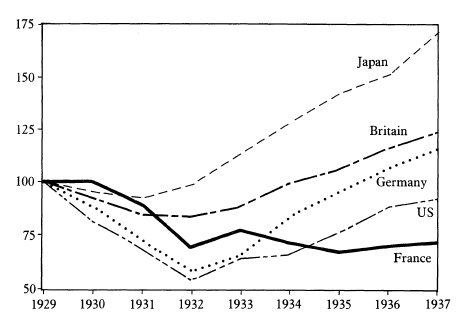
If we introduced the gold standard, "hard money", "sound money" today it would become a hidden tax on civilization: paid to those who already own gold. In other words, it's a hidden tax on the poor, paid to the rich. It results not only in injustice but economic stagnation as well: as most hard money countries learned the hard way up to 1937 by which time all developed economies dropped the gold standard like a hot potato - and those who dropped the gold standard faster recovered faster from the Great Depression.
Most voters seem to prefer visible taxes and visible inflation instead, and I prefer a fee structure where those who benefit from modern civilization most pay a fee for the riches they earn utilizing modern civilization. Civilization is not cheap . One of the simplest metrics to determine how much a person benefits from modern civilization is "annual personal income".
-
Re:It's Ironic
- 19 century USA calls, says you are wrong.There was deflation at the time, dollar was gaining value, prices were dropping,
You are quite wrong about historic facts. Firstly, even measured in norminal price levels you are wrong: check the historic inflation rate for the US.
The period of 1800-1900 was evidently not "deflation at the time".
The dollar was gaining in value, firstly because almost every other civilized country on the western hemisphere was growing at that time, secondly because it was backed by an inflating supply of gold (the US was one of the biggest gold producers at the time), thirdly because the US had a very rapid influx of population, lots of migrating workers eager to increase the international value of the fixed supply of dollars.
Take away the increasing supply in gold backed by gold mines and take away the increasing value of exports fuelled by cheap immigrants you get a stagnating economy: for example France, the last holdout with the gold standard after the Great Depression, was the slowest to recover from the Great Depression.
-
Re:Electrons cause consciousness.
It has been proven that free will would have to exist on the quantum scale if it exists at all. The math shows this.
http://www.princeton.edu/main/news/archive/S23/69/84A24/index.xml?section=announcements
-
Re:2002 called, it wants its fears back
While you might be happy that your preferred liberal or conservative news hits you, you'll never get to see the converse. This is because Google, Facebook, newspaper sites and even Netflix filter what hits you before you get to see it. And since they give you what you want, you never see the opposing viewpoints or step outside your comfort zone. It amounts to a claim of censorship through personalization and now that every site does it, it's commingle a problem.
This would be a pretty avant-garde line of thinking if there hadn't been an entire book written about it nine years ago
And it's just as big a crock now as it was back then. Don't like what I'm saying? Well then, I rest my case.
Except that argument is exactly the kind of confirmation-bias people are arguing about.
"It's a crock because I can't see the results" != "there are no results"
-
Real research on online segregation
Jesse Shapiro has done some real research on the segregation of political groups online. Here's the abstract:
We use individual and aggregate data to ask how the Internet is changing the ideologi- cal segregation of the American electorate. Focusing on online news consumption, offline news consumption, and face-to-face social interactions, we define ideological segregation in each domain using standard indices from the literature on racial segregation. We find that ideological segregation of online news consumption is low in absolute terms, higher than the segregation of most offline news consumption, and significantly lower than the segregation of face-to-face interactions with neighbors, co-workers, or family members. We find no evidence that the Internet is becoming more segregated over time.
Cass Sunstein got rather famous for books Republic.com and Republic.com 2.0 , warning that, "as
-
Real research on online segregation
Jesse Shapiro has done some real research on the segregation of political groups online. Here's the abstract:
We use individual and aggregate data to ask how the Internet is changing the ideologi- cal segregation of the American electorate. Focusing on online news consumption, offline news consumption, and face-to-face social interactions, we define ideological segregation in each domain using standard indices from the literature on racial segregation. We find that ideological segregation of online news consumption is low in absolute terms, higher than the segregation of most offline news consumption, and significantly lower than the segregation of face-to-face interactions with neighbors, co-workers, or family members. We find no evidence that the Internet is becoming more segregated over time.
Cass Sunstein got rather famous for books Republic.com and Republic.com 2.0 , warning that, "as
-
Re:2002 called, it wants its fears back
While you might be happy that your preferred liberal or conservative news hits you, you'll never get to see the converse. This is because Google, Facebook, newspaper sites and even Netflix filter what hits you before you get to see it. And since they give you what you want, you never see the opposing viewpoints or step outside your comfort zone. It amounts to a claim of censorship through personalization and now that every site does it, it's commingle a problem.
This would be a pretty avant-garde line of thinking if there hadn't been an entire book written about it nine years ago
It would, but then again learned men of the early 20th century were advising people to read as many opposing views on philosophy, religion, politics, ethics, etc., long before this book. They were often labeled as dangerous men of learning. In the end, they suggest one will naturally filter out or take in ideas/ideals that add to one's perceptions of human existence.
-
Re:2002 called, it wants its fears back
While you might be happy that your preferred liberal or conservative news hits you, you'll never get to see the converse. This is because Google, Facebook, newspaper sites and even Netflix filter what hits you before you get to see it. And since they give you what you want, you never see the opposing viewpoints or step outside your comfort zone. It amounts to a claim of censorship through personalization and now that every site does it, it's commingle a problem.
This would be a pretty avant-garde line of thinking if there hadn't been an entire book written about it nine years ago
And it's just as big a crock now as it was back then. Don't like what I'm saying? Well then, I rest my case.