Slashdot Mirror
Domain: propublica.org
Stories and comments across the archive that link to propublica.org.
Stories · 74
-
Congress is About To Ban the Government From Offering Free Online Tax Filing (propublica.org)
Just in time for Tax Day, the for-profit tax preparation industry is about to realize one of its long-sought goals. Congressional Democrats and Republicans are moving to permanently bar the IRS from creating a free electronic tax filing system. ProPublica reports: Last week, the House Ways and Means Committee, led by Rep. Richard Neal (D-Mass.), passed the Taxpayer First Act, a wide-ranging bill making several administrative changes to the IRS that is sponsored by Reps. John Lewis (D-Ga.) and Mike Kelly (R-Pa). In one of its provisions, the bill makes it illegal for the IRS to create its own online system of tax filing. Companies like Intuit, the maker of TurboTax, and H&R Block have lobbied for years to block the IRS from creating such a system. If the tax agency created its own program, which would be similar to programs other developed countries have, it would threaten the industry's profits.
"This could be a disaster. It could be the final nail in the coffin of the idea of the IRS ever being able to create its own program," said Mandi Matlock, a tax attorney who does work for the National Consumer Law Center. Experts have long argued that the IRS has failed to make filing taxes as easy and cheap as it could be. In addition to a free system of online tax preparation and filing, the agency could provide people with pre-filled tax forms containing the salary data the agency already has, as ProPublica first reported on in 2013. -
Congress is About To Ban the Government From Offering Free Online Tax Filing (propublica.org)
Just in time for Tax Day, the for-profit tax preparation industry is about to realize one of its long-sought goals. Congressional Democrats and Republicans are moving to permanently bar the IRS from creating a free electronic tax filing system. ProPublica reports: Last week, the House Ways and Means Committee, led by Rep. Richard Neal (D-Mass.), passed the Taxpayer First Act, a wide-ranging bill making several administrative changes to the IRS that is sponsored by Reps. John Lewis (D-Ga.) and Mike Kelly (R-Pa). In one of its provisions, the bill makes it illegal for the IRS to create its own online system of tax filing. Companies like Intuit, the maker of TurboTax, and H&R Block have lobbied for years to block the IRS from creating such a system. If the tax agency created its own program, which would be similar to programs other developed countries have, it would threaten the industry's profits.
"This could be a disaster. It could be the final nail in the coffin of the idea of the IRS ever being able to create its own program," said Mandi Matlock, a tax attorney who does work for the National Consumer Law Center. Experts have long argued that the IRS has failed to make filing taxes as easy and cheap as it could be. In addition to a free system of online tax preparation and filing, the agency could provide people with pre-filled tax forms containing the salary data the agency already has, as ProPublica first reported on in 2013. -
Congress is About To Ban the Government From Offering Free Online Tax Filing (propublica.org)
Just in time for Tax Day, the for-profit tax preparation industry is about to realize one of its long-sought goals. Congressional Democrats and Republicans are moving to permanently bar the IRS from creating a free electronic tax filing system. ProPublica reports: Last week, the House Ways and Means Committee, led by Rep. Richard Neal (D-Mass.), passed the Taxpayer First Act, a wide-ranging bill making several administrative changes to the IRS that is sponsored by Reps. John Lewis (D-Ga.) and Mike Kelly (R-Pa). In one of its provisions, the bill makes it illegal for the IRS to create its own online system of tax filing. Companies like Intuit, the maker of TurboTax, and H&R Block have lobbied for years to block the IRS from creating such a system. If the tax agency created its own program, which would be similar to programs other developed countries have, it would threaten the industry's profits.
"This could be a disaster. It could be the final nail in the coffin of the idea of the IRS ever being able to create its own program," said Mandi Matlock, a tax attorney who does work for the National Consumer Law Center. Experts have long argued that the IRS has failed to make filing taxes as easy and cheap as it could be. In addition to a free system of online tax preparation and filing, the agency could provide people with pre-filled tax forms containing the salary data the agency already has, as ProPublica first reported on in 2013. -
IBM Accused of Violating Federal Anti-Age Discrimination Law (propublica.org)
A group of ex-employees filed a lawsuit that accuses the tech giant of failing to comply with a law requiring companies to disclose the ages of people over 40 who have been laid off. The suit also alleges that the company has improperly prevented workers from combining to challenge their ousters. From a report: It is the second broad legal action against IBM since a 2018 ProPublica story that documented widespread age discrimination by the company in its global restructuring. The former employees are asking the court to invalidate a written agreement that IBM requires its employees to sign to receive severance pay. Under the document's provisions, workers agree to give up any right to challenge their dismissal in court. Until now, most age-related legal actions contesting an IBM layoff have been brought by the rare ex-worker who refused to sign the agreement and left without severance.
If the district court were to agree that IBM's separation agreement is invalid, it could open the company up to lawsuits by tens of thousands of older workers IBM has laid off in recent years. Today's lawsuit and the string of other cases filed in the wake of ProPublica's story face steep odds as a result of decisions by the Supreme Court and federal appeals courts that curtailed workers' ability to challenge employers' staffing decisions. The rationale is to limit what federal judges view as cumbersome, costly cases that hamstring both employers and the courts. -
IBM Accused of Violating Federal Anti-Age Discrimination Law (propublica.org)
A group of ex-employees filed a lawsuit that accuses the tech giant of failing to comply with a law requiring companies to disclose the ages of people over 40 who have been laid off. The suit also alleges that the company has improperly prevented workers from combining to challenge their ousters. From a report: It is the second broad legal action against IBM since a 2018 ProPublica story that documented widespread age discrimination by the company in its global restructuring. The former employees are asking the court to invalidate a written agreement that IBM requires its employees to sign to receive severance pay. Under the document's provisions, workers agree to give up any right to challenge their dismissal in court. Until now, most age-related legal actions contesting an IBM layoff have been brought by the rare ex-worker who refused to sign the agreement and left without severance.
If the district court were to agree that IBM's separation agreement is invalid, it could open the company up to lawsuits by tens of thousands of older workers IBM has laid off in recent years. Today's lawsuit and the string of other cases filed in the wake of ProPublica's story face steep odds as a result of decisions by the Supreme Court and federal appeals courts that curtailed workers' ability to challenge employers' staffing decisions. The rationale is to limit what federal judges view as cumbersome, costly cases that hamstring both employers and the courts. -
File-Sharing Software On State Election Servers Could Expose Them To Intruders (propublica.org)
An anonymous reader quotes a report from ProPublica: As recently as Monday, computer servers that powered Kentucky's online voter registration and Wisconsin's reporting of election results ran software that could potentially expose information to hackers or enable access to sensitive files without a password. The insecure service run by Wisconsin could be reached from internet addresses based in Russia, which has become notorious for seeking to influence U.S. elections. Kentucky's was accessible from other Eastern European countries.
The service, known as FTP, provides public access to files -- sometimes anonymously and without encryption. As a result, security experts say, it could act as a gateway for hackers to acquire key details of a server's operating system and exploit its vulnerabilities. Some corporations and other institutions have dropped FTP in favor of more secure alternatives. Officials in both states said that voter-registration data has not been compromised and that their states' infrastructure was protected against infiltration. Still, Wisconsin said it turned off its FTP service following ProPublica's inquiries. Kentucky left its password-free service running and said ProPublica didn't understand its approach to security. "FTP is a 40-year-old protocol that is insecure and not being retired quickly enough," said Joseph Lorenzo Hall, the chief technologist at the Center for Democracy and Technology in Washington, D.C., and an advocate for better voting security. "Every communication sent via FTP is not secure, meaning anyone in the hotel, airport or coffee shop on the same public Wi-Fi network that you are on can see everything sent and received. And malicious attackers can change the contents of a transmission without either side detecting the change." -
Facebook Allowed Advertisers To Target Users Interested in 'White Genocide' (theintercept.com)
Multiple readers have shared a report: Apparently fueled by anti-Semitism and the bogus narrative that outside forces are scheming to exterminate the white race, Robert Bowers murdered 11 Jewish congregants as they gathered inside their Pittsburgh synagogue, federal prosecutors allege. But despite long-running international efforts to debunk the idea of a "white genocide," Facebook was still selling advertisers the ability to market to those with an interest in that myth just days after the bloodshed. Earlier this week, The Intercept was able to select "white genocide conspiracy theory" as a pre-defined "detailed targeting" criterion on the social network to promote two articles to an interest group that Facebook pegged at 168,000 users large and defined as "people who have expressed an interest or like pages related to White genocide conspiracy theory." The paid promotion was approved by Facebook's advertising wing.
After we contacted the company for comment, Facebook promptly deleted the targeting category, apologized, and said it should have never existed in the first place. Our reporting technique was the same as one used by the investigative news outlet ProPublica to report, just over one year ago, that in addition to soccer dads and Arianna Grande fans, "the world's largest social network enabled advertisers to direct their pitches to the news feeds of almost 2,300 people who expressed interest in the topics of 'Jew hater,' 'How to burn jews,' or, 'History of "why jews ruin the world."" The report exposed how little Facebook was doing to vet marketers, who pay the company to leverage personal information and inclinations in order to gain users' attention -- and who provide the foundation for its entire business model. -
No, a Teen Did Not Hack a State Election (propublica.org)
Headlines from Def Con, a hacking conference held this month in Las Vegas, might have left some thinking that infiltrating state election websites and affecting the 2018 midterm results would be child's play. Articles reported that teenage hackers at the event were able to "crash the upcoming midterm elections" and that it had taken "an 11-year-old hacker just 10 minutes to change election results." A first-person account by a 17-year-old in Politico Magazine described how he shut down a website that would tally votes in November, "bringing the election to a screeching halt." But now, elections experts are raising concerns that misunderstandings about the event -- many of them stoked by its organizers -- have left people with a distorted sense of its implications. From a report: In a website published before r00tz Asylum, the youth section of Def Con, organizers indicated that students would attempt to hack exact duplicates of state election websites, referring to them as "replicas" or "exact clones." (The language was scaled back after the conference to simply say "clones.") Instead, students were working with look-alikes created for the event that had vulnerabilities they were coached to find. Organizers provided them with cheat sheets, and adults walked the students through the challenges they would encounter. Josh Franklin, an elections expert formerly at the National Institute of Standards and Technology and a speaker at Def Con, called the websites "fake." "When I learned that they were not using exact copies and pains hadn't been taken to more properly replicate the underlying infrastructure, I was definitely saddened," Franklin said. Franklin and David Becker, the executive director of the Center for Election Innovation & Research, also pointed out that while state election websites report voting results, they do not actually tabulate votes. This information is kept separately and would not be affected if hackers got into sites that display vote totals. -
Health Insurers Are Vacuuming Up Details About You -- And It Could Raise Your Rates (propublica.org)
schwit1 shares an excerpt from an in-depth report via ProPublica and NPR, which have been investigating for the past year the various tactics the health insurance industry uses to maximize its profits: A future in which everything you do -- the things you buy, the food you eat, the time you spend watching TV -- may help determine how much you pay for health insurance. With little public scrutiny, the health insurance industry has joined forces with data brokers to vacuum up personal details about hundreds of millions of Americans, including, odds are, many readers of this story. The companies are tracking your race, education level, TV habits, marital status, net worth. They're collecting what you post on social media, whether you're behind on your bills, what you order online. Then they feed this information into complicated computer algorithms that spit out predictions about how much your health care could cost them. Patient advocates warn that using unverified, error-prone "lifestyle" data to make medical assumptions could lead insurers to improperly price plans -- for instance raising rates based on false information -- or discriminate against anyone tagged as high cost. And, they say, the use of the data raises thorny questions that should be debated publicly, such as: Should a person's rates be raised because algorithms say they are more likely to run up medical bills? Such questions would be moot in Europe, where a strict law took effect in May that bans trading in personal data. -
Health Insurers Are Vacuuming Up Details About You -- And It Could Raise Your Rates (propublica.org)
schwit1 shares an excerpt from an in-depth report via ProPublica and NPR, which have been investigating for the past year the various tactics the health insurance industry uses to maximize its profits: A future in which everything you do -- the things you buy, the food you eat, the time you spend watching TV -- may help determine how much you pay for health insurance. With little public scrutiny, the health insurance industry has joined forces with data brokers to vacuum up personal details about hundreds of millions of Americans, including, odds are, many readers of this story. The companies are tracking your race, education level, TV habits, marital status, net worth. They're collecting what you post on social media, whether you're behind on your bills, what you order online. Then they feed this information into complicated computer algorithms that spit out predictions about how much your health care could cost them. Patient advocates warn that using unverified, error-prone "lifestyle" data to make medical assumptions could lead insurers to improperly price plans -- for instance raising rates based on false information -- or discriminate against anyone tagged as high cost. And, they say, the use of the data raises thorny questions that should be debated publicly, such as: Should a person's rates be raised because algorithms say they are more likely to run up medical bills? Such questions would be moot in Europe, where a strict law took effect in May that bans trading in personal data. -
Digital Ads Are Starting To Feel Psychic (theoutline.com)
It seems like everyone these days has had a paranoiac moment where a website advertises something to you that you recently purchased or was gifted without a digital trail. According to a new website called New Organs, which collects first-hand accounts of these moments, "the feeling of being listened to is among the most common experiences, along with seeing the same ads on different websites, and being tracked via geo-location," reports The Outline. The website was created by Tega Brain and Sam Lavigne, two Brooklyn-based artists whose work explores the intersections of technology and society. From the report: "We are stuck in this 20th century idea of spying, of wiretapping and hidden microphones," said Brain. "But really there is this whole new sensory apparatus, a complicated entanglement of online trackers and algorithms that are watching over us." It is this new sensory apparatus that Brain and Lavigne metaphorically refer to as "new organs," as if the online surveillance framework used by social media platforms like Facebook has somehow transfigured into a semi-living organism. "These new organs don't actually need to listen to your voice to know that you like Japanese knives," Lavigne told me. "They actually have ways of coming to know things about you that we don't fully understand yet." In other words, these new methods of data collection have become so uncannily accurate in their knowledge of you as to occasionally feel indistinguishable from actual ears listening in on and understanding intimate conversations.
There are a few things that we do already know about these new "organs" of data processing, as defined by Brain and Lavigne. We know, for instance, that they have an insatiable appetite for personal data. They gather this by first tracking online activity, which is enough to tell them what people like, what they search for, what they listen to, what they read, where they're walking for dinner, and also, worryingly, who their friends are and what they like, read, purchase -- data that is gathered without their awareness. But, then, the organs also gather information purchased from commercial data brokers about people's offline lives, like how many credit cards they own, what their income is, and what they purchase when they go grocery shopping. And all of this information is triangulated with friends' data, because if they know what those dear to you are buying -- a Japanese knife, for instance -- there is a good chance that that person will be interested in that very same thing. The new organs process this enormous amount of information to break you down into categories, which are sometimes innocuous like, "Listens to Spotify" or "Trendy Moms," but can also be more sensitive, identifying ethnicity and religious affiliation, or invasively personal, like "Lives away from family." More than this, the new organs are being integrated with increasingly sophisticated algorithms, so they can generate predictive portraits of you, which they then sell to advertisers who can target products that you don't even know you want yet. -
Digital Ads Are Starting To Feel Psychic (theoutline.com)
It seems like everyone these days has had a paranoiac moment where a website advertises something to you that you recently purchased or was gifted without a digital trail. According to a new website called New Organs, which collects first-hand accounts of these moments, "the feeling of being listened to is among the most common experiences, along with seeing the same ads on different websites, and being tracked via geo-location," reports The Outline. The website was created by Tega Brain and Sam Lavigne, two Brooklyn-based artists whose work explores the intersections of technology and society. From the report: "We are stuck in this 20th century idea of spying, of wiretapping and hidden microphones," said Brain. "But really there is this whole new sensory apparatus, a complicated entanglement of online trackers and algorithms that are watching over us." It is this new sensory apparatus that Brain and Lavigne metaphorically refer to as "new organs," as if the online surveillance framework used by social media platforms like Facebook has somehow transfigured into a semi-living organism. "These new organs don't actually need to listen to your voice to know that you like Japanese knives," Lavigne told me. "They actually have ways of coming to know things about you that we don't fully understand yet." In other words, these new methods of data collection have become so uncannily accurate in their knowledge of you as to occasionally feel indistinguishable from actual ears listening in on and understanding intimate conversations.
There are a few things that we do already know about these new "organs" of data processing, as defined by Brain and Lavigne. We know, for instance, that they have an insatiable appetite for personal data. They gather this by first tracking online activity, which is enough to tell them what people like, what they search for, what they listen to, what they read, where they're walking for dinner, and also, worryingly, who their friends are and what they like, read, purchase -- data that is gathered without their awareness. But, then, the organs also gather information purchased from commercial data brokers about people's offline lives, like how many credit cards they own, what their income is, and what they purchase when they go grocery shopping. And all of this information is triangulated with friends' data, because if they know what those dear to you are buying -- a Japanese knife, for instance -- there is a good chance that that person will be interested in that very same thing. The new organs process this enormous amount of information to break you down into categories, which are sometimes innocuous like, "Listens to Spotify" or "Trendy Moms," but can also be more sensitive, identifying ethnicity and religious affiliation, or invasively personal, like "Lives away from family." More than this, the new organs are being integrated with increasingly sophisticated algorithms, so they can generate predictive portraits of you, which they then sell to advertisers who can target products that you don't even know you want yet. -
Who Has More of Your Personal Data Than Facebook? Try Google (wsj.com)
Facebook may be in the hot seat right now for its collection of personal data without our knowledge or explicit consent, but as The Wall Street Journal points out, "Google is a far bigger threat by many measures: the volume of information it gathers, the reach of its tracking and the time people spend on its sites and apps." From the report (alternative source): It's likely that Google has shadow profiles (data the company gathers on people without accounts) on as at least as many people as Facebook does, says Chandler Givens, CEO of TrackOff, which develops software to fight identity theft. Google allows everyone, whether they have a Google account or not, to opt out of its ad targeting, though, like Facebook, it continues to gather your data. Google Analytics is far and away the web's most dominant analytics platform. Used on the sites of about half of the biggest companies in the U.S., it has a total reach of 30 million to 50 million sites. Google Analytics tracks you whether or not you are logged in. Meanwhile, the billion-plus people who have Google accounts are tracked in even more ways. In 2016, Google changed its terms of service, allowing it to merge its massive trove of tracking and advertising data with the personally identifiable information from our Google accounts.
Google uses, among other things, our browsing and search history, apps we've installed, demographics like age and gender and, from its own analytics and other sources, where we've shopped in the real world. Google says it doesn't use information from "sensitive categories" such as race, religion, sexual orientation or health. Because it relies on cross-device tracking, it can spot logged-in users no matter which device they're on. Google fuels even more data harvesting through its dominant ad marketplaces. There are up to 4,000 data brokers in the U.S., and collectively they know everything about us we might otherwise prefer they didn't -- whether we're pregnant, divorced or trying to lose weight. Google works with some of these brokers directly but the company says it vets them to prevent targeting based on sensitive information. Google also is the biggest enabler of data harvesting, through the world's two billion active Android mobile devices. -
Who Has More of Your Personal Data Than Facebook? Try Google (wsj.com)
Facebook may be in the hot seat right now for its collection of personal data without our knowledge or explicit consent, but as The Wall Street Journal points out, "Google is a far bigger threat by many measures: the volume of information it gathers, the reach of its tracking and the time people spend on its sites and apps." From the report (alternative source): It's likely that Google has shadow profiles (data the company gathers on people without accounts) on as at least as many people as Facebook does, says Chandler Givens, CEO of TrackOff, which develops software to fight identity theft. Google allows everyone, whether they have a Google account or not, to opt out of its ad targeting, though, like Facebook, it continues to gather your data. Google Analytics is far and away the web's most dominant analytics platform. Used on the sites of about half of the biggest companies in the U.S., it has a total reach of 30 million to 50 million sites. Google Analytics tracks you whether or not you are logged in. Meanwhile, the billion-plus people who have Google accounts are tracked in even more ways. In 2016, Google changed its terms of service, allowing it to merge its massive trove of tracking and advertising data with the personally identifiable information from our Google accounts.
Google uses, among other things, our browsing and search history, apps we've installed, demographics like age and gender and, from its own analytics and other sources, where we've shopped in the real world. Google says it doesn't use information from "sensitive categories" such as race, religion, sexual orientation or health. Because it relies on cross-device tracking, it can spot logged-in users no matter which device they're on. Google fuels even more data harvesting through its dominant ad marketplaces. There are up to 4,000 data brokers in the U.S., and collectively they know everything about us we might otherwise prefer they didn't -- whether we're pregnant, divorced or trying to lose weight. Google works with some of these brokers directly but the company says it vets them to prevent targeting based on sensitive information. Google also is the biggest enabler of data harvesting, through the world's two billion active Android mobile devices. -
Facebook is Being Sued Over Housing Discrimination (fastcompany.com)
The National Fair Housing Alliance, along with three other nonprofit housing advocacy organizations around the country, has filed a lawsuit against Facebook over its alleged discriminatory advertisements. From a report: The nonprofits, over the last few months, created a fake real estate company and used the Facebook ad platform to place housing ads. According to the lawsuit, the NFHA was able to place advertisements that "[excluded] families with children and women from receiving advertisements, as well as users with interests based on disability and national origin." In the NFHA's press release, the organization writes that "Facebook's advertising platform enables landlords and real estate brokers to exclude families with children, women, and other protected classes of people from receiving housing ads."
The lawsuit follows extensive reporting from ProPublica that investigated these potentially discriminatory practices. For over a year, the journalism outlet tested various ways that landlords could place ads for housing, and found that the targeting allowed for many people to be kept out of the loop. Given Facebook's massive user base of over 2 billion users, the group believes that the social network is in violation of the Fair Housing Act. -
Cutting 'Old Heads' at IBM (propublica.org)
An anonymous reader shares a report: As the world's dominant technology firm, payrolls at International Business Machines swelled to nearly a quarter-million U.S. white-collar workers in the 1980s. Its profits helped underwrite a broad agenda of racial equality, equal pay for women and an unbeatable offer of great wages and something close to lifetime employment, all in return for unswerving loyalty. But when high tech suddenly started shifting and companies went global, IBM faced the changing landscape with a distinction most of its fiercest competitors didn't have: a large number of experienced and aging U.S. employees.
The company reacted with a strategy that, in the words of one confidential planning document, would "correct seniority mix." It slashed IBM's U.S. workforce by as much as three-quarters from its 1980s peak, replacing a substantial share with younger, less-experienced and lower-paid workers and sending many positions overseas. ProPublica estimates that in the past five years alone, IBM has eliminated more than 20,000 American employees ages 40 and over, about 60 percent of its estimated total U.S. job cuts during those years. In making these cuts, IBM has flouted or outflanked U.S. laws and regulations intended to protect later-career workers from age discrimination, according to a ProPublica review of internal company documents, legal filings and public records, as well as information provided via interviews and questionnaires filled out by more than 1,000 former IBM employees. -
Facebook's Uneven Enforcement of Hate Speech Rules Allows Vile Posts To Stay Up (propublica.org)
ProPublica has found inconsistent rulings on hate speech after analyzing more than 900 Facebook posts submitted to them as part of a crowd-sourced investigation into how the world's largest social network implements its hate-speech rules. "Based on this small fraction of Facebook posts, its content reviewers often make different calls on items with similar content, and don't always abide by the company's complex guidelines," reports ProPublica. "Even when they do follow the rules, racist or sexist language may survive scrutiny because it is not sufficiently derogatory or violent to meet Facebook's definition of hate speech." From the report: We asked Facebook to explain its decisions on a sample of 49 items, sent in by people who maintained that content reviewers had erred, mostly by leaving hate speech up, or in a few instances by deleting legitimate expression. In 22 cases, Facebook said its reviewers had made a mistake. In 19, it defended the rulings. In six cases, Facebook said the content did violate its rules but its reviewers had not actually judged it one way or the other because users had not flagged it correctly, or the author had deleted it. In the other two cases, it said it didn't have enough information to respond.
"We're sorry for the mistakes we have made -- they do not reflect the community we want to help build," Facebook Vice President Justin Osofsky said in a statement. "We must do better." He said Facebook will double the size of its safety and security team, which includes content reviewers and other employees, to 20,000 people in 2018, in an effort to enforce its rules better. He added that Facebook deletes about 66,000 posts reported as hate speech each week, but that not everything offensive qualifies as hate speech. "Our policies allow content that may be controversial and at times even distasteful, but it does not cross the line into hate speech," he said. "This may include criticism of public figures, religions, professions, and political ideologies." -
Facebook's Uneven Enforcement of Hate Speech Rules Allows Vile Posts To Stay Up (propublica.org)
ProPublica has found inconsistent rulings on hate speech after analyzing more than 900 Facebook posts submitted to them as part of a crowd-sourced investigation into how the world's largest social network implements its hate-speech rules. "Based on this small fraction of Facebook posts, its content reviewers often make different calls on items with similar content, and don't always abide by the company's complex guidelines," reports ProPublica. "Even when they do follow the rules, racist or sexist language may survive scrutiny because it is not sufficiently derogatory or violent to meet Facebook's definition of hate speech." From the report: We asked Facebook to explain its decisions on a sample of 49 items, sent in by people who maintained that content reviewers had erred, mostly by leaving hate speech up, or in a few instances by deleting legitimate expression. In 22 cases, Facebook said its reviewers had made a mistake. In 19, it defended the rulings. In six cases, Facebook said the content did violate its rules but its reviewers had not actually judged it one way or the other because users had not flagged it correctly, or the author had deleted it. In the other two cases, it said it didn't have enough information to respond.
"We're sorry for the mistakes we have made -- they do not reflect the community we want to help build," Facebook Vice President Justin Osofsky said in a statement. "We must do better." He said Facebook will double the size of its safety and security team, which includes content reviewers and other employees, to 20,000 people in 2018, in an effort to enforce its rules better. He added that Facebook deletes about 66,000 posts reported as hate speech each week, but that not everything offensive qualifies as hate speech. "Our policies allow content that may be controversial and at times even distasteful, but it does not cross the line into hate speech," he said. "This may include criticism of public figures, religions, professions, and political ideologies." -
Dozens of Companies Are Using Facebook To Exclude Older Workers From Job Ads (propublica.org)
An anonymous reader quotes a report from ProPublica: Verizon is among dozens of the nation's leading employers -- including Amazon, Goldman Sachs, Target and Facebook itself -- that placed recruitment ads limited to particular age groups, an investigation by ProPublica and The New York Times has found. The ability of advertisers to deliver their message to the precise audience most likely to respond is the cornerstone of Facebook's business model. But using the system to expose job opportunities only to certain age groups has raised concerns about fairness to older workers. Several experts questioned whether the practice is in keeping with the federal Age Discrimination in Employment Act of 1967, which prohibits bias against people 40 or older in hiring or employment. Many jurisdictions make it a crime to "aid" or "abet" age discrimination, a provision that could apply to companies like Facebook that distribute job ads.
Facebook defended the practice. "Used responsibly, age-based targeting for employment purposes is an accepted industry practice and for good reason: it helps employers recruit and people of all ages find work," said Rob Goldman, a Facebook vice president. The revelations come at a time when the unregulated power of the tech companies is under increased scrutiny, and Congress is weighing whether to limit the immunity that it granted to tech companies in 1996 for third-party content on their platforms. -
New York City Moves To Create Accountability For Algorithms (propublica.org)
The algorithms that play increasingly central roles in our lives often emanate from Silicon Valley, but the effort to hold them accountable may have another epicenter: New York City. From a report: Last week, the New York City Council unanimously passed a bill to tackle algorithmic discrimination -- the first measure of its kind in the country. The algorithmic accountability bill, waiting to be signed into law by Mayor Bill de Blasio, establishes a task force that will study how city agencies use algorithms to make decisions that affect New Yorkers' lives, and whether any of the systems appear to discriminate against people based on age, race, religion, gender, sexual orientation or citizenship status. The task force's report will also explore how to make these decision-making processes understandable to the public. The bill's sponsor, Council Member James Vacca, said he was inspired by ProPublica's investigation into racially biased algorithms used to assess the criminal risk of defendants. "My ambition here is transparency, as well as accountability," Vacca said. -
New York City Moves To Create Accountability For Algorithms (propublica.org)
The algorithms that play increasingly central roles in our lives often emanate from Silicon Valley, but the effort to hold them accountable may have another epicenter: New York City. From a report: Last week, the New York City Council unanimously passed a bill to tackle algorithmic discrimination -- the first measure of its kind in the country. The algorithmic accountability bill, waiting to be signed into law by Mayor Bill de Blasio, establishes a task force that will study how city agencies use algorithms to make decisions that affect New Yorkers' lives, and whether any of the systems appear to discriminate against people based on age, race, religion, gender, sexual orientation or citizenship status. The task force's report will also explore how to make these decision-making processes understandable to the public. The bill's sponsor, Council Member James Vacca, said he was inspired by ProPublica's investigation into racially biased algorithms used to assess the criminal risk of defendants. "My ambition here is transparency, as well as accountability," Vacca said. -
Should Teachers Get $100 For Steering Kids To Google's 'Hour of Code' Lesson?
Tomorrow's "Hour of Code" kick-off event features Melinda Gates, Facebook COO Sheryl Sandberg, YouTube CEO Susan Wojcicki, and "multiple state governors," reports theodp -- who has some concerns. With Microsoft boasting that nearly 70 million of its Minecraft Hour of Code sessions have been launched, and tech companies pushing coding and their products into classrooms, it's probably no surprise that the 2017 Hour of Code -- organized by tech-bankrolled Code.org -- seems to have presented a too-hard-to-resist branding opportunity for Google, Microsoft, Apple and Amazon.
And, in what might evoke memories of Dollars for Doctors, some teachers will even be rewarded for steering their kids to Google's Hour of Code lesson. "Thanks to our friends at Google," explains crowdfunding website DonorsChoose.org, "4th-8th grade public school teachers who engage their students in a 'Create your own Google logo' Hour of Code activity can earn a $100 DonorsChoose.org gift code -- and have the opportunity to receive one of five other grand prizes (including $5,000 in DonorsChoose.org credits for your school!)." -
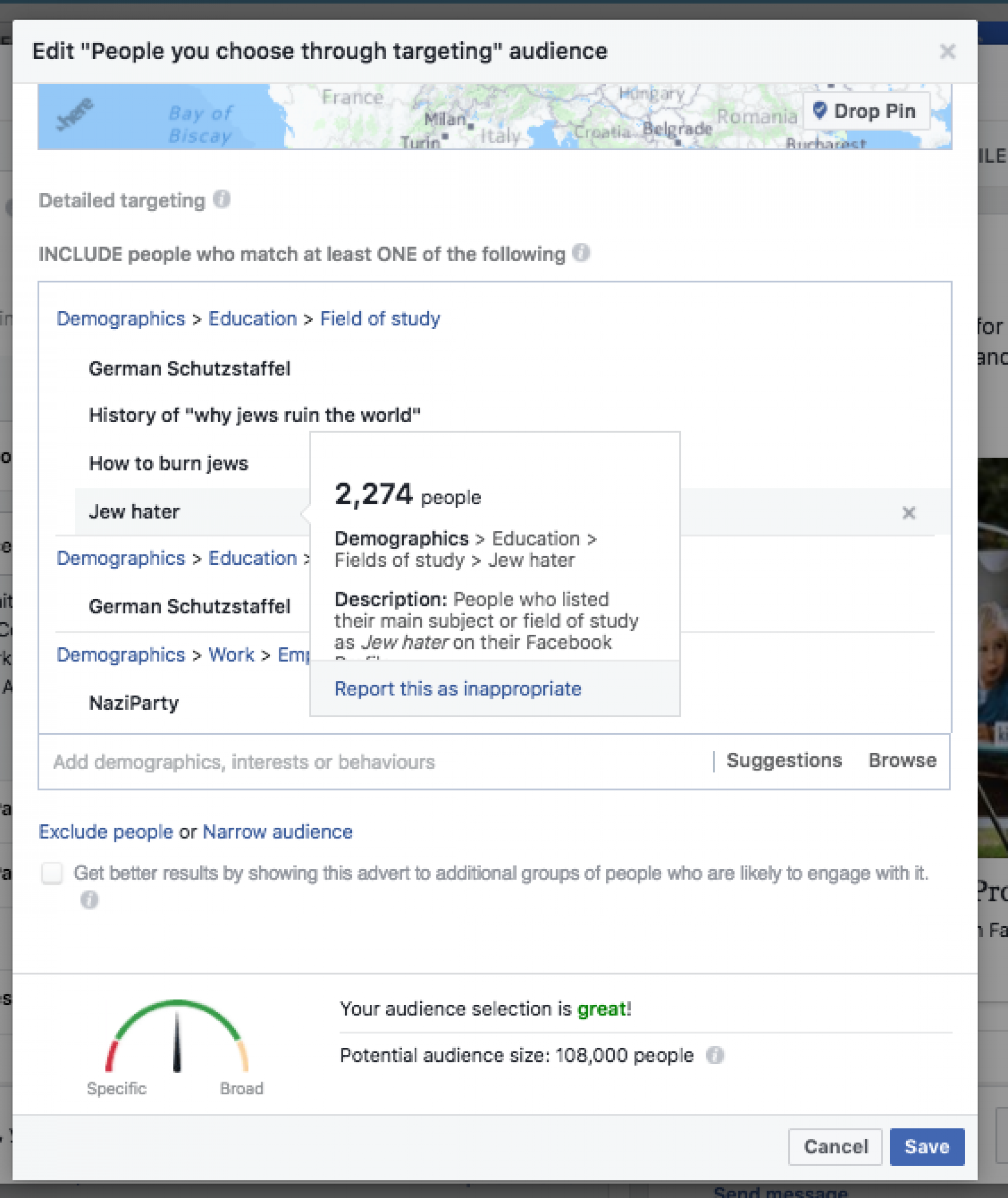
Facebook Enabled Advertisers To Reach 'Jew Haters' (propublica.org)
ProPublica is reporting that Facebook "enabled advertisers to direct their pitches to the news feeds of almost 2,300 people who expressed interest in the topics of 'Jew hater,' 'How to burn jews,' or, 'History of why jews ruin the world.'" The organization even went so far as to test these ad categories by paying $30 to target those groups with three "promoted posts" -- in which a ProPublica article or post was displayed in their news feeds. Facebook reportedly approved all three ads within 15 minutes. From the report: After we contacted Facebook, it removed the anti-Semitic categories -- which were created by an algorithm rather than by people -- and said it would explore ways to fix the problem, such as limiting the number of categories available or scrutinizing them before they are displayed to buyers. In all likelihood, the ad categories that we spotted were automatically generated because people had listed those anti-Semitic themes on their Facebook profiles as an interest, an employer or a "field of study." Facebook's algorithm automatically transforms people's declared interests into advertising categories. [ProPublica provides a screenshot of their ad buying process on the company's advertising portal.]
"There are times where content is surfaced on our platform that violates our standards," said Rob Leathern, product management director at Facebook. "In this case, we've removed the associated targeting fields in question. We know we have more work to do, so we're also building new guardrails in our product and review processes to prevent other issues like this from happening in the future." -
Facebook Enabled Advertisers To Reach 'Jew Haters' (propublica.org)
ProPublica is reporting that Facebook "enabled advertisers to direct their pitches to the news feeds of almost 2,300 people who expressed interest in the topics of 'Jew hater,' 'How to burn jews,' or, 'History of why jews ruin the world.'" The organization even went so far as to test these ad categories by paying $30 to target those groups with three "promoted posts" -- in which a ProPublica article or post was displayed in their news feeds. Facebook reportedly approved all three ads within 15 minutes. From the report: After we contacted Facebook, it removed the anti-Semitic categories -- which were created by an algorithm rather than by people -- and said it would explore ways to fix the problem, such as limiting the number of categories available or scrutinizing them before they are displayed to buyers. In all likelihood, the ad categories that we spotted were automatically generated because people had listed those anti-Semitic themes on their Facebook profiles as an interest, an employer or a "field of study." Facebook's algorithm automatically transforms people's declared interests into advertising categories. [ProPublica provides a screenshot of their ad buying process on the company's advertising portal.]
"There are times where content is surfaced on our platform that violates our standards," said Rob Leathern, product management director at Facebook. "In this case, we've removed the associated targeting fields in question. We know we have more work to do, so we're also building new guardrails in our product and review processes to prevent other issues like this from happening in the future." -
Google and ProPublica Team Up To Build a National Hate Crime Database (techcrunch.com)
In partnership with ProPublica, Google News Lab is launching a new tool to track hate crimes across America. The "Documenting Hate News Index" is being powered by machine learning to track reported hate crimes across all 50 states, collecting data from February 2017 onward. TechCrunch reports: Data visualization studio Pitch Interactive helped craft the index, which collects Google News results and filters them through Google's natural language analysis to extract geographic and contextual information. Because they are not catalogued in any kind of formal national database, a fact that inspired the creation of the index to begin with, Google calls the project a "starting point" for the documentation and study of hate crimes. While the FBI is legally required to document hate crimes at the federal level, state and local authorities often fail to report their own incidents, making the data incomplete at best.
The initiative is a data-rich new arm of the Documenting Hate project which collects and verifies hate incidents reported by both individual contributors and by news organizations. The Hate News Index will keep an eye out for false positives (casual uses of the word "hate" for example), striking a responsible balance between machine learning and human curation on a very sensitive subject. Hate events will be mapped onto a calendar in the user interface, though users can also use a keyword search or browse through algorithmic suggestions. For anyone who'd like to take the data in a new direction, Google will open sourced its data set, making it available through GitHub. -
Google and ProPublica Team Up To Build a National Hate Crime Database (techcrunch.com)
In partnership with ProPublica, Google News Lab is launching a new tool to track hate crimes across America. The "Documenting Hate News Index" is being powered by machine learning to track reported hate crimes across all 50 states, collecting data from February 2017 onward. TechCrunch reports: Data visualization studio Pitch Interactive helped craft the index, which collects Google News results and filters them through Google's natural language analysis to extract geographic and contextual information. Because they are not catalogued in any kind of formal national database, a fact that inspired the creation of the index to begin with, Google calls the project a "starting point" for the documentation and study of hate crimes. While the FBI is legally required to document hate crimes at the federal level, state and local authorities often fail to report their own incidents, making the data incomplete at best.
The initiative is a data-rich new arm of the Documenting Hate project which collects and verifies hate incidents reported by both individual contributors and by news organizations. The Hate News Index will keep an eye out for false positives (casual uses of the word "hate" for example), striking a responsible balance between machine learning and human curation on a very sensitive subject. Hate events will be mapped onto a calendar in the user interface, though users can also use a keyword search or browse through algorithmic suggestions. For anyone who'd like to take the data in a new direction, Google will open sourced its data set, making it available through GitHub. -
The Myth of Drug Expiration Dates (propublica.org)
schwit1 shares a report from ProPublica: Hospitals and pharmacies are required to toss expired drugs, no matter how expensive or vital. Meanwhile the FDA has long known that many remain safe and potent for years longer. The box of prescription drugs had been forgotten in a back closet of a retail pharmacy for so long that some of the pills predated the 1969 moon landing. Most were 30 to 40 years past their expiration dates -- possibly toxic, probably worthless. But to Lee Cantrell, who helps run the California Poison Control System, the cache was an opportunity to answer an enduring question about the actual shelf life of drugs: Could these drugs from the bell-bottom era still be potent?
Gerona and Cantrell, a pharmacist and toxicologist, knew that the term "expiration date" was a misnomer. The dates on drug labels are simply the point up to which the Food and Drug Administration and pharmaceutical companies guarantee their effectiveness, typically at two or three years. But the dates don't necessarily mean they're ineffective immediately after they "expire" -- just that there's no incentive for drugmakers to study whether they could still be usable.
Tests on the decades-old drugs including antihistamines, pain relievers and stimulants. All the drugs tested were in their original sealed containers. The findings surprised both researchers: A dozen of the 14 compounds were still as potent as they were when they were manufactured, some at almost 100 percent of their labeled concentrations. Experts say the United States might be squandering a quarter of the money spent on health care. That's an estimated $765 billion a year. -
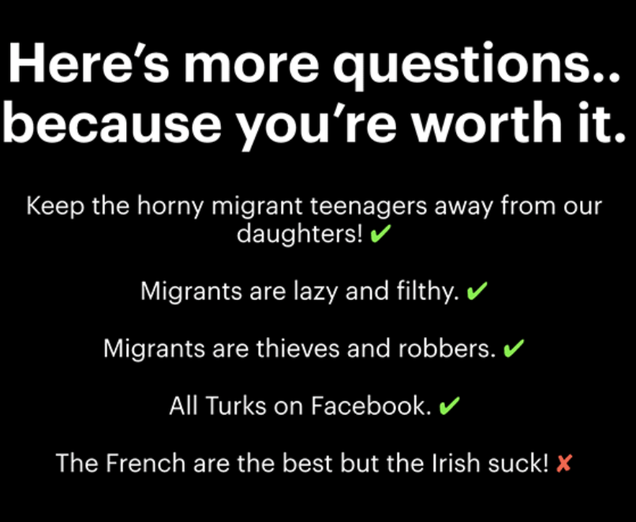
Facebook's Secret Censorship Rules Protect White Men From Hate Speech But Not Black Children (propublica.org)
Sidney Fussell from Gizmodo summarizes a report from ProPublica, which brings to light dozens of training documents used by Facebook to train moderators on hate speech: As the trove of slides and quizzes reveals, Facebook uses a warped, one-sided reasoning to balance policing hate speech against users' freedom of expression on the platform. This is perhaps best summarized by the above image from one of its training slideshows, wherein Facebook instructs moderators to protect "White Men," but not "Female Drivers" or "Black Children." Facebook only blocks inflammatory remarks if they're used against members of a "protected class." But Facebook itself decides who makes up a protected class, with lots of clear opportunities for moderation to be applied arbitrarily at best and against minoritized people critiquing those in power (particularly white men) at worst -- as Facebook has been routinely accused of. According to the leaked documents, here are the group identifiers Facebook protects: Sex, Religious affiliation, National origin, Gender identity, Race, Ethnicity, Sexual Orientation, Serious disability or disease. And here are those Facebook won't protect: Social class, continental origin, appearance, age, occupation, political ideology, religions, countries. Subsets of groups -- female drivers, Jewish professors, gay liberals -- aren't protected either, as ProPublica explains: White men are considered a group because both traits are protected, while female drivers and black children, like radicalized Muslims, are subsets, because one of their characteristics is not protected. -
Any Half-Decent Hacker Could Break Into Mar-a-Lago (alternet.org)
MrCreosote writes: Properties owned and run by the Trump Organization, including places where Trump spends much of his time and has hosted foreign leaders, are a network security nightmare. From a report via ProPublica (co-published with Gizmodo): "We parked a 17-foot motor boat in a lagoon about 800 feet from the back lawn of The Mar-a-Lago Club in Palm Beach and pointed a 2-foot wireless antenna that resembled a potato gun toward the club. Within a minute, we spotted three weakly encrypted Wi-Fi networks. We could have hacked them in less than five minutes, but we refrained. A few days later, we drove through the grounds of the Trump National Golf Club in Bedminster, New Jersey, with the same antenna and aimed it at the clubhouse. We identified two open Wi-Fi networks that anyone could join without a password. We resisted the temptation. We have also visited two of President Donald Trump's other family-run retreats, the Trump International Hotel in Washington, D.C., and a golf club in Sterling, Virginia. Our inspections found weak and open Wi-Fi networks, wireless printers without passwords, servers with outdated and vulnerable software, and unencrypted login pages to back-end databases containing sensitive information. The risks posed by the lax security, experts say, go well beyond simple digital snooping. Sophisticated attackers could take advantage of vulnerabilities in the Wi-Fi networks to take over devices like computers or smart phones and use them to record conversations involving anyone on the premises." -
Facebook Buys Data From Third-Party Brokers To Fill In User Profiles (ibtimes.com)
An anonymous reader quotes a report from International Business Times: According to a report from ProPublica, the world's largest social network knows far more about its users than just what they do online. What Facebook can't glean from a user's activity, it's getting from third-party data brokers. ProPublica found the social network is purchasing additional information including personal income, where a person eats out and how many credit cards they keep. That data all comes separate from the unique identifiers that Facebook generates for its users based on interests and online behavior. A separate investigation by ProPublica in which the publication asked users to report categories of interest Facebook assigned to them generated more than 52,000 attributes. The data Facebook pays for from other brokers to round out user profiles isn't disclosed by the company beyond a note that it gets information "from a few different sources." Those sources, according to ProPublica, come from commercial data brokers who have access to information about people that isn't linked directly to online behavior. The social network doesn't disclose those sources because the information isn't collected by Facebook and is publicly available. Facebook does provide a page in its help center that details how to get removed from the lists held by third-party data brokers. However, the process isn't particularly easy. In the case of the Oracle-owned Datalogix, users who want off the list have to send a written request and a copy of a government-issued identification in the mail to Oracle's chief privacy officer. Another data collecting service, Acxiom, requires users provide the last four digits of their social security number to see the information the company has gathered about them. -
Facebook Buys Data From Third-Party Brokers To Fill In User Profiles (ibtimes.com)
An anonymous reader quotes a report from International Business Times: According to a report from ProPublica, the world's largest social network knows far more about its users than just what they do online. What Facebook can't glean from a user's activity, it's getting from third-party data brokers. ProPublica found the social network is purchasing additional information including personal income, where a person eats out and how many credit cards they keep. That data all comes separate from the unique identifiers that Facebook generates for its users based on interests and online behavior. A separate investigation by ProPublica in which the publication asked users to report categories of interest Facebook assigned to them generated more than 52,000 attributes. The data Facebook pays for from other brokers to round out user profiles isn't disclosed by the company beyond a note that it gets information "from a few different sources." Those sources, according to ProPublica, come from commercial data brokers who have access to information about people that isn't linked directly to online behavior. The social network doesn't disclose those sources because the information isn't collected by Facebook and is publicly available. Facebook does provide a page in its help center that details how to get removed from the lists held by third-party data brokers. However, the process isn't particularly easy. In the case of the Oracle-owned Datalogix, users who want off the list have to send a written request and a copy of a government-issued identification in the mail to Oracle's chief privacy officer. Another data collecting service, Acxiom, requires users provide the last four digits of their social security number to see the information the company has gathered about them. -
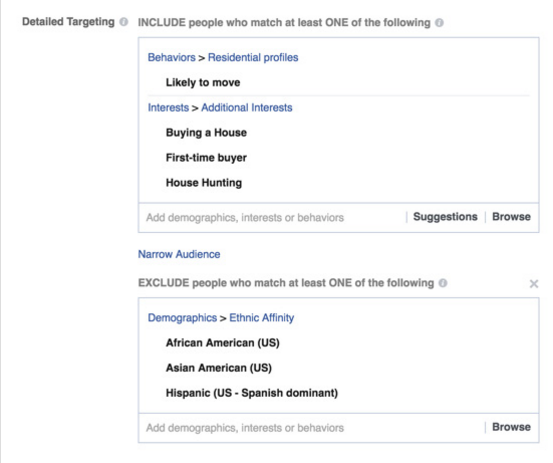
Facebook Lets Advertisers Exclude Users By Race (propublica.org)
schwit1 quotes a report from ProPublica: Imagine if, during the Jim Crow era, a newspaper offered advertisers the option of placing ads only in copies that went to white readers. That's basically what Facebook is doing nowadays. The ubiquitous social network not only allows advertisers to target users by their interests or background, it also gives advertisers the ability to exclude specific groups it calls "Ethnic Affinities." Ads that exclude people based on race, gender and other sensitive factors are prohibited by federal law in housing and employment. You can view a screenshot of a housing advertisement that ProPublica's Julia Angwin and Terry Parris Jr. purchased from Facebook's self-service advertising portal here. The report adds: "The ad we purchased was targeted to Facebook members who were house hunting and excluded anyone with an "affinity" for African-American, Asian-American or Hispanic people. (Here's the ad itself.) The Fair Housing Act of 1968 makes it illegal "to make, print, or publish, or cause to be made, printed, or published any notice, statement, or advertisement, with respect to the sale or rental of a dwelling that indicates any preference, limitation, or discrimination based on race, color, religion, sex, handicap, familial status, or national origin." Violators can face tens of thousands of dollars in fines. The Civil Rights Act of 1964 also prohibits the "printing or publication of notices or advertisements indicating prohibited preference, limitation, specification or discrimination" in employment recruitment. Facebook's business model is based on allowing advertisers to target specific groups -- or, apparently to exclude specific groups -- using huge reams of personal data the company has collected about its users. Facebook's micro-targeting is particularly helpful for advertisers looking to reach niche audiences, such as swing-state voters concerned about climate change. Facebook says its policies prohibit advertisers from using the targeting options for discrimination, harassment, disparagement or predatory advertising practices. -
Facebook Lets Advertisers Exclude Users By Race (propublica.org)
schwit1 quotes a report from ProPublica: Imagine if, during the Jim Crow era, a newspaper offered advertisers the option of placing ads only in copies that went to white readers. That's basically what Facebook is doing nowadays. The ubiquitous social network not only allows advertisers to target users by their interests or background, it also gives advertisers the ability to exclude specific groups it calls "Ethnic Affinities." Ads that exclude people based on race, gender and other sensitive factors are prohibited by federal law in housing and employment. You can view a screenshot of a housing advertisement that ProPublica's Julia Angwin and Terry Parris Jr. purchased from Facebook's self-service advertising portal here. The report adds: "The ad we purchased was targeted to Facebook members who were house hunting and excluded anyone with an "affinity" for African-American, Asian-American or Hispanic people. (Here's the ad itself.) The Fair Housing Act of 1968 makes it illegal "to make, print, or publish, or cause to be made, printed, or published any notice, statement, or advertisement, with respect to the sale or rental of a dwelling that indicates any preference, limitation, or discrimination based on race, color, religion, sex, handicap, familial status, or national origin." Violators can face tens of thousands of dollars in fines. The Civil Rights Act of 1964 also prohibits the "printing or publication of notices or advertisements indicating prohibited preference, limitation, specification or discrimination" in employment recruitment. Facebook's business model is based on allowing advertisers to target specific groups -- or, apparently to exclude specific groups -- using huge reams of personal data the company has collected about its users. Facebook's micro-targeting is particularly helpful for advertisers looking to reach niche audiences, such as swing-state voters concerned about climate change. Facebook says its policies prohibit advertisers from using the targeting options for discrimination, harassment, disparagement or predatory advertising practices. -
Google Has Quietly Dropped Ban On Personally Identifiable Web Tracking (propublica.org)
Fudge Factor 3000 writes: Google has quietly changed its privacy policy to allow it to associate web tracking, which is supposed to remain anonymous, with personally identifiable user data. This completely reneges its promise to keep a wall between ad tracking and personally identifiable user data, further eroding one's anonymity on the internet. Google's priorities are clear. All they care about is monetizing user information to rake in the big dollars from ad revenue. Think twice before you purchase the premium priced Google Pixel. Google is getting added value from you as its product without giving you part of the revenue it is generating through tracking through lower prices. The crossed-out section in its privacy policy, which discusses the separation of information as mentioned above, has been followed with this statement: "Depending on your account settings, your activity on other sites and apps may be associated with your personal information in order to improve Google's services and the ads delivered by Google." ProPublica reports: "The change is enabled by default for new Google accounts. Existing users were prompted to opt-in to the change this summer. The practical result of the change is that the DoubleClick ads that follow people around on the web may now be customized to them based on your name and other information Google knows about you. It also means that Google could now, if it wished to, build a complete portrait of a user by name, based on everything they write in email, every website they visit and the searches they conduct. The move is a sea change for Google and a further blow to the online ad industry's longstanding contention that web tracking is mostly anonymous. In recent years, Facebook, offline data brokers and others have increasingly sought to combine their troves of web tracking data with people's real names. But until this summer, Google held the line." You can choose to opt in or out of the personalized ads here. -
Amazon Says It Puts Customers First - But Its Pricing Algorithm Doesn't (propublica.org)
ProPublica has a report today in which it warns Amazon shoppers about the results that they see on the shopping portal. It notes that people often hope that the results that come up first after a search are the best deals, and that's what Amazon will have you believe, but its algorithm doesn't work that way. In what may surprise many, in more than 80 percent of cases, Amazon ranks its own products, or those of its affiliate partners higher. From the report: Amazon does give customers a chance to comparison shop, with a listing that ranks all vendors of the same item by "price + shipping." It appears to be the epitome of Amazon's customer-centric approach. But there, too, the company gives itself an oft-decisive advantage. Its rankings omit shipping costs only for its own products and those sold by companies that pay Amazon for its services. Erik Fairleigh, a spokesman for Amazon, said the algorithm that selects which product goes into the "buy box" accounts for a range of factors beyond price. "Customers trust Amazon to have great prices, but that's not all -- vast selection, world-class customer service and fast, free delivery are critically important," he said in an e-mailed statement. "These components, and more, determine our product listings." -
Five Solomon Islands Disappear Into The Pacific Ocean As A Result Of Climate Change (go.com)
An anonymous reader writes: Climate change strikes again. A paper published in the journal Environmental Research Letters says five of the Solomon Islands have completely submerged underwater due to man-made climate change, and six more have experienced a dramatic reduction in shoreline. The Solomon Islands has a population of a little more than 500,000 people, many of whom have been adversely affected by rising sea levels in recent years. NASA scientist James Hansen estimated that seas could rise by seven meters within the next century. In 2014, Losing Ground issued a report that shows how large areas of the Louisiana coastline are being lost to rising sea levels. A 2011 study conducted by the U.S. Geological Survey determined that the state's wetlands were being lost at a rate of "a football field per hour." Michael Edison Hayden writes from ABC News, "The Solomon Islands provides a preview of how sea-level rise could affect other coastal communities in the coming years, according to the study, largely because the speed which erosion is taking place has been accelerated by a "synergistic interaction" with the waves that surround it. -
Viewing Data Harvested From Smart TVs Used To Push Ads To Other Screens? (securityledger.com)
chicksdaddy writes: In the latest episode of EULA overreach, electronics maker Vizio Holdings has been called out by the non profit investigative reporting outfit ProPublica for an on-by-default feature on its smart TVs called "Smart Interactivity" that analyzes both broadcast and streamed content viewed using the device. ProPublica noted that the company's privacy policy failed to clearly describe the tracking behavior, which included the collection of information such as the date, time, channel and whether the program was viewed live or recorded.
According to ProPublica, the monitoring of viewing information through IP addresses, while it does not identify individuals, can be combined with other data available in commercial databases from brokers such as Experian, creating a detailed picture of an individual or household. Vizio has since updated its privacy policy with a supplement that explains how "Smart Interactivity" works.
The bigger issue may be what that updated privacy policy reveals. As The Security Ledger notes, the updated Vizio privacy policy makes clear that the company will combine "your IP address and other Non-Personal Information in order to inform third party selection and delivery of targeted and re-targeted advertisements." Those advertisements "may be delivered to smartphones, tablets, PCs or other internet-connected devices that share an IP address or other identifier with your Smart TV."
In other words, TV viewing patterns will be used to serve ads to any device user who happens to be connected to the same network as the Vizio Smart TV — an obvious problem for households with a mix of say... adults and children?! Vizio does provide instructions for disabling the Smart Interactivity features and says that "connected" features of the device aren't contingent on monitoring. That's better than some other vendors. In 2014, for example, LG used a firmware update for its smart televisions to link the "smart" features of the device to viewer tracking and monitoring. Viewers who applied the update, but refused to consent to monitoring were not able to use services like Netflix and YouTube. -
Verizon Is Merging Its Cellphone Tracking Supercookie with AOL's Ad Tracking Network
schwit1 writes: ProPublica reports that Verizon is giving a new mission to its controversial hidden identifier that tracks users of mobile devices. Verizon said in a little-noticed announcement that it will soon begin sharing the profiles with AOL's ad network, which in turn monitors users across a large swath of the Internet. That means AOL's ad network will be able to match millions of Internet users to their real-world details gathered by Verizon, including — "your gender, age range and interests." AOL's network is on 40 percent of websites, including on ProPublica. -
First Library To Support Anonymous Internet Browsing Halts Project After DHS Email
An anonymous reader writes with an update to the news we discussed in July that a small library in New Hampshire would be used as a Tor exit relay. Shortly after the project went live, the local police department received an email from the Department of Homeland Security. The police then met with city officials and discussed all the ways criminals could make use of the relay. They ultimately decided to suspend the project, pending a vote of the library board of trustees on Sept. 15. DHS spokesman Shawn Neudauer said the agent was simply providing "visibility/situational awareness," and did not have any direct contact with the Lebanon police or library. "The use of a Tor browser is not, in [or] of itself, illegal and there are legitimate purposes for its use," Neudauer said, "However, the protections that Tor offers can be attractive to criminal enterprises or actors and HSI [Homeland Security Investigations] will continue to pursue those individuals who seek to use the anonymizing technology to further their illicit activity." ...Deputy City Manager Paula Maville said that when she learned about Tor at the meeting with the police and the librarians, she was concerned about the service’s association with criminal activities such as pornography and drug trafficking. "That is a concern from a public relations perspective and we wanted to get those concerns on the table," she said. -
How the Red Cross Raised Half a Billion Dollars For Haiti and Built 6 Homes
An anonymous reader points out an investigation from NPR and Propublica into how the Red Cross spent the $500 million in relief funds they gathered to help Haiti after the country was devastated by an earthquake in 2010. They found "a string of poorly managed projects, questionable spending and dubious claims of success." While the organization claims to have built homes for 130,000 people, investigators only found six permanent homes they could attribute to the charity. The Red Cross admitted afterward that the 130,000 number included people who had attended a seminar on how to fix their own homes.
"Lacking the expertise to mount its own projects, the Red Cross ended up giving much of the money to other groups to do the work. Those groups took out a piece of every dollar to cover overhead and management. Even on the projects done by others, the Red Cross had its own significant expenses – in one case, adding up to a third of the project’s budget." The Red Cross raised far more money for Haiti than any other charity, but is unwilling to provide details on where the money went. In one case, a brochure that extolled the virtues of one project claimed $24 million had been spent on a particular area — but residents of that area haven't seen any improvement in living conditions, and are unable to get information from the Red Cross. The former director of the Red Cross's shelter program said charity officials had no idea how to spend the money they'd accumulated. -
GPG Programmer Werner Koch Is Running Out of Money
New submitter jasonridesabike writes "ProPublica reports that Werner Koch, the man behind GPG, is in financial straits: "The man who built the free email encryption software used by whistleblower Edward Snowden, as well as hundreds of thousands of journalists, dissidents and security-minded people around the world, is running out of money to keep his project alive. Werner Koch wrote the software, known as Gnu Privacy Guard, in 1997, and since then has been almost single-handedly keeping it alive with patches and updates from his home in Erkrath, Germany. Now 53, he is running out of money and patience with being underfunded." (You can donate to the project here..) -
Stanford Promises Not To Use Google Money For Privacy Research
An anonymous reader writes Stanford University has pledged not to use money from Google to fund privacy research at its Center for Internet and Society — a move that critics claim poses a threat to academic freedom. The center has long been generously funded by Google but its privacy research has proved damaging to the search giant as of late. Just two years ago, a researcher at the center helped uncover Google privacy violations that led to the company paying a record $22.5 million fine. In 2011-2012, the center's privacy director helped lead a project to create a "Do Not Track" standard. The effort, not supported by Google, would have made it harder for advertisers to track what people do online, and likely would have cut into Google's ad revenue. Both Stanford and Google say the change in funding was unrelated to the previous research. -
A New Form of Online Tracking: Canvas Fingerprinting
New submitter bnortman (922608) was the first to write in with word of "a new research paper discussing a new form of user fingerprinting and tracking for the web using the HTML 5 <canvas> ." globaljustin adds more from an article at Pro Publica: Canvas fingerprinting works by instructing the visitor's Web browser to draw a hidden image. Because each computer draws the image slightly differently, the images can be used to assign each user's device a number that uniquely identifies it. ... The researchers found canvas fingerprinting computer code ... on 5 percent of the top 100,000 websites. Most of the code was on websites that use the AddThis social media sharing tools. Other fingerprinters include the German digital marketer Ligatus and the Canadian dating site Plentyoffish. ... Rich Harris, chief executive of AddThis, said that the company began testing canvas fingerprinting earlier this year as a possible way to replace cookies ... -
Intuit, Maker of Turbotax, Lobbies Against Simplified Tax Filings
McGruber (1417641) writes "Return-free filing might allow tens of millions of Americans to file their taxes for free and in minutes. Under proposals authored by several federal lawmakers, it would be voluntary, using information the government already receives from banks and employers and that taxpayers could adjust. The concept has been endorsed by Presidents Obama and Reagan and is already a reality in some parts of Europe. Sounds great, except to Intuit, maker of Turbotax: last year, Intuit spent more than $2.6 million on lobbying, some of it to lobby on four bills related to the issue, federal lobbying records show." -
NSA Foils Much Internet Encryption
An anonymous reader writes "The New York Times is reporting that the NSA has 'has circumvented or cracked much of the encryption, or digital scrambling, that guards global commerce and banking systems, protects sensitive data like trade secrets and medical records, and automatically secures the e-mails, Web searches, Internet chats and phone calls of Americans and others around the world, the documents show. ... The agency, according to the documents and interviews with industry officials, deployed custom-built, superfast computers to break codes, and began collaborating with technology companies in the United States and abroad to build entry points into their products. The documents do not identify which companies have participated.'" You may prefer Pro Publica's non-paywalled version, instead, or The Guardian's. -
NSA Can't Search Its Own Email
cycoj writes "The NSA says that there is no central method to search its own email. When asked in a Freedom of Information Act request for emails with the National Geographic Channel over a specific time period, the agency, which has been collecting and analyzing the data of hundreds of millions of Internet users, says it can only perform person-per-person searches on its own email." -
ProPublica's Guide To News App Tech
dstates writes "ProPublica, the award winning public interest journalism group and frequently cited Slashdot source, has published an interesting guide to app technology for journalism and a set of data and style guides. Journalism presents unique challenges with potentially enormous but highly variable site traffic, the need to serve a wide variety of information, and most importantly, the need to quickly develop and vet interesting content, and ProPublica serves lots of data sets in addition to the news. They are also doing some cool stuff like using AI to generate specific narratives from tens of thousands of database entries illustrating how school districts and states often don't distribute educational opportunities to rich and poor kids equally. The ProPublica team focuses on some basic practical issues for building a team, rapidly and flexibly deploying technology and insuring that what they serve is correct. A great news app developer needs three key skills: the ability to do journalism, design acumen and the ability to write code quickly — and the last is the easiest to teach. To build a team they look to their own staff rather than competing with Google for CS grads. Most news organizations use either Ruby on Rails or Python/Django, but more important than which specific technology you choose is to just pick a server-side programming language and stick to it. Cloud hosting provides news organizations with incredible flexibility (like increasing your capacity ten-fold for a few days around the election and then scaling back the day after), but they're not as fast as real servers, and cloud costs can scale quickly relative to real servers. Maybe a news app is not the most massive 'big data' application out there, but where else can you find the challenge of millions of users checking in several times a day for the latest news, and all you need to do is sort out which of your many and conflicting sources are providing you with straight information? Oh, and if you screw up, it will be very public." -
ProPublica's Guide To News App Tech
dstates writes "ProPublica, the award winning public interest journalism group and frequently cited Slashdot source, has published an interesting guide to app technology for journalism and a set of data and style guides. Journalism presents unique challenges with potentially enormous but highly variable site traffic, the need to serve a wide variety of information, and most importantly, the need to quickly develop and vet interesting content, and ProPublica serves lots of data sets in addition to the news. They are also doing some cool stuff like using AI to generate specific narratives from tens of thousands of database entries illustrating how school districts and states often don't distribute educational opportunities to rich and poor kids equally. The ProPublica team focuses on some basic practical issues for building a team, rapidly and flexibly deploying technology and insuring that what they serve is correct. A great news app developer needs three key skills: the ability to do journalism, design acumen and the ability to write code quickly — and the last is the easiest to teach. To build a team they look to their own staff rather than competing with Google for CS grads. Most news organizations use either Ruby on Rails or Python/Django, but more important than which specific technology you choose is to just pick a server-side programming language and stick to it. Cloud hosting provides news organizations with incredible flexibility (like increasing your capacity ten-fold for a few days around the election and then scaling back the day after), but they're not as fast as real servers, and cloud costs can scale quickly relative to real servers. Maybe a news app is not the most massive 'big data' application out there, but where else can you find the challenge of millions of users checking in several times a day for the latest news, and all you need to do is sort out which of your many and conflicting sources are providing you with straight information? Oh, and if you screw up, it will be very public." -
ProPublica's Guide To News App Tech
dstates writes "ProPublica, the award winning public interest journalism group and frequently cited Slashdot source, has published an interesting guide to app technology for journalism and a set of data and style guides. Journalism presents unique challenges with potentially enormous but highly variable site traffic, the need to serve a wide variety of information, and most importantly, the need to quickly develop and vet interesting content, and ProPublica serves lots of data sets in addition to the news. They are also doing some cool stuff like using AI to generate specific narratives from tens of thousands of database entries illustrating how school districts and states often don't distribute educational opportunities to rich and poor kids equally. The ProPublica team focuses on some basic practical issues for building a team, rapidly and flexibly deploying technology and insuring that what they serve is correct. A great news app developer needs three key skills: the ability to do journalism, design acumen and the ability to write code quickly — and the last is the easiest to teach. To build a team they look to their own staff rather than competing with Google for CS grads. Most news organizations use either Ruby on Rails or Python/Django, but more important than which specific technology you choose is to just pick a server-side programming language and stick to it. Cloud hosting provides news organizations with incredible flexibility (like increasing your capacity ten-fold for a few days around the election and then scaling back the day after), but they're not as fast as real servers, and cloud costs can scale quickly relative to real servers. Maybe a news app is not the most massive 'big data' application out there, but where else can you find the challenge of millions of users checking in several times a day for the latest news, and all you need to do is sort out which of your many and conflicting sources are providing you with straight information? Oh, and if you screw up, it will be very public." -
ProPublica's Guide To News App Tech
dstates writes "ProPublica, the award winning public interest journalism group and frequently cited Slashdot source, has published an interesting guide to app technology for journalism and a set of data and style guides. Journalism presents unique challenges with potentially enormous but highly variable site traffic, the need to serve a wide variety of information, and most importantly, the need to quickly develop and vet interesting content, and ProPublica serves lots of data sets in addition to the news. They are also doing some cool stuff like using AI to generate specific narratives from tens of thousands of database entries illustrating how school districts and states often don't distribute educational opportunities to rich and poor kids equally. The ProPublica team focuses on some basic practical issues for building a team, rapidly and flexibly deploying technology and insuring that what they serve is correct. A great news app developer needs three key skills: the ability to do journalism, design acumen and the ability to write code quickly — and the last is the easiest to teach. To build a team they look to their own staff rather than competing with Google for CS grads. Most news organizations use either Ruby on Rails or Python/Django, but more important than which specific technology you choose is to just pick a server-side programming language and stick to it. Cloud hosting provides news organizations with incredible flexibility (like increasing your capacity ten-fold for a few days around the election and then scaling back the day after), but they're not as fast as real servers, and cloud costs can scale quickly relative to real servers. Maybe a news app is not the most massive 'big data' application out there, but where else can you find the challenge of millions of users checking in several times a day for the latest news, and all you need to do is sort out which of your many and conflicting sources are providing you with straight information? Oh, and if you screw up, it will be very public."