Slashdot Mirror
Domain: reprap.org
Stories and comments across the archive that link to reprap.org.
Comments · 200
-
Re:Trolling
I know I'm in the minority here in that I have no problems with patents (copyrights, on the other hand, are out of control...).
While the typical FLOSS advocate likes to differentiate (after the fashion of RMS and others) between patents and copyrights, I see a convergence between the two. If we disregard the case of software patents, which most people here are probably against, the main difference between patents and copyrights is that patents are for hardware and copyrights are for software that includes stuff normally classed as pure data (music, books) by people in the IT industry.
But this difference is likely to disappear in the future once personal 3D printing is perfected either via the evolution of devices like the RepRap or via the development of more sci-fi-ish technologies like molecular assemblers. When that time comes, copyrights and patents will be virtually indistinguishable.
To most people, copyright is a concept that applies mostly to the faithful reproduction of certain pieces of information, such that the copy resembles the original in as close a manner as the medium allows.
Thus, it would be considered as copyright "infringement" if you distributed a movie ripped from a 25 GB Blu-Ray disc and re-encoded to, say, a more download-friendly 700 MB. As pure digital data, there's a vast difference between the original and copy. But ask any teenager, lawyer, or judge, and everybody would agree that the copy is the "same" movie as the original.
However, copyright has a broader definition to those deeply involved in the so-called "creative" industries. There, you could be sued for copyright infringement for producing and distributing a big-budget movie about students at a wizard academy forced to battle an evil warlock with a Nazi-like obsession for wizard purity. (You can probably get away with small-time fan-fiction though.) If copyright is merely about mechanical copying, why would Hollywood studios even bother negotiating with the authors or publishers of popular novels and comic books except purely for trademark purposes?
-
What?
-
What?
-
RepRap
Online 3D printing services are nice to have, but you can also make your own 3D printer. Some RepStraps are even made from discarded Epson inkjet printers.
If you don't feel like you're able to design your own, you can also buy parts or even full kits from MakerBot, Ultimaker, etc.
-
Re:Next Step: Reproduction
That's called a RepRap.
"RepRap takes the form of a free desktop 3D printer capable of printing plastic objects. Since many parts of RepRap are made from plastic and RepRap prints those parts, RepRap self-replicates by making a kit of itself - a kit that anyone can assemble given time and materials."
-
Re:Self replicating
Lots of people are already doing this at least in part RepRap is capable of replicating about 50% of its own parts
-
Re:It's a shame it's on Instructables...
You can see the thing it's self on Thingiverse.
It's a neat idea, kind of fun for first circuits. Some people in the RepRap community have been experimenting with directly printing circuits. It would be very neat to see that come to fruition.
-
Re:3D printers suck
To some extent you can bolt an extruder onto your existing CNC mill. That is my "rep-strapping" plan. Lots of details at this link.
Most of the time and money is in the 3-d robot part that does all the positioning. An extruder is actually pretty cheap.
http://reprap.org/wiki/EMCRepStrap
The other issue, as a machinist, I can verify that accessories that a mill requires are about twice the cost of the mill, and the accessories a lathe requires are about the cost of a lathe. So, I bolt my $350 rotary table to my $500 mill, stick the $50 7/8 inch gearcutting arbor in the spindle, clamp a $50 expanding arbor into my $125 chuck attached to the rotab, supported on the other side by my semi-homemade tailstock that cost about $100, then stick a $25 involute gear cutter in the arbor, I'm not gonna add it up, but just to cut a simple gear out of a blank machined on my lathe, is gonna cost almost as much in accessories as the mill itself. Then add a bunch of clamps, a decent vise, a much of endmill holders unless you're one of those collet people, it adds up, man.
At least theoretically a "utilimaker" thing only requires the additional purchase of a power cord.
-
Re:Inevitable, but more illegal stuff on the way?
You haven't seen the product of a high end machine.
They can stand up to pretty demanding service, like rocket engines:
http://blog.reprap.org/2011/06/paul-breed-of-unreasonable-rocket-fame.html
-
Re:3D Printer
-
Re:Level of detail
While I don't know about this particular machine, some of the repraps have been doing some very fine detail models down to 0.01m layer height [1] This combined with I believe about 0.3mm horizontal resolution should let you get some decent detail at 28mm sizes. You might still need to do a little additional clean up (the hot plastic like to make thin strings on some models, and some other minor things like that), to get a finished product but it could easily end up cheaper than some of the prices I've heard of other people paying for things like Warhammer ($4k investment for an army to play with... just go to the dollar store and buy 100 little green army men!). Along with units it'd also work well for doing buildings and other structures, possibly better than for units.
[1] http://blog.reprap.org/2011/12/001-layer-height-on-prusa-mendel.html
-
Arduino also powers most RepRap 3D printers
Here's the RAMPS "shield" (Arduino daughterboard) that plugs into an Arduino MEGA microcontroller board to drive the various stepper motors of the printer -- http://reprap.org/wiki/Arduino_Mega_Pololu_Shield , http://reprap.org/wiki/RAMPS_1.4 .
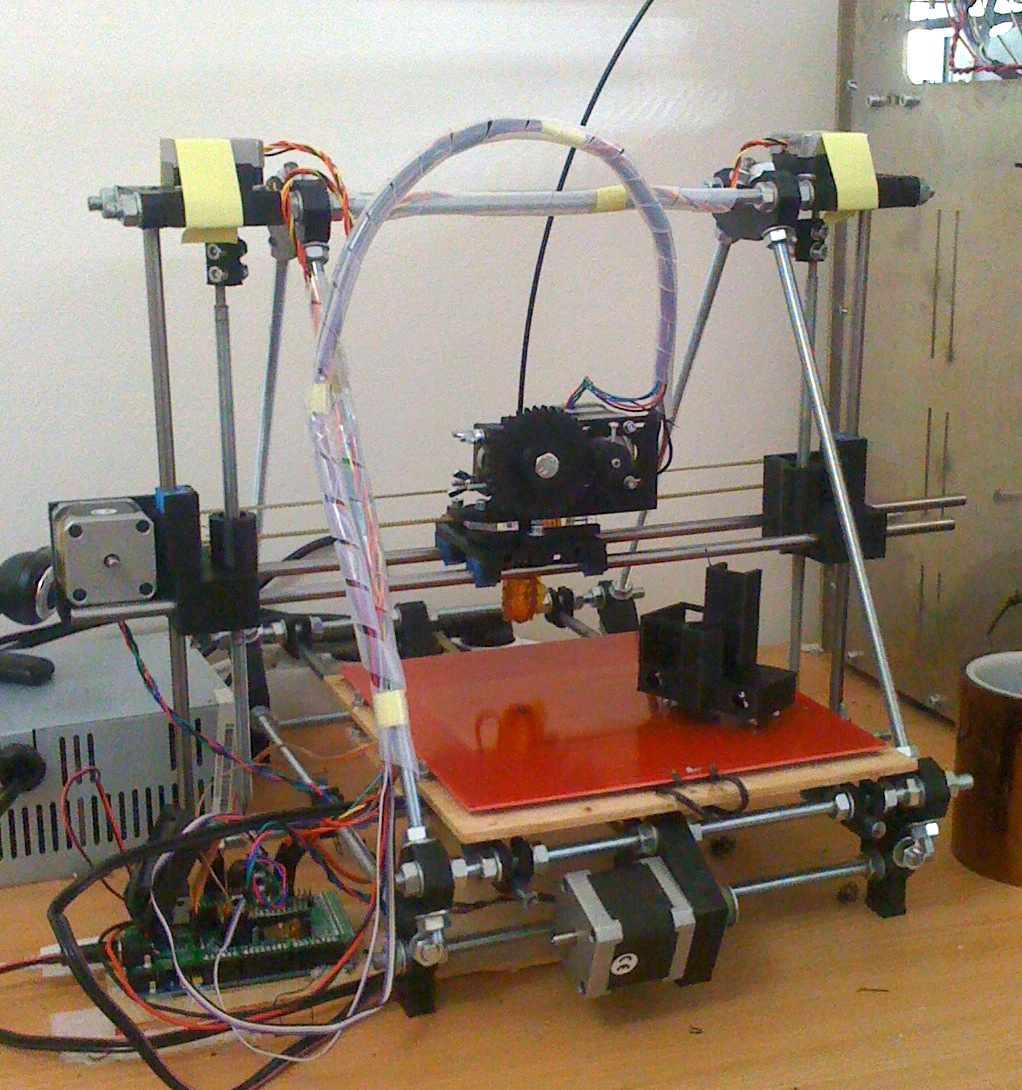
If you look carefully, the Arduino is the blue board underneath the green RAMPS board in this picture of an assembled RepRap -- http://reprap.org/mediawiki/images/4/4a/Assembled-prusa-mendel.jpg .
There are cheaper AVR microcontroller boards that'll do the job of controlling a 3D printer, but the Arduino is by far and away the most popular.
-
Arduino also powers most RepRap 3D printers
Here's the RAMPS "shield" (Arduino daughterboard) that plugs into an Arduino MEGA microcontroller board to drive the various stepper motors of the printer -- http://reprap.org/wiki/Arduino_Mega_Pololu_Shield , http://reprap.org/wiki/RAMPS_1.4 .
If you look carefully, the Arduino is the blue board underneath the green RAMPS board in this picture of an assembled RepRap -- http://reprap.org/mediawiki/images/4/4a/Assembled-prusa-mendel.jpg .
There are cheaper AVR microcontroller boards that'll do the job of controlling a 3D printer, but the Arduino is by far and away the most popular.
-
Arduino also powers most RepRap 3D printers
Here's the RAMPS "shield" (Arduino daughterboard) that plugs into an Arduino MEGA microcontroller board to drive the various stepper motors of the printer -- http://reprap.org/wiki/Arduino_Mega_Pololu_Shield , http://reprap.org/wiki/RAMPS_1.4 .
If you look carefully, the Arduino is the blue board underneath the green RAMPS board in this picture of an assembled RepRap -- http://reprap.org/mediawiki/images/4/4a/Assembled-prusa-mendel.jpg .
There are cheaper AVR microcontroller boards that'll do the job of controlling a 3D printer, but the Arduino is by far and away the most popular.
-
Re:very useful for kindling interest in coding
You mean infrastructure like this?
http://reprap.org/wiki/Main_Page
Just add
Blender (or similar program, offhand can't remember what the memory requirements are)
+
Raspberry PiThat sounds like I need hundreds of people and massive infrastructure, US$1k. Given that the price is heavily influenced by the 3d printer the overall cost of the setup can be dropped substantially if the price of that item drops.
-
Re:Adverts and lack of control (by the user)
Wait till 3d printers become affordable!
What do you define as "affordable"? You can get a RepRap for less monetary output than a color laser printer (the 2D kind).
-
I'm optimistic
If projects like the Global Village Construction Set achieve their goals, communities could establish their own industrial base to pursue big goals. Maker culture (and open source before it) has achieved some amazing things, like affordable home 3D printing, and it's accelerating. The failure of government and business to achieve big goals could be seen as an opportunity. What goals would you pursue?
-
Re:Booring.
Closest you're going to get today: http://reprap.org/wiki/Main_Page
-
Re:Oh god, more delusions
To say that these things can not make anything useful is very far from correct. Checkout RepRap which is a very similar device to makerbot. Its firmware has the code built in to print the parts it is made from and is one of the tenants of the project. The video on the RepRap home page explaining the project is brilliant. These projects are indeed very worthy of getting funded.
-
Ok? So it's Eldy but..
... in some probably unnecessarily fancy/expensive hardware?
Eldy, runs on most hardware, it's about a 13MB download free as in Gratis/Freeware and packs a Developers Network for bugs, translations and so forth.
In other words: Go ahead and recycle some hardware! Get a sturdy desktop or better yet, build a frame around it if needed be or hook it to a bigger (flat)TV.
I'm sure there exists some keyboards with bigger keys today if that is a requirement. Anyhow, it would be cool with a free as in Freedom oshw keyboard that was easy to build for the average
-
Re:Replicator economy or peak employment?
Not to mention the parent project of makerbot, RepRap
-
Re:Won't have it all
RepRap isn't all that expensive (cupcake is sub $1000). Two years ago someone did make a PCB from plastic and solder. Granted, it's inefficient and slow, but that will only improve with time.
-
Well..
I'd say RepRap. Not that it is "unknown", but strange it is not mentioned all that often when one thinks about from that first blogpost in -05 and what have happened since. Especially these days when you can get the plasticparts (clonedel), stepper motors on ebay and a small drillpress for cheaps. Not to mention tiny "one board", easy to solder through hole solutions like Sanguinololu.
Passwordmaker generates ditto for all my internets accounts, pinpadlocks etc. Runs on whatever you throw it at, as javascript, android, crapple, N900 (Thanks George (caco3)!), as CLI. Portable to say the least, mature and of course secure to the extent of what cards you got up your sleeve.
I use Zim to organize everything these days! It's stays out of your way and doesn't complicate things. It uses textfiles as database, which is really nice as you get access to your stuff quickly through a terminal for example. Ok, sure I long for the day that it gets say a Couchdb-plugin...
Redshift safes my eyes from getting cooked. I have yet to download that maemosandbox and compile it for my N900 though. There was a new release a few days ago btw, some new fine functions and not "just" bugfixes!
-
Well..
I'd say RepRap. Not that it is "unknown", but strange it is not mentioned all that often when one thinks about from that first blogpost in -05 and what have happened since. Especially these days when you can get the plasticparts (clonedel), stepper motors on ebay and a small drillpress for cheaps. Not to mention tiny "one board", easy to solder through hole solutions like Sanguinololu.
Passwordmaker generates ditto for all my internets accounts, pinpadlocks etc. Runs on whatever you throw it at, as javascript, android, crapple, N900 (Thanks George (caco3)!), as CLI. Portable to say the least, mature and of course secure to the extent of what cards you got up your sleeve.
I use Zim to organize everything these days! It's stays out of your way and doesn't complicate things. It uses textfiles as database, which is really nice as you get access to your stuff quickly through a terminal for example. Ok, sure I long for the day that it gets say a Couchdb-plugin...
Redshift safes my eyes from getting cooked. I have yet to download that maemosandbox and compile it for my N900 though. There was a new release a few days ago btw, some new fine functions and not "just" bugfixes!
-
Well..
I'd say RepRap. Not that it is "unknown", but strange it is not mentioned all that often when one thinks about from that first blogpost in -05 and what have happened since. Especially these days when you can get the plasticparts (clonedel), stepper motors on ebay and a small drillpress for cheaps. Not to mention tiny "one board", easy to solder through hole solutions like Sanguinololu.
Passwordmaker generates ditto for all my internets accounts, pinpadlocks etc. Runs on whatever you throw it at, as javascript, android, crapple, N900 (Thanks George (caco3)!), as CLI. Portable to say the least, mature and of course secure to the extent of what cards you got up your sleeve.
I use Zim to organize everything these days! It's stays out of your way and doesn't complicate things. It uses textfiles as database, which is really nice as you get access to your stuff quickly through a terminal for example. Ok, sure I long for the day that it gets say a Couchdb-plugin...
Redshift safes my eyes from getting cooked. I have yet to download that maemosandbox and compile it for my N900 though. There was a new release a few days ago btw, some new fine functions and not "just" bugfixes!
-
Re:"chocolate-printer" ... not "chocolate printer"
Note the hyphen. A "chocolate printer" would be a printer made out of chocolate. And that would be news, not this.
If they based their design on the self-replicating RepRap then they should be able to use it to print out a chocolate chocolate-printer.
-
First published in 2009?
This guy didn't nearly the amount of press but here's the article from 2009. I've seen on print chocolate at a convention / maker faire before too but I don't know who owned it.
http://builders.reprap.org/2009/03/chocolate-extruder.html
It would be interesting if they really did reinvent the wheel instead of copying everything that already exists though. Hopefully they will publish their plans.
-
Re:It was only a matter of time
Up next, printing with water!
-
Re:Scotty, beam me down
It's small, but probably not as cheap as a Rep Rap which is a fully open-source implementation of a 3D printer that's been around for a few years. They've developed the first iteration into the 'Mendel' which has addrssed some of the issues they came across in initial development.
-
Re:And I still fail to see a use....
So a RepRap can print more of itself?
-
3D Printing & modelling
Teach the kids about 3D printing (see http://reprap.org/ maybe even get one of the cheap printer kits or an UP! Printer if you have budget.
These things let kids unleash a form of creativity and spatial learning that is hard to find anywhere else. No need to actually teach them how to design 3D objects - they'll be scrambling to figure it out for themselves! Keen students will print their own 3D printers. Less enthusiastic ones will download from http://thingiverse.com/ and create "Mash up" objects.
Inevitably one of them will print a penis for shock value, but kids are like that.
-
Re:Quality control?
It does seem that the RepRap is of higher quality. I didn't do any hard core searching, but all the comments about them only seem to be unhappy with the customer service of the places selling them. The quality seems much better than the descriptions of the thing-o-matic. The RepRap version that is sold pre-assembled by Botmill is only $1400, but they get terrible reviews for their customer service. The kits are much cheaper at many places ($600), have a look at the RepRap wiki. The RepRap is the one that was on slashdot a bit back and was a bit overhyped as being able to replicated itself. Well it can make it's own plastic parts, but not the metal or circuit boards. Being able to make the plastic parts seems worth it to me though.
-
Re:I would think...
So, it's not perfect or self-replicating, but you can do some cool stuff with it.
Quite an interesting development, indeed. If a higher level of self-replication is wanted, however, it's worth mentioning Reprap, of which Makerbot is a commercial spin-off (e.g. Makerbot is to Reprap what Ubuntu is to Debian). Reprap has an explicit design goal of maximizing the level of self-replication.
-
Re:Hello
Should of linked it
http://reprap.org/wiki/Main_PageReprap wasnt designed to be sold at a profit, it was designed to benefit humanity and schools
ironically all this makerbot thing did was copy it and double the price -
Decentralize the technology
The main problem with the OLPC, the one thing that made the project open to subversion by companies like Intel and Microsoft, is its centralized model of development. You get the laptops or tablets from one source, say, the central government of the country that buys into the idea or some buy-one/donate-the-other scheme. I understand that it's supposed to be more of an educational than a computing project. But this set-up generates dependency. What happens when the machines are damaged? More importantly, what happens to the next batch of children without laptops? Since the machines are manufactured in the usual Asian places (hint: two countries claiming the same name), this will likely result in a foreign exchange outflow from a country that can least afford it, as certain essential non-technological items (e.g. food and basic medicine) may need to take priority.
What the OLPC should have set out to develop is a RepRap-like infrastructure that will allow the adults (or even older children) of the community that takes part in the project to manufacture the laptops by themselves from cheap, readily available components. If this isn't 100% possible, then give them at least enough transfer of technology to allow them to build the least technological parts, like the case or the keyboard. Think of a laptop case made out of recycled plastic or hard laminated cardboard. Then again, how far off is the day when we can run a desktop OS on an Arduino board?
Don't just give them fish. Teach them how to fish.
Computers made using such technology might appear crude at first, but not much cruder than the devices that ushered in the PC revolution.
-
Re:Copyright Rocks
Since it's Sunday, and I have nothing better to do. Let me humor you with a long reply.
Yes, it would be great if we can have everything free. That's called the Star Trek economy. Once we have production-grade replicators or nth-generation Repraps, that will become a reality, indistinguishable from magic. Now, if all that we need to manufacture something is the work to haul some amorphous lump of matter and dump it into the replicator, then the value of money degrades to that of a household chores bribe: Hey, Junior, can you fetch me some dirt from the back yard. I promise, I'll drive you to the ballgame this Sunday.
That's it, as far as goods that we can hold in our hands are concerned. We're not yet at the Star Trek level as far as physical objects are concerned. Every single iPhone or Prius has to go through some form of manual intervention, a worker who has to assemble the bits and bolts. You can't just download the blueprint for a laptop and feed the binary data to any of today's state-of-the-art 3D printers. And even if you can, you still need special materials that you can't ask Junior to fetch from your back yard.
On the other hand, duplicating an eBook or an Mp3 is as easy as typing "cp *mp3
So, I'm sure you'll ask, who'll pay for the initial step? Those hungry for novelty and innovation. If nobody wants to pay to hear a new version of the Goldberg Variations, then we're stuck to listening to the old recordings by, say, Glenn Gould, or until some bored amateur decides to record and foist on us her atonal version of Bach.
Don't underestimate boredom as a motive for innovation and progress. It's what made Wikipedia the dominant source of information in the Internet, millions of bored users deciding to contribute their little tidbits of information.
Yes, Wikipedia still needs money to operate its servers. But that is minuscule compared to the quantity of "free" editing and writing work contributed by bored users, trolls, and government agents. We don't pay for the pizza but for the pizza delivery.
-
Re:There will be a need for "Open Source Models"
Thingiverse is a place to freely share 3D object designs: http://www.thingiverse.com/about
RepRap is GPLv2 and later: http://reprap.org/wiki/RepRapGPLLicence
-
Re:Paper car = not smart
IIRC ABS is the stuff lego bricks are made of. I know, "lego brick" is not exactly the specific measurement you asked for, but that perhaps helps to get a feeling for it.
BTW the fine folks creating reprap, the open source 3d printer, often print with ABS, as well.
-
Re:Really???
I'm sorry you got your panties in a bunch because some of the groupthink coincides with some of my own thoughts.
I maintain my points, and here's another one:
The most exciting thing Microsoft has done in the past several years was to showcase "Surface" - which promptly disappeared into some back room at the R&D lab, never to be heard from again. To put it succinctly, as my wife did: "That looked like it would be fun. Where did it go?" Why did the only innovative product Microsoft has come up with in the past 10 years that didn't piss off half their userbase get stuffed into a closet to rot?
Microsoft lost touch with the consumer market a long time ago, and the stock market (and the tech sector) are finally starting to notice.
Will they be closing their doors any time soon? Probably not. Did IBM close their doors? No. They just became less relevant to the industry at large, lost their market share, and helplessly watched their profits dwindle.
As for the patents thing, I never mentioned software patents specifically, I said "patents". Microsoft is suing people in a thinly-veiled attempt to keep hold of their market share, and this is irrelevant to the discussion? Way to go, you sure dodged that groupthink, there.
In this modern era, it is now possible to copy physical objects with a minimum of time and effort investment (See the RepRap, for example), and purely digital objects can be copied with just a few clicks and/or keystrokes. In addition, with rapid physical transportation (as well as near-instantaneous information transportation), idea-flow really is practically unstoppable. This is a discussion for another thread, of course, but dismissing my point because I happen to share certain ideas with the "slashdot groupthink" is kinda like ignoring a man trying to hand you a coupon for a free cheeseburger because he's black (or atheist, or wearing a silly hat, or any other ill-informed prejudicial reason). You missed the boat because you were dodging the man carrying fishing pole.
-
Re:As opposed to doers?
It's a reference to the MakerBot. It's a RepStrap, a way to build yourself a RepRap if you don't yet own a one. I've got one on my desk upstairs, waiting for a replacement thermistor for my extruder so I can start churning out parts for this one.
The fact that you can get one in a kit form has spawned a whole host of different printable upgrades for the MakerBot. For example, there's a set of models up on thingiverse you can download and print that will let you mount a Dremel tool in place of the print head for light CNC work. I'm planning to try cutting circuit boards with it. -
Re:1 watt isn't enough to set skin on fire
Could it be used in projects such as RepRap?
-
Self-replicating machinery
The state-of-the-art in self-replicating machinery is being developed primarily by hobbyists (with the odd Engineering prof here and there). See www.reprap.org for the biggest project. For the most part, all it takes money for parts, and good engineering discipline to measure, record, and refine.
An open topic that I haven't seen addressed is how to make the jump from a machine that is merely self-replicating to one that is a bona-fide Von Neumann machine; how do you make a replicator that can produce children that are slightly smaller and more accurate? How do you prevent loss of accuracy between generations?
Less theoretical open problems are in creating an architecture that can support multiple print modes, and finding good materials that are cheap, effective, and have the right properties. How can you effectively print circuit boards? Semiconductors?
It's an area that is not currently in the mainstream eye, there's not much in a business model in giving someone a machine to put you out of business, and it's in the crossroads of technology-makes-that-possible and requires-real-work-outside-of-moms-basement which makes it a target rich environment for someone that's motivated.
-
RepRap
Check out RepRap. It is a 3D printer that can copy itself (or a significant part of itself, really). There is a lot of room for research which can be performed with a small budget. In fact, that is the whole point of the project.
You can even try to win the $80,000 Gada Prize. Basically, join a group and try to make enough improvements to make it accessible to residents of developing countries.
I haven't started participating yet, but I plan to.
-
RepRap
Check out RepRap. It is a 3D printer that can copy itself (or a significant part of itself, really). There is a lot of room for research which can be performed with a small budget. In fact, that is the whole point of the project.
You can even try to win the $80,000 Gada Prize. Basically, join a group and try to make enough improvements to make it accessible to residents of developing countries.
I haven't started participating yet, but I plan to.
-
Re:Why??
I tried to submit a story about this but it was rejected...
2obvious4u writes "Here on Slashdot we like to discuss copyright, MPAA, RIAA, torrents and all the little details that go along with false scarcity and what that means to the digital economy. Well what happens when that false scarcity starts happening to physical goods? I bring this up for discussion because I've spent the last couple of days looking at getting a MakerBot CNC 3D printer and while looking at it I found the RepRap 3D printer which is almost fully self replicating. You can then go to thingverse and download real world, usable, physical objects including the RepRap 3D printer. So now just like with music and movies we can share physical objects with each other and all we need to print it is the digital design and enough plastic or other materials to create the object. If you haven't seen this tech and how much it has grown in the last two years, you are really missing out. These things even decorate cupcakes!"
Basically we are at the point where we can take a raw material input stream and print whatever objects we want. The next step would be to be able to make things out of exotic materials. -
Re:Scale Down Constellation for LEO
Forget the moon, that is just going into another gravity well. it is not a "stepping stone" to mars, the asteroids, or the other planets.
I disagree, building a moon base would be a significant stepping stone. There is lots and lots of research that still needs to be done for meaningful long-distance space exploration. For example:
- The Russians and ESA are for example working on the Mars 500 project to see what happens if a group of cosmo-, taiko- and (euro-?) -nauts are locked up in a tin can together for 500 days. Where is the NASA equivalent of that? Is it not exciting enough because no big rockets are involved since the tin can is somewhere near Moscow? Long-distance travel means making sure the explorers are not at each others' throat.
- For both colonization and long-distance exploration missions, you need a life-support system that is robust, repairable, and produces very little waste and waste heat. A moon base would be excellent to test it because, unlike the Mars 500 tin-can, the vacuum outside is real and the micrometeorites, radiation levels etc. are real. I believe there's a really important lesson to be shown to the world, that building a sustainable mini-ecosystem is *hard*. And, that if you fuck up the one you're currently using, the only one we know works for generations, you're *fucked*.
- Manufacturing and autonomous manufacturing. I don't care how hard it is, I think Robert Zubrin is spot-on about its importance for missions to the moon and mars. He talks about a fuel factory here, to be run for 10 months in preparation to the manned mission, but even nicer would be a solar-cell driven factory for crude, low-energy, amorphous silicon solar cells, or maybe even some kind of very slow separator using mass spectrometry that over a period of years collects tiny amounts of pure boron, phosphorus, etc.
The versions made this century don't have to be self-replicating
-
Respecting Hayek but moving beyond him...
What about when consumers can buy nanotech 3D printers?
http://www.reprap.org/wiki/Main_Page
http://en.wikipedia.org/wiki/3d_printingAnd then print their own solar cells, 3D printers, and matter extractors and recyclers?
Mainstream economics, if it ever made any sense, is on its way out...
That said, totally free global markets might not be that bad if there was a global basic income as a human right for every person to regularly claim some part of the fruits of the industrial commons:
http://www.basicincome.org/bien/aboutbasicincome.html
http://www.basicincome.org/bien/papers.htmlAnd of course some way to account for externalities:
http://en.wikipedia.org/wiki/ExternalityAnd a way to limit the concentration of wealth and power that can destroy the free market by regulatory capture (as happens all too often in the USA...)
Note that Friedrich Hayek said he was not against government intervention if it was based on "a clear set of principles", and a basic income as a human right (which also might smooth out business cycles), as well as concerns about externalities and concentration of wealth and power, might fit that definition:
"The road to serfdom: text and documents"
http://books.google.com/books?id=qg61T_I1mwsC&pg=PA20
"... he repeatedly emphasized in his talks before business groups that he was not against government intervention per se: "I think what is needed is a clear set of principles which enables us to distinguish between the legitimate fields of government activities and the illegitimate fields of government activity.""Otherwise, without a human right to make a claim on the fruits of the industrial commons, what are you going to do if robots, AI, better design, and saturated demand take your job? Marshall Brain painted that picture, and it is not pretty:
http://www.marshallbrain.com/manna1.htmAnd Frances Moore Lappé has already pointed out how starvation is quite possible around plenty:
http://en.wikipedia.org/wiki/Frances_Moore_Lapp%C3%A9
"Throughout her works Lappé has argued that world hunger is caused not by the lack of food but rather by the inability of hungry people to gain access to the abundant amount of food that exists in the world and/or food-producing resources because they are simply too poor. She has posited that our current "thin democracy" creates a maldistribution of power and resources that inevitably creates waste and an artificial scarcity of the essentials for sustainable living."Some other ideas about freedom, if you are interested:
"Ivan Illich: deschooling, conviviality and the possibilities for informal education and lifelong learning"
http://www.infed.org/thinkers/et-illic.htmAnd from Ivan Illich's deschooling society, that echoes some of Hayek's points:
http://reactor-core.org/deschooling.html
"""
The choice is between two radically opposed institutional types, both of which are exemplified in certain existing institutions, although one type so characterizes the contemporary period. as to almost define it. This dominant type I would propose to call the manipulative institution. The other type also exists, but only precariously. The institutions which -
Re:Nothing to say...
Citation here
-
Sand and Magnesium as resources...
...sounds like a great choice as resources to use. As Sand is basically silicon and readily available, magnesium is also the 7th most abundant in th earths crust. It seems like this thing could go a long way towards very cheap mass production of all sorts of solid things very cheaply. There is also the RepRap project but they use plastics which I'm afraid are quite expensive as resource, although they kind of target a different area. I'm excited by this, I've been following these ideas for a while and it seems to be going somewhere, I guess we're getting closer to general purpose building machines.
-
Reprap Addition?
That way we can have self-fabricating robots that also self-assemble themselves.