 Slashdot Mirror
Domain: rochester.edu
Stories and comments across the archive that link to rochester.edu.
Comments · 323
-
Nuclear
@BeauHD Do you read this stuff before you post it? Let me help you...
http://www.pas.rochester.edu/~... -
How good are you with neutrinos?
If someone else has any bright ideas how to mitigate evil behavior incoming from ISPs (because they will take full advantage of this, believe you me), I'm all ears.
If you can shrink this amazing technology down to about the size and cost of a microwave oven, and provide high data rates with low latency, I'd say the problem is solved. A breakthrough like that would permanently eliminate the ability of corporations and governments alike to interfere with Internet communication. -
Ok, since you need help? Good start
http://cs.rochester.edu/~sandh... PAY ATTENTION to caching, clustering, & optimized for SSD hardware
APK
P.S.=> That's just the TIP of the iceberg too from the University of Rochester - searching "SSD future filesystems" gets you more to think about... apk
-
The real link
University of Rochester Body heat triggers shape change in new type of polymer
The real source even has video
-
Re:Education is getting better
I disagree. In fact had the opposite effect: New Math as taught in the late 1970s/early 1980s was unsuccessful in teaching pre-college math.
Sorry, but I'm not sure we're talking about the same thing. The New Math in secondary education was developed in the 1950s and implemented in the 1960s. By the early 1970s, the New Math movement was largely dead.
By replacing basic Math education like algebra/geometry with the screwed up "New Math" they ruined math for those of us who actually had to take it in college for engineering. You can't learn Calculus without a solid understanding of Algebra and Geometry.
I'm not sure you know what you're talking about. In the mid-1950s, high school enrollment in Algebra was down to about 25% of all high students, and enrollment in Geometry was down to less than 12% of high school students. The New Math was about encouraging students to take such courses, by combatting an anti-intellectual populism in the previous generation of educational reformers. It also encouraged clarity in concepts and algorithms in these classes which would line up better with advanced math taught in college. Also, the very idea of teaching calculus in high school was a product of the New Math reform.
New Math didn't teach what we needed to know to be successful in college math.
Without the reform of New Math curricula in the 1950s and 1960s, you may not have even had the option of taking math like geometry or algebra in high school, let alone calculus. How would missing out on such things be better preparation for college math??
I think you're focusing too much on the reforms to primary education, and you don't seem to know what secondary New Math curricular reform was about. It was mostly about emphasizing the math you think claim it was jettisoning from curricula.
I'd suggest you read about what the New Math reform actually was about. Here's a short intro to curricular reforms over the 20th century, here's a longer history of the New Math movement, and here's an intro to the sorry state of secondary math education in the U.S. around 1950 -- which definitely included little decent prep in geometry or algebra. One of the main goals of the New Math reform was to incorporate "a solid understanding of Algebra and Geometry" into the U.S. high school. At times, the reformers did go too far into abstraction, but I'm really not sure what you're talking about.
-
Re:Sexes ARE different, thankfully
But there's only one issue with that...
How was that study conducted? Has it ever been reviewed by peers or successfully reproduced?
Screw Mars and Venus; men and women are from Earth
This would argue againstsegregation... But even that study shows ample differences between genders, and the article describing it (which is what you linked to) acknowledges ample earlier studies "that had shown significant, and often large, sex differences".
If you had a society where eating apples was something almost exclusively done by men
Most of the female chess Grand Masters (not to be confused with the WGMs) come from places, where views on gender-roles remain quite traditional — Georgia, China, Russia, or Ukraine.
This alone handily defeats the argument, that it is the dastardly "Victorian moral system", that keeps women from advancing in anything other than child-bearing and singing.
If a girl from Lviv can become a Grandmaster — her last opponent, incidentally, being a girl from Vladivostok, what is the excuse for a girl from Los Angeles? Sex-stereotypes are only wider-spread in the former USSR...
the very fact that historically there were fewer women in STEM (a legacy from the old Victorian moral system)
Citation needed.
Or, one can decide that having 50% of the human population having a solid interest in the sort of careers most valuable to the improvement of the human condition is a good thing
I'll see your 50% and raise it to 100%. You make even less sense with these slogan here, than you made earlier with attempts to remain scientific.
and maybe we should give a shot at remedying this
Rectifying what? Are there laws or even customs, that prevent girls from entering a STEM field and excelling in it? I am not aware of any such and I await your citations.
even if just on the "offchance" that it's not biological
But what if it is bilogicial — as seems perfectly probable? Would not your efforts to encourage people to do, what they have little aptitude towards, then be wasteful and, indeed, detrimental to that "improvement of the human condition"?
-
Re:Sexes ARE different, thankfully
Or, maybe, women and men simply aren't the same?
The anatomy and physiology are demonstrably different.
Obviously what's at hand here is mental differences. Are there demonstrable mental differences? Yes! But there's only one issue with that...
In almost any sentence where people say "Women (verb)..." or "Men (verb)..." and it's about something psychological (as opposed to, say, something involving reproductive organs or a statistical difference in strength / height or the like), 99% of the time it's equally accurate to simply say "People (verb)..." The popular perception of the degree of differences between genders (including the effects of both brain structure and hormones) is often vastly different from the statistical reality. Screw Mars and Venus; men and women are from Earth. Psychologically, we're statistically virtually identical in most measures. And in many cases where there are differences that even manage to meet statistical significance, what differences there are may well be artifacts of culture.
Human children learn through imitating. They adopt role models (such as their parents at an early age) and mimic their behaviors, to the degree that it can even hinder them (one of the sort of psychological tests where chimps perform better than human children is to lay out a puzzle and have an adult solve it in front of the subjects, but insert a bunch of needless time-wasting steps; the human children almost invariably perform all of the time-wasting steps while the chimps catch on quickly that they're pointless and skip them). As a general rule, children most mimic members of their gender, something that socially they're rewarded for. By the very nature of this system, it inherently perpetuates the carryover of any totally non-gender-related but nonetheless gender-segregated activities from the previous generation. If you had a society where eating apples was something almost exclusively done by men, even if you didn't specifically teach the next generation that apples are a "men's fruit", the vast majority of girls wouldn't take up eating apples.
Given this, whether there would be any factual basis or not for women to be better or worse at STEM, the very fact that historically there were fewer women in STEM (a legacy from the old Victorian moral system), this will automatically lead to there being fewer women in STEM in the next generation. Now, one can do nothing and just hope that, after enough generations, the problem will remedy itself. Or, one can decide that having 50% of the human population having a solid interest in the sort of careers most valuable to the improvement of the human condition is a good thing, and maybe we should give a shot at remedying this, even if just on the "offchance" that it's not biological.
-
Re:Don't buy American.
Feeding the troll but what the heck....
From early 2012
The company aims to deliver about May 18 a second report on transistor characteristics of the CPU. It will include an analysis of the DC electrical properties of the chip’s NMOS and PMOS transistors, data on its gate and channel leakage current and performance benchmarks measured at three temperature levels.
The analysis will include use of Scanning and Transmission Electron Microscopy, Spreading Resistance Profiling and X-ray techniques. UBM TechInsights is a sister division of UBM LLC, the publisher of EE Times.
And that is just to see the circuitry. Good luck reverse engineering it to figure out what does what and verify there is nothing there that should not be there.
You might also look at this for an even older take on 486 and pentium tear downs... again with no attempt at reverse engineering the logic.
-
Re:Women prefer male bosses
You seriously think you can make a claim credited to a scientific study, and then when you can't show evidence that such a study claiming what you did was ever conducted, suddenly switch to a "but everyone knows" laden with old gender stereotypes and the standard lame appeal to darwin - and think that will fly?
In almost any sentence where people say "Women (verb)..." or "Men (verb)..." and it's about something psychological (as opposed to, say, something involving reproductive organs or a statistical difference in strength / height or the like), 99% of the time it's equally accurate to simply say "People (verb)..." The popular perception of differences between genders (including the effects of both brain structure and hormones) is often vastly different from the statistical reality. Screw Mars and Venus; men and women are from Earth. Psychologically, we're statistically virtually identical in most measures. And in many cases where there are differences that even manage to meet statistical significance, what differences there are may well be artifacts of culture.
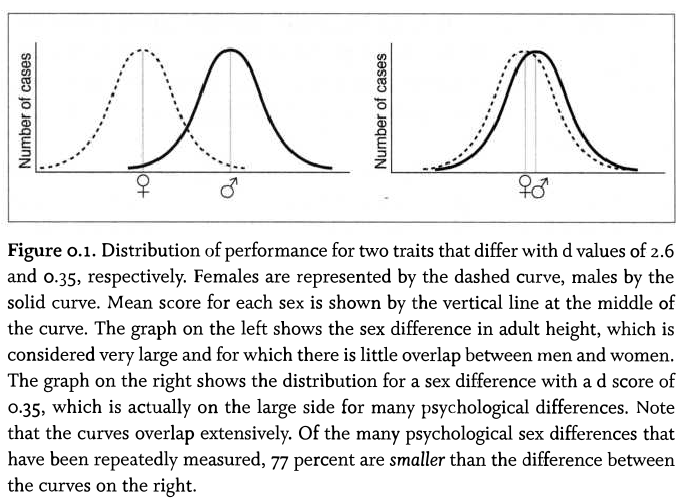
How little are most of these "differences"? This set of graphs puts it into perspective.
Again: Either present your supposed "study" or drop the issue.
-
Re:Pictures or it didn't happen
-
Re:Pictures or it didn't happen
-
Re:Pictures or it didn't happen
-
Re:Before you start complaining...
Indeed. Culture is most likely much more of a factor.
Most people credit there being far more differences between the sexes than there actually are. Here's what I wrote on XKCD the last time the topic came up:
Let's keep it simple.
In almost any sentence where people say "Women (verb)..." or "Men (verb)..." and it's about something psychological (as opposed to, say, something involving reproductive organs or a statistical difference in strength / height or the like), 99% of the time it's equally accurate to simply say "People (verb)..." The popular perception of differences between genders (including the effects of both brain structure and hormones) is often vastly different from the statistical reality. Screw Mars and Venus; men and women are from Earth. Psychologically, we're statistically virtually identical in most measures. And in many cases where there are differences that even manage to meet statistical significance, what differences there are may well be artifacts of culture.
https://www.rochester.edu/news/show.php?id=5382
Remember that your partner is an individual who has thoughts and feelings just like yours. They are not their gender. Remember that gay couples have the exact same sort of relationship problems as straight ones.
And if you still have trouble viewing the other gender as being of the same stock as you... men, look at your scrotum. See the line down the middle? That's where your labia fused before you were born. Women, look at your clitoris. That would have been your penis.
We're all made of the same stuff.
One closing graph:
http://1.bp.blogspot.com/-nQ-nxqcuLsU/Tr_TimJmlBI/AAAAAAAAAo0/sp22VFq5wdo/s1600/sex-differences.gif
(The above graph, for people who don't want to follow a link: the left side shows two bell curves with little overlap, while the right shows two that are practically identical. "Figure 0.1. Distribution of performance for two traits that differ with d values of 2.6 and 0.35, respectively. Females are represented by the dashed curve, males by the solid curve. Mean score for each sex is shown by the vertical line at the middle of the curve. The graph on the left shows the sex difference in adult height, which is considered very large and for which there is little overlap between men and women. The graph on the right shows the distribution for a sex difference with a d score of 0.35, which is actually on the large side for many psychological differences. Note that the curves overlap extensively. Of the many psychological differences that have been repeatedly measured, 77 percent are smaller than the difference between the curves on the right.")
-
Re:LOL Whut!
This luser is supposedly an assistant professor in CS at some little university ex polytechnic is my bet
It's the University of Rochester; do you win or lose the bet?
-
Re:'Why don't they tell people?'"
Because your chances of killing yourself wandering around out here in the summer without water are MUCH higher than your chances of contracting Valley Fever. I've lived in the Phoenix area for 12 years and it's pretty much common knowledge as far as I can tell.
And thirst is not a good guide for when to drink. By the time you even feel thirst, you are already on your way to dehydration. That goes even more for hot dry places like Phoenix.
-
Re:Not on your life ...
How about predicting disease transmission from twitter?
-
Re:Why aren't there more contributors to this proj
It is absolutely possible to have high performance userspace graphics, as was proven with some of the more up-to-date drivers. I think it was ATI that first did it, by the way.
Absolutely not. Read this and understand it (first link I found that was useful): http://www.cs.rochester.edu/u/cli/research/switch.pdf
From the summary: "In general, the indirect cost of context switch ranges from several microseconds to more than one thousand microseconds for our workload."
If you can skip that "several microseconds to more than one thousand microseconds" blip, you will get MUCH better performance. That is why graphics drivers are in the kernel and why you can NOT say that you can ever get high performance user space graphics drivers (under current architectures).
-
Re:I am doubtful
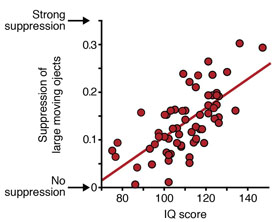
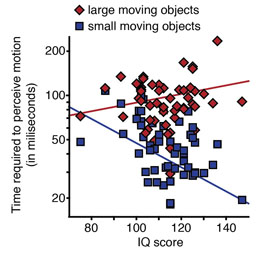
Also, the correlation was at most 71%, note that flipping a coin is expected to correlate to around 50%.
Flipping a coin would have an expected correlation of 0%, although with only 56 samples it could easily be 20-30% in any particular trial. 71% is pretty significant.
Of course, it seems like the researchers did test a lot of different possible relationships and cognitive skills, so they were biased towards finding at least one strong one. (obligatory XKCD.) Still, 71% is a lot better than you are giving them credit for.
Their data seems to be awfully well clustered and the slope seems to be due to the outliers.
See how the data points are all paired? -- each IQ has exactly two dots above it, one red and one blue, presumably representing the same individual. From what I can tell, the important part of that graph is not the absolute position of the red or blue dots, which I agree do not have a remarkable slope, but rather the difference between red and blue for a given individual.
Their other plot from the news article seems to be just that difference, or some derived representation of it. It's a much more convincing relationship.
-
Re:Popcorn time!
I have a theory: playing football outside trains your peripheral motion perception (1) and reading trains your foveal motion perception. I'll leave it as an exercise to the reader to figure out how these activities might correlate with intelligence.
Full text, btw: http://www.bcs.rochester.edu/people/Duje/papers/13_Melnick_IQ_CB.pdf
-
Re:Popcorn time!
I was able to see them all no problem, regardless of size. I guess that means I'm really smart? Or that the test was a crock of shit. Could be that.
Um, no. Hopefully you can find someone to explain this plot to you. If says if you could see them equally, you're about 75 IQ. I had a harder time with the full screen ones, before I knew that was a sign of a higher IQ.
-
link to the article (free)
Not sure if anybody has already posted this, but if you'd like to read the article and lack access (and are unwilling to fork over $35) you can read it through the university's website for free: http://www.bcs.rochester.edu/people/Duje/papers/13_Melnick_IQ_CB.pdf
-
I am doubtful
Much of the brain's visual processing can change dynamically with changes in environment.
For example, a common experiment in college psych courses is to give a student glasses that flip the world upside-down. It takes a few days for the student's brain to adapt to the new inputs, and then they see the world normally (and revert after a few days w/o the glasses). Patients with macular degeneration can wear glasses that stretch-map the visual input around areas of missing vision (in the manner of a cylindrical mirror). After some time, they report seeing the world normally - their visual system has adapted and remapped the input.
I wonder if the effect simply measures the amount of reading the subject does; in other terms, perhaps it's just measuring the amount of fine-focus eye training? What does the test show for people who play a lot of arcade games (shooters, especially ones that throw a lot of targets at you)? Or people who use a lot of visual perception in their daily lives?
The article stated that the authors "tested for other possible explanations". Also, the correlation was at most 71%, note that flipping a coin is expected to correlate to around 50%. Their data seems to be awfully well clustered and the slope seems to be due to the outliers. The first study used 12 subjects, and the second only 53.
I'm unconvinced. It could be promising, but I would like to see correlations from more data.
-
Re:Statistics?
This is kind of interesting:
http://www.urmc.rochester.edu/news/story/index.cfm?id=3687
Basically, there have been 480 cases of magnet ingestion reported in children in the last decade, with nearly half of those cases reported in the last year. This is not necessarily injuries, but simple ingestion. Are kids actually swallowing more magnets these days, or are parents and doctors simply more aware of the danger? The article's title claims that injuries are are the rise, but makes does not state the actual number of injuries.
-
Re:WTF, this was already invented
Hmm, their stuff doesn't look like CSG to me - look at the blends and morphs for example, those are certainly not CSG operations.
Also, don't trust wikipedia. CSG means something very specific and is not just an interface that lets you do Boolean operations. See explanations from some of the guys who came up with the stuff: Requicha (pdf) and John Woodwark's website
Only a system which has a CSG tree as an internal representation and point membership evaluation can be called a real CSG system. As soon as it stores surfaces, it's just back to being a plain old BRep system.
The packages you mention don't actually use CSG, whatever they may call their operations. Ones that do are: iCAD (from japan), BRL-CAD (US-Army, now open source) and the old AutoSolids add-on for AutoCAD (which is dead now).
If you're interested in reading up some more, a good starting point might be the original reports
I can help if you have further questions
-
Re:great!
A report EFDA in preparation for ITER here. It gives shot cycle times:
- Jet: 30 minutes
- DIII-D: 14 minutes
- ASDEX: Just under 30 minutes
- FTU: 20 minutes
- RFX: 10 minutes
It even discusses replacement schedule of some equipment for ITER, with only a few blanket modules replaced per year and a complete replacement only every 10 years, for example. The time between shots is referenced as 1600 seconds here due to the limitations it places on computing requirements (so repetition rate would be ~2000 seconds since the plasma shots will be up to 400 seconds).
The introduction in the full text of the paper here discusses how HiPER will be designed with a target of 10 Hz repetition rate for a 100 full power shot sequence.
The report here mentions how the Omega laser system is designed around a 30 minute repetition rate.
20-30 per working day for JT-60
Even the ones I references as being kind of slow, NIF and Z-machine, are one shot per day, not weeks and months between shots.
The smaller projects I've worked on typically ran every 2-5 minutes when cycling during a normal day, limited by them typically using underpowered, but free (due to inheriting from previous experiment) cooling system. Their run campaigns were limited by staffing, as when the handful of people were busy analyzing data, no one was left to run the machine. Larger machines I've worked on had technicians and large teams to run 5+ shifts a week, and would run for at least a third of the year. Time not running was typically spent calibrating, repairing, upgrading diagnostics, and occasionally power supplies, most of which are components a production reactor would not have. Larger machines had a much more diverse diagnostic suite, so were much harder to organize and get things ready for a full run campaign, for reasons unrelated to plasma or neutron damage. The larger machines also could run into budget reasons running for a larger part of year due to staffing (technicians assigned to more than one thing) and power costs.
Neutron damage, failures due to plasma damage, and over all maintenance costs and cycling are a MAJOR issue that fusion research needs to address before becoming commercial. But that still doesn't mean your "hours, days, and even weeks" accurate for anything currently or in the near future.
-
Re:Luddite
Uhhh. In order to illustrate the volatility it needs to be log scale. How else could you compare a change in 50 % when Dow Jones is 100 compared to 13000. Anyway, here is a graph of volatility of Dow Jones . http://schwert.ssb.rochester.edu/usvol.pdf . As you can see our volatility is quiet low compared to the thirties. Anyone who thinks a bit will understand that the claim that prices are somehow crazy nowadays compared to the good old days cannot be true, since it would mean that good dividend paying companies could be bought cheap by the simple strategy of entering a buy order with a low price. No HFT algorithm can buy below your order. Of course there are differences to the thirties. For example the volatility within a tenth of a second is much higher.
-
Re:I agree
Modern games, especially when camouflaging of some form is involved (which usually is in shooters) it's motion that will give them away, if your eyes are not adapted to spotting things.
So:
1. Pattern and antipattern detection/recognition (hey that grass looks diff... oh that's an enemy!)
2. Fine motion detection/recognition (something just moved in those trees)These very same "skills" are trainable - the more you play, the better you get. This has actual real-world impact, especially in the realm of soldiers, hunters etc. Likewise if you've done a lot of that kind of thing, you'll find you pick up these games a bit easier since there's something to build on.
Here's another study, though this one's some news report with no links.
-
Re:Not much energy.
They do fusion research there for DoE, but yes it's heavily subsidized by DoD (since they're not allowed to do detonation tests on nuclear weapons anymore). The University of Rochester has a similar facility: http://www.lle.rochester.edu/ , and they get grants from both DoD and DoE.
-
Working link
Since the link in the summary gives a 404, here's what appears to be the same article direct from the school's website:
http://www.rochester.edu/news/show.php?id=4022
The title of the article is a verbatim match to the URL in the summary, so I'm pretty sure it's the same article.
-
Re:And the sad part is...
I like the way this is modded Flamebait. Moderators, I recommend that you try reading the linked article.
...acting white is a pejorative term usually applied to African-Americans
The phrase was coined by Signithia Fordham [.jpg] <University of Rochester, Susan B. Anthony Professor of Gender and Women’s Studies> and first popularized in her 1986 study, Black Students' School Success: Coping with the "Burden of 'Acting White.'"
So, moderators: The term "acting white" was coined by a BLACK PROFESSOR to describe BLACK STUDENTS who SUCCEED IN ACADEMICS.
You thought it was racist? You're calling HER racist. And I agree with you. She's racist.
You thought it was flamebait? You're calling HER a race-baiter. And I find myself agreeing with you yet again.
-
Re:And the sad part is...
I like the way this is modded Flamebait. Moderators, I recommend that you try reading the linked article.
...acting white is a pejorative term usually applied to African-Americans
The phrase was coined by Signithia Fordham [.jpg] <University of Rochester, Susan B. Anthony Professor of Gender and Women’s Studies> and first popularized in her 1986 study, Black Students' School Success: Coping with the "Burden of 'Acting White.'"
So, moderators: The term "acting white" was coined by a BLACK PROFESSOR to describe BLACK STUDENTS who SUCCEED IN ACADEMICS.
You thought it was racist? You're calling HER racist. And I agree with you. She's racist.
You thought it was flamebait? You're calling HER a race-baiter. And I find myself agreeing with you yet again.
-
Here's what's really insidious:
OK here's what perhaps people are missing about this scheme and what's really insidious
Researchers know that paying someone money to learn (or the reverse of this, fining them for not learning) has the effect of making learning uninteresting to the learner unless money is involved as an incentive / disincentive.
http://www.rochester.edu/pr/Review/V72N6/0401_feature1.html
This of course perfectly describes the mind set known as "greedy" where all expenditure of mental effort is evaluated first and foremost on a transactional basis and is never its own reward.
The people who most fit the above description are of course just those billionaires funding these schemes.
So these schools become narcissistic projections of the funder's own egos and value systems.
But these personalities don't invent, they aren't creative, they aren't the source of technological progress.
Rather they're the specific personalities that fill the role of monopolist winners within a system that is guaranteed to produce such winners in any event. Given our system of deregulatory capitalism and pliable legislators and courts, someone was going to be Bill Gates and someone was going to be Larry Ellison. They're not unique in that sense.
Ellison himself characterized the early buggy database as a "roach motel for for information- data goes in, but it never comes out..." which is not surprising since he invented none of it and barely understood E F Codd's relational model to begin with. Nevertheless he's a business winner.
Gates famously invented nothing of note; he was good in his capacity as a narcissistic leader and good at surrounding himself with co-dependents who could be relied on to fiercely buy into the cult of personality and do actual work.
This is in marked contrast to the mindset of the lowly researcher who actually invents new technology and makes actual discoveries. This type of person is curious for curiosity's sake and feels wonder at things that motivates her towards knowledge for knowledge's sake. Some of them become entrepreneurs it's true but they're two different personality types- one is mercantile and transactional and fundamentally disinterested in anything that won't make her money and the other is more likely to seek out a position in life which will let her pursue her interests and be comfortable. All of academia is built on this basic fact.
-
Another overhyped materials science article
We get at least one of these overhyped materials science articles each month. This time, someone has figured out how to deposit a garnet layer in a wafer fab. This is blown up into "photonic computing real soon now". It's not.
There's a lot of work in progress (PowerPoint) on optical on-chip interconnects. This is not "photonic computing". It's clusters of CPUs with a network of optical interconnects, all on one IC. The CPUs are still made of transistors. IBM has a very active research program in this area. But it's a long way from working. There are optical switching elements that work experimentally, but nothing ready for volume manufacturing yet. The optical interconnects themselves aren't considered to be the big problem.
So far, most of the proposed approaches involve un-buffered circuit switched networks. An optical connection is set up from CPU 1 to CPU 2 by electrical means, and then data is blasted across it. Circuit setup time is long compared to the data rate. So this is for long messages within a cluster, not cache synchronization. Think (inevitably) Beowulf cluster on a chip, not thousand-CPU shared memory microprocessors. The technology may also be useful as a network optical switch.
Short version: when this all works, servers get more densely packed.
-
Re:USA #1
Indeed, how do Americans fall for this stuff while people in other nations seem to be able to get better deals? Are we really just that dumb?
Not that much. The "will happily pay thousands of dollars because they're giving me a free phone now" is possible thanks to a logical fallacy called "hyperbolic discounting" -- the article in the link refers to lab animals, but it's proven that it works on humans, too. Simpler descriptions here and here. Of course it's being exploited and used as a marketing method since years.
And: not only Americans fall for this, and endless businesses all around the world use this trick to, well, screw us. We Europeans just like to think we are smarter than the yanks -
Aphorism that should be applied
Correlation does not imply causation.
See also: Scientific method
-
see also
Video gaming is already the subject of academic study elsewhere, for example see this summary of work by Daphne Bavelier, "Action Video Games Sharpen Vision 20 Percent"
-
Re:Tritium?
This is pretty wrong. Yes, there is some contribution from deuterium activation but mainly it is burnable poisons in the fuel assembly and ternary fissions that produce tritium in BWRs. In PWRs boric acid in the coolant is even more important. http://meetings.lle.rochester.edu/Tritium/documents/3.ppt
-
Re:Theorists vs. Practitioners, attitudes towards
Hah, that's "everyone's happy", of course.
Incidentally, this was the work that started the "reduce to SAT, because it's NP-complete and, btw, fast" trend.
-
24 million hours? So that's.... 2,500+ yrs?
" And after the 1.6 billion hours, does the computer self destruct? Just curious."
Same. 24 million hours? There's only 8,765 hours in a year, so what is that, about 2,500 years?
So I googled it. Apparently supercomputer hours aren't people hours, they're processor-hours, so 1 processor working for 1 hour is 1 processor hour. 24 million hours means (# of processors) * (# of hours) = 24 million. For example, (24,000 processors) * (1,000 hours) = 24 million. So it could be done in 41 days, not 2,500 years, if they have 24,000 processors working on it.
Not sure if I like this method of measuring processor usage since a project that took a million hours in 2001 wouldn't take a million hours in 2010 but that's what's in the article.
Oh and to answer your question: no, it probably doesn't self-destruct but it'd probably be replaced since I'd imagine if 1.5% is anywhere near my hypothetical 41 days then that'd put 1.6 billion at about 7.4 yrs. -
Re:Outside Looking In
This is the paper.
http://www.bcs.rochester.edu/people/Daphne/Li_NN.pdf
Cool, thanks.
See, this is one that I find to be trivial, in that focused attention improves perceptual acuity, and maintaining attention on that task trains the visual system to maintain the acuity. The same effect was seen in radar operators in the 50s. Using games is fine since they're commonly available, but a simple program to do the same would be easy enough to create and could be made adaptive to the specific result desired.
But that's in no way a criticism. I find it trivial because my field deals with this kind of thing all the time. Gamers are just learning about it. This is why it'd be good to work together -- to prevent reinventing the Lunar Lander.
And just so nobody think I'm hiding behind fake fellowship to fly my own flag, I'll admit to helping on a project to test potential pilots and train those accepted into training, using long term focused attention to the point of exhaustion, combined with manual dexterity, reaction time and problem solving having to do with geometric form and color. The Hungarian air force still uses it. It's Tetris with eye blink and EEG recording indexed to the game speed and scoring.
-
Re:Outside Looking In
This is the paper. http://www.bcs.rochester.edu/people/Daphne/Li_NN.pdf
-
Re:Outside Looking In
No. Because "more fps is better". Helps AMD and nVidia sell new graphics cards, and helps sell new systems to gamers. (similar to "horsepower", and "ping time", "fps" is a single brag-measure).
And, because it is easiest to generate a game using a generate/event loop. The technique was described in
James D. Foley , Andries Van Dam, Fundamentals of interactive computer graphics, Addison-Wesley Longman Publishing Co., Inc., Boston, MA, 1982 (http://portal.acm.org/citation.cfm?id=6684&dl=GUIDE&coll=GUIDE&CFID=69932769&CFTOKEN=26597849)
and is still used to this day.
Personally, I find "twitch games" hopelessly boring, but there is some literature that playing these games improves (in some sense), the human visual system. http://www.rochester.edu/news/show.php?id=3342
I don't have a subscription to "Nature Neuroscience", and I haven't reviewed this myself (not my field). The brief synopsis indicates an improvement in gray-scale resolving, but I don't know of any supporting experiments yet.
-
They do..
Playing lots of FPS or "action video games" do have significant, measurable effects on cognition including speeding reaction time, decreasing attentional blink, improving multi-element tracking, improving spatial resolution for both vision and attention, etc etc.. A lot of interesting research on the subject is being done at the Bavelier Lab . Review papers can be found here and here [PDF warning].
-
They do..
Playing lots of FPS or "action video games" do have significant, measurable effects on cognition including speeding reaction time, decreasing attentional blink, improving multi-element tracking, improving spatial resolution for both vision and attention, etc etc.. A lot of interesting research on the subject is being done at the Bavelier Lab . Review papers can be found here and here [PDF warning].
-
They do..
Playing lots of FPS or "action video games" do have significant, measurable effects on cognition including speeding reaction time, decreasing attentional blink, improving multi-element tracking, improving spatial resolution for both vision and attention, etc etc.. A lot of interesting research on the subject is being done at the Bavelier Lab . Review papers can be found here and here [PDF warning].
-
Re:Uses of multiple light sourcesThe original work on using multiple flashes for edge detection was done at MIT although I don't recall who it was actually done by. Not long after the paper came out I worked on an implementation of it for an undergrad research project with one of my professors (Chris Brown). We definitely used a canon powershot and built a rig to support the external flashes and microcontroller needed to control the process.
Our particular aim was automating detection and classification of small bombs in natural scenes. These bomblets are huge problems wherever wars are fought as they stick around ready to maim and kill for many years.
-
Re:Dang! Things were just getting fun
Yes, we simply must reverse this policy if this country is ever going to take nuclear seriously. Much nuclear waste is still useful material, but we limit ourselves from reprocessing it to use it more completely. Another reason for inflated "nuclear waste" numbers is because, as I understand it, anything that comes out of secured areas is labeled "nuclear waste" and disposed of. So used radiation suits and other such harmless things are part of the total.
Quick link to back this up, I'm sure there are better sites...
http://www.history.rochester.edu/class/EZRA/ -
Re:Actively stabilized fusion
Uhhhh, what are you talking about? The plasma parameters are not by any means, in so far as I can see, actively controlled in any way in this scheme. Their plan is to launch two colliding toroidal vortex rings of hot plasma into the vorticular void of a large sphere or rapidly spinning molten LiPb metal. Then, using pistons, they launch an imploding spherically symmetric shockwave into the metal to converge upon the merged spheromaks at the center of the setup. The TOTAL confinement time looks like it'll be measured in microseconds at most on this thing, no way is there time for active control of the plasma during a shot like that.
As fusion schemes go, I am obligated to express my opinion that this one is way fucking wacky, however, it is significantly less wacky than a lot of other ideas out there (polywell, I'm looking at you) and it does not appear to have any immediate show stoppers associated with it which would allow me to dismiss it out of hand. I am not a physicist, but I did just get home from my job working on one of the nation's largest conventional (laser driven) inertial confinement fusion reactors and I have a very deep enthusiast's interest on these matters. On the laser fusion device that I work on, we have recently begun shooting MTF targets (we call it MIF or magneto-inertial fusion though) on our system as well, and the results are quite interesting. We use a centimeter scale, single loop Helmholtz coil setup with a conventionally laser-driven fusion microcapsule sitting at the center of the coils. The laser fires, compressing the D-T fuel to tremendous pressure and temperature (higher than in the sun's core) and just before the exact moment of maximum compression and fusion burn (bang time) the Helmholtz coils are fired with power from a couple hundred Joule capacitor bank, thereby producing a huge magnetic field in the compressed target capsule and hopefully increasing the plasma confinement time from a mere few picoseconds to several times longer (the Larmor radius of charged particles in a magnetic field of the intensity we produce is on the order of the size of the compressed capsule, it effectively suppresses electron thermal conductivity and confines the hot plasma within itself). Proton deflectrometry has been successfully used to validate the expected ~.2 megagauss magnetic fields in our setups. The work ahead of the guys with this piston driven shockwave idea is enormous, but the field of plasma and fusion physics is still rich with exciting discovery. I wish these gentlemen the very best of luck.
-
Re:The purpose of patents is to prevent progress
According to the book "Against Intellectual Monopoly", p1, ch.1, "During the period of Watt's patents the U.K. added about 750 horsepower of steam engines per year. In the thirty years following Watt's patents, additional horsepower was added at a rate of more than 4,000 per year. Moreover, the fuel efficiency of steam engines changed little during the period of Watt's patent; while between 1810 and 1835 it is estimated to have increased by a factor of five." (emphasis mine)
The book makes reference to "Capital and Steam Power", by John Lord, London, 1923, and says that, "The history of the firm of Boulton & Watt is interesting for another reason. From 1775 to 1800 they possessed a monopoly of steam-engine construction, and, therefore, their output comprises practically all the engines that were erected in Great Britain before the year 1800." Lord provides detailed records as to the production of the steam engines in England during that time.
During the time of their monopoly, there couldn't have been that much innovation and production given the incredible burst in output following the expiration of the patents. In fact, other inventors were held back or holding back until the patents expired, see for example, the story of John Hornblower.
I agree with you that Watt didn't invent the steam engine, an error on the part of the education I received. However, I disagree that his contributions to the advancement to the steam engine were anywhere as great as you make them out to be. And I still maintain that he used his patents to hold down the competition and thus, innovation. -
lasers?
There was an article a month or so ago about how this guy used lasers to (I'm guessing) increase the surface area on the filament, thus increasing efficiency by something like 40%.
http://www.rochester.edu/news/show.php?id=3385
Maybe both can be used for a super-lightbulb?
-xed


![Signithia Fordham [.jpg]](http://www.rochester.edu/pr/Review/V68N4/images/feafordham.jpg)