Slashdot Mirror
Domain: roughlydrafted.com
Stories and comments across the archive that link to roughlydrafted.com.
Comments · 990
-
Embrace, Extend, Extinguish...
This would be the embrace phase...
http://www.roughlydrafted.com/...
You know once they're at 75%+ marketshare, they'll change their tune... -
Re: Not the first time...
And don't forget, Microsoft's video standards and players were originally based on STOLEN QuickTime Source Code
Did you read that website? The claims and timeline are completely totally wrong for DOS; why would you trust it for Quicktime?
From the page:
Course 1: the Desktop OS Monopoly
Microsoft snared CP/M code to sell as DOS, then blocked Digital Research from competing with its own product.
Microsoft partnered with IBM to use it as a vehicle for establishing its purloined MS-DOS as a standard.
After Compaq cloned IBM's hardware, Microsoft dumped IBM to court PC clone makers.
Microsoft used its remaining charms to get IBM to develop OS/2 as its DOS replacement.
After hiring away VMS engineers, Microsoft used that company's technology in NT, and dumped IBM's OS/2.
NeXTSTEP, Solaris/Intel, and BeOS were all prevented from competing through exclusive OEM contracts.The first point is wrong; the second point occurred before the first AND was the other way around; the third point never happened, the fourth point is the wrong way around; the fifth point has seeds of truth, and the sixth point only has seeds of truth. You can refute all of the above with just two books "Hard Drive" and "Showstopper!".
Parts of Quicktime may have indeed been "stolen" from Apple, but I wouldn't trust that site to supply meaningful facts.
-
Re: Not the first time...
Quicktime's been around several years longer than any Microsoft "Direct" family products, which were introduced starting with Windows 95. QuickTime Media Player has been around since 1991.
And don't forget, Microsoft's video standards and players were originally based on STOLEN QuickTime Source Code.
So in a very real sense, QuickTime for Windows will continue to live on. -
Re:wtf
It's Microsoft. Data loss from lack of backups is has happened to them before. Unfortunately they didn't learn from past mistakes.
-
Re:Whoa, that iPad prototype
For those who don't know, Samsung marketed this digital picture frame in 2006, long before the iPad was even a rumor, and even pre-dating the iPhone.
But not before what would be the iPad was sold as a Tablet Mac rumor (or rather Patent) in 2005. Note that the Samsung picture frame is not a copy of that patent, because it actually doesn't look all that much like it.
-
Re:weakly disguised hit-piece
Jobs got booted and went on to outdo Apple sufficently that they ended up buying him back and more or less gutting their own products to rebuild them around his.
Not really. Jobs got booted and went on to meander around aimlessly in computing. His success was with Pixar, not with NeXT. The only reason NeXTStep was superior to Apple's other options is that they had been dicking around incompetently with a variety of OS projects which never went anywhere. It's also not clear that NeXTStep was actually a better option than BeOS, but it's cleat that Jobs and NeXT were a package deal, and the rest is history.
The fact that NeXTStep, an overpriced and antiquated wacky Unix variant based around a development system and language nobody wanted to use at the time was superior to MacOS of the day is a testament to how aimless and pointless Apple was without Jobs, not to the quality (or success) of NeXTStep.
-
Re:Apple Developer Program now all inclusive
Symbian code signing was like 200 bucks every six months(So 400 a year!) back in the Symbian days and you got little to no support.
BlackBerry signing was a little complicated and had three tiers of API usage, each tier costing $100.
Qualcomm had their own requirements that was something like 100 apps for 400 bucks for use on the Verizon game store.
So in 2008 when Apple announced that it was going to only cost $100 bucks for unlimited apps and all public APIs with a storefront that you could make money on, it was a godsend.
-
Re:OS/2 better then windows at running windows app
Microsoft - Dave Cutler's team - were working on the OS that was going to replace OS/2 (......Windows NT 3.1 and successors after the (surprising) Windows 3.0 success.
....Windows NT and OS/2 have no common ancestor. They are completely different OSes from bottom to top.
My understanding is that NT had quite a bit of OS/2 in it. It is true that Dave Cutler and his team members were recruited by MS from DEC, and came with with the the source code of a DEC OS called Mica (an evolution from VMS but later cancelled), and this (and Cutler's experience in DEC) was used in creating NT. DEC later got an out of court settlement from MS over this stolen code. Reference. Nevertheless, some elements of OS/2 were also used, like the printing sub-system I believe.
Seeing that MS had rights to OS/2 and wanted a new OS in a hurry following the breakdown of their partnership with IBM, it would be suprising if they had not used parts of OS/2. -
Re:Theft
As far i know, neither microsoft nor apple did actually stole code.
Microsoft stole VMS code to help make Windows NT. Perhaps more precisely, a VMS team headed by Dave Cutler stole the code from their employer, DEC, and took it with them to work for Microsoft where they developed NT.
DEC did not seem to mind very much though. By that time it seemed that their business model was to allow their staff to walk away with code and then settle for an out-of-court payment from the company it had gone to. That is what they did with Microsoft.
A DEC guy's account -
Re: Mind boggling
That is an often-repeated myth. There was no Microsoft bailout of Apple. That $150M was a drop in the bucket for Apple, which still had over $1B in the bank at the time.
What really happened was that Microsoft had to settle a losing patent infringement with Apple--essentially, Microsoft stole QuickTime source code and got caught red-handed. The bulk of this settlement came in an undisclosed cash amount--anywhere from $500M to $2B, according to analysts. Microsoft also had to commit to continue releasing Office for Mac, although it did get Apple to bundle Internet Explorer with Macs. (No big loss for Apple; Netscape at the time sucked like a vacuum cleaner.) The $150M investment was, in fact, the least significant part of the transaction.
-
Re:Good line
I stole it from Roughly Drafted, but I don't orgasm at the sight of an Apple logo, so feel free to take it
-
Re:Bias
Agreed. Here's a wholly anti-Samsung piece to even things out:
-
Re:What Innovfation?
If you want to get nit-picky about it, Microsoft stole nothing either...
Stolen Quicktime code was found in Video For Windows, the apparent fix for inferior performance in the previous version. Apple had previously refused to license that code. As mentioned in the other posting, the investment of $150 million in Apple stock, removal of the Apple code, agreement guaranteeing continued updates to office, and Apple continuing to include Explorer for a short time were the major components of the out of court settlement reached.
Involving a third party in getting the code doesn't excuse using stolen code.The earlier issues went beyond the look of an icon. The functional behavior of multiple windows was a major issue that I recall.
From
http://www.roughlydrafted.com/RD/RDM.Tech.Q1.07/5F0C866C-6DDF-4A9A-9515-531B0CA0C29C.html"QuickTime for Windows vs QuickTime for Video for Windows
Apple brought QuickTime to Windows by simply porting large chunks of the Macintosh's native drawing system. QuickTime performance on Windows was vastly better than Microsoft's Video for Windows because Apple bypassed the GDI Windows graphics subsystem.Microsoft and Intel were both shocked to find that Apple could deliver smooth video on the PC that was beyond what either company had imagined to be possible. When Microsoft requested a free license for QuickTime for Windows in 1993, Apple refused.
Meanwhile, Intel wanted to accelerate Microsoft's Video for Windows in hardware. It approached Apple's partner Canyon to develop a video driver that would provide similar performance to QuickTime.
While knowing that Canyon possessed Apple's code, Intel did not specify that Canyon needed to do clean room development, and gave the company an unrealistically short timeframe to develop the code.
As expected, Canyon simply delivered Apple's code to Intel, which then licensed it to Microsoft. When Video for Windows suddenly improved in 1994, Apple investigated and found that Microsoft had simply stolen code from QuickTime in order to compete with QuickTime.
Apple sued and won an injunction that stopped Microsoft from distributing portions of the stolen code, and the case was eventually resolved as part of the 1997 agreement between the two companies."
Going to the Apple partner that had the Apple source code and ending up with it was not legitimate Windows innovation.
-
The bullshit myth that won't diehttp://news.cnet.com/2100-1001-202143.html
“Apple, which ended its third quarter with $1.2 billion in cash, will use the additional $150 million to invest in its core markets of education and creative content, Anderson said.”
http://www.roughlydrafted.com/RD/RDM.Tech.Q1.07/592FE887-5CA1-4F30-BD62-407362B533B9.html
http://lightbox.time.com/2011/10/06/in-a-private-light-diana-walkers-photos-of-steve-jobs/#10
“Less than 12 hours before his big announcement, nobody here knows yet about the bombshell to come. In fact, Jobs is still negotiating it here at the Castle--on a cell phone. "Hi, Bill," you hear him say in the echo chamber of the old hall. Then his voice drops, and for nearly an hour he paces the stage, running through last-minute details with Gates. All the while, he leans over his computer, paces, lies down on the stage, paces, lurks in dark corners, paces and talks, paces and talks.
This is the fateful call for the boy titans of the personal-computer revolution, meant to settle the war. At one point, talking about Apple, Jobs says, "There are a lot of good things, happily--and a lot of screwed-up things." Then, to his crew, he yells, "Have we got satellite contact with the other side?" Assured this has been taken care of, he answers a question from Gates about what to wear on the morrow ("I'm just going to wear a white shirt," he assures him), and he finally ends the conversation with a heartfelt "Thank you for your support of this company. I think the world's a better place for it." And so that's how Apple and Microsoft, Steve Jobs and Bill Gates, finally seal it--on a cell-phone call.
The deal is vintage Jobs. Amelio began the process of repairing relations between the two longtime rivals. But once he was out the door at Apple, Jobs contacted Gates to try to get talks started again. Gates dispatched his CFO, Gregory Maffei, who met Jobs at his home. Jobs suggested they go for a walk. Grabbing a couple of bottles of mineral water from the fridge, the two took off for a stroll around Palo Alto. Jobs was barefoot. "It was an interesting scene," Maffei recalls. "It was a pretty radical change for the relations between the two companies." The two walked for nearly an hour, through Palo Alto's green university area, as they pounded out the details of a potential deal. Jobs, Maffei says, was "expansive and charming. He said, 'These are things that we care about and that matter.' And that let us cut down the list. We had spent a lot of time with Amelio, and they had a lot of ideas that were nonstarters. Jobs had a lot more ability. He didn't ask for 23,000 terms. He looked at the whole picture, figured about what he needed. And we figured he had the credibility to bring the Apple people around and sell the deal."”
-
Re:At first I thought the Judge was biased
The iPhone has never been more than 20-30% of total smartphone sales.
Perhaps, but what I actually said was that Apple fans *claimed* it was higher, and they would link to some page like this as evidence ("If you look at this January 2009 data, The iPhone was actually less than half of a percentage point away from owning 70 percent of the mobile browsing market.") or "iPhone grabbed 72% of smartphone market share in Japan" or "iPad owns 96% of enterprise market and iPhone share climbs to 53%". And even now we are seeing stuff like "Apple's iPhone Has Staged A Monster Comeback, Android Is Now Dead In The Water". Yes, a platform that with almost a million phones being activated every day is apparently now "dead in the water". Those Apple marketing guys are good at getting their message broadcast.
Apple's share has never amounted to a large percentage of computing device sales.
According to this, Apples market share in 1980 was 15%. Okay, that is "huge" on the scale of all PC clones combined, but it beats out the market share of individual manufacturers like Dell and Lenovo today. This article says "In 1984, the Apple II had 15% of the market, Apple's best showing ever. (When combined with the Mac, Apple had over 20% of the market that year.)". The same page says that Apple's low point in 2001 was 2.3%. So from a high of 20% to a low of 2.3%... that's a big fall, losing 88.5% of the market, which was my real point.
-
Re:"Beleaguered"
Stop perpetuating this myth
The truth is that Apple had irrefutable proof that Microsoft had copied source code from Quicktime, they were already in court over this before Steve Jobs came back with the NeXT purchase, and the $150 million investment was part of an out-of-court settlement that included cross-licensing and other terms. It was spun in a way that benefited both companies. To the layman it was a vote of confidence in Apple, to others it was a self-serving ploy by Microsoft to keep a competitor alive during its antitrust trial.
But dig deeper and you find the real story, reported at least as early as 1998. For more recent articles backing this up just google "microsoft apple quicktime 150 million".
Microsoft had to pay Apple a substantial amount of money as part of their out-of-court settlement; rumours put it between $500M and $2 billion over several years (near bottom of article). So Apple definitely benefited from an infusion of cash from Microsoft, but it wasn't the paltry $150 million investment the public heard about.
Could Apple have survived without the $150M investment, the PR value it gave them, and the up-to $2B in settlement money? Very likely--Apple had around $2B in cash in 1997, its single quarter loss of $700M due to restructuring was behind it. It would've been more shaky at the start and they might not have made as much, but they had enough to tide them over until the iMac era brought them back to profitability.
-
Re:"Microsoft's Downfall"
Already seen that thanks. if you want to see the difference between a true leader, ruthless bastard though he was, and Ballmer you should read the yellow road to Cairo where with NOTHING but screenshots and pure bullshit Gates managed to keep the entire industry waiting on MSFT while causing corps with actual selling products to flop because he would lay on the BS so thick everyone looked at the fake screenshots and turned up their nose at the actual products.
Now was that a nice thing to do? Fuck no it wasn't, but it showed what kind of uber sized brass balls Gates was swinging and further shows just how truly pathetic Ballmer is compared to Gates. Gates, Jobs, and Ellison are just in a class by themselves, while Ballmer is the jester doing a little dance and hoping people will buy the shtick, he just doesn't deserve the big chair.
-
Re:Read the Jobs biography
-
Re:Big bucks in motion
Wow, you obviously have no clue as to the history of Apple & Adobe.
See desktop publishing tools. Here's a start:
http://www.roughlydrafted.com/2010/04/14/chronicles-of-conflict-the-history-of-adobe-vs-apple/Adobe fucked Apple at it's low. Apple took this chance to pay them back, and then some.
-
Re:This game is tough to win, though
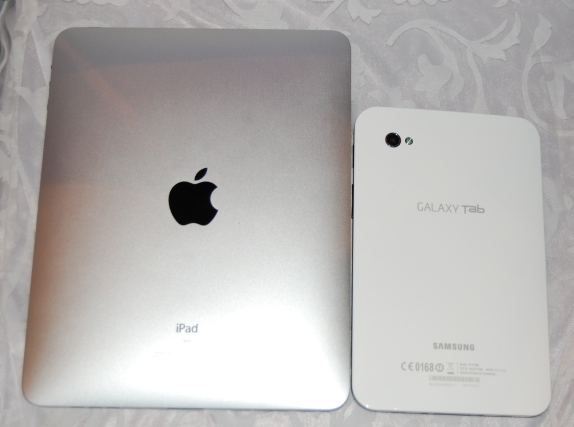
2006 Samsung digital photo frame viewed from other angles
So it is agreed that the design of the iPad from a frontal perspective is basically identical to Samsung's digital photo frame.
So it is likewise agreed that Samsung's digital photo frame does not invalidate Apple's design patent (I can play your silly game too, you know).
And since the side by side comparison posted above only shows frontal views, then it is also agreed that the frontal perspective is the most important one.
Nope, I don't agree to that. This lawsuit looked at all perspectives, not just the "frontal" one.
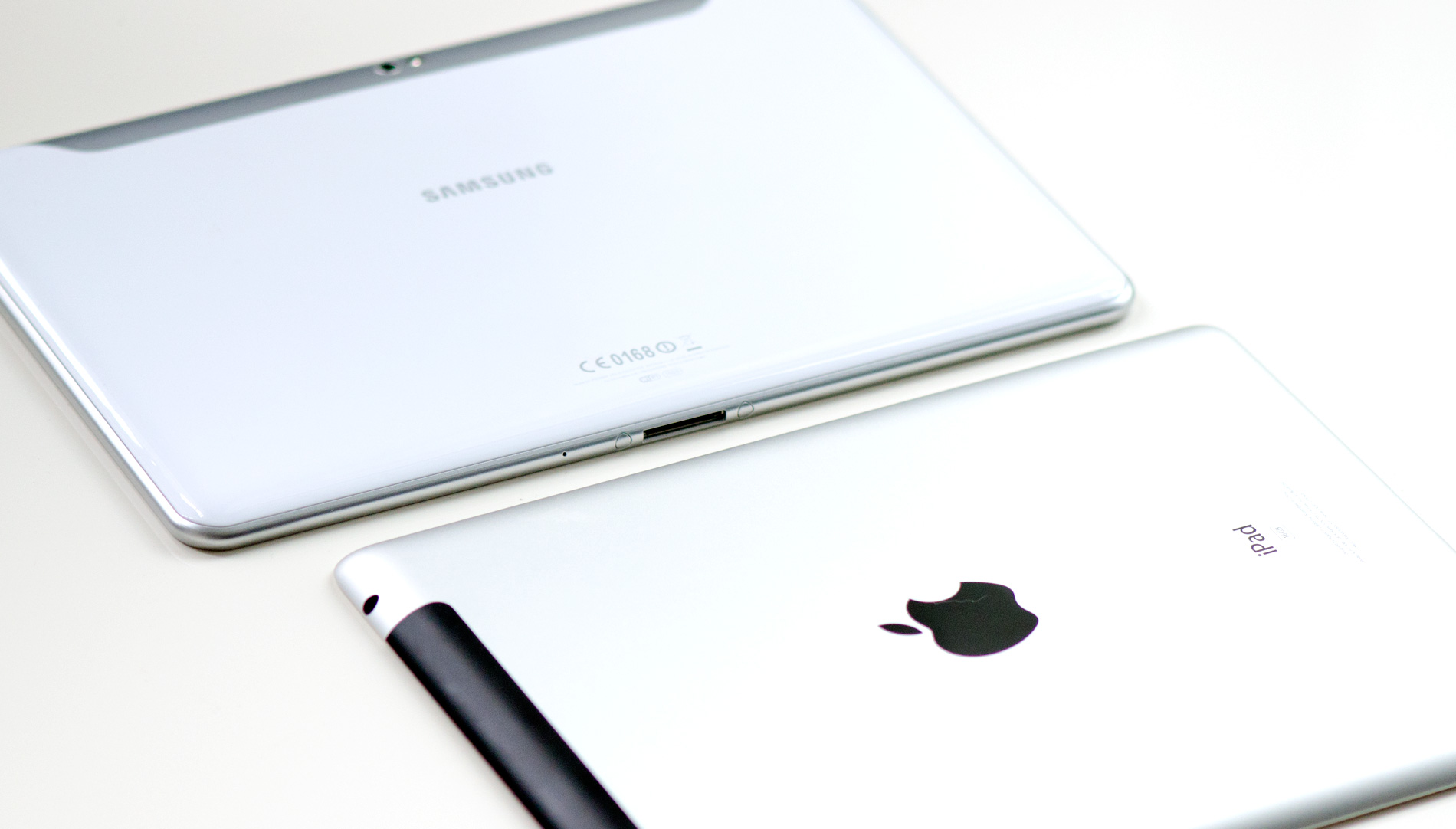
If a differing rear design is supposed to be a valid differentiator, then see: iPad vs Galaxy Tab from another angle The iPad and Galaxy Tab appear very different when viewed from the rear; obviously not the same device.
Yes, they do. The iPad also appears very different from the XBox 360, which, like the Galaxy Tab, was not an issue in this lawsuit. There are a whole host of things that the iPad does not resemble, such as a car, a toaster, and a tuba.
The iPad does however look a lot like the Galaxy Tab 10.1 , which was the product in question.
An honest, good faith poster would acknowledge that point and concede that they had inadvertently compared the iPad to a product that wasn't in the lawsuit and is not subject to an injunction, much like toasters and tubas. Believing you to be such an honest, good faith poster, I'll wait for your reply.
Cheers.
-
Re:This game is tough to win, though
2006 Samsung digital photo frame viewed from other angles
So it is agreed that the design of the iPad from a frontal perspective is basically identical to Samsung's digital photo frame. And since the side by side comparison posted above only shows frontal views, then it is also agreed that the frontal perspective is the most important one.
If a differing rear design is supposed to be a valid differentiator, then see: iPad vs Galaxy Tab from another angle The iPad and Galaxy Tab appear very different when viewed from the rear; obviously not the same device.
-
Re:Does it really matter
Seems the Apple reality distortion field didn't die with Jobs. What really happened is that the lawyers the judge was questioning said he couldn't tell them apart, but when the judge asked if the others could, another quickly supplied the correct answer. In other words, they could tell the difference.
Did the lawyer who guessed correctly guess? It's a 50-50 shot that could save their case, so it would have been reasonable to do so. But maybe he didn't... in which case, why was it just a simple "that one" rather than a description of the distinct features that led to the conclusion?
See, what really matters is that the judge couldn't tell them apart and thought that a reasonable person couldn't tell them apart either. That Samsung's lawyers, who had meticulously poured over details of both the iPad and the Galaxy Tab, couldn't immediately say "yes, your honor, the Tab has features x, y, z that are distinctive from the iPad" was what doomed them.But of course what really happened is rather inconvenient for Apple fans' theory that the Galaxy Tab's design must be a ripoff of the iPad, instead of taking its design cues from another Samsung product.
-
This game is tough to win, though
-
Re:The big difference here is
But we were talking about the history of the clones. Now remember at the time MSFT wasn't shit, they were a couple of smelly nerds in a fricking crappy office. he may have pointed out a better deal or something but if you think gates could have made old big blue do shit then you are wrong. hell the ONLY reason we have those wonderful AMD chips now is that big blue FORCED Intel to allow second sources. of course i'm sure you know later chips came from the Cyrix devs but at the time AMD was simply a cloner that managed to ramp up the speed on some Intel chips.
BTW if you are interested in this stuff look up "AMD developer speaks out Bulldozer' to see one of the former AMD guys lay out why the company went to crap, its pretty enlightening. Sorry I can't look it up for you but I'm chatting with a nephew at the same time as I write this so I'm juggling here, but according to him AMD's previous CEO basically fired all the decent guys and went to automated layouts which gives a good 20%+ speed hit, and then on TOP of that epic fail didn't even bother to tell MSFT about their new designs so that Windows won't really support Faildozer until Win 8. that's one of the reasons i just built a Thuban for the oldest and gave my youngest my Deneb, as i didn't want us to buy Intel because of Faildozer.
And i'll be happy to agree with you that today X86 is simply one of several layers of micro-ops but we are talking about 1982-1999, the era of the rise of the PC and chips back then did NOT for the most part use a translation layer like they do today and yet X86 exploded simply because it could scale REAL well while 68k and others didn't. You have to remember chips were speeding up so quickly that frankly EVERYBODY ended up OCing, just so they wouldn't be completely screwed! I was one of the lucky ones with a Celeron 300a, that damned thing could nearly double the clock on air.
But if you can point me to where gates picked 8088 or even give a hint what I need to look for I'll certainly check it out as i was under the impression he didn't really get any major power until Win 3.x and the breakup of MS OS/2. BTW you want something to get pissed at gates over read this and see how he managed to hold everyone back on DOS based crap just by showing some fake screencaps and BSing his ass off. Even if you don't care for the man you have to admit it took some giant brass balls to pull THAT one off. The funny part is somebody at Apple tried the same trick but then fucked up and gave a developer demo for Copeland which showed, to rip off an old Internet meme "IT'S A FAAAAKE!" by showing the thing couldn't run for a minute or two without crashing. gates was smart enough to ONLY show screencaps and not the actual running OS.
-
Re:Excellent...
Greenpeace lied about Apple to get attention? No way! That's never happened before.
-
Oracle seeks an end to software patents
By acquiring an injunction against Google's implementation of Android, Oracle could accomplish a major market disruption that would get loads of everyone's attention: an end to the sales of Android devices, and possibly, the bricking of millions of existing Android devices.
Such a monumental disruption for consumers might be just about enough to get the public, and politicians, to admit that software patents are inappropriate, and the legal minefield they create is not good for American businesses.
Oracle could have a lot to gain from the death of software patents, as they could develop many new products without regard to existing patents. This is the argument put forth by Daniel Eran Dilger when the suit was first filed. http://www.roughlydrafted.com/2010/08/14/how-oracle-might-kill-googles-android-and-software-patents-all-at-once/
I find Dilger's analysis of the industry to be particularly enlightening, as he is a master of both the technology and the history of these platforms.As other commenters have noted, Larry Ellison seems like the kind of executive who would undertake a case like this for personal reasons. If it is true that he dislikes the situation of software patents, the case will proceed with them as Oracle's target.
Further, as a less ambitious interpretation, there is the argument that Google forked Java simply to avoid paying the licensing fee. IANAL, but that's what the law is there to prevent. We need to stop Google from stealing everyone else's properties and getting away with it simply because "people like Google search and Gmail too much".
-
Re:First post
I seem to recall that Apple at the time still had a couple of billion in the bank as cash? Oh, I guess it was only $1.2 billion.
"Others have suggested Apple was just out of money and desperately needed Microsoft's help, ignoring the fact that Apple had just reported holding $1.2 billion in cash. Another $0.15 billion wasn't going to make any significant difference in the survival of the company."
http://www.roughlydrafted.com/RD/RDM.Tech.Q1.07/592FE887-5CA1-4F30-BD62-407362B533B9.html
-
Re:That's rich
-
IBM
Microsoft seemed like a technology supplier to IBM before...
IBM was left with an operating system but no applications. No one felt sorry for IBM at the time, they were just coming out of a very abusive anti-trust action. However, that's no reason for the article summary to try to whitewash M$
-
Re:I don't know...
Lets ask some Oracle guys how they recovered the filesystem for the Danger guys (the ones responsible for the Sidekick dataloss ) after they threw in the towel.
-
Re:Hey, buddy.
Uhhh....how EXACTLY were they unethical? they PAID Apple for the rights to use several elements that Apple had in turn paid Xerox for, at the time I'm sure they thought MSFT was suckers because at the time IBM PC tech frankly sucked compared to the Motorola tech apple was using. Apple foolishly didn't see that for the masses it isn't about what's "best" its about what's "good enough" with the best price point. At the same time IBM royally fucked up by not buying an exclusive license for DOS thinking nobody would have the balls to go against big blue, besides they had the BIOS locked up....or so they thought.
IMHO you really didn't see the vicious douchebaggery from Bill & Co until the 90s, when they started fucking over companies like Drivespace and Spyglass and held the industry back for half a decade by showing screencaps of a non existent OS. For those that don't know what I'm talking about this article is quite a good read. One really has to give Gates credit, how many could control an ENTIRE industry with NOTHING but pure bullshit and giant brass balls? Takes a hell of a poker player to pull off a bluff THAT big. I sure wouldn't want to play Texas Hold 'em with the guy.
-
Re:Norton Disk Doctor
That wouldn't surprise me as from everything I've seen Bill Gates was brilliant but a right bastard and had NO problem crushing companies like bugs. Look at the whole drivespace/doublespace mess or Spyglass. But like Jobs you really have to give the man credit, if you haven't read it Microsoft's Yellow Road to Cairo is a great read as it shows how the man was able to control the entire tech sector with nothing but screenshots and bullshit which you do have to admit is pretty damned impressive. Sadly i'd take darth gates over the sweaty monkey any day of the week. Have you SEEN Win 8? Its a fricking cell phone UI for the desktop!
Anyway the Connor bug you are describing sounds EXACTLY like what I've run into, its always in the first dozen sectors and once Spinrite marks those as dead it'll work for years. i have a 200gb Seagate I've been using as a large flash drive for years that got bit by it. For whatever reason Windows just won't mark those as dead but having Spinrite go in and mark them seems to do the trick. The only diff between the bug i ran into and yours is these machines were run daily, it would just work fine one day and the next...nothing. It seemed to happen more after Seagate bought Maxtor so it may have been cheap rebadged Maxtors. That is why I'm glad i grabbed some Samsung drives before they are all gone. Their Ecogreen drives kick butt and actually score better on my benchmarks than 7200 RPM Seagates, probably thanks to the huge cache.
Anyway if the guy could find a copy of Norton 97 I'd say go for it, its just that I doubt seriously he'll actually find a copy of Norton 97. i know the Internet has a looong memory but most of the Win9x sites have been gone for half a decade and the old tools along with them. I probably have a copy on a CD somewhere, but since all my customers are either running XP or 7 it is kinda useless. Who uses Fat32 or Win9x anymore?
Hell I don't think even more old junker machines have a floppy drive anymore, that is one tech I was damned glad died. Fussy buggy little bastards. When the first flash stick came out i happily paid nearly $80 for a 32mb stick just to get away from those POS floppies. Good riddance I say.
-
Nope
-
Re:MS isn't a competitor. Frenemies 4evar!
Lest you forget, MS kept Apple alive with a huge cash infusion when they were about to go under. They need each other. They're best frenemies.
After all these years, most people still don't know what the reasons were for the buying of non-voting stock. First of all, Apple wasn't "about to go under." Everyone makes the same mistake in repeating this myth that Apple was on the verge of bankruptcy. Second, the reason Microsoft bought the stock and continued Office was part of an agreement over the theft of Quicktime source code and its use in Video For Windows.
-
Re:How dare they sue us!
Apple to oranges comparison. Try reading this: http://www.roughlydrafted.com/2011/08/23/samsungs-digital-picture-frame-was-no-ipad/
-
Re:So little memory of SIX YEARS AGO?
Um, yes. Possibly you are too young to remember six or so years ago (!?), but Windows Mobile was at the time a VERY successful platform.
The iPhone cratered it, because Microsoft sat on the platform for too long without real improvement and as a software base it totally sucked and could not evolve. But Microsoft has history of prior success in the mobile space and a TON of corporate relationships that, while dusty, could come back to be of use.
Er, no. Sadly, I'm not too young to remember six years ago -- on the contrary, I used PDAs and smartphones all through that period and I remember it very well. Being as kind to you as I can, I think you're probably referring to Wince PDAs, when between the end of 2004 and the start of 2007 they took over the dying PDA (non-phone) market. Unfortunately for MS, by 2004 Q4 the non-phone PDA market had essentially peaked, and was being taken over by smartphones.
And in the phone market (which is what we're talking about here), Windows Mobile was always miles behind Symbian, and then RIM, Apple and now Android OSes -- with a maximum market share of 23% in 2004 Q1, falling now to 2% with WP7 in 2011 Q2. (See this ref for Wince's peak market share, and then wikipedia lists Gartner's market share stats from 2007 onwards; unfortunately, I can't find any Gartner stats for smartphones before '07
History tells us that Windows on phones has been one long history of decline from a not-very-high peak. As I've said, if MS belatedly succeeds in this market, it'll be in spite of what's happened in the past. Actually, it'd be a first, despite trying to crack into it for more than seven years
Feel free to cite contrary refs to support your claim of "VERY successful" if you can
-
Re:What
Exactly what I was thinking - another FUD attack on Google. The first thing I think now when I hear an attack on Google and Android is that there's a very good chance that it was written by a shill.
IMO, Apple doesn't have much of a reputation for hiring shills to do the dirty work for them - they have big enough mouths to spew FUD themselves.
Microsoft on the other hand has a deep-running history of hiring shills - and it wouldn't be the first time CNET's been on the receiving end either.
-
Re:Attitudes about HURD: why slashdot is irrelavan
I did some research, and according to this article, although OSX does use Mach, it is nonetheless not a microkernel:
Once again, just for good measure: Mac OS X is not based on a microkernel architecture, and has never used Mach as a microkernel. Apple's XNU kernel is larger than many monolithic kernels, and does not suffer from the intractable performance failure the world associates with Mach microkernel research.
Apple has incorporated progress the Mach project made in development of Mach 3.0, but nothing changed: Mac OS X still does not have a microkernel architecture. Its XNU kernel is not implemented as a microkernel. Apple does not use Mach as a microkernel.
-
Re:Bill Gates
The word you are looking for isn't FUD it is vaporware and frankly one should give credit where credit is due as it turned out to be a bloody brilliant strategy. MSFT knew at the time they were years behind and had some serious trouble, so Bill had the occasional screenshot and mockup cooked up and through the sheer power of his giant brass balls and ability to bullshit got the press to believe it was real.
This managed in a one two punch to not only keep OEMs buying MSFT for fear that they would be left out when the "next new thing" hit, but also killed competitors who couldn't make their real products able to do the miraculous things Bill's non existent OS could do. Frankly it was bloody brilliant. If you had run BeOS or OS/2 at the time (I ran both) you'd know that Win pre 98 was like a joke compared to them, but Bill and his magical brass balls kept them both at bay with nothing but bullshit and some phony screencaps.
But as for why he won the OS battle I'd argue its the same reason you don't see Linux getting any traction on the desktop: The combination of ease of use and availability of programs. I know this shocks the shit out of Linux users, even have one moron here who can't read a sentence that put it as his sig, but as far as Windows users are concerned THERE IS NO CLI IN WINDOWS since they will never ever have to use it, ever. Windows has spent untold millions in research and work making sure every single thing is "clicky clicky" simple, whereas Linux is to this day more often than not a screen scraper on top of a CLI app and if you need to do anything more than the absolute basics (such as install a driver or change wireless settings) you will often have to drop to term.
The other reason for winning is why I gave up on OS/2 and BeOS around the Win98 era, the availability of programs There are literally millions of programs, from games and video editing to office software and every niche of business under the sun, both free and commercial and the one OS you can be assured it runs on is Windows thanks to its network effect and backwards compatibility. Hell Windows 7 seems to get several patches a month that are nothing but new shim settings for older programs, MSFT really does put in the work when it comes to backwards compatibility. While Linux too has plenty of apps, the simple fact is all the decent ones run on Windows while there is tons of specialized software that has no Linux equivalent and never will. Sure you have 50 million text editors and programmers tools, but what about medical transcription? CAD and engineering programs that will work with the big name software like SolidWorks?
In the end while Bill's ability to bullshit got them through the dark times of Win 1/2/3 it was all the money spent on ease of use and the whole "developers developers developers" meme that allowed MSFT to win the whole ball of wax.
-
Re:Collateral success vs indication of support nee
These business are probably mom and pop shops or startup hipsters who'll never run anything more enterprisey then Outlook on the Macs.
No. Of course not. Nobody seriously uses Macs (or is currently studying same) in a large-scale deployment. And of course, this doesn't even count the countless educational institutions (from K through college) and R&D (pure science) labs that have each used dozens to thousands of Macs for years. If you think those don't count as "enterprise-scale" deployments as well, you're delusional.
-
Re:History repeats?
(Apple doesn't count; because they have created their own OS).
Not really. They tried to create their own modern OS in the late 90's. Finally after spending many millions on the project, they gave up and allowed themselves to be taken over by NeXT instead. Then they slapped their gui-paint layer on top of UNIX like some fat chick going to the disco slaps pasty makeup on.
Since NeXTStep was already a GUI-based BSD/Mach "UNIX", what you REALLY mean is that Apple applied some cold-cream, wiped off the NeXT makeup, and THEN slapped on Mac makeup, LOL!
While I admit that that was the original plan, things didn't exactly work out that way... At least Apple was willing to accept that they couldn't realize their overly-ambitious Rhapsody/Copland "Red Box, Blue Box, Yellow Box" OS. But even then, they were able to back-port much of that development back into MacOS 8 and 9, and even OS X (what do you think "Classic" mode was?). So, not nearly as much of that work was wasted as one would initially think.
As for being taken over by NeXT, that meme started because of so many NeXTStep/OpenStep engineers that were subsequently hired by Apple to work on the Rhapsody/NeXTStep integration that was to become OS X. But the simple fact of the matter is, Apple wrote the check, not NeXT.Apple's developers don't seem to have the skill-set needed to create a robust multi-tasking OS. They concentrate more on 'style.'
No. They already had that in the form of A/UX, But it wasn't really suited for a consumer-grade OS. What the issue REALLY was that, Apple didn't have TIME to finish what they had started, and the intended project was frankly too ambitious for ANYONE to complete in a reasonable timeframe. At least Apple was smart enough to recognize that, and act accordingly.
One-button mice (yeah, yeah, we know that was in the past.) They're a company of marketers, where trademark-buzz like 'Quicktime' and 'Altivec' are the trump cards.
QuickTime was a groundbreaking suite of APIs (and they had to call it SOMETHNG), which was then shamelessly subsequently ripped off by Microsoft (with the help of Intel). Altivec is a Motorola (Freescale) trademark, not Apple's. In fact, Apple always referred to Altivec as the "Velocity Engine".
-
Re:History repeats?
(Apple doesn't count; because they have created their own OS).
Not really. They tried to create their own modern OS in the late 90's. Finally after spending many millions on the project, they gave up and allowed themselves to be taken over by NeXT instead. Then they slapped their gui-paint layer on top of UNIX like some fat chick going to the disco slaps pasty makeup on.
Since NeXTStep was already a GUI-based BSD/Mach "UNIX", what you REALLY mean is that Apple applied some cold-cream, wiped off the NeXT makeup, and THEN slapped on Mac makeup, LOL!
While I admit that that was the original plan, things didn't exactly work out that way... At least Apple was willing to accept that they couldn't realize their overly-ambitious Rhapsody/Copland "Red Box, Blue Box, Yellow Box" OS. But even then, they were able to back-port much of that development back into MacOS 8 and 9, and even OS X (what do you think "Classic" mode was?). So, not nearly as much of that work was wasted as one would initially think.
As for being taken over by NeXT, that meme started because of so many NeXTStep/OpenStep engineers that were subsequently hired by Apple to work on the Rhapsody/NeXTStep integration that was to become OS X. But the simple fact of the matter is, Apple wrote the check, not NeXT.Apple's developers don't seem to have the skill-set needed to create a robust multi-tasking OS. They concentrate more on 'style.'
No. They already had that in the form of A/UX, But it wasn't really suited for a consumer-grade OS. What the issue REALLY was that, Apple didn't have TIME to finish what they had started, and the intended project was frankly too ambitious for ANYONE to complete in a reasonable timeframe. At least Apple was smart enough to recognize that, and act accordingly.
One-button mice (yeah, yeah, we know that was in the past.) They're a company of marketers, where trademark-buzz like 'Quicktime' and 'Altivec' are the trump cards.
QuickTime was a groundbreaking suite of APIs (and they had to call it SOMETHNG), which was then shamelessly subsequently ripped off by Microsoft (with the help of Intel). Altivec is a Motorola (Freescale) trademark, not Apple's. In fact, Apple always referred to Altivec as the "Velocity Engine".
-
Re:ImpressiveMicrosoft's weak product security created 99% of world's spam, then used the taxpayer-funded law enforcement to clean up 33%. What about the other 66%, Microsoft? Not such a good job afterall, eh?
BTW, I have reasons to believe that in reality the parent is a paid advertisement for you-know-who.
-
Um, you're kidding.
Um, what? It's hard to estimate profit margins, but Daniel Eran Dilger estimates that Microsoft has a 66% profit margin on Office and 81% on Windows. That's far beyond typical profit margins, so such prices are not "rock bottom".
-
Re:OK. I'll speak the truth and take the hit.
http://www.roughlydrafted.com/RD/RDM.Tech.Q1.07/5F0C866C-6DDF-4A9A-9515-531B0CA0C29C.html
The above article is very demonstrative of the truth of the insightful GP comment.
Very interesting article even for someone that lived through it. I can remember reading articles and thinking that Microsoft is just doing it better or doing what's best for us consumers, when all along they were out to kill superior products and were trying to take over certain technological advances (such as streaming video or authoring media). Very interesting article.
-
Re:Follow the money
...and the frothing fanboys (wait until this gets posted on TUAW or DaringFireball)
DaringFireball doesn't strike me as too bad in the fanboy department; RoughlyDrafted seems to froth more.
-
Re:our motto...
Ah this again.
Apple had over a billion in the bank when Microsoft paid them off.
Paid them off because Microsoft and Intel were caught stealing Quicktime code. Shortly afterwards Apple was able to spend billions they didn't have while not touching their balance, somehow. Then Microsoft publicly paid them the $150 million. Apple was not that close to dead, at that point. It's made for some great stories though.
The (annotated) story, if you're actually interested.
-
Re:it was 1999
Microsoft, among other things, was paying for Apple to end a lawsuit over stolen Quicktime code that Intel/MS used to speed up video on Windows. They paid a lot more than 150million, that was just the bit made public.
-
Re:Gaming on WP7
If anyone puts any stock in what Galen Gruman says they are a complete and utter moron. This guy is the most opinionated and yet clueless money-grubbing-advertisement-whoring 'journalist' that I've seen for a very long time. There are many examples of this guy just not getting it.
This is the same guy who in the same week published one article calling users 'idiots' for wanting to buy iPads and another stating it would kill the Netbook. This guy will do anything to drive traffic to a website that makes regular use huge full-page advertisements, pop-ups and slideshow articles. He calls himself an executive editor of a magazine he owns and uses at his credentials to enter press events where he spouts even more technological ignorance. I honestly don't know a single person who can stand this guy at press events and I know a couple who have come close to hitting him. It's pathetic.
-
Re:so...
Hmm, funny that I hear so many complaints about the app store approval process and the difficulty of marketing software through that venue and about the technical limitations of the platform then. I suppose that the people I associate with have been deliberately hoodwinking me - aren't I lucky that some random guy on the internet is more reliable?
Your perspective is to just dismiss something because you don't want to believe it. My perspective is I've been through this procedure, you haven't. So your impression of how it goes is irrelevant.
C'mon, look at your own post. Apple does all the work for you? That's the same as saying that you get to do all the hard work but have minimal control over your marketing process. This is not an attractive proposition for anyone beyond individual programmers or small teams working out of a garage.
There's your first big mistake. Confusing marketing with selling. I already said marketing is the same no matter what mobile platform you are using. It's certainly not left to Apple to do. You need your own well designed web-site, you need to do your own press releases, send out freebies, advertise, talk about the app in the right places, organise link exchanges etc. No difference between platforms.
My comment that Apple does all the work applies to the actual process of selling. They take the orders, process the credit cards, run sales support, deal with fraud, apply DRM so you don't have to keep track of serial numbers. etc.
Android is already a larger platform than iPhone.
Not according to Gartner, nor Canalys, nor IDC. Three companies that have been supplying worldwide market share figures for the smartphone market for over a decade. The NPD figures you are referring to are US only. And the US is affected by the AT&T exclusivity that you mention elsewhere. So no, Android is not a bigger platform.
http://www.roughlydrafted.com/2010/05/10/reality-check-npds-android-vs-iphone-sales-headlines/It looks like MeeGo is going to be a player soon as well.
Let's file that with all the "Product X is going to kill the iPod" predictions shall we.
Additionally, the AT&T exclusivity places limits on the potential market.
Again, the world is bigger than the US. the non-AT&T US market is a small fraction of the worldwide smartphone market. You need to think outside of your own neighbourhood. It's no limit, it's just a sub-market that won't be reached for a year and a half yet.
Which platform will professional developers want to prioritize?
Developers already prioritize the iPhone/iPad market. That will only change if/when Android apps sell more than IPhone apps. There's no sign of that happening.
Apple's current model doesn't really take competition into account - it assumes it can maintain a monopoly.
What complete bunk. iPhone entered the market which had already been occupied with smartphones for 10 years. It's never had a monopoly. It's been growth against competition all the way.
Now to go back to your original, and still unjustified claim that iPhone has an "ease of development" problem compared with Android. One big issue on the other side you haven't considered. Android is a fractured market, and will only get more so. Different OS versions, lack of OS updates for existing phones, different screen sizes, different proprietary extention APIs. It's possible to write apps that cope with this fractured market place but it becomes ever more difficult, and testing on all combinations is impossible. For iOS there will always be far less fragmentation. A limited number of known devices, with the vast majority of them rapidly updated to the latest OS release.