Slashdot Mirror
Domain: scotese.com
Stories and comments across the archive that link to scotese.com.
Comments · 46
-
Re:Model fits the data [Re:Vindication]
1) How accurate can we judge the entire planet's average temperature in the year 1800? The graph shows swings from year to year in the 0.2 C range. Can we really judge the average surface temperature of the planet with 0.2 degrees Celsius?
Take a look at the grey band - it's more obvious in the second graph, the 10 year moving average. The grey band is the 95% uncertainty interval for Berkeley's calculation of the average temperature - statistically on each data point there is a 5% chance that the real average temperature lies outside the grey band. You will see that in the year 1800, the grey band is massive: +/- 0.5 degrees. But over time, as there are more measurements around the world, and those measurements have less randomness in them (i.e. get more accurate), the uncertainty shrinks pretty slowly.
2) Also, the chart shows 200 years. This is a blip on the scale of climate science. If you look at the climate history on a much, much larger scale, you'll find that 200 years means nothing. For example, the chart on this page shows that we are much cooler than the average. An sharp increase in average temps would help put us "right".
This is true - no matter how much we heat up the earth, life will survive. But if the climate changes too much from our current conditions, then there will be massive changes. Lots of creatures will become extinct (eventually new ones will evolve, taking advantage of the abundance of food/lack of predators but that happens very slowly) and we will probably have to totally rethink our farming practices. We should move our cities too given that many would no longer be well-situated, but what would probably happen is that we turn up our air-conditioners and burn even more coal. I concede that the effects of climate change are less well understood (at least by me!) than that it is happening.
Or this chart which goes back 4500 years, shows that we just came out of an ice age, so a temperature increase would be expected, and also negates your Berkely graph.
Seriously? I give you the Berkeley graphs, which appear to have used a pretty rigourous method, where you can download their temperature data and source code, and is being peer-reviewed, and you rebut this with a graph that does not have a labelled y-axis and appears to have been drawn with a bezier tool? If you want to convince me that there is no scientific consensus, i.e. that researchers who know what they're doing and are doing it properly, disagree that global warming is happening/is a problem, then please stop using graphs like that. Especially when they disagree with the graph I provided, which gives its sources (IIRC, every temperature measurement they could get their hands on), and includes three other groups' sets of numbers on the same axes - none of which agree with the graph you provided.
Or, finally, this page which shows a whole slew of charts, most of which show that we are in a cold period of climate history, and an increase in average temperature would get the earth back to the "normal" range.
Again, the really-long-range graphs don't have much to do with the current debate, because I'd like life to survive in its current form as much as possible. When large-scale, seemingly-irreversible (on the scale of centuries) changes are made to the only planet we live on, I get nervous about the potential for things to go wrong.
There are too many graphs on that page to go through them individually, but it doesn't give that site any credibility to include graphs like this one, which show very suspicious behaviour - local temperature swings around wildly and then the music st
-
Re:Model fits the data [Re:Vindication]
Speaking of graphs, I find this one really scary, and would want to see it flatten out or drop for a good few years before I stop caring about my energy usage.
Just taking a quick gander at that particular graph, I notice that it covers 200 years of surface temperature. This brings a couple of points to my mind:
1) How accurate can we judge the entire planet's average temperature in the year 1800? The graph shows swings from year to year in the 0.2 C range. Can we really judge the average surface temperature of the planet with 0.2 degrees Celsius?
2) Also, the chart shows 200 years. This is a blip on the scale of climate science. If you look at the climate history on a much, much larger scale, you'll find that 200 years means nothing. For example, the chart on this page shows that we are much cooler than the average. An sharp increase in average temps would help put us "right". Or this chart which goes back 4500 years, shows that we just came out of an ice age, so a temperature increase would be expected, and also negates your Berkely graph. Or, finally, this page which shows a whole slew of charts, most of which show that we are in a cold period of climate history, and an increase in average temperature would get the earth back to the "normal" range.
-
More "Oh Noes !1!!" noise - Article is wrong.
Debunking requested? Sure!
I hesitate to even post the URL, but I'm sure the Slashdot folks will give this "ominous report" the debunking it so thoroughly needs: Doomsday: How BP Gulf disaster may have triggered a 'world-killing' event
Interesting link, albeit woefully flawed. The beginning, emphasis mine:
Ominous reports are leaking past the BP Gulf salvage operation news blackout that the disaster unfolding in the Gulf of Mexico may be about to reach biblical proportions.
251 million years ago a mammoth undersea methane bubble caused massive explosions, poisoned the atmosphere and destroyed more than 96 percent of all life on Earth. [1] Experts agree that what is known as the Permian extinction event was the greatest mass extinction event in the history of the world. [2]
55 million years later another methane bubble ruptured causing more mass extinctions during the Late Paleocene Thermal Maximum (LPTM).
The LPTM lasted 100,000 years. [3]
Those subterranean seas of methane virtually reshaped the planet when they explosively blew from deep beneath the waters of what is today called the Gulf of Mexico.
Here's a pic of the world's land masses around 255 mya, and another of around 237 mya. Here's a pic from close to the 55 million years later mentioned in the article above, around 195 mya.
In none of these scenarios is the current Gulf of Mexico a body of water. This would seem to rule out any sort of clathrate-based "sea fart", at least from that specific region.
Moreover, the two events the article mentions aren't quite right. The first is the Permian-Triassic extinction, indeed around 251 mya, but the cause is still debated, with one of the leading explanations being a combination of factors that include one or more impact events.
The second event is dated in the article at 55 million years after the Permian-Triassic extinction, or around 196 mya. However, the Paleocene didn't even begin until around 65 mya. What the article author was probably thinking about was the Paleocene-Eocene Thermal Maximum, dated to around 55 mya. One of the theories for the cause of the PETM is indeed that methane clathrates may have destabilized, causing a runaway greenhouse effect, until the poles were warm enough for palm trees and sea turtles. However, the PETM isn't associated with any mass extinction -- the Cretaceous–Tertiary extinction happened 65 mya when the geologic K-T boundary was laid down in the rock, and is again theorized to be due mainly to one or more impact events. Note in the pic here that the Gulf of Mexico is indeed a body of water by this time, but rather than being the source of any clathrate fart, it is instead noted as the location of the Chicxulub crater, theorized to be the kicker that killed the dinosaurs.
So basically, as disruptive as any sustained "sea fart" might be, the article you linked is full of bunkum and misinformation. And that's just in the intro.
Cheers,
-
More "Oh Noes !1!!" noise - Article is wrong.
Debunking requested? Sure!
I hesitate to even post the URL, but I'm sure the Slashdot folks will give this "ominous report" the debunking it so thoroughly needs: Doomsday: How BP Gulf disaster may have triggered a 'world-killing' event
Interesting link, albeit woefully flawed. The beginning, emphasis mine:
Ominous reports are leaking past the BP Gulf salvage operation news blackout that the disaster unfolding in the Gulf of Mexico may be about to reach biblical proportions.
251 million years ago a mammoth undersea methane bubble caused massive explosions, poisoned the atmosphere and destroyed more than 96 percent of all life on Earth. [1] Experts agree that what is known as the Permian extinction event was the greatest mass extinction event in the history of the world. [2]
55 million years later another methane bubble ruptured causing more mass extinctions during the Late Paleocene Thermal Maximum (LPTM).
The LPTM lasted 100,000 years. [3]
Those subterranean seas of methane virtually reshaped the planet when they explosively blew from deep beneath the waters of what is today called the Gulf of Mexico.
Here's a pic of the world's land masses around 255 mya, and another of around 237 mya. Here's a pic from close to the 55 million years later mentioned in the article above, around 195 mya.
In none of these scenarios is the current Gulf of Mexico a body of water. This would seem to rule out any sort of clathrate-based "sea fart", at least from that specific region.
Moreover, the two events the article mentions aren't quite right. The first is the Permian-Triassic extinction, indeed around 251 mya, but the cause is still debated, with one of the leading explanations being a combination of factors that include one or more impact events.
The second event is dated in the article at 55 million years after the Permian-Triassic extinction, or around 196 mya. However, the Paleocene didn't even begin until around 65 mya. What the article author was probably thinking about was the Paleocene-Eocene Thermal Maximum, dated to around 55 mya. One of the theories for the cause of the PETM is indeed that methane clathrates may have destabilized, causing a runaway greenhouse effect, until the poles were warm enough for palm trees and sea turtles. However, the PETM isn't associated with any mass extinction -- the Cretaceous–Tertiary extinction happened 65 mya when the geologic K-T boundary was laid down in the rock, and is again theorized to be due mainly to one or more impact events. Note in the pic here that the Gulf of Mexico is indeed a body of water by this time, but rather than being the source of any clathrate fart, it is instead noted as the location of the Chicxulub crater, theorized to be the kicker that killed the dinosaurs.
So basically, as disruptive as any sustained "sea fart" might be, the article you linked is full of bunkum and misinformation. And that's just in the intro.
Cheers,
-
More "Oh Noes !1!!" noise - Article is wrong.
Debunking requested? Sure!
I hesitate to even post the URL, but I'm sure the Slashdot folks will give this "ominous report" the debunking it so thoroughly needs: Doomsday: How BP Gulf disaster may have triggered a 'world-killing' event
Interesting link, albeit woefully flawed. The beginning, emphasis mine:
Ominous reports are leaking past the BP Gulf salvage operation news blackout that the disaster unfolding in the Gulf of Mexico may be about to reach biblical proportions.
251 million years ago a mammoth undersea methane bubble caused massive explosions, poisoned the atmosphere and destroyed more than 96 percent of all life on Earth. [1] Experts agree that what is known as the Permian extinction event was the greatest mass extinction event in the history of the world. [2]
55 million years later another methane bubble ruptured causing more mass extinctions during the Late Paleocene Thermal Maximum (LPTM).
The LPTM lasted 100,000 years. [3]
Those subterranean seas of methane virtually reshaped the planet when they explosively blew from deep beneath the waters of what is today called the Gulf of Mexico.
Here's a pic of the world's land masses around 255 mya, and another of around 237 mya. Here's a pic from close to the 55 million years later mentioned in the article above, around 195 mya.
In none of these scenarios is the current Gulf of Mexico a body of water. This would seem to rule out any sort of clathrate-based "sea fart", at least from that specific region.
Moreover, the two events the article mentions aren't quite right. The first is the Permian-Triassic extinction, indeed around 251 mya, but the cause is still debated, with one of the leading explanations being a combination of factors that include one or more impact events.
The second event is dated in the article at 55 million years after the Permian-Triassic extinction, or around 196 mya. However, the Paleocene didn't even begin until around 65 mya. What the article author was probably thinking about was the Paleocene-Eocene Thermal Maximum, dated to around 55 mya. One of the theories for the cause of the PETM is indeed that methane clathrates may have destabilized, causing a runaway greenhouse effect, until the poles were warm enough for palm trees and sea turtles. However, the PETM isn't associated with any mass extinction -- the Cretaceous–Tertiary extinction happened 65 mya when the geologic K-T boundary was laid down in the rock, and is again theorized to be due mainly to one or more impact events. Note in the pic here that the Gulf of Mexico is indeed a body of water by this time, but rather than being the source of any clathrate fart, it is instead noted as the location of the Chicxulub crater, theorized to be the kicker that killed the dinosaurs.
So basically, as disruptive as any sustained "sea fart" might be, the article you linked is full of bunkum and misinformation. And that's just in the intro.
Cheers,
-
More "Oh Noes !1!!" noise - Article is wrong.
Debunking requested? Sure!
I hesitate to even post the URL, but I'm sure the Slashdot folks will give this "ominous report" the debunking it so thoroughly needs: Doomsday: How BP Gulf disaster may have triggered a 'world-killing' event
Interesting link, albeit woefully flawed. The beginning, emphasis mine:
Ominous reports are leaking past the BP Gulf salvage operation news blackout that the disaster unfolding in the Gulf of Mexico may be about to reach biblical proportions.
251 million years ago a mammoth undersea methane bubble caused massive explosions, poisoned the atmosphere and destroyed more than 96 percent of all life on Earth. [1] Experts agree that what is known as the Permian extinction event was the greatest mass extinction event in the history of the world. [2]
55 million years later another methane bubble ruptured causing more mass extinctions during the Late Paleocene Thermal Maximum (LPTM).
The LPTM lasted 100,000 years. [3]
Those subterranean seas of methane virtually reshaped the planet when they explosively blew from deep beneath the waters of what is today called the Gulf of Mexico.
Here's a pic of the world's land masses around 255 mya, and another of around 237 mya. Here's a pic from close to the 55 million years later mentioned in the article above, around 195 mya.
In none of these scenarios is the current Gulf of Mexico a body of water. This would seem to rule out any sort of clathrate-based "sea fart", at least from that specific region.
Moreover, the two events the article mentions aren't quite right. The first is the Permian-Triassic extinction, indeed around 251 mya, but the cause is still debated, with one of the leading explanations being a combination of factors that include one or more impact events.
The second event is dated in the article at 55 million years after the Permian-Triassic extinction, or around 196 mya. However, the Paleocene didn't even begin until around 65 mya. What the article author was probably thinking about was the Paleocene-Eocene Thermal Maximum, dated to around 55 mya. One of the theories for the cause of the PETM is indeed that methane clathrates may have destabilized, causing a runaway greenhouse effect, until the poles were warm enough for palm trees and sea turtles. However, the PETM isn't associated with any mass extinction -- the Cretaceous–Tertiary extinction happened 65 mya when the geologic K-T boundary was laid down in the rock, and is again theorized to be due mainly to one or more impact events. Note in the pic here that the Gulf of Mexico is indeed a body of water by this time, but rather than being the source of any clathrate fart, it is instead noted as the location of the Chicxulub crater, theorized to be the kicker that killed the dinosaurs.
So basically, as disruptive as any sustained "sea fart" might be, the article you linked is full of bunkum and misinformation. And that's just in the intro.
Cheers,
-
Re:General Confusion
You're right that the equator is considerably south of the 45th parallel. However, you forget that continents move around, given enough time. So in the Cambrian North America (Laurentia) was near the equator - here's a map. Fast forward 320 million years to when the dinosaurs began to rule the earth, and North America is approaching where it is today - here's another map. Note how Alberta is approaching the 45th parallel, where it is found in your atlas.
You need to get yourself a different atlas if you're going to think about things that happen over geologic timescales.
-
Re:General Confusion
You're right that the equator is considerably south of the 45th parallel. However, you forget that continents move around, given enough time. So in the Cambrian North America (Laurentia) was near the equator - here's a map. Fast forward 320 million years to when the dinosaurs began to rule the earth, and North America is approaching where it is today - here's another map. Note how Alberta is approaching the 45th parallel, where it is found in your atlas.
You need to get yourself a different atlas if you're going to think about things that happen over geologic timescales.
-
Re:The glaciers are retreating!
--How did coral reefs survive periods when CO2 was several times higher than today?--
They were not there as such. Tho whole biosphere was way different then. That would probably be around the time coal was formed. I think this would be about right, but then again are you a climatologist? I'm not, but I had enough chemistry to know that making seawater more acidic and reducing it's salinity by the melting of the ice caps, cannot be good at all. It will do some very nasty things that CO2 in the air alone would not bother, but when you send it up much goes into the oceans. Just let a coke go flat and test the PH of the water. That's as plain and simple as simple could be. Heat of course cause the ice to melt. We'll you know it wont kill everything, just 90% to 99% of all life possibly all people, but it really doesn't matter, because war over fossil fuels can change present allies into enemies. So if you want to talk about burning fossil fuels. We will not be able to do that cheaply for long anyhow. You wanna talk cost. Pay a lot now or go bankrupt tomorrow. Fossil fuels should probably be only used to make stuff like certain plastics. It would last a long time if we just didn't burn them. It would be much much better to run all transportation off of electricity, and generate all of that with nukes. It's the fastest, cheapest, and not without flaws, but the best method that I can think of to fix things. We have to build many very fast. Lithium Ion battery tech is already good enough for transportation using the same highways and gas stations, but they would deliver electricity either by just swapping ISO standard component batteries or that follow some kind of standard from nation to nation. That would make it work with current tech. Some MIT students have batteries that charge in 15 minutes and will get you 300 miles of range, but that still just in the design stage. You know gas caps a nozzles follow a standard. So could battery packs for a car for distance traveling. Charge at home at night for going to work. Take a careful look at the data. It does really look bad. Really now denying global warming is like saying smoking doesn't cause cancer or denying the holocaust happened or denying that our own government probably spies on us from time to time.
Check this out where it says "today" on the chart. That's us. Everything else was before that. Those other cycles that you see are before us and were usually cased by impacts of asteroids of a certain size. Each time life carried on with just 1% left in some cases. It wasn't just the dinosaurs. There was worse than that before them. So, I guess if you want snakes and lizards to get bigger and more numerous and mammals to be smaller and less numerous (maybe down to rat size), then you could present global warming as a good thing. There might still be a few humans left if we don't go to war over all of the social changes that this will cause too. The next global war if there is one will probably do us in for good. Of course there are a lot of variables that haven't been studied, small mistakes, but nothing to change my views on the overall picture here.
We should be having that argument, It has been settled. Now the thing to argue over is how fast we are going to do something to try to fix the problem and live happy ever after. The end.
Hope ya'll liked the story.
-
Re:CO2
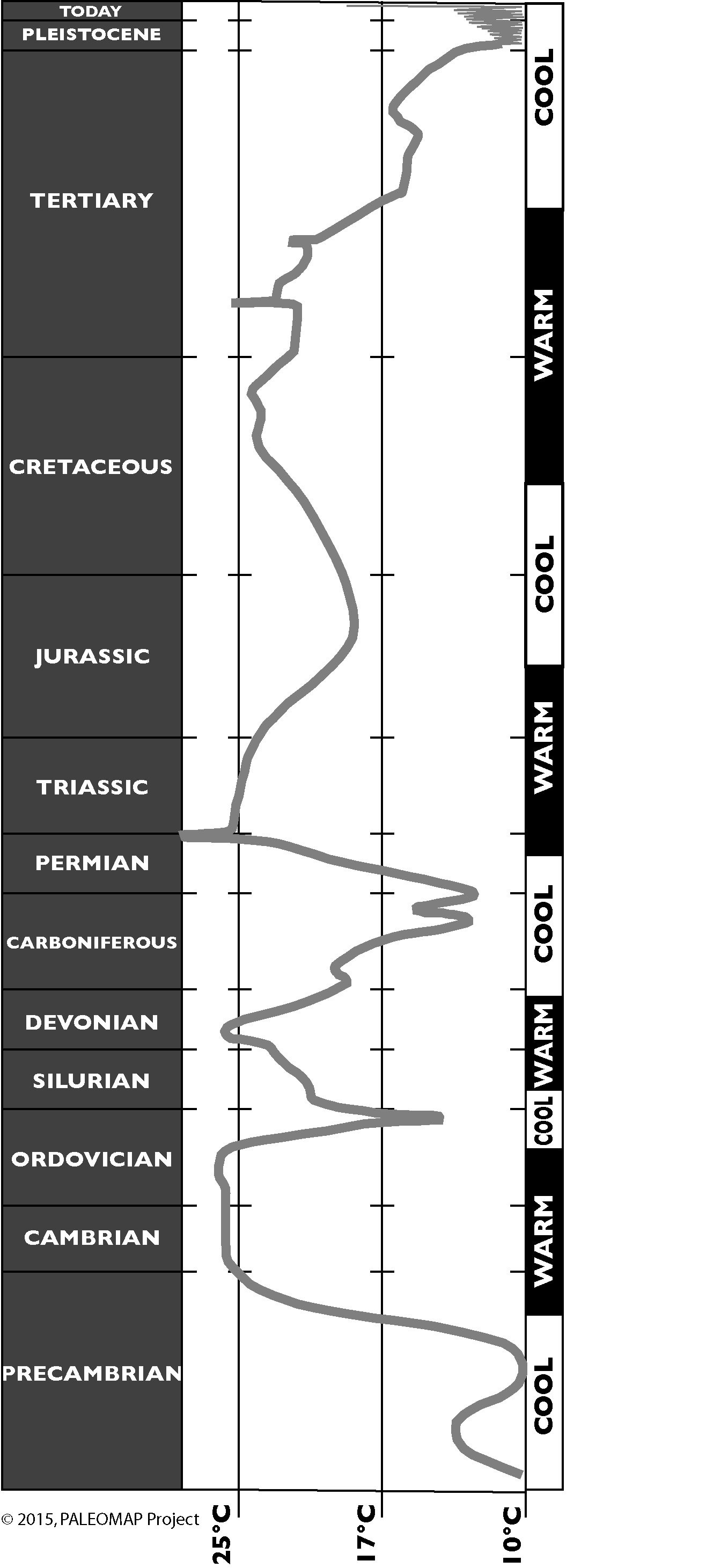
We're also in an incredibly cool climate today; During those periods of high CO2 you mention, the temperature has been about 15 degrees C warmer worldwide. The Earth seems to have two stable temperatures; about 10C, and about 25C. When scientists are talking about feedback loops, they're talking about the transition to a global hot-house.
Take a look here:
http://scotese.com/climate.htm
As you can see, our current climate is unusual. Global temperature was similar during the Precambrian (before any animals), at the end Ordovician and the end Carboniferous. As you can see, the global temperature stayed where in these cold zones for a relatively small time.
So yeah, the trees will be fine if we ramped global temperature 15C, but the point is that it wouldn't be great for human civilization. -
Re:That any government attempt to control...
Hey, I would really like some more text around that graph in the second link. It looks awfully suspicious - that average temperature just looks wrong.
It's right - remember the timescale is millions of years. Here's the source, from the well-known geologist Christopher Scotese:
-
Re:Yes we do.
your "Science" is wrong.
"The early part of the Carboniferous was mostly warm; in the later part of the Carboniferous, the climate cooled."
The carbon load in the atmosphere dropped due to significant coral reef activity over a great number of epicontinental sea area fixing that carbon into limestone.
try this graph:
http://www.scotese.com/images/globaltemp.jpgthe Carboniferous started with average around 20C in the Devonian then dropped to 10C by the Early Permian
-
Re:Whew, no problem then
http://www.canadafreepress.com/index.php/article/7326 http://www.ilovemycarbondioxide.com/pdf/No_Evidence.pdf http://jimball.com.au/Warming.htm http://www.geocraft.com/WVFossils/Carboniferous_climate.html http://www.scotese.com/climate.htm http://www.climatechangefraud.com/content/view/35/190/ http://www.ace.mmu.ac.uk/eae/Climate_Change/Older/Ice_Ages.html I still think that it is the ultimate arrogance that humans think they can alter the planets evolution. Think of continental drift and the accompanying earthquakes, volcanic activity etc. and you'll understand how insignificant humans are.
-
Re:but wait...But back to your point about how they knew what it was called, I have a related question. How do they know that Eastern Laurentia had crinkle cut coastlines like Canada? Weren't they formed by glacial activity? How does that happen at the equator?
The coastlines on the maps are the more or less modern coastlines, superimposed on the ancient plates, purely to help orient us. I think they assume we don't take the coastlines literally.
There are lots of interesting sites with graphics of continental drift in that period.
This one: http://www.scotese.com/Rodinia3.htm shows both what the coastlines might have been like, as well as having a key map of the modern shapes. And http://www.palaeo.de/edu/scotese and http://www.ucmp.berkeley.edu/geology/tectonics.html have some animations showing the continents moving through the period. Really awe-inspiring (in the meaning, not the quality of the graphics).
-
Re:So now we have the"Because, frankly, the stated aims of environmentalists - improving the forests, saving the fuzzy animals, and so on, is actually served by the increasing CO2 in the atmosphere, as plants grow better in richer CO2 atmospheres and that leads to a stronger biosphere all round."
Hold up there buddy, that is simply not true, many animals depend on icy habitats (polar bears, penguins) which are going to disappear with increasing temperature. Increased melting will disrupt the north Atlantic drift which will completely change the climate of northern Europe to something like the previous ice age. Increased levels of CO2 interacting with the sea will cause the oceans to become more acidic, this is already happening.
Whatever the result, the planet is likely to be going through the most rapid period of change to its internal distribution of gases ever recorded, as a direct result of pollution from burning fossil fuels. As a species, humanity has emerged in a relatively calm period in the earth's climatic history, now, our children and their children, and heaven forbid, maybe even we, will have to deal with the consequences of these actions, which I doubt will "lead to a stronger biosphere all round." I'm curious. The climate has changed much faster in the past than it is changing today. Of course, this was before SUV's and even man were on the planet. So, if man didn't cause it then, isn't it even remotely possible that man is not causing it today? This is backed up when you consider that the earth has heated and cooled all on its own throughout history. When it was warm, it cooled. When it was cool, the earth warmed. Seeing as we are in a historical cool spell, doesn't it makes sense that the earth would warm itself, with, or without our help?
It seems to me that when we see something happen, we immediately try to figure out what WE did to cause it. It's the same kind of self-centered belief system that led Native Americans to believe that a certain dance or sacrifice would lead to rain. -
Re:Business as usualThis stuff normally happens on the scale of hundreds of thousands to millions of years. Just 120+ years of rapidly accelerating human industry has managed to create a significant spike in global temperature. http://www.scotese.com/climate.htm I don't see the spike
-
Re:The bigger issue
I was in the Bahamas last year measuring water temperature, beach erosion and doing population counts to provide data on why coral is dying off all over the world. Its a complex topic but one of the leading culprits is ocean warming. Coral is adapted to a narrow range. Once the coral reefs are gone, which will be soon, say goodbye to fish diversity and sandy beaches.
I've heard this before, and I'd like to ask you an honest question. Coral has been around for a long time; according to this link on wikipedia, over 500 million years. Average global climate temperature has been both significantly warmer and cooler in that time. My question is why would warming be the thing that's hurting them? I am not a biologist, nor an expert in this in any way; you are; that's why I'm asking you. To me, and again I'm a radar engineer, it seems more likely that the thing that's different now, and hurting them is us; runoff from our farms; the increased nitrogen and fertilizer in the water, or some other group of chemicals we're putting into the environment. Even CO2, as in the form of making the oceans more acidic, doesn't seem to me to be the problem; since again that too has been higher in coral's history.
Also, beach erosion; how is that bad at all; except for the idiots who build houses or hotels on beaches? Isn't that simply a natural process? I think beaches communities should reverse development, and build back the dunes between the towns and the water. Screw the beach front hotels; it's bad for the environment, and we can still enjoy the beach without having a house or hotel on it!
As for your comment about west nile virus, hell, we had malaria here too; but back before you or I were born, we defeated it. DDT being a big help there; amongst other things. West Nile is not a biggie. If we can stop malaria in Cuba and the South, we can stop it here when it gets warmer. People can adapt. -
Re:Finally, someone said it
Actually, a quick look at scotese.com will show that someone who fails to site any source for his data made a website that shows that the climate has been changing since the Earth had a climate to begin with. I could go and make a website with lots of fancy graphs and graphics too... but if I don't cite sources for the data, then it doesn't mean a damn thing.
Well, if you can't defeat the argument, attack the source. There methods are explained in plain English HERE if you care to take the time to read them. It appears that neither one of us knows what you are talking about. -
Re:Finally, someone said itClimate change is fact, and solid science.
Very true. A quick look at climate history will show that the climate has been changing since the Earth had a climate to begin with, well before the SUV was invented and Bush was elected. It will also show that we are actually in a cool period and global warming will get us back to where we need to be! It's worse than you think. You should see the temperatures on Venus, we're in a deep freezer compared to them!!
In that graph, right near where we are, where it's really cold, right at the start of the Pleistocene, that's 1.806 million years ago. The fact is "where we need to be" is right here, this is the climate we evolved for, a global average of 22C found a few million years futher back was great for those species but we were built for ~12C.
A lot can happen in that period of time, species and ecosystems can adapt extensively given even a fraction of that period. Unfortunately we're changing a lot faster than that and a lot of life won't be able to keep up. Only in countries where there is a strong vested interest in maintaining the status quo has the issue been politicized.
Right, and the countries that are interested in changing the status quo are NOT politicizing the issue? I get it, since they are on YOUR side, it's not political, but those with different views are politicizing the issue. You're talking about politicizing two different things.
First there's the science, ie a^2 + b^2 = c^2, this is something that shouldn't be politicized because unlike the Pythagorean theorem the average person isn't qualified to pass judgement on most science. We have to trust the scientific community to give us the right facts, afterall that's what they're there for.
The next part is the action that results from the science, ie should be build a right angled room using pythagorean theorem so we can have a contrived example? This is what can be politicized as it involves action.
As example of where this separation seems to be holding is the stem cell debate. Despite the fact that I disagree with the people fighting stem cell research they are for the most part not attacking the science itself, rather they are saying they don't want to take a course of action offered by the science.
The problem with global warming is instead of arguing about the appropriate response (ie sure the oceans will go up but we don't think it's worth the short term economic disruption), something that is justly political, they're attacking the science instead. This is what the poster meant by politicizing global warming, people claiming that a^2 + b^2 = c^2 or the value of pi is a political question, it isn't a political question, it's a scientific question, a scientific question that has been answered.
What we need to do about it? Now that's a political question. -
Re:Finally, someone said it
Climate change is fact, and solid science.
Very true. A quick look at climate history will show that the climate has been changing since the Earth had a climate to begin with, well before the SUV was invented and Bush was elected. It will also show that we are actually in a cool period and global warming will get us back to where we need to be!
Only in countries where there is a strong vested interest in maintaining the status quo has the issue been politicized.
Right, and the countries that are interested in changing the status quo are NOT politicizing the issue? I get it, since they are on YOUR side, it's not political, but those with different views are politicizing the issue. -
Re:Renewable Energy even w/o global warming
Global warming would be good for the planet. The Medieval optimum as noted from the history books illustrates this. However the amount of warming won't make much difference to the heating bills. Insulation is still a lot cheaper than trying to heat up the outdoors.
We only need to go back as far as the eocene for instance to find when the planet for millions of years was warmer than now. A good place to check is http://www.scotese.com./ During the eocene the planet was both warmer and wetter. A really important issue is to note where the planet was warmer and wetter.
The tropics and subtropics won't warm up much. They are already warm. Water vapour levels can be up around 80,000 ppm (remember CO2 is at about 370) and at these levels the water vapour traps most of the incident solar energy that can be trapped. As we get to higher latitudes we lose H2O because as the temperature drops the amount of water vapour in the atmosphere plumets. When we get down to freezing, we have effectively lost most of the H2O. IE, Antarctica is the dryest continent on the planet even though its covered with snow and the reason is because its so cold. The dryness allows the incident solar energy to escape. So the colder the planet gets the more energy leaky it gets.
If anyone wonders - could the planet flip into a deep freeze and totally freeze up as it loses all of its H2O blanket? The answer is yes. There is very strong evidence this happened several times during the precambrian. Check the Stuartian tillites for instance which were deposited as part of the Flinders ranges in Australia. At the time of these glacial deposts, Australia was north of the equator and quite close to the equator. The theory is that because the planet was totally frozen over, CO2 released by processes such as volcanoes could not be absorbed and eventually built up into levels measured at 1000's of parts per million. At these levels it's green house capabilities were able to make the difference and eventually tip the planet out of the frozen state at the equator at which point as the ice melted water vapour was able to accumulate which added to the effect and Boom - planet earth flipped from a totally frozen state to a warm balmy state about 10C warmer than now... where it stayed for millions of years. Solar energy back then was not as great as today and this would explain why the earth went through several cycles of deep freezing. Also one would expect the orbit of the planet to be somewhat larger than today because there is some debris in space which should apply a little orbital friction. I've not come across how much orbital decay one would expect over the last billions of years.
The CO2 mind you was not able to stay in the atmosphere at these levels. It ended up forming carbonate rich cap rocks which overlay the tilites and are massively thick and found all over the planet.
The best we can hope for if we do have global warming is that high latitudes might warm a little and this might postpone the next ice age. During the last one Toronto for instance was covered with over a mile of ice. I don't think those people would do so well if this re-occurs. I do however suspect many torontonians worry about global warming and do not worry about how to cope with a mile of ice.
If we had global warming to the tune of say 5 degrees, then Calgary might gain a climate more like Denver. Areas of the North West Terriories and Siberia might become more appealing and people might migrate. Agricultural crop bands would move northward to the poles. The tree lines would creap to higher latitudes.
In fact, 5 million years ago there were trees growing north of the arctic circle. So its obvious the earth was quite a lot warmer back then and it certainly was not because of man made CO2 emissions.
With warming we would expect more moisture and probably a greater accumulation of the Greenland and Antarctic ice caps because these regions would still remain well bel -
Re:Is this a surprise to you, or are you just joki
I suggest you read the two papers I referenced.
I was already familiar with the Wikipedia cite, what other papers did you refer to?
You say the CO2 emissions correlate with global temp curves, did they cause the Medieval Warming Period or Holocene?
No.
Other than solar activity, the only explanation for the extraordinary Holocene warming is a recent (1999) theory that the Earth's tilt may have changed for a couple thousand years. That theory is based on a model, there's no evidence as of yet. But it could be that the change in tilt and unusual sunspot activity caused the warming.
So maybe it's manmade CO2 and sunspots together causing the current warm spell?? Possibly, except that the Earth's history shows the global climate has little sensitivity to CO2 levels. For example, over the last 600 million years:
- CO2 levels have dropped from 7000 ppm to approx 400 ppm
- Average global temps have remained steadily within a 72F (22C) to 54F (12C) range while CO2 levels have plunged to current levels These fact alone show that the Earth's climate is not as sensitive to changes in CO2 levels as the models indicate
Finally, there have only been three periods during which temps have been as low as they are today, and the other two took place during mass extinctions (Ordovician and Permian). Also, the Permian extinction period is the only other time when CO2 levels have been as low. Just another coincidence? Or proof that we're in an unstable period of cooling and the Earth's climate is eventually going to get warmer no matter what we do.
So there you have it: wide swings in CO2 levels have occurred at the same time temps have remained relatively stable; certainly there haven't been runaway greenhouse effects that the current models would lead us to expect. In short, I question your science.
-
Re:Oh please
First, the ice caps haven't existed for 5 billion years. They certainly didn't exist during the Hadean, when the surface of the Earth was molten. Clearly, the lack of ice caps at one point in history does not preclude their existence later on. And their existence today does not preclude their lack later on. Your argument is flawed.
Second, the known historical extent of the ice caps is far more then is an acceptable range for human civilization, as we see it today, to exist. Have you heard of the snowball earth hypothesis? Even though the Earth may not have been completely frozen, there is good evidence for massive worldwide glaciation.
And, what do you mean by run-away system? This research does not suggest that the melting would continue forever. It does suggest that ice caps may not remain during periods of global high temperature. Examine this page. The Earth's temperature has historically varied between two values, and there is no reason to think that we couldn't see a return to a temperature that precludes polar ice. It's happened before. It'll happen again. And the scientific consensus is that we're speeding it on it's way. -
Re:Now what would be really cool...
They should link up here (there are others, too):
http://www.scotese.com/newpage13.htm -
Climate is changing constantly during the history
It's not the first time in the Earth's history when climate is changing. In fact it's changing constantly.
look at this
http://www.scotese.com/climate.htm -
Look at this picture
-
Look at this picture
-
Re:Two Qustions
The earth was hotter during the Permian temperature excursion than during the eocene.
http://www.scotese.com/climate.htm
In fact - it was warmer during the cretaceous as well.
http://en.wikipedia.org/wiki/Image:Phanerozoic_Cli mate_Change.png
http://en.wikipedia.org/wiki/Paleoclimatology
Adding a little CO2 to the green house gas inventory of the earth (50,000+/-???? H2O + 365+/-?? CO2) is a drop in the bucket. Its like feeding your hourse a meal of oats and thinking its going to turn him into an elephant.
Consider. A horse might weigh say 1000 lbs and the oats say 1 lbs. This is a 1000:1 ratio.
CO2 change is arguably about 80 ppm and water vapour levels are arguably in the range of 50,000 PPM. This is also a 1000:1 ratio give or take.
The thing is we can't measure _average_ water vapour levels over the planet very accurately. This is much the same as weighing your horse. While at any point in time you can weigh him very accurately if you wish - the problem is he might take a shit. So did he shit before you weighed him or after? Did you measure the water vapour while the rain cloud was comming in or after it left?
If you add the weight of the meal of oats to a weighing of your horse - the weight of the bag of oats isn't significant regardless how accuratly you can weigh the oats and the horse.
The analogy holds with the change in CO2 levels as it applies to total greenhouse gas concentrations on the planet. We simply do not know if overall the water vapour levels are increasing/decreasing or going sideways and we also don't really know what the variance is. We do know there is a tremendous amount of energy stored in the oceans and this has enough of a moderating effect that a HUGE drop in temperature as was caused by Mount Tambora in 1815 (http://en.wikipedia.org/wiki/Mount_Tambora) did not cause the earth's temperature to spiral out of control.
This is in spite of the fact that it caused the year without a summer: http://en.wikipedia.org/wiki/Year_Without_a_Summer
The cooling of the atmosphere due to this eruption will have caused a decline in the absolute water vapour in the atmosphere and this is combined with the reduced solar radiation due to tha volcanic ash from Tambora. The climatic effects lasted several years. Yet the earth promptly bounced back as soon as the ash settled out of the atmosphere.
If the earth's temperature were as sensitive as Mann et al think it is to green house gasses then the question is why is it sensitive to only the CO2 component which is orders of magnitude smaller than the water vapour? Hmm.
I think the answer is obvious. The horse analogy works in more ways than one. -
Re:Idjot:Finding flaws
During the ordovician (taconic orogeny) CO2 levels were 13x to 17x higher than now. As the Orovidian began, the average temperature on the earth was about 10C warmer than now. By the end of the Ordovian we had a considerable amount of mountain building and the temperature plumeted and this is in spite of the CO2 levels.
30 million years ago the planet started to cool. Your 400,000 years are a drop in the geological bucket. Even 2 million years are a drop. However there have been about 20 ice ages during the last 2 million years. They tend to come on a cycle of about 110,000 years and the CO2 levels fluxuate with these ice ages. The last one ended about 18,000 years ago which is very recent.
At the end of the cretaceous the planet was about 10C warmer than now. We did not have anywhere near the mountains then that we have now. For instance, the rockies were starting to form in the late jusrassic. However most were built after the cretaceous ended.
Since the miocene we have the Rockies, Andies, Alps, two (2) Hellenic mountain ranges, the Pyrenees, the development of the Himalias and the Tibetian Plateau as well as the Colorado plateau. Read this http://www.scotese.com/moreinfo15.htm
You should look at these two graphs as well: http://en.wikipedia.org/wiki/Image:Phanerozoic_Cli mate_Change.png
http://en.wikipedia.org/wiki/Image:Phanerozoic_Car bon_Dioxide.png
You can find these in the wikipedia artical on paleoclimatology:
I'll quote: "Or more specifically that changing continental configurations and mountain building probably have a larger impact on climate than carbon dioxide."
Of course this is disputed - just as the notion of global warming caused by CO2 is disputed.
The thing is the most powerful green house gas is H2O. It is present in the atmosphere at levels up to 80,000 ppm (and higher) and is almost totally absent at the top of mountains because as the temperature drops to freezing it falls as snow. Clearly a lot of land at high elevation will increase the amount of energy reflected into space.
In addition, CO2 levels are about 365 ppm. The change is CO2 is about 80 ppm from the 280 ppm level estimated for the pre-industrial era. From the paleoclimatology artical: "it is clear that the preindustrial atmosphere with only 280 ppm CO2 is not far from the lowest ever occurring since the rise of macroscopic life."
Changes in water vapour swamp the changes in CO2 by many orders of magnitude. In fact, if you compare 365 ppm to say 80,000 ppm its like comparing the thickness of a sheet of paper to a tree stump. We cannot even _estimate_ the actual average water vapour levels to an accuracy of say 500 ppm much less 80 ppm. So we certainly do not know if water vapour levels have risen worldwide by more than 80 ppm or even if they have fallen. If they have risen which is to be expected actually, then this may be far more significant than CO2.
Since we cannot measure water vapour that accurately we certainly cannot model it. In a model you cannot add numbers you cannot measure and it is totally bad science to add in numbers smaller than the uncertainly of the large numbers.
When we get a handle on water vapour we'll be in a better position. There are new satellite techniques now that are promising.
I personally think irrigation may be a factor because it forces entire rivers into the atmosphere and does so where arid conditions prevail. However, I don't think this can be proven at this point and we might be left with mountain building being the deciding factor. -
Earth-like real estate?A similar type sun, an asteroid belt, and three Neptune-sized planets.
Assuming that Bode's Law applies there, it's a reasonable assumption that a planet resides within the habitable zone around that star.
However, unless it has through some miracle of coincidence a large moon to provide the environment of constant change via tides and crustal flexing, I doubt that Darwinian processes would have had the time to produce an ecosphere like ours. Maybe something along the lines of the Paleozoic era might be possible.
But then, with an asteroid belt comes catastrophic encounters, and maybe that would be the larger driving influence for Darwinian change.
But in any case, I doubt that the coincidence would be strong enough to extend to a similarity of geography that would support an ecological mechanism similar to ours, that regulates climate change between two quasi-stable regimes.
Quite possibly, once life developed on such a world it might quickly drive it into a greenhouse state like Venus, without the mechanisms that switch us between greenhouse and icehouse that we have.
-
Re:Not Good News For New Orleans
To suggest that global warming is going to change the environment is the same as suggesting that there will be no future ice ages. Since there have been around 20 in the past 2 million years on something like a 110,000 year cycle - this would mean that the last has come and gone. Please note that 5 million years ago there were trees north of the Arctic circle.
If we believe in irreversable Global Warming, then we can expect the planet will revert to the warm phase which is about 20 degrees F (10C) on average warmer than now and which the planet enjoyed for oh about +85% of the last 500+ million years. This will melt the Antarctic and Greenland ice sheets. http://www.scotese.com/climate.htm
There is no evidence to suggest this will happen. Most likely we are simply in an interglacial and there will be another glacial cycle just as there has been in the past.
If we reject the idea of the Global Warming, then this senerio - if the planet warms up a little for a short while then it will just delay the onset of the next ice age.
During the last ice age there were glaciers as thick as the Matterhorn in Switzerland is high. Toronto was covered by more than a mile of ice. That is a lot of ice and it wouldn't be very nice to live in a world like this.
The thing is that whoever is correct, there is little that mankind can do about it. If we have a warming trend for a while then some islands may be flooded and Florida might need to hire some Dutch engineers. Britain may once again be able to tend vinyards. If we have global cooling for a while as occured during the little ice age then we may find that we won't have enough food to eat.
A far more pressing problem is that mankind is buring fossil fuels at a totally unsustainable rate. IMHO we are going to be facing the peak of world oil production within a couple years and when this happens, $70 oil is going to look real cheap.
So I would suggest that rather than worry about global warming, we should instead prepare for a world with less oil and gas. This will probably have the side effect of reducing CO2 emissions. If anyone considers this a positive outcome then fine.
North America peaked in natural gas production in 2001. Since that time - what has the population of North America done to cope?
The answer is pretty much nothing. A huge part of the fertilizer industry has been shut down. Now part of the plastics industry will follow suit. The price of Natural Gas goes up and up (and temporarily down for now - yes I DO know about gas in storage levels) and still people talk about building more gas fired electricity stations. Ontario is still thinking there is no issue and they can have all the gas they want and I read New York State is also imbued with a high level of polyanna thinking.
The last major company to think this way was Calpine. They are in bankruptcy now. If we look at their history we will find that a few years back their shares were trading at $45 bux. They had more gas turbines on order than could be built in the USA. They were planning on burning most of the North American gas supplies all by themselves. The market LOVED THEM.
I do not subscribe to the fears of Global Warming. However I will say again - those who do should get off their butts and do something about it. Insulate your homes. Shut off your furnaces. Stop driving your cars.
Do something that counts, something that will reduce your demand for fossil fuels. If you want to justify it by citing Global warming then be my guest. But however you justify it - DO SOMETHING. Tear a wall down in your house and use some spare time to put R50 insualtion into it. That alone will accomplish far more than wasting your time worrying about something you can do nothing about. -
Re:Who's still denying it these days?
Thanks for the post. Interesting data. Especially the 300k to 400k range. I think our problem is we are not used to interpolating backwards. I think hotter temperatures are at the bottom of the referred chart. When you do that, it get hotter. Refer to this link http://www.scotese.com/climate.htm to realize the chart has hotter at the bottom and cooler at the top. Assuming CO2 concentrations are greater toward the top then the relation is inverted from what people are claiming.
Looks like CO2 may be part of the temperature regulation on Earth. The chart shows the concentration of CO2 does not control temperature as temp always decreased/increased again even though CO2 became more prevalent. CO2 maybe an effect of the temperature change.
It's Jan in NC and I'm driving to work with the convertible top down so maybe this Global Warming is caused by wreckless pollution or maybe the natural 10 celsius swing is underway. Either cause, 10 degrees won't wipe out humans but maybe Florida and other poorly chosen build spots and leave the Canucks sitting pretty. -
Re:in 2025 the story reads:
Your logic is correct but it has nothing to do with the presumed warming which BTW is not at all proved. Paleoclimatologists are now starting to debunk the myth of Global Warming.
Lots of land at high elevation is connected with global cooling and we have had a great deal of mountain building since the end of the Creataceous (65 million years ago). if you check Scotese's section on the Miocene he elaborates on this: http://www.scotese.com/moreinfo15.htm
This may have been enough to tip us into the present snow ball earth. However it is more likely that it was a number of factors working together and the mountain building is just one of them.
Nevertheless once we cooled and the poles froze over - at that point the Milankovitch cycles clearly are enough to cause repeated glaciation and interglacials and we are presently in an interglacial.
Over the last say 30 million years there has been a great deal of erosion of the high elevation land mass... yet there is still a large amount of land mass at high elevation. So where this leaves us with regard to whether the earth is stable in a hot house phase or snowball phase is an open question. I rather think we are stable in either phase and nobody knows where the boundries are.
In addition we have the cosmic radiation flux and this varies depending on where the solar system is in our trip around the galaxy. Presently it is argued that the flux is high and this results in a greater amount of cloud cover. This in turn increases the reflection of incident solar radiation.
The press however ignores this for the most part and still focuses on CO2. The truth of the matter is that it is quite easy to see that CO2 has a minimal effect at levels under say 10,000's PPM and presently these levels are at about 370 PPM. In the past CO2 did have an effect, and is probably responsible for the cycles in the precambrian where the planet is likely to have frozen all the way down to the equator. The distribution of Precambrian tilites supports this.
With the earth completely frozen over then CO2 which was still being released by volcanic activity could not be absorbed by the oceans and indeed the amount of photosynthesis was reduced due to the frozen climate... and in this environment CO2 would have built up to several 10,000's PPM - like maybe 30,000 PPM or more - this would eventually be enough to start a warming.
In this environment as the oceans at the equator melted, the CO2 would be absorbed and meanwhile as the temperatures climbed above freezing, the water vapour in the atmosphere would have climbed back into the 10,000's of PPM - so H2O back then would have replaced the CO2 as a greenhouse gas - as it has been doing since the end of the Precambrian.
We know that CO2 levels during the Taconic Orogeny of the Ordovician were 13x to 17x greater than now. This was not enough to prevent a global cooling. Back then the planet dropped from a hot house into a snowball phase and then warmed back up again. Albeit the sun was producing less energy back then. This leaves us with the proof that high levels of CO2 back then could not keep the planet warm and the positive feedback of a hothouse earth with high water vapour levels augmented with high CO2 couldn't keep the planet warm.
So the whole round earth did cool during the Ordovician and eventually slipped into an ice house phase (like today). Later the earth did warm up in spite of the fact that the positive feedback and low water vapour levels due to condensation of water vapour (IE the inability of the atmosphere to hold significant volumnes of water at temperatures below the dew point) could not keep the planet cold.
Large amounts of land at high elevation may have caused the Ordovician cooling and the subsequent erosion of this land may have allowed the planet to warm up. But this explanation would be an oversimplification, and at best it is likely only a factor in the picture.
CO2 during the Or -
in 2025 the story reads:
Global cooling harming seal populations.
Ice conditions in the arctic continue to deteriorate as global cooling continues to increase the size of arctic ice flows. Whereas 20 years ago Polar Bears had to swim as much as 60 miles between flows, the cooling trend over the last 2 decades has reduced the distance to as little as 1-2 miles in some cases.
Polar bear populations have been exploding in recent years. Polar bears are preditors of baby seals (see picture of cure little seal with big brown eyes attached). Polar bears have been known to eat as much as 100 pounds of seal flesh in a single feeding. Bears can kill several seals in a single day.
Bears search around until they find the breathing holes seals need to make through the ice in order to breath. Faced with certain death from drowing the hapless seal has no alternative other than to take her chances.
2 decades ago the arctic was warmer than today and with the cooling, vast areas of the arctic ocean which were formerly open water are now freezing over. This further adds to the misery faced by the seals. In the past seals could simply surface in the open ocean whereas today they must not only cope with the encroaching ice, they also face certain dead either from drowning or from predatory bear attacks.
Global cooling has been attributed to the inability of mankind to stabilize the climate.
Fossil fuel consumption has been in decline worldwide since the peak of World Oil Production in 2007. CO2 levels are still rising but are not strong enough to offset the well recoginzed cooling trend identifed by the progression of our planet into another ice age. As the planet cools, ice continues to build up and ever greater amounts of water vapour are lost from the atmosphere. This sets on a vicious positive feedback mechanizm which will eventually culminate with a full blown glacial cycle with Glaciers to a depth of over 10,000 feet in the North Eastern part of the USA.
The peak of the last ice age occured about 18,000 years ago and is widely recognised as the 22'nd cycle of the recent Pleistocene ice ages. The present ice ages have been gripping the earth since the cooling trend of the last 30 million years which is now recognized as being a partial consequence of the mountain building which peaked in the Miocene and which continues today in areas like the Himalyan Ranges.
The present cooling trend is thought to be the beginning of another ice age which is anticipated sometime during the next 20,000 years. In the past glacial cycles occured with a frequency of about 110,000 years and are caused by the variations in the Earth's orbit (Milankovitch cycles).
For more information please check Christopher Scotese's paleoclimate website: http://www.scotese.com/lastice.htm -
Re:IT'S BUSH'S FAULT!!
I'm just curious how many scientists have looked at the possibility that the earth warms and cools in cycles,
Yes. All of them. Find an atmospheric science textbook. It's in there.
and there's really not anything we can do to affect it, or stop it.
You're asking whether atmospheric scientists, people who study the atmosphere and its behavior, think that the manner in which earth's chaotic, multi-factored atmosphere behaves over time is fixed, unchanging, and can never be effected by anything.
No, none of them think that. The cycles themselves, which are quite erratic, demonstrate that changes can happen: For one thing, the cycles obviously happen for some kind of reason. For another thing, the cycles to which you refer haven't always happened. Further back in the past the climate's cycles operated differently.
The way in which the atmospheric cycles have operated for the last 2 billion years or so-- long stable periods followed by slowly increasing, then sudden and dramtic shifts-- suggest not that climate is some preplanned externally determined thing, caused by the hand of God moving a knob on a thermostat somewhere. What they suggest is the idea of the earth's atmospheric state having a number of equilibrium points, and we are moving back and forth between those equilibrium points. This is exactly what the article slashdot links here is about-- feedback mechanisms. The idea is that as you move further away from a stable equilibrium point, positive feedback mechanisms come into play which move you further and further away from that equilibrium point, and negative feedback mechanisms which were keeping you stable at that equilibrium point shut down. Once you nudge things away from the place where they were, the more the mean temperature rises the more the mean temperature is inspired to rise further, and the more the CO2 concentration rises the more the CO2 concentration is naturally inspired to rise even further. The lesson to take away here isn't to blame the cycles; the cycles themselves need that nudge to start. The lesson to take away is, you don't want to nudge the atmosphere out of that stable state, because once you start it may be too late to nudge it back. -
Re:I think change is the result of mankindYou are wrong.
There is massive evidence of huge climate changes before Homo Sapiens emerged, with temperature changes at least ten times as high as has been observed though the last hundred years.
But life itself has changed our planet. Before life became established on Earth, and even for some one or two billion years afterwards, the air contained no free oxygen, but life changed this as photosynthesis produces oxygen as a waste product. Ironically, oxygen was poisonous to life at that time, but life evolved to cope with this poisonous gas.
-
Re:Do people in the US...
I mean, it isn't even a topic of debate outside the US, people accept it as fact.
I don't need the comfort of a society to think for myself. I don't think humans are responsible for "global warming" on Earth any more than we are for "global warming" on Venus.
Maybe we're having "global warming" because we were just in cold period in earth's climate history? Maybe you should focus your effort on teaching the non-US world statistics ? -
Re:Already Flipped
Disclaimer: The following post has a rather disjointed flow. Sorry. I work 3rd shift and am up well past my bedtime...
While both halves of that are technically true, no one sane would assert that the human effects would result in a run away scenario and Earth turning into Venus. Rather the effect of human activity, if any, will be to push the climate into another relatively stable state.
Historically, over the last half-billion years or so, there have been two stable climate states: ice ages, and "heat ages". Ice ages have a global average temperature around 12C, and "heat ages" have a global average temperature around 22C, with very little inbetween. The transitions from one to the other are likely governed by respective self-feeding loops that sequester/release carbon in/from global sinks. The exact climate details are more fickle; whether a heat age means sweltering rainforests or arid deserts, for instance, depends on the current positions of the continents and the ocean currents that flow around them. As a general rule of thumb, though, higher temperatures mean more violent, unpredictable, extreme weather, since the global weather system is nothing more than a very large heat engine.
We're currently in an abnormal warm spell coming out of an ice age, so our climate is already highly unstable without human intervention. On top of that, the formation of the current climate was likely tied to the formation of the very fossil fuels that we're now re-releasing into the atmosphere.
To my unprofessional eye, it looks like a massive climate shift is inevitable at this point, and that humans have sped up the timeline. For humans as a species, it'll likely be no big deal, but one thing we can be damn sure that it'll cause gradual but massive upheaval of the social order.
-
Re:More on sinks
Perhaps most of the people in this discussion should do more research and get a better handle on reality and the past climate of the earth.
During the last 2 billion years the Earth's climate has alternated between a frigid "Ice House", like today's world, and a steaming "Hot House", like the world of the dinosaurs.
For the approximately 600 million years that we can reconstruct climatological data, approximately 80 million of those, or 16%, has been at a mean global temerature comparable to today's levels. Another 80 million, or 16%, has been spent at temperatures averaging 5 C higher than current levels, and about 330 million years, or 67%, have been spent a full 10 C higher than current levels. These three "stable" points show great consistancy over the course of millions of years. The remaining 20% falls outside of these three points, but almost completely above the current global mean.
Global warming is occurring... but it has very little to do with Human presence, and would still continue even if we all killed ourselves off this afternoon. This may be distressing to those living in low lying areas, however eliminating global human emissions of greenhouse gases isn't going to change the fact.
-
tripe
this is such a bunch of tripe!
First of all.. if we were to take the encylopeadia Britannica and stack all the books up.. then the thickness of each page would represent more than 100,000 years of the earth's history. This means that the last ice age which ended about 10,000 years ago and was at peak 18,000 years ago would be within 1/5 of the thickness of the last page.
There were 8 ice ages in the last 2 million years and that is within the last 20 pages.
Within the last 2,000 years (2% of the thichness of the last page) there have been several warming and cooling periods denoted by such names as the little ice age and the medieval warm period . Crocs were in the themes during Roman times... (little warmer).
look here to see a chart showing global temperature over the last billion or so years. This is the paleomap project an they have done increadible work.
Check out the university of Carleton, Tim Patterson has an excellent course on climate change and this is being broadcast on TLC as well.
On Chris Scotese's web site you will see that for 90% of the history of the planet for the last 650 million years or so, the earth was about 20 degrees warmer than now. If you look at the miocene maps you will see that 14 Million years ago the planet was warmer.. and a lot wetter..
BTW... the time scale on Chris's chart is not linear. If the chart is re-scaled it tells the same story but is even more dramatic. (We leave the re-scalling to the student as an excersize).
Look here if you want to know why Britian is so keen on renewable energy and specifically look at these charts which show the decline rate of North Sea oil production. Britain will become an oil importer within 2 years. The decline rate of North Sea oil production is more than 15% per year. The chart shows how feilds deplete. You can see how the big plays are drilled first and last the longest... and thereafter smaller and smaller fields are brought online until they give up and stop drilling. This is where Britian is now. One of the stats is that Britian has about 250 barrels of oil per capita. That is it! On to renewable because the oil resource is gone.
The real issue of climate change is this. Water in the atmosphere is far more significant than CO2. Firstly H2O is at a far greater level so the question becomes... how would we express the level of H2O in the atmosphere? Secondly there is uncertainty in the measurements. Thirdly, irrigation and agriculture increase the H2O levels. Most of that water pumped onto the fields will evaporate and plants do transpire!
CO2 levels are in the range of 0.036% and this of course is a plant nutrient.
So we are left with adding 2 numbers for instance.
H2O = 0%-4.0% +/- what? a percent?
CO2 = 0.036% +/- 0.0005
You can see these numbers here in table 7a-1.
Since the warming response is most likely due to the weighted "sum" of the CO2 and H2O and all the other green house gasses of course, then we need to "add" the H2O levels to the CO2 levels. Well - the numbers are in the preceeding paragraph and I don't know how to add them. We don't even have a good handle on the uncertainty of the H2O levels... but, My guess is that irrigation and agriculture have increased the H2O substancially.
So - we end up with the anaolgy to the encyclopeadia. Almost all of the data for climate modeling has been collected in the last 100 years and this represents 1/1000'th of the thickenss of the last page of the stack of books. Meanwhile all the other pages are basically ignored. The geological history of the planet shows that the planet is usually (90% of the time) about 20 degrees warmer than now. So most likely the planet will warm back up. But we don't know when and we might get another ice age or several before this happens. Anyone for 10,000 feet of ice over Toronto? Who votes for palm trees in the artic circle? -
tripe
this is such a bunch of tripe!
First of all.. if we were to take the encylopeadia Britannica and stack all the books up.. then the thickness of each page would represent more than 100,000 years of the earth's history. This means that the last ice age which ended about 10,000 years ago and was at peak 18,000 years ago would be within 1/5 of the thickness of the last page.
There were 8 ice ages in the last 2 million years and that is within the last 20 pages.
Within the last 2,000 years (2% of the thichness of the last page) there have been several warming and cooling periods denoted by such names as the little ice age and the medieval warm period . Crocs were in the themes during Roman times... (little warmer).
look here to see a chart showing global temperature over the last billion or so years. This is the paleomap project an they have done increadible work.
Check out the university of Carleton, Tim Patterson has an excellent course on climate change and this is being broadcast on TLC as well.
On Chris Scotese's web site you will see that for 90% of the history of the planet for the last 650 million years or so, the earth was about 20 degrees warmer than now. If you look at the miocene maps you will see that 14 Million years ago the planet was warmer.. and a lot wetter..
BTW... the time scale on Chris's chart is not linear. If the chart is re-scaled it tells the same story but is even more dramatic. (We leave the re-scalling to the student as an excersize).
Look here if you want to know why Britian is so keen on renewable energy and specifically look at these charts which show the decline rate of North Sea oil production. Britain will become an oil importer within 2 years. The decline rate of North Sea oil production is more than 15% per year. The chart shows how feilds deplete. You can see how the big plays are drilled first and last the longest... and thereafter smaller and smaller fields are brought online until they give up and stop drilling. This is where Britian is now. One of the stats is that Britian has about 250 barrels of oil per capita. That is it! On to renewable because the oil resource is gone.
The real issue of climate change is this. Water in the atmosphere is far more significant than CO2. Firstly H2O is at a far greater level so the question becomes... how would we express the level of H2O in the atmosphere? Secondly there is uncertainty in the measurements. Thirdly, irrigation and agriculture increase the H2O levels. Most of that water pumped onto the fields will evaporate and plants do transpire!
CO2 levels are in the range of 0.036% and this of course is a plant nutrient.
So we are left with adding 2 numbers for instance.
H2O = 0%-4.0% +/- what? a percent?
CO2 = 0.036% +/- 0.0005
You can see these numbers here in table 7a-1.
Since the warming response is most likely due to the weighted "sum" of the CO2 and H2O and all the other green house gasses of course, then we need to "add" the H2O levels to the CO2 levels. Well - the numbers are in the preceeding paragraph and I don't know how to add them. We don't even have a good handle on the uncertainty of the H2O levels... but, My guess is that irrigation and agriculture have increased the H2O substancially.
So - we end up with the anaolgy to the encyclopeadia. Almost all of the data for climate modeling has been collected in the last 100 years and this represents 1/1000'th of the thickenss of the last page of the stack of books. Meanwhile all the other pages are basically ignored. The geological history of the planet shows that the planet is usually (90% of the time) about 20 degrees warmer than now. So most likely the planet will warm back up. But we don't know when and we might get another ice age or several before this happens. Anyone for 10,000 feet of ice over Toronto? Who votes for palm trees in the artic circle? -
tripe
this is such a bunch of tripe!
First of all.. if we were to take the encylopeadia Britannica and stack all the books up.. then the thickness of each page would represent more than 100,000 years of the earth's history. This means that the last ice age which ended about 10,000 years ago and was at peak 18,000 years ago would be within 1/5 of the thickness of the last page.
There were 8 ice ages in the last 2 million years and that is within the last 20 pages.
Within the last 2,000 years (2% of the thichness of the last page) there have been several warming and cooling periods denoted by such names as the little ice age and the medieval warm period . Crocs were in the themes during Roman times... (little warmer).
look here to see a chart showing global temperature over the last billion or so years. This is the paleomap project an they have done increadible work.
Check out the university of Carleton, Tim Patterson has an excellent course on climate change and this is being broadcast on TLC as well.
On Chris Scotese's web site you will see that for 90% of the history of the planet for the last 650 million years or so, the earth was about 20 degrees warmer than now. If you look at the miocene maps you will see that 14 Million years ago the planet was warmer.. and a lot wetter..
BTW... the time scale on Chris's chart is not linear. If the chart is re-scaled it tells the same story but is even more dramatic. (We leave the re-scalling to the student as an excersize).
Look here if you want to know why Britian is so keen on renewable energy and specifically look at these charts which show the decline rate of North Sea oil production. Britain will become an oil importer within 2 years. The decline rate of North Sea oil production is more than 15% per year. The chart shows how feilds deplete. You can see how the big plays are drilled first and last the longest... and thereafter smaller and smaller fields are brought online until they give up and stop drilling. This is where Britian is now. One of the stats is that Britian has about 250 barrels of oil per capita. That is it! On to renewable because the oil resource is gone.
The real issue of climate change is this. Water in the atmosphere is far more significant than CO2. Firstly H2O is at a far greater level so the question becomes... how would we express the level of H2O in the atmosphere? Secondly there is uncertainty in the measurements. Thirdly, irrigation and agriculture increase the H2O levels. Most of that water pumped onto the fields will evaporate and plants do transpire!
CO2 levels are in the range of 0.036% and this of course is a plant nutrient.
So we are left with adding 2 numbers for instance.
H2O = 0%-4.0% +/- what? a percent?
CO2 = 0.036% +/- 0.0005
You can see these numbers here in table 7a-1.
Since the warming response is most likely due to the weighted "sum" of the CO2 and H2O and all the other green house gasses of course, then we need to "add" the H2O levels to the CO2 levels. Well - the numbers are in the preceeding paragraph and I don't know how to add them. We don't even have a good handle on the uncertainty of the H2O levels... but, My guess is that irrigation and agriculture have increased the H2O substancially.
So - we end up with the anaolgy to the encyclopeadia. Almost all of the data for climate modeling has been collected in the last 100 years and this represents 1/1000'th of the thickenss of the last page of the stack of books. Meanwhile all the other pages are basically ignored. The geological history of the planet shows that the planet is usually (90% of the time) about 20 degrees warmer than now. So most likely the planet will warm back up. But we don't know when and we might get another ice age or several before this happens. Anyone for 10,000 feet of ice over Toronto? Who votes for palm trees in the artic circle? -
tripe
this is such a bunch of tripe!
First of all.. if we were to take the encylopeadia Britannica and stack all the books up.. then the thickness of each page would represent more than 100,000 years of the earth's history. This means that the last ice age which ended about 10,000 years ago and was at peak 18,000 years ago would be within 1/5 of the thickness of the last page.
There were 8 ice ages in the last 2 million years and that is within the last 20 pages.
Within the last 2,000 years (2% of the thichness of the last page) there have been several warming and cooling periods denoted by such names as the little ice age and the medieval warm period . Crocs were in the themes during Roman times... (little warmer).
look here to see a chart showing global temperature over the last billion or so years. This is the paleomap project an they have done increadible work.
Check out the university of Carleton, Tim Patterson has an excellent course on climate change and this is being broadcast on TLC as well.
On Chris Scotese's web site you will see that for 90% of the history of the planet for the last 650 million years or so, the earth was about 20 degrees warmer than now. If you look at the miocene maps you will see that 14 Million years ago the planet was warmer.. and a lot wetter..
BTW... the time scale on Chris's chart is not linear. If the chart is re-scaled it tells the same story but is even more dramatic. (We leave the re-scalling to the student as an excersize).
Look here if you want to know why Britian is so keen on renewable energy and specifically look at these charts which show the decline rate of North Sea oil production. Britain will become an oil importer within 2 years. The decline rate of North Sea oil production is more than 15% per year. The chart shows how feilds deplete. You can see how the big plays are drilled first and last the longest... and thereafter smaller and smaller fields are brought online until they give up and stop drilling. This is where Britian is now. One of the stats is that Britian has about 250 barrels of oil per capita. That is it! On to renewable because the oil resource is gone.
The real issue of climate change is this. Water in the atmosphere is far more significant than CO2. Firstly H2O is at a far greater level so the question becomes... how would we express the level of H2O in the atmosphere? Secondly there is uncertainty in the measurements. Thirdly, irrigation and agriculture increase the H2O levels. Most of that water pumped onto the fields will evaporate and plants do transpire!
CO2 levels are in the range of 0.036% and this of course is a plant nutrient.
So we are left with adding 2 numbers for instance.
H2O = 0%-4.0% +/- what? a percent?
CO2 = 0.036% +/- 0.0005
You can see these numbers here in table 7a-1.
Since the warming response is most likely due to the weighted "sum" of the CO2 and H2O and all the other green house gasses of course, then we need to "add" the H2O levels to the CO2 levels. Well - the numbers are in the preceeding paragraph and I don't know how to add them. We don't even have a good handle on the uncertainty of the H2O levels... but, My guess is that irrigation and agriculture have increased the H2O substancially.
So - we end up with the anaolgy to the encyclopeadia. Almost all of the data for climate modeling has been collected in the last 100 years and this represents 1/1000'th of the thickenss of the last page of the stack of books. Meanwhile all the other pages are basically ignored. The geological history of the planet shows that the planet is usually (90% of the time) about 20 degrees warmer than now. So most likely the planet will warm back up. But we don't know when and we might get another ice age or several before this happens. Anyone for 10,000 feet of ice over Toronto? Who votes for palm trees in the artic circle? -
Re:Ice age has been the normal state of the planet
Actually.. right now we are in one of the coldest periods in the planets history. For 250 million years palm trees and crocodiles grew north of the artic circle and the artic ocean was ice free... Average tempature then was 22 C, now it is 12 C.
You can read more about the earth's climate history Here -
Re:Problem with Environmental Theories
My information was from dead tree publications, so I had to do a little Google search here to turn up something on the web. The positions of the continents can be reconstructed at any period in history here. An elementary reference on paleoclimates can be found here. That last site appears to require IE to view all available features.
-
Dinosaurs and The Expanding Earth???well, first things first:
Here is the link that gives the intro to the basic wacko theorywith links, etc.
Next we have links to the Expanding Earth theory (with another one here, with some nice graphics, but which is again wacko. It holds that the reason for the shifting of the continents is based on the earth expanding like a balloon, with the crust spreading in sections. The pretty graphics explain the idea nicely. It is tied into the interesting explanation of how dinosaurs could be so big.
Next we have a collection of somewhat related FAQs about science vs areas of psuedo science here, followed by a nice basic intro to plate techtonics here and here.
Some nice graphics related to plate techtonics can be found here and here as well.
the main point being that the continents have been separated and combined into a large single land mass many times through the history of the planet.
so the idea of shifting gravity and an expanding earth is probably a little silly.