Slashdot Mirror
Domain: scripting.com
Stories and comments across the archive that link to scripting.com.
Stories · 52
-
Open and Rich Co-exist But Don't Mingle So Much (scripting.com)
In an interview with The Atlantic, Ev Williams, best known for co-founding Blogger, Twitter, and Medium, says the web is about money now -- and not creativity. According to him, the burst of creativity has repeatedly been followed by big companies showing up and locking it down. From the article: But the thing about dreaming up a future, and making it real, is then you have to live in it. Back in San Francisco, coming out of the BART station on Market Street, he admits that the web game has changed since he came up. [Editor's note: he is talking about web services that allow you to book a taxi with an app, pay for stuff you purchase with your phone]. "There were always ecommerce startups," he says. "I was never part of that world, and we kind of looked down on them when the whole boom was happening. We were creating businesses, but ours had more creativity, ours weren't just for the money. Or maybe ours were even for utility but not just money, whereas clearly there are ways for both." He laughs. "Even the Google guys -- they were trying to create something really useful and good for the world, and they made all the money." Software developer and writer Dave Winer disagrees. He believes that not all technologies are money-driven -- at least when you look at it from a different perspective. He writes: The fun is over. Now it's about money. I guess that's what you see from his perspective. And from Facebook, Apple and Google, and maybe Oracle and Salesforce, and a few others. But there are technologies that went a different way. My favorite example is Manhattan's relationship to Central Park. The apartment buildings around the park are the money, and the creativity is in the park. The buildings are exclusive, the most expensive real estate in the world. The park is open to anyone, rich or poor, from anywhere in the world. The park is the engine of renewal. It's where the new stuff comes from. The buildings are where the money is parked. In the interview Williams did with the Atlantic, in NYC, they looked into the park from a nearby hotel. That's one valid perspective of course. Or you could go for a walk and see wha''s happening inside the park. You can see a great concert at Lincoln Center or Carnegie Hall, but there's great music in the park too. It's different. But it's good music. And the price is right. -
Commenters To Dropbox CEO: Houston, We Have a Problem
theodp (442580) writes "On Friday, Dropbox CEO Drew Houston sought to quell the uproar over the appointment of former Secretary of State Condoleezza Rice to the company's board of directors, promising in a blog post that Rice's appointment won't change its stance on privacy. More interesting than Houston's brief blog post on the method-behind-its-Condi-madness (which Dave Winer perhaps better explained a day earlier) is the firestorm in the ever-growing hundreds of comments that follow. So will Dropbox be swayed by the anti-Condi crowd ("If you do not eliminate Rice from your board you lose my business") or stand its ground, heartened by pro-Condi comments ("Good on ya, DB. You have my continued business and even greater admiration")? One imagines that Bush White House experience has left Condi pretty thick-skinned, and IPO riches are presumably on the horizon, but is falling on her "resignation sword" — a la Brendan Eich — out of the question for Condi?" -
Does Software Need a Siskel and Ebert?
theodp writes "Over at Scripting News, Dave Winer laments the lack of serious software reviews in the NY Times. That wasn't always the case, recalls Dave. 'When they started doing software reviews in the early '80s it was with the usual Times flair,' says Winer. 'But somewhere along the line they stopped taking tech seriously. It's as if they would only review Saturday morning television shows. How could television like The Sopranos or Breaking Bad take root in the culture if there was no criticism that discussed it? Yet that's where we are today with software.' So, does software need a Siskel and Ebert (or A.O. Scott and Manohla Dargis for you highfalutin NYT readers!)?" -
NYT Publisher Says Not Focusing on Engineering Was A Serious Mistake
curtwoodward writes "You'd have a hard time picking just one way the traditional news business stumbled into the Internet era. But America's most important newspaper publisher says one mistake sticks out. In a recent discussion at Harvard, Arthur Sulzberger Jr. of the New York Times said newspapers really messed up by not having enough engineers on hand 'building the tools that we're now using.' Instead, the the news business faces a world where outsiders like Facebook and Twitter control the technology that is distributing their work." Or maybe those outsiders are just better. -
Time For a Hobbyist Smartphone?
theodp writes "Over at Scripting News, Dave Winer has a hobbyist phone on his wish list. Innovative phone manufacturers, Winer suggests, should 'make a smart phone with a really great scripting language, with all kinds of scriptable tools on board. Instead of disallowing scripting, disallow apps that can't be scripted. Make a great simple programming environment that runs on desktops or laptops that plugs right in, but it should also be easy to write scripts on the phone itself. Dave concludes, 'We've already seen the Jobs phone. Now it's time for Woz's.' Having ditched App Inventor, it would appear that Google isn't interested. Microsoft Research has the idea, if not the right implementation, with TouchDevelop (video). Any other existing or in-the-works projects that might fit the bill?" -
Could a Grace Hopper Get Hired In Today's Silicon Valley?
theodp writes "There has been lots of heated discussion on the topic of where-the-girls-aren't, both in the tech and larger business world. Dave Winer broached the subject of 'Why are there so few women programmers?', prompting a mix of flame, venom and insight. Over at Valleywag, Nitasha Tiku pegs 'Culture Fit' as an insidious excuse used to marginalize women in tech. Completing the trilogy is an HBR article, 'Why Do So Many Incompetent Men Become Leaders?', in which Tomas Chamorro-Premuzic concludes the problem is that manifestations of hubris, which occur much more frequently in men than women, are commonly mistaken for leadership potential. So, with a gender and age strike against her, would a Grace Hopper in her prime even land an interview in today's Silicon Valley?" -
Remember the Computer Science Past Or Be Condemned To Repeat It?
theodp writes "In the movie Groundhog Day, a weatherman finds himself living the same day over and over again. It's a tale to which software-designers-of-a-certain-age can relate. Like Philip Greenspun, who wrote in 1999, 'One of the most painful things in our culture is to watch other people repeat earlier mistakes. We're not fond of Bill Gates, but it still hurts to see Microsoft struggle with problems that IBM solved in the 1960s.' Or Dave Winer, who recently observed, 'We marvel that the runtime environment of the web browser can do things that we had working 25 years ago on the Mac.' And then there's Scott Locklin, who argues in a new essay that one of the problems with modern computer technology is that programmers don't learn from the great masters. 'There is such a thing as a Beethoven or Mozart of software design,' Locklin writes. 'Modern programmers seem more familiar with Lady Gaga. It's not just a matter of taste and an appreciation for genius. It's a matter of forgetting important things.' Hey, maybe it's hard to learn from computer history when people don't acknowledge the existence of someone old enough to have lived it, as panelists reportedly did at an event held by Mark Zuckerberg's FWD.us last Friday!" -
Is Code.org Too Soulless To Make an Impact?
theodp writes "By trotting out politicians (Bill Clinton, Mike Bloomberg, Marco Rubio, Al Gore) and celebrities (Chris Bosh, will.i.am, Ashton Kutcher), Tuesday's Code.org launch certainly was a home run with the media. But will it actually strike a chord with kids and inspire them to code? Dave Winer has his doubts, and explains why — as someone who truly loves programming — code.org rubbed him the wrong way. 'I don't like who is doing the pitching,' says Winer, 'and who isn't. Out of the 83 people they quote, I doubt if many of them have written code recently, and most of them have never done it, and have no idea what they're talking about.' Code.org's because-you-can-make-a-lot of-money-doing-it pitch also leaves Dave cold. So, why should one code, Dave? 'Primarily you should do it because you love it, because it's fun — because it's wonderful to create machines with your mind. Hugely empowering. Emotionally gratifying. Software is math-in-motion. It's a miracle of the mind. And if you can do it, really well, there's absolutely nothing like it.' Nice. So, could Code.org use less soulless prattle from 'leaders and trendsetters' and more genuine passion from programmers?" Just force all ninth graders to learn Scheme instead of Microsoft Word. -
What Early Software Was Influential Enough To Deserve Acclaim?
theodp writes "That his 28-year-old whip-smart, well-educated CS grad friend could be unaware of MacWrite and MacPaint took Dave Winer by surprise. 'They don't, for some reason,' notes Winer, 'study these [types of seminal] products in computer science. They fall between the cracks of "serious" study of algorithms and data structures, and user interface and user experience (which still is not much-studied, but at least is starting). This is more the history of software. Much like the history of film, or the history of rock and roll.' So, Dave asks, what early software was influential and worthy of a Software Hall of Fame?" -
What Early Software Was Influential Enough To Deserve Acclaim?
theodp writes "That his 28-year-old whip-smart, well-educated CS grad friend could be unaware of MacWrite and MacPaint took Dave Winer by surprise. 'They don't, for some reason,' notes Winer, 'study these [types of seminal] products in computer science. They fall between the cracks of "serious" study of algorithms and data structures, and user interface and user experience (which still is not much-studied, but at least is starting). This is more the history of software. Much like the history of film, or the history of rock and roll.' So, Dave asks, what early software was influential and worthy of a Software Hall of Fame?" -
Is the Flickr API a National Treasure?
First time accepted submitter somekind writes "Over the past few months Twitter imposed restrictions on the use of its client API, and Facebook shut down the facial recognition API supporting face.com after acquiring the company. Mathew Ingram noted these and other examples (Google starting to charge for high-volume use of Google Maps) as evidence that 'open APIs' published by a single vendor can't be trusted by outside developers. Worried about the possibility that Yahoo! might do the same with Flickr, Dave Winer has just launched a petition to Obama asking the President to declare the Flickr API a National Historic Landmark, thus (by Dave's reckoning) legally protected from arbitrary withdrawal or wholesale changes by its corporate masters." -
Comments On Code Comments?
theodp writes "It seems like comments are on programmers' minds these days. The problem with comments, as Zachary Voase sees it, is that our editors display comments in such a way as to be ignored by the programmer. And over at Scripting News, Dave Winer shares some comments on comments, noting how outlining features allow programmers to see and hide comments as desired. 'The important thing is that with elision (expand/collapse),' explains Winer, 'comments don't take up visual space so there's no penalty for fully explaining the work. Without this ability there's an impossible tradeoff between comments and the clarity of comment-free code.' Winer also makes the case for providing links in his code to external 'worknotes.' So, what are your thoughts on useful commenting practices or features, either implemented or on your wishlist?" -
Facebook, Instagram, Ben Bernanke: Thank You For the New Tech Bubble
pigrabbitbear writes "Those who continue to inflate the tech bubble will be quick to remind us all of how they've learned from the past. That this time, it's simply different. They do have a point. Silicon Valley (and Alley) have matured. Startups these days are focused, driven, and efficient, creating products that people actually use. In a period of less than a year after its launch, Instagram was used by 5 million users, who by August of 2011 had uploaded 150 million photos. But even with these impressive results, it's impossible to ignore the fact that many of the fundamental economic factors that led the first bubble remain." A couple other readers contributed similar articles — Instagram's sale seems to have solidified the idea for many that we're in the midst of another tech bubble, though some are more certain about it than others. -
The Bosses Do Everything Better (or So They Think)
theodp writes "Some people, writes Dave Winer, make the mistake of thinking that if the result of someone's work is easy to use, the work itself must be easy. Like the boss — or boss's boss's boss — who asks for your code so he can show you how to implement the features he wants instead of having to bother to explain things. Give the code to him, advises Winer. If he pulls it off, even poorly, at least you'll know what he was asking for. And if he fails, well, he might be more patient about explaining what exactly he wants, and perhaps even appreciate how hard your work is. Or — more likely — you may simply never hear from him again. Win-win-win. So, how do you handle an anything-you-can-do-I-can-do-better boss?" -
The Un-Internet and War On General Purpose Computers
theodp writes "Apple,' writes Dave Winer in The Un-Internet, 'is providing a bad example for younger, smaller companies like Twitter and Tumblr, who apparently want to control the 'user experience' of their platforms in much the same way as Apple does. They feel they have a better sense of quality than the randomness of a free market. So they've installed similar controls.' Still, Winer's seen this movie before and notes, 'Eventually we overcome their barriers, and another layer comes on. And the upstarts become the installed-base, and they make the same mistakes all over again. It's the Internet vs the Un-Internet. And the Internet, it seems, always prevails.' Thinking along the same lines, Cory Doctorow warns the stakes are only going to get higher, and issues a call-to-arms for The Coming War on General Purpose Computation." -
It's Not a New Ballmer Microsoft Needs; It's a New Gates
theodp writes "Over at GeekWire, Todd Bishop posits that Microsoft doesn't need to replace Steve Ballmer as much as it needs to replace Bill Gates. 'The perennial push to oust Ballmer is back,' Bishop says. 'But as long as we're all going down this path again, there's actually a larger issue to address: Microsoft no longer has an overarching technology leader next to the CEO at the top of the company – someone with a strong engineering background and technical vision, surveying the field and calling the plays. There will never be another Bill Gates. But there should be someone in his former role as chief software architect, if not in title, then at least in effect.' Ray Ozzie was supposed to be The One, but for some reason that never really worked out (Dave Winer warns BigCo politics can crush even the most innovative). Any thoughts on who might 'fill the bill'?" -
Are You Ready For the Digital Afterlife?
theodp writes "Dave Winer's call for Future-Safe Archives goes mainstream in Rob Walker's NY Times Magazine cover story on how the Internet can provide a certain kind of immortality to those who are prepared. To illustrate how digital afterlives might play out, Walker cites the case of 34-year-old writer Mac Tonnies, who updated his blog on Oct. 18, 2009, sent out some public tweets and private messages via Twitter, went to bed and died of cardiac arrhythmia. As word of his death spread via his own blog, Tonnies's small, but devoted audience rushed in to save his online identity. 'Finding solace in a Twitter feed may sound odd,' writes Walker, 'but the idea that Tonnies's friends would revisit and preserve such digital artifacts isn't so different from keeping postcards or other physical ephemera of a deceased friend or loved one.' Unfortunately, how long Mac Tonnies's digital afterlife will remain for his Web friends and parents is still a big question, since it's preserved in a hodge-podge of possibly gone-tomorrow online services for which no one has the passwords. Hoping to fill the need for digital-estate-planning services are companies like Legacy Locker, which are betting that people will increasingly want control over their digital afterlife. 'We're entering a world where we can all leave as much of a legacy as George Bush or Bill Clinton,' says filmmaker-and-friend-of-Tonnies Paul Kimball. 'Maybe that's the ultimate democratization. It gives all of us a chance at immortality.'" -
Amazon Cloud Not Big Enough For Feds and WikiLeaks
theodp writes "Dave Winer was already upset that Amazon Web Services (AWS) pulled the plug on WikiLeaks for posting classified US government documents. So, he wasn't exactly thrilled to receive email three weeks later from an AWS PR flack boasting that 'the US federal government continues to be one of our fastest growing customer segments.' Writes Winer: 'It makes perfect sense that the US government is a big customer of Amazon's web services. It also makes perfect sense that Amazon wouldn't want to do anything to jeopardize that business. There might not have even been a phone call, it might not have been necessary.' Amazon, which wowed the White House with its ability to scale video slideshow site Animoto, was able to get its foot in the Federal door as a Recovery.gov redesign subcontractor." -
Amazon Cloud Not Big Enough For Feds and WikiLeaks
theodp writes "Dave Winer was already upset that Amazon Web Services (AWS) pulled the plug on WikiLeaks for posting classified US government documents. So, he wasn't exactly thrilled to receive email three weeks later from an AWS PR flack boasting that 'the US federal government continues to be one of our fastest growing customer segments.' Writes Winer: 'It makes perfect sense that the US government is a big customer of Amazon's web services. It also makes perfect sense that Amazon wouldn't want to do anything to jeopardize that business. There might not have even been a phone call, it might not have been necessary.' Amazon, which wowed the White House with its ability to scale video slideshow site Animoto, was able to get its foot in the Federal door as a Recovery.gov redesign subcontractor." -
Tech's Dark Secret, It's All About Age
theodp writes "Universities really should tell engineering students what to expect in the long term and how to manage their technical careers. Citing ex-Microsoft CTO David Vaskevitch's belief that younger workers have more energy and are sometimes more creative, Wadwha warns that reports of ageism's death have been greatly exaggerated. While encouraging managers to consider the value of the experience older techies bring, Wadwha also offers some get-real advice to those whose hair is beginning to grey: 1) Move up the ladder into management, architecture, or design; switch to sales or product management; jump ship and become an entrepreneur. 2) If you're going to stay in programming, realize that the deck is stacked against you, so be prepared to earn less as you gain experience. 3) Keep your skills current — to be coding for a living when you're 50, you'll need to be able to out-code the new kids on the block. Wadwha's piece strikes a chord with 50-something Dave Winer, who calls the rampant ageism 'really f***ed up,' adding that, 'It's probably the reason why we keep going around in the same loops over and over, because we chuck our experience, wholesale, every ten years or so.'" -
Throwing Out Software That Works
theodp writes "Just as the iPhone rendered circa-2007 smartphones obsolete, points out Marco Arment, the iPad is on the verge of doing the same to circa-2010 netbooks. Should this succeed, cautions Dave Winer, we may be entering an era of deliberate degradation of the user experience and throwing overboard of software that works, for corporate reasons. Already, Winer finds himself having to go to a desktop machine if he wants to view web content that's inaccessible with his iPhone and iPad. 'There was no bottleneck for software in the pre-iPad netbooks,' he writes. 'It matters. What I want is the convenient form factor without the corporate filter. It's way too simplistic to believe that we'll get that, but we had it. That's what I don't like — deliberate devolution.'" -
Google Considered Too Big To Fail
theodp writes "Doc Searls is worried about the way Google makes money. 'Nearly all of it comes from advertising,' he frets. 'That's what pays for all the infrastructure Google is giving to the rest of us. As our dependency on Google verges on the absolute, this should be a concern.' Have we reched Peak Advertising? Blogger Dave Winer says amen, asking if Google is already 'too big to fail.'" -
Apple Rejects iPhone App As Competitive To iTunes
DaveyJJ sends news of yet another rejection of an iPhone app by Apple, with perhaps a chilling twist for potential developers of productivity or utility apps. John Gruber of Daring Fireball writes: "Let's be clear: forbidding 'duplication of functionality' is forbidding competition. The point of competition is to do the same thing, but better." Paul Kafasis (co-founder of Rogue Amoeba Software) makes the point that this action by Apple will scare talented developers away from the iPhone platform. And Dave Weiner argues that the iPhone isn't a "platform" at all: "The idea that it's a platform should mean no individual or company has the power to turn you off." -
Should Apple Give Back Replaced Disks?
theodp writes "As if having to pay $160 to replace a failed 80-GB drive wasn't bad enough, Dave Winer learned to his dismay that Apple had no intention of giving him back the disk he paid them to replace. Since it contained sensitive data like source code and account info, Dave rightly worries about what happens if the drive falls into the wrong hands. Which raises an important question: In an age of identity theft and other confidentiality concerns, is it time for Apple — and other computer manufacturers — to start following the practice of auto mechanics and give you the option of getting back disks that are replaced?" -
Should Apple Give Back Replaced Disks?
theodp writes "As if having to pay $160 to replace a failed 80-GB drive wasn't bad enough, Dave Winer learned to his dismay that Apple had no intention of giving him back the disk he paid them to replace. Since it contained sensitive data like source code and account info, Dave rightly worries about what happens if the drive falls into the wrong hands. Which raises an important question: In an age of identity theft and other confidentiality concerns, is it time for Apple — and other computer manufacturers — to start following the practice of auto mechanics and give you the option of getting back disks that are replaced?" -
Dvorak Admits To Trolling Mac Users
jalefkowit writes "Tech pundit John Dvorak has long been known for his inflammatory opinions. Many have suspected that these opinions are just a way to drive up traffic to his column. Now, we have it straight from the horse's mouth: Dave Winer has Dvorak on video describing his methodology for trolling the Mac community to pump up his stats." I have to admit I'm also guilty of posting the occasional inflammatory story, but I find it's usually best to suffix the title with a question mark, and let our ever-knowledgeable readers hash out the issue and decide for themselves. -
Dvorak Admits To Trolling Mac Users
jalefkowit writes "Tech pundit John Dvorak has long been known for his inflammatory opinions. Many have suspected that these opinions are just a way to drive up traffic to his column. Now, we have it straight from the horse's mouth: Dave Winer has Dvorak on video describing his methodology for trolling the Mac community to pump up his stats." I have to admit I'm also guilty of posting the occasional inflammatory story, but I find it's usually best to suffix the title with a question mark, and let our ever-knowledgeable readers hash out the issue and decide for themselves. -
Building the "Social Internet" From the Outside In
What initially struck me about Freecycle was that it was the first useful thing on the Internet I learned about by reading a newspaper instead of through the leading-edge online news sources I follow. The next thing I noticed about Freecycle was that, unlike Craigslist, Flickr, and other "Social Internet" phenomena, it wasn't centered on major cities but had local groups all over the place, even in towns like Apache Junction, Arizona, and Bradenton, Florida. And then, when I actually used my local Freecycle group, I discovered something else: A high percentage of users were over 50, female, or both. Note that Freecycle was not started in or near San Francisco or New York, and that it's a non-profit. It's decentralized, so anyone who wants to start a local Freecycle community, anywhere in the world, can go ahead and do it. Since it's essentially a collection of Yahoo! Groups, no technical knowledge is required, just time and patience.
Freecycle scales easily. If one group gets too crowded -- and many get hundreds of OFFERED and WANTED posts every day -- it's no big deal to split that group into two or more smaller sub-regional ones. And if more moderators are needed, training them is no problem, at least on the technical side. This is an ideal volunteer job for a retiree with a computer and Internet connection. There are plenty of retirees on my local Freecycle, and I'm sure there are many on other local Freecycles, too.
Support Your Local Blogfinder
TampaBLAB is meaningless to you unless you live in or near Tampa, Florida. It aggregates local blogs, and only local blogs. Founder/maintainer Brett Glisson put it online in September, 2005, and says it now gets "about 1000 to 1500 pageviews per day," and that it has "been picking up a lot of steam" in the past few weeks.
Brett got the idea from ORblogs, which calls itself "Oregon's Independent Weblog Community." He decided to do it as a regional thing rather than statewide because he liked the idea of it being intensely local.
Brett says, "This kind of site is something anyone with a bit of web-savvy could do."
TampaBLAB isn't as fancy as Dan Gillmor's Bayosphere or many of the other professionally-run regional blogs and "citizen journalism" sites out there, but it's not supposed to be a professional operation. It's something put together by one guy who has a day job in IT with a local financial service company, using "tweaked versions" of WordPress, FeedWordPress, the OZH Click Counter and "some custom graphics."
Brett has his own blog, My Addled Brain, but it is just one of 60+ blogs that now belong to TampaBLAB. A cabbie writes about the cab business. RANTING RIGHT WING HOWLER is exactly what you'd expect. Bitch | Lab ("because lefties and feminists have dirty mids too") is in a category of its own. Several "professional" bloggers from the St. Petersburg Times are listed. There's no set political agenda. There are neighborhood activism blogs, sports blogs, news blogs, opinion blogs, and silly random musings. It's a mix of pretty much everything and anything that anyone in the Tampa area might want to write about on the Internet.
At some point Brett hopes to interview some of the bloggers and perhaps try to have a get-together now and then in order to make it more of a community. And he may look for some local business sponsors, but has no expectation of ever earning a living either from his blog or by aggregating others' blogs.
The main thing here is that Brett has put together an easy way for locals to find what other locals are writing. It is an idea that can be duplicated anywhere the Internet reaches for next to no money, without a national company or big name behind it.
What Else is Out There?
Freecycle and TampaBLOG use existing software. They aren't hot Web 2.0 properties that have venture capitalists sniffing after them and get lots of buzz. But they are at least as important to the people who use them -- who are, remember, not necessarily computer sophisticates -- as Gmail or LinkedIn.
I'm sure there are plenty of other unheralded Web communities out there, quietly growing and attracting non-technical users. Most will never amount to much. But a few will become popular and influential, or at least will inspire imitators that might end up changing the way millions of people use the Internet.
---------
Have something to say to the Slashdot community? Email your article or proposal to roblimo at slashdot dot org. -
Google Finally Moves Toward RSS Standard
declan writes "My News.com colleague Evan Hansen just got his hands on an internal email thread revealing that Google is planning to embrace RSS. Evan's co-authored News.com article quotes from the email (sent to Sergey Brin, Larry Page, and Eric Schmidt) confirming that Google is rethinking only supporting Atom. Slashdot covered Google's purchase of Pyra Labs and Blogger.com/Blogspot.com last year that made it a fan of the Atom standard. Does this news mean that RSS is now viewed as out of Dave Winer's control? Will RSS and Atom finally converge?" -
The Internet, Media and Politics
Several people submitted an interesting column on Davenet about the differences in methodologies of the Dean campaign and other primary campaigns. Of course, the analogy doesn't have to be strictly Dean - it can apply to any candidate who breaks from the traditional norms of campaigning. and while I think people have been saying since 1996 that this is the year of the Internet in politics, for me this is the first *real* use of the Internet in a meaningful way. In any case, the question of productization in politics is a very real one, and should be discussed. -
Third Open Source Content Management Conference
word spreader writes "The Third OSCOM conference on free and open source content management is happening at Harvard Law School May 28-30, 2003. The conference theme is 'Leveraging content with CMS: authoring and syndication towards the semantic web.' It is organized in conjunction with the Berkman Center at the Law School. The keynote will be given by Dave Winer (author and co-inventor of numerous important Internet technologies). A second keynote will be delivered by Jon Udell from Infoworld." -
Content Syndication With RSS
Alex Moskalyuk writes "Ben Hammersley's Content Syndication with RSS is a step-by-step guide to implementing RSS. This standard is gaining popularity among the Web community, and some of your favorite sites might syndicate their content as RSS feeds. The new O'Reilly publication focuses on many aspects of this standard, and is of primary interest to developers, Web site designers, data architects and anyone interested in distributing their data around the Web." So if you have a steady stream of information for your customers, family, or fans, read on for the rest of Alex's review. Content Syndication With RSS author Ben Hammersley pages 222 publisher O'Reilly rating 8/10 reviewer Alex Moskalyuk ISBN 0596003838 summary Introduction and guide for RSS implementationsThe first three chapters are primarily discussing the multiplicity of RSS standards. While with some other technologies it might seem a bit excessive, remember that RSS is a forked project with the forks at this moment bearing little resemblance to one another. The abbreviations even have different abbreviations - RSS means Really Simple Syndication if you are using RSS 0.91 or RSS 0.92, that was developed by Dave Winer. RSS means RDF Site Summary if the version you're using RSS 1.0. The development credits in this case go to RSS DEV team. To confuse you even more, the RSS 2.0 standard is deciphered as... correct, Really Simple Syndication again.
Hence chapter 4 discusses Winer's implementation (simplistic and user-friendly), while chapter 6 focuses on RSS 1.0 (RDF-compliant and data-architect-friendly), and chapter 8 talks about RSS 2.0 (improved RSS 0.9x). Chapter 4 is available online as a PDF file. Section 4.4 is recommended for those interested in promoting their RSS feeds as it provides pretty good reference to meta data.
Chapter 9 is perhaps of special interest to Web developers and administrators out there. It presents several code samples to properly parse RSS and present the result in readable HTML. The examples include (a) parsing with XML::Simple in Perl, (b) parsing with Perl regular expressions, (c) parsing with XML::Simple and sending the headlines to cell phones via WWW::SMS, (d) parsing via XSLT transformation. Python, PHP and ASP folks might feel left out due to the abundance of Perl examples, but if you got so far in the book, you can probably apply the regular expressions example or search for appropriate support for RSS format in your preferred language.
Going beyond the standard itself, RSS directories, aggregators and readers are discussed. Author makes a distinction between the last two by classifying Meerkat-like services into aggregators and desktop or Web applications designed to present the information to the user into readers. The chapter also provides information about Syndic8, its API, and describes the feed registration process. OReilly's Meerkat is also discussed in chapter, together with reference table for its API (you can make Meerkat generate HTML or RSS news headlines on certain topic or using certain keywords by providing a right query to its Web interface).
The book is quite a smooth read for a text describing the details of data specification. The chapters are informative and the book is not overloaded with useless information just to increase the page count. The tips are quite useful for someone, who is knew to the field and answers some questions not covered by standards (e.g., how often should you request an RSS feed, what to do if you're being screen-scraped, etc.)
I like the way the author divided the chapters into RSS 0.9x/2.0 and RSS 1.0 and kept two worlds apart. Most of the time you probably won't be interested in developing a feed to support both standards, but would like to focus just on one. The examples in Perl are perfect with me, although for someone new to Perl or programming in general those examples with abundant regular expressions might look a bit convoluted. Kudos to the author for not expanding on the topic, like many do, and providing an example of a script for RSS manipulation in every possible language out there.
What's missing? I wish more pages were dedicated to desktop RSS readers. FeedReader, HotSheet, Syndirella, Beaver and SharpReader are excellent end user applications currently gaining some popularity among those who'd prefer to browse the favorite headlines at a glance, instead of going to a dozen of sites every morning. To be fair, there's a huge list of readers in Appendix, and some applications mentioned above only came around in the last few months, which was probably after the book hit the press. Some sites also didn't make it into the book. I like DailyRotation and FreshNews that borrow from Meerkat's versatility and provide their own feed portal.
Overall, the book is a pretty good developer's guide to RSS standard. Accompanied with helpful illustrations and numerous tips it's an excellent resource for those unfamiliar with RSS and a helpful reference for those who have been doing Web syndication for a while.
You can purchase Content Syndication With RSS from bn.com. Slashdot welcomes readers' book reviews -- to see your own review here, read the book review guidelines, then visit the submission page. -
Dave Winer On Microsoft, SOAP, XML-RPC In NYT
daveuserland writes: "Lots of activity in XML-over-HTTP. An article in today's NY Times about Microsoft, SOAP, UserLand and me. My comments. In the meantime XML-RPC keeps growing with solid interop. 29 implementations in the new XML-RPC directory. The politics are intense but everything's going well." It sounds like Dave understands this .Net thing; even after hearing about it for a few years, I've yet to hear a really lucid explanation of why I should want my apps and personal data floating in an amorphous cloud, but maybe that's just me. -
AOL Opens ICQ? Well, Kinda.
daveuserland writes "Dan Gillmor got an email from Yossi Vardi of AOL pointing to a site where they document the API for ICQ. This is quite interesting. They have a long license agreement, so it's not exactly an open spec. I posted the agreement here so it's easy to read (on their page it appears in a tiny scrolling text box). I'm curious to know if their API is XML-based and if it is implemented in SOAP and/or XML-RPC." Wow - I just finished reading the restrictions - my favorite is the "10,000 copies" limit, as well as the continued prohibition against people under 13 years old. With "open" like this, who needs closed? -
ESR On XML-RPC
daveuserland writes "Eric S. Raymond has discovered our XML-RPC project, going strong since early 1998. I don't think XML-RPC has ever been discussed on Slashdot. It's one of the most ambitious and successful open source projects, but not from the usual suspects. Raymond says: "XML-RPC is very much in the Unix spirit. It's deliberately minimalist but nevertheless quite powerful, offering a way for the vast majority of RPC applications that can get by on passing around boolean/integer/float/string datatypes to do their thing in a way that is lightweight and easy to to understand and monitor. This simple type ontology acts as a valuable check on interface complexity."" -
Bill Gates on Freedom
kgutwin writes "Here's something I found interesting: Bill Gates on Freedom. A short essay by Bill Gates written for the 24 Hours of Democracy Project. For all the talk on Slashdot about freedom of speech and censoring on the Internet, I found it interesting to read Bill's ideas on the subject. Frankly, I had no idea his views could be so, well, agreeable." Unfortunately, the main reason that Microsoft and the telecommunications companies opposed the Communications Decency Act (which is what he's talking about) is that they were afraid they'd be sucked into enforcing it - having to act as censors themselves. Now that there's no danger of that, they no longer support free speech to any significant degree. -
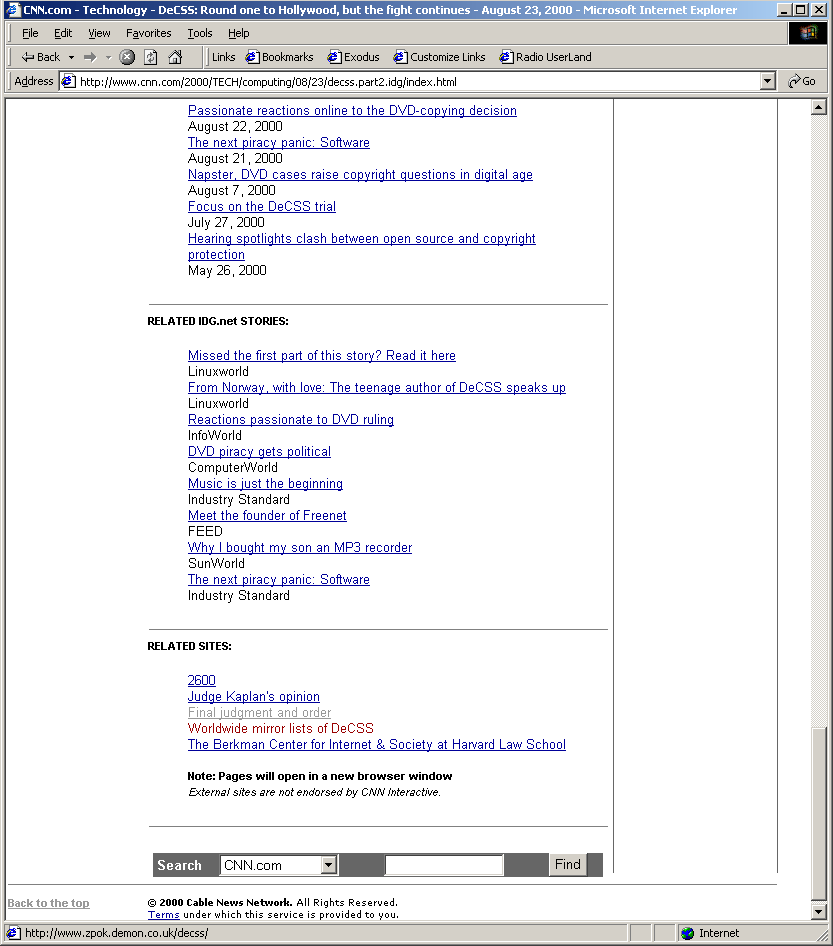
More DeCSS Time-Warner Hypocrisy
Sethb writes "Scripting News has the scoop about CNN linking to the source code for DeCSS. CNN is a subsidiary of Time-Warner, so in effect they're suing 2600 and others for something that they are doing themselves!" Update: 08/26 02:05 AM by michael : CNN has deleted the link from their story after reporters asked about it. But the screenshots are out there. -
More DeCSS Time-Warner Hypocrisy
Sethb writes "Scripting News has the scoop about CNN linking to the source code for DeCSS. CNN is a subsidiary of Time-Warner, so in effect they're suing 2600 and others for something that they are doing themselves!" Update: 08/26 02:05 AM by michael : CNN has deleted the link from their story after reporters asked about it. But the screenshots are out there. -
Manic Depressive Geeks
goingware writes: "I think a relevant followup to your recent article Slashdot meets the Pinkerton Corp. is the article Friends in High Places in the March 30, 2000 edition of the Metro San Jose. Included in the article is a link to a letter I wrote to Dave Winer's Scripting News about the relationship between programming and madness. The ad in the Metro seeking bipolar tech workers for the story promised confidentiality, but I chose to allow them to run my name and photo because I run a Web site for manic depressive people to educate them and their loved ones about the illness." -
Manic Depressive Geeks
goingware writes: "I think a relevant followup to your recent article Slashdot meets the Pinkerton Corp. is the article Friends in High Places in the March 30, 2000 edition of the Metro San Jose. Included in the article is a link to a letter I wrote to Dave Winer's Scripting News about the relationship between programming and madness. The ad in the Metro seeking bipolar tech workers for the story promised confidentiality, but I chose to allow them to run my name and photo because I run a Web site for manic depressive people to educate them and their loved ones about the illness." -
Netscape 1994 Time Capsule
jenkin sear writes "Netscape Time capsule site- original splash screens, and much of the original netscape site, including the release notes for version 0.9. Definitely a trip down memory lane.... I saw this link on scripting news" Warm fuzzies. Sure was simpler then. An interesting similiar and unrelated article also popped out recently, a history of microsoft.com. -
Ted Nelson Releases Xanadu
ewen writes "Ted Nelson has at last released the source to Xanadu, the extremely rich but never-quite-finished hypertext system. There was a couple of sessions at the O'Reilly Open Source conference yesterday, which Jon Udell has written up, and Dave Winer has posted some background material and thoughts at his website, www.scripting.com. " -
Here Come The Weblogs
Weblogs -- described by one of their creators as the "pirate radio stations" of the Web, are a new, personal, and determinedly non-hostile evolution of the electric community. They are also the freshest example of how people use the Net to make their own, radically different new media. A look at Weblogs plus a list of a few identifiable existing species in the electric community. Feel free, of course, to add your own.Electric Community Part Two:
Here Comes the Weblog
The members of electronic communities like Slashdot come together in the first place because of some shared interest - in this case a complex, sometimes highly technical range of acquired knowledge - Linux, open source, programming. An individualistic community with a common purpose, sites like this attract focused, like-minded participants, programmers and developers whose shared experience was mastery of a complex operating system, a willingness to endure technical hurdles, and an almost secret common language.
Newcomers, drawn to see what's going on or foraging for information themselves, often enrage the established dwellers of an e-community. They don't know as much, ask stupid questions, speak a different language. Intruders, they throw the ecological balance out of whack.
Mark Stefik of the Information Sciences and Technology Laboratory at the Xerox Palo Alto Research Center, likens this resentment to the problem of assimilation when natural disasters or wars cause mass exodus to new lands. When the rate of immigration exceeds a certain level, the resulting chaos in the host country can evoke tremendous resentment and backlash.
Size is a factor, too. As an electric community grows, so do the maintenance costs - hardware, bandwidth, the pressure coherently present more and more information, the need for revenue to support all these functions. As more and more people move through the site, it's harder to recognize addresses, message styles, or individual personalities.
So an electronic community faces, from the beginning, a serious dilemma --- whether to stay small, but remain marginal, or to grow, and becoming more profitable and acquiring more bandwidth and software. In a sense, it suffers either way. If a community stays small, it starves. If it grows, it suffers in a different way. The WELL, one of the first and most important electronic communities (I've been a member for years) has survived by remaining small, smart and simple.
Many of its members have reasons for avoiding too much hostility. They have continuing, powerful, very personal ties to one another. Topics range from science and technology to culture, movies and parenting. And the WELL has been successful in part by providing strong, experienced moderators with authority who discourage eruptions of hostility and keep conversations on track without discouraging free speech.
E-communities without personal forums - jobs, parenting, family life - have a tougher time forming a sense of community, since there's no real way for members to get to know one another. People aren't attacking human beings they know, but disembodied voices and messages.
From the beginning, the Net and the Web have been about individuals creating their own media. This process evolves constantly as people online struggle to find communities where they can glean information, keep up with new technologies, receive help, make human contact.
Some online sociologists use the club analogy when it comes to differentiating large and public versus small and exclusive e-communities.
Exclusive discussion groups - those that limit membership and topics - are like private clubs in that they offer membership by invitation or even fees. In these smaller e-communities, people can speak more freely, perhaps say things they wouldn't say in public.
Stefik writes: "To take the private-club idea another step forward, consider the possibility of private clubs with exclusive memberships, rules about confidentiality with real bite, and limits on the ability of the excluded public to post'There might be private newsgroups for people who are generally inaccessible - for example, major financiers, philanthropists, leaders of powerful companies, or even scientists."
The recent surge in classy, well-designed, intensely-linked weblogs - almost all, essentially reflecting the interests and tastes of their creators and a small number of like-minded people -- suggests a non-commercial version on Stefik's idea.
The weblog isn't a new term on the Net, but it's being used in a new way. One previous definition of weblog is an archive of activity on a web server. Another is an online diary. But in the context of the e-community, the weblog is new, and evolving rapidly, despite the fact that specialized and idiosyncratic sites have been around for some years.
On Camworld.com, Cameron Barrett has written about and developing his notion of the weblog - he calls it a small, eclectic site, usually maintained by one person, with a high concentration of repeat visitors, plentiful WWW links, and a zero tolerance for flames.
Barrett, an interactive designer, writes on Camworld ("Anatomy Of A Weblog" ) that he heard the term "weblog" for the first time a few months ago, but isn't sure who coined it.
Weblogs are a perfect example of the biological evolution of electronic communities. Very personal foraging sites, they are limited in membership, their links continuously updated, and are often focused on a single subject or theme.
They seem to almost all be ideologically opposed to hostility, including essayish commentary and observations. Because the site creator limits and approves membership, they don't need to be defended as intensely as bigger sites, nor do they attract - or permit - posters who abuse others. One obvious payoff is that the flow of ideas is strong, uninterrupted and impressive.
Barrett calls weblogs "microportals. Some weblogs: Smug; Flutterby; Scripting News; ; Stating the Obvious -- I was startled to come upon a column by Rogers Cadenhead about why I don't belong on Slashdot (weblogs may be less hostile, but don't look for sweet, either); Obscure Store, and Joshua Eli Schachter's very smart memepool.
Some webpools are designed by their creators simply to revolve around what they find interesting. Writer Keith Dawson describes webpools as "filtered news," but as with anything having to do with the Net and the Web, there are lots of different points of view.
The Christian Science Monitor newspaper, e-mails Christine Booker, was "weblogging" their own publication earlier this week. That is, an editor provided synapses of articles of interest, with links and particularly notable quotes. The editor was providing pre-digested highlights of his paper, only without commentary. Thus "weblogging" has even come to journalism, not usually an institution on the forefront of digital change.
The point is, Booker wrote, instead of asking readers to scan headlines to decide what to read, they have a section at the top of their World report that says, in effect: our international editor puts foreign news coverage in perspective so that you can go straight to the meat. In a different way, that's what weblogs do - interesting stories for pre-selected communities.
Booker, who designs and manages websites for the University of Washington Department of Surgery, and is an avid reader of weblogs, says it's important to convey their personal nature. "Even sites that don't contain any original content or much commentary give me a glimpse into the mind of the weblogger. What someone chooses to link tells me what they're interested in, what they think is funny, what they find absurd. Some webloggers offer links embedded in one or two lines of more or less oblique commentar" (jjg.net) Booker says that as far as she can tell, many, if not most of these sites started very informally and then, one way or another, the URL got passed around soon these "hobby sites" developted devoted audiences, readers who visit them at least daily, sometimes more.
Jesse James Garrett, content editor for Ingram Micro's Web site and editor of the weblog jjg.net says that "weblogs are the pirate radio stations of the Web, personal platforms through which individuals broadcast their perspectives on current events, the media, our culture, and basically anything else that strikes their fancy from the vast sea of raw material available out there on the Web. Some are more topic-focused than others, but all are really built around someone's personal interests. Neither a faceless news-gathering organization nor an impersonal clipping service, a quality weblog is distinguished by the voice of its editor, and that editor's connection with his or her audience."
One of the best weblogs I found was Peter Merholz's peterme.com. "How freakin? cool is this?" he asks in the lead item for May 12, writing about tracking satellites live and real-time using a 3D Java applet. The site mixes the best of web design and technology - interface, design, web development - with pop culture: movie reviews, an essay on the late cartoonist Shel Silverstein.
Merholz has decided, "for what it's worth," to pronounce "weblog" as "we? - blog."
While weblogs don't have the reach and influence - thus, the commercial potential -- of larger, more inter-active and open sites, it's easy to imagine them as powerful supplements to the major foraging sites. And, depending on their members, could be influential at sharing memes, essays and ideas.
Cameron Barrett's thoughts on weblogs can be found here, along with his list of favorites. Keith Dawson, who runs the Tasty Bits of Technology Front site - in some ways a pioneer, classic weblog, also has written about weblogs at here.
To me, weblogs may embody personalized media on the Net - enterprising geeks creating interesting new sites that set out to define news in different ways, to be both interesting, coherent, and more civil. This is the complete opposite structure of conventional media, which is top-down, boring and inherently arrogant.
They may be among the first e-communities to successfully overcome online hostility and abuse as well. That alone could make them highly popular.
Weblogs, however personal, are foraging sites in the classic sense of the term.
But Weblogs aside, the idea of electronic communities as encompassing distinct biological types is irresistible. And it makes sense. I'd identify these species of electric villagers. Add your own:
FORAGERS ( Stefik would call them Wolves): the people running sites or submitting and linking to discovered information.
LURKERS (Stefik's Spiders): The largest group, professionals, academics, researchers and others whose needs for information is practical, and who wait for it, usually in silence.
FISHERMEN: People who trawl selected sub-topics or discussions for specific data, such as information about a kind of information or software.
HELPERS: Electronic communities often have a compliment of knowledgeable veterans who welcome newcomers, and are happy to counsel them in the ways of the site. The helpers don't see newcomers as a threat, but an opportunity for the village to grow and prosper.
IDEOLOGISTS (as in priests and theologists): Vigilant for deviations from what they perceive as the site's purpose, they disagree and criticize, sometimes sharply, but rarely with venom or cruelty.
DEFENDERS (as in warrior bees or ants): Ideologically- driven flamers who seek to keep their communities pure, free from intrusive outsiders, whom they see as threatening and de-stabilizing.
ANONYMOUS COWARDS (Spies, informers, information bringers and Braying Hyenas): Two types, people with legitimate information that they can't share under their own names, and exhibitionists who get to express hostility without consequence. The single biggest cause of the destruction of communities, they are the most frequently cited reason newcomers flee, veterans tire and advertisers move on to more hospitable environments.
TECHS (worker bees and ants): The people in any community for whom the construction of the site is its own reward. They are constantly working to offer options and services, improve software and access.
Some questions: What does an electric community need to work? Are there other identifiable types of e-community members? Are new kinds of sites like weblogs the future, or a minor step on the evolutionary chain?
-
Windows programmers: not all party-members
Here's an article found on LWN from Dave Winer: many Windows developers would benefit from a stronger Linux platform, so the free software community should not lump all Windows programmers with Microsoft. -
What's Related Security Fuss
-
Dave Winer on Advocacy
Josh Lucas wrote in to tell us that Dave Winer, of Scripting.com fame as well as writer of several essays that have sparked controversy on Slashdot in recent weeks, has written a nice bit on Linux Advocacy. If you haven't, you should read The Linux Advocacy HOWTO. I'm not kidding. Read it carefully. Then read it again. If we all followed this document, there would be no stopping Linux. -
Dave Winer on Advocacy
Josh Lucas wrote in to tell us that Dave Winer, of Scripting.com fame as well as writer of several essays that have sparked controversy on Slashdot in recent weeks, has written a nice bit on Linux Advocacy. If you haven't, you should read The Linux Advocacy HOWTO. I'm not kidding. Read it carefully. Then read it again. If we all followed this document, there would be no stopping Linux. -
Davenet on Opensource
An anonymous reader sent in this link where you can read Dave Winer's take on Open Source. He expresses mostly skepticism, but raises a few major points. I'm sure most of you will read this and disagree strongly with him, but most of these points are the exact sort of problems that will prevent, say Corel from openning up their suite. We need to solve these problems, in a way that benefits both the company, and the community, for open source to really overtake closed code. -
Dave Winer on Competition (scripting.com)
I haven't been actively following this whole Frontier thing, but a lot of you guys have. Check out this story sent to us by a reader who requested anonymity. Basically Dave Winer has written a program called Frontier, and recently a movement has been afoot to create a GPL version of his program. A major issue was that the clone sought originally to duplicate the 'western' theme that Frontier already had. It's interesting reading. I suggest spending some time linking around this site, it has a load of cool stuff to read. -
Freeing up Java
Zooko Journeyman writes " Dave Winer wrote an article suggesting that JavaSoft could open the source to Java. Wednesday he had an e-mail exchange with Bill Joy in which Bill Joy argues against opening the source."