Slashdot Mirror
Domain: sfu.ca
Stories and comments across the archive that link to sfu.ca.
Comments · 260
-
Re:a little easy but...
...or a program to calculate pi.
Funny you should mention that. The first code I ever wrote in C was PiHex (a distributed project computing project, back in the days before those became cool, which computed the 5 trillionth, 40 trillionth, and quadrillionth bits of Pi. All of them were zero.) -
Spatial Orientation
While I cannot say I have met a large enough sample size to distinguish between women and men, I have met lots of people who had great difficulties "getting" CS concepts. (And also certain theoretical math and physics) I would often understand the concept after just hearing the overview, while these people would have to be explained all the details to really understand what is happening.
I believe the problem is spatial orientation. Certain people can create an accurate representation in their minds, and thus can easily "see" the changes happening. In the article I linked to, they give an example of rotating a complex shape in three-dimensional space. Obviously certain concepts in CS (data structures, for instance) involve making a mental picture to understand what's happening, since you can't exactly touch the data.
What I find interesting is how the theory mentioned in this article compares with this theory. According to the article above, only humans with very high or very low levels of testosterone enables humans to think spatially.
In the article I linked to (and many others), there is a theory that men traditionally developped this skill so that they could map out where lunch was, track it and hunt it down, and how they would need to get back home once they had killed it. This is compared to the women, who would stay near home and 'gather' small berries which required more of a sharp eye.
So my question is now, is did these early humans (which obviously must have needed good spatial abiliity) have high or low testosterone? And where are the high-testosterone guys that should be exceeding at spatial orientation now? -
Re:Seems an easy tradeoff to me...
Well, here's a pretty good thesis on the topic:
Amateur Radio and Innovation in Telecommunications Technology The summary is "a hell of a lot", and if you want a comprehensive list, read the thesis. -
Re:Non-Americansyour right, it wasn't Jean Chretien (prime minister in the late '90s) who came to america for treatment because the candian system was lacking. It was obert Bourassa, the Premier of Quebec who didn't wait for the canadian health system and went to maryland for cancer treatment.
The reasons patients travel for treatment vary. Many medical tourists from the United States are seeking treatment at a quarter or sometimes even a 10th of the cost at home. From Canada, it is often people who are frustrated by long waiting times. More on the fabulous wait times form the canadian health system Long waiting times are the main, and in many cases, the only reason some Canadians say they would be willing to pay for treatments outside of the public health care system.
- Roy Romanow in his report on the future of health care in Canada, November 2002
Now anytime you take tax dollars and redistribute it to people for specefic services they might not be able to afford, it is called welfare. I find it strikingly odd that you call going on welfare to get proper medical tratment when your pay is too low to afford insurance but don't make the conection when the same program is expanded to every one reguardless of thier income. It almost apears to be a "My way or it isn't good enough" argument.
Now to pirated drugs. WoW how snowballed are you? This made big news in the US.
Canada, taking an unusual step that the United States has resisted, said yesterday that it had overridden Bayer's patent for Cipro
So yes they do in some cases. This is the only one i know about but i havn't done any searching out side trying to google for remebered headlines. Canida as i like to call it, is a purposeful mispelling.
Oh, BTW, In our system, you choose your doctor. They're not "assigned" to you.
Sure, if you can find a doctor.. GOOD LUCK -
Re:i dont mean to brag but...
-
Re:PageRank on source code
Sorry, you're not going to get away from spambots this time rstorjoh@sfu.ca
-
Automated lecture recording system
Shit, when I went to university just about every lecture was automatically recorded at a central location, for any lecture hall which was equipped with the A/V equipment. It was routine that if you missed a class or just wanted to listen to the lecture again that you could go and pick up a tape. Whatever is so strange about it?
Read this article: http://www.sfu.ca/mediapr/sfu_news/archives/sfunew s06240416.html -- they've developed a system for automatically recording all lectures and, if the prof approves, immediately making the lectures available over the web in WMV/MP3 format on a password protected site. -
Oh it's okay then
Many systems, especially those that use cryptography for digital signatures are most at risk here."
Well, they still beat some Microsoft "encryption" method from Microsoft... -
Re:Biologically speaking, how...
Sorry, right concept, but wrong diagram and wrong numbers. Here is a more comprehensive page.
The same example with the correct data:
500nm produces a stimulation proportional to (2,6,1). Typical R=(3,0,0), typical G=(5,11,0), typical B=(0,0,3). There is no way to solve r*R+g*G+b*B=(2,1,6) for positive r,g and b.
b=1/3 and g=6/11 obviously, but if r is equal to or bigger than 0, then b*B is equal to or bigger than 30/11, which is bigger than 2, ergo too much stimulation of the red receptors. -
RGB doesn't cover the visible gamut. At all.
It's not the discrete gaps that are the problem! RGB does not represent all of the visible colors, even theoretically. Assuming a perfectly smooth RGB model with infinite intensity and perfect black, and infinitely precise levels of R, G, and B, there is a huge chunk (around 45%, if I remember right) of the visible gamut that is totally unreproducible. CMY covers some areas that RGB doesn't, and vice versa. Neither is the whole gamut. There are more complex models that do, like CIE L*a*b.
-
Re:RGBCMY is more marketing factoid than it isreal
Not quite. The "step" issue is separate from the fact that the RGB gamut does not cover the visible gamut all the way. There are colors we can see that no amount of twiddling can *ever* get an RGB monitor to reproduce.
You are right that a digital RGB representation is discrete, not smooth, but there are colors "outside the grid," too. Pure yellow, for example.
Here's a nice link, again: clicky click -
Re:RGBCMY is more marketing factoid than it isreal
As others have pointed out, the RGB colorspace can't represent all of the colors.
-
Not so. RGB, CMY, YUV, etc... are not full gamut.
RGB, CMY, CMYK, etc... *cannot* represent the entire visible color gamut. YIQ (the one used by NTSC TV), YUV (PAL TV), and YCrCb represent a smaller gamut than RGB, to be sure, but neither represent the whole thing.
For that, you need a more complex model like CIELAB.
Here's some links:
A whole lot of information.
Samsung stating that their shiny DTV sets can't match the visible gamut.
A graph of visible, RGB, Pantone, and CMYK gamuts
-
My MITS Altair emulation project
I've used Bob's emulator a bit, playing with the PDP-11 emulation when I had an 11 in my basement that was failing. I now use the VAX emulator running BSD. I've also used SIMH as inspiration for my own emulation project for emulating a MITS Altair 8800 (with the front panel).
The next version is done and will be released within the next week or so after I update the docs to synchronize with the changes made.
Anyway, the project page is here:
-
Not helping...News like this really isn't helping Darl's attempt to become more evil than Satan.
-
Re:Better naming = better jokes
Actually, SFU is also the abbreviation for Simon Fraser University, located in British Columbia, Canada. SFU is the home of at least two episodes of Stargate, as well as occasional episodes of Outer Limits (The Cold Fusion episode), The Fly 2, an Anime convention, and the V-chip of South Park fame.
-
SFU stands for Simon Fraser UniversityI'm a graduate student in SFU!
Roozbeh/
-
Different for civil and criminal.At first I thought in Canada you were guilty until proven innocent. But if my short Canadian incarceration has taught me nothing, I learned that they have very different procedures for civil and criminal proceedings. I can't come up with the proper google keywords to get a proper legal document, but if a Canadian says they have innocent until proven guilty then who am I to argue.
I was found innocent of weapons smuggling BTW.
-
While not a big fan of the game itself . . .. . . I don't mind studying the underlying math behind it at all. In fact, I find the study of probability and game theory more fun than poker itself.
As a geek, I prefer playing with John Conway's Life.
-
Re:Oracle was the first SQL relational database ..
Some background info on QUEL if anyone is interested.
-
Re:This Will Save Lives
Nonsense. Weapons like this only make it more likely for people to be injured and killed. This kind of 'assymetric warfare' tool (i.e. we have 'em, the other guys don't) just makes it more likely that we will start and continue wars.
Robots are particularly nasty weapons, because it reduces the risk of injury to one side so much. A commander is more likely to attack a building and kill everyone inside if she is less likely to have any nasty injuries on her team. Can you tell the difference between an Iraqi that means you harm and an innocent civilian on a shakey, wireless TV picture, when one mistake means death for them and/or you? I'd guess no.
Seriously, I believe developing robots for combat purposes is immoral as it is deliberately removing the moral agent from the pointy end of things, even more than the already-illegal poison gas and neutron bombs.
Taking the long view, and supposing that robots become very smart and capable - and my colleagues in robot research are trying very hard to make it so - do we want them armed to the teeth and designed to kill people? I think not. Some will protest that this robot is for reconnaisance and is not armed, and they are right so far. But adding a gun or bomb is a technically trivial next step. It's alreay happened with the Predator drone.
I have 'No Evil Robots' web page that makes this point, and reminds me to keep my robots peaceful.
Besides, a toughened remote-control buggy is not a very interesting robot anyway. There are a hundred cool robots at CMU, and MIT, USC, NASA, that are not designed to spot Iraqis so we can kill them, and have more interesting technology. And that's just in the US - there are many CRAZY things going on in Japan. Check them out.
-
other offenders
I heard this closed source program uses the FFTW (Fastest Fourier Transform in the West). I feel it is my duty as an agent of the communist state to inform you.
-
Re:HP Printer Easter Egg
I have a HP ScanJet 5p SCSI scanner that plays Ode To Joy. You have to set the SCSI ID to 0 (or 1? Can't remember off hand) and then hold the scan button while powering it up. The motors in the scanner then play ode to joy. I have an ogg recording of it here.
-
Re:Odd thing about trains...Why are they so loud at night? I know trains run through the city here regularly, and I can't hear the train whistles where I live during the day, even though I know they still toot them, but at night I can here the trains that have got to be at least ten miles from here. Why is that?
If there is a large body of water between you and the train tracks, or if you're in an area with weird cooling characteristics, you might be hearing the effects of a temperature inversion.
Air temperatures right above large bodies of water tend to be cooler then the surrounding air. Similarly, there might be some areas near you that cool more rapidly at night than other areas. These effects cause layers of air at different temperatures, which set up an impedance mismatch.
Sound that travels through the air bounce off these temperature inversions, which can 'bend' sound toward you. Combine this effect with lower ambient noise levels at night, and you find that you can sometime hear noise sources at far distances.
See here for an explanation.
-
Re:How far away?
Also note that geosynchronous orbit is at 42,250 km. Which means this asteroid is potentially coming very close to some of the satellites we've put up there.
-
Re:Calculating PI
I did the same thing. I wrote an application, here is the source:
Pi up to 50,000,000 digits!
It's written an interpreted language called "HTML" and is interpreted via a "Web Browser".
Bibliography: Google search for "pi". -
Soundscape studies did this decades agoSince this is a rerun story, I'm going to repost myself from a few weeks back:
Hildegard Westerkamp wrote about Walkmans and personal audio space as a key part of her 1988 thesis "Listening and Soundmaking-A Study of Music-as- Environment", but the World Soundscape Project generally had a pretty good analysis of this right from the beginning of the phenomenon.
Now I don't know that Bull has ignored soundscape studies in general, but it is the true home of sound nerds who move beyond the engineering and get into the social, psychophysics, and ecological aspects of sound, and the article should have mentioned it at least. If you're interested in the field at all, you need to check out the World Forum for Acoustic Ecology, where this stuff is hashed out on many levels.The composer R. Murray Shafer's concept of "schizophonia" became used to describe an effect of electroacoustic tech: essentially something you hear that happens in another place and time. Barry Truax's definitive book Acoustic Communication develops the whole idea further.
The thing about PLD's is that they supplant the actual soundscape with a soundtrack, often a remedy to noise and stress but usually just fun. There may be a long-term chronic danger from extreme schizophonia, but I don't think it's been studied empirically. Soundscape studies is fringe, most of the work being done in the area is engineering and psych.
-
Soundscape studies did this decades agoSince this is a rerun story, I'm going to repost myself from a few weeks back:
Hildegard Westerkamp wrote about Walkmans and personal audio space as a key part of her 1988 thesis "Listening and Soundmaking-A Study of Music-as- Environment", but the World Soundscape Project generally had a pretty good analysis of this right from the beginning of the phenomenon.
Now I don't know that Bull has ignored soundscape studies in general, but it is the true home of sound nerds who move beyond the engineering and get into the social, psychophysics, and ecological aspects of sound, and the article should have mentioned it at least. If you're interested in the field at all, you need to check out the World Forum for Acoustic Ecology, where this stuff is hashed out on many levels.The composer R. Murray Shafer's concept of "schizophonia" became used to describe an effect of electroacoustic tech: essentially something you hear that happens in another place and time. Barry Truax's definitive book Acoustic Communication develops the whole idea further.
The thing about PLD's is that they supplant the actual soundscape with a soundtrack, often a remedy to noise and stress but usually just fun. There may be a long-term chronic danger from extreme schizophonia, but I don't think it's been studied empirically. Soundscape studies is fringe, most of the work being done in the area is engineering and psych.
-
Soundscape studies did this decades agoSince this is a rerun story, I'm going to repost myself from a few weeks back:
Hildegard Westerkamp wrote about Walkmans and personal audio space as a key part of her 1988 thesis "Listening and Soundmaking-A Study of Music-as- Environment", but the World Soundscape Project generally had a pretty good analysis of this right from the beginning of the phenomenon.
Now I don't know that Bull has ignored soundscape studies in general, but it is the true home of sound nerds who move beyond the engineering and get into the social, psychophysics, and ecological aspects of sound, and the article should have mentioned it at least. If you're interested in the field at all, you need to check out the World Forum for Acoustic Ecology, where this stuff is hashed out on many levels.The composer R. Murray Shafer's concept of "schizophonia" became used to describe an effect of electroacoustic tech: essentially something you hear that happens in another place and time. Barry Truax's definitive book Acoustic Communication develops the whole idea further.
The thing about PLD's is that they supplant the actual soundscape with a soundtrack, often a remedy to noise and stress but usually just fun. There may be a long-term chronic danger from extreme schizophonia, but I don't think it's been studied empirically. Soundscape studies is fringe, most of the work being done in the area is engineering and psych.
-
Re:I think the Prof's name is a hint....are there other people who have been doing this for a while?
Hildegard Westerkamp wrote about Walkmans and personal audio space as a key part of her 1988 thesis "Listening and Soundmaking-A Study of Music-as- Environment", but the World Soundscape Project generally had a pretty good analysis of this right from the beginning of the phenomenon.
The composer R. Murray Shafer's concept of "schizophonia" became used to describe an effect of electroacoustic tech: essentially something you hear that happens in another place and time. Barry Truax's definitive book Acoustic Communication develops the whole idea further.
The thing about PLD's is that they supplant the actual soundscape with a soundtrack, often a remedy to noise and stress but usually just fun. There may be a long-term chronic danger from extreme schizophonia, but I don't think it's been studied empirically. Soundscape studies is fringe, most of the work being done in the area is engineering and psych.
-
Re:I think the Prof's name is a hint....are there other people who have been doing this for a while?
Hildegard Westerkamp wrote about Walkmans and personal audio space as a key part of her 1988 thesis "Listening and Soundmaking-A Study of Music-as- Environment", but the World Soundscape Project generally had a pretty good analysis of this right from the beginning of the phenomenon.
The composer R. Murray Shafer's concept of "schizophonia" became used to describe an effect of electroacoustic tech: essentially something you hear that happens in another place and time. Barry Truax's definitive book Acoustic Communication develops the whole idea further.
The thing about PLD's is that they supplant the actual soundscape with a soundtrack, often a remedy to noise and stress but usually just fun. There may be a long-term chronic danger from extreme schizophonia, but I don't think it's been studied empirically. Soundscape studies is fringe, most of the work being done in the area is engineering and psych.
-
Re:I think the Prof's name is a hint....are there other people who have been doing this for a while?
Hildegard Westerkamp wrote about Walkmans and personal audio space as a key part of her 1988 thesis "Listening and Soundmaking-A Study of Music-as- Environment", but the World Soundscape Project generally had a pretty good analysis of this right from the beginning of the phenomenon.
The composer R. Murray Shafer's concept of "schizophonia" became used to describe an effect of electroacoustic tech: essentially something you hear that happens in another place and time. Barry Truax's definitive book Acoustic Communication develops the whole idea further.
The thing about PLD's is that they supplant the actual soundscape with a soundtrack, often a remedy to noise and stress but usually just fun. There may be a long-term chronic danger from extreme schizophonia, but I don't think it's been studied empirically. Soundscape studies is fringe, most of the work being done in the area is engineering and psych.
-
It's best to contact the copyright holders....On our campus, the student union showed screenings of various films.
They got fined for not obtaining public performance rights. article about fines . It's best to be safe than sorry.
-
Re:Silencewhat kind of a world would we be in if silence becomes patented?
Noisy.
It doesn't really matter, anyway, silence (meaning quiet, really) has suffered the "tragedy of the commons" and barely exists. There are almost no acoustic wildernesses left (where you can't hear internal combustion, eg.) and silence has become a golden commodity reflected in real estate values and construction techniques. We're habituated to the constant hum of fans and machinery and all policy decisions on the topic are oriented towards noise reduction, not quiet protection; technological solutions are generally oriented towards masking or reduction, not noise elimination.
In communication studies, silence is like the water we fish swim in: everyone notices it's there, but almost no-one studies it. Without some degree of relative silence, acoustic communication is impossible. We've traded some of that away for progress, and the results are subtle but disturbing.
-
Re:But it sucks
I've got to agree.
I watched the miniseries when it came out and thought it was okay, if a bit cliched.
Then I bought the original series DVD set, and watched the whole thing. It does have a noticeable fromage factor in places (e.g. Muffit, reusing a lot of the space footage in *every* episode, the robots in "Greetings from Earth"), but it's obvious to me that the creators really cared about telling an interesting story of their own.
There was so much about the original that had its own feel - the design of the costumes, the sets, the ships, the Cylons - and in the remake they've all been replaced by generic sci-fi designs.
90% or more of the elements in the remake could have been designed for any space action film - Wing Commander in particular comes to mind. I was *especially* disappointed with the new Cylons. It's obvious that they only make an appearance for a few seconds because the CG is so poorly animated. I also thought the new Raiders with the scanning eye on the front were incredibly cheesy.
That having been said, there were a few things I thought were clever - particularly one of the plot twists near the end that I will not explain to avoid spoiling anyone.
I also liked that "Caprica" was actually the university in Canada that I went to (BG is higher class than The Sixth Day or The Fly II, both of which also filmed there).
Basically I feel like the creators of the new series started changing things not because it was a good idea, but just for the sake of doing it, Rick Berman-style.
I guess a new series could turn out well, but I get the impression that it won't. Sci-fi should have let Richard Hatch do his follow-up idea instead of "reimagining" the story. -
Re:For those that need more proof
Another Mirror, gzipped this time.
-
Re:Hey now....
No wonder, they have a rather large population with a very coherent DNA to study there
[QUOTE] Like Iceland, Newfoundland's unique gene pool is a priceless commodity that could change the fortunes of the island
THE RUSH FOR THE ROCK
By William Illsey Atkinson, as printed in The Globe and Mail, Jan. 5, 2000
Reprinted with special permission, W. Atkinson, Jan. 2000
Burnaby, B.C. -- It has a nice ring: Newfoundland and Laboratory. No, it's not a misprint. The Rest Of Canada -- which in this case includes Quebec -- likes to think of the easternmost province as the have-not of the 10. But multidisciplinary fieldwork based on human genetics may pave the way to a high-tech gold mine in Newfoundland.
At least one geneticist, Dr. William Davidson, thinks so. Last summer, Willie Davidson moved from being a professor of biochemistry and molecular biology at Memorial University to become Dean of Science at Simon Fraser University. In his cross-Canada relocation, at least one thing remained intact: His passion for the right of Newfoundlanders to control a natural resource of vast potential value -- their own genes. [/QUOTE]
[More at the link above] -
Re:Battletech : 2010The US army's stryker only come equipped with a machine gun. The USMC uses the same basic vehicle, as does the Canadian army, and the Australian army, equipped with a variety of weapons. The army's strykers don't mount those turrets because the extra few inches mean they won't fit in anything but the largest transport aircraft. With the little machine gun turret they fit in the standard, more common, medium sized transport aircraft.
Note particularly the recon mast carried on the Canadian vehicle I have linked to.
-
Re:Great Acronym! SFU! Well...
Students from Simon Fraser University might not be so impressed.
-
Re:Just bear through it.
Learn to drink water instead.
Ah, foul stuff that is. I'd recommend caffeine-free soda pop or tea instead.
I can't argue with your choice of university, though. I used to be the network admin for The Peak while I was going there. -
Re:1 dead == 15 dead?
>but in general, the idea that "gun-control" affects the "bad guys" is mostly a myth.
They say that, but in my home country (Canada), I rarely hear about any weapons being used in crimes apart from handguns and rifles (and even then that's quite the rarity and always front page news, every time). Fully automatic weapons, to be honest, the only time I've ever seen one on TV news was when Denis Lortie tried to take over the Quebec parliament. For an idea of Canada's gun control laws, here's a paper.
That all being said, there's limits to what I can take, and Canada's latest gun control bill, C68, is going way too far. Sorry to bring the Canadian perspective into this, I know the US is a different country with different needs, but we do seem to have fewer problems with people shooting each other.
As I've mentioned, I'm a fan of allowing organized groups ("militias") to own weapons. That's simply because as part of an organized group, with any luck you'll either be let go if you go insane, or better yet, others in the group will advise you not to do idiotic things.
>Obviously you accept that widely quoted argument
I did at one point, but I have had the figures countering it shown to me. That's why I say I wouldn't want to make it true -- it might not be right now, but it could be. No sense in helping it along.
>Please don't get the idea that I'm blood-thirsty or anything though
I wouldn't... the only people here like that are the deranged trolls. -
Check out the bar charts
The problem with the internet is it's too easy for some nutcase to put up a slick website, complete with bar charts and look sane.
-
Re:No; this is just more FUDMight I remind you of the horrific ptrace() bug which was a KERNEL exploit in Linux 2.2, and a similar ptrace()/kmod exploit that affected Linux 2.4. You might be vulnerable to the kmod kernel bug right now. This bug exists across distributions, across userspace software, even across kernel versions.
The fact is, it's very possible for local exploit conditions to exist in the kernel itself. That means it doesn't matter what software you might or might not have installed -- you are always potentially vulnerable. All it takes is a single point of weakness to get local access, and then the story's over.
It is a critical misjudgment to assume that Linux itself is somehow invincible.
-
nothing new for quebec
This has been a problem for a while now for merchants in Quebec, and there have been numerous stories. What gets me is that even if you only speak English, your signs and advertising still have to have French in it. Just silly.
-
Re:mirrors
Add another one to the list
http://www.sfu.ca/~rpearcea/list.tar.bz2 -
Re:More mirrors needed
Here's my mirror in Canada. I know it's not in the US, but at least it's not offshore
-
Re:Prepare to be spammed.
The proof that pi is transcendental is quite complicated. However, there is a simple proof that pi is irrational.
So if someone asks if pi is irrational, why take a detour through transcendental numbers? Why not simply mention Ivan Niven's 1-page proof? -
Surveillance for some timeSince I live near Vancouver and am writing a paper on privacy right now, I decided to look into this a little bit. Here's what I've found:
- The organization in question, Barwatch, donated $5000 to the incredibly right-wing Liberal party (go figure) that currently runs the province. The same organization was behind a fight with the worker's compensation board of BC regarding the rights of workers not to have to work in a cloud of second-hand smoke. The Liberals changed the law to remove the WCB ventilation requirements.
- The same liberals have passed (I think) some privacy legislation that allows disclosure of personal information collected by observation at a performance, sports meet, or a similar event that is open to the public (Think Tampa superbowl), and allows organisations not to tell individuals what information they have, "if the disclosure of the personal information would reveal confidential commercial information that if disclosed, could, in the opinion of a reasonable person, harm the competitive position of the organization". In other words, it's pretty wide open.
- This isn't the first time Barwatch has cranked up surveillance of its patrons: This article mentions that video taping has been going on in Barwatch bars for three years before the article was written, in 1999. It also demonstrates that while these programs are justified by safety concerns, they are also used for marketing data.
- These guys have some power: Apart from the smoking legislation, Barwatch also lobbied to implement bus service later, and allow bars open later. Recently, the BC Liberal party allowed bars to be open until 4 AM on Fridays, and Translink began offering night bus service to at least SFU.
- On his geocities resume web site, Bradley Shende claims to be the Barwatch founder. According to his site, "Barwatch is an original concept. It's purpose was to establish communication between licensed establishments and the various branches of municipal law enforcement and regulation to create a forum of co-operation rather than adversity, and to set standards by which we would all operate our licensed premises. The organization has been a success over the years and is now branched out into the US and all over Canada." Apparently he is also "a quick study on systems and software". Nice win2k experience, Bradley.
- Barwatch has changed their phone number, and no longer has a web presence (www.barwatch.org as posted on Shende's web site). I was unable to contact them before posting this. The often cited name of the chair and spokesman of Barwatch is Vance Campbell.
-
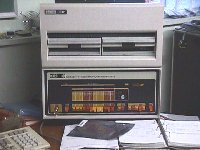
The PDP-8 from DECis actually, IMHO, the first personal computer and was introduced in March of 1965, predating the MCM by about 8 years.Here is one on a desktop (with dual floppies! woohoo!).
This was the first computer I got to use hands on (the language being FOCAL and one had to toggle in the bootstrapping code). It sure beat handing in cards for the 360!
A good starting point to read more is here
-
Re:More links, and a serious offer
University dropout, baby. But that doesn't stop me from wanting to work here.