Slashdot Mirror
Domain: skyandtelescope.com
Stories and comments across the archive that link to skyandtelescope.com.
Comments · 128
-
Re:Not even! The Moon is still vaporware.
Some humans have 20/20 vision. Some humans have 20/200 vision. Some humans have 20/10 vision. Some humans have much better vision than that.
If you do a strip mine on the front side, people will see it. Unaided. Also: contrast, and shadows. Remember, the Sun is reflecting directly, without having been attenuated by an atmosphere. That totally changes the visibility distance calculations.
The limit of the size of a lunar feature detectable by people with really good vision is about 100 km -- the size of Copernicus crater. It is an an actual feature on the Moon and it is in fact the limit of what can be seen. This is very well established. Kepler crater, at half this is invisible to the naked eye. Only people using telescopes can see it (binoculars are just two small telescopes mounted together).
The largest surface mine on Earth is the Hull–Rust–Mahoning Open Pit Iron Mine in Hibbing, Minnesota about 5 km in its largest dimension.
-
Re:What powers the rover?
There is a legitimate concern with using solar panels somewhere that has 2 week long nights. But you're correct that they're combining nuclear with solar to address that, having the lander power down and not do any work at night with the nuclear being just enough to keep it warm:
"The rover and the lander feature solar panels for daytime power and operation, along with nuclear plutonium-238 heaters to keep their electronic components warm during the two-week-long lunar night." (source)
Apparently solar is enough cheaper or longer lasting than other options that it's worth being limited to half time operation.
-
Re:What's interesting in the sky with a small tele
Don't overlook the moon-- for somebody new to astronomy, the moon is AMAZING.
Pro tip: DON'T look at the moon when it's full-- the full-on sunlight washes out all the contrast. Look at it first or second quarter.
This is a great season to spot planets-- you can get Venus, Mars, Jupiter, and Saturn in an evening without even staying up very late. Mars, unfortunately, although it's unusually close and bright right now, is in the middle of a hellacious dust storm, so you won't see much features. You should be able to spot the polar cap, though.
Pro tip: you don't have to wait for sunset to observe Venus. It's actually better to observe it with some skylight, because it's so bright.
Other than that, if there's light pollution you're not going to seem much in the way of nebulae, but double stars are still interesting. Mizar-- the star at the bend of the Big Dipper-- is easy to find. Some stars where the two components are different colors are interesting. Check this site: https://www.skyandtelescope.co...
-
Canned and replaced by what?
Our atmosphere is opaque to infrared. So any infrared astronomy has to be done from space. Hubble can only do partial infrared (specifically near-infrared), not the rest of the infrared spectrum.
Infrared is needed because it can peer through dust clouds. See this image of Eagle Nebula in visible vs. near infrared by Hubble to see the difference.
JWST works mainly in infrared, near and far. Moreover, it has much more aperture than Hubble (~ 2.4 meters vs 6.5 meters).
All this means that JWST can see back in time when the first stars that shined in the cosmos, and shed light on how the Big Bang progressed. Important stuff, and no instrument compares to its capabilities.
-
Re:Big deal. We launched real people and returned.
Actually we do have photos. http://www.skyandtelescope.com...
-
Re:Hmm
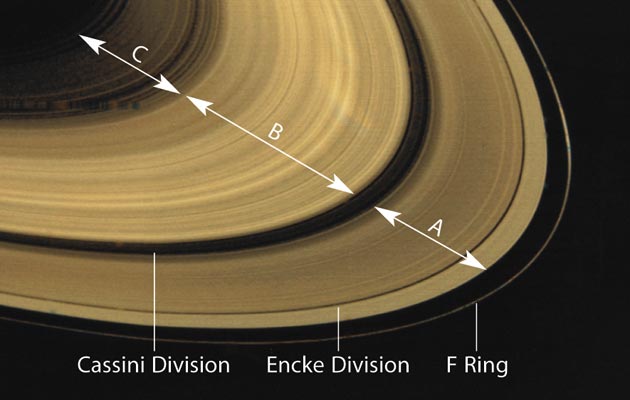
Pioneer 11 was the first probe to visit Saturn. One of its trajectories considered for the mission (and eventually rejected) was to pass right through the Cassini Division. Once Pioneer got there, we found out the Cassini Division wasn't quite as empty as it appears from Earth.
-
One of the Best Showers I have Ever Seen
This was a superior shower, one of the best I have seen. I watched from the outskirts of Wrightwood, CA; elevation 1800 m just 20 km north of the Los Angeles basin but with an SQM 19.05 sky, a measure of sky darkness. due to mountain shielding of the light dome (the Milky Way is visible). This published list of darkness comparisons: rates this as "Typical for a suburb with widely spaced single-family homes.".
Starting at 12:40 a.m. (when I went out and started viewing) I saw 5 spectacular Earth-grazing fireballs leaving persistent glowing trails, with apparent colors of white, reddish, and greenish. In two hours of total viewing time, ending at 3:30 a.m. (I did some driving around testing different viewing sites), I saw 91 meteors, with the peak right at the end when the radiant in Perseus was high overhead, and it had hit about 80 meteors and hour in a 15 minute period.
-
Re:Track it here
It's probably the most beginner-friendly telescope there is.
They're cheap, they're super-easy to aim (like a cannon, basically), you don't have to align it to the North Star, you don't have to lock/unlock screws while moving.
The mirror is big enough to see all the planets, double-stars and some galaxies/clusters/nebulaes, even in light-polluted areas. I could look at Jupiter/Moon/Saturn/ISS every night and not get tired of it. It's a wonderful experience to see the great red storm or Io's shadow on Jupiter. It's nowhere near as detailed as on NASA pictures, but it's very enjoyable to see it directly.
My daughter enjoys it too, and can track the moon by her own (she's 5).
I was a complete beginner a year ago, and learned a lot just using this telescope outside, and looking at Stellarium every now and then. I still have much to learn.
http://www.skyandtelescope.com... is a great todo-list.
What's funny is that for this price, you cannot get any decent optical tube or any decent tripod. With a dobsonian, you get both, and they're more than good enough for many astronomical needs. -
NRO mirror
This is an old spy satellite for the Navy
No, not Navy: NRO. It was apparently the mirror built for the next-generation reconaissance satellite, which got cancelled.
Also, it's not the whole spy satellite-- it's just the mirror. http://www.sciencemag.org/news...some more links of interest:
http://www.sciencemag.org/news...
http://www.skyandtelescope.com... -
Re:This further supports that it's mental illness
First, no, they are in the "quiet" zone near the radio telescope because there is little to no radio signals there.
Second, microwave ovens are not fully shielded and they indeed leak RF energy. They are only shielded enough to protect human tissue. My microwave oven blocks my 2.4 GHz cordless phones and WiFi tablets nearby.
Also, when you open the door without pressing "stop", a huge burst will be emitted from the microwave oven. Please read this article concerning microwave ovens and another radio telescope:
-
A Better Web Site for Comet Catalina
If you want an informative web site that actually works without Javascript, visit http://www.skyandtelescope.com...
-
Real tips are not on CNN...
I wonder why the summary let us think the CNN article is giving good tips while the real tips are coming from Sky and Telescope's website. It is a waste of time to refer people to the CNN article. Aren't we on a website for nerds or not? Here is the link: http://www.skyandtelescope.com...
-
Flare observed at Williams College
-
Re:What time zone is the 10:20 PM?
Sky & Telescope provides this chart that should answer your question.
Lucky sods--the moon will set here (Scandinavia) about 10 minutes before the eclipse begins.
-
This may be important for quantum gravity
The brightest Gamma ray bursts (GRB) are important for quantum gravity, as the photons have a short enough wavelength and go over long enough distances that spacetime foam should give them dispersion. The best test so far is based mostly on GRB 080916C, and from what I hear this new burst may be able to do better.
A little background.
The Heisenberg uncertainty principle predicts "virtual" particles. The time part of the uncertainty principle is delta T delta E > h, where E is energy, T is time and h is Planck's constant (I am ignoring factors of 2 pi). As the time of an event (say, the time for a photon to travel one wavelength) gets shorter, the energy of the virtual particles allowed (delta E) gets bigger. For short enough time periods (i.e., near the Planck time), the energy is enough that the virtual particles are black holes, popping in and out of existence, and severely mangling the spacetime on that time / distance scale. This mangling is called "spacetime foam". The wavelength of the GRB photons is much larger than the Planck distance (roughly, the virtual black holes should live for a Planck time and have an event horizon the size of the Planck distance), but the GRBs are very far away, and the GRB photons pass over many, many, Planck distances along the way, and each adds a little nudge. This effect depends on the photon energy (it is larger for higher energies, as these are smaller photons), thus the "dispersion" mentioned in these papers.
The really cool thing is that the existing dispersion limits seem to be less than many people's expectations. If this is confirmed (and pushed down to a little smaller distance scale), then the conventional spacetime foam ideas I outlined above here may not be correct. This, in fact, may be the first evidence for the "holographic principle," which implies a smoother spacetime than the above ideas. In any case, this is the only way we have at present to say anything experimental about quantum gravity, so the more data the better.
-
Re:folding@home
I'm not sure people realize that SETI has basically already failed. They've covered their entire spectrum numerous times
The entire spectrum? We've only looked at one frequency range on 20% of the sky:
SETI@home is basically a 21-cm survey. If we haven't guessed right about the alien broadcasters' choice of hailing frequency, the project is barking up the wrong tree in a forest of thousands of trees. Secondly, there has been little real-time followup of interesting signals. Lack of immediate, dedicated followup means that many scans are needed of each sky position in order to deal with the problem of interstellar scintillation if nothing else.
With its first, single-feed receiver, SETI@home logged at least three scans of more than 67 percent of the sky observable from Arecibo, amounting to about 20 percent of the entire celestial sphere. Of this area, a large portion was swept six or more times. Werthimer says that a reasonable goal, given issues such as interstellar scintillation, is nine sweeps of most points on Arecibo's visible sky.
Quoted from http://www.skyandtelescope.com/resources/seti/3304561.html?page=5&c=y
Also, when there is no work to be done, your computer can look at other things.
I donate my time to several medical studies that will likely find some results that will help all people. I also donate some time to climate research that has less of a chance of helping EVERYONE. I also donate some time to SETI which has a very, very small chance of changing the world.
It is called hedging your bets. I spend some CPU on things with low risk and low reward, and others on things with high risk and high reward.
-
Re:Location of photos... WTF
-
Would make a nice Astronomy Picture of the Dayhttp://www.skyandtelescope.com/community/skyblog/observingblog/A-Dream-Comet-Heading-Our-Way-171521041.html
An added bonus is that the comet passes very close to Mars in early October 2013 and could potentially be observed by the sensitive Mast Cameras on the rover Curiosity.
-
Re:How can I see this?
Check this site every few months until late 2013. They are great for new and charts.
-
Intelligent spending
I respect what Jill Tarter has helped accomplish in terms of constructing a (half-finished) radio telescope optimized for SETI, but overall I must say that the quest she had been entrusted with is in shambles - and her successor likely won't do much better. We're at a point in time in which both human and computer resources are more abundantly available on the internet than ever before. SETI Institute, on Jill Tarter's watch, has chosen to forego the opportunity to utilize these resources to vastly expand the amount of search space covered by the Allen Telescope Array, instead opting to keep the real-time data produced by the telescope under wraps and sharing it only with a few, select partners - presumably, to be able to keep the winnings to themselves, if they ever happen upon their big discovery. Is it really any wonder that such a self-interested and greedy scheme is struggling to find support from private benefactors?
-
See S&T for answers
Kelly Beatty's post (http://www.skyandtelescope.com/community/skyblog/observingblog/133013563.html) told me a lot more than the OP, plus there's an interesting animated gif showing the relative positions (in 2D) of the earth, moon, and 2005 YU55.
-
Light pollution
There are a large number of light pollution articles to be found on the Sky and Telescope website. We amateur astronomers are keenly aware that light pollution isn't just about being able to see more stars from our backyard. Yet, when I mention the subject to friends, family, co-workers, etc, I often get a blank stare. "What's 'light pollution'?" What do you think can/should be done to improve widespread public awareness of light pollution and its effects?
-
Light pollution
There are a large number of light pollution articles to be found on the Sky and Telescope website. We amateur astronomers are keenly aware that light pollution isn't just about being able to see more stars from our backyard. Yet, when I mention the subject to friends, family, co-workers, etc, I often get a blank stare. "What's 'light pollution'?" What do you think can/should be done to improve widespread public awareness of light pollution and its effects?
-
Perhaps this will help
-
Local Damage
Asteroid 2011 MD was estimated to be 25 to 55 feet which is in the "Local Damage" asteroid range whose impacts occur about 1 – 10 times per century.
BTW, that's "Local Damage" only if you're not local to the damage; else, it's lethal damage.
-
Re:You won't be able to see the moon landing site
Of course, conspirationists don't RTFA where the first link point you to a high res image of a landing site.
Now how your trolling has been moderated positive to this point is beyond my understanding.... -
Re:Hah! SK Hand Tools owns the SK in Sky!
Sky & Telescope Magazine owned the word Sky in 1941, after assimilating two magazines, The Sky, published by the the Hayden Planetarium and The Telescope, published by Harvard University. Read about it here.
Seems to me if anyone has a claim on the word, they would be near the head of the line.
-
Re:The Sun
Small addition to the above--personally I like observing the sun through the eyepiece with a solar filter--the experience is more personal and you can see more detail.
But as others have pointed out elsewhere on this thread, you can use your telescope to project an image of the sun very easily.
This has a couple of advantages:
1. No extra equipment needed at all
2. Several people or even a small group can view simultaneously
3. You can project the image onto a piece of paper & the sketch the location/shape of sunspots directly
Some more ideas & tips here:
http://www.skyandtelescope.com/observing/objects/sun/3304766.html
http://solar-center.stanford.edu/observe/Also as the single overall best tip for figuring out how to use your telescope: Subscribe to Sky & Telescope:
http://www.skyandtelescope.com/
After a year or so of reading that magazine each month you'll have a much better idea about what to do with your telescope and how to use it.
-
Re:The Sun
Small addition to the above--personally I like observing the sun through the eyepiece with a solar filter--the experience is more personal and you can see more detail.
But as others have pointed out elsewhere on this thread, you can use your telescope to project an image of the sun very easily.
This has a couple of advantages:
1. No extra equipment needed at all
2. Several people or even a small group can view simultaneously
3. You can project the image onto a piece of paper & the sketch the location/shape of sunspots directly
Some more ideas & tips here:
http://www.skyandtelescope.com/observing/objects/sun/3304766.html
http://solar-center.stanford.edu/observe/Also as the single overall best tip for figuring out how to use your telescope: Subscribe to Sky & Telescope:
http://www.skyandtelescope.com/
After a year or so of reading that magazine each month you'll have a much better idea about what to do with your telescope and how to use it.
-
Re:The Sun
I used my binoculars to go spotting at Jupiter a while back after this image... Outstanding picture.
About ten years ago, I had a 4" Newtonian telescope, and being a fairly constant reader of Sky & Telescope Magazine, I knew that the Moon was to occult Uranus at a specific date and time. So I pointed my telescope in the right direction and, sure enough, this perfect little green sphere rose from the mountains of the Moon, definitely one of those "wow!" moments.
At other times, I did also manage to "snag" a couple of the LINEAR comets.So my best advice for the budding amateur astronomer is to buy Sky & Telescope Magazine or visit http://www.skyandtelescope.com/ to get monthly tips of celestial event watching.
A friend of mine owns several more serious telescopes, in the 10" - 18" inch range, and what's kept him up at night during the past year is the challenge of "capturing" binary star systems, here's the drill:
1. Find your target binary in a star atlas. There's tons of them. Some of them are even triple or quadruple star systems.
2. Point the telescope in the general direction, find your bearings and lock on target. This might take a while.
3. Increase magnification by changing lenses, until the lesser magnitude companion star pops out. Mission accomplished.
4. Go for a more difficult (lesser magnitude) system next time around, thereby honing your skills.Happy hunting!
-
When are you doing the class?
Different things are visible at different times, although a four inch telescope is really only going to be able to see the the brightest objects. A little better than binoculars, but surprisingly little better after you account for the perception boost binoculars get by letting you use both eyes.
If you're talking about a nearby observation opportunity, then let me recommend Sky & Telescope - At a Glance and Human Spaceflight Realtime Data as sources of interesting things to look for. You can also nearly always find a satellite or two around dusk, if you know where to look. Nasa has some pages about that as well.
Make sure you have some information to talk about about everything you plan to look at, since most of the class will be standing around the telescope rather than actually looking through it at any given time.
-
Re:Two days?
OK, now I feel guilty. And I've got 10 minutes before lunch.
A lot of the recent research on the Tunguska impact has come out of a university in Italy
"Closer to the site, windowpanes shattered, livestock were knocked off their feet and broken bones resulted when people were dashed to the ground."
"Yet, owing to the area's remoteness, only one nomad lost his life."
"Remarkably, there were only two reported human deaths." Oh, sorry, that's your link.[SIGH] Pick a number, any number you want.
-
Re:Assuming...
Sky & Telescope magazine has a thorough story on this in its November issue. A press release with a link to a PDF of the article is at http://www.skyandtelescope.com/about/pressreleases/64679127.html#
-
Re:It is difficult to say who is right
Here you can find a brief description of the Milky Way structure. In the time frame of 1 Gy our solar system makes probably four revolutions around the center of our galaxy. I try to make an example about what is the problem with the theory related with TFA. Suppose you live in New York City: get out from your home, look carefully to people around you, then get into the underground. Make four trips all around the city, and go back home. Are the very same people you met before still all around you ?!? Some of your neighbours for sure, others don't, somebody who previously was hidden is now in sight of you, and somebody else died or emigrated elsewhere. Now you are the solar system: what if one of your neighbours is like this one ? And what about dark matter (if ever exists) ? My point is that to prove or disprove the theories from Shaviv or Mellot we need something better than a piece of paper with a sketch of our galaxy, and a sign showing "you are here". I wonder if some further evidence can be inferred from geological data besides O16/O18 measurements. I am very curious about the outcome...
-
It's not just about the lights
Pollution in general turns the atmosphere into a hazy soup that scatters, reflects, and blocks the light of the stars. The lights in our urban and suburban night-time environments only make that haze visible because of the light reflected from it, making it harder to see dim objects in the sky. There is a scale to measure the 'darkness' of a viewing location, called the 'Bortle Dark-Sky Scale', which allows you to evaluate the 'darkness' your viewing location. Using this scale, the night-time sky in Galileo's time would achieve a ranking of '1', the darkest sky possible. If that were the case, it would have been possible to read a book or a newspaper with ease by the light of the full Moon.
The 'World Atlas of the Artificial Night Sky Brightness' has some nice pix of worldwide light pollution.
An article in 'The New Yorker' magazine from August, 2007, discusses light pollution and John Bortle. -
Re:Read the DOE Report on 'Cold Fusion' =They fund
-
More info avaiable
At Sky and Telescope's site. Pretty pictures, too.
-
Umm, *last* night guysWent out to see it on a perfectly clear (if rather freezing) night last night. It's very easy to find if you know where to look (hint to self next time- make sure to check if your finder chart is EST or UTC
Even in my 8-inch scope it was pretty underwhelming. This was nowhere near a Comet Holmes type event, where it was obviously naked eye visible and glorious in any kind of optics. Flipped the scope around and went cluster hunting, so the night wasn't a wash
You can still see it tonight (and for the next week) if you want: bring binoculars at the minimum. A finder chart is at Sky and Telescope. Note that the chart on that page is for 9PM EST but that the detailed charts are UTC.
-
Re:If you want ot get in the hobby.
Even so, this utility shows the inner 3 very close together (although at Jupiter's edge) at 01:49 UT on 1/19/2009. Also, on 1/20/2009 at 07:59 UT all but Io are close together. Remember, I don't care if they're close wrt to each other in space, just along the same line wrt my eye.
-
Re:If you want ot get in the hobby.
Do you know of a site that predicts conjunctions of Jupiter's Galilean satellites from Earth's perspective?
Sky and Telescope has a Javascript utility.
JPL's Horizons on line system includes major satellites and will also provide orbital elements.
The USNO Nautical almanac also has this information if you want it in print.
-
Re:Ingnoring the electric field
EM phenomena in the sun are well understood.
Bullshit. Where is the quantitative explanation for the (obviously magnetodynamic) solar cycle? Whence the twisted plasma filaments edging solar spots? http://www.skyandtelescope.com/news/3306886.html?page=1&c=y Not well understood at all.
-
Re:Not just about turning off the lights
Global dimming specifically measures the reduction in the amount of sunlight that reaches the surface of the Earth because of atmospheric aerosols. It has only been measured for fifty or so years and does not take into account the reduction in surface irradiance that has occurred because of natural or man-made causes in the the nearly two hundred years prior to when record keeping started. Aerosol Optical Depth as well as 'plain old' Optical Depth, are measures of the transparency of an optical medium -like the atmosphere- at optical wavelengths and have a greater effect on dim, point-sources, of light -such as stars- than they do on brighter extended sources of light -the Moon and the Sun- since small aerosol particles in the atmosphere have a greater tendency to scatter the light -which reduces the apparent brightness and increases the extinction- of point sources. If the atmosphere was truly 'clean', then the only phenomenon that an observer would have to contend with is 'Rayliegh Scattering'. A short article over at 'Sky and Telescope's" site, ties it all together. The reduction in atmospheric transparency since the Middle Ages due to man-made pollution has, by some estimates, reduced the brightness of the stars in the night sky by as much as twenty-five percent. There was an article published last year -that may have been mentioned here on \.- that discussed this very situation. Unfortunately, it escapes both my memory and that of Google.
-
Re:Determining origin
Lets face it, even if we retrieved a sample and analysed it in a lab, we wouldn't be able to say with any real certainty where it came from.
With an actual sample, and isotope analysis, we could say whether or not it came from this solar system. This is done all of the time for tiny grains found in meteors and collected directly, some of which do not come from this solar system.
True, saying where it did come from might require sampling most of the star systems in our region of the galaxy and that will take... a while.
-
Re:Modding system
But there's nothing insightful, informative, or interesting to say. The summary covered that: "they don't have a single clue about where or what the heck this thing is."
OK, here's something informative: Slashdot linked to a Gizmodo article, which made fun of a Sky and Telescope article, which reports about a scientific paper and then 95% of those commenting the Slashdot article never even read the Gizmodo article, 95% of those looking at the Gizmodo article never got as far as looking at the Sky and Telescope article and only about 3 Persons read the actual paper.
-
The paper
Here's a link to another, slightly more serious article, which also links the paper itself.
-
Sky and Telescope Article
The Sky and Telescope article is much better than the Gizmodo blog. The article explains why it can't be closer than 130 ly due to no parallax, though IDK why they didn't use a more sensitive satellite for measuring parallax of objects up to 1600 ly away. Maybe it was only seen after the fact, or the other satellite was not sensitive enough? The thing could not be farther than 11 billion ly either, since otherwise the light would be distorted as it passed through interstellar hydrogen clouds (i.e. "cosmic hydrogen absorption in its spectrum"). The Sky and Telescope article even includes a reference to the original paper describing the phenomenon. I suggest you read that article instead. It is much more interesting!
-
Re:Of course they've never been seen.
Well, their dramatic wording is very correct - only about 45% of Mercury's surface has been imaged in detail. This was done 33 years ago by Mariner 10. So over half of the map of Mercury is still blank. It's the biggest unimaged planetary area in our solar system! Next week Messenger will image some of these never-before -seen/imaged areas of the planet (about 30% of it IIRC).
Here's a current map of Mercury.
There has been some interesting Earth-based radar observations using Arecibo's radio telescope. These observations give us an idea what to expect to see in the blank areas. Here's a map combined with radar observations. There are also various recent Earth-based optical observations using lucky-imaging techniques, but the images lack detail for accurate mapping.
So to be pedantic the Messenger will take detailed never-before-seen images of never-before-imaged-in-detail and never-before-imaged-at-all -areas of Mercury. In few weeks we'll get a new map of Mercury! -
Re:UK?
Last I heard, the Earth rotates, and since we are both in the Northern hemisphere and even roughly the same latitude, you should be able to use the same chart -- http://media.skyandtelescope.com/images/Comet+Holmes+Finder_l.jpg
-
Low Buck, High Yeild
First things first... decide if you want the focus of the hobby to be the scopes or the stargazing.
If you're serious about the stargazing, forget the pricey glass. Get a decent set of binoculars and a few good books, and one of those plastic "Star Wheel" sky charts.
For the binocs, a basic pair of 10x70's will set you back a hundred and fifty bucks or so online. For the books, try Astronomy for Dummies and Left Turn at Orion. Also, your library will have back issues of Sky and Telescope - read 'em, and then visit their site. They have star maps you can print out that shows what's worth looking at each month. Try not to be too put out by their over-agressive marketeering.
The learning curve will be steeper than a big-bucks robotic "Goto Scope" that aims and focuses for you, but with a nice lawn chair, some decent binoculars and a rough understanding of what you're pointing them at, a night under the stars won't fail to deliver a few thrills.
Once that gets old, then look into the big-money glass. Telescopes, on their own, are a pretty damn rewarding hobby, especially once you get into making and modding them yourself. But unless you really, really know what you're after, dropping a grand on glass isn't a good idea. It likely won't be anywhere near what you want once you understand what that is. -
Sky & Telescope article
There's a Sky & Telescope article,
http://www.skyandtelescope.com/resources/darksky/3304011.html?page=4&c=y
written by John E. Bortle, which describes the scale. I'm guessing that he knows something about this Bortle scale.
While i consider my house in the inner-city, Class 9, the description doesn't cover it. I regularly observe from my driveway, which has a local street light, but which is across the street from a grocery store parking lot. I don't bring a flashlight, as there is enough light to find a lost contact lens.
But with an eight or ten inch scope, and an Oxygen 3 filter ($80 US), most nebulae are evident. You need the eight or so inches of aperture, since the filter rejects most light - it's a narrow band filter. M-16 (the Eagle Nebula) can be seen even right between those parking lot flood lights.
So, i often observe from the driveway because it takes the least time. And neighbors walking by sometimes ask what i'm doing, which allows me to show them. If i've forgotten something, it's right inside the house. If it's cold, i can warm up by going back inside. But also, i don't have to wait for my eyes to dark-adapt.
The worse light pollution of all comes from the Sun. When the Sun is up, it's hard to see much. I've only been able to see Venus, Jupiter, Mars and Saturn when the Sun is up. Class 10, at least. And it seems to be up about half the time. I have a solar filter, but with it you can only see the Sun.