Slashdot Mirror
Domain: skytopia.com
Stories and comments across the archive that link to skytopia.com.
Comments · 65
-
Re:Flux and colour temperature
Just to check - did you get my latest email? In case you didn't, here's the exe again which should hopefully work with your second monitor:
http://www.skytopia.com/stuff/... -
Flux and colour temperature
As a result of research like this, I created SunsetScreen to allow the user to change the screen's colour filter to *any* colour, not just a hue along the colour temperature scale. An orange tint is probably good at night for increased melatonin production, but a blue tint may be desirable during the day to increase seratonin.
I also prefer using it to Flux because you can set the exact time of sunset/sunrise instead of letting the seasons dictate it (4pm sunset in the winter? - thanks but I want the screen a normal colour at that time in the afternoon!). -
Re:Summarize
Well said. When I write the history and bug fixes for my OpalCalc program, I make sure to put the most important changes at the top of each release, and sometimes in bold/yellow to emphasize how big the change is.
I wish programs like Irfanview would do this (still waiting for full 32 bit PNG support on that one). -
Arcade versus home versions
For those that enjoy these kind of comparisons, here's an old 'arcade versus home versions' page I created many moons ago - all on one page.
"Actual in-game graphics may vary"
http://www.skytopia.com/games/arcade/arcadecompare.html -
Sounds similar to a certain filesystem...
We could learn off Amazon for our own computer file systems. A metadata/database filesystem where everything is stored all in one folder (rather than organized into directories) would save everyone so much time. The barcode would be replaced by 'tags' or metadata. Popular and recent tags could be accessible via a dropdown. Hunting for files, reorganization, deciding where to store files, becomes suddenly much easier.
More info:
http://www.skytopia.com/project/articles/filesystem.html
http://fishbowl.pastiche.org/2003/01/19/filesystem_sacrilege/
http://dbfs.sourceforge.net/ -
Re:Latency?
-
Getting there...
This is getting closer to what I've been hoping for.
Glad to see the realtime filtering of documentation too. That's something that's been missing from not just programming languages, but software and Windows in general (my own documentation for a program called opalcalc takes this to its logical conclusion at the bottom of the page).
What I'd really like to see though is not just real-time filtering of functions/methods/variables (each with their own metadata, so a word such as "exit" can be associated with "close" or "quit"), but ALSO where each function is ranked according to how much it's used. This will vary somewhat from person to person and program to program, but more often than not, some methods (and variables) from a class will be used much more often than others in general. It would be nice to see these at the top when given (often hundreds of) potential candidates. -
Similar software
Calculators should be multi-line like this - it's so much easier to keep track of calculations. Similar to LastCalc is InstaCalc on the web and something on the Mac called Soulver which is also very impressive.
Shameless plug: I've been working tirelessly on something like this too for almost a year, and apart from lists and a couple of other minor features, is a bit like LastCalc on steroids:
OpalCalc (for Windows currently).
The screenshots should give an idea of what it can do, but to name a few things: it's even more like notepad, faster, can handle times/dates, and allow words in the sum (like saying "5 oranges * £10 = £50" ). -
Yes, and 16k is enough for anyone too
I think 2000x GPU power is very much underestimating the potential for a number of reasons:
1: Raytracing / global illumination. In comparison to games with true global illumination, current technology 3D worlds with only direct illumination (or scanline rendering) look crude and unconvincing. Objects appear 'cookie-cutter' like and colours tend not to gel with the overall 3D landscape.
Toy Story 3 took around 7 hours to render each frame. To render in real-time for a video game (say 60 FPS), you would need a processor that was around 1 million times faster than what we have today. And AFAIK, that's mostly using Reyes rendering (which incorporates mostly rasterization techniques with only minimal ray tracing.
2: Worlds made of atoms, voxels or points. This makes a world of difference for both the user and the designer. Walls can be broken through realistically, water can flow properly, and explosions will eat away at the scenery.
2000x? Pah, try 2 TRILLION as a starting point. -
Latency rears its head again
I don't use a splash screen, but my own project - OpalCalc - takes about 700ms to open (used to be over a second), and while this sounds minuscule and hardly anyone complains, it does feel 'awkward' to open compared to say notepad, or the standard Windows calculator when you want to do a quick calc. (Getting the load time under 300ms soon though I hope).
Somewhat related, a while back, I wrote an article about latency in desktop apps (as well as the OS's GUI generally). Here are some quick stats for Ubuntu 10.10 versus Windows 7:
http://www.skytopia.com/project/articles/lag/latency.html#desktop
Haiku is very good in this regard. -
Latency rears its head again
I don't use a splash screen, but my own project - OpalCalc - takes about 700ms to open (used to be over a second), and while this sounds minuscule and hardly anyone complains, it does feel 'awkward' to open compared to say notepad, or the standard Windows calculator when you want to do a quick calc. (Getting the load time under 300ms soon though I hope).
Somewhat related, a while back, I wrote an article about latency in desktop apps (as well as the OS's GUI generally). Here are some quick stats for Ubuntu 10.10 versus Windows 7:
http://www.skytopia.com/project/articles/lag/latency.html#desktop
Haiku is very good in this regard. -
Pixel function multiplies interest in programming
I hope that the plot(x,y,r,g,b) function is featured as part of their lessons, because that can easily multiply a student's interest by a factor of 10.
There's nothing quite like being able to control any part of the screen. When I started off on the ZX spectrum, I was just drawing dots, lines and circles. And it looked rubbish, but it felt amazing, especially when animation came into play. Today, I'm doing more this kind of stuff, but at the heart of it is the plot(x,y,r,g,b) function. -
Buffer bloat animationI thought this animation by Richard Scheffenegger was a good way to show what's happening: http://www.skytopia.com/project/articles/lag/nam00000.avi Here's a description of the video:
The bad Bufferbloat setup is on the left (yellow dots), and the 'good' setup (i.e. how things used to be configured about 10-20 years ago when RAM was more expensive!) is on the right (cyan/blue dots).
Both sides start off okay, but notice how the left side 'queues' (tall yellow dot columns) keep on growing over time, while the right side blue columns stop short because of the small buffer size. As they stop short, some data 'packets' must be dropped, and this gets reported back to the upload site that it's shoving data to the user too fast. As a result, the upload site temporarily slows the sending of data, and thus the system self-corrects.
Meanwhile, on the left side, these packets of data never get dropped, so the giant bloated yellow buffers get filled more and more, but the computer at the upload site doesn't realise the carnage of these giant queues further down the line, and instead thinks "All is okay, let's keep sending data fast!".
Finally, when a smaller piece of data needs to be sent to the user (see 2:30+ signified by red dots on the left and dark blue dots on the right), the left side shows the red dots (which could be say, a small email) wading through giant queues to reach their destination, really slowly. Furthermore these tiny bits of data often need special 'emergency' treatment as they hold up other larger data associated with it. On the good right side, the dark blue dots have no such giant queues. -
Re:iTuned offers one minute previews now
Even if they supply non-DRM tracks, and they are below say 50p, iTunes is a mediocre player for the PC compared to something like Mediamonkey.
And I doubt they'd supply the rarer tracks I'd be interested in anyway.
And I bet they make you jump through hoops for anyone wanting to upload their tracks to sell. -
Re:Yea right
A few words for you: Global illumination, path-tracing, trillions of particles, atom worlds, AI.
See 5, 3 and 2 from this page:
http://www.skytopia.com/project/cpu/cpu3.htmlAlso remember that "lifelike" isn't necessarily an ideal, and that there are things we can see which far exceed the mundane visuals you can get from the relatively dull world we inhabit.
-
A level up on the problem
A while back, I created a much more devious, twisted version of the sphere packing problem which can be found here:
http://www.skytopia.com/project/imath/imath.html#12 -
More importantly...
More important than the orientation of the keypad is a calculator that takes full advantage of a keyboard and full-size screen.
It turns out >99.9% of PC calculators don't feature a full multi-line notepad/scratchpad style, or on-the-fly 'answer-as-you-type' functionality. A bit like the amazing Soulver on the Mac actually, which was the only calc so far to realize that traditional paper-roll calcs are doing it all wrong.
Hence the inevitable quick shameless plug for my 'OpalCalc' calculator which I only just released yesterday. I'll let the page speak for itself
http://www.skytopia.com/software/opalcalc/ -
Speaking as someone who's very jaded with games...
I'm probably one of the more jaded people here when it comes to enjoying games. I rarely play them these days, as 'real life' gets in the way too much. Also, the atmosphere of games is WAY lower than when I was a kid. It's like having a weird dream, which has a strange kind of atmosphere, and then trying to explain that atmosphere to someone else - you can't do it (also similar to when you try to describe 'green' to a born-blind person). Hence nostalgia is incredibly difficult to pin down.
However I will say this, despite my pessimism and the way I usually find today's games utterly boring, I know that an INCREDIBLE game could be produced in theory. For a driving type game for example, it would have the physics of something like Stunt Car Racer, with the tight controls of Outrun, and the futuristic setting of F-Zero, Wipeout or STUN runner, with the variety and sometimes colour/clarity of say, Rainbow Islands, but a million times better than any of these. The game would be easy to master, and incredibly hard to complete with worldwide competitions taking place each day trying to beat the best time / get the furthest. There would always be something to do with your fingers to keep interest at every millisecond in the game (twitch gameplay to the max). The graphics would also be fully raytraced, with full global illumination, not the rasterization crap they use today, which always makes 3D graphics look 'cookie-cutter'-esque. It would be as popular as football if done right I reckon.
A while back, I made a spoof article and spoke about such a game. Look for 'Forward Inertia' which is described later on, and how it's compared to the dull and drab games which are churned out by their bucketloads with zero imagination today. Okay, that's a bit OTT, but not enough for me to feel a bit depressed about the situation.
-
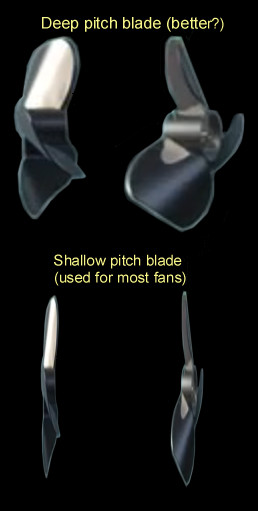
Re:Blade depth is rubbish?
Why don't the blades have a deeper pitch/depth to them. From what I've heard, this increases the efficiency of the wind sucked underneath.
It's the same with cooling fans. Manufacturers (apart from the previous few) always make the blades super thin. It's really dumb, and it causes them to be much louder and waste more energy. Compare:
http://www.skytopia.com/stuff/fan.jpg
Torque.
-
Blade depth is rubbish?
Why don't the blades have a deeper pitch/depth to them. From what I've heard, this increases the efficiency of the wind sucked underneath.
It's the same with cooling fans. Manufacturers (apart from the previous few) always make the blades super thin. It's really dumb, and it causes them to be much louder and waste more energy. Compare:
-
Ultrafast search and metadata filesystem
I have recently found an incredibly fast search tool called Everything. We're talking about Google-like searching where the results pop up as you type. It must be something on the order of a fifth of a second for my 1.5 million files. This kind of technology should be widespread - it makes searches actually *pleasant* to do. Anyway thanks to Everything, I worry less now about where I store my files, and I also try to pack in keywords into the filename.
Anyway, this kind of program is just a glimpse of what a future OS would look like. Imagine a system where everything is stored in tags and where folders become obsolete or used far less often. What you have then is a database or metadata file-system. The relatively new Haiku OS uses such a system, and I wrote about the massive advantages from this old page:
http://www.skytopia.com/project/articles/filesystem.html
Honestly, we'll all be better off the sooner we switch. -
On a similar theme...
Nice illusion indeed, and at least partially new. A while back, I combined two different illusions to make a single more effective illusion. I wonder if there's any connection with the one in the news article as they both seem to rely on the movement of peripheral vision confusing other aspects of change in peripheral vision:
http://www.skytopia.com/project/illusion/ipage-vb.html
The effect this one achieves is the disappearence of visual areas rather than 'merely' lessening the effect. Although mine is arguably more dramatic once it happens, it can be slightly tricky to see the effect immediately compared to the one in the news article. -
Re:he's right
No, no it doesn't. I have access to sense data. I have access to emotions. I do not have access to qualia, I don't even know what it is supposed to be since you wont provide me with a definition.
Surely you have at least a vague idea of what I'm referring to? How different red is from blue, how they're both totally indescribable, but somehow very real regardless (albeit very abstract)? 'Elemental' is another word I would use.
I don't know what it is either exactly, but it's definitely something tangible. Do you even consider that as a remote possibility? Is there just something about qualia which says to you something that suggests the merest hint of something 'weird' going on about say, the colour red, or a musical chord, or the taste of cinnamon? Surely you must know what I'm talking about. You can disagree, but you must know what I mean.
It just seems stupid to me that one can't say: "I'm seeing (or not seeing) the same colour as you are when I look at that tree/lake", and not actually mean something when one says it. Essentially, you're saying the above statement is meaningless.
Finally, see the 'Eclipse of Mars' illusion I created a while back at the top of this URL. It may not change your mind, but you can't get a stronger quale than that! http://www.skytopia.com/project/illusion/2illusion.html -
And this is progress?
I'm closer to being a Google fan than most probably, but after seeing the video, they intend to abolish the desktop, and nothing (yes none of your own files) will be stored on your own computer. I'm sorry, but ignoring everything else, I dread the amount of lag if everything ran off the internet. Programs such as Photoshop or Visual Studio would download every time instead of run immediately? No thanks.
In a perfect world with infinite bandwidth, and no lag, maybe it's doable.
What would make me truly respect them is if they came up with something like BeOS, or QNX (Haiku), but which also had a metadata/database file system where everything is searched for, and folders become less of an issue (or not needed at all). Encouraging programs to be more self-contained would also be a step forwards too. -
How programmable though.
A decade or so back, I created something called "Super Magnet", and the whole idea was to create a system of atoms/magnets with completely customizable forces - a bit like an infinitely extendable version of what Nature does.
Yes, I know this is in software, but the results can be pretty cool:
http://www.youtube.com/watch?v=LTW09McfCjA
http://www.youtube.com/watch?v=jdfSWsTBtyE
http://www.skytopia.com/project/magnet/magnet.html
Bear in mind these animations are about 10 years old - modern hardware and algorithms would use many more magnets (though creativity counts for quite a bit too). -
Trickier puzzle
It's an interesting problem, but a slightly trickier probability puzzle in the Snooker Table of Doom:
-
Re:RGB
Parent is correct. Any colours around green and cyan are usually terribly unsaturated on most monitors. In fact, even in 'real life', it isn't theoretically possible to experience true cyan/aqua because the nearest direct wavelength will stimulate the red eye cone to some extent creating colour pollution.
There is a trick around this, which can be found by over-saturating the red cone. This weakens it temporarily, and then when shortly afterwards you see anything resembling cyan, it will appear as close to the true qualia as you could ever expect. The "Eclipse of Mars" illusion that follows in the below link demonstrates this for those who are curious:
-
Mandelbulb mayhem
Impressive stuff. Their next project now can be the infinitely detailed surface of the Mandelbulb:
-
Using Google to find the best host
FWIW, I spent a few good months compiling data from the 'wisom of the masses' - i.e. along searching for quotes such as "I love host x", or "I hate host x". It sounds as though it could be open to spam, but I managed to filter out these kind of comments (as well as affiliate based incentives). Here are my findings (including fully open and reproducible results and full technique):
-
ICDSoft
Are excellent, though I have no idea how big they'll scale.
Their support is literally incredible: they replied to my question (before joining) within 7 minutes.
Also, see the article 'Finding The Best Web Site Hosts The Googalistic Way'---'s awesome.
-
I'd like to see. . .
Department of energy?
Mapping weather systems?
Cracking high bit encryption schemes? Listening to every phone call happening on the planet and mapping social patterns?
BORING!
No, I want to see a 100 million core supercomputer render one of those 3D "Mandelbulbs" and let me do some real-time exploring with a VR helmet.
Now THAT would be a worthy use for such resources!
That and being able to grow virtual beings from DNA samples.
-FL
-
Re:Animated quaternion
Not to rain on your parade
We're comparing a power 8 version of the generlized Mandelbrot formula (Zn+1=Zn^k + C, with k=8) against a power-2 quaternion Julia.
In the epilogue, the author admits that there's less variety in the Mandelbulb-8 than even in the classic Mandelbrot.
-
Not a "true" 3D Mandelbrot
It's definitely nifty, the pictures are beautiful, and the creator deserves praise, but the author himself says it's probably not a "true" 3D Mandelbrot:
http://www.skytopia.com/project/fractal/2mandelbulb.html#epilogue
As exquisite as the detail is in our discovery, there's good reason to believe that it isn't the real McCoy.
Evidence it's not the holy grail? Well, the most obvious is that the standard quadratic version isn't anything special. Only higher powers (around after 3-5) seem to capture the detail that one might expect. The original 2D Mandelbrot has organic detail even in the standard power/order 2 version. Even power 8 in the 3D Mandelbulb has smeared 'whipped cream' sections, which are nice in a way as they provide contrast to the more detailed parts, but again, they wouldn't compare to the variety one might expect from a 3D version of Seahorse valley.So, Slashdot, I know this is asking a lot, but can you PLEASE at least read the article before posting? Thanks.
-
Re:Just another flavour of Linux?
The database file system sounds interesting. Can you let me know how close it is to the (short-ish, readable) article here:
-
Re:Try Windows 7?
1: But do they all inter-operate perfectly? That's a rhetorical question because I've heard a few times from slashdot users how lots of distros (or even programs within one distro) won't interoperate perfectly (whether it's GUI stuff, formats, or other stuff).
2: Does it really have a full metadata system where everything can stored in one folder (without naming duplication issues), and where programs and stuff still continues to operate? And does the system really automatically summon a brand new open/save requester for each program out there to take advantage of this new system (example: allowing one to edit the metadata on saving)? I doubt it supports everything that this page shows, but even it does, we want this system to be standard/default throughout all of the OS, simply because it is a *better* way of working than a hierarchical approach (it can practically subsume it for one).
3: 'Snappy' is that under-rated metric that's hard to define or measure but which definitely exists. We're talking about sub-second pauses after clicking buttons, opening programs, popping up a menu, refreshing windows, multi-tasking - all that kind of thing. I've heard again from slashdot users that Ubuntu is less responsive/snappy than Win 7.
4: While I think you're right technically, an OS with a database/metadata OS as standard is going to be a heck of a lot closer than the current mess we have. Refinements after that will be incremental and be much more compatible with the OS we would use in 500 years time. There's only so much you can do with an OS after all.
-
Sleep is an addiction
Bah, if only people realised that sleep was an addictive habit and could be eliminated altogether through sheer willpower alone! My years of research provide 140% proof of that:
-
Key swaps...
Here's a better idea - make the = and + key reverse, so that shift produces =, and pressing it normally makes +. This way it would be like the minus key.
Here's another idea. Have the parenthesis keys replace the less often used square brackets (and swap them, so that shift+9 is [ instead. Either that, or add more keys for the parenthesis symbols instead of using shift to get them.
Finally, even better than the above ideas, let's all have a keyboard where you can define what they keys are, like the new Optimus OLED keyboard. -
Sleep kills?
Nonsense of course. All my research proves the contrary.
Everyone who's wise knows sleep is really an addictive illness that needs to be overcome. -
Graph truncated
All well and good, but unfortunately the graph on the web site is truncated. Here is the real version: http://www.skytopia.com/stuff/graph.png
-
Re:I agree!
Sleep addiction has been covered before: "Sleep Is An Addictive Illness"
-
Re:Basic feature?
Simply because our filesystems are too slow for the kind of metadata style databases that music programs use.
Instead of basing our music players around the filesystem, we should base our filesystems around our music players. The resulting metadata/tagged (database) file system works much better in the end.
Linky -
Database/metadata filesystem
The hierachrical system is an outdated concept based on traditional methods of meat-space organization.
I'm surprised no one else has mentioned this yet, but a metadata filesystem would save so much time. Tracks would be autotagged with timestamp, size, and filetype if possible, but allowing the user to set their own custom tags would bring out the real benefits.
It would work like Google, where every file is in a single folder. You would an ultra-fast filter window to narrow down to any criteria. Tags could be reused easily (the filesystem would save recently used tags in a dropdown menu on opening or saving), and a thesaurus would help detect near misses if need be. Here's a little more info:
http://www.skytopia.com/project/articles/filesystem.html
In any case, for all the hardened folder adherents, there's no reason why they two systems can't coexist.
-
Re:Pointless
The CLI may be faster than a GUI based OS for file manipulation once you're used to it. But using a metadata/tag based filesystem would be a quantum leap above both.
-
Re:Buddhabrot
Not bad, but not a thousandth as good as what the real 3D mandelbrot would look like. I have this link as my sig which is just a happy coincidence
-
Re:Winamp becoming Damned Irritating
Try MediaMonkey. It's similar to Winamp's speed and relative unbloatwareness, but unlike Winamp, it doesn't seem like it's going to be sold to the next Yahoo, AOL, or M$.
I've recently switched and couldn't be happier. Here's a in-depth review should you need convincing. -
Re:LED lighting
Got it today, and wired up. It didn't explode and here's a photo
-
Re:just just
There is arguably no one alive today in the west that is culturally conditioned to prefer just intonation.
Playing or listening to music in JI (and there is quite a lot of the stuff out there if you look carefully) could be enough to be 'conditioned', and of course, there are many JI advocates who prefer the sound of JI for whatever reasons.
I'm a barbershop singer, and we have to deal with oddities such as having to sing an ascending third sharper than we think it should be when the melody is moving up by that interval, yet when singing the third as part of a harmony, it will have to be flatter to be in tune.
Interestingly, in one study on Barbershop singing, they found a preference towards the equal tempered major third, but the minor seventh, they preferred the pure version. (ref).
I would say: Both versions (ET & JI) sound good in different ways, but the JI version sounds good in the sense that it's almost not quite there, and therefore affects the 'overall timbre', rather than the sense of harmony. I myself do appreciate the sound that can result of simple intervals like this.
However, it's worth stressing again that (I believe) this is a different kind of consonance to the consonance type usually associated with the twelve chromatic intervals of the scale. I'm sure you'd agree that they sound good in different ways, and that even as part of the a static chord, the ET version has a slight advantage (in one way, if not in the other) over the JI version?
-
Re:Frist Psot?
This is true, but as far as perception of musical consonance/dissonance goes, logarithms don't mean much. It's the harmonic series that serves as the foundation of music.
I think it would be more correct to say that the harmonic series serves as the foundation of timbre, rather than music or harmony per se. The twelve notes may use very similar, but not quite the same pitches as those found in the harmonic series.
Evidence of this is how the seventh harmonic feels nice in it's own way (in a timbral/camouflaging sense), but in another way, it feels very flat compared to the 12-et equivalent. More importantly, the minor third isn't adequately represented by the harmonic series.
But yes, individual preference for one tuning over another is surely a result of cultural conditioning.
Despite what I said about this, it could still be the case that one of the models (ET or Just) represents the intervals of the scale best. I only meant that Just intonation had no particularly special reason to be chosen over ET as the basis of the scale.
but one cannot say one of these scales is better, or truer, than the other; merely that one has a subjective preference.
Yes one may be able to say that
Quoting from that article:
"...at least a subset of the [12-ET] scale at least partially generalizes to at least Indian, Chinese and Arab-Persian music as well [55][56][57][58] (also see [59][193][195][61][62]))."
See all the references from 55 onwards - a real goldmine of info -
Re:Frist Psot?
I'll take issue with the fact that equal tempered is necessarily a compromise, and how vocalists and violinists etc. will naturally strive for the 'pure' ratios.
In fact various studies have shown the reverse (equal temperament being the preferred intervals), and many more studies have shown ambiguous results.
The numbers of equal temperament might look arbitrary (1.25992 instead of 1.25 for the major third, and 1.3348 instead of 1.3333 for the major fourth), but on a logarithmic scale, they are perfectly neat (2^(4/12) or 2^(5/12)).
I myself prefer the equal tempered intervals. To me, it's the Just ones which sound off. Yes, I might be culturally conditioned, but then who's to say that the people who prefer just intoned intervals aren't culturally conditioned?
After tons of research into the phenomenon, I haven't even begun to touch upon some of the more intricate issues, but the earlier link, and particularly this one (my site) is a good place start to learn how crazily complex the whole thing is. -
Re:Frist Psot?
I'll take issue with the fact that equal tempered is necessarily a compromise, and how vocalists and violinists etc. will naturally strive for the 'pure' ratios.
In fact various studies have shown the reverse (equal temperament being the preferred intervals), and many more studies have shown ambiguous results.
The numbers of equal temperament might look arbitrary (1.25992 instead of 1.25 for the major third, and 1.3348 instead of 1.3333 for the major fourth), but on a logarithmic scale, they are perfectly neat (2^(4/12) or 2^(5/12)).
I myself prefer the equal tempered intervals. To me, it's the Just ones which sound off. Yes, I might be culturally conditioned, but then who's to say that the people who prefer just intoned intervals aren't culturally conditioned?
After tons of research into the phenomenon, I haven't even begun to touch upon some of the more intricate issues, but the earlier link, and particularly this one (my site) is a good place start to learn how crazily complex the whole thing is.