Slashdot Mirror
Domain: slashdot.org
Stories and comments across the archive that link to slashdot.org.
Stories · 37,380
-
The Best Parking Apps You've Never Heard Of and Why You Haven't
Bennett Haselton writes "If you read no further, use either the BestParking or ParkMe app to search all nearby parking garages for the cheapest spot, based on the time you're arriving and leaving. I'm interested in the question of why so few people know about these apps, how is it that they've been partially crowded out by other 'parking apps' that are much less useful, and why our marketplace for ideas and intellectual properly is still so inefficient." Read below to see what Bennett has to say.I casually asked a couple of my friends in Seattle -- where street parking is often unavailable, and parking garages vary widely in price -- if they'd ever heard of an app that would let them find the cheapest available parking garage, based on the time they wanted to enter and the time they planned on leaving. (Street parking is usually cheaper if you can find it, but the app would be useful for times that you can't find any.) Most of my friends said that they'd never heard of such an app, but they'd definitely use one if it existed. I also looked up parking apps on Google but the small subset that I randomly tried out, didn't do what I needed. So I thought about writing a "Somebody-with-more-time-than-me-should-go-and-do-this-thing" article, similar to the ride-swapping piece, when one of my friends casually mentioned the BestParking app.
Well, I tried it and it worked. (Lest I be accused of undue favoritism, ParkMe does the same thing just as well, although I didn't find it until later.) In both apps, you bring up a map centered on your current location, or scroll the map to where you plan on looking for parking later. You enter the time that you'll be entering and leaving, and the app shows a map with each parking garage represented by an icon showing the dollar amount that it will cost to park for that time. Without these apps, comparing rates is an annoyingly complex process to do by hand, in a crowded city like Seattle with many garages with different rates (and different times when their "evening rates" kick in -- usually 5 PM, but ranging from 4 to 7 PM), but the apps factor all of that in to give you the cheapest garage for the given time range. You can tap the individual garage icons for more information (if you plan on returning by 11 PM but you're not sure, you'd probably prefer a 24-hour garage instead of one that locks up at midnight). Also, if you're sitting at your computer and you already know the neighborhood where you'll be parking later, you can do the same search on each of their websites. (Although if you are on your phone, please don't do this from a moving car, duh. In Seattle there are plenty of 3-minute spots where you can pull over and do a search.)
So, I've been quite happy with both apps -- but I thought it was interesting that almost none of my friends had ever heard of them. I threw a quick survey up on Amazon's Mechanical Turk website, which I've used before for crowdsourced surveys and other experiments. I polled 50 people, offering them 25 cents apiece to answer these questions:
Would you use these apps? Section A: Parking garage app
Suppose a website and/or smartphone app existed where you could specify a neighborhood of a city, and enter a start and end time for when you wanted to park, and the app would automatically find the cheapest parking garage for that time range (assuming its too hard to find street parking).
1. Are you aware of any such apps/websites that already exist? If yes, whats the name of the app? (No need to do a web search -- only answer "Yes" if you already know of such an app or website.)
2. Would you use such an app/website if it existed? (Or, if youre aware of such an app that already exists, do you use it?)
Yes/No Section B: Spare room rental app
Suppose a website and/or smartphone app existed where you could list a room in your house as a temporary rental, and visitors to your city could rent it out for a single night, or more.
3. Are you aware of any such apps/websites that already exist? If yes, whats the name of the app? (No need to do a web search -- only answer "Yes" if you already know of such an app or website.)
4. Would you use such an app/website if it existed? (Or, if youre aware of such an app that already exists, do you use it?)
Yes/No
The second section, about a spare room rental app, was thrown in as a control in the experiment -- I knew the answer to that question (AirBnB), and I thought a large portion of the survey-takers would too, so I wanted to make sure they weren't just filling out the survey with blow-off answers to get the 25 cents as fast as possible.
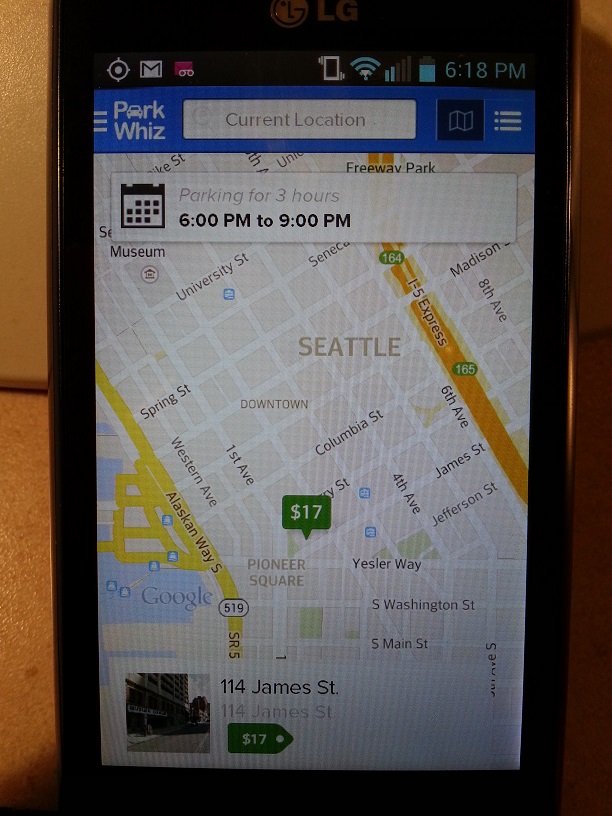
Of the 50 people who filled out the survey, 14 of them said they had heard of using AirBnB, Couchsurfing, or Craigslist for the purpose of renting out a room or finding one to rent (almost all of them mentioned AirBnB specifically). But of the same 50 respondents, only two of them mentioned any parking apps that they had heard of, and only one of them mentioned one of the two that I'd found which actually worked. (The other person mentioned an app called ParkWhiz, which, when I tested it out, only displayed one $17 parking garage in a neighborhood where I know of several $5 garages, which BestParking and ParkMe did list correctly.)
This seems to confirm the anecdotal evidence from my survey of my Seattle friends -- there is a great deficiency in awareness of these apps, relative to how useful people would find them if they knew about them.
So how is it that people are finding -- or not finding -- these apps? In a Google search for "parking app", the first result was an ad for ParkWhiz. BestParking and ParkMe did show up in the results, but so did another one called Parker, as well as a Mashable article by Kate Freeman listing "7 City Parking Apps to Save You Time, Money and Gas". Of the apps listed in the article, the only city-specific one that worked in Seattle (PrimoSpot) has been discontinued, and of the non-city-specific ones, only Parker is still around. (The article doesn't even mention BestParking or ParkMe, although I don't know if they existed when it was written.) Finally, a friend in my survey told me about an app called Parkopedia, which has over 100,000 downloads on Google Play (the same as BestParking, and more than ParkMe).
So even if it did occur to you to look for a parking-garage-finding app, the problem is that if you randomly picked one of the five most popular parking apps (BestParking, Parker, ParkMe, Parkopedia, and ParkWhiz), you might accidentally pick one of the three out of five that is a fail:
-
ParkWhiz, as noted above, only showed one $17 garage in a neighborhood full of other, cheaper garages.
-
Both ParkMe and Parkopedia display their results as a map with an icon marking each parking garage -- but with no price information. Simply having a map of parking garage locations isn't too useful, since you could get that by searching Google Maps for "parking" anyway. In both apps, you can click on parking garage icons to bring up a window showing their rates, but in Parker most of the listed garages just said "Contact facility for current rates". Parkopedia did usually display the rates for different garages -- but it's a pain to click on each of a dozen parking garage icons looking for the cheapest one. A typical area of downtown Seattle will have one garage where you can park for $5 for the evening, surrounded by garages where parking costs $10 or more, but Parkopedia doesn't make it easy to find it. And neither app lets you specify a start and end time for your parking so that you can find the cheapest garage for that time range.
So it seems odd that according to the Google Play store, Parkopedia has more downloads than ParkMe (100,000+ vs 50,000+), even though ParkMe seems a lot more useful. Meanwhile ParkWhiz, the one that found only one overpriced parking garage in a neighborhood full of cheaper ones, has fewer downloads but a slightly higher star rating in the app store than ParkMe. Of course in my parking-app survey of friends and Mechanical Turk users, the far-and-a-way winner was simply not knowing that any of these apps existed at all.
And here's why it matters to you even if you ride a granola-powered bike to work: I think this is a confirming instance of what I've been arguing for years, that the marketplace for ideas, inventions, and intellectual property is far less efficient than most people think it is. Every day a huge amount of human capital is squandered by people trying to jostle their competitors out of Google search results, or even just trying to raise the capital to advertise their products to people who would find them extremely useful, but will never find out about it if the venture capitalists don't come through with the money to advertise it. All of that is time and effort that could have instead gone towards making the products better.
I've suggested an algorithm based on "random-sample voting" as an antidote to some of these market inefficiencies, such as stopping people from buying votes on Digg, promoting the best ideas on Obama's "We The People" petition website, or even deciding whether J.K. Rowling is the world's greatest author or just lucky. Basically, in each scenario, the competing entities -- whether apps, or songs, or ideas for improving U.S. government policy -- would be rated by a sufficiently large random sample of qualified raters. ("Qualified raters" might mean economists in the case of the White House policy-petition website, or it might mean music consumers in the case of an algorithm to find the best new songs.) Each entity would receive an average rating from those raters, and then the entities with the highest average rating would be the ones promoted to the widest audience (at the top of Google search results, for example). It sounds deceptively simple, but it's far less amenable to "gaming the system", because you can't rope in your friends to vote for your app, or pay voters to rate you highly on Digg. The only way to win in this system is to make your song, idea, or app, the best that it can be -- which means your human capital is being channeled productively, instead of being wasted hiring an SEO company to try and knock your competition out of the top spot on Google.
If competition between parking apps worked this way, then all the current users of Parker, ParkWhiz and Parkopedia, would switch to BestParking and ParkMe, saving themselves a lot of hassle in the process, and those second-rate apps would have never even gotten on the ground unless they got their act together and implemented the same features. More broadly, if competition in the marketplace of ideas worked this way, then there wouldn't be so many users who really wish they could have an app like this, without realizing that the apps exist!
One striking thing about looking at a map of downtown parking garages, is how wildly the rates vary from each other, with $15 garages situated right next to the $5 ones. In theory, in a competitive marketplace, such rates should stabilize around a single price, for goods that are roughly comparable. But the $10 lots do still manage to get some customers who don't know any better, because it's just not practical to criss-cross a grid of several dozen city blocks looking for the cheapest garage. BestParking and ParkMe help people deal with this inefficient marketplace. So it's ironic that they're being held back by a marketplace for ideas that operates just as inefficiently in its own way.
-
-
The Best Parking Apps You've Never Heard Of and Why You Haven't
Bennett Haselton writes "If you read no further, use either the BestParking or ParkMe app to search all nearby parking garages for the cheapest spot, based on the time you're arriving and leaving. I'm interested in the question of why so few people know about these apps, how is it that they've been partially crowded out by other 'parking apps' that are much less useful, and why our marketplace for ideas and intellectual properly is still so inefficient." Read below to see what Bennett has to say.I casually asked a couple of my friends in Seattle -- where street parking is often unavailable, and parking garages vary widely in price -- if they'd ever heard of an app that would let them find the cheapest available parking garage, based on the time they wanted to enter and the time they planned on leaving. (Street parking is usually cheaper if you can find it, but the app would be useful for times that you can't find any.) Most of my friends said that they'd never heard of such an app, but they'd definitely use one if it existed. I also looked up parking apps on Google but the small subset that I randomly tried out, didn't do what I needed. So I thought about writing a "Somebody-with-more-time-than-me-should-go-and-do-this-thing" article, similar to the ride-swapping piece, when one of my friends casually mentioned the BestParking app.
Well, I tried it and it worked. (Lest I be accused of undue favoritism, ParkMe does the same thing just as well, although I didn't find it until later.) In both apps, you bring up a map centered on your current location, or scroll the map to where you plan on looking for parking later. You enter the time that you'll be entering and leaving, and the app shows a map with each parking garage represented by an icon showing the dollar amount that it will cost to park for that time. Without these apps, comparing rates is an annoyingly complex process to do by hand, in a crowded city like Seattle with many garages with different rates (and different times when their "evening rates" kick in -- usually 5 PM, but ranging from 4 to 7 PM), but the apps factor all of that in to give you the cheapest garage for the given time range. You can tap the individual garage icons for more information (if you plan on returning by 11 PM but you're not sure, you'd probably prefer a 24-hour garage instead of one that locks up at midnight). Also, if you're sitting at your computer and you already know the neighborhood where you'll be parking later, you can do the same search on each of their websites. (Although if you are on your phone, please don't do this from a moving car, duh. In Seattle there are plenty of 3-minute spots where you can pull over and do a search.)
So, I've been quite happy with both apps -- but I thought it was interesting that almost none of my friends had ever heard of them. I threw a quick survey up on Amazon's Mechanical Turk website, which I've used before for crowdsourced surveys and other experiments. I polled 50 people, offering them 25 cents apiece to answer these questions:
Would you use these apps? Section A: Parking garage app
Suppose a website and/or smartphone app existed where you could specify a neighborhood of a city, and enter a start and end time for when you wanted to park, and the app would automatically find the cheapest parking garage for that time range (assuming its too hard to find street parking).
1. Are you aware of any such apps/websites that already exist? If yes, whats the name of the app? (No need to do a web search -- only answer "Yes" if you already know of such an app or website.)
2. Would you use such an app/website if it existed? (Or, if youre aware of such an app that already exists, do you use it?)
Yes/No Section B: Spare room rental app
Suppose a website and/or smartphone app existed where you could list a room in your house as a temporary rental, and visitors to your city could rent it out for a single night, or more.
3. Are you aware of any such apps/websites that already exist? If yes, whats the name of the app? (No need to do a web search -- only answer "Yes" if you already know of such an app or website.)
4. Would you use such an app/website if it existed? (Or, if youre aware of such an app that already exists, do you use it?)
Yes/No
The second section, about a spare room rental app, was thrown in as a control in the experiment -- I knew the answer to that question (AirBnB), and I thought a large portion of the survey-takers would too, so I wanted to make sure they weren't just filling out the survey with blow-off answers to get the 25 cents as fast as possible.
Of the 50 people who filled out the survey, 14 of them said they had heard of using AirBnB, Couchsurfing, or Craigslist for the purpose of renting out a room or finding one to rent (almost all of them mentioned AirBnB specifically). But of the same 50 respondents, only two of them mentioned any parking apps that they had heard of, and only one of them mentioned one of the two that I'd found which actually worked. (The other person mentioned an app called ParkWhiz, which, when I tested it out, only displayed one $17 parking garage in a neighborhood where I know of several $5 garages, which BestParking and ParkMe did list correctly.)
This seems to confirm the anecdotal evidence from my survey of my Seattle friends -- there is a great deficiency in awareness of these apps, relative to how useful people would find them if they knew about them.
So how is it that people are finding -- or not finding -- these apps? In a Google search for "parking app", the first result was an ad for ParkWhiz. BestParking and ParkMe did show up in the results, but so did another one called Parker, as well as a Mashable article by Kate Freeman listing "7 City Parking Apps to Save You Time, Money and Gas". Of the apps listed in the article, the only city-specific one that worked in Seattle (PrimoSpot) has been discontinued, and of the non-city-specific ones, only Parker is still around. (The article doesn't even mention BestParking or ParkMe, although I don't know if they existed when it was written.) Finally, a friend in my survey told me about an app called Parkopedia, which has over 100,000 downloads on Google Play (the same as BestParking, and more than ParkMe).
So even if it did occur to you to look for a parking-garage-finding app, the problem is that if you randomly picked one of the five most popular parking apps (BestParking, Parker, ParkMe, Parkopedia, and ParkWhiz), you might accidentally pick one of the three out of five that is a fail:
-
ParkWhiz, as noted above, only showed one $17 garage in a neighborhood full of other, cheaper garages.
-
Both ParkMe and Parkopedia display their results as a map with an icon marking each parking garage -- but with no price information. Simply having a map of parking garage locations isn't too useful, since you could get that by searching Google Maps for "parking" anyway. In both apps, you can click on parking garage icons to bring up a window showing their rates, but in Parker most of the listed garages just said "Contact facility for current rates". Parkopedia did usually display the rates for different garages -- but it's a pain to click on each of a dozen parking garage icons looking for the cheapest one. A typical area of downtown Seattle will have one garage where you can park for $5 for the evening, surrounded by garages where parking costs $10 or more, but Parkopedia doesn't make it easy to find it. And neither app lets you specify a start and end time for your parking so that you can find the cheapest garage for that time range.
So it seems odd that according to the Google Play store, Parkopedia has more downloads than ParkMe (100,000+ vs 50,000+), even though ParkMe seems a lot more useful. Meanwhile ParkWhiz, the one that found only one overpriced parking garage in a neighborhood full of cheaper ones, has fewer downloads but a slightly higher star rating in the app store than ParkMe. Of course in my parking-app survey of friends and Mechanical Turk users, the far-and-a-way winner was simply not knowing that any of these apps existed at all.
And here's why it matters to you even if you ride a granola-powered bike to work: I think this is a confirming instance of what I've been arguing for years, that the marketplace for ideas, inventions, and intellectual property is far less efficient than most people think it is. Every day a huge amount of human capital is squandered by people trying to jostle their competitors out of Google search results, or even just trying to raise the capital to advertise their products to people who would find them extremely useful, but will never find out about it if the venture capitalists don't come through with the money to advertise it. All of that is time and effort that could have instead gone towards making the products better.
I've suggested an algorithm based on "random-sample voting" as an antidote to some of these market inefficiencies, such as stopping people from buying votes on Digg, promoting the best ideas on Obama's "We The People" petition website, or even deciding whether J.K. Rowling is the world's greatest author or just lucky. Basically, in each scenario, the competing entities -- whether apps, or songs, or ideas for improving U.S. government policy -- would be rated by a sufficiently large random sample of qualified raters. ("Qualified raters" might mean economists in the case of the White House policy-petition website, or it might mean music consumers in the case of an algorithm to find the best new songs.) Each entity would receive an average rating from those raters, and then the entities with the highest average rating would be the ones promoted to the widest audience (at the top of Google search results, for example). It sounds deceptively simple, but it's far less amenable to "gaming the system", because you can't rope in your friends to vote for your app, or pay voters to rate you highly on Digg. The only way to win in this system is to make your song, idea, or app, the best that it can be -- which means your human capital is being channeled productively, instead of being wasted hiring an SEO company to try and knock your competition out of the top spot on Google.
If competition between parking apps worked this way, then all the current users of Parker, ParkWhiz and Parkopedia, would switch to BestParking and ParkMe, saving themselves a lot of hassle in the process, and those second-rate apps would have never even gotten on the ground unless they got their act together and implemented the same features. More broadly, if competition in the marketplace of ideas worked this way, then there wouldn't be so many users who really wish they could have an app like this, without realizing that the apps exist!
One striking thing about looking at a map of downtown parking garages, is how wildly the rates vary from each other, with $15 garages situated right next to the $5 ones. In theory, in a competitive marketplace, such rates should stabilize around a single price, for goods that are roughly comparable. But the $10 lots do still manage to get some customers who don't know any better, because it's just not practical to criss-cross a grid of several dozen city blocks looking for the cheapest garage. BestParking and ParkMe help people deal with this inefficient marketplace. So it's ironic that they're being held back by a marketplace for ideas that operates just as inefficiently in its own way.
-
-
The Best Parking Apps You've Never Heard Of and Why You Haven't
Bennett Haselton writes "If you read no further, use either the BestParking or ParkMe app to search all nearby parking garages for the cheapest spot, based on the time you're arriving and leaving. I'm interested in the question of why so few people know about these apps, how is it that they've been partially crowded out by other 'parking apps' that are much less useful, and why our marketplace for ideas and intellectual properly is still so inefficient." Read below to see what Bennett has to say.I casually asked a couple of my friends in Seattle -- where street parking is often unavailable, and parking garages vary widely in price -- if they'd ever heard of an app that would let them find the cheapest available parking garage, based on the time they wanted to enter and the time they planned on leaving. (Street parking is usually cheaper if you can find it, but the app would be useful for times that you can't find any.) Most of my friends said that they'd never heard of such an app, but they'd definitely use one if it existed. I also looked up parking apps on Google but the small subset that I randomly tried out, didn't do what I needed. So I thought about writing a "Somebody-with-more-time-than-me-should-go-and-do-this-thing" article, similar to the ride-swapping piece, when one of my friends casually mentioned the BestParking app.
Well, I tried it and it worked. (Lest I be accused of undue favoritism, ParkMe does the same thing just as well, although I didn't find it until later.) In both apps, you bring up a map centered on your current location, or scroll the map to where you plan on looking for parking later. You enter the time that you'll be entering and leaving, and the app shows a map with each parking garage represented by an icon showing the dollar amount that it will cost to park for that time. Without these apps, comparing rates is an annoyingly complex process to do by hand, in a crowded city like Seattle with many garages with different rates (and different times when their "evening rates" kick in -- usually 5 PM, but ranging from 4 to 7 PM), but the apps factor all of that in to give you the cheapest garage for the given time range. You can tap the individual garage icons for more information (if you plan on returning by 11 PM but you're not sure, you'd probably prefer a 24-hour garage instead of one that locks up at midnight). Also, if you're sitting at your computer and you already know the neighborhood where you'll be parking later, you can do the same search on each of their websites. (Although if you are on your phone, please don't do this from a moving car, duh. In Seattle there are plenty of 3-minute spots where you can pull over and do a search.)
So, I've been quite happy with both apps -- but I thought it was interesting that almost none of my friends had ever heard of them. I threw a quick survey up on Amazon's Mechanical Turk website, which I've used before for crowdsourced surveys and other experiments. I polled 50 people, offering them 25 cents apiece to answer these questions:
Would you use these apps? Section A: Parking garage app
Suppose a website and/or smartphone app existed where you could specify a neighborhood of a city, and enter a start and end time for when you wanted to park, and the app would automatically find the cheapest parking garage for that time range (assuming its too hard to find street parking).
1. Are you aware of any such apps/websites that already exist? If yes, whats the name of the app? (No need to do a web search -- only answer "Yes" if you already know of such an app or website.)
2. Would you use such an app/website if it existed? (Or, if youre aware of such an app that already exists, do you use it?)
Yes/No Section B: Spare room rental app
Suppose a website and/or smartphone app existed where you could list a room in your house as a temporary rental, and visitors to your city could rent it out for a single night, or more.
3. Are you aware of any such apps/websites that already exist? If yes, whats the name of the app? (No need to do a web search -- only answer "Yes" if you already know of such an app or website.)
4. Would you use such an app/website if it existed? (Or, if youre aware of such an app that already exists, do you use it?)
Yes/No
The second section, about a spare room rental app, was thrown in as a control in the experiment -- I knew the answer to that question (AirBnB), and I thought a large portion of the survey-takers would too, so I wanted to make sure they weren't just filling out the survey with blow-off answers to get the 25 cents as fast as possible.
Of the 50 people who filled out the survey, 14 of them said they had heard of using AirBnB, Couchsurfing, or Craigslist for the purpose of renting out a room or finding one to rent (almost all of them mentioned AirBnB specifically). But of the same 50 respondents, only two of them mentioned any parking apps that they had heard of, and only one of them mentioned one of the two that I'd found which actually worked. (The other person mentioned an app called ParkWhiz, which, when I tested it out, only displayed one $17 parking garage in a neighborhood where I know of several $5 garages, which BestParking and ParkMe did list correctly.)
This seems to confirm the anecdotal evidence from my survey of my Seattle friends -- there is a great deficiency in awareness of these apps, relative to how useful people would find them if they knew about them.
So how is it that people are finding -- or not finding -- these apps? In a Google search for "parking app", the first result was an ad for ParkWhiz. BestParking and ParkMe did show up in the results, but so did another one called Parker, as well as a Mashable article by Kate Freeman listing "7 City Parking Apps to Save You Time, Money and Gas". Of the apps listed in the article, the only city-specific one that worked in Seattle (PrimoSpot) has been discontinued, and of the non-city-specific ones, only Parker is still around. (The article doesn't even mention BestParking or ParkMe, although I don't know if they existed when it was written.) Finally, a friend in my survey told me about an app called Parkopedia, which has over 100,000 downloads on Google Play (the same as BestParking, and more than ParkMe).
So even if it did occur to you to look for a parking-garage-finding app, the problem is that if you randomly picked one of the five most popular parking apps (BestParking, Parker, ParkMe, Parkopedia, and ParkWhiz), you might accidentally pick one of the three out of five that is a fail:
-
ParkWhiz, as noted above, only showed one $17 garage in a neighborhood full of other, cheaper garages.
-
Both ParkMe and Parkopedia display their results as a map with an icon marking each parking garage -- but with no price information. Simply having a map of parking garage locations isn't too useful, since you could get that by searching Google Maps for "parking" anyway. In both apps, you can click on parking garage icons to bring up a window showing their rates, but in Parker most of the listed garages just said "Contact facility for current rates". Parkopedia did usually display the rates for different garages -- but it's a pain to click on each of a dozen parking garage icons looking for the cheapest one. A typical area of downtown Seattle will have one garage where you can park for $5 for the evening, surrounded by garages where parking costs $10 or more, but Parkopedia doesn't make it easy to find it. And neither app lets you specify a start and end time for your parking so that you can find the cheapest garage for that time range.
So it seems odd that according to the Google Play store, Parkopedia has more downloads than ParkMe (100,000+ vs 50,000+), even though ParkMe seems a lot more useful. Meanwhile ParkWhiz, the one that found only one overpriced parking garage in a neighborhood full of cheaper ones, has fewer downloads but a slightly higher star rating in the app store than ParkMe. Of course in my parking-app survey of friends and Mechanical Turk users, the far-and-a-way winner was simply not knowing that any of these apps existed at all.
And here's why it matters to you even if you ride a granola-powered bike to work: I think this is a confirming instance of what I've been arguing for years, that the marketplace for ideas, inventions, and intellectual property is far less efficient than most people think it is. Every day a huge amount of human capital is squandered by people trying to jostle their competitors out of Google search results, or even just trying to raise the capital to advertise their products to people who would find them extremely useful, but will never find out about it if the venture capitalists don't come through with the money to advertise it. All of that is time and effort that could have instead gone towards making the products better.
I've suggested an algorithm based on "random-sample voting" as an antidote to some of these market inefficiencies, such as stopping people from buying votes on Digg, promoting the best ideas on Obama's "We The People" petition website, or even deciding whether J.K. Rowling is the world's greatest author or just lucky. Basically, in each scenario, the competing entities -- whether apps, or songs, or ideas for improving U.S. government policy -- would be rated by a sufficiently large random sample of qualified raters. ("Qualified raters" might mean economists in the case of the White House policy-petition website, or it might mean music consumers in the case of an algorithm to find the best new songs.) Each entity would receive an average rating from those raters, and then the entities with the highest average rating would be the ones promoted to the widest audience (at the top of Google search results, for example). It sounds deceptively simple, but it's far less amenable to "gaming the system", because you can't rope in your friends to vote for your app, or pay voters to rate you highly on Digg. The only way to win in this system is to make your song, idea, or app, the best that it can be -- which means your human capital is being channeled productively, instead of being wasted hiring an SEO company to try and knock your competition out of the top spot on Google.
If competition between parking apps worked this way, then all the current users of Parker, ParkWhiz and Parkopedia, would switch to BestParking and ParkMe, saving themselves a lot of hassle in the process, and those second-rate apps would have never even gotten on the ground unless they got their act together and implemented the same features. More broadly, if competition in the marketplace of ideas worked this way, then there wouldn't be so many users who really wish they could have an app like this, without realizing that the apps exist!
One striking thing about looking at a map of downtown parking garages, is how wildly the rates vary from each other, with $15 garages situated right next to the $5 ones. In theory, in a competitive marketplace, such rates should stabilize around a single price, for goods that are roughly comparable. But the $10 lots do still manage to get some customers who don't know any better, because it's just not practical to criss-cross a grid of several dozen city blocks looking for the cheapest garage. BestParking and ParkMe help people deal with this inefficient marketplace. So it's ironic that they're being held back by a marketplace for ideas that operates just as inefficiently in its own way.
-
-
The Best Parking Apps You've Never Heard Of and Why You Haven't
Bennett Haselton writes "If you read no further, use either the BestParking or ParkMe app to search all nearby parking garages for the cheapest spot, based on the time you're arriving and leaving. I'm interested in the question of why so few people know about these apps, how is it that they've been partially crowded out by other 'parking apps' that are much less useful, and why our marketplace for ideas and intellectual properly is still so inefficient." Read below to see what Bennett has to say.I casually asked a couple of my friends in Seattle -- where street parking is often unavailable, and parking garages vary widely in price -- if they'd ever heard of an app that would let them find the cheapest available parking garage, based on the time they wanted to enter and the time they planned on leaving. (Street parking is usually cheaper if you can find it, but the app would be useful for times that you can't find any.) Most of my friends said that they'd never heard of such an app, but they'd definitely use one if it existed. I also looked up parking apps on Google but the small subset that I randomly tried out, didn't do what I needed. So I thought about writing a "Somebody-with-more-time-than-me-should-go-and-do-this-thing" article, similar to the ride-swapping piece, when one of my friends casually mentioned the BestParking app.
Well, I tried it and it worked. (Lest I be accused of undue favoritism, ParkMe does the same thing just as well, although I didn't find it until later.) In both apps, you bring up a map centered on your current location, or scroll the map to where you plan on looking for parking later. You enter the time that you'll be entering and leaving, and the app shows a map with each parking garage represented by an icon showing the dollar amount that it will cost to park for that time. Without these apps, comparing rates is an annoyingly complex process to do by hand, in a crowded city like Seattle with many garages with different rates (and different times when their "evening rates" kick in -- usually 5 PM, but ranging from 4 to 7 PM), but the apps factor all of that in to give you the cheapest garage for the given time range. You can tap the individual garage icons for more information (if you plan on returning by 11 PM but you're not sure, you'd probably prefer a 24-hour garage instead of one that locks up at midnight). Also, if you're sitting at your computer and you already know the neighborhood where you'll be parking later, you can do the same search on each of their websites. (Although if you are on your phone, please don't do this from a moving car, duh. In Seattle there are plenty of 3-minute spots where you can pull over and do a search.)
So, I've been quite happy with both apps -- but I thought it was interesting that almost none of my friends had ever heard of them. I threw a quick survey up on Amazon's Mechanical Turk website, which I've used before for crowdsourced surveys and other experiments. I polled 50 people, offering them 25 cents apiece to answer these questions:
Would you use these apps? Section A: Parking garage app
Suppose a website and/or smartphone app existed where you could specify a neighborhood of a city, and enter a start and end time for when you wanted to park, and the app would automatically find the cheapest parking garage for that time range (assuming its too hard to find street parking).
1. Are you aware of any such apps/websites that already exist? If yes, whats the name of the app? (No need to do a web search -- only answer "Yes" if you already know of such an app or website.)
2. Would you use such an app/website if it existed? (Or, if youre aware of such an app that already exists, do you use it?)
Yes/No Section B: Spare room rental app
Suppose a website and/or smartphone app existed where you could list a room in your house as a temporary rental, and visitors to your city could rent it out for a single night, or more.
3. Are you aware of any such apps/websites that already exist? If yes, whats the name of the app? (No need to do a web search -- only answer "Yes" if you already know of such an app or website.)
4. Would you use such an app/website if it existed? (Or, if youre aware of such an app that already exists, do you use it?)
Yes/No
The second section, about a spare room rental app, was thrown in as a control in the experiment -- I knew the answer to that question (AirBnB), and I thought a large portion of the survey-takers would too, so I wanted to make sure they weren't just filling out the survey with blow-off answers to get the 25 cents as fast as possible.
Of the 50 people who filled out the survey, 14 of them said they had heard of using AirBnB, Couchsurfing, or Craigslist for the purpose of renting out a room or finding one to rent (almost all of them mentioned AirBnB specifically). But of the same 50 respondents, only two of them mentioned any parking apps that they had heard of, and only one of them mentioned one of the two that I'd found which actually worked. (The other person mentioned an app called ParkWhiz, which, when I tested it out, only displayed one $17 parking garage in a neighborhood where I know of several $5 garages, which BestParking and ParkMe did list correctly.)
This seems to confirm the anecdotal evidence from my survey of my Seattle friends -- there is a great deficiency in awareness of these apps, relative to how useful people would find them if they knew about them.
So how is it that people are finding -- or not finding -- these apps? In a Google search for "parking app", the first result was an ad for ParkWhiz. BestParking and ParkMe did show up in the results, but so did another one called Parker, as well as a Mashable article by Kate Freeman listing "7 City Parking Apps to Save You Time, Money and Gas". Of the apps listed in the article, the only city-specific one that worked in Seattle (PrimoSpot) has been discontinued, and of the non-city-specific ones, only Parker is still around. (The article doesn't even mention BestParking or ParkMe, although I don't know if they existed when it was written.) Finally, a friend in my survey told me about an app called Parkopedia, which has over 100,000 downloads on Google Play (the same as BestParking, and more than ParkMe).
So even if it did occur to you to look for a parking-garage-finding app, the problem is that if you randomly picked one of the five most popular parking apps (BestParking, Parker, ParkMe, Parkopedia, and ParkWhiz), you might accidentally pick one of the three out of five that is a fail:
-
ParkWhiz, as noted above, only showed one $17 garage in a neighborhood full of other, cheaper garages.
-
Both ParkMe and Parkopedia display their results as a map with an icon marking each parking garage -- but with no price information. Simply having a map of parking garage locations isn't too useful, since you could get that by searching Google Maps for "parking" anyway. In both apps, you can click on parking garage icons to bring up a window showing their rates, but in Parker most of the listed garages just said "Contact facility for current rates". Parkopedia did usually display the rates for different garages -- but it's a pain to click on each of a dozen parking garage icons looking for the cheapest one. A typical area of downtown Seattle will have one garage where you can park for $5 for the evening, surrounded by garages where parking costs $10 or more, but Parkopedia doesn't make it easy to find it. And neither app lets you specify a start and end time for your parking so that you can find the cheapest garage for that time range.
So it seems odd that according to the Google Play store, Parkopedia has more downloads than ParkMe (100,000+ vs 50,000+), even though ParkMe seems a lot more useful. Meanwhile ParkWhiz, the one that found only one overpriced parking garage in a neighborhood full of cheaper ones, has fewer downloads but a slightly higher star rating in the app store than ParkMe. Of course in my parking-app survey of friends and Mechanical Turk users, the far-and-a-way winner was simply not knowing that any of these apps existed at all.
And here's why it matters to you even if you ride a granola-powered bike to work: I think this is a confirming instance of what I've been arguing for years, that the marketplace for ideas, inventions, and intellectual property is far less efficient than most people think it is. Every day a huge amount of human capital is squandered by people trying to jostle their competitors out of Google search results, or even just trying to raise the capital to advertise their products to people who would find them extremely useful, but will never find out about it if the venture capitalists don't come through with the money to advertise it. All of that is time and effort that could have instead gone towards making the products better.
I've suggested an algorithm based on "random-sample voting" as an antidote to some of these market inefficiencies, such as stopping people from buying votes on Digg, promoting the best ideas on Obama's "We The People" petition website, or even deciding whether J.K. Rowling is the world's greatest author or just lucky. Basically, in each scenario, the competing entities -- whether apps, or songs, or ideas for improving U.S. government policy -- would be rated by a sufficiently large random sample of qualified raters. ("Qualified raters" might mean economists in the case of the White House policy-petition website, or it might mean music consumers in the case of an algorithm to find the best new songs.) Each entity would receive an average rating from those raters, and then the entities with the highest average rating would be the ones promoted to the widest audience (at the top of Google search results, for example). It sounds deceptively simple, but it's far less amenable to "gaming the system", because you can't rope in your friends to vote for your app, or pay voters to rate you highly on Digg. The only way to win in this system is to make your song, idea, or app, the best that it can be -- which means your human capital is being channeled productively, instead of being wasted hiring an SEO company to try and knock your competition out of the top spot on Google.
If competition between parking apps worked this way, then all the current users of Parker, ParkWhiz and Parkopedia, would switch to BestParking and ParkMe, saving themselves a lot of hassle in the process, and those second-rate apps would have never even gotten on the ground unless they got their act together and implemented the same features. More broadly, if competition in the marketplace of ideas worked this way, then there wouldn't be so many users who really wish they could have an app like this, without realizing that the apps exist!
One striking thing about looking at a map of downtown parking garages, is how wildly the rates vary from each other, with $15 garages situated right next to the $5 ones. In theory, in a competitive marketplace, such rates should stabilize around a single price, for goods that are roughly comparable. But the $10 lots do still manage to get some customers who don't know any better, because it's just not practical to criss-cross a grid of several dozen city blocks looking for the cheapest garage. BestParking and ParkMe help people deal with this inefficient marketplace. So it's ironic that they're being held back by a marketplace for ideas that operates just as inefficiently in its own way.
-
-
The Best Parking Apps You've Never Heard Of and Why You Haven't
Bennett Haselton writes "If you read no further, use either the BestParking or ParkMe app to search all nearby parking garages for the cheapest spot, based on the time you're arriving and leaving. I'm interested in the question of why so few people know about these apps, how is it that they've been partially crowded out by other 'parking apps' that are much less useful, and why our marketplace for ideas and intellectual properly is still so inefficient." Read below to see what Bennett has to say.I casually asked a couple of my friends in Seattle -- where street parking is often unavailable, and parking garages vary widely in price -- if they'd ever heard of an app that would let them find the cheapest available parking garage, based on the time they wanted to enter and the time they planned on leaving. (Street parking is usually cheaper if you can find it, but the app would be useful for times that you can't find any.) Most of my friends said that they'd never heard of such an app, but they'd definitely use one if it existed. I also looked up parking apps on Google but the small subset that I randomly tried out, didn't do what I needed. So I thought about writing a "Somebody-with-more-time-than-me-should-go-and-do-this-thing" article, similar to the ride-swapping piece, when one of my friends casually mentioned the BestParking app.
Well, I tried it and it worked. (Lest I be accused of undue favoritism, ParkMe does the same thing just as well, although I didn't find it until later.) In both apps, you bring up a map centered on your current location, or scroll the map to where you plan on looking for parking later. You enter the time that you'll be entering and leaving, and the app shows a map with each parking garage represented by an icon showing the dollar amount that it will cost to park for that time. Without these apps, comparing rates is an annoyingly complex process to do by hand, in a crowded city like Seattle with many garages with different rates (and different times when their "evening rates" kick in -- usually 5 PM, but ranging from 4 to 7 PM), but the apps factor all of that in to give you the cheapest garage for the given time range. You can tap the individual garage icons for more information (if you plan on returning by 11 PM but you're not sure, you'd probably prefer a 24-hour garage instead of one that locks up at midnight). Also, if you're sitting at your computer and you already know the neighborhood where you'll be parking later, you can do the same search on each of their websites. (Although if you are on your phone, please don't do this from a moving car, duh. In Seattle there are plenty of 3-minute spots where you can pull over and do a search.)
So, I've been quite happy with both apps -- but I thought it was interesting that almost none of my friends had ever heard of them. I threw a quick survey up on Amazon's Mechanical Turk website, which I've used before for crowdsourced surveys and other experiments. I polled 50 people, offering them 25 cents apiece to answer these questions:
Would you use these apps? Section A: Parking garage app
Suppose a website and/or smartphone app existed where you could specify a neighborhood of a city, and enter a start and end time for when you wanted to park, and the app would automatically find the cheapest parking garage for that time range (assuming its too hard to find street parking).
1. Are you aware of any such apps/websites that already exist? If yes, whats the name of the app? (No need to do a web search -- only answer "Yes" if you already know of such an app or website.)
2. Would you use such an app/website if it existed? (Or, if youre aware of such an app that already exists, do you use it?)
Yes/No Section B: Spare room rental app
Suppose a website and/or smartphone app existed where you could list a room in your house as a temporary rental, and visitors to your city could rent it out for a single night, or more.
3. Are you aware of any such apps/websites that already exist? If yes, whats the name of the app? (No need to do a web search -- only answer "Yes" if you already know of such an app or website.)
4. Would you use such an app/website if it existed? (Or, if youre aware of such an app that already exists, do you use it?)
Yes/No
The second section, about a spare room rental app, was thrown in as a control in the experiment -- I knew the answer to that question (AirBnB), and I thought a large portion of the survey-takers would too, so I wanted to make sure they weren't just filling out the survey with blow-off answers to get the 25 cents as fast as possible.
Of the 50 people who filled out the survey, 14 of them said they had heard of using AirBnB, Couchsurfing, or Craigslist for the purpose of renting out a room or finding one to rent (almost all of them mentioned AirBnB specifically). But of the same 50 respondents, only two of them mentioned any parking apps that they had heard of, and only one of them mentioned one of the two that I'd found which actually worked. (The other person mentioned an app called ParkWhiz, which, when I tested it out, only displayed one $17 parking garage in a neighborhood where I know of several $5 garages, which BestParking and ParkMe did list correctly.)
This seems to confirm the anecdotal evidence from my survey of my Seattle friends -- there is a great deficiency in awareness of these apps, relative to how useful people would find them if they knew about them.
So how is it that people are finding -- or not finding -- these apps? In a Google search for "parking app", the first result was an ad for ParkWhiz. BestParking and ParkMe did show up in the results, but so did another one called Parker, as well as a Mashable article by Kate Freeman listing "7 City Parking Apps to Save You Time, Money and Gas". Of the apps listed in the article, the only city-specific one that worked in Seattle (PrimoSpot) has been discontinued, and of the non-city-specific ones, only Parker is still around. (The article doesn't even mention BestParking or ParkMe, although I don't know if they existed when it was written.) Finally, a friend in my survey told me about an app called Parkopedia, which has over 100,000 downloads on Google Play (the same as BestParking, and more than ParkMe).
So even if it did occur to you to look for a parking-garage-finding app, the problem is that if you randomly picked one of the five most popular parking apps (BestParking, Parker, ParkMe, Parkopedia, and ParkWhiz), you might accidentally pick one of the three out of five that is a fail:
-
ParkWhiz, as noted above, only showed one $17 garage in a neighborhood full of other, cheaper garages.
-
Both ParkMe and Parkopedia display their results as a map with an icon marking each parking garage -- but with no price information. Simply having a map of parking garage locations isn't too useful, since you could get that by searching Google Maps for "parking" anyway. In both apps, you can click on parking garage icons to bring up a window showing their rates, but in Parker most of the listed garages just said "Contact facility for current rates". Parkopedia did usually display the rates for different garages -- but it's a pain to click on each of a dozen parking garage icons looking for the cheapest one. A typical area of downtown Seattle will have one garage where you can park for $5 for the evening, surrounded by garages where parking costs $10 or more, but Parkopedia doesn't make it easy to find it. And neither app lets you specify a start and end time for your parking so that you can find the cheapest garage for that time range.
So it seems odd that according to the Google Play store, Parkopedia has more downloads than ParkMe (100,000+ vs 50,000+), even though ParkMe seems a lot more useful. Meanwhile ParkWhiz, the one that found only one overpriced parking garage in a neighborhood full of cheaper ones, has fewer downloads but a slightly higher star rating in the app store than ParkMe. Of course in my parking-app survey of friends and Mechanical Turk users, the far-and-a-way winner was simply not knowing that any of these apps existed at all.
And here's why it matters to you even if you ride a granola-powered bike to work: I think this is a confirming instance of what I've been arguing for years, that the marketplace for ideas, inventions, and intellectual property is far less efficient than most people think it is. Every day a huge amount of human capital is squandered by people trying to jostle their competitors out of Google search results, or even just trying to raise the capital to advertise their products to people who would find them extremely useful, but will never find out about it if the venture capitalists don't come through with the money to advertise it. All of that is time and effort that could have instead gone towards making the products better.
I've suggested an algorithm based on "random-sample voting" as an antidote to some of these market inefficiencies, such as stopping people from buying votes on Digg, promoting the best ideas on Obama's "We The People" petition website, or even deciding whether J.K. Rowling is the world's greatest author or just lucky. Basically, in each scenario, the competing entities -- whether apps, or songs, or ideas for improving U.S. government policy -- would be rated by a sufficiently large random sample of qualified raters. ("Qualified raters" might mean economists in the case of the White House policy-petition website, or it might mean music consumers in the case of an algorithm to find the best new songs.) Each entity would receive an average rating from those raters, and then the entities with the highest average rating would be the ones promoted to the widest audience (at the top of Google search results, for example). It sounds deceptively simple, but it's far less amenable to "gaming the system", because you can't rope in your friends to vote for your app, or pay voters to rate you highly on Digg. The only way to win in this system is to make your song, idea, or app, the best that it can be -- which means your human capital is being channeled productively, instead of being wasted hiring an SEO company to try and knock your competition out of the top spot on Google.
If competition between parking apps worked this way, then all the current users of Parker, ParkWhiz and Parkopedia, would switch to BestParking and ParkMe, saving themselves a lot of hassle in the process, and those second-rate apps would have never even gotten on the ground unless they got their act together and implemented the same features. More broadly, if competition in the marketplace of ideas worked this way, then there wouldn't be so many users who really wish they could have an app like this, without realizing that the apps exist!
One striking thing about looking at a map of downtown parking garages, is how wildly the rates vary from each other, with $15 garages situated right next to the $5 ones. In theory, in a competitive marketplace, such rates should stabilize around a single price, for goods that are roughly comparable. But the $10 lots do still manage to get some customers who don't know any better, because it's just not practical to criss-cross a grid of several dozen city blocks looking for the cheapest garage. BestParking and ParkMe help people deal with this inefficient marketplace. So it's ironic that they're being held back by a marketplace for ideas that operates just as inefficiently in its own way.
-
-
The Best Parking Apps You've Never Heard Of and Why You Haven't
Bennett Haselton writes "If you read no further, use either the BestParking or ParkMe app to search all nearby parking garages for the cheapest spot, based on the time you're arriving and leaving. I'm interested in the question of why so few people know about these apps, how is it that they've been partially crowded out by other 'parking apps' that are much less useful, and why our marketplace for ideas and intellectual properly is still so inefficient." Read below to see what Bennett has to say.I casually asked a couple of my friends in Seattle -- where street parking is often unavailable, and parking garages vary widely in price -- if they'd ever heard of an app that would let them find the cheapest available parking garage, based on the time they wanted to enter and the time they planned on leaving. (Street parking is usually cheaper if you can find it, but the app would be useful for times that you can't find any.) Most of my friends said that they'd never heard of such an app, but they'd definitely use one if it existed. I also looked up parking apps on Google but the small subset that I randomly tried out, didn't do what I needed. So I thought about writing a "Somebody-with-more-time-than-me-should-go-and-do-this-thing" article, similar to the ride-swapping piece, when one of my friends casually mentioned the BestParking app.
Well, I tried it and it worked. (Lest I be accused of undue favoritism, ParkMe does the same thing just as well, although I didn't find it until later.) In both apps, you bring up a map centered on your current location, or scroll the map to where you plan on looking for parking later. You enter the time that you'll be entering and leaving, and the app shows a map with each parking garage represented by an icon showing the dollar amount that it will cost to park for that time. Without these apps, comparing rates is an annoyingly complex process to do by hand, in a crowded city like Seattle with many garages with different rates (and different times when their "evening rates" kick in -- usually 5 PM, but ranging from 4 to 7 PM), but the apps factor all of that in to give you the cheapest garage for the given time range. You can tap the individual garage icons for more information (if you plan on returning by 11 PM but you're not sure, you'd probably prefer a 24-hour garage instead of one that locks up at midnight). Also, if you're sitting at your computer and you already know the neighborhood where you'll be parking later, you can do the same search on each of their websites. (Although if you are on your phone, please don't do this from a moving car, duh. In Seattle there are plenty of 3-minute spots where you can pull over and do a search.)
So, I've been quite happy with both apps -- but I thought it was interesting that almost none of my friends had ever heard of them. I threw a quick survey up on Amazon's Mechanical Turk website, which I've used before for crowdsourced surveys and other experiments. I polled 50 people, offering them 25 cents apiece to answer these questions:
Would you use these apps? Section A: Parking garage app
Suppose a website and/or smartphone app existed where you could specify a neighborhood of a city, and enter a start and end time for when you wanted to park, and the app would automatically find the cheapest parking garage for that time range (assuming its too hard to find street parking).
1. Are you aware of any such apps/websites that already exist? If yes, whats the name of the app? (No need to do a web search -- only answer "Yes" if you already know of such an app or website.)
2. Would you use such an app/website if it existed? (Or, if youre aware of such an app that already exists, do you use it?)
Yes/No Section B: Spare room rental app
Suppose a website and/or smartphone app existed where you could list a room in your house as a temporary rental, and visitors to your city could rent it out for a single night, or more.
3. Are you aware of any such apps/websites that already exist? If yes, whats the name of the app? (No need to do a web search -- only answer "Yes" if you already know of such an app or website.)
4. Would you use such an app/website if it existed? (Or, if youre aware of such an app that already exists, do you use it?)
Yes/No
The second section, about a spare room rental app, was thrown in as a control in the experiment -- I knew the answer to that question (AirBnB), and I thought a large portion of the survey-takers would too, so I wanted to make sure they weren't just filling out the survey with blow-off answers to get the 25 cents as fast as possible.
Of the 50 people who filled out the survey, 14 of them said they had heard of using AirBnB, Couchsurfing, or Craigslist for the purpose of renting out a room or finding one to rent (almost all of them mentioned AirBnB specifically). But of the same 50 respondents, only two of them mentioned any parking apps that they had heard of, and only one of them mentioned one of the two that I'd found which actually worked. (The other person mentioned an app called ParkWhiz, which, when I tested it out, only displayed one $17 parking garage in a neighborhood where I know of several $5 garages, which BestParking and ParkMe did list correctly.)
This seems to confirm the anecdotal evidence from my survey of my Seattle friends -- there is a great deficiency in awareness of these apps, relative to how useful people would find them if they knew about them.
So how is it that people are finding -- or not finding -- these apps? In a Google search for "parking app", the first result was an ad for ParkWhiz. BestParking and ParkMe did show up in the results, but so did another one called Parker, as well as a Mashable article by Kate Freeman listing "7 City Parking Apps to Save You Time, Money and Gas". Of the apps listed in the article, the only city-specific one that worked in Seattle (PrimoSpot) has been discontinued, and of the non-city-specific ones, only Parker is still around. (The article doesn't even mention BestParking or ParkMe, although I don't know if they existed when it was written.) Finally, a friend in my survey told me about an app called Parkopedia, which has over 100,000 downloads on Google Play (the same as BestParking, and more than ParkMe).
So even if it did occur to you to look for a parking-garage-finding app, the problem is that if you randomly picked one of the five most popular parking apps (BestParking, Parker, ParkMe, Parkopedia, and ParkWhiz), you might accidentally pick one of the three out of five that is a fail:
-
ParkWhiz, as noted above, only showed one $17 garage in a neighborhood full of other, cheaper garages.
-
Both ParkMe and Parkopedia display their results as a map with an icon marking each parking garage -- but with no price information. Simply having a map of parking garage locations isn't too useful, since you could get that by searching Google Maps for "parking" anyway. In both apps, you can click on parking garage icons to bring up a window showing their rates, but in Parker most of the listed garages just said "Contact facility for current rates". Parkopedia did usually display the rates for different garages -- but it's a pain to click on each of a dozen parking garage icons looking for the cheapest one. A typical area of downtown Seattle will have one garage where you can park for $5 for the evening, surrounded by garages where parking costs $10 or more, but Parkopedia doesn't make it easy to find it. And neither app lets you specify a start and end time for your parking so that you can find the cheapest garage for that time range.
So it seems odd that according to the Google Play store, Parkopedia has more downloads than ParkMe (100,000+ vs 50,000+), even though ParkMe seems a lot more useful. Meanwhile ParkWhiz, the one that found only one overpriced parking garage in a neighborhood full of cheaper ones, has fewer downloads but a slightly higher star rating in the app store than ParkMe. Of course in my parking-app survey of friends and Mechanical Turk users, the far-and-a-way winner was simply not knowing that any of these apps existed at all.
And here's why it matters to you even if you ride a granola-powered bike to work: I think this is a confirming instance of what I've been arguing for years, that the marketplace for ideas, inventions, and intellectual property is far less efficient than most people think it is. Every day a huge amount of human capital is squandered by people trying to jostle their competitors out of Google search results, or even just trying to raise the capital to advertise their products to people who would find them extremely useful, but will never find out about it if the venture capitalists don't come through with the money to advertise it. All of that is time and effort that could have instead gone towards making the products better.
I've suggested an algorithm based on "random-sample voting" as an antidote to some of these market inefficiencies, such as stopping people from buying votes on Digg, promoting the best ideas on Obama's "We The People" petition website, or even deciding whether J.K. Rowling is the world's greatest author or just lucky. Basically, in each scenario, the competing entities -- whether apps, or songs, or ideas for improving U.S. government policy -- would be rated by a sufficiently large random sample of qualified raters. ("Qualified raters" might mean economists in the case of the White House policy-petition website, or it might mean music consumers in the case of an algorithm to find the best new songs.) Each entity would receive an average rating from those raters, and then the entities with the highest average rating would be the ones promoted to the widest audience (at the top of Google search results, for example). It sounds deceptively simple, but it's far less amenable to "gaming the system", because you can't rope in your friends to vote for your app, or pay voters to rate you highly on Digg. The only way to win in this system is to make your song, idea, or app, the best that it can be -- which means your human capital is being channeled productively, instead of being wasted hiring an SEO company to try and knock your competition out of the top spot on Google.
If competition between parking apps worked this way, then all the current users of Parker, ParkWhiz and Parkopedia, would switch to BestParking and ParkMe, saving themselves a lot of hassle in the process, and those second-rate apps would have never even gotten on the ground unless they got their act together and implemented the same features. More broadly, if competition in the marketplace of ideas worked this way, then there wouldn't be so many users who really wish they could have an app like this, without realizing that the apps exist!
One striking thing about looking at a map of downtown parking garages, is how wildly the rates vary from each other, with $15 garages situated right next to the $5 ones. In theory, in a competitive marketplace, such rates should stabilize around a single price, for goods that are roughly comparable. But the $10 lots do still manage to get some customers who don't know any better, because it's just not practical to criss-cross a grid of several dozen city blocks looking for the cheapest garage. BestParking and ParkMe help people deal with this inefficient marketplace. So it's ironic that they're being held back by a marketplace for ideas that operates just as inefficiently in its own way.
-
-
UN: Renewables, Nuclear Must Triple To Save Climate
An anonymous reader writes "On the heels of a study that concluded there was less than a 1% chance that current global warming could be simple fluctuations, U.N. scientists say energy from renewables, nuclear reactors and power plants that use emissions-capture technology needs to triple in order keep climate change within safe limits. From The Washington Post: 'During a news conference Sunday, another co-chair, Rajendra K. Pachauri of India, said the goal of limiting a rise in global temperatures "cannot be achieved without cooperation." He added, "What comes out very clearly from this report is that the high-speed mitigation train needs to leave the station soon, and all of global society needs to get on board."'" -
Can Web-Based Protests Be a Force for Change?
Lucas123 writes: "Several high profile protests have circulated across the Web in the past few weeks, garnering social and news media attention — and even forcing the resignation of one high-level executive. There are two components driving the trend in Internet protests: They tend to be effective against Web services, and online networks allow people to mobilize quickly. According to a study released last month by Georgetown University's Center for Social Impact Communication, active Web useres are likely to do far more for a cause than simply 'like' it on a website. And, because a few clicks can cancel a service, their actions carry weight. But there may be a coming backlash as people can grow tired of online activism; and corporations may also take a more proactive stance in response to them." -
Commenters To Dropbox CEO: Houston, We Have a Problem
theodp (442580) writes "On Friday, Dropbox CEO Drew Houston sought to quell the uproar over the appointment of former Secretary of State Condoleezza Rice to the company's board of directors, promising in a blog post that Rice's appointment won't change its stance on privacy. More interesting than Houston's brief blog post on the method-behind-its-Condi-madness (which Dave Winer perhaps better explained a day earlier) is the firestorm in the ever-growing hundreds of comments that follow. So will Dropbox be swayed by the anti-Condi crowd ("If you do not eliminate Rice from your board you lose my business") or stand its ground, heartened by pro-Condi comments ("Good on ya, DB. You have my continued business and even greater admiration")? One imagines that Bush White House experience has left Condi pretty thick-skinned, and IPO riches are presumably on the horizon, but is falling on her "resignation sword" — a la Brendan Eich — out of the question for Condi?" -
NSA Allegedly Exploited Heartbleed
squiggleslash writes: "One question arose almost immediately upon the exposure of Heartbleed, the now-infamous OpenSSL exploit that can leak confidential information and even private keys to the Internet: Did the NSA know about it, and did they exploit if so? The answer, according to Bloomberg, is 'Yes.' 'The agency found the Heartbeat glitch shortly after its introduction, according to one of the people familiar with the matter, and it became a basic part of the agency's toolkit for stealing account passwords and other common tasks.'" The NSA has denied this report. Nobody will believe them, but it's still a good idea to take it with a grain of salt until actual evidence is provided. CloudFlare did some testing and found it extremely difficult to extract private SSL keys. In fact, they weren't able to do it, though they stop short of claiming it's impossible. Dan Kaminsky has a post explaining the circumstances that led to Heartbleed, and today's xkcd has the "for dummies" depiction of how it works. Reader Goonie argues that the whole situation was a failure of risk analysis by the OpenSSL developers. -
Phil Shapiro says 20,000 Teachers Should Unite to Spread Chromebooks (Video)
Phil Shapiro often loans his Chromebook to patrons of the public library where he works. He says people he loans it to are happily suprised at how fast it is. He wrote an article earlier this month titled Teachers unite to influence computer manufacturing that was a call to action; he says that if 20,000 teachers demand a simple, low-cost Chromebook appliance -- something like a Chrome-powered Mac mini with a small SSD instead of a hard drive, and of course without the high Mac mini price -- some computer manufacturer will bite on the idea. Monitors? There are plenty of used ones available. Ditto speakers and keyboards, not that they cost much new. The bottom line is that Phil believes Chromebooks, both in their current form factor and in a simpler one, could be "the" computer for schools and students. Maybe so, not that Android tablets are expensive or hard to use. And wait! Isn't there already a Chromebox? And even a Chromebase all-in-one Chrome-based desktop? In any case, Chrome-based computers look pretty good for schools and libraries, especially if and when prices for the simplest members of the family get down to where Phil thinks they should be. (Alternate video link) -
'weev' Conviction Vacated
An anonymous reader writes "A few years back, Andrew 'weev' Auernheimer went public with a security vulnerability that made the personal information of 140,000 iPad owners available on AT&T's website. He was later sentenced to 41 months in prison for violating the Computer Fraud and Abuse Act (or because the government didn't understand his actions, depending on your viewpoint). Now, the Third U.S. District Court of Appeals has vacated weev's conviction. Oddly, the reason for the ruling was not based on the merits of the case, but on the venue in which he was tried (PDF). From the ruling: 'Although this appeal raises a number of complex and novel issues that are of great public importance in our increasingly interconnected age, we find it necessary to reach only one that has been fundamental since our country's founding: venue. The proper place of colonial trials was so important to the founding generation that it was listed as a grievance in the Declaration of Independence.'" -
'weev' Conviction Vacated
An anonymous reader writes "A few years back, Andrew 'weev' Auernheimer went public with a security vulnerability that made the personal information of 140,000 iPad owners available on AT&T's website. He was later sentenced to 41 months in prison for violating the Computer Fraud and Abuse Act (or because the government didn't understand his actions, depending on your viewpoint). Now, the Third U.S. District Court of Appeals has vacated weev's conviction. Oddly, the reason for the ruling was not based on the merits of the case, but on the venue in which he was tried (PDF). From the ruling: 'Although this appeal raises a number of complex and novel issues that are of great public importance in our increasingly interconnected age, we find it necessary to reach only one that has been fundamental since our country's founding: venue. The proper place of colonial trials was so important to the founding generation that it was listed as a grievance in the Declaration of Independence.'" -
'weev' Conviction Vacated
An anonymous reader writes "A few years back, Andrew 'weev' Auernheimer went public with a security vulnerability that made the personal information of 140,000 iPad owners available on AT&T's website. He was later sentenced to 41 months in prison for violating the Computer Fraud and Abuse Act (or because the government didn't understand his actions, depending on your viewpoint). Now, the Third U.S. District Court of Appeals has vacated weev's conviction. Oddly, the reason for the ruling was not based on the merits of the case, but on the venue in which he was tried (PDF). From the ruling: 'Although this appeal raises a number of complex and novel issues that are of great public importance in our increasingly interconnected age, we find it necessary to reach only one that has been fundamental since our country's founding: venue. The proper place of colonial trials was so important to the founding generation that it was listed as a grievance in the Declaration of Independence.'" -
Fire Risk From Panasonic Batteries In Sony Vaio Laptops
jones_supa writes: "Sony is warning about a potential fire risk in some of its Vaio Fit 11A portable notebooks (the final model under the Vaio brand, which was sold off in February). The company is asking customers to stop using this laptop model as soon as possible. Sony said it had received three reports of overheating batteries causing partial burns to Vaio computers. The company stopped selling the product at the beginning of this month, with nearly 26,000 units in the wild. The manufacturer and company responsible for the faulty batteries is Panasonic. 'A Panasonic spokeswoman confirmed the company had provided the batteries to Sony under an outsourcing contract. She declined to say which other computer makers had received Panasonic batteries, as such information is confidential. However, she said the batteries are customized according to clients' requirements and differ depending on client.'" -
Nat Geo Writer: Science Is Running Out of "Great" Things To Discover
Hugh Pickens DOT Com (2995471) writes "John Horgan writes in National Geographic that scientists have become victims of their own success and that 'further research may yield no more great revelations or revolutions, but only incremental, diminishing returns.' The latest evidence is a 'Correspondence' published in the journal Nature that points out that it is taking longer and longer for scientists to receive Nobel Prizes for their work. The trend is strongest in physics. Prior to 1940, only 11 percent of physics prizes were awarded for work more than 20 years old but since 1985, the percentage has risen to 60 percent. If these trends continue, the Nature authors note, by the end of this century no one will live long enough to win a Nobel Prize, which cannot be awarded posthumously and suggest that the Nobel time lag 'seems to confirm the common feeling of an increasing time needed to achieve new discoveries in basic natural sciences—a somewhat worrisome trend.' One explanation for the time lag might be the nature of scientific discoveries in general—as we learn more it takes more time for new discoveries to prove themselves.
Researchers recently announced that observations of gravitational waves provide evidence of inflation, a dramatic theory of cosmic creation. But there are so many different versions of 'inflation' theory that it can 'predict' practically any observation, meaning that it doesn't really predict anything at all. String theory suffers from the same problem. As for multiverse theories, all those hypothetical universes out there are unobservable by definition so it's hard to imagine a better reason to think we may be running out of new things to discover than the fascination of physicists with these highly speculative ideas. According to Keith Simonton of the University of California, 'the core disciplines have accumulated not so much anomalies as mere loose ends that will be tidied up one way or another.'" -
Interviews: Ask Bre Pettis About Making Things
As co-founder and CEO of MakerBot Industries, Bre Pettis is a driving force in the Maker and 3-D printing world. He's done a number of podcasts for Make, and even worked as an assistant at Jim Henson's Creature Shop in London after college. Makerbot's design community, Thingiverse, boasts over 100,000 3D models, and inspires countless artists and designers by allowing them to share their designs. Bre has agreed to set aside some time from printing in order to type answer to your questions. Normal Slashdot interview rules apply. -
Heartbleed OpenSSL Vulnerability: A Technical Remediation
An anonymous reader writes "Since the announcement malicious actors have been leaking software library data and using one of the several provided PoC codes to attack the massive amount of services available on the internet. One of the more complicated issues is that the OpenSSL patches were not in-line with the upstream of large Linux flavors. We have had a opportunity to review the behavior of the exploit and have come up with the following IDS signatures to be deployed for detection." -
Do Free-To-Play Games Get a Fair Shake?
An anonymous reader writes "This article makes the case that most gamers treat 'free-to-play' games with derision and scorn when they really shouldn't. The author refers to it as 'snobbery.' We've all either encountered or heard about a game company using shady business practices to squeeze every cent from their users through in-app purchases (a.k.a. microtransations, a.k.a. cash shops), or a simple pay-to-win format. But these stories don't represent all games — by a long shot. It's something endemic to shady developers and publishers, not the business model. Think about traditionally-sold games, and how often you've seen a trailer that horribly misrepresents gameplay. Or a $60 game that was an unfinished, buggy mess. Or a Kickstarted project that didn't deliver on its promises. The author says, 'When something is new, when it isn't aimed at you, when it is created by strange people in strange places, when it breaks established norms and when it is becoming hugely popular... it's scary for the establishment. The ethical critique is an easy way to fight these changes, a call to protect the children or protect the irrational people who obviously can't like these games on their own merits. We begin to sound as reactionary as the ban on pinball or the fears over jazz music corrupting the minds of our youth.'" -
Yahoo DMARC Implementation Breaks Most Mailing Lists
pdclarry writes: "On April 8, Yahoo implemented a new DMARC policy that essentially bars any Yahoo user from accessing mailing lists hosted anywhere except on Yahoo and Google. While Yahoo is the initiator, it also affects Comcast, AT&T, Rogers, SBCGlobal, and several other ISPs. Internet Engineering Council expert John R. Levine, a specialist in email infrastructure and spam filtering, said, 'Yahoo breaks every mailing list in the world including the IETF's' on the Internet Engineering Task Force (IETF) list.
DMARC (Domain-based Message Authentication, Reporting & Conformance) is a two-year-old proposed standard previously discussed on Slashdot that is intended to curb email abuse, including spoofing and phishing. Unfortunately, as implemented by Yahoo, it claims most mailing list users as collateral damage. Messages posted to mailing lists (including listserv, mailman, majordomo, etc) by Yahoo subscribers are blocked when the list forwards them to other Yahoo (and other participating ISPs) subscribers. List members not using Yahoo or its partners are not affected and will receive posts from Yahoo users. Posts from non-Yahoo users are delivered to Yahoo members. So essentially those suffering the most are Yahoo's (and Comcast's, and AT&T's, etc) own customers. The Hacker News has details about why DMARC has this effect on mailing lists. Their best proposed solution is to ban Yahoo email users from mailing lists and encourage them to switch to other ISPs. Unfortunately, it isn't just Yahoo, although they are getting the most attention." -
Interviews: Jonathan Coulton Answers Your Questions
We recently had the chance to talk with internet rock star and former code monkey Jonathan Coulton. We asked him a number of your questions and a few of our own about music, technology, and copyright issues. Read below to see what he had to say. A rundown of the tech you use during a show?
by Bhull
Can you give some details about the technology you use on stage when playing live without a band?
Jonathan: It depends on what I'm doing. I guess, when I'm not with a band, mostly I am comfortable playing on the acoustic guitar, which is a piece of wood with some wires attached to it. And a microphone, which vibrates and creates an electrical impulse that goes through wires. I have also been known to perform with gadgets. The thing is, I have a gadget problem. I'm looking around my office, right now, and I see, from where I am currently standing I can see eight or nine items that I purchased, because I saw a video of somebody doing something cool with it.
They have touchpads and buttons. Some of them are synthesizers and weird effect boxes, and weird grid instruments. I have a Tenori-On. I have performed a couple of songs with that. I did a version of Code Monkey, where I used a grid device called a "monome". And various pieces of software, and you know, crazy foot pedals. I would say that I'm sort of a frustrated musical technologist. I wish that I were better at using these devices, because they're very cool. What happens is I buy them in anticipation of learning how to play them really well. And I never really get to the "really well" part.
Samzenpus: You use RSS to announce a lot of your shows. Do you find that to be more effective than fliers or traditional advertising?
Jonathan: It's funny, the best way to communicate with people has really changed, over the years. Surprisingly, I find these days that the most guaranteed response, the best way to get people's attention, is with an email list, which surprises me. I'm an RSS guy. I am devoted to reading feeds throughout the day. So for me, the idea of essentially subscribing to someone from whom I want to hear news in the future, makes perfect sense. Like, if you want to know when my shows are, subscribe to my RSS feed, and it will be pushed to you when that information is available.
But I think that the basic problem on the Internet today is that we're all overwhelmed with stuff. I have this problem too. Keeping up with all of my feeds is a full time job, so stuff falls through cracks.
The same with Twitter. For a while, Twitter was a really effective and direct way of communicating with people. But as time has gone on, everybody follows more people. So you might not be able to keep up with that entire feed. If you haven't checked it in a day, and you look and you've got 250 unread tweets, you might be like, "You know what, I'm going to skip that route." Which results in everybody promoting things multiple times on Twitter, and that whole thing is a mess. But really, email is still a thing that sits in your inbox and waits for you to pay attention to it.
If you assume that you've got a number of people who actually want to get that information, then when you put that little flag in their inbox, they will wait until they have time, and then they will read it. That's still seems to be the most effective way of getting information out to people.
Revenue?
by ThatsDrDangerToYou
What is your approximate breakdown of revenue annually (i.e. % from digital downloads, CDs, live shows, royalties)? How has it changed over the years?
Jonathan: I would say, in a standard year when I'm doing the amount of touring that I am comfortable doing, between 20 and 30 dates, I will make probably equal money from touring and from downloads.
Which is to say that people do purchase downloads from me. Still. Today. I will say that that number has been in steady decline. I think, in part because of the rise of streaming music, instead of purchasing music. Also because there's no ignoring the fact that I haven't had any new material in a couple of years. There's only so long that a back catalog can stay relevant and active in people's lives.
To be honest, I haven't looked in a while, and I tend to not pay all that much attention to the specific numbers of the various components that make up what I do. Because it's like, what are you going to do? You put the stuff up for sale, and people are going to buy it, or not. I'm not going to spend a lot of time trying to convince people one way or the other.
For me, I'm lucky enough that I have a bunch of different income streams that add up to making a pretty decent living as a musician. So I'm not going to complain about this piece of it shrinking, or that piece of it shrinking. The world is what it is.
more karaoke tracks?
by Nick Number
Over the past five years I've taken on the mantle of karaoke nerd (I will also answer to diva), and I've really enjoyed performing the karaoke tracks which I bought from your website and persuaded various KJs to import. "First of May" tends to get me some funny looks, and despite the disclaimer, I've yet to be punched in the nose after singing it. Do you have plans to release any new karaoke tracks? Is there any chance that "Still Alive" will get one, or does Valve own those rights?
What about more sheet music?
Jonathan: The karaoke tracks are popular sellers. The thing about it that I love is thinking about all these completely unaware karaoke audiences around the country, you know, expecting to hear "Achy Breaky Heart". Instead, it's a song about a sad, giant squid. It's a lovely..So, you know, it really tickles me to think of those things floating around out there at karaoke nights.
In answer to your other question, yes. "Still Alive" is a song that is owned by Valve. Because it was a work-for-hire song, I have limited things that I can do with it. Although, I am allowed to record and release new versions of that song. So presumably, I could, because I did a new version of that song on my last album, I could take that and make a karaoke track out of it. Honestly, I just haven't gotten to it.
There are guitar tabs, in the Wiki on my website. That tends to solve the problem for most people. As far as sheet music, you know, that's a relatively complex task, taking a pop song arrangement, shrinking it down to some sort of piano version that makes sense, and is the right difficulty level, and all that stuff. That's just another thing that I think is, in terms of the hours it would take to do, or for me to hire somebody else to do it. Because I certainly wouldn't do it myself; It's sort of a question of return on investment. I don't know how many people would really buy it. I would love for it to exist. It's just a question of finding the time and the resources to create it.
Valve?
by Jaktar
Hi Jon. Have you been approached for Portal 3? Also, thanks for releasing all those tracks for Ultrastar DX. My son was absolutely terrified of the Creepy Doll song and my kids love to sing RE:Your Brains (They're 6 and 5).
Jonathan: I have not heard anything about Portal 3. When we were in the thick of doing Portal 2, there were a few people I talk to who were kind of like, "Ugh. People are already bugging us about Portal 3, and Portal 2 is not even out yet. And we're so sick of Portal."
It's that thing where you're up to your neck on some project, and the last thing you want to do is think about doing it ever again. So I don't know. I have no inside news on Portal 3, and that is the honest truth. But the caveat is that they don't tell me anything until they absolutely have to. So, who knows?
Thoughts on thing a week?
by smaddox
What are your retrospective thoughts on you're thing a week project? I'm particularly interested in if you thought it was a success (and what that might mean), and if you would suggest something similar to other artists. Loved your music ever since i heard about you through Slashdot 6 or 7 years ago! Thanks for all the laughs and entertainment!
Jonathan: Yes, boy, I'm really proud of "Thing a Week", and very happy with the way it behaved in my life. I did it really because I didn't know what else to do.
Not only was it a pretty effective way of getting attention, and kicking off what was then a brand new professional career as a musician. But I really learned a lot about song-writing, and recording, and the creative process, in general. It was such a hard year. The first two songs were easy. And then, everything after that was increasingly harder. It's the kind of thing, you hear this all the time from writers and creators of all stripes, that it never really gets easier.
The process is what it is to you, personally. There are few ways to make it better. You have to sit down and do it. That's the sad truth of it. It rarely falls out of the sky into your lap. Everything you make is the result of sitting down with your tools and making them go until a thing is done. You forget that that is true, but it is unquestionably the only way to get things done. So yes, I'm really proud of it. I'm really glad to have done it. And I certainly recommend that kind of process to anyone who is a frustrated, creative person.
I would say the components of it would be doing creative work on a regular basis, and also publishing on a regular basis, without regard to making everything perfect. That was a key component for me. Writing a song and releasing it, maybe even before it was done. Or before it was as good as I thought I could make it. Because as hard as it is to start something, it's even harder to finish something. So you trick yourself into doing both of those things, by setting a deadline... it's also that you have to make a lot of bad things in order to make one good thing. You can't filter that stuff on the way in. You can only filter it after it's out the door. Honestly, you've got to finish each song, and then decide what the good ones are.
Popularity of your songs
by Overzeetop
As a consumer listening to songs I find only a small percentage of work of any single artist strikes that perfect mix that makes me want to put a song on a "favorites" playlist. As you look back at your library of songs, is there a group that you think really are just meh and how many do you still really, really enjoy performing? As a followup - if the songs you perform the most get stale for you as a performer do you look to your catalog to keep things fresh or do you prefer to write new material?
Jonathan: Geez, my favorites rotate around. As you say, I get tired of certain songs, and songs fall out of favor. I forget about certain songs, and then am reminded how much I like them. My favorites, the ones that really stand the test of time, for me, are the ones that are not that funny, at all. I really like the sad ones, and the straight-ahead ones. The giant squid song is one of my favorites because it's weirdly personal for me, in a way that I'm not sure I fully understand. But I find it emotionally, really compelling.
"Shop Vac" is a good example of a song that I didn't realize how dark and weird it is, until a couple of years after I wrote it. I was like, "Oh, my... Did this guy kill his family?" I love "You Ruined Everything", which is a song about becoming a parent. Recently, I was on the JoCo Cruise Crazy fan cruise that we do every year. There was a woman who bugged me on Twitter, every couple of days before the cruise. She said, "Please play `Pizza Day'. Please play `Pizza Day'. Please play `Pizza Day'." Which is a song from "Thing a Week" that I kind of rushed through, and immediately forgot about, and have never played in concert since.
Because of her incessant harangue, I did play it on the cruise. I was reminded, it's a nice song. So stuff like that will happen, where songs that I haven't played in years, somebody will ask for them. I'll play them and say, "Oh, yes, that's a pretty good song, actually."
Samzenpus: For people who don't know, could you just give a little synopsis of the whole "Glee" issue?
Jonathan: Yes. I was alerted by someone on Twitter that there was a video review of some music from an upcoming episode, that was leaked by someone. And the music was the song, "Baby Got Back", in the exact style that I did it. Which is to say, they used the melody that I wrote. They used, almost precisely, the background vocals that I had arranged. They even used some of the lyric changes that I had made. For instance, "Dial 1-900-Johnny C" instead of "1-900-Mix-A-Lot".
As the air date of that episode approached, I got my lawyers involved. I also saw the song for sale on iTunes. We were trying to figure out, "What is the situation here?" It's a complicated intellectual property issue, because my song was kind of a cover song. But I had added new material to it, by writing a melody for a rap song, where there is no melody.
Without going into the details, because there are a lot of boring aspects to that. It was unclear how solid of a case we really had. Even though, when you listen to them, side by side, or even on top of each other, they line up exactly. There was also some indication that they might have used some of my tracks, because I had used this sound effect of a duck quaking, at some point in the song. I can hear that duck quack in their recording.
Where it ended up is, ultimately, I and my legal team decided that, while we could go further with it, the question I had to ask myself was, "Do I really want to be in a protracted legal battle with Fox?"...They had made it clear from the get-go, that they thought they were doing me a favor. And no way was I going to get any money. They were not open to really anything; they didn't give an inch, from the moment we started complaining to them.
As a sort of protest, I released my original track with a new name. I called it "Baby Got Back in the Style of Glee", which I think made them mad. Then people started buying that track, and rating it very highly. It shot past their version in the iTunes charts. And I gave away all the proceeds from that track, splitting it between the It Gets Better organization, and VH1 Save the Music.
You know, that to me felt like a bigger victory than I was likely to get in the legal process. So I said, "Well, let's call that `done'."
Samzenpus: As I'm sure you're aware, "The Good Wife" made an episode about it. Did they contact you?
Jonathan: It was another moment where I didn't hear about it until it was on television, and somebody Tweeted about it. I flipped over, and there was Matthew Lillard playing me, essentially. Suddenly my life was ripped from the headlines. It was a very strange experience.
They did not contact me ahead of time, but I thought it was really well done. I appreciated that they let the good guys win in their version. I love Matthew Lillard. I was flattered to be portrayed by him. They got in touch. I spoke with a couple of people there, and they said, "We want you to know we're really big fans, and we think what happened to you was terrible. We're sorry that we didn't contact you ahead of time. But honestly, our legal team was afraid of the Fox lawyers." To which I said, "I hear you, brothers."
Samzenpus: For those who don't know, could you explain how you license your music?
Jonathan: I use a creative commons license. It is "attribution, non- commercial", which is to say that, even though these songs still retain their copyright, creative commons is this caveat to standard copyright. Specifically, it gives anyone the right to share those songs, freely, and use them in non-commercial ways, provided they give me attribution. It's basically a way of declaring, ahead of time, what kinds of use you are okay with. For me, I love that people are able to do remixes, and make videos.
Samzenpus: It's led to some amazing videos, and many with World of Warcraft toons.
Jonathan: Yes, that's a great example. It's Cory Doctorow who talks about this idea of creative commons as being a way to turn your art into these dandelion seeds that float on the wind, and hopefully take purchase in some soil that you never would have found otherwise.
Those World of Warcraft videos are a perfect example. Because I didn't even know it was a thing, but it's a thing. There are communities of people who are really into making and watching music videos made using materials from World of Warcraft. Some of those videos, there's one particular user named "Spiff", some of his videos have been viewed literally millions of times. You can't buy that kind of exposure. Or I should say I can't buy that kind of exposure. Some people could, but not me.
What is your ideal Copyright system?
by wertigon
Hi Jonathan! These days it's quite popular to both bash the copyright system and sue those thieving filesharers to oblivion. I'd like to ask you what you, as an independent musician, think would be a good balance between the creator rights and the public interests? Would it be a RIAA wet dream where all the content is locked up behind paywalls and getting a copy from an unauthorized source, like say a library, would constitute a crime with a minimum of 6 months in jail? Do you believe more in the Pirate Parties vision of abolishing the monopoly on creating copies, but retaining the protection against economic abuse? Or are you more in favor of going full nuclear by abolishing the entire copyright system all together? Thank you for all the great songs you have produced over the years!
Jonathan: A lot of people in the music industry will tell you that. Creative commons is a clear and open declaration of the kind of thing that happens anyway, in a kind of don't ask, don't tell way. Take songs as an example. There are plenty of songs that get used in various ways, that are probably violations of copyright. But the holders of the IP of that song don't really mind. So they don't say anything.
They don't condone that kind of stuff, because they want to reserve their right in a future situation where they don't like it. But if something happens, and they're kind of okay with it, they'll be like, "eh, let's just let it go and not say anything." The way we use and consume media has changed a great deal in the last 10, 20 years. So to say that you can't use a song in a home movie of yours, which is, unquestionably, a violation of copyright, to say that you can't do that is kind of absurd at this point. The thing I like about creative commons is that it is a clear statement of what is already happening. It's a clear statement of how we all use and think about digital media.
How To Be JoCo?
by ThatsDrDangerToYou
So I'm here in my cube wondering how to reach escape velocity. I could maybe do a thing a quarter or maybe a thing a month though, and have a decent set within a year. What are the best first steps and what was your greatest challenge in leaving the day job?
Jonathan: I would say in general, for people who want to be professional, creative people, the same is true that has always been true. Which is that you need to make stuff, a lot. You need to get better and better, always, at making stuff. You need to publish that stuff, on a regular basis, whatever that means to you. It doesn't need to be a big deal, but you need to get it in front of other people. You need to try to find the groups of people who will like your stuff, and hope that they like it.
You notice, I haven't talked about money at all, yet. Because, if everything goes well, the money comes later. To describe my strategy generally, it was, get the stuff out there; attract some attention, and see what we can build this in to.
There are so many different ways to get your stuff out there. Try everything, and keep the stuff that works. It's not an easy line of work. The days when you could sit around dreamily in your room, coming up with poems, and then, a bunch of business people would turn that into money for you, that doesn't really exist any more.
It takes work. And not just the creative work. You have to be a bit of an entrepreneur, these days. If you're not into spreadsheets, at least a little bit. Then for goodness sake, don't go into the entertainment business. -
Princeton Students Develop Open Source Voice Control Platform For Any Device
rjmarvin (3001897) writes "Two Princeton computer science students have created an open source platform for developing voice-controlled applications that are always on. Created by Shubhro Saha and Charlie Marsh, Jasper runs on the Raspberry Pi under Raspbian, using a collection of open source libraries to make up a development platform for building voice-controlled applications. Marsh and Saha demonstrate Jasper's capability to perform Internet searches, update social media, and control music players such as Spotify. You need a few easily obtainable bits of hardware (a USB microphone, wifi dongle or ethernet, and speakers). The whole thing is powered by CMU Sphinx (which /. covered the open sourcing of back in 2000). Jasper provides Python modules (under the MIT license) for recognizing phrases and taking action, or speaking when events occur. There doesn't seem to be anything tying it to the Raspberry Pi either, so you could likely run it on an HTPC for always-on voice control of your media center. -
Last Month's "Planet X" Announcement Was Probably Wrong
KentuckyFC (1144503) writes "Last month, astronomers announced the discovery of the most distant body in the Solar System, a dwarf planet called 2012VP113. They also said this body's orbit was strangely aligned with several other dwarf planets in the Kuiper Belt and that this could be the result of these bodies being herded by a much larger Planet X even further from the Sun. They calculated that this hidden planet could be between 2 and 15 times the mass of the Earth and orbiting at a distance of between 200 AU and 300 AU, an announcement that triggered excited headlines around the world. Now it looks as though these predictions were wildly optimistic. It turns out that the position of Planet X can be constrained more tightly using orbital measurements of other planets. And when this data is added into the mix, Planet X can only only orbit at much greater distances, if it exists at all. The new calculations suggest that a planet twice the mass of Earth cannot orbit any closer than about 500 AU. And a planet 15 times the mass of Earth must be at least 1000 AU distant. What's more, the New Horizons mission currently on its way to Pluto, should constrain the distance to beyond 4700 AU. So any Planet X hunters out there are likely to be disappointed." -
A Conversation with Ubuntu's Jono Bacon (Video)
You've probably heard Jono Bacon speak at a Linux or Open Source conference. Or maybe you've heard one of his podcasts or read something he's written in his job as Ubuntu's community manager or even, perhaps, read The Art of Community, which is Jono's well-regarded book about building online communities. Jono also wrote and performed the heavy metal version of Richard M. Stallman's infamous composition, The Free Software Song. An excerpt from the Jono version kicks off our interview, and the complete piece (about two minutes long) closes the video. Please note that this video is a casual talk with Jono Bacon, the person, rather than a talk with the "official" Ubuntu Jono Bacon. So please, pull up a chair, lean back, and join us. (Alternate Video Link) -
Mozilla CEO Firestorm Likely Violated California Law
theodp (442580) writes "While the rise and fall of Brendan Eich at Mozilla sparked a debate over how to properly strike a balance between an employee's political free speech and his employer's desire to communicate a particular corporate 'culture,' notes Brian Van Vleck at the California Workforce Resource Blog, the California Labor Code has already resolved this debate. 'Under California law,' Van Vleck explains, 'it is blatantly illegal to fire an employee because he has donated money to a political campaign. This rule is clearly set forth in Labor Code sections 1101-1102.' Section 1102 begins, 'No employer shall coerce or influence or attempt to coerce or influence his employees through or by means of threat of discharge or loss of employment to adopt or follow or refrain from adopting or following any particular course or line of political action or political activity.' Corporate Counsel's Marlisse Silver Sweeney adds, 'Mozilla is adamant that the board did not force Eich to resign, and asked him to stay on in another role. It also says that although some employees tweeted for his resignation, support for his leadership was expressed by a larger group of employees. And this is all a good thing for the company from a legal standpoint.' As Eich stepped down, Re/code reported that Mozilla Executive Chairwoman Mitchell Baker said Eich's ability to lead the company had been badly damaged by the continued scrutiny over the hot-button issue. 'It's clear that Brendan cannot lead Mozilla in this setting,' Baker was quoted as saying. 'I think there has been pressure from all sides, of course, but this is Brendan's decision. Given the circumstances, this is not surprising.' Van Vleck offers these closing words of advice, 'To the extent employers want to follow in Mozilla's footsteps by policing their employees' politics in the interests of 'culture,' 'inclusiveness,' or corporate branding, they should be aware that their efforts will violate California law.'" -
Mozilla CEO Firestorm Likely Violated California Law
theodp (442580) writes "While the rise and fall of Brendan Eich at Mozilla sparked a debate over how to properly strike a balance between an employee's political free speech and his employer's desire to communicate a particular corporate 'culture,' notes Brian Van Vleck at the California Workforce Resource Blog, the California Labor Code has already resolved this debate. 'Under California law,' Van Vleck explains, 'it is blatantly illegal to fire an employee because he has donated money to a political campaign. This rule is clearly set forth in Labor Code sections 1101-1102.' Section 1102 begins, 'No employer shall coerce or influence or attempt to coerce or influence his employees through or by means of threat of discharge or loss of employment to adopt or follow or refrain from adopting or following any particular course or line of political action or political activity.' Corporate Counsel's Marlisse Silver Sweeney adds, 'Mozilla is adamant that the board did not force Eich to resign, and asked him to stay on in another role. It also says that although some employees tweeted for his resignation, support for his leadership was expressed by a larger group of employees. And this is all a good thing for the company from a legal standpoint.' As Eich stepped down, Re/code reported that Mozilla Executive Chairwoman Mitchell Baker said Eich's ability to lead the company had been badly damaged by the continued scrutiny over the hot-button issue. 'It's clear that Brendan cannot lead Mozilla in this setting,' Baker was quoted as saying. 'I think there has been pressure from all sides, of course, but this is Brendan's decision. Given the circumstances, this is not surprising.' Van Vleck offers these closing words of advice, 'To the extent employers want to follow in Mozilla's footsteps by policing their employees' politics in the interests of 'culture,' 'inclusiveness,' or corporate branding, they should be aware that their efforts will violate California law.'" -
Mozilla CEO Firestorm Likely Violated California Law
theodp (442580) writes "While the rise and fall of Brendan Eich at Mozilla sparked a debate over how to properly strike a balance between an employee's political free speech and his employer's desire to communicate a particular corporate 'culture,' notes Brian Van Vleck at the California Workforce Resource Blog, the California Labor Code has already resolved this debate. 'Under California law,' Van Vleck explains, 'it is blatantly illegal to fire an employee because he has donated money to a political campaign. This rule is clearly set forth in Labor Code sections 1101-1102.' Section 1102 begins, 'No employer shall coerce or influence or attempt to coerce or influence his employees through or by means of threat of discharge or loss of employment to adopt or follow or refrain from adopting or following any particular course or line of political action or political activity.' Corporate Counsel's Marlisse Silver Sweeney adds, 'Mozilla is adamant that the board did not force Eich to resign, and asked him to stay on in another role. It also says that although some employees tweeted for his resignation, support for his leadership was expressed by a larger group of employees. And this is all a good thing for the company from a legal standpoint.' As Eich stepped down, Re/code reported that Mozilla Executive Chairwoman Mitchell Baker said Eich's ability to lead the company had been badly damaged by the continued scrutiny over the hot-button issue. 'It's clear that Brendan cannot lead Mozilla in this setting,' Baker was quoted as saying. 'I think there has been pressure from all sides, of course, but this is Brendan's decision. Given the circumstances, this is not surprising.' Van Vleck offers these closing words of advice, 'To the extent employers want to follow in Mozilla's footsteps by policing their employees' politics in the interests of 'culture,' 'inclusiveness,' or corporate branding, they should be aware that their efforts will violate California law.'" -
Smart Car Tipping Trending In San Francisco
First time accepted submitter hackajar1 (1700328) writes "Is it a crime of opportunity or another page in the current chapter of Anti-Tech movement in San Francisco? Either way, the new crime trending in San Francisco invloves tipping Smart Cars on their side. While they only take 3 — 4 people to tip, this could just be kids simply having "fun" at the very expensive cost of car owners. Alternatively it could be part of a larger movement in San Francisco against anyone associated with HiTech, which is largely being blamed for neighborhood gentrification and rent spikes in recent years." This sounds like a story that would catch the ears of veteran reporter Roland Hedley. -
Smart Car Tipping Trending In San Francisco
First time accepted submitter hackajar1 (1700328) writes "Is it a crime of opportunity or another page in the current chapter of Anti-Tech movement in San Francisco? Either way, the new crime trending in San Francisco invloves tipping Smart Cars on their side. While they only take 3 — 4 people to tip, this could just be kids simply having "fun" at the very expensive cost of car owners. Alternatively it could be part of a larger movement in San Francisco against anyone associated with HiTech, which is largely being blamed for neighborhood gentrification and rent spikes in recent years." This sounds like a story that would catch the ears of veteran reporter Roland Hedley. -
AMD Unveils the Liquid-Cooled, Dual-GPU Radeon R9 295X2 At $1,500
wesbascas (2475022) writes "This morning, AMD unveiled its latest flagship graphics board: the $1,500, liquid-cooled, dual-GPU Radeon R9 295X2. With a pair of Hawaii GPUs that power the company's top-end single-GPU Radeon R9 290X, the new board is sure to make waves at price points that Nvidia currently dominates. In gaming benchmarks, the R9 295X2 performs pretty much in line with a pair of R9 290X cards in CrossFire. However, the R9 295X2 uses specially-binned GPUs which enable the card to run with less power than a duo of the single-GPU cards. Plus, thanks to the closed-loop liquid cooler, the R9 295X doesn't succumb to the nasty throttling issues present on the R9 290X, nor its noisy solution." -
Apple: Dumb As a Patent Trolling Fox On iPhone Prior Art?
theodp (442580) writes "GeekWire reports that a Microsoft researcher's 1991 video could torpedo Apple's key 'slide to unlock' patent, one of 5 patents that the iPhone maker cited in its demand for $40 per Samsung phone. Confronted with what appears to be damning video evidence of prior art that pre-dates its 'invention' by more than a decade, Apple has reportedly argued that the sliding on/off switch demoed by Catherine Plaisant is materially different than the slide to unlock switch that its 7 inventors came up with. Apple's patent has already been deemed invalid in Europe because of similar functionality present in the Swedish Neonode N1M." The toggle widgets demoed in the video (attached below) support sliding across the toggle to make it more difficult to swap state (preventing accidental toggling). The video itself is worth a watch — it's interesting to see modern UIs adopting some of the idioms that testing in the early 90s showed were awful (e.g. Gtk+ 3's state toggles). -
Seagate Releases 6TB Hard Drive Sans Helium
Lucas123 (935744) writes "Seagate has released what it said is the industry's fastest hard drive with up to a 6TB capacity, matching one released by WD last year. WD's 6TB Ultrastar He6 was hermetically sealed with helium inside, something the company said was critical to reducing friction for additional platters, while also increasing power savings and reliability. Seagate, however, said it doesn't yet need to rely on Helium to achieve the 50% increase in capacity over its last 4TB drive. The company used the same perpendicular magnetic recording technology that it has on previous models, but it was able to increase areal density from 831 bits per square inch to 1,000. The new drive also comes in 2TB, 4TB and 5TB capacities and with either 12Gbps SAS or 6Gbps SATA connectivity. The six-platter, enterprise-class drive is rated to sustain about 550TB of writes per year — 10X that of a typical desktop drive." -
Book Review: Mobile HTML5
Michael Ross (599789) writes "Web designers and developers nowadays are familiar with the critical decision they face each time before building an application intended for mobile devices: whether to target a particular device operating system (e.g., iOS) and create the app using the language dictated by the OS (e.g., Objective-C), or try to build an operating system-agnostic app that runs on any device equipped with a modern web browser (primarily using HTML5, CSS3, and JavaScript), or try to do a combination of both (using a library such as PhoneGap). The second option offers many advantages, and is the approach explored in the book Mobile HTML5, authored by Estelle Weyl, an experienced front-end developer." Keep reading for the rest of Michael's review. Mobile HTML5 author Estelle Weyl pages 480 publisher O'Reilly Media rating 8/10 reviewer Michael Ross ISBN 978-1449311414 summary An extensive tutorial and reference on HTML5 and CSS3 This title was published on 14 November 2013 under the ISBN 978-1449311414, by O'Reilly Media (who graciously provided me with a review copy). The book's material, spanning 480 pages, is grouped into 14 chapters and an appendix, as well as an introduction in which the author presents the advantages of web apps versus native apps, a brief history of both categories (focusing on iPhone development), and an even briefer overview of the HTML5 APIs that are covered in depth in the chapters that follow. Prospective readers may want to first check the publisher's website, where they will find the table of contents, book details, author biography, and a list of errata (only eight as of this writing). In addition, the example code used in the book is available on the author's site. Oddly, the introduction does not specify the requisite knowledge that readers should possess to get the most out of the book. However, a solid understanding of HTML, CSS, and JavaScript would be most helpful; but prior exposure to HTML5 and CSS3 is unneeded, as is any knowledge of any JavaScript libraries, because the author intentionally eschews them in her presentation.
The first chapter, titled "Setting the Stage to Learn Mobile HTML5, CSS3, and JavaScript APIs," continues the discussion begun in the Introduction — largely focusing on the development and testing tools used throughout the book and needed by the reader if he desires to replicate the work described in the narrative. The author's sharp words against IE 6 will be especially appreciated by those designers and developers who have lost countless hours — from both their work schedules and possibly their lifespans — as a result of the rage-inducing layout quirks and other flaws of that demonic browser. Some readers may be confused by the author's instructions for accessing the developer tools in Google Chrome (View > Developer > Developer Tools); with the traditional menu bar now gone, the steps would be the menu icon > Tools > Developer tools.
The next two chapters provide fast-paced coverage of the HTML5 syntax and the new elements and attributes introduced in this latest version of the standard. There are only a few minor blemishes: The author sometimes backtracks, repeating information noted earlier, but worded somewhat differently. For instance, in the second chapter, readers are presented with the syntax of an HTML element (page 25), which is repeated ten pages later. More noticeably, the reader is told six times that the "title" element is required. In the next chapter, the discussion of the "details" and "summary" elements is quite repetitive. Incidentally, on page 76, the author mentions that the "iframe" element has a new attribute, "srcdoc," whose values should not include double quotes, which should be escaped with the """ entity; more accurately, they should be replaced entirely with that entity. Lastly, the explanation of the "sandbox" attribute values is inadequate; readers will need to consult other sources to understand the full meaning of those allowed values. Nevertheless, HTML authors of all levels of experience should be able to benefit from these two chapters.
Forms are an essential component of any dynamic website, and are covered in great detail in the fourth chapter, which explicates the many new features introduced in HTML5, such as validation and error messaging, which significantly reduce the prior reliance upon JavaScript for such functionality. The author does a fine job of explaining these promising new improvements to form elements. The only weakness is, again, redundant explanations — for instance, in the first three sections: "Attributes of <input>," "<input> Types and Attributes," and "New Values for <input> Type." A glaring example is found on page 96, where the second reader tip is echoed in the paragraph that follows it. Screenshots are provided showing the specialized keyboards displayed on the leading handheld devices for the email, URL, phone, number, search, and datetime input types. The chapter concludes with a discussion of form field validation (including use of the validity state object) and the remaining form-related elements, both new and old.
The next two chapters focus on the APIs introduced with HTML5 that were relatively well-defined at the time the book was written, beginning with those that implement SVG, canvas, audio, and video functionality within a webpage, and concluding with application cache, local storage, SQL database storage, geolocation, Web workers, microdata, and ARIA. Most of the narrative should be clear to the reader, although one problem is that sometimes the example code does not reflect the recommendations in the text. For instance, on page 136, the author notes that SVG image accessibility can be enhanced by using the "aria-label" attribute, and that the height and width need not be specified in the "embed" and "object" elements — and yet the code presented does not adhere to these guidelines. Also, on page 175, the author refers to forking code, but the code in question is not forked to a different project or revision; rather, she means different code is executed depending upon the chosen HTML5 database.
Chapters 7 through 10 focus on CSS3, including its unique selectors, color values, units of measurement, box model properties, gradients, shadows, transitions, and animations. It all begins with a review of CSS basics, including media queries and best practices — which makes this book even more viable as a single source for learning HTML and CSS coding. Media queries are touched upon only briefly, because they are covered in depth in a later chapter. Readers will likely find interesting the discussion of maximizing website performance by balancing the number of HTTP requests, the use of embedded styles, and the use of local storage of previously-downloaded CSS and JavaScript files. Oddly, there is inconsistency in the formatting of the example CSS code — for instance, three different formats on a single page (205). Nonetheless, the explanations are for the most part quite clear, aside from the "p:first-of-type" (on page 215). The many snippets of example markup and CSS clearly illustrate how cascading works, and how one can avoid overuse of IDs (and any use of !"important"). The coverage of pseudo-classes and pseudo-elements is quite thorough, with plenty of examples.
The last four chapters employ many of the topics covered earlier and apply them to responsive web design (RWD). Chapter 11 demonstrates how to use CSS 2 and CSS3 capabilities for building websites and web apps that can work and appear as best as possible on device viewports of any size — including those that have yet to be implemented. The information is valuable, marred only by a lack of CSS code showing how the examples were created (e.g., on page 343), prior to discussing the allowed property names and values, and their shorthand notation. Readers learn how to utilize multiple columns, border images, flexbox, @supports, and responsive images. That last topic is arguably the most unresolved aspect of RWD images, and perhaps that is the reason why the author does not discuss the emerging "srcset" attribute and "picture" element for handling the challenge of serving images whose file sizes are optimal for the device's viewport and connection speed. The last three chapters discuss various design and performance considerations one should bear in mind when developing for mobile devices. Most of the initial narrative is at a high level, while the later chapters get into the details of screen sizes, hardware, testing, battery life, and latency. Incidentally, the "meta" element on page 386 was probably not intended to be struck out. The book concludes with an appendix devoted to CSS selectors and specificity.
As with most technical books of this length, this one contains numerous errata: "on ithe Phone" (page xiii), "Chapters Chapter" (xxii), "a[n] OOCSS" (xxv), "that [the] Sources" (12), "never[-]used" (42), "developers that" (44; should read "developers who"), "spammers last millennium" (47; we wish!), "When [the] favicon" (51), "favico.ico" (ditto), "at [the] site" (ditto), "so [it] has" (66), "on [the] same" (77), "<detail>" (80; should read "<details>"), "Barn[e]s" (80), "])){" (95; should read "]){"), "seperate" (101), "override [the] default appearance" (102), "rangUnderflow" (121), "form control[']s value" (121), "requiredlist" (124, 125), "an list" (124), "pros of cons" (146), "first from" (149; should read "first frame"), "when [the] game" (168), "function [is] initially" (169), and "via [a] banner" (179). At this point, roughly halfway through the book, I stopped recording errata.
Most of the writing is clear and straightforward. However, some of the phrasing is a bit confusing, e.g., "is in the last call" (page 101). Other phrasing may come across as too flippant, e.g., "Duh!" (page 48). Some terms are used much earlier than when explained, e.g., "shadow DOM" (page 100). A few terms are used that can have various meanings depending upon the context, but in this book their intended meanings are not defined and likely would not be obvious to the average reader. For example, in Chapter 3, several times the author refers to the "outline" of a (presumably HTML) document and a "node" that one might create, but does not explain what is meant by those terms in these cases.
Most books that use some sort of example project to illustrate the ideas being presented, will weave it into the narrative when appropriate and/or as much as possible. The example project for this book, CubeeDoo, is mentioned countless times, but apparently not explained in its entirety, nor is discussed the stitching together of the code snippets into a complete application. As a consequence, the example project adds less instructional value to the book than could be expected given the amount of space devoted to it. Arguably, it would have been better to either make full use of the project as a teaching resource, or use a simpler application if the first option would have been overwhelming, or simply exclude it altogether from the text and, optionally, post it online for readers who wish to examine the code on their own.
In terms of the layout and presentation of the text, this book, like so many other O'Reilly Media titles, oftentimes has too little space between adjacent words, making it more difficult to read the text at a rapid pace and to quickly locate individual words known to be present on any given page (such as words found in the index). In some cases, attribute names are chopped off midway and continued on the next line, but without the standard hyphen to indicate word continuation (e.g., "ac / cesskey" on page 30). The same is occasionally done for JavaScript method names (e.g., "se / tAttribute" on page 39). Admittedly, for keywords such as element names and attributes, as well as JavaScript names, adding any hyphen might be even more misleading, as some readers might erroneously conclude that the hyphen is part of the name when not broken over two lines.
The book's primary problem is the repetition of information, not just within each chapter, but oftentimes even on the same page. This is true not only within the main text, but also in the reader tips, which sometimes present new and useful information, but far too often repeat the information found in the paragraph preceding the tip — sometimes an almost-verbatim repeat of the paragraph's last sentence. This is not of great consequence, and may be helpful to readers who miss an important point the first time it is presented. Some of it may be unavoidable, given the overlap among the various topics. But it certainly does add to the (nontrivial) length of the book.
Regardless, these are not overly important flaws. Suffused with the author's honest writing style — as well as her obvious experience and enthusiasm — Mobile HTML5 is a substantial and instructive treatment of the primary new techniques for building mobile-ready websites and web apps.
Michael Ross is a freelance web developer and writer.
You can purchase Mobile HTML5 from amazon.com. Slashdot welcomes readers' book reviews (sci-fi included) -- to see your own review here, read the book review guidelines, then visit the submission page. -
Book Review: Mobile HTML5
Michael Ross (599789) writes "Web designers and developers nowadays are familiar with the critical decision they face each time before building an application intended for mobile devices: whether to target a particular device operating system (e.g., iOS) and create the app using the language dictated by the OS (e.g., Objective-C), or try to build an operating system-agnostic app that runs on any device equipped with a modern web browser (primarily using HTML5, CSS3, and JavaScript), or try to do a combination of both (using a library such as PhoneGap). The second option offers many advantages, and is the approach explored in the book Mobile HTML5, authored by Estelle Weyl, an experienced front-end developer." Keep reading for the rest of Michael's review. Mobile HTML5 author Estelle Weyl pages 480 publisher O'Reilly Media rating 8/10 reviewer Michael Ross ISBN 978-1449311414 summary An extensive tutorial and reference on HTML5 and CSS3 This title was published on 14 November 2013 under the ISBN 978-1449311414, by O'Reilly Media (who graciously provided me with a review copy). The book's material, spanning 480 pages, is grouped into 14 chapters and an appendix, as well as an introduction in which the author presents the advantages of web apps versus native apps, a brief history of both categories (focusing on iPhone development), and an even briefer overview of the HTML5 APIs that are covered in depth in the chapters that follow. Prospective readers may want to first check the publisher's website, where they will find the table of contents, book details, author biography, and a list of errata (only eight as of this writing). In addition, the example code used in the book is available on the author's site. Oddly, the introduction does not specify the requisite knowledge that readers should possess to get the most out of the book. However, a solid understanding of HTML, CSS, and JavaScript would be most helpful; but prior exposure to HTML5 and CSS3 is unneeded, as is any knowledge of any JavaScript libraries, because the author intentionally eschews them in her presentation.
The first chapter, titled "Setting the Stage to Learn Mobile HTML5, CSS3, and JavaScript APIs," continues the discussion begun in the Introduction — largely focusing on the development and testing tools used throughout the book and needed by the reader if he desires to replicate the work described in the narrative. The author's sharp words against IE 6 will be especially appreciated by those designers and developers who have lost countless hours — from both their work schedules and possibly their lifespans — as a result of the rage-inducing layout quirks and other flaws of that demonic browser. Some readers may be confused by the author's instructions for accessing the developer tools in Google Chrome (View > Developer > Developer Tools); with the traditional menu bar now gone, the steps would be the menu icon > Tools > Developer tools.
The next two chapters provide fast-paced coverage of the HTML5 syntax and the new elements and attributes introduced in this latest version of the standard. There are only a few minor blemishes: The author sometimes backtracks, repeating information noted earlier, but worded somewhat differently. For instance, in the second chapter, readers are presented with the syntax of an HTML element (page 25), which is repeated ten pages later. More noticeably, the reader is told six times that the "title" element is required. In the next chapter, the discussion of the "details" and "summary" elements is quite repetitive. Incidentally, on page 76, the author mentions that the "iframe" element has a new attribute, "srcdoc," whose values should not include double quotes, which should be escaped with the """ entity; more accurately, they should be replaced entirely with that entity. Lastly, the explanation of the "sandbox" attribute values is inadequate; readers will need to consult other sources to understand the full meaning of those allowed values. Nevertheless, HTML authors of all levels of experience should be able to benefit from these two chapters.
Forms are an essential component of any dynamic website, and are covered in great detail in the fourth chapter, which explicates the many new features introduced in HTML5, such as validation and error messaging, which significantly reduce the prior reliance upon JavaScript for such functionality. The author does a fine job of explaining these promising new improvements to form elements. The only weakness is, again, redundant explanations — for instance, in the first three sections: "Attributes of <input>," "<input> Types and Attributes," and "New Values for <input> Type." A glaring example is found on page 96, where the second reader tip is echoed in the paragraph that follows it. Screenshots are provided showing the specialized keyboards displayed on the leading handheld devices for the email, URL, phone, number, search, and datetime input types. The chapter concludes with a discussion of form field validation (including use of the validity state object) and the remaining form-related elements, both new and old.
The next two chapters focus on the APIs introduced with HTML5 that were relatively well-defined at the time the book was written, beginning with those that implement SVG, canvas, audio, and video functionality within a webpage, and concluding with application cache, local storage, SQL database storage, geolocation, Web workers, microdata, and ARIA. Most of the narrative should be clear to the reader, although one problem is that sometimes the example code does not reflect the recommendations in the text. For instance, on page 136, the author notes that SVG image accessibility can be enhanced by using the "aria-label" attribute, and that the height and width need not be specified in the "embed" and "object" elements — and yet the code presented does not adhere to these guidelines. Also, on page 175, the author refers to forking code, but the code in question is not forked to a different project or revision; rather, she means different code is executed depending upon the chosen HTML5 database.
Chapters 7 through 10 focus on CSS3, including its unique selectors, color values, units of measurement, box model properties, gradients, shadows, transitions, and animations. It all begins with a review of CSS basics, including media queries and best practices — which makes this book even more viable as a single source for learning HTML and CSS coding. Media queries are touched upon only briefly, because they are covered in depth in a later chapter. Readers will likely find interesting the discussion of maximizing website performance by balancing the number of HTTP requests, the use of embedded styles, and the use of local storage of previously-downloaded CSS and JavaScript files. Oddly, there is inconsistency in the formatting of the example CSS code — for instance, three different formats on a single page (205). Nonetheless, the explanations are for the most part quite clear, aside from the "p:first-of-type" (on page 215). The many snippets of example markup and CSS clearly illustrate how cascading works, and how one can avoid overuse of IDs (and any use of !"important"). The coverage of pseudo-classes and pseudo-elements is quite thorough, with plenty of examples.
The last four chapters employ many of the topics covered earlier and apply them to responsive web design (RWD). Chapter 11 demonstrates how to use CSS 2 and CSS3 capabilities for building websites and web apps that can work and appear as best as possible on device viewports of any size — including those that have yet to be implemented. The information is valuable, marred only by a lack of CSS code showing how the examples were created (e.g., on page 343), prior to discussing the allowed property names and values, and their shorthand notation. Readers learn how to utilize multiple columns, border images, flexbox, @supports, and responsive images. That last topic is arguably the most unresolved aspect of RWD images, and perhaps that is the reason why the author does not discuss the emerging "srcset" attribute and "picture" element for handling the challenge of serving images whose file sizes are optimal for the device's viewport and connection speed. The last three chapters discuss various design and performance considerations one should bear in mind when developing for mobile devices. Most of the initial narrative is at a high level, while the later chapters get into the details of screen sizes, hardware, testing, battery life, and latency. Incidentally, the "meta" element on page 386 was probably not intended to be struck out. The book concludes with an appendix devoted to CSS selectors and specificity.
As with most technical books of this length, this one contains numerous errata: "on ithe Phone" (page xiii), "Chapters Chapter" (xxii), "a[n] OOCSS" (xxv), "that [the] Sources" (12), "never[-]used" (42), "developers that" (44; should read "developers who"), "spammers last millennium" (47; we wish!), "When [the] favicon" (51), "favico.ico" (ditto), "at [the] site" (ditto), "so [it] has" (66), "on [the] same" (77), "<detail>" (80; should read "<details>"), "Barn[e]s" (80), "])){" (95; should read "]){"), "seperate" (101), "override [the] default appearance" (102), "rangUnderflow" (121), "form control[']s value" (121), "requiredlist" (124, 125), "an list" (124), "pros of cons" (146), "first from" (149; should read "first frame"), "when [the] game" (168), "function [is] initially" (169), and "via [a] banner" (179). At this point, roughly halfway through the book, I stopped recording errata.
Most of the writing is clear and straightforward. However, some of the phrasing is a bit confusing, e.g., "is in the last call" (page 101). Other phrasing may come across as too flippant, e.g., "Duh!" (page 48). Some terms are used much earlier than when explained, e.g., "shadow DOM" (page 100). A few terms are used that can have various meanings depending upon the context, but in this book their intended meanings are not defined and likely would not be obvious to the average reader. For example, in Chapter 3, several times the author refers to the "outline" of a (presumably HTML) document and a "node" that one might create, but does not explain what is meant by those terms in these cases.
Most books that use some sort of example project to illustrate the ideas being presented, will weave it into the narrative when appropriate and/or as much as possible. The example project for this book, CubeeDoo, is mentioned countless times, but apparently not explained in its entirety, nor is discussed the stitching together of the code snippets into a complete application. As a consequence, the example project adds less instructional value to the book than could be expected given the amount of space devoted to it. Arguably, it would have been better to either make full use of the project as a teaching resource, or use a simpler application if the first option would have been overwhelming, or simply exclude it altogether from the text and, optionally, post it online for readers who wish to examine the code on their own.
In terms of the layout and presentation of the text, this book, like so many other O'Reilly Media titles, oftentimes has too little space between adjacent words, making it more difficult to read the text at a rapid pace and to quickly locate individual words known to be present on any given page (such as words found in the index). In some cases, attribute names are chopped off midway and continued on the next line, but without the standard hyphen to indicate word continuation (e.g., "ac / cesskey" on page 30). The same is occasionally done for JavaScript method names (e.g., "se / tAttribute" on page 39). Admittedly, for keywords such as element names and attributes, as well as JavaScript names, adding any hyphen might be even more misleading, as some readers might erroneously conclude that the hyphen is part of the name when not broken over two lines.
The book's primary problem is the repetition of information, not just within each chapter, but oftentimes even on the same page. This is true not only within the main text, but also in the reader tips, which sometimes present new and useful information, but far too often repeat the information found in the paragraph preceding the tip — sometimes an almost-verbatim repeat of the paragraph's last sentence. This is not of great consequence, and may be helpful to readers who miss an important point the first time it is presented. Some of it may be unavoidable, given the overlap among the various topics. But it certainly does add to the (nontrivial) length of the book.
Regardless, these are not overly important flaws. Suffused with the author's honest writing style — as well as her obvious experience and enthusiasm — Mobile HTML5 is a substantial and instructive treatment of the primary new techniques for building mobile-ready websites and web apps.
Michael Ross is a freelance web developer and writer.
You can purchase Mobile HTML5 from amazon.com. Slashdot welcomes readers' book reviews (sci-fi included) -- to see your own review here, read the book review guidelines, then visit the submission page. -
Interview: John McAfee Answers Your Questions
A while ago you had a chance to ask John McAfee about his past, politics, and what he has planned for the future. As usual, John answered with extreme frankness, with some interesting advice for anyone stuck at a checkpoint in the third world. Below you can read all his answers to your questions. Travel tips?
by timothy
John:
You've had the chance to travel (sometimes in extraordinary circumstances!) through some very interesting places, and I'm wondering if you have as a result any concrete advice or suggestions to give about intelligent traveling.
- Do you have anything you'd consider unusual or otherwise notably every-day carry gear?
- How do you keep documents safe / backed up / safe from prying eyes and fingers?
- Are there places that, however adventurous you are, you avoid because you consider them too dangerous?
McAfee: As all of my close friends know, I have not always been a drug free citizen. Prior to 1983 I was a synthesis of corporate manager and drug dealer. The drug dealer profession took priority, and for a period of time that was my only occupation. Well .. taking the drugs that I sold also became a principal occupation. I gave up taking drugs and dealing drugs in 1983.
During my drug dealing days I became adept at those talents required of a successful drug dealer: clandestine travel through the Third World countries that produce and transport the goods; dealing with corrupt officials; dealing with drug lords and drug traffickers; successfully passing checkpoints; bribery, and in emergencies, the methods of escape.
In order to make the most of your travels, you need to first understand that, throughout much of the Third World, there is a smoothly functioning “system” in place that has evolved over centuries. From the First World perspective it is a “corrupt” system, but that’s not a helpful word if you want to acquire the most effective attitude for dancing with it. I prefer “negotiable”. It focuses the mind on the true task at hand when dealing with officialdom and removes any unpleasant subconscious connotations. So if you can view the following tools and tips as negotiation guidelines it will help bring the necessary smile to your face when the situation requires one.
Press Credentials
The most powerful tool a traveler can possess is a Press card. It will allow you to completely bypass the “documentation” process if you have limited time or limited funds and don’t want to deal with it. I have dozens stashed in all my vehicles, in my wallet, in my pockets, in my boats.I am paranoid about being caught without one when I need one. They have magical properties if the correct incantations are spoken while producing them. A sample incantation at a police checkpoint (this will work in any Third World country):
“Hi, I’m really glad to see you.” (produce the press card at this point). I’m doing a story on Police corruption in (fill in country name) and I would love to get a statement from an honest police officer for the story. It’s for a newspaper in the U.S. Would you be willing to go on record for the piece?” You can add or subtract magic words according to the situation. Don’t worry about having to actually interview the officer. No sane police person would talk to a reporter about perceived corruption while at the task of being perceived to be corrupt. He will politely decline and quickly wave you through. If you do find the rare idiot officer who wants to talk, ask a few pointed questions about his superiors and it will quickly awaken his sensibilities. He will send you on your way.
The press card is powerful, but has risks and limitations. Do not attempt this magic, for example, at a Federale checkpoint in Mexico on a desolate road late at night. You will merely create additional, and unpleasant work for the person assigned to dig the hole where they intend to place you.
Documentation
Documentation is the polite word for “cash”.The real art of producing documentation is the subtle play of how much to produce. In some countries, a policeman makes less than a dollar an hour. At a checkpoint, a policeman will usually share his proceeds with the other officers lounging by the side of the road and with the police Chief. The Chief will get about 25% in countries like Colombia and Panama, so if there are three officers total, then a ten-dollar contribution will end up with about $2.50 in each person’s pocket – a good take for someone making about a dollar an hour in legitimate salary.
Nothing irks locals more than someone who produces documentation in excess of what is expected. It ruins the system for the rest of the population. The Police begin to expect more from everyone, and the populace is then burdened beyond any sense of reasonableness. I might mention that checkpoints for any given location in most countries are set up no more than once a week, and frequent travelers reach accommodations with the authorities so that they are not unnecessarily burdened to the point that they are single-handedly putting the policeman’s children through school. The police are, by and large, honest people with hearts, and few truly abuse the system.
So to give more than is reasonable is a crime against humanity. The following are some hard and fast formulas that I have learned from trial and error over the years:
Documentation is inversely proportional to traffic density – the higher the traffic, the less you pay, the lower the traffic the more you pay. This is simple economics: The police must make their personal quota from whatever traffic there is.
If you stop at a checkpoint and there are four or five cars in line, you can be assured that less than a couple of dollars will be expected from a Gringo. Smart folks carry a half dozen cold cokes and beers in a cooler in the backseat and simply reach around, grab one or the other and hand it out the window with a smile. In the late afternoon on a hot day, this will be received with far more appreciation than a few small coins. If you hand a cold drink to all of the officers, you could easily talk them into giving you a protective escort to the next town.
In low traffic areas, in addition to having to pay more, you will also entail more risk. It’s never good to travel lonely roads in Central America, unless you are very experienced or closely wired in to the authorities. However, if you’ve come down to do a dope score or are determined to visit Crucita or her sister in some remote village and have no other choice, then strictly adhere to the following:
Do not get out of the car, even if ordered to do so. Your car is your only avenue of escape. It’s a ton or more of steel capable of doing serious harm to anyone foolish enough to stand in front of it, and once underway is difficult to stop. The checkpoint police in Central America never chase anyone down, in spite of years of watching U.S. Television and action movies. It’s too much work, plus they could have an accident. It’s not worth it for an unknown quantity. And they won’t shoot, unless you’ve run over one of them while driving off. It makes noise and wastes a round that they must account for when they return to the station – creating potential problems with the higher-ups. Not that I recommend running. It’s just that outside of the car you have lost the only advantage you have.
Smile and, if possible, joke. Say something like: “I’d like to stay and chat but I’m in a hurry to meet a girl. Her husband will be back soon.” This will go a long way toward creating a shared communion with the officers and will elicit a shared-experience type of sympathy.
Don’t wait for them to talk. Take the initiative. Have your documentation ready as you pull up and simply present it to the policeman while beginning your patter similar to the above, or whatever patter is comfortable for you. Never hand cash directly. Slip it in inside your insurance papers, or some other paperwork relating to your car or your journey, with about an inch of the banknote discretely sticking out. I use a Cannon Ixus 530 setup manual with the front and back cover removed. It’s small, light, and looks like it could be important paperwork for almost anything.
Remember: 50% of the police who stop you in most Third World countries can’t read. This is a powerful piece of information for the wise.
Once the officer has removed the banknote, which will be immediate, reach out and retrieve your laptop manual (or whatever you choose to use), smile, wave and drive off immediately without asking permission, but slowly, without looking back. Doing the job and leaving quickly without appearing to hurry off is the key here. Don’t give them enough time to assess you.
The above is a fail-safe formula for back roads of Central Americaif adhered to explicitly. Expect to part with at least 20 bucks. If, on approaching the checkpoint, you judge the police body language to be insolent or agitated, change the twenty for a fifty.
If something goes awry and the above, for some reason, has not worked, then pretend stupidity. Ask them to repeat everything they say and act bewildered. If ordered to get out of the car, smile broadly and simply drive off. Again – slowly.
If drugs or other contraband are planted in your vehicle by one of the police while another has your attention (a very common occurrence), understand, above all, that there is a zero probability that you will be arrested, unless you add to the “offense” by pissing someone off or otherwise acting unwisely. The intent is to scare. Under no circumstances deny that it is yours. Say something like “Damn, I thought I left that at home”, or “That’s the second time I’ve been caught this week.” This will show them that you are a good natured player and will probably negotiate. Denying ownership of the contraband will be seen as confrontational – an attitude that brings high risk when dealing with Third World authorities. The “documentation”, however, need not be much. They have chosen an approach to making a living that is universally considered by the locals as “not fair play”, and they should not be unjustly rewarded for it. Sure, they did go to the effort of distracting you, and someone had to go to the trouble to plant the dope, so they deserve something, but $5 is the maximum you need to pay. If they ask for more, then you can safely become indignant. They will shut up. The locals won’t tolerate police that take too much unfair advantage of the system, and your obvious awareness of the correct protocols will alert them to potential trouble if they push things.
If you actually are carrying contraband, of any kind – drugs, guns, Taiwanese sex slaves – whatever, and are caught, then the actions that you take within the first few seconds of discovery will have a profound impact on the rest of your life. The reality is: You have been caught. The officers have options:
1. Arrest you and charge you, where you are likely to confess to other people about exactly what you were carrying and how much – thereby limiting the policemen’s ability to make off with much of the cache.
2. Come to some arrangement with you that is mutually beneficial and that does not include your demise, or create any undue risks to the officers’ jobs or safety.
Option 2 is obviously preferable. To anyone not fond of prisons, that is.
Your first order of business is to assess your situation. If you are in a town or even near one with reasonable traffic driving by, then the chances of your demise, or incurring harm to yourself, are virtually nil if you keep your wits about you. If you are on a lonely country road, and there is only one officer, or even two, your risks could be high, so you will be handicapped in your negotiations.
On your side, you have the option to go to jail and tell your story to lots of people, which generally restricts the officers’ abilities to make money on the encounter - the higher-ups will take it. On their side, they have the guns, and threats. Ignore the threats. You are fully cognizant of the fact that their sincere hope is that some accommodation can be reached that enriches their pockets and allows you to leave the area without compromising them.
So — first things first. Smile. There is no circumstance under which a smile will handicap you when dealing with authorities.
Be friendly in your speech and immediately and fully acknowledge your situation, and theirs. This puts them at ease and sets the framework for negotiation. Be polite but firm. Let them know that they will not be able to walk off with your entire stash, and do this early on. It creates more reasonable expectations in their minds. If your contraband is drugs, offer them a small hit while talking. It re-enforces, subconsciously, the idea that the dope is your possession and that they are partaking due entirely to your good will. If you are transporting sex slaves, then I must say first that I cannot possibly condone your chosen occupation, but -offering each one of the policemen a taste of the goods may well seal the deal without any additional cash thrown in.
It’s important to be firm without any semblance of hostility. If the policemen tell you, for example, that they are going to confiscate all of the goods, then, with an apologetic manner that implies an unfortunate certainty, say “I’m sorry, but that won’t be possible”. Shake your head sadly as if you had divulged: “My mom just died”. And this is the point to present them with an absurdly low offer. If you are carrying 20 keys of cocaine or a half ton of marijuana, then offer them $50. Alternatively, you could offer them a one ounce bag of the weed or a gram or so of the coke. If it’s sex slaves, tell them they can look at the bare breasts of one of the least attractive women (in parts of Southern Mexico, this might actually be sufficient).
They will be taken aback at your offer, but it will place any unreasonable expectations they may have in stark perspective. As a rule of thumb, if you are near a populated place, you will ultimately settle by parting with an amount of cash equal to about 10% of the wholesale value of the goods. On a road with infrequent and unpredictable traffic, maybe 20%. If you are on a desolate road, especially if the body language is not comforting, you may have to bite the bullet, give them the entire wad, plus your car, and ask for a ride to the bus station. Don’t expect the police to accept the drugs or contraband as payment if you are near a populated area. They would obviously be seen transferring the goods to their vehicles. If you are not carrying sufficient cash, then you are unprepared, and shouldn’t be doing shady deals in Central America.
Never display fear or hostility. Smile throughout, and crack what jokes you can.
Name Dropping
Knowing the name of the country’s Police Commissioner and Armed Forces Chief, and the Chief of Police for each county or town you will be driving through can be very helpful. Knowing all the mayor’s names will not hurt any either. Name-dropping is a powerful tool in the Third World, especially for gringos, if used appropriately. Telling a cop in America that you are friends with the mayor or the police chief will seldom help you avoid a traffic ticket, and may even increase the charges. In Central America, offending a Police Commissioner will immediately get a policeman fired, with no repercussions to the Commissioner, and, depending on the offense, may even get the officer “erased”. So it gives an officer serious pause when you say: “The drugs belong to Commissioner (insert name). I am delivering them to a friend for him”. If spoken with authority and condescension, they can have a dramatic effect. No policeman in his right mind would try to validate the story. Resident Gringos, for odd reasons, are prized as friends by wealthy and prominent locals, so it would not be out of the question to be close with the Country’s Police Commissioner. If the cop asks any specifics, like, how you know the Commissioner, pull out your cell phone and say: “I have the commissioner’s number, why don’t we call him and you can ask him yourself.” You need to have solid self-assurance, or at least some large cojones, to pull this off, but in a tough situation this can work miracles.
A small amount of research is necessary before using this approach. You need to know, for example, whether the police commissioner is really dealing drugs (almost all are). Every local inhabitant in the country will know this information (there are no secrets in the Third World). The policeman will certainly know.
You don’t have to be doing something illegal in order to use the name-dropping approach. It should work under any circumstances: You have no money; You are in a hurry and cant waste the time to answer questions; you are bored and just want to f*** with someone — whatever.
Generally, the tactic of planting drugs on people is only practiced in heavily trafficked tourist areas. The police in tourist areas are handicapped because tourists generally don’t “pay their due” to the police, or to any other functionary. Tourists consider it "corrupt” to have to pay policeman to do their jobs, or to pay them in order to have the freedom to drive down the street on checkpoint day. The police therefore are forced to resort to unethical means in order to make a living in these places.
GiftsGifts occupy a different strata in the system of negotiation. They are used when some future consideration is required, or after an official favor has been provided. Gifts can be small or large, depending on the circumstances and the wise person will have an ample supply ready for any event. I operated seven small businesses in Central America and socked an ample supply of gifts:
Favors, likewise, are part of the system. They have no negative connotation, and they require offers whose magnitude reflects the magnitude of the favor.
One common “favor” that is considered questionable is to gift an officer in the armed forces to provide armed support for a drug deal, a revenge raid, an armored car heist, or similar function. It’s a very common occurrence but it’s deemed to be morally sketchy by most of the populace. The reason for this, I believe, is the sense of unease created by the image of highly organized, insolent, largely illiterate men with fully automatic weapons catering to the whims of anyone with spare change. The general consensus is that the system of “negotiation” should stop at the gates of the military. The military should uphold the system, not practice it, as my friend and philosopher Paz once said. This is nothing more illogical than policemen as “officers of the peace”. The fact that SWAT teams exist and every policeman carries a gun and is trained in violent tactics, should alert us to the fact that practicing peace is not the means of choice for maintaining peace.
If you take the above advice to heart you should enjoy your adventures heartily.
Book and Movie?
by Anonymous Coward
Is Boston George still working on your biography? Have you thought about making your story into a movie? Who would you like to see play you, besides Charlie Sheen of course.
McAfee: George, as you probably know, is still in prison. Prison is an environment that abhors haste, and projects are drawn out for as long as possible so that the overwhelming amount of time on one’s hands can be efficiently consumed. I would expect the book to be out about the same time that George is out — in a few years, if it were being authored by him alone. There are multiple authors, however, each doing their part and I expect the book to be out shortly.
Warner Brothers has already announced a movie. The screenplay is based on the E-book by Josh Davis. Interesting story here: Josh Davis was approached by Conde Naste media June of 2012 and asked if he would be willing to write a story about me that could be turned into a movie. This was six months prior to the murder of Gregory Faul. Josh said yes and Wired Magazine, owned by Conde Naste, was chosen as the vehicle. Josh called me and asked if he could interview me for a Wired piece and I said “yes”. Had he told me it would be turned into a movie I would have said “no”. No one in their right mind would say “yes”. Movies require a number of elements in order to be successful. If your story does not have these elements, then they must be manufactured or inferred.
Josh came down and spent two weeks in Belize and a couple of days with me. Those couple of days has become “a significant part of a year” according to Davis’s resume today. He passes himself of as the “John McAfee” expert.
Impact Future Media is also doing a movie. I am co-operating fully with them, mostly because the CEO of the company, Francois Garcia, is Argentinian and I am too afraid of him not to co-operate. He is a nice man although not the sort of person you would want to piss off.
As to who should play me, I think we would all agree that Morgan Freeman is the obvious choice.
Google: Doing no harm?
by globaljustin
Mr. McAfee, thanks for taking questions! My question: Do you consider Google in its current incarnation to be a "good company"? I ask in the context of revelations about the level of Gmail snooping, Google bus controversy, Google Glass failure, "only criminals want privacy", Larry Page refusing to donate to charity, Google Maps interface changes, etc. You used to be in security, so applying that experience & your recent public issues, do you "trust" Google?
McAfee: Good God what a question. First and foremost: I don’t trust anything or anyone. I’m not remotely cynical, I’m just old and I’ve seen a lot. I trust people to be human, meaning all the weaknesses known to humanity exist in all of us. And everyone has a price. For some people it may not be money. It may be a daughter or a wife, which is why Cartel operatives are so fond of kidnapping family members. If someone sends you your daughter’s ear, then to get the other ear back with daughter attached you might happily betray all of your friends. If not that, then maybe it is your reputation, or your job, or torture, or even your life. Everyone has a price. It’s always something. If the previous two axioms are taken as given, then clearly, you can trust no-one.
Companies are even worse. They have all of the weaknesses that humans possess (they are made up of humans after all) and absolutely none of the virtues. They are a derivative of profit, and profit is amoral.
Is Google good or bad. It’s good, because all of the information in the world is now at my fingertips, thanks to Google. It’s bad because it wants to track me and invade my privacy so that it can increase its profits. It’s good because it has streamlined the world around us and caused unimagined efficiencies. It’s bad because it co-operates with agencies that don’t have our best interests at heart. It’s good because it has created astonishing new industries. It’s bad because it controls the rankings of those industries and uses it’s own beliefs to moderate that ranking. It’s good because it allows me to make my own decisions about events rather than having to rely on the news and other media. It’s bad because the delivery of such information can be, and is, listed in ways that one opinion or the other can be highlighted. Etc. It’s good for Google stockholders. It’s bad for any competitor’s stockholders. It’s good for the realtors who rent or sell Google their needed office space. It’s bad for everyone else because rents go up. I hope I’ve answered your question.
Why didn't you ask Intel to rebrand before?
by sandytaru
Seems like if you didn't want to be associated with the software, you could have asked them to remove the name years ago.
McAfee: I did.
Any advice for Peter Norton?
by HornWumpus
what advice would you give to Pete to get his name off the second worst software on the planet?
McAfee: Yes. Grow a beard.
Re:Belize
by Anonymous Coward
Has there been any new developments or investigation into the fire that burned down your compound? Do you still maintain the government was involved? Since there was never charges brought against you in the murder case, would you go back?
McAfee: The fire was never investigated. Investigation as a method of solving crimes is a novel idea that has not yet caught on in Belize, or much of Central America for that matter. Police investigators are engaged primarily in uncovering indiscretions within the general population for which they can demand money for keeping their mouths shut - an intricate and beautiful art that reached its zenith with incarnation of J. Edgar Hoover here in in America.
What does happen, and it seems to work reasonably well, is that when a crime is committed, a random person who everyone believes should belong in jail is arrested. Sometimes more than one. If the person or persons, does not have an airtight alibi, such as being in attendance at some other jail during the time of the crime, or performing at a live concert with hundreds of people watching during the time of the crime, then the person, or persons, is charged and generally goes to jail. Exceptions are relatives and friends of powerful people who are never charged for anything under any circumstances, even if an entire town witnesses them engaging in any illegal act, including murder. Local judges are instructed in how to decide cases by the most powerful person in the town and it all seems to work smoothly and efficiently. In the case of the fire that consumed my property, a woman who was a neighbor of mine was arrested. She is a nice lady who happened to refuse the advances of the local political party representative and was chosen for discipline. I refused to press charges and she was released.
Of course the government was involved. And of course I would never go back.Re:Belize
by Anonymous Coward
Whatever happened to your girlfriend Samantha? Why didn't she leave the country with you after running from authorities?
McAfee: Within a few days of my exit from Guatemala she was happily engaged in the monumental task of seducing every male, and female, in Southern Guatemala. It was an extravagant objective and one which, given the population density of the region, had a limited chance of success, I felt. I ran the numbers by her but she tirelessly kept at this task, with no letup. She entertained me throughout with her stories and outrageously effective pickup lines. While she was thus entertaining herself I hired lawyer after lawyer to get her a visa with no success. Ultimately we mutually agreed to abandon the pursuit, whereupon she moved back to Belize and, with perseverance and courage, began the same process with Orange Walk district as her objective. There is some slight probability that she could succeed. After it was over I tattoo’d her name on my back, along with the name of total stranger who I met in the tattoo shop - and who I have not seen since.Drug Cartel
by Anonymous Coward
I saw yesterday in USA Today that you were on the run because a drug cartel had a $600,000+ hit on you. If you got out of the business of doing and dealing drugs in the '80s, why are the drug cartels still interested in you?
McAfee: For yourself, and anyone else who chose not to read the USA Today story (I don’t blame you, I also only read headlines in newspapers), this is the answer:
While I chose to get out of the drug business, the Government of Belize has not so chosen. My problem with the government is not drugs, but the fact that I uncovered rampant corruption of all kinds throughout the Government. The government is closely associated with cartels and has limited pull outside of Belize. So asking the Cartel to help them is a reasonable solution for them.
"Buy Belize" ads
by Ungrounded Lightning
An observation more than a question, but feel free to comment (especially if you have information on the subject). Starting shortly after your Belizian adventure I've noticed a rash of radio advertising, touting Belize as a tax haven and secure retirement site for those with substantial assets, and trying to sell land to them. These adds always strike me as funny. Since their authorities went after you, has Belize suffered a sudden drop in interest as a "safe haven" for the retiring well-off, or perhaps an exodus of others already there?
McAfee: Belize hired a Colombian based tourism crisis management firm, among other things they have been buying mass advertising in print, tv in order to change their image.
Additionally they started an official rumour that I was a good thing for Belize, ever since I came into the news, real state has boomed in the country... we tracked down the original source of that press release and was issued by Remax Belize.
This is all I know.
Device Technology / Licensing
by pariah99
Hey John, I ended up spending a week sailing with friends in Belize last year over summer vacation - lovely place! We actually ended up sailing with a skipper who used to work with you, and he told me you had some wild times together! We didn't spend a lot of time together, but he left a huge impression on me and my sailing buddies. Unfortunately, he very recently passed away, as I'm sure you've heard. Okay, that's a bit besides the point, so on to my question: I was seriously wondering on what kind of technology your device incorporates. Does it use existing technologies like Tor, or is it based on a new protocol. If it's a new thing, is the technology dependent on a number of exit nodes a la Tor, or does it depend on the number of peers using the software in order to obfuscate identifying information. In either case, will you consider releasing the software side of things under an open license?
McAfee: The captain’s name was Freddy Waite. The finest skipper that ever sailed. He could tell jokes and stories all day long and the tougher the sailing conditions the more fun he had. I’ve probably spent a thousand hours at the helm with Freddie, talking or just sitting together in silence. He was my full time captain for four years. It was a sad day for me when he recently died.
As to the technology — at this point, for competitive reasons, we are not discussing it. The rumor that it was a gift to me from aliens, is, however, totally false. However, our first privacy application is out on Google Play as of 3 days ago. It is called DCentral1. With DCentral1, you can see what information installed applications have been granted access to. One touch starts a scan that scores apps based off of their requested uses. It will tell you which apps listen to you by accessing the phone’s microphone, which apps watch you using the built in camera and video capabilities, which apps are reading your e-mails and text messages, which apps are sending messages or emails without alerting you, etc. You will be shocked at the results of a scan, I can guarantee you. You can customize the score value for each permission and receive a score tailored to your preferences. You can determine which applications you want to continue to trust after the scan. Those you distrust will be removed if you so choose.
With DCentral1, our goal is to offer more freedom to users through awareness. Information is currency in the digital age, and it's important to know what information (and to whom) you're giving away. DCentral1 is available for free on Android, and we hope to have it available on iOS in the near future!Can gov backed spyware last in the wild?
by AHuxley
We have seen huge efforts by contractors to sell malware with key logging or tracking to different govs using deep insights into consumer OS over many years. With quality AV efforts from around the world and more realtime networked behaviour analysis who is winning the dissident watching game?
McAfee: As always, the battle tilts first one way then the other. If your question is: “Will there ever be an ultimate winner?”, the answer is no. The same tools are available to each side, just as soon as one side steals the newer tools from the other side, so there is no way for either side to maintain the upper hand. The white hats have the advantage of numbers, support and the fact that they can co-operate openly. The dark hats have the advantage of relative anonymity and the never-ending support of dissatisfied people everywhere.
Politics?
by Anonymous Coward
Did anyone from the GOP contact you about Obamacare or were they just using your name. Have they talked to you about running for office or has your stance on Snowden turned them off? Would you consider running as a third party candidate?
McAfee: The attorney for the House Ways and Means Committee contacted me and asked if I would help. I said “no”. I would never run for office, neither would I want to be in office, of any kind. I would rather drive a nail through my foot. -
Judge (Tech) Advice By Results
Bennett Haselton writes "What advice would you give someone who just bought a new laptop? What would you tell someone about how to secure their webserver against attacks? For that matter, how would you tell someone to prepare for their first year at Burning Man? I submit that the metric by which we usually judge tech advice, and advice in general, is fundamentally flawed, and has bred much of the unhelpful tech advice out there." Read below to see what Bennett has to say.First, take a step back and imagine trying to come up with good advice in an area where results are easy to measure, like weight loss. (For the sake of argument, assume the advice recipients are genuinely medically obese people who can benefit from safe weight loss, not anorexics.) Suppose you were trying to measure the effects of two pieces of weight-loss advice, say, Program 1 and Program 2. You would think the most straightforward way to measure the effectiveness of the programs would be to divide a group of 100 volunteers randomly into two groups of 50, then have Group 1 follow Program 1, and have Group 2 follow Program 2 (with some type of monitoring for compliance). At the end of some time period, you simply measure which group has lost more weight (up to some healthy maximum threshold), and the program they were following, is the better program. What could be simpler than that? Isn't that the best, most obvious way to compare the two programs?
Actually no. I would say that's a terrible way to measure the two programs' effectiveness, under almost any reasonable set of assumptions about how the programs will be applied in the real world.
First of all, it's trivially easy to devise a program that would score really well under this system -- exercise for an hour and a half total every day, while eating nothing but fruits and vegetables and lean meats (or whatever would be considered a "perfect" diet by people who follow fanatically healthy eating habits -- I have no idea, because I don't). On the other hand, this by itself is not a valid reason to reject this measurement, because just because it's easy to score well under a particular measurement system, doesn't mean the measurement is not valid.
The real problem with this metric is that it has no bearing on what good it would do to give this advice to people in the real world, because in the case of the work-out-and-eat-kale gospel, most people are not going to follow it. So consider an alternative metric: Take 100 volunteers, divide them randomly into two groups, tell Group 1 about Program 1, and tell Group 2 about Program 2. That's it -- but you have no power to force them to actually follow the advice. All you know is that they were all drawn from a pool of volunteers who were sincerely interested in losing weight, but if you make the advice too complicated, they'll tune out, or if you make the advice too hard to follow, they'll lose motivation. And then at the end of some time period, you check in and see which group has lost more weight. You could call this "whole-audience based results" (I promise I'm not trying to coin a neologism, but let's call it WABR), because you're looking at the results achieved by everyone who heard the advice, not just the people who were deemed to have "followed" the advice correctly. (The previously rejected metric, looking only at the results of people who are judged to have followed the advice correctly, could be called Compliance-Based Results or CBR).
Consider that if a fitness fanatic gives weight-loss advice to one particular person, who either doesn't follow it perfectly or quits after a short period, the advice-giver can always claim that the advice was great, the recipient just didn't "do it right". But if you're giving your advice to 50 people in Group 1, and someone else is giving different advice to 50 people in Group 2, the samples are large enough that the proportion of unmotivated people is going to be about the same in each group -- so if Group 2 loses more weight, you probably can't use the excuse that you got stuck with all the unmotivated losers in Group 1. The advice that Group 2 must have worked better because it struck some sort of balance between effectiveness and ease of compliance.
Under this metric, it's not as easy to come up with a "program" that would score well. Simply telling people "Just eat less and exercise more," for example, would obviously score terribly under this metric, since (1) "less" and "more" are not defined precisely and (2) most people in the target audience have heard this advice before anyway. You would have to think carefully about what kinds of cooking and diet advice are easy to follow and fairly enjoyable, or what kind of exercise advice would fit into the average person's lifestyle. If someone objects that "No one piece of advice works for everyone" -- fair enough, so you could even design a program that segments your target audience: "If you have lots of time on your hands but not a lot of money for things like fresh produce, do A, B and C. Otherwise, if you have a very busy schedule but you can afford to buy whatever you want, do X, Y, and Z." You could nonetheless combine all that "if-then-else" advice into a single program and call it Program 1 -- as long as the metric for the success of Program 1 is to give it to 50 volunteers who are interested in losing weight, and track how much weight they actually use, without getting into arguments about whether they "really followed" the program or not.
If Michelle Obama made me her anti-obesity czar, that's more or less what I would do:
- Recruit a large number of test volunteers who are interested in losing weight.
- Recruit some (much smaller) number of doctors, nutritionists, and general fitness blowhards who are interested in giving people advice about losing weight.
- Each advice-giver is allowed to submit a set of instructions on how to lose weight.
- The volunteer pool is randomly divided into groups, and each group is assigned one of the submitted methods (probably after a panel of doctors pre-screened the methods for medical safety; otherwise, the winning method would probably end up being something involving heroin). That method is distributed to everyone in the volunteer group, but nobody will monitor them for compliance.
- Check back in with each volunteer pool at the end of some time period. Whichever volunteer group has lost the most weight, the person who submitted the advice that was given to that group, gets a million dollars, and the glory that is rained down upon them as their winning advice is promoted all the world.
No, really, seriously. If you want to reduce obesity rates in the country, shouldn't the ideal solution be something WABR-based, very close to this? It does no good to come up with a piece of advice that works well under CBR -- where you can force people to follow the program (or exclude them from the results if they don't) -- because that doesn't predict how the advice will work when distributed to the population at large, where of course you can't force people to follow the program. On the other hand, if the advice works reasonably well for a group of volunteers whose compliance is entirely up to them, then that should be a better predictor of how well it would work on a larger audience.
(Of course, someone might object that the true metric of healthy weight-loss advice is not how much weight you've lost after several months, but whether you've made a permanent lifestyle change that keeps it off even several years later. In that case you would just make that the new prize-winning criterion -- which group has lost and kept the most weight off three years down the road -- but still sticking to the WABR principle.)
Another advantage of WABR is that it avoids squabbling over whether a person "really" followed the advice, if they failed to achieve the desired result. If an advice-giver tells you to "eat less and exercise more", and you eat a little less and exercise a little more but fail to achieve any noticeable changes, it's highly unlikely that the advice-giver is going to concede their advice didn't work, even if you did follow it literally. On the other hand, no matter how much less you eat or how much more you exercise, if it doesn't work, the advice-giver can always say that you didn't reduce your calories or exercise enough -- which makes the advice unfalsifiable, because there's no circumstance under which the advice-giver would have to admit they were wrong. This also applies to advice that's extremely difficult to follow, such as "Eliminate all sugar from your diet" -- if the advice fails, it would be easy for the advice-giver to find ways that the advice recipient deviated from the program (if they ate fruits -- which most doctors recommend doing -- does fructose count?). WABR means that you don't have to adjudicate who actually followed the advice, because the results are collected from everyone who heard the advice.
Now, back to tech. I've deliberately avoided dwelling on technical examples, because after reading through the weight loss example, you can probably generalize this pretty easily. If Bob tells you to keep your new laptop virus-free by ditching Windows and all of your programs and switching to Linux, and Alice tells you to keep your new laptop virus-free by installing a free anti-virus program, then in a WABR test, I'll bet Alice's group would be left with fewer virus infections at the end of the year than Bob's group, for the simple reason that most people can't or won't follow Bob's advice. I'd even concede that the small number of people who do switch to Linux might have fewer viruses to deal with, but I'd say it's irrelevant. By any reasonable definition, Alice's advice is more helpful, or, simply put, better.
When I wrote "4 Tips For Your New Laptop" for Slashdot last Christmas, I think I was subconsciously using WABR as a metric for how well the advice would work for people. Because if you sincerely want the advice to be helpful (and I did), shouldn't the definition of success be the average benefit across all the people who read or attempt to follow the advice? Rather than a piece of advice that has a 100% success rate among readers who can follow it, but only 5% of them can?
One user posted this comment in response to the article:
First, syncing to cloud is not backup. Second, being at the mercy of a provider doesn't strike me as a good idea in long-term.
Better invest in a NAS. A 2-bay Synology would suffice. 2 4TB drives in Mirrored Raid work great. WD has the "red" line of drives specifically made and tested for NAS storage. They are not as fast but run cool, silent, no vibrations.
Most NAS units run on linux so you can easily add syncing, versioning, "personal cloud", maybe use to play movies on smart TVs via DLNA and so on.
Finally, from time to time do proper backups. For home use, proper backup means burning data on DVD/BD - on 2 separate discs.OK. Let's suppose every word in that comment is correct. Now suppose we gave 50 people the advice from my original article, and 50 other people the advice I just quoted, but we have no power to actually force either group to follow the advice in either case. Which group do you think would have fewer computer catastrophes over the course of the year? (Yes, of course a lot of people would drop out of following the quoted advice because they didn't know what the guy was talking about, but imagine a version that had each sentence fleshed out in more detail explaining the acronyms and describing what the hardware costs. I still think my simpler advice would win.) I don't mean to pick on that guy in particular. Most computing advice out there would not score very well under WABR.
Similarly, when I wrote about how to make your first trip to Burning Man easier, it was partly in response to all the veterans who had given me CBR-based advice, like, "Build a hexayurt to sleep in." Of course, if you look only at a sample of people who actually did build a hexayurt at Burning Man, most of them probably had a great experience there. But if your advice is to tell people to build a hexayurt, only a small proportion of them will try it (and if they try and fail, you can claim that they didn't actually "follow your advice"!). The advice I wrote was to buy a tent and stake it down, because I think that if you tell 50 people to do that, and tell another group of 50 people to build a hexayurt, the people that you tell to buy a tent are on average more likely to have a good experience. (Although it wouldn't be a huge difference, because most people that you tell to build a hexayurt, will eventually figure out that you were fucking with them and will buy a tent anyway.)
Of course, as I said in a previous article about the sorry state of cooking instructions on the Internet (scroll down to the part about jalapeno poppers), the real reason most directions on the Internet suck, is because they were written to grab search engine traffic. That just requires some keywords to appear in the title of the page and in multiple spots in the body content, and has nothing to do with whether the directions work. So nothing I say is going to change the minds of people who are farming "how-to" content for some extra clicks.
I'm more concerned about people who are supposedly trying to be helpful, but revert to advice that sounds as if it would do well under CBR but badly under WABR. Consider -- if your goal in giving the advice is, very generally, to bring the greatest benefit to the average person hearing it, then WABR should be your metric for success, shouldn't it? Obviously I'm not suggesting that it's usually practical to test one piece of advice against another by recruiting 100 volunteers, dividing them into two groups of 50, etc. I'm saying that in cases where it's instinctively very likely that one piece of advice would do much better under WABR than another, then that's the advice you should give to people -- a fact that is lost on the leet hax0rs who think they're being useful by saying things like "Dump Windows and install Linux."
And it's not merely that advice which scores poorly under WABR is unhelpful. WABR is the measurement by which a person's advice is helpful to other people, so if a person is giving advice that they can't possibly sincerely believe would score well by that metric, it comes across as caring more about something other than being helpful. Perhaps the advice-giver wants to sound smart, or simply wants to avoid the possibility of having to admit they were wrong (if you make your advice hard to follow, that reduces the chance of somebody actually climbing that mountain and then pointing out to you if your suggestion didn't work). So it's not just that the advice-giver is being unhelpful, it's that they're being a dick.
For a long time, I would hear pieces of tech advice that I knew would probably give a good result if I followed them to the letter (i.e. would do well under CBR), but something would nag at me, not only making me think that I probably would not end up with a good result, but making me resent the advice-giver for some reason that I couldn't precisely define. Now, I think, I've precisely defined it: I should have told them, "If you gave this advice to 50 people, and some other comparable advice to another similar group of 50 people, and if we measured the results by looking at everybody in each group without getting into arguments over whether they 'properly followed' the advice or not, you must be aware that the advice you just gave me would score worse than any number of alternatives that you could have supplied with just a little more effort." Unfortunately that's not very compact.
So, if someone asks you for general technical guidance, I submit you will be doing them a favor if you keep WABR in mind. I would also advocate for it as a way to settle disputes over which of two pieces of third-party advice is actually "better".
According to my own rule, though, I'm not sure how many people reading this will actually keep this approach in mind next time they're giving technical advice. On the other hand, it's hard to imagine an alternative exhortation that would achieve a better result.
-
Judge (Tech) Advice By Results
Bennett Haselton writes "What advice would you give someone who just bought a new laptop? What would you tell someone about how to secure their webserver against attacks? For that matter, how would you tell someone to prepare for their first year at Burning Man? I submit that the metric by which we usually judge tech advice, and advice in general, is fundamentally flawed, and has bred much of the unhelpful tech advice out there." Read below to see what Bennett has to say.First, take a step back and imagine trying to come up with good advice in an area where results are easy to measure, like weight loss. (For the sake of argument, assume the advice recipients are genuinely medically obese people who can benefit from safe weight loss, not anorexics.) Suppose you were trying to measure the effects of two pieces of weight-loss advice, say, Program 1 and Program 2. You would think the most straightforward way to measure the effectiveness of the programs would be to divide a group of 100 volunteers randomly into two groups of 50, then have Group 1 follow Program 1, and have Group 2 follow Program 2 (with some type of monitoring for compliance). At the end of some time period, you simply measure which group has lost more weight (up to some healthy maximum threshold), and the program they were following, is the better program. What could be simpler than that? Isn't that the best, most obvious way to compare the two programs?
Actually no. I would say that's a terrible way to measure the two programs' effectiveness, under almost any reasonable set of assumptions about how the programs will be applied in the real world.
First of all, it's trivially easy to devise a program that would score really well under this system -- exercise for an hour and a half total every day, while eating nothing but fruits and vegetables and lean meats (or whatever would be considered a "perfect" diet by people who follow fanatically healthy eating habits -- I have no idea, because I don't). On the other hand, this by itself is not a valid reason to reject this measurement, because just because it's easy to score well under a particular measurement system, doesn't mean the measurement is not valid.
The real problem with this metric is that it has no bearing on what good it would do to give this advice to people in the real world, because in the case of the work-out-and-eat-kale gospel, most people are not going to follow it. So consider an alternative metric: Take 100 volunteers, divide them randomly into two groups, tell Group 1 about Program 1, and tell Group 2 about Program 2. That's it -- but you have no power to force them to actually follow the advice. All you know is that they were all drawn from a pool of volunteers who were sincerely interested in losing weight, but if you make the advice too complicated, they'll tune out, or if you make the advice too hard to follow, they'll lose motivation. And then at the end of some time period, you check in and see which group has lost more weight. You could call this "whole-audience based results" (I promise I'm not trying to coin a neologism, but let's call it WABR), because you're looking at the results achieved by everyone who heard the advice, not just the people who were deemed to have "followed" the advice correctly. (The previously rejected metric, looking only at the results of people who are judged to have followed the advice correctly, could be called Compliance-Based Results or CBR).
Consider that if a fitness fanatic gives weight-loss advice to one particular person, who either doesn't follow it perfectly or quits after a short period, the advice-giver can always claim that the advice was great, the recipient just didn't "do it right". But if you're giving your advice to 50 people in Group 1, and someone else is giving different advice to 50 people in Group 2, the samples are large enough that the proportion of unmotivated people is going to be about the same in each group -- so if Group 2 loses more weight, you probably can't use the excuse that you got stuck with all the unmotivated losers in Group 1. The advice that Group 2 must have worked better because it struck some sort of balance between effectiveness and ease of compliance.
Under this metric, it's not as easy to come up with a "program" that would score well. Simply telling people "Just eat less and exercise more," for example, would obviously score terribly under this metric, since (1) "less" and "more" are not defined precisely and (2) most people in the target audience have heard this advice before anyway. You would have to think carefully about what kinds of cooking and diet advice are easy to follow and fairly enjoyable, or what kind of exercise advice would fit into the average person's lifestyle. If someone objects that "No one piece of advice works for everyone" -- fair enough, so you could even design a program that segments your target audience: "If you have lots of time on your hands but not a lot of money for things like fresh produce, do A, B and C. Otherwise, if you have a very busy schedule but you can afford to buy whatever you want, do X, Y, and Z." You could nonetheless combine all that "if-then-else" advice into a single program and call it Program 1 -- as long as the metric for the success of Program 1 is to give it to 50 volunteers who are interested in losing weight, and track how much weight they actually use, without getting into arguments about whether they "really followed" the program or not.
If Michelle Obama made me her anti-obesity czar, that's more or less what I would do:
- Recruit a large number of test volunteers who are interested in losing weight.
- Recruit some (much smaller) number of doctors, nutritionists, and general fitness blowhards who are interested in giving people advice about losing weight.
- Each advice-giver is allowed to submit a set of instructions on how to lose weight.
- The volunteer pool is randomly divided into groups, and each group is assigned one of the submitted methods (probably after a panel of doctors pre-screened the methods for medical safety; otherwise, the winning method would probably end up being something involving heroin). That method is distributed to everyone in the volunteer group, but nobody will monitor them for compliance.
- Check back in with each volunteer pool at the end of some time period. Whichever volunteer group has lost the most weight, the person who submitted the advice that was given to that group, gets a million dollars, and the glory that is rained down upon them as their winning advice is promoted all the world.
No, really, seriously. If you want to reduce obesity rates in the country, shouldn't the ideal solution be something WABR-based, very close to this? It does no good to come up with a piece of advice that works well under CBR -- where you can force people to follow the program (or exclude them from the results if they don't) -- because that doesn't predict how the advice will work when distributed to the population at large, where of course you can't force people to follow the program. On the other hand, if the advice works reasonably well for a group of volunteers whose compliance is entirely up to them, then that should be a better predictor of how well it would work on a larger audience.
(Of course, someone might object that the true metric of healthy weight-loss advice is not how much weight you've lost after several months, but whether you've made a permanent lifestyle change that keeps it off even several years later. In that case you would just make that the new prize-winning criterion -- which group has lost and kept the most weight off three years down the road -- but still sticking to the WABR principle.)
Another advantage of WABR is that it avoids squabbling over whether a person "really" followed the advice, if they failed to achieve the desired result. If an advice-giver tells you to "eat less and exercise more", and you eat a little less and exercise a little more but fail to achieve any noticeable changes, it's highly unlikely that the advice-giver is going to concede their advice didn't work, even if you did follow it literally. On the other hand, no matter how much less you eat or how much more you exercise, if it doesn't work, the advice-giver can always say that you didn't reduce your calories or exercise enough -- which makes the advice unfalsifiable, because there's no circumstance under which the advice-giver would have to admit they were wrong. This also applies to advice that's extremely difficult to follow, such as "Eliminate all sugar from your diet" -- if the advice fails, it would be easy for the advice-giver to find ways that the advice recipient deviated from the program (if they ate fruits -- which most doctors recommend doing -- does fructose count?). WABR means that you don't have to adjudicate who actually followed the advice, because the results are collected from everyone who heard the advice.
Now, back to tech. I've deliberately avoided dwelling on technical examples, because after reading through the weight loss example, you can probably generalize this pretty easily. If Bob tells you to keep your new laptop virus-free by ditching Windows and all of your programs and switching to Linux, and Alice tells you to keep your new laptop virus-free by installing a free anti-virus program, then in a WABR test, I'll bet Alice's group would be left with fewer virus infections at the end of the year than Bob's group, for the simple reason that most people can't or won't follow Bob's advice. I'd even concede that the small number of people who do switch to Linux might have fewer viruses to deal with, but I'd say it's irrelevant. By any reasonable definition, Alice's advice is more helpful, or, simply put, better.
When I wrote "4 Tips For Your New Laptop" for Slashdot last Christmas, I think I was subconsciously using WABR as a metric for how well the advice would work for people. Because if you sincerely want the advice to be helpful (and I did), shouldn't the definition of success be the average benefit across all the people who read or attempt to follow the advice? Rather than a piece of advice that has a 100% success rate among readers who can follow it, but only 5% of them can?
One user posted this comment in response to the article:
First, syncing to cloud is not backup. Second, being at the mercy of a provider doesn't strike me as a good idea in long-term.
Better invest in a NAS. A 2-bay Synology would suffice. 2 4TB drives in Mirrored Raid work great. WD has the "red" line of drives specifically made and tested for NAS storage. They are not as fast but run cool, silent, no vibrations.
Most NAS units run on linux so you can easily add syncing, versioning, "personal cloud", maybe use to play movies on smart TVs via DLNA and so on.
Finally, from time to time do proper backups. For home use, proper backup means burning data on DVD/BD - on 2 separate discs.OK. Let's suppose every word in that comment is correct. Now suppose we gave 50 people the advice from my original article, and 50 other people the advice I just quoted, but we have no power to actually force either group to follow the advice in either case. Which group do you think would have fewer computer catastrophes over the course of the year? (Yes, of course a lot of people would drop out of following the quoted advice because they didn't know what the guy was talking about, but imagine a version that had each sentence fleshed out in more detail explaining the acronyms and describing what the hardware costs. I still think my simpler advice would win.) I don't mean to pick on that guy in particular. Most computing advice out there would not score very well under WABR.
Similarly, when I wrote about how to make your first trip to Burning Man easier, it was partly in response to all the veterans who had given me CBR-based advice, like, "Build a hexayurt to sleep in." Of course, if you look only at a sample of people who actually did build a hexayurt at Burning Man, most of them probably had a great experience there. But if your advice is to tell people to build a hexayurt, only a small proportion of them will try it (and if they try and fail, you can claim that they didn't actually "follow your advice"!). The advice I wrote was to buy a tent and stake it down, because I think that if you tell 50 people to do that, and tell another group of 50 people to build a hexayurt, the people that you tell to buy a tent are on average more likely to have a good experience. (Although it wouldn't be a huge difference, because most people that you tell to build a hexayurt, will eventually figure out that you were fucking with them and will buy a tent anyway.)
Of course, as I said in a previous article about the sorry state of cooking instructions on the Internet (scroll down to the part about jalapeno poppers), the real reason most directions on the Internet suck, is because they were written to grab search engine traffic. That just requires some keywords to appear in the title of the page and in multiple spots in the body content, and has nothing to do with whether the directions work. So nothing I say is going to change the minds of people who are farming "how-to" content for some extra clicks.
I'm more concerned about people who are supposedly trying to be helpful, but revert to advice that sounds as if it would do well under CBR but badly under WABR. Consider -- if your goal in giving the advice is, very generally, to bring the greatest benefit to the average person hearing it, then WABR should be your metric for success, shouldn't it? Obviously I'm not suggesting that it's usually practical to test one piece of advice against another by recruiting 100 volunteers, dividing them into two groups of 50, etc. I'm saying that in cases where it's instinctively very likely that one piece of advice would do much better under WABR than another, then that's the advice you should give to people -- a fact that is lost on the leet hax0rs who think they're being useful by saying things like "Dump Windows and install Linux."
And it's not merely that advice which scores poorly under WABR is unhelpful. WABR is the measurement by which a person's advice is helpful to other people, so if a person is giving advice that they can't possibly sincerely believe would score well by that metric, it comes across as caring more about something other than being helpful. Perhaps the advice-giver wants to sound smart, or simply wants to avoid the possibility of having to admit they were wrong (if you make your advice hard to follow, that reduces the chance of somebody actually climbing that mountain and then pointing out to you if your suggestion didn't work). So it's not just that the advice-giver is being unhelpful, it's that they're being a dick.
For a long time, I would hear pieces of tech advice that I knew would probably give a good result if I followed them to the letter (i.e. would do well under CBR), but something would nag at me, not only making me think that I probably would not end up with a good result, but making me resent the advice-giver for some reason that I couldn't precisely define. Now, I think, I've precisely defined it: I should have told them, "If you gave this advice to 50 people, and some other comparable advice to another similar group of 50 people, and if we measured the results by looking at everybody in each group without getting into arguments over whether they 'properly followed' the advice or not, you must be aware that the advice you just gave me would score worse than any number of alternatives that you could have supplied with just a little more effort." Unfortunately that's not very compact.
So, if someone asks you for general technical guidance, I submit you will be doing them a favor if you keep WABR in mind. I would also advocate for it as a way to settle disputes over which of two pieces of third-party advice is actually "better".
According to my own rule, though, I'm not sure how many people reading this will actually keep this approach in mind next time they're giving technical advice. On the other hand, it's hard to imagine an alternative exhortation that would achieve a better result.
-
Judge (Tech) Advice By Results
Bennett Haselton writes "What advice would you give someone who just bought a new laptop? What would you tell someone about how to secure their webserver against attacks? For that matter, how would you tell someone to prepare for their first year at Burning Man? I submit that the metric by which we usually judge tech advice, and advice in general, is fundamentally flawed, and has bred much of the unhelpful tech advice out there." Read below to see what Bennett has to say.First, take a step back and imagine trying to come up with good advice in an area where results are easy to measure, like weight loss. (For the sake of argument, assume the advice recipients are genuinely medically obese people who can benefit from safe weight loss, not anorexics.) Suppose you were trying to measure the effects of two pieces of weight-loss advice, say, Program 1 and Program 2. You would think the most straightforward way to measure the effectiveness of the programs would be to divide a group of 100 volunteers randomly into two groups of 50, then have Group 1 follow Program 1, and have Group 2 follow Program 2 (with some type of monitoring for compliance). At the end of some time period, you simply measure which group has lost more weight (up to some healthy maximum threshold), and the program they were following, is the better program. What could be simpler than that? Isn't that the best, most obvious way to compare the two programs?
Actually no. I would say that's a terrible way to measure the two programs' effectiveness, under almost any reasonable set of assumptions about how the programs will be applied in the real world.
First of all, it's trivially easy to devise a program that would score really well under this system -- exercise for an hour and a half total every day, while eating nothing but fruits and vegetables and lean meats (or whatever would be considered a "perfect" diet by people who follow fanatically healthy eating habits -- I have no idea, because I don't). On the other hand, this by itself is not a valid reason to reject this measurement, because just because it's easy to score well under a particular measurement system, doesn't mean the measurement is not valid.
The real problem with this metric is that it has no bearing on what good it would do to give this advice to people in the real world, because in the case of the work-out-and-eat-kale gospel, most people are not going to follow it. So consider an alternative metric: Take 100 volunteers, divide them randomly into two groups, tell Group 1 about Program 1, and tell Group 2 about Program 2. That's it -- but you have no power to force them to actually follow the advice. All you know is that they were all drawn from a pool of volunteers who were sincerely interested in losing weight, but if you make the advice too complicated, they'll tune out, or if you make the advice too hard to follow, they'll lose motivation. And then at the end of some time period, you check in and see which group has lost more weight. You could call this "whole-audience based results" (I promise I'm not trying to coin a neologism, but let's call it WABR), because you're looking at the results achieved by everyone who heard the advice, not just the people who were deemed to have "followed" the advice correctly. (The previously rejected metric, looking only at the results of people who are judged to have followed the advice correctly, could be called Compliance-Based Results or CBR).
Consider that if a fitness fanatic gives weight-loss advice to one particular person, who either doesn't follow it perfectly or quits after a short period, the advice-giver can always claim that the advice was great, the recipient just didn't "do it right". But if you're giving your advice to 50 people in Group 1, and someone else is giving different advice to 50 people in Group 2, the samples are large enough that the proportion of unmotivated people is going to be about the same in each group -- so if Group 2 loses more weight, you probably can't use the excuse that you got stuck with all the unmotivated losers in Group 1. The advice that Group 2 must have worked better because it struck some sort of balance between effectiveness and ease of compliance.
Under this metric, it's not as easy to come up with a "program" that would score well. Simply telling people "Just eat less and exercise more," for example, would obviously score terribly under this metric, since (1) "less" and "more" are not defined precisely and (2) most people in the target audience have heard this advice before anyway. You would have to think carefully about what kinds of cooking and diet advice are easy to follow and fairly enjoyable, or what kind of exercise advice would fit into the average person's lifestyle. If someone objects that "No one piece of advice works for everyone" -- fair enough, so you could even design a program that segments your target audience: "If you have lots of time on your hands but not a lot of money for things like fresh produce, do A, B and C. Otherwise, if you have a very busy schedule but you can afford to buy whatever you want, do X, Y, and Z." You could nonetheless combine all that "if-then-else" advice into a single program and call it Program 1 -- as long as the metric for the success of Program 1 is to give it to 50 volunteers who are interested in losing weight, and track how much weight they actually use, without getting into arguments about whether they "really followed" the program or not.
If Michelle Obama made me her anti-obesity czar, that's more or less what I would do:
- Recruit a large number of test volunteers who are interested in losing weight.
- Recruit some (much smaller) number of doctors, nutritionists, and general fitness blowhards who are interested in giving people advice about losing weight.
- Each advice-giver is allowed to submit a set of instructions on how to lose weight.
- The volunteer pool is randomly divided into groups, and each group is assigned one of the submitted methods (probably after a panel of doctors pre-screened the methods for medical safety; otherwise, the winning method would probably end up being something involving heroin). That method is distributed to everyone in the volunteer group, but nobody will monitor them for compliance.
- Check back in with each volunteer pool at the end of some time period. Whichever volunteer group has lost the most weight, the person who submitted the advice that was given to that group, gets a million dollars, and the glory that is rained down upon them as their winning advice is promoted all the world.
No, really, seriously. If you want to reduce obesity rates in the country, shouldn't the ideal solution be something WABR-based, very close to this? It does no good to come up with a piece of advice that works well under CBR -- where you can force people to follow the program (or exclude them from the results if they don't) -- because that doesn't predict how the advice will work when distributed to the population at large, where of course you can't force people to follow the program. On the other hand, if the advice works reasonably well for a group of volunteers whose compliance is entirely up to them, then that should be a better predictor of how well it would work on a larger audience.
(Of course, someone might object that the true metric of healthy weight-loss advice is not how much weight you've lost after several months, but whether you've made a permanent lifestyle change that keeps it off even several years later. In that case you would just make that the new prize-winning criterion -- which group has lost and kept the most weight off three years down the road -- but still sticking to the WABR principle.)
Another advantage of WABR is that it avoids squabbling over whether a person "really" followed the advice, if they failed to achieve the desired result. If an advice-giver tells you to "eat less and exercise more", and you eat a little less and exercise a little more but fail to achieve any noticeable changes, it's highly unlikely that the advice-giver is going to concede their advice didn't work, even if you did follow it literally. On the other hand, no matter how much less you eat or how much more you exercise, if it doesn't work, the advice-giver can always say that you didn't reduce your calories or exercise enough -- which makes the advice unfalsifiable, because there's no circumstance under which the advice-giver would have to admit they were wrong. This also applies to advice that's extremely difficult to follow, such as "Eliminate all sugar from your diet" -- if the advice fails, it would be easy for the advice-giver to find ways that the advice recipient deviated from the program (if they ate fruits -- which most doctors recommend doing -- does fructose count?). WABR means that you don't have to adjudicate who actually followed the advice, because the results are collected from everyone who heard the advice.
Now, back to tech. I've deliberately avoided dwelling on technical examples, because after reading through the weight loss example, you can probably generalize this pretty easily. If Bob tells you to keep your new laptop virus-free by ditching Windows and all of your programs and switching to Linux, and Alice tells you to keep your new laptop virus-free by installing a free anti-virus program, then in a WABR test, I'll bet Alice's group would be left with fewer virus infections at the end of the year than Bob's group, for the simple reason that most people can't or won't follow Bob's advice. I'd even concede that the small number of people who do switch to Linux might have fewer viruses to deal with, but I'd say it's irrelevant. By any reasonable definition, Alice's advice is more helpful, or, simply put, better.
When I wrote "4 Tips For Your New Laptop" for Slashdot last Christmas, I think I was subconsciously using WABR as a metric for how well the advice would work for people. Because if you sincerely want the advice to be helpful (and I did), shouldn't the definition of success be the average benefit across all the people who read or attempt to follow the advice? Rather than a piece of advice that has a 100% success rate among readers who can follow it, but only 5% of them can?
One user posted this comment in response to the article:
First, syncing to cloud is not backup. Second, being at the mercy of a provider doesn't strike me as a good idea in long-term.
Better invest in a NAS. A 2-bay Synology would suffice. 2 4TB drives in Mirrored Raid work great. WD has the "red" line of drives specifically made and tested for NAS storage. They are not as fast but run cool, silent, no vibrations.
Most NAS units run on linux so you can easily add syncing, versioning, "personal cloud", maybe use to play movies on smart TVs via DLNA and so on.
Finally, from time to time do proper backups. For home use, proper backup means burning data on DVD/BD - on 2 separate discs.OK. Let's suppose every word in that comment is correct. Now suppose we gave 50 people the advice from my original article, and 50 other people the advice I just quoted, but we have no power to actually force either group to follow the advice in either case. Which group do you think would have fewer computer catastrophes over the course of the year? (Yes, of course a lot of people would drop out of following the quoted advice because they didn't know what the guy was talking about, but imagine a version that had each sentence fleshed out in more detail explaining the acronyms and describing what the hardware costs. I still think my simpler advice would win.) I don't mean to pick on that guy in particular. Most computing advice out there would not score very well under WABR.
Similarly, when I wrote about how to make your first trip to Burning Man easier, it was partly in response to all the veterans who had given me CBR-based advice, like, "Build a hexayurt to sleep in." Of course, if you look only at a sample of people who actually did build a hexayurt at Burning Man, most of them probably had a great experience there. But if your advice is to tell people to build a hexayurt, only a small proportion of them will try it (and if they try and fail, you can claim that they didn't actually "follow your advice"!). The advice I wrote was to buy a tent and stake it down, because I think that if you tell 50 people to do that, and tell another group of 50 people to build a hexayurt, the people that you tell to buy a tent are on average more likely to have a good experience. (Although it wouldn't be a huge difference, because most people that you tell to build a hexayurt, will eventually figure out that you were fucking with them and will buy a tent anyway.)
Of course, as I said in a previous article about the sorry state of cooking instructions on the Internet (scroll down to the part about jalapeno poppers), the real reason most directions on the Internet suck, is because they were written to grab search engine traffic. That just requires some keywords to appear in the title of the page and in multiple spots in the body content, and has nothing to do with whether the directions work. So nothing I say is going to change the minds of people who are farming "how-to" content for some extra clicks.
I'm more concerned about people who are supposedly trying to be helpful, but revert to advice that sounds as if it would do well under CBR but badly under WABR. Consider -- if your goal in giving the advice is, very generally, to bring the greatest benefit to the average person hearing it, then WABR should be your metric for success, shouldn't it? Obviously I'm not suggesting that it's usually practical to test one piece of advice against another by recruiting 100 volunteers, dividing them into two groups of 50, etc. I'm saying that in cases where it's instinctively very likely that one piece of advice would do much better under WABR than another, then that's the advice you should give to people -- a fact that is lost on the leet hax0rs who think they're being useful by saying things like "Dump Windows and install Linux."
And it's not merely that advice which scores poorly under WABR is unhelpful. WABR is the measurement by which a person's advice is helpful to other people, so if a person is giving advice that they can't possibly sincerely believe would score well by that metric, it comes across as caring more about something other than being helpful. Perhaps the advice-giver wants to sound smart, or simply wants to avoid the possibility of having to admit they were wrong (if you make your advice hard to follow, that reduces the chance of somebody actually climbing that mountain and then pointing out to you if your suggestion didn't work). So it's not just that the advice-giver is being unhelpful, it's that they're being a dick.
For a long time, I would hear pieces of tech advice that I knew would probably give a good result if I followed them to the letter (i.e. would do well under CBR), but something would nag at me, not only making me think that I probably would not end up with a good result, but making me resent the advice-giver for some reason that I couldn't precisely define. Now, I think, I've precisely defined it: I should have told them, "If you gave this advice to 50 people, and some other comparable advice to another similar group of 50 people, and if we measured the results by looking at everybody in each group without getting into arguments over whether they 'properly followed' the advice or not, you must be aware that the advice you just gave me would score worse than any number of alternatives that you could have supplied with just a little more effort." Unfortunately that's not very compact.
So, if someone asks you for general technical guidance, I submit you will be doing them a favor if you keep WABR in mind. I would also advocate for it as a way to settle disputes over which of two pieces of third-party advice is actually "better".
According to my own rule, though, I'm not sure how many people reading this will actually keep this approach in mind next time they're giving technical advice. On the other hand, it's hard to imagine an alternative exhortation that would achieve a better result.
-
Should Microsoft Give Kids Programmable Versions of Office?
theodp (442580) writes "Over at Microsoft on the Issues, Microsoft continues to lament the computer programming skills gap of American kids, while simultaneously lobbying for more H-1B visas to fill that gap. Saying that states must do more to 'help students gain critical 21st century skills,' Microsoft credits itself and partner Code.org for getting 30,606,732 students to experience coding through the Hour of Code, claiming that K-12 kids have 'written 1,332,784,839 lines of code' (i.e., dragged-and-dropped puzzle pieces), So, if it's concerned about helping students gain programming skills, shouldn't Microsoft be donating fully-functional desktop versions of MS-Office to schools, which would allow kids to use Visual Basic for Applications (VBA)? While Microsoft's pledge to give 12 million copies of its Office software to schools was heralded by the White House and the press, a review of the 'fine print' at Microsoft suggests it's actually the online VBA-free version of Office 365 Education that the kids will be getting, unless their schools qualify for the Student Advantage program by purchasing Office for the faculty and staff. Since Microsoft supported President Obama's call for kids to 'Don't Just Play on Your Phone, Program It', shouldn't it give kids the chance to program MS-Office, too?" -
Australia May 'Pause' Trades To Tackle High-Frequency Trading
angry tapir (1463043) writes "The Australian Securities and Investment Commission (ASIC), a government financial watchdog, is reportedly contemplating the idea of implementing a 500 millisecond delay on trades in an effort to put the brakes on high-frequency trading. ASIC last year knocked back the idea and stated that fears about HFT were overblown. However, in a government inquiry today representatives of the organization said the idea of a 'pause' is still on the table." -
Slashdot Asks: Will You Need the Windows XP Black Market?
NicknamesAreStupid (1040118) writes "As Whoever57 pointed out, there are some who will still get support for Microsoft Windows XP — the 'haves'. However, most will be the 'have nots.' Anytime you have such market imbalance, there is opportunity. Since Microsoft clearly intends to create a disparity, there will certainly be those who defy it. What will Microsoft do to prevent bootleg patches of XP from being sold to the unwashed masses? How will they stop China from supporting 100 million bootleg XP users? And how easily will it be to crack Microsoft's controls? How big will the Windows XP patch market be?" There are a lot of businesses still on Windows XP; if you work for one of them, will the official end of life spur actually cause you to upgrade? (And if so, to what?) -
Facebook and Google's Race To Zero
theodp (442580) writes "As Facebook and Google battle to bring the Internet to remote locations, Alicia Levine takes an interesting look at the dual strategy of Zero Rating and Consolidated Use employed by Google's FreeZone and Facebook's 0.facebook.com, websites which offer free access to certain Google and Facebook services via partnerships with mobile operators around the world. By reducing the cost to the user to zero, Levine explains, the tech giants not only get the chance to capture billions of new eyeballs to view ads in emerging markets, they also get the chance to effectively become "The Internet" in those markets. "If I told you that Facebook's strategy was to become the next Prodigy or AOL, you'd take me for crazy," writes Levine. "But, to a certain degree, that's exactly what they're trying to do. In places where zero-rating for Facebook or Google is the key to accessing the Internet, they are the Internet. And people have started to do every normal activity we would do on the Internet through those two portals because it costs them zero. This is consolidated use. If Facebook is my free pass to the Internet, I'm going to try to do every activity possible via Facebook so that it's free." The race to zero presents more than just a business opportunity, adds Levine — it also presents a chance for tech companies to improve lives. And if Google and Facebook fall short on that count, well, at least there's still Wikipedia Zero." -
Facebook and Google's Race To Zero
theodp (442580) writes "As Facebook and Google battle to bring the Internet to remote locations, Alicia Levine takes an interesting look at the dual strategy of Zero Rating and Consolidated Use employed by Google's FreeZone and Facebook's 0.facebook.com, websites which offer free access to certain Google and Facebook services via partnerships with mobile operators around the world. By reducing the cost to the user to zero, Levine explains, the tech giants not only get the chance to capture billions of new eyeballs to view ads in emerging markets, they also get the chance to effectively become "The Internet" in those markets. "If I told you that Facebook's strategy was to become the next Prodigy or AOL, you'd take me for crazy," writes Levine. "But, to a certain degree, that's exactly what they're trying to do. In places where zero-rating for Facebook or Google is the key to accessing the Internet, they are the Internet. And people have started to do every normal activity we would do on the Internet through those two portals because it costs them zero. This is consolidated use. If Facebook is my free pass to the Internet, I'm going to try to do every activity possible via Facebook so that it's free." The race to zero presents more than just a business opportunity, adds Levine — it also presents a chance for tech companies to improve lives. And if Google and Facebook fall short on that count, well, at least there's still Wikipedia Zero." -
The Verge: Google Is Working on a TV Box Of Its Own
Amazon may have a slight lead in the world of Android-based TV-centric mini-boxes with its Amazon Fire TV, but according to this story, Google is getting set to release just such a box itself. "According to documents obtained exclusively by The Verge, Google is about to launch a renewed assault on your television set called Android TV. Major video app providers are building for the platform right now. Android TV may sound like a semantic difference — after all, Google TV was based on Android — but it’s something very different. Android TV is no longer a crazy attempt to turn your TV into a bigger, more powerful smartphone. "Android TV is an entertainment interface, not a computing platform," writes Google. "It’s all about finding and enjoying content with the least amount of friction." It will be "cinematic, fun, fluid, and fast." ... What does that all mean? It means that Android TV will look and feel a lot more like the rest of the set top boxes on the market, including Apple TV, Amazon’s Fire TV, and Roku." -
Intel Releases $99 'MinnowBoard Max,' an Open-Source Single-Board Computer
A few months back, we posted a video interview with some of the folks behind the Linux-friendly, x86-based MinnowBoard. TechCrunch reports the release of a more powerful version of the same all-in-one computer, now with a 1.91GHz Atom E3845 processor. According to the linked article, "The board's schematics are also available for download and the Intel graphics chipset has open-source drivers so hackers can have their way with the board. While it doesn’t compete directly with the Raspberry Pi – the Pi is more an educational tool and already has a robust ecosystem – it is a way for DIYers to mess around in x86 architected systems as well as save a bit of cash. The system uses break-out boards called Lures to expand functionality." -
CryptoPhone Sales Jump To 100,000+, Even at $3500
An anonymous reader writes "Since Edward Snowden started making NSA files public last year, GSMK has seen a jump in sales. There are more than 100,000 CryptoPhones in use today. How secure they really are will be determined in the future. But I'm sure that some government agencies, not just in the U.S., are very interested in getting a list of users." For the price the company's charging for a modified Galaxy S3, it had better be as secure as they claim; otherwise, the free and open source RedPhone from Moxie Marlinspike's Whisper Systems seems like something to think about first. -
Was Eich a Threat To Mozilla's $1B Google "Trust Fund"?
theodp (442580) writes "Over the years, Mozilla's reliance on Google has continued to grow. Indeed, in its report on Brendan Eich's promotion to CEO of Mozilla, the WSJ noted that "Google accounted for nearly 90% of Mozilla's $311 million in revenue." So, with its Sugar Daddy having also gone on record as being virulently opposed to Proposition 8, to think that that Google's support didn't enter into discussions of whether Prop 8 backer Eich should stay or go seems, well, pretty much unthinkable. "It is the chilling and discriminatory effect of the proposition on many of our employees that brings Google to publicly oppose Proposition 8," explained Google co-founder Sergey Brin in 2008. "We should not eliminate anyone's fundamental rights, whatever their sexuality, to marry the person they love." Interestingly, breaking the news of Eich's resignation was journalist Kara Swisher, whose right to marry a top Google exec in 2008 was nearly eliminated by Prop 8. "In an interview this morning," wrote Swisher, "Mozilla Executive Chairwoman Mitchell Baker said that Eich's ability to lead the company that makes the Firefox Web browser had been badly damaged by the continued scrutiny over the hot-button issue, which had actually been known since 2012 inside the Mozilla community." Swisher, whose article was cited by the NY Times in The Campaign Against Mozilla's Brendan Eich, added that "it was not hard to get the sense that Eich really wanted to stick strongly by his views about gay marriage, which run counter to much of the tech industry and, increasingly, the general population in the U.S. For example, he repeatedly declined to answer when asked if he would donate to a similar initiative today." So, was keeping Eich aboard viewed by Mozilla — perhaps even by Eich himself — as a possible threat to the reported $1 billion minimum revenue guarantee the organization enjoys for delivering search queries for Google?" -
Was Eich a Threat To Mozilla's $1B Google "Trust Fund"?
theodp (442580) writes "Over the years, Mozilla's reliance on Google has continued to grow. Indeed, in its report on Brendan Eich's promotion to CEO of Mozilla, the WSJ noted that "Google accounted for nearly 90% of Mozilla's $311 million in revenue." So, with its Sugar Daddy having also gone on record as being virulently opposed to Proposition 8, to think that that Google's support didn't enter into discussions of whether Prop 8 backer Eich should stay or go seems, well, pretty much unthinkable. "It is the chilling and discriminatory effect of the proposition on many of our employees that brings Google to publicly oppose Proposition 8," explained Google co-founder Sergey Brin in 2008. "We should not eliminate anyone's fundamental rights, whatever their sexuality, to marry the person they love." Interestingly, breaking the news of Eich's resignation was journalist Kara Swisher, whose right to marry a top Google exec in 2008 was nearly eliminated by Prop 8. "In an interview this morning," wrote Swisher, "Mozilla Executive Chairwoman Mitchell Baker said that Eich's ability to lead the company that makes the Firefox Web browser had been badly damaged by the continued scrutiny over the hot-button issue, which had actually been known since 2012 inside the Mozilla community." Swisher, whose article was cited by the NY Times in The Campaign Against Mozilla's Brendan Eich, added that "it was not hard to get the sense that Eich really wanted to stick strongly by his views about gay marriage, which run counter to much of the tech industry and, increasingly, the general population in the U.S. For example, he repeatedly declined to answer when asked if he would donate to a similar initiative today." So, was keeping Eich aboard viewed by Mozilla — perhaps even by Eich himself — as a possible threat to the reported $1 billion minimum revenue guarantee the organization enjoys for delivering search queries for Google?" -
Scientist Quits Effort To Live-Blog Stem Cell Generation
According to reader sciencehabit (1205606), Kenneth Ka-Ho Lee, the embryologist who has been live-blogging his attempt to reproduce a new kind of stem cells, has given up, writing on this Research Gate page, "I don't think STAP cells exist and it will be a waste of manpower and research funding to carry on with this experiment any further." From the linked article: "Though he is giving up, he hopes others will continue to investigate whether the new approach – which has dogged by controversy and claims of research misconduct — can really lead to stem cells." -
Ask Slashdot: the State of Open CS, IT, and DBA Courseware in 2014?
xyourfacekillerx writes "Not long ago, Slashdot readers answered a question for someone seeking to finish a BS in CS online. I am in a similar situation with a different question. I have spent five years frivolously studying philosophy at a very expensive university, and now I want to start towards an Associate's in CS, and then perhaps a Bachelor's (I want to program for a living; I write code daily anyways). After four hours of combing through Google results, I still don't have much useful information. Problem 1: I am out of money and I have an 8 to 5 job, so on-campus enrollment is not an option. Problem 2: and I have very little to transfer due to the specificity of my prior studies: I don't even have my core English/Language or even math cores to transfer. My questions are: 1) Just where are the open CS courses? Who offers it in a way that's more than just lecture notes posts online? 2) Can any of it help or hinder me getting a degree (i.e. does any of it transfer, potentially? Is it a waste of time? Additionally, any tips about accredited online universities (preferably self-paced) where I can start to get my associates and/or bachelor's in CS at low cost would be useful. I intend to be enrolled online somewhere by Fall, and I am starting my own search among local (Colorado) junior colleges who don't demand on-campus presence like most four-years schools do."