Slashdot Mirror
Domain: slashdot.org
Stories and comments across the archive that link to slashdot.org.
Stories · 37,380
-
ASCAP Refuses To Debate Lessig
An anonymous reader writes "Back in June ASCAP oddly declared war on free culture, specifically calling out Creative Commons, EFF and Public Knowledge, making a number of false statements about all three. The war of words continued as the three groups responded politely, pointing out the errors in the statement from ASCAP's Paul Williams. Larry Lessig wrote a blog post where he asked Williams to debate these topics, saying that it might help if they could get away from making false statements. Williams has now publicly declined to debate saying that it's not worth his time, and once again attacking these groups for trying to 'silence' him. It's difficult to see how a request for a public discussion and debate is an attempt to silence, but that's ASCAP's position and they're sticking to it." -
UK Courts Rule Nintendo DS R4 Cards Illegal
CheShACat writes "A UK high court ruled today that R4 cards for the Nintendo DS are illegal, finding two vendors guilty of selling 'game copiers.' The ruling by Justice Floyd is quoted as saying, 'The economic effect on Nintendo of the trade in these devices is substantial as each accused device can store and play copies of many Nintendo DS games [...] The mere fact that the device can be used for a non-infringing purpose is not a defence.' No word in the article as to what law in particular they were found to have broken, nor of the penalty the vendors are facing, but this looks like bad news for all kinds of hardware mod, on any platform, that would enable homebrew users to bypass vendor locks." Nintendo won a related lawsuit in the Netherlands recently, in addition to the one in Australia earlier this year. -
DefCon Ninja Badges Let Hackers Do Battle
eecue writes "The folks at DefCon, the world's largest hacker convention [previously on Slashdot], have been making awesome badges for years. Last year along with the convention badge, a group of hackers known as the Ninjas created an electronic badge for their exclusive party. This year the Ninjas have taken the whole electronic badge thing to the next level with an interactive, wireless, encrypted ninja battle video game badge. I convinced the Ninjas to give Wired.com an exclusive sneak peek, and let me tell you, this thing is awesome." -
Our Video Game Heritage Is Rotting Away
eldavojohn writes "There's been a movement to preserve virtual worlds but MIT's Tech Review paints a dire picture of our video game memories rotting away in the attic of history. From the article: 'Entire libraries face extinction the moment the last remaining working console of its kind — a Neo Geo, Atari 2600 or something more obscure, like the Fairchild Channel F — bites the dust.' Published in The International Journal of Digital Curation, a new paper highlights this problem and explains how emulators fall short to truly preserve our video game heritage. The paper also breaks down popular SNES emulators to illustrate the growing problem with emulators and their varying quality. Do you remember any video consoles like the Magnavox Odyssey that are forever lost to the ages?" -
DMCA Exemptions Don't Matter
sbma44 followed up to the recent news that jailbreaking iPhones is now legal with an article about DMCA exemptions. He says "The American Prospect has an article up that argues that focus on specific DMCA exemptions is silly, the practical upshot is about zero, and the underlying law remains as rotten as ever." -
Long In Development, Toshiba 'SCiB' Battery Debuts
relliker notes Toshiba's announcement of the SCiB, a battery we have been following for years. (As usual, use NoScript to avoid the incredibly annoying timed begging popup on Gizmag's site.) Here is Toshiba's SCiB site. The battery's specs claim 6,000+ charge/deep-discharge cycles with minor capacity loss, safe rapid charging to 90% in 5 minutes, and enhanced safety regarding overheating or shorting out. It could make its way into electric vehicles before long. -
Long In Development, Toshiba 'SCiB' Battery Debuts
relliker notes Toshiba's announcement of the SCiB, a battery we have been following for years. (As usual, use NoScript to avoid the incredibly annoying timed begging popup on Gizmag's site.) Here is Toshiba's SCiB site. The battery's specs claim 6,000+ charge/deep-discharge cycles with minor capacity loss, safe rapid charging to 90% in 5 minutes, and enhanced safety regarding overheating or shorting out. It could make its way into electric vehicles before long. -
Rambus Could Reap Millions In Patent Settlements
RedEaredSlider writes "Rambus, a designer of semiconductor chips, won a long-running patent battle with NVIDIA, but that dispute is not the only one the company is involved in — and the upcoming decisions could mean millions in additional revenue. Besides the NVIDIA decision, Rambus is involved in a suit with Hynix Semiconductor that will be heard in October. In that case, Hynix had originally sued Rambus in 2000, but Rambus counter-sued. Hynix lost, and appealed. The parties will appear before the US Court of Appeals for the Federal Circuit in October. A judgment in Rambus's favor would be worth at least $397 million, according to the company's general counsel, Tom Lavelle." -
Heat Ray Gun Fails Final Test; Nixed From War
eldavojohn writes "The heat ray gun to be deployed in Afghanistan has failed its final test and will not be deployed. US military commanders who have had it in the field now have declined to use it. After being tested more than 11,000 times on around 700 volunteers, it failed to achieve satisfaction from the military and will not be deployed." -
When Is It Right To Go Public With Security Flaws?
nk497 writes "When it comes to security flaws, who should be warned first: users or software vendors? The debate has flared up again, after Google researcher Tavis Ormandy published a flaw in Windows Support. As previously noted on Slashdot, Google has since promised to back researchers that give vendors at least 60-days to sort out a solution to reported flaws, while Microsoft has responded by renaming responsible disclosure as 'coordinated vulnerability disclosure.' Microsoft is set to announce something related to community-based defense at Black Hat, but it's not likely to be a bug bounty, as the firm has again said it won't pay for vulnerabilities. So what other methods for managing disclosures could the security industry develop, that balance vendors need for time to develop a solution and researchers' needs to work together and publish?" -
When Is It Right To Go Public With Security Flaws?
nk497 writes "When it comes to security flaws, who should be warned first: users or software vendors? The debate has flared up again, after Google researcher Tavis Ormandy published a flaw in Windows Support. As previously noted on Slashdot, Google has since promised to back researchers that give vendors at least 60-days to sort out a solution to reported flaws, while Microsoft has responded by renaming responsible disclosure as 'coordinated vulnerability disclosure.' Microsoft is set to announce something related to community-based defense at Black Hat, but it's not likely to be a bug bounty, as the firm has again said it won't pay for vulnerabilities. So what other methods for managing disclosures could the security industry develop, that balance vendors need for time to develop a solution and researchers' needs to work together and publish?" -
When Is It Right To Go Public With Security Flaws?
nk497 writes "When it comes to security flaws, who should be warned first: users or software vendors? The debate has flared up again, after Google researcher Tavis Ormandy published a flaw in Windows Support. As previously noted on Slashdot, Google has since promised to back researchers that give vendors at least 60-days to sort out a solution to reported flaws, while Microsoft has responded by renaming responsible disclosure as 'coordinated vulnerability disclosure.' Microsoft is set to announce something related to community-based defense at Black Hat, but it's not likely to be a bug bounty, as the firm has again said it won't pay for vulnerabilities. So what other methods for managing disclosures could the security industry develop, that balance vendors need for time to develop a solution and researchers' needs to work together and publish?" -
Kepler Investigator Says 'Galaxy Is Rich In Earth-Like Planets'
astroengine writes "In a recent presentation, Kepler co-investigator Dimitar Sasselov unexpectedly announced news that the Kepler Space Telescope has discovered scores of candidate Earth-like exoplanets. Not waiting for the official NASA press release to announce the discovery, Sasselov went into some detail at the TEDGlobal talk in Oxford, UK earlier this month. This surprise announcement comes hot on the heels of controversy that erupted last month when the Kepler team said they were withholding data on 400 exoplanet candidates until February 2011. In light of this, Sasselov's unofficial announcement has already caused a stir. Keith Cowing, of NASAWatch.com, has commented on this surprise turn of events, saying it is really annoying 'that the Kepler folks were complaining about releasing information since they wanted more time to analyze it before making any announcements. And then the project's Co-I goes off and spills the beans before an exclusive audience — offshore. We only find out about it when the video gets quietly posted weeks later.' Although Sasselov could have handled the announcement better (and waited until NASA made the official announcement), this has the potential to be one of the biggest astronomical discoveries of our time — so long as these Earth-like 'candidates' are confirmed by further study." -
UK ISP TalkTalk Caught Monitoring Its Customers
An anonymous reader writes "The UK ISP TalkTalk has been caught using a form of Deep Packet Inspection technology to monitor and record the websites that its customers visit, without getting their explicit consent. The system, which is not yet fully in place, ultimately aims to help block malware websites by comparing the URL that a person visits against a list of good and bad sites. Bad sites will then be restricted. TalkTalk claims that its method is totally anonymous and that the only people with visibility of the URL database itself are Chinese firm Huawei, which will no doubt help everybody to feel a lot better (apply sarc mark here) about potentially having their privacy invaded." -
OpenGL 4.1 Specification Announced
WesternActor writes "The Khronos Group has announced full details for the OpenGL 4.1 specification. Among the new features of the spec, which comes just five months after the release of the 4.0 specification, is full support for OpenGL ES, which simplifies porting between mobile and desktop platforms. It'll be interesting to see what effect, if any, this new spec has on the graphics industry — more compatibility could change the way many embedded systems are designed. There are lots of other changes and additions in the spec, as well." Reader suraj.sun contributes insight from Ars, which brings OpenGL's competition into focus: "OpenGL 4.0 brought feature parity with Direct3D 11's new features — in particular, compute shaders and tessellation — and with 4.1, the Khronos Group claims that it is surpassing the functionality offered in Microsoft's 3D API. ... Whether this truly constitutes a leapfrogging of Direct3D 11 is not obvious." -
Android Users Aren't As Disloyal As Reported
ergo98 writes "As we discussed recently, a CNN article had a statement that '77% of iPhone owners say they'll buy another iPhone, compared to 20% of Android customers who say they'll buy another Android phone.' This was a gross misrepresentation. The CNN story now has up this note: 'Correction: An earlier version of this story incorrectly said that 20% of Android customers say they'll buy another Android phone. The survey actually revealed that 20% of all smartphone customers say they'll buy an Android phone.' The Yankee Group has further sought to clarify the situation by saying that the 20% are people who explicitly said they would buy a 'Google-branded' phone (which excludes the overwhelming majority of popular Android phones) — as Google gets out of the business of selling branded phones. Summarizing their position on Android: 'Yankee Group still believes that Android will become the next breakout mobile phone platform, making it the third most popular platform behind iPhone and RIM's Blackberry in installed base for at least the next five years.'" -
How Cyber Spies Infiltrate Business Systems
snydeq writes "InfoWorld's Bob Violino reports on the quiet threat to today's business: cyber spies on network systems. According to observers, 75 percent of companies have been infected with undetected, targeted attacks — ones that typically exploit multiple weaknesses with the ultimate goal of compromising a specific account. Such attacks often begin by correlating publicly available information to access a single system. From there, the entire environment can be gradually traversed enabling attackers to place monitoring software in out-of-the-way systems, such as log servers, where IT often doesn't look for intrusions. 'They collect the data and send it out, such as via FTP, in small amounts over time, so they don't rise over the noise of normal traffic and call attention to themselves,' Violino writes. 'There's probably no way you can completely protect your organization against the increasingly sophisticated attacks by foreign and domestic spies. That's especially true if the attacks are coming from foreign governments, because nations have resources that most companies do not possess.'" -
Major Flaws Found In Recent BitTorrent Study
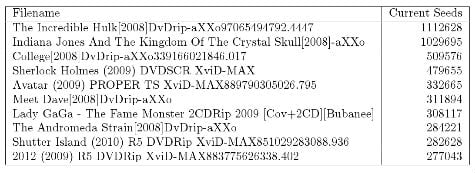
Caledfwlch writes with a followup to news we discussed a couple days ago about a study that found only 0.3% of torrents to be legal. (A further 11% was described as "ambiguous.") TorrentFreak looked more deeply into the study and found a number of flaws, suggesting that the researchers' data may have been pulled from a bogus tracker. Quoting: "Here's where the researchers make total fools out of themselves. In their answer to the question they refer to a table of the top 10 most seeded torrents. ... the most seeded file was uploaded nearly two years ago (The Incredible Hulk) and has a massive 1,112,628 seeders. The torrent in 10th place is not doing bad either with 277,043 seeds. All false data. We're not sure where these numbers originate from but the best seeded torrent at the moment only has 13,739 seeders; that's 1% of what the study reports. Also, the fact that the release is nearly two years old should have sounded some alarm bells. It appears that the researchers have pulled data from a bogus tracker, and it wouldn't be a big surprise if all the torrents in their top 10 are actually fake." They also take a cursory look at isoHunt, finding that 1.5% of torrent files come from Jamendo alone, "a site that publishes only Creative Commons licensed music." -
EU Launches Antitrust Investigation Against IBM
FlorianMueller writes "The European Commission announced today that it has launched two parallel antitrust investigations into IBM's mainframe practices, following complaints lodged by T3 Technologies last year and French open source startup TurboHercules in March. EU regulators suspect an abuse of a dominant position and illegal tying of IBM's mainframe hardware to its proprietary mainframe operating system z/OS. There's even the possibility of a third case based on a complaint filed very recently by NEON, and the DoJ is also looking into this matter. IBM now finds itself in a situation previously experienced by Microsoft and Intel. This may also affect IBM's credibility when lobbying in the EU for open standards." Reader coondoggie points out a response from IBM saying that the accusations are being driven by Microsoft and other competitors. -
Plone 3 Multimedia
Trevor James writes "Plone 3 Multimedia is an excellent book focusing on adding multimedia including images, audio and video files to a Web site built using the Plone 3 CMS. Overall this book has a nice balance and mix of text, screenshots and code. I recommend the book for Plone power users including Plone developers and users who want to enhance and expand their core Plone multimedia arsenal. You'll get more out of this book if you already have a Plone site running but want to add more multimedia based capabilities to it." Read on for the rest of Trevor's review. Plone 3 Multimedia author Tom Gross pages 372 publisher Packt Publishing rating 8/10 reviewer Trevor James ISBN 1847197663 summary Focuses on adding multimedia including images, audio and video files to a Web site built using the Plone 3 CMS Chapter 1 gives us an intro to the Plone, CMS and multimedia universe with concise definitions of terms such as CMS, Zope architecture, Buildout, and multimedia and tells us why we should be using the Plone CMS to host and store multimedia content. Chapter 1 concludes with a look at the Plone4Artists project which extends the core Plone CMS to add multimedia rich features for musicians and artists who need powerful Web sites for their audio and image based content. Plone4Artists adds modules for handling images, audio, video, events and calendars, and tags.
Chapter 2 gets things started by using the Plone 3 CMS to post image content. The author reviews how we can leverage the Plone core Image type to post image files. While reading Chapter 2 I followed along with my own Plone 3 local install so I could work on the tutorials and recipes hands-on as the author presented them. I started out by adding some images to my Plone site and followed the author's instructions on transforming and resizing the image. Gross gives code-based recipes for restricting image dimensions and file size to a specific user. He also shows us how to access images using code in our page templates, via a Python code method, and how to add images to custom content types using code. There's a lot of code and detailed analysis provided just in the first 25 pages of the book and you really get your money's worth just from this chapter on image manipulation. This chapter will interest developers and users of Plone who want to dive into the code and find out how images are being manipulated behind the scenes.
Gross moves on to show us how to organize our images into views which are essentially folders that contain images. The folders provide thumbnails of our images and are clickable to larger scales. We learn how to post a page and then use the Plone Kupu text editor to browse for an image from our folders and upload that image to our page. Gross points out that you can search for images by keyword (and by using wildcards) within the Kupu editor — a powerful feature if you have a ton of images. Then he tells us how to customize various elements of Kupu functionality using code, including tweaking CSS. Gross shows us how to take the tweaks we've made and make them easily persistent across our site's functionality by creating a boilerplate. There's a lot of code in this section of chapter 2 and developers will get a lot of expert tips and examples here.
Having an interest in Web services and how to get image content from Picasa and Flickr into Plone and other CMS-driven sites I was pleased to see Gross show us how to enhance our images using the p4a.ploneimage product; and how to build galleries of our images using the collective.plonetruegallery product. Gross installs the product, configures it and then accesses Flickr and Picasa data. He concludes the chapter looking at another gallery product called slideshowfolder. Gross shows that there are lots of methods for enhancing your Plone site using images and displaying the images as rich interactive galleries.
Chapter 3 covers adding audio content to your site in the same exhaustive detail as the image chapter. I like the discussion of how to choose the best audio format for your Web site. Gross shows us how to enhance our audio player widgets on the Plone site using the p4a.ploneaudio product. There's a lot of detail provided on setting up metadata for our audio libraries and collections. Building custom audio players and using the Flowplayer, a commonly used Flash-based player on open source driven CMS sites. Gross even shows us differences between embedding audio content using HTML 5 vs. HTML 4 and he concludes the chapter building a player using HTML 5. Another exhaustively detailed chapter.
Chapter 4 gives us tutorials on adding video content, including streaming and embedding videos on your Plone site. Gross gives us a tour of the p4a.plonevideo product and the embed version of the product which allows us to embed externally hosted videos (from YouTube, Yahoo! video, and blib.tv). Flowplayer for videos is also presented. The chapter follows the same outline and format as the audio chapter.
Chapter 5 covers adding Flash content to your Plone site and a lot of background discussion on Flash and how best to embed Flash using the Kupu text editor in Plone. Various Plone based Flash products are discussed. Gross also discusses using Silverlight and adding Silverlight content to a Plone site. This is a great topic to be included in this title. Being a Drupal developer I'm hoping that there is more discussion soon in print titles on how to integrate Silverlight content with Drupal sites. So it's nice to see this topic in a Plone book.
Chapter 6 and 7 deal with general content organization concepts and best practices, and syndication opportunities for your Plone site. Gross gives examples of using Dublin core metadata; and managing content using Plone based categories and keywords. Setting up glossaries of content, tagging content and integrating GoogleMaps is also discussed. RSS and Atom are given detailed attention as well here. These chapters should interest any Plone user or developer since it deals with more general Plone concepts and not just focusing on multimedia.
Chapter 8 looks at more advanced upload strategies. Gross spends time showing us how to create bulk uploads on our site using products such as collective.uploadify. Muliuploads is a huge plus and benefit for using Plone as your CMS and this chapter will interest anyone who wants to get large amounts of images into their Web site. Following on this topic Gross tells us how best to store our files and content in chapter 9. Again this topic will be of great interest to site managers and administrators who are in charge of keeping tabs on where content is being hosted and stored. System and server administrators may find some enlightenment in this chapter for dealing with hosting large amounts of CMS-driven multimedia content. Finally chapter 10 covers performance issues including server optimization and site caching mechanisms.
The Appendixes contain a wealth of information for developers including explanations of multimedia formats and licenses. I appreciated Gross' definitions of various codecs and the differences between various lossless codecs and comparisons with lossy codecs. Just the detail on the MPEG-1 Audio Layer 3 and Ogg Vorbis is encyclopedic and I'd most likely look here first before going to another resouces like Wikipedia. There's a ton of good information on licensing and the differences between Creative Commons Attribution licenses, Attribution Share Alike, No Derivatives, Non-commercial and more.
Appendix B contains details and explanation of syndication formats including RSS, RSS 2.0 and Atom. Example XML files for both Atom and RSS 2.0 feeds are given. MediaRSS is also explained in great detail. Finally Appendix C gives links to a large amount of resources and tutorials on how to use Plone for multimedia and links to various segments of the Plone support community including IRC chat.
Overall I'm pleased with this title. It's another great open source and CMS based resource from Packt Publishing and Tom Gross has added required reading to the expanding library of titles on Plone. If you're a Plone user or developer geared towards working with a lot of multimedia content this book belongs in your collection.
You can purchase Plone 3 Multimedia from amazon.com. Slashdot welcomes readers' book reviews -- to see your own review here, read the book review guidelines, then visit the submission page. -
Plone 3 Multimedia
Trevor James writes "Plone 3 Multimedia is an excellent book focusing on adding multimedia including images, audio and video files to a Web site built using the Plone 3 CMS. Overall this book has a nice balance and mix of text, screenshots and code. I recommend the book for Plone power users including Plone developers and users who want to enhance and expand their core Plone multimedia arsenal. You'll get more out of this book if you already have a Plone site running but want to add more multimedia based capabilities to it." Read on for the rest of Trevor's review. Plone 3 Multimedia author Tom Gross pages 372 publisher Packt Publishing rating 8/10 reviewer Trevor James ISBN 1847197663 summary Focuses on adding multimedia including images, audio and video files to a Web site built using the Plone 3 CMS Chapter 1 gives us an intro to the Plone, CMS and multimedia universe with concise definitions of terms such as CMS, Zope architecture, Buildout, and multimedia and tells us why we should be using the Plone CMS to host and store multimedia content. Chapter 1 concludes with a look at the Plone4Artists project which extends the core Plone CMS to add multimedia rich features for musicians and artists who need powerful Web sites for their audio and image based content. Plone4Artists adds modules for handling images, audio, video, events and calendars, and tags.
Chapter 2 gets things started by using the Plone 3 CMS to post image content. The author reviews how we can leverage the Plone core Image type to post image files. While reading Chapter 2 I followed along with my own Plone 3 local install so I could work on the tutorials and recipes hands-on as the author presented them. I started out by adding some images to my Plone site and followed the author's instructions on transforming and resizing the image. Gross gives code-based recipes for restricting image dimensions and file size to a specific user. He also shows us how to access images using code in our page templates, via a Python code method, and how to add images to custom content types using code. There's a lot of code and detailed analysis provided just in the first 25 pages of the book and you really get your money's worth just from this chapter on image manipulation. This chapter will interest developers and users of Plone who want to dive into the code and find out how images are being manipulated behind the scenes.
Gross moves on to show us how to organize our images into views which are essentially folders that contain images. The folders provide thumbnails of our images and are clickable to larger scales. We learn how to post a page and then use the Plone Kupu text editor to browse for an image from our folders and upload that image to our page. Gross points out that you can search for images by keyword (and by using wildcards) within the Kupu editor — a powerful feature if you have a ton of images. Then he tells us how to customize various elements of Kupu functionality using code, including tweaking CSS. Gross shows us how to take the tweaks we've made and make them easily persistent across our site's functionality by creating a boilerplate. There's a lot of code in this section of chapter 2 and developers will get a lot of expert tips and examples here.
Having an interest in Web services and how to get image content from Picasa and Flickr into Plone and other CMS-driven sites I was pleased to see Gross show us how to enhance our images using the p4a.ploneimage product; and how to build galleries of our images using the collective.plonetruegallery product. Gross installs the product, configures it and then accesses Flickr and Picasa data. He concludes the chapter looking at another gallery product called slideshowfolder. Gross shows that there are lots of methods for enhancing your Plone site using images and displaying the images as rich interactive galleries.
Chapter 3 covers adding audio content to your site in the same exhaustive detail as the image chapter. I like the discussion of how to choose the best audio format for your Web site. Gross shows us how to enhance our audio player widgets on the Plone site using the p4a.ploneaudio product. There's a lot of detail provided on setting up metadata for our audio libraries and collections. Building custom audio players and using the Flowplayer, a commonly used Flash-based player on open source driven CMS sites. Gross even shows us differences between embedding audio content using HTML 5 vs. HTML 4 and he concludes the chapter building a player using HTML 5. Another exhaustively detailed chapter.
Chapter 4 gives us tutorials on adding video content, including streaming and embedding videos on your Plone site. Gross gives us a tour of the p4a.plonevideo product and the embed version of the product which allows us to embed externally hosted videos (from YouTube, Yahoo! video, and blib.tv). Flowplayer for videos is also presented. The chapter follows the same outline and format as the audio chapter.
Chapter 5 covers adding Flash content to your Plone site and a lot of background discussion on Flash and how best to embed Flash using the Kupu text editor in Plone. Various Plone based Flash products are discussed. Gross also discusses using Silverlight and adding Silverlight content to a Plone site. This is a great topic to be included in this title. Being a Drupal developer I'm hoping that there is more discussion soon in print titles on how to integrate Silverlight content with Drupal sites. So it's nice to see this topic in a Plone book.
Chapter 6 and 7 deal with general content organization concepts and best practices, and syndication opportunities for your Plone site. Gross gives examples of using Dublin core metadata; and managing content using Plone based categories and keywords. Setting up glossaries of content, tagging content and integrating GoogleMaps is also discussed. RSS and Atom are given detailed attention as well here. These chapters should interest any Plone user or developer since it deals with more general Plone concepts and not just focusing on multimedia.
Chapter 8 looks at more advanced upload strategies. Gross spends time showing us how to create bulk uploads on our site using products such as collective.uploadify. Muliuploads is a huge plus and benefit for using Plone as your CMS and this chapter will interest anyone who wants to get large amounts of images into their Web site. Following on this topic Gross tells us how best to store our files and content in chapter 9. Again this topic will be of great interest to site managers and administrators who are in charge of keeping tabs on where content is being hosted and stored. System and server administrators may find some enlightenment in this chapter for dealing with hosting large amounts of CMS-driven multimedia content. Finally chapter 10 covers performance issues including server optimization and site caching mechanisms.
The Appendixes contain a wealth of information for developers including explanations of multimedia formats and licenses. I appreciated Gross' definitions of various codecs and the differences between various lossless codecs and comparisons with lossy codecs. Just the detail on the MPEG-1 Audio Layer 3 and Ogg Vorbis is encyclopedic and I'd most likely look here first before going to another resouces like Wikipedia. There's a ton of good information on licensing and the differences between Creative Commons Attribution licenses, Attribution Share Alike, No Derivatives, Non-commercial and more.
Appendix B contains details and explanation of syndication formats including RSS, RSS 2.0 and Atom. Example XML files for both Atom and RSS 2.0 feeds are given. MediaRSS is also explained in great detail. Finally Appendix C gives links to a large amount of resources and tutorials on how to use Plone for multimedia and links to various segments of the Plone support community including IRC chat.
Overall I'm pleased with this title. It's another great open source and CMS based resource from Packt Publishing and Tom Gross has added required reading to the expanding library of titles on Plone. If you're a Plone user or developer geared towards working with a lot of multimedia content this book belongs in your collection.
You can purchase Plone 3 Multimedia from amazon.com. Slashdot welcomes readers' book reviews -- to see your own review here, read the book review guidelines, then visit the submission page. -
Open Sarcasm Fighting Copyrighted Punctuation
pinkushun writes "SarcMark is a copyrighted punctuation mark, that claims 'It's time that sarcasm is treated equally!' Pretty damn cheeky while they're charging for their software, which only inserts their punctuation through a hotkey. Open Sarcasm is destroying SarcMark by advocating a new punctuation mark (not displaying here properly — alt+U0161) as the new open and free sarcasm symbol. Either way, this will be one interesting turnout. With bad unicode support across the web, displaying the characters properly might be an issue. PS Left out sarcastic end sentence as Slashdot doesn't display the U0161 character." -
Glass Invisibility Cloak Shields Infrared
An anonymous reader writes with the latest advance in the quest for a cloak of invisibility (Michigan Tech University's press release). We've been following this research as it develops; here are stories from each of the last four years. "Invisibility cloaks are slowly working their way up to shorter wavelengths — starting at millimeter-long microwaves and working their way to the nanometer wavelengths of visible light. EETimes says we are about half way there — micrometer wavelengths — in this story about using chalcogenide glass to create invisibility cloaks in the infrared. Quoting: 'Invisibility cloaks cast in chalcogenide glass can render objects invisible to infrared frequencies of light, according to researchers at Michigan Technological University... Most other demonstrations of invisibility cloaks have used metamaterials composed of free-space split-ring resonators that were constructed from metal printed-circuit board traces surrounded by traditional dielectric material. The Michigan Tech researchers... claim that by substituting nonmetallic glass resonators made from chalcogenide glass, infrared cloaks are possible too...'" -
Glass Invisibility Cloak Shields Infrared
An anonymous reader writes with the latest advance in the quest for a cloak of invisibility (Michigan Tech University's press release). We've been following this research as it develops; here are stories from each of the last four years. "Invisibility cloaks are slowly working their way up to shorter wavelengths — starting at millimeter-long microwaves and working their way to the nanometer wavelengths of visible light. EETimes says we are about half way there — micrometer wavelengths — in this story about using chalcogenide glass to create invisibility cloaks in the infrared. Quoting: 'Invisibility cloaks cast in chalcogenide glass can render objects invisible to infrared frequencies of light, according to researchers at Michigan Technological University... Most other demonstrations of invisibility cloaks have used metamaterials composed of free-space split-ring resonators that were constructed from metal printed-circuit board traces surrounded by traditional dielectric material. The Michigan Tech researchers... claim that by substituting nonmetallic glass resonators made from chalcogenide glass, infrared cloaks are possible too...'" -
Glass Invisibility Cloak Shields Infrared
An anonymous reader writes with the latest advance in the quest for a cloak of invisibility (Michigan Tech University's press release). We've been following this research as it develops; here are stories from each of the last four years. "Invisibility cloaks are slowly working their way up to shorter wavelengths — starting at millimeter-long microwaves and working their way to the nanometer wavelengths of visible light. EETimes says we are about half way there — micrometer wavelengths — in this story about using chalcogenide glass to create invisibility cloaks in the infrared. Quoting: 'Invisibility cloaks cast in chalcogenide glass can render objects invisible to infrared frequencies of light, according to researchers at Michigan Technological University... Most other demonstrations of invisibility cloaks have used metamaterials composed of free-space split-ring resonators that were constructed from metal printed-circuit board traces surrounded by traditional dielectric material. The Michigan Tech researchers... claim that by substituting nonmetallic glass resonators made from chalcogenide glass, infrared cloaks are possible too...'" -
Glass Invisibility Cloak Shields Infrared
An anonymous reader writes with the latest advance in the quest for a cloak of invisibility (Michigan Tech University's press release). We've been following this research as it develops; here are stories from each of the last four years. "Invisibility cloaks are slowly working their way up to shorter wavelengths — starting at millimeter-long microwaves and working their way to the nanometer wavelengths of visible light. EETimes says we are about half way there — micrometer wavelengths — in this story about using chalcogenide glass to create invisibility cloaks in the infrared. Quoting: 'Invisibility cloaks cast in chalcogenide glass can render objects invisible to infrared frequencies of light, according to researchers at Michigan Technological University... Most other demonstrations of invisibility cloaks have used metamaterials composed of free-space split-ring resonators that were constructed from metal printed-circuit board traces surrounded by traditional dielectric material. The Michigan Tech researchers... claim that by substituting nonmetallic glass resonators made from chalcogenide glass, infrared cloaks are possible too...'" -
Stuxnet May Represent New Trend In Malware
Trailrunner7 writes "As more information continues to come out about the Stuxnet worm and the vulnerabilities that it exploits, it's becoming increasingly clear that this kind of attack may be a preview of the attacks that are likely to become commonplace in the months and years ahead. The most interesting aspect of all of this is the fact that the attackers behind Stuxnet clearly knew about the vulnerability in the Siemens WinCC system before the malware was written. That implies the malware authors had some advance intelligence about the configuration of the Siemens software and knew exactly where there was a weakness." -
Superheroes vs. the Westboro Baptist Church
sv_libertarian writes "They've faced down humans time and time again, but Fred Phelps and his minions from the Westboro Baptist Church were not ready for the cosplay action that awaited them at Comic-Con. After all, who can win against a counter-protest that includes robots, magical anime girls, Trekkies, Jedi, and... kittens?" -
Survey Says Most iPhone Users Love AT&T
Hugh Pickens writes "In a report sure to raise eyebrows, CNN Money claims that despite a very vocal group of detractors, the vast majority of iPhone users love AT&T. A survey released this week by Yankee Group reports that 73% of iPhone owners scored their satisfaction with the carrier as an 8, 9, or 10 on a 10-point scale. The results seem surprising, given the pounding AT&T has taken in the media and on the blogosphere about its service-related issues with the iPhone and AT&T's recent iPad-related security glitch. For its part, AT&T says its network really isn't as bad as many people think. 'There's a gap between what people hear about us and what their experience is with us. We think that gap is beginning to close,' says Mark Siegel, an AT&T spokesman. 'It doesn't mean we're perfect; we still have work to do. But that's no surprise to us, because we have a great network.'" Buried in the penultimate paragraph is the somewhat alarming note that "77% of iPhone owners say they'll buy another iPhone, compared to 20% of Android customers who say they'll buy another Android phone." -
Cell Phone Group Sues San Francisco Over Radiation Law
crimeandpunishment writes "The wireless industry wants to put San Francisco's cell phone radiation law on hold. An industry trade group filed a lawsuit Friday trying to stop the law, which requires cell phone stores to display how much radio energy each phone emits. The group says the law, which is the first of its kind in the country, supersedes the authority of the Federal Communications Commission, and will mislead consumers into thinking one phone is safer than another." -
Dell Drops Ubuntu PCs From Its Website
Barence writes "Dell has stopped selling consumer PCs preloaded with Ubuntu from its website, and doesn't know when they're coming back. A search for Ubuntu on the Dell UK website returns only one laptop — the Dell Latitude 2100 from the company's business range. Dell insists that it's continuing to sell Ubuntu systems, but only over the phone, and has no idea when — or even if — the Ubuntu PCs will return online. 'We've recently made an effort to simplify our offerings online, by focusing on our most popular bundles and configuration options, based on customer feedback for reduced complexity and a simple, easy purchase experience,' Dell told PC Pro. 'We're also making some changes to our Ubuntu pages, and as a result, they are currently available through our phone-based sales only.' The move comes after Dell put a page on its website advising customers only to go for Ubuntu if they were interested in open-source programming." -
Droid X Gets Rooted
An anonymous reader writes "The Droid X forums have posted a procedure to root the new Motorola Droid X, putting to rest Andoid fans' fears that they would never gain access to the device's secrets due to a reported eFuse that would brick the phone if certain boot files were tampered with. Rooting the phone is the first step in gaining complete control over the device." -
Microsoft Says No To Paying Bug Bounties
Trailrunner7 writes "In the wake of both Mozilla and Google significantly increasing their bug bounties to the $3,000 range, there have been persistent rumors in the security community that Microsoft soon would follow suit and start paying bounties as well. However, a company official said on Thursday that Microsoft was not interested in paying bounties. 'We value the researcher ecosystem, and show that in a variety of ways, but we don't think paying a per-vuln bounty is the best way. Especially when across the researcher community the motivations aren't always financial. It is well-known that we acknowledge researcher's contributions in our bulletins when a researcher has coordinated the release of vulnerability details with the release of a security update,' Microsoft's Jerry Bryant said." -
Microsoft Says No To Paying Bug Bounties
Trailrunner7 writes "In the wake of both Mozilla and Google significantly increasing their bug bounties to the $3,000 range, there have been persistent rumors in the security community that Microsoft soon would follow suit and start paying bounties as well. However, a company official said on Thursday that Microsoft was not interested in paying bounties. 'We value the researcher ecosystem, and show that in a variety of ways, but we don't think paying a per-vuln bounty is the best way. Especially when across the researcher community the motivations aren't always financial. It is well-known that we acknowledge researcher's contributions in our bulletins when a researcher has coordinated the release of vulnerability details with the release of a security update,' Microsoft's Jerry Bryant said." -
SFLC Wants To Avoid Death by Code
foregather writes "The Software Freedom Law Center has released some independent research on the safety of software close to our hearts: that inside of implantable medical devices like pacemakers and insulin pumps. It turns out that nobody is minding the store at the regulatory level and patients and doctors are blocked from examining the source code keeping them alive. From the article: 'The Food and Drug Administration (FDA) is responsible for evaluating the risks of new devices and monitoring the safety and efficacy of those currently on market. However, the agency is unlikely to scrutinize the software operating on devices during any phase of the regulatory process unless a model that has already been surgically implanted repeatedly malfunctions or is recalled. ... Despite the crucial importance of these devices and the absence of comprehensive federal oversight, medical device software is considered the exclusive property of its manufacturers, meaning neither patients nor their doctors are permitted to access their IMD's source code or test its security.'" -
37 States Join Investigation of Google Street View
bonch writes "Attorneys General from 37 states have joined the probe into Google's Street View data collection. The investigation seeks more information behind Google's software testing and data archiving practices after it was discovered that their Street View vans scanned private WLANs and recorded users' MAC addresses. Attorney general Richard Blumenthal said, 'Google's responses continue to generate more questions than they answer. Now the question is how it may have used — and secured — all this private information.'" -
Digital Act Could Spur Creation of Pirate ISPs In UK
scurtis writes "British anti-copyright group, Pirate Party UK, has predicted that Pirate ISPs will spring up across the country — promoting online privacy and allowing users to share files anonymously — in response to draconian file-sharing proposals outlined in the Digital Economy Act. The news follows reports that the Pirate Party in Sweden (PiratPartiet) will launch the world's first 'Pirate ISP.' The move is designed to curb the use of online surveillance in the country, and combat what PiratPartiet describes as the 'big brother society.'" -
Video Game Legends To Be Inducted Into Hall of Fame
killdashnine writes "Last year we discussed the creation of the International Video Game Hall of Fame and Museum in Ottumwa, Iowa, and a first event in 2009 which brought 3,500 people to witness it. Since then, there's been much progress toward creation of the museum, including the upcoming 'Big Bang 2010' exhibition. Their first event kicks off with formal induction ceremonies, tournaments, record-setting attempts, and an array of concerts from 8-bit music to modern rock. This serves as the first official fundraiser for this new non-profit. Iowa is positioning itself as the Video Game Capital of the World. While some sneer and scoff at this, pointing to LA or Seattle as gaming giants and rightful heirs to the title, the real goal is not to glorify software developers but rather to memorialize the 'heroes of video games,' from the iconic Pac Man to pioneers such as Ralph Baer." Here's a list of this year's inductees. Who gets your vote for next year? -
Google Up Ante For Disclosure Rules, Increases Bug Bounty
An anonymous reader writes "In a recent post by seven members of their security team, Google lashed out against the current standards of responsible disclosure, and implicitly backed the recent actions of Tavis Ormandy (who is listed as one of the authors). The company said it believed 60 days should be an 'upper bound' for fixing critical vulnerabilities, and asked to to be held to the same standard by external researchers. In another, nearly simultaneous post to the Chromium blog, Google also announced they are raising the security reward for Chrome vulnerabilities to $3133.7, apparently in response to Mozilla's recent action." -
Google Up Ante For Disclosure Rules, Increases Bug Bounty
An anonymous reader writes "In a recent post by seven members of their security team, Google lashed out against the current standards of responsible disclosure, and implicitly backed the recent actions of Tavis Ormandy (who is listed as one of the authors). The company said it believed 60 days should be an 'upper bound' for fixing critical vulnerabilities, and asked to to be held to the same standard by external researchers. In another, nearly simultaneous post to the Chromium blog, Google also announced they are raising the security reward for Chrome vulnerabilities to $3133.7, apparently in response to Mozilla's recent action." -
Pay-Per-View Journalism Is Burning Out Reporters Young
Hugh Pickens writes "Young journalists once dreamed of trotting the globe in pursuit of a story, but the NY Times now reports that instead many are working online shackled to their computers, where they try to eke out a fresh thought or be first to report even the smallest nugget of news — anything that will impress Google's algorithms and draw readers their way. The New York Times, The Washington Post, and The Los Angeles Times all display a 'most viewed' list on their home pages; some media outlets, including Bloomberg News and Gawker Media, now pay writers based in part on how many readers click on their articles. 'At a [traditional] paper, your only real stress point is in the evening when you're actually sitting there on deadline, trying to file,' says Jim VandeHei, Politico's executive editor. 'Now at any point in the day starting at 5 in the morning, there can be that same level of intensity and pressure to get something out.' The pace has led to substantial turnover in staff at digital news organizations. At Politico, roughly a dozen reporters have left in the first half of the year — a big number for a newsroom that has only about 70 reporters and editors. 'When my students come back to visit, they carry the exhaustion of a person who's been working for a decade, not a couple of years,' says Duy Linh Tu of the Columbia University Graduate School of Journalism. 'I worry about burnout.'" -
What the Google-ITA Deal Really Portends
Much of the discussion about Google's bid to buy ITA Software, including here, has been limited by the lack of understanding all around about how airline search and reservations actually work now, and what it is exactly that ITA Software does. Travel expert Edward Hasbrouck wrote a detailed 3-part piece on his blog explaining the back story, what ITA Software does, and what it means for travelers. "...because CRS/GDS [Computerized Reservation Systems or Global Distribution Systems] companies are generally invisible in their intermediary role (and currently all owned by groups of private equity investors, so they need not report publicly on their finances or operations), few analysts outside the travel tech industry know how to interpret the implications of Google's decision to invest $700 million in this sector. Frankly, I'm not at all sure Google itself understands what ITA Software does (and doesn't) do, and what they are getting for their money. ... What will this deal mean for travelers? The short answer is that it is likely to be a bad thing for travelers ... because it is likely to exacerbate the trend toward personalized and less transparent pricing of airline tickets (and other travel services) and the de facto disappearance of key consumer protection principles embodied in the definition of a common carrier and the requirement for a published tariff applicable equally to all would-be customers complying with the same rules." -
eBook Sales Outpace Hardbacks
dptalia writes "Amazon announced that for every 100 hardback books they sell, 180 eBooks are sold. In addition, they've seen sales for Kindles triple since they lowered the price. But traditionalists shouldn't panic yet — paperbacks are still the king." -
Man Caught Smuggling 18 Monkeys In Girdle
38-year-old Roberto Cabrera was arrested at Mexico City's international airport after authorities discovered his monkey girdle. Cabrera was carrying 18 endangered titi monkeys in the many-pouched undergarment. He says he used the girdle to smuggle the primates because he was afraid x-rays would hurt them if they were in a suitcase. It's good to see that the animal smuggling undergarment business is getting more sophisticated. The 18-monkey girdle is a substantial upgrade from 13-songbird socks. -
Times Paywall Blocks 90% of Traffic
Jamie was one of several readers to note the not particularly surprising results of the recent Times switch to a pay-wall. Apparently a 90% drop in readership is the reward. But then again, if they are paying real money, it might still be ok for them. It doesn't look very good though. -
Blogetery Shutdown Due To al-Qaeda Info
Archness1 writes "Over the weekend we discussed news that blog host Blogetery.com had been shut down at the request of the US government. Now, it appears the site was shut down because some of the blogs it was hosting contained information on al-Qaeda hit lists and bomb making. According to the article, Burst.net shut down Blogetery of its own accord after the FBI made a request to the host for information on the people who made the posts. '[Burst.net CTO Joe Marr] said the FBI contacted Burst.net and sent a Voluntary Emergency Disclosure of Information request. The letter said terrorist material, which presented a threat to American lives, was found on a server hosted by Burst.net and asked for specific information about the people involved. In the FBI's letter, the agency included a clause that says Web hosts and Internet service providers may voluntarily elect to shut down the sites of customers involved in these kinds of situations.'" -
How IT Pros Can Avoid Legal Trouble
snydeq writes "InfoWorld's Peter S. Vogel reports on the kinds of inadvertent transgressions that could land IT pros into legal trouble without realizing it. From confidentiality and privacy negligence, to copyright and source code violations, IT staff are legally liable for a lot more than they might think — in some cases because the law will not stop at your employer, instead holding individual IT employees responsible for violations even if the individuals are just 'doing their job.' Worse, as the recent case against Terry Childs has shown, judges and juries are often not technically savvy enough to understand what IT pros do. 'That lack of understanding can lead them to conclude you're at fault or should have known better,' Vogel writes. 'After all, many people think anyone technical is a whiz kid or brainiac on any topic.'" What legally questionable scenarios have cropped up at your job? -
Google Spent $100M Defending Viacom Lawsuit
I Don't Believe in Imaginary Property writes "Lawsuits are never cheap, even if you're on the winning side. But not many cost as much as Viacom's lawsuit against Google. The search giant won before trial, and even so Google spent $100 million defending themselves. Incidentally, Viacom is appealing the ruling, so it's not even over yet. Perhaps it's no wonder our rights are vanishing online when it takes $100M to protect just one of them." -
R In a Nutshell
joel.neely writes "R is a statistical computing environment that is fully-compliant with state-of-the-art buzzwords: free, open-source, cross-platform, interactive, graphics, objects, closures, higher-order functions, and more. It is supported by an impressive collection of user-supplied modules through CRAN, the 'Comprehensive R Archive Network.' And now it has its own O'Reilly Nutshell book, R in a Nutshell, written by Joseph Adler. I am pleased to report that Adler has risen to the challenge of the highly-regarded 'Nutshell' franchise. As is traditional for the series, this title mixes introduction, tutorial, and reference material in a style that is well suited to a reader who already has a background in programming, but is a new or occasional user of R." Read on for the rest of Joel's review. R in a Nutshell author Joseph Adler pages 672 publisher O'Reilly rating 9/10 reviewer Joel Neely ISBN 978-0-596-80170-0 summary A practical and engaging introduction to the R statistical system and its usage As a curious newcomer to R who wanted to get going quickly, I was well-served by Part 1, which provided an R kickstart. Chapter 1 covers the process of getting and installing R. It is short, to the point, and just works, addressing Windows, Mac OS X, and Linux/Unix with equal attention. Chapter 2, on the R user interface, introduces the range of options for interacting with R: the GUI (both the standard version and some enhanced alternatives), the interactive console, batch mode, and the RExcel package (which supports R inside a certain well-known spreadsheet). Chapter 3 uses a set of interactive examples to provide a quick tour of the R language and environment, establishing a task-oriented theme that carries through the rest of the book. The last chapter of part 1 covers R packages. It summarizes the standard pre-loaded packages, introduces the tools to explore repositories and install additional package, and concludes by explaining how to create new packages.
As a polyglot programmer who is always interested in seeing how a new language approaches programs and their construction, I enjoyed Part 2, which described the R language. This section begins with an overview in chapter 5, and then devotes a chapter each to R syntax, R objects, symbols and environments (central to understanding the dynamic nature of R), functions (including higher-order functions), and R's own approach to object-oriented programming. This section closes in chapter 11, with a discussion of techniques and tips for improving performance.
As a busy professional with data sitting on my hard drive that I'd like to understand better, I appreciated Part 3, with its practical emphasis on using R to load, transform, and visualize data. Chapter 12 presented alternatives for loading, editing, and saving data, from the built-in data editor, through file I/O in a variety of formats, to a mature set of database access options. Chapter 13 illustrated a range of techniques for manipulating, organizing, cleaning, and sorting data, in preparation for presentation or more detailed analysis. Chapter 14 introduces the reader to the wealth of graphical presentation options built into the R environment. There are so many charting types and details that this chapter could have been overwhelming, but Adler keeps the interest high and the mood light by drawing on an engaging variety of data: toxic chemical levels, baseball statistics, the topography of Yosemite Valley, demographic data, and even turkey prices. Chapter 15 is devoted to lattice graphics, the R implementation of the "trellis graphics" technique for data visualization developed at Bell Labs. This chapter illustrates the power of lattice graphics by exploring the question of why more babies are born on weekdays than weekends.
As a non-statistician who still occasionally needs to do some number-crunching, I'm sure I'll be returning to Part 4, with its detailed explanations and illustrations of analysis tools and techniques–almost two-hundred pages worth. In chapters 16 through 20, Adler surveys topics in data analysis, probability, statistics, power tests, and regression modeling. As someone who has been offered too many medications and lost fortunes, I found much to enjoy in chapter 21, which used a variety of spam-detection techniques to illustrate the concepts of classification. Chapter 22, on machine learning, discusses several of the data mining techniques that R supports. Chapter 23 covers time series analysis, which may be used to identify trends or periodic patterns in data. Finally, chapter 24 offers an overview of Bioconductor, an open-source project focused on genomic data.
The book closes with a detailed reference to the standard R packages.
This is an impressive piece of work. In a volume of this size (about 650 pages), navigation is crucial, and I found both the organization of the chapters and index up to the task. I was able to follow the instructions and examples through the first several chapters of the book essentially without a hitch, and in the latter chapters the variety of illustrations and data sources added interest to what could have been very dull going.
I won't claim perfection for this book. There were a couple of explanations that could have been clearer, and one or two odd turns of phrase or rough edits. Out of all the code examples that I tried, I found exactly one that didn't seem to work without a minor correction. For a work of this size, that's actually pretty amazing!
As a long-time O'Reilly reader, I see Joseph Adler's R in a Nutshell as a welcome addition to the menagerie.
You can purchase R in a Nutshell: A Desktop Quick Reference from amazon.com. Slashdot welcomes readers' book reviews -- to see your own review here, read the book review guidelines, then visit the submission page. -
R In a Nutshell
joel.neely writes "R is a statistical computing environment that is fully-compliant with state-of-the-art buzzwords: free, open-source, cross-platform, interactive, graphics, objects, closures, higher-order functions, and more. It is supported by an impressive collection of user-supplied modules through CRAN, the 'Comprehensive R Archive Network.' And now it has its own O'Reilly Nutshell book, R in a Nutshell, written by Joseph Adler. I am pleased to report that Adler has risen to the challenge of the highly-regarded 'Nutshell' franchise. As is traditional for the series, this title mixes introduction, tutorial, and reference material in a style that is well suited to a reader who already has a background in programming, but is a new or occasional user of R." Read on for the rest of Joel's review. R in a Nutshell author Joseph Adler pages 672 publisher O'Reilly rating 9/10 reviewer Joel Neely ISBN 978-0-596-80170-0 summary A practical and engaging introduction to the R statistical system and its usage As a curious newcomer to R who wanted to get going quickly, I was well-served by Part 1, which provided an R kickstart. Chapter 1 covers the process of getting and installing R. It is short, to the point, and just works, addressing Windows, Mac OS X, and Linux/Unix with equal attention. Chapter 2, on the R user interface, introduces the range of options for interacting with R: the GUI (both the standard version and some enhanced alternatives), the interactive console, batch mode, and the RExcel package (which supports R inside a certain well-known spreadsheet). Chapter 3 uses a set of interactive examples to provide a quick tour of the R language and environment, establishing a task-oriented theme that carries through the rest of the book. The last chapter of part 1 covers R packages. It summarizes the standard pre-loaded packages, introduces the tools to explore repositories and install additional package, and concludes by explaining how to create new packages.
As a polyglot programmer who is always interested in seeing how a new language approaches programs and their construction, I enjoyed Part 2, which described the R language. This section begins with an overview in chapter 5, and then devotes a chapter each to R syntax, R objects, symbols and environments (central to understanding the dynamic nature of R), functions (including higher-order functions), and R's own approach to object-oriented programming. This section closes in chapter 11, with a discussion of techniques and tips for improving performance.
As a busy professional with data sitting on my hard drive that I'd like to understand better, I appreciated Part 3, with its practical emphasis on using R to load, transform, and visualize data. Chapter 12 presented alternatives for loading, editing, and saving data, from the built-in data editor, through file I/O in a variety of formats, to a mature set of database access options. Chapter 13 illustrated a range of techniques for manipulating, organizing, cleaning, and sorting data, in preparation for presentation or more detailed analysis. Chapter 14 introduces the reader to the wealth of graphical presentation options built into the R environment. There are so many charting types and details that this chapter could have been overwhelming, but Adler keeps the interest high and the mood light by drawing on an engaging variety of data: toxic chemical levels, baseball statistics, the topography of Yosemite Valley, demographic data, and even turkey prices. Chapter 15 is devoted to lattice graphics, the R implementation of the "trellis graphics" technique for data visualization developed at Bell Labs. This chapter illustrates the power of lattice graphics by exploring the question of why more babies are born on weekdays than weekends.
As a non-statistician who still occasionally needs to do some number-crunching, I'm sure I'll be returning to Part 4, with its detailed explanations and illustrations of analysis tools and techniques–almost two-hundred pages worth. In chapters 16 through 20, Adler surveys topics in data analysis, probability, statistics, power tests, and regression modeling. As someone who has been offered too many medications and lost fortunes, I found much to enjoy in chapter 21, which used a variety of spam-detection techniques to illustrate the concepts of classification. Chapter 22, on machine learning, discusses several of the data mining techniques that R supports. Chapter 23 covers time series analysis, which may be used to identify trends or periodic patterns in data. Finally, chapter 24 offers an overview of Bioconductor, an open-source project focused on genomic data.
The book closes with a detailed reference to the standard R packages.
This is an impressive piece of work. In a volume of this size (about 650 pages), navigation is crucial, and I found both the organization of the chapters and index up to the task. I was able to follow the instructions and examples through the first several chapters of the book essentially without a hitch, and in the latter chapters the variety of illustrations and data sources added interest to what could have been very dull going.
I won't claim perfection for this book. There were a couple of explanations that could have been clearer, and one or two odd turns of phrase or rough edits. Out of all the code examples that I tried, I found exactly one that didn't seem to work without a minor correction. For a work of this size, that's actually pretty amazing!
As a long-time O'Reilly reader, I see Joseph Adler's R in a Nutshell as a welcome addition to the menagerie.
You can purchase R in a Nutshell: A Desktop Quick Reference from amazon.com. Slashdot welcomes readers' book reviews -- to see your own review here, read the book review guidelines, then visit the submission page.