Slashdot Mirror
Domain: slashdot.org
Stories and comments across the archive that link to slashdot.org.
Stories · 37,380
-
The In-Progress Plot To Kill Google
twitter writes "Four years after Steve Ballmer vowed to kill Google, Wired details Microsoft's, AT&T's, and big publishers' ongoing slog. The story is filled with astroturfers, lobbyists and others spending millions to manufacture FUD about privacy and monopoly in order to protect the obsolete business models of their patrons, who are mostly known for progress-halting monopoly and invasion of privacy. Their greatest coup to date was preventing Google from rescuing Yahoo." -
Belkin's President Apologizes For Faked Reviews
remove office writes "After I wrote about how Belkin's Amazon.com sales rep Mike Bayard had been paying for fake reviews of his company's products using Mechanical Turk, hundreds of readers across the Web expressed their outrage. As a result of the online outcry, Belkin's president Mark Reynoso has issued a statement apologizing and saying that 'this is an isolated incident' and that 'Belkin does not participate in, nor does it endorse, unethical practices like this.' Amazon moved swiftly to remove several reviews on Belkin products it believed were fraudulent. But now fresh evidence of astroturfing has surfaced, by the same Belkin executive." -
Conficker Worm Could Create World's Biggest Botnet
nk497 writes "The worm that's supposedly infected almost nine million PCs running Windows, dubbed Cornficker or Downadup, could lead to a massive botnet, security researchers have said. The worm initially spread to systems unpatched against MS08-067, but has since 'evolved and is now able to spread to patched computers through portable USB drives through brute-force password-guessing.'" -
Beginning iPhone Development
Cory Foy writes "When my wife got a Touch several months back, the first thing I wanted to do was build some applications for it. Who wouldn't want to play with a device that has accelerometers, position sensors and multi-touch gestures? But being new to the Mac world, I needed something to help guide me along. Beginning iPhone Development aims to be that guide. But does it live up to the challenge of teaching a newbie Mac and iPhone developer?" Read below for the rest of Cory's review. Beginning iPhone Development: Exploring the iPhone SDK author Dave Mark, Jeff LaMarche pages 536 publisher Apress rating Five $1000 Rubies reviewer Cory Foy ISBN 978-1-4302-1626-1 summary A great introduction to the iPhone SDK and getting into iPhone Development The first thing you'll need to do is head over to the Apple Developers Site and register for an account. You can then download the iPhone API. Note that while the API download and simulator are free — deploying to a real iPhone or iTouch is not, even if it is your own. To do that you have to apply to the iPhone Developer Program which is $99. For the book, you'll be fine with just the simulator with the exception of any accelerometer application, since the simulator doesn't have that feature.
With that out of the way, I was quite impressed with the book. Although I've done quite a bit of development in the past, I haven't worked with Objective-C before, and was a little concerned if I would be in over my head. If you are in that position, don't fear — the authors do a great job of walking you through, and you'll find yourself working with it in no time.
The first chapters introduce you to the basics of the iPhone and development, starting with the canonical "Hello, World" application. The book walks you through how to get and install Xcode and the iPhone API. It then introduces you to Interface Builder, the partner-in-crime to Xcode. Even in the first chapter, the authors show their attention to detail, explaining common issues you might run into (like trying to Build and Run while your iPhone or iTouch is plugged in to your Mac).
Chapter 3 introduces the Model-View-Controller paradigm, a pattern that is probably one of the most misunderstood patterns in UI development. They give you enough information to be familiar with the terms you'll be using, and they very much mean it when they tell you not to worry if you aren't understanding something — they always loop back around to make sure you understand it.
Chapter 4 was a long chapter for me, but introduces some important concepts around user interaction and controls. By the end, you have an interface which has a variety of controls which interact with each other. As with the other chapters, the authors introduce tips and tricks to make things easier (for example, Option->Cmd->Up Arrow to switch from the header to implementation file in Xcode).
Chapter 5 covers autorotation and basic animations, including linking in the Core Graphics Framework. I especially like how the authors gave three different ways of making your app auto-rotation aware, describing the benefits and drawbacks of each. Chapter 6 follows this up by introducing multi-view interfaces, something very necessary as you get into more complex iPhone development.
Chapters 7-9 describe various methods to presenting information to users, including toolbars, table views, hierarchical navigation and hierarchical lists. However, it isn't all drag-n-drop, the authors get into some good (and sometimes deep) conversations about what you are doing. For example, in Chapter 8, they talk about issues with NSDictionary and how to create deep mutable copies.
Chapters 10-13 are the last of the "fundamentals" — application settings, basic data management, custom drawing using Quartz and Open GL, and taking inputs (including gestures and multi-touch). As someone who spends most of his time as far away from graphics libraries as possible, I was quite impressed with the basics that were introduced and what someone like me could get up and running.
Finally we get into the fun. Chapter 14 introduces Core Location, allowing to figure out where in the world you are. The book goes through a discussion about the various ways to get location information, and drawbacks of each. (Helpful tip: no matter which method, if you are polling every second, you'll drain the battery pretty quickly). For the simulator-only users, this is when things start to become tricky. Chapter 14 does work, though you aren't prompted for access to Core Location.
Chapter 15, however, is useless without an actual phone, even though it's perhaps the most fun. In this chapter, the book goes through the accelerometer and all the interesting things you can do with it. There's even a small discussion on the physics (but just enough!). Both apps you create (Shake and Break and the Marble game) are quite fun for someone just starting out with all of this. It's a shame Apple couldn't figure out a way yet to include the accelerometer in the simulator.
Chapter 16 covers using the iPhone camera and Photo Library. It's short, but it shows the power of the simple interfaces Apple provides. In just 9 pages you'll be capturing images right from the iPhone.
The final two chapters I thought were quite fitting — Localization and Follow-Ups. In the localization chapter, the book covers extracting strings out to resource files and using locale to read them in. Having a day job which ships our software in 12 different languages, I know first-hand how difficult localization can be to get right, so I was glad to see this chapter. The final chapter is just a wrap-up of resources you can reach out to for help and information.
All in all I was very surprised and pleased with the book. I've had the fortune of reading many technical books, and few do a great job of walking someone through the basics without making them feel like a dolt. It felt like every time I was stuck or unsure there was a tip, hint or paragraph which explained what was going on.
The main drawback to me is the fee to deploy apps to your own phone. This wasn't something I ran into doing either J2ME or Windows Mobile apps in the past, and it is a shame that to even work on your own phone you have to pay a fee. However, since the fee does give you the ability to submit apps to the App Store, then I guess it's a consolation. I'd rather Apple lock deployments to one iPhone (or iTouch) for the truly casual people who just want to do interesting things on their own phone.
In summary, I give this book five $1000 Rubys for making a clean, concise, easy-to-read and follow introduction to iPhone development. Great job guys!
You can purchase Beginning iPhone Development: Exploring the iPhone SDK from amazon.com. Slashdot welcomes readers' book reviews — to see your own review here, read the book review guidelines, then visit the submission page. -
Beginning iPhone Development
Cory Foy writes "When my wife got a Touch several months back, the first thing I wanted to do was build some applications for it. Who wouldn't want to play with a device that has accelerometers, position sensors and multi-touch gestures? But being new to the Mac world, I needed something to help guide me along. Beginning iPhone Development aims to be that guide. But does it live up to the challenge of teaching a newbie Mac and iPhone developer?" Read below for the rest of Cory's review. Beginning iPhone Development: Exploring the iPhone SDK author Dave Mark, Jeff LaMarche pages 536 publisher Apress rating Five $1000 Rubies reviewer Cory Foy ISBN 978-1-4302-1626-1 summary A great introduction to the iPhone SDK and getting into iPhone Development The first thing you'll need to do is head over to the Apple Developers Site and register for an account. You can then download the iPhone API. Note that while the API download and simulator are free — deploying to a real iPhone or iTouch is not, even if it is your own. To do that you have to apply to the iPhone Developer Program which is $99. For the book, you'll be fine with just the simulator with the exception of any accelerometer application, since the simulator doesn't have that feature.
With that out of the way, I was quite impressed with the book. Although I've done quite a bit of development in the past, I haven't worked with Objective-C before, and was a little concerned if I would be in over my head. If you are in that position, don't fear — the authors do a great job of walking you through, and you'll find yourself working with it in no time.
The first chapters introduce you to the basics of the iPhone and development, starting with the canonical "Hello, World" application. The book walks you through how to get and install Xcode and the iPhone API. It then introduces you to Interface Builder, the partner-in-crime to Xcode. Even in the first chapter, the authors show their attention to detail, explaining common issues you might run into (like trying to Build and Run while your iPhone or iTouch is plugged in to your Mac).
Chapter 3 introduces the Model-View-Controller paradigm, a pattern that is probably one of the most misunderstood patterns in UI development. They give you enough information to be familiar with the terms you'll be using, and they very much mean it when they tell you not to worry if you aren't understanding something — they always loop back around to make sure you understand it.
Chapter 4 was a long chapter for me, but introduces some important concepts around user interaction and controls. By the end, you have an interface which has a variety of controls which interact with each other. As with the other chapters, the authors introduce tips and tricks to make things easier (for example, Option->Cmd->Up Arrow to switch from the header to implementation file in Xcode).
Chapter 5 covers autorotation and basic animations, including linking in the Core Graphics Framework. I especially like how the authors gave three different ways of making your app auto-rotation aware, describing the benefits and drawbacks of each. Chapter 6 follows this up by introducing multi-view interfaces, something very necessary as you get into more complex iPhone development.
Chapters 7-9 describe various methods to presenting information to users, including toolbars, table views, hierarchical navigation and hierarchical lists. However, it isn't all drag-n-drop, the authors get into some good (and sometimes deep) conversations about what you are doing. For example, in Chapter 8, they talk about issues with NSDictionary and how to create deep mutable copies.
Chapters 10-13 are the last of the "fundamentals" — application settings, basic data management, custom drawing using Quartz and Open GL, and taking inputs (including gestures and multi-touch). As someone who spends most of his time as far away from graphics libraries as possible, I was quite impressed with the basics that were introduced and what someone like me could get up and running.
Finally we get into the fun. Chapter 14 introduces Core Location, allowing to figure out where in the world you are. The book goes through a discussion about the various ways to get location information, and drawbacks of each. (Helpful tip: no matter which method, if you are polling every second, you'll drain the battery pretty quickly). For the simulator-only users, this is when things start to become tricky. Chapter 14 does work, though you aren't prompted for access to Core Location.
Chapter 15, however, is useless without an actual phone, even though it's perhaps the most fun. In this chapter, the book goes through the accelerometer and all the interesting things you can do with it. There's even a small discussion on the physics (but just enough!). Both apps you create (Shake and Break and the Marble game) are quite fun for someone just starting out with all of this. It's a shame Apple couldn't figure out a way yet to include the accelerometer in the simulator.
Chapter 16 covers using the iPhone camera and Photo Library. It's short, but it shows the power of the simple interfaces Apple provides. In just 9 pages you'll be capturing images right from the iPhone.
The final two chapters I thought were quite fitting — Localization and Follow-Ups. In the localization chapter, the book covers extracting strings out to resource files and using locale to read them in. Having a day job which ships our software in 12 different languages, I know first-hand how difficult localization can be to get right, so I was glad to see this chapter. The final chapter is just a wrap-up of resources you can reach out to for help and information.
All in all I was very surprised and pleased with the book. I've had the fortune of reading many technical books, and few do a great job of walking someone through the basics without making them feel like a dolt. It felt like every time I was stuck or unsure there was a tip, hint or paragraph which explained what was going on.
The main drawback to me is the fee to deploy apps to your own phone. This wasn't something I ran into doing either J2ME or Windows Mobile apps in the past, and it is a shame that to even work on your own phone you have to pay a fee. However, since the fee does give you the ability to submit apps to the App Store, then I guess it's a consolation. I'd rather Apple lock deployments to one iPhone (or iTouch) for the truly casual people who just want to do interesting things on their own phone.
In summary, I give this book five $1000 Rubys for making a clean, concise, easy-to-read and follow introduction to iPhone development. Great job guys!
You can purchase Beginning iPhone Development: Exploring the iPhone SDK from amazon.com. Slashdot welcomes readers' book reviews — to see your own review here, read the book review guidelines, then visit the submission page. -
Review: Lord of the Rings: Conquest
Pandemic Studios, having enjoyed some success with their release of Star Wars: Battlefront II, sought to bring their style of action game to the Lord of the Rings universe as well. Since both Star Wars and LotR are widely regarded as classics in their respective genres, and both have a rich, deep fan base, the task would appear to be similar in scope. Many were expecting Lord of the Rings: Conquest to be, if nothing else, a playground for Tolkien fans to revel in the environments so vividly brought to life by the movies. Unfortunately, between the short, simplistic campaign and the shallow, uninspired combat, LotR: Conquest merely relies on its name for success, failing to bring the innovation or cleverness that the franchise deserves. Read on for the rest of my thoughts.- Title: Lord of the Rings: Conquest
- Developer: Pandemic Studios
- Publisher: Electronic Arts
- System: Windows, PS3, Xbox 360, Nintendo DS
- Reviewer: Soulskill
- Score: 5/10
LotR: Conquest starts you off with a training scenario in which you learn how to play each of the four classes: Warrior, Mage, Archer, and Scout. Each brings a set of unique attacks and special abilities to the table. Warriors flail about with swords, having standard attacks of different speeds and strengths. You can chain multiple attacks in a row, and you can use specific sequences of attacks as "combos," which can have a devastating effect on enemies. They are also able to parry attacks, and to occasionally toss a throwing axe at somebody, dealing damage and knocking them down. It's very effective for closing on those pesky mages and archers who like to stand at range. As warriors cleave their way through enemies, they build energy for special attacks, which imbue their sword with fire. One such attack drops the warrior low to the ground and charges enemies, effectively getting under their guard. Another is a flaming whirlwind, suitable for demolishing large crowds. The third is a powerful direct attack that can punch through an enemy's defenses, and there's also a powerful, spinning slash called a Crowdbreaker — it requires a full bar of energy to use, but can take out a group of enemies with ease.
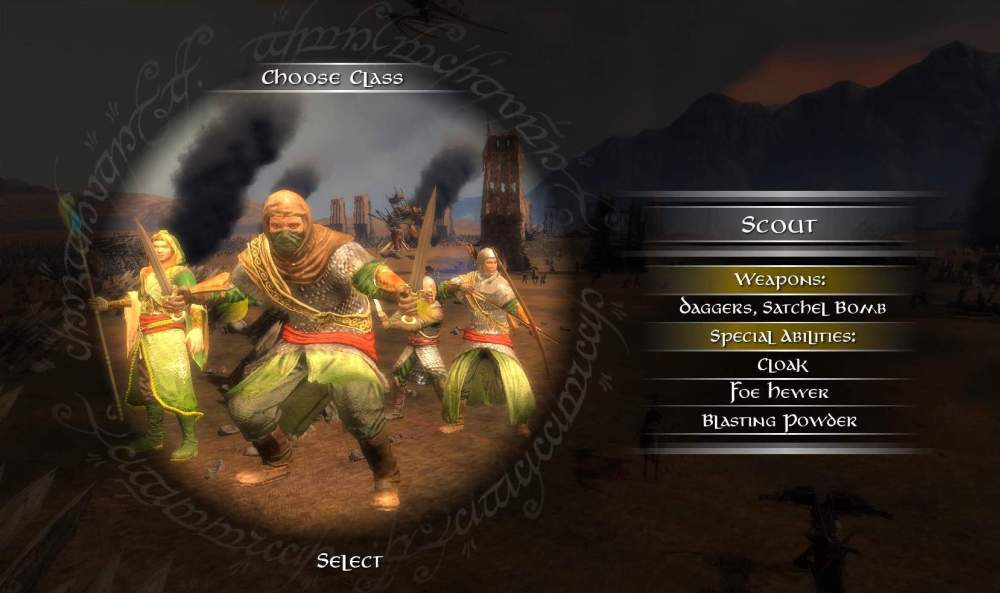
The other melee class is the Scout. Their basic attacks are quick and less powerful. They also have combos, and more importantly, the ability to cloak themselves, turning almost invisible to their enemies. Anyone who knows you're there can still see a faint outline of your character, but it's easy for an enemy who's focused on something else to overlook you. You can pop out of stealth and attack as normal, or you can try to sneak around behind somebody for an extremely powerful backstab, which will kill most units by itself. However, it can be tough to do if your opponent is moving, and missing your opportunity will cause you to fall out stealth and be very vulnerable for a few seconds. Scouts also work on an energy system, though in a slightly different way; in addition to generating energy by normally attacking enemies, you gradually refill your bar just standing around. Using stealth slowly drains it, as do special movies. Scouts can move quickly by rolling, and they can chuck satchel bombs, which can be entertaining.
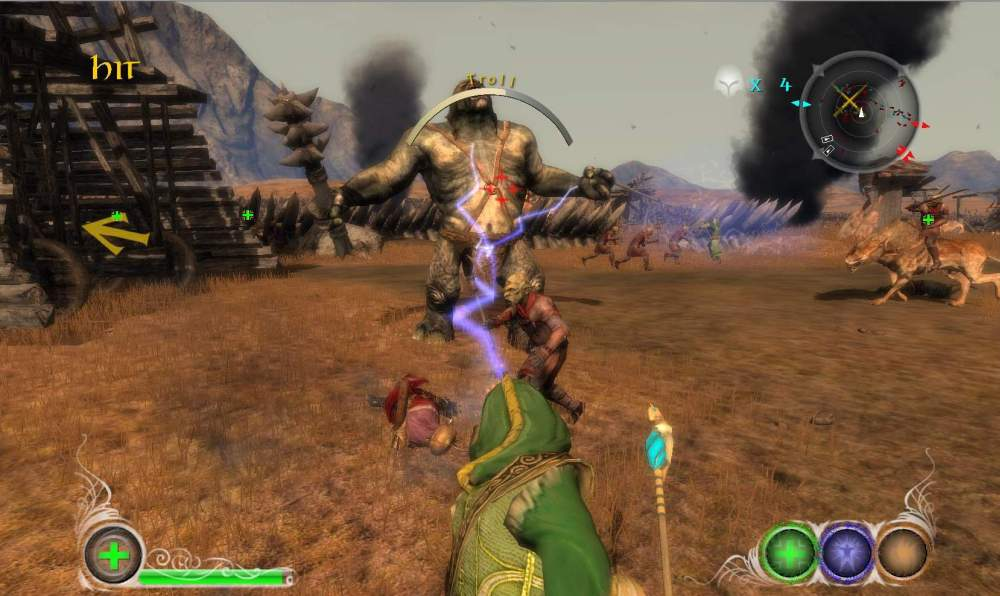
Archers are perhaps the simplest class. Most of the time they stand around shooting arrows in a manner reminiscent of Legolas. They have three ways to modify their arrows; multi-shot, which sprays several arrows out at once, fire arrow, which explodes wherever it lands (think Rambo), and poison arrow, which drops a cloud of poison where it lands, slowly draining the health of enemies nearby. The abilities are all on timers, so once you've used one, you simply wait for it to be available again. They can also throw a kick at anybody who gets close. Their range and mobility make them fairly powerful. Their arrows are easily dodged, especially from far away, but Archers can zoom in on somebody and hit them with a headshot, causing massive damage. Mages are probably the most interesting classes, primarily because they can interact with friendly units in addition to enemies. Their main attack is a bolt of lightning. The damage isn't high, but by holding the button, you can charge up the attack, which allows it to chain up to two times. Their special attacks are also on timers. They can throw a fireball, which will create a deadly field of fire wherever it lands, and they can knockback nearby enemies with a shockwave. They can also heal themselves and friendly targets, and they can put up a large spherical shield that will protect anyone inside from ranged attacks. A mage escorting a group of archers and warriors by using the shield to protect them and heals to keep them alive can be extremely tough to defeat.
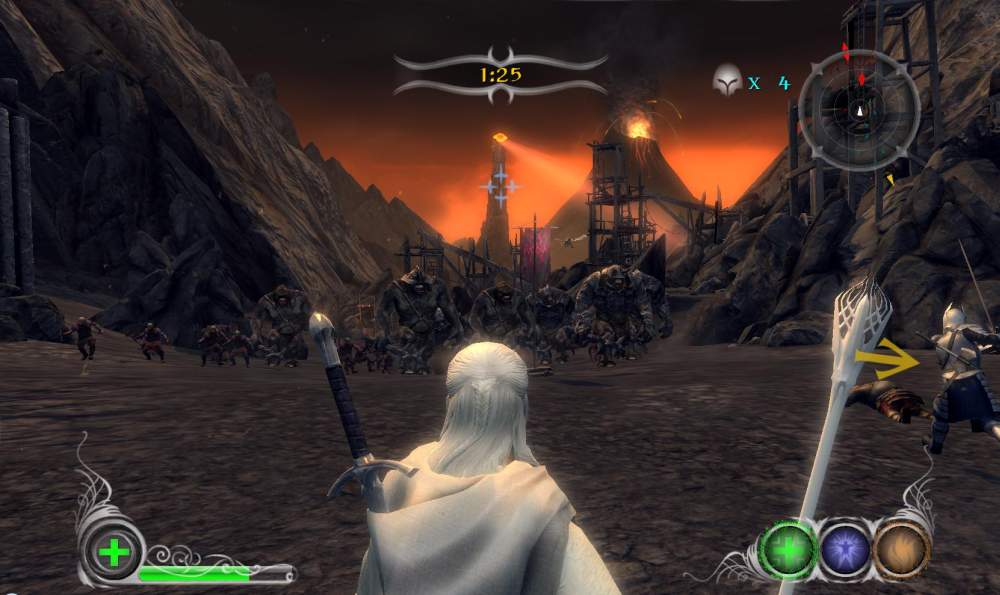
There are two single-player campaigns — one for Good and one for Evil — which have seven or eight missions apiece. Each mission takes somewhere around 20-30 minutes, and you'll make it through the whole game in 8 hours or so. It has three difficulty settings, so if that doesn't sound like a lot of time, bump the AI up a notch so you don't just breeze through it. The game draws heavily upon the movies to tell the story. A narrator (Hugo Weaving) provides background information while clips from the movies are show overlaying a map of Middle Earth. They're often stitched together in a way that suits the purposes of the game's plot, so if you're a diehard fan, there will be opportunities to nitpick. The first campaign focuses on the forces of Good, and it provides a rough outline of the story in the movies, with some liberties taken to add to the gameplay. You start out as a soldier in the battle for Helm's Deep. Your character takes part in a series of objectives — defending the walls, falling back to the main gate, saving King Theoden, then re-taking the wall and beating back the Uruk-hai. If you're familiar with the story, it will play out mostly as you expect. You'll stumble across some of the main villains, such as Saruman, Wormtongue, and a Balrog, and do most of the fighting yourself. Periodically throughout the campaign, you'll be able control the familiar good guys — Gandalf, Legolas, Aragorn, etc. — who are slight variations on the archetypes you've been using, but rather more powerful.
The Evil campaign is a new story, beginning with Sauron's recovery of the One Ring, and his subsequent rampage through Middle Earth. That's not a spoiler — they tell you as much going into the first mission. Most of the missions are like that; you'll go to a well-known location (such as the Mines of Moria or Rivendell), fight through a series of destructive objectives, and kill a major character at the end. There's no suspense, no drama, and the major Good characters are brought into the fray with little fanfare. That's not to say the campaign is without merit; several mission objectives are very nicely done. For example, when attacking Rivendell, at one point you're ordered to storm the buildings and burn all of the books, while the elves panic and fight back around you. It's a nice touch; it feels like something the Uruk-hai would do. Another mission has you razing the Shire — again, something completely unnecessary and completely in character for Sauron's legions. The hobbits don't put up much of a fight, and it has a very brutal feel.
Throughout both campaigns, you'll occasionally get to fight some of Middle Earth's more impressive inhabitants, like the Trolls and the leafy Ents. Melee classes can climb on the backs of trolls and perform a devastating attack to fell them. It's a good thing, too — best of luck going toe to toe with one. Later, you're able to actually take control of your faction's giants. It's fun to run around smashing things as a troll, but it gets old quickly, and other games have been doing it better for a long time. You can also ride horses and Wargs. You can knock people over by riding into them, or flail to the sides with your weapon, but you're much more likely to just fall off as soon as an enemy gets near you. Maybe Pandemic was simply erring on the side of caution with regard to game balance, but riding is awfully unsatisfying. You'll encounter the giant, tusked Oliphaunts carting invaders around. Neat to see, but ridiculously easy to defeat by tapping the series of button presses that show up on your screen.
The AI in LotR: Conquest is more comical than effective. As your mage launches his fire nuke at a group of enemies, they'll alertly shout "Watch out, Fire Wall!" while blithely standing in the fire and dying. Nearby enemies won't hesitate to walk into the fire and immediately die if it lies between you and them. You'll also see the occasional enemy standing around, facing the wrong direction and trying to decide what to do for far too long. The AI also isn't good at backing off for the sake of fun. Oftentimes you'll get knocked down and surrounded, then beaten to death without regaining control of your character. Scouts pick odd times to one-shot you, as will archers, which can be frustrating as well. When discussing balance, game developers often say "It's easy to kill the player." This game is proof of that. Members of your own faction aren't any more helpful; progress made fighting toward your mission objective will often be lost when you die, as your allies quickly crumble without you.
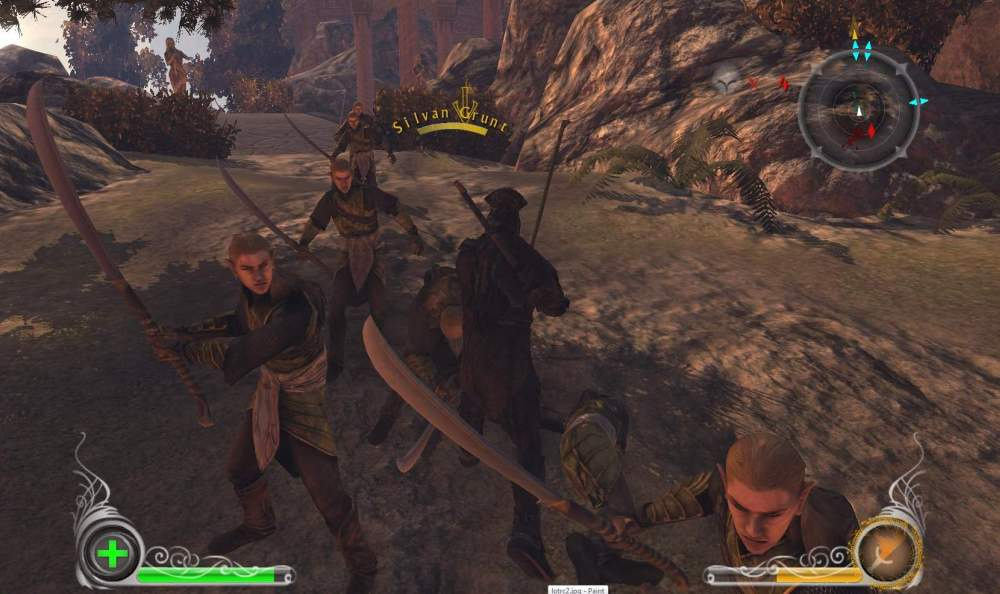
The art is a mixed bag. The maps are pretty enough, and it's cool to see and interact with places like Rivendell and Isengard. The scale doesn't seem quite right, though. Everything is smaller than it appeared in the movies, and places like the Mines of Moria and Helm's Deep don't have that epic feel to them. The character models look pretty good, but there isn't much variation between the generic versions. It can be distracting to wonder when that group of orcs or elves running toward you acquired cloning technology. The Balrog is very cool-looking, though. The music is, of course, fantastic; they've added sections of the movie soundtrack to the game, and they did an excellent job of timing it for objectives and victories.
The game has several multiplayer modes in addition to the typical deathmatch scenarios: Conquest places a series of flags throughout a map, and your team needs to control each point long enough to raise your banner there. Capture the Ring places the One Ring in the middle of the playing field, the goal being to grab it and take it to your enemy's base. There are also a limited number of larger units (i.e. trolls, Ents, horses, etc.) that players can control, but they are not noticeably more powerful. You have the option of running with a bunch of AI friends and foes to fill out the field of war. They don't have much of an impact, but it makes things look more like an actual battle. Melee classes seem to be at a slight disadvantage here — between typical online latency and the propensity for real players to move away, it can be very hard to actually hit anything. Scouts in particular have a rough time. Anyone who's played for a while can pick up the blur of a cloaked Scout, and it's almost impossible to backstab somebody who is specifically trying to avoid it. Given that missing a backstab leaves you exposed and vulnerable, you're better off looking for another target. There's also Co-op play, which can be more entertaining if you've got a friend or three to play with. Perhaps the nicest part is having teammates is that they'll know to peel a pesky Warrior off of you before you get killed. A coordinated group is very, very tough to beat. Unfortunately, the combat, while more frenzied, is even less forgiving to your character's recovery time after performing a move. Completely miss with that heavy attack? Time to respawn. Again.
LotR: Conquest relies heavily on the movies to establish its style. Perhaps too heavily; there's not much in this game that will surprise you or make you wonder what's around the next corner. If you're not a fan of Lord of the Rings or you don't particularly care for this type of action game, Conquest doesn't bring anything new that would change your mind. On the other hand, if you're a nut about the books or movies, and would like a light, quick romp through Middle Earth (without minding the liberties taken with the plot for the sake of gameplay), this will fit the bill. The environments, regardless of scale, are quite recognizable, and it's neat to participate in the same fights you've seen in the movie theater. If you were waiting for the One Game to do justice to Tolkien's universe... well, keep waiting.
-
Review: Lord of the Rings: Conquest
Pandemic Studios, having enjoyed some success with their release of Star Wars: Battlefront II, sought to bring their style of action game to the Lord of the Rings universe as well. Since both Star Wars and LotR are widely regarded as classics in their respective genres, and both have a rich, deep fan base, the task would appear to be similar in scope. Many were expecting Lord of the Rings: Conquest to be, if nothing else, a playground for Tolkien fans to revel in the environments so vividly brought to life by the movies. Unfortunately, between the short, simplistic campaign and the shallow, uninspired combat, LotR: Conquest merely relies on its name for success, failing to bring the innovation or cleverness that the franchise deserves. Read on for the rest of my thoughts.- Title: Lord of the Rings: Conquest
- Developer: Pandemic Studios
- Publisher: Electronic Arts
- System: Windows, PS3, Xbox 360, Nintendo DS
- Reviewer: Soulskill
- Score: 5/10
LotR: Conquest starts you off with a training scenario in which you learn how to play each of the four classes: Warrior, Mage, Archer, and Scout. Each brings a set of unique attacks and special abilities to the table. Warriors flail about with swords, having standard attacks of different speeds and strengths. You can chain multiple attacks in a row, and you can use specific sequences of attacks as "combos," which can have a devastating effect on enemies. They are also able to parry attacks, and to occasionally toss a throwing axe at somebody, dealing damage and knocking them down. It's very effective for closing on those pesky mages and archers who like to stand at range. As warriors cleave their way through enemies, they build energy for special attacks, which imbue their sword with fire. One such attack drops the warrior low to the ground and charges enemies, effectively getting under their guard. Another is a flaming whirlwind, suitable for demolishing large crowds. The third is a powerful direct attack that can punch through an enemy's defenses, and there's also a powerful, spinning slash called a Crowdbreaker — it requires a full bar of energy to use, but can take out a group of enemies with ease.
The other melee class is the Scout. Their basic attacks are quick and less powerful. They also have combos, and more importantly, the ability to cloak themselves, turning almost invisible to their enemies. Anyone who knows you're there can still see a faint outline of your character, but it's easy for an enemy who's focused on something else to overlook you. You can pop out of stealth and attack as normal, or you can try to sneak around behind somebody for an extremely powerful backstab, which will kill most units by itself. However, it can be tough to do if your opponent is moving, and missing your opportunity will cause you to fall out stealth and be very vulnerable for a few seconds. Scouts also work on an energy system, though in a slightly different way; in addition to generating energy by normally attacking enemies, you gradually refill your bar just standing around. Using stealth slowly drains it, as do special movies. Scouts can move quickly by rolling, and they can chuck satchel bombs, which can be entertaining.
Archers are perhaps the simplest class. Most of the time they stand around shooting arrows in a manner reminiscent of Legolas. They have three ways to modify their arrows; multi-shot, which sprays several arrows out at once, fire arrow, which explodes wherever it lands (think Rambo), and poison arrow, which drops a cloud of poison where it lands, slowly draining the health of enemies nearby. The abilities are all on timers, so once you've used one, you simply wait for it to be available again. They can also throw a kick at anybody who gets close. Their range and mobility make them fairly powerful. Their arrows are easily dodged, especially from far away, but Archers can zoom in on somebody and hit them with a headshot, causing massive damage. Mages are probably the most interesting classes, primarily because they can interact with friendly units in addition to enemies. Their main attack is a bolt of lightning. The damage isn't high, but by holding the button, you can charge up the attack, which allows it to chain up to two times. Their special attacks are also on timers. They can throw a fireball, which will create a deadly field of fire wherever it lands, and they can knockback nearby enemies with a shockwave. They can also heal themselves and friendly targets, and they can put up a large spherical shield that will protect anyone inside from ranged attacks. A mage escorting a group of archers and warriors by using the shield to protect them and heals to keep them alive can be extremely tough to defeat.
There are two single-player campaigns — one for Good and one for Evil — which have seven or eight missions apiece. Each mission takes somewhere around 20-30 minutes, and you'll make it through the whole game in 8 hours or so. It has three difficulty settings, so if that doesn't sound like a lot of time, bump the AI up a notch so you don't just breeze through it. The game draws heavily upon the movies to tell the story. A narrator (Hugo Weaving) provides background information while clips from the movies are show overlaying a map of Middle Earth. They're often stitched together in a way that suits the purposes of the game's plot, so if you're a diehard fan, there will be opportunities to nitpick. The first campaign focuses on the forces of Good, and it provides a rough outline of the story in the movies, with some liberties taken to add to the gameplay. You start out as a soldier in the battle for Helm's Deep. Your character takes part in a series of objectives — defending the walls, falling back to the main gate, saving King Theoden, then re-taking the wall and beating back the Uruk-hai. If you're familiar with the story, it will play out mostly as you expect. You'll stumble across some of the main villains, such as Saruman, Wormtongue, and a Balrog, and do most of the fighting yourself. Periodically throughout the campaign, you'll be able control the familiar good guys — Gandalf, Legolas, Aragorn, etc. — who are slight variations on the archetypes you've been using, but rather more powerful.
The Evil campaign is a new story, beginning with Sauron's recovery of the One Ring, and his subsequent rampage through Middle Earth. That's not a spoiler — they tell you as much going into the first mission. Most of the missions are like that; you'll go to a well-known location (such as the Mines of Moria or Rivendell), fight through a series of destructive objectives, and kill a major character at the end. There's no suspense, no drama, and the major Good characters are brought into the fray with little fanfare. That's not to say the campaign is without merit; several mission objectives are very nicely done. For example, when attacking Rivendell, at one point you're ordered to storm the buildings and burn all of the books, while the elves panic and fight back around you. It's a nice touch; it feels like something the Uruk-hai would do. Another mission has you razing the Shire — again, something completely unnecessary and completely in character for Sauron's legions. The hobbits don't put up much of a fight, and it has a very brutal feel.
Throughout both campaigns, you'll occasionally get to fight some of Middle Earth's more impressive inhabitants, like the Trolls and the leafy Ents. Melee classes can climb on the backs of trolls and perform a devastating attack to fell them. It's a good thing, too — best of luck going toe to toe with one. Later, you're able to actually take control of your faction's giants. It's fun to run around smashing things as a troll, but it gets old quickly, and other games have been doing it better for a long time. You can also ride horses and Wargs. You can knock people over by riding into them, or flail to the sides with your weapon, but you're much more likely to just fall off as soon as an enemy gets near you. Maybe Pandemic was simply erring on the side of caution with regard to game balance, but riding is awfully unsatisfying. You'll encounter the giant, tusked Oliphaunts carting invaders around. Neat to see, but ridiculously easy to defeat by tapping the series of button presses that show up on your screen.
The AI in LotR: Conquest is more comical than effective. As your mage launches his fire nuke at a group of enemies, they'll alertly shout "Watch out, Fire Wall!" while blithely standing in the fire and dying. Nearby enemies won't hesitate to walk into the fire and immediately die if it lies between you and them. You'll also see the occasional enemy standing around, facing the wrong direction and trying to decide what to do for far too long. The AI also isn't good at backing off for the sake of fun. Oftentimes you'll get knocked down and surrounded, then beaten to death without regaining control of your character. Scouts pick odd times to one-shot you, as will archers, which can be frustrating as well. When discussing balance, game developers often say "It's easy to kill the player." This game is proof of that. Members of your own faction aren't any more helpful; progress made fighting toward your mission objective will often be lost when you die, as your allies quickly crumble without you.
The art is a mixed bag. The maps are pretty enough, and it's cool to see and interact with places like Rivendell and Isengard. The scale doesn't seem quite right, though. Everything is smaller than it appeared in the movies, and places like the Mines of Moria and Helm's Deep don't have that epic feel to them. The character models look pretty good, but there isn't much variation between the generic versions. It can be distracting to wonder when that group of orcs or elves running toward you acquired cloning technology. The Balrog is very cool-looking, though. The music is, of course, fantastic; they've added sections of the movie soundtrack to the game, and they did an excellent job of timing it for objectives and victories.
The game has several multiplayer modes in addition to the typical deathmatch scenarios: Conquest places a series of flags throughout a map, and your team needs to control each point long enough to raise your banner there. Capture the Ring places the One Ring in the middle of the playing field, the goal being to grab it and take it to your enemy's base. There are also a limited number of larger units (i.e. trolls, Ents, horses, etc.) that players can control, but they are not noticeably more powerful. You have the option of running with a bunch of AI friends and foes to fill out the field of war. They don't have much of an impact, but it makes things look more like an actual battle. Melee classes seem to be at a slight disadvantage here — between typical online latency and the propensity for real players to move away, it can be very hard to actually hit anything. Scouts in particular have a rough time. Anyone who's played for a while can pick up the blur of a cloaked Scout, and it's almost impossible to backstab somebody who is specifically trying to avoid it. Given that missing a backstab leaves you exposed and vulnerable, you're better off looking for another target. There's also Co-op play, which can be more entertaining if you've got a friend or three to play with. Perhaps the nicest part is having teammates is that they'll know to peel a pesky Warrior off of you before you get killed. A coordinated group is very, very tough to beat. Unfortunately, the combat, while more frenzied, is even less forgiving to your character's recovery time after performing a move. Completely miss with that heavy attack? Time to respawn. Again.
LotR: Conquest relies heavily on the movies to establish its style. Perhaps too heavily; there's not much in this game that will surprise you or make you wonder what's around the next corner. If you're not a fan of Lord of the Rings or you don't particularly care for this type of action game, Conquest doesn't bring anything new that would change your mind. On the other hand, if you're a nut about the books or movies, and would like a light, quick romp through Middle Earth (without minding the liberties taken with the plot for the sake of gameplay), this will fit the bill. The environments, regardless of scale, are quite recognizable, and it's neat to participate in the same fights you've seen in the movie theater. If you were waiting for the One Game to do justice to Tolkien's universe... well, keep waiting.
-
Review: Lord of the Rings: Conquest
Pandemic Studios, having enjoyed some success with their release of Star Wars: Battlefront II, sought to bring their style of action game to the Lord of the Rings universe as well. Since both Star Wars and LotR are widely regarded as classics in their respective genres, and both have a rich, deep fan base, the task would appear to be similar in scope. Many were expecting Lord of the Rings: Conquest to be, if nothing else, a playground for Tolkien fans to revel in the environments so vividly brought to life by the movies. Unfortunately, between the short, simplistic campaign and the shallow, uninspired combat, LotR: Conquest merely relies on its name for success, failing to bring the innovation or cleverness that the franchise deserves. Read on for the rest of my thoughts.- Title: Lord of the Rings: Conquest
- Developer: Pandemic Studios
- Publisher: Electronic Arts
- System: Windows, PS3, Xbox 360, Nintendo DS
- Reviewer: Soulskill
- Score: 5/10
LotR: Conquest starts you off with a training scenario in which you learn how to play each of the four classes: Warrior, Mage, Archer, and Scout. Each brings a set of unique attacks and special abilities to the table. Warriors flail about with swords, having standard attacks of different speeds and strengths. You can chain multiple attacks in a row, and you can use specific sequences of attacks as "combos," which can have a devastating effect on enemies. They are also able to parry attacks, and to occasionally toss a throwing axe at somebody, dealing damage and knocking them down. It's very effective for closing on those pesky mages and archers who like to stand at range. As warriors cleave their way through enemies, they build energy for special attacks, which imbue their sword with fire. One such attack drops the warrior low to the ground and charges enemies, effectively getting under their guard. Another is a flaming whirlwind, suitable for demolishing large crowds. The third is a powerful direct attack that can punch through an enemy's defenses, and there's also a powerful, spinning slash called a Crowdbreaker — it requires a full bar of energy to use, but can take out a group of enemies with ease.
The other melee class is the Scout. Their basic attacks are quick and less powerful. They also have combos, and more importantly, the ability to cloak themselves, turning almost invisible to their enemies. Anyone who knows you're there can still see a faint outline of your character, but it's easy for an enemy who's focused on something else to overlook you. You can pop out of stealth and attack as normal, or you can try to sneak around behind somebody for an extremely powerful backstab, which will kill most units by itself. However, it can be tough to do if your opponent is moving, and missing your opportunity will cause you to fall out stealth and be very vulnerable for a few seconds. Scouts also work on an energy system, though in a slightly different way; in addition to generating energy by normally attacking enemies, you gradually refill your bar just standing around. Using stealth slowly drains it, as do special movies. Scouts can move quickly by rolling, and they can chuck satchel bombs, which can be entertaining.
Archers are perhaps the simplest class. Most of the time they stand around shooting arrows in a manner reminiscent of Legolas. They have three ways to modify their arrows; multi-shot, which sprays several arrows out at once, fire arrow, which explodes wherever it lands (think Rambo), and poison arrow, which drops a cloud of poison where it lands, slowly draining the health of enemies nearby. The abilities are all on timers, so once you've used one, you simply wait for it to be available again. They can also throw a kick at anybody who gets close. Their range and mobility make them fairly powerful. Their arrows are easily dodged, especially from far away, but Archers can zoom in on somebody and hit them with a headshot, causing massive damage. Mages are probably the most interesting classes, primarily because they can interact with friendly units in addition to enemies. Their main attack is a bolt of lightning. The damage isn't high, but by holding the button, you can charge up the attack, which allows it to chain up to two times. Their special attacks are also on timers. They can throw a fireball, which will create a deadly field of fire wherever it lands, and they can knockback nearby enemies with a shockwave. They can also heal themselves and friendly targets, and they can put up a large spherical shield that will protect anyone inside from ranged attacks. A mage escorting a group of archers and warriors by using the shield to protect them and heals to keep them alive can be extremely tough to defeat.
There are two single-player campaigns — one for Good and one for Evil — which have seven or eight missions apiece. Each mission takes somewhere around 20-30 minutes, and you'll make it through the whole game in 8 hours or so. It has three difficulty settings, so if that doesn't sound like a lot of time, bump the AI up a notch so you don't just breeze through it. The game draws heavily upon the movies to tell the story. A narrator (Hugo Weaving) provides background information while clips from the movies are show overlaying a map of Middle Earth. They're often stitched together in a way that suits the purposes of the game's plot, so if you're a diehard fan, there will be opportunities to nitpick. The first campaign focuses on the forces of Good, and it provides a rough outline of the story in the movies, with some liberties taken to add to the gameplay. You start out as a soldier in the battle for Helm's Deep. Your character takes part in a series of objectives — defending the walls, falling back to the main gate, saving King Theoden, then re-taking the wall and beating back the Uruk-hai. If you're familiar with the story, it will play out mostly as you expect. You'll stumble across some of the main villains, such as Saruman, Wormtongue, and a Balrog, and do most of the fighting yourself. Periodically throughout the campaign, you'll be able control the familiar good guys — Gandalf, Legolas, Aragorn, etc. — who are slight variations on the archetypes you've been using, but rather more powerful.
The Evil campaign is a new story, beginning with Sauron's recovery of the One Ring, and his subsequent rampage through Middle Earth. That's not a spoiler — they tell you as much going into the first mission. Most of the missions are like that; you'll go to a well-known location (such as the Mines of Moria or Rivendell), fight through a series of destructive objectives, and kill a major character at the end. There's no suspense, no drama, and the major Good characters are brought into the fray with little fanfare. That's not to say the campaign is without merit; several mission objectives are very nicely done. For example, when attacking Rivendell, at one point you're ordered to storm the buildings and burn all of the books, while the elves panic and fight back around you. It's a nice touch; it feels like something the Uruk-hai would do. Another mission has you razing the Shire — again, something completely unnecessary and completely in character for Sauron's legions. The hobbits don't put up much of a fight, and it has a very brutal feel.
Throughout both campaigns, you'll occasionally get to fight some of Middle Earth's more impressive inhabitants, like the Trolls and the leafy Ents. Melee classes can climb on the backs of trolls and perform a devastating attack to fell them. It's a good thing, too — best of luck going toe to toe with one. Later, you're able to actually take control of your faction's giants. It's fun to run around smashing things as a troll, but it gets old quickly, and other games have been doing it better for a long time. You can also ride horses and Wargs. You can knock people over by riding into them, or flail to the sides with your weapon, but you're much more likely to just fall off as soon as an enemy gets near you. Maybe Pandemic was simply erring on the side of caution with regard to game balance, but riding is awfully unsatisfying. You'll encounter the giant, tusked Oliphaunts carting invaders around. Neat to see, but ridiculously easy to defeat by tapping the series of button presses that show up on your screen.
The AI in LotR: Conquest is more comical than effective. As your mage launches his fire nuke at a group of enemies, they'll alertly shout "Watch out, Fire Wall!" while blithely standing in the fire and dying. Nearby enemies won't hesitate to walk into the fire and immediately die if it lies between you and them. You'll also see the occasional enemy standing around, facing the wrong direction and trying to decide what to do for far too long. The AI also isn't good at backing off for the sake of fun. Oftentimes you'll get knocked down and surrounded, then beaten to death without regaining control of your character. Scouts pick odd times to one-shot you, as will archers, which can be frustrating as well. When discussing balance, game developers often say "It's easy to kill the player." This game is proof of that. Members of your own faction aren't any more helpful; progress made fighting toward your mission objective will often be lost when you die, as your allies quickly crumble without you.
The art is a mixed bag. The maps are pretty enough, and it's cool to see and interact with places like Rivendell and Isengard. The scale doesn't seem quite right, though. Everything is smaller than it appeared in the movies, and places like the Mines of Moria and Helm's Deep don't have that epic feel to them. The character models look pretty good, but there isn't much variation between the generic versions. It can be distracting to wonder when that group of orcs or elves running toward you acquired cloning technology. The Balrog is very cool-looking, though. The music is, of course, fantastic; they've added sections of the movie soundtrack to the game, and they did an excellent job of timing it for objectives and victories.
The game has several multiplayer modes in addition to the typical deathmatch scenarios: Conquest places a series of flags throughout a map, and your team needs to control each point long enough to raise your banner there. Capture the Ring places the One Ring in the middle of the playing field, the goal being to grab it and take it to your enemy's base. There are also a limited number of larger units (i.e. trolls, Ents, horses, etc.) that players can control, but they are not noticeably more powerful. You have the option of running with a bunch of AI friends and foes to fill out the field of war. They don't have much of an impact, but it makes things look more like an actual battle. Melee classes seem to be at a slight disadvantage here — between typical online latency and the propensity for real players to move away, it can be very hard to actually hit anything. Scouts in particular have a rough time. Anyone who's played for a while can pick up the blur of a cloaked Scout, and it's almost impossible to backstab somebody who is specifically trying to avoid it. Given that missing a backstab leaves you exposed and vulnerable, you're better off looking for another target. There's also Co-op play, which can be more entertaining if you've got a friend or three to play with. Perhaps the nicest part is having teammates is that they'll know to peel a pesky Warrior off of you before you get killed. A coordinated group is very, very tough to beat. Unfortunately, the combat, while more frenzied, is even less forgiving to your character's recovery time after performing a move. Completely miss with that heavy attack? Time to respawn. Again.
LotR: Conquest relies heavily on the movies to establish its style. Perhaps too heavily; there's not much in this game that will surprise you or make you wonder what's around the next corner. If you're not a fan of Lord of the Rings or you don't particularly care for this type of action game, Conquest doesn't bring anything new that would change your mind. On the other hand, if you're a nut about the books or movies, and would like a light, quick romp through Middle Earth (without minding the liberties taken with the plot for the sake of gameplay), this will fit the bill. The environments, regardless of scale, are quite recognizable, and it's neat to participate in the same fights you've seen in the movie theater. If you were waiting for the One Game to do justice to Tolkien's universe... well, keep waiting.
-
Review: Lord of the Rings: Conquest
Pandemic Studios, having enjoyed some success with their release of Star Wars: Battlefront II, sought to bring their style of action game to the Lord of the Rings universe as well. Since both Star Wars and LotR are widely regarded as classics in their respective genres, and both have a rich, deep fan base, the task would appear to be similar in scope. Many were expecting Lord of the Rings: Conquest to be, if nothing else, a playground for Tolkien fans to revel in the environments so vividly brought to life by the movies. Unfortunately, between the short, simplistic campaign and the shallow, uninspired combat, LotR: Conquest merely relies on its name for success, failing to bring the innovation or cleverness that the franchise deserves. Read on for the rest of my thoughts.- Title: Lord of the Rings: Conquest
- Developer: Pandemic Studios
- Publisher: Electronic Arts
- System: Windows, PS3, Xbox 360, Nintendo DS
- Reviewer: Soulskill
- Score: 5/10
LotR: Conquest starts you off with a training scenario in which you learn how to play each of the four classes: Warrior, Mage, Archer, and Scout. Each brings a set of unique attacks and special abilities to the table. Warriors flail about with swords, having standard attacks of different speeds and strengths. You can chain multiple attacks in a row, and you can use specific sequences of attacks as "combos," which can have a devastating effect on enemies. They are also able to parry attacks, and to occasionally toss a throwing axe at somebody, dealing damage and knocking them down. It's very effective for closing on those pesky mages and archers who like to stand at range. As warriors cleave their way through enemies, they build energy for special attacks, which imbue their sword with fire. One such attack drops the warrior low to the ground and charges enemies, effectively getting under their guard. Another is a flaming whirlwind, suitable for demolishing large crowds. The third is a powerful direct attack that can punch through an enemy's defenses, and there's also a powerful, spinning slash called a Crowdbreaker — it requires a full bar of energy to use, but can take out a group of enemies with ease.
The other melee class is the Scout. Their basic attacks are quick and less powerful. They also have combos, and more importantly, the ability to cloak themselves, turning almost invisible to their enemies. Anyone who knows you're there can still see a faint outline of your character, but it's easy for an enemy who's focused on something else to overlook you. You can pop out of stealth and attack as normal, or you can try to sneak around behind somebody for an extremely powerful backstab, which will kill most units by itself. However, it can be tough to do if your opponent is moving, and missing your opportunity will cause you to fall out stealth and be very vulnerable for a few seconds. Scouts also work on an energy system, though in a slightly different way; in addition to generating energy by normally attacking enemies, you gradually refill your bar just standing around. Using stealth slowly drains it, as do special movies. Scouts can move quickly by rolling, and they can chuck satchel bombs, which can be entertaining.
Archers are perhaps the simplest class. Most of the time they stand around shooting arrows in a manner reminiscent of Legolas. They have three ways to modify their arrows; multi-shot, which sprays several arrows out at once, fire arrow, which explodes wherever it lands (think Rambo), and poison arrow, which drops a cloud of poison where it lands, slowly draining the health of enemies nearby. The abilities are all on timers, so once you've used one, you simply wait for it to be available again. They can also throw a kick at anybody who gets close. Their range and mobility make them fairly powerful. Their arrows are easily dodged, especially from far away, but Archers can zoom in on somebody and hit them with a headshot, causing massive damage. Mages are probably the most interesting classes, primarily because they can interact with friendly units in addition to enemies. Their main attack is a bolt of lightning. The damage isn't high, but by holding the button, you can charge up the attack, which allows it to chain up to two times. Their special attacks are also on timers. They can throw a fireball, which will create a deadly field of fire wherever it lands, and they can knockback nearby enemies with a shockwave. They can also heal themselves and friendly targets, and they can put up a large spherical shield that will protect anyone inside from ranged attacks. A mage escorting a group of archers and warriors by using the shield to protect them and heals to keep them alive can be extremely tough to defeat.
There are two single-player campaigns — one for Good and one for Evil — which have seven or eight missions apiece. Each mission takes somewhere around 20-30 minutes, and you'll make it through the whole game in 8 hours or so. It has three difficulty settings, so if that doesn't sound like a lot of time, bump the AI up a notch so you don't just breeze through it. The game draws heavily upon the movies to tell the story. A narrator (Hugo Weaving) provides background information while clips from the movies are show overlaying a map of Middle Earth. They're often stitched together in a way that suits the purposes of the game's plot, so if you're a diehard fan, there will be opportunities to nitpick. The first campaign focuses on the forces of Good, and it provides a rough outline of the story in the movies, with some liberties taken to add to the gameplay. You start out as a soldier in the battle for Helm's Deep. Your character takes part in a series of objectives — defending the walls, falling back to the main gate, saving King Theoden, then re-taking the wall and beating back the Uruk-hai. If you're familiar with the story, it will play out mostly as you expect. You'll stumble across some of the main villains, such as Saruman, Wormtongue, and a Balrog, and do most of the fighting yourself. Periodically throughout the campaign, you'll be able control the familiar good guys — Gandalf, Legolas, Aragorn, etc. — who are slight variations on the archetypes you've been using, but rather more powerful.
The Evil campaign is a new story, beginning with Sauron's recovery of the One Ring, and his subsequent rampage through Middle Earth. That's not a spoiler — they tell you as much going into the first mission. Most of the missions are like that; you'll go to a well-known location (such as the Mines of Moria or Rivendell), fight through a series of destructive objectives, and kill a major character at the end. There's no suspense, no drama, and the major Good characters are brought into the fray with little fanfare. That's not to say the campaign is without merit; several mission objectives are very nicely done. For example, when attacking Rivendell, at one point you're ordered to storm the buildings and burn all of the books, while the elves panic and fight back around you. It's a nice touch; it feels like something the Uruk-hai would do. Another mission has you razing the Shire — again, something completely unnecessary and completely in character for Sauron's legions. The hobbits don't put up much of a fight, and it has a very brutal feel.
Throughout both campaigns, you'll occasionally get to fight some of Middle Earth's more impressive inhabitants, like the Trolls and the leafy Ents. Melee classes can climb on the backs of trolls and perform a devastating attack to fell them. It's a good thing, too — best of luck going toe to toe with one. Later, you're able to actually take control of your faction's giants. It's fun to run around smashing things as a troll, but it gets old quickly, and other games have been doing it better for a long time. You can also ride horses and Wargs. You can knock people over by riding into them, or flail to the sides with your weapon, but you're much more likely to just fall off as soon as an enemy gets near you. Maybe Pandemic was simply erring on the side of caution with regard to game balance, but riding is awfully unsatisfying. You'll encounter the giant, tusked Oliphaunts carting invaders around. Neat to see, but ridiculously easy to defeat by tapping the series of button presses that show up on your screen.
The AI in LotR: Conquest is more comical than effective. As your mage launches his fire nuke at a group of enemies, they'll alertly shout "Watch out, Fire Wall!" while blithely standing in the fire and dying. Nearby enemies won't hesitate to walk into the fire and immediately die if it lies between you and them. You'll also see the occasional enemy standing around, facing the wrong direction and trying to decide what to do for far too long. The AI also isn't good at backing off for the sake of fun. Oftentimes you'll get knocked down and surrounded, then beaten to death without regaining control of your character. Scouts pick odd times to one-shot you, as will archers, which can be frustrating as well. When discussing balance, game developers often say "It's easy to kill the player." This game is proof of that. Members of your own faction aren't any more helpful; progress made fighting toward your mission objective will often be lost when you die, as your allies quickly crumble without you.
The art is a mixed bag. The maps are pretty enough, and it's cool to see and interact with places like Rivendell and Isengard. The scale doesn't seem quite right, though. Everything is smaller than it appeared in the movies, and places like the Mines of Moria and Helm's Deep don't have that epic feel to them. The character models look pretty good, but there isn't much variation between the generic versions. It can be distracting to wonder when that group of orcs or elves running toward you acquired cloning technology. The Balrog is very cool-looking, though. The music is, of course, fantastic; they've added sections of the movie soundtrack to the game, and they did an excellent job of timing it for objectives and victories.
The game has several multiplayer modes in addition to the typical deathmatch scenarios: Conquest places a series of flags throughout a map, and your team needs to control each point long enough to raise your banner there. Capture the Ring places the One Ring in the middle of the playing field, the goal being to grab it and take it to your enemy's base. There are also a limited number of larger units (i.e. trolls, Ents, horses, etc.) that players can control, but they are not noticeably more powerful. You have the option of running with a bunch of AI friends and foes to fill out the field of war. They don't have much of an impact, but it makes things look more like an actual battle. Melee classes seem to be at a slight disadvantage here — between typical online latency and the propensity for real players to move away, it can be very hard to actually hit anything. Scouts in particular have a rough time. Anyone who's played for a while can pick up the blur of a cloaked Scout, and it's almost impossible to backstab somebody who is specifically trying to avoid it. Given that missing a backstab leaves you exposed and vulnerable, you're better off looking for another target. There's also Co-op play, which can be more entertaining if you've got a friend or three to play with. Perhaps the nicest part is having teammates is that they'll know to peel a pesky Warrior off of you before you get killed. A coordinated group is very, very tough to beat. Unfortunately, the combat, while more frenzied, is even less forgiving to your character's recovery time after performing a move. Completely miss with that heavy attack? Time to respawn. Again.
LotR: Conquest relies heavily on the movies to establish its style. Perhaps too heavily; there's not much in this game that will surprise you or make you wonder what's around the next corner. If you're not a fan of Lord of the Rings or you don't particularly care for this type of action game, Conquest doesn't bring anything new that would change your mind. On the other hand, if you're a nut about the books or movies, and would like a light, quick romp through Middle Earth (without minding the liberties taken with the plot for the sake of gameplay), this will fit the bill. The environments, regardless of scale, are quite recognizable, and it's neat to participate in the same fights you've seen in the movie theater. If you were waiting for the One Game to do justice to Tolkien's universe... well, keep waiting.
-
US CTO Choice Down To a Two-Horse Race
theodp writes "Barack Obama apparently didn't return CmdrTaco's call. BusinessWeek reports that the choices for the first US CTO have narrowed, and it's now a two-horse race between Padmasree Warrior, Cisco's CTO, and Vivek Kundra, who holds the same title for the Government of the District of Columbia. Two very different resumes — which would you advise Obama to pick?" I just know I was #3 on the list. -
Second Prototype of the $200 Open Source Tablet
holy_calamity writes "TechCrunch blogger Mike Arrington decided last year to invent a new class of low-cost internet tablet using open source hardware and software. The second prototype has been unveiled, sporting a 12-inch touchscreen powered by a Via Nano processor, 1 GB of ram and a 4 GB flash drive. It runs a browser and nothing else on top of a custom Linux build. 'Resolution is 1024×768, which means the vast majority of websites are viewed in full width without scrolling. The device also has wifi, an accelerometer (so when you turn the screen on its side you can view more of a web page), a camera and a four cell battery.'" -
Active Directory Comes To Linux With Samba 4
Da Massive writes in with another possible answer to a recent Ask Slashdot about FOSS replacements for Microsoft AD server. "Enterprise networks now have an alternative choice to Microsoft Active Directory (AD) servers, with the open source Samba project aiming for feature parity with the forthcoming release of version 4, according to Canberra-based Samba developer Andrew Bartlett. Speaking at this year's linux.conf.au Linux and open source conference in Hobart, Bartlett said Samba 4 is aiming to be a replacement for AD by providing a free software implementation of Microsoft's custom protocols. Because AD is 'far more than LDAP and Kerberos,' Bartlett said, Samba 4 is not only about developing with Microsoft's customization of those protocols, it is also about moving the project beyond just providing an NT 4 compatible domain manager." -
Solution Against Cold Boot Attack In the Making
Bubba writes "I just discovered this blog: Frozen Cache. It describes a concept for preventing cold boot attacks by saving the encryption key in the CPU cache. It is claimed that by disabling the CPU cache the key will remain in cache and won't be written to memory. The blog says they're working on a proof-of-concept implementation for Linux. Could this really turn out to be a working solution?" Update: 01/19 20:26 GMT by KD : Jacob Appelbaum, one of the authors of the cold boot attack paper, wrote in with this comment: "It's not a solution. It simply seeks to make it more obscure but an attacker would certainly still be able to pull off the attack. From what is on that blog, there's still a full keyschedule in memory at this time. This is how we reconstruct the key, the redundant information in memory; it's not just the 128/256 bit key itself. For older methods, they needed the actual specific key bits but we don't need them because we recreate them. Basically, the CPU is acting as a ghetto crypto co-processer. Emphasis on ghetto. It's a nice suggestion but the devil is in the details and sadly the details in this case aren't really up to snuff. It's a bogus solution." -
Dvorak Layout Claimed Not Superior To QWERTY
Michael Pyne sends in an article published at Reason Online 13 years ago, dismantling the entrenched myth that the Dvorak keyboard layout is a superior technology to QWERTY. The odd thing is that this 13-year-old article recaps research (refereed and published in a respected economics journal) 19 years ago. While we have discussed Dvorak many times over the years, I don't believe we have dug into this convincing-sounding refutation of the Dvorak mythology. The article is in the context of arguing against the conventional wisdom of "first mover advantage" — that the first product to market gains a large entrenchment benefit, such as VHS vs. Beta, MS-DOS vs. anything, etc. It's very much a pro-markets piece. -
Dvorak Layout Claimed Not Superior To QWERTY
Michael Pyne sends in an article published at Reason Online 13 years ago, dismantling the entrenched myth that the Dvorak keyboard layout is a superior technology to QWERTY. The odd thing is that this 13-year-old article recaps research (refereed and published in a respected economics journal) 19 years ago. While we have discussed Dvorak many times over the years, I don't believe we have dug into this convincing-sounding refutation of the Dvorak mythology. The article is in the context of arguing against the conventional wisdom of "first mover advantage" — that the first product to market gains a large entrenchment benefit, such as VHS vs. Beta, MS-DOS vs. anything, etc. It's very much a pro-markets piece. -
Dvorak Layout Claimed Not Superior To QWERTY
Michael Pyne sends in an article published at Reason Online 13 years ago, dismantling the entrenched myth that the Dvorak keyboard layout is a superior technology to QWERTY. The odd thing is that this 13-year-old article recaps research (refereed and published in a respected economics journal) 19 years ago. While we have discussed Dvorak many times over the years, I don't believe we have dug into this convincing-sounding refutation of the Dvorak mythology. The article is in the context of arguing against the conventional wisdom of "first mover advantage" — that the first product to market gains a large entrenchment benefit, such as VHS vs. Beta, MS-DOS vs. anything, etc. It's very much a pro-markets piece. -
Dvorak Layout Claimed Not Superior To QWERTY
Michael Pyne sends in an article published at Reason Online 13 years ago, dismantling the entrenched myth that the Dvorak keyboard layout is a superior technology to QWERTY. The odd thing is that this 13-year-old article recaps research (refereed and published in a respected economics journal) 19 years ago. While we have discussed Dvorak many times over the years, I don't believe we have dug into this convincing-sounding refutation of the Dvorak mythology. The article is in the context of arguing against the conventional wisdom of "first mover advantage" — that the first product to market gains a large entrenchment benefit, such as VHS vs. Beta, MS-DOS vs. anything, etc. It's very much a pro-markets piece. -
A Step Toward an Invisibility Cloak
Technology Review has a writeup on the latest advance in the lab towards an invisibility cloak made of metamaterials, described this week in Science. We've been following this technology since the beginning. The breakthrough is software that lets researchers design materials that are both low-loss and wideband. "The cloak that the researchers built works with wavelengths of light ranging from about 1 to 18 gigahertz — a swath as broad as the visible spectrum. No one has yet made a cloaking device that works in the visible spectrum, and those metamaterials that have been fabricated tend to work only with narrow bands of light. But a cloak that made an object invisible to light of only one color would not be of much use. Similarly, a cloaking device can't afford to be lossy: if it lets just a little bit of light reflect off the object it's supposed to cloak, it's no longer effective. The cloak that Smith built is very low loss, successfully rerouting almost all the light that hits it." -
A Step Toward an Invisibility Cloak
Technology Review has a writeup on the latest advance in the lab towards an invisibility cloak made of metamaterials, described this week in Science. We've been following this technology since the beginning. The breakthrough is software that lets researchers design materials that are both low-loss and wideband. "The cloak that the researchers built works with wavelengths of light ranging from about 1 to 18 gigahertz — a swath as broad as the visible spectrum. No one has yet made a cloaking device that works in the visible spectrum, and those metamaterials that have been fabricated tend to work only with narrow bands of light. But a cloak that made an object invisible to light of only one color would not be of much use. Similarly, a cloaking device can't afford to be lossy: if it lets just a little bit of light reflect off the object it's supposed to cloak, it's no longer effective. The cloak that Smith built is very low loss, successfully rerouting almost all the light that hits it." -
A Step Toward an Invisibility Cloak
Technology Review has a writeup on the latest advance in the lab towards an invisibility cloak made of metamaterials, described this week in Science. We've been following this technology since the beginning. The breakthrough is software that lets researchers design materials that are both low-loss and wideband. "The cloak that the researchers built works with wavelengths of light ranging from about 1 to 18 gigahertz — a swath as broad as the visible spectrum. No one has yet made a cloaking device that works in the visible spectrum, and those metamaterials that have been fabricated tend to work only with narrow bands of light. But a cloak that made an object invisible to light of only one color would not be of much use. Similarly, a cloaking device can't afford to be lossy: if it lets just a little bit of light reflect off the object it's supposed to cloak, it's no longer effective. The cloak that Smith built is very low loss, successfully rerouting almost all the light that hits it." -
Valve Takes Optimistic View of Piracy
GameDaily recently spoke with Jason Holtman, director of business development and legal affairs for Valve, about online sales and piracy. Holtman took a surprising stance on the latter, effectively taking responsibility for at least a portion of pirated games. Quoting: "'There's a big business feeling that there's piracy,' he says. But the truth is: 'Pirates are underserved customers. When you think about it that way, you think, "Oh my gosh, I can do some interesting things and make some interesting money off of it." We take all of our games day-and-date to Russia,' Holtman says of Valve. 'The reason people pirated things in Russia,' he explains, 'is because Russians are reading magazines and watching television — they say "Man, I want to play that game so bad," but the publishers respond "you can play that game in six months...maybe." We found that our piracy rates dropped off significantly,' Holtman says." Attitudes like this seem to be prevalent at Valve; last month we talked about founder Gabe Newell's comments that "most DRM strategies are just dumb." -
The Best Robots of 2008
An anonymous reader writes "Robot innovation continued its relentless advances during 2008. SingularityHub has a showcase of the best robot videos of the past year. These robot videos are really amazing, and they show just how far we have come in the field of robotics in recent years." The videos include toy robots, robot musicians (which we've discussed in the past), modular robots that work together to move around, robots doing synchronized martial arts, the BigDog robot that can walk on almost any type of terrain, and robot soccer. We've also recently talked about a couple of robots that will bring you beer. -
The Best Robots of 2008
An anonymous reader writes "Robot innovation continued its relentless advances during 2008. SingularityHub has a showcase of the best robot videos of the past year. These robot videos are really amazing, and they show just how far we have come in the field of robotics in recent years." The videos include toy robots, robot musicians (which we've discussed in the past), modular robots that work together to move around, robots doing synchronized martial arts, the BigDog robot that can walk on almost any type of terrain, and robot soccer. We've also recently talked about a couple of robots that will bring you beer. -
The Best Robots of 2008
An anonymous reader writes "Robot innovation continued its relentless advances during 2008. SingularityHub has a showcase of the best robot videos of the past year. These robot videos are really amazing, and they show just how far we have come in the field of robotics in recent years." The videos include toy robots, robot musicians (which we've discussed in the past), modular robots that work together to move around, robots doing synchronized martial arts, the BigDog robot that can walk on almost any type of terrain, and robot soccer. We've also recently talked about a couple of robots that will bring you beer. -
The Best Robots of 2008
An anonymous reader writes "Robot innovation continued its relentless advances during 2008. SingularityHub has a showcase of the best robot videos of the past year. These robot videos are really amazing, and they show just how far we have come in the field of robotics in recent years." The videos include toy robots, robot musicians (which we've discussed in the past), modular robots that work together to move around, robots doing synchronized martial arts, the BigDog robot that can walk on almost any type of terrain, and robot soccer. We've also recently talked about a couple of robots that will bring you beer. -
Windows 7's Media Hype Having the Opposite Effect As Vista's
Death Metal Maniac tips an Ars Technica piece suggesting that the media's coverage of Vista's flaws portrayed the operating system as worse than it was, and, if early reports on Windows 7 are any indication, positive hype will create the opposite reaction this time around. Quoting: "... the problem is exaggeration; ... bloggers and journalists alike use their personal experiences to prove their point in their writing. The blame doesn't solely lie with us, as Vista was by no means perfect, but we did manage to amplify the problems beyond reason. And if the beta is anything to go by, Windows 7 is going to fly. This is, by far, the best beta operating system the software giant has ever released. The media has locked on to this, and is using exaggeration already, before Windows 7 is even ready for prime time." Apparently a decent beta can succeed where $300 million and Jerry Seinfeld failed. -
RIAA Walks Away From Another "Discovery" Case
NewYorkCountryLawyer writes "You may recall that the RIAA walked away last week from one of their 'discovery' cases seeking the identities of 'John Does' who attended Rhode Island College. We have just learned that they walked away from another one, BMG Music v. Does 1-14, in Greensboro, North Carolina. 2 of the 14 John Does had settled, but the other 12 — who hung tough — will never be identified to the RIAA lawyers and will not have to pay any 'settlement.' This adds fuel to the debate over whether the RIAA has finally seen the light or is still sneaking around in the dark." -
Graphene Sheets Get Easier To Manufacture
grunaura writes "South Korean researchers have devised a way to create graphene sheets one centimeter square using a hydrocarbon vapor on heated nickel. It's touted as being more efficient than the current process where graphene sheets are pressed, and there is evidence that 'the quality of graphene grown by chemical vapour deposition is as high as mechanically cleaved graphene.' Graphene is relatively new, but not to Slashdot. This round of news highlighting the technology focuses on the bendable nature of graphene sheets, as opposed to the memory applications or capacitive properties discussed here previously. These films are the closest we have come to superconductors at room temperature." -
Ubuntu's Laptop Killing Bug Fixed
jeevesbond writes "Back in October of 2007 we discussed a bug that would dramatically shorten the life of laptops using Ubuntu. Ubuntu users will be glad to know that a fix has finally been released for Ubuntu versions 9.04, 8.10 and 8.04 (LTS). However, as this fix is not yet in the update repositories, anyone wishing to test it should follow these instructions for enabling the 'proposed' repository. Report your results on the original bug report. Happy testing!" -
RIAA Tries To Appeal Order Allowing Internet TV Court Broadcast
NewYorkCountryLawyer writes "The RIAA has appealed the order entered several days ago allowing the January 22nd hearing in SONY BMG Music v. Tenenbaum to be streamed over internet TV. Additionally, they've made a motion for a stay. I'm just a country lawyer, but as far as I know: (a) it's not possible to appeal the order, (b) it was procedurally improper and ineffective to file a notice of appeal, and (c) it was improper to direct their motion for a stay to the District Court Judge. Well, let's hope the arguments in the First Circuit will be streamed, too. Meanwhile, one commentator wonders why the tooth and nail opposition to broadcasting, since the professed aim of the litigations was to 'educate' the public?" -
YouTube Muting, Removing Videos Involving Warner Music
notseamus writes "In the past few days, YouTube has started muting videos uploaded by users that use 'unauthorized copyrighted music' in response to Warner Music's threat over royalties, and so far appears to target only Warner Music related videos. Ars Technica also reports that after three DMCA notices YouTube will remove a user account, even when it appears to be fair use. Kevin Lee has had video essays — which he believes are fair use — removed from YouTube, and his account disabled before he could file a counter notice." -
EU Antitrust Troubles Continue For Microsoft
Julie188 writes "Opera Software's year-old antitrust complaint against Microsoft took another step toward being vindicated, and the Oslo-based browser maker can't help crowing over the European Commission's decision. Opera had filed a complaint with the EC in December, 2007, contending that Microsoft's bundling of Internet Explorer with Windows violated antitrust rules. Yesterday, the EC sent a 'Statement of Objections (SO)' to Microsoft with a preliminary finding that bundling IE with Windows does indeed constitute an antitrust abuse. Microsoft has eight weeks to plead its case and change the EC's mind, an unlikely outcome if ever there was one. Opera's CEO said, 'On behalf of all Internet users, we commend the Commission for taking the next step towards restoring competition in a market that Microsoft has strangled for more than a decade.'" -
Seagate Hard Drive Fiasco Grows
AnInkle writes "Two months after acknowledging that their flagship 1.5TB Barracuda 7200.11s could hang while streaming video or during low-speed file transfers, Seagate again faces a swell of complaints about more drives failing just months after purchase. Again, The Tech Report pursued the matter until they received a response acknowledging the bricking issue. Seagate says they've isolated a 'potential firmware issue.' They say there's 'no data loss associated with this issue, and the data still resides on the drive;' however, 'the data on the hard drives may become inaccessible to the user when the host system is powered on.' If users don't like the idea of an expensive data-laden paperweight, Seagate is offering a firmware upgrade to address the matter, as well as data recovery services if needed. By offering free data recovery, Seagate seems to be trying to head off what could become a PR nightmare that may affect several models under both the Seagate and Maxtor brands." -
The Zen of SOA
Alex Roussekov writes "The book "Zen of SOA" by Tom Termini introduces an original view to the challenging world of SOA. He refers to the Zen philosophy as a "therapeutic device" helping SOA practitioners to get rid of prejudices and opinions in order to apply a clear mind-set based on real-life experiences and the application of technology knowledge. Each chapter of the book is prefaced by Zen Truism that the author suggests to "revisit, reflect on it longer, and see if you are able to establish a truth from the narrative, as well as from your own experiences." In fact, the book is about a SOA Blueprint outlining a methodology for building a successful SOA strategy. The target audience is C-level Executives, IT Managers and Enterprise Architects undertaking or intending to undertake adoption of SOA throughout their organizations. I strongly recommend the book to all SOA practitioners involved in implementation of SOA." Read below for the rest of Alexander's review. The Zen of SOA author Tom Termini pages 112 publisher BlueDog Ltd (November 21, 2008) rating 9/10 reviewer Alexander Roussekov ISBN ISBN 978-0-615-24703-8 summary provides a clear methodology to guide SOA implementations
The author's vision is based on extensive experience in the SOA arena and he elegantly leads and prepares the reader for the introduction of his SOA Blueprint approach. I personally enjoyed reflecting on the Zen conundrums which stimulated me to focus and understand the content.
In Chapter 1 the author explains SOA as both Business and Technical Concept and the main challenges it tackles from different stakeholder perspectives. He also emphasizes some misconceptions and technology myths about Web Services and ESB which are key enablers but do not represent a holistic view of SOA.
Chapter 2 elaborates on using the SOA Best Practices as a critical success factor for maximizing an organization's potential and improving performance. The author recommends an Incremental Approach to the SOA Implementation. This is supported by a comprehensive Case Study with the US Federal Trade Commission client.
Chapter 3 gives a technology view of SOA. The author covers a number of SOA technology components, their capabilities and positioning within the SOA technology stack including Portal, ESB, Service Registry/Repository, Business Rules and Enterprise Search Engines.
In Chapter 4 — the concept of "Future-Proof" is defined by the author and his team as "architecting to be highly available, reliable, and easy to manage."
The future-proofing is an inherent quality factor with technological and cultural aspects which need to be achieved throughout the overall SOA Lifecycle. The author suggests that "a pilot, or proof-of-concept, presented in advance of implementation and deployment, can convincingly demonstrate the ability of the architecture to validate the business intent".
Chapter 5 presents the author's rationale for an incremental approach to SOA implementation. The main point is that the contemporary business dynamic creates a myriad of competitive pressures which impose significant risks, whereas an incremental approach shields the business from the SOA implementation demands and helps to accommodate the changes and utilize the benefits.
Chapter 6 "The SOA Blueprint" is the essence of the book. It is a "set of guidelines for the practical business deployment of services using SOA methods in a moderately sized, somewhat complex organization". The author has used the OASIS' reference models for SOA as a foundation framework. The Blueprint is also consistent with well defined and recognized methodologies such as TOGAF and Zachman. For example, the Blueprint artifacts fit well in the taxonomy of the Zachman Architectural Framework and they can be mapped to corresponding activities in the TOGAF ADM.
Chapter 7 provides practical guidance and recommendations related to the context of the SOA Blueprint. The author puts the focus on Standardization, Business Customer Perspective of Services, Risk Mitigation Strategy as well as technical aspects such as Data Integration, Service Orchestration, Security and Metadata.
Finally, Chapter 8 offers a checklist with a number of items required for the customization of the SOA Blueprint. The author provides both item definitions and procedural guidance.
Tom Termini shares deep expertise and knowledge gained by hard work on numerous SOA projects for government and private sector clients. His examples of real business value achieved can be traced in the case studies described in the book. Each case study is related to a particular SOA "koan" and comes with the description of the business context, approach, solution and the business benefits obtained as a result.
The Zen of SOA is a concise, readable and very well illustrated book which provides practical advice, guidance and immediate impetus for development of SOA Implementation Strategy, Vision, Roadmap.
You can purchase The Zen of SOA from amazon.com. Slashdot welcomes readers' book reviews -- to see your own review here, read the book review guidelines, then visit the submission page. -
The Zen of SOA
Alex Roussekov writes "The book "Zen of SOA" by Tom Termini introduces an original view to the challenging world of SOA. He refers to the Zen philosophy as a "therapeutic device" helping SOA practitioners to get rid of prejudices and opinions in order to apply a clear mind-set based on real-life experiences and the application of technology knowledge. Each chapter of the book is prefaced by Zen Truism that the author suggests to "revisit, reflect on it longer, and see if you are able to establish a truth from the narrative, as well as from your own experiences." In fact, the book is about a SOA Blueprint outlining a methodology for building a successful SOA strategy. The target audience is C-level Executives, IT Managers and Enterprise Architects undertaking or intending to undertake adoption of SOA throughout their organizations. I strongly recommend the book to all SOA practitioners involved in implementation of SOA." Read below for the rest of Alexander's review. The Zen of SOA author Tom Termini pages 112 publisher BlueDog Ltd (November 21, 2008) rating 9/10 reviewer Alexander Roussekov ISBN ISBN 978-0-615-24703-8 summary provides a clear methodology to guide SOA implementations
The author's vision is based on extensive experience in the SOA arena and he elegantly leads and prepares the reader for the introduction of his SOA Blueprint approach. I personally enjoyed reflecting on the Zen conundrums which stimulated me to focus and understand the content.
In Chapter 1 the author explains SOA as both Business and Technical Concept and the main challenges it tackles from different stakeholder perspectives. He also emphasizes some misconceptions and technology myths about Web Services and ESB which are key enablers but do not represent a holistic view of SOA.
Chapter 2 elaborates on using the SOA Best Practices as a critical success factor for maximizing an organization's potential and improving performance. The author recommends an Incremental Approach to the SOA Implementation. This is supported by a comprehensive Case Study with the US Federal Trade Commission client.
Chapter 3 gives a technology view of SOA. The author covers a number of SOA technology components, their capabilities and positioning within the SOA technology stack including Portal, ESB, Service Registry/Repository, Business Rules and Enterprise Search Engines.
In Chapter 4 — the concept of "Future-Proof" is defined by the author and his team as "architecting to be highly available, reliable, and easy to manage."
The future-proofing is an inherent quality factor with technological and cultural aspects which need to be achieved throughout the overall SOA Lifecycle. The author suggests that "a pilot, or proof-of-concept, presented in advance of implementation and deployment, can convincingly demonstrate the ability of the architecture to validate the business intent".
Chapter 5 presents the author's rationale for an incremental approach to SOA implementation. The main point is that the contemporary business dynamic creates a myriad of competitive pressures which impose significant risks, whereas an incremental approach shields the business from the SOA implementation demands and helps to accommodate the changes and utilize the benefits.
Chapter 6 "The SOA Blueprint" is the essence of the book. It is a "set of guidelines for the practical business deployment of services using SOA methods in a moderately sized, somewhat complex organization". The author has used the OASIS' reference models for SOA as a foundation framework. The Blueprint is also consistent with well defined and recognized methodologies such as TOGAF and Zachman. For example, the Blueprint artifacts fit well in the taxonomy of the Zachman Architectural Framework and they can be mapped to corresponding activities in the TOGAF ADM.
Chapter 7 provides practical guidance and recommendations related to the context of the SOA Blueprint. The author puts the focus on Standardization, Business Customer Perspective of Services, Risk Mitigation Strategy as well as technical aspects such as Data Integration, Service Orchestration, Security and Metadata.
Finally, Chapter 8 offers a checklist with a number of items required for the customization of the SOA Blueprint. The author provides both item definitions and procedural guidance.
Tom Termini shares deep expertise and knowledge gained by hard work on numerous SOA projects for government and private sector clients. His examples of real business value achieved can be traced in the case studies described in the book. Each case study is related to a particular SOA "koan" and comes with the description of the business context, approach, solution and the business benefits obtained as a result.
The Zen of SOA is a concise, readable and very well illustrated book which provides practical advice, guidance and immediate impetus for development of SOA Implementation Strategy, Vision, Roadmap.
You can purchase The Zen of SOA from amazon.com. Slashdot welcomes readers' book reviews -- to see your own review here, read the book review guidelines, then visit the submission page. -
Coffee Can Reduce the Risk of Alzheimer's
Amenacier writes "Recent studies by Finnish and Swedish researchers have shown that drinking moderate amounts of coffee can reduce the risk of Alzheimer's disease in people. The reason for this is as yet unknown, although it has been hypothesized that the high levels of antioxidants found in coffee may play a role in preventing dementia and Alzheimer's. Alternatively, some studies have shown that coffee can protect nerves, which may help prevent Alzheimer's. Other studies have shown that coffee may also help to protect against diabetes, another disease which has been shown to have links to Alzheimer's disease. However, researchers warn against drinking too much coffee, as 3 cups or more may cause hallucinations." -
Coffee Can Reduce the Risk of Alzheimer's
Amenacier writes "Recent studies by Finnish and Swedish researchers have shown that drinking moderate amounts of coffee can reduce the risk of Alzheimer's disease in people. The reason for this is as yet unknown, although it has been hypothesized that the high levels of antioxidants found in coffee may play a role in preventing dementia and Alzheimer's. Alternatively, some studies have shown that coffee can protect nerves, which may help prevent Alzheimer's. Other studies have shown that coffee may also help to protect against diabetes, another disease which has been shown to have links to Alzheimer's disease. However, researchers warn against drinking too much coffee, as 3 cups or more may cause hallucinations." -
Breathalyzer Source Code Ruling Upheld
dfn_deux writes "In a follow up to a 2005 story where Florida judge Doug Henderson ruled that breathalyzer evidence in more than 100 drunk driving cases would be inadmissible as evidence at trial, the Second District Court of Appeal and Circuit Court has ruled on Tuesday to uphold the 2005 ruling requiring the manufacturer of the Intoxilyzer 5000, Kentucky-based CMI Inc, to release source code for their breathalyzer equipment to be examined by witnesses for the defense of those standing trial with breathalyzer test result being used as evidence against them. '"The defendant's right to a fair trial outweighed the manufacturer's claim of a trade secret," Henderson said Tuesday. In response to the ruling defense attorney, Mark Lipinski, who represents seven defendants challenging the source codes, said the state likely will be forced to reduce charges — or drop the cases entirely.' ... What this really means is that outside corporations cannot sell equipment to the state of Florida and expect to hide the workings of their machine by saying they are trade secret. It means the state has to give full disclosure concerning important and critical aspects of the case." -
DC Power Poised To Bring Savings To Datacenters
snydeq writes "InfoWorld's Logan Harbaugh follows up his '10 IT Power-Saving Myths Debunked' to argue in favor of using DC power in the datacenter. The practice — viewed as a somewhat crackpot means for reducing wasteful conversions in the datacenter just a few short years ago — has gained traction to the point where server vendors such as HP, IBM, and Sun are making DC power supplies available in their server wares. Meanwhile, Panduit and other companies are working to bring down another barrier for DC to the datacenter: a standardized 400-VDC connector and cabling solution. And with GE working to list 600-VDC circuit breakers with the Underwriters Labs, DC's promise of reduced conversion waste could soon be commonly realized." -
Switching To Solar Power — Six Months Later
ThinSkin writes "Slashdot readers may remember an article regarding ExtremeTech's Loyd Case's experiences with solar power for the home after one month of usage. During that time six months ago, it sure seemed like a great deal, but the tables have turned significantly once winter approached. While it's no surprise solar power generation is expected to dwindle during the winter, Loyd compares solar power data of the last six months to determine if solar power is still worth the time and money." -
Sony Shows Off Flexible OLED Screens At CES
An anonymous reader writes "Sony's stand at CES had a small area set aside for flexible OLED screens, along with three mock-ups of possible OLED devices (including one stunning ultra-portable with no hinge and a single display for both screen and keyboard). There was also a working OLED screen being bent back and forth while playing a video clip. Does this mean roll-up, low-power colour screens will soon hit the market? Not unless OLED prices come down — Sony's stunning XEL-1 OLED TV costs $2,500, but only has an 11in screen ..." -
Microsoft Tag, Smartphone-Scannable Barcodes
dhavleak writes "Microsoft Research has come up with Microsoft Tag: '...just aim your camera phone at a Tag and instantly access mobile content, videos, music, contact information, maps, social networks, promotions, and more. Nothing to type, no browsers to launch!' Device support is fairly extensive (iPhone, WinMo, BlackBerry and more), and tag scanning appears to work quickly and reliably from different distances and angles. Long Zheng has an overview on his site. The Tag is similar to a barcode, but has obvious visual differences — colored vs. black and white, and triangles vs. squares or lines. The technology looks interesting, but will it get the adoption necessary to be successful? What applications do you see for such technology?" -
In-Depth With the Windows 7 Public Beta
Dozer writes "With the Windows 7 public beta out, Ars Technica has an in-depth look at the release. There's praise for Windows 7's UI changes and polish as well much-needed changes to UAC, but also a warning that those who have problems with Vista won't like Windows 7 much better. 'If you couldn't stand Vista's UI (whether it's because you didn't like Explorer, Aero, Control Panel, UAC, or anything else), Windows 7 is unlikely to do much to help, as it builds on the same UI. If Vista's hardware demands were too steep, Windows 7 will likely cause you the same grief, as its hardware demands match. And if Vista didn't work with a program or device you need to use, Windows 7 will offer no salvation, as its compatibility is virtually identical.'" -
How Microsoft Beats GNU/Linux In Schools
twitter writes "Ever wonder why schools still use Windows? Boycott Novell has extracted the details from 2002 Microsoft email presented in the Comes vrs Microsoft case and other leaks. What emerges is Microsoft's desperate battle to 'never lose to Linux.' At stake for Microsoft is more than a billion dollars of annual revenue, vital user conditioning and governmental lock in that excludes competition, and software freedom for the rest of us. Education and Government Incentives [EDGI] and "Microsoft Unlimited Potential" are programs that allows vendors to sell Windows at zero cost. Microsoft's nightmare scenario has already been realized in Indiana and other places. Windows is not really competitive and schools that switch save tens of millions of dollars. Because software is about as expensive as the hardware in these deals, the world could save up to $500 million each year by dumping Microsoft. Now that the cat is out of the bag, it's hard to see what Microsoft can do other than what they did to Peter Quinn." -
How Microsoft Beats GNU/Linux In Schools
twitter writes "Ever wonder why schools still use Windows? Boycott Novell has extracted the details from 2002 Microsoft email presented in the Comes vrs Microsoft case and other leaks. What emerges is Microsoft's desperate battle to 'never lose to Linux.' At stake for Microsoft is more than a billion dollars of annual revenue, vital user conditioning and governmental lock in that excludes competition, and software freedom for the rest of us. Education and Government Incentives [EDGI] and "Microsoft Unlimited Potential" are programs that allows vendors to sell Windows at zero cost. Microsoft's nightmare scenario has already been realized in Indiana and other places. Windows is not really competitive and schools that switch save tens of millions of dollars. Because software is about as expensive as the hardware in these deals, the world could save up to $500 million each year by dumping Microsoft. Now that the cat is out of the bag, it's hard to see what Microsoft can do other than what they did to Peter Quinn." -
IRS Eyeballing Virtual World Tax Policies
Kotaku points out a Washington Post report about this year's recommendations from the national taxpayer advocate (an official who suggests improvements and updates to the tax code) which include developing clearer protocols for reporting taxable income from virtual worlds. We've previously discussed the implementation of such policies in China. Quoting the report summary (PDF): "By one estimate, about $1 billion in real dollars changed hands in computer-based environments called 'virtual worlds' in 2005. ... IRS employees have been unable to respond to taxpayer inquiries about how to report transactions associated with them. Economic activities in virtual worlds may present an emerging area of tax noncompliance, in part because the IRS has not provided guidance about whether and how taxpayers should report such activities. To improve voluntary tax compliance, the National Taxpayer Advocate recommends that the IRS issue guidance addressing how taxpayers should report economic activities in virtual worlds." -
SCO Proposes Sale of Assets To Continue Litigation
gzipped_tar sends in this excerpt from the Salt Lake Tribune: "The embattled SCO Group Inc. is proposing to auction off its core products and use proceeds to continue its controversial lawsuits over the alleged violations of its copyrights in Linux open-source software. The Lindon company has filed a new reorganization plan with the federal court in Delaware where it sought bankruptcy protection from creditors after an adverse ruling in the Linux litigation. If approved by a bankruptcy judge, the plan could mean SCO's server software and mobile products lines are owned by other parties while SCO itself remained largely to pursue the lawsuits under the leadership of CEO Darl McBride. 'One goal of this approach is to separate the legal defence of its intellectual property from its core product business,' McBride said in a letter to customers, partners and shareholders. Jeff Hunsaker, president and COO of The SCO Group, said the litigation had been distracting to the company's efforts to market its products. 'We believe there's value in these assets and in order for the business to move forward it's imperative we separate it from our legal claims and we allow our products business to move forward,' he said Friday." -
New Memristor Makes Low-Cost, High-Density Memory
KentuckyFC writes "A group of electronics engineers have discovered that a thin layer of vanadium oxide acts as a memristor, the fourth basic component of circuits after resistors, capacitors, and inductors that was discovered last year. At a critical temperature, a current passing through the layer causes it to change from an insulating state to a metal-like state, thereby changing its resistance (abstract). The effect lasts many hours — which is what makes the layer a memristor (a resistor with memory). The team says this could be scaled up to make resistive random access memory, or RRAM, at very low cost, from little more than layers of vanadium oxide." -
Mumbai Police To Enforce Wi-Fi Security
caffeinemessiah writes "In the wake of the recent terrorist attacks in Mumbai, India, the local police are going to be sniffing out unsecured wi-fi access points and ordering the owners to secure them. The article notes that 'terror mails were sent through unsecured Wi-Fi connections' before bomb blasts in other Indian cities. No word on if they'll be walking around using Kismet, or if people who use pathetically weak WEP encryption will be ordered to switch to more advanced protocols. Unfortunately, a gesture like this does not take into account the insidious scenario of walking into a cafe, buying a coffee and then (legally) using the cafe's wi-fi. Or the fact that terrorists might actually be able to pay to use a cybercafe, and know what VPNs are." On the other hand, the Mumbai police may still be keeping track of the mandatory keyloggers that went into the area's cybercafes in 2007. -
Gaza Debate Goes Virtual
Ian Lamont writes "The war of words over the conflict in Gaza has moved from the real world to the Internet. Besides a furious stream of mini-debates on Twitter between supporters of and critics of Israel's military actions, there have also been demonstrations in Second Life at an Israel-themed sim and a collection of Facebook applications, including 'QassamCount' and 'Stop Israel's war crimes in Gaza.' Another project — 'mapping the war in Gaza' — was launched by Al Jazeera and takes user-submitted reports, tweets, and Microsoft Virtual Earth to track the number of casualties and other developments." In addition to this, the series of website defacements we discussed a few days ago has now extended to sites controlled by NATO and the US Army.