Slashdot Mirror
Domain: slashdot.org
Stories and comments across the archive that link to slashdot.org.
Stories · 37,380
-
Future of Space Elevator Looks Shaky
lurking_giant writes "In a report on NewScientist.com, researchers working on development of a space elevator (an idea we have discussed numerous times) have determined that the concept is not stable. Coriolis force on the moving climbers would cause side loading that would make stability extremely difficult, while solar wind would cause shifting loads on the geostationary midpoint. All of this would likely make it necessary to add thrusters, which would consume fuel and negate the benefits of the concept. Alternatively, careful choreography of multiple loads might ease the instability, again with unknown but negative economic impacts." -
Future of Space Elevator Looks Shaky
lurking_giant writes "In a report on NewScientist.com, researchers working on development of a space elevator (an idea we have discussed numerous times) have determined that the concept is not stable. Coriolis force on the moving climbers would cause side loading that would make stability extremely difficult, while solar wind would cause shifting loads on the geostationary midpoint. All of this would likely make it necessary to add thrusters, which would consume fuel and negate the benefits of the concept. Alternatively, careful choreography of multiple loads might ease the instability, again with unknown but negative economic impacts." -
Firefox 3.1 Beta 2 Adds Private Browsing
CWmike was one of several readers to point out the release of Firefox 3.1 Beta 2, the first version of its flagship browser to switch on the much faster TraceMonkey JavaScript engine and sport a working privacy mode dubbed "Private Browsing." An ancillary addition to Private Browsing is a new addition to the "Clear Recent History" dialog box allowing users selectively to erase the last hour, the last two hours, the last four hours, today's, or all browsing history — previously, the wipe was all or nothing. This beta includes support for "web worker threads," a developing specification that will let Web-based application developers run background processes to speed up their apps. One feature present in Beta 1 is gone in the new beta: Ctrl-Tab switching. According to the developer, the UI needs more work; the feature probably won't be in the final 3.1. -
Khronos Releases OpenCL Spec
kpesler writes "Today, the Khronos Group released the OpenCL API specification (which we discussed earlier this year). It provides an open API for executing general-purpose code kernels on GPUs — so-called GPGPU functionality. Initially bolstered by Apple, the API garnered the support of major players including NVIDIA, AMD/ATI, and Intel. Motivated by inclusion in OS X Snow Leopard, the spec was completed in record time — about half a year from the formation of the group to the ratified spec." -
Khronos Releases OpenCL Spec
kpesler writes "Today, the Khronos Group released the OpenCL API specification (which we discussed earlier this year). It provides an open API for executing general-purpose code kernels on GPUs — so-called GPGPU functionality. Initially bolstered by Apple, the API garnered the support of major players including NVIDIA, AMD/ATI, and Intel. Motivated by inclusion in OS X Snow Leopard, the spec was completed in record time — about half a year from the formation of the group to the ratified spec." -
Sun's Mickos Is OK With Monty's MySQL 5.1 Rant
narramissic writes "Back on November 29, MySQL developer Michael Widenius trashed Sun's decision to give MySQL 5.1 a 'generally available' designation in a now-infamous blog post. Widenius warned users to be 'very cautious about MySQL 5.1' because 'there are still many known and unknown fatal bugs in the new features that are still not addressed.' And now we get Sun's response. In an interview Monday, Marten Mickos, senior VP of Sun's database group, said, 'I learned over many years about the benefits and the painfulness of absolute transparency in open source. A little bit of debate never hurts. This is part of being an open-source company. ... People are free to blog about what they want.' Doubtless, this will do nothing to end the debate over whether Widenius will follow fellow MySQL co-founder David Axmark's lead and leave Sun." -
Nmap Network Scanning
brothke writes "The 1962 song Wipe Out, with its energetic drum solo started, was the impetus for many people to take up playing the drums. Similarly, Nmap, the legendary network scanner, likely interested many in the art of hacking, and for some, started a career for security professionals and hackers. Nmap and its creator Fyodor need no introduction to anyone on Slashdot. With that, Nmap Network Scanning: The Official Nmap Project Guide to Network Discovery and Security Scanning, is a most useful guide to anyone interested in fully utilizing Nmap." Read on for the rest of Ben's review. Nmap Network Scanning: The Official Nmap Project Guide to Network Discovery and Security Scanning author Gordon Lyon (Fyodor) pages 468 publisher Nmap Project rating 9 reviewer Ben Rothke ISBN 978-0979958717 summary Valuable book about an invaluable security tool One may ask, why spend $50 on this book, when the Nmap Reference Guide provides a significant amount of the basic information needed to use the tool, especially since the reference guide is both free, and well written. The reference guide is included in the book in chapter 15, and takes up 41 pages. And for those that are cash strapped, the free reference guide is the way to go.
In addition, the web site for the book notes that about half of the content is available in the free online edition. The most useful information is in the book in chapters exclusive to the print edition, which includes Detecting and Subverting Firewalls and Intrusion Detection System, Optimizing Nmap Performance, Port Scanning Techniques and Algorithms, Host Discovery, and troubleshooting.
The main benefit of the buying the book is that it has the collected wisdom of Fyodor's, in addition to numerous real-world scenarios, and Nmap commands not documented elsewhere. At over 400 pages, the books 15 chapters provide the reader with everything they need to know about using Nmap to the fullest.
Chapter 1 starts with an overview of the history of Nmap and how it came to be. As to the question of whether port scanning is legal, the author writes that it is best to avoid the debate and its associated analogies. He advises that it's best to avoid ISP abuse reports and criminal charges, by not annoying the target network administrators in the first place. Chapter 1 provides a number of practical suggestions on just how to do that.
A complaint against Nmap it that is has often been blamed for crashing systems. Chapter 1 shows that the reality is that Nmap will rarely be the primary cause of a system crash. The truth is that many of the systems that crashed as a result of an Nmap scan were likely unstable from the outset, and Nmap either pushed them over the top or they coincidentally crashed at the same time as the Nmap scan.
An ironic incident detailed in chapter 3 is when someone from the information security department of Target Corp. complained to the author that he felt the Nmap documentation was particularly directed at his organization; given the use of the term target. He requested that the Nmap documentation be changed from targetto example. The section on target enumeration in the book shows the author did not take that request to heart.
Another example of where the book goes beyond what is in the reference guide is where the author shows the most valuable TCP ports via his probe of tens of millions of IP addresses across the internet. Not surprisingly, ports 80 23 and 443 were the top three most commonly open TCP ports. It is surprising that other ports, which should have been secured long ago, are still as vulnerable as ever.
For the serious Nmap user, the book is worth purchasing just for the indispensable information in chapter 16, which is about optimizing Nmap performance. The author writes that one of his highest priorities in the creation of Nmap has been performance. Nmap uses parallelism and numerous advanced algorithms to execute its blazingly fast scans. This chapter shows how to create Nmap commands to obtain only the information you care about and significantly sped up the scan. The chapter details numerous scan time reduction techniques, and strategies on how to deal with long scans. The chapter concludes with the output of a user who, with a customized Nmap command, was able to reduce his scan of a 676,352 IP address network from nearly a week to 46 hours.
Chapter 10 is also a fascinating chapter on the topic of detection and subverting of firewalls and IDS. The function of such tests on an internal network is to help an organization understand the dangers and risks of a real attack. Since it is not uncommon for firewalls to be accidentally misconfigured, or have rule bases that leak from far too many rules; such a test can be quite useful to any network.
Nmap Network Scanning: The Official Nmap Project Guide to Network Discovery and Security Scanning is the guide for anyone who wants to get more out of Nmap. It is useful whether one is a novice and only getting into basic security testing, or an advanced user looking for ways to optimize Nmap.
The book takes a real-world approach on how to use the tool and clearly documents every Nmap feature and option. It also shows how the tool should be correctly used in various settings.
What is unique about is that this is a rare book in which the creator of the program wrote it. Linus Torvalds never got around to writing a Linux reference, nor did the creators of the Check Point firewall. In Nmap Network Scanning, the reader gets the story from the creator of the code itself. This then is the ultimate Nmap reference guide.
Aside from the history and use of the program in the first chapter, the rest of the book is an extreme guide to maximizing the use of Nmap. It is written by a programmer and written for the technically astute. Anyone who wants to maximize their use of Nmap will find no better reference.
Ben Rothke manages the Bright Hub Enterprise Security channel and is the author of Computer Security: 20 Things Every Employee Should Know.
You can purchase Nmap Network Scanning: The Official Nmap Project Guide to Network Discovery and Security Scanning from amazon.com. Slashdot welcomes readers' book reviews -- to see your own review here, read the book review guidelines, then visit the submission page. -
Nmap Network Scanning
brothke writes "The 1962 song Wipe Out, with its energetic drum solo started, was the impetus for many people to take up playing the drums. Similarly, Nmap, the legendary network scanner, likely interested many in the art of hacking, and for some, started a career for security professionals and hackers. Nmap and its creator Fyodor need no introduction to anyone on Slashdot. With that, Nmap Network Scanning: The Official Nmap Project Guide to Network Discovery and Security Scanning, is a most useful guide to anyone interested in fully utilizing Nmap." Read on for the rest of Ben's review. Nmap Network Scanning: The Official Nmap Project Guide to Network Discovery and Security Scanning author Gordon Lyon (Fyodor) pages 468 publisher Nmap Project rating 9 reviewer Ben Rothke ISBN 978-0979958717 summary Valuable book about an invaluable security tool One may ask, why spend $50 on this book, when the Nmap Reference Guide provides a significant amount of the basic information needed to use the tool, especially since the reference guide is both free, and well written. The reference guide is included in the book in chapter 15, and takes up 41 pages. And for those that are cash strapped, the free reference guide is the way to go.
In addition, the web site for the book notes that about half of the content is available in the free online edition. The most useful information is in the book in chapters exclusive to the print edition, which includes Detecting and Subverting Firewalls and Intrusion Detection System, Optimizing Nmap Performance, Port Scanning Techniques and Algorithms, Host Discovery, and troubleshooting.
The main benefit of the buying the book is that it has the collected wisdom of Fyodor's, in addition to numerous real-world scenarios, and Nmap commands not documented elsewhere. At over 400 pages, the books 15 chapters provide the reader with everything they need to know about using Nmap to the fullest.
Chapter 1 starts with an overview of the history of Nmap and how it came to be. As to the question of whether port scanning is legal, the author writes that it is best to avoid the debate and its associated analogies. He advises that it's best to avoid ISP abuse reports and criminal charges, by not annoying the target network administrators in the first place. Chapter 1 provides a number of practical suggestions on just how to do that.
A complaint against Nmap it that is has often been blamed for crashing systems. Chapter 1 shows that the reality is that Nmap will rarely be the primary cause of a system crash. The truth is that many of the systems that crashed as a result of an Nmap scan were likely unstable from the outset, and Nmap either pushed them over the top or they coincidentally crashed at the same time as the Nmap scan.
An ironic incident detailed in chapter 3 is when someone from the information security department of Target Corp. complained to the author that he felt the Nmap documentation was particularly directed at his organization; given the use of the term target. He requested that the Nmap documentation be changed from targetto example. The section on target enumeration in the book shows the author did not take that request to heart.
Another example of where the book goes beyond what is in the reference guide is where the author shows the most valuable TCP ports via his probe of tens of millions of IP addresses across the internet. Not surprisingly, ports 80 23 and 443 were the top three most commonly open TCP ports. It is surprising that other ports, which should have been secured long ago, are still as vulnerable as ever.
For the serious Nmap user, the book is worth purchasing just for the indispensable information in chapter 16, which is about optimizing Nmap performance. The author writes that one of his highest priorities in the creation of Nmap has been performance. Nmap uses parallelism and numerous advanced algorithms to execute its blazingly fast scans. This chapter shows how to create Nmap commands to obtain only the information you care about and significantly sped up the scan. The chapter details numerous scan time reduction techniques, and strategies on how to deal with long scans. The chapter concludes with the output of a user who, with a customized Nmap command, was able to reduce his scan of a 676,352 IP address network from nearly a week to 46 hours.
Chapter 10 is also a fascinating chapter on the topic of detection and subverting of firewalls and IDS. The function of such tests on an internal network is to help an organization understand the dangers and risks of a real attack. Since it is not uncommon for firewalls to be accidentally misconfigured, or have rule bases that leak from far too many rules; such a test can be quite useful to any network.
Nmap Network Scanning: The Official Nmap Project Guide to Network Discovery and Security Scanning is the guide for anyone who wants to get more out of Nmap. It is useful whether one is a novice and only getting into basic security testing, or an advanced user looking for ways to optimize Nmap.
The book takes a real-world approach on how to use the tool and clearly documents every Nmap feature and option. It also shows how the tool should be correctly used in various settings.
What is unique about is that this is a rare book in which the creator of the program wrote it. Linus Torvalds never got around to writing a Linux reference, nor did the creators of the Check Point firewall. In Nmap Network Scanning, the reader gets the story from the creator of the code itself. This then is the ultimate Nmap reference guide.
Aside from the history and use of the program in the first chapter, the rest of the book is an extreme guide to maximizing the use of Nmap. It is written by a programmer and written for the technically astute. Anyone who wants to maximize their use of Nmap will find no better reference.
Ben Rothke manages the Bright Hub Enterprise Security channel and is the author of Computer Security: 20 Things Every Employee Should Know.
You can purchase Nmap Network Scanning: The Official Nmap Project Guide to Network Discovery and Security Scanning from amazon.com. Slashdot welcomes readers' book reviews -- to see your own review here, read the book review guidelines, then visit the submission page. -
130,000 Inflatable Breasts Have Been Lost At Sea
pomke writes "According to WAtoday, 'More than 130,000 inflatable breasts have been lost at sea en route to Australia. Men's magazine Ralph was planning to include the boobs as a free gift with its January issue. The cargo is worth about $200,000, which is another blow for publisher ACP's parent company PBL, which is already in $4.3 billion of debt.' I wonder if they could be used for Global Warming Research?" -
Review: Wrath of the Lich King
Since shortly after its release in late 2004, World of Warcraft has held the position of the most popular MMO, quickly outstripping predecessors such as Everquest and Ultima Online, and continuing to hold the lead despite competition from contemporaries and newer offerings, like Warhammer Online. When World of Warcraft's first expansion, The Burning Crusade, was released, it built on an already rich world by using feedback from players and two extra years of design experience to work on condensing the game to focus more on the best parts. Now, with the release of Wrath of the Lich King, Blizzard seems to have gotten themselves ahead of the curve; in addition to the many changes intended to remove the "grind" aspect that is so prevalent in this genre, they've gone on to effectively put themselves in the player's shoes and ask, "What would make this more fun? Wouldn't it be cool if..?" Read on for the rest of my thoughts.- Title: World of Warcraft: Wrath of the Lich King
- Developer: Blizzard Entertainment
- Publisher: Activision Blizzard
- System: PC
- Reviewer: Soulskill
- Score: 9/10
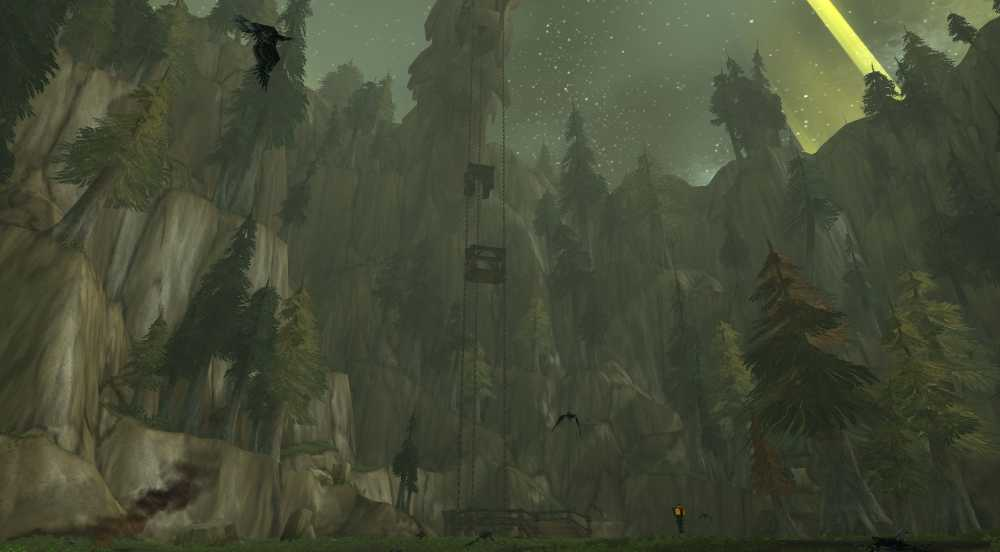
The first thing you'll notice as you set foot on the expansion's new continent, Northrend, is that the art is extremely well done and the vistas are visually impressive. During the first expansion, the primary mode of travel shifted from land-based mounts to much faster flying mounts, and it's clear that the designers of Northrend kept this well in mind. The size and scope of everything has been ratcheted up, from soaring spires and mountains to massive icebergs to spacious valleys and canyons. One of the early zones, Howling Fjord, starts you off looking up at incredibly high cliffs with nothing but a rickety wood-and-chain elevator to help you reach the top. While doing quests at the base of the cliffs, you can't help but wonder, "What's up there?" Later in the zone, you'll find grassy fields and misty forests gradually giving way to snow, ice formations, and new buildings that are a big step up, artistically, from what was seen in the original game, or even the first expansion. The various creatures you encounter are new and more detailed as well. Sleek, aggressive-looking Proto-drakes circle lazily above a burning forest and enormous Storm Giants stomp through the plains, catching unsuspecting adventurers by surprise and leading to more than a few untimely deaths. Fan-favorite Murlocs have undergone a transformation, appearing all the more ready to make a meal of you. Even the seas have gotten more detailed; icebergs look like nothing that could have come out of the original game, and the waters are now teeming with Warcraft-ized orca, hammerheads, and walruses.
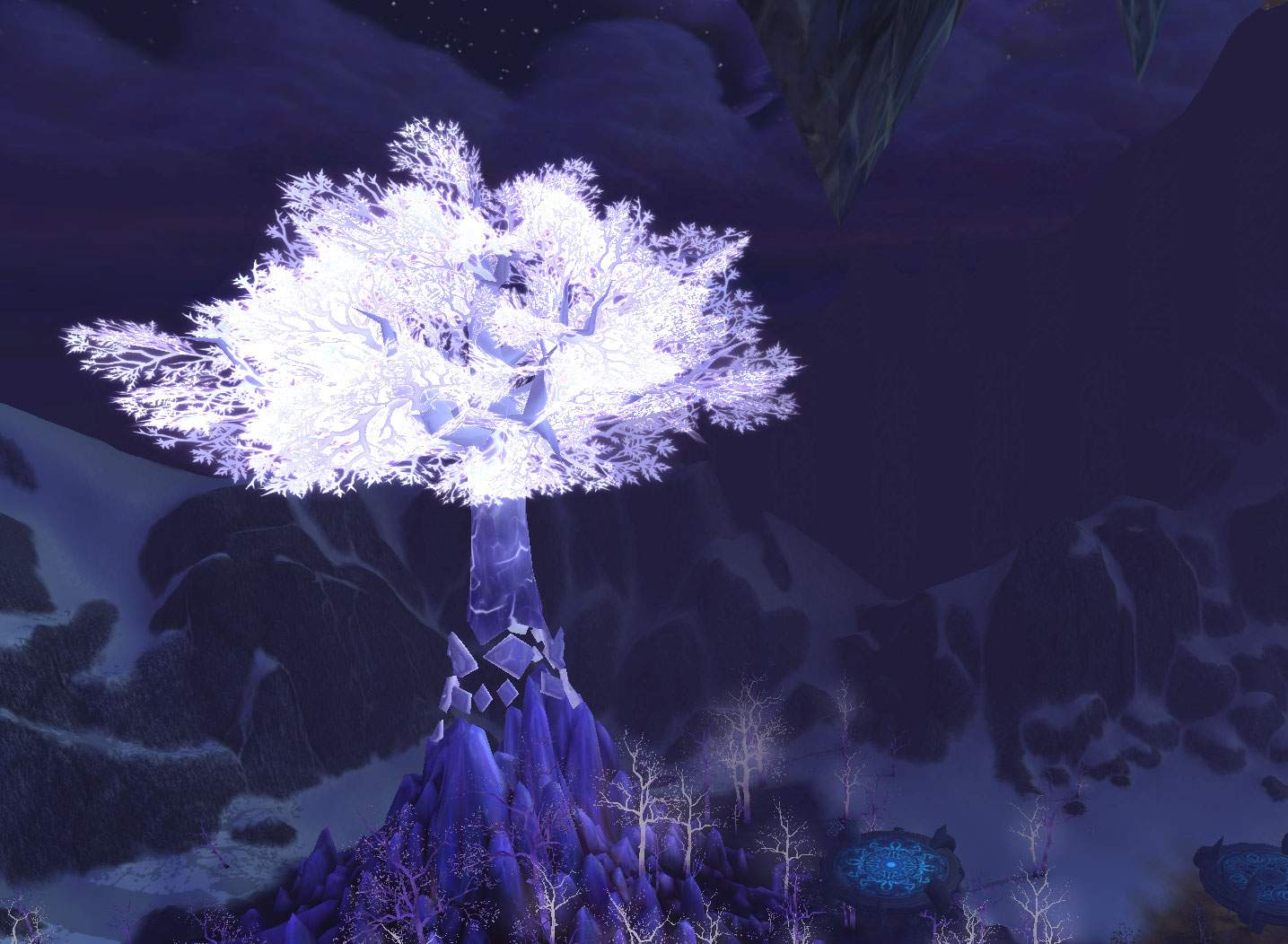
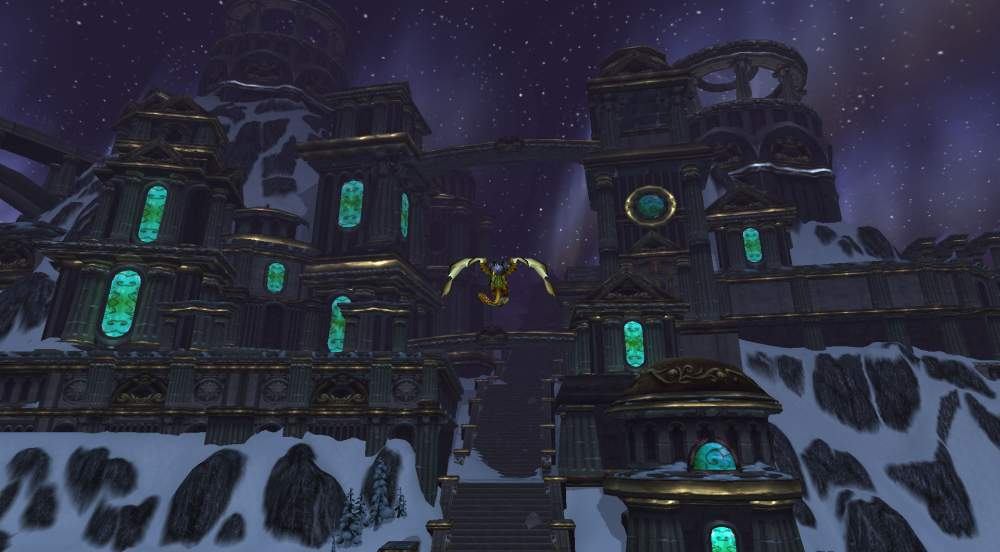
Each zone brings a unique art style. Soon after finishing the starting zones, you'll enter Dragonblight, where the skeletons of giant dragons litter the frozen tundra and battles between dragonflights rage overheard. Again, the kinds of things you'll see in Wrath of the Lich King just didn't happen in the original game, and rarely in The Burning Crusade. There are plenty of spots where the design team clearly said, "Ok, let's set this up so the players will just get here and stare at it for five minutes before remembering what they're doing." If you enjoyed exploring earlier parts of the game, Wrath of the Lich King will blow you away. One of the later zones, Storm Peaks, is exactly what it sounds like; a dark, snowy mountain range in which you'll find yourself traveling up and down as much as side to side. The absurdly high mountaintops give the area an epic feel, but Blizzard didn't stop there. Rising up from many peaks are ancient structures, or ruins in some cases. They do wonders for arousing curiosity, and you clearly get the impression that Something Big was here. The northern part of the zone where the dungeons are located is a stronghold for giants, originally built for the Titans, according to Warcraft lore, and it definitely looks the part.
One of the major headlines of Wrath of the Lich King was the introduction of the game's first new class — the Death Knight. Dubbed a "Hero Class," it is only available to players who already have another character at level 55 or higher, but the Death Knight itself starts at level 55, rather than level 1. This is partly due to the class' level of complexity, which is slightly higher than most others, and also to encourage players to try them out by not requiring the time involved to go level up from the very beginning. The Death Knight's resource management system is based on runes and runic power. You start out with six runes available, and using your abilities will consume one or more of them. The runes will then refresh themselves after 10 seconds, giving you the opportunity to use them again. Abilities also generate runic power, which can be used to fuel other spells. Death Knights can wear plate armor, and are intended for use as a "tank" class as well as dealing damage. They use big, two-handed weapons while tanking, rather than a one-hander and a shield, and they're stronger than most against magic. The class was balanced quite well by the extensive beta testing, though minor tuning is still underway to bring each of the three talent trees in line with Blizzard's goals. If you do nothing else in this expansion, it's worth starting a Death Knight and going through the introductory quest line; the story and visual effects are amazing.
Wrath raises the level cap from 70 to 80, so you'll spend most of your time questing and (should you choose) running dungeons for your first few weeks (depending on how much you play, and to what lengths you're willing go for efficiency; the first player to reach level 80 did so only 27 hours after the expansion launched). Gear has effectively been reset again, but not as severely as it was in The Burning Crusade. Powerful level 70 items will last in some cases all the way to level 80, but they should be replaced quickly once you start doing "endgame" activities. Actually getting to 80 isn't a problem; you should make it there with hundreds of quests to spare. Much like the first expansion, Wrath packs quests quite densely throughout most of the zones, so you needn't feel compelled to finish quests that don't interest you or do group quests when you'd rather fly solo (although the rewards for such are often good). The quests themselves are as much a step up from The Burning Crusade as it was over the original game. Many still follow the standard MMO format of "Go slay 10 demonbears," or "Go collect 10 cow eggs," but the quests tell stories, ranging from small and self-contained to grand and overarching. They paint a very clear picture of what's happening in Northrend, and what its inhabitants are doing to fight the Lich King.
In addition to those basic quests, Blizzard did quite a bit to spice things up. One of the most popular quest lines of the first expansion was an arena event in which you and your comrades fought off an increasingly difficult series of enemies. Wrath has three such events, each with its own story and flavor. Bombing runs are back, but they now usually make use of a new vehicle system which lets you hop on a creature or contraption and control its unique selection of abilities. One quest gives you a tank you use to rampage through a field of thickly packed undead, using the buzz-saw on the front to cut down any in your path. Another has you riding on an airborne troop transport, dropping smoke flares by the harpoon launchers of an enemy encampment to protect your allies as they are deployed to fight. One of the more epic quests lets you take control of a massive Storm Giant and use it to take out an even more colossal boss while crushing swarms of skeletons underfoot. Another way Blizzard found to keep things interesting is what they call "phasing" technology. One of the long-standing complaints about the MMO genre is that there is very little permanence to a player's actions. When Player A rescues a princess from an evil wizard's tower, he's very shortly going to turn around and see her back in the tower, waiting for the next player to do the same quest. Either that, or when Player B comes along, the princess is already saved, and he missed out on that content. Blizzard's solution was to implement different "phases" of an otherwise static zone. You'll start out in the beginning phase, during which, for example, a town is under attack. Completing a quest to fight off the attack bumps you into the next phase, where the town is safe and its fighting force is going on the offensive. Now, a player who hadn't done that quest could come from the same place as you, and stand where you're standing, but you and he would see two different things. His town still needs saving, yours doesn't. This is used to great effect in Icecrown, one of the later zones. You get the feeling as you do quests that you're really taking over parts of the zone; towns spring up, one-time battles are fought, and the appearance of the zone at the end is quite different from at the beginning. Another great use of this technology is for an invasion of one of the old capitol cities. You ride to its defense alongside faction leaders, participating in a good balance of plot and action.
The instanced dungeons in Northrend are also a step up over their predecessors. As with the outside world, they've gotten bigger and more impressive, often setting the group's path against an expansive backdrop to make it seem like you have a ton of room, even when you don't. Blizzard whittled down the length of most instances, aiming for a start-to-finish time of roughly an hour. The "trash" mobs between bosses are typically few and varied; the progress made since the original game in that regard is quite evident. You no longer have to worry that hopping into a group with random strangers could turn into a three-hour affair. Blizzard has gone out of their way to create new and interesting boss scenarios as well. An instance called "The Oculus" is a disjointed series of platforms which can only be accessed by flying. After finishing off the first boss, you free a group of NPCs which offer you a choice in Drakes to ride — Red, Yellow or Green — each of which has its own abilities. It behaves like a vehicle; you direct its flight path and choose when to fire off spells, and it carries you from platform to platform where you'll find later bosses. For the last boss in the instance, you actually use the drakes to fight, battling with spells far too powerful for a normal character to control. In another instance, one of the bosses hops on his flying mount and heads outside while you fight your way through a gauntlet of smaller NPCs to reach the end of a hallway. Periodically, he'll drop down and blast one side of the hallway with ice, making an already hectic fight even more dangerous. When you reach the end of the hallway, you'll find harpoon launchers which you use to shoot down his mount and force him to land and fight. One of the instances in The Burning Crusade had a boss which would use mind-control to make your group fight each other for a brief time before resuming the battle as normal. Wrath of the Lich King takes this one step further; the last boss in one of the new instances casts a spell which will dump each player into his own phase and spawn copies of that player's groupmates. The copies then try to kill him. Each player is tasked with killing their own group to survive. As they succeed, they're shunted into other players' phases until they're all back in the original, at which point they re-engage the boss.
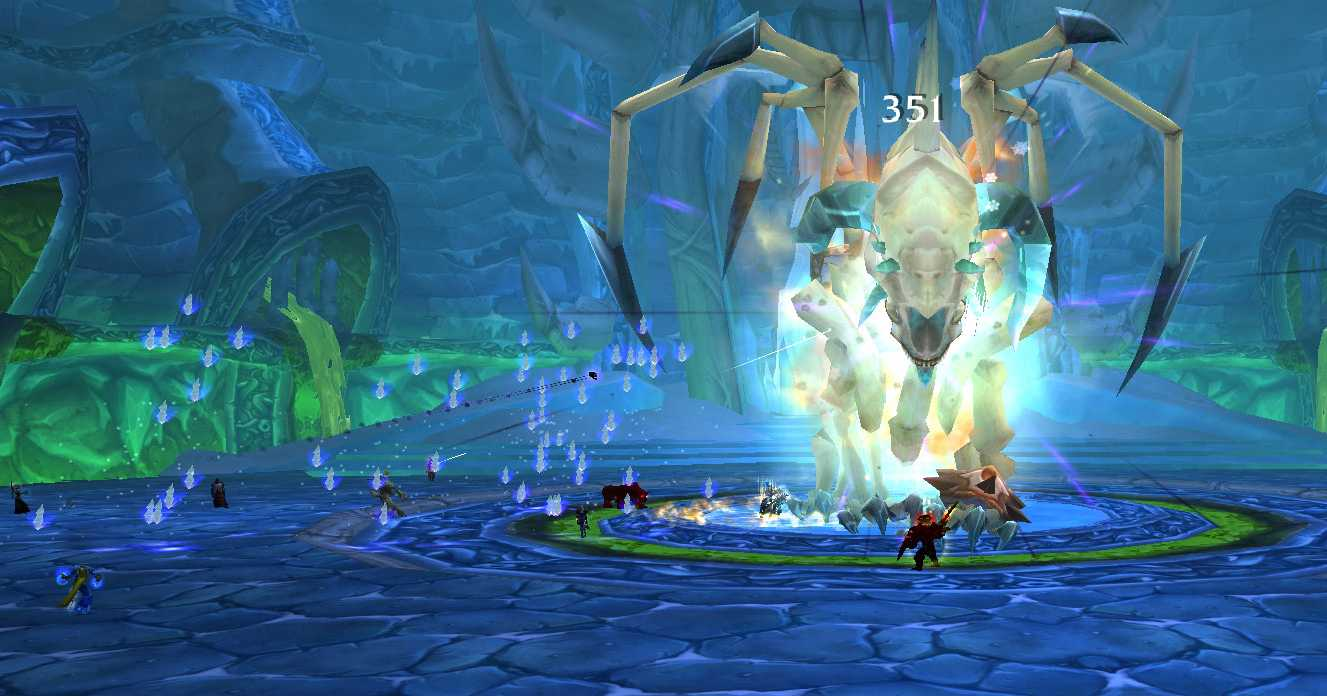
Heroic Dungeons return in Wrath, giving players the option of a harder version of an instance that results in better loot. They're tuned better this time around; Blizzard wanted to make the transition from normal dungeons to heroics to raids a smooth one, and they've done a much better job than at the beginning of the first expansion. They've also expanded the "heroic" philosophy to raids as well. Now each raid dungeon has two settings; a "normal" 10-man version, and a "heroic" 25-man version, each tuned appropriately for the size of the group. Wrath launched with four introductory-level raids, and more difficult ones are planned for the next few content patches in the coming months. As we discussed previously, the current raids have been conquered already, but unless you're willing to devote many, many hours to playing the game, reaching the end of the content before more is released won't be an issue for you. Blizzard revisited Naxxramas, a raid instance hailed as the best in the original game, but one that only a few percent of the World of Warcraft population ever got to see. It's now the primary starter raid, tuned to be much more forgiving than it was in 2006, but still able to make unprepared groups struggle. The other raids are quick, involving one boss each, compared to the 15 in Naxxramas. The fight against Malygos is an encounter where Blizzard shows off just how cool they can make a boss fight; if you don't mind spoilers, you can take a look at a video and explanation of the fight from the folks at TankSpot. One of the other raid bosses, Sartharion, lets the players decide how difficult they want the fight to be. Sartharion is a dragon, and in his lair, there are three drake mini-bosses which can be quickly and easily killed beforehand if the raid so chooses. If they aren't killed, they join in the fight when the raid takes on Sartharion himself. You can choose to leave one, two, or all three drakes alive, effectively giving the fight four difficulty settings. The more difficult the encounter, the better loot you'll receive. Very few raids can manage the fight with all drakes alive at this point. Blizzard has stated that we can expect to see more of this type of selective challenge. It allows them to tune the raids such that more people can see and complete them, but still give the more hardcore players something tough to work on.
Blizzard has done a number of other things to make the game more player-friendly. Professions have been revamped in several ways. First, all professions will, in some way, make your character more powerful, either through crafted gear or through passive bonuses. Second, those bonuses are available sooner, so you don't necessarily need to drop thousands of gold grinding out the last few points in order to get that upgrade. Third, recipes are mostly easier to obtain now. The developers have instituted an interesting system for Jewelcrafting in particular: Each day you can do a quest once which will give you a currency token. You can then spend those tokens to purchase many different recipes. This does two things; it guarantees that all of those recipes will be attainable eventually for minimal work, and it lets you choose which ones you want to get first. They've also made other, PvP-related recipes available by simply engaging in PvP. A few still drop in various spots around the world, but they're much less rare than the ones in The Burning Crusade . Others drop at the end of instances, and yet more are made available by increasing reputation with some of the factions scattered around Northrend. Virtually everything you do will make progress toward filling out the profession. Other professions have similar mechanics, but aren't as fleshed-out. Alchemy and the new profession, Inscription, have "discovery" abilities which will allow you to learn new things, but have a lengthy cooldown. As with Jewelcrafting, it's nice that you'll get everything eventually, but in this case you have little control over which "discovered" recipes you learn. Inscription itself is interesting; you essentially enchant your spells and abilities to behave in a slightly different manner. Often you can sacrifice an unimportant aspect of a spell to make it better in another way; for example, one of the Mage glyphs increases the damage on their Frostbolt spell, but removes the slowing effect placed on the target.
Tanking has received a huge make-over in Wrath. No longer is the focus on building threat; it's more about mitigating damage. This removes a lot of the headaches involved in grouping with strangers. Tanks also do quite a bit more damage than they did in the past, making it more fun for people who like to see big numbers. The success of instance groups used to rely almost exclusively on the tank and healer, and while they're still very important, the focus has shifted more to include the damage-dealers. Many fights are significantly easier with better damage output (and some are almost impossible without). It's a welcome change; all members of the group should contribute to its success. Reputation grinds have been made easier as well. Instead of using the method of the first expansion where running dungeons in a particular place increased your reputation with a particular faction, they now use a "championing" system. Wearing the tabard of whichever faction you choose will allow you to gain reputation with that faction regardless of which dungeon you enter. So, you can always run your favorite instance, or do a different one every night while still working toward whatever reward you'd like. That seems to be one of the major themes of Wrath; putting choice back into the players' hands.
PvP has been a bit slow to get started, since many players are still on their way to the level cap. The next arena season is due to start in a couple weeks, after which I'm sure we'll see a round of minor nerfs and buffs to smooth out any issues that arise. Wintergrasp is alive and thriving, however, as the first dedicated world-PvP zone. The concept is simple; one faction controls the central keep while the other tries to break through the walls and capture it. Fighting and scoring kills will increase your rank during a battle, which will allow you to drive increasingly powerful siege vehicles. You can use them to knock down walls, chuck barrels of poison vast distances, or to try to run over enemy players swarming around your wheels. Defenders can man turrets as well. Blizzard has tried to address faction imbalances with a buff called "Tenacity." It essentially makes you more powerful the more your faction is out-manned. In extreme cases, it can turn players into the equivalent of raid bosses — ones that know to take out your healers first. The faction that controls Wintergrasp also has access to a raid dungeon, and the boss inside drops PvP gear. It's a fun, quick way to cap off a victory. One of the things I like best about Wintergrasp is the spacing between the battles. A battle lasts for a maximum of 40 minutes, and when it's over, it's over. A new one won't start for another couple hours, so there's little reason to stick around. The new battleground, Strand of the Ancients, also makes use of vehicles and an attacker/defender relationship. It's definitely a break from the old battlegrounds, but a welcome one. Honor point rewards for both are pretty good — unfortunately, if the costs for PvP gear from the beta are to be believed, the effort involved to build a PvP set will be the last serious grind left in the game.
When Blizzard first announced Wrath of the Lich King, there was speculation about whether it would continue the success of The Burning Crusade or if the World of Warcraft juggernaut would finally begin to run out of steam, as MMOs often do several years into their life. With the early previews and later throughout the beta, we got hints that such was not the case. Now that we've had time to explore the finished version of Wrath (or at least as "finished" as any MMO project ever is) it's clear that the legendary "Blizzard polish" is there, in addition to a great deal of innovation within a single game. They're not just releasing the equivalent of new maps and models and skins — the whole game is evolving into something much more consistent and coherent than the original game. If any company in the MMO game industry could afford to rest on their laurels, it's Blizzard — but they're not. And I already wonder what they'll have in store for the next expansion.
-
Review: Wrath of the Lich King
Since shortly after its release in late 2004, World of Warcraft has held the position of the most popular MMO, quickly outstripping predecessors such as Everquest and Ultima Online, and continuing to hold the lead despite competition from contemporaries and newer offerings, like Warhammer Online. When World of Warcraft's first expansion, The Burning Crusade, was released, it built on an already rich world by using feedback from players and two extra years of design experience to work on condensing the game to focus more on the best parts. Now, with the release of Wrath of the Lich King, Blizzard seems to have gotten themselves ahead of the curve; in addition to the many changes intended to remove the "grind" aspect that is so prevalent in this genre, they've gone on to effectively put themselves in the player's shoes and ask, "What would make this more fun? Wouldn't it be cool if..?" Read on for the rest of my thoughts.- Title: World of Warcraft: Wrath of the Lich King
- Developer: Blizzard Entertainment
- Publisher: Activision Blizzard
- System: PC
- Reviewer: Soulskill
- Score: 9/10
The first thing you'll notice as you set foot on the expansion's new continent, Northrend, is that the art is extremely well done and the vistas are visually impressive. During the first expansion, the primary mode of travel shifted from land-based mounts to much faster flying mounts, and it's clear that the designers of Northrend kept this well in mind. The size and scope of everything has been ratcheted up, from soaring spires and mountains to massive icebergs to spacious valleys and canyons. One of the early zones, Howling Fjord, starts you off looking up at incredibly high cliffs with nothing but a rickety wood-and-chain elevator to help you reach the top. While doing quests at the base of the cliffs, you can't help but wonder, "What's up there?" Later in the zone, you'll find grassy fields and misty forests gradually giving way to snow, ice formations, and new buildings that are a big step up, artistically, from what was seen in the original game, or even the first expansion. The various creatures you encounter are new and more detailed as well. Sleek, aggressive-looking Proto-drakes circle lazily above a burning forest and enormous Storm Giants stomp through the plains, catching unsuspecting adventurers by surprise and leading to more than a few untimely deaths. Fan-favorite Murlocs have undergone a transformation, appearing all the more ready to make a meal of you. Even the seas have gotten more detailed; icebergs look like nothing that could have come out of the original game, and the waters are now teeming with Warcraft-ized orca, hammerheads, and walruses.
Each zone brings a unique art style. Soon after finishing the starting zones, you'll enter Dragonblight, where the skeletons of giant dragons litter the frozen tundra and battles between dragonflights rage overheard. Again, the kinds of things you'll see in Wrath of the Lich King just didn't happen in the original game, and rarely in The Burning Crusade. There are plenty of spots where the design team clearly said, "Ok, let's set this up so the players will just get here and stare at it for five minutes before remembering what they're doing." If you enjoyed exploring earlier parts of the game, Wrath of the Lich King will blow you away. One of the later zones, Storm Peaks, is exactly what it sounds like; a dark, snowy mountain range in which you'll find yourself traveling up and down as much as side to side. The absurdly high mountaintops give the area an epic feel, but Blizzard didn't stop there. Rising up from many peaks are ancient structures, or ruins in some cases. They do wonders for arousing curiosity, and you clearly get the impression that Something Big was here. The northern part of the zone where the dungeons are located is a stronghold for giants, originally built for the Titans, according to Warcraft lore, and it definitely looks the part.
One of the major headlines of Wrath of the Lich King was the introduction of the game's first new class — the Death Knight. Dubbed a "Hero Class," it is only available to players who already have another character at level 55 or higher, but the Death Knight itself starts at level 55, rather than level 1. This is partly due to the class' level of complexity, which is slightly higher than most others, and also to encourage players to try them out by not requiring the time involved to go level up from the very beginning. The Death Knight's resource management system is based on runes and runic power. You start out with six runes available, and using your abilities will consume one or more of them. The runes will then refresh themselves after 10 seconds, giving you the opportunity to use them again. Abilities also generate runic power, which can be used to fuel other spells. Death Knights can wear plate armor, and are intended for use as a "tank" class as well as dealing damage. They use big, two-handed weapons while tanking, rather than a one-hander and a shield, and they're stronger than most against magic. The class was balanced quite well by the extensive beta testing, though minor tuning is still underway to bring each of the three talent trees in line with Blizzard's goals. If you do nothing else in this expansion, it's worth starting a Death Knight and going through the introductory quest line; the story and visual effects are amazing.
Wrath raises the level cap from 70 to 80, so you'll spend most of your time questing and (should you choose) running dungeons for your first few weeks (depending on how much you play, and to what lengths you're willing go for efficiency; the first player to reach level 80 did so only 27 hours after the expansion launched). Gear has effectively been reset again, but not as severely as it was in The Burning Crusade. Powerful level 70 items will last in some cases all the way to level 80, but they should be replaced quickly once you start doing "endgame" activities. Actually getting to 80 isn't a problem; you should make it there with hundreds of quests to spare. Much like the first expansion, Wrath packs quests quite densely throughout most of the zones, so you needn't feel compelled to finish quests that don't interest you or do group quests when you'd rather fly solo (although the rewards for such are often good). The quests themselves are as much a step up from The Burning Crusade as it was over the original game. Many still follow the standard MMO format of "Go slay 10 demonbears," or "Go collect 10 cow eggs," but the quests tell stories, ranging from small and self-contained to grand and overarching. They paint a very clear picture of what's happening in Northrend, and what its inhabitants are doing to fight the Lich King.
In addition to those basic quests, Blizzard did quite a bit to spice things up. One of the most popular quest lines of the first expansion was an arena event in which you and your comrades fought off an increasingly difficult series of enemies. Wrath has three such events, each with its own story and flavor. Bombing runs are back, but they now usually make use of a new vehicle system which lets you hop on a creature or contraption and control its unique selection of abilities. One quest gives you a tank you use to rampage through a field of thickly packed undead, using the buzz-saw on the front to cut down any in your path. Another has you riding on an airborne troop transport, dropping smoke flares by the harpoon launchers of an enemy encampment to protect your allies as they are deployed to fight. One of the more epic quests lets you take control of a massive Storm Giant and use it to take out an even more colossal boss while crushing swarms of skeletons underfoot. Another way Blizzard found to keep things interesting is what they call "phasing" technology. One of the long-standing complaints about the MMO genre is that there is very little permanence to a player's actions. When Player A rescues a princess from an evil wizard's tower, he's very shortly going to turn around and see her back in the tower, waiting for the next player to do the same quest. Either that, or when Player B comes along, the princess is already saved, and he missed out on that content. Blizzard's solution was to implement different "phases" of an otherwise static zone. You'll start out in the beginning phase, during which, for example, a town is under attack. Completing a quest to fight off the attack bumps you into the next phase, where the town is safe and its fighting force is going on the offensive. Now, a player who hadn't done that quest could come from the same place as you, and stand where you're standing, but you and he would see two different things. His town still needs saving, yours doesn't. This is used to great effect in Icecrown, one of the later zones. You get the feeling as you do quests that you're really taking over parts of the zone; towns spring up, one-time battles are fought, and the appearance of the zone at the end is quite different from at the beginning. Another great use of this technology is for an invasion of one of the old capitol cities. You ride to its defense alongside faction leaders, participating in a good balance of plot and action.
The instanced dungeons in Northrend are also a step up over their predecessors. As with the outside world, they've gotten bigger and more impressive, often setting the group's path against an expansive backdrop to make it seem like you have a ton of room, even when you don't. Blizzard whittled down the length of most instances, aiming for a start-to-finish time of roughly an hour. The "trash" mobs between bosses are typically few and varied; the progress made since the original game in that regard is quite evident. You no longer have to worry that hopping into a group with random strangers could turn into a three-hour affair. Blizzard has gone out of their way to create new and interesting boss scenarios as well. An instance called "The Oculus" is a disjointed series of platforms which can only be accessed by flying. After finishing off the first boss, you free a group of NPCs which offer you a choice in Drakes to ride — Red, Yellow or Green — each of which has its own abilities. It behaves like a vehicle; you direct its flight path and choose when to fire off spells, and it carries you from platform to platform where you'll find later bosses. For the last boss in the instance, you actually use the drakes to fight, battling with spells far too powerful for a normal character to control. In another instance, one of the bosses hops on his flying mount and heads outside while you fight your way through a gauntlet of smaller NPCs to reach the end of a hallway. Periodically, he'll drop down and blast one side of the hallway with ice, making an already hectic fight even more dangerous. When you reach the end of the hallway, you'll find harpoon launchers which you use to shoot down his mount and force him to land and fight. One of the instances in The Burning Crusade had a boss which would use mind-control to make your group fight each other for a brief time before resuming the battle as normal. Wrath of the Lich King takes this one step further; the last boss in one of the new instances casts a spell which will dump each player into his own phase and spawn copies of that player's groupmates. The copies then try to kill him. Each player is tasked with killing their own group to survive. As they succeed, they're shunted into other players' phases until they're all back in the original, at which point they re-engage the boss.
Heroic Dungeons return in Wrath, giving players the option of a harder version of an instance that results in better loot. They're tuned better this time around; Blizzard wanted to make the transition from normal dungeons to heroics to raids a smooth one, and they've done a much better job than at the beginning of the first expansion. They've also expanded the "heroic" philosophy to raids as well. Now each raid dungeon has two settings; a "normal" 10-man version, and a "heroic" 25-man version, each tuned appropriately for the size of the group. Wrath launched with four introductory-level raids, and more difficult ones are planned for the next few content patches in the coming months. As we discussed previously, the current raids have been conquered already, but unless you're willing to devote many, many hours to playing the game, reaching the end of the content before more is released won't be an issue for you. Blizzard revisited Naxxramas, a raid instance hailed as the best in the original game, but one that only a few percent of the World of Warcraft population ever got to see. It's now the primary starter raid, tuned to be much more forgiving than it was in 2006, but still able to make unprepared groups struggle. The other raids are quick, involving one boss each, compared to the 15 in Naxxramas. The fight against Malygos is an encounter where Blizzard shows off just how cool they can make a boss fight; if you don't mind spoilers, you can take a look at a video and explanation of the fight from the folks at TankSpot. One of the other raid bosses, Sartharion, lets the players decide how difficult they want the fight to be. Sartharion is a dragon, and in his lair, there are three drake mini-bosses which can be quickly and easily killed beforehand if the raid so chooses. If they aren't killed, they join in the fight when the raid takes on Sartharion himself. You can choose to leave one, two, or all three drakes alive, effectively giving the fight four difficulty settings. The more difficult the encounter, the better loot you'll receive. Very few raids can manage the fight with all drakes alive at this point. Blizzard has stated that we can expect to see more of this type of selective challenge. It allows them to tune the raids such that more people can see and complete them, but still give the more hardcore players something tough to work on.
Blizzard has done a number of other things to make the game more player-friendly. Professions have been revamped in several ways. First, all professions will, in some way, make your character more powerful, either through crafted gear or through passive bonuses. Second, those bonuses are available sooner, so you don't necessarily need to drop thousands of gold grinding out the last few points in order to get that upgrade. Third, recipes are mostly easier to obtain now. The developers have instituted an interesting system for Jewelcrafting in particular: Each day you can do a quest once which will give you a currency token. You can then spend those tokens to purchase many different recipes. This does two things; it guarantees that all of those recipes will be attainable eventually for minimal work, and it lets you choose which ones you want to get first. They've also made other, PvP-related recipes available by simply engaging in PvP. A few still drop in various spots around the world, but they're much less rare than the ones in The Burning Crusade . Others drop at the end of instances, and yet more are made available by increasing reputation with some of the factions scattered around Northrend. Virtually everything you do will make progress toward filling out the profession. Other professions have similar mechanics, but aren't as fleshed-out. Alchemy and the new profession, Inscription, have "discovery" abilities which will allow you to learn new things, but have a lengthy cooldown. As with Jewelcrafting, it's nice that you'll get everything eventually, but in this case you have little control over which "discovered" recipes you learn. Inscription itself is interesting; you essentially enchant your spells and abilities to behave in a slightly different manner. Often you can sacrifice an unimportant aspect of a spell to make it better in another way; for example, one of the Mage glyphs increases the damage on their Frostbolt spell, but removes the slowing effect placed on the target.
Tanking has received a huge make-over in Wrath. No longer is the focus on building threat; it's more about mitigating damage. This removes a lot of the headaches involved in grouping with strangers. Tanks also do quite a bit more damage than they did in the past, making it more fun for people who like to see big numbers. The success of instance groups used to rely almost exclusively on the tank and healer, and while they're still very important, the focus has shifted more to include the damage-dealers. Many fights are significantly easier with better damage output (and some are almost impossible without). It's a welcome change; all members of the group should contribute to its success. Reputation grinds have been made easier as well. Instead of using the method of the first expansion where running dungeons in a particular place increased your reputation with a particular faction, they now use a "championing" system. Wearing the tabard of whichever faction you choose will allow you to gain reputation with that faction regardless of which dungeon you enter. So, you can always run your favorite instance, or do a different one every night while still working toward whatever reward you'd like. That seems to be one of the major themes of Wrath; putting choice back into the players' hands.
PvP has been a bit slow to get started, since many players are still on their way to the level cap. The next arena season is due to start in a couple weeks, after which I'm sure we'll see a round of minor nerfs and buffs to smooth out any issues that arise. Wintergrasp is alive and thriving, however, as the first dedicated world-PvP zone. The concept is simple; one faction controls the central keep while the other tries to break through the walls and capture it. Fighting and scoring kills will increase your rank during a battle, which will allow you to drive increasingly powerful siege vehicles. You can use them to knock down walls, chuck barrels of poison vast distances, or to try to run over enemy players swarming around your wheels. Defenders can man turrets as well. Blizzard has tried to address faction imbalances with a buff called "Tenacity." It essentially makes you more powerful the more your faction is out-manned. In extreme cases, it can turn players into the equivalent of raid bosses — ones that know to take out your healers first. The faction that controls Wintergrasp also has access to a raid dungeon, and the boss inside drops PvP gear. It's a fun, quick way to cap off a victory. One of the things I like best about Wintergrasp is the spacing between the battles. A battle lasts for a maximum of 40 minutes, and when it's over, it's over. A new one won't start for another couple hours, so there's little reason to stick around. The new battleground, Strand of the Ancients, also makes use of vehicles and an attacker/defender relationship. It's definitely a break from the old battlegrounds, but a welcome one. Honor point rewards for both are pretty good — unfortunately, if the costs for PvP gear from the beta are to be believed, the effort involved to build a PvP set will be the last serious grind left in the game.
When Blizzard first announced Wrath of the Lich King, there was speculation about whether it would continue the success of The Burning Crusade or if the World of Warcraft juggernaut would finally begin to run out of steam, as MMOs often do several years into their life. With the early previews and later throughout the beta, we got hints that such was not the case. Now that we've had time to explore the finished version of Wrath (or at least as "finished" as any MMO project ever is) it's clear that the legendary "Blizzard polish" is there, in addition to a great deal of innovation within a single game. They're not just releasing the equivalent of new maps and models and skins — the whole game is evolving into something much more consistent and coherent than the original game. If any company in the MMO game industry could afford to rest on their laurels, it's Blizzard — but they're not. And I already wonder what they'll have in store for the next expansion.
-
Review: Wrath of the Lich King
Since shortly after its release in late 2004, World of Warcraft has held the position of the most popular MMO, quickly outstripping predecessors such as Everquest and Ultima Online, and continuing to hold the lead despite competition from contemporaries and newer offerings, like Warhammer Online. When World of Warcraft's first expansion, The Burning Crusade, was released, it built on an already rich world by using feedback from players and two extra years of design experience to work on condensing the game to focus more on the best parts. Now, with the release of Wrath of the Lich King, Blizzard seems to have gotten themselves ahead of the curve; in addition to the many changes intended to remove the "grind" aspect that is so prevalent in this genre, they've gone on to effectively put themselves in the player's shoes and ask, "What would make this more fun? Wouldn't it be cool if..?" Read on for the rest of my thoughts.- Title: World of Warcraft: Wrath of the Lich King
- Developer: Blizzard Entertainment
- Publisher: Activision Blizzard
- System: PC
- Reviewer: Soulskill
- Score: 9/10
The first thing you'll notice as you set foot on the expansion's new continent, Northrend, is that the art is extremely well done and the vistas are visually impressive. During the first expansion, the primary mode of travel shifted from land-based mounts to much faster flying mounts, and it's clear that the designers of Northrend kept this well in mind. The size and scope of everything has been ratcheted up, from soaring spires and mountains to massive icebergs to spacious valleys and canyons. One of the early zones, Howling Fjord, starts you off looking up at incredibly high cliffs with nothing but a rickety wood-and-chain elevator to help you reach the top. While doing quests at the base of the cliffs, you can't help but wonder, "What's up there?" Later in the zone, you'll find grassy fields and misty forests gradually giving way to snow, ice formations, and new buildings that are a big step up, artistically, from what was seen in the original game, or even the first expansion. The various creatures you encounter are new and more detailed as well. Sleek, aggressive-looking Proto-drakes circle lazily above a burning forest and enormous Storm Giants stomp through the plains, catching unsuspecting adventurers by surprise and leading to more than a few untimely deaths. Fan-favorite Murlocs have undergone a transformation, appearing all the more ready to make a meal of you. Even the seas have gotten more detailed; icebergs look like nothing that could have come out of the original game, and the waters are now teeming with Warcraft-ized orca, hammerheads, and walruses.
Each zone brings a unique art style. Soon after finishing the starting zones, you'll enter Dragonblight, where the skeletons of giant dragons litter the frozen tundra and battles between dragonflights rage overheard. Again, the kinds of things you'll see in Wrath of the Lich King just didn't happen in the original game, and rarely in The Burning Crusade. There are plenty of spots where the design team clearly said, "Ok, let's set this up so the players will just get here and stare at it for five minutes before remembering what they're doing." If you enjoyed exploring earlier parts of the game, Wrath of the Lich King will blow you away. One of the later zones, Storm Peaks, is exactly what it sounds like; a dark, snowy mountain range in which you'll find yourself traveling up and down as much as side to side. The absurdly high mountaintops give the area an epic feel, but Blizzard didn't stop there. Rising up from many peaks are ancient structures, or ruins in some cases. They do wonders for arousing curiosity, and you clearly get the impression that Something Big was here. The northern part of the zone where the dungeons are located is a stronghold for giants, originally built for the Titans, according to Warcraft lore, and it definitely looks the part.
One of the major headlines of Wrath of the Lich King was the introduction of the game's first new class — the Death Knight. Dubbed a "Hero Class," it is only available to players who already have another character at level 55 or higher, but the Death Knight itself starts at level 55, rather than level 1. This is partly due to the class' level of complexity, which is slightly higher than most others, and also to encourage players to try them out by not requiring the time involved to go level up from the very beginning. The Death Knight's resource management system is based on runes and runic power. You start out with six runes available, and using your abilities will consume one or more of them. The runes will then refresh themselves after 10 seconds, giving you the opportunity to use them again. Abilities also generate runic power, which can be used to fuel other spells. Death Knights can wear plate armor, and are intended for use as a "tank" class as well as dealing damage. They use big, two-handed weapons while tanking, rather than a one-hander and a shield, and they're stronger than most against magic. The class was balanced quite well by the extensive beta testing, though minor tuning is still underway to bring each of the three talent trees in line with Blizzard's goals. If you do nothing else in this expansion, it's worth starting a Death Knight and going through the introductory quest line; the story and visual effects are amazing.
Wrath raises the level cap from 70 to 80, so you'll spend most of your time questing and (should you choose) running dungeons for your first few weeks (depending on how much you play, and to what lengths you're willing go for efficiency; the first player to reach level 80 did so only 27 hours after the expansion launched). Gear has effectively been reset again, but not as severely as it was in The Burning Crusade. Powerful level 70 items will last in some cases all the way to level 80, but they should be replaced quickly once you start doing "endgame" activities. Actually getting to 80 isn't a problem; you should make it there with hundreds of quests to spare. Much like the first expansion, Wrath packs quests quite densely throughout most of the zones, so you needn't feel compelled to finish quests that don't interest you or do group quests when you'd rather fly solo (although the rewards for such are often good). The quests themselves are as much a step up from The Burning Crusade as it was over the original game. Many still follow the standard MMO format of "Go slay 10 demonbears," or "Go collect 10 cow eggs," but the quests tell stories, ranging from small and self-contained to grand and overarching. They paint a very clear picture of what's happening in Northrend, and what its inhabitants are doing to fight the Lich King.
In addition to those basic quests, Blizzard did quite a bit to spice things up. One of the most popular quest lines of the first expansion was an arena event in which you and your comrades fought off an increasingly difficult series of enemies. Wrath has three such events, each with its own story and flavor. Bombing runs are back, but they now usually make use of a new vehicle system which lets you hop on a creature or contraption and control its unique selection of abilities. One quest gives you a tank you use to rampage through a field of thickly packed undead, using the buzz-saw on the front to cut down any in your path. Another has you riding on an airborne troop transport, dropping smoke flares by the harpoon launchers of an enemy encampment to protect your allies as they are deployed to fight. One of the more epic quests lets you take control of a massive Storm Giant and use it to take out an even more colossal boss while crushing swarms of skeletons underfoot. Another way Blizzard found to keep things interesting is what they call "phasing" technology. One of the long-standing complaints about the MMO genre is that there is very little permanence to a player's actions. When Player A rescues a princess from an evil wizard's tower, he's very shortly going to turn around and see her back in the tower, waiting for the next player to do the same quest. Either that, or when Player B comes along, the princess is already saved, and he missed out on that content. Blizzard's solution was to implement different "phases" of an otherwise static zone. You'll start out in the beginning phase, during which, for example, a town is under attack. Completing a quest to fight off the attack bumps you into the next phase, where the town is safe and its fighting force is going on the offensive. Now, a player who hadn't done that quest could come from the same place as you, and stand where you're standing, but you and he would see two different things. His town still needs saving, yours doesn't. This is used to great effect in Icecrown, one of the later zones. You get the feeling as you do quests that you're really taking over parts of the zone; towns spring up, one-time battles are fought, and the appearance of the zone at the end is quite different from at the beginning. Another great use of this technology is for an invasion of one of the old capitol cities. You ride to its defense alongside faction leaders, participating in a good balance of plot and action.
The instanced dungeons in Northrend are also a step up over their predecessors. As with the outside world, they've gotten bigger and more impressive, often setting the group's path against an expansive backdrop to make it seem like you have a ton of room, even when you don't. Blizzard whittled down the length of most instances, aiming for a start-to-finish time of roughly an hour. The "trash" mobs between bosses are typically few and varied; the progress made since the original game in that regard is quite evident. You no longer have to worry that hopping into a group with random strangers could turn into a three-hour affair. Blizzard has gone out of their way to create new and interesting boss scenarios as well. An instance called "The Oculus" is a disjointed series of platforms which can only be accessed by flying. After finishing off the first boss, you free a group of NPCs which offer you a choice in Drakes to ride — Red, Yellow or Green — each of which has its own abilities. It behaves like a vehicle; you direct its flight path and choose when to fire off spells, and it carries you from platform to platform where you'll find later bosses. For the last boss in the instance, you actually use the drakes to fight, battling with spells far too powerful for a normal character to control. In another instance, one of the bosses hops on his flying mount and heads outside while you fight your way through a gauntlet of smaller NPCs to reach the end of a hallway. Periodically, he'll drop down and blast one side of the hallway with ice, making an already hectic fight even more dangerous. When you reach the end of the hallway, you'll find harpoon launchers which you use to shoot down his mount and force him to land and fight. One of the instances in The Burning Crusade had a boss which would use mind-control to make your group fight each other for a brief time before resuming the battle as normal. Wrath of the Lich King takes this one step further; the last boss in one of the new instances casts a spell which will dump each player into his own phase and spawn copies of that player's groupmates. The copies then try to kill him. Each player is tasked with killing their own group to survive. As they succeed, they're shunted into other players' phases until they're all back in the original, at which point they re-engage the boss.
Heroic Dungeons return in Wrath, giving players the option of a harder version of an instance that results in better loot. They're tuned better this time around; Blizzard wanted to make the transition from normal dungeons to heroics to raids a smooth one, and they've done a much better job than at the beginning of the first expansion. They've also expanded the "heroic" philosophy to raids as well. Now each raid dungeon has two settings; a "normal" 10-man version, and a "heroic" 25-man version, each tuned appropriately for the size of the group. Wrath launched with four introductory-level raids, and more difficult ones are planned for the next few content patches in the coming months. As we discussed previously, the current raids have been conquered already, but unless you're willing to devote many, many hours to playing the game, reaching the end of the content before more is released won't be an issue for you. Blizzard revisited Naxxramas, a raid instance hailed as the best in the original game, but one that only a few percent of the World of Warcraft population ever got to see. It's now the primary starter raid, tuned to be much more forgiving than it was in 2006, but still able to make unprepared groups struggle. The other raids are quick, involving one boss each, compared to the 15 in Naxxramas. The fight against Malygos is an encounter where Blizzard shows off just how cool they can make a boss fight; if you don't mind spoilers, you can take a look at a video and explanation of the fight from the folks at TankSpot. One of the other raid bosses, Sartharion, lets the players decide how difficult they want the fight to be. Sartharion is a dragon, and in his lair, there are three drake mini-bosses which can be quickly and easily killed beforehand if the raid so chooses. If they aren't killed, they join in the fight when the raid takes on Sartharion himself. You can choose to leave one, two, or all three drakes alive, effectively giving the fight four difficulty settings. The more difficult the encounter, the better loot you'll receive. Very few raids can manage the fight with all drakes alive at this point. Blizzard has stated that we can expect to see more of this type of selective challenge. It allows them to tune the raids such that more people can see and complete them, but still give the more hardcore players something tough to work on.
Blizzard has done a number of other things to make the game more player-friendly. Professions have been revamped in several ways. First, all professions will, in some way, make your character more powerful, either through crafted gear or through passive bonuses. Second, those bonuses are available sooner, so you don't necessarily need to drop thousands of gold grinding out the last few points in order to get that upgrade. Third, recipes are mostly easier to obtain now. The developers have instituted an interesting system for Jewelcrafting in particular: Each day you can do a quest once which will give you a currency token. You can then spend those tokens to purchase many different recipes. This does two things; it guarantees that all of those recipes will be attainable eventually for minimal work, and it lets you choose which ones you want to get first. They've also made other, PvP-related recipes available by simply engaging in PvP. A few still drop in various spots around the world, but they're much less rare than the ones in The Burning Crusade . Others drop at the end of instances, and yet more are made available by increasing reputation with some of the factions scattered around Northrend. Virtually everything you do will make progress toward filling out the profession. Other professions have similar mechanics, but aren't as fleshed-out. Alchemy and the new profession, Inscription, have "discovery" abilities which will allow you to learn new things, but have a lengthy cooldown. As with Jewelcrafting, it's nice that you'll get everything eventually, but in this case you have little control over which "discovered" recipes you learn. Inscription itself is interesting; you essentially enchant your spells and abilities to behave in a slightly different manner. Often you can sacrifice an unimportant aspect of a spell to make it better in another way; for example, one of the Mage glyphs increases the damage on their Frostbolt spell, but removes the slowing effect placed on the target.
Tanking has received a huge make-over in Wrath. No longer is the focus on building threat; it's more about mitigating damage. This removes a lot of the headaches involved in grouping with strangers. Tanks also do quite a bit more damage than they did in the past, making it more fun for people who like to see big numbers. The success of instance groups used to rely almost exclusively on the tank and healer, and while they're still very important, the focus has shifted more to include the damage-dealers. Many fights are significantly easier with better damage output (and some are almost impossible without). It's a welcome change; all members of the group should contribute to its success. Reputation grinds have been made easier as well. Instead of using the method of the first expansion where running dungeons in a particular place increased your reputation with a particular faction, they now use a "championing" system. Wearing the tabard of whichever faction you choose will allow you to gain reputation with that faction regardless of which dungeon you enter. So, you can always run your favorite instance, or do a different one every night while still working toward whatever reward you'd like. That seems to be one of the major themes of Wrath; putting choice back into the players' hands.
PvP has been a bit slow to get started, since many players are still on their way to the level cap. The next arena season is due to start in a couple weeks, after which I'm sure we'll see a round of minor nerfs and buffs to smooth out any issues that arise. Wintergrasp is alive and thriving, however, as the first dedicated world-PvP zone. The concept is simple; one faction controls the central keep while the other tries to break through the walls and capture it. Fighting and scoring kills will increase your rank during a battle, which will allow you to drive increasingly powerful siege vehicles. You can use them to knock down walls, chuck barrels of poison vast distances, or to try to run over enemy players swarming around your wheels. Defenders can man turrets as well. Blizzard has tried to address faction imbalances with a buff called "Tenacity." It essentially makes you more powerful the more your faction is out-manned. In extreme cases, it can turn players into the equivalent of raid bosses — ones that know to take out your healers first. The faction that controls Wintergrasp also has access to a raid dungeon, and the boss inside drops PvP gear. It's a fun, quick way to cap off a victory. One of the things I like best about Wintergrasp is the spacing between the battles. A battle lasts for a maximum of 40 minutes, and when it's over, it's over. A new one won't start for another couple hours, so there's little reason to stick around. The new battleground, Strand of the Ancients, also makes use of vehicles and an attacker/defender relationship. It's definitely a break from the old battlegrounds, but a welcome one. Honor point rewards for both are pretty good — unfortunately, if the costs for PvP gear from the beta are to be believed, the effort involved to build a PvP set will be the last serious grind left in the game.
When Blizzard first announced Wrath of the Lich King, there was speculation about whether it would continue the success of The Burning Crusade or if the World of Warcraft juggernaut would finally begin to run out of steam, as MMOs often do several years into their life. With the early previews and later throughout the beta, we got hints that such was not the case. Now that we've had time to explore the finished version of Wrath (or at least as "finished" as any MMO project ever is) it's clear that the legendary "Blizzard polish" is there, in addition to a great deal of innovation within a single game. They're not just releasing the equivalent of new maps and models and skins — the whole game is evolving into something much more consistent and coherent than the original game. If any company in the MMO game industry could afford to rest on their laurels, it's Blizzard — but they're not. And I already wonder what they'll have in store for the next expansion.
-
Review: Wrath of the Lich King
Since shortly after its release in late 2004, World of Warcraft has held the position of the most popular MMO, quickly outstripping predecessors such as Everquest and Ultima Online, and continuing to hold the lead despite competition from contemporaries and newer offerings, like Warhammer Online. When World of Warcraft's first expansion, The Burning Crusade, was released, it built on an already rich world by using feedback from players and two extra years of design experience to work on condensing the game to focus more on the best parts. Now, with the release of Wrath of the Lich King, Blizzard seems to have gotten themselves ahead of the curve; in addition to the many changes intended to remove the "grind" aspect that is so prevalent in this genre, they've gone on to effectively put themselves in the player's shoes and ask, "What would make this more fun? Wouldn't it be cool if..?" Read on for the rest of my thoughts.- Title: World of Warcraft: Wrath of the Lich King
- Developer: Blizzard Entertainment
- Publisher: Activision Blizzard
- System: PC
- Reviewer: Soulskill
- Score: 9/10
The first thing you'll notice as you set foot on the expansion's new continent, Northrend, is that the art is extremely well done and the vistas are visually impressive. During the first expansion, the primary mode of travel shifted from land-based mounts to much faster flying mounts, and it's clear that the designers of Northrend kept this well in mind. The size and scope of everything has been ratcheted up, from soaring spires and mountains to massive icebergs to spacious valleys and canyons. One of the early zones, Howling Fjord, starts you off looking up at incredibly high cliffs with nothing but a rickety wood-and-chain elevator to help you reach the top. While doing quests at the base of the cliffs, you can't help but wonder, "What's up there?" Later in the zone, you'll find grassy fields and misty forests gradually giving way to snow, ice formations, and new buildings that are a big step up, artistically, from what was seen in the original game, or even the first expansion. The various creatures you encounter are new and more detailed as well. Sleek, aggressive-looking Proto-drakes circle lazily above a burning forest and enormous Storm Giants stomp through the plains, catching unsuspecting adventurers by surprise and leading to more than a few untimely deaths. Fan-favorite Murlocs have undergone a transformation, appearing all the more ready to make a meal of you. Even the seas have gotten more detailed; icebergs look like nothing that could have come out of the original game, and the waters are now teeming with Warcraft-ized orca, hammerheads, and walruses.
Each zone brings a unique art style. Soon after finishing the starting zones, you'll enter Dragonblight, where the skeletons of giant dragons litter the frozen tundra and battles between dragonflights rage overheard. Again, the kinds of things you'll see in Wrath of the Lich King just didn't happen in the original game, and rarely in The Burning Crusade. There are plenty of spots where the design team clearly said, "Ok, let's set this up so the players will just get here and stare at it for five minutes before remembering what they're doing." If you enjoyed exploring earlier parts of the game, Wrath of the Lich King will blow you away. One of the later zones, Storm Peaks, is exactly what it sounds like; a dark, snowy mountain range in which you'll find yourself traveling up and down as much as side to side. The absurdly high mountaintops give the area an epic feel, but Blizzard didn't stop there. Rising up from many peaks are ancient structures, or ruins in some cases. They do wonders for arousing curiosity, and you clearly get the impression that Something Big was here. The northern part of the zone where the dungeons are located is a stronghold for giants, originally built for the Titans, according to Warcraft lore, and it definitely looks the part.
One of the major headlines of Wrath of the Lich King was the introduction of the game's first new class — the Death Knight. Dubbed a "Hero Class," it is only available to players who already have another character at level 55 or higher, but the Death Knight itself starts at level 55, rather than level 1. This is partly due to the class' level of complexity, which is slightly higher than most others, and also to encourage players to try them out by not requiring the time involved to go level up from the very beginning. The Death Knight's resource management system is based on runes and runic power. You start out with six runes available, and using your abilities will consume one or more of them. The runes will then refresh themselves after 10 seconds, giving you the opportunity to use them again. Abilities also generate runic power, which can be used to fuel other spells. Death Knights can wear plate armor, and are intended for use as a "tank" class as well as dealing damage. They use big, two-handed weapons while tanking, rather than a one-hander and a shield, and they're stronger than most against magic. The class was balanced quite well by the extensive beta testing, though minor tuning is still underway to bring each of the three talent trees in line with Blizzard's goals. If you do nothing else in this expansion, it's worth starting a Death Knight and going through the introductory quest line; the story and visual effects are amazing.
Wrath raises the level cap from 70 to 80, so you'll spend most of your time questing and (should you choose) running dungeons for your first few weeks (depending on how much you play, and to what lengths you're willing go for efficiency; the first player to reach level 80 did so only 27 hours after the expansion launched). Gear has effectively been reset again, but not as severely as it was in The Burning Crusade. Powerful level 70 items will last in some cases all the way to level 80, but they should be replaced quickly once you start doing "endgame" activities. Actually getting to 80 isn't a problem; you should make it there with hundreds of quests to spare. Much like the first expansion, Wrath packs quests quite densely throughout most of the zones, so you needn't feel compelled to finish quests that don't interest you or do group quests when you'd rather fly solo (although the rewards for such are often good). The quests themselves are as much a step up from The Burning Crusade as it was over the original game. Many still follow the standard MMO format of "Go slay 10 demonbears," or "Go collect 10 cow eggs," but the quests tell stories, ranging from small and self-contained to grand and overarching. They paint a very clear picture of what's happening in Northrend, and what its inhabitants are doing to fight the Lich King.
In addition to those basic quests, Blizzard did quite a bit to spice things up. One of the most popular quest lines of the first expansion was an arena event in which you and your comrades fought off an increasingly difficult series of enemies. Wrath has three such events, each with its own story and flavor. Bombing runs are back, but they now usually make use of a new vehicle system which lets you hop on a creature or contraption and control its unique selection of abilities. One quest gives you a tank you use to rampage through a field of thickly packed undead, using the buzz-saw on the front to cut down any in your path. Another has you riding on an airborne troop transport, dropping smoke flares by the harpoon launchers of an enemy encampment to protect your allies as they are deployed to fight. One of the more epic quests lets you take control of a massive Storm Giant and use it to take out an even more colossal boss while crushing swarms of skeletons underfoot. Another way Blizzard found to keep things interesting is what they call "phasing" technology. One of the long-standing complaints about the MMO genre is that there is very little permanence to a player's actions. When Player A rescues a princess from an evil wizard's tower, he's very shortly going to turn around and see her back in the tower, waiting for the next player to do the same quest. Either that, or when Player B comes along, the princess is already saved, and he missed out on that content. Blizzard's solution was to implement different "phases" of an otherwise static zone. You'll start out in the beginning phase, during which, for example, a town is under attack. Completing a quest to fight off the attack bumps you into the next phase, where the town is safe and its fighting force is going on the offensive. Now, a player who hadn't done that quest could come from the same place as you, and stand where you're standing, but you and he would see two different things. His town still needs saving, yours doesn't. This is used to great effect in Icecrown, one of the later zones. You get the feeling as you do quests that you're really taking over parts of the zone; towns spring up, one-time battles are fought, and the appearance of the zone at the end is quite different from at the beginning. Another great use of this technology is for an invasion of one of the old capitol cities. You ride to its defense alongside faction leaders, participating in a good balance of plot and action.
The instanced dungeons in Northrend are also a step up over their predecessors. As with the outside world, they've gotten bigger and more impressive, often setting the group's path against an expansive backdrop to make it seem like you have a ton of room, even when you don't. Blizzard whittled down the length of most instances, aiming for a start-to-finish time of roughly an hour. The "trash" mobs between bosses are typically few and varied; the progress made since the original game in that regard is quite evident. You no longer have to worry that hopping into a group with random strangers could turn into a three-hour affair. Blizzard has gone out of their way to create new and interesting boss scenarios as well. An instance called "The Oculus" is a disjointed series of platforms which can only be accessed by flying. After finishing off the first boss, you free a group of NPCs which offer you a choice in Drakes to ride — Red, Yellow or Green — each of which has its own abilities. It behaves like a vehicle; you direct its flight path and choose when to fire off spells, and it carries you from platform to platform where you'll find later bosses. For the last boss in the instance, you actually use the drakes to fight, battling with spells far too powerful for a normal character to control. In another instance, one of the bosses hops on his flying mount and heads outside while you fight your way through a gauntlet of smaller NPCs to reach the end of a hallway. Periodically, he'll drop down and blast one side of the hallway with ice, making an already hectic fight even more dangerous. When you reach the end of the hallway, you'll find harpoon launchers which you use to shoot down his mount and force him to land and fight. One of the instances in The Burning Crusade had a boss which would use mind-control to make your group fight each other for a brief time before resuming the battle as normal. Wrath of the Lich King takes this one step further; the last boss in one of the new instances casts a spell which will dump each player into his own phase and spawn copies of that player's groupmates. The copies then try to kill him. Each player is tasked with killing their own group to survive. As they succeed, they're shunted into other players' phases until they're all back in the original, at which point they re-engage the boss.
Heroic Dungeons return in Wrath, giving players the option of a harder version of an instance that results in better loot. They're tuned better this time around; Blizzard wanted to make the transition from normal dungeons to heroics to raids a smooth one, and they've done a much better job than at the beginning of the first expansion. They've also expanded the "heroic" philosophy to raids as well. Now each raid dungeon has two settings; a "normal" 10-man version, and a "heroic" 25-man version, each tuned appropriately for the size of the group. Wrath launched with four introductory-level raids, and more difficult ones are planned for the next few content patches in the coming months. As we discussed previously, the current raids have been conquered already, but unless you're willing to devote many, many hours to playing the game, reaching the end of the content before more is released won't be an issue for you. Blizzard revisited Naxxramas, a raid instance hailed as the best in the original game, but one that only a few percent of the World of Warcraft population ever got to see. It's now the primary starter raid, tuned to be much more forgiving than it was in 2006, but still able to make unprepared groups struggle. The other raids are quick, involving one boss each, compared to the 15 in Naxxramas. The fight against Malygos is an encounter where Blizzard shows off just how cool they can make a boss fight; if you don't mind spoilers, you can take a look at a video and explanation of the fight from the folks at TankSpot. One of the other raid bosses, Sartharion, lets the players decide how difficult they want the fight to be. Sartharion is a dragon, and in his lair, there are three drake mini-bosses which can be quickly and easily killed beforehand if the raid so chooses. If they aren't killed, they join in the fight when the raid takes on Sartharion himself. You can choose to leave one, two, or all three drakes alive, effectively giving the fight four difficulty settings. The more difficult the encounter, the better loot you'll receive. Very few raids can manage the fight with all drakes alive at this point. Blizzard has stated that we can expect to see more of this type of selective challenge. It allows them to tune the raids such that more people can see and complete them, but still give the more hardcore players something tough to work on.
Blizzard has done a number of other things to make the game more player-friendly. Professions have been revamped in several ways. First, all professions will, in some way, make your character more powerful, either through crafted gear or through passive bonuses. Second, those bonuses are available sooner, so you don't necessarily need to drop thousands of gold grinding out the last few points in order to get that upgrade. Third, recipes are mostly easier to obtain now. The developers have instituted an interesting system for Jewelcrafting in particular: Each day you can do a quest once which will give you a currency token. You can then spend those tokens to purchase many different recipes. This does two things; it guarantees that all of those recipes will be attainable eventually for minimal work, and it lets you choose which ones you want to get first. They've also made other, PvP-related recipes available by simply engaging in PvP. A few still drop in various spots around the world, but they're much less rare than the ones in The Burning Crusade . Others drop at the end of instances, and yet more are made available by increasing reputation with some of the factions scattered around Northrend. Virtually everything you do will make progress toward filling out the profession. Other professions have similar mechanics, but aren't as fleshed-out. Alchemy and the new profession, Inscription, have "discovery" abilities which will allow you to learn new things, but have a lengthy cooldown. As with Jewelcrafting, it's nice that you'll get everything eventually, but in this case you have little control over which "discovered" recipes you learn. Inscription itself is interesting; you essentially enchant your spells and abilities to behave in a slightly different manner. Often you can sacrifice an unimportant aspect of a spell to make it better in another way; for example, one of the Mage glyphs increases the damage on their Frostbolt spell, but removes the slowing effect placed on the target.
Tanking has received a huge make-over in Wrath. No longer is the focus on building threat; it's more about mitigating damage. This removes a lot of the headaches involved in grouping with strangers. Tanks also do quite a bit more damage than they did in the past, making it more fun for people who like to see big numbers. The success of instance groups used to rely almost exclusively on the tank and healer, and while they're still very important, the focus has shifted more to include the damage-dealers. Many fights are significantly easier with better damage output (and some are almost impossible without). It's a welcome change; all members of the group should contribute to its success. Reputation grinds have been made easier as well. Instead of using the method of the first expansion where running dungeons in a particular place increased your reputation with a particular faction, they now use a "championing" system. Wearing the tabard of whichever faction you choose will allow you to gain reputation with that faction regardless of which dungeon you enter. So, you can always run your favorite instance, or do a different one every night while still working toward whatever reward you'd like. That seems to be one of the major themes of Wrath; putting choice back into the players' hands.
PvP has been a bit slow to get started, since many players are still on their way to the level cap. The next arena season is due to start in a couple weeks, after which I'm sure we'll see a round of minor nerfs and buffs to smooth out any issues that arise. Wintergrasp is alive and thriving, however, as the first dedicated world-PvP zone. The concept is simple; one faction controls the central keep while the other tries to break through the walls and capture it. Fighting and scoring kills will increase your rank during a battle, which will allow you to drive increasingly powerful siege vehicles. You can use them to knock down walls, chuck barrels of poison vast distances, or to try to run over enemy players swarming around your wheels. Defenders can man turrets as well. Blizzard has tried to address faction imbalances with a buff called "Tenacity." It essentially makes you more powerful the more your faction is out-manned. In extreme cases, it can turn players into the equivalent of raid bosses — ones that know to take out your healers first. The faction that controls Wintergrasp also has access to a raid dungeon, and the boss inside drops PvP gear. It's a fun, quick way to cap off a victory. One of the things I like best about Wintergrasp is the spacing between the battles. A battle lasts for a maximum of 40 minutes, and when it's over, it's over. A new one won't start for another couple hours, so there's little reason to stick around. The new battleground, Strand of the Ancients, also makes use of vehicles and an attacker/defender relationship. It's definitely a break from the old battlegrounds, but a welcome one. Honor point rewards for both are pretty good — unfortunately, if the costs for PvP gear from the beta are to be believed, the effort involved to build a PvP set will be the last serious grind left in the game.
When Blizzard first announced Wrath of the Lich King, there was speculation about whether it would continue the success of The Burning Crusade or if the World of Warcraft juggernaut would finally begin to run out of steam, as MMOs often do several years into their life. With the early previews and later throughout the beta, we got hints that such was not the case. Now that we've had time to explore the finished version of Wrath (or at least as "finished" as any MMO project ever is) it's clear that the legendary "Blizzard polish" is there, in addition to a great deal of innovation within a single game. They're not just releasing the equivalent of new maps and models and skins — the whole game is evolving into something much more consistent and coherent than the original game. If any company in the MMO game industry could afford to rest on their laurels, it's Blizzard — but they're not. And I already wonder what they'll have in store for the next expansion.
-
Review: Wrath of the Lich King
Since shortly after its release in late 2004, World of Warcraft has held the position of the most popular MMO, quickly outstripping predecessors such as Everquest and Ultima Online, and continuing to hold the lead despite competition from contemporaries and newer offerings, like Warhammer Online. When World of Warcraft's first expansion, The Burning Crusade, was released, it built on an already rich world by using feedback from players and two extra years of design experience to work on condensing the game to focus more on the best parts. Now, with the release of Wrath of the Lich King, Blizzard seems to have gotten themselves ahead of the curve; in addition to the many changes intended to remove the "grind" aspect that is so prevalent in this genre, they've gone on to effectively put themselves in the player's shoes and ask, "What would make this more fun? Wouldn't it be cool if..?" Read on for the rest of my thoughts.- Title: World of Warcraft: Wrath of the Lich King
- Developer: Blizzard Entertainment
- Publisher: Activision Blizzard
- System: PC
- Reviewer: Soulskill
- Score: 9/10
The first thing you'll notice as you set foot on the expansion's new continent, Northrend, is that the art is extremely well done and the vistas are visually impressive. During the first expansion, the primary mode of travel shifted from land-based mounts to much faster flying mounts, and it's clear that the designers of Northrend kept this well in mind. The size and scope of everything has been ratcheted up, from soaring spires and mountains to massive icebergs to spacious valleys and canyons. One of the early zones, Howling Fjord, starts you off looking up at incredibly high cliffs with nothing but a rickety wood-and-chain elevator to help you reach the top. While doing quests at the base of the cliffs, you can't help but wonder, "What's up there?" Later in the zone, you'll find grassy fields and misty forests gradually giving way to snow, ice formations, and new buildings that are a big step up, artistically, from what was seen in the original game, or even the first expansion. The various creatures you encounter are new and more detailed as well. Sleek, aggressive-looking Proto-drakes circle lazily above a burning forest and enormous Storm Giants stomp through the plains, catching unsuspecting adventurers by surprise and leading to more than a few untimely deaths. Fan-favorite Murlocs have undergone a transformation, appearing all the more ready to make a meal of you. Even the seas have gotten more detailed; icebergs look like nothing that could have come out of the original game, and the waters are now teeming with Warcraft-ized orca, hammerheads, and walruses.
Each zone brings a unique art style. Soon after finishing the starting zones, you'll enter Dragonblight, where the skeletons of giant dragons litter the frozen tundra and battles between dragonflights rage overheard. Again, the kinds of things you'll see in Wrath of the Lich King just didn't happen in the original game, and rarely in The Burning Crusade. There are plenty of spots where the design team clearly said, "Ok, let's set this up so the players will just get here and stare at it for five minutes before remembering what they're doing." If you enjoyed exploring earlier parts of the game, Wrath of the Lich King will blow you away. One of the later zones, Storm Peaks, is exactly what it sounds like; a dark, snowy mountain range in which you'll find yourself traveling up and down as much as side to side. The absurdly high mountaintops give the area an epic feel, but Blizzard didn't stop there. Rising up from many peaks are ancient structures, or ruins in some cases. They do wonders for arousing curiosity, and you clearly get the impression that Something Big was here. The northern part of the zone where the dungeons are located is a stronghold for giants, originally built for the Titans, according to Warcraft lore, and it definitely looks the part.
One of the major headlines of Wrath of the Lich King was the introduction of the game's first new class — the Death Knight. Dubbed a "Hero Class," it is only available to players who already have another character at level 55 or higher, but the Death Knight itself starts at level 55, rather than level 1. This is partly due to the class' level of complexity, which is slightly higher than most others, and also to encourage players to try them out by not requiring the time involved to go level up from the very beginning. The Death Knight's resource management system is based on runes and runic power. You start out with six runes available, and using your abilities will consume one or more of them. The runes will then refresh themselves after 10 seconds, giving you the opportunity to use them again. Abilities also generate runic power, which can be used to fuel other spells. Death Knights can wear plate armor, and are intended for use as a "tank" class as well as dealing damage. They use big, two-handed weapons while tanking, rather than a one-hander and a shield, and they're stronger than most against magic. The class was balanced quite well by the extensive beta testing, though minor tuning is still underway to bring each of the three talent trees in line with Blizzard's goals. If you do nothing else in this expansion, it's worth starting a Death Knight and going through the introductory quest line; the story and visual effects are amazing.
Wrath raises the level cap from 70 to 80, so you'll spend most of your time questing and (should you choose) running dungeons for your first few weeks (depending on how much you play, and to what lengths you're willing go for efficiency; the first player to reach level 80 did so only 27 hours after the expansion launched). Gear has effectively been reset again, but not as severely as it was in The Burning Crusade. Powerful level 70 items will last in some cases all the way to level 80, but they should be replaced quickly once you start doing "endgame" activities. Actually getting to 80 isn't a problem; you should make it there with hundreds of quests to spare. Much like the first expansion, Wrath packs quests quite densely throughout most of the zones, so you needn't feel compelled to finish quests that don't interest you or do group quests when you'd rather fly solo (although the rewards for such are often good). The quests themselves are as much a step up from The Burning Crusade as it was over the original game. Many still follow the standard MMO format of "Go slay 10 demonbears," or "Go collect 10 cow eggs," but the quests tell stories, ranging from small and self-contained to grand and overarching. They paint a very clear picture of what's happening in Northrend, and what its inhabitants are doing to fight the Lich King.
In addition to those basic quests, Blizzard did quite a bit to spice things up. One of the most popular quest lines of the first expansion was an arena event in which you and your comrades fought off an increasingly difficult series of enemies. Wrath has three such events, each with its own story and flavor. Bombing runs are back, but they now usually make use of a new vehicle system which lets you hop on a creature or contraption and control its unique selection of abilities. One quest gives you a tank you use to rampage through a field of thickly packed undead, using the buzz-saw on the front to cut down any in your path. Another has you riding on an airborne troop transport, dropping smoke flares by the harpoon launchers of an enemy encampment to protect your allies as they are deployed to fight. One of the more epic quests lets you take control of a massive Storm Giant and use it to take out an even more colossal boss while crushing swarms of skeletons underfoot. Another way Blizzard found to keep things interesting is what they call "phasing" technology. One of the long-standing complaints about the MMO genre is that there is very little permanence to a player's actions. When Player A rescues a princess from an evil wizard's tower, he's very shortly going to turn around and see her back in the tower, waiting for the next player to do the same quest. Either that, or when Player B comes along, the princess is already saved, and he missed out on that content. Blizzard's solution was to implement different "phases" of an otherwise static zone. You'll start out in the beginning phase, during which, for example, a town is under attack. Completing a quest to fight off the attack bumps you into the next phase, where the town is safe and its fighting force is going on the offensive. Now, a player who hadn't done that quest could come from the same place as you, and stand where you're standing, but you and he would see two different things. His town still needs saving, yours doesn't. This is used to great effect in Icecrown, one of the later zones. You get the feeling as you do quests that you're really taking over parts of the zone; towns spring up, one-time battles are fought, and the appearance of the zone at the end is quite different from at the beginning. Another great use of this technology is for an invasion of one of the old capitol cities. You ride to its defense alongside faction leaders, participating in a good balance of plot and action.
The instanced dungeons in Northrend are also a step up over their predecessors. As with the outside world, they've gotten bigger and more impressive, often setting the group's path against an expansive backdrop to make it seem like you have a ton of room, even when you don't. Blizzard whittled down the length of most instances, aiming for a start-to-finish time of roughly an hour. The "trash" mobs between bosses are typically few and varied; the progress made since the original game in that regard is quite evident. You no longer have to worry that hopping into a group with random strangers could turn into a three-hour affair. Blizzard has gone out of their way to create new and interesting boss scenarios as well. An instance called "The Oculus" is a disjointed series of platforms which can only be accessed by flying. After finishing off the first boss, you free a group of NPCs which offer you a choice in Drakes to ride — Red, Yellow or Green — each of which has its own abilities. It behaves like a vehicle; you direct its flight path and choose when to fire off spells, and it carries you from platform to platform where you'll find later bosses. For the last boss in the instance, you actually use the drakes to fight, battling with spells far too powerful for a normal character to control. In another instance, one of the bosses hops on his flying mount and heads outside while you fight your way through a gauntlet of smaller NPCs to reach the end of a hallway. Periodically, he'll drop down and blast one side of the hallway with ice, making an already hectic fight even more dangerous. When you reach the end of the hallway, you'll find harpoon launchers which you use to shoot down his mount and force him to land and fight. One of the instances in The Burning Crusade had a boss which would use mind-control to make your group fight each other for a brief time before resuming the battle as normal. Wrath of the Lich King takes this one step further; the last boss in one of the new instances casts a spell which will dump each player into his own phase and spawn copies of that player's groupmates. The copies then try to kill him. Each player is tasked with killing their own group to survive. As they succeed, they're shunted into other players' phases until they're all back in the original, at which point they re-engage the boss.
Heroic Dungeons return in Wrath, giving players the option of a harder version of an instance that results in better loot. They're tuned better this time around; Blizzard wanted to make the transition from normal dungeons to heroics to raids a smooth one, and they've done a much better job than at the beginning of the first expansion. They've also expanded the "heroic" philosophy to raids as well. Now each raid dungeon has two settings; a "normal" 10-man version, and a "heroic" 25-man version, each tuned appropriately for the size of the group. Wrath launched with four introductory-level raids, and more difficult ones are planned for the next few content patches in the coming months. As we discussed previously, the current raids have been conquered already, but unless you're willing to devote many, many hours to playing the game, reaching the end of the content before more is released won't be an issue for you. Blizzard revisited Naxxramas, a raid instance hailed as the best in the original game, but one that only a few percent of the World of Warcraft population ever got to see. It's now the primary starter raid, tuned to be much more forgiving than it was in 2006, but still able to make unprepared groups struggle. The other raids are quick, involving one boss each, compared to the 15 in Naxxramas. The fight against Malygos is an encounter where Blizzard shows off just how cool they can make a boss fight; if you don't mind spoilers, you can take a look at a video and explanation of the fight from the folks at TankSpot. One of the other raid bosses, Sartharion, lets the players decide how difficult they want the fight to be. Sartharion is a dragon, and in his lair, there are three drake mini-bosses which can be quickly and easily killed beforehand if the raid so chooses. If they aren't killed, they join in the fight when the raid takes on Sartharion himself. You can choose to leave one, two, or all three drakes alive, effectively giving the fight four difficulty settings. The more difficult the encounter, the better loot you'll receive. Very few raids can manage the fight with all drakes alive at this point. Blizzard has stated that we can expect to see more of this type of selective challenge. It allows them to tune the raids such that more people can see and complete them, but still give the more hardcore players something tough to work on.
Blizzard has done a number of other things to make the game more player-friendly. Professions have been revamped in several ways. First, all professions will, in some way, make your character more powerful, either through crafted gear or through passive bonuses. Second, those bonuses are available sooner, so you don't necessarily need to drop thousands of gold grinding out the last few points in order to get that upgrade. Third, recipes are mostly easier to obtain now. The developers have instituted an interesting system for Jewelcrafting in particular: Each day you can do a quest once which will give you a currency token. You can then spend those tokens to purchase many different recipes. This does two things; it guarantees that all of those recipes will be attainable eventually for minimal work, and it lets you choose which ones you want to get first. They've also made other, PvP-related recipes available by simply engaging in PvP. A few still drop in various spots around the world, but they're much less rare than the ones in The Burning Crusade . Others drop at the end of instances, and yet more are made available by increasing reputation with some of the factions scattered around Northrend. Virtually everything you do will make progress toward filling out the profession. Other professions have similar mechanics, but aren't as fleshed-out. Alchemy and the new profession, Inscription, have "discovery" abilities which will allow you to learn new things, but have a lengthy cooldown. As with Jewelcrafting, it's nice that you'll get everything eventually, but in this case you have little control over which "discovered" recipes you learn. Inscription itself is interesting; you essentially enchant your spells and abilities to behave in a slightly different manner. Often you can sacrifice an unimportant aspect of a spell to make it better in another way; for example, one of the Mage glyphs increases the damage on their Frostbolt spell, but removes the slowing effect placed on the target.
Tanking has received a huge make-over in Wrath. No longer is the focus on building threat; it's more about mitigating damage. This removes a lot of the headaches involved in grouping with strangers. Tanks also do quite a bit more damage than they did in the past, making it more fun for people who like to see big numbers. The success of instance groups used to rely almost exclusively on the tank and healer, and while they're still very important, the focus has shifted more to include the damage-dealers. Many fights are significantly easier with better damage output (and some are almost impossible without). It's a welcome change; all members of the group should contribute to its success. Reputation grinds have been made easier as well. Instead of using the method of the first expansion where running dungeons in a particular place increased your reputation with a particular faction, they now use a "championing" system. Wearing the tabard of whichever faction you choose will allow you to gain reputation with that faction regardless of which dungeon you enter. So, you can always run your favorite instance, or do a different one every night while still working toward whatever reward you'd like. That seems to be one of the major themes of Wrath; putting choice back into the players' hands.
PvP has been a bit slow to get started, since many players are still on their way to the level cap. The next arena season is due to start in a couple weeks, after which I'm sure we'll see a round of minor nerfs and buffs to smooth out any issues that arise. Wintergrasp is alive and thriving, however, as the first dedicated world-PvP zone. The concept is simple; one faction controls the central keep while the other tries to break through the walls and capture it. Fighting and scoring kills will increase your rank during a battle, which will allow you to drive increasingly powerful siege vehicles. You can use them to knock down walls, chuck barrels of poison vast distances, or to try to run over enemy players swarming around your wheels. Defenders can man turrets as well. Blizzard has tried to address faction imbalances with a buff called "Tenacity." It essentially makes you more powerful the more your faction is out-manned. In extreme cases, it can turn players into the equivalent of raid bosses — ones that know to take out your healers first. The faction that controls Wintergrasp also has access to a raid dungeon, and the boss inside drops PvP gear. It's a fun, quick way to cap off a victory. One of the things I like best about Wintergrasp is the spacing between the battles. A battle lasts for a maximum of 40 minutes, and when it's over, it's over. A new one won't start for another couple hours, so there's little reason to stick around. The new battleground, Strand of the Ancients, also makes use of vehicles and an attacker/defender relationship. It's definitely a break from the old battlegrounds, but a welcome one. Honor point rewards for both are pretty good — unfortunately, if the costs for PvP gear from the beta are to be believed, the effort involved to build a PvP set will be the last serious grind left in the game.
When Blizzard first announced Wrath of the Lich King, there was speculation about whether it would continue the success of The Burning Crusade or if the World of Warcraft juggernaut would finally begin to run out of steam, as MMOs often do several years into their life. With the early previews and later throughout the beta, we got hints that such was not the case. Now that we've had time to explore the finished version of Wrath (or at least as "finished" as any MMO project ever is) it's clear that the legendary "Blizzard polish" is there, in addition to a great deal of innovation within a single game. They're not just releasing the equivalent of new maps and models and skins — the whole game is evolving into something much more consistent and coherent than the original game. If any company in the MMO game industry could afford to rest on their laurels, it's Blizzard — but they're not. And I already wonder what they'll have in store for the next expansion.
-
Review: Wrath of the Lich King
Since shortly after its release in late 2004, World of Warcraft has held the position of the most popular MMO, quickly outstripping predecessors such as Everquest and Ultima Online, and continuing to hold the lead despite competition from contemporaries and newer offerings, like Warhammer Online. When World of Warcraft's first expansion, The Burning Crusade, was released, it built on an already rich world by using feedback from players and two extra years of design experience to work on condensing the game to focus more on the best parts. Now, with the release of Wrath of the Lich King, Blizzard seems to have gotten themselves ahead of the curve; in addition to the many changes intended to remove the "grind" aspect that is so prevalent in this genre, they've gone on to effectively put themselves in the player's shoes and ask, "What would make this more fun? Wouldn't it be cool if..?" Read on for the rest of my thoughts.- Title: World of Warcraft: Wrath of the Lich King
- Developer: Blizzard Entertainment
- Publisher: Activision Blizzard
- System: PC
- Reviewer: Soulskill
- Score: 9/10
The first thing you'll notice as you set foot on the expansion's new continent, Northrend, is that the art is extremely well done and the vistas are visually impressive. During the first expansion, the primary mode of travel shifted from land-based mounts to much faster flying mounts, and it's clear that the designers of Northrend kept this well in mind. The size and scope of everything has been ratcheted up, from soaring spires and mountains to massive icebergs to spacious valleys and canyons. One of the early zones, Howling Fjord, starts you off looking up at incredibly high cliffs with nothing but a rickety wood-and-chain elevator to help you reach the top. While doing quests at the base of the cliffs, you can't help but wonder, "What's up there?" Later in the zone, you'll find grassy fields and misty forests gradually giving way to snow, ice formations, and new buildings that are a big step up, artistically, from what was seen in the original game, or even the first expansion. The various creatures you encounter are new and more detailed as well. Sleek, aggressive-looking Proto-drakes circle lazily above a burning forest and enormous Storm Giants stomp through the plains, catching unsuspecting adventurers by surprise and leading to more than a few untimely deaths. Fan-favorite Murlocs have undergone a transformation, appearing all the more ready to make a meal of you. Even the seas have gotten more detailed; icebergs look like nothing that could have come out of the original game, and the waters are now teeming with Warcraft-ized orca, hammerheads, and walruses.
Each zone brings a unique art style. Soon after finishing the starting zones, you'll enter Dragonblight, where the skeletons of giant dragons litter the frozen tundra and battles between dragonflights rage overheard. Again, the kinds of things you'll see in Wrath of the Lich King just didn't happen in the original game, and rarely in The Burning Crusade. There are plenty of spots where the design team clearly said, "Ok, let's set this up so the players will just get here and stare at it for five minutes before remembering what they're doing." If you enjoyed exploring earlier parts of the game, Wrath of the Lich King will blow you away. One of the later zones, Storm Peaks, is exactly what it sounds like; a dark, snowy mountain range in which you'll find yourself traveling up and down as much as side to side. The absurdly high mountaintops give the area an epic feel, but Blizzard didn't stop there. Rising up from many peaks are ancient structures, or ruins in some cases. They do wonders for arousing curiosity, and you clearly get the impression that Something Big was here. The northern part of the zone where the dungeons are located is a stronghold for giants, originally built for the Titans, according to Warcraft lore, and it definitely looks the part.
One of the major headlines of Wrath of the Lich King was the introduction of the game's first new class — the Death Knight. Dubbed a "Hero Class," it is only available to players who already have another character at level 55 or higher, but the Death Knight itself starts at level 55, rather than level 1. This is partly due to the class' level of complexity, which is slightly higher than most others, and also to encourage players to try them out by not requiring the time involved to go level up from the very beginning. The Death Knight's resource management system is based on runes and runic power. You start out with six runes available, and using your abilities will consume one or more of them. The runes will then refresh themselves after 10 seconds, giving you the opportunity to use them again. Abilities also generate runic power, which can be used to fuel other spells. Death Knights can wear plate armor, and are intended for use as a "tank" class as well as dealing damage. They use big, two-handed weapons while tanking, rather than a one-hander and a shield, and they're stronger than most against magic. The class was balanced quite well by the extensive beta testing, though minor tuning is still underway to bring each of the three talent trees in line with Blizzard's goals. If you do nothing else in this expansion, it's worth starting a Death Knight and going through the introductory quest line; the story and visual effects are amazing.
Wrath raises the level cap from 70 to 80, so you'll spend most of your time questing and (should you choose) running dungeons for your first few weeks (depending on how much you play, and to what lengths you're willing go for efficiency; the first player to reach level 80 did so only 27 hours after the expansion launched). Gear has effectively been reset again, but not as severely as it was in The Burning Crusade. Powerful level 70 items will last in some cases all the way to level 80, but they should be replaced quickly once you start doing "endgame" activities. Actually getting to 80 isn't a problem; you should make it there with hundreds of quests to spare. Much like the first expansion, Wrath packs quests quite densely throughout most of the zones, so you needn't feel compelled to finish quests that don't interest you or do group quests when you'd rather fly solo (although the rewards for such are often good). The quests themselves are as much a step up from The Burning Crusade as it was over the original game. Many still follow the standard MMO format of "Go slay 10 demonbears," or "Go collect 10 cow eggs," but the quests tell stories, ranging from small and self-contained to grand and overarching. They paint a very clear picture of what's happening in Northrend, and what its inhabitants are doing to fight the Lich King.
In addition to those basic quests, Blizzard did quite a bit to spice things up. One of the most popular quest lines of the first expansion was an arena event in which you and your comrades fought off an increasingly difficult series of enemies. Wrath has three such events, each with its own story and flavor. Bombing runs are back, but they now usually make use of a new vehicle system which lets you hop on a creature or contraption and control its unique selection of abilities. One quest gives you a tank you use to rampage through a field of thickly packed undead, using the buzz-saw on the front to cut down any in your path. Another has you riding on an airborne troop transport, dropping smoke flares by the harpoon launchers of an enemy encampment to protect your allies as they are deployed to fight. One of the more epic quests lets you take control of a massive Storm Giant and use it to take out an even more colossal boss while crushing swarms of skeletons underfoot. Another way Blizzard found to keep things interesting is what they call "phasing" technology. One of the long-standing complaints about the MMO genre is that there is very little permanence to a player's actions. When Player A rescues a princess from an evil wizard's tower, he's very shortly going to turn around and see her back in the tower, waiting for the next player to do the same quest. Either that, or when Player B comes along, the princess is already saved, and he missed out on that content. Blizzard's solution was to implement different "phases" of an otherwise static zone. You'll start out in the beginning phase, during which, for example, a town is under attack. Completing a quest to fight off the attack bumps you into the next phase, where the town is safe and its fighting force is going on the offensive. Now, a player who hadn't done that quest could come from the same place as you, and stand where you're standing, but you and he would see two different things. His town still needs saving, yours doesn't. This is used to great effect in Icecrown, one of the later zones. You get the feeling as you do quests that you're really taking over parts of the zone; towns spring up, one-time battles are fought, and the appearance of the zone at the end is quite different from at the beginning. Another great use of this technology is for an invasion of one of the old capitol cities. You ride to its defense alongside faction leaders, participating in a good balance of plot and action.
The instanced dungeons in Northrend are also a step up over their predecessors. As with the outside world, they've gotten bigger and more impressive, often setting the group's path against an expansive backdrop to make it seem like you have a ton of room, even when you don't. Blizzard whittled down the length of most instances, aiming for a start-to-finish time of roughly an hour. The "trash" mobs between bosses are typically few and varied; the progress made since the original game in that regard is quite evident. You no longer have to worry that hopping into a group with random strangers could turn into a three-hour affair. Blizzard has gone out of their way to create new and interesting boss scenarios as well. An instance called "The Oculus" is a disjointed series of platforms which can only be accessed by flying. After finishing off the first boss, you free a group of NPCs which offer you a choice in Drakes to ride — Red, Yellow or Green — each of which has its own abilities. It behaves like a vehicle; you direct its flight path and choose when to fire off spells, and it carries you from platform to platform where you'll find later bosses. For the last boss in the instance, you actually use the drakes to fight, battling with spells far too powerful for a normal character to control. In another instance, one of the bosses hops on his flying mount and heads outside while you fight your way through a gauntlet of smaller NPCs to reach the end of a hallway. Periodically, he'll drop down and blast one side of the hallway with ice, making an already hectic fight even more dangerous. When you reach the end of the hallway, you'll find harpoon launchers which you use to shoot down his mount and force him to land and fight. One of the instances in The Burning Crusade had a boss which would use mind-control to make your group fight each other for a brief time before resuming the battle as normal. Wrath of the Lich King takes this one step further; the last boss in one of the new instances casts a spell which will dump each player into his own phase and spawn copies of that player's groupmates. The copies then try to kill him. Each player is tasked with killing their own group to survive. As they succeed, they're shunted into other players' phases until they're all back in the original, at which point they re-engage the boss.
Heroic Dungeons return in Wrath, giving players the option of a harder version of an instance that results in better loot. They're tuned better this time around; Blizzard wanted to make the transition from normal dungeons to heroics to raids a smooth one, and they've done a much better job than at the beginning of the first expansion. They've also expanded the "heroic" philosophy to raids as well. Now each raid dungeon has two settings; a "normal" 10-man version, and a "heroic" 25-man version, each tuned appropriately for the size of the group. Wrath launched with four introductory-level raids, and more difficult ones are planned for the next few content patches in the coming months. As we discussed previously, the current raids have been conquered already, but unless you're willing to devote many, many hours to playing the game, reaching the end of the content before more is released won't be an issue for you. Blizzard revisited Naxxramas, a raid instance hailed as the best in the original game, but one that only a few percent of the World of Warcraft population ever got to see. It's now the primary starter raid, tuned to be much more forgiving than it was in 2006, but still able to make unprepared groups struggle. The other raids are quick, involving one boss each, compared to the 15 in Naxxramas. The fight against Malygos is an encounter where Blizzard shows off just how cool they can make a boss fight; if you don't mind spoilers, you can take a look at a video and explanation of the fight from the folks at TankSpot. One of the other raid bosses, Sartharion, lets the players decide how difficult they want the fight to be. Sartharion is a dragon, and in his lair, there are three drake mini-bosses which can be quickly and easily killed beforehand if the raid so chooses. If they aren't killed, they join in the fight when the raid takes on Sartharion himself. You can choose to leave one, two, or all three drakes alive, effectively giving the fight four difficulty settings. The more difficult the encounter, the better loot you'll receive. Very few raids can manage the fight with all drakes alive at this point. Blizzard has stated that we can expect to see more of this type of selective challenge. It allows them to tune the raids such that more people can see and complete them, but still give the more hardcore players something tough to work on.
Blizzard has done a number of other things to make the game more player-friendly. Professions have been revamped in several ways. First, all professions will, in some way, make your character more powerful, either through crafted gear or through passive bonuses. Second, those bonuses are available sooner, so you don't necessarily need to drop thousands of gold grinding out the last few points in order to get that upgrade. Third, recipes are mostly easier to obtain now. The developers have instituted an interesting system for Jewelcrafting in particular: Each day you can do a quest once which will give you a currency token. You can then spend those tokens to purchase many different recipes. This does two things; it guarantees that all of those recipes will be attainable eventually for minimal work, and it lets you choose which ones you want to get first. They've also made other, PvP-related recipes available by simply engaging in PvP. A few still drop in various spots around the world, but they're much less rare than the ones in The Burning Crusade . Others drop at the end of instances, and yet more are made available by increasing reputation with some of the factions scattered around Northrend. Virtually everything you do will make progress toward filling out the profession. Other professions have similar mechanics, but aren't as fleshed-out. Alchemy and the new profession, Inscription, have "discovery" abilities which will allow you to learn new things, but have a lengthy cooldown. As with Jewelcrafting, it's nice that you'll get everything eventually, but in this case you have little control over which "discovered" recipes you learn. Inscription itself is interesting; you essentially enchant your spells and abilities to behave in a slightly different manner. Often you can sacrifice an unimportant aspect of a spell to make it better in another way; for example, one of the Mage glyphs increases the damage on their Frostbolt spell, but removes the slowing effect placed on the target.
Tanking has received a huge make-over in Wrath. No longer is the focus on building threat; it's more about mitigating damage. This removes a lot of the headaches involved in grouping with strangers. Tanks also do quite a bit more damage than they did in the past, making it more fun for people who like to see big numbers. The success of instance groups used to rely almost exclusively on the tank and healer, and while they're still very important, the focus has shifted more to include the damage-dealers. Many fights are significantly easier with better damage output (and some are almost impossible without). It's a welcome change; all members of the group should contribute to its success. Reputation grinds have been made easier as well. Instead of using the method of the first expansion where running dungeons in a particular place increased your reputation with a particular faction, they now use a "championing" system. Wearing the tabard of whichever faction you choose will allow you to gain reputation with that faction regardless of which dungeon you enter. So, you can always run your favorite instance, or do a different one every night while still working toward whatever reward you'd like. That seems to be one of the major themes of Wrath; putting choice back into the players' hands.
PvP has been a bit slow to get started, since many players are still on their way to the level cap. The next arena season is due to start in a couple weeks, after which I'm sure we'll see a round of minor nerfs and buffs to smooth out any issues that arise. Wintergrasp is alive and thriving, however, as the first dedicated world-PvP zone. The concept is simple; one faction controls the central keep while the other tries to break through the walls and capture it. Fighting and scoring kills will increase your rank during a battle, which will allow you to drive increasingly powerful siege vehicles. You can use them to knock down walls, chuck barrels of poison vast distances, or to try to run over enemy players swarming around your wheels. Defenders can man turrets as well. Blizzard has tried to address faction imbalances with a buff called "Tenacity." It essentially makes you more powerful the more your faction is out-manned. In extreme cases, it can turn players into the equivalent of raid bosses — ones that know to take out your healers first. The faction that controls Wintergrasp also has access to a raid dungeon, and the boss inside drops PvP gear. It's a fun, quick way to cap off a victory. One of the things I like best about Wintergrasp is the spacing between the battles. A battle lasts for a maximum of 40 minutes, and when it's over, it's over. A new one won't start for another couple hours, so there's little reason to stick around. The new battleground, Strand of the Ancients, also makes use of vehicles and an attacker/defender relationship. It's definitely a break from the old battlegrounds, but a welcome one. Honor point rewards for both are pretty good — unfortunately, if the costs for PvP gear from the beta are to be believed, the effort involved to build a PvP set will be the last serious grind left in the game.
When Blizzard first announced Wrath of the Lich King, there was speculation about whether it would continue the success of The Burning Crusade or if the World of Warcraft juggernaut would finally begin to run out of steam, as MMOs often do several years into their life. With the early previews and later throughout the beta, we got hints that such was not the case. Now that we've had time to explore the finished version of Wrath (or at least as "finished" as any MMO project ever is) it's clear that the legendary "Blizzard polish" is there, in addition to a great deal of innovation within a single game. They're not just releasing the equivalent of new maps and models and skins — the whole game is evolving into something much more consistent and coherent than the original game. If any company in the MMO game industry could afford to rest on their laurels, it's Blizzard — but they're not. And I already wonder what they'll have in store for the next expansion.
-
Review: Wrath of the Lich King
Since shortly after its release in late 2004, World of Warcraft has held the position of the most popular MMO, quickly outstripping predecessors such as Everquest and Ultima Online, and continuing to hold the lead despite competition from contemporaries and newer offerings, like Warhammer Online. When World of Warcraft's first expansion, The Burning Crusade, was released, it built on an already rich world by using feedback from players and two extra years of design experience to work on condensing the game to focus more on the best parts. Now, with the release of Wrath of the Lich King, Blizzard seems to have gotten themselves ahead of the curve; in addition to the many changes intended to remove the "grind" aspect that is so prevalent in this genre, they've gone on to effectively put themselves in the player's shoes and ask, "What would make this more fun? Wouldn't it be cool if..?" Read on for the rest of my thoughts.- Title: World of Warcraft: Wrath of the Lich King
- Developer: Blizzard Entertainment
- Publisher: Activision Blizzard
- System: PC
- Reviewer: Soulskill
- Score: 9/10
The first thing you'll notice as you set foot on the expansion's new continent, Northrend, is that the art is extremely well done and the vistas are visually impressive. During the first expansion, the primary mode of travel shifted from land-based mounts to much faster flying mounts, and it's clear that the designers of Northrend kept this well in mind. The size and scope of everything has been ratcheted up, from soaring spires and mountains to massive icebergs to spacious valleys and canyons. One of the early zones, Howling Fjord, starts you off looking up at incredibly high cliffs with nothing but a rickety wood-and-chain elevator to help you reach the top. While doing quests at the base of the cliffs, you can't help but wonder, "What's up there?" Later in the zone, you'll find grassy fields and misty forests gradually giving way to snow, ice formations, and new buildings that are a big step up, artistically, from what was seen in the original game, or even the first expansion. The various creatures you encounter are new and more detailed as well. Sleek, aggressive-looking Proto-drakes circle lazily above a burning forest and enormous Storm Giants stomp through the plains, catching unsuspecting adventurers by surprise and leading to more than a few untimely deaths. Fan-favorite Murlocs have undergone a transformation, appearing all the more ready to make a meal of you. Even the seas have gotten more detailed; icebergs look like nothing that could have come out of the original game, and the waters are now teeming with Warcraft-ized orca, hammerheads, and walruses.
Each zone brings a unique art style. Soon after finishing the starting zones, you'll enter Dragonblight, where the skeletons of giant dragons litter the frozen tundra and battles between dragonflights rage overheard. Again, the kinds of things you'll see in Wrath of the Lich King just didn't happen in the original game, and rarely in The Burning Crusade. There are plenty of spots where the design team clearly said, "Ok, let's set this up so the players will just get here and stare at it for five minutes before remembering what they're doing." If you enjoyed exploring earlier parts of the game, Wrath of the Lich King will blow you away. One of the later zones, Storm Peaks, is exactly what it sounds like; a dark, snowy mountain range in which you'll find yourself traveling up and down as much as side to side. The absurdly high mountaintops give the area an epic feel, but Blizzard didn't stop there. Rising up from many peaks are ancient structures, or ruins in some cases. They do wonders for arousing curiosity, and you clearly get the impression that Something Big was here. The northern part of the zone where the dungeons are located is a stronghold for giants, originally built for the Titans, according to Warcraft lore, and it definitely looks the part.
One of the major headlines of Wrath of the Lich King was the introduction of the game's first new class — the Death Knight. Dubbed a "Hero Class," it is only available to players who already have another character at level 55 or higher, but the Death Knight itself starts at level 55, rather than level 1. This is partly due to the class' level of complexity, which is slightly higher than most others, and also to encourage players to try them out by not requiring the time involved to go level up from the very beginning. The Death Knight's resource management system is based on runes and runic power. You start out with six runes available, and using your abilities will consume one or more of them. The runes will then refresh themselves after 10 seconds, giving you the opportunity to use them again. Abilities also generate runic power, which can be used to fuel other spells. Death Knights can wear plate armor, and are intended for use as a "tank" class as well as dealing damage. They use big, two-handed weapons while tanking, rather than a one-hander and a shield, and they're stronger than most against magic. The class was balanced quite well by the extensive beta testing, though minor tuning is still underway to bring each of the three talent trees in line with Blizzard's goals. If you do nothing else in this expansion, it's worth starting a Death Knight and going through the introductory quest line; the story and visual effects are amazing.
Wrath raises the level cap from 70 to 80, so you'll spend most of your time questing and (should you choose) running dungeons for your first few weeks (depending on how much you play, and to what lengths you're willing go for efficiency; the first player to reach level 80 did so only 27 hours after the expansion launched). Gear has effectively been reset again, but not as severely as it was in The Burning Crusade. Powerful level 70 items will last in some cases all the way to level 80, but they should be replaced quickly once you start doing "endgame" activities. Actually getting to 80 isn't a problem; you should make it there with hundreds of quests to spare. Much like the first expansion, Wrath packs quests quite densely throughout most of the zones, so you needn't feel compelled to finish quests that don't interest you or do group quests when you'd rather fly solo (although the rewards for such are often good). The quests themselves are as much a step up from The Burning Crusade as it was over the original game. Many still follow the standard MMO format of "Go slay 10 demonbears," or "Go collect 10 cow eggs," but the quests tell stories, ranging from small and self-contained to grand and overarching. They paint a very clear picture of what's happening in Northrend, and what its inhabitants are doing to fight the Lich King.
In addition to those basic quests, Blizzard did quite a bit to spice things up. One of the most popular quest lines of the first expansion was an arena event in which you and your comrades fought off an increasingly difficult series of enemies. Wrath has three such events, each with its own story and flavor. Bombing runs are back, but they now usually make use of a new vehicle system which lets you hop on a creature or contraption and control its unique selection of abilities. One quest gives you a tank you use to rampage through a field of thickly packed undead, using the buzz-saw on the front to cut down any in your path. Another has you riding on an airborne troop transport, dropping smoke flares by the harpoon launchers of an enemy encampment to protect your allies as they are deployed to fight. One of the more epic quests lets you take control of a massive Storm Giant and use it to take out an even more colossal boss while crushing swarms of skeletons underfoot. Another way Blizzard found to keep things interesting is what they call "phasing" technology. One of the long-standing complaints about the MMO genre is that there is very little permanence to a player's actions. When Player A rescues a princess from an evil wizard's tower, he's very shortly going to turn around and see her back in the tower, waiting for the next player to do the same quest. Either that, or when Player B comes along, the princess is already saved, and he missed out on that content. Blizzard's solution was to implement different "phases" of an otherwise static zone. You'll start out in the beginning phase, during which, for example, a town is under attack. Completing a quest to fight off the attack bumps you into the next phase, where the town is safe and its fighting force is going on the offensive. Now, a player who hadn't done that quest could come from the same place as you, and stand where you're standing, but you and he would see two different things. His town still needs saving, yours doesn't. This is used to great effect in Icecrown, one of the later zones. You get the feeling as you do quests that you're really taking over parts of the zone; towns spring up, one-time battles are fought, and the appearance of the zone at the end is quite different from at the beginning. Another great use of this technology is for an invasion of one of the old capitol cities. You ride to its defense alongside faction leaders, participating in a good balance of plot and action.
The instanced dungeons in Northrend are also a step up over their predecessors. As with the outside world, they've gotten bigger and more impressive, often setting the group's path against an expansive backdrop to make it seem like you have a ton of room, even when you don't. Blizzard whittled down the length of most instances, aiming for a start-to-finish time of roughly an hour. The "trash" mobs between bosses are typically few and varied; the progress made since the original game in that regard is quite evident. You no longer have to worry that hopping into a group with random strangers could turn into a three-hour affair. Blizzard has gone out of their way to create new and interesting boss scenarios as well. An instance called "The Oculus" is a disjointed series of platforms which can only be accessed by flying. After finishing off the first boss, you free a group of NPCs which offer you a choice in Drakes to ride — Red, Yellow or Green — each of which has its own abilities. It behaves like a vehicle; you direct its flight path and choose when to fire off spells, and it carries you from platform to platform where you'll find later bosses. For the last boss in the instance, you actually use the drakes to fight, battling with spells far too powerful for a normal character to control. In another instance, one of the bosses hops on his flying mount and heads outside while you fight your way through a gauntlet of smaller NPCs to reach the end of a hallway. Periodically, he'll drop down and blast one side of the hallway with ice, making an already hectic fight even more dangerous. When you reach the end of the hallway, you'll find harpoon launchers which you use to shoot down his mount and force him to land and fight. One of the instances in The Burning Crusade had a boss which would use mind-control to make your group fight each other for a brief time before resuming the battle as normal. Wrath of the Lich King takes this one step further; the last boss in one of the new instances casts a spell which will dump each player into his own phase and spawn copies of that player's groupmates. The copies then try to kill him. Each player is tasked with killing their own group to survive. As they succeed, they're shunted into other players' phases until they're all back in the original, at which point they re-engage the boss.
Heroic Dungeons return in Wrath, giving players the option of a harder version of an instance that results in better loot. They're tuned better this time around; Blizzard wanted to make the transition from normal dungeons to heroics to raids a smooth one, and they've done a much better job than at the beginning of the first expansion. They've also expanded the "heroic" philosophy to raids as well. Now each raid dungeon has two settings; a "normal" 10-man version, and a "heroic" 25-man version, each tuned appropriately for the size of the group. Wrath launched with four introductory-level raids, and more difficult ones are planned for the next few content patches in the coming months. As we discussed previously, the current raids have been conquered already, but unless you're willing to devote many, many hours to playing the game, reaching the end of the content before more is released won't be an issue for you. Blizzard revisited Naxxramas, a raid instance hailed as the best in the original game, but one that only a few percent of the World of Warcraft population ever got to see. It's now the primary starter raid, tuned to be much more forgiving than it was in 2006, but still able to make unprepared groups struggle. The other raids are quick, involving one boss each, compared to the 15 in Naxxramas. The fight against Malygos is an encounter where Blizzard shows off just how cool they can make a boss fight; if you don't mind spoilers, you can take a look at a video and explanation of the fight from the folks at TankSpot. One of the other raid bosses, Sartharion, lets the players decide how difficult they want the fight to be. Sartharion is a dragon, and in his lair, there are three drake mini-bosses which can be quickly and easily killed beforehand if the raid so chooses. If they aren't killed, they join in the fight when the raid takes on Sartharion himself. You can choose to leave one, two, or all three drakes alive, effectively giving the fight four difficulty settings. The more difficult the encounter, the better loot you'll receive. Very few raids can manage the fight with all drakes alive at this point. Blizzard has stated that we can expect to see more of this type of selective challenge. It allows them to tune the raids such that more people can see and complete them, but still give the more hardcore players something tough to work on.
Blizzard has done a number of other things to make the game more player-friendly. Professions have been revamped in several ways. First, all professions will, in some way, make your character more powerful, either through crafted gear or through passive bonuses. Second, those bonuses are available sooner, so you don't necessarily need to drop thousands of gold grinding out the last few points in order to get that upgrade. Third, recipes are mostly easier to obtain now. The developers have instituted an interesting system for Jewelcrafting in particular: Each day you can do a quest once which will give you a currency token. You can then spend those tokens to purchase many different recipes. This does two things; it guarantees that all of those recipes will be attainable eventually for minimal work, and it lets you choose which ones you want to get first. They've also made other, PvP-related recipes available by simply engaging in PvP. A few still drop in various spots around the world, but they're much less rare than the ones in The Burning Crusade . Others drop at the end of instances, and yet more are made available by increasing reputation with some of the factions scattered around Northrend. Virtually everything you do will make progress toward filling out the profession. Other professions have similar mechanics, but aren't as fleshed-out. Alchemy and the new profession, Inscription, have "discovery" abilities which will allow you to learn new things, but have a lengthy cooldown. As with Jewelcrafting, it's nice that you'll get everything eventually, but in this case you have little control over which "discovered" recipes you learn. Inscription itself is interesting; you essentially enchant your spells and abilities to behave in a slightly different manner. Often you can sacrifice an unimportant aspect of a spell to make it better in another way; for example, one of the Mage glyphs increases the damage on their Frostbolt spell, but removes the slowing effect placed on the target.
Tanking has received a huge make-over in Wrath. No longer is the focus on building threat; it's more about mitigating damage. This removes a lot of the headaches involved in grouping with strangers. Tanks also do quite a bit more damage than they did in the past, making it more fun for people who like to see big numbers. The success of instance groups used to rely almost exclusively on the tank and healer, and while they're still very important, the focus has shifted more to include the damage-dealers. Many fights are significantly easier with better damage output (and some are almost impossible without). It's a welcome change; all members of the group should contribute to its success. Reputation grinds have been made easier as well. Instead of using the method of the first expansion where running dungeons in a particular place increased your reputation with a particular faction, they now use a "championing" system. Wearing the tabard of whichever faction you choose will allow you to gain reputation with that faction regardless of which dungeon you enter. So, you can always run your favorite instance, or do a different one every night while still working toward whatever reward you'd like. That seems to be one of the major themes of Wrath; putting choice back into the players' hands.
PvP has been a bit slow to get started, since many players are still on their way to the level cap. The next arena season is due to start in a couple weeks, after which I'm sure we'll see a round of minor nerfs and buffs to smooth out any issues that arise. Wintergrasp is alive and thriving, however, as the first dedicated world-PvP zone. The concept is simple; one faction controls the central keep while the other tries to break through the walls and capture it. Fighting and scoring kills will increase your rank during a battle, which will allow you to drive increasingly powerful siege vehicles. You can use them to knock down walls, chuck barrels of poison vast distances, or to try to run over enemy players swarming around your wheels. Defenders can man turrets as well. Blizzard has tried to address faction imbalances with a buff called "Tenacity." It essentially makes you more powerful the more your faction is out-manned. In extreme cases, it can turn players into the equivalent of raid bosses — ones that know to take out your healers first. The faction that controls Wintergrasp also has access to a raid dungeon, and the boss inside drops PvP gear. It's a fun, quick way to cap off a victory. One of the things I like best about Wintergrasp is the spacing between the battles. A battle lasts for a maximum of 40 minutes, and when it's over, it's over. A new one won't start for another couple hours, so there's little reason to stick around. The new battleground, Strand of the Ancients, also makes use of vehicles and an attacker/defender relationship. It's definitely a break from the old battlegrounds, but a welcome one. Honor point rewards for both are pretty good — unfortunately, if the costs for PvP gear from the beta are to be believed, the effort involved to build a PvP set will be the last serious grind left in the game.
When Blizzard first announced Wrath of the Lich King, there was speculation about whether it would continue the success of The Burning Crusade or if the World of Warcraft juggernaut would finally begin to run out of steam, as MMOs often do several years into their life. With the early previews and later throughout the beta, we got hints that such was not the case. Now that we've had time to explore the finished version of Wrath (or at least as "finished" as any MMO project ever is) it's clear that the legendary "Blizzard polish" is there, in addition to a great deal of innovation within a single game. They're not just releasing the equivalent of new maps and models and skins — the whole game is evolving into something much more consistent and coherent than the original game. If any company in the MMO game industry could afford to rest on their laurels, it's Blizzard — but they're not. And I already wonder what they'll have in store for the next expansion.
-
Is There a Cyberwar, and Is the US Losing It?
kenblakely writes "BusinessWeek is running a story asserting that the 'US is Losing the Global Cyberwar.' This whole cyberwar thing has been discussed a few times on Slashdot where the Chinese are asserted to be using cyberwarfare to attain military superiority. And, of course, there is the whole Russia-Georgia thing. Even the US military is getting in on the action, and the fear of a cyber Pearl Harbor seems almost palpable. I'm curious what the Slashdot crowd thinks about the growing fascination with 'cyberwar': hype to get more money and create new force structure, source of the next world war, or somewhere in between?" -
Is There a Cyberwar, and Is the US Losing It?
kenblakely writes "BusinessWeek is running a story asserting that the 'US is Losing the Global Cyberwar.' This whole cyberwar thing has been discussed a few times on Slashdot where the Chinese are asserted to be using cyberwarfare to attain military superiority. And, of course, there is the whole Russia-Georgia thing. Even the US military is getting in on the action, and the fear of a cyber Pearl Harbor seems almost palpable. I'm curious what the Slashdot crowd thinks about the growing fascination with 'cyberwar': hype to get more money and create new force structure, source of the next world war, or somewhere in between?" -
Is There a Cyberwar, and Is the US Losing It?
kenblakely writes "BusinessWeek is running a story asserting that the 'US is Losing the Global Cyberwar.' This whole cyberwar thing has been discussed a few times on Slashdot where the Chinese are asserted to be using cyberwarfare to attain military superiority. And, of course, there is the whole Russia-Georgia thing. Even the US military is getting in on the action, and the fear of a cyber Pearl Harbor seems almost palpable. I'm curious what the Slashdot crowd thinks about the growing fascination with 'cyberwar': hype to get more money and create new force structure, source of the next world war, or somewhere in between?" -
Reuters Pulls Out of Second Life, Army Heads In
A little over two years ago, Reuters made headlines by setting up a reporter as a go-between for Second Life and the real world. Now, they've evidently decided that the buzz is no longer there, so they've ended the virtual-reporting experiment. The reporter, Eric Krangel, offered his own take on the situation, and what he thinks Linden Labs could do to make Second Life a better place. Whether or not the advice is taken, the US Army has decided to carve out its own presence in the virtual world by setting up a pair of islands that will function as recruiting tools. An article at Massively suggests that interest in Second Life is still high among a variety of organizations, saying, "at present it appears that more businesses are coming in than going out." -
Battle Over Minimum Pricing Heating Up
The Wall Street Journal is covering developments in the gathering battle between manufacturers and retailers / discounters, especially online ones, over minimum prices. Earlier this year the Supreme Court upheld the right of manufacturers to enforce price floors for their products. Since then, manufacturers have increasingly been employing service companies like NetEnforcers to snitch on discounters who offer goods below "minimum advertised prices" (or MAPs), and to send DMCA takedown notices to the likes of eBay and Craigslist for below-minimum offers. Separately, the Journal reports that a coalition of discounters and retailers is using eBay as a stalking-horse in a campaign to get consumers, and then politicians, fired up enough to pass legislation outlawing MAPs. -
NSA Is Building a New Datacenter In San Antonio
An anonymous reader writes in with an article from a Texas paper on the NSA's new facility in San Antonio. "America's top spy agency has taken over the former Sony microchip plant and is transforming it into a new data-mining headquarters... where billions of electronic communications will be sifted in the agency's mission to identify terrorist threats. ... [Author James] Bamford writes about how NSA and Microsoft had both been eyeing San Antonio for years because it has the cheapest electricity in Texas, and the state has its own power grid, making it less vulnerable to power outages on the national grid. He notes that it seemed the NSA wanted assurance Microsoft would be here, too, before making a final commitment, due to the advantages of 'having their miners virtually next door to the mother lode of data centers.' The new NSA facility is just a few miles from Microsoft's data center of the same size. Bamford says that under current law, NSA could gain access to Microsoft's stored data without even a warrant, but merely a fiber-optic cable." The article mentions the NRC report concluding that data mining is ineffective as a tactic against terrorism, which we discussed a couple of months back. -
FBI Vaguely Warns of Asterisk Vishing Vulnerability
coondoggie writes in to let us know about a fraud alert issued by the FBI's Internet Crime Complaint Center, warning that an unspecified bug in unspecified versions of Asterisk IP PBX software could allow criminals to generate "thousands of vishing telephone calls to consumers within one hour." PC World checked with Digium, developer of Asterisk, and found some puzzlement as to what bug the FBI had in mind. "In March, researchers at Mu Security reported a bug that could allow an attacker to take control of an Asterisk system. Digium wasn't certain what vulnerability the FBI was referencing in its advisory. However John Todd, the company's Asterisk open-source community director, believes that it was probably this March bug. That vulnerability 'basically allowed you to take over the account of one individual,' he said. ... However, the attack described by the FBI would be extremely hard to pull off, Todd said." Update: 12/09 02:54 GMT by KD : Digium has put out a statement on the IC3 warning (further details), confirming that what the FBI had in mind was an old bug and difficult in the extreme to exploit. -
What Happens To Code From Failed Projects?
Idzuna writes "With the somewhat recent announcement of Tabula Rasa shutting down, I have been thinking about what will happen to the Server/Client code. Does it get used as a guide for other projects? Does it get destroyed? Or does it just sit there on a hard drive somewhere in storage? The same question applies to many other failed creations. I know the likelihood of the code being distributed freely is next to nil, as most companies probably recycle code. If a vulnerability was found in old code, it could be applied to other products that the company has released. But wouldn't it help development of different projects if such a resource was available?" -
Spore the Most Pirated Game of 2008
TorrentFreak has posted some statistics on the most pirated games of the past year. Leading the list by a large margin is Spore, made infamous even before its release for the draconian DRM attached to the game. It was downloaded through BitTorrent roughly 1.7 million times, with The Sims 2 and Assassin's Creed following at just over a million each. (It's worth noting that Spore came out in September, so that figure is essentially for a mere three months.) GameSetWatch has posted a related piece discussing the countermeasures involved in dealing with piracy. It's the second article in a series about piracy; we discussed the first a couple days ago. -
Spore the Most Pirated Game of 2008
TorrentFreak has posted some statistics on the most pirated games of the past year. Leading the list by a large margin is Spore, made infamous even before its release for the draconian DRM attached to the game. It was downloaded through BitTorrent roughly 1.7 million times, with The Sims 2 and Assassin's Creed following at just over a million each. (It's worth noting that Spore came out in September, so that figure is essentially for a mere three months.) GameSetWatch has posted a related piece discussing the countermeasures involved in dealing with piracy. It's the second article in a series about piracy; we discussed the first a couple days ago. -
RIAA Vs. Web 2.0? Social Media and Litigation
NewYorkCountryLawyer writes "After learning that Professor Nesson's CyberLaw class at Harvard Law School has set up a Facebook page to assist in its defense of Joel Tenenbaum in an RIAA case, SONY BMG Music v. Tenenbaum, Wendy Davis of the Online Daily Examiner opines that 'Web 2.0,' and more particularly, the 'social media,' are playing an increasingly important role in RIAA litigation. We at Slashdot have already learned that principle, and have made good use of it, as have our friends at Groklaw." -
RIAA Vs. Web 2.0? Social Media and Litigation
NewYorkCountryLawyer writes "After learning that Professor Nesson's CyberLaw class at Harvard Law School has set up a Facebook page to assist in its defense of Joel Tenenbaum in an RIAA case, SONY BMG Music v. Tenenbaum, Wendy Davis of the Online Daily Examiner opines that 'Web 2.0,' and more particularly, the 'social media,' are playing an increasingly important role in RIAA litigation. We at Slashdot have already learned that principle, and have made good use of it, as have our friends at Groklaw." -
TAAS Company Presents New Orbital Space Plane
RobGoldsmith writes "The TAAS Company have released details on their new Orbital Space Plane. The new design has many attributes to set it apart from its rivals. One highlight is the integrated Safety System; this is where an escape vehicle can eject from the main body of the craft then fly home safely. They claim: 'With the system's performance capability, economical first stage tow and independence from ground launch facilities, it can offer the lowest price. It also offers the safest flight.' Could this spaceship rival Virgin Galactic's SpaceShipTwo?" Reader wooferhound points out related news from XCOR Aerospace (which we've discussed previously), that they're beginning to take orders for seats on their own suborbital flights, with test runs planned for 2010. Seats will be going for around $95,000 each, less than half the cost of the first tickets for SpaceShipTwo. -
TAAS Company Presents New Orbital Space Plane
RobGoldsmith writes "The TAAS Company have released details on their new Orbital Space Plane. The new design has many attributes to set it apart from its rivals. One highlight is the integrated Safety System; this is where an escape vehicle can eject from the main body of the craft then fly home safely. They claim: 'With the system's performance capability, economical first stage tow and independence from ground launch facilities, it can offer the lowest price. It also offers the safest flight.' Could this spaceship rival Virgin Galactic's SpaceShipTwo?" Reader wooferhound points out related news from XCOR Aerospace (which we've discussed previously), that they're beginning to take orders for seats on their own suborbital flights, with test runs planned for 2010. Seats will be going for around $95,000 each, less than half the cost of the first tickets for SpaceShipTwo. -
Hawaii Planning State-Wide Electric Car Network
MojoKid writes to tell us that Hawaii is planning on implementing a statewide electric car charging network. While the initiative seems to highlight the lower carbon footprint, Hawaii doesn't exactly seem like the ideal candidate for this initiative. One reader pointed out that perhaps a solar or wind power generation initiative might be a little better suited for the island state. "We have tons of wind and sun here that could be harnessed for electricity, but Hawaiian Electric Company has enough control over the government to block most wind and solar projects, and they make more money burning oil and diesel because the PUC lets them pass the fuel costs directly on to the consumer. Gov Lingle is taking all the credit, but if she actually wants to make a difference in oil consumption in the islands she needs to get large scale wind and solar projects pushed through first." -
Online Billpay Provider Loses Control of Domains
An anonymous reader writes "Several sites are running a story about a domain hijacking at Checkfree, the largest provider of online bill payment services to numerous banks and credit unions. According to Network Solutions, someone logged in to the domain administration page using Checkfree's account, and redirected its domains to a site in the Ukraine configured to serve up malware to unsuspecting users." Things like this make me nervous about switching to otherwise-tempting online bill payment, but checks are dangerous, too. -
Xbox 360 Laptop Creator Unveils Sleek New Design
A couple years ago we discussed Benjamin Heckendorn's modification which turned the Xbox 360 into a laptop. Now, he's completed a new, revamped design which includes a removable Xbox 360 hard drive, an internal Wi-fi module and a new button layout. It looks a lot nicer, too. He's also posted a description of how he did it. -
New Hampshire Law Students Take On RIAA
NewYorkCountryLawyer writes "We have recently learned that another law school legal aid clinic has joined the fight against the RIAA. Student attorneys from the Consumer and Commercial Law Clinic of the Franklin Pierce Law Center in Concord, New Hampshire, working under law school faculty supervision, are representing a lady targeted by the RIAA in UMG Recording v. Roy in New Hampshire. The case is scheduled for trial next Fall. That makes at least 4 law schools providing anti-RIAA defense services: University of Maine, University of San Francisco, Franklin Pierce, and, most recently, Harvard. Hopefully many more will follow. One commentator theorizes that this news 'will ... [encourage] professors and students at other law schools to take on hitherto defenseless people being pilloried by the corporate music industry.'" -
New Hampshire Law Students Take On RIAA
NewYorkCountryLawyer writes "We have recently learned that another law school legal aid clinic has joined the fight against the RIAA. Student attorneys from the Consumer and Commercial Law Clinic of the Franklin Pierce Law Center in Concord, New Hampshire, working under law school faculty supervision, are representing a lady targeted by the RIAA in UMG Recording v. Roy in New Hampshire. The case is scheduled for trial next Fall. That makes at least 4 law schools providing anti-RIAA defense services: University of Maine, University of San Francisco, Franklin Pierce, and, most recently, Harvard. Hopefully many more will follow. One commentator theorizes that this news 'will ... [encourage] professors and students at other law schools to take on hitherto defenseless people being pilloried by the corporate music industry.'" -
Political and Technical Implications of GitTorrent
lkcl writes "The GitTorrent Protocol (GTP) is a protocol for collaborative git repository distribution across the Internet. Git promises to be a distributed software management tool, where a repository can be distributed. Yet, the mechanisms used to date to actually 'distribute,' such as ssh, are very much still centralized. GitTorrent makes Git truly distributed. The initial plans are for reducing mirror loading, however the full plans include totally distributed development: no central mirrors whatsoever. PGP signing (an existing feature of git) and other web-of-trust-based mechanisms will take over from protocols on ports (e.g. ssh) as the access control 'clearing house.' The implications of a truly distributed revision control system are truly staggering: unrestricted software freedom. The playing field is leveled in so many ways, as 'The Web Site' no longer becomes the central choke-point of control. Coming just in time for that all-encompassing Free Software revolution hinted at by The Rebellion Against Vista, this article will explain more fully some of the implications that make this quiet and technically brilliant project, GitTorrent, so important to Software Freedom, from both technical and political perspectives." -
Age of Conan Servers To Merge, Funcom Sees Layoffs
Two ominous signs have come recently for Age of Conan fans; developer Funcom went through a round of layoffs, and they announced plans to merge some of the game's servers in order to maintain a "healthy" population. Despite this, Funcom has maintained that development will continue for both the PC version and the upcoming Xbox 360 version of the game, confident that Age of Conan won't follow Tabula Rasa into oblivion. A writer at Vox ex Machina doesn't share that view, pointing to several of the game's flaws as reasons why it didn't maintain the popularity it enjoyed at launch. -
Age of Conan Servers To Merge, Funcom Sees Layoffs
Two ominous signs have come recently for Age of Conan fans; developer Funcom went through a round of layoffs, and they announced plans to merge some of the game's servers in order to maintain a "healthy" population. Despite this, Funcom has maintained that development will continue for both the PC version and the upcoming Xbox 360 version of the game, confident that Age of Conan won't follow Tabula Rasa into oblivion. A writer at Vox ex Machina doesn't share that view, pointing to several of the game's flaws as reasons why it didn't maintain the popularity it enjoyed at launch. -
Valve's Gabe Newell On DRM
Ars Technica is running a story about recent comments by Valve's Gabe Newell in which he bluntly stated, "As far as DRM goes, most DRM strategies are just dumb. The goal should be to create greater value for customers through service value (make it easy for me to play my games whenever and wherever I want to), not by decreasing the value of a product (maybe I'll be able to play my game and maybe I won't)." Ars then points out a response by Microsoft's Games for Windows Community Manager Ryan Miller suggesting Rockstar Games' recent decision not to have install limits for the PC version of GTA IV made the use of SecuROM acceptable. GameSetWatch has a related piece discussing the difficulty in measuring piracy and enforcing infringement laws. -
Apple Says Macs Are Safe, No Antivirus Needed
lobridge writes "Over the last two days multiple news feeds (and Slashdot) have been reporting that Apple has been quietly recommending antivirus software for their machines. It appears now that Apple has deleted an entry on their forums that suggested this and are saying that Mac computers are 'safe out of the box.'" -
Atari Talks Ghostbusters Date, Popular Franchises
Early last month, Atari announced the production of a new Ghostbusters game featuring many of the original actors and set for some time in 2009. Now, they've announced that the game will be scheduled for June. Atari executives also took the opportunity to discuss several of their popular franchises, saying they had plans to revisit the Neverwinter Nights series as well as Baldur's Gate. A console version of The Witcher was confirmed, and Atari detailed "a partnership with famed rhythm-game designer Tetsuya Mizuguchi and Q! Entertainment on a new music-based game for the Wii. Details on the game are slim, and it's operating under the working title 'QJ.'" -
The Backstory of the Kaminsky Bug
Ant recommends a Wired piece on the background story of the Kaminsky DNS bug and its (temporary) resolution, decreasing the odds of a successful breach from 1 in 2^16 to 1 in 2^32. We've discussed this uber-hole a number of times. Wired follows the story arc from before Kaminsky's discovery of the bug to his public presentation of it in Las Vegas. -
The Backstory of the Kaminsky Bug
Ant recommends a Wired piece on the background story of the Kaminsky DNS bug and its (temporary) resolution, decreasing the odds of a successful breach from 1 in 2^16 to 1 in 2^32. We've discussed this uber-hole a number of times. Wired follows the story arc from before Kaminsky's discovery of the bug to his public presentation of it in Las Vegas. -
The Other Side of the Sprint Vs. Cogent Depeering
Swoolley writes "A month back this community discussed the Sprint vs. Cogent depeering. Now a story I wrote for Forbes.com tells the inside story of the fight, based on the lawsuits the two companies filed against each other in Virginia state court. For once, thanks to those suits, the public gets to see the details of a confidential peering agreement between two of the Internet's largest autonomous systems, as well as the circumstances leading up to the depeering. (Which company is in the right? Read the facts and decide for yourself.) While some people have argued that the depeering is reason for more government regulation, the Forbes story makes the case that details of the recent Cogent vs. Sprint fight argue for exactly the opposite: keeping the Internet backbones free of government meddling." -
The Other Side of the Sprint Vs. Cogent Depeering
Swoolley writes "A month back this community discussed the Sprint vs. Cogent depeering. Now a story I wrote for Forbes.com tells the inside story of the fight, based on the lawsuits the two companies filed against each other in Virginia state court. For once, thanks to those suits, the public gets to see the details of a confidential peering agreement between two of the Internet's largest autonomous systems, as well as the circumstances leading up to the depeering. (Which company is in the right? Read the facts and decide for yourself.) While some people have argued that the depeering is reason for more government regulation, the Forbes story makes the case that details of the recent Cogent vs. Sprint fight argue for exactly the opposite: keeping the Internet backbones free of government meddling." -
Model-View-Controller — Misunderstood and Misused
paradox1x writes "Malcolm Tredinnick shares a terrific rant against the misunderstanding and misuse of the Model-View-Controller design pattern. In particular he takes issue with the notion that Django should be considered an MVC framework. He says that 'It's as valid as saying it's a "circus support mechanism," since the statement is both true, in some contexts, and false in others (you can definitely use Django-based code to help run your circus; stop looking so skeptical).' I'm not sure I agree with the entire piece, but it is a very good read." We recently discussed another look at the bending and stretching of MVC patterns in the world of Web development. -
45nm Opteron Performance, Power Efficiency Tested
An anonymous reader writes "Now that Intel has unleashed its next-generation Core i7 processors, all eyes are turned to AMD and its incoming wave of 45nm CPUs. To get a feel for AMD's future competitiveness, The Tech Report has taken a pair of 2.7GHz 45nm Opterons (with 75W power envelopes) and put them through the paces against Intel Xeons and older, 65nm Opterons in an extensive suite of performance and power efficiency tests — from Cinema 4D and SPECjbb to computational fluid dynamics and a custom XML handling benchmark. The verdict: AMD's new 45nm quad-core design is a notable improvement over the 65nm iteration, and it proves to be a remarkably power-efficient competitor to Intel's Xeons. However, 45nm AMD chips likely don't have what it takes to best Intel's Core i7 and future Nehalem-based Xeons." -
New Massive Botnet Building On Windows Hole
CWmike writes "The worm exploiting a critical Windows bug that Microsoft patched with an emergency fix in late October is now being used to build a fast-growing botnet, said Ivan Macalintal, a senior research engineer with Trend Micro. Dubbed 'Downad.a' by Trend (and 'Conficker.a' by Microsoft and 'Downadup' by Symantec), the worm is a key component in a massive new botnet that a new criminal element, not associated with McColo, is creating. 'We think 500,000 is a ballpark figure,' said Macalintal when asked the size of the new botnet. 'That's not as large as some, such as [the] Kraken [botnet], or Storm earlier, but it's... starting to grow.'" -
New Massive Botnet Building On Windows Hole
CWmike writes "The worm exploiting a critical Windows bug that Microsoft patched with an emergency fix in late October is now being used to build a fast-growing botnet, said Ivan Macalintal, a senior research engineer with Trend Micro. Dubbed 'Downad.a' by Trend (and 'Conficker.a' by Microsoft and 'Downadup' by Symantec), the worm is a key component in a massive new botnet that a new criminal element, not associated with McColo, is creating. 'We think 500,000 is a ballpark figure,' said Macalintal when asked the size of the new botnet. 'That's not as large as some, such as [the] Kraken [botnet], or Storm earlier, but it's... starting to grow.'" -
French "Three Strikes" Law Gets New Life
Kjella writes "A little over a week ago we discussed the EU's forbidding of disconnecting users from the Internet. But even after having passed with an 88% approval in the European Parliament, and passing through the European Commission, it was all undone last week. The European Council, led by French President Nicolas Sarkozy, removed the amendment before passing the Telecom package. This means that there's now nothing stopping France's controversial 'three strikes' law from going into effect. What hope is there for a 'parliament' where near-unanimous agreement can be completely undone so easily?"