Slashdot Mirror
Domain: slate.com
Stories and comments across the archive that link to slate.com.
Stories · 448
-
Uber Reveals One of Its Big Vulnerabilities (slate.com)
One-quarter of its business happens in just five cities; 15 percent of bookings happen on airport trips. From a report: About 24 percent of Uber's bookings -- all the money that customers pay through the app and in cash, including driver earnings -- occur in just five cities: New York, Los Angeles, San Francisco, London, and Sao Paulo. For a company that operates in more than 700 cities, including quite a few giants -- Mexico City, Tokyo, Paris, Lagos, Hong Kong, Seoul, and Mumbai, to name a few -- that concentration gives Uber a surprising vulnerability at the local level. And they know it.
This vulnerability casts a new light on, for example, Uber's 2015 humiliation of New York City Mayor Bill de Blasio, when the company fought off the City Council's proposed vehicle cap. That was a warning to other politicians, and a show of power, but it was also a vital business move. The company's filing also mentions, as a cautionary tale, what happened afterward: Just three years later, the City Council approved minimum rates for drivers and a cap on the number of new ride-hail vehicles. The company also mentions its regulatory challenges in London and San Francisco. -
Tech Critics Create Powerful Video Responding To IBM's 'Dear Tech' Ad (slate.com)
"Technology hasn't fallen short of its promise. Tech companies have," argues Evan Selinger, a philosophy professor at Rochester Institute of Technology, reporting on a new "collaborative video response to IBM's Dear Tech Ad" (which was aired during last week's telecast of the Oscar's). Earlier Selinger wrote: [IBM's] infantilizing ad depicts technology as if it were an autonomous person, a benevolent Santa Claus figure that can give great products to all the good little girls and boys if they ask politely.... It all sounds nice. But the message obscures the fact that technology hasn't fallen short of its promise. It's recalcitrant tech companies that need to change. That includes IBM....
IBM isn't alone in this sunny disingenuousness. Its competitors also give lip service to listening to our hopes and dreams while shutting down criticism that's voiced to make things better... A commercial like this one can't avoid being an empty marketing pitch when it represents a contested concept as a clear and unambiguous wish that technology can magically grant just as easily as Santa can satisfy a request for a new smartphone.
So a team of tech critics including Joy Buolamwini of the MIT Media Lab "created an alternative to IBM's ad. It's a provocative, line-by-line, video counterstatement" -- not "Dear Tech," but "Dear Tech Company."
Here are some of its more provocative quotes:
"We have a pretty complicated relationship."
"Your track record is mixed."
"Really mixed."
"And you have the potential to do immense harm."
"Are you only benefiting a few?"
"While many more suffer?"
The new counter-ad urges its viewers to demand more accountability from tech companies. (Sasha Costanza-Chock, an associate professor of civic media at MIT, even argues for companies "that treat people as more than data subjects for surveillance capitalism.") In a follow-up article, Selinger writes:
The most dangerous message promoted by the Dear Tech commercial is that socially responsible technology will be on its way simply because people are asking for it. This way of characterizing change suggests tech companies aren't incentivized to promote outcomes that are more self-serving than giving the public what it deserves.
The new video says, "Let's make time to understand the impact of technology on people's lives." It's a powerful message. Too bad this ad doesn't have an Oscars-sized budget behind it. -
Tech Critics Create Powerful Video Responding To IBM's 'Dear Tech' Ad (slate.com)
"Technology hasn't fallen short of its promise. Tech companies have," argues Evan Selinger, a philosophy professor at Rochester Institute of Technology, reporting on a new "collaborative video response to IBM's Dear Tech Ad" (which was aired during last week's telecast of the Oscar's). Earlier Selinger wrote: [IBM's] infantilizing ad depicts technology as if it were an autonomous person, a benevolent Santa Claus figure that can give great products to all the good little girls and boys if they ask politely.... It all sounds nice. But the message obscures the fact that technology hasn't fallen short of its promise. It's recalcitrant tech companies that need to change. That includes IBM....
IBM isn't alone in this sunny disingenuousness. Its competitors also give lip service to listening to our hopes and dreams while shutting down criticism that's voiced to make things better... A commercial like this one can't avoid being an empty marketing pitch when it represents a contested concept as a clear and unambiguous wish that technology can magically grant just as easily as Santa can satisfy a request for a new smartphone.
So a team of tech critics including Joy Buolamwini of the MIT Media Lab "created an alternative to IBM's ad. It's a provocative, line-by-line, video counterstatement" -- not "Dear Tech," but "Dear Tech Company."
Here are some of its more provocative quotes:
"We have a pretty complicated relationship."
"Your track record is mixed."
"Really mixed."
"And you have the potential to do immense harm."
"Are you only benefiting a few?"
"While many more suffer?"
The new counter-ad urges its viewers to demand more accountability from tech companies. (Sasha Costanza-Chock, an associate professor of civic media at MIT, even argues for companies "that treat people as more than data subjects for surveillance capitalism.") In a follow-up article, Selinger writes:
The most dangerous message promoted by the Dear Tech commercial is that socially responsible technology will be on its way simply because people are asking for it. This way of characterizing change suggests tech companies aren't incentivized to promote outcomes that are more self-serving than giving the public what it deserves.
The new video says, "Let's make time to understand the impact of technology on people's lives." It's a powerful message. Too bad this ad doesn't have an Oscars-sized budget behind it. -
How Can You Decide Which VPN To Trust? (slate.com)
Slate's senior technology writer reports that his hunt for a reliable ISP "led me on a convoluted journey through accusations and counteraccusations, companies with shadowy leadership and those with conflicts of interest, and VPN ratings sites that might be even shadier than the companies they're reviewing." Many VPNs appear to be outright scams. Others make internet browsing sluggish. Free versions bombard you with ads. It's a world so thicketed that the leading firms and experts can't agree on the basic criteria for what counts as "reputable," let alone which companies best meet that description. The CEO of one top VPN company, Silicon Valley-based AnchorFree, told me in a phone interview that he suspects one of his top rivals is secretly based in China -- which would raise a red flag for many privacy advocates because of the Chinese government's aggressive surveillance regime... [But] many VPN users consider offshore providers preferable to U.S.-based firms. AnchorFree, for its part, has been dinged by reviewers for running a free, ad-supported VPN, which some privacy experts consider a conflict of interest. (It also offers a paid VPN service.) The two companies point to dueling trust reports by outside groups, each of which appears to reflect well on the firm that's touting it, thanks to different methodologies. "It is fascinating the amount of sniping that goes on" between VPN companies, said Joseph Jerome, who has closely studied VPNs in his role as policy counsel for the Privacy and Data Project at the nonprofit Center for Democracy & Technology. "They are very quick to pull out knives and shiv each other...."
If it's so hard to assess the credibility of the industry's top names...you can imagine how difficult it might be to suss out the myriad lesser-known alternatives. A January investigation by the site Top10VPN found that more than half of the top 20 free VPN apps on the iOS and Android app stores either have Chinese ownership or are based in China. That's all the more suspicious given that China officially banned VPNs last year. The concern: If China is allowing them to continue operating, it could be because they're sharing data on their users with the Chinese government. When you use a VPN, you're trusting that VPN with the same deep level of access to your online activity that you'd normally give your ISP. In other words, now they can see what you're up to whenever you're using the internet. VPNs may be more privacy-focused than big, corporate ISPs, but they're also smaller, more opaque, and less publicly accountable.
"I just wanted internet privacy. I hadn't bargained on a knife fight..." the author writes, concluding that "Several weeks, dozens of calls, and thousands of words later, I can't say I'm much closer to a clear-cut answer... One of the only definitive takeaways, besides 'steer clear of free VPNs,' is that your choice of VPN should depend on what you're using it for.
"If you're just trying to stay safe online, it may make sense to steer toward a larger, U.S.-based company that's clear about both who owns it and how it treats your data." -
Netflix Buys Rights To Stream Chinese Sci-Fi Blockbuster 'The Wandering Earth' (npr.org)
An anonymous reader writes from a report via NPR: Netflix announced this week that it has acquired the rights to stream Chinese sci-fi blockbuster "The Wandering Earth," which has already grossed more than $600 million globally and hit number two in the all-time Chinese box office rankings since it was released in theaters Feb. 5. Netflix will translate the movie into 28 languages and release it in more than 190 countries. The movie, based on a short story by Hugo award winner Liu Cixin (author of "Three Body Problem" and "Ball Lighting") is set in a distant future in which the earth is about to be devoured by the sun. Using propulsive engines, humans turn earth into a spaceship and try to launch it out of the solar system and the planet is saved by a Chinese hero (rather than American ones as typically seen in Hollywood sci-fi movies.)
For China's film industry, the release marks a major milestone. "Filmmakers in China see science fiction as a holy grail," Raymond Zhou, an independent critic, told The New York Times. "It's like the coming-of-age of the industry." Two sci-fi movies, "The Wandering Earth" and "Crazy Alien," which is also inspired by Liu's work, topped this Chinese New Year movie season. Inkoo Kang wrote at Slate that the film "understands what American blockbusters are still loath to admit: Responding to climate change will pose infrastructural challenges on a massive order and require drastic measures on a planetary scale. Perhaps it takes a country like China, which is accustomed to a manic rate of construction and grandness of organizational possibility, to seriously consider how dramatically humanity will have to reimagine our ways of life to survive such a catastrophic force." -
The Latest Crop of Instagram Influencers? Medical Students. (slate.com)
An anonymous reader shares a report: Celebrity physicians often catapult to fame via their mastery of traditional media, like television or radio or books or magazines, and we're used to seeing medical advice and expertise there. What you may have yet to encounter, or haven't fully noticed yet, is the growing group of current medical students who are perhaps on track to achieve even greater fame, through their prodigious and aggressive use of social media, particularly Instagram. Even before receiving their medical degrees, these future doctors are hard at work growing their audiences (many have well into the thousands of followers), arguably in ways even more savvy than the physicians on social media today.
I first learned of the medical student Instagram influencer community a few months ago, when a friend shared links to a few of these accounts with me, asking if this is what medical school was really like. Curated and meticulously organized, these accounts posted long reflections after anatomy lab sessions, video stories of students huddled around a defibrillator during a CPR training session, pictures of neat study spaces featuring board-prep textbooks next to cups of artisan coffee, and 5 a.m. selfies taken in the surgery locker-room before assisting with a C-section. Initially, I cringed. Sure, they looked vaguely familiar -- they were (literally) rose-tinted, glamorized snapshots of relatable moments dispersed over the past few years of my life. But interspersed, and even integrated, into those relatable moments were advertisements and discount codes for study materials and scrub clothing brands. Something about that, in particular, felt impulsively antithetical to my (perhaps wide-eyed) interpretation of medicine's ideals, of service to others over self-promotion.
Sufficiently intrigued, I fell into a digital rabbit hole that surfaced dozens of fellow med students moonlighting as social media influencers, and the partnerships grew ever more questionable. Some accounts featured sponsored posts advertising watches and clothes from Lululemon; another linked back to a personal blog that included a page that allowed followers to "shop my Instagram." A popular fitness-oriented account, hosted by an aspiring M.D., promoted protein powder and pre-workout supplements. A future dermatologist showcased skin care products. Another future M.D.'s account highlights the mattresses, custom maps, furniture rental services, and food brand that, according to the posts, help her seamlessly live the life of a third-year med student. -
The Latest Crop of Instagram Influencers? Medical Students. (slate.com)
An anonymous reader shares a report: Celebrity physicians often catapult to fame via their mastery of traditional media, like television or radio or books or magazines, and we're used to seeing medical advice and expertise there. What you may have yet to encounter, or haven't fully noticed yet, is the growing group of current medical students who are perhaps on track to achieve even greater fame, through their prodigious and aggressive use of social media, particularly Instagram. Even before receiving their medical degrees, these future doctors are hard at work growing their audiences (many have well into the thousands of followers), arguably in ways even more savvy than the physicians on social media today.
I first learned of the medical student Instagram influencer community a few months ago, when a friend shared links to a few of these accounts with me, asking if this is what medical school was really like. Curated and meticulously organized, these accounts posted long reflections after anatomy lab sessions, video stories of students huddled around a defibrillator during a CPR training session, pictures of neat study spaces featuring board-prep textbooks next to cups of artisan coffee, and 5 a.m. selfies taken in the surgery locker-room before assisting with a C-section. Initially, I cringed. Sure, they looked vaguely familiar -- they were (literally) rose-tinted, glamorized snapshots of relatable moments dispersed over the past few years of my life. But interspersed, and even integrated, into those relatable moments were advertisements and discount codes for study materials and scrub clothing brands. Something about that, in particular, felt impulsively antithetical to my (perhaps wide-eyed) interpretation of medicine's ideals, of service to others over self-promotion.
Sufficiently intrigued, I fell into a digital rabbit hole that surfaced dozens of fellow med students moonlighting as social media influencers, and the partnerships grew ever more questionable. Some accounts featured sponsored posts advertising watches and clothes from Lululemon; another linked back to a personal blog that included a page that allowed followers to "shop my Instagram." A popular fitness-oriented account, hosted by an aspiring M.D., promoted protein powder and pre-workout supplements. A future dermatologist showcased skin care products. Another future M.D.'s account highlights the mattresses, custom maps, furniture rental services, and food brand that, according to the posts, help her seamlessly live the life of a third-year med student. -
Your Credit Score Isn't a Reflection of Your Moral Character. But the Department of Homeland Security Seems To Think It Is. (slate.com)
What kind of person racks up debts and doesn't pay them? Your credit score is an attempt to answer this question. A report elaborates: These important three-digit numbers summarize our statistical risk for lenders. The allure of the credit score is its clarity: It cuts through appearances and converts our messy lives into an easily readable metric. The difference between a score of 750 and 600 is obvious. One is an excellent bet for a lender to make; the other is not. On balance, credit scores have made borrowing more convenient, and fairer, for consumers. But the U.S. Department of Homeland Security wants to use credit scores for an entirely different purpose, one they were never built for and are not suited for.
The agency charged with safeguarding the nation would like to make immigrants submit their credit scores when applying for legal resident status. The new rule, contained in a proposal signed by DHS Secretary Kirstjen Nielsen, is designed to help immigration officers identify applicants likely to become a "public charge" -- that is, a person primarily dependent on government assistance for food, housing, or medical care. According to the proposal, credit scores and other financial records (including credit reports, the comprehensive individual files from which credit scores are generated) would be reviewed to predict an applicant's chances of "self-sufficiency." The proposal is open for public comment until Dec. 10. Setting aside the proposal's moral abdication when it comes to the needy, we should be troubled by another injustice: its abuse of personal metrics. -
Facebook Now Faces a Massive Backlash. But Will Anything Change? (fortune.com)
Slate argues that Facebook "is a normal sleazy company now," saying the company "obscured its problems and fought dirty against its critics" -- but that now its failings are being publicly aired. And Reason provides yet another example: The Times also reveals that Facebook chose to support FOSTA (and its Senate counterpart, SESTA) -- legislation that guts a fundamental protection for digital publishers and platforms, and makes prostitution advertising a federal crime -- not as a matter of principle but as a political tactic to tar opponents and cozy up to Congressional critics.
Even Steve Wozniak has joined the critics, saying this week that Facebook should "stop putting money before morals," adding later that "I haven't seen them do one real thing." Woz also suggested that Facebook should allow users to export their data so they could upload it onto competing social networks.
Now long-time Slashdot reader pcjunky reports that the same scammy ad has been running on Facebook for a full two months after it was reported. But maybe they're just understaffed? Engadget reports that over the last six months Facebook has discoverd and eliminated 1.5 billion different fake accounts -- which is 200 million more than the 1.3 billion accounts it removed in the previous six months. On the Blind app, one Facebook employee reportedly asked the ultimate question: "Why does our company suck at having a moral compass?"
So where will it all lead? According to Fortune, Senators Chris Coons and Bob Corker "warned Friday that Congress would impose new regulations to rein in Facebook unless the social-media company addresses concerns about privacy and the spread of misinformation on its platform."
But will anything change? -
World Chess Champion Faces American Challenger, Grueling First Game, and Woody Harrelson (chess.com)
"It's the biggest chess event of the year as World Champion Magnus Carlsen will try to defend his title against the American challenger Fabiano Caruana," reports Chess.com -- which is webcasting game two right now (7 a.m. PST, 3 p.m. London/GMT).
After seven grueling hours and 115 moves on Friday, the first game of their 12-game competition ended in a draw -- though challenger Caruana acknowledged that "I was quite fortunate to end up with a draw... I was outplayed after the opening... I think I was clearly losing, for a long time I was losing." This was not the most pleasant experience to defend this extremely long game with white. I think I was quite fortunate to end up with a draw... There was definitely a lot of nerves. It is a very different feeling playing the first game of a world championship match.... Normally with white you shouldn't be too happy with a draw, but considering my position I am very happy. I am relieved to have escaped."
Slate reports Caruana has spent $50,000 on chess coaching just in 2018 in hopes of claiming the 1 million euro prize. Ironically, the match's "ceremonial starter", actor Woody Harrelson, bungled Caruana's first move by knocking over his king -- and then by moving the wrong pawn. "Caruana was ready to accept the mistake and continue with the match before officials gave Harrelson a third chance and he finally moved the correct piece."
Defending champion Magnus Carlsen later admitted that "I couldn't quite find the knockout before the time trouble.... I tried to find a way to exchange in order to play for a win, but I couldn't find it. Then I just moved around hoping to force a blunder, but I didn't succeed." -
Corneas Could Be the First Mainstream Application of Bioprinting (ieee.org)
A startup says it can replace donated eyes with 3D-printed corneas. From a report: Here's a futuristic problem that may not have occurred to you: If self-driving cars really catch on and the number of traffic fatalities plunges, so will the number of organs available for transplant. Currently, about 20 percent of donated organs come from people who die in car accidents. Luckily, there's a futuristic solution: 3D-printed organs.
This technology is far from ready for the clinic, as researchers are still trying to figure out how to print out complex tissue structures with blood vessels and nerves. But for one early indicator of progress in this field, look to the eye. Precise Bio, a North Carolina-based startup founded by several professors at the renowned Wake Forest Institute for Regenerative Medicine, is working on bioprinting tissues for a variety of medical applications. The company just announced that its first products will be for the eye -- starting with a human cornea suitable for transplantation. "We plan to put our printers in eye banks," says Precise Bio CEO Aryeh Batt. -
The Shutting Down of FilmStruck and the False Promise of Streaming Classics (newyorker.com)
The FilmStruck indie, arthouse and classic film subscription-streaming service will shut down next month, Turner and Warner Bros. Digital Networks announced this week. The New Yorker's film critic Richard Brody writes: The site isn't accepting any new subscribers, and it's a good bet that it won't be adding films, either. In the year and a half that I've been offering recommendations here of movies to stream, FilmStruck titles have featured prominently. One could keep busy, happy, and cinematically sustained for a long time on the sole basis of FilmStruck movies, and all the more so with the inclusion of movies from Turner Classic Movies. (The movie diet wouldn't be an entirely balanced one: the site does poorly with such domains as American independent filmmaking, African cinema, and the past forty years of film history. Its over-all flaw is its reliance on recognized classics: the programming of the site is more responsive than it is proactive, and it might have been improved by more personalized, idiosyncratic selections that would have made it more like a permanent online film festival.)
The site instead offered various modes of promotional outreach. Some, such as essays, and some home-produced videos, were significant works in themselves, but the site over all diluted its offerings with a home page of diversions and distractions that felt like a tawdry sampling of multiplex ballyhoo raising an unwelcome racket amid the art-house tranquillity. That conspicuously commercial waiting room to the classic-cinema library suggests the culture clash at the heart of the enterprise, the one that arises from its odd original fusion of Criterion with TCM, which was then a part of Time Warner -- and which foreshadowed its doom. That air of doom arises from more than the inherent conflicts of the high-culture outpost and the mass-market colossus. Slate's arts and culture critic Joanna Scutts writes: FilmStruck did not care who you were: It set out to teach you something new, not just to feed you more helpings of what you already know you like. It employed a team of smart women and brought in directors like Barry Jenkins to record short, passionate introductions to films they loved. Its personality shone through tightly curated collections, from a timely gathering of all the previous incarnations of A Star Is Born, to a larger batch of Japanese horror titles, to deep dives into a particular director or cinematographer. It offered up inventive double-feature pairings and led you through its extensive archives in ways that were creative, cheeky, thought-provoking, and unpretentious. It made it clear that a passion for art-house and classic film was not exclusive to old white men. That kind of personality, that kind of discoverability, that kind of curation, can't be replicated by an algorithm. It takes time, money, and effort. It takes thought and education. It takes human beings. -
Does Amazon Owe Wikipedia For Taking Advantage of The Free Labor of Their Volunteers? (slate.com)
Slate's Rachel Withers argues that "tech companies that profit from Wikipedia's extensive database owe Wikimedia a much greater debt." Amazon's Alexa, for example, uses Wikipedia "without credit, contribution, or compensation." The Google Assistant also sources Wikipedia, but they credit the encyclopedia -- and other sites -- when it uses it as a resource. From the report: Amazon recently donated $1 million to the Wikimedia Endowment, a fund that keeps Wikipedia running, as "part of Amazon's and CEO Jeff Bezos' growing work in philanthropy," according to CNET. It's being framed as a "gift," one that -- as Amazon puts it -- recognizes their shared vision to "make it easier to share knowledge globally." Obviously, and as alluded to by CNET, $1 million is hardly a magnanimous donation from Amazon and Bezos, the former a trillion-dollar company and the latter a man with a net worth of more than $160 billion. But it's not just the fact that this donation is, in the scheme of things, paltry. It's that this "endowment" is dwarfed by what Amazon and its ilk get out of Wikipedia -- figuratively and literally. Wikipedia provides the intelligence behind many of Alexa's most useful skills, its answers to everything from "What is Wikipedia?" to "What is Slate?" (meta).
Amazon's know-it-all Alexa is renowned for its ability to answer questions, but Amazon didn't compile all that data itself; according to the Amazon developer forum, "Alexa gets her information from a variety of trusted sources such as IMDb, Accuweather, Yelp, Answers.com, Wikipedia and many others." Nor did it pay those who did: While Amazon customers pay at least $39.99 for an Echo device (and the pleasure of asking Alexa questions), Alexa freely pulls this information from the internet, leeching off the hard work performed by Wikipedia's devoted volunteers (and unlike high school students, it doesn't even bother to change a few words around). It's hardly noble for Amazon to support Wikipedia, considering how much Alexa uses its services, nor is it particularly selfless to fund the encyclopedia when it relies upon its peer-reviewed accuracy; ultimately, helping Wikipedia helps Amazon, too. [...] We all benefit from Wikipedia, but arguably no one more than the smart speakers, for which the internet's encyclopedia is a valuable and value-adding resource. It's frankly a little exploitative how little they give back. Withers goes on to note that Wikipedia seeks donations from its users -- it's a non-profit that runs entirely on donations from the general public. While one can argue that "Amazon is only packing up information that we ourselves leech for free all the time, [...] Alexa is also diverting people away from visitng Wikipedia pages, where they might noticed a little request for a donation, or from realizing they are using Wikipedia's resources at all," Withers writes.
A report from TechCrunch earlier this year pointed out that Amazon is the only one of the big tech players not found on Wikimedia's 2017-2018 corporate donor list -- one that includes Apple, Google, and even Amazon's Seattle-based sibling Microsoft, all of which matched employee donations to the tune of $50,000. -
Are There Dangers in a Cashless Society? (slate.com)
Slate asks why more businesses are refusing cash -- and investigates the downside. An anonymous reader quotes their report: Stores are eliminating cash registers and coin rolls in pursuit of what they say is a safer, more streamlined payment process -- and one that most of their customers want to use anyway. At Dos Toros, co-founder Leo Kremer said that more than half of the shop's customers used cash when its first location opened in Manhattan in 2009. By the beginning of this year, that number had fallen to just 15 percent. At that point, the various hassles of dealing with cash -- employee training, banking fees, armored-truck pickups, and the occasional robbery -- outweighed the cost of credit card fees on those transactions. The shift wound up being more or less revenue-neutral, Kremer said, but saved a lot of time and trouble. Dos Toros' New York locations have been fully cash-free since the winter.... "After talking to the team and absorbing the flow at the register, we felt like almost everyone who used cash had a card. It just hasn't been an issue...."
But it would be hard to find anyone more gung-ho about the abolition of cash than credit card companies. Last summer, for example, Visa announced a $10,000 reward to 50 businesses that would give up cash entirely. "What concerns me about a cashless future is how much it benefits Wall Street," Stacy Mitchell, co-director of the Institute for Local Self-Reliance, wrote to me in an email. "They can charge swipe fees of two to three percent not because that's what the service actually costs, but because they have monopoly power."
Citing services like Square and Apple Pay, the article notes that 4 in 10 purchases used to involve cash, but between 2011 and 2016 it dropped to just 3 in 10 purchases (according to the San Francisco Fed). Yet the article's author also presents this counter-argument. "In Shanghai, the venture capitalist Eric Li told me a story about trying to get his morning coffee the morning after a storm had knocked out the internet on his block.
"No one could buy coffee, because no one was carrying cash." -
Facebook Will Harass You Mercilessly If You Try To Break Up (slate.com)
schwit1 shares a summary from PJ Media: Breaking up with Facebook is apparently as difficult as breaking up with a bad boyfriend or girlfriend who won't accept your decision. That's the experience Henry Grabar of Slate had when he stopped signing on. He stopped logging in on June 6 and stayed off Facebook for ten days. He had been a member for over ten years and this was the longest period he had remained off the social network. But Facebook didn't leave him alone. He received 17 email messages in a span of nine days urging him to return.
Grabar is not alone in trying to wean himself off Facebook for various reasons. Some do it because they realize it can be a waste of time, while others do it because of the company's inability to protect (or lack of interest in protecting) its members' personal data. The company has mistakenly released data of millions of its members and friends of members to third parties, and many of them have used the data for illicit purposes. While Facebook says they are not losing members, some recent statistics paint a different story. According to a Pew study, only 51 percent of U.S. teenagers use the service now, down from 71 percent in 2015. This was the first time the numbers have fallen. The frequent messages reinforced Grabar's decision to stay off the platform. Some of the messages included photo updates from his friends; liked posts from groups he belonged to; and comments about a news article that was posted to a group he belonged to. -
Twitter Will Start Hiding Tweets That 'Detract From the Conversation' (slate.com)
Yesterday, Twitter announced several new changes to quiet trolls and remove spam. According to Slate, the company "will begin hiding tweets from certain accounts in conversations and search results." In order to see them, you'll now have to scroll to the bottom of the conversation and click "Show more replies," or go into your search settings and choose "See everything." From the report: When Twitter's software decides that a certain user is "detract[ing] from the conversation," all of that user's tweets will be hidden from search results and public conversations until their reputation improves. And they won't know that they're being muted in this way; Twitter says it's still working on ways to notify people and help them get back into its good graces. In the meantime, their tweets will still be visible to their followers as usual and will still be able to be retweeted by others. They just won't show up in conversational threads or search results by default. The change will affect a very small fraction of users, explained Twitter's vice president of trust and safety, Del Harvey -- much less than 1 percent. Still, the company believes it could make a significant difference in the average user's experience. In early testing of the new feature, Twitter said it has seen a 4 percent drop in abuse reports in its search tool and an 8 percent drop in abuse reports in conversation threads. -
New Child Protection Nonprofit Strikes Back At Sex-Negative Approach of FOSTA-SESTA (youcaring.com)
qirtaiba writes: When the FOSTA-SESTA online sex trafficking bill passed last month, it sailed through Congress because there were no child protection organizations that stood against it, and because no member of Congress (with the brave exceptions of Ron Wyden and Rand Paul) wanted to face re-election having opposed a bill against sex trafficking, despite its manifest flaws. In the wake of the law's passage, its real targets -- not child sex traffickers, but adult sex workers and the internet platforms used by them -- have borne the brunt of its effects. Websites like the Erotic Review and Craigslist's personals section have either shut down entirely or for U.S. users, while Backpage.com has been seized, leaving many adult sex workers in physical and financial peril.
A new child protection organization, Prostasia Foundation, has just been announced, with the aim of taking a more sex-positive approach that would allow it to push back against laws that really target porn or sex work under the guise of being child protection laws. Instead, the organization promotes a research-based approach to the prevention of child sexual abuse before it happens. From the organization's press release: "Prostasia Director Jaylen MacLaren is a former child prostitute who used a website like this to screen her clients. She now recognizes those clients as abusers, but she does not blame the website for her suffering. 'I am committed to preventing child sexual abuse, but I don't believe that this should come at the cost of civil liberties and sexual freedom,' Jaylen said. 'I have found ways to express my sexuality in consensual and cathartic ways.'" Nerea Vega Lucio, a member of the group's Advisory Council, said, 'Child protection laws need to be informed by accurate and impartial research, and ensuring that policy makers have access to such research will be a top priority for Prostasia.'" -
Facebook Acknowledges It Has Been Keeping Records of Android Users' Calls, Texts (slate.com)
Last week, a user found that Facebook had a record of the date, time, duration, and recipient of calls he had made from the past few years. A couple days later, Ars Technica published an account of several others -- all Android users -- who found similar records. Now, Slate Magazine is reporting that Facebook has acknowledged that it was collecting and storing these logs, "attributing it to an opt-in feature for those using Messenger or Facebook Lite on an Android device." The company did however deny that it was collecting call or text history without a user's permission. From the report: "This helps you find and stay connected with the people you care about, and provides you with a better experience across Facebook," the company said in a post Sunday. "People have to expressly agree to use this feature. We introduced this feature for Android users a couple of years ago. Contact importers are fairly common among social apps and services as a way to more easily find the people you want to connect with."
Ars Technica refuted their claim that everyone knowingly opted in. Instead, Ars Technica's Sean Gallagher claimed, that opt-in was the default setting and users were not separately alerted to it. Nor did Facebook ever say publicly that it was collecting that information. "Facebook says that the company keeps the data secure and does not sell it to third parties," Gallagher wrote. "But the post doesn't address why it would be necessary to retain not just the numbers of contacts from phone calls and SMS messages, but the date, time, and length of those calls for years." -
Manafort Left an Incriminating Paper Trail Because He Couldn't Figure Out How to Convert PDFs to Word Files (slate.com)
There are two types of people in this world: those who know how to convert PDFs into Word documents and those who are indicted for money laundering. Former Trump campaign chairman Paul Manafort is the second kind of person , Slate reports. From the report: Back in October, a grand jury indictment charged Manafort and his business associate Rick Gates with a variety of crimes, including conspiring "to defraud the United States." On Thursday, special counsel Robert Mueller filed a new indictment against the pair, substantially expanding the charges. As one former federal prosecutor told the Washington Post, Manafort and Gates' methods appear to have been "extensive and bold and greedy with a capital 'G,' but ... not all that sophisticated." One new detail from the indictment, however, points to just how unsophisticated Manafort seems to have been. Here's the relevant passage from the indictment. I've bolded the most important bits:
Manafort and Gates made numerous false and fraudulent representations to secure the loans. For example, Manafort provided the bank with doctored [profit and loss statements] for [Davis Manafort Inc.] for both 2015 and 2016, overstating its income by millions of dollars. The doctored 2015 DMI P&L submitted to Lender D was the same false statement previously submitted to Lender C, which overstated DMI's income by more than $4 million. The doctored 2016 DMI P&L was inflated by Manafort by more than $3.5 million. To create the false 2016 P&L, on or about October 21, 2016, Manafort emailed Gates a .pdf version of the real 2016 DMI P&L, which showed a loss of more than $600,000. Gates converted that .pdf into a "Word" document so that it could be edited, which Gates sent back to Manafort. Manafort altered that "Word" document by adding more than $3.5 million in income. He then sent this falsified P&L to Gates and asked that the "Word" document be converted back to a .pdf, which Gates did and returned to Manafort. Manafort then sent the falsified 2016 DMI P&L .pdf to Lender D. So here's the essence of what went wrong for Manafort and Gates, according to Mueller's investigation: Manafort allegedly wanted to falsify his company's income, but he couldn't figure out how to edit the PDF. -
Bitcoin's Value Plummeted Overnight and No One Knows Why (slate.com)
Jacob Brogan, writing for Slate: While the Western Hemisphere slept, Bitcoin plummeted. Just after midnight Eastern Time on Friday, the cryptocurrency was valued at a little over $15,000, on the digital currency exchange Coinbase. At that point, it was already well below the $19,783 all-time high it had hit the week before. Over the course of the night, Bitcoin began to decline erratically, occasionally spiking but following a general downward trend. Around 9:22 a.m. Eastern, it hit a temporary floor, valued at a mere $10,400. By that point, it had declined more than $6,000 from its short-term peak the morning before, having lost more than one-third of its value. Bitcoin wasn't the only currency hit by a sharp drop. Tech Crunch's Jon Russell reports that most other prominent cryptocurrencies also fell, including Ethereum, Litecoin, and Bitcoin Cash (which is, confusingly, separate from Bitcoin proper). As Russell notes, it's hard to say why this is happening, "in the same way that nobody knows exactly why bitcoin's price has [shot] up from a touch under $1,000 at the start of the year." -
Two Major ISPs Are Suffering Outages, Making the Internet Really Slow Right Now (slate.com)
Freshly Exhumed writes: Two major backbone internet service providers -- Level 3 and Cogent -- appear to be suffering from massive outages and downgraded service, according to ISP monitoring service Downdetector. Users in San Francisco, Los Angeles, Chicago, Boston, Dallas, Atlanta, New York, Philadelphia, Baltimore, and Washington, D.C. are apparently being hit the hardest. Comcast is also said to be affected to a lesser degree. "Backbone internet service providers work directly with large internet platforms like Netflix to deliver large amounts of data across networks, and also work behind the scenes of consumer-facing ISPs," reports Slate. "Since the internet is an interconnected mess of wires, disruptions with Level 3 and Cogent could impact service for Comcast and Verizon users in turn." -
Space Is Not a Void (slate.com)
An anonymous reader shares an article: When President Kennedy announced the Apollo Program, he famously argued that we should go to the moon because it is hard. Solving the technical challenges of space travel is a kind of civilizational achievement on its own, like resolving an interplanetary Rubik's Cube. The argument worked, perhaps all too well. As soon as we landed on the moon, humanity's expansion into the cosmos slowed and then stopped (not counting robots). If you were to draw a graph charting the farthest distance a human being has ever been from the surface of Earth, the peak was in 1970 with Apollo 13. With the successful moon landings, we solved all of the fundamental challenges involved in launching humans into orbit and bringing them back safely. The people watching those early feats of exploration imagined we would soon be sending astronauts to Mars and beyond, but something has held us back. Not know-how, or even money, but a certain lack of imagination. Getting to space isn't the hard part -- the hard part is figuring out why we're there. Sure, we can celebrate the human spirit and the first person to do this or that, but that kind of achievement never moves beyond the symbolic. It doesn't build industries, establish settlements and scientific research stations, or scale up solutions from expensive one-offs to mass production. Furthermore, as five decades of failing to go farther than our own moon have demonstrated, that kind of symbolism can't even sustain itself, much less energize new activity. -
People Who Can't Remember Their Bitcoin Passwords Are Really Freaking Out Now (slate.com)
An anonymous reader quotes a report from Slate: Bitcoin has had quite a week. On Thursday, the cryptocurrency surged past $19,000 a coin before dropping down to $15,600 by Friday midday. The price of a single Bitcoin was below $1,000 in January. Any investors who bought Bitcoins back in 2013, when the price was less than $100, probably feel pretty smart right now. But not all early cryptocurrency enthusiasts are counting their coins. Instead they might be racking their brains trying to remember their passwords, without which those few Bitcoins they bought as an experiment a few years ago could be locked away forever. That's because Bitcoin's decentralization relies on cryptography, where each transaction is signed with an identifier assigned to the person paying and the person receiving Bitcoin.
"I've tried to ignore the news about Bitcoin completely," joked Alexander Halavais, a professor of social technology at Arizona State University, who said he bought $70 of Bitcoin about seven years as a demonstration for a graduate class he was teaching at the time but has since forgotten his password. "I really don't want to know what it's worth now," he told me. "This is possibly $400K and I'm freaking the fuck out. I'm a college student so this would change my life lmao," wrote one Reddit user last week. The user claimed to have bought 40 bitcoins in 2013 but can't remember the password now. "A few years ago, I bought about 20 euros worth of bitcoin, while it was at around 300eur/btc.," lamented another Reddit user earlier this week. "Haven't looked at it since, and recently someone mentioned the price had hit 10.000usd. So, I decided to take a look at my wallet, but found that it wasn't my usual password. I have tried every combination of the password variations I usually use, but none of them worked." -
Zimbabwe's Internet Went Down for About Five Hours. The Culprit Was Reportedly a Tractor. (slate.com)
Zimbabweans lost internet access en masse on Tuesday when a tractor reportedly cut through key fiber-optic cables in South Africa and another internet provider experienced simultaneous issues with its primary internet conduits. From a report: The outage began shortly before noon local time and persisted for more than five hours, affecting not only citizens' day-to-day internet usage but businesses that rely upon web access. And while five internet-free hours might sound unfathomable to those of us accustomed to having the web constantly at our fingertips, large-scale internet outages -- from inadvertent lapses caused by ship anchors to government-calculated blackouts designed to showcase political power -- do happen, and maybe more frequently than you'd thought. According to local news sources, a tractor in South Africa damaged cables belonging to Liquid Telecom, which has an 81.5 percent market share of Zimbabwe's international-equipped internet bandwidth as of the second quarter of 2017 and leases capacity to other internet providers. In a bad coincidence, city council employees in Kuwadzana, a suburb of Zimbabwe's capitol city of Harare, cut an additional TelOne cable around the same time. (According to NewsDay Zimbabwe, it was an accident. The company blamed "faults that occurred on our main links through South Africa and Botswana" in a statement.) -
Apple Has Ruined Its Podcasts App (slate.com)
Mike Pesca, host of Slate's daily podcast The Gist, writes about the recent interface changes to Apple's Podcasts app (condensed): Up until two months ago, the Apple Podcasts app was the only podcasting app I used. It gave me a nice, workable list of the shows I liked; let me know when those shows were updated; played the shows easily and without glitches; and offered the option of listening in double speed. I knew where everything was, and I thought of its shortcomings not as features the app was lacking but more like things one simply could not do with a podcast. If the Apple Podcast app wasn't great for sharing podcasts via email or text -- and it was not -- I told myself, "That just must be something that's hard for a podcast app to execute." I figured the best a podcasting app could do was to facilitate sharing the feed of a show, rather than the specific episode I was listening to. I never dared dream I could send a specific time within that episode. What sorcery is that? But sometime in the past few months, the Apple app began to fail me. Of my four basic requirements, three suffered. The list of the shows I listened to was now incomplete. There was no longer a number denoting how many episodes of each show I had on the app. The list of unplayed episodes had melded into the list of played episodes. I was offered the opportunity to browse my "Library," but access to any "card catalog" or "Dewey Decimal System" proved elusive. Apple kept pushing me toward my "recently updated" shows, but these weren't the offerings most useful to me every time I checked back in. -
PSA: Comcast Doesn't Really Support Net Neutrality (slate.com)
An anonymous reader quotes a report from Slate: Anyone who has ever paid a bill to or waited for customer service from Comcast knows why it is one of America's most detested companies, its recent efforts to improve its image notwithstanding. While Comcast says its customers will "enjoy strong net neutrality protections," it hasn't explicitly said it won't offer paid prioritization, which is how the company would most likely monetize its new ability to legally muck with internet traffic. In other words, Comcast might not choke or slow service to any website, but it could speed access to destinations that pay for the priority service. The company's promises should sound familiar. As Jon Brodkin pointed out in Ars Technica on Monday, back when the FCC was crafting the network neutrality rules in 2014, Comcast said it had no plans to enact paid prioritization, either. "We don't prioritize Internet traffic or have paid fast lanes, and have no plans to do so," a Comcast executive wrote in a blog post that year.
But Comcast's line has changed in an important way. In a comment to the FCC from earlier this year, the company said it is time for the FCC to adopt a "more flexible" approach to paid prioritization, and noted in a blog post at the time that the FCC should consider net neutrality principles that prevent "no anticompetitive paid prioritization." In other words, not necessarily all paid prioritization. The inclusion of "anti-competitive" could signal that the company does in fact hope to offer fast-lane service, but at the same price for all. And it might be a price that say, Fox News and the New York Times can afford, but one that smaller outlets can't. That Comcast's language is changing is one reason to distrust its promises regarding net neutrality, but its track record is an even bigger one. The company has been caught red-handed lying about its traffic discrimination in the past. In 2007, for example, when Comcast was found intermittently blocking users' ability to use BitTorrent, the company made numerous false claims about its network interference before finally admitting its bad behavior and halting the disruptions. -
FCC Announces Plan To Repeal Net Neutrality (nytimes.com)
FCC on Tuesday said it plans to dismantle landmark regulations that ensure equal access to the internet, clearing the way for companies to charge more and block access to some websites. From a report on the New York Times: The proposal, put forward by the F.C.C. chairman, Ajit Pai, is a sweeping repeal of rules put in place by the Obama administration that prohibited high-speed internet service providers from blocking or slowing down the delivery of websites, or charging extra fees for the best quality of streaming and other internet services for their subscribers. The clear winners from the move would be telecom giants like AT&T and Comcast that have lobbied for years against regulations of broadband and will now have more control over the online experiences of American consumers. The losers could be internet sites that will have to answer to telecom firms to get their content in front of consumers. And consumers may see their bills increase for the best quality of internet service. Note from the editor: the aforementioned link could be paywalled; consider the alternative sources: NPR, ArsTechnica, Associated Press, BBC, Axios, Reuters, TechCrunch, and Slate.
FTC Commissioner Terrell McSweeny criticized the move. She said, "So many things wrong here, like even if FCC does this FTC still won't have jurisdiction. But even if we did, most discriminatory conduct by ISPs will be perfectly legal. This won't hurt tech titans with deep pockets. They can afford to pay all the trolls under the bridge. But the entrepreneurs and innovators who truly make the Internet great won't be so lucky. It will be harder for them to compete. The FCC is upending the Internet as we know it, not saving it."
This is what the internet looks like when there is no net neutrality. Earlier today, news outlet Motherboard suggested we should build our own internet if we want to safeguard the essence of open internet.
In a statement, EFF said: It is worth reflecting on just how wildly unsupported by the public and wrong the FCC is on its effort to end an Open Internet. More than 1000 small businesses, investors, and technology startups in all 50 states have publicly opposed the proposal. More than 900 online video creators that produce content for more than 240 million viewers oppose the FCC plan. Over 200 international businesses and organizations have weighed in opposition. Fifty-two racial justice, civil rights, and human rights organizations have filed in support of the current rules. Dozens of ISPs across the country have told the FCC to leave the rules in place. Libraries, around 120,000 in total, from across the United States support retaining the Open Internet Order. Privacy organizations have told the FCC that its proposal would further degrade broadband user privacy and therefore oppose the proposal. State Attorneys General from Illinois, California, Connecticut, Hawaii, Iowa, Maine and Maryland, Massachusetts, Mississippi, Oregon, Vermont, Washington and DC support retaining the existing consumer protections. Sixty Mayors across the country have filed their opposition to the FCC plan. The National Association of Realtors expressed their support for keeping a legally enforceable Open Internet rule. And 1.52 million unique comments (as in people navigating the cumbersome FCC website directly to submit a statement rather than use a form letter website) were submitted in support of Title II and Network Neutrality versus only 23,000 supporting the FCC. A recent poll has found that 77 percent of Americans support retaining the current Network Neutrality rules (the poll broke it down to 73 percent of Republican voters, 80 percent of Democratic voters, and 76 percent of independents). The numbers are even higher when Americans are asked whether they support privacy protections, such as requiring ISPs to obtain consent from users before monetizing with third parties (85 percent Republicans, 82 percent Democrats, and 78 percent independents). So if the public and virtually every facet of Internet culture (including ISPs) oppose the FCC's plan, then why are we even going down this path? To put it simply: the FCC is not serving the public interest, but rather is serving the interests of the very few but massive vertically integrated ISPs that support the current agency's agenda. -
Federal Appeals Court: You Have a Constitutional Right to Film Police Officers in Public (slate.com)
On Friday, a panel of judges for the 3rd U.S. Circuit Court of Appeals unanimously ruled that the First Amendment protects individuals' right to film police officers performing their official duties. From a report: The 3rd Circuit now joins the 1st, 5th, 7th, 9th, and 11th Circuits in concluding that the Constitution guarantees a right to record. No federal appeals court has yet concluded that the First Amendment does not safeguard the right to film law enforcement officers conducting police activity in public. Friday's decision involved two instances in which the Philadelphia police retaliated against citizens attempting to film them. In the first incident, a legal observer named Amanda Geraci tried to film police arresting an anti-fracking protester when an officer pinned her against a pillar, preventing her from recording the arrest. In the second, a Temple University sophomore named Richard Fields tried to film police officers breaking up a house party when an officer asked him whether he "like[d] taking pictures of grown men" and demanded that he leave. When Fields refused, the officer arrested and detained him, confiscating his phone and looking through its photos and videos. The officer cited Fields for "Obstructing Highway and Other Public Passages," although the charges were dropped when the officer failed to appear at a court hearing. Geraci and Fields filed civil rights suits against the officers who interfered with their filming attempts. -
Going After Netflix, Cannes Bans Streaming-Only Movies From Competition Slots (slate.com)
An anonymous reader writes: The Cannes Film Festival is taking a stand against Netflix. Responding to a rumor that the streaming service's Okja, directed by Bong Joon Ho, and The Meyerowitz Stories, directed by Noah Baumbach, would be excluded from awards consideration after being included in the Competition lineup, the festival released a statement clarifying and adjusting its positioning going forward. The short version: From now on, if you want to compete at Cannes, your movie had better be released in French movie theaters -- not just online. There has long been a point of tension between Cannes and Netflix, to the extent where the inclusion of Okja and The Meyerowitz Stories came as a bit of a surprise. Netflix films had previously been snubbed and festival officials had advocated for "discouraging" the streaming service's online-first approach to release. The two movies included in Cannes' lineup this year are slated for theatrical bows stateside, but according to the festival's official statement, "no agreement has been reached" to get the moves into French cinemas and the effort to reach one was made "in vain." However, the statement does clarify that this rule goes into effect next year, so Okja and The Meyerowitz Stories will remain in competition and eligible for the Palme d'Or. -
Fans Choose A New Football Team's Plays With Their Smartphones (slate.com)
A new arena-league football team plays on a 50-yard field and uses a mobile app that allows fans to vote on the team's next play. An anonymous reader writes: Slate describes a receiver tackled for a short gain after the audience instructed the quarterback to throw a quick pass -- as "shouts and cheers exploded from the stands, with phones raised triumphantly in the air." The quarterback is informed of the chosen plays through an earphone in his helmet, and after one touchdown, one of the players even thanked a fan in the seats for picking a good play. "Then noses immediately returned to screens...the coach and QB were antsy, peering upward, waiting for the fans' next call as the play clock ticked down again..." The team eventually lost 78-47, but to at least make things more interactive, the players all have their Twitter handles sewn on the backs of their jerseys.
Fans can also be "virtual general managers" for a small fee, dialing in to a weekly phone call to give feedback to the team's president, and fans also selected the team's head coach from online resumes and some YouTube videos of interviews. In fact, the article says the fans even picked the team's name, with the name "Screaming Eagles" finally winning out over "Teamy McTeamface" and "Spaghetti Monsters." -
The Leap Week: Did Apple Really Have a Record Quarter? (lapcatsoftware.com)
An anonymous reader shares a blog post: Apple stated that Q1 FY2017 was an all-time record for quarterly revenue. The media dutifully and mostly uncritically spread this "great" news for Apple. Technically the claim is true, the revenue was an all-time record. True but misleading. Although Apple didn't lie as such, you might say there was a sin of omission, and a definite spin of the facts. Most Apple fiscal quarters are 13 weeks long. Once in a while, however, they need a 14 week quarter. You might call it a "leap quarter". There was a good explanation of this financial practice a few years ago in Slate. Apple's Q1 2017 was a 14 week quarter, for the first time since Q1 2013. John Gruber writes at DaringFireball, "Adjusted for the extra week, Apple actually had another down quarter." -
New Analysis Shows Lamar Smith's Accusations On Climate Data Are Wrong (arstechnica.com)
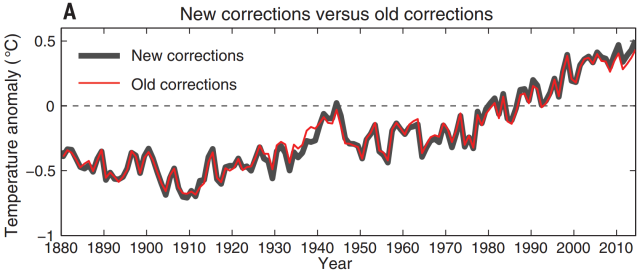
Layzej writes from a report via Ars Technica: In 2015, NOAA released version 4 of their marine temperature dataset called ERSST. The new dataset accounted for a known cooling bias introduced when ocean temperature measurements transitioned from being taken in ship engine intake valves to buoy-based measurements. The warming of the last couple decades increased ever so slightly in NOAA's new analysis. This was a red flag for U.S. House Science Committee Chair Lamar Smith (R-TX), who rejects the conclusions of climate science -- like the fact that the Earth's climate is warming. Suddenly he wanted to see the researchers' e-mails and echoed the accusations of contrarian blogs about scientists' supposedly nefarious adjustments to sea surface temperature measurements. Rather than invoking scientific conspiracies, issues like this should be settled by analyzing the data. A new study, led by University of California Berkeley's Zeke Hausfather, does just that -- and Rep. Smith won't like these results, either. To test the NOAA dataset, Zeke's team created instrumentally homogeneous temperature records from sensors available only over the last couple decades. As it happens, the Argo float data, the buoy data, and the satellite data each hew closer to the updated dataset that NOAA used. The older version (3b) gives a global average that is too cool in recent years, growing to an offset of about 0.06 degrees Celsius. The researchers repeat this same analysis for two more major sea surface datasets that are used by the UK Met Office and the Japanese Meteorological Agency for their global temperature records. Both of those datasets also drift cooler than the comparison data, but less so than NOAA's old dataset. -
Self-Driving Cars Will Make Organ Shortages Even Worse (slate.com)
One of the many ways self-driving cars will impact the world is with organ shortages. It's a morbid thought, but the most reliable sources for healthy organs and tissues are the more than 35,000 people killed each year on American roads. According to the book "Driverless: Intelligent Cars and the Road Ahead," 1 in 5 organ donations comes from the victim of a vehicular accident. Since an estimated 94 percent of motor-vehicle accidents involve some kind of a driver error, it's easy to see how autonomous vehicles could make the streets and highways safer, while simultaneously making organ shortages even worse. Slate reports: As the number of vehicles with human operators falls, so too will the preventable fatalities. In June, Christopher A. Hart, the chairman of the National Transportation Safety Board, said, "Driverless cars could save many if not most of the 32,000 lives that are lost every year on our streets and highways." Even if self-driving cars only realize a fraction of their projected safety benefits, a decline in the number of available organs could begin as soon as the first wave of autonomous and semiautonomous vehicles hits the road -- threatening to compound our nation's already serious shortages. We're all for saving lives -- we aren't saying that we should stop self-driving cars so we can preserve a source of organ donation. But we also need to start thinking now about how to address this coming problem. The most straightforward fix would be to amend a federal law that prohibits the sale of most organs, which could allow for development of a limited organ market. Organ sales have been banned in the United States since 1984, when Congress passed the National Organ Transplant Act after a spike in demand (thanks to the introduction of the immunosuppressant cyclosporine, which improved transplant survival rates from 20-30 percent to 60-70 percent) raised concerns that people's vital appendages might be "treated like fenders in an auto junkyard." Others feared an organ market would exploit minorities and those living in poverty. But the ban hasn't completely protected those populations, either. The current system hasn't stopped organ harvesting -- the illegal removal of organs from the recently deceased without the consent of the person or family -- either in the United States or abroad. It is estimated that, worldwide, as many as 10,000 black market medical operations are performed each year that involve illegally purchased organs. So what would an ethical fix to our organ transplant shortage look like? To start, while there's certainly a place for organ donation markets in the United States, implementation will be understandably slow. There are, however, small steps that can get us closer to a just system. For one, the country could consider introducing a "presumed consent" rule. This would change state organ donation registries from affirmative opt-in systems (checking that box at the DMV that yes, you do want to be an organ donor) to an affirmative opt-out system where, unless you state otherwise, you're presumed to consent to be on the list. -
How Social Isolation Is Killing Us (nymag.com)
schwit1 quotes a report from The New York Times: Social isolation is a growing epidemic (Warning: may be paywalled; alternate source) -- one that's increasingly recognized as having dire physical, mental and emotional consequences. Since the 1980s, the percentage of American adults who say they're lonely has doubled from 20 percent to 40 percent. About one-third of Americans older than 65 now live alone, and half of those over 85 do. People in poorer health -- especially those with mood disorders like anxiety and depression -- are more likely to feel lonely. Those without a college education are the least likely to have someone they can talk to about important personal matters. A wave of new research suggests social separation is bad for us. Individuals with less social connection have disrupted sleep patterns, altered immune systems, more inflammation and higher levels of stress hormones. One recent study found that isolation increases the risk of heart disease by 29 percent and stroke by 32 percent. Another analysis that pooled data from 70 studies and 3.4 million people found that socially isolated individuals had a 30 percent higher risk of dying in the next seven years, and that this effect was largest in middle age. Loneliness can accelerate cognitive decline in older adults, and isolated individuals are twice as likely to die prematurely as those with more robust social interactions. These effects start early: Socially isolated children have significantly poorer health 20 years later, even after controlling for other factors. All told, loneliness is as important a risk factor for early death as obesity and smoking. -
Facebook Is Clamping Down On Fake News, Partners With Fact Checkers To Flag Stories (slate.com)
After weeks of criticism over its role in spreading fake news during and after the 2016 U.S. Presidential election, Facebook said today it is taking concrete steps to halt the sharing of hoaxes on its platform. From a report on Slate: The company announced on Thursday several new features designed to identify, flag, and slow the spread of false news stories on its platform, including a partnership with third-party fact-checkers such as Snopes and PolitiFact. It is also taking steps to prevent spammers and publishers from profiting from fake news. The new features are relatively cautious and somewhat experimental, which means they may not immediately have the intended effects. But they signal a new direction for a company that has been extremely reticent to take on any editorial oversight of the content posted on its platform. And they are likely to evolve over time as the company tests and refines them. First, it's trying to make it easier for users to report fake news stories. The drop-down menu at the top right of each post in your feed will now include an explicit option to report it as a "fake news story," after which you'll be prompted to choose among multiple options, which include notifying Facebook and messaging the person who shared it. -
Twitters Says It Will Ban Trump If He Breaks Hate-Speech Rules (qz.com)
Twitter has made a serious effort as of late to limit hate speech on its social media site, especially after Election Day where "biased graffiti, assaults and other incidents have been reported in the news." The company now faces President-elect Donald Trump, who has used Twitter for the past 18 months as a megaphone for his views and rants, which many would consider as "hate speech." According to the American Bar Association, hate speech is "speech that offends, threatens, or insults groups, based on race, color, religion, national origin, sexual orientation, or other traits." Quartz reports: While Trump's deceptive tweets may not violate Twitter's rules against harassment, threats and "hateful conduct," Twitter is still keeping an eye on his account for more egregious offenses. This week, the company told Slate it would consider banning key government officials, even the president, if its rules against hate speech or other language were violated. "The Twitter Rules prohibit violent threats, harassment, hateful conduct, and multiple account abuse, and we will take action on accounts violating those policies," a spokesperson wrote. Twitter confirmed with Quartz that everyone, including government officials, were subject to the policy: "The Twitter Rules apply to all accounts," a spokesman wrote. Trump may not have crossed that line yet, but he hasn't exactly refrained from making incendiary claims. Most recently, he claimed that Abdul Razak Ali Artan, who allegedly carried out an attack injuring 11 students at Ohio State University, "should not have been in our country." Artan was a legal permanent U.S. resident, whose family had fled Somalia for Pakistan in 2007. He arrived in the States in 2014. -
Facebook Disputes Gizmodo Report, Says It Never Built and Withheld Any News Feed Changes Based on Their Political Impact (slate.com)
Tech news site Gizmodo reported Monday that Facebook planned a News Feed update that would have identified fake or hoax news stories, but "disproportionately impacted right-wing news sites by downgrading or removing that content from people's feeds" so it chose to never release the update. Facebook has denied the claims in the report. A spokesperson told Slate: "The article's allegation is not true. We did not build and withhold any News Feed changes based on their potential impact on any one political party. We always work to make News Feed more meaningful and informative, and that includes examining the quality and accuracy of items shared, such as clickbait, spam, and hoaxes. Mark himself said, "I want to do everything I can to make sure our teams uphold the integrity of our products." This includes continuously review updates (sic) to make sure we are not exhibiting unconscious bias. -
Are Tesla Crashes Balanced Out By The Lives That They Save? (eetimes.com)
Friday EE Times shared the story of a Tesla crash that occurred during a test drive. "The salesperson suggested that my friend not brake, letting the system do the work. It didn't..." One Oregon news site even argues autopiloted Tesla's may actually have a higher crash rate.
But there's also been stories about Teslas that have saved lives -- like the grateful driver whose Model S slammed on the brakes to prevent a collision with a pedestrian, and another man whose Tesla drove him 20 miles to a hospital after he'd suddenly experienced a pulmonary embolism. (Slate wrote a story about the incident titled "Code is My Co-Pilot".) Now an anonymous Slashdot reader asks: How many successes has the autopilot had in saving life and reducing damage to property? What is the ratio of these successes to the very public failures?
I'd be curious to hear what Slashdot readers think. If you add it all up, are self-driving cars keeping us safer -- or just making us drive more recklessly? -
Computer Scientists Believe a Trump Server Was Communicating With a Russian Bank (slate.com)
In light of the Democratic National Committee hack by the Russians earlier this year, a "tightly knit community of computer scientists" working in a variety of fields came up with the hypothesis, "which they set out to rigorously test: If the Russians were worming their way into the DNC, they might very well be attacking other entities central to the presidential campaign, including Donald Trump's many servers." In late July, one of the scientists who asked to be referred to as Tea Leaves discovered possible malware emanating from Russia, with the destination domain having Trump in its name. What the researcher saw "was a bank in Moscow that kept irregularly pinging a server registered to the Trump Organization on Fifth Avenue": Slate Magazine reports: More data was needed, so he began carefully keeping logs of the Trump server's DNS activity. As he collected the logs, he would circulate them in periodic batches to colleagues in the cybersecurity world. Six of them began scrutinizing them for clues. The researchers quickly dismissed their initial fear that the logs represented a malware attack. The communication wasn't the work of bots. The irregular pattern of server lookups actually resembled the pattern of human conversation -- conversations that began during office hours in New York and continued during office hours in Moscow. It dawned on the researchers that this wasn't an attack, but a sustained relationship between a server registered to the Trump Organization and two servers registered to an entity called Alfa Bank. The server was first registered to Trump's business in 2009 and was set up to run consumer marketing campaigns. It had a history of sending mass emails on behalf of Trump-branded properties and products. Researchers were ultimately convinced that the server indeed belonged to Trump. But now this capacious server handled a strangely small load of traffic, such a small load that it would be hard for a company to justify the expense and trouble it would take to maintain it. That wasn't the only oddity. When the researchers pinged the server, they received error messages. They concluded that the server was set to accept only incoming communication from a very small handful of IP addresses. A small portion of the logs showed communication with a server belonging to Michigan-based Spectrum Health. -
Assange Says Wikileaks is 'Working On' Hacking Donald Trump's Tax Return (slate.com)
Julian Assange made headlines Friday when talk-show host Bill Maher asked him why Wikileaks wasn't hacking into Donald's Trump's tax returns. "Well, we're working on it," Assange replied. But it was apparently the culmination of a larger back-and-forth. An anonymous reader quotes Slate: Earlier in the interview, Maher said it sure looked like Assange was "working with a bad actor, Russia" to hurt "the one person who stands in the way of us being ruled by Donald Trump." Assange then tried to move the conversation toward what he thought was a smoking gun against Maher, saying he had found there was a "William Maher" who "gave a Clinton-affiliated entity $1 million." Maher explained he had famously given President Obama $1 million in 2012 and he never tried to hide it. When Assange pressed on whether he had also given money to Clinton, Maher shot back: "Fuck no."
Slate has a video of the entire interview, and while Friday WikiLeaks was publicizing Assange's appearance on the show on Twitter, Saturday they were tweeting a clarification. "WikiLeaks isn't 'working on' hacking Trump's tax-returns. Claim is a joke from a comedy show. We are 'working on' encouraging whistleblowers." -
Ask Slashdot: How Do You Keep Your Credit Card Secure?
It's easy to pontificate about the best security practices -- but the real test is what we do with our own money. Long-time Slashdot reader Keybounce writes: So, like most of you, I recently got a new credit card with a chip in it. I was not worried about that -- I know the chips are harder to copy and counterfeit. But I recently discovered that the card is also a radio card -- swiping it near the screen caused an message to show up on the reader. In this case, it told me to use the chip reader instead, but this means it has an active radio signal, and could be "hacked" -- stolen by someone with the right device.
How can I prevent this? Is there anything I can do that will disable the radio signal and still leave the chip functioning?
At least 200 million RFID credit cards were in circulation by 2012, even though their signals could be easily intercepted, prompting the introduction of RFID-blocking wallets and sleeves. But what's the alternative? A recent article in Quartz argued that America's transition to chip cards has been an utter disaster (since the banks dispensed with PIN numbers altogether and now validate with only an electronic signature). Is the answer to just use a mobile wallet like Apple Pay or Android Pay -- or to always pay with cash?
So leave your own answer in the the comments. How are you keeping your own credit card secure? -
Satya Nadella Explores How Humans and AI Can Work Together To Solve Society's Greatest Challenges (geekwire.com)
In an op-ed for Slate, Microsoft CEO Satya Nadella has shared his views on AI, and how humans could work together with this nascent technology to do great things. Nadella feels that humans and machines can work together to address society's greatest challenges, including diseases and poverty. But he admits that this will require "a bold and ambition approach that goes beyond anything that can be achieved through incremental improvements to current technology," he wrote. You can read the long essay here. GeekWire has summarized the principles and goals postulated by Nadella. From the article:AI must be designed to assist humanity.
AI must be transparent.
AI must maximize efficiencies without destroying the dignity of people.
AI must be designed for intelligent privacy.
AI needs algorithmic accountability so humans can undo unintended harm.
AI must guard against bias.
It's critical for humans to have empathy.
It's critical for humans to have education.
The need for human creativity won't change.
A human has to be ultimately accountable for the outcome of a computer-generated diagnosis or decision.
-
Satya Nadella Explores How Humans and AI Can Work Together To Solve Society's Greatest Challenges (geekwire.com)
In an op-ed for Slate, Microsoft CEO Satya Nadella has shared his views on AI, and how humans could work together with this nascent technology to do great things. Nadella feels that humans and machines can work together to address society's greatest challenges, including diseases and poverty. But he admits that this will require "a bold and ambition approach that goes beyond anything that can be achieved through incremental improvements to current technology," he wrote. You can read the long essay here. GeekWire has summarized the principles and goals postulated by Nadella. From the article:AI must be designed to assist humanity.
AI must be transparent.
AI must maximize efficiencies without destroying the dignity of people.
AI must be designed for intelligent privacy.
AI needs algorithmic accountability so humans can undo unintended harm.
AI must guard against bias.
It's critical for humans to have empathy.
It's critical for humans to have education.
The need for human creativity won't change.
A human has to be ultimately accountable for the outcome of a computer-generated diagnosis or decision.
-
Ask Slashdot: Should I Expect Tracking When Subscribing To News Sites?
Long-time Slashdot reader robot5x writes: I'm a fan of online privacy and, where possible, don't automatically permit cookies and tend to set Ghostery to block all trackers in my browser. This rarely causes a problem -- I have lots of subscriptions to various sites which require me to login and have only rarely encountered minor issues. Recently I had a present of a Slate Plus membership. I really like their content and was keen on supporting it financially. Activating it from the email they sent required me to first register as a user. I clicked on the icon, and nothing happened. Ghostery picked up 7 trackers which I had blocked.
Assuming that one of these was the cause, I activated each in turn and reloaded. None of them made any difference, except a single tracker from JanRain. Accepting this tracker let everything work perfectly. Reading more about JanRain though -- and particularly its interaction with Adobe analytics (which it also tries to load) -- I discovered that they wanted to "create a holistic view of your business by collecting, analyzing and reporting all customer interactions. To derive the most actionable insights, you must link your customers' actions with who they are and what their interests are. Janrain bridges the gap by connecting demographic and psychographic data, collected through traditional and social login, with Adobe's behavioral data, so you understand the whole customer journey".
I do not want them to do any of this, and don't think I should have to. Interactions with Slate's 'support' were excruciating and -- while they at least didn't ask me to restart my computer -- they actually ended up saying that allowing these trackers is tied to their login process and I have to either accept or get a refund.
Robot 5x asks: Is it unacceptable to have to accept being tracked as a paying customer for new sites? "Or am I just being a big baby?" -
Drone-Shooting is Now a Federal Crime, FAA Confirms (slate.com)
An anonymous reader writes: At least 12 different drones have been shot from the sky in the United States, including drone shootings in Arkansas, Oklahoma, Virginia, Kentucky, and New Jersey. Now the FAA is confirming that drone shooting is a federal offense, citing regulations against aircraft sabotage. An aviation attorney (teaching drone law at New York's Vaughn College of Aeonautics) tells Forbes this means penalties of up to 20 years in prison for interfering with the "authorized" operation of an aircraft, while threatening a drone or a drone operator would also be a federal crime subject to five years in prison.
Slate notes that "This is bad news if you were planning to invest in the DroneDefender, a goofy-looking gun that promised to disrupt intrusive drones by bombarding them 'with radio waves that disrupt [their] remote control and GPS signals'." And Popular Science adds that "It also poses a complication for some local and state laws, like Utah's proposed HB 420, which would let police shoot down drones in emergency situations." Meanwhile, police in the Netherlands are actually training eagles to attack drones. And last week in South Africa, a drone crashed through the window of an office building and hit an unarmed office worker on the head. -
Drone-Shooting is Now a Federal Crime, FAA Confirms (slate.com)
An anonymous reader writes: At least 12 different drones have been shot from the sky in the United States, including drone shootings in Arkansas, Oklahoma, Virginia, Kentucky, and New Jersey. Now the FAA is confirming that drone shooting is a federal offense, citing regulations against aircraft sabotage. An aviation attorney (teaching drone law at New York's Vaughn College of Aeonautics) tells Forbes this means penalties of up to 20 years in prison for interfering with the "authorized" operation of an aircraft, while threatening a drone or a drone operator would also be a federal crime subject to five years in prison.
Slate notes that "This is bad news if you were planning to invest in the DroneDefender, a goofy-looking gun that promised to disrupt intrusive drones by bombarding them 'with radio waves that disrupt [their] remote control and GPS signals'." And Popular Science adds that "It also poses a complication for some local and state laws, like Utah's proposed HB 420, which would let police shoot down drones in emergency situations." Meanwhile, police in the Netherlands are actually training eagles to attack drones. And last week in South Africa, a drone crashed through the window of an office building and hit an unarmed office worker on the head. -
Drone-Shooting is Now a Federal Crime, FAA Confirms (slate.com)
An anonymous reader writes: At least 12 different drones have been shot from the sky in the United States, including drone shootings in Arkansas, Oklahoma, Virginia, Kentucky, and New Jersey. Now the FAA is confirming that drone shooting is a federal offense, citing regulations against aircraft sabotage. An aviation attorney (teaching drone law at New York's Vaughn College of Aeonautics) tells Forbes this means penalties of up to 20 years in prison for interfering with the "authorized" operation of an aircraft, while threatening a drone or a drone operator would also be a federal crime subject to five years in prison.
Slate notes that "This is bad news if you were planning to invest in the DroneDefender, a goofy-looking gun that promised to disrupt intrusive drones by bombarding them 'with radio waves that disrupt [their] remote control and GPS signals'." And Popular Science adds that "It also poses a complication for some local and state laws, like Utah's proposed HB 420, which would let police shoot down drones in emergency situations." Meanwhile, police in the Netherlands are actually training eagles to attack drones. And last week in South Africa, a drone crashed through the window of an office building and hit an unarmed office worker on the head. -
Shockwave Images Help NASA In Development of 'Quiet' Supersonic Jet (go.com)
An anonymous reader writes: NASA is working on developing a next-generation supersonic jet that can break the sound barrier with a soft "thump" instead of a sonic boom. They are using a technique called schlieren imagery to "visualize supersonic flow phenomena with full-scale aircraft in flight" with the sun as the backdrop for the photos. According to a NASA blog post, viewing shock waves and their density is crucial to the project so engineers can work on a design to minimize those reverberations. While the Quiet Supersonic Technology (QueSST) research aircraft is being developed, stunning images were captured of a supersonic jet flying at Mach 1.05 with the sun in the background. NASA says when QueSST is operational, it could "unlock the future to commercial supersonic flight over land," essentially ushering in a new era of aviation that could allow us to get from point A to point B faster and without the loud roar of the Concorde as it breaks the sound barrier. -
Terrorist Attack In Brussels Airport and Metro Station: At Least 34 Dead (mirror.co.uk)
SomeoneFromBelgium writes: This morning there was a double bomb explosion in Brussels, Belgium. In the National Airport entrance hall an estimated 13 people were killed by a big explosion; around the same time another bomb exploded in Metro station 'Maalbeek,' close to the financial district, killing an estimated 10 persons. Note: story updates bump this figure ot at least 34 deaths. Reader jones_supa adds Shots were fired and Arabic shouted before the blasts, suggesting a terrorist attack. Video and images on social media showed smoke rising from an airport building and shattered windows. Confused and shocked passengers fled the terminal to safety as they were evacuated by armed police. Footage showed rubbish littered across the floor. All traffic from and to the airport has been suspended. The airport is monitoring the situation closely and will deliver further announcements in Twitter. Update: 03/22 13:06 GMT by T : According to the New York Times and other sources, at least one of the explosions was set off by a suicide bomber. Slate has an actively updating stream of updates about the attack, too. -
Asteroid Impacts Make Tiny Diamonds
The Bad Astronomer writes: It's long been thought that asteroid impacts create pressures high enough to form diamonds. Now, using high-energy lasers and X-ray crystallography, researchers have confirmed that lonsdaleite, a form of diamond, can be made this way.