Slashdot Mirror
Domain: sourceforge.net
Stories and comments across the archive that link to sourceforge.net.
Comments · 31,462
-
Re:Regexes How2
There are quite a few regular expression tools available, with different capabilities and purposes. For the novice who doesn't want to learn more or doesn't have time, the best is probably txt2regex, which walks you through the construction of the regexp and generates output for 20 different programs and languages. It is one of the few tools that I know of that isn't specialized for a particular language or program. My own tool, Redet, provides an interface to 29 regular expression implementations. It is aimed at people who know something about regular expressions or are willing to spend some time learning but helps out by providing palettes showing the notation for each program and a history system, so that you can first construct the pieces of a complex regexp, then assemble them. It also has features aimed at providing a search environment that may be useful for people who need no help constructing their regular expressions.
regex-coach uses PERL-style regular expressions. Its particular virtue is that it can single-step through the match and show the parse tree, so it is useful if you want to understand the matching process in detail. Similar in that it helps to understand the implementation of regular expressions is re_graph, which given a regular expression draws the corresponding finite state automaton.
A couple of nice tools aimed at Python users are Kiki and Kodos.
These and some other tools and libraries are listed on this page.
-
Re:Just develop a Linux version
It's not that easy. iTunes on both Windows and OS X depends on Quicktime. Porting Quicktime would be a lot of extra work on top of the special UI things they already do when they port programs. They could use a media framework that is already present on Linux, but I doubt they would want to do that. In addition, to not have a half-assed port, they would have to support iPods and other MP3 players like they do on Windows. I think this part is the least of their worries, since most MP3 players use the USB Mass Storage driver (does iTunes on Windows even support those which don't?), and all iPods are supported in Linux. The main barriers are Quicktime and the iTunes interface.
The largest barrier is that they probably just don't want to do it. It doesn't seem economically sound to me to do so either. -
Re:Why not Tivo?
You mean like this?
(albeit only for series 1 with a network adapter) -
Re:Rolling your own
vector graphics solve the problem of scaling artefacts; they do not, by themselves, adjust the level of detail as you zoom.
Actually, they're starting to. Just look at section 12.3 of the SVG 1.2 spec: "Alternate content based on display resolutions". Not only is it in the spec, but it's shown up on the roadmaps of things such as librsvg. Just two or three levels can replace a slew of bitmap icons.
-
Re:Maybe next year, eh?
If businesses switch to the 'thin client' model, or anything similar, then this will be a step backwards, technologically speaking, and it will be a decision which is based entirely on financial motives.
As someone who recently switched over an office's mixed Windows network to a thin-client setup based on Slackware and the excellent Linux Terminal Server Project, I claim that this is not a step backwards (technologically or otherwise), but simply a step in a different direction. Yes, it's a lot cheaper all right, but that is not the only motive. It's also:
- a lot faster for the users: the thin clients boot up in no time and everything else doesn't need to boot because it's already up. Also, because Linux caches everything and uses shared memory, programs start up very fast after the first user has started them up for the first time. Finally, everyone gets to profit from the big fat server's execution speed (no, it doesn't degrade significantly from being shared; load is usually under 0.20).
- more flexible for the users: their own user environment is available from any office computer, instead of being tied to one PC, and can even be accessed remotely via SSH.
- a lot more practical for the sysadmin: everything needs to be upgraded only once and everyone immediately uses the new version. No need for manual client installation or risky and expensive central upgrade distribution systems. With SSH, everything can even be safely managed remotely.
- quite extensible: nothing says you are limited to one server. You can either distribute tasks over different servers (programs can run on different computers and be displayed on the same terminal screen, and users won't even notice), or you can combine LTSP with OpenMOSIX and make the server and all the clients participate in a big happy cluster! Imagine running The GIMP and having twenty computers transparently divide the rendering work among them...
In short, the thin client model is highly underrated. It has a lot of possibilities, some of which are either hard to realize or plainly not available on traditional PC setups. It's not universally the best solution but for offices they are typically very suitable.
And no, the PC is not dead and is not about to die. With that I agree entirely.
___________
* Yes, I'm being civilized. -
Re:You just want an RDP Client, right?
Although reading it again it seems it wants an RDP Server. Like this one: xrdp
-
Time to wake up...
Is this http://pearpc.sourceforge.net/screenshots/pearpc_
x p.jpg
PearPC screen shot good enough for you? Works here. -
Re:progress?
Quick hyperbolic examples:
This screenshot is an example of Microsoft Word and its 16x16 buttons. Although most people can recognise the page icon for New, floppy disk icon (with the flap the wrong way round, too!) for Save, there are inexplicable little things like a set of tools, a clipboard with a tick on it, and a padlock. I could guess at what some of these mean, but without seeing the tooltip I couldn't be sure. It's a shame most applications have adopted this way of doing things.
Iconifying said commands is bad because it's hard to deduce said icon's meaning (little clipboard with a tick in it, for example).
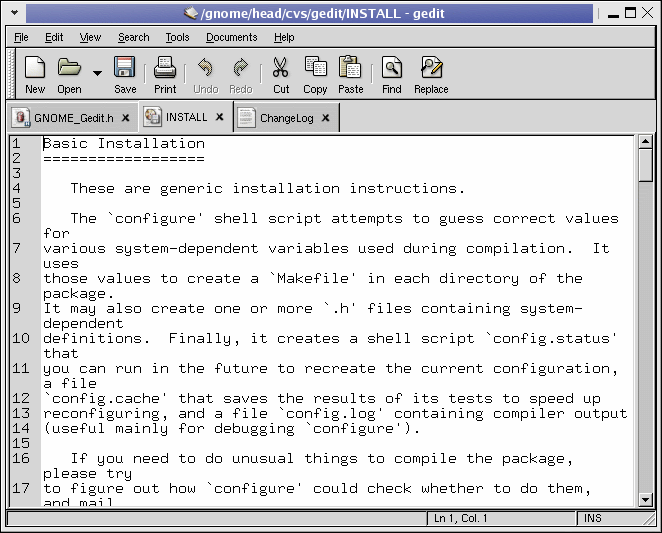
For a better way, see the iWork applications (I can't find screenshots, though), which store most commands in menus, or GTK applications such as this one (I know gedit isn't as complex as Office, I'm just showing the toolkit). The save button has both a floppy disk icon and "Save" under it, if you weren't sure. Spellcheck has "Spellcheck" written under it. And you can change these things (globally) under Menus and Toolbars in Preferences. -
Re:what software is positioned to take advantage?
I believe that Pymol can display stereo models. It's a modelling package for chemistry/biology. And it's open source. There are countless non open source software in chemo/bioinformatics that use stereo views.
I guess that's the reason why they call this laptop "molecule". -
Re:Switch?
I just wish more people would drop the axiom that you must only run one OS at a time and you must worship it like mad, be on the verge of switching to another one or just hate everything about computers.
Yeah.. I'm also running Linux (primary OS), Windows, and OS X (on a Mac Mini). I actually hoped that OS X would make the other two unnecessary, but I find myself using Linux for almost everything, and a few OS-specific apps I run on the Mac and Windows boxes. Combined with Synergy, having all three OS's at my finger tips is really really nice and I've gotten quite used to working in multiple OS's at the same time. It's only recently that the scales began tipping in Linux's favor (I found some great apps for Linux which replaced equivalent apps for Windows and OSX, such as Amarok and K3B). -
My set:
I very heavily use my thumb drive on school/library pubic systems, and have an allmost entirely different set of programs i use:
For AIM:
TerrAIM
For IRC:
Dana I acutally use this little IRC client whenever im in windows, even on my own machines. very light and fast.
For Remote:
Both RealVNC and PuTTY
My favorive text editor:
Notepad++
And a number of tools from DS Software Notably TaskKill. -
My set:
I very heavily use my thumb drive on school/library pubic systems, and have an allmost entirely different set of programs i use:
For AIM:
TerrAIM
For IRC:
Dana I acutally use this little IRC client whenever im in windows, even on my own machines. very light and fast.
For Remote:
Both RealVNC and PuTTY
My favorive text editor:
Notepad++
And a number of tools from DS Software Notably TaskKill. -
forgot the link
great for form fields
-
Re:The rise (again) of console gaming...
-
GamesSo I read a number of posters stating that the lack of games for Mac will drive people away. I am amazed by this claim for two reasons.
First, if a game is decent, chances are, it exists for the Mac. Nearly all major games (Warcraft (I-WoW), Call to Duty, NWN, SW KotOR, Sims, etc.) have Mac versions that equal their Windows counterparts (not emulation). Second, who is running away from Linux because of the lack of games?
In all fairness to people buying these computers, it is about user experience. If the Macintosh delivers a better user experience, people will switch. The halo effect of the iPod is to show people what a well-designed machine feels like. Since (IMHO) the Macintosh has a much better experience, along with all of the accoutrements of a *nix under the hood, I had very little heartburn over switching.
Incidentally, the main use of my Mac is collision modelling in FORTRAN. Thank goodness for gfortran. The POSIX-compliant version is much more stable than its Windows counterpart and neither it nor g95 require MinGW on Darwin (obviously).
Finally, Darwin has the ability to compile the *nix OSS that we have all come to love. I keep a recent build of Apple's X11 on my machine and have yet to run into a tgz that didn't compile cleanly or with minimum tweaking. For those who love their OSS but don't like to work their own code, there are a couple decent package managers for the Mac as well (i-Installer, Fink, etc).
-
So why start a new project?
Freediag is stagnant because people have lost interest. If they want to implement new protocols within the 0BD II standard they should pick up Freediag and continue the development. Freediag is almost completely finished the portability portion of it's development. It compiles under most operating systems.
I guess Yay! for GPL being upheld in court. Yay! For independent an DIY auto repair folks. However, bummer for a project that really needs some new blood. -
Good.
But remember, the GPL itself is not specifically "tested", per se, because GPL software developers assert them rights granted to them via copyright on an individual basis. This makes it a sometimes long and arduous process to assert rights and/or prove infringement, but hopefully more precedent will help.
Since the provisions of the GPL have been upheld in a case in Germany as well, maybe PearPC will be able to more easily defend itself against CherryOS, which has blatantly taken GPL code, without release of source code or attribution, from PearPC and several other GPL projects:
eWeek has a general overview of the situation:
http://www.eweek.com/article2/0,1759,1775386,00.as p
Below is a comprehensive collection of evidence, which runs the gamut from CherryOS including original PearPC graphics, extremely unique strings and error messages, debug code from PearPC, the same unique MAC address as PearPC's default network adapter, shared specific functionality, including bugs, and so on:
http://www.ht-technology.com/cherryos-pearpc/cherr yos-pearpc.html
http://www.drunkenblog.com/drunkenblog-archives/00 0501.html
http://www.drunkenblog.com/drunkenblog-archives/00 0503.html
http://www.drunkenblog.com/drunkenblog-archives/00 0504.html
http://www.drunkenblog.com/drunkenblog-archives/00 0507.html
http://starport.dnsalias.net/index.php?show=articl e&id=348
http://forums.pearpc.net/viewtopic.php?p=16178#161 78
http://www.tliquest.net/ryan/cherryos/
http://dhost.info/kourge/en/projects/frauds/cherry os.php
Additionally, PearPC project authors are already asserting their rights under the GPL:
http://sourceforge.net/mailarchive/message.php?msg _id=11116974
And a general compilation of some of the evidence so far against CherryOS:
http://sourceforge.net/mailarchive/message.php?msg _id=11125509 -
Good.
But remember, the GPL itself is not specifically "tested", per se, because GPL software developers assert them rights granted to them via copyright on an individual basis. This makes it a sometimes long and arduous process to assert rights and/or prove infringement, but hopefully more precedent will help.
Since the provisions of the GPL have been upheld in a case in Germany as well, maybe PearPC will be able to more easily defend itself against CherryOS, which has blatantly taken GPL code, without release of source code or attribution, from PearPC and several other GPL projects:
eWeek has a general overview of the situation:
http://www.eweek.com/article2/0,1759,1775386,00.as p
Below is a comprehensive collection of evidence, which runs the gamut from CherryOS including original PearPC graphics, extremely unique strings and error messages, debug code from PearPC, the same unique MAC address as PearPC's default network adapter, shared specific functionality, including bugs, and so on:
http://www.ht-technology.com/cherryos-pearpc/cherr yos-pearpc.html
http://www.drunkenblog.com/drunkenblog-archives/00 0501.html
http://www.drunkenblog.com/drunkenblog-archives/00 0503.html
http://www.drunkenblog.com/drunkenblog-archives/00 0504.html
http://www.drunkenblog.com/drunkenblog-archives/00 0507.html
http://starport.dnsalias.net/index.php?show=articl e&id=348
http://forums.pearpc.net/viewtopic.php?p=16178#161 78
http://www.tliquest.net/ryan/cherryos/
http://dhost.info/kourge/en/projects/frauds/cherry os.php
Additionally, PearPC project authors are already asserting their rights under the GPL:
http://sourceforge.net/mailarchive/message.php?msg _id=11116974
And a general compilation of some of the evidence so far against CherryOS:
http://sourceforge.net/mailarchive/message.php?msg _id=11125509 -
Re:Now the question is...What we need is a really cheap, really good e-book reader that accepts multiple and non-proprietary formats.
Any PalmOS device, plus Plucker for HTML and Weasel for text. Weasel's screen-wrap autoscroll is hands-down the best way I've ever found to read e-texts. Plucker's autoscroll isn't as pretty IMO.
Then there's of course the proprietary readers for DocBook and MobiPocket and I would guess PDF, although I haven't bothered with that.
I can carry about ten books on my 8MB Visor, which keeps me busy for quite awhile. Only problem is what to do during takeoff/landing--I usually carry a single dead tree while I'm at it. One book+one palm is reading material for a couple of weeks.
-
Re:Linux, here we come!
-
Re:Linux, here we come!
-
Quick question
I am the leader of an open-source (GPL) effort to create a truly multi-user and multi-blog blogging tool built on PHP and called pLog. Even though it's an ugly name, it stands "PHP Log" and has nothing to do with Amazon's patent whatsoever. But the question is... Should we start worrying about this now? I mean, can we expect Amazon's lawyers coming after us because our project name and the name of their patent sound too similar? We've been in Sourceforge since June 2003 (if that counts)
We'd like to keep our name because it's been our identity for almost 2 years now but we cannot affort legal litigation (being a free community effort, etc) -
Re:memaid
Flash card programs.
Granule, a GTK+-based Flash card program using the Leitner method. -
Pauker
There is a great open source flashcard program called Pauker. I use it to learn German and like it quite a bit.
Pauker helps teach you the words and quiz you on them. I've found it to be the best open-source flash card program available. -
Re:Adam Curry
Seriously, podcasting is his baby, he got this thing rolling. Check out ipodder they have apps that will automagically download podcasts and put them in your iTunes. No, you don't need an iPod, these are just MP3 files.
-
Gnome flashcard programs
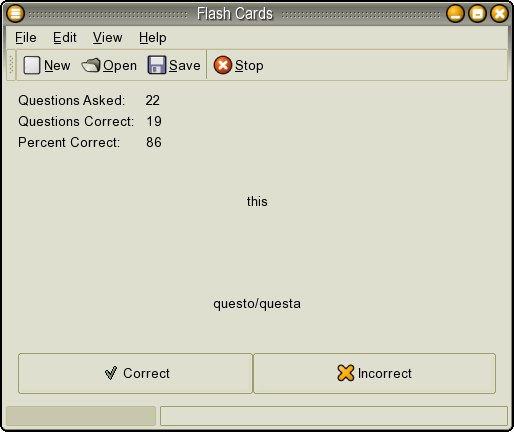
I'm writing a Mono program that's imaginatively called gflashcards (screenshot). The webpage is pretty junky and the program isn't al that great right now, but I've been putting a lot of work into both and there'll probably be cool new versions of them in around a week.</plug>
If you want something a bit more complete right this instant, check out granule
-
Gnome flashcard programs
I'm writing a Mono program that's imaginatively called gflashcards (screenshot). The webpage is pretty junky and the program isn't al that great right now, but I've been putting a lot of work into both and there'll probably be cool new versions of them in around a week.</plug>
If you want something a bit more complete right this instant, check out granule
-
Gnome flashcard programs
I'm writing a Mono program that's imaginatively called gflashcards (screenshot). The webpage is pretty junky and the program isn't al that great right now, but I've been putting a lot of work into both and there'll probably be cool new versions of them in around a week.</plug>
If you want something a bit more complete right this instant, check out granule
-
Pauker is a good flashcard program
I've used Pauker in the past and found it to be a great flashcard program. Free, opensource, and runs anywhere you have java.
-
memaid
There's a linux program called memaid:
http://memaid.sourceforge.net/index.php
Pauker is a java program:
http://pauker.sourceforge.net/
I've tried sort of half-heartedly to get memaid to work, but I didn't have a lot of luck. I didn't push, though, and I didn't post any questions on the mail list.
-
memaid
There's a linux program called memaid:
http://memaid.sourceforge.net/index.php
Pauker is a java program:
http://pauker.sourceforge.net/
I've tried sort of half-heartedly to get memaid to work, but I didn't have a lot of luck. I didn't push, though, and I didn't post any questions on the mail list.
-
Re:1000 digits in an hour not particularly impress
Then you've missed the whole point of memory systems, that the associations *must work for you*. In the first memory software package you pointed us to, one of the touted features is the ability to change which phonemes associate with which letters.
Strong associations are created when you find a visual or auditory link between a number and the corresponding letter or phoneme, like '2' and 'N' (which contains two downstrokes), that makes sense to you.
There is a visual system in which '2' is represented by a duck (similar shapes), and a the numeral '8' associates with an hourglass.
Another number memory system uses visual words which rhyme with the number words (one->bun, two-shoe, three->tree,
I'll check out the software packages, they look interesting. -
Winamp Radio + Streamripper = Free Music
I can't understand how Napster or even the more successful ITMS manages to make any money. I don't know a single person who's used either service. Are these companies operating at a loss? Obviously it takes money to keep napster running, the ITMS I can understand, it has all of Apple behind it to prop it up even if it's not making a dime for them, but how is Napster supporting itself?
Maybe I'm just being irrational here but it would seem that Napster is doomed unless a 3rd party is injecting funds into it.
What I've been doing for months now is using winamp's internet radio feature along with an awesome plug-in called Stream Ripper. It works well, and you get the quality that the stream is at, usually a very acceptable 160-192kbps. -
Suddenly, the available alternative
at sourceforge will be popular =)
-
Re:1000 digits in an hour not particularly impress
-
Re:that's expensive
If you ever went to Arabia, they wouldn't need a legal reason to arrest / torture you. You'd just vanish or get beat to death by "holy" men. That's kinda the point.
However, if you are serious about helping, what I would suggest grabbing a copy of FreeNet and running a node. You don't even have to actively surf on it, IIRC, to allow it to make active copies of nodes, thus allowing "banned" content to get out.
IIRC, they had also included last time I ran it a built in proxy server/anonymizer, so you'd be helping in that way, too.
If you are concerned about Bandwidth, you can use Netlimiter to throttle it. I don't know of any Linux equivilants to Netlimiter, but I'm sure there's something (probably built in). -
Re:Maybe a dumb question...
-
It's time...
To start taking anonymous p2p more seriously...
-
Re:DIY-VOIP-Network
Then all that remains to do is to tell those softphones how to find your Asterisk server and what their username and password is. In some cases a little fine tuning may be needed. For example, if someone is behind NAT, you may have to work around NAT traversal problems.
I'm using siproxd to get around my NAT for my SIP phones. I'm using Grandstream Budgetone SIP hardphones on one network, and a Debian box as my NAT to the internet (actually, to another internal network which in turn connects to the internet, but that doesn't really matter as it works the same) with Broadvoice as my connection to the PSTN. Works well.
Have been planing on setting up Asterisk to play with for a while now so I may have to do that soon. -
Re:Anybody using it?
Well, until you are able to make the jump to OOo, another open source program may be able to help with the PDF creation. PDF Creator installs itself as a print driver and makes life pretty nice (unless you need links embedded within word to transfer to PDF) and can be found on Source Forge. Maybe someday Word will decide to stop eating documents, but that's probably wishful thinking.
-
What to do
shall I delve myself into the mess that is J2EE and/or
If you can land a job at a game company, and they're not working you to death, then I'd certainly say do that. I would if I could.
I know what you mean about J2EE/.NET. There's a lot of open-source business-management software out there, and I'm sure I could start a business installing and customizing such software for other businesses. I could start in my local area with personal contacts, and grow as much as I wanted to. Everyone else could do it too, and we wouldn't even be competing with each other until our reaches started to intersect. Great idea, right?
Well, first, it means you have to slog through a bunch of open-source packages, figuring out what they really do, how they're architected inside, and whether they're lame-brained piles of crap. Not an easy task. I'm immersed in only one open-source project right now, and one is enough! The next hurdle is figuring out how to make a profit on a service that's going to require a lot of customization and support. Plus, you have to be willing to throw yourself into what can be a really boring topic. I once worked for a tax-software company -- I loved the people I worked with, the software was well-written and documented, and they did their best to make it a fun place to work, but having to write tax software all day still eventually drove me buggers. I dunno, maybe the slow economy and tight job market would keep me focused this time.
Is that the sort of dilemma you're wrestling with?
-
Re:But Unix is 30+ years old.
Until they actually release an OS, all this discussion is pretty much theoretical. The horizons are fuzzy because we can't actually run the damned thing to refine it.
Then allow me to part the fog with a working release: http://www.debian.org/ports/hurd/hurd-cd
Please note that that is not an "official" release, but it should run.
An easier choice is to use the Bochs PC emulator and Hurd disk image, available here.
-
Re:GNU
I'd like to see a full userland based strictly on this and BSD, with as little GNU as possible in it, simply because BSD and Heirloom Toolchest are closer in function to TRUE Unix.
Moll. -
Re:Why, oh why, did they have to repeat the tag na
Interesting suggestion. This technique might only work for XML documents above a certain level of size, number of tag types, and possibly even parsing complexity. The applicability might depend upon whether your utilization of XML serialized data is batch-oriented or transactional in nature. This technique would yield lots of benefits for scenarios where someone is dumping a few, very large XML documents across the wire, but perhaps not so much for scenarios where lots of small, quick XML documents are being exchanged back and forth. CPU saturation (and eventually memory I/O saturation) for example, might become a concern in certain scenarios.
In any case, it seems one name for this technique is XML "compaction". I searched around Sourceforge and found quite a few projects trying to tackle the general problem domain of efficient XML transmission. The compaction terminology was used and explicitly described by the Xqueeze project. There are other projects that either directly apply themselves against the XML compression problem or are tangentially resolving the problem by completely changing the representation format (no transcoding): xmltk, XMLPPM, XBIS XML, WAP Binary XML (WBXML). I will probably look at Xqueeze and XMLPPM for my own programming work that requires handling XML formatted data in a more batch-oriented setting.
-
Re:Why, oh why, did they have to repeat the tag na
Interesting suggestion. This technique might only work for XML documents above a certain level of size, number of tag types, and possibly even parsing complexity. The applicability might depend upon whether your utilization of XML serialized data is batch-oriented or transactional in nature. This technique would yield lots of benefits for scenarios where someone is dumping a few, very large XML documents across the wire, but perhaps not so much for scenarios where lots of small, quick XML documents are being exchanged back and forth. CPU saturation (and eventually memory I/O saturation) for example, might become a concern in certain scenarios.
In any case, it seems one name for this technique is XML "compaction". I searched around Sourceforge and found quite a few projects trying to tackle the general problem domain of efficient XML transmission. The compaction terminology was used and explicitly described by the Xqueeze project. There are other projects that either directly apply themselves against the XML compression problem or are tangentially resolving the problem by completely changing the representation format (no transcoding): xmltk, XMLPPM, XBIS XML, WAP Binary XML (WBXML). I will probably look at Xqueeze and XMLPPM for my own programming work that requires handling XML formatted data in a more batch-oriented setting.
-
Re:Why, oh why, did they have to repeat the tag na
Interesting suggestion. This technique might only work for XML documents above a certain level of size, number of tag types, and possibly even parsing complexity. The applicability might depend upon whether your utilization of XML serialized data is batch-oriented or transactional in nature. This technique would yield lots of benefits for scenarios where someone is dumping a few, very large XML documents across the wire, but perhaps not so much for scenarios where lots of small, quick XML documents are being exchanged back and forth. CPU saturation (and eventually memory I/O saturation) for example, might become a concern in certain scenarios.
In any case, it seems one name for this technique is XML "compaction". I searched around Sourceforge and found quite a few projects trying to tackle the general problem domain of efficient XML transmission. The compaction terminology was used and explicitly described by the Xqueeze project. There are other projects that either directly apply themselves against the XML compression problem or are tangentially resolving the problem by completely changing the representation format (no transcoding): xmltk, XMLPPM, XBIS XML, WAP Binary XML (WBXML). I will probably look at Xqueeze and XMLPPM for my own programming work that requires handling XML formatted data in a more batch-oriented setting.
-
Re:Why, oh why, did they have to repeat the tag na
Interesting suggestion. This technique might only work for XML documents above a certain level of size, number of tag types, and possibly even parsing complexity. The applicability might depend upon whether your utilization of XML serialized data is batch-oriented or transactional in nature. This technique would yield lots of benefits for scenarios where someone is dumping a few, very large XML documents across the wire, but perhaps not so much for scenarios where lots of small, quick XML documents are being exchanged back and forth. CPU saturation (and eventually memory I/O saturation) for example, might become a concern in certain scenarios.
In any case, it seems one name for this technique is XML "compaction". I searched around Sourceforge and found quite a few projects trying to tackle the general problem domain of efficient XML transmission. The compaction terminology was used and explicitly described by the Xqueeze project. There are other projects that either directly apply themselves against the XML compression problem or are tangentially resolving the problem by completely changing the representation format (no transcoding): xmltk, XMLPPM, XBIS XML, WAP Binary XML (WBXML). I will probably look at Xqueeze and XMLPPM for my own programming work that requires handling XML formatted data in a more batch-oriented setting.
-
Re:Why, oh why, did they have to repeat the tag na
Interesting suggestion. This technique might only work for XML documents above a certain level of size, number of tag types, and possibly even parsing complexity. The applicability might depend upon whether your utilization of XML serialized data is batch-oriented or transactional in nature. This technique would yield lots of benefits for scenarios where someone is dumping a few, very large XML documents across the wire, but perhaps not so much for scenarios where lots of small, quick XML documents are being exchanged back and forth. CPU saturation (and eventually memory I/O saturation) for example, might become a concern in certain scenarios.
In any case, it seems one name for this technique is XML "compaction". I searched around Sourceforge and found quite a few projects trying to tackle the general problem domain of efficient XML transmission. The compaction terminology was used and explicitly described by the Xqueeze project. There are other projects that either directly apply themselves against the XML compression problem or are tangentially resolving the problem by completely changing the representation format (no transcoding): xmltk, XMLPPM, XBIS XML, WAP Binary XML (WBXML). I will probably look at Xqueeze and XMLPPM for my own programming work that requires handling XML formatted data in a more batch-oriented setting.
-
Not entirely true
While Internet Explorer can be managed using group policies, which you have to use to lock down windows anyway, that doesn't mean firefox is entirely unmanageable in a network environment.
Firefox accepts a startup flag (-profile d:\foo) that tells it what it's configuration directory is. You can install firefox on a shared directory, and have it retrieve settings from a (read-only) shared directory (or on a per user basis).
While it's not as finegrained as internet explorer's policies (where you might prevent some-one from changing only the homepage, and nothing else, or vice-versa), it's by no means unconfigurable.
This sort of thing should hardly come as a surprise. Applications have been using
Now, it's a shame firefox doesn't come with a handy-dandy MSI file, but then, neither does Internet Explorer. Then again, "deploying" firefox is a question of copying/sharing a directory and adding a shortcut with a -profile flag. Much easier and less prone to failure than a (remote/MSI) IE install.
Also, check out sysinternals. They have some real handy tools like PsExec (in the Pstools package); basically rexec for windows, which can really ease your pain when managing a zillion workstations where some change needs to be applied NOW.
And for more security options, check out windows-2003 server and XPs "software restriction policies"; and the great tdifw firewall (no GUI, just a service configured by copying a text-based file to your workstations and restarting the service, mucht better than any Norton offering) (wipfw might also be nice). -
Not entirely true
While Internet Explorer can be managed using group policies, which you have to use to lock down windows anyway, that doesn't mean firefox is entirely unmanageable in a network environment.
Firefox accepts a startup flag (-profile d:\foo) that tells it what it's configuration directory is. You can install firefox on a shared directory, and have it retrieve settings from a (read-only) shared directory (or on a per user basis).
While it's not as finegrained as internet explorer's policies (where you might prevent some-one from changing only the homepage, and nothing else, or vice-versa), it's by no means unconfigurable.
This sort of thing should hardly come as a surprise. Applications have been using
Now, it's a shame firefox doesn't come with a handy-dandy MSI file, but then, neither does Internet Explorer. Then again, "deploying" firefox is a question of copying/sharing a directory and adding a shortcut with a -profile flag. Much easier and less prone to failure than a (remote/MSI) IE install.
Also, check out sysinternals. They have some real handy tools like PsExec (in the Pstools package); basically rexec for windows, which can really ease your pain when managing a zillion workstations where some change needs to be applied NOW.
And for more security options, check out windows-2003 server and XPs "software restriction policies"; and the great tdifw firewall (no GUI, just a service configured by copying a text-based file to your workstations and restarting the service, mucht better than any Norton offering) (wipfw might also be nice).