Slashdot Mirror
Domain: sourceforge.net
Stories and comments across the archive that link to sourceforge.net.
Comments · 31,462
-
For AV Geeks, er Home Theater Owners
How about:
FFDSHOW - a top-notch xvid decoder, but more importantly also real-time high-quality video "manipulator" including scaling, transformations, noise removal, subtitling, color correction, macro-deblocking, etc - the list is huge. Play your DVDs through FFDSHOW with the right settings and the good ones start to look almost like HDTV. I don't know of any one proprietary product, or even group of products, that comes close to this level of functionality.
dScaler a very high-quality video de-interlacer for both live and batch processing
DRC - digital room correction and BurteFIR an audio convolver - together they are able to turn your $100 cheap-ass stereo system into something comparable to a $5K-$10K setup. (Ok, there is expensive hardware out there to do something similar, but no software, proprietary or otherwise)
-
Re:iRate
- The whole idea is a good one, and there's no company nickel-and-diming it to death.
Agreed -- iRate is fantastic. While there are some garbage 'samples' on the list, there are very few. Out of 1,000 songs I've only encountered 27 (just purged that many just now).
I would never have found these gems if it weren't for iRate; Kade Puckett (Backwoods), Nimbus (Twist), Beds for Sleeping Kites (I was starting to believe), Beth Quist (most), Norine Braun (most), Seismic Anamoly (many), MISS (Head Not Found), Electric Franenstein (Coolest Little Monster), Ehren Starks (many), Jeff Wahl (many), Shannon Campbell (Dreaming of Violets),
Yes, you can get these songs elsewhere...though iRate will help you get music you like from places you might not be looking. Many of the artists also sell high quality versions of the same songs that are on iRate -- so you're not stuck with 128bit MP3s if you want to get a better copy.
-
LCRs
Even better, for those with a landline or VoIP phone, would be a system that automatically picks the cheapest route out for any given call.
Basically, you're looking for something like Least Cost Routers (anybody wanna translate this?). These things have been very popular in Germany ever since the telecom market was deregulated. In Germany you can use other (landline) telecom providers through a Call-By-Call system, dialing the provider's prefix before your actual phone number if you want to use a provider other than your default one (e.g., 01033 for German Telekom, 01013 for Tele2). There's whole websites dedicated to providing lists of the cheapest call-by-call providers. These LCRs can store such lists of providers and their rates for different types of calls (i.e., local, long-distance, other countries, cell phone networks, etc.) at different times of the day/week, and the automatically prefix the number you dial with the cheapest provider's. Of course, lists can be updated manually or automatically. Now, I'm not sure if anybody has built such a device with cell vs. landline vs. VoIP in mind, but if that exists, other Slashdotters who can be bothered to look it up instead of working
FWIW, there's also an isdn4linux-based LCR tool and corresponding phone rate databases (see English summary at bottom) available. For cell/landline/VoIP solutions, if there's nothing else available, there is probably a good starting point.
-
For the GPL version....
Instructions are
Here
for the GPL version of PyQt for Win32 Qt/3.3.
-
I was just about to drop QtI developed an open source project a while back using the non-commercial Qt 2.3 version, but this trapped my project in limbo, because it requires the VC++ 6.0 compiler, among other reasons.
Was just recently looking at other truly open toolkits so that I could get the project out of this situation. Now I can just stay with Qt, which is nice because it has worked very well in the project.
Good move Trolls!
mhack
-
Re:What is the eaiest way to upgrade from 10 to 10
try swaret
-
Don't forget SING....
Sure, obviously nmap, tcpdump, and snort, (plus ethereal and etherape if you like pretty pictures). Another I don't see mentioned here is SING (which stands for "send ICMP nasty garbage").
It's a command line tool (sort of like netcat) for fabricating ICMP packets.
Talk to Dug Song or the phenoelit guys about m-i-t-m attacks, and ARP or ICMP level hacking, and you might find some uses for SING. -
Re:Trolltech is NOT trolling.
I wonder how much this has to do with their decision.
Shame their commercial license is so incredibly overpriced... believe I'll learn wxWindows instead. -
Why? Altivec-optimized libraries supplied by Apple
You really don't need macstl unless you have a strong desire to use valarray in C++...for example, the ATLAS project http://math-atlas.sourceforge.net/ already uses Altivec (and SSE/SSE2, etc) wherever it results in a speedup. So, if your code does linear algebra, use ATLAS and you'll see an automatic speedup in many cases. Other projects such as fftw http://fftw.org/ include Altivec/SSE/SSE2 optimizations as well. ATLAS includes lots of other optimizations such as cache-blocking, loop-unrolling, etc. I don't know of macstl includes such optimizations, but I do know that ATLAS performance approaches the theoretical peak performance on G4/G5 for things like matrix-matrix multiplication.
Not only that, but Apple's vecLib http://developer.apple.com/ReleaseNotes/MacOSX/vec Lib.html includes ATLAS so you don't even have to download or install anything - it comes with OS X. -
Re:GPL Qt for Windows
Yes it does (target Win32)
-
Re:Kindows????
-
Re:GPL Qt for Windows
-
Flash is till easier
It's still easier to make a program like this in Flash; you can use ruby for a command line version. Why do you think so many are flocking to Flash now. MX 2004 Pro can do amazing things with very little work! And the next version is going to be better.
That's why I hold out hope for native flash compiling solutions like Flirt.
But it's not enough to have Flash being able to be run natively, we also need a free Flash IDE. That's where good OOP scripting languages like Ruby and Flash extensions like Ming/Ruby come in handy. With the mix of the two you can make an open source Flash IDE, using Flash as the interface elements (an interface made in flash that sends the variables on) that could send out all the info through Ruby, which would then compile the
Now all we need is people to help Ming and all the sub project, Ming/php, Ming/Ruby, Ming/perl, et cetera, to keep up with the file format specs released by Macromedia. -
swaret is greatI had 10.1 several days ago, through updating via swaret.
Actually, my last actual install was 9.0, and I've updated to each subsequent version using swaret and setting it to update against "current"
For more info... go to swaret.sourceforge.net
But, I'll probably buy 10.1 just to do my part in helping Pat with his bills.
-
Re:Not quite true
You could do something like that in Windows using the (free) ac3filter's output matrix. This matrix enables you to assign every channel to any output channel, including spreading a channel over several output channels. You can also save the configuration to a preset.
I'm sure other surround sound applications feature something akin to the output matrix. -
Re:Who installed Kazza Media Desktop???
Seriously only internet newbies, grandmas & grandpas installed the Kazza Media Desktop. All other installed Kazza Lite (No Adware!) or eDonkey.
Newsflash - the groups of people that you've named account for the vast majority of users on the Internet, explaining why Kazaa was (is?) the number 1 p2p network.
Later all eDonkey users switched to Overnet and later on to eMule and BitTorrent
I don't know anything about eMule/Overnet but I assume they're traditional p2p software, the same as BitTorrent - in that you can see what you're downloading and from whom. So your next comment about open source p2p apps being "more safe in use than a closed source application because clever people can read and understand the code" is only true if you're defining "safe" as "less likely to be infected with spyware/adware/affected by crashes/exploits".
Open source p2p applications that follow the "traditional" model of just connecting to peers and sharing requested files directly aren't "safe" if you mean in terms of avoiding prosecution - what you're sharing can still be tracked pretty easily.
Open source applicatons like MUTE or Freenet, on the other hand... Of course, they have their own issues. -
Re:Who installed Kazza Media Desktop???
Seriously only internet newbies, grandmas & grandpas installed the Kazza Media Desktop. All other installed Kazza Lite (No Adware!) or eDonkey.
Newsflash - the groups of people that you've named account for the vast majority of users on the Internet, explaining why Kazaa was (is?) the number 1 p2p network.
Later all eDonkey users switched to Overnet and later on to eMule and BitTorrent
I don't know anything about eMule/Overnet but I assume they're traditional p2p software, the same as BitTorrent - in that you can see what you're downloading and from whom. So your next comment about open source p2p apps being "more safe in use than a closed source application because clever people can read and understand the code" is only true if you're defining "safe" as "less likely to be infected with spyware/adware/affected by crashes/exploits".
Open source p2p applications that follow the "traditional" model of just connecting to peers and sharing requested files directly aren't "safe" if you mean in terms of avoiding prosecution - what you're sharing can still be tracked pretty easily.
Open source applicatons like MUTE or Freenet, on the other hand... Of course, they have their own issues. -
Re:Who installed Kazza Media Desktop???
Seriously only internet newbies, grandmas & grandpas installed the Kazza Media Desktop. All other installed Kazza Lite (No Adware!) or eDonkey.
Newsflash - the groups of people that you've named account for the vast majority of users on the Internet, explaining why Kazaa was (is?) the number 1 p2p network.
Later all eDonkey users switched to Overnet and later on to eMule and BitTorrent
I don't know anything about eMule/Overnet but I assume they're traditional p2p software, the same as BitTorrent - in that you can see what you're downloading and from whom. So your next comment about open source p2p apps being "more safe in use than a closed source application because clever people can read and understand the code" is only true if you're defining "safe" as "less likely to be infected with spyware/adware/affected by crashes/exploits".
Open source p2p applications that follow the "traditional" model of just connecting to peers and sharing requested files directly aren't "safe" if you mean in terms of avoiding prosecution - what you're sharing can still be tracked pretty easily.
Open source applicatons like MUTE or Freenet, on the other hand... Of course, they have their own issues. -
Re:fix the file selection
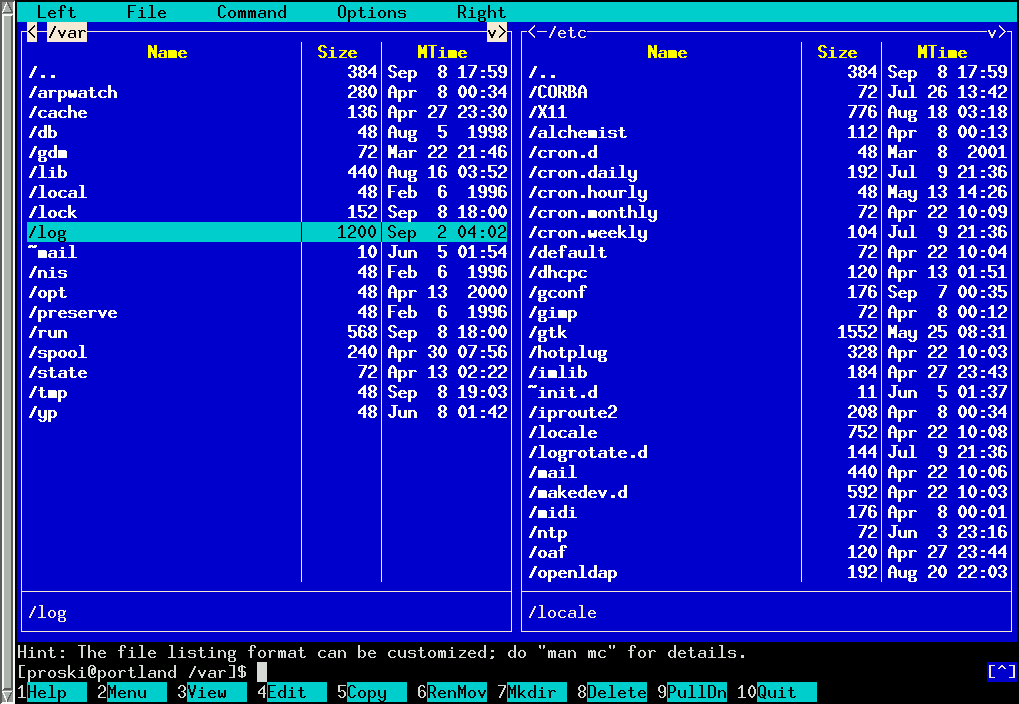
Yep, no one uses split pane file managers.
-
Re:Some ideas and whining
Here's some games I'm still wating for [...] Star Control II!
Here you go, it's open source now: http://sc2.sourceforge.net/ -
Re:PocketPC sync
Try Multisync. It can synchronize between Ximian Evolution, PocketPC, SyncML, the Sharp Zaurus, PalmOS, IrMC, LDAP and take backups.
Works like a charm. Of course, it does nothing with Sunbird - yet. -
Re:Stealing Windows customers?Hmm...not too sure, but have a look at MediaPipe. I won't burn for you, but it has pretty limitless possibilities for conversions/effects (ie shrinking/colour/etc).
It might take a minute to get used to (it's almost like scripting) but there's a reasonable community who can help you out.
-
Re:JPEG 2000 for video? Huh?
JPEG 2000 has one feature that might make it better in "archival" purposes - there is a lossless mode which still achieves higher compression ratios than PNG.
Yes, lossless JPEG 2000 is a reasonable option. I'm not sure any lossy video codec counts as 'archival' storage. Might as well just put published DVDs in a preservation vault. The wide release of movies of movies on DVD has done more for the preservation of movies themselves than anything else in history.
Still, for a digital archive of the film masters, until the patent issues with JPEG 2000 are resolved, I'd just put MNG and FLAC in an Ogg file.
And if you can spare the space, a directory with a wav file and a stack of uncompressed TIFF images is even better. Compression formats are complicated to reverse engineer.
-
Re:Can we run C++ on a Mac
Mac OS X is a BSD system, so you have access to the wide variety of Unix-ish open source software. Whatever your favorite language is, if there's a BSD interpreter/compiler/whatever, it probably also runs on OS X.
Apple gives away free development tools. GCC is the base compiler on Mac OS X. XCode is a development environment that can do pretty much everything. I also highly recommend Shark from the free CHUD package (check out the Celestia optimization tutorial). It makes wonders when it comes to analyzing your app's performance problems.
Oracle 10g was recently released for Mac OS X Server (download here).
There are also zillions of OSS packages that work on OS X (check out DarwinPorts and Fink for example). -
Re:He does NOT do a good job, fuck it!!!!!
Please visit Slashcode bug #981137, which concerns automatically hyperlinking URLs in "Plain Old Text" mode, and add a comment to show your support for a speedy resolution. No progress has been made on this trivial feature request for longer than six months.
Redistribute this comment at will. -
Re:He does NOT do a good job, fuck it!!!!!
Please visit Slashcode bug #981137, which concerns automatically hyperlinking URLs in "Plain Old Text" mode, and add a comment to show your support for a speedy resolution. No progress has been made on this trivial feature request for longer than six months.
-
Re:Alternative to XCF?
I think most of those steps can be done with the NetPBM tools. There doesn't appear to be anything like that Clearize program in NetPBM, but it should be pretty simple to whip up something yourself. I've written PPM/PNM filters before. The package comes with libraries for the formats, and it's fairly simple to use.
The pipeline would look something like this:
$ pngtopnm imgsrc/title-screen.png | pnmscale -xsize 720 -ysize 160 | pnmclearize -b | pnmquant 256 | ppmtobmp > src.bmp
There is an xcftoppm script that comes with gimp-perl, but I suspect that it starts up The Gimp. Or something like that. Maybe not what you're looking for. Maybe you could skip the whole XCF issue and do all your compositing with the NetPBM tools.
I'm not sure what you're saying about the license. You lost me at this part:
I can't just distribute the graphical assets under a separate license because the program runs on an embedded system with no file system; all assets have to be linked into the executable.
What does the build system have to do with the embedded system with no file system?
-
Re:Stealing Windows customers?For Gentoo fans how about skip the dual boot and install Portage in OSX: http://www.gentoo.org/doc/en/macos-guide.xml
You could use the GNU OSX archive: http://www.osxgnu.org/
Of course as you mentioned there is Fink which lets you do things like this relatively easily
-
Re:The System Tray
There are several alternatives:
All Tray
KDocker (not kdes specific either) -
Re:The System Tray
There are several alternatives:
All Tray
KDocker (not kdes specific either) -
Re:a question...Does anyone on
I run Popfile on my main PC. For someone who gets more than a handful of spams a day it's simply invaluable. Let me prove it to you. Here are some stats I've just copied and pasted from its web interface:
Since Thu Nov 20 16:14:56 2003
Bucket Classification Count
inbox-----------1,505-------1.04%
invoices--------196---------0.13%
newsletters-----2,076-------1.44%
spam------------139,989-----97.29%
unclassified----114---------0.07%Messages classified---------143,880
Classification errors-------830
Accuracy--------------------99.42%I don't post my email addresses all over the place* and as far as I can remember haven't posted on usenet for a long long time. Getting two or three spam emails a week firmly puts you on the "lucky" or "minority" side.
If nobody really got much spam at all then there wouldn't be stories all over the place about it and slashdot wouldn't have its own "spam" section. -
Re:What is this world coming to?
If the entire planet switched to non-Microsoft software, where would we get our daily dose of Clippy?
Vigor!
Inspired by
User Friendly. -
Re:The System Tray
If your workspace is real cluttered, I'd suggest using VirtuaWin, which works much like workspaces in Linux. You can give yourself an entire virtual desktop dedicated to email. Hit a couple of keys, and you have a clean, new desktop.
-
Re:Thanks! =D
Here's a powerful link on Free Distribution.
I recommend it anytime I see someone saying that copyright law is extremely important to the survival of innovation. Sometimes the creation of new works, is more important than the survival of old works.
-
Re:Open Source 3D
Link here.
-
Re:But the OS is just the starting pointYeah...evolution is quite stable, and it will work with exchange. So I guess "until" is "now."
Thanks for the tip. I tried Evolution a while back and liked it, but the Exchange integration was still lacking.
I also found this project:
http://evolution-win32.sourceforge.net/index.php
It would be nice to get rid of Outlook even on the computers where I have to run Windows.
-
Re:a question...
I've been playing with SVG in linux for the last couple of weeks. And I came across a couple of fun relevant projects:
Gnome: supports scalable SVG icons, fun!!!
Inkscape: is an open source SVG editor that has recently added Text-on-a-Path to its feature list
librsvg: lib for adding SVG support to apps. Also, has a command line SVG rasterizer (although inkscape can do that also) -
Re:a question...
I've been playing with SVG in linux for the last couple of weeks. And I came across a couple of fun relevant projects:
Gnome: supports scalable SVG icons, fun!!!
Inkscape: is an open source SVG editor that has recently added Text-on-a-Path to its feature list
librsvg: lib for adding SVG support to apps. Also, has a command line SVG rasterizer (although inkscape can do that also) -
Re:Open Source 3D
Yeah, it's just a shame ATI and NVIDIA feel such a need to keep their card specs secret from everybody... there are some people working on these things though. One project I have been keeping an eye on for a little while is this one, they seem to be making some progress on R300 drivers (R300 cards are the ones after 9200, I think). Check out their current status:
# 01/31/05
* Tagged a new snapshot "jump_and_click" of r300_driver. Quake3 demo should now be playable, albeit with some artifacts.
Now I don't want to hype this up too much, I guess they probably still have a lot of work to do, but I think a playable Quake 3 is fairly promising... okay, it's taken a little while to get to this stage from the release of the R300, but it still goes to show that it can be done! -
Re:Finding things is harder...
Azureus is Java, and runs nice on my Mandrake box. When you compare it to BitTornado running one torrent, Azureus seems like a resource hog, but when running multiple torrents Azureus can actually be better on memory than BitTornado running multiple windows. As far as features go, Azureus has many, including a page full of developer/community created plugins. I run Azureus on my Mandrake box in a console, and use the WebUI plugin to control things. Check them out at http://azureus.sourceforge.net/
-
ClamWin - SF.NET POTM plug.
-
ClamWin - SF.NET POTM plug.
-
Re:Why?
I would neither say Linux sucks any more than I would say that games are only produced for Windows.
The truth is that there are a number of pre-written interfaces for the porting of games from one platform to another. Off the top of my head there are the libraries which Loki Software wrote and which they now allow others to use. There are a number of such packages at SourceForge including the wxwindows and others. So the lack of packages which you can use to have a game come out on all platforms is untrue.
The ONLY reason I can think of is INERTIA. Microsoft frowns upon companies which produce games for other platforms (since it can mean the loss of a sale of their OS et al) and I am sure that Microsoft does nasty things to companies who want to produce software for any platform other than the Microsoft platform. (As was shown in the AntiTrust case against Microsoft.) And while it may be true that DirectX is geared towards games; the last time I looked at NeverWinter Nights and others - they use OpenGL -or- DirectX. And sometimes both together.
Also, don't forget that Microsoft is now into the gaming industry big time and companies which have been bought by Microsoft (like the people who brought you Myth I & II ) will tend to only produce games for the Microsoft platform. (Or to release for the other platforms only after exhausting all income paths for the Microsoft platform.) So any game a Microsoft held company creates is probably going to stay running only on the Microsoft platform for quite a while before it is released to other platforms.
The real question which is not even being asked is that if Microsoft has actually converted their programs to run as native programs on the Macintosh (which is BSD based), then why don't they release their programs for Linux? The answer (to me) is that this is just one of the ways they can take a stab at Linux to get back at Linux users (ie: to punish them) for not just continuing to use their products. But then I've seen a lot of companies do very petty things just because one or two people in high ranking positions are upset with how something isn't going their way. But that is (as I've said) just my feelings on this subject.
To be fair with Microsoft: The original poster should have known better to get a router, use the built-in firewall, install a good anti-virus piece of software, install a cookie catcher (like SpyBot), get RegCleaner, and Empty Temp and then, on a regular - weekly basis - clean their system up. We have been really lucky or watchful (I don't know which) with our systems in that we have as of yet to get a virus or to allow cookies to remain on our systems for more than a day or two. SpyBot does a great job of keeping our system clean (I've donated a couple of times now to try to help out) and BitDefender does a great job of keeping viruses in check. Once a week run all of the above and clean the system up. Then scandisk and defrag over night. By doing this our systems have stayed virus/cookie free and we do not have a lot of crashes (unless I'm programming something and step on memory or something like that). -
Re:what about second?
-
A stego method that actually works
Hiding ciphertext within pictures or sounds does not work. They are mathematical methods to detect that a picture or a sound contains encrypted data (unusual noise). There is currently only one steganographic method I am aware of that really works. It is hiding ciphertext within ciphertext. I know only of one open source and free program that realises this scheme: TrueCrypt. And here is how they do it.
-
A stego method that actually works
Hiding ciphertext within pictures or sounds does not work. They are mathematical methods to detect that a picture or a sound contains encrypted data (unusual noise). There is currently only one steganographic method I am aware of that really works. It is hiding ciphertext within ciphertext. I know only of one open source and free program that realises this scheme: TrueCrypt. And here is how they do it.
-
Re:Linux and classic PC Software
Classic games, huh?
Well, I happen to have just the links for you.
Doomsday: A windows and linux improved doom port
http://www.doomsdayhq.com/
ScummVM: An LucasArts games emulator. Plays almost all games: Indiana Jones, Day of the Tentacle, Sam & Max...
http://www.scummvm.org/
DOSbox: An DOS emulator. Good for classic games.
http://dosbox.sourceforge.net/
With Wine, you can also play lots of classic windows games. Take a look at wine's application database to find your game.
http://appdb.winehq.org/ -
Re:More on FlightGearby building around plib for most of its OpenGL infrastructure
Oops. This is the link for plib.
-
If you use AWSTATS
There is a patch you can apply, available here that will prevent referer spam from showing up in reports.
-
Re:why linux?
Well, consoles are not the end-all solutiuon to gaming. They might excel in some types of games, but not all. Ever seen strategy or simulation-games on consoles?
And I do have one occasion where gaming has been better on Linux than on W2K. I have some old DOS-games that I like to play, like Steel Panthers 2. It wont work in W2K so, I installed Dosbox on it, and ran the game there. It worked, but it was unbearably slow. I then tried installing Dosbox on my Gentoo (running on the same machine), and it was ALOT faster! The game was actually playable (it wasn't on Windows)!
That said, I do still keep W2K around. Mainly just to play games