Slashdot Mirror
Domain: sourceforge.net
Stories and comments across the archive that link to sourceforge.net.
Comments · 31,462
-
Re:Got anything free (as in anything)?I prefer free as in soup, and free as in beer is even better. Any suggestions along those lines?
How about The File Shredder
I don't know how good it is, but it's GPL.
-
Re:thunderbird?Alternately, someone could write an "Exchange to POP3 converter" like Hotmail Popper and other similar projects.
Great idea IMHO. Maybe add it to Mr Postman.
-
Re:Low Frame Rates? No Problem.
Try Motion. I've messed around with it in the past and it seems to work great.
-
Motion
Try Motion.
I have a security system for my house running on an older version of Motion. This is what can happen when a gadget-freak has a paranoid girlfriend...
The system has more than three and fewer than nine cameras, some obvious, some concealed in and around the house. Each camera goes into a BT878-compatible card (some dedicated cards, some multiport).
When motion is detected, I can capture on the order of 10-15 fps (not at stunning resolution, admittedly, but 320x240 pixels is good enough for me). If there is motion on two or more cameras, the frame rate decreases. Captured images are saved as timestamped JPEGs in a hierarchical directory structure, along with MPEGs that are assembled of each incident. This is not a particularly mighty machine; it's an Athlon 1800+ with 512MB memory. The limiting factor tends to be the PCI bus when you have a lot of cameras.
Motion supports some nice features. You can set noise and motion detection threshholds on a per-camera basis. You can use a 256-level grayscale image for a sensitivity map, so you can mask certain regions out or decrease their contribution to triggering the recording (useful if plants sway in the breeze). You can label individual cameras with descriptive text ("Front Door"), and all frames are time and date stamped.
I have some custom scripts that manage disk space consumption, deleting the oldest data when drive capacity goes below a set level. I can maintain several week's worth of data in normal conditions. I monitor my setup with a secured Apache setup that groks the file layout, and provides some additional telemetry.
If you need to view data in realtime (normally, I don't), you can use something like Cambozola. If you look at the Motion email archives, you'll find postings on how to run multiple Cambozola applets in a single browser window.
You can do cool stuff, like linking motion detection alarms to scripts. When a known burglary suspect was seen casing the joint, I had some of the cameras send an email to page my phone when they detected motion. Some of the images captured were useful for the police in an ongoing investigation.
Also noteworthy, Motion has one of the friendliest and most helpful communities of any OS project I've been involved with. The mailing list is a great resource, and the maintainers will often go out of their way to help on even the most bone-headed newbie configuration questions on unsupported hardware.
-
Re:So what's the copylocking?
What is with Viviendi? For the longest time, it seemed like they had the gamer close to heart. Then they started throwing every kind of copy protection on their products. I quit giving them cash when they started picking on F/OSS projects. Last time I checked BnetD's website (a few weeks ago), it pulled up Blizzard's battle.net site. Thought I had a typo and found the real site. I've been giving them hell ever since. With any luck, Blizzard will be bought-up or crushed in a few years.
I may speak with my wallet, but a cable modem and a good FTP server speaks louder... -
Midi file generatorI have a genetic programming based midi file generator that allows a user to build, rate and breed (so to speak) grammars that generate midi files. It is written in java and uses an external midi file player (in linux it defaults to timidity) to play the files. Find it here .
As the page shows it also can be used to generate pov files and other kinds of oddness. There is a current running version at this page that is generating "plants" and selecting them for "how well they compete for sunlight" (sort of).
Don't tell me the UI is terrible. I know. I'm more interested in what I can make it do and playing with the innards. Currently I'm working on "poetry", event generation for testing java programs and finding a way to import grammars that generate other music - so I could possibly produce music(???) that is the b-st-rd offspring of Mozart and Madonna (say).
-
Re:Open Source Audio programs for Windows
CDex
Ogg Vorbis Audacity
CD-DA X-Tractor AudioCoding Mp3splt Mp3Wrap
Alba Extractor PeerCast GNUMP3d Mp3 Tag Tools
GramoFile FFmpeg
JAZZ++ Open Sound World
Wow. Slashdot really sucks. If the lameness filter actually prevented ascii art, they might have an excuse. -
Re:Open Source Audio programs for Windows
CDex
Ogg Vorbis Audacity
CD-DA X-Tractor AudioCoding Mp3splt Mp3Wrap
Alba Extractor PeerCast GNUMP3d Mp3 Tag Tools
GramoFile FFmpeg
JAZZ++ Open Sound World
Wow. Slashdot really sucks. If the lameness filter actually prevented ascii art, they might have an excuse. -
Re:Open Source Audio programs for Windows
CDex
Ogg Vorbis Audacity
CD-DA X-Tractor AudioCoding Mp3splt Mp3Wrap
Alba Extractor PeerCast GNUMP3d Mp3 Tag Tools
GramoFile FFmpeg
JAZZ++ Open Sound World
Wow. Slashdot really sucks. If the lameness filter actually prevented ascii art, they might have an excuse. -
Re:Open Source Audio programs for Windows
CDex
Ogg Vorbis Audacity
CD-DA X-Tractor AudioCoding Mp3splt Mp3Wrap
Alba Extractor PeerCast GNUMP3d Mp3 Tag Tools
GramoFile FFmpeg
JAZZ++ Open Sound World
Wow. Slashdot really sucks. If the lameness filter actually prevented ascii art, they might have an excuse. -
Re:Open Source Audio programs for Windows
CDex
Ogg Vorbis Audacity
CD-DA X-Tractor AudioCoding Mp3splt Mp3Wrap
Alba Extractor PeerCast GNUMP3d Mp3 Tag Tools
GramoFile FFmpeg
JAZZ++ Open Sound World
Wow. Slashdot really sucks. If the lameness filter actually prevented ascii art, they might have an excuse. -
Re:Open Source Audio programs for Windows
CDex
Ogg Vorbis Audacity
CD-DA X-Tractor AudioCoding Mp3splt Mp3Wrap
Alba Extractor PeerCast GNUMP3d Mp3 Tag Tools
GramoFile FFmpeg
JAZZ++ Open Sound World
Wow. Slashdot really sucks. If the lameness filter actually prevented ascii art, they might have an excuse. -
Re:Open Source Audio programs for Windows
CDex
Ogg Vorbis Audacity
CD-DA X-Tractor AudioCoding Mp3splt Mp3Wrap
Alba Extractor PeerCast GNUMP3d Mp3 Tag Tools
GramoFile FFmpeg
JAZZ++ Open Sound World
Wow. Slashdot really sucks. If the lameness filter actually prevented ascii art, they might have an excuse. -
Re:Open Source Audio programs for Windows
CDex
Ogg Vorbis Audacity
CD-DA X-Tractor AudioCoding Mp3splt Mp3Wrap
Alba Extractor PeerCast GNUMP3d Mp3 Tag Tools
GramoFile FFmpeg
JAZZ++ Open Sound World
Wow. Slashdot really sucks. If the lameness filter actually prevented ascii art, they might have an excuse. -
Re:Open Source Audio programs for Windows
CDex
Ogg Vorbis Audacity
CD-DA X-Tractor AudioCoding Mp3splt Mp3Wrap
Alba Extractor PeerCast GNUMP3d Mp3 Tag Tools
GramoFile FFmpeg
JAZZ++ Open Sound World
Wow. Slashdot really sucks. If the lameness filter actually prevented ascii art, they might have an excuse. -
Re:Open Source Audio programs for Windows
CDex
Ogg Vorbis Audacity
CD-DA X-Tractor AudioCoding Mp3splt Mp3Wrap
Alba Extractor PeerCast GNUMP3d Mp3 Tag Tools
GramoFile FFmpeg
JAZZ++ Open Sound World
Wow. Slashdot really sucks. If the lameness filter actually prevented ascii art, they might have an excuse. -
Doesn't Mozilla do this?
So if I am making a homebrew mail program to connect to my work's Exchange email, is the Ximian connector the best solution?
Doesn't Mozilla have access to Exchange mail because it can use SPA, Microsoft's Proprietary Secure Password Authentication?
See this note on Mozilla's forums saying that they Implemented SPA (aka NTLM MSN) authentication for IMAP (it was already implemented for POP and SMTP in 0.5). By using the NTLM Davenport project couldn't I use SPA with my homebrew email program in the same way that Mozilla does?Also, does the Evolution work like YahooPops where it goes through a web page connection? If so, wouldn't a direct connection using SPA like Outlook and Mozilla do be more elegant, efficient, faster?
-
Doesn't Mozilla do this?
So if I am making a homebrew mail program to connect to my work's Exchange email, is the Ximian connector the best solution?
Doesn't Mozilla have access to Exchange mail because it can use SPA, Microsoft's Proprietary Secure Password Authentication?
See this note on Mozilla's forums saying that they Implemented SPA (aka NTLM MSN) authentication for IMAP (it was already implemented for POP and SMTP in 0.5). By using the NTLM Davenport project couldn't I use SPA with my homebrew email program in the same way that Mozilla does?Also, does the Evolution work like YahooPops where it goes through a web page connection? If so, wouldn't a direct connection using SPA like Outlook and Mozilla do be more elegant, efficient, faster?
-
Claim your pizza here!
CSound http://www.csound.net/
ZynAddSubFX http://zynaddsubfx.sourceforge.net/
FluidSynth http://www.fluidsynth.org/
Rosegarden http://www.rosegardenmusic.com/
-
Free audio tools worth mentioning
-
Re:One more step, a Win32 port of Evolution
According to this interview with Miguel de Icaza at OSNews, "Ximian is working on a native port of Evolution 2.0 to Windows using the WIMP engine to make the application look XP-native."
I imaging the reference to WIMP is the WIMP-GTK theme for GTK-on-Windows that mirrors the look of Windows.
This is how Gaim handles their Windows "port" (thought I don't think "port" is really the rigtht word. -
Re:One more step, a Win32 port of Evolution
According to this interview with Miguel de Icaza at OSNews, "Ximian is working on a native port of Evolution 2.0 to Windows using the WIMP engine to make the application look XP-native."
I imaging the reference to WIMP is the WIMP-GTK theme for GTK-on-Windows that mirrors the look of Windows.
This is how Gaim handles their Windows "port" (thought I don't think "port" is really the rigtht word. -
Re:Macs.
You could use evolution in fink. It's only in CVS at the moment, but I'm sure that evolution 2 will be supported officially in fink eventually. Alternatively, it looks like you could compile it yourself, when it's released: unofficial ximian guide to evolution on osx
-
Re:Your graphs are unreadable
Oh please. What decent graphics apps out there *don't* support PNGs? And even if you do have such an old, underpowered graphics app, you could always export to some other format and convert.
As for those applications which output bloated PNGs, use pngcrush. -
Re:Any chance of including NTFS?
agreed, there is absolutely no way to run ntfs under linux
-
Re:Say WHAT?
I have. They're phenominally easy to use, and basically force you to set 128-bit WEP as the default. The newer ones suggest you use 256-bit WPA, which works hunky-dory with Apple's WPA implementation. I have a MN-700 base station a short distance from me right now and it absolutely screams.
What planet are you on, dude? I've got an MN-500 sitting three feet from me. You know what it's doing? Accepting wireless connections in the clear from anyone in range. And no, it's not because I'm a selfless soul. In fact, all it's doing is sitting around playing WAP and switch for a few systems behind a LEAF Box simply because it doesn't have the friggin' HORSEPOWER to handle standard loose UDP methods in a NAT scheme. Asheron's Call - a game Microsoft PUBLISHED and currently controls the billing for - cannot be played on two systems behind it. I would assume the same goes for EQ or most other online games that use multiple port-triggered UDP connections.
Not to mention that WEP is OFF by default, it doesn't force you to use it at ALL, and in fact they make it WAY more difficult to turn on (especially at 128-bit) than it actually needs to be - enough so that most normal people wouldn't even bother with it.
Frankly, I love Microsoft's input devices (be they voice, mouse, keyboard, Joystick, or oddities like the Strategic Commander, regardless of whoever makes them), but their networking equipment is far beyond subpar. -
Well I've found the...
...WMD.
-
Re:Well...
-
Missing nominees
- Monte Davidoff - co-author (along with Gates and Allen) of Microsoft/Altair BASIC
- Richard Stallman - Pioneer of open software movement/GNU
- Niklaus Wirth - PARC researcher responsible for Algol, Pascal, Modula-2, Laser Printers, and more
- Marvin Minsky - Built the first neural net AI in 1951
- Seymour Papert - Developer of LOGO and another AI pioneer
- Tommy Flowers - Built one of the earliest electronic computers, with the practical application of codebreaking during WWII
- Donald Knuth - Regarded by many as the "Father of Computer Science".
- Edsger Wybe Dijkstra - The guy leading the way to abolish the GOTO statement is surely a hall-of-famer!
- Konrad Zuse - Another early computer pioneer that due to politics and circumstances beyond his control was never able to be fully-recognized.
- Jeff Raskin - Creator of the Macintosh and pioneer in computer-human interfaces.
- Monte Davidoff - co-author (along with Gates and Allen) of Microsoft/Altair BASIC
-
LGPL Licensing
How has the switch to LGPL affected contributions to the project, both positively and negatively? When the switch happened, there was a lot of noise from groups like Transgaming who needed to license proprietary technology from third parties, and the formation of the ReWind project. Has there been a noticable effect on contributions to WINE from outside groups as result of the licensing change?
- Stealth Dave -
Re:The Humane Environment
But, hey, check out the picture of Jef's organ!
-
Re:A great idea
That's the general idea of these CDs:
k12wincd
The OpenCD
Gnuwin II
Burn copies, share them with your friends, tell them to make copies.
Get People familiar with the software first, then the migration to linux is easy.
-
Re:Ditch Fedora - Go Debian Unstable
(apt-get update && apt-get dist-upgrade once / day usually ends up doing around 20+ packages)
RedHat isn't formally supporting Fedora anyways, so I don't get it, what is the incentive?
Let me be the first to say I'm a big Debian fan. I use it on several computers. However, using Debian unstable on my main workstation for about a year was not the most pleasant experience. I don't remember everything, but I'll list a few of the more major annoyances:
1.) Some of us really don't want to download 20 (or over 100) packages, many of them the same update as last week, just to stay up to date with security holes.
2.) Though Debian fans love to say "just use unstable if you want the latest", Debian unstable is often _not_ faster than Fedora or Mandrake at getting the latest version of X, KDE, GNOME, or many other applications. IIRC, it took some time before Debian unstable got KDE 3. Yes, you can add additional sources (which I, actually, do with FC1 on my main workstation now to get the very latest KDE - kde-redhat)
3.) Debian Unstable is not the first priority of the Debian Security project. As such, I wouldn't trust a Debian unstable computer with any directly open ports to the internet, as even the latest "apt-get upgrade" may not fix security bugs that are fixed in Debian stable.
4.) At times, Debian unstable can truly be unstable. For a few weeks sometime last year (January?), KDE broke. A workaround was found a short while later, but it took a few weeks for the packages themselves to be fixed. Depending on what you have installed, Debian unstable can feel rather buggy.
All of this led me to install Debian stable on my computer last spring, which stayed until I got a new computer this February. I found that so long as I grabbed the latest KDE from kde.org's unofficial Debian packages, the system felt pretty new. However, I started to wish for a more updated feel with regards to fonts (which often look terrible in Debian, especially unstable, and I'm not the only one who couldn't quite figure out how to fix them). A more updated application set and the same ability to apt-get a bunch of packages made Fedora feel really nice on my new workstation. Fonts are beautiful, and the kde-redhat project does a nice job of packaging up the latest and greatest KDE. When I do apt-get upgrade, I often get some larger or non-essential upgrades, but it doesn't seem to be the quantity that I went through with Debian unstable. I didn't have to put much fuss into getting my system to look great _and_ have the niceties of the apt system.
I kept browsing the Debian-devel mailing list, hoping to see some sign of when we might see a new release, but some legal and technical issues seem to be pushing it back quite a ways. Therefore, I'm now a believer in the "Debian for the server" mentality. Never before has my desktop looked and functioned so cleanly, with OpenOffice now using some KDE widgets (thanks to the packaging from kde-redhat, I wouldn't have realized it was available otherwise). There was a strange problem with Mozilla in Debian where the occasional line of text would have part of the characters "shifted" a few pixels, which was very distracting. That made me switch to Konqueror way back when, and I still don't use Mozilla much at home - but it's nice to know that in Fedora the Mozilla fonts look great.
Sorry for the long rant, but I think I've got a decent perspective of one user who's tried both Debian unstable, stable, and Fedora on the desktop, and to me it just isn't worth the hassle to use Debian. -
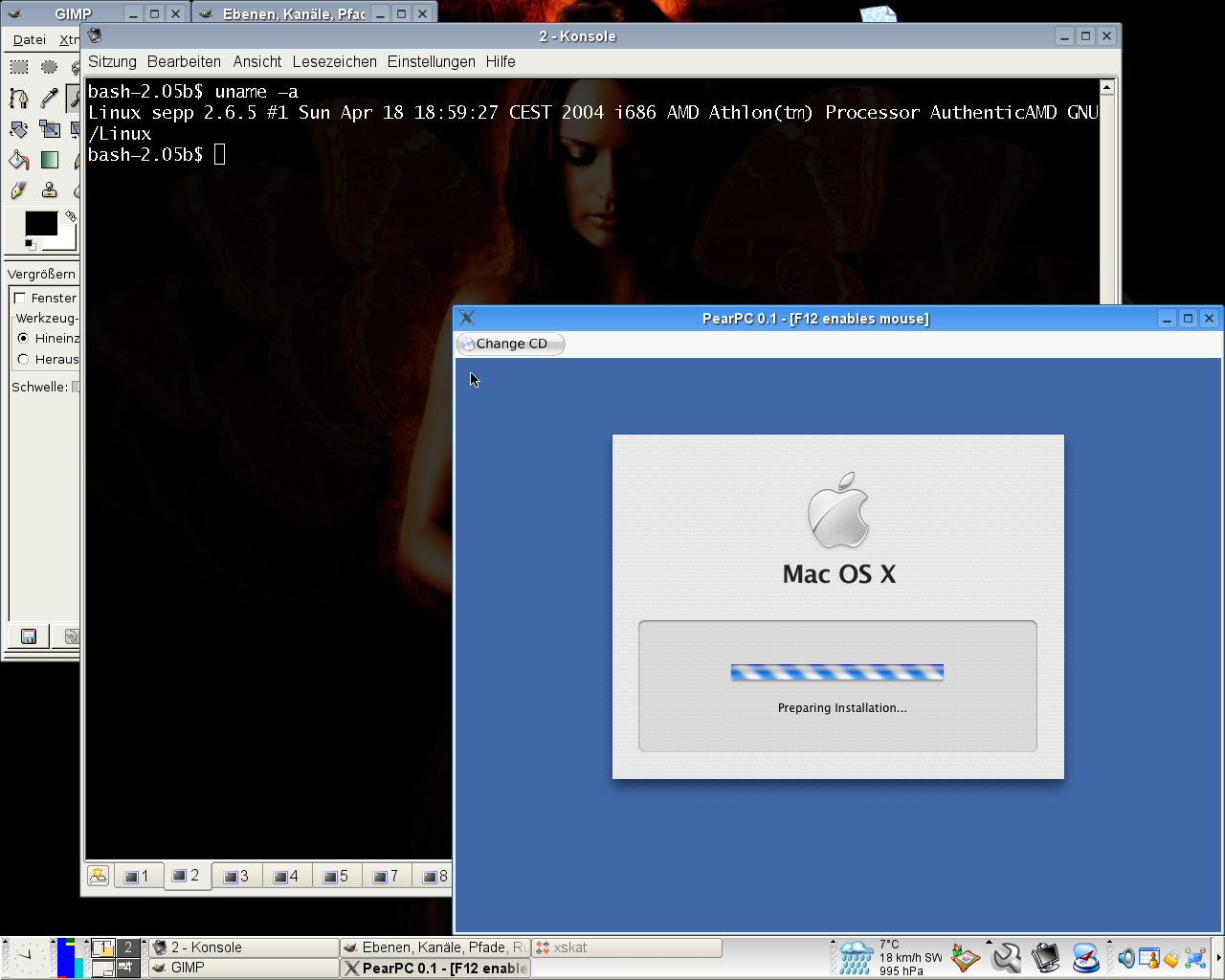
Re:Work with OS X?confirmed.
as for your other questions... you haven't used any virtualization/emulation software before, have you?
-
Must hurt to be wrong.
-
Re:Use a computer
Yeah thats a good idea. Should probably use mixd player with the system. The cost of the system would be around 40 dollars, I guess(excluding the old computers).
-
Mixplayd
If you have lots of time, you could get mixplayd, an old pc or two, several old sound cards each, and craft a little perl to tie it all together. Probably cheaper time-wise to just buy something.
-
Re:This may be a good thing for Linux.
...upgrading a kernel without rebooting.
There used to be something called Two Kernel Monte which would do what you're describing, but it looks dead in the water.
-
Red Hat is also easy to update
Often it can be more time consuming to patch Linux, too - find and download RPM, potentially requiring you to find and download dependencies, etc., and installing, while in Windows, for most users, it's "click on Windows update button.
With Red Hat Enterprise 3, 'up2date -u' will get you most patches, unless it is Audacity or something most people never use. -
Re:Uh, prior-art?You can avoid the Sybil attack by only connecting to people you know in real life, but obviously you lose the main advantage of a peer-to-peer network that way: the ability to find strangers and their files. However, with careful design I believe you can still communicate (and share files) with strangers across a trust network - that's what I'm attempting to do in my PhD project.
Some packets have to travel several hops over the trust network, so you have two new problems: sharing the bandwidth and finding short routes.
The first problem is solved by requiring every participant to contribute as many resources to the network as they use. You do this by charging your neighbours for forwarding their packets, and paying them to forward your packets. You're free to set the price as high as you want, and they're free to send the packets by a cheaper route, so you're in competition with their other neighbours to carry their traffic. The payment happens hop-by-hop so you don't need a digital currency, you just keep score with each of your neighbours.
The second problem (finding short routes) is solved by flooding, because that's a good way of finding the lowest-latency route in a dynamic network. But you don't want to flood the entire network because that kills scalability. Instead, anyone who wants to receive connections sends out periodic advertisement broadcasts. Each node that receives the advertisement adds an entry to its route cache. Anyone who wants to establish a connection broadcasts a search for a node with a route to the destination. If the search reaches a node that has seen the advertisement, it proceeds along the cached route to the destination. Since the broadcasts only need to overlap at one node, the diameter of each broadcast is on average half the diameter of the network, so the traffic scales according to the square root of the number of nodes, which is better than unlimited flooding but still not great.
You don't necessarily trust people more than one hop away, so you need end-to-end proof of delivery using digital signatures. When a packet is acknowledged, each node along the route updates its route cache (even the nodes that weren't in range of the original advertisement), so finding a route to a well-known destination just requires finding someone who's communicated with it recently.
-
Very bad articleThis is a very poor quality article, I analyzed it before. There are possibly better ones mentioned by others.
Just look at the matrix multiplication case. Look at the graph and see that 1000x1000 takes 30 seconds on CPU and 7 seconds on GPU. Let's translate it to Millions of operations per second: CPU -> 33 Mop/s, GPU -> 142 Mop/s Matrix multiplication has cubic complexity so for CPU: 1000 * 1000 * 1000 / 7 seconds / 1000000 = 33 Mop/s
Now think a while: 33 million operations on 1.5 GHz Pentium 4 with SSE (I assume there is no SSE2). Pentium 4 has fuse multiply-add unit which makes it do two ops per clock. So we get 3 billion ops per second peak performance! What they claim is that the CPU is 100 times slower for matrix multiply. That is unlikely. You can get 2/3 of peak on Pentium 4. Just look at ATLAS or FLAME projects. If you use one of these projects you can multiply 1000 matrix in half a second: 14 times faster than the quoted GPU.
Another thing is the floating point arithmetic. GPU uses 32-bit numbers (at most). This is too small for most scientific codes. CPU can do 64-bits. Also, if you use 32-bits on CPU it will be 4 times as fast as 64-bit (SSE extension). So in 32-bit mode, Pentium 4 is 28 times faster than the quoted GPU.
Finally, the length of the program. The reason matrix multiply was chosen is becuase it can be encoded in very short code - three simple loops. This fits well with 128-instruction vertex code length. You don't have to keep reloading the code. For more challenging codes it will exceed allowed vertex code length. The three loop matrix multiply implementation stresses memory bandwidth. And CPU has MB/s and GPU has GB/s. No wonder GPU wins. But I can guess that without making any tests.
-
Re:Uh, prior-art?
You need a central certificate authority to validate the autheticity of users. And, that is a big no-no in P2P systems.
Bollocks. You can use PGP and whatnot without a central authority, can't you? With p2p, all you require is to determine if a file can be verified to have been posted by a trusted user/handle. This does not necessarily imply a centralised authority. As far as I know, the completely decentralised freenet allows you to do precisely this. Sadly, it's slow as hell. -
Re:"improved wireless support" for a chipset? WTF?
Actually, Intel is leading development of an open source driver for the Centrino MiniPCI card (Pro/wireless 2100).
-
Re:Would it really matter?
so you are one of the losers who keeps changing the id3 tags..
but seriously, its not like its magic to create a checksum of only
music frames of mp3s. This has been done few times ago, for example
checkout crc authentication built to mp3, or better yet, use a ready
tool such as
linux -> mp3bookhelper
windows -> mp3-vaccinator
Another way is to compare tree hashes of files. A tree hash is where
you break a file into a binary tree, where each leaf is a hash of a
segment of a file. You combine the hashes of each leaf to get a node
hash. All the way until you get the root node hash. With a tree hash
its quite efficient to figure out what part of file is different and
needs a redownload. That is assuming you are using id3v1 which does
not change file size. This is yet another reason to avoid
id3v2/Ape systems.
--
/apz, "Dishonor will not trouble me, once I am dead." -- Euripides
-
More fun in sight!
Wow! Great.
So now we have *yet another way* to spy/be spied upon!
Van Ech Phreaking (original paper, SW source for Echbox, simplified description ) is bad enough, now we have to watch for shotgun mikes!
Hook this up with Wardriving and Let The Games Begin.
Although, apparently, this has a *LONG* way to go before a full password capture is feasible using the technique.
(By the way there is a wireless security presentation here that is quite good (had info on some stuff I hadn't heard about. For example Warchalking) -
Check out the Chromium project
Intercepting the OpenGL calls from non-modified OpenGL applications and rendering them to walls and CAVEs is a nice trick.
If this interests you at all, you also need to check out the open source Chromium project, which can do that, and much, much more. While it doesn't have the event tracking that VRiser appears to have, it has the ability to render to tiled displays, stereo displays, CAVES, do distributed sort-last compositing, OpenGL stream modification on the fly, parallel OpenGL submission, and a heck of a lot more. It supports high-speed cluster interconnects such as Myrinet, Quadrics, and Infiniband. It's also pretty easy to add your own OpenGL modification if you want to do something special.
As an example, check out this project that uses Chromium to split up live Quake games into an external isometric view.
(Disclaimer: I'm one of the Chromium developers, and my Lab helps pay the external developers to write this open source tool.) -
Re:Interesting
-
Ack! QtParted not KPartEd.
Not KParted, QtParted. My apologies to the developers of QtParted, you've got a great tool.
QtParted is great for resizing live NTFS partitions.
Aaargh! -
Looks more like a stealth cry for help
to run some kind of dodgy business.
Anyway, I find cdrdao quite helpful. -
Leo Makes a Mini Dig Today
I just got off work, came home, did the "chores", and flicked on tvtime, and caught the last 5 minutes of call for help. As the credit rolled by, Leo threw a nice little dig in, "Look at the names to the left [Note: They were technically on his left, but...], these are the people who make Call for Help possible, we could'nt do this without them...".
I find it abherrent that a company would clean house wholesale of talent when its doing well, and even when its doing poorly for that matter. I can't imagine the cost savings in moving production a hundred miles away can make up for hiring, firing, and moving costs.