Slashdot Mirror
Domain: sourceforge.net
Stories and comments across the archive that link to sourceforge.net.
Comments · 31,462
-
Re:Seriousl, what's so great about the iPod?
There's reasons to use iTunes, but only if you own an iPod, since then you are required to use it.
Sorry, what? I've never used iTunes with my iPod - I use gtkpod. -
Re:It's the licenseI'm not going to debate the relative merits of Qt to Gtk+, but I do want to correct some misconceptions you have about Gtk+.
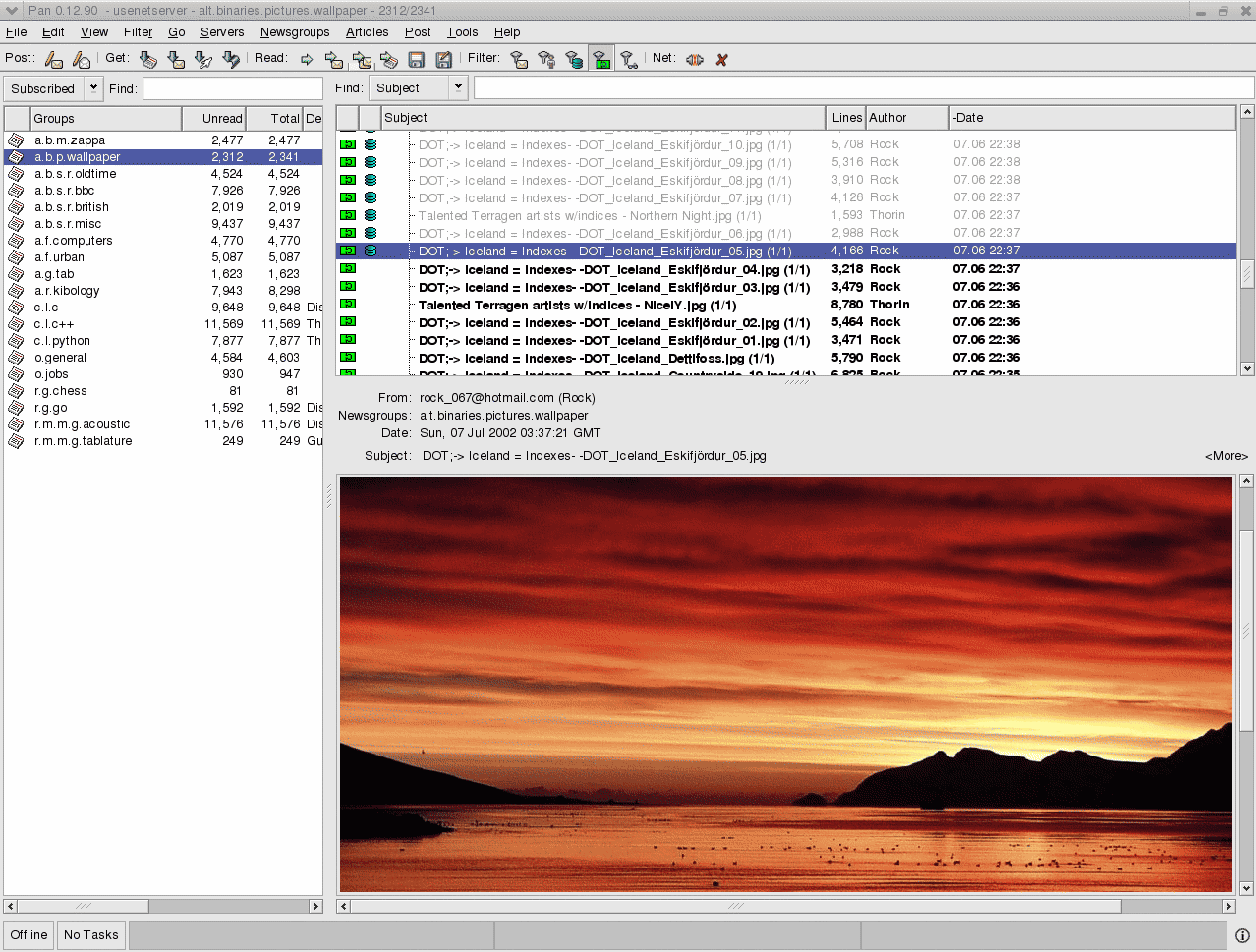
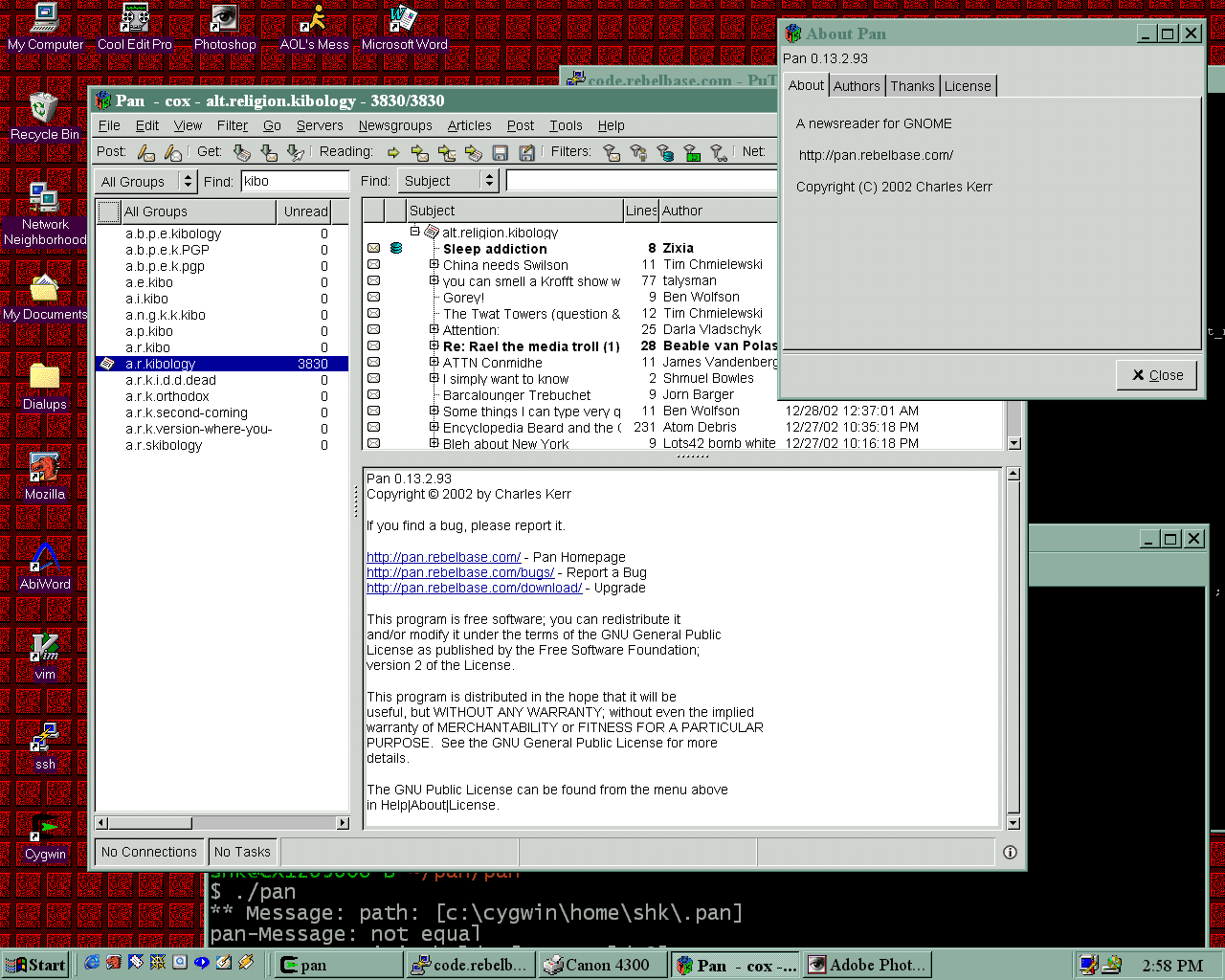
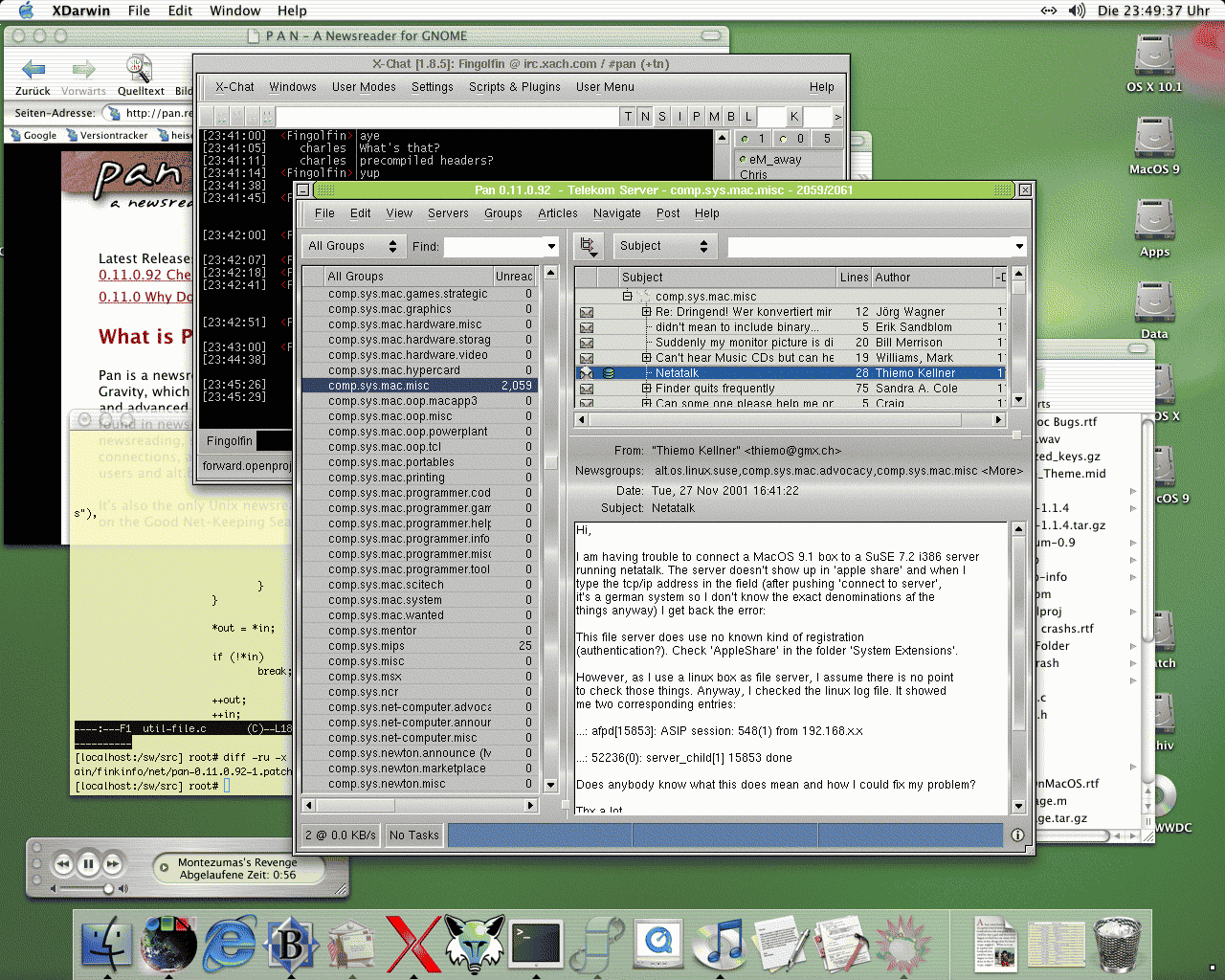
- When you write in Gtk+, you can get an application that runs on all the platforms you listed. My gtk+ newsreader Pan runs on Linux, Windows, and Mac OSX.
- The window manager is orthogonal to the topic of what's important from the software maker's point of view: ICCCM compliance is the only feature any application writer cares about. No application requires a specific WM. To do so would needlessly limit their audience.
- Likewise, you're misinformed about Mono: nobody is telling anyone that they have to port anything to Mono. C# is just another language that Gnome supports. Never in the 4+ years I've worked on Pan has anyone mentioned porting Pan to C#.
- gtk doesn't lack documentation. In fact the documentation team has made leaps and bounds over the last year.
- If you prefer RAD tools, Anjuta and Glade are available.
- Discussing Qt as a `modern C++ based toolkit' and disparaging Gtk+ as lacking a `modern API' is just language bias (and ignores moc's pre-STL cruftiness). If you want to use gtk+ in an OO language, many language bindings are available.
Again, this isn't to take anything away from Qt -- its tools are pretty good, and its documentation is excellent. However, Gtk+ is very good too.
-
Re:It's the licenseI'm not going to debate the relative merits of Qt to Gtk+, but I do want to correct some misconceptions you have about Gtk+.
- When you write in Gtk+, you can get an application that runs on all the platforms you listed. My gtk+ newsreader Pan runs on Linux, Windows, and Mac OSX.
- The window manager is orthogonal to the topic of what's important from the software maker's point of view: ICCCM compliance is the only feature any application writer cares about. No application requires a specific WM. To do so would needlessly limit their audience.
- Likewise, you're misinformed about Mono: nobody is telling anyone that they have to port anything to Mono. C# is just another language that Gnome supports. Never in the 4+ years I've worked on Pan has anyone mentioned porting Pan to C#.
- gtk doesn't lack documentation. In fact the documentation team has made leaps and bounds over the last year.
- If you prefer RAD tools, Anjuta and Glade are available.
- Discussing Qt as a `modern C++ based toolkit' and disparaging Gtk+ as lacking a `modern API' is just language bias (and ignores moc's pre-STL cruftiness). If you want to use gtk+ in an OO language, many language bindings are available.
Again, this isn't to take anything away from Qt -- its tools are pretty good, and its documentation is excellent. However, Gtk+ is very good too.
-
Re:It's the license
An application that runs pretty much everywhere (Linux, Windows AND MacOSX)
GTK also run natively, without any fuss, on OSX and Windows.A modern C++ based toolkit
What's not "modern" about GTK? You know, in most cases, programming in plain C is also the better solution, being more simple and effective.You have only a tiny fraction of potential customers
Why? GTK runs just as easily on any OS and in any environment - besides, who even uses Gtk/QT on Windows or OSX?You have to confront the pains of GTK+ which are lack of tools, documentation and an modern API
Well, I simply disagree on that. There are so many different helping libraries that are part of GTK/GNOME and tools like Guile that I've never felt the need for anything more. I have found the documentation, from man pages to the GTK tutorial, to be right on the spot. It seems to me you're just a C++ programmer that likes Qt more than GTK - the points you are making aren't factual or analytic - they're just your sore feelings on the issue. -
Re:Why not interpreted C++, instead?C++ didn't even exist when Perl was first invented.
According to wikipedia, C++ dates back to 1979, with the first commercial compiler in 1985.
C++ is a terrible language for interpretation
Right. At least someone tried
Better to have a language which is designed for interpretation from the start.
Completely agree.
-
Re:Answer to WinFS
Drag and drop install?
Already got it. -
Re:the release of mute only days after clay's arti
Ok, you didn't read the article too well yourself now, did you. He mentions PGP a few times, but in no way does he say that is what P2P networks have to do. For a description of why encrypting the data is important, I point you to a link on the MUTE page:
The Article
I suggest you read the bit at the very bottom of the page. It descibes how encryption can help prevent the RIAA from catching you.
To make a brief summary of the article, the encryption would mean the RIAA could not see what you were trying to find, or even what you were actually downloading. Sure they could know that you might be downloading something illegal, but you could just as easily be downloading a new song your buddy wrote.
So basically, maybe you should educate yourself, before you start making ill-thought remarks. -
Re:This is excellent
There's a handy little Sourceforge project to solve that problem: The X Modeline Generator
-
Not on Windows it doesn't
Developers can write commercial apps to their hearts content using QT with complete freedom (beer & speech) as long as your apps are GPL'd.
True, but deploying those apps to users of a particular immensely popular proprietary operating system currently requires an additional heavyweight API translation layer, which can eat performance when deploying an app in a heterogeneous computing environment or to users outside a company.
-
Religious/political? Try "Economic"
Begun, the flame wars have.
I think the inclusion of one [major free X11 desktop environment] over the other should NOT be made primarily on Religious/political grounds, but on Technical ones.
Issues that some might characterize as "Religious/political" may more precisely be "economic." Perens would have one believe that it's less expensive to build and deploy an in-house GTK+ app than an in-house Qt app. If an app contains trade secrets, then GTK+'s weaker copyleft lets the app stay in-house, whereas Qt Proprietary costs four figures per developer per version, and Qt Free gives your employees the right to leak anything produced using it. In addition, even for apps that don't bear trade secrets, GTK+ is ported natively to a particular immensely popular proprietary operating system, whereas Qt Free needs the heavyweight Cygwin layer.
-
Routing algorithm isnt new. "learning bridges"Referencing this page, it looks like the standard way that one sets up a routing table in a network switch, as I learned it in a Telecom Networks class.
There's lots of examples of this, if you search on google. The first one I found is in this powerpoint (slide 9). For those of you who don't want to download a ppt, here's the relevant text:
Basic Switching Algorithm
- Maintain data structure called the switch forwarding table
- The forwarding table is indexed by MAC address and contains port numbers
- Packet arrives on port P with source S and destination D
- Set Fwd(S)=P
- If we have an entry Fwd(D) and Fwd(D)P, then send packet out Fwd(D)
- Otherwise, flood packet out all ports
I googled with "learning bridge OR bridges" network switch algorithm.
This looks pretty cool, but it seems like there will be problems when nodes go on and offline, since broadcasts get used to find nodes. Won't nodes that come and go periodically cause problems -- or is this a non-issue?
The idea that nodes go down will probably not be an issue, because you have a (two-way) TCP connection to the node, so you know when it goes down.
-
Re:how many file sharing systems are there now?
-
Re:It might werk.
-
Re:Keep this out.
Gosh, like PostgresQL or Oracle?
-
How does this compare to Waste?
I've played Waste the encrypted private network tool started by Justin Frankel.
MUTE sounds similar. Has anyone tried both? How do they compare? -
That's great
I used Java stored procedures a lot back when I was working at a
-
Re:BMW paper cars
-
Re:About LaTeX..Couple questions, I thought I read on one site that you can only go 4 levels down on sections/subsections.
Another poster has answered this below..
Is this true? (Hopefully using the right term...I mean itemized lists with roman numerials, numbers, letters for each part)
If you mean "itemized" or "enumerated" lists then yes there is a limit it appears you can go 5 deep.
The following will give a "Too deeply nested" error. Due to the "sub sub sub sub sub sub item"
N.B. It it not very pretty due to having to get past the "comment compression filter"...
\documentclass{article} \begin{document} \begin{itemize} \item Item \begin{itemize} \item Sub item \begin{itemize} \item Sub sub item \begin{itemize} \item sub sub sub item \begin{itemize} \item sub sub sub sub item \begin{itemize} \item sub sub sub sub sub item \end{itemize} \end{itemize} \end{itemize} \end{itemize} \end{itemize} \end{itemize} \end{document}
As with many aspects of LaTeX however if you find it doesn't do something it probably means it's not prudent (from a structural perspective) to do it anyway. For example if you really need that level of deep reference you may well be better off with part,chapter,section, subsection,
Also, can ya'll post some good links to a newbie learning LaTex..and some good reference sites that have all the tags layed out with good explanations?
Sure, below are a list places I would reccomend starting, you havn't said if you use Windows, *nix or Mac so i've added both (sorry if you are a Mac man you'll have to Google yourself).
- Editing:
- *nix If you are a *nix user I would reccomend the following editing combination.
- XEmacs
- AucTeX. A sophisticated editing mode for LaTeX
- preview-latex. Places the rendered equations and images directly in the editor window making "equation tuning" and other tasks a snip.
- Windows
- WinEdt. A very sophisticated text editor for Windows. Its forte is LaTeX. It is not free, but well worth the money.
- Learning resources:
- Other random stuff
- dvipdfm. For converting the output of LaTeX into PDF (highly recommended)
- Prof. Knuth's home page(The author of TeX).
- CTANThe Comprehensive TeX Archive Network. Here you will be able to download packages, utilities and tools that do not come by default in your LaTeX distribution.
-ed
-
Re:It might werk.
WMP on Windows is hellishly fast. You're given a choice between the new interface(WMP9, fluffy) and the old one(WMP6, minimalist) on XP, and they're both equivalent in functionality due to the fact that they're actually just frontends for DirectShow.
Not exactly. If you want to play stuff created in Windows Media 9 format, you need to install extra software that isn't well advertised. In addition, WMP6 can't handle streaming media from servers that expect 7 or later. The only way to use version 7 streaming stuff is to use something like Gabest's Media Player Classic, which can also play Real, QT, Bink, and 'Matroska' formatted files if you have the appropriate codecs installed. -
Re:Quicktime sucks. Who cares?
Seeing how Apple has published all the specs for the QT framework, I'm amazed someone hasn't written a nicer player frontend.
They have.
I haven't had to open a QTPlayer, WiMP, or even install the Real player since I got Media Player Classic. -
Re:God...
I use that software, and it is still ridiculous that I have to use it everytime I use RealOne. I can get around it by using Media Player Classic, which uses RealOne and Quicktime libraries to play Real and Quicktime files, but there are times I need RealOne to play streams that MPC sometimes struggles to play.
I shouldn't be having to remove the programme from memory via the Task Manager, and I should be having to use that control panel to make sure it doesn't load itself at logon. -
Media Player Classic
Use Media Player Classic. No, it's not actually Microsoft's old Media Player. It just looks like it.
As long as you have Real's software installed (or just the appropriate DLLs), you can play Windows Media, Real Video. Quictime too, if you have that installed.
Now if only new systems came set up like that, where one player could play everything, users could actually benefit.
But then pigs might start sprouting wings. -
I still have one in my garage.
I mentioned this when the Israeli company pulled an insurance job on its "multi-million dollar" effort.
AI RC choppers are not new or particularly funky. Mine's quite smart too. Granted this is rather funkier than normal but it's no massive leap forward as some may have you believe.
Quick links:Century, FMA, Open source RC Heli auto-pilot project -
Re:good job...
The Hollywood filmmaking industry. They used it on Harry Potter, Scooby-Doo, Stuart Little, etc.
-
Re:Quicktime sucks. Who cares?Yeah - Quicktime is such a POS that MPEG-4 is based on it. Bunch of losers.
Really - before you start ranting you should at least bother to learn something about the subject. You can write plugins for QT. There is technical documentation at Apple's Quicktime developer's site, and you can download both Windows & Mac SDKs. Also, check sourceforge for other QT Components.
-
Re:just wondering
yep, and already been implemented:
rhythmbox -
Re:I'll use itunes
In all seriousness, there seems to be some misconception that windows-iTunes can't play ogg files. Well, I'm not sure about the parrent, but I know that there is an open source plugin for windows-Quicktime that plays ogg files just fine.
-
Re:QT: Linux client?
-
Re:Fullscreen is a feature
i know. i hate apple! it's not like you can't find any free alternatives with fullscreen built in that even play more media formats by default.
-
Re:Unbreakable anonymity?
"All that routing and broadcasting is expensive though. Slow. Thats why freenet sux. (That and the whole java thing.)"
BitTorrent does the same routing and broadcasting, and seems to manage okay under load.
Plus I was referring to Konspire which is written in C++. In fact, the website has a whole page dedicated to why Java isn't suitable for this kind of work. Not that it affects the speed of your network connections what language the program is in.
-
Re:WASTE!WASTE:
WASTE is a software product and protocol that enables secure distributed communication for small (on the order of 10-50 nodes) trusted groups of users.
WASTE is designed to enable small companies and small teams within larger companies to easily communicate and collaborate in a secure and efficient fashion, independent of physical network topology.
-
Commercial UAVs are already availableI've been working on building a Linux based UAV and have GPLed the software for it. We're also selling turnkey helicopter UAVs that look very much like the Mantis in the article through my company, Rotomotion.
There is no AI onboard, so you don't have to worry about it becoming self aware and joining Skynet. We have a few more years before the machines take over.
-
Re:How does this benefit me?
2.4.x was better because it thinned out use of the BKL
Yeah, OK. I've only been following Kernel Traffic for a while, so I didn't recognize this either.
googling.... sourceforging....
BKL = Big Kernel Lock. Here's a nice paper on global locking The Linux Scalability Effort seems to have coordinated some of the effort to remove it and also introduce other features which help SMP. Not too surprising that a lot of contributions come from IBM & SGI folk. -
Re:How does this benefit me?
2.4.x was better because it thinned out use of the BKL
Yeah, OK. I've only been following Kernel Traffic for a while, so I didn't recognize this either.
googling.... sourceforging....
BKL = Big Kernel Lock. Here's a nice paper on global locking The Linux Scalability Effort seems to have coordinated some of the effort to remove it and also introduce other features which help SMP. Not too surprising that a lot of contributions come from IBM & SGI folk. -
Re:How does this benefit me?
2.4.x was better because it thinned out use of the BKL
Yeah, OK. I've only been following Kernel Traffic for a while, so I didn't recognize this either.
googling.... sourceforging....
BKL = Big Kernel Lock. Here's a nice paper on global locking The Linux Scalability Effort seems to have coordinated some of the effort to remove it and also introduce other features which help SMP. Not too surprising that a lot of contributions come from IBM & SGI folk. -
That's Freenet
That's exactly what FreeNet does. It hides the sender and the reciever by rooting data through random other peers.
The major problem is that it's slow. -
Re:As much as I would like to see...
However, the biggest obstacle is that Linux hasn't been ported to run on rubble.
Yes it has. -
SELinux
I just spent the last 3 days trying to get the SELinux extensions, courtesy of the NSA installed on a Fedora Core 1 system.
I eventually gave up. However, the SELinux extensions were merged into the 2.6 kernel and it's apparently the plan of Fedora/Red Hat to put it into Fedora Core 2 sometime later this spring.
I, for one, can't wait. -
WOW
Isn't it amazing how seriously slashot readers really don't take
60 posts talking about a Microsoft fledgling technology here says so much more than 300 slashbots flaming each other on the other "Microsoft's New Core OS Team Learning from Linux" thread.
Microsoft is a smart company. No really, they must be. If you have shed loads of money, you can pay lots of smart people enough money to make them work hard enough to roll out products which will do something "acceptably well" at worst, "reasonably well" at best. That can't be denied because of the number of users Microsoft has. Yes, there's smart people who use Microsoft technology too.
Microsoft has recognised our strengths so I think it's time to acknowledge what Microsoft does well. The opening flames on the Server CE technology could be turned another way - isn't the MSSQL Server code ripe for an overhaul like someone going at it like a hatchet to make it run on embedded/compact devices?
The zealots don't do us any good. It slows Linux adoption and makes us look like nutters. And there are quite a few smart Linux people who like -
Re:Burst...
While it's definitely not the perfect solution, and lacks alot of the features you've cited, iRATE is a nice "distribution hub" that basically gathers links from free music sites, points your client to the site, and then allows you to moderate to your tastes. I've definitely found some music I like that I never would have heard on through normal outlets.
LFTL -
2 quick things
1) You'll donate those "not so great" systems to me, right? I mean, I'm running Not-So-Great Previous-Generation back here, after all.
2) What about CoreWars? It'd be great, especially if some of you are coders. -
Re:Camera might be USB mass storage device.
It's slightly more complicated than that...
The Easyshare cameras ( I know this cuz I have a CX4230 ) use PTP (Picture Transfer Protocol) which is a standard supported by Kodak, Sony, Canon and others to offer standard way for talking to the cameras. This makes it trivial to support new cameras when the come out since you don't have to go thru the trouble of building a driver from scratch.
There's a sourceforge page with more details
But the short of the answer is that it should work fine. Check out the compatiblity list to be sure, but gphoto also offers a generic driver which should work as a generic driver.
-
Re:PDA
I've been very impressed with PAdict which is free, and RoadLingua which is not and requires a hack such as CJKOS.
When I looked at the hardware denki-jisho (and to some extent the dead-tree variety) I found the ones using kana/kanji were aimed heavily at Japanese (usage examples, etc.) and the foreigner targeted ones, without exception, used romanji. I failed to find a dedicated device that would fit your (or my) needs. Sorry.
Looks like there's a gap in the market!
-
Hobby Operating SystemsHe missed a couple hobby operating systems:Happily, he did mention my hobby OS.
Emulators like VirtualPC and Bochs are a really nice way to play with operating system code without having to worry about screwing up your machine. -
Hobby Operating SystemsHe missed a couple hobby operating systems:Happily, he did mention my hobby OS.
Emulators like VirtualPC and Bochs are a really nice way to play with operating system code without having to worry about screwing up your machine. -
Yet Another MP3/Ogg Vorbis cataloger
I've written an MP3 / Ogg Vorbis cataloger, Audiolink, which reads ID3 info from MP3s and Ogg Vorbis comments and populates this info in a database. You can also enter extra information, like "male artist", "female artist", "composer", etc. You can later search the database for music by your favorite composer, or your favorite artists. The search results can be exported to a playlist (symlinks to the original music, so it's audio-player format-free!).
-
Re:Sharp, Sanyo, Seiko, etcYes, but the poster specified why those won't work: they only do romaji input and output (romaji is one of several Japanese character sets; it's a way to roughly express Japanese words in the Roman alphabet). Needless to say, the input systems for hirigana and katakana (the alphabets you probably associate with "Japanese") are much more complex and require more than a simple modification of a translator designed for two languages that use what is more or less the same alphabet (English, Spanish, German, French, etc.).
As for my recommendation: you probably aren't going to find a decent dedicated dictionary outside of Japan, and even then it'll probably be expensive. However, as numerous other people have pointed out, there are good programs available for PDAs. A Palm Zire is about a hundred bucks, and there are certainly dictionaries available on the Net (although I don't know anything about their quality). For example, a quick Google turns up this, which looks like a decent app that takes hirigana, katakana and kanji, as well as English, input.
-
Listen to iRATE radio insteadiRATE radio is a GPLed Java program with native binaries (compiled with gcj) for Windows and Linux, and a Java webstart installer that runs from the JRE that comes with Mac OS X. From iRATE's homepage:
iRATE radio is a collaborative filtering client/server mp3 player/downloader. The iRATE server has a large database of music. You rate the tracks and it uses your ratings and other people's to guess what you'll like. The tracks are downloaded from websites which allow free and legal downloads of their music.
In July, iRATE's database held the URLs of 46,000 MP3 files, although I think the database has been temporarily reduced in size so that the ratings can work more effectively for the tracks that remain.iRATE version 0.3 is coming soon, and needs help with testing. If you'd like to help test, subscribe to the irate-devel mailing list and start trying out the testing builds. There's been a lot of work put into 0.3, but that means there's more that needs testing.
-
Listen to iRATE radio insteadiRATE radio is a GPLed Java program with native binaries (compiled with gcj) for Windows and Linux, and a Java webstart installer that runs from the JRE that comes with Mac OS X. From iRATE's homepage:
iRATE radio is a collaborative filtering client/server mp3 player/downloader. The iRATE server has a large database of music. You rate the tracks and it uses your ratings and other people's to guess what you'll like. The tracks are downloaded from websites which allow free and legal downloads of their music.
In July, iRATE's database held the URLs of 46,000 MP3 files, although I think the database has been temporarily reduced in size so that the ratings can work more effectively for the tracks that remain.iRATE version 0.3 is coming soon, and needs help with testing. If you'd like to help test, subscribe to the irate-devel mailing list and start trying out the testing builds. There's been a lot of work put into 0.3, but that means there's more that needs testing.
-
Re:Who bought a Brian Adams CD?
Seriously, though, if you want to play this game well, someone should make a truly anonymous P2P network.
Someone already did. It's called Freenet.