Slashdot Mirror
Domain: space-track.org
Stories and comments across the archive that link to space-track.org.
Comments · 12
-
Re:44% larger risk
Yes, lots of politics (domestic and international) behind this test.
One correction to the GP: NASA doesn't track the objects in orbit. CSpOC takes care of the tracking and distribution of data. NASA does statistical sampling and modeling of the environment, as well as impact testing and evaluation of shielding designs. Also, NASA scientists typically use metric (though the hardware people often still use inch-pound-second). -
Re:What are the military applications?
This is the best reply I've read here. I think that back when they built the current system (article says 1961) the military wanted to know where everything was so they could identify the military threats. (You also don't want to launch your counter-strike when that Russian rocket booster burns up over Alaska.) That's still the case, but the use for collision avoidance is becoming more important now. The data go into real-time calculations and also into long-term environmental models.
The data (sure...minus classified) are already available to the public, with the caveat that these are averaged/low-res data not suitable for collision avoidance. -
Didn't happen
The reference is this blog posting over at Foreign Policy which was posted back in March: http://shadow.foreignpolicy.com/blog/5630 The test was of a sub-orbital kill vehicle intercepting a sub-orbital target, both launched from ballistic missiles. There was no orbital debris generated and a satellite was not destroyed. This can be verified by looking at NASA's Orbital debris Quarterly Reports as well as the satellite catalog on Space Track: http://www.orbitaldebris.jsc.nasa.gov/newsletter/newsletter.html http://www.space-track.org/perl/login.pl However, because the same technology can be used for both hit-to-kill missile defense and hit-to-kill ASATs, the test can be seen as another test of China's ASAT capability, in the same way as the destruction of USA 193 (a satellite) by the US Aegis missile defense system
-
Re:Obama's first test from Putin?
Actually, the probability of collision can be calculated very well. Based on publicly available general perturbations data, such as you might get from Space-Track, the probability of collision for these objects was on the order of 1e-5. There are roughly 20 conjunctions a day that reach this threshold. There is also more accurate data available to refine this calculation. But it isn't being done.
Your tax dollars at work.
-
TLEs, Telemetry, Picture
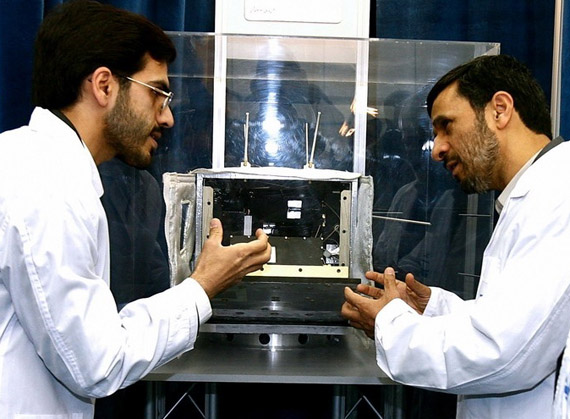
Space Track lists two new objects in orbit with a 56 degree inclination: 2009-004A and 2009-004B (catalog numbers 33506 and 33507, respectively). AFSK telemetry supposedly from Omid are on Wikipedia.
Here is a picture of Omid, it isn't very large.
-
space-track.org
http://www.space-track.org/ is run by some branch of the US military which may or may not have been part of the USAF and may or may not have been disbanded or reinstated recently.
We can neither confirm nor deny.
In order to get access to the data provided by space-track.org you need to agree http://www.space-track.org/perl/user_agreement.pl that you won't disclose such data to anyone else, especially any Arabs or Chinese, on pain of prosecution for treason or littering or stuff.
Should you agree to such restrictions and log on to the site, your login and password, and all the content of the site, are transmitted in the clear.
Whether you want to run a website or a war I doubt these are the people you want to do it.
-
space-track.org
http://www.space-track.org/ is run by some branch of the US military which may or may not have been part of the USAF and may or may not have been disbanded or reinstated recently.
We can neither confirm nor deny.
In order to get access to the data provided by space-track.org you need to agree http://www.space-track.org/perl/user_agreement.pl that you won't disclose such data to anyone else, especially any Arabs or Chinese, on pain of prosecution for treason or littering or stuff.
Should you agree to such restrictions and log on to the site, your login and password, and all the content of the site, are transmitted in the clear.
Whether you want to run a website or a war I doubt these are the people you want to do it.
-
Re:Confused
There are many objects omitted by the released elements. You may recall a spat in August 2007 wherein the French authorities threatened to release elements for what were assumed to be classified US assets.
Also the StratCom elements are subject to an end-user license that prohibits dissemination of the data or any analysis based thereupon. Many amateur observers therefore refrain from using the elements:
http://www.space-track.org/perl/user_agreement.pl
Ted Molczan and the guys on the SeeSat list do an amazing job of tracking these sats.
-
Re:don't do anything until the first accident?
Actually, there have been three confirmed collisions between tracked objects. Here's what I have off the top of my head - I'd have to check my notes at work for the details.
Cerise vs. Ariane Rocket Body, 1996. Lopped off the gravity gradient boom, but the satellite was recovered and continued its mission. Just a little more wobbly then before.
Collision between an old US rocket engine and a piece of a chinese rocket body in Jan. 2005. Resulted in two additonal piece of tracked debris and the loss of tracking on one of the original pieces.
Another collision in 1991 - I don't recall the details of this one. It was discovered last winter/spring by somebody examining historical data.
There are probably more, but nobody is looking for them systematically with the right data. First a little background...
The US Air Force maintains the most complete & accurate satellite catalog. It comes in two flavors - low quality General Perturbations or GP data (TLE or Two Line Elements), and higher quality Special Perturbations or SP data (VCM or Vector Covariance Messages)
Here are the current roadblocks:
- The US Air Force only does even a rudimentary collision avoidance (CA) analysis for a fraction of the catalog - the birds they fly, all manned objects, and a handful of NASA sats. After the collision last Jan. some general asked why they didn't see it coming. Their answer boiled down to two things
-- Debris vs. debris isn't important (except, wouldn't it be nice to have a heads up so that you might have a chance of tracking the new pieces)
-- Their processes can't analyze All vs. All for one days worth of time in one days worth of computer time . ie. they can't keep up. There are algorithms out there (and they are well aware of them) that can do the job several orders of maginitude faster, but CMOC has the worst case of NIH I've ever encountered. You tend to get shot in the face for even suggesting they aren't doing the best they could be - it tends to be a career limiting move.
- The Air Force only makes public about 2/3 of the unclassified GP catalog (via the space-track website (http://www.space-track.org/ So even if you want to do it yourself, you can't get the data.
- Even if you could get all fo the GP data, it's really not good enough. I did some analysis on the collision last Jan. - there are a few hundred conjunctions every day that appear as likely as that one. Without better data, it's impossible to nail it down. And you can't get the SP data, even from the inside. It's doesn't appear to actually be classified, though it's tough to get a authoritative answer on that. But you can't get it. They protect their existance by keeping a stranglehold on the data.
- There's alot of stuff out there that isn't cataloged. The space surveilance network is a hodgepodge of often antique sensors, and on many of them space surveillance is only a secondary or tertiary mission. They have their hands full keeping up with what they have - discovering and tracking new stuff isn't a priority.
The ESA is getting fed up with this state of affairs, and is begining to set up their own space surveillance capability. Hopefully that will shake some things up a bit.
Otherwise, it'll take a major loss on orbit. And actually, that already happened - read the CAIB reportly carefully - a piece of debris separated from Columbia on orbit, but wasn't discovered until they did a post-mortem on the tracking data. If we were doing robust space surveillance and CA, it could have been a tipoff. There probably wasn't anything that could ahve been done at that point - but we could have tried.
Sincerely,
A concerned analyst -
Re:Definition of fascism
I'm a little confused how this event even remotely relates to fascism. The TLE data is still freely available on the Space Track website.
Everything isn't doom and gloom you know. It boggles the mind how you got from this story to fascism so quickly (5 minutes?). Or did you not actually read the links provided?
I smell stormtroopers!!!
-
Re:i'm doing my taxes today
Check your pie hole.
-
U.S. Withholding Satellite Data -- copyedited
plover writes "Due to Congressional legislation passed quietly in 2003, the Air Force Space Command will no longer distribute space surveillance data via NASA. There was supposedly a three year transitional period when the data was to be made available via a NASA web site, but earlier this month their transitional server went down hard. NASA has decided not to rebuild it. (It was scheduled to be shut down on 31 March 2005 anyway.) The only way to obtain satellite data now is by signing up with the official Space-Track website. Part of the agreement to necessary to obtain data from their site is not to redistribute it. Of course, amateurs are still free to redistribute their observations, including those of classified satellites."