Slashdot Mirror
Domain: space.com
Stories and comments across the archive that link to space.com.
Stories · 1,058
-
Atlas 5 Rocket Set to Launch Pluto Probe
tmerrill writes "An unprecedented mission to the outer edges of our solar system is set to launch in 4 days, despite a launch delay. From the article: 'NASA's first spacecraft to visit the planet Pluto is set to launch no earlier than Jan. 17 atop an Atlas 5 rocket on a decade-long trip to the fringe of the Solar System ... In order to reach Pluto by 2015, the $650 million New Horizons mission must lift off this month in order to swing by Jupiter for a gravity boost. The probe's 35-day launch window, however, stretches until Feb. 14. The launch window opens on Jan. 11. Inspections of the probe's Atlas 5 booster prompted mission managers to push their launch target to no earlier than Jan. 17, NASA officials said.'" The New York Times has details as well. -
Atlas 5 Rocket Set to Launch Pluto Probe
tmerrill writes "An unprecedented mission to the outer edges of our solar system is set to launch in 4 days, despite a launch delay. From the article: 'NASA's first spacecraft to visit the planet Pluto is set to launch no earlier than Jan. 17 atop an Atlas 5 rocket on a decade-long trip to the fringe of the Solar System ... In order to reach Pluto by 2015, the $650 million New Horizons mission must lift off this month in order to swing by Jupiter for a gravity boost. The probe's 35-day launch window, however, stretches until Feb. 14. The launch window opens on Jan. 11. Inspections of the probe's Atlas 5 booster prompted mission managers to push their launch target to no earlier than Jan. 17, NASA officials said.'" The New York Times has details as well. -
Mysterious MilkyWay Warp Finally Explained?
* * Beatles-Beatles writes to tell us Space.com is reporting that scientists think that a collision between mysterious 'dark matter' and two of the Milky Way's nearby neighbors may be causing our galaxy to warp 'like a vinyl record left out in the hot Sun.' From the article: 'The warp is most clearly visible in a thin disk of hydrogen gas that extends across the entire 200,000-light-year diameter of the Milky Way. Viewed sideways, one half of the hydrogen disk appears to stick up above our galaxy's plane of stars and gas, while the other half dips below the plane for a bit and then rises upward again farther away from the galaxy's center.'" -
New Studies Doubt Mars Water Theory
An anonymous reader writes "Two groups of scientists have doubted the Mars rover scientists' theory that Mars was drenched with water for a significant time. If their dry Mars theories are supported, it is unlikely that life ever existed on Mars. The first group say that rock features that indicate water are actually caused by meteorite impacts. The second group argue that these features are caused by volcanic activity. Steve Squyres, the Mars rover lead scientist, is sticking by his original findings." -
Zero-Gravity Sports League In Development
Jonathan writes "A company that provides weightless flights to paying space tourists is developing a league around a sport that is designed for a zero-G environment." From the article: "The sport is called 'Paraball'...originally short for Parabolic Football," Persaud told SPACE.com. "The game really isn't like football anymore as the rules have developed, but the name has stuck," he added. [..] "The International Parabolic Sports League (IPSL) I plan to start with seven U.S. based teams, plus one Toronto-based team. Initially all League games would be played from the Las Vegas, Nevada airport, but we'll have 'home' games when the Zero-Gravity Corporation are able to bring their aircraft to that many cities over the time span of the league's season." -
Russian Kliper not Funded by ESA
anzha writes "It seems that while the Russians are making plans for the future, they are doing so alone. Space.com has an article profiling the Russian Kliper program. Largely seen as a response to the American CEV, the Russians had been stating the ESA would be supporting the enterprise as well. However, this week, ESA decided not to fund the project." -
Russian Kliper not Funded by ESA
anzha writes "It seems that while the Russians are making plans for the future, they are doing so alone. Space.com has an article profiling the Russian Kliper program. Largely seen as a response to the American CEV, the Russians had been stating the ESA would be supporting the enterprise as well. However, this week, ESA decided not to fund the project." -
Crab Nebula by Hubble
nut writes "I just wanted to draw people's attention to the Image Of The Day courtesy of The Hubble Telescope. There's a couple of other pages with a little more info. I don't know how anyone can doubt the value of putting the Hubble telescope up there when it gives you desktop wallpaper like this :o)" -
NASA Prizes for Builder and Flyer Robots
FleaPlus writes "NASA has recently announced a couple more X-Prize-style Centennial Challenges. The first is a Telerobotic Construction Challenge, for using a team of robots to assemble structures from building blocks with minimal human intervention. The second is an Planetary Unmanned Aerial Vehicle Challenge, to create a robot which can fly a path using visual navigation and hit ground targets with a probe (no GPS allowed). Rules are still being finalized, with the contests scheduled for 2007. Both prizes are for $250,000, the max Congress is allowing NASA to offer." -
Hubble Replacement on Slow Track
iamlucky13 writes "The targeted launch date for the James Webb Space Telescope, an infrared space observatory currently nearing the completion of the design stage, has been pushed back 2 years to help deal with a price tag that has grown to $4.5 billion. This advanced telescope is designed to build upon the achievements of the Hubble after its retirement, peering into deep space with it's large 6.5 meter primary mirror from the L2 point 1.5 million kilometers from earth. As the highest priority science mission on NASA's agenda, a decision was made to spread the extra cost over additional budget cycles rather than compromise it's instrument package. Regardless, some of the lower priority missions may feel the impact of the JWST cost growth." -
Hayabusa Probe Fails Landing Attempt
wschalle writes "Yesterday, at 3:46 PM EST the probe successfully dropped a small object onto the asteroid as a touchdown target. JAXA then apparently lost control of the probe for 3 hours. The probe went to an auto-pilot mode during the communications failure, collecting data about its flight and saving it for later transmission. The probe's exact location is unknown, but it is estimated to be between 10 and 100 kilometers from the asteroid at this time. The mission has been troubled by repeated failures, including the loss of a small robotic lander, and a gyroscope failure that was later repaired." -
Space.com's Top 10 Space Movies of All Time
Comatose51 writes "Space.com has posted a Top 10 Space Movies of All Time list based on reader ratings on each movie. Apollo 13 is currently the #1 movie, followed by Star Trek: First Contact at #2, and Wrath of Khan at #3. I was surprised by Apollo 13 at #1, since I initially equated space movies with sci-fi. However, I don't disagree with it. What do other Slashdotters think, or suggest as good space movies?" -
Space.com's Top 10 Space Movies of All Time
Comatose51 writes "Space.com has posted a Top 10 Space Movies of All Time list based on reader ratings on each movie. Apollo 13 is currently the #1 movie, followed by Star Trek: First Contact at #2, and Wrath of Khan at #3. I was surprised by Apollo 13 at #1, since I initially equated space movies with sci-fi. However, I don't disagree with it. What do other Slashdotters think, or suggest as good space movies?" -
Hubble Sees Stars As They're Born
Artful Yankee writes "Space.com is reporting that the Hubble telescope revealed stars as they were being born. The article explains, 'The stars have yet to condense into small enough packages to trigger thermonuclear fusion, which is what powers stars, but they appear to be on the verge, astronomers said today.' All these amazing discoveries from Hubble and people still talk about abandoning it." -
Using Gravity To Tow Asteroids
cryptocom writes "Space.com is reporting that two scientists at NASA are proposing using a 20-ton spacecraft to pull asteroids off a possible collision course with Earth, using the spacecraft's own gravity as an attractor. This idea would not only be cheaper, but have a much higher chance of success, due to not having to actually land on the asteroid's surface." -
Pluto's 3 Moons and a Probe to Study Them
It doesn't come easy writes "For those of you keeping score, Pluto now officially has three moons, with more possibly to follow. The newfound moons orbit about 27,000 miles (44,000 kilometers) from Pluto, more than twice as far as Charon, Pluto's other satellite. They are 5,000 times dimmer than Charon. The moons were found using the Hubble Space Telescope. For now, Pluto is the only Kuiper Belt object known to have satellites. Some nice images of Pluto and its moons are included in links. Enjoy!" Relatedly IZ Reloaded writes "NASA says the Atlas 5 rocket that will carry the New Horizons Pluto probe has suffered slight damage thanks to Hurricane Wilma. New Scientist reports: "The Atlas 5 rocket stands within a construction hangar at Cape Canaveral Air Force Station on Florida's east coast. As Wilma rolled though the region on 24 October, fierce 122-kilometer-per-hour winds tore holes in the hangar's 83-meter-tall door and caused minor damage to the rocket inside."" -
New Dust Storm on Mars Viewable with Telescopes
starexplorer writes "Space.com is reporting that a large dust storm has just began on Mars, just as the Red Planet has gotten in prime viewing location this weekend with a decent sized backyard telescope. An amazing stroke of luck for everyone this weekend! Three PDF Viewing Guides, movies and more available to help get you started." -
New Dust Storm on Mars Viewable with Telescopes
starexplorer writes "Space.com is reporting that a large dust storm has just began on Mars, just as the Red Planet has gotten in prime viewing location this weekend with a decent sized backyard telescope. An amazing stroke of luck for everyone this weekend! Three PDF Viewing Guides, movies and more available to help get you started." -
Mars Polar Lander Lost Again
IZ Reloaded writes "The Mars Global Surveyor during one of its latest scans of the area where the Mars Polar Lander was originally spotted, discovers that the spacecraft is no longer there! Space.com reports, "We conclude that our interpretation of these features was in error. This is not the location of the Mars Polar Lander. Because the landing uncertainty ellipse is so much larger than our images, and we do not have another candidate to which to target...we cannot continue to hunt for the lander," the MSSS site explains." -
China Going Up and Coming Down
SoCalChris writes "The BBC writes that China has just completed the world's highest railroad, climbing to 16,640 feet (5,072 meters) above sea level. The cars will be sealed to help passengers cope with the pressure changes from the altitude. The line is expected to begin carrying passengers next year." This news comes at the same time that their Chinese taikonauts return from their spaceflight after just 115 hours in orbit. -
20,000 Show up for X-Prize Expo
Zacharski writes to tell us that the X-Prize Cup Expo was held Sunday in Las Cruces New Mexico in front of about 20,000 people. John Carmack was there with his team from Armadillo Aerospace. From the article: "Armadillo Aerospace got their rocket-powered, vertical takeoff, vertical landing vehicle off the ground. Blasting off into the sky then hovering for a few seconds, the craft began lowering itself to the ground - but tipped over on touchdown. The wet ground due to overnight rain was the cause, although the craft appeared undamaged in the fall. An internal hose was punctured, however, causing subsequent flights to be scrubbed." The expo also ended with quite a bang when Starchaser's Churchill Mk2 rocket engine blew up. -
20,000 Show up for X-Prize Expo
Zacharski writes to tell us that the X-Prize Cup Expo was held Sunday in Las Cruces New Mexico in front of about 20,000 people. John Carmack was there with his team from Armadillo Aerospace. From the article: "Armadillo Aerospace got their rocket-powered, vertical takeoff, vertical landing vehicle off the ground. Blasting off into the sky then hovering for a few seconds, the craft began lowering itself to the ground - but tipped over on touchdown. The wet ground due to overnight rain was the cause, although the craft appeared undamaged in the fall. An internal hose was punctured, however, causing subsequent flights to be scrubbed." The expo also ended with quite a bang when Starchaser's Churchill Mk2 rocket engine blew up. -
Allen Telescope Array In Action
DIY News writes "36 of an eventual herd of 350 dishes are now operational in a remote area 250 miles northeast of San Francisco. These antennas, 20 feet in diameter and the height of a football goal post, are the first installment of the Allen Telescope Array, and they are ideal for short SETI projects while the array is being built." From the articel: "The young ATA's first foray into SETI will be known by the straightforward (if not overly galvanic) name of Inner Galactic Plane Survey. The word 'survey' may surprise many who are familiar with this telescope's design. After all, it's being finely tuned to speedily examine large numbers of star systems in a so-called "targeted search". The completed array will be exceptionally nimble at such individual scrutiny, and will leave previous targeted searches in the data dust." -
Test Equipment Finds Life In Mars-like Conditions
DIY News writes "In a test of equipment that might one day be used to search for biological activity on Mars, researchers discovered life tucked deep inside a frozen Norwegian volcano, a test region said to have geology similar to that of Mars. The test instruments discovered a rare and complex microbial community living in blue ice vents inside a frozen volcano, which is the kind of evidence scientists have been searching for on the Red Planet." -
Short Gamma-ray Bursts Traced to Colliding Stars
Astervitude writes "Collisions of the cosmic kind could be the source of one of nature's most lethal explosions. Astronomers have traced the origin of short-duration gamma-ray bursts, or GRBs, to the merger of neutron stars or other dense bodies. Space.com has a report on the scientific detective work that led to the solution of what has been described as a 35-year-old mystery. "Our observations do not prove the coalescence model, but we surely have found a lady with a smoking gun next to a dead body," said Shri Kulkarni, one of over two dozen astronomers who discovered and investigated two short-duration bursts that took place last May and July. Unlike short-duration GRBs, long-duration GRBs are believed to be produced when extremely massive stars collapse and explode as supernovas." -
New Tenth Planet Has a Moon
starexplorer writes "SPACE.com is reporting that the recently discovered 10th planet of our solar system has a neighbor - a moon. The discovery team also have nicknamed the planet 'Xena' and the moon 'Gabrielle'. Many scientists are objecting to whether the new planet really is a new planet - so what do you call a moon with no planet?" -
New Tenth Planet Has a Moon
starexplorer writes "SPACE.com is reporting that the recently discovered 10th planet of our solar system has a neighbor - a moon. The discovery team also have nicknamed the planet 'Xena' and the moon 'Gabrielle'. Many scientists are objecting to whether the new planet really is a new planet - so what do you call a moon with no planet?" -
New Tenth Planet Has a Moon
starexplorer writes "SPACE.com is reporting that the recently discovered 10th planet of our solar system has a neighbor - a moon. The discovery team also have nicknamed the planet 'Xena' and the moon 'Gabrielle'. Many scientists are objecting to whether the new planet really is a new planet - so what do you call a moon with no planet?" -
SpaceShipOne to Join Smithsonian Collection
iamlucky13 writes "After having inspired space enthusiasts around the world and possibly setting the stage for space tourism by winning the X-Prize a year ago, SpaceShipOne is on it's way to the Smithsonian National Air and Space Museum in Washington DC. There it will join other historic craft such as Lindbergh's Spirit of St. Louis and Yeager's Glamorous Glennis. The exhibit will be unveiled on October 5th at a ceremony with Burt Rutan of Scaled Composites, the company that built SpaceShipOne, and Paul Allen, the Microsoft co-founder who funded the project." -
'Starquake' Cracks Star
geekroot's dad writes "Space.com is reporting that a huge 'starquake' releasing as much energy as our sun does in 250,000 years, has cracked a nearby neutron star. The magnetar produced the brightest explosion ever seen by man outside of the milky way. Although it is 50,000 light-years away, the blast was so huge it temporarily blinded some satellites and briefly altered Earth's upper atmosphere!" -
'Starquake' Cracks Star
geekroot's dad writes "Space.com is reporting that a huge 'starquake' releasing as much energy as our sun does in 250,000 years, has cracked a nearby neutron star. The magnetar produced the brightest explosion ever seen by man outside of the milky way. Although it is 50,000 light-years away, the blast was so huge it temporarily blinded some satellites and briefly altered Earth's upper atmosphere!" -
'Starquake' Cracks Star
geekroot's dad writes "Space.com is reporting that a huge 'starquake' releasing as much energy as our sun does in 250,000 years, has cracked a nearby neutron star. The magnetar produced the brightest explosion ever seen by man outside of the milky way. Although it is 50,000 light-years away, the blast was so huge it temporarily blinded some satellites and briefly altered Earth's upper atmosphere!" -
US Senate Allows NASA To Buy Soyuz Vehicles
arc.light writes "According to a report at Space.com, the US Senate voted to allow NASA to buy Russian Soyuz vehicles for the purpose of servicing the International Space Station. Because Russia continues to assist Iran with its nuclear energy and ballistic missile programs, NASA would otherwise not be allowed to buy Russian hardware by the Iran Nonproliferation Act of 2000. The US House of Representatives still needs to give its approval before NASA can make such a purchase." -
European Students to Put Microsatellite Into Orbit
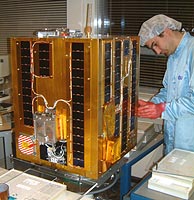
Astervitude writes "A Frankenstein's microsatellite made out of parts "donated" by university students across Europe will be launched on September 30 atop a Russian booster. Space.com reports that more than 400 students "spread across 23 universities and 12 countries" spent 18 months designing and building the SSETI Express. While its acronym sounds suspiciously similar to that of a project that seeks to uncover signs of intelligent life beyond Earth, the SSETI or Student Space Exploration Technology Initiative mission is actually part of an effort by the European Space Agency "to boost student interest in space technology and offer some hands-on experience." The satellite itself weighs a mere 136 pounds and is the "size of a small washing machine", as shown in this ESA photo. Visitors to the mission site may want to check out the contest page for ham radio operators to help collect data from the satellite." -
The Return of Saturn's Spokes
CheshireCatCO writes "After more than a year in orbit around Saturn, the Cassini spacecraft has finally spotted 'spokes' in the rings. Spokes, large radial structures in the rings, where seen by the Voyager spacecraft and have remained difficult to fully explain. The reappearce of the spokes comes about two years earlier than many models predicted." -
NASA Plan to Return to the Moon
sjoeboo writes "NASA briefed senior White House officials Wednesday on its plan to spend $100 billion during the next 12 years building the spacecraft and rockets it needs to put humans back on the Moon by 2018. The U.S. space agency now expects to roll out its lunar exploration plan to key Congressional committees on Friday and to the broader public through a news conference on Monday." -
SpaceX Announces Bigger Rocket
bullitB writes "SpaceX, a commercial developer of rocket systems, has announced a new Evolved Expendable Launch Vehicle (EELV) class rocket. Dubbed the Falcon 9, the rocket will be able to launch nearly 25 metric tons into low earth orbit for a mere $78 million. It looks like they have already signed up Bigelow Aerospace for a launch in 2008." -
Visiting Our Red Space Neighbor
Enthusiasm for visiting our red space neighbor seems to be growing. m4dm4n writes "A study carried out by MIT's Aeronautics and Astronautics department has concluded that getting men to Mars in the 2020 timeframe is possible. The intelligent re-use of crew habitat modules, propulsion stages, and engines in various missions will enable NASA to significantly reduce their initial timeline which was well past 2030." Relatedly, ErikPeterson wrote to mention a Space.com article where Neil Armstrong says getting to Mars may be easier than getting to the Moon was back in the day, because of the hurdles they had to overcome. From the article: "It will be expensive, it will take a lot of energy and a complex spacecraft. But I suspect that even though the various questions are difficult and many, they are not as difficult and many as those we faced when we started the Apollo (space program) in 1961." We're starting to understand more about the red planet as well, as madstork2000 writes "The BBC is reporting on the possibility of active volcanoes on Mars. So now there is water, heat, and soon big business when 4Frontiers gets there. Hopefully we'll get a Google Mars soon to check it out up close." -
Phoenix Mars Lander Hits Halfway Point
It doesn't come easy writes "There is a nice write-up over at Space.com about Phoenix, NASA's next Mars lander. The article includes a few more details about the steps NASA is taking to ensure a successful mission." The Phoenix project was first given the green light earlier this year and hopes to benefit from some hard lessons learned on earlier projects. -
Water Flowed Recently on Mars
elfguygmail.com writes "According to to Space.com 'Small gullies on Mars were carved by water recently and would be prime locations to look for life, NASA scientists said today.' " -
SpaceShipThree to be Orbital Spacecraft
FleaPlus writes "The president of spaceflight company Virgin Galactic has recently stated that if the upcoming suborbital service with SpaceShipTwo is successful, the follow-up SpaceShipThree will be an orbital craft. Although orbital spaceflights would be much longer and could potentially dock with orbital space stations, they are also considerably more difficult than suborbital spaceflights. Other private firms working on orbital spaceflight (and potentially in the running for Robert Bigelow's $50 million America's Space Prize for orbital flight) include t/Space and SpaceX." -
Animated View from the Mars Rover
An anonymous reader writes "The Mars Spirit rover is within sight of the summit of Husband Hill, and it's looking out onto a vast plain where it caught sight of dust devils that are presented in a new animation of stills. Meanwhile, on NASA's site is a cool new panorama of 'Rub al Khali' taken by Opportunity." The science of the dust devils was covered previously on Slashdot. -
Animated View from the Mars Rover
An anonymous reader writes "The Mars Spirit rover is within sight of the summit of Husband Hill, and it's looking out onto a vast plain where it caught sight of dust devils that are presented in a new animation of stills. Meanwhile, on NASA's site is a cool new panorama of 'Rub al Khali' taken by Opportunity." The science of the dust devils was covered previously on Slashdot. -
The Milky Way is Not a Spiral?
ETEQ writes "Space.com reports that new data from the Spitzer Space Telescope showing that the Milky Way is in fact a barred spiral! Looks like all our old astronomy textbooks will have to be thrown away..." -
U.S. Okays Virgin Galactic Plans
Aron writes "Space.com reports that the U.S. Department of State's Directorate of Defense Trade Controls has approved collaboration of technical details between Scaled Composites of Mojave, California and Virgin Galactic of the United Kingdom to build passenger-carrying suborbital spaceliners. The next suborbital ship will be a nine person vessel." From the article: "Details about the new company were unveiled at the Experimental Aircraft Association's (EAA) AirVenture air show held July 25-31 in Oshkosh, Wisconsin. The Spaceship Company will build a fleet of commercial suborbital spaceships and launch aircraft. Scaled Composites is to be under contract for research and development testing, as well as certification of a 9-person SpaceShipTwo (SS2) design, and a White Knight Two (WK2) mothership to be called Eve." -
Lord British on Personal Spaceflight
FleaPlus writes "The Space Review has an interview with Richard Garriott (aka "Lord British"), best known as the creator of the genre-defining Ultima series of role playing games. In the interview he talks about his current work as the vice chairman of Space Adventures, and his thoughts on private-sector spaceflight in general. It includes an anecdote about how he funded the initial Russian studies which opened the door for Dennis Tito, Mark Shuttleworth, and Gregory Olsen's flights to the International Space Station, but was unable to go himself after the late-90s stock market bubble burst." -
Hidden Black Holes Discovered
mknewman wrote to mention a Space.com article discussing the discovery of a large group of hidden black holes. From the article:"Black holes cannot be seen directly, because they trap light and anything else that gets too close. But astronomers infer their presence by noting the behavior of material nearby: gas is superheated and accelerated to a significant fraction of light-speed just before it is consumed. The activity releases X-rays that escape the black hole's clutches and reveal its presence. " -
20k Down Can Get You Up Into Space
TheOzz writes "Virgin Galactic announced this week that space tourism will be a reality by 2008. The company is already taking $20,000 deposits for the estimated $200,000 seats on their new spaceships. You can reserve your seat today at the Virgin Galactic web site. The Virgin Group's Branson teamed up with SpaceShipOne builder Burt Rutan to form The Spaceship Company that will build these new commercial spaceships. They are building 9-person spaceships that will carry 7 paying passengers and two crew members, according to space.com. They report that test flights should start in 2007." -
Space Shuttle Discovery to Launch July 26
thhamm writes "According to Space.com: 'NASA will restart the countdown for the space shuttle Discovery Saturday, with plans to launch the orbiter spaceward on July 26 after more than a week of work to pin down a fuel sensor glitch, mission managers said late Wednesday'. In the meantime, technicians will work with grounding wiring associated with the liquid hydrogen engine cutoff sensor system, as well as adjust the configuration of components within Discovery's point sensor box." -
Commercial Use of Shuttle Landing Facilities Planned
VeganBob writes "There may be future non-NASA uses of the Shuttle Landing Facilities. At 15,000 feet long and 300 feet wide, the landing strip is larger than those at most commercial airports. From the article: 'NASA today issued a formal request for expressions of interest by non-NASA organizations, including commercial space companies, for use of the Shuttle Landing Facility (SLF) at the Kennedy Space Center (KSC), Fla. The announcement is the first step in considering how and when NASA can expand access to available capacity at the SLF by government, commercial, and academic organizations.' SPACE.com also covers this announcement."