Slashdot Mirror
Domain: spaceflightnow.com
Stories and comments across the archive that link to spaceflightnow.com.
Comments · 567
-
Re:Competition is good.
How about a couple minutes for you to understand exactly why it wasn't allowed.....playing that time passing song....
It was because NASA needed funding for the Space Shuttle. It had nothing to do with safety. Merely, requiring private companies to post bonds prior to each launch covers your safety concerns without requiring a decade long ban.
Further, it's worth noting that many of the companies which by your reckoning can't be trusted to run a safe commercial launch vehicle are the same ones that were building and running NASA's Space Shuttle (as well as having decades of launch experience under their belts).
Further, it is monumentally stupid to claim that commercial launches can be confused with a nuclear attack. One launch isn't going to take out the USSR. For example, here's a story written shortly after the fall of the Shuttle monopoly.Some of the agency's likely tactics are already evident. One strategem, reported by several observers close to the Shuttle/ ELV controversy, has been to apply pressure on contractors sup- plying major components to NASA to keep them from entering the ELV business. Although nothing has appeared in official docu- ments, it is said that NASA officials have suggested to possible private competitors that their contracts for Shuttle components might be endangered if these firms engaged in private launches. Another tactic has been to try to delay implementation of "full cost recovery," so that NASA could charge Shuttle customers less than the full cost of launches for long enough to capture the market, with the cost picked up by the taxpayer. This could close down production lines for a number of the components needed to construct and launch ELVs, making their later development far more expensive than would otherwise be the case.
What is most disturbing is that NASA's anti-competitive activities could undermine the President's broad initiative on space commercialization by undermining private sector efforts before they can acquire a firm financial footing. The agency would thereby undercut a number of key benefits for Americans that the initiative would otherwise yield.The first thing you should do before writing stupid drivel is ask yourself, "Gee, is there really a problem here?" But no, you just had to get that anti-libertarian straw man in without regard for the history.
So what you are telling me is that for some odd reason, despite private rocket launches in their own facilities using their own rockets is now considered okay, and done on a regular basis, you are still in a white hot seething astrorage anger and feeling much butthurt because of the way it used to be a long time ago?
And you should too. Because history has a habit of repeating itself. What's going to happen when NASA has the SLS supply chain and SpaceX has the Falcon Heavy, a cheaper and more reliable competitor?
Well, that SLS supply chain, being better connected politically, are going to use their connections to sabotage SpaceX, just like Space Shuttle proponents did commercial space launch back in the 70s or the launch oligopoly did to various would-be competitors in the 80s and 90s.
They're already playing games with the Commercial Orbital Transportation Services (COTS) program which was an attempt by NASA to encourage commercial launch services, including SpaceX, to supply ISS with supplies and personnel. The number of competitors was reduced from six competitors to two by interference from Congress. There's also fishing expeditions for "anomalies" from recent Falcon 9 launches. Notice that nobody else was targeted by that demand for info -
Re:Material selection
Curiosity's RTG, like most that came before it, is powered with Plutonium-238. Pu-238 is an alpha-particle emitter, meaning that the radiation is easily blocked by most solid objects (as opposed to, say, gamma or neutron radiation, which require significant shielding). The radiation levels that leave the RTG housing would, I expect, be non-significant compared to the ambient radiation on the surface of Mars.
UV radiation would be a bigger problem as far as plastics are concerned. -
And the recovery system?
The Reuters article makes no mention of the landing attempt this time -- that's probably because it exploded the instant it touched the water. My guess is superheated engine nozzles do not like ice cold seawater.
-
Slashdown confirmed
Splashdown. Status below -
-
Re:Perhaps Mars One and Space X are tighter than w
I think it is a stretch to even suggest that Mars One is a backup plan to SpaceX. At best I would put Inspiration Mars (Dennis Tito's project) in that realm, assuming Mr. Tito goes anywhere with his project as well.
I saw a Reddit conversation with the guys of Mars One that showed they really knew almost nothing about the technical side of things, and sort of thought they could magically buy anything they needed to get the job done. That might work for something such as an Antarctic expedition where the tools and experience of going there has already been done and is in large scale production for other purposes, but it doesn't work for going well beyond the frontier of human experience.
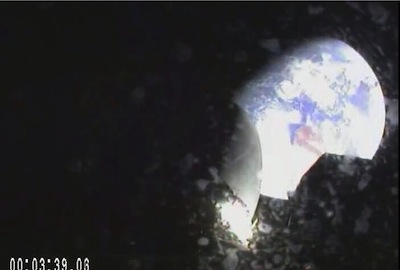
At least SpaceX has put stuff into space, where photos like this are something that their equipment has actually taken. The guys with Mars One have been no higher than what you can get with a commercial jetliner, and that is as a passenger as well. I like big dreams, but either company needs to unfortunately produce much of the equipment needed for going to Mars in-house as nobody else is even making the stuff necessary. SpaceX knows how to make stuff that works in space and has stuff in space right now to show it can get the job done. What does Mars One even have?
-
Looks familiar
Reminds me of the Genesis probe parachute failure.
-
Re:PHB's strike again
February 15th was the date beyond which the survival of the Columbia crew was unlikely due to suffocation.
A Soyuz has a three person capacity. I don't think Russia had enough lying around waiting to be launched. You're looking at 3, 4, or 7 launches to rescue the entire Columbia crew with Soyuz and they would need to occur in short order. Atmosphere loss from cycling the airlocks would be too great and cause the February 15th survival date to no longer be tenable.
As for the Atlantis rescue. Me thinks you believe it to be far simpler than it truly was.
http://spaceflightnow.com/shuttle/sts107/030523rescue/ -
Re:How is the Falcon Heavy assembled?
Here's their plan, from 2012. Space-X wants to assemble the Falcon Heavy horizontally, so they'll have to build a big mechanism to lift it up to vertical. For the Falcon 9, they use this. It runs on multiple railroad tracks from the assembly shed to the pad. They'll need something more than three times as big for the Falcon Heavy, a bigger shed, a way to lug the thing up the hill to the pad, etc. All doable, but they're already setting that up at Vandenberg, where the weather is better (no hurricanes).
-
Re:So what should the family do?
For 0,05 arcsec (according to Wikipedia, the best resulution VLA can reach
7 microarcseconds will be achievable today, when the network of telescopes is up and running: http://www.spaceflightnow.com/news/n1107/25spektr/
Additional resolution can be derived from repeated observations from different positions of Earth within the galaxy. I cannot say if this is enough specifically for detection of "shadows," but the linked article does talk about observation of black holes.
-
Re:The Manifold Hinderings of Mind
It is also the difference between fixed price contracts where SpaceX says they will deliver a satellite to orbit for a given price and then SpaceX will eat any cost overruns themselves vs. stuff Lockheed Martin does with a cost-plus contract where their profit is guaranteed but the price that taxpayers will pay can vary if "problems" arise.
Just try, if you will, to find out how much money was spent on the last Atlas V rocket. Reportedly the Canadian government paid $10 million dollars for this particular launch. Yeah, that is a bit less than what even SpaceX will typically charge for a Falcon 9 flight, but they certainly didn't screw over the Canadian taxpayers or expect Canada to pay for any cost overruns.
Yeah, I'd say there are a bunch of people very ignorant of these NASA contracts you are talking about. Those Grumman contracts in the previous post certainly had no similarity to the government contracts that SpaceX has been using.
-
Reusable first stage?
I watched the webcast live. The qualification of the upgraded Falcon 9 seemed to have gone very well, with payloads deployed in nominal orbits. They were also supposed to do some first tests for recovering the first stage. The only thing that I could find was that the second of two burns after separation sent it into a spin, after which it crash-landed in the ocean. Anyone has some more news about that?
-
Re:Dashcam?
Wonder where range safety was, but don't know what their protocol is; it might cause less damage if it goes off on the ground as long as its unpopulated versus an air burst. Someone in the know can weigh in here?
"Russian rockets do not carry self-destruct explosives like Western boosters"
[Proton Rocket Crashes].
Range safety is entirely achieved by... well... range.
That was one of the larger modifications necessary to Soyuz-2 for it to be allowed to
launch from Kourou in French Guiana: The Kourou-launched russian rockets do have
self-destruct capability. -
Re:They saw this coming for ages...
Actually, we've seen hints of this for a bit, so it's not a tremendous shock, but it is quite possible that some of the farther-reaching instruments might get cancelled in order to have an early launch.
-
You can see one yourself
The following is from Ted Molczan, an expert on satellites and launches and a major contributor to the seesat-l list. There's a good change of seeing a fuel dump from a Delta 4 medium if you're in the right place at the right time.
WGS 5 is scheduled for launch from Cape Canaveral on a Delta 4 Medium+(5,4) in about 11 hours, on 2013 May 24, between 00:27 and 00:57 UTC.
http://www.spaceflightnow.com/delta/d362/status.html
I offer the following rough TLE of the orbit after the final burn of the 2nd stage, assuming launch at window-open:
SECO-2 440 X 66991 km
1 78901U 13144.04069444
2 78901 24.0048 67.6288 8299446 177.8402 1.4113 1.08160032 04
Following spacecraft separation, observers within range should look for the following 2nd stage events (times
approximate):
T+ UTC
00:45:00 01:12:00 CCAM Start (Collision and Contamination Avoidance Manoeuvre)
00:47:20 01:14:20 CCAM End
00:54:41 01:21:41 H2 Depletion End
00:56:40 01:23:40 O2 Depletion End
01:18:33 01:45:33 N2H4 depletion EndThe fuel dump could produce a spectacular comet-like phenomenon, similar to that of WGS 4, imaged last year despite
challenging conditions by Willie Koorts: http://satobs.org/seesat/Jan-2012/0270.html -
Re:Missle fuel dumps or staging, common phenom
The following is from Ted Molczan, an expert on satellites and launches and a major contributor to the seesat-l list. There's a good change of seeing a fuel dump from a Delta 4 medium if you're in the right place at the right time.
WGS 5 is scheduled for launch from Cape Canaveral on a Delta 4 Medium+(5,4) in about 11 hours, on 2013 May 24, between 00:27 and 00:57 UTC.
http://www.spaceflightnow.com/delta/d362/status.html
I offer the following rough TLE of the orbit after the final burn of the 2nd stage, assuming launch at window-open:
SECO-2 440 X 66991 km
1 78901U 13144.04069444
2 78901 24.0048 67.6288 8299446 177.8402 1.4113 1.08160032 04
Following spacecraft separation, observers within range should look for the following 2nd stage events (times
approximate):
T+ UTC
00:45:00 01:12:00 CCAM Start (Collision and Contamination Avoidance Manoeuvre)
00:47:20 01:14:20 CCAM End
00:54:41 01:21:41 H2 Depletion End
00:56:40 01:23:40 O2 Depletion End
01:18:33 01:45:33 N2H4 depletion EndThe fuel dump could produce a spectacular comet-like phenomenon, similar to that of WGS 4, imaged last year despite
challenging conditions by Willie Koorts: http://satobs.org/seesat/Jan-2012/0270.html -
Re:No Amphibians Listed in ArticleThe animals on the spacecraft were geckos, which certainly are lizards. There were no newts launched on Bion-M1, nor any other kind of amphibian.
Sources:
http://www.spaceflightnow.com/news/n1304/19bionm1/#.UZlBX39dAbE
http://www.space.com/20732-russia-launches-animals-space-bion-m1.html -
Re:Ask Slashdot question in the making...The whole purpose of this mission was to measure the variations in the moon's gravity by flying at a very low altitude. Consequently, those gravitational variations introduced changes in the orbit requiring relatively frequent corrections. It follows that the closer you orbit, the more actively you'll have to work to maintain that orbit. When you fly low over a mountain, the extra mass in that area will pull you down, and you'll have to correct for that with upward thrust.
The moon's uneven gravity field presents a challenge to ground controllers planning trajectories for low-altitude lunar orbiters. The tug of lunar gravity can alter a satellite's orbit, requiring frequent rocket burns to adjust the spacecraft's path around the moon.
-
Re:spent bosters ?
http://www.spaceflightnow.com/soyuz/st25/120628newdate/
This article indicates that the four boosters on the outside of the rocket comprise the first stage, and separate into four pieces that fall north of the launch site, presumably in un-inhabited area, sort of like our New Mexico/Nevada desert where the US does stuff at White Sands or Groom Lake.
-
Re:Lifting Ballast to Space is a Sin!
Given how expensive the satellite is it would be foolish to launch it on an unproven platform.
If you really think it is a sin go find a company that wants a 5 ton satellite launched for free, with the possibility of loosing it.
It's not 5-tons, but SpaceX is working with a company (Orbcomm) that apparently is willing to launch a 1/4 ton satellite on an unproven platform. Unfortunatly, their OG2 satellite didn't fare well with its recent experience with SpaceX (they are filing a $10M insurance claim for this loss).
-
Yes, Falcon 9 development was a NASA contract
Do you really think that SpaceX developed all of Falcon 9 with just $248M?
No. The number I quoted of $248 Million was the portion of the NASA contract that had already been paid by NASA before the first flight. The payments from NASA continued after that. According to the Space-X web page, "The Falcon 9 launch vehicle was developed from a blank sheet to first launch in four and half years for just over $300 million." By the end of second COTS flight in May 2012, NASA had put in $396 million, paying for the development and two demo flights
see http://www.spaceflightnow.com/falcon9/003/120602crs/ :
"NASA invested $396 million into SpaceX under a public-private partnership agreement signed in 2006. The space agency released payments to the California-based company as it met design, testing and flight milestones."or http://www.nasa.gov/pdf/649910main_cots2_presskit_051412.pdf :
"To date [i.e., May 1 2012, just before the COTS-2 launch] Space-X has received $381 million for completing 37 out of 40 milestones worth a possible $396 million in that [COTS] agreement."That also covers Falcon-1.
No, that doesn't cover Falcon-1. That wasn't part of the Commercial Orbital Transportation contract, and NASA didn't pay for development of Falcon-1.
My point was that NASA paid for development of the Falcon-9; and it was not true that (as the post I originally responded to claimed), "government had nothing to do with it." If you want to say "yes, but it was remarkably inexpensive," or "yes, but they didn't pay for development of Falcon-1", or "yes, but private capital was invested to build up Space-X in the first place," or "yes, but private companies contracting with the government is a cost-effective way for NASA to do business," sure, all of these statements are fine; I agree.
-
Price
So on that subject, did these guys get paid this time?
I'm curious what they charged NASA, what they actually spent on this launch (not R&D costs to get here, just costs to build, fuel and launch)...The spacex website says a falcon9 launch is $54mil for 2012.
That may be the cost quoted on the website, but they are charging NASA $133 million per launch. Development costs and the costs of the demonstration flights were charged (also to NASA) separately.
"SpaceX and NASA signed a $1.6 billion Commercial Resupply Services contract in December 2008 for 12 flights to the space station through 2015."
http://spaceflightnow.com/falcon9/003/120602crs/$1.6B/12 launches = $133.3M/flight
-
Re:Second?
I thought the same. According to SpaceFlightNow.com http://spaceflightnow.com/falcon9/003/status.html/ and Slashdot http://science.slashdot.org/story/12/05/31/168226/after-trip-to-iss-spacexs-dragon-capsule-returns-safely-to-earth/ The first docking of Dragon with the ISS was May 25 at 16:03 GMT.
-
Re:Rail System
Some US rockets are transported on rails.
The old Titan IV had the rocket assembled in one building then moved to one of two pads on two sets of rails. The rails had a switch to go to two different pads. Then a building moved over the rocket to integrate the payload. They did this because they did lots of DOD payloads. This way you could have a crew of rocket techs with one level of clearance assemble the rocket. Then at the pad have the NRO people with very high clearance have access to the payload.
http://spaceflightnow.com/titan/b39/031006rollout.htmlThe Atlas V uses a refurbished pad and still uses the same set of rails.
http://www.wired4space.com/launch-sites/cape-canaveral-afs/atlas-v-with-muos-1-rolls-out-to-the-lc-41-launch-padSpace X horizontally integrates and rides out on rails.
The Delta IV has it's core stage roll out horizontally and is lifted vertical onto a fixed pad with a roll away building.
http://wattsupwiththat.com/2010/01/19/new-goes-p-weather-satellite-getting-prepped-for-launch/One of the reasons in the old days large US rockets were assembled vertically was because they weren't strong enough to be lifted horizontally when integrated. Most of these structures are very strong in the axial direction but can't take large radial loads.
Also the shuttle SRB's are VERY heavy at about 1 million pounds each. These require a large pad hence a large transporter.
-
Build a Rocket First
Before an Indian rocket goes to Mars it might be helpful if they, you know, built one? Last I heard, and a brief Google search doesn't seem to show any new progress, they were still using Russian engines on their cryogenic upper state. This was because they've been trying for 20 years to build a working engine, apparently without any measurable success at all. Somehow buying a Proton and trucking it to an Indian launch pad isn't quite the same as "an Indian rocket". Here is the link to last time I heard of actual hardware leaving the ground.
-
Re:Nice Job China
Have we "advanced" now that Obama Administration killed our manned space program (after promising not to BTW) ?
[Citation needed] - There may be one, I just can't find it.
What I did find is an article describing his administration's committment to manned space flight. Even though we're not launching men now doesn't mean we don't plan to. The vision he described in 2010 is coming true with the recent SpaceX achievements.
-
Re:More info and video
I believe he's actually referring to the $500m Ares I Mobile Launch Tower
It was the smaller portion of constellation. SLS is roughly in the same class as the Ares V, the larger half the constellation fleet, which would undoubtedly have been far more expensive than the Ares I platform. -
Re:Launch window
There was a Atlas V scheduled to go up on the 5th, but that's now bumped up to the 3rd. I read over at NASASpaceFlight that Falcon 9 has a launch window approximately every three days from the Cape to ISS. Spaceflightnow.com has a worldwide launch calender; you can see how many times this flight has been delayed. It was originally scheduled for June 6th of last year, so it'll be just a day shy of 11 months behind schedule, if there aren't any further reschedules.
-
What is the Definition of Failure?
According to this link: http://spaceflightnow.com/atlas/av019/120103rescue.html the satellite has attained the correct orbit and will soon be operational. They don't call them rocket scientists for nothing.
-
Re:Glad they didn't go to a backup!
According to this:
http://spaceflightnow.com/atlas/av019/111009.html
They used the hall effect thrusters instead of the hydrazine/nitrogen tetraoxide engine. The hall effect thrusters run on xenon and electricity, so NO they did not use the same fuel source. The hall effect thrusters have a specific impulse of ~8000s instead of the ~300s for hydrazine, so they are insanely fuel efficient, but extremely low thrust. (1/4N vs ~450N for the main engine)..
-
Heading hyperbole
Already been established that they were able to overcome the rag and get the satellite into a functional orbit where it can fulfill its mission objective. http://www.spaceflightnow.com/atlas/av019/120103rescue.html
-
Re:dude
Woops, cynicism fail.
For future reference, I work in the launch industry, and we routinely launch on days with 20% to 30% chance for acceptable weather. Try not to be so negative. This is space we're talking about! -
Re:Good luck
The next window is the 16th if the Delta 4 launch gets off on time, not that that helps you. I don't know how long you're there, but the Delta launch is scheduled for the 14th at 2:49-3:08 a.m., which would be better than nothing.
-
Mechanism?
I tried to look up the mechanism of how microwave data is interpreted to give salinity levels, but all I could find in a quick hunt was some IEEE papers which were over my head. Anyone here care to give a summary of the method?
The article below has more technical details than the submitted link:
http://www.spaceflightnow.com/delta/d354/
(Off topic true story: A friend was once head of his college IEEE chapter. A freshman from another country who was just joining brought him a check to cover the membership made out to "I. Tripoli".)
-
Re:Small Edit Re: TFS
You're not serious right? Space-X already has all the necessary permits and certifications so that their rockets don't go crashing into your house. The Obama administration is already working to privatize nasa launches to
-
Re:Sure it's cheaper
Yeah, and it's worth noting that the *hardware* budget was $250,000. It was launched on a Minotaur IV, which costs a cool $50 million USD to purchase and launch. Their web site is far from clear, but it looks like these tiny satellites were allowed to piggyback on another launch. Which is a great deal for them, since they didn't really care what orbit their satellite got put in or how many years (or months, in this case) it would stay up.
But if I was a commercial venture, with full-sized satellites, and I had to spend $10 million+++ to buy my own launches, I'd make damn sure my satellites are top quality.
-
It is the launch costs that kills you
The satellites were launched by a Minotaur IV rocket from Alaska.
These rockets are derived from converted old Minuteman/Peacekeeper ICBMs.
Despite that, the launch costs of such a rocket can still be $40-50 million
So, unless you can score a free ride for your doohickey, it ain't so cheap. -
Re:Definitely a nail biter
There's a minimum separation time between when one ship leaves ISS and another one docks, and if they had held fast to that schedule, it would have been delayed until Friday because of the late departure of... I think it was a Soyuz mission.
The launch that almost delayed STS-133 was ATV2. And it wasn't about separation between leaving and docking, it was separations between dockings. ATV2 was scheduled to launch Feb 15, but scrubbed to launch Feb 16. It was scheduled to dock on the same day as STS-133 was scheduled to launch. In the end the shuttle folks decided to launch anyway.
http://spaceflightnow.com/tracking/launchlog.html
http://insideksc.com/content.php/250-STS-133-Launch-Preps-Move-Ahead-ATV-2-Aims-to-Launch-Today
http://en.wikipedia.org/wiki/STS-133#Johannes_Kepler_ATV_rescheduled
-
Who needs jammers? We have the sun.
People forgot about it due to the ong solar minimum, but if this many things are dependant upon GPS, they're going to want to find some contingency plans:
-
Just a note...
SpaceX has specifically said it's Dragon Spacecraft has a heat shield designed to withstand the increased speed that would exist from a return trip from Mars.
"The ablator, called PICA-X for short, was tested inside an arc jet laboratory at NASA's Ames Research Center at Moffett Field, Calif.
"It's actually the most powerful stuff known to man. Dragon is capable of re-entering from a lunar velocity, or even a Mars velocity with the heat shield that it has," Musk said.
-
Dragon has landed!
Update: The Dragon has successfully made a soft landing in the Pacific! This makes it the first-ever commercial spacecraft to return from orbit, and the first American capsule splash-down since 1975. A recovery vessel has already arrived at the capsule and is currently attaching floatation devices to it. NASA and SpaceX are doing a press conference as early as 3:30pm EST, which will presumably be broadcast both on NASA TV and SpaceX's website.
SpaceX has also released a video pointing out a window of the Dragon capsule while in orbit. They apparently also have video of the descent and presumably more video from inside the capsule which will soon be available.
For more updates:
http://twitter.com/SpaceXer
http://spaceflightnow.com/falcon9/002/status.html -
Re:This is pretty big.
It's not just about velocity. You also have to be able to carry enough supplies to keep the crew alive. Also - and this is the kicker - you need to have big enough heat shields to come back down. See, lunar missions do not carry enough fuel to settle into an Earth orbit before re-entry. It's basically a nice three day drop from the moon into the Pacific. You need a massive heat shield to do that. Dragon doesn't have one massive enough.
Actually, the Dragon's heat shield is pretty massively over-engineered, to the extent that it can survive reentry from both lunar and Martian return velocities:
http://www.spaceflightnow.com/falcon9/002/100716firststage/
The Dragon's heat shield will also be put to the test during re-entry. The capsule's blunt end is coated with phenolic impregnated carbon ablator, a resistant insulator used by NASA's Stardust mission that returned comet samples to Earth.
The ablator, called PICA-X for short, was tested inside an arc jet laboratory at NASA's Ames Research Center at Moffett Field, Calif.
"It's actually the most powerful stuff known to man. Dragon is capable of re-entering from a lunar velocity, or even a Mars velocity with the heat shield that it has," Musk said.
-
Piggyback Payload
Hmmm, here's an interesting little bit of info. Apparently the NRO bolted a few cubesats to the side of this rocket as well. They deployed successfully according to Spaceflightnow's live blog update. I can't find much information on the little guys (and probably won't since they are NRO) but wikipedia confirms that there was a secondary payload on this test. Apparently some government offices already feel that the Falcon 9 is worthy enough to carry their goods.
Also, pretty pictures of the launch. -
Piggyback Payload
Hmmm, here's an interesting little bit of info. Apparently the NRO bolted a few cubesats to the side of this rocket as well. They deployed successfully according to Spaceflightnow's live blog update. I can't find much information on the little guys (and probably won't since they are NRO) but wikipedia confirms that there was a secondary payload on this test. Apparently some government offices already feel that the Falcon 9 is worthy enough to carry their goods.
Also, pretty pictures of the launch. -
CNN has video up
The official SpaceX video (which includes things like a view from the rocket itself) hasn't been released yet, but CNN has posted NASA's video here:
http://edition.cnn.com/2010/US/12/08/space.flight/
Ongoing updates will be posted to SpaceX's twitter account. The Dragon capsule is expected to orbit the Earth a few times and then land off the California coast about three hours after the launch, and SpaceX has announced that they're doing a press conference an hour or two after the landing.
-
Shuttle vs. Everyone
-
Shuttle vs. Everyone
-
Shuttle vs. Everyone
-
Shuttle vs. Everyone
-
Shuttle vs. Everyone
-
Re:Launched April 22?Yes, this mission was launched seven months ago, and is not even going on the limit of its capability..
"The X-37B has the requirement to be on-orbit up to 270 days,"
http://spaceflightnow.com/atlas/av012/100225x37arrival/ http://en.wikipedia.org/wiki/USA-212