Slashdot Mirror
Domain: spaceflightnow.com
Stories and comments across the archive that link to spaceflightnow.com.
Comments · 567
-
Re:Trying to bring back Steady State Model!
Of particular interest is the press release by the Space Telescope Science Institute - the research arm of NASA's Hubble Space Telescope - promoting the claim that NGC 4319 is not connected by a filament to Markarian 205, the object next to it. These press releases appear to be a case of scientific fraud insofar as they point the readers to visible light photographs from the Hubble instead of the far more radio-deep imagery produced on much less expensive, even amateur, CCD telescopes.
Markarian 205 was reported by Weedman as a Seyfert nucleus appearing within the arms of the lower-redshift spiral galaxy NGC 4319. Most of the argument here has centered on whether or not there is a visible connection between the two. Pictures were published with and without a bridge (Arp once said that he had pictures that showed no bridge as well, and didn't want to be thought lacking in observational skill). There was some early discussion of photographic proximity effects creating false bridges between bright objects, but it doesn't go away with linear detectors. Various reports were given by Arp 1971 (ApLett 9,1), Lynds and Millikan 1972 (ApJLett 176, L5), Stockton et al 1979 (ApJ 231, 673), and Sulentic 1983 (ApJLett 265, L49). Cecil and Stockton (1985 ApJ 288, 201) used CCD data from Mauna Kea to show that there is definitely some kind of luminous object between Mkn 205 and NGC 4319, stating that "Arp was correct in his insistence that his broad-band plates showed luminous intervening material. The opposite conclusions of his critics were - depending on their degree of qualification - either wrong, misleading, or irrelevant."
"We realized that
Realize that they could have argued that the radio filament was a background object, a "chance" observation. They didn't. They literally said that the filament is not there. But, the filament clearly shows up on CCD imagery - just not the optical.
The public needs to think more clearly about what has happened here. I was able to even get Ethan Siegal, one of the world's most vocal proponents of the Big Bang, to agree with me that something is not right about this particular situation.
-
Re:A long time ago, observing a galaxy far, far aw
A list of vindications for Halton Arp:
In most of these cases, cosmologists and science journalists point the public to ad hoc extensions of the Big Bang. Yet, their original model did not predict these observations.
1. Alignment of quasar minor axes (vindication of Arp ejection model)
"The first odd thing we noticed was that some of the quasars’ rotation axes were aligned with each other -- despite the fact that these quasars are separated by billions of light-years"
2. Numerous apparent interactions of objects of wildly different redshifts (not possible with Big Bang, vindication of Arp)
For example, NGC 7603, NGC 4319 and NGC 3628, just to name three. There are many, many more at this point. See the first part of the Universe: Cosmology Quest documentary and Arp's Intrinsic Redshift lecture for a more thorough treatment.
Of particular interest is the press release by the Space Telescope Science Institute - the research arm of NASA's Hubble Space Telescope - promoting the claim that NGC 4319 is not connected by a filament to Markarian 205, the object next to it. These press releases appear to be a case of scientific fraud insofar as they point the readers to visible light photographs from the Hubble instead of the far more radio-deep imagery produced on much less expensive, even amateur, CCD telescopes.
Markarian 205 was reported by Weedman as a Seyfert nucleus appearing within the arms of the lower-redshift spiral galaxy NGC 4319. Most of the argument here has centered on whether or not there is a visible connection between the two. Pictures were published with and without a bridge (Arp once said that he had pictures that showed no bridge as well, and didn't want to be thought lacking in observational skill). There was some early discussion of photographic proximity effects creating false bridges between bright objects, but it doesn't go away with linear detectors. Various reports were given by Arp 1971 (ApLett 9,1), Lynds and Millikan 1972 (ApJLett 176, L5), Stockton et al 1979 (ApJ 231, 673), and Sulentic 1983 (ApJLett 265, L49). Cecil and Stockton (1985 ApJ 288, 201) used CCD data from Mauna Kea to show that there is definitely some kind of luminous object between Mkn 205 and NGC 4319, stating that "Arp was correct in his insistence that his broad-band plates showed luminous intervening material. The opposite conclusions of his critics were - depending on their degree of qualification - either wrong, misleading, or irrelevant."
"We realized that
3. Numerous instances where high-redshift quasars appear aligned with the axes of low-redshift "foreground" galaxies (statistics indicate this occurs far too often for a strict recession velocity interpretation of redshift)
Quasars, Redshifts and Controversies, by Halton Arp (1987)
"To summarize this initial chapter, I would emphasize that with the known densities with which quasars of different apparent brightness are distributed over the sky, one can compute what are the chances of finding by accident a quasar at a c
-
Re:Now Downloading Monetization, Pls Wait For Toas
I wonder how many 'dark satellites' there are in orbit that are technically functional yet have been abandoned because they're no longer able to maintain the desired orbit. I bet enthusiasts could do some interesting things if given access to those.
there are currently 1 980 active satellites in orbit. Whilst this is 13.92% increase over the number of active satellites last year, it still represents only 40% of the satellites orbiting the planet.
This means that there are 2 877 pieces of useless metal hurtling around the Earth at high speed!
It's easy to find inactive satellite numbers. Active but not in use due to a specific cause would take serious research and then only supply a minimum.
Casual check for satellites in the wrong orbit but active: at least 24 satellites. [1] [2] [3] [4]
-
Some more information on the sat here....
https://spaceflightnow.com/201...
he Merah Putih satellite launched Tuesday will provide C-band telecommunications services over Indonesia and India. The new telecom craft was built by SSL in Palo Alto, California.
SSL completed construction of the Merah Putih satellite ahead of schedule, according to Telkom Indonesia, also known as PT Telkom. The new satellite will replace Telkom 1, which failed in a mysterious debris-shedding event in geostationary orbit last year.
Officials from Telkom Indonesia expected the Telkom 1 satellite, which launched in 1999, to remain operational until Merah Putih’s launch. But Telkom 1’s failure last year forced the operator to re-route communications traffic through other satellites.
The Merah Putih satellite is designed for a 16-year life, its owner said in a statement. The spacecraft will be positioned in geostationary orbit more than 22,000 miles (nearly 36,000 kilometers) over the equator at 108 degrees east longitude.
-
Re:Have backups on standby
Indeed spares that are no longer needed presumably because they have been superseded have been donated to NASA for repurposing in the past.
-
Re:It has to be proven better
As a result, they've modified their fuel loading procedure, and proposed longer term updates to their oxygen tank design.
The proposed changes are complete. Falcon 9 Block 5 has many changes to improve reliability and safety. Updates to the oxygen/helium tanks are just one of many.
Keep in mind, SpaceX has a major advantage in safety and reliability that others don't have. They have recovered their boosters in tact. I'm sure they have torn them down to do detailed analysis on how the components hold up in flight. No other launch provider can do that. -
Re:Good luck with that 30% cut to NASA's budget
So with his proposed cut to NASA of 30% how exactly does he expect to fund ANY human space travel? They can barely fund robotic exploration at the current funding levels.
Where do you get 30%? From the Progressives at CNN? Has he revised the 3% cuts from his budget proposal in May?
The Trump administration’s fiscal 2018 budget request includes $19.1 billion for NASA, a $561 million decrease over previously enacted levels that would reduce the number of Earth science missions, eliminate the agency’s education office and do away with the Obama administration’s plans to robotically retrieve a piece of an asteroid as a precursor to eventual flights to Mars.
Sounds like the budget deals with under-budgeted robotic missions by eliminating them and shifting focus to manned lunar missions in partnership with private enterprise. Everything about your highly rated comment is complete bullshit.
-
Re: Well
SpaceX provides discount access to orbit. If you are launching a 5 billion dollar GSO comsat, you will go with ULA. If you want to dump a van load of cubesats designed by high school science clubs into LEO, you go with SpaceX.
DoD is launching with SpaceX now, so they have definitely jumped up in the rankings compared to ULA, and the various state-owned launchers. Cubesats and science projects are becoming the domain of start-ups that NASA is funding
FWIW the accident involved a new block-5 merlin engine that was undergoing lox load testing for leaks and 'something' caught fire, damaging the test facility, and presumably the engine, severely. It has not been determined if the engine, which was not firing, was at fault.
-
Re:Divert just 0.5% of the military budget to NASA
China is making great progress and is doing very well for themselves but last I heard their heavy lift capabilities are lacking and delayed. Not to say China won't get it but in certain regards they are behind NASA.
-
Re:Will we find out how much processing for reuse?Found it:
According to Koenigsmann, SpaceX technicians replaced several items that were exposed to salt water after splashdown, such as batteries and the capsule’s heat shield. But the hull, thrusters, harnessing, propellant tanks, and some avionics boxes are original, he said. “I can tell you the majority of this Dragon has been in space before,” Koenigsmann said.
-
Re:Oh that's easy
Yes, just look at the list of worldwide planned rocket launches. Quite a few from Vandenberg Airforce Base
-
Re:SpaceX plans to waste tons of fucking money
Is there THAT much shit being sent into space?
Yes. And that's just Spacex, there are a 7 other providers with their own full launch manifests. SpaceFlightNow does a pretty good job tracking upcoming launches.
Some quick searching shows there are about 4500 satellites in orbit, 1500 or them operational. Looks like we are putting about 200+ more per year up there. source So yeah, there is plenty of "shit" to send up there.
-
Re: Marketing Stunt
Unlike the Russians or the Chinese.
BTW, SpaceX is planning their next launch on sunday jan 8.
-
Re:Title is wildly misleading
As commented above, the article at:
http://spaceflightnow.com/2016...notes that all 3 stages are solid propellant systems.I see no mention of liquid propellants, though there may be some for the spin-up and station keeping.
If this really is a completely solid propellant system, the cost savings would be incredible. One number I saw was 1/3 the cost of traditional systems. At least for earth orbit, that should give the Space-X crew some competition for a while - which is good for everyone.
I agree that this could be a cost-efficient way to get to orbit, but it's not competition for the Falcon 9. This launch boosted a 365 kg satellite into GTO. The Falcon 9 can boost 8,300 kilograms into GTO. The Epsilon costs $38M per launch, so for this launch the cost to orbit was about $104K per kilogram. The Falcon 9 costs $62M, so for a max payload mission it would cost about $7500 per kilogram. They're not even in the same ballpark.
-
Re:Title is wildly misleading
As commented above, the article at:
http://spaceflightnow.com/2016...notes that all 3 stages are solid propellant systems.I see no mention of liquid propellants, though there may be some for the spin-up and station keeping.
If this really is a completely solid propellant system, the cost savings would be incredible. One number I saw was 1/3 the cost of traditional systems. At least for earth orbit, that should give the Space-X crew some competition for a while - which is good for everyone.
-
Re:Slightly better summary
-
Re:More Like "Crunch"
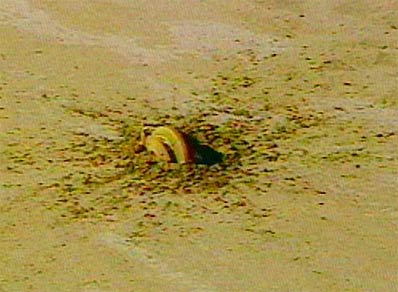
In order to show up in the images, the pattern probably resembles that of the crash-landed Genesis probe. (Earth desert)
It's also possible its landing fuel, which appeared to be under-utilized based on telemetry, sprayed about upon impact.
-
Re: no soyuz seats = no space for nasa astronauts
-
Re:SpaceX Dragon 2 should be ready
It is proven technology as it already delivers supplies to ISS and returns safely. They have tested the abort system on the ground along with the other systems. I do not see why they will not be ready for flights in 2018. Boeing on the other hand is still way behind
Keep dreaming. SpaceX has never launched a person into space. Dragon 2 may be ready for testing by 2018, but given SpaceX's recent spotty record with launches, NASA in no way will put an astronaut on a SpaceX rocket or an untested Dragon 2. Their safety rating and supplier quality control needs to be dramatically improved before that happens.
-
SpaceX Dragon 2 should be ready
It is proven technology as it already delivers supplies to ISS and returns safely. They have tested the abort system on the ground along with the other systems. I do not see why they will not be ready for flights in 2018. Boeing on the other hand is still way behind
-
Re:Where is the funding for the trip?
Re, aerocapture: actually backwards - for non-manned missions aerocapture is generally lower velocity at Mars (~6km/s) than simple Earth entry (7,8km/s); it's only higher for manned missions to Mars (~8-10km/s), which generally take faster trajectories.
Hmm, anything else that hasn't been covered? Comms, SpaceX has a no cost deal to use the DSN in exchange for landing data. Anything else?
-
Link to article with images
Link to article containing images of damage.
Skip the Space.com video, they're just trying to force more ads on you via video.
-
Re: SpaceX's Next Big Challenge
SpaceX is a big player indeed. Take a look at http://spaceflightnow.com/laun..., and you'll see that SpaceX is right up there in launches scheduled. It's even competitive with Soyuz. That's with Falcon Heavy not online yet, too; they'll be able to pick up even more jobs once they can put heavy and even super-heavy-class payloads up. For that matter, they may not even need FH for that; according to their latest payload limit updates, the F9 is a Heavy-Lift Launch Vehicle (more than 20 tons to LEO) if flown in expendable configuration (no legs, no fins, probably little if any first-stage RCS, and no need to conserve fuel for re-entry and landing). They can't re-use those boosters, but they can use the profit margin on them to focus on making reusable launches even cheaper and faster.
As for mass market, though, that's a case where SpaceX's success will feed on itself. Right now, satellites are super expensive to launch. This means that you want to make the ones you launch super-reliable (sucks to get them into space and discover they don't work), very feature-rich (to maximize value per launch), as long-lived as possible (to amortize their launch cost over a longer time), and as future-proof as possible (because expanding capacity or capabilities later will be extremely expensive). All of this, of course, makes the satellites themselves extremely expensive. Therefore, there's less market for launches, because there's only so many satellites that it makes sense to launch at $200M a pop.
Now, imagine that the launch costs go way down. Suddenly, the total cost of launching a satellite also goes way down, and the vast majority of it is now the cost of the satellite. When you can launch two cheap satellites for less total cost than one expensive one and get the same capabilities, or launch four three-year satellites (planning each one to be an upgrade on the last) instead of one long-lived beast that will need bleeding-edge components at launch and still be quite obsolete in 12 years (but costs more than 4 times as much), you will end up with double or quadruple your launch count. When launches become cheap enough that it's viable to build an affordable global personal communication network like what Iridium wanted to be, you'll see a wave of companies wanting to put up the network that will replace the concept of cell towers, and they'll need to put up a *lot* of satellites.
Also, it's not just satellites. Remember that Dragon 2 is designed to be reusable as well. When launching a human-rated vehicle into orbit becomes cheap enough that space tourists don't have to be one of the 0.001%, you'll have a lot more people lining up to go... and you'll need places for them to go, so that'll increase your satellite market again as Bigelow and such launch space hotels. Then there's things like asteroid mining, which is currently hampered by launch costs but could become a regular source of launch contracts if the costs come down enough to make the business model viable.
As for "any time soon"... launches are already accelerating. It'll snowball as prices drop, as reliability increases, and as capacities expand.
-
A link with some actual information
http://spaceflightnow.com/2016...
The Falcon 9 rocket’s countdown proceeded normally Thursday until a member of the SpaceX launch team called a hold at approximately T-minus 1 minute, 41 seconds, before the scheduled launch time of 6:47 p.m. EST (2347 GMT).
The cause of the last-minute abort was an issue with loading cryogenic liquid oxygen into the rocket, according to a SpaceX official on the official launch webcast. Both stages of the Falcon 9 burn a mixture of RP-1 kerosene fuel and liquid oxygen.
-
More SpaceX fanboi spin!
Spaceflightnow called it differently. "Falcon 9 launches ocean study satellite, barge landing fails" Slashdot, you are pathetic. You are entitled to your own opinion, not your own facts.
-
Re:But can we explain
Because he posts the single most interesting stories on the site?
I don't know whether to (+1, Ironically Funny), or (-1, Fuck off Ethan), but you made me laugh either way.
We've known it's density waves for years. Decades, arguably. If Ethan's blogspam is new and revelatory to you, you haven't been paying attention. If you want a pop-science focus, http://www.astrobio.net/ is decent, as is Phil Plait's Bad Astronomer. If you want mission updates, http://spaceflightnow.com/ has good (and in some cases, live) coverage. If you want well-sourced articles on a wide range of topics, any of the blogs on the Planetary Society will do; these authors have been working in the field for decades.
Literally anything is better than Forbes/Medium blogspam. All the guy does is take a few pretty images that show up first on a Google Image Search for whatever it is he's cutting and pasting about, then tells you how amazing it is that space. And time. Are, like, the same thing. Like a gravity and a bowling ball and a rubber sheet. Here's that
-
Space Launches Schedule
SpaceX has a number of launches coming up according to Space Flight Now including:
* 19 Dec - Falcon 9 rocket will launch 11 second-generation Orbcomm communications satellites.
* Dec ? - Falcon 9 rocket will launch the SES 9 communications satellite.
* Jan - Falcon 9 rocket will launch the 10th Dragon spacecraft on the eighth operational cargo delivery mission to the International Space Station.
* Jan - Falcon 9 rocket will launch the Jason 3 ocean altimetry mission. Jason 3 will measure ocean surface topography to aid in ocean circulation and climate change research for NOAA, EUMETSAT, NASA and the French space agency, CNES.
* There are others scheduled for early 2016 -
Re:meanwhile soyuz ...
A Soyuz launched mission failed just last April, carrying a Progress 27M spacecraft meant for a resupply mission to the ISS.
http://spaceflightnow.com/2015...
"Roscosmos said in a statement Wednesday that mission control lost communications with the Progress spacecraft 1.5 seconds before the cargo carrier’s planned separation from the third stage of its Soyuz launcher."
"A report by Russia’s Tass news agency Wednesday claimed the RD-0110 engine burned longer than designed during Tuesday’s launch, citing a source from the engine’s manufacturer." -
Re:This guy should be a lawyer
Belief in the infallibility of computers and programmers is sort of funny, actually.
The Space Shuttle Columbia's computer did a remarkably good job of keeping the nose pointed in the right direction while the craft was disintegrating, right up until the time it lost hydraulic pressure and control became impossible:
the [plasma] breach ultimately caused unusual aerodynamic drag to develop on the left side of the spacecraft, forcing Columbia's flight computers to adjust the shuttle's roll trim with the elevons, or wing flaps, on each wing. Eventually, two right-firing rocket thrusters were ignited to provide additional muscle. But it was a losing battle.
-
Re:This is Kazakhstan we're talking about
My guess is some of that super toxic hydrazine reached the ground from the Russian Soyuz launch failure in May.
Chemistry 101: Abort, Retry, Fail
-
This is Kazakhstan we're talking about
My guess is some of that super toxic hydrazine reached the ground from the Russian Soyuz launch failure in May.
-
Re:We had one, it was called the Shuttle.
forget things like "didn't realize that we lost O-ring redundancy at temperatures below 40F",
Well, the engineers did realize that, this was just MBAs (or their cousins) killing people as usual. Meanwhile Proton has been flying for decades with a design flaw.
-
Re:The bravest astronaut
will be the first to board the next launch vehicle to the ISS after all these failures.
It's not like any of them are proving themselves particularly reliable. And it's not like any of these failures would have been survivable for the crew.
Actually, the situation is not as dire. The Progess launch failure was a result of combining the new Soyus 2-1A design with the supply ship, and
Officials were considering launching space station crews on the Soyuz-2.1a version once its performance was demonstrated on Progress missions.
Today's mission used the older Soyus-U design, and I would guess that the next crew going up would also use this older launcher.
-
Re:The bravest astronaut
will be the first to board the next launch vehicle to the ISS after all these failures.
It's not like any of them are proving themselves particularly reliable. And it's not like any of these failures would have been survivable for the crew.
Actually, the situation is not as dire. The Progess launch failure was a result of combining the new Soyus 2-1A design with the supply ship, and
Officials were considering launching space station crews on the Soyuz-2.1a version once its performance was demonstrated on Progress missions.
Today's mission used the older Soyus-U design, and I would guess that the next crew going up would also use this older launcher.
-
Re:This should be a major embarrassment
Latest data says the sail is deployed:
http://spaceflightnow.com/2015... -
A pretty ugly attempt
It doesn't sound as much like an analysis as more excuses and spin from Elon Musk. You must admit, it was a pretty ugly attempt. ULA's engine compartment recovery scheme makes more sense. Self-respect would ULA them from ever attempting the crudely engineered spectacle we just watched.
-
Re:Landed OK but tipped over
Well, the video is up on SpaceFlightNow, and it cuts off before the rocket tips over. Yes, we have no reason to believe there was anything left.
-
Re:Number 4
Yah that's why the photo caught my eye; I was thinking why would people inside a several foot thick concrete dome need harnesses and fire blankets... whomever is in this room is not having a good day.
After knowing what it's called there is an even more amazing article on that very room.
http://www.spaceflightnow.com/...
They join technicians working on the platform to jump down a chute on the north-side of the platform that connected to the teflon-lined slide that rapidly gets them underground.
That 200-foot slide empties into the aptly-named "rubber room" with its rubber floors meant to absorb the impact of the explosion occurring on the pad surface 40 feet above them. Hopping off the landing ramp, the people would scurry to their left into the fallout shelter, a domed room suspended on shock-dampening springs and sealed off with massive blast-proof doors. Inside, the chamber held 20 chairs, a toilet and carbon dioxide scrubbing equipment to keep the occupants alive until rescue teams arrive.
AWESOME! -
Re:Umm...
The FTC authorized the merger as long as some terms in a consent degree were followed by both parties. It's very possible that the FTC just said "yeah, whatever the Pentagon wants" and waved it through. But to be honest, I'm not sure if keeping the two companies separate would have been any more efficient. It's already a duopoly with a single, captive buyer, and there's no way that one provider is going to charge much less than the other guy. It's like the airlines. One company set its rates on Monday, and on Tuesday, everyone else sets the same rates.
It also sounds like Boeing and Lockheed Martin was suing their crap out of each other before joining the ULA. If you look at the KC-X program to provide an aeriel refueling plane to succeed the KC-135, lawsuits can keep a program from going forward for years. The Air Force/Pentagon/Boeing/Lockheed/FTC might have just looked at all this horseshit, and said, screw it.
-
Re:To be fair
NASA's budget was increased for 2015. http://spaceflightnow.com/2014...
-
Re:So, ion drive or something???
Yes, ion thrusters. Used to adjust from the original elliptical orbit to the final circular one (and yea, it takes a long time to do that compared to a conventional booster). They've been using these to maintain position for almost 20 years.
-
Re:Using NASA's dictionary
http://spaceflightnow.com/chal...
T+1:56 "Flight controllers here are looking very carefully at the situation. Obviously a major malfunction."
T+2:50 "We have a report from the flight dynamics officer that the vehicle has exploded. The flight director confirms that. We are looking at checking with the recovery forces to see what can be done at this point."(The main explosion happened at T+1:13.)
-
Re:Designs from what?
False. They are not "reconditioned". They are essentially rebuilt from scratch by the Aerojet with the major participation of Ukrainian "Yuzhnoe" design bureau. The mere fact that the entire fuel supply system ifs prvided by Ukrainians immediately requires a full rebuild. And, of course, the fact that the engine failed today is already a direct factual indication that this was not a Russian engine.
Your description lacks a citation, and does not agree with what an Aerojet VP said in an interview:
http://www.spaceflightnow.com/news/n1003/15nk33/Aerojet converts the NK-33 to an AJ26 engine by removing some harnessing, adding U.S. electronics, qualifying it for U.S. propellants, and modifying the system to gimbal for steering, Van Kleeck told Spaceflight Now in a January interview.
The article also notes:
Officials wanted to make sure the kerosene-fueled engine could still perform after four decades in storage. The NK-33 engines were originally designed and built in the 1960s and 1970s for the ill-fated Soviet N1 moon rocket.
These are old Russian engines, built for the N-1 rocket, which failed all four launch attempts (one of which caused the largest artificial non-nuclear explosion in history), so I am not sure where you're getting the idea that Russian equipment doesn't fail.
-
Re:So why not watch it *FROM* mars?
NASA obviously thought about this possibility, so yes, the event will be observed by at least 3 satellites orbiting currently around Mars, 2 rovers on Mars, the Hubble telescope and probably plenty of earth-based telescopes.
-
Re:Any news on the first stage landing tests?
This time, they launched without the landing legs, but since they are still testing above water that does not matter a lot. Deploying the legs and soft landing on water have been tried successfully already, so I imagine they could test other things like partially flying back to the launching site, fuel permitting. The twitters are silent, so far, however.
At the NASA pre-launch press conference, Hans Koenigsmann said that they would be doing the first boost back burn, as well as a re-entry and "landing" burn. At the SpaceX CRS-4 Post Launch Briefing he said that it looked like all the burns wear successful, but they had to wait for the boat that collected telemetry to return.
I feel like I've seen some confirmation on good telemetry on twitter, but I can't find it now and this story is old enough that no one will likely see my post anyway...
-
Any news on the first stage landing tests?
This time, they launched without the landing legs, but since they are still testing above water that does not matter a lot. Deploying the legs and soft landing on water have been tried successfully already, so I imagine they could test other things like partially flying back to the launching site, fuel permitting. The twitters are silent, so far, however.
-
Re:To Dwell or Not To Dwell
By the way, here's a somewhat more detailed article:
http://spaceflightnow.com/news...
It seems the complaining panel may be trying to "force science" when it's really an exploration or survey mission. Example:
"The proposal lacked specific scientific questions to be answered, testable hypotheses, and proposed measurements and assessment of uncertainties and limitations," Neal wrote.
You don't "prove hypotheses", you collect evidence first. If you find something really interesting, then either spend more time at that place, or drive back to it if oddities are found after-the-fact and are big enough to justify it.
It seems they are asking for premature regimentation. You have to react to circumstances. Essentially, its mission plan should be "drive around and sniff at interesting or odd things".
-
Re:My money is on SpaceX
ISS supply mission. Engine explodes. Fails to deliver secondary payload
Primary payload delivered to orbit, secondary lost due to a failed engine re-ignite. This is a partial failure.
ISS supply mission. Maneuvering thrusters fail.
Supply craft captured by ISS due to space x incompetence. This is a failure.
Satellite launch delayed by helium leaks. First stage recovery failure.
Primary payload delivered to orbit after huge delays cutting into profit ability. This demonstrates space x's need to cut corners in order to remain viable.
Prototype failed due to a production ready component unrelated to the test that could have easily gone off on any of the other flight and again caused delays of their flights cutting into profitability requiring space x to cut corners in the future.
Fixed that for you.
-
Re:My money is on SpaceX
ISS supply mission. Engine explodes. Fails to deliver secondary payload
Primary payload delivered to orbit, secondary lost due to a failed engine re-ignite. This is a partial success.
ISS supply mission. Maneuvering thrusters fail.
Supply craft docked to ISS. This is a success.
Satellite launch delayed by helium leaks. First stage recovery failure.
Primary payload delivered to orbit. This is a success.
Prototype failed. This is a test. This was not a launch ready first stage. This was not carrying a second stage or payload. This has no relevance.
-
Re:My money is on SpaceX
You're replying to the Anti-SpaceX Nutter, who really appears to believe that every one of their launches was a failure. I'm guessing he thinks those satellites SpaceX launched are just faked in the Arizona desert.
They have had a string of failures.
ISS supply mission. Engine explodes. Fails to deliver secondary payload
ISS supply mission. Maneuvering thrusters fail.
Satellite launch delayed by helium leaks. First stage recovery failure.
Test rocket explodes.If you could pull musks dick out of your mouth long enough you would notice a long line failures due to shoddy engineer practices caused by cutting corners.