Slashdot Mirror
Domain: stanford.edu
Stories and comments across the archive that link to stanford.edu.
Comments · 4,853
-
Re:And it damn well should be.
Deliberately dumb? Not really, just baiting. Don't think the Xerox copier hasn't been considered in copyright infringement litigation. The main point is the MPAA and RIAA are so bent on driving a crowbar between the consumer and the media they control, they'll do anything necessary to limit our historical rights. Part of this is threatening manufacturers with litigation if they don't apply copy protection systems to ordinary items under threat of violating some imaginary clause of the DMCA. Unfortunately, the DMCA is being used to drive out all notions of "fair use" and the eventual "public domain" status of any copyrighted work. Fortunately, the public can supply feedback to the Government on how the DMCA is going.
The granddaddy of this litigation in the modern age was the Betamax Case where Universal and others accused VCR makers of being part of a copyright infringement mechanism. That was struck down and the ruling was later challenged by MGM v. Grokster. That allowed the Betamax ruling to stand but failed to define the limits of what is legal or illegal in the Internet age.
Meanwhile, the MPAA and RIAA were very busy trying to lock down all technical avenues of distribution. They even tried to get copy protection applied to analog audio systems (apply a phase rotation at several frequencies which triggers copy inhibit). I can't find a current link to that but the RIAA gave demonstrations to Congress on how this would reduce the problem of tape copying and off-air recording. Artists countered with their own demonstrations to Congress on how it trashed the audio. The goal was to enact a law to make copying music illegal under any circumstances, including "fair use". The INDUCE Act proposed by Orrin Hatch gives a glimpse into how far this could go.
I have no idea how they let the CD slip out the door without protections but the content controllers (I hesitate to call them providers) have been trying to retrofit restrictions to the CD ever since the CD-R came about for consumers. The MPAA made sure the DVD wouldn't be in the same boat as the CD or the Betamax. The DVD, obviously designed for recording movies, was not to be released in any form without controls approved by the MPAA members. I work with some of the people who were in the room when the first DVD was made in the U.S. What a mess - the MPAA had teams of lawyers ready to sue you for trying to create a mechanism to pirate movies. That's how the DVD was viewed.
Now, there's no shortage of ways to recognize content and disable equipment from use which displeases the MPAA or RIAA. Fortunately, several watchdog groups are pushing back on the laws just as hard to keep some of these historical freedoms and "fair use" alive. Otherwise, we'd get sued for copyright infringement by walking down the street and whistling a song.
Here are a few other things worth reading:
-
Re:The "Revolutionary New Camera"
OK, how do you know this? Did you actually read it somewhere, or are you merely speculating that they are using the Red camera because they mention a "revolutionary new camera" and the Red camera is new? If the latter, I don't think the article supports your speculation. The Red camera merely captures video at a higher resolution than any other... essentially indistinguishable from film. The article implies that the camera they are using can capture multiple levels of focus, and I have not seen anything that says the Red camera can do this any better than a film camera could. Also, I saw a page that suggests the Red camera costs $18,000 -- cheaper than some film cameras -- so why would Susan Sarandon notice more security around it than regular cameras?
I think it's more likely that they are using computer graphics techniques to capture multiple planes of focus in a single shot. Something like the Stanford camera array can sample the lightfield of a scene, then selectively pick a depth of field or camera position/direction *after* shooting:
http://graphics.stanford.edu/projects/array/
Or they could be using something like the device described in Morgan McGuire's PhD thesis, which can capture multiple planes of focus in a scene:
http://graphics.cs.williams.edu/papers/DVMSIGGRAPH 05/index.html
Both approaches would require large devices containing multiple cameras, which would explain the security described in the article for cost alone, if not also for trade secret reasons. And both would allow you to selectively refocus portions of the frame. -
Re:Why no security as standard?
Yea, weres my SRTP!?
HTTP digest was a laughable attempt for securing web sites and well with VoIP its even funnier. Am I the only person in the world who is just tired of the answer to everything being CHAP discuised in different clothing?
What everyone needs to do is adapot stanfords SRP
http://srp.stanford.edu/
SRP provides mutual authentication without enabling easedroppers to perform offline dictionary attack. It also provides keying required to enable session encryption (SRTP..whatever) No PKI or super long passwords. What more can we ask for?
I don't know why people don't adapot it. Its PDC possibly the coolest authentication protocol ever. Sometimes I think NSA conspiracy but then I think laziness and the perception of unsolved/unknown IP/patent issues with SRP like implementations.
The least we can do is implement it ourselves and then at least make some $$$ off some three letter agency paying us to take it off the market? -
Re:Focus is a tool
I'm certainly no camera geek, so I'm not entirely sure that the post-processing capabilities equates to an infinite depth of field, but it looks like it might be headed in that direction.
Light Field Photography with a Hand-Held Plenoptic Camera -
Re:new use of old trick
Or you could just use MOSS http://theory.stanford.edu/~aiken/moss/ (or other) like everyone else.
-
Apples and Oranges
Every time I see a discussion or article (there are too many to count nowadays) with the words, god, religion, hypothesis, testable conjecture, evidence, science and other sundry scientific and religious words, it wonder why it so hard for people to understand that they are comparing apples and oranges.
The way I see it, you cannot possibly use science to prove or disprove the existence of God or use god to explain away real, hard-earned scientific evidence. One is a matter of knowledge and the other is a matter of belief. A more formal treatment of the differences between belief and knowledge if you are so inclined (after all this is slashdot..)
Its not that hard a concept to grasp, but admittedly it's quite hard to stfu when somebody who does not see it that way goes off, especially a hardcore fanatic or for that matter dawkins (just a wee bit though..). -
Re:LOL
Soon and Baliunus? Their work was severely flawed; see here. They managed to get it published in Energy and Environment, which is pretty bottom of the barrel; when they got a similar version through peer review in the more respectable Climate Research, half the editorial board resigned in disgrace (here). It should never have passed peer review.
-
Double Jeopardy
In case anybody is wondering (and I was upon reading this), Russians do have strong double jeopardy protections.
-
Re:Unisonok.. this is Halvy.. my bad.. I was high on coffee when I responded this morning. Either take the advice of someone who is a Win guru... or if you want to dabble with a Linux solution.. try the rdiff via Cygwin track (which I think according to this old article may shed some light on issues that may arise with writing to ntfs) http://www.stanford.edu/group/rdiff-backup/old-li
s t-archive/2002-February/000068.html
Also you said that 'ideally' you would want the db's to goto the servers (sql)... well if you meant to a simple holding area (ie. partition), then that would seem easy enough. However if you meant integrating into sql itself, then obviously you will need more expert advice on how to set that up gracefully.
--- Silence is not Golden.. it is deadly. -
Re:Let me know when...
The application you're thinking of was termed "Dual Photography" in the original paper: http://graphics.stanford.edu/papers/dual_photogra
p hy/DualPhotography.pdf Very cool stuff. -
Petascale
Oh my, 1 PFLOPS... that's not that big anymore. 4 years from now they should be talking 20+ PFLOPS at least.
I'm very interested in their bandwidth numbers and architecture, which the ydo not mention.
. -
FYI,one way to compute 3d brain models from MRIs..
is done through the application of 'level sets' its pretty fun stuff to study. There are some cool videos of level set stuff like this one: http://graphics.stanford.edu/~fedkiw/animations/w
a ter_oil.avi . And the application of level sets is very broad. I've only dabbled in Level Sets but I am very tempted to do a Master's thesis on it =P. -
Re:article (or quote) must be wrong
The earthquakes associated with the process are tiny, and probably have nothing to do with tectonic plates. The idea of getting a volcano seems a bit farfetched, and anyhow volcanoes don't put out much CO2 at all. I think you may be thinking of SO2.
>> [...]even a small CO2 belch from an active site has been known to wipe out small towns.
[citation needed]
>> There seem to be a few indications that it may be no better for the environment than oil. I'd like to be wrong, but there it is.
More details, please.
>> There isn't a great deal more power to be had, at least not the 3000% increase that you are talking about.
Again, citation needed. Can you point me to research indicating that Minnesota (or heck, any state) is actually wind saturated? As in, something that specifically states they are already extracting a significant percent of all the wind energy that is economically harvestable?
I suspect that the primary reason for the low figures is a lack of people willing to put up the extra couple of cents per kilowatt hour needed to get more projects up and running. I suppose there might also be a lack of landowners willing to host windmills. But my understanding is that we could increase our production of wind turbines a hundred fold and not come close to running out of places to put them. Wikipedia cites a report that claims that there is enough wind available to power our current needs five times over, without dipping into lower quality sites (read, offshore, or areas with less than 15mph average windspeed). And I really doubt there are many places you could put a turbine where it wouldn't pay back the original energy investment (outside downtown Baghdad).
Offshore sites often have nearly twice the wind speed. Since energy production goes up with the cube of wind speed, there is huge potential out there. -
And now for a semi-useful related result
Although I won't go give Roland a pile of cash, I think it's worth mentioning that there's this amusing little video regarding beer bubble physics.
It's all on why bubbles in Guinness move down. -
Re:And the market is?HEAT? put a fan across the drives make a GIANT difference in drive longevity. You may be interested in reading this article and for even more information this paper. Apparently Google collects performance/environmental/failure data against their entire computing infrastructure and has over 5 years worth of this data. In this analysis (of likely hundreds of thousands of drives of different types / manufacturers over a long period) they found little to no correlation between heat and failure rate of the drives. Power use, well that one you have a choice. Low power and slow. high power and fast. please pick one. To better qualify that statement, "slow" and "fast" are only relative to each other, not necessarily a user's experience on a particular application. A high percentage of the time, a "slow" machine will suffice just fine (as per your example).
-
Re:You aren't a designer
On the other hand, I am a pedant. I pay close attention to fonts. I notice when a single character has been substituted because the specified font didn't have a glyph for a particular codepoint.
That reminds me of this message on Donald Knuth's webpage. As much as I appreciate both the fonts and the typesetting provided by TeX, I doubt I would ever notice the difference between the deltas. -
Re:feasible
But.. but.. but.. those proteins aren't going to fold themselves!!!
-
Stanford will always have the biggest
Stanford still has the the best idea.
-
no malicious code was found
No malicious code was found in any of the machines...
guys have a look at this:
http://graphics.stanford.edu/~danielrh/vote/vote.h tml , yes it is the 'obfuscated v contest'
it was a contest designed to show that it is possible to write programs that look perfectly innocent in a code analyses but that do have a covert (malicious) function - in this case the programs had to count votes and do it correctly under normal circumstances but produce scewed results on the day of the election.
Have a look at the winning entry: can you spot it? http://graphics.stanford.edu/~danielrh/vote/pparka nzky.c no? thats what i thought! -
no malicious code was found
No malicious code was found in any of the machines...
guys have a look at this:
http://graphics.stanford.edu/~danielrh/vote/vote.h tml , yes it is the 'obfuscated v contest'
it was a contest designed to show that it is possible to write programs that look perfectly innocent in a code analyses but that do have a covert (malicious) function - in this case the programs had to count votes and do it correctly under normal circumstances but produce scewed results on the day of the election.
Have a look at the winning entry: can you spot it? http://graphics.stanford.edu/~danielrh/vote/pparka nzky.c no? thats what i thought! -
Re:To Avoid Gmail Reassembly...
TLS/SSL's main design goal was to avoid man in the middle attacks. While perfect security is impossible, TLS/SSL definitely makes MITM difficult enough that ISP's can't possibly think about routinely inspecting the contents of an SSL session. (unless end users decide to install a malicious root certificate... but only one largish organization that I know has tried that, and they stopped, and if an ISP tried to set something like that up, they'd probably be sued, as well as having their IP range blacklisted by financial organizations).
-
Re:Hang on a Minute...
It seems very intuitive. For each bluffing algorithm (hand->bet correspondence), it seems there would be one that beats it, and then you'd have a sort of rock-paper-scissors cycle.
And computers, interestingly enough, tend to do better at rock-paper-scissors than humans. For example,
http://chappie.stanford.edu/cgi-bin/roshambot -
Re:No, nor does having fat friends
The study is talking about probabilistic causation.
Read on wikipedia about regression, gaussian distribution (central limit theorem) and explained variance and it should become clearer.
A good book about causal modelling is: http://bayes.cs.ucla.edu/BOOK-2K/
It's not like we experience determinism in the real world. here are two of the many papers patrick suppes wrote on this topic:
http://suppes-corpus.stanford.edu/article.html?id= 300 about indeterminism
http://suppes-corpus.stanford.edu/article.html?id= 228 about causal analysis -
Re:No, nor does having fat friends
The study is talking about probabilistic causation.
Read on wikipedia about regression, gaussian distribution (central limit theorem) and explained variance and it should become clearer.
A good book about causal modelling is: http://bayes.cs.ucla.edu/BOOK-2K/
It's not like we experience determinism in the real world. here are two of the many papers patrick suppes wrote on this topic:
http://suppes-corpus.stanford.edu/article.html?id= 300 about indeterminism
http://suppes-corpus.stanford.edu/article.html?id= 228 about causal analysis -
1968: Engelbart shows chord keyboard
These single hand keyboards are called chord keyboards and a pretty old idea. In fact Douglas Engelbart used on during the mother of all demos (first: windows, mouse, internet, video conferencing etc.)
I wanted one since I saw one for the first time in a computer magazine (the Octima, about 1984), but they never caught on. Some are available, mostly for disabled people, and they are very expensive. According to people who have worked with them it just takes just a couple of days to become fast on these ones, but you cannot become as fast as a very fast typist.
I guess this is the main problem: for starters they seem to be harder, since they cannot see the letters, for pro-typists/programmers they do not offer enough gain, unless they have RSI. Maybe mobile typing will finally be their breakthrough. Took only 30 years.
-
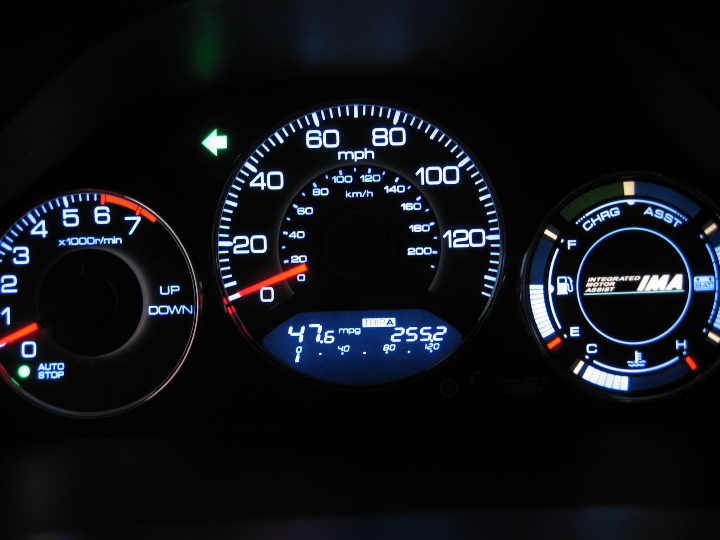
Re:metric?
Says someone who's obviously old enough to drive a car but too retarded to remember what the dash looks like. Miles aren't metric so you can write "miles-per-hour" any way you like. But if you're right about kph, how about you support your assertion with a screenshot?
-
Re:Been there, Done thatbrunascle: while we're wasting time, let's test relativity theory
MISSION UPDATE -- JUNE 2007
GP-B SUCCEEDED IN COLLECTING THE DATA TO TEST EINSTEIN'S PREDICTIONS ABOUT GRAVITY
Over four decades of planning, inventing, designing, developing, testing, training and rehearsing paid off handsomely for GP-B. The 17.3-month flight mission succeeded in collecting all the data needed to carry out this unprecedented, direct experimental test of Einstein's general theory of relativity--his theory of gravity.
-
Re:Auctions (if fair & open) yield the RIGHT p
Two very well known economists that study auctions and mechanism design would disagree about the Vickrey auction being the best. In fact, when used in iterative or combinatorial situations, the Vickrey auction can be downright bad.
http://www.stanford.edu/~milgrom/publishedarticles /Lovely%20but%20Lonely%20Vickrey%20Auction-072404a .pdf -
Shaders!
I've taught introductory computer graphics courses at both Stanford and the University of California, Santa-Cruz, and by far the most important change that needs to be made to the "traditional" curriculum is the introduction of the programmable pipeline. Far more so than the chosen language or API, teaching shaders forces students to understand the mathematics that lies at the heart of the graphics pipeline while simultaneously endowing them with the tools they need to create Really Cool Projects®. The prevailing mentality seems to be that asking students to handle lighting and transformations directly in an introductory setting is too difficult, but my experience has been that this is not at all the case.
For those that are interested, I have SIGCSE paper on the subject available here. -
Re:Not arbitrary.
The choice of 80 columns was pretty much arbitrary -- indeed, IBM also made 51 column and 96 column cards at various points. 80 columns was big enough to record an 80-digit decimal number, and had no real special significance that I'm aware of.
The size of the IBM was made equal to the dollar bill of that time, allowing reuse of existing filing bins and adaptation of other currency manipulating equipment. -
Does your rant have any basis in reality?
While I'm always up for a good rant about how fields are dumbed down, you're way off the mark.
most programmers aren't computer scientists. The author himself is evidently not one.
Seems like he has some chops, given this talk he gave at PARC
It was bad enough when courses about a programming language replaced ones about algorithms and data structures (I'm looking at you, Java and D-flat).
Is it really a bad thing to teach data structures in Java?
It was bad enough when the object, not the bit, became the fundamental unit of information.
Thanks for the chuckle, you sound exactly lik the grumpy old man from the SNL skit. Back in my day we didn't have objects, we had bits and we liked it! I'm not sure what you're trying to prove with this, well other than you know what a bit is and that makes you superior to people that think in higher level abstractions.
He's proposing that we replace the study of computer science with a vocational programming, and call that emaciated husk "computer science."
He does? I didn't get that from the article. Can you site something in that review or in the book?
That field has given us not only staples, like A* pathfinding, but a whole vocabulary with which we can talk about algorithms -- how do you say that a scheduler is O(log N) the number of processes except to, well, say it's O(log N)? You can't talk about computer science without talking about algorithms.
Did he say that it was absolutely worthless? I'm not sure if O(logN) is really an algorithm either.
"We don't need to understand the underpinnings of how things work", the angry mob chants, "but only implement the right interfaces and everything will happen automatically."
Does he state anything near to this?
The only really new things are algorithms, and increasingly, we're calling people who couldn't independently create bubble sort "computer scientists." It's ridiculous. Call computer science what it is, and create a separate label and department for people who can program, but not discover new things.
Ah, so I see where this leads up to. THe only thing CS related is the worship of the algorithm, and anything else
I wonder whether we'll fall into an old science fiction cliché and regress so far that we are unable to understand or recreate the technology of our ancestors.
Grumpy Old Man #2! Do you have any evidence to show that CS of today can't create what the CS of 1950's did and improve on the subject? Yeah your typical VB programmer can't, but who cares? This is like complaining that painting is going in the shitter as paint by numbers books are popular. -
Re:wahay!
"Doing a GUI really well takes creativity I've never had (apparently a lot of guys like me work at M$. I don't know where Apple finds it's GUI guys)."
Maybe the question should rather be: Why doesn't Microsoft look for the kind of GUI-guys Apple hires. And the answer to that might well be found at the top of each company. A quote from Steve Jobs' Commencement address at Stanford (June 12, 2005):
"Because I had dropped out [of college] and didn't have to take the normal classes, I decided to take a calligraphy class [...]. It was beautiful, historical, artistically subtle in a way that science can't capture, and I found it fascinating. None of this had even a hope of any practical application in my life. But ten years later, when we were designing the first Macintosh computer, it all came back to me. And we designed it all into the Mac. It was the first computer with beautiful typography. If I had never dropped in on that single course in college, the Mac would have never had multiple typefaces or proportionally spaced fonts. And since Windows just copied the Mac, its likely that no personal computer would have them. If I had never dropped out, I would have never dropped in on this calligraphy class, and personal computers might not have the wonderful typography that they do."
Read the whole thing, it's quite interesting (if not to say: inspiring). -
Re:MWI is cool and all....
-
Re:MWI is cool and all....
-
Re:MWI is cool and all....(1) "Qualia" generally refers to "what it is like" for you to experience something. Every experience you have has its qualitative component, called a "quale" in the singular. So when you take a hallucinogen, the hallucinations you experience still have a qualitative component.
(2) If you're asking whether there's a phenomenal difference (difference in quality) between a hallucination and a "real" experience (veridical perception), well, I would say yes, and it's more than just the fact that one has a real referent (and the other is imaginary). But this is by no means an uncontroverted area in philosophy. See here for more.
(3) If your drug doesn't produce any experience at all (it's psychoactively inert) then, it wouldn't produce any novel qualia, because there'd be no novel experience to go along with ingesting the drug.
-
Re:$500 is a steal, why are people being so diffic
Someone might want to do all those things specifically on their console
Yeah, and someone might really want to do their taxes on the front panel of their refrigerator.
As long as you're going as far as you have, you might as well say "I can play games on my PC, thus I don't need any console at all!"
Except a great video card ends up costing more than most consoles, and a PC makes a less predictable platform, so there are good reasons for consoles. It works like this--consoles are better at playing video games, PC's are better at being PC's. Except the PS3, which makes a shitty PC, a decent game console if HD is the only differentiating feature for you, and a surprisingly good scientific computation node.
-
Re:As they say...
Aristotle was hardly still accepted as current in the 16th and 17th centuries. Google John Philoponus -- "As regards the natural motion of bodies falling through a medium, Aristotle's verdict that the speed is proportional to the weight of the moving bodies and indirectly proportional to the density of the medium is disproved by Philoponus through appeal to the same kind of experiment that Galileo Galilei was to carry out [approximately 1000 years] later."
-
Google Distinguished Engineer's point of view
A couple of months ago, Luiz André Barroso of Google gave a talk at Stanford about this very topic. Unfortunately the talk wasn't recorded, but here's a summary: http://cs343-spr0607.stanford.edu/index.php/Write
u ps:Luiz_Andr%C3%A9_Barroso -
Re:I didn't get far...http://sloan.stanford.edu/mousesite/1968Demo.html
Not strictly what you're looking for, but I believe the computer used was commercially available, it's just that Doug had to build his own mouse, being the first guy on Earth to use one. In 1968.
It's really appropriate that the captcha is "origins"... -
Re:Depends on what you mean by real world.Thank you for the compliment. It's equally nice to know that there are active questioners on Slashdot determined to stretch the quality to the limits. In the spirit of providing information, though, I'll add a few links for the perusal and amusement of all. I'm hard on some of the software, but that's not because I could do better. If anything, it's because I have confidence the authors could.
Let's start with a Slashdotting of NASA...
- Scalable Dynamic Chimera Methods for Unsteady Aerodynamics is one of those packages mere mortals like us will have either no use for or will have to just drool over.
- Fully Unstructured Navier-Stokes 3D is a nice Fortran-based CFD, requires some hefty paperwork to obtain, and may need you to use G95 rather than GCC's GFortran, due to compiler bugs.
- OVERFLOW and related CFD software.
- Three Dimensional Multi-block Advanced Grid Generation System is the component that actually lets you do a lot of the necessary grid work for CFDs.
- Viscous Upwind ALgorithm for Complex Flow ANalysis is the hardest of the CFD codes at NASA to obtain, but if you want to work on anything hypersonic, it's the best place to start. Do Not Use hypersonic airflows for CPU cooling.
- Astrophysical Thermonuclear Flash Simulator - well, you never know.
- Geant4, for the subatomic nuclear physicist in your life...
- Open Field Operation and Manipulation is a nice open-source CFD package.
- Parallel Basic Local Alignment Search Tool gives you a parallelized search engine for nucleotides and proteins.
- Stanford Exploration Project provides some nice parallel geophysics applications and tools.
- Tachyon Parallel Raytracer is a nice example of what you can do with parallelism and graphics.
- Kerrighed is an up-and-coming clustering system for Linux. I saw it demonstrated at SC|05 - and was less than impressed. It needed a lot of work at that point. However, it looks like it has improved a lot since then, and it would be unreasonable to not mention it.
- MOSIX is the second-oldest clustering technology to gain a fan following to rival Star Trek. It's very good, though hard to get if you're not in academia. Arguably for entirely fair reasons.
- OpenMOSIX was originally a fork from MOSIX but is now essentially its own clustering technology. Development is nowhere near the speed I'd like, it does need far more eyes, but is well-known and highly regarded. Moshe Bar is also one of the coolest developers I've encountered.
- DAKOTA is a program for profiling parallel applications and should be useful in telling you where you are gaining and losing.
- HPC Toolkit is another toolkit for profiling HPC applications.
- is yet another profiler for parallel software. Between this and the others I've listed, you should have more information than sequential programmers ever get to work with.
- Performance API is a facility used by most of the profiling software to provide an architecture-independent view of performance counters. I have it on good authority that some (now former)
-
Knuth
For all those of you bashing Gates and claiming he's a buffoon simply because he doesn't use e-mail -- you do realize that Knuth doesn't either, right?
-
Re:A serious thought, for the moment...
Can you cite any reliable sources for the stock of *economically recoverable* uranium, and how long that stock could meet *all human energy needs* including ground transportation?
Additionally, safety concerns have to do with the fact that nuclear power plant operators have a pretty poor track record of a) disposing of waste properly, and b) telling the truth about what they've done.
Classic scaremongering. Both points you make are a) full of shit, and b) outright lies. So, I'll dispense with those first.
If you remember the movie Erin Brockovich; where California electric companies were using open air evaporating ponds to dispose of toxic Chromium metals. Yes that did happen, no it was not a nuclear plant, and yes, it received a lot of press coverage.
The movie Civil Action, where companies were sued for dumping toxic chemicals onto the ground, into streams and rivers. Yes, those things did happen. In every year from the founding fathers up to the 1970's there were a LOT of companies disposing of waste improperly, and precisely NONE of it was nuclear waste. NONE OF IT.
Nuclear reactors are not easy to build. It takes scores of engineers to do it, people who know how nasty the waste byproducts and radiological components can be. You can't just build a reactor in your back yard. Since the inception of the technology, EVERY SINGLE MOLECULE OF WASTE HAS BEEN ACCOUNTED FOR! People are incorrectly attributing the irresponsibility of power companies and heavy industry in the past over to the Nuclear industry because of the fears instilled in us every single day of our lives from the sources I point out in my previous post.
So, your points a & b are horseshit, horseshit, horseshit. And if you don't know what that is, thats the stuff that comes from a horse.
Now, as to "economically recoverable"... what a buzzword. Nuclar Reprocessing plants can recover 95% of spent fuel to put back into production. A Stanford study shows that if were were ONLY to harvest the URANIUM found naturally in SEAWATER, it would power reactors for 7 million years. The same study also states that we have enough fuel available to power ALL the worlds energy needs for the next 5 Billion years. -
Wheels like the Dymaxion Car, 1937
Separately powered wheels that could swivel through 360 degrees was a feature of Bucky Fuller's Dymaxion Car
-
Re:Imagine if you will
Are you honestly suggesting that we have reached the "end of science?"
No, I think there are still things to learn, I just doubt that I'm suggesting that the general theory of relativity hasn't failed a test yet (although it doesn't explain the tiny world of quantum physics), and has predicted many things that are still being proven true in experiments almost a century later. The only way of fast travel that obeys the rules in General Relativity would be a wormhole. Wormholes aren't proven to exist and I doubt they do. How do you create one? The most likely way would be collapse of a star into a black hole, I don't think I want that to happen to Sol. Then you'd also need some matter with negative mass (which we haven't observed) to keep it from collapsing completely. Oh, and a white hole at the other end, which would violate the third law of thermodynamics. And so we have a wormhole, we need to move one end to another star, which is more difficult than taking a simple trip there in the first place so let's rule wormholes out for now.
Fire was taming something that occurred naturally. Gravity can be seen just by dropping something. Magnetism occurred in natural stones. Traveling across the ocean was merely daring to try it. Electricity was harnessing forces we can see in lightning or when walking across a rug. Flight was possible, we saw birds do it. We saw chemicals interacting (rusting for instance) long before we understood what was happening. You just have to look up on a clear day to see nuclear fusion in action. Where's the observable phenomenon that will let things travel faster than light or switch unharmed into another dimension and back?
I'm not saying that we've reached the "end of science" by any means, but I do believe that the universe obeys certain laws, and that traveling faster than light from one point in our universe to another is about as likely using science as it is by waving a magic wand.
-
Re:Both right?
Yeah, but none of those magic wands of the past went directly against the principles of sound scientific knowledge at the time. I feel the speed of light barrier is going to keep us from reaching Star Trek, ever.
How many times to I have to post it? Gravity Probe B has recently experimentally confirmed relativistic "frame-dragging", the implication of which is that "gravitic" information travels faster than light. (SETI by radio astronomy is retarded, any advanced lifeform will know that.)
On the overall subject, the author of the linked article is neglecting one way manned suicide reconnaissance probes, genetic engineering of humans for the journey and destination, and of course gravitic drive ships.
Very narrow minded, Stross is wrong, Hawking is right.
A good example is this quote from TFA:Colonize the Gobi desert, colonise the North Atlantic in winter -- then get back to me about the rest of the solar system!
Done, and done! Stross obviously has very little knowledge about human capability. I am a devoted science fiction fan and I have never heard of him. An Arthur C. Clarke he certainly is not! -
Re:"perfect" sphereThe Gravity Probe B (GP-B) project holds the current record for the roundest object. Incidentally, just this month GP-B released a portion of their final data that experimentally confirms general relativity!!! (Which was strangely deemed not newsworthy when submitted to slashdot.)
After years of work and the invention of new technologies and processes for polishing, measuring sphericity, and thin-film coating, the result was a homogenous 1.5-inch sphere of pure fused quartz, polished to within a few atomic layers of perfectly smooth. In fact, the GP-B gyro rotors are now listed in the Guinness Database of World Records as being the roundest objects ever manufactured; they are topped in sphericity only by neutron stars. The spherical rotors are the heart of each GP-B gyroscope. The raw quartz material was mined in Brazil, and then fused (baked) and refined in a proprietary process at Heraeus Amercil in Germany. The interior composition of each gyro rotor is homogeneous to within two parts in a million. On its surface, each gyroscope rotor is less than three ten-millionths of an inch from perfect sphericity. This means that every point on the surface of the rotor is the exact same distance from the center of the rotor to within 3x10⁻⁷ inches. If a GP-B gyroscope rotor were enlarged to the size of the Earth, its tallest mountain or deepest ocean trench would be less than eight feet!
http://einstein.stanford.edu/content/exec_summary/ GP-B_ExecSum-scrn.pdf[PDF] -
Re:"perfect" sphereThe Gravity Probe B (GP-B) project holds the current record for the roundest object. Incidentally, just this month GP-B released a portion of their final data that experimentally confirms general relativity!!! (Which was strangely deemed not newsworthy when submitted to slashdot.)
After years of work and the invention of new technologies and processes for polishing, measuring sphericity, and thin-film coating, the result was a homogenous 1.5-inch sphere of pure fused quartz, polished to within a few atomic layers of perfectly smooth. In fact, the GP-B gyro rotors are now listed in the Guinness Database of World Records as being the roundest objects ever manufactured; they are topped in sphericity only by neutron stars. The spherical rotors are the heart of each GP-B gyroscope. The raw quartz material was mined in Brazil, and then fused (baked) and refined in a proprietary process at Heraeus Amercil in Germany. The interior composition of each gyro rotor is homogeneous to within two parts in a million. On its surface, each gyroscope rotor is less than three ten-millionths of an inch from perfect sphericity. This means that every point on the surface of the rotor is the exact same distance from the center of the rotor to within 3x10⁻⁷ inches. If a GP-B gyroscope rotor were enlarged to the size of the Earth, its tallest mountain or deepest ocean trench would be less than eight feet!
http://einstein.stanford.edu/content/exec_summary/ GP-B_ExecSum-scrn.pdf[PDF] -
Re:One small step.....
What an odd thing to say. Linux (as an operating system) is currently capable of supporting (insert the name of any application you can mention here). Does it currently support that application? Maybe not, but thats not the fault of the OS, as its ready and capable. Perhaps you should consider reading the Church-Turing Thesis. The short version is that any computing device which is capable of a small set of very primitive directives, is capable of performing (running) any (program) that any other device capable of the same set of very small primitive directives. Put another way, anything that Solaris, ZOS, Windows(x), MacOS, Linux, BSD, or any other system is capable of, any of the others are similarly capable. This doesn't just apply to operating system, but also computer languages, and also computing hardware (any microprocessor). Many have looked the thesis over, including among others Bertrand Russell and Albert Einstein, and could not even begin to refute it. This thesis does not deal with time complexity or efficiency. Some systems may be less efficient than others, but we are talking about capability, not efficiency here.
-
Re:And it will only be a matter of time...And where do I sign up for this ?
http://web.mit.edu/admissions/
http://www.admissions.caltech.edu/
http://www.stanford.edu/dept/uga/
and the list goes on... -
Re:Linus is not the god you think he is.
You forgot Dijkstra http://en.wikipedia.org/wiki/Edsger_Dijkstra and of course Knuth http://www-cs-faculty.stanford.edu/~knuth/
Not that you're wrong. I would not call Linux "a poor re-implementation of a 20 year old operating system", but the original reason behind it was not to be the best OS out there. It was to fill a need that Linus had.
I am sure that if Linus had taken Andrew S. Tanenbaum's OS design course he wouldn't have turned in Linux as a piece of coursework... But that wasn't why it was created. I would imagine that people who take that course are not given assignments like "Write an OS from the ground up" but more likely "implement X in a micro kernel architecture"...
Z.