Slashdot Mirror
Domain: stanford.edu
Stories and comments across the archive that link to stanford.edu.
Comments · 4,853
-
Re:T3?
I wasn't even aware that T3 brought anything new to special effects stage.
That's a naive statement on the state of VFX. Not particularly directed at you but a large number of people just go by the looks without knowing what goes on behind the scenes.
T3 was the subject of several SIGGRAPH (the most important conference and organization related to computer graphics) sketches and even one SIGGRAPH paper (one of the highest honors in CG research):
Smoke Simulation for Large Scale Phenomena
Big Bangs
Melting a Terminatrix
The Machines of T3
'T3' -- BETWEEN THE LAYERS
Fight the Future
Terminator 3 Evolves Historic Effect
TechTV Segements on T3 and Pirates of the Caribbean Online
T3: Man vs. Machine
Building a Believable BlockbusterNot saying that the others weren't outstanding and innovative as well. Thye same point can be made about all the other bakeoff finalists.
-
Re:T3?
I wasn't even aware that T3 brought anything new to special effects stage.
That's a naive statement on the state of VFX. Not particularly directed at you but a large number of people just go by the looks without knowing what goes on behind the scenes.
T3 was the subject of several SIGGRAPH (the most important conference and organization related to computer graphics) sketches and even one SIGGRAPH paper (one of the highest honors in CG research):
Smoke Simulation for Large Scale Phenomena
Big Bangs
Melting a Terminatrix
The Machines of T3
'T3' -- BETWEEN THE LAYERS
Fight the Future
Terminator 3 Evolves Historic Effect
TechTV Segements on T3 and Pirates of the Caribbean Online
T3: Man vs. Machine
Building a Believable BlockbusterNot saying that the others weren't outstanding and innovative as well. Thye same point can be made about all the other bakeoff finalists.
-
Re:Nivida CG
Actually, the BrookGPU implementation that this article refers to requires an installation of Cg, because what it actually does is convert the Brook code into Cg code. That's why Cg is on its list of requirements page. Brook is just a slightly easier language to code in than Cg, that's all.
-
Re:wait a minute
Are you sure that you can compare the speed of GPU and CPU?
Professor Pat Hanrahan, of Stanford University, made a stab at answering this question in his presentation 'Why is Graphics Hardware so Fast?'. The first half of the presentation focuses on this question, while the second half of the presentation covers programming languages that utilitize this hardware. Specifically, the Stanford Real-Time Shading Language (RTSL) and Brook are discussed. Overall, it's a good presentation that should get you up to speed with the basics of what's happening in this area of research. -
Re:wait a minute
Are you sure that you can compare the speed of GPU and CPU?
Professor Pat Hanrahan, of Stanford University, made a stab at answering this question in his presentation 'Why is Graphics Hardware so Fast?'. The first half of the presentation focuses on this question, while the second half of the presentation covers programming languages that utilitize this hardware. Specifically, the Stanford Real-Time Shading Language (RTSL) and Brook are discussed. Overall, it's a good presentation that should get you up to speed with the basics of what's happening in this area of research. -
Site is slowAs the programmability and performance of modern GPUs continues to increase, many researchers are looking to graphics hardware to solve problems previously performed on general purpose CPUs. In many cases, performing general purpose computation on graphics hardware can provide a significant advantage over implementations on traditional CPUs. However, if GPUs are to become a powerful processing resource, it is important to establish the correct abstraction of the hardware; this will encourage efficient application design as well as an optimizable interface for hardware designers.
Brook is an extension of standard ANSI C and is designed to incorporate the ideas of data parallel computing and arithmetic intensity into a familiar and efficient language. The general computational model, referred to as streaming, provides two main benefits over traditional conventional languages:- Data Parallelism: Allows the programmer to specify how to perform the same operations in parallel on different data.
- Arithmetic Intensity: Encourages programmers to specify operations on data which minimize global communication and maximize localized computation.
The BrookGPU compilation and runtime architecture consists of a two components. BRCC is the BrookGPU compiler is a source to source metacompiler which translates Brook source files (.br) into
The BRT is an architecture independent software layer which implements the backend support of the Brook primatives for particular hardware. The BRT is a class library which presents a generic interface for the compiler to use. The implementation of the class methods are customized for each hardware supported by the system. The backend implementation is choosen at runtime based on the hardware available on the system or at request of the user. The backends include: DirectX9, OpenGL ARB, NVIDIA NV3x, and C++ reference. -
Good point.
After taking a quick peek at the language part of the project it seems right now that most of it's functions are all about sets of data and how to move them around.
Makes sence of course as that is what a GPU is all about. (Yes I'm vastly over-simplyifying here.) So I would gather that it might be used for types of data that are streamed alot? Maybe used for video editing, real time video, etc where your trying to deal with a lot of data at once that your trying to move around and not just store or have to perform some more complicated types of functions upon.
However, I'm no 3d programmer and I should would love a more detailed analysis of the potentals for this. -
first link is incorrect
but the link to the project page is correct.
-
As usual...
John McCarthy came up with the same idea (and invented a better XML before anyone had even heard of SGML) 30 years ago.
-
Re: Bandwdth
One user mentioned a bandwidth concern, I would like a adress it.
I was working on a project like this, and am now looking into contributing to GNUNet, a similar project. My framework had peers moving data in a similar way as these ants. The way I looked at it was that most of the time I select some files, let them download, and come back later. I'm sure the downloading takes only ten or twentey minues, but I'm at work or busy otherwise. Once I'm done downlaoding my computer just sits there folding. The bandwidth is going un-used!
There is plenty of bandwith sitting idle out there, so long as the ants are clever enough to avoid busy relays noone will really notice the drop in their performance. I think that they would have a similar approach (it seems it would work this way as a concequene of their ant design).
I sincerely hope that one of these true P2P private networks takes off in a big way, till then I will support them in every way I can. -
Re:About LaTeX..Couple questions, I thought I read on one site that you can only go 4 levels down on sections/subsections.
Another poster has answered this below..
Is this true? (Hopefully using the right term...I mean itemized lists with roman numerials, numbers, letters for each part)
If you mean "itemized" or "enumerated" lists then yes there is a limit it appears you can go 5 deep.
The following will give a "Too deeply nested" error. Due to the "sub sub sub sub sub sub item"
N.B. It it not very pretty due to having to get past the "comment compression filter"...
\documentclass{article} \begin{document} \begin{itemize} \item Item \begin{itemize} \item Sub item \begin{itemize} \item Sub sub item \begin{itemize} \item sub sub sub item \begin{itemize} \item sub sub sub sub item \begin{itemize} \item sub sub sub sub sub item \end{itemize} \end{itemize} \end{itemize} \end{itemize} \end{itemize} \end{itemize} \end{document}
As with many aspects of LaTeX however if you find it doesn't do something it probably means it's not prudent (from a structural perspective) to do it anyway. For example if you really need that level of deep reference you may well be better off with part,chapter,section, subsection,
Also, can ya'll post some good links to a newbie learning LaTex..and some good reference sites that have all the tags layed out with good explanations?
Sure, below are a list places I would reccomend starting, you havn't said if you use Windows, *nix or Mac so i've added both (sorry if you are a Mac man you'll have to Google yourself).
- Editing:
- *nix If you are a *nix user I would reccomend the following editing combination.
- XEmacs
- AucTeX. A sophisticated editing mode for LaTeX
- preview-latex. Places the rendered equations and images directly in the editor window making "equation tuning" and other tasks a snip.
- Windows
- WinEdt. A very sophisticated text editor for Windows. Its forte is LaTeX. It is not free, but well worth the money.
- Learning resources:
- Other random stuff
- dvipdfm. For converting the output of LaTeX into PDF (highly recommended)
- Prof. Knuth's home page(The author of TeX).
- CTANThe Comprehensive TeX Archive Network. Here you will be able to download packages, utilities and tools that do not come by default in your LaTeX distribution.
-ed
-
Re:I doubt they'd find anything
SETI@Home is the most popular project, measured by number of participants, but it was actually the third large-scale, public domain, distributed computing project. A lot of its functionality and design is based on the second project, distributed.net, which in turn is based on some design ideas from the first project, GIMPS.
SETI@Home has definitely done a lot to popularize distributed computing, and has influenced many later projects, including protein folding projects like Distributed Folding and Folding@Home.
To see what other projects are out there, take a look at my site about distributed computing projects. And click on the links to past years (on my main index page) to see just how fast this field of science is growing.
Kirk
P.S. Somebody please -
alsa!
at last we have default alsa. ding dong the evil oss-free witch is dead!
so when's planet-ccrma going to update to 2.6? -
Re:what bubble?
The term 'trojan' goes all the way back to the horse presented to the people of Troy as a present but was a sneeky Greek attack (a brief history here). A Trojan in the true sense refers to this, so I suppose the parent was referring to iTunes being a sneak ploy to get people to use iPod.
Not that the 'hacker colloqualism' of trojan horse is a misuse, it is not, but to see this as the primary source is just wrong. -
Re:Copyright question
Is it okay to use and distribute a snippet of GPLed code if it's considered "fair use"? If so, can you ignore the GPL license since it would THEN be more restrictive than the current copyright law?
If you're distributing the code, you're not violating the GPL, since that's exactly what it requires you to do.
If you're distributing the complete compiled program without the code, you're probably not covered under fair use, since it usually only protects use of 'excerpts' or other carefully defined portions of works.
Maybe you can more clearly explain a situation where you would be in violation of the GPL, but protected under fair use? -
Re:What's the use?
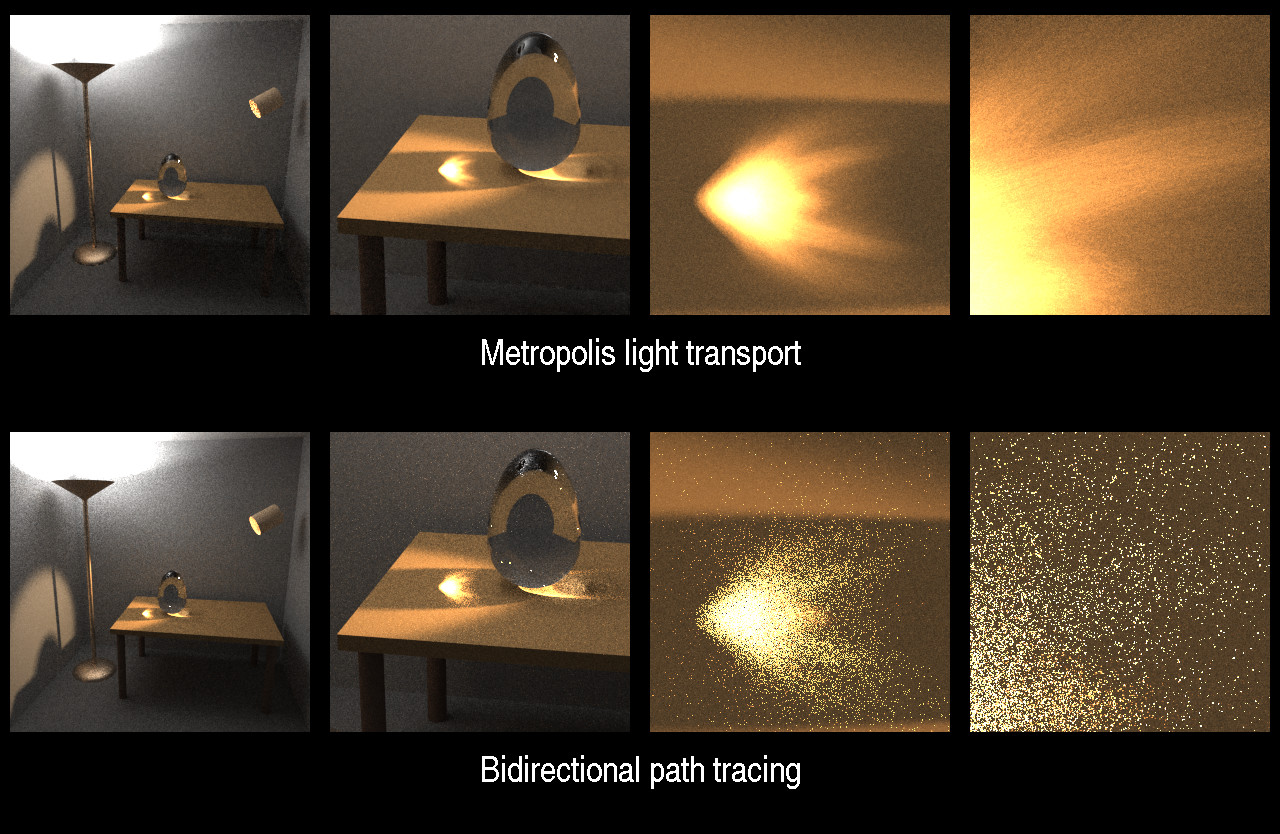
For instance, the next step after radiosity, as I understand, is Metropolis Light Transport. It can render some rather nice caustics:
http://graphics.stanford.edu/papers/metro/fig6.jpg
http://graphics.stanford.edu/papers/metro/ -
Re:What's the use?
For instance, the next step after radiosity, as I understand, is Metropolis Light Transport. It can render some rather nice caustics:
http://graphics.stanford.edu/papers/metro/fig6.jpg
http://graphics.stanford.edu/papers/metro/ -
Missed the largest one.
Particle physics experiments routinely collect far more data than this. The Babar experiment that I participated in stores enough data that its database is an order of magnitude greater in size than anything in this article (Current size: 895.0 TB).
See: BaBar Database for details, it uses an OO database (which in my experience was very painful for users)
Dan
-
Missed the largest one.
Particle physics experiments routinely collect far more data than this. The Babar experiment that I participated in stores enough data that its database is an order of magnitude greater in size than anything in this article (Current size: 895.0 TB).
See: BaBar Database for details, it uses an OO database (which in my experience was very painful for users)
Dan
-
Our Community and DMCA
Does the notion that a small group, using Internet-centric communication, coordination and managment imply that the days of the political lobbyist are numbered? Does it imply that we can create an organized approach to reaffirming Fair Use and restructuring the DMCA. If Howard Dean can use Internet-centricity to overthrow the Democratic Party then surely the Slashdot community can coordinate moves to restructure DMCA along user-centric lines.
-
Our Community and DMCA
Does the notion that a small group, using Internet-centric communication, coordination and managment imply that the days of the political lobbyist are numbered? Does it imply that we can create an organized approach to reaffirming Fair Use and restructuring the DMCA. If Howard Dean can use Internet-centricity to overthrow the Democratic Party then surely the Slashdot community can coordinate moves to restructure DMCA along user-centric lines.
-
The mandatory great open-source tool for this-post
Have you looked at rdiff-backup? It's a mix of a backup system and rsync, thus makes it possible to back up entire hard disks over a small connection.
-
course website
Following the schema of all Stanford CS courses, it will soon be at:
Since it already has a "Under construction...", the professor's assistant is probably already busy preparing the page. -
Tilting pie menus rock!There's an earlier slashdot article about "Gyroscope Gives CellPhones" 'Tilt Control'". Probably not gyroscopes, but actually MEMS accelerometers.
Pie menus are a naturally efficient way to operate a tilt-sensitive user interface. Scrolling up and down through one-dimensional linear menus with a device that can tilt in any directions is a waste of the device's potential.
Here's a cool research paper from Sony's Computer Science Labs, about "tilting pie menus". I love it! I can't wait till all cell phones can sense tilt. Tilt control rocks!
Tilting Operations for Small Screen Computers
By Jun Rekimoto, Sony Computer Science Laboratory, Inc.
More details: Tilting Operations for Small Screen Interfaces (Tech Note)
HTML version from Google-Don
-
This course is going to be online.
The link to scpd.stanford.edu means that the course will be available both online and on tv to all Stanford students and companies that pay for Stanford courses.
I wonder if my expired stanford.edu account will let me in to view the courses? -
Re:Legal Ramifications Resulting From Use of NTLMThe only problem may be if MS has a patent on something fundamental in the NTLM system...
True, but the law says reverse engineering is legal for interoperability. And it seems to me this is a big fat interoperability issue.
(f) Reverse Engineering. - (1) Notwithstanding the provisions of subsection (a)(1)(A), a person who has lawfully obtained the right to use a copy of a computer program may circumvent a technological measure that effectively controls access to a particular portion of that program for the sole purpose of identifying and analyzing those elements of the program that are necessary to achieve interoperability of an independently created computer program with other programs, and that have not previously been readily available to the person engaging in the circumvention, to the extent any such acts of identification and analysis do not constitute infringement under this title.
(Seems to essentially overrule what lots of companies pull out the DMCA for, doesn't it?)
In any case, also check out Sega Enterprises LTD. v. Accolade INC. 977 F.2D 1510 (9TH CIR. 1992) and Atari Games Corp. v. Nintendo of America, 975 F.2d 832 (Fed. Cir. 1992) -
great quotes... innovation retrospective
this articles a good read so take the time to go through it as it summarises innovation from the early internet years to date.
innovation. The trick is finding that one crazy idea. The problem with crazy ideas, though, is that for every one good crazy idea, there's a thousand bad crazy ideas
the eternal quest for an idea. you better start with a good idea. if you don't, no matter how hard you try it wont pan out.
the Internet community back then, the key technical people, didn't want the Internet to become easy to use or graphical,
what other examples can you think of right now?... only smart people can use [insert you own example]
Mosaic started with 12 users in February 1993. It had 1,000 users within three or four weeks. About 10,000 users by spring. It was up to 1 million by early 1994
Posters who question why Andreessen has such prominence should reflect on this. No Mosaic (mozilla), no Microsoft Internet Explorer (IE Based on NCSA Mosaic code base licensed from Spyglass), no World Wide Web in the early to mid 90's. No doubt someone else may have invented the browser but how much longer would it have taken?
At first that makes you like a little bunny rabbit
Larry, Sergi do you feel the hot breath of the MS juggernaut as you approach your IPO. Will google will be a repeat of Netscape/MS tussle?
Oracle database was a huge success
it sure helps when the government (CIA) is your preferred backer. Why does oracle feel the need to keep trying to re-innovate or create the next best idea?
innovation comes from companies that are 2 years old, populated by 19-year-olds
In fact it's both. The technical revolution was spurred on the back of the transistor. This was the combined effort of Bardeen, Brattain and shockley at Bell Labs - no small comany there
-
great quotes... innovation retrospective
this articles a good read so take the time to go through it as it summarises innovation from the early internet years to date.
innovation. The trick is finding that one crazy idea. The problem with crazy ideas, though, is that for every one good crazy idea, there's a thousand bad crazy ideas
the eternal quest for an idea. you better start with a good idea. if you don't, no matter how hard you try it wont pan out.
the Internet community back then, the key technical people, didn't want the Internet to become easy to use or graphical,
what other examples can you think of right now?... only smart people can use [insert you own example]
Mosaic started with 12 users in February 1993. It had 1,000 users within three or four weeks. About 10,000 users by spring. It was up to 1 million by early 1994
Posters who question why Andreessen has such prominence should reflect on this. No Mosaic (mozilla), no Microsoft Internet Explorer (IE Based on NCSA Mosaic code base licensed from Spyglass), no World Wide Web in the early to mid 90's. No doubt someone else may have invented the browser but how much longer would it have taken?
At first that makes you like a little bunny rabbit
Larry, Sergi do you feel the hot breath of the MS juggernaut as you approach your IPO. Will google will be a repeat of Netscape/MS tussle?
Oracle database was a huge success
it sure helps when the government (CIA) is your preferred backer. Why does oracle feel the need to keep trying to re-innovate or create the next best idea?
innovation comes from companies that are 2 years old, populated by 19-year-olds
In fact it's both. The technical revolution was spurred on the back of the transistor. This was the combined effort of Bardeen, Brattain and shockley at Bell Labs - no small comany there
-
used to do it. found better causes
I've contributed over 5000 work units to SETI and even found one of those "interesting" signals. I stopped a while ago. Why? a few reasons:
1. I realized that the amount of time a civilization would use anything recognizable over radio waves would probably be pretty short. From the invention of radio until every signal is compressed and/or encrypted would probably be a few hundred years at best. compressed and encrypted data would just look like noise and probably wouldn't stand out. So it's either no-radio or unintelligible radio signals for billions of years with a small "hearable" window. not too promising that we'd be able to catch that.
2. There are better or at least more interesting causes out there for CPU donators. Folding@home has the potential to contribute to a nanotechnological or medical revolution. United Devices is a project to test cancer drugs and the results go to Oxford in case you're wondering about the for-profit nature of the company behind it. Finaly, the climate prediction project is contributing to a better understanding of planetary climate dynamics.
My side interest is Mars exploration and terraformation which is a pretty much just consists of reading literature on the subject. However, with contributing to nanotech, cancer drugs and climate prediction, I am making a small dent in the effort to adapt both ourselves and technology to making a new world.
I realize that last part was a bit offtopic but I thought I'd at least give a little reasoning behind why I choose to run those ones. -
Re:hunt down spammers
The U.S. should rightfully continue to refuse to agree to any treaty that has not been shown to be in the best interests of the citizens of the U.S.
Of course if you are so uneducated as to not know that treaties like Kyoto and the ICC, whilst not obviously in America's short term interests, are in fact in America's long term interests, you might say something so daft in the context of Kyoto and the ICC.
Have a read about the prisoners' dilemma and you might see what I mean. -
Re:A presentation was given on this last month.
Whoops -- try this:
Paladium Lecture -
How about this...
-
Re:Am I the only one?
Back in my day we didn't have this abstract stuff [introduction to a book]. No sir. No turing machines and no compilers. We had to hard code our algorithms. We didn't have punch cards either. I had to manipulate the very laws of physics. My computers were huge, took large grants from the government to build. Heck, one of my employees (a woman) had to pretend to be a man just to find work.
--Charles Babbage -
A good place to use that extra power
-
Re:Ferrets
I think they're just worried that people will rediscover the ancient art of ferret legging.
-
Re:The folks at HP said...
Actually the first computer mouse was invented by Douglas Engelbart of Stanford Research Institute long before the people at Xerox Park made the office of the future that featured a computer with mouse on each desk. See pictures of the first mouse.
This does not mean that some one at HP never said people wouldn't want to have a mouse. -
Re:Cryptonomicon
Funny, first thing I thought of was Don Knuth.
-
As usual Knuth is an expert
-
A presentation was given on this last month.
-
Re:So what exactly is it good for in the office?It's interesting that IM is finally getting the attention it deserves in the corporate world.
I wrote a research paper last year examining the basic issues of IM in the workplace.
Big takeaway: Managers and employees have profoundly different interpretations of how/why IM should be implemented at work. If you want, read the paper here.
-
The spread of the free software mode of production
Good stuff, the more areas of human activity that the free software way of producing things spreads to the better, another science thing is featured on the front page of Creative Commons at the moment, PLoS:
The Public Library of Science is a nonprofit organization dedicated to making the world's scientific and medical literature a freely available public resource. PLoS emerged in October 2000 through the effort of three dynamic and highly respected scientists: Nobel Laureate and former head of the National Institutes of Health Harold Varmus, molecular biologist Pat Brown of Stanford University, and biologist Michael Eisen of Lawrence Berkeley National Lab and UC Berkeley. This trio's dream, as the L.A. Times put it, is to build "a world in which the many thousands of scientific journals . . . are placed in an electronic library open to the public."
Science and education seem to be areas where this is taking off at the moment, the design of things seems to be happening at a lot slower rate. Perhaps the lack of free CAD software to compete with AutoCAD is one of the main things holding this back?
I'm looking forward to the day when I can buy a washing machine and vacuum cleaner that are build from designs under GPL style licences...
-
Re:Blame the teacher!
Doctor Donald E. Knuth is a professor at Stanford. Right now he is working on his books, The Art of Computer Programming. He has three of about five volumes done so far. Very good books, well worth the $150 price even if you don't get them on sale.
-
Re:Mapping engine status: Stalled
Go look at the H3 viewer here. This is the definitive work in this area. Tamara is now at UBC, I talked to her at a conference, she's cool.
-
Re:Great
SRP looks very interesting too. It's a zero-knowledge based system and does not even require encryption when authenticating to be secure from capture/replay and brute forcing. It does not require a key to be stored locally at the client (you simply use a passphrase), and the server does not have enough knowledge to reconstruct the password. Furthermore, the password is never transmitted to the server.
One caveat though: You need to generate/transmit the password in some secure way (as is the case with all systems).
-
Re:So he's the one
If you think that "discrete math" is a buzz-word, you should read D.E. Knuth: Selected Papers on Discrete Mathematics. Sorry to disappoint you, but CS people like me trust somebody like DEK more to decide what a buzzword is than pretenders like you. If it would be a buzzword, he wouldn't have chosen it as a determining category in one of his book's title.
-
alsa sound kernel support
I'm looking forward to the end the nasty OSSFree, and the beginning of the silky smooth default included Alsa sound kernel.
no more annoying upgrading my system to Alsa when I want to make it into a professional audio workstation
-
Re:Sure:
Very good. But how do you store this?
-
The other side: the hidden costs in people terms
This article from Stanford Business School talks about research showing workers reactions -- they fear virtual teams may make them obsolete.
Basically: work virtually, put all your knowledge on the company intranet for others to have, and why would the company need you any more?
That's a simplistic assumption, because the value of an employee is primarily in what cannot be communicated or written down easily (otherwise rules engines would be able to replace us all), but executives might just assume that once you've been "milked" of what you know, you are expendable. In your place they hire some cheap incompentent, and tell them to read your digital history. -
Cancer-fighting Fish!These fish may be new to the pet trade, but they have been used for years by biologists to study growth and development. Fluorescent zebrafish are excellent experimental subjects, because:
- They breed like wildfire and are easy to raise in large numbers. (Imagine a big, big wall of fishtanks.)
- Their embryos are a convenient size and are completely transparent - you can see every organ in their bodies.
- You can watch the embryos continuously under the microscope for hours, or even days, at a time. (This is not true of, say, mouse embryos, which tend to become very unhappy once they are removed from the mother mouse.)
- Find some protein that they think is important, like growth hormone.
- Find the gene for that protein. For human genes, you can do the equivalent of a Google search through the entire human genome. If you want the equivalent gene in zebrafish, you can take advantage of the zebrafish genome archives. There are also complete genomes for mice, Drosophila (fruit flies) and other creatures that are popular with scientists.
- Make a copy of the promoter for your interesting gene. (Genes, like email messages, are controlled by their headers. In genetics these headers are called "promoters". Basically, when the promoter gets activated, the cell starts to transcribe the gene and begins to produce the protein which the gene encodes.)
- Attach your copied promoter to the gene for a fluorescent protein (the most popular protein is Green Fluorescent Protein, known as GFP - but there are red, cyan and yellow ones as well.)
- Insert your new promoter+gene into an egg cell and grow a creature. Breed it a lot. Inbreed its offspring a lot until you have an extended family of genetically engineered creatures.
My lab uses transgenic, fluorescent mice to study how blood vessels grow. We are trying to learn how to prevent blood vessels from growing into tumors...
-
Re:Why is there a need for this?
One of many research projects for automated bug-finding. (Researchers often like to use Linux to feed to their toys since it's a large and reasonably realistic code base.) This particular paper reports over 500 bugs in Linux found by analysis for some simple conditions for bugs like:
- failure to check for NULL before using the allocated block
- memory leaks
- use of pointer after memory was freed
- allocating (and using) a smaller block than the pointer points to, which is to say a memory overwrite
- deadlocks from calling blocking functions while interrupts are masked
- unloading dynamically loaded kernel modules while they are in use
- failure to release acquired locks
- releasing a lock multiple times
- paths that fail to re-enable interrupts
In short, a whole laundry list of the usual mistakes people make repeatedly.
Open source programmers are just as human as anyone else. And just because people could look at the source doesn't mean they actually do.