Slashdot Mirror
Domain: statewatch.org
Stories and comments across the archive that link to statewatch.org.
Comments · 62
-
Re:That worked great in GermanyAlright, let's go over this too:
This is a leaked draft impact assessment(PDF alert)
Note: you have just repeated the URL from the article; just repeating a source does not make it any more genuine, and may make it actually less convincing.
you can read more about it here: European Copyright Leak Exposes Plans to Force the Internet to Subsidize Publishers
If this were an alternate source, I'd consider that it might lend more credibility to the assumption that the putative leak is genuinely what it is purported to be. But this is not an alternate source for it; rather, it is the EFF's analysis is of the very same putative leak indeed, to the URL. It therefore does not give said putative leak more credibility.
This is what Julia Reda (MEP) says about it: Commissioner Oettinger is about to turn EU copyright reform into another ACTA:
This is not a copyright fit for the digital age. It’s a copyright that tries to protect the big players of the past from the future.
Again, an analysis the same putative leak, to the URL, not an alternate source. As an opinion piece on the question of paying for news excerpts, it is certainly relevant; as a proof that the purported leak is genuine, it is not.
Note that I do not belittle the EFF or Reda's analyses, and I certainly don't think less of their opinions on copyright; my point was initially, and still is, "how do we know rather than assume that this is really a leak of a EU Commission document intended to be the Commission's proposal?" and I find no convincing answer to this question in opinions based on the very assumption I am questioning.
(oh, and before anyone asks, or skips the asking and states outright: I find the idea of trying to make news "sources" collect pay for excerpts of their "content" bad in several respects, including for the very ones it is supposed to benefit. But just because I disagree with a document does not make that document genuine, nor does it allow me to disregard checking whether it is. Fact-checking is -- well, should be -- anisotropic.)
-
Re:That worked great in Germany
This is a leaked draft impact assessment(PDF alert), you can read more about it here: European Copyright Leak Exposes Plans to Force the Internet to Subsidize Publishers
This is what Julia Reda (MEP) says about it: Commissioner Oettinger is about to turn EU copyright reform into another ACTA:
This is not a copyright fit for the digital age. It’s a copyright that tries to protect the big players of the past from the future.
Europe’s publishing, film and music industries have clearly found that influencing Commissioner Oettinger to write laws is easier and more lucrative than adapting to progress and competing fairly. -
Re:How many years could he be charged with?
Who's the ignorant moron, again?
Uh... you? That'd be my guess, since 'ignorance' means that you're blissfully unaware of the facts of a situation. And this is one situation where you appear to be in exactly that state, but insist on parroting a blog post from another ignorant MORAN that you read somewhere online, despite the fact that the author was dead wrong and completely ignorant of the relevant laws.
http://www.statewatch.org/news...
Article 14: Temporary and Deferred Surrender.
Read it, and weep, chum. The articles governing US-UK extradition and US-Sweden extradition are largely identical.
-
Re:How many years could he be charged with?
extradition from Sweden to the US is easy, extradition from the UK to the US is harder.
Is that so, perfesser?
Do read Article 14 of the US-UK extradition treaty, which covers "temporary surrender."
http://www.statewatch.org/news...
Yes, that's the same exact clause that has you shitting bricks over his chances of being extradited by Sweden... and it's in force in the UK, as well. So explain to us why it's so much harder for the UK to extradite him, when the US-UK treaty is more or less exactly the same as the US-Sweden treaty in regards to this clause?
-
Re:Refund on overhearing my pizza order
Crashing the Wiretapper's Ball ( 06.01.06)
http://www.wired.com/science/d... shows some of the thinking at the time.
EU & FBI launch global telecommunications surveillance system (Statewatch bulletin, January-February 1997, vol 7 no 1)
http://www.statewatch.org/eufb... The idea was for the US gov to make sure all new emerging digital devices from a phone (POTS) replacement to ISP card at an exchange to consumer level/quality text encryption was US wiretap friendly i.e. as e.g. an old POTS was to tracking all calls logs and voice recordable.
US telco industry and multinationals at the time faced the costly US only privilege for having to retool (expensive tested software, encryption and new hardware) just for the US market and would be at a disadvantage if costs grew.
The stigma of a US brand been US wiretap friendly may not have sold well if other countries could claim that a lower price competing product was more secure.
Over time the US gov fixed the issue with international law enforcement treaties, gov letters setting global telco products to be of a standard that US law enforcement liked (cost and encryption).
Most telco products where going to be compliant to US standards - and be US wiretap friendly with costs passed on - no US firms or bands where going to be left with huge costs. -
Re:"According to The Telegraph..."
Call me when they release these "classified documents",
http://www.statewatch.org/news/2014/jan/eu-enlets-wp-2014-2020.pdf
I found it at the website named in TFA: http://www.statewatch.org/news/
There's no reason not to link directly to these documents, but news organizations rarely seem to. -
Re:"According to The Telegraph..."
Call me when they release these "classified documents",
http://www.statewatch.org/news/2014/jan/eu-enlets-wp-2014-2020.pdf
I found it at the website named in TFA: http://www.statewatch.org/news/
There's no reason not to link directly to these documents, but news organizations rarely seem to. -
Re:Capital Crime
There is no requirement to carry identity cards in the UK or the US. Ration cards were used as a national identity card during the second world war. My grandfather committed an act of civil disobedience when he was stopped for speeding after the war. He refused to show his ration card because the war was over. His act of civil disobedience was debated in parliament and is one of the reasons why there are no national identity cards in the UK. British Identity Cards: Arguments For and Against their Retention and Use 1945-1952 Doesn't mention my grandfather but does provide a good overview of the postwar debate about national identity cards.
-
Re:Give it a few months...
The UK data retension legislation on this is set at the EU level.
-
Re:Anonymous isn't an activist group
...deliberately hide their... identities
absolutely.. I'm sure these people are completely innocent -
Re:Logic disconnect...
Here is the extradition treaty. Which are the one-sided parts, or the part that allows what you claimed happened?
-
Re:Logic disconnect...
And just to clarify, the first thing in the extradition treaty is:
"An offense shall be an extraditable offense if the conduct on which the offense is based is punishable under the laws in both States by deprivation of liberty for a period of one year or more or by a more severe penalty."
-
Re:Anonymity is forbidden in Brazil
You do know that US does not *own* every other country out there in the world, right? And therefore US laws and Constitution doesn't apply to other nations either?
You'd be surprised how many other nations do not have a guarantee to freedom of speech (Germany), privacy (India), and religion (France) - and I haven't even invoked China!
Since I'm Portuguese and we have anti-hate speech laws, yes, I'm well aware of that. But in practice nobody is going to arrest me for defaming a Brazilian citizen.
I'm not saying I agree with the judge, considering it's $9,000 USD fine - for negligence I'm assuming, by lacking any sort of moderation in its forums - but alarmists here sound like Brazil is in the brink of 1984 and the world will end.
I'm not saying that - on the contrary, I'm saying those laws are completely harmless and pointless, because they can't be effectively enforced.
On the other hand, our Patriot Act is pretty imbecilic, flying in the face of everything we stand for. And while we understand how annoying our airport security screening is, other nations think it's beyond stupid, and well, pretty Orwellian.
Well, I can corroborate that! I just wish we hadn't helped. But it's what happens when we elect someone like Barroso (which then was invited to preside the EU Commission and left us in mid-term...)
-
Re:Paranoid libertoon garbage as usual
Welcome to "advanced, free and democratic" Europe. For those not-bothering-to-be-bothered-anybody there are, of course, plenty of EU edutainment materials and bedtime stories.
-
Re:Paranoid libertoon garbage as usual
Welcome to "advanced, free and democratic" Europe. For those not-bothering-to-be-bothered-anybody there are, of course, plenty of EU edutainment materials and bedtime stories.
-
Re:Paranoid libertoon garbage as usual
Welcome to "advanced, free and democratic" Europe. For those not-bothering-to-be-bothered-anybody there are, of course, plenty of EU edutainment materials and bedtime stories.
-
Re:The 13 votes
Firstly, If you have representatives, its not a democracy, its a republic.
If you have representatives you may have a representative democracy.
Representatives in a republic do face the difficult choice of doing what they think is right versus doing what the majority of their constituents want.
Representatives are not needed in a republic. So long as the head of government is not a monarchy or hereditary head of state it is a republic. NAZI Germany was a representative democracy, and therefore also a republic. On the other hand Monaco, surrounded by France and the Med, is a Principality ruled by a monarchy. Kuwait and Saudi Arabia are monarchies as well. Morocco, where Bogart's Casablanca is, is a Constitutional monarchy. So is the United Kingdom.
simply voting based on your perception of the majority of your constituents desires is essentially reverting back to mob rule.
I agree, and so did the USA's Founding Fathers. That's why they only gave the federal government limited power, if the Constitution does not enumerate a power the federal government does not have that power. Of course some people twist things around when they say it's a living document. Of course it can be changed, by amending it which has been done 27 tymes. Therein lines a big difference between the USA and other constitutional democracies, government is limited in it's powers. The USA's Constitution itself can fit on two pages of paper, adding the amendments my printer software said it was 20 pages. The EU's proposed constitution, which voters in France vetoed as did those in the Netherlands, however was 852 pages. Now while the EU Constitution is dead the Treaty of Lisbon has been approved and signed.
Falcon
-
the real issue is ..
The real issue is that McKinnon is being extradited without the US being required to provide prima facie evidence, a situation that isn't reciprocated. I guess it's because we're not a real country anaways
-
Re:Thomas is one of the hardest sites to use
In the EU the problem is the same. It is a mess to link EU documents, so the best thing you can do is to mirror them.
The European access to documents directive is undergoing a recast procedure. Further an Italian MEP just released a draft report for the annual report on document access. All members of the LIBE Committee can make a difference.
While this sort of legislation really makes high impact there are only few persons who care about this field and follow the legislation. Your chance to get involved, become a freeourdocuments nerd and make a difference! All you need is a wiki and collect all the stuff.
If you are interested in the matter UK based statewatch is a good information source to understand what is going on.
-
Re:Ah the Uk
It is one-sided: if a Yank cracked British government computers the US government would not extradite them to the UK. See the synopsis from Statewatch:
"Under the new treaty, the allegations of the US government will be enough to secure the extradition of people from the UK. However, if the UK wants to extradite someone from the US, evidence to the standard of a "reasonable" demonstration of guilt will still be required.
No other EU countries would accept this US demand, either politically or constitutionally. Yet the UK government not only acquiesced, but did so taking advantage of arcane legislative powers to see the treaty signed and implemented without any parliamentary debate or scrutiny.
Guantanamo Bay, the failed extradition of Lofti Raissi and US contempt for the International Criminal Court make this decision to remove relevant UK safeguards all the more alarming"
My government is being a lap dog by signing up to this bullshit treaty in the first place. The Conservative ad campaign, back in the nineties, was right: New Labour, New Danger.
What's worse is those fucking weasels, David Blunkett, Tony Blair and the rest of the traitors in Her Majesty's Government got this through with no parliamentary discussion. They used an arcane part of the British Constitution to do, what you Americans would call, and 'end run' around the spirit of it (which is that any major change like this should be discussed in Parliament).
Sadly, I think the time to go Guy Fawkes on this bunch of pricks has passed. We should have done it in 2003, oh well, we'll have to wait until the next election when an even bigger arsehole will be voted in.
I'm not pissed off with Americans in general by the way. After all, I really enjoy posting on Slashdot (except for when it says: You must wait a little bit before using this resource; please try again later. Arrrgh!), but frankly your government are dicks and my government are pussies. And dicks fuck pussies, right?
-
Re:the list
Well since this discussion is about another possession law, it thought that example relevant. Also the way I see it thought crimes are about the authorities trying to control the way you think and one of the ways to do that is to stop you possessing items that are involved in the thinking they don't like. If there was a way of directly telling what you think then I think this this government would make a laws using that as evidence of wrong thought!
There has also been prosecutions for speech relating to terrorism. There has also been inappropriate detentions ( http://en.wikipedia.org/wiki/Walter_Wolfgang for a famous, if brief, example). There have also been a number of well documented cases of the police stopping protesters whilst on route to a protest, this probably being the most famous http://www.statewatch.org/news/2004/dec/05fairford-appeal.htm, although they tend to use breach of the peace laws for justification for this sort of thing. I see the fact that the police would act this way (which is a change in their behaviour) as an example of the climate of authoritarian control that this government has fostered.
You might find a google search for guilty terrorism site:bbc.co.uk interesting, in particular note how high a proportion of the links are for possession or speech (all be it not private speech) (aka incitement) but not actual terrorism or assistance to terrorism. And this is simply the cases that warrant a BBC news story.
One of the most famous cases is http://news.bbc.co.uk/1/hi/uk/7084801.stm where she was found guilty of having articles "likely to be useful to a person committing or preparing an act of terrorism" but NOT of "possessing an article for a terrorist purpose", in other words they had no evidence that she was actually intending to commit terrorism, just that she had materials that could be used for it. -
Re:A real dangerI'm English. I live in the UK.
The situation in Europe is but a few steps behind that in the US.
This is one of the true of evils of the "harmonization" argument. "We must harmonize our laws to become more compatible." And then when one side implements a restrictive law, there is pressure on the other side to match it. Right now the UK is leading the way in Europe for that sort of thing with their surveillance efforts, and you can expect the surveillance proponents here in the US to point at Britain and say "see that? That's what we ought to be doing." Then a few months later it will be the same situation, but flowing from the US to Europe. It works that way with copyright law as well. Too bad that the pressure rarely seems to be over lifting restrictions, only for adding them. -
Re:A real danger
I'm English. I live in the UK.
The situation in Europe is but a few steps behind that in the US.
Further references: here, here and here. -
Re:Ha ha ha ha...
"Press corps?... you mean any of those corporations like Sony or Disney or News Corp that pretty much control what is seen or read in the US?"
Its amazing. 100% Guaranteed, if you point out something drastic happening in the EU, people start throwing you examples about how bad things are in the US. Only, I don't live in the US, and bad things happening in the US means bad things happening in the EU can be ignored - or better yet, we can just pretend its not real.
"Propaganda?, try watching the trailers for the US and international versions of the new "Indiana Jones" trailer."
Indiana Jones is a commercial film. On a serious note, did you ever in your life contemplate and examine EU propaganda?
EU to launch 7 million euro anniversary PR campaign and use Eurovision. The Austrian press has revealed that the EU has earmarked more than 7 million euros for an ambitious PR campaign which aims to try and win back the hearts of European citizens at its 50th anniversary next year. As part of this effort the EU has launched an online competition - 'design a birthday logo for the EU' - whose motto is "Happy birthday EU", which will become the official symbol of the 50th anniversary of the Treaty of Rome. The Commission is offering 12,000 euros worth of prizes, as well as an invitation to a prize ceremony, for the winning entries, which must "reflect the EU's achievements (such as peace and prosperity) and its future". On the website EU Communications Commissioner Margot Wallstrom says, "50 years of peaceful co-operation and growing prosperity and security in Europe is really something to celebrate. It is also an excellent occasion to discuss what we expect from the EU in the future, for our children and generations to come." Click here to see the website.
The Sunday Telegraph has seen a memo by Wallstrom showing that the Commission also wants to link the Eurovision song contest to the anniversary. Viewers would be told about "the need of close co-operation in our common project", "solidarity" and "the benefits that European integration has brought to its citizens". Some of the new member states are not keen. An unnamed Czech government source said, "For most of the new members, this plan brought back memories of Communist times." (Die Presse, Sunday Telegraph, 23 July)
EU propaganda makes Bush and US efforts cited by people like you look utterly pathetic. But its clearly working, you are not aware of their activities.
"And no, regardless of what you may have read chidren do not get finger printed without permission, and no before you even bring up the topic... Socialized Medicine is not a bad thing."
http://www.theregister.co.uk/2006/09/07/kiddyprinting_allowed/
http://www.statewatch.org/news/2006/jul/08fingerprinting-children.htm
http://www.eudemocrats.org/bg/23/article/21/
http://www.computing.co.uk/computeractive/news/2195260/becta-guidelines-fingerprinting
http://www.leavethemkidsalone.com/
Its not exactly secret, the funny part is your head is so far up your backside you think its not happening.
Tell me, do you think that the American bashers round these parts would take to the idea of America taking fingerprints of all children without permission of parents? Even then, that kind of Policy would be openly discussed in the US. In the EU it gets talked about in secret closed session and just implemented. The executive does not answer to the people.
As for Socialised Medicine, I live in the UK. I live in a socialised medical system, and I can tell you Michael Moore was talking such incredible disinformation about the UK NHS that its not even funny. But thats a side show when ta -
Re:Self contained
You clearly deserve a government job!
Perhaps in Denmark.
Or Spain
Or, hey, maybe you should produce videos for Greenpeace, threatening anyone who doesn't agree with them. I'm sure that would help.
-
civil contingencies act 2004
Go and read the civil contingencies act 2004 and then say what the government can and can't do.
In times of war and terrorism they can do what they please....
http://www.statewatch.org/news/2004/jan/12uk-civil -contingencies-bill-revised.htm -
Re:what are those 34 items?Statewatch News online has a useful overview.
The 12 January 2004 draft "Undertakings of the [USA] Department of Homeland Security Bureau of Customs and Border Protection (CBP)" on transfers of airline reservations data (passenger name records, or PNR's) from the European Union to the USA, lists the following 34 items:
1. PNR record locator code
2. Date of reservation
3. Date(s) of intended travel
4. Name
5. Other names on PNR
6. Address
7. All forms of payment information
8. Billing address
9. Contact telephone numbers
10. All travel itinerary for specific PNR
11. Frequent flyer information (limited to miles flown and address(es))
12. Travel agency
13. Travel agent
15. Travel status of passenger
16. Split/Divided PNR information
17. Email address
18. Ticketing field information
19. General remarks
20. Ticket number
21. Seat number
22. Date of ticket issuance
23. No show history
24. Bag tag numbers
25. Go show information
26. OSI information
27. SSI/SSR information
28. Received from information
29. All historical changes to the PNR
30. Number of travellers on PNR
31. Seat information
32. One-way tickets
33. Any collected APIS information
34. ATFQ fields -
Re:what are those 34 items?Statewatch News online has a useful overview.
The 12 January 2004 draft "Undertakings of the [USA] Department of Homeland Security Bureau of Customs and Border Protection (CBP)" on transfers of airline reservations data (passenger name records, or PNR's) from the European Union to the USA, lists the following 34 items:
1. PNR record locator code
2. Date of reservation
3. Date(s) of intended travel
4. Name
5. Other names on PNR
6. Address
7. All forms of payment information
8. Billing address
9. Contact telephone numbers
10. All travel itinerary for specific PNR
11. Frequent flyer information (limited to miles flown and address(es))
12. Travel agency
13. Travel agent
15. Travel status of passenger
16. Split/Divided PNR information
17. Email address
18. Ticketing field information
19. General remarks
20. Ticket number
21. Seat number
22. Date of ticket issuance
23. No show history
24. Bag tag numbers
25. Go show information
26. OSI information
27. SSI/SSR information
28. Received from information
29. All historical changes to the PNR
30. Number of travellers on PNR
31. Seat information
32. One-way tickets
33. Any collected APIS information
34. ATFQ fields -
Re:I really hope...
Actually, no. We (the UK) have agreed to send people over to the US with no further questions and no evidence needed for trial. The US, however, hasn't agreed to do the same - it might be unfair on American citizens in the UK, see?
Here's the source.
-
Re:How would he like it....
Interesting. This article suggests that the US has signed an amended extradition treaty recently. Bit disturbing too.
-
Re:and if...
No where in the world do people give up their own constitutionally protected rights faster on the slightest scare than in the USA.
That's a ridiculous ssertion, not backed up by the fact that most democarcies have been eroding civil liberties like crazy recently. For example:
http://www.oup.co.uk/isbn/1-84-174183-3
http://www.sscnet.ucla.edu/southasia/History/Indep endent/anti_terr.html
http://www.quaker.org/qcea/aroundeurope/2003/255.h tm#Third
http://uninews.unimelb.edu.au/articleid_2938.html
http://64.233.161.104/search?q=cache:l-h-3gElzYcJ: www.ihf-hr.org/viewbinary/viewdocument.php%3Fdoc_i d%3D5537+european+anti-terrorism+legislation&hl=en
http://www.forumsec.org.fj/news/2004/July/July_08. htm
http://www.statewatch.org/news/2003/apr/18funright s.html -
Re:Nobody remembers the acquittal, just the arrest
I'll see if I can dig up a proper link, but various critical articles in the media a few weeks back (IIRC it was commentary after the 7 July bombings, or possibly after the old man was thrown out of the Labour Party conference) were citing something like 30,000 arrests, resulting in charging around half those people with any offence, many not terrorism related, and as I said only single figures (possibly low double figures these days) of convictions for terrorism-related offences.
(PS: I found a couple of links by searching for "UK anti-terrorism legislation arrest statistics" on Google, which suggest I'm misremembering. However, they still list nearly 1,000 arrests, fewer than half resulting in a charge, and only around 20 convictions, so I stand by my argument even if the numbers were off.)
(PPS: I wonder if the figures mentioned by Liberty in the aftermath of 11 September, cited here, were the sort of thing the articles I was thinking of were describing. They mention over 7,000 arrests, with a much smaller number of people charged and only a tiny fraction ever convicted.
-
Re:There are some organisations already
Hey, not fair, I saw them first...
Anyway, there is also statewatch, privacy international and liberty.. Also plenty of ideas (dmca, biometric rfid passports, airline passenger data selling/sharing, listening in to internet traffic with warrants and listening in to radio traffic without (UKusa)) have roots in the USA, so the EFF and ACLU should be doing their part already. Not that the brits need help thinking up stuff like this, but still.
-
Re:Anyone get the feeling...Would you be amazed if I used the argument that we are better off than Europe then? Take a look at your own framework for collecting and distributing data on "suspected" criminals, along with other powers not seen here in the US since WWII (or even then).
The British, for example, have a much lower threashold to search and sieze, as well as detain without trial. England is not alone however.
I guess what I'm saying, with about 5 minutes worth of research, is, it's not wise to throw stones if you live in a glass house.
-
Re:Pretty sad.
WAKE UP!
Your in/from europe? Then just go back to sleep (you must have been for two years now). The US didn`t start forcing this on its own population *it started forcing this upon europe* assuming the EU would be slow, inneficient and all "democratic" like. (Slow? yes, democratic? no. don`t they remember the patent and traffic data stories?)
I guess this is just a "eating ones own dogfood" situation. Good news for USians though, on the passport front the US is reconsidering trading the security of the passports (mainly unauthorized reading) against ease of implementation and a slightly sooner rollout date. After thousands of people told them so they think that the Basic Access Control part of the spec they are paying and shoving down others throat may actually be there for a reason... A TSA official was quoted as saying: "Engineers designing security features for a reason? gee what an idea, Imagene what would heapon if we would think things through like that all beforehand and stuff. Wanna build a monorail?... everyone! monorail, monorail monorail".
Think I am cynical? read the EU`s research center`s arguments for these things:
"The large-scale introduction of biometric passports in Europe provides Member States with a unique opportunity to ensure that these have a positive impact, and that they enable the creation a vibrant European industry sector. Two conditions would appear to be necessary for this to happen. Firstly, the creation of a demand market based on wide user acceptance, by clearly setting out the purpose and providing appropriate safeguards for privacy and data protection. Secondly, the fostering of a competitive supply market for biometrics. This is unlikely to emerge by itself and will need kick-starting by governments - in their role as launch customers, not as regulators."An opportunity to ensure things don`t get f@#$ed up? yeah I want one of those, hell give me two! What, they can cost money? lets give everyone one then!
-
read this
http://www.statewatch.org/news/2003/jul/25ukus.ht
m
"On 31 March, David Blunkett, UK Home Secretary, signed an Extradition Treaty on behalf of the UK with his United States counterpart, Attorney General Tom Ashcroft, ostensibly bringing the US into line with procedures between European countries. The UK parliament was not consulted at all and the text was not public available until the end of May. The only justification given for the delay was "administrative reasons", though these did not hold-up scrutiny by the US senate, which began almost immediately. The UK-US Treaty has three main effects: - (1) it removes the requirement on the US to provide prima facie evidence when requesting the extradition of people from the UK but maintains the requirement on the UK to satisfy the "probable cause" requirement in the US when seeking the extradition of US nationals; - (2) it removes or restricts key protections currently open to suspects and defendants; - (3) it implements the EU-US Treaty on extradition, signed in Washington on 25 June 2003, but far exceeds the provisions in this agreement. An analysis of the new UK-US Treaty - which will replace the 1972 UK-US Treaty - follows below, together with a number of relevant cases and issues that raise serious concern about the new agreement (and those between the EU and US). Ben Hayes of Statewatch comments: "Under the new treaty, the allegations of the US government will be enough to secure the extradition of people from the UK. However, if the UK wants to extradite someone from the US, evidence to the standard of a "reasonable" demonstration of guilt will still be required." -
what, you mean this?http://www.statewatch.org/news/2003/jul/25ukus.ht
m
you just don't care about anything happening outside your country, do you?"On 31 March, David Blunkett, UK Home Secretary, signed an Extradition Treaty on behalf of the UK with his United States counterpart, Attorney General Tom Ashcroft, ostensibly bringing the US into line with procedures between European countries. The UK parliament was not consulted at all and the text was not public available until the end of May. The only justification given for the delay was "administrative reasons", though these did not hold-up scrutiny by the US senate, which began almost immediately. The UK-US Treaty has three main effects: - (1) it removes the requirement on the US to provide prima facie evidence when requesting the extradition of people from the UK but maintains the requirement on the UK to satisfy the "probable cause" requirement in the US when seeking the extradition of US nationals; - (2) it removes or restricts key protections currently open to suspects and defendants; - (3) it implements the EU-US Treaty on extradition, signed in Washington on 25 June 2003, but far exceeds the provisions in this agreement. An analysis of the new UK-US Treaty - which will replace the 1972 UK-US Treaty - follows below, together with a number of relevant cases and issues that raise serious concern about the new agreement (and those between the EU and US). Ben Hayes of Statewatch comments: "Under the new treaty, the allegations of the US government will be enough to secure the extradition of people from the UK. However, if the UK wants to extradite someone from the US, evidence to the standard of a "reasonable" demonstration of guilt will still be required."
-
The war on terror, an EU update
This has to be the worst dupe ever. How often has slashdot covered this?
The *entire European union* will require biometrics stored in contactless chips (RFID) in a passport. The EU didn`t think of this all by itself, the US forced it. If the EU doesn`t go along fast with this billion dollar hype it`s citizens will have to get a visa to visit the US. (How are US plans for this coming along?)
The biometrics are two fingerprints and a digital portrait. The last one will be to low resolution for camera surveilance but ofcourse this wont stop people from trying. Face it(no phun), the words "false positive" sound complicated and no politician is going to bother to look like caring about these words. Ofcourse you can translate them to "huge lines at the airport", "tens of innocent people questioned on ever major airport every day" (So mister Bin Laden, how did you turn into an asian twelve year old?).
Want to hear some of the argumentation behind this? Yes you do! Implementing passports with biometric identifiers will be a great business opertunity, especially for the business that get to build the hardware for this stuff... Boy do I wish I was making this up.
Of course the people who sell biometrics are alway happy to tell how many people on this planet have the same fingerprint and face. wanna guess? Its always a very low number, like zero. In fact they keep saying this over and over. They never have any time left to mention that:
a. biometric comparisons always allows for lots of differences because no one want`s to hold up a line at the airport because of a mismatch due to some sweat.... every time someone sweats one these occasions.
b. cheap fingerprint scanners are fooled by gummy bear taste gelatine prints, pressing bags of water on the scanner.... or just blowing on it. Can you blame these vendors for not mentioning this? Maybe not, they are afterall, very busy in this "post 911 world". Or so they keep saying.Ofcourse it doesn`t stop here. Other bright ideas going on the the EU:
- Giving US three leter ancronym agencies read access to all airline booking systems. If airlines refused they couldn`t land in the US, now they comply they might be send back midair from time to time. But hey, what are the chances of someone matching a name on a list of 70,000 names? (If you think this list sounds to short, don`t worry adding names is easy, no evidence of anything is required)
- Storing traffic data for every telephone or Internet connection in the EU... Depending on the phase of the moon this data consists of telephone call data, GSM location data and ofcourse URL`s of every site visited and headers for send and/or received mail. Yes I mean storing everything about the communication of everyone....
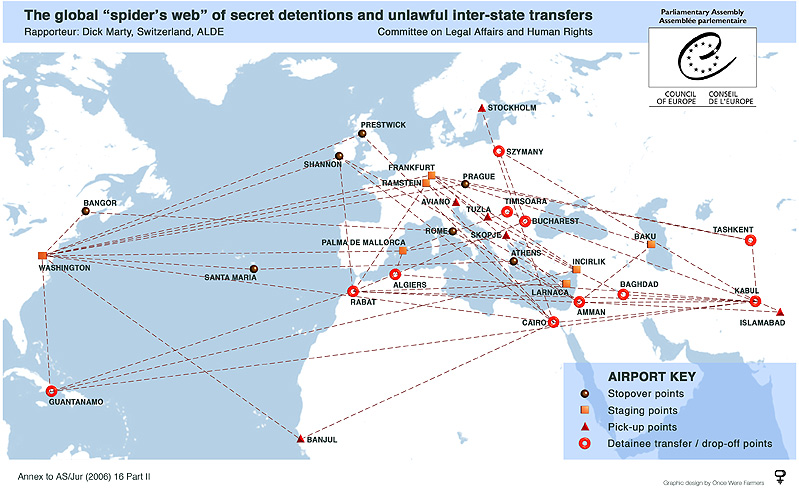
Meanwhile Italy, Germany and Sweden are investigating what heaponed to a some of their citizens. They where kidnapped by the CIA and sent to places that make abu graib look like the holiday in... Ofcourse these investigations arent about getting justice for these people, they are just about making things difficult for the national goverment for allowing these kidnap operations.
Anyway, it seamed like the right time for an European update on these things.
-
Useful in some cases
I recently returned to the UK from the continent after nearly a decade in France, Holland, Germany and Switzerland.
Mostly in Germany and Switzerland, nothing happens without your ID but it makes life easy getting an apartment, opening bank accounts, getting mobile phone contracts and so on. In the UK, in the absence of an ID card, opening a bank account was a complete pain.
I am British, with a passport and NI number. But these are no good for opening a bank account in the UK (unless you already have a UK bank account...). The rules are that you have to show a recent utility bill (or equivalent) with your name and current address plus other forms of identification. Of course, to get such a utility bill, I had to get an apartment but a lot of landlords want your bank account so that they can be assured of regular and timely payment. A vicious circle which proved frustrating to break.
The banks do offer to write to your foreign bank but the British, being such insular little islanders expect everything to be conducted in English, even if you have only just arrived from a small island off Japan. They will not attempt to communicate even in another major European language. In contrast, European banks often conduct their operations in several major languages.
To survive, I had to use the services of a friend's bank account (gotta be someone you can trust implicitly) until after several months, I was able to get an apartment and then, after having a utility bill, open my own account.
I've spoken to other foreigners (Swedish, Spanish, Bulgarian etc.) who all had to go through the same farcical process. All come from places where ID cards are the norm and wonder why the UK has to make life so difficult.
I note that 'Blind Man' Blunkett (the current and, one fervently hopes only temporary, Home Secretary) is possibly rejecting the notion of an ID card, not because it might make things easier for ordinary citizens but because there might be workarounds for crooks and terrorists. This is typical of the horrendously authoritarian Blunkett, nothing he does is for Joe Soap but only to simplify (to make more 'efficient') police powers and processes. See, for example the US-UK Extradition Treaty 2003 -
Re:Indymedia?
Its hard to know without really knowing what happened. If it was via the UK-US MLAT, and the fbi could justify the request under british law, then the home office had little choice.
A good overview of the legality. -
Re: Fuck this shit
Another question is where to move to. Either the infrastructure sucks, or it's going down quite the same hole.
-
Re:Insulting to officials?
Funny that. I'm working had to get out of the UK (couple of months or so, if things go well). This country is such a poodle of the US. No, really, just take a look at our recent appalling and one-sided extradition treaty with the US. Dangerous stuff.
-
EU and Data retention
Tame.
EU is currenly planning 1-3 year mandatory data retention for all Internet traffic data. The process is right now at the member states' goverments (E.g. the Finnish goverment just decided to support the initiative but the parliament has to still agree..) So for all Europeans, contacting your MP would be a very good idea..
More info here:
Statewatch - EU and Data retention
V. -
Re:And fingerprints stop hijackings, how?
-
Re:And fingerprints stop hijackings, how?
-
Re:Alright, this isn't even funny.
Are you sure about that ?
Maybe the papers don't mention what happens at the EU level a lot (mine doesn't at least), but read statewatch a bit and see what we'll get in the EU. It ain't pretty. -
EU Strikes Back
My position is that it's no big deal either way. But I'm a big fan of rational decision-making because it tends to lead to better decisions.
Well to make a rational decision you require good information so let me pass you a bit more.
This program generates an enormous amount of hostility towards the USA. The EU has just passed a resolution opposing giving passenger related information to the USA and this is represntative of the attitude here in Europe. People naturally and wisely resent giving others power over themselves. Especially when those others represent someone else's interests (such as the USA).
I think the hostility this creates is well worth considering as a factor in evaluating this measure.
Personally, I'm much less likely to go the USA again now on principle. There are also lots of luddite types (particularly the older ones) who do not want their eyeballs probed with LASERS!
Finally, consider that this will lead to the same measures against US citizens by countries other than Brazil. -
Re:Alright, this isn't even funny.
I know you mean well, but please do bear in mind that other countries had this policy for a while. I can only point and laugh that *all* of you go through this now instead of just a select, singled out minority.
In that particular instance that I linked to above, the choice given was stark: if you go to that country, follow the rules *they* impose on your visit, or don't go. Simple as that.
It's not like fingerprinting you is really a big deal in itself, especially if you don't intend staying on in the US. However, the message that this sends out very clearly is that the country no longer welcomes visitors. Hey, fingerprinting is something that I associate with being done just before you're marched into jail, not otherwise.
-
Its becoming a bloody joke
Fucking asswipes made a deal with UK to allow them to extradite pretty much anyone they want without even going through a judge here! I don't know which government i hate more, the US for being such assholes, or my own government following them like a little puppy. Im not even going to start about camp X-ray.
extract from statewatch
On 31 March, David Blunkett, UK Home Secretary, signed an Extradition Treaty on behalf of the UK with his United States counterpart, Attorney General Tom Ashcroft, ostensibly bringing the US into line with procedures between European countries. The UK parliament was not consulted at all and the text was not public available until the end of May. The only justification given for the delay was "administrative reasons", though these did not hold-up scrutiny by the US senate, which began almost immediately.
The UK-US Treaty has three main effects:
- (1) it removes the requirement on the US to provide prima facie evidence when requesting the extradition of people from the UK but maintains the requirement on the UK to satisfy the "probable cause" requirement in the US when seeking the extradition of US nationals;
- (2) it removes or restricts key protections currently open to suspects and defendants;
- (3) it implements the EU-US Treaty on extradition, signed in Washington on 25 June 2003, but far exceeds the provisions in this agreement.
Ofcourse it works the otherway around but i dont think we would have a chance in hell of extraditing an American - the treaty is very unfairly balanced. -
Google is a Privacy Time BombWith all the froth and lather about how great Google is as the utimate search machine, we seem to forgotten that we are slowly entering our life histories into the Internet and more recently directly into Google's databases. More amazingly we're doing it for free and in some cases we're even paying for the priviledge. No one seems to be giving any thought to who or what controls the resulting data. If you subscribe to Bill Joy's views about privacy (Why the Future Doesn't Need Us) then you're fine and the rest of this article won't concern you.
If however, you are like most people, and you do draw a line between public and private information about yourself, then Google's innovative strategies combined with its overwhelming market share make it a privacy time bomb just waiting to explode. If Microsoft were behind Google, much of the world would be up in arms (Remember NT's supposed NSA Backdoor?) No so with Google. Strangely, perhaps because Google actually works pretty well and isn't laced with bugs that allow viruses to damage your home computer, no one makes a fuss.
In the recent years the public has sometimes been shocked to learn about some of the side effects that our technological progress has brought. Organizations combining data from multiple databases (for 'marketing' purposes) and technologies such as license plate recognition make possible a 'technical utopia' that Big Brother could only have dreamed about.
This combined with the hightened fear of terrorism and the corresponding (over-)reaction by governments has led to a information gathering infrastructure that is unique in world history. In the post 9/11 world there has been increasing pressure from the American government on organizations and companies (from your local library to European airlines) to forward all types to information to 'the authorities'. Google is most likely just one more intelligence source, though in all probablilty a highly valuable one, in the war against terrorism.
Suspicions that Google has 'ties' with the NSA was published in Slashdot (Should You Fear Google?) last Febuary. After reading some of the comments associated with that article, one begins to wonder if Goggle is just the Internet arm of the Echelon project.
While each tenticle pulling at our privacy is relatively harmless by itself, the combined affect of the multiple attacks on our personal privacy is large and disturbing. Worse still, is that we have only ourselves blame. Our very own democratic governments encourage and protect the individuals and organizations that are attempting to implement these policies. And largely because of own our ignorance and apathy, we don't raise our voices against it.
It's like comparing the public's reaction to a government proposal to mandate the installation of ID chips in its citizens, which causes a massive outcry, vs. parents desire to install the same chips in their children, because of their fear of abductions. The end result may be the same, but in the second case we did it to ourselves.
I guess the moral is that we should just be a bit more aware of what we're doing, and a bit more willing to say 'no'. While the current western decomcratic governments probably do 'have our best interests at heart', what happens when some unsavory character sells or gives this information to our enemies, or worse our government is no longer domocratic and becomes our enemy?