Slashdot Mirror
Domain: taxfoundation.org
Stories and comments across the archive that link to taxfoundation.org.
Comments · 618
-
Re:Talking Point
I think you'll find less resistance from me or anybody else if you focus on things that elicit a positive image...like pushing increased research funds for cleaner burning engines, real fuel production alternatives like algae. Things that benefit everyone, AND reduce environmental impact.
You're hoping for some future technology to save us all--a deus ex machina. But there are things we can do now. For example, eliminate subsidies and favoritism for automobiles.
Oh, but this would hurt Big Oil and people who love to drive, so it wouldn't benefit everyone.
You can't please everyone all the time, so why should we even try?
-
Re:Welcome to Australia, Ferengi.
all taxes have to be included in prices
It's the government's fault that U.S. companies don't do that, not companies'. Most countries have a single unified tax structure. A store can set a price, and advertise that price inclusive of taxes nationwide.
The U.S. is an amalgam of tax-governing bodies. The States can set their own sales tax. The counties can set their own sales tax. The cities can set their own sales tax. Consequently, the sales tax rate differs, sometimes from city to city. A store sets a price and advertises that price + taxes, it's correct for one locale, incorrect everywhere else. The only way to advertise a "correct" price is without taxes. Not because the price varies or because they're trying to hide the final price from you, but because the tax rate varies.
There are currently close to 10,000 different sales tax rates in the U.S. With more states trying to impose sales tax on Internet purchases, it's actually becoming a barrier to entry for small businesses trying to start up Internet sales. The sales tax rates can change at any time if some local governing body decides to change it, so you have to either watch daily for new tax rate changes, or hire someone to do it for you (but you still have to pay if they make a mistake). Amazon tried to harmonize sales taxes in the U.S. because of this, but the States were more interested in casting it as "protecting brick and mortar stores from unfair Internet competition" than addressing the real problem.
The best solution (other than a harmonized sales tax) would be if the Federal government set up a website listing the ~10,000 different tax rates, and forced states and local governments to update their entry in the site before a sales tax rate was "official". Businesses could then just download all the different tax rates every night and be sure they're charging the correct sales tax.and if you buy something you have all kinds of rights (two week period to send stuff back/cancel contracts
That's the case for nearly everything in the U.S. too. In fact most shops have 30-90 day return policies.
two year warranty on physical items and such) that cannot be taken away by ToSs.
Warranties are just insurance policies. Just because the law forces companies to provide them to everyone does not mean they're free. Their cost is rolled into the price of the item you're buying.
In general, insurance is not worth it (otherwise someone wouldn't be selling it to you). It makes sense to insure items whose prices are so high it'd be difficult for you to replace (e.g. cars, houses, maybe appliances depending on your income level). But for items costing a few hundreds of dollars or less, you actually save money by just replacing the things which break rather than taking out an insurance policy/requiring a warranty for them. This is why larger companies and organizations self-insure rather than buying insurance for things like mailed packages and fleet cars. You'll notice the more expensive items like large appliances and cars already come with multi-year warranties exceeding what's required by EU law. That's because being an insurance policy on something that's difficult for the buyer to afford to replace, it's additional profit for the manufacturer to provide the 5- or 10-year warranty and raise the price accordingly.
The one place warranties do help is setting a baseline for product durability. i.e. It weeds out products which are so shabbily made it'll break after a few months. The cost of providing warranty service is so high the manufacturer goes back and redesigns the product to be more durable. At least usually that's how it works. Sometimes it doesn't (e.g. hard drives, where manufacturers can refurbish enough drives returned under warranty to replace new drives which -
Re:Howl's Moving Castle and other dreams
"Not a political map"? yes it is.
the Howard Javis inspired 'tax foundation' that ignores the 40% effective net taxes paid by the bottom 50% of citizens is PURE politics, and false at that.Thanks for the reply. "Proposition 13" Jarvis? Wow, it is fascinating to see how his influence has gelled and morphed in the generation since. I'm curious how any slice of economic sleight-of-hand applied across the board such as ignoring the 40%/50% might become a pure political issue. Is it one of those "Because ___ people tend to be ___" type of things? (I really am clueless here).
Since it was posted original map which averages by state has been updated with a more detailed one that averages by county. No doubt a mob of Upstate New Yorkers threatened to burn the website down for letting New York City turn their whole state blue=bad, costly. And the scoundrels reversed the color scheme too so the state/county maps are visually incompatible.
So I changed the colors back. Here is an animated GIF I made with corrected colors which flips between their State and County map. In it we see that duh, their "purchasing power" is a function of rural versus metropolis.
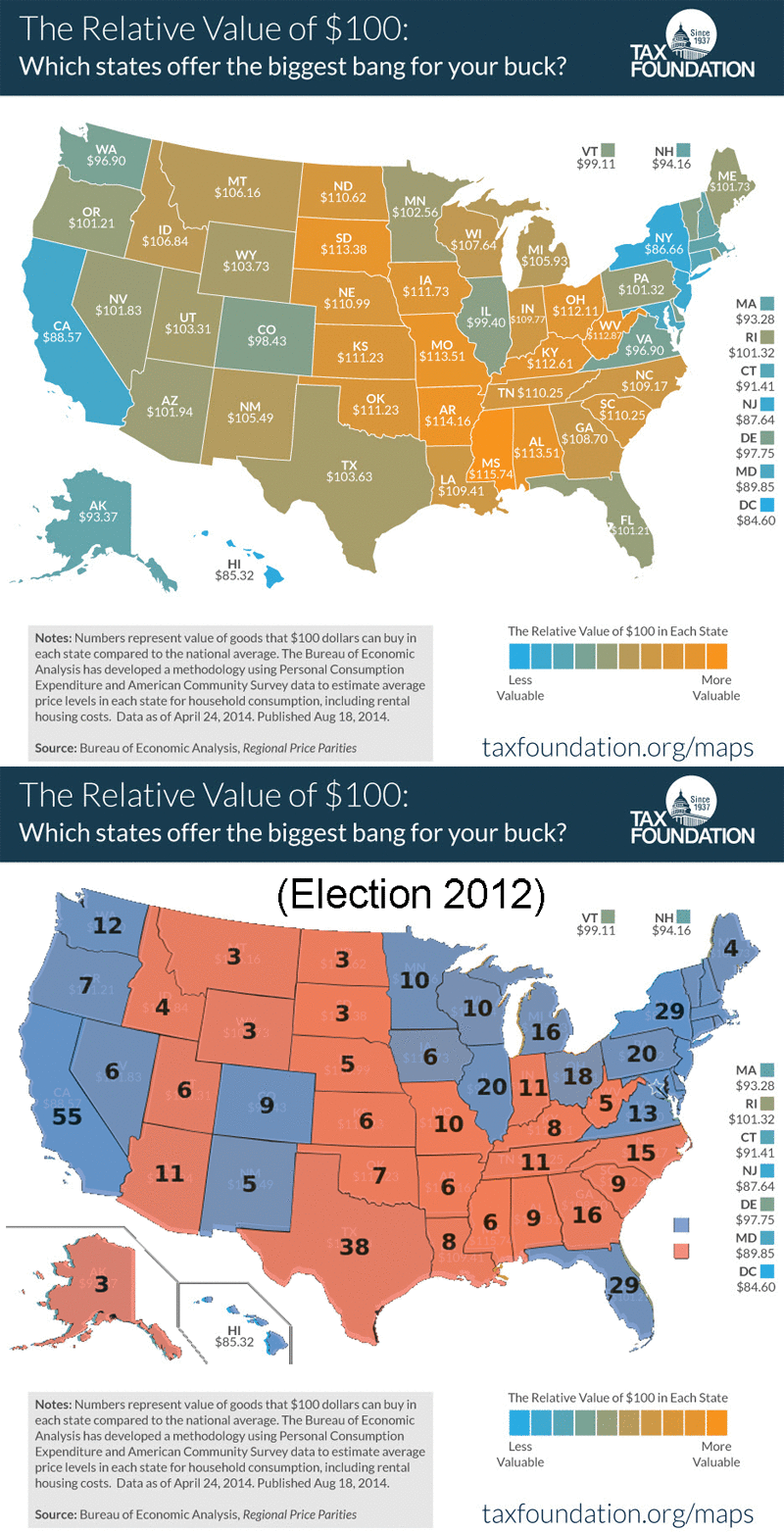
Regarding your cry of "politics"... I was struck with the similarity of the their State average map to another: here is a GIF showing their State averages and electoral 2012 results. Aside from a few states their $100 purchasing power distribution has an uncanny resemblance to the Presidential race. Is some of this not strictly party politics after all... rather, a glimpse of the battle line between city-states and rural-folk who are hanging on by an electoral thread? Or is it wealthy versus not?
I do sense that the city vs. rural divide is becoming a real battle, a country-wide struggle to secure resources and clout as the Water Wars divided California. In this Slashdot musing I lay out what I deem as a front line, the move by city-folk to abolish the electoral college. What think?
-
Re:Howl's Moving Castle and other dreams
"Not a political map"? yes it is.
the Howard Javis inspired 'tax foundation' that ignores the 40% effective net taxes paid by the bottom 50% of citizens is PURE politics, and false at that.Thanks for the reply. "Proposition 13" Jarvis? Wow, it is fascinating to see how his influence has gelled and morphed in the generation since. I'm curious how any slice of economic sleight-of-hand applied across the board such as ignoring the 40%/50% might become a pure political issue. Is it one of those "Because ___ people tend to be ___" type of things? (I really am clueless here).
Since it was posted original map which averages by state has been updated with a more detailed one that averages by county. No doubt a mob of Upstate New Yorkers threatened to burn the website down for letting New York City turn their whole state blue=bad, costly. And the scoundrels reversed the color scheme too so the state/county maps are visually incompatible.
So I changed the colors back. Here is an animated GIF I made with corrected colors which flips between their State and County map. In it we see that duh, their "purchasing power" is a function of rural versus metropolis.
Regarding your cry of "politics"... I was struck with the similarity of the their State average map to another: here is a GIF showing their State averages and electoral 2012 results. Aside from a few states their $100 purchasing power distribution has an uncanny resemblance to the Presidential race. Is some of this not strictly party politics after all... rather, a glimpse of the battle line between city-states and rural-folk who are hanging on by an electoral thread? Or is it wealthy versus not?
I do sense that the city vs. rural divide is becoming a real battle, a country-wide struggle to secure resources and clout as the Water Wars divided California. In this Slashdot musing I lay out what I deem as a front line, the move by city-folk to abolish the electoral college. What think?
-
Howl's Moving Castle and other dreams
Wouldn't it be keen if Diablo Canyon and the other operating nucleaar plants could rise up on giant clawed feet and saunter over to a state that actually wants a clean source of emissions-free energy.
It would also be cool if nuclear electricity was shaped a bit differently, perhaps a little series of dips in the sinusoid like tumblers in a lock... that way the grid could reconfigure itself to gather carbon free energy and pool it for use in states that are not driven by anti-nuclear hysterics.
Then the minions of Enron could come out of retirement, and just as the kind gentleman did for the Yellow Bellied Sneetches, they could install an Apparatus that smooths the sinusoid making the energy appear to have come from Solar or Wind -- for a good price, so the Californians could have Stars Upon Thars.
I recognize that this assessment of Diablo Canyon comes from the NRC, not California. But cue the hysteria as the San Onorfe haters gather their torches and march on to battle evil. Leaving in its wake peace and natural gas for all.
California is becoming more BLUE as time goes on. Hint: Take a peek -- that is not a political map.
-
Re:I see 2 problems
So how about you get off your ass and change the laws governing how ridiculous your taxes are?
No, you don't ACTUALLY want that do you? My guess is that you're happy to take all the benefits those taxes provide, but somehow think its okay to not actually participate in paying them.California has one of the highest tax burdens in the country. It's even worse if you factor in average income. Graduated income taxes means states with higher incomes naturally have a higher tax burden. The #1-3 tax burden states are all in the top 5 in income. But California at #4 in tax burden is 15th in income.
It's not about being unwilling to pay taxes for services. It's about the state being inefficient at providing those services. Any shortfall is viewed not as a spending problem, but a revenue one; meaning the inefficiencies are allowed to remain while taxation goes up relative to other states. Most of what I've seen in my two decades here has been creative phantom budget cuts which really only push the costs to future years, and hiding new taxes in places the public won't notice. If the government spent half as much creative effort trying to actually streamline spending, things wouldn't be so bad.
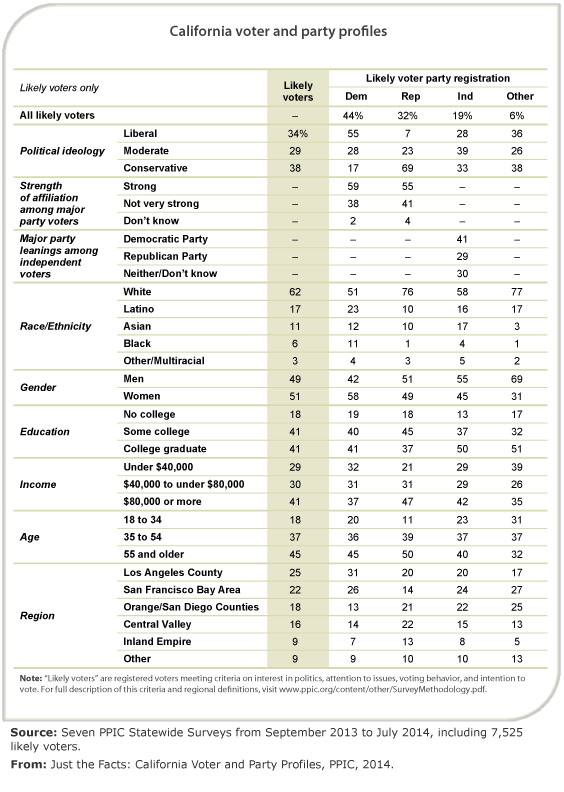
Unfortunately, voting doesn't make much difference because the districts have been gerrymandered (that tends to happen when one party controls a state for a long time). The breakdown of likely voters in California favors Democrats by only about 60% to 40%. But in the legislature Democrats hold 69% of the Assembly and 68% of the Senate (down from 78% after the latest election). The last time the state had anything close to proportional representation was in the late 1990s after governor Pete Wilson (R) vetoed the districts drawn by the legislature. The State Supreme Court ended up redrawing the districts, and the breakdown of elected legislators was much closer to the will of the voters (who were about 55%/45% in favor of Democrats back then). -
Re:Crazy
Because gas taxes in NY are more than 3 times higher than in NJ. http://taxfoundation.org/artic...
-
Re:The end of our industry
I don't think you really want to believe what the Heritage Foundation is telling you.
Their premise is that the rich pay the majority of the federal tax, so let's really look at the numbers to make sure if their premise is correct.
According to the Federal Income Tax Data from 2011. The top 10% paid 68.3% of all the federal taxes. So far so good...
What makes up the top 10%? The Tax Foundation was nice enough to tabulate this report.
Top 1% includes all households that made over $388,905/year and they paid 35.1% of the federal tax burden.
Top 5% includes all households that made over $167,728/year and they paid 56.5% of the federal tax burden.
Top 10% includes all households that made over $120,136/year and they paid 68.3% of the federal tax burden.Using the exact same information that the Heritage Foundation used I can factually say:
64.9 % of all federal taxes were paid by households making less than $388,905/year.
43.5% of all federal taxes were paid by households making less than $167,728/year.
31.7% of all federal taxes were paid by households making less than $120,136/year.My point being that Heritage Foundation used statistics to make a point that is not close to being factual. Their assertion that the rich pay the most taxes is most definitely false. The first clue should have been when they talked about percentage of income without actually showing the income bracket for each percentage.
Go read the actual Tax Stat reports at the IRS's Tax Stats and you will be surprised how small a percentage people who make over $800,000/year pay.
-
Re:I'm assuming here...
the first problem is that low taxation
US corporate income tax rate is one of the highest in the world, both in terms of top statutory rates and in terms of effective rates.
inheritable business empires
The average life expectancy of a Fortune 500 company is between 40 and 50 years. Koch Industries is an outlier as a large, completely privately owned company at $115 billion revenue (although Cargill, another, is the largest privately owner company at $136 billion), and is a bit older than usual at 74 years. But most large companies are publicly owned, such as Chevron ($220 billion), Philips66 ($170B), Apple ($176B), Berkshire Hathaway ($162B), General Motors ($156B), General Electric ($145B), etc.
Koch Industries was founded due to a scientific breakthrough of a more efficient thermal cracking process for turning crude oil into gasoline. The company then expanded by innovating new developments in petrochemicals and fibers. And it runs 1,720 km^2 of cattle ranches.
-
Re:Come and get it, stupid future generations!
The wealthiest individuals do not pay income tax because they don't have income. Their "income" is actually long term capital gains with the highest rate paid at 20%. They don't pay SSI, Medicare or Medicaide and even if they did they are capped at $125,000 in income. Because of this Mitt Romney had to pay extra taxes for his effective rate (the actual taxation rate) to be 15%.
Again, please see the actual data. The top 1% average a 24% income tax rate. And IF it was just the 15% you claim, then it's still in the top 6%. Meaning more than 94% of all US taxpayers pay.
How is paying a much higher rate than 94 out of 100 in any way NOT progressive?
-
Re:Biggest detail left out
Also, if a top earner is actually paying 24 percent income tax, they don't live in one of the states with no income tax.
Real top earners have a median income tax of around 8 percent.
Only suckers who can't afford tax lawyers and tax accountants pay 24 percent.
Fwiw, my brother and uncle both work in tax and insurance law in NYC.
Wrong. See the actual tax return data for yourself. I've linked it above and now here - it is quite eye-opening. The FEDERAL (not State - FEDERAL) tax return data shows the average income tax rate of the top 1% is 24%. AVERAGE, FEDERAL. Nothing to do with State. If you're unlucky enough to live in California (like I do), then you get the privilege of paying up to another 10.5% on top of that.
-
Re:Biggest detail left out
You do understand that SSI "contributions" AND payments are capped, don't you?
Peruse the latest income tax return data. The top 1% have a 24% income tax rate. They also average just under $1 million in income. So they are paying at least (assuming they are NOT self-employed and have to pay both halves) another 1.1% SSI effectively on their entire income. Meaning that their SSI, FICA and income tax rate is, on average, 25%. I wonder how many other people have a tax rate approaching that?
What tax rate is "suitable" for the rich? Where do you draw the line on "rich"?
-
Re:Come and get it, stupid future generations!
The richest have been undertaxed for decades.
I would LOVE to see the data that backs that claim, because what I see is that the top 1% have consistently paid a MUCH higher income tax rate than their share of income would dictate. At least since 1980... If you are in the top 1%, you will be in the group that earns 17% of all income. And you also will pay an average 24% income tax rate, and pay 37% of all income taxes. So you make 1/6th of all income and get to pay more than 1/3rd of all income taxes. How is that considered undertaxed?
-
Re:Economics of envy
Federal tax receipts, historical. In 1957 tax receipts were basically $80 billion. In 2013, tax receipts were $2,775 billion.
Population of the US, historical. In 1957, there were about 172 million people. In 2013 there are about 317 million.
Inflation calculator. A 1957 dollar is worth about $8.46 in 2013
Tax receipts in 1957, per capita: $465. Correct for a 2013 dollar (multiply by $8.46) and you get about $3900 (the Federal Government also ran a real cash surplus and the national debt decreased).
Tax receipts in 2013, per capita: $8754. Or a bit more than double that 1957 per-capita after you adjust for inflation (deficit - pushing over $2000 per person).
Essentially, the Federal Government is taking about twice out of everybody's pocket as it did back in the "high tax" 50s. The difference is in the deductions allowed today versus then, so the actual, effective tax rate was dramatically different than what many suspect. And given that the overwhelming majority of tax receipts come from high income people (the top 10% pay more than 70% of all Federal income taxes, and when you include SSI/FICA - which they would all cap out - and capital gains, approximately 88% of individual, and 40% of ALL, Federal receipts comes from the income of these top 10%), we are witnessing a massive wealth redistribution at the hands of the Federal Government. The fact it's happening so poorly is not a reflection on the taxpayers, but the inefficiency and corrupt nature of the Federal Government.
Given that being in Congress makes one quite wealthy, perhaps a lot of that redistribution is strictly for the benefit of those IN Government. It's still a Federal Government by the people and of the people, but increasingly FOR Government, not for the people.
-
Re:Reality Check
Breaking my AC rule here because what you spout is an oft-repeated but absolute lie. And it cannot be allowed to stand.
Take a look at the actual breakdown of taxpayers. The top 1% pay, on average, 24% in income tax alone. The top 5% average a 16% tax rate (top 5% being those who make around $150K+ a year - meaning a lot of people here at Slashdot, lots of tech workers). It's not until you get below that level that you find those who pay less than 15% tax rates.
Furthermore, those who have income outside of long-term capital gains will pay their 7.62% SS/FICA on their first $110K of salary; above that level they are exempt - but SS benefits are also capped. Since SS is nominally a "retirement plan" insurance package, capped benefits means capped contributions.
The vast majority who are paying less than 15% total taxes (income and SS/FICA) are the 75% of the population who earn under $67K per year; if you're earning more than that, then you are most likely paying well above 15% total taxes to the Federal Government. And in some States (like California), you can pay as high as 10.5% - meaning an income tax load of 40% or more is entirely realistic for a high earner.
For the record, I'm paying an effective 21% Federal income tax rate, I capped out my SS/FICA (meaning $16,700 - self-employed so I pay both halves), and my CA State income tax rate is 7.1%. Total taxes I'm paying this year are about 35% of my adjusted gross income (and about 30% of my gross income). A 15% tax rate? I'd gladly take it - provided everyone else also paid the same (which is how it should be - a flat tax rate for everyone).
-
Re:What country are we talking about?
The GP asserted that corporations didn't pay tax. I think we can both agree they did. Now you want to discuss how much they pay; OK, fine. How much should they pay? And how much should the average person pay? Because the vast majority of US citizens pay less than 10% federal income tax. And it's the bottom 80% who pay that rate; the top 20% tend to pay way above 10%.
So how much would you want the corporations to pay, since we agree they ARE paying? How much should the average US taxpayer pay? And how can, like the GP insinuated, an US citizen or corporation avoid paying any taxes? And should we eliminate deductions - which you apparently want to see happen (want to tax based on revenues, not net income - like taxing you on gross income, not adjusted, not after deductions)?
-
Re:Are you earning more since Reagan was elected?
Informative? Seriously?
LynnwoodRooster seems to have been betting that by stating a lie while providing a couple of links (that refute the lie) most people will assume that that the links actually support it.
If you follow the GINI link you will find that the both the pre-tax and after-tax GINI DID NOT INCREASE AT ALL during the Clinton years! The rise under Reagan went flat, then resumed its rise again under Bush.
Also actually look at that median HOUSEHOLD (not individual) curve LR links to. By the end of the Reagan-Bush era it was down to $48K (from 45.5K at the start), a far less impressive 5.5% over 12 years, and the whole reason for the rise was due to the second adult in the household going to work - since actual wages were flat.
-
Re:A short list of things that are like the Holoca
You're wrong, excise taxes and tolls only cover about a third of road spending. General taxes pay for the other 2/3. It varies quite a bit by state, you can see the numbers here.
The big reason for this is the fact gas taxes haven't been raised in many years and are a flat rate, not a percentage of the cost. Every year the gas taxes aren't raised to keep up with rising prices roads fall further behind. -
Re:A short list of things that are like the Holoca
0 dollars of income taxes are spent on the roads. 0%. Roads are maintained with the excise tax on gasoline.
Maybe that's the case in your country, but in the United States, road funding tends to come from a variety of sources.
Specifically, road funding tends to come from the general fund for state roads, and out of local funding sources for local roads - this includes stuff like income taxes and property taxes. Roughly speaking, road users are subsidized, for good or bad.
For the United States state spending, you can find a chart here for how much each state actually takes in via user fees, and pays out on roads. The best state is Delaware, where for every $1.00 spent on roads, about $0.60 comes from user fees. The worst state is Alaska or Wyoming - where for every $1.00 spent on roads, about $0.05 comes from user fees. The average is about $0.32 from user fees for every $1.00 spent.
Again, I can't say how your country funds roads, but in the United States, a strong argument can be made that income taxes, as well as other sources, funds roads.
-
Re: Private enterprise to the rescue
This has lasted a lot longer than the last 10 years. I'm a resident for 40 years and it has been an issue in all of that time. Don't try to make this into something that it isn't.
I'd also like to point out that PA has the 15th highest gas tax in the nation. So maybe it's valid that the tax payers are sick of getting reamed by the state and given a crap service instead? As my OP on this topic stated, there is corruption in the government too... this only further proves my point. Thank you. -
Re:Solar power is subsidy of rich
" And, of course, most tax revenue is paid by the rich(-ish)."
bwahahahhaha!http://taxfoundation.org/article/summary-latest-federal-individual-income-tax-data-0
-
Re:Education con game
When the government decides who is rich and who isn't, you end up finding people who would never consider themselves rich to be rather wealthy even when they are working and in the middle class.
If you taxed the truly wealthy, the 1% or even the 5% of top earners 100%, it wouldn't make much of an impact on our debt. It would be around 2.4 trillion dollars in total (about 1.9 trillion more then they are already paying) and it would drop as soon as the top 5% of earners stopped trying to make a paycheck they wouldn't ever see. The top 5% of income earners have about 31% of the adjusted gross income in the US and already pay more than 58% of the taxes collected. The top 10% of earners pay 70% and the top 25 earners pay roughly 87% of taxes collected already. And you can be in the top 25% if your adjusted gross income is just over $66K a year. Who would have thought 60,000 was rich? Well, the government does.
the sources for this came from here.
http://taxfoundation.org/article/summary-latest-federal-individual-income-tax-data-0 -
Re:Which company bought this 'new' rule?
No, I've figured out how redistribution works. Like paying taxes so a rich, smug, socialist can get a tax credit on a $70,000 electric car or solar array for his backyard.
Income redistribution in America: rich city folk (Democrats) paying for poor country folk (Republicans). Guess who yells loudest about income redistribution?
-
Re:Nonpartisan?
Former directors: Wayne Gable (Koch Industries), Joseph Luby (Exxon), Pam Olson (Bush-Cheney campaign), current director Bill Archer (former Texas Republican congressman)
Nonpartisan means that they aren't affiliated with any political party; it doesn't mean that they agree equally with either party. In fact, given the level of crony capitalism and failures the current administration and Democrats are responsible for, it's rather hard to agree with anything Obama or the Democrats are doing unless you are completely blinded by partisanship.
"Krugman has also accused the Tax Foundation of "deliberate fraud" in connection with a report it issued concerning the American Jobs Act.[47]"
Krugman's accusation is based on the fact that the Tax Foundation compares the annual revenue from a 100% tax on the rich to the total debt (a reduction in 2-3%); he believes one should consider the long term effect. But the long term effect is obvious from the Tax Foundation analysis: that's not even sufficient to make a big dent in the deficit, let alone start paying down the debt. Or one simply needs to recall that US national debt increases an average of 9%/year anyway.
It doesn't take a rocket scientist to figure out that if you are reducing the deficit by only 12-20%, you aren't going to be reducing the debt at all; even a Nobel-prize winning economist should be able to figure that one out, but I'm beginning to suspect that Krugman is simply getting senile.
-
Re:Unmitigated bullshit
At a state level, Nevada, where I live, is ranked third by the Tax Foundation in "state business tax climate" for 2013, and conversely 47th in tax collected per person. We have no corporate income tax, no personal state income tax. We ranked 46th in federal aid in 2011 (same source), so it's not like Nevada is a "donor" state.
So, free of all of those taxes, Nevada's unemployment rates should be pretty good, because taxes are the worst thing for a regional economy, right? Except, in August, the state had the highest unemployment rate in the nation according to the BLS.
Yes, there are other factors besides taxation. There is regulation, of course, but it doesn't seem that much worse here than in California where I used to live. We have the double whammy of underfunded schools with a very strong teachers union, which pretty makes any improvement in education impossible. Our state legislature meets only every two years, and seems to function about on par with our federal legislature, so getting anything done from a legislative perspective is difficult. It gets really hot here about 1/3 of the year (although not much in the way of earthquakes, tornadoes, hurricanes, etc. - pick your poison I guess)
In my case, I was drawn to Nevada by the low taxation, but businesses are not crashing the boarders. Taxation is not everything. There is a balance to be had between taxes and other quality of life factors, some of which you need government actively involved with. Education, infrastructure, utility price stability also count.
-
Re:at some point...
Federal and state taxes will eat up 33% of that $40
ummm, no. the average tax rate for the wealthiest %0.1 of americans doesn't even reach 33%. consider you get tax breaks when going to school (unless you are counted as a dependent), you'd be paying single digit taxes at most.
http://taxfoundation.org/sites/taxfoundation.org/files/docs/ff285.pdf
-
Re:Great country you have over there
The amount of poverty (or near-poverty) here compared to my home country (Australia) astounds me. Huge portions of the population barely getting by...the run-down infrastructure etc. Not to say there's not nice areas too
In a word, bullshit. The US has one of the most progressive tax systems in the world, even more so than most of Western Europe, more so than Australia. Hell, half the country doesn't even pay taxes.
Unfortunately, the main function of government in the US has become the opposite of the original Lockean purpose of the social contract - i.e., separating citizens from their wealth and giving it to others, while taking a huge cut. We have 45 million fucking people on food stamps! TWICE the population of Australia!
And what have we gotten for it? One of our Founding Fathers, Ben Franklin, said the worst thing you could do for the poor is to make them comfortable, lest they not want to escape it. Our "poor" in the US have cable TV and cellphones and are suffering from diabetes due to their obesity. Just enough to keep them voting for the Party of Handouts, exactly as planned... -
Re: Hey MA programmers! Move to NH.
And have you paid your property taxes yet?
Yes, and gladly.
New Hampshire is always ranked one of the lowest states in overall tax burden: frequently the lowest, usually in the bottom three.
Massachusetts is always one of the highest, always in the top 10. (Citation)
So yes, I pay my property taxes, and they are unbearably high.
Are you saying that paying more overall is good, if it lowers property taxes?
What exactly is your point?
-
Re: Cars Not Cool?
That depends on your definition of "most" since the USA average is 32% of road expenses covered by user taxes and fees. Locally, San Francisco just passed a $150M bond measure paid out of the general fund to repair their roads.
Even if drivers paid 100% of the road costs, their commute is still aided by transit riders (and bicyclists), since there's not enough roads to support them all. The SF Bay bridge carries 250,000 cars each day, while the BART system carries 400,000 riders/day (not an apples to apples comparison because not all BART riders are driving to SF, and not all car drivers are staying in SF, there are other roads and other forms of transit to SF, but it gives a sense of the scale of transit versus roads). Without transit, there wouldn't be enough roads for all of the cars, nor spaces to park them in.
-
Re:The government will fix it
The government has the fix for everything. Just let them confiscate more of our wealth and give them more power to micro-manage every aspect of our lives. That's the solution to this problem and apparently every other problem.
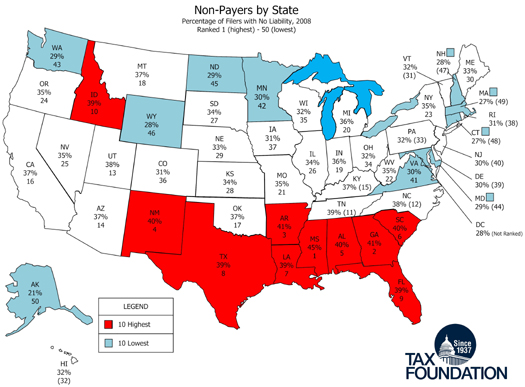
Let me guess; you live in one of those red states, like the top ten ranked by Romney's infamous 47% who pay no taxes http://www.slate.com/content/dam/slate/blogs/the_reckoning/2012/10/non-payers-by-state.jpg.CROP.original-original.jpg
and where the federal government "confiscates your wealth" by giving you back more of it, compared to the blue states where the federal government "confiscates our wealth" to give it to you guys so that your ignorant asses won't starve and turn to cannibalism, for which assistance you bite the hand which feeds you as an expression of your Christian morality.
2007 - http://taxfoundation.org/sites/taxfoundation.org/files/docs/fedspend_per_taxesbystate-20071009.pdf
2004 - http://www.flickr.com/photos/michaelpinto/2987025203/ -
Re:I call bulls*&$!
If it is illegal to remove income as taxable income, it is not a crime.
You have no idea what you are saying, you are just ranting about rich people you don't think are paying enough in taxes. Of course if it is illegal to remove income as taxable income it is a crime. That's BY DEFINITION. Do you have any evidence that those awful rich people are doing this, or is it just conjecture on your part? If you have evidence, report it to the IRS. I think they have a bounty for such things, but even if they don't, it is your responsibility as a citizen to report it. Don't just whine about it.
If you have no intention of acknowledging facts, don't try to debate.
I showed you the facts. The link I provided showed you were wrong. Where's your data?
It is potentially taxed income
You have a problem sticking with the terms you use. You said it was "potential income", not "potentially taxed income." Which is it?
This is why the tax code assumes "potential" while determining what your tax rate is.
That is complete and utter nonsense. There is no "potential income" line on the tax form. There is "total income", "adjusted gross income", and "income subject to tax". The tax rates are based on "income subject to tax". That's not a "potential income", it's based on actual income. The total income has nothing to do with your tax rates, which is what I think you are trying to refer to as "potential income", but there is no "potential" about it. Either it is or it isn't. If a rich person, no, if ANY person isn't writing down all the income on his tax form, it is a crime. If you have proof someone is doing that, report it. Just assuming it happens is a waste of everyone's time.
Guessing? How about basic common sense.
You're guessing at how much a rich person puts in this "tax account". There is no "common sense" to tell you that, you'd have to ask the rich people.
If you spend $2.00 purchasing a $1.50 coupon,
I'm not spending anything when I put money in an account. I still have it, it's there for me to withdraw when I want to. If I'm putting it into a "tax account" as an escrow for future taxes, well, that doesn't change how much tax I'll owe, only that I'll be sure to make some interest on it while I'm holding it.
If, by some odd chance, you are referring to an IRA of some kind by "tax account", then you're still wrong. Then the rich person truly is using $100,000 to get no benefit. His deductions for this money go away as his income goes up and if he has a qualified retirement plan. I am hardly in the top 5% even, but I am high enough up the scale that my allowed contribution is exactly $0. An IRA truly is a poor-person's benefit -- another example of you complaining about a deduction that the rich can't take but the poor can, just like the "per person" dependent deduction and child tax credit.
You never showed my numbers were upside down,
I pointed you to the link that showed you they were. Since you didn't bother to look, let's review, shall we? You said, and I quoted this in my response: "Wealthy people pay 8-10% tax on average while you and I pay 35-40%." I provided a link to here, which you apparently did not bother to look at. In that data for 2009, it shows the following facts:
- The average tax rate for the top 1% was 24.01%
- The average tax rate for the 25% to 50% level was 5.58%
- The average tax rate for 10% to 25% was 8.23%
- The average rates for lower income brackets were smaller.
Now, I don't know what tax rate you fall into, but the data clearly shows that while you claim that "wealthy" pay only 8-10%, they really pay 24.01%. And the "you and I" pay anywhere from 6-11% (and that covers from $32k thro
-
Re:I call bulls*&$!
Wealthy people pay 8-10% tax on average while you and I pay 35-40%.
The numbers show otherwise.
-
Re:I call bulls*&$!
Don't the top 5% make far more than 58% of all the income?
No. From here, the top 5% made 32% of the total AGI. That's far less than 58%.
The same link shows some amazing other numbers, like the average tax rate for the top 5% is more than 20%, while the average for all is only 11%, and the bottom 50% rate is less than 2%.
Warren Buffet was complaining that his secretary paid more in taxes than he did. That may be true, if Warren Buffet is a tax cheat. The average tax rate for the top 1% was 24%, while the average tax rate for the 25-50% group (AGI between $32k and $66k) was just 5.58%. I expect Buffet's AGI to be in the top 1%, so that 24% of his much larger income (>$343k) should be considerably larger than his secretary's 5.5% of $66k. Calculation: 24% of 343k is $82k. 5.5% of $66k is $3630. That's 22 times as much. Unless he's a cheat, or she's borrowing money to give the feds her entire salary plus extra money. I'd believe the former much sooner than I'd believe the latter.
-
Re:350ppm
Corporate taxes are greater than the sales taxes at the local level
-
Re:Sequestration is a gimmick
What tax rate should the rich pay, relative to the middle class? You might find it worthwhile to look at the actual income tax rates paid by various income groups and see that the higher income groups do, in fact, pay more in income taxes.
-
Re:good.
That's Bull shit If they confiscated 100% of the top 1% it would just barely close the deficit this year, and it wouldn't have in 2012. $1.324 trillion AGI - $0.318 trillion income tax already paid would have been less than the 1.1 trillion 2012 deficit. The sequestration is chump change in the budget sadly.
-
Re:Remember
From here, for 2009 the top 1% by percentile paid 36.73% of the income taxes. The top 50% paid 97.75%.
That's not exactly what you said, so let's look here for 2010. From table 1, we see that the top 10% of filers earned 45% of the total income collectively and paid 71% of the income taxes. That's much more than your 40%/40% ratio.
The top 1% paid an average rate of 23.39%. Not 0%, not 15%. They had 18.9% of the total income but paid 37.4% of the income tax revenues. Almost double what a flat tax would have cost them. And even though they didn't make 40% of the wealth, they paid almost 40% of the taxes.
STFU about reported income taxes. The entire point is that they use their wealth to hide their income in exotic ways not available to the rest of us. Hidden income, and dodged taxes don't appear to the IRS, so they don't appear to any other resource you try to cite.
Additionally, I think the broader issue is that the entire system is upside-down on itself to prop up the ultra-rich. A working man is taxed much harder than a working dollar, which is totally fucked up. The taxes these shitheads do pay are less aggressive since it is investment income, and they still have the balls to try and hide it.
At some point the whole thing will come crashing down on them. At some point when an elite few have everything, and everyone else is fighting over scraps, the elite just start getting their heads chopped off. Honestly, I thought the 2008 financial crisis was going to be a catalyst for something like this to happen in our lifetimes.
My wife and I combined make close to 160k/yr. We fucking cringe at what it costs just to buy a few days groceries at publix. I'm amazed that people survive in 2013 on even 1/4 of what we earn, let alone the millions scraping by on minimum wage.. We don't even have kids. How anyone can argue on behalf of these greedy scumbags is beyond me.
-
Re:Remember
If you are taking in 40% of the income of the entire nation, you should expect to pay 40% of the tax of that entire nation.
From here, for 2009 the top 1% by percentile paid 36.73% of the income taxes. The top 50% paid 97.75%.
That's not exactly what you said, so let's look here for 2010. From table 1, we see that the top 10% of filers earned 45% of the total income collectively and paid 71% of the income taxes. That's much more than your 40%/40% ratio.
The top 1% paid an average rate of 23.39%. Not 0%, not 15%. They had 18.9% of the total income but paid 37.4% of the income tax revenues. Almost double what a flat tax would have cost them. And even though they didn't make 40% of the wealth, they paid almost 40% of the taxes.
-
Re:Not blocking, just ignoring
A person who earns $40k a year (a low base for skilled labor) will give roughly $10k a year in taxes...that's a net gain for the government
Actually someone earning $40k is in the middle quintile of incomes, and will generally receive $15k per year in transfer income from the government, so actually they are a net loss for the government.
They might provide a net gain for the private economy of course (or they would likely not have a job).
Most "net gain" for the government comes from upper quintile income individuals.
-
Re:Addendum
Everybody thinks their taxes are high, even when their taxes aren;t very high. MS, for example, is 37th in tax burden. Granted state tax burdens don't actually seem to vary very much, so you pay 7.8% as opposed yo an average of 9.9%, but 37th is still pretty damn low.
BTW, the lowest state is Alaska at 7% even. The highest is New York state which charges 12.8%.
-
Re:Can't America get its acts together ?
In 2009, the top 1% earned 14% of all income, but paid 36% of all income taxes. This is more than what you claim they *need* to pay. Please check my math, maybe I made a mistake. It is based on AGI, so maybe there is some big deduction I am missing. http://taxfoundation.org/article/summary-latest-federal-individual-income-tax-data-0
Your point maybe correct on the wealthy getting a greater share of the wealth , I don't know, but please cite some statistics. I think your blame is somewhat misguided. I put more blame on bad policies and unrealistic expectations for our recent economic troubles. -
Re:This isn't a bad thing.
I'm afraid the data doesn't match up with your perceptions. The rich already pay a higher effective tax rate than those in lower income brackets on average (about 24%), while the bottom 50% pay an average of less than 2%. Yes, by all means, let's let the wealthy pay their proportionate share of taxes, by reducing their tax rates!
That's income tax only. Add in social security tax (flat percentage until you hit a cap, then 0% so high earners pay a lower total %age), sales taxes, fuel taxes, property taxes (direct and indirect - the land lord doesn't pay the property taxes, he includes the tax in the rent payment), etc. When you add it all up, the working poor pay a higher tax rate than the rich.
-
Re:This isn't a bad thing.
I'm afraid the data doesn't match up with your perceptions. The rich already pay a higher effective tax rate than those in lower income brackets on average (about 24%), while the bottom 50% pay an average of less than 2%. Yes, by all means, let's let the wealthy pay their proportionate share of taxes, by reducing their tax rates!
-
Re:If there was a Bad at Math Map...
Care to back that up? I only mention this because most people seem to be unaware of which states are net receivers and which states are net payers of Federal tax revenues. California and Texas, for example, are net payers, thus it could be argued that if they seceded they would see an increase of capital.
Huh? Did you look at that site? From 1981 to 2005 it shows Texas sending $146932 million, and receiving $148683. That makes TX a net receiver, not a net payer. California is a net payer however.
Do you have your GOP reading glasses on?
-
Re:I say let them
-
Re:If there was a Bad at Math Map...
Care to back that up? I only mention this because most people seem to be unaware of which states are net receivers and which states are net payers of Federal tax revenues. California and Texas, for example, are net payers, thus it could be argued that if they seceded they would see an increase of capital.
-
Re:Someone didn't get the memo
Now, remember that pretty much all of those states exist due to constant government-based welfare in the form of subsidies and infrastructure funds that the states absolutely cannot cover by themselves. In Northern Virginia, when we need to improve a road, we pay higher taxes. When South Dakota needs to improve a road, they whine to the federal government, and everyone else pays for it. And while they do that, they lower their own taxes because... well... taxes suck and they all want to keep their money.
Hey dumbass, Virginia mooches off the federal government just as much as South Dakota!
-
Re:This will be SOOO fixed with RomneyCare!
Yeah, because the federal government has been so much better at keeping its fiscal house in order.
The highest debt per capita of any state in the country is Connecticut at $5,402.
The per capita debt of the federal government is $51,654.92 or more than 9 times as much.
Total spending per capita in the United States has gone from $6,339.90 in 2000 to $11,194.30 in 2010. The inflation adjusted increase was 39.4%.
California and Illinois are acknowledged fiscal basket cases - the inflation adjusted per capita increase in spending in those two states from 2000 to 2012 were 42% and 57% respectively. The median state (Michigan at #25) had a 38% increase - slightly better than the US.
Let's just say that neither level of government has been fiscally responsible. All of these figures are increases per capita - more money being spent per person - which means even if everyone (including the rich) was pitching in like it was the height of the dot-com bubble we'd still be under water.
-
Re:Attention Radical Free Software Leftists!What he's saying is accurate. States which typically vote Republican are the states which contribute the least in Federal taxes, but receive the most in Federal aid.
http://taxfoundation.org/blog/why-do-some-states-feast-federal-spending-not-others
As for your disillusioned Obama comment... He wants to make people pay their fair share of taxes while Romney wants the middle class to "distribute" their wealth up the chain so it lands in some dudes bank account, not helping the economy at all. Spending money helps the economy, hoarding it doesn't.
-
Re:Democracy as a permanent form of gov't
"on the backs of middle class citizens", because that's not who pays the taxes.
if you mean the middle class doesn't pay it's share of taxes, you are wrong.
During 2009,
If we're talking about the 99% vs 1%, the 99% is paying a close to 2/3 of the taxes.