Slashdot Mirror
Domain: theoildrum.com
Stories and comments across the archive that link to theoildrum.com.
Comments · 211
-
Power beaming was hashed over at The Oil Drum
and shown to be a pointless make-work project.
http://www.theoildrum.com/node...
http://www.theoildrum.com/node...
http://www.theoildrum.com/node... -
Power beaming was hashed over at The Oil Drum
and shown to be a pointless make-work project.
http://www.theoildrum.com/node...
http://www.theoildrum.com/node...
http://www.theoildrum.com/node... -
Power beaming was hashed over at The Oil Drum
and shown to be a pointless make-work project.
http://www.theoildrum.com/node...
http://www.theoildrum.com/node...
http://www.theoildrum.com/node... -
Re:Hint: Too High Wages are Too High
No sir, no reason whatsoever that overpaying workers leads to fewer workers over time! Just unpossible!
You sure, are a moron. Automation plus the relative low cost of energy in oil (something like 10,000 man-hour per barrel) and even paying pennies/hour to workers is often overpaying them.
No, obviously that can't be entirely it or we'd have replaced all the workers already. Obviously there's plenty of jobs that can't be automated yet or perhaps ever. The people who are left obviously want higher pay because all things being equal there's no reason for them not to demand more per person? Wages aren't set on the cost of the labor but on the price of the final product and the size of the labor pool. If anything, more automatic should spur higher wages for those still with a job.
The rest? Well, automation is going to wipe out those jobs regardless of how little a wage one asks because automation is literally less than pennies per hour and there's simply no way to compete with that. The only thing asking for lower wages now will do is perhaps delay the point those jobs are replaced with machines. But they do nothing to do with the long-term ramifications of so many jobs being replaced with automation.
The real truth? It seems obvious that the people left working should be being paid a lot more than they used to ($60-$200/hour jobs). It seems obvious that those people will inherently have much higher tax rates as a consequence (being paid $416,000/year and you'll have a hefty tax bill). And it seems obvious that the rest of humanity will be stuck on a shitty welfare system.
The only thing left is to consider reforming taxes to be much more progressive so those people making $416,000/year aren't only paying in the ~35% range. But, then, that also involves dealing with the issue that Federal and State taxes end up being a mess where total tax rates vary greatly for no clear reason and without clear goals in mind--most States have so much done for them through Federal funding that taxing their residents again in part misses the point. Of course, State governments will resist this because they're interested in their own control--they fear for their jobs and it has little to do with their residents' interests not being represented, as evidence in gerrymandering at the State level being so horrible. But we're already so far down this road and States clearly are unwilling to subsidize all those people who literally will find no work and constantly beg the Federal government for help.
To me, the obvious point is that all this automation could produce an age of utopia with a lack of scarcity. And yet greed or dumb fucks like you ruin it and actually blame the people who are closest to working to market correct the imbalance produced by automation. That you are so myopic that you don't begin to see that long-term welfare must be a reality in a world where most people need not work and most work will have regulated wages, enforced in part by unions, to provide the motivation for the few that do work and yet also providing the means to provide that welfare state.
Oh, but the tyranny of the government! The ruining of our lives! You do not begin to understand how it is the exact bad acts that need combated, not merely the means to do bad acts. For if anything of what you believed were true, you would have long ago rose up against your own nation for their war machines have demonstrated capable of possible world domination only stopped by the other war machines and the general threat of self destruction of their leaders, but that does nothing to stop them from crushing their own citizens. That you are not crushed, literally, to death, shows that at some level they lack the desire. And if you wish that to remain the same, you should direct their actions to do good and now cower in fear until it is too late and they destroy you.
PS - It's much too late to put the genie back in the bott
-
anyone who believed the bull
Should have had a look at the production curves, tight, shale and fracked sources have very rapid decline. It's pretty much the definition of unsustainable.
-
When it comes to "big money"
First, I will say I have worked for a major oil company.
Second, I will say I have read "Twilight in the Desert" by Matthew Simmons, was an ardent follower of The Oil Drum petroleum web site - was more active there than I am here.. That site was full of petroleum engineers and field guys - and I trusted their insight far more than I trust words from any investment advisor sitting behind desk whose job it is to influence my decisions of how to allocate my retirement savings.
And Third, I will say I swallowed the "Peak Oil" paradigm hook line and sinker. Apparently messed up my retirement savings big time by investing in the energy sector as I believed with all my heart that we were in serious decline.
Suddenly fracking made the scene and all the investment buyers saw energy as plentiful again. And the price dropped, And many of the smaller guys sold out.
I cannot help but wonder if all this panic talk is them yet rounding up another round of panicky people and investors to make a poor investment.
I can't help but remember all this talk about how dire our energy situation was coming from our leaders. Then there is no energy crisis, Then there is.
Almost sounds like Donovan singing about petroleum. First there is a crisis, then there is no crisis, then there is.
We pay countless taxes into our government, and countless well-paid bureaucrats are supposed to be leading us, but does anyone up there really know what's going on?
So far, they seem to rank about as reliable as an ouija board.
How in the hell can anyone make rational decisions when no-one seems to take this stuff seriously? It seems lately all our government has wanted to so is snoop. 96% is a helluva big number.
I believe special interest tie guys have the government release all these "facts" in order to manipulate the market.
When I saw fracking, I was and still am concerned that was equivalent to "blowing the gas cap" on a dying oil well as once we relieved the subterranean pressure that was helping to push what was left of the liquid oil to the surface, we were draining the last "fart" from the earth before there was no longer enough energy recoverable from the lift effort than we were able to recover from the oil lifted. It meant the show was over.
I remain very concerned this whole fracking "happy days are here again" thing has been nothing more than a ploy to get control of the remaining oil reserves at a bargain basement price. -
Re:Economic reasons
Right! http://europe.theoildrum.com/n... ÂAnyway, even from these qualitative data we should be able to understand why the Empire was in trouble. One of the main causes of the trouble was that it had this big military apparatus, the legions, that needed to be paid and didn't bring in any profit. It was the start of an hemorrhage of gold that couldn't be reversed. In addition, the Empire bled itself even more by building an extensive system of fortifications - the limes that had to be maintained and manned, besides being expensive in themselves. [...] Military expenses were not the only cause of the fall. With erosion gnawing at agricultural yields and mine productivity going down, we should not be surprised if the empire collapsed. It simply couldn't do otherwise. So, you see that the collapse of the Roman Empire was a complex phenomenon where different negative factors reinforced each other. It was a cascade of negative feedbacks, not a single one, that brought down the empire.Â
-
Horseshit
First, there is no such thing as eagerness to tap the Arctic, so I have no idea why this article exists; it's a big troll. The TAPS pipeline has had declining volumes for decades. There's been talk (for years) of a gas pipeline but it's pretty much not going to happen, for a number of reasons that no one really gives a shit about.
Second, I'm from Valdez, Alaska. I was there for the spill, and for about twenty years afterwards. The long-term environmental impact is practically nil. Fish stocks recovered quickly, same with sea otter and sea lion populations, shorebirds, etc. The spill happened about twenty miles from my hometown. Yes, in a few beaches you can dig down and find a thin sheen of oil in the shale, but it doesn't seem to affect the critters much. Massive oil spills are not necessarily all that big of a deal.
Thirdly, the oil companies have small spills fairly often, and while the existing methods of cleanup may not scale, it's less of an issue all the time, and not necessarily the end of the world if it does happen. Also, there's not actually all that much opportunity for a large spill: we don't have gushers up there, or supertankers, and the pipelines can be shut down pretty quickly. They're monitored to some degree, usually with 'smart pigs' which travel inside the pipeline cleaning wax deposits and checking for damage. There was an incident a few years back where some drunken yahoo shot a hole in the pipeline, but it did not result in a large spill.
My sister works on the North Slope, in the oilfields. It's actually a really sensitive area environmentally, and the oil companies have to report even tiny spills. Also, it's really hard to build on permafrost without it melting and subsiding into a huge bog. You can't even drive cars on it without tearing it up, they use smaller golfcart type things most of the time. The wells and pads are as small as they can be. I'm not going to eulogize the oil companies for having a good environmental record up there, but they have been limited by the terrain, perhaps more effectively than regulations might have done.
This panel has its head up its collective ass, though, and this story is just trolling. It's not inevitable that there will be a big spill, and it's not necessarily a problem if it happens, and it's not something that we don't know how to deal with. There are a lot of current methods for cleanup that probably wouldn't work so well there, and I'm sure it's worth someone's time to figure out what the best way to clean up big oil spills in Arctic conditions, but "inevitable big Arctic oil spill" is just sensationalism. In other words, it's horseshit, and you've all been had.
-
Re:NO NO NO
It was a bit difficult to read, but the paradox sounds like those "Endverbraucher in Haushalten" who don't have solar panels, are basically forced to subsidize the difference between Börsenstrompreis and Ökostrompreis, and (brilliant use of mass psychology), this subsidy then goes to their own neighbours if they have a solar panel on the roof. So, if you don't invest € 980 in ( electricity + renewable infrastructure investment ) per year, your neighbours will be sure to profit instead of you.
It's fucking brilliant. Who came up with this idea? Joschka Fischer's Green Party? What a clever use of (some) people's "keeping up with the Joneses" wish, the need for renewable power infrastructure, the need to reduce carbon footprint, the political need to invest before you can reap the profits (big problem, see http://www.theoildrum.com/node/6647 (Jeff Vail - The Renewables Gap)).
IANAEconomist, but unless I have read the article wrong, I don't see what the problem is. Brilliant government strategy. -
Re:We Wish
What increased consumption? Consumption (in the US at least) has remained relatively constant for decades, mainly due to massive fuel efficiency increases as well as reduced transportation needs.
http://www.theoildrum.com/node/9811
Also, I'm a libertarian, and so far I've made a lot more from bitcoins than they have cost me. I've paid about an extra $5 per month in electricity costs for mining over the last 4 months since I started, and I've already acquired about $200 worth of goods bought from bitcoins. It sort of helps when you already have a bunch of GPU's laying around from gaming, but I've since bought two used one with high MH/s for how cheap they are.
I think liberals just hate bitcoins because it further diminishes the relevance of the Keynesian economics model which they base their philosophy on. And the Keynesian model was pretty much debunked during the 80's anyways due to stagflation, which the Keynesian model says is impossible.
And no, I'm not contributing to carbon output. My area is powered by both nuclear and hydroelectric, but mostly nuclear, which environmentalists are by and large against even though it is both safer, cheaper, and contributes less to pollution than just about every other form of electricity generation, and unlike other renewable sources, its use is practical no matter where your geographical location.
-
Re:We Wish
We first thought we were hitting peak oil in the 1920s IIRC
You don't recall correctly. Peak Theory was proposed in 1956, so it would have needed a time machine for your proposal to be true.
Since then the theory has been born out by the USA and over 50 other countries that are already past their peak oil production.
http://www.theoildrum.com/node/5576For a good read, I suggest The Age of Oil
If it's the source of your earlier recollection, I'll give it a miss. I've read plenty more accurate books such as Twilight in the Desert.
-
Re:NIMBY are the sole reason
Interest doesn't equal intent. The financial situation just doesn't make sense for nuclear (at present). Given the (artificially, temporary) low prices of natural gas and the relatively inexpensive and rapid timeline of a natural gas fired electrical generation plant AND the increasingly favorable costs for wind / solar conventional nucs just aren't a hot item. Especially since the 'new and improved' Gen III plants don't exist in the US just yet so it's a bit of a stretch to call up Westinghouse and ask for a tour (want to fly to Beijing?).
Let's face it, current LWR technology just hasn't worked out all that well. Turns out it's expensive to build and maintain. They're insanely complex. Impossible to insure (unless the feds step in). Covered by tons of regulations (would you want it any other way given human avarice and greed?). Enormous capital expenditures. Basically they got outcompeted. Yeah, free market?!$&#*&>.
Now, lets move forward a decade or so. Westinghouse and the French company (I want to say 'Avarice' but that's not it) are working on Gen III reactors being sited in China. IF (big if) they pull it off, get a couple of years of installing them and running them without major issues AND natural gas prices climb (again - follow The Oil Drum or similar sites, tl;dr the depletion rate of fracked natural gas wells is truly enormous) and nobody figures out a reasonable strategy to turn solar power into baseload power, THEN nuclear might have a chance.
All they would have to do is figure out the the little problem of waste storage.
Certainly, much of nuclear power's issues are political rather than technical in nature but politics is "the art of the possible". If we were rational creatures, Mr. Spock would be President for Life and we'd have flying cars.
But we're not. So we can't have nice things.
-
Re:Geothermal heating?
There is lot of confusion, since the term "geothermal" is used for two different technologies. The first is digging deep to hot rocks and using water to extract the heat and doing something with it. This has been used for over a century, but has a lot of problems with it.
The other is going a few feet down to use the ground as a heat source or sink for a heat pump/air conditioner. The latter is what is used now. The problem is that the cost of digging and laying the pipes sometimes cancels out the energy savings.
For more see this comment
-
Re:Obama's false premise
> to last for decades at minimum
That is a gross overestimate of the actual resources available.
-
Re:Left out the important qualifier...
Incorrect. Although the natural gas price has been dropping for a couple of reasons (oversupply being one), there are many wells that are frakked for nat gas. And oil. And nat gas and oil. What you may be getting confused about it the fact that they are flaring a lot of natural gas because the price is low.
This just points out to one of the many insanities about how we go extracting resources. Natural gas pretty much requires pipelines to make it recovery sensible in economic terms. No pipeline, you flare it. But if you have a pipeline, you sell it.
The economics of the shale plays (tight gas / tight oil) are complicated and resemble the Monty Python Dead Parrot sketch in more ways than one.
TL'DR - head out to the Oil Drum for more than you ever wanted to know about this.
-
Re:Politics
I agree on all points but that of oil. Fracking depends on high oil prices, otherwise it isn't economically viable (don't expect the price of gas or oil to come down). As well, those fracked wells show much faster production declines than traditional oil wells, on an individual basis they decline pretty fast. Environmental concerns are also pretty big, may as well be mining rare earths...
For more info regarding fracking and the "more oil than Saudi Arabia" propaganda (at best that's what it is, at worst it is completely uninformed...), this article goes over the basics:
http://www.theoildrum.com/node/9753The Oil Drum has many other more detailed articles as well.
-
Re:A clear example of how lobbying hurts everyone
I lied; it's worse. Here's some math:
http://www.theoildrum.com/story/2006/8/25/221617/881#comment-93851
-
Re:Care to back that up?
This research:
Ethanol Production Using Corn, Switchgrass, and Wood; Biodiesel Production Using Soybean and Sunflower David Pimentel and Tad W. Patzek Natural Resources Research, Vol. 14, No. 1, March 2005 doi:10.1007/s11053-005-4679-8
Which was cited by the article you cited.
Here is another discussion:
http://www.theoildrum.com/story/2006/8/25/221617/881
The latter is more interesting because not only does it point out the economic issues, but also that there are other issues such as water consumption, soil erosion, political costs etc. associated with using ethanol for fuel.
The Oil Drum is a very worthy site because it presents a useful hard economic view of alternative energies. I think it's probably overly pessimistic, however it's probably a lot closer to the truth than a lot of the advocacy positions that appear in the media.
-
Not Shocking
This really shouldn't suprise anyone. For most of the history of Oil Production, the USA has been the world's largest producer. We only lost the title in the 70's (I was a kid, so yes, I remember us being the largest before). We never left the top three, and the Saudi's never outproduced us by a large percentage.
I even remember back in the 70's being told that we had so much shale that we could easily keep leading the world, but it would probably stay put until we figured out a way to get it more cheaply, or the prices raised a fair amont.
Both have happened, so here we are.
-
Dollar a gallon gasoline
Gasoline has about 40 kWh/gal of energy in it. So if the process takes no more than 100 kWh to produce a gallon, then the energy cost is a dollar a gallon per cent of cost per kWh.
So penny a kWh power will provide dollar a gallon synthetic gasoline. (Plus capital cost for the plants of perhaps 10%).
http://www.htyp.org/dollar_a_gallon_gasoline
I think I know how to get the cost of power down into the 1-2 cents per kWh level. It involves power satellites and laser propulsion to get the cost of lifting parts to GEO down. If you want to know more ask. hkeithhenson@gmail.com The previous iteration is here. http://www.theoildrum.com/node/7898 -
Re:And how will this
In the 70s maybe. These days the world is pumping all it can muster, using advanced extraction techniques, which will likely cause the crash to be faster than it otherwise would have.
-
Re:Still Wrong
Much of the "green revolution" occurred because of extra energy input in the form of oil. Cheap oil allowed for the expansion of nitrogen fertilizer, pesticides and mechanical harvesting. While the last two don't use an enormous amount of oil, the first does. As fossil fuels become more expensive, so does nitrogen based fertilizer.
So there is likely a limit to the ability of said revolution to feed the planet. And I'm ignoring other potential limiters such as water, salinization of croplands and many others.
Wow, someone who knows about modern agriculture. My hat is off to you, still, don't waste your breath. Just eat drink and be merry, for we are fucked.
-
Water is the limiting factor
Much of the "green revolution" occurred because of extra energy input in the form of oil. Cheap oil allowed for the expansion of nitrogen fertilizer, pesticides and mechanical harvesting. While the last two don't use an enormous amount of oil, the first does. As fossil fuels become more expensive, so does nitrogen based fertilizer.
So there is likely a limit to the ability of said revolution to feed the planet. And I'm ignoring other potential limiters such as water, salinization of croplands and many others.
According to a recent report on "feeding the world" on the economist, thanks to cheap fertilizer the limiting factor to crop productivity is no longer nitrogen, as it was for most of human history, nor so much land, but mainly water.
Look at how many of the world's great rivers hardly reach the ocean anymore because they are used so intensively, worry about how river flow becomes more seasonal when there is less perennial snow, and worry about the potential for conflict between countries that are upriver and those dowriver ( as an example).
We shouldn't be arguing about mass starvation and malthusian catastrophes. Nor is that what TFA is predicting: you don't need to get nearly that far for a tightening of food supply to have dangerous consequences. I don't think anyone seriously contests that the spike in food prices was a big factor in the recent unrest in the arab world...
And in all this the US, the world's largest corn producer, is currently burning 40% of it's corn production by putting 10% etanol in gas. Stopping this senseless waste would be a concrete step to ease the upward pressure on food prices, and the unpredictable consequences it can bring. -
Re:Still Wrong
Much of the "green revolution" occurred because of extra energy input in the form of oil. Cheap oil allowed for the expansion of nitrogen fertilizer, pesticides and mechanical harvesting. While the last two don't use an enormous amount of oil, the first does. As fossil fuels become more expensive, so does nitrogen based fertilizer.
So there is likely a limit to the ability of said revolution to feed the planet. And I'm ignoring other potential limiters such as water, salinization of croplands and many others.
-
Re:Wow.
"We are not dependent on fossil fuels"
Wow. Just wow. And to buttress your argument you point to a completely speculative, disorganized, unprovenanced blog.
Go hang out on the Oil Drum for a week to see how staggeringly incorrect you are.
Can we get off of fossil fuels without crashing civilization as we know it? That's a very interesting question. Theoretically we can. We have the technology to create energy from much safer sources. Any practical chance of this happening?
No, not really.
-
Re:Peak Oil
Uh, no, the US is not the biggest exporter.
Fracking bought time, nothing more. If you require more evidence, look at oil prices. They are still at a very high level. If fracking had somehow magically increased the provable discoveries, there would have been a massive drop in the price.
-
Re:2 kW enough?
How efficient is the production of natural gas and pumping it to houses?
That's irrelevant since you incur the same costs whether you directly burn the gas for heating or use it in the fuel cell and then use electric heating. Now in the absolute conventional gas has an EROI somewhere between 20 and 100. I doubt distribution uses much energy but I could not find any figure so if you find any please post them.
-
Re:Scarce? Where?
In real life we have hundreds of years of fossil fuels left.
Sort of true. There certainly will be oil in the ground 200 years from now. It won't be easy to get, nor will it be inexpensive. The global taste for fossil fuels, especially liquid fossil fuels is truly enormous and growing (think China and India who are attempting to get to US per capita energy expenditures). The supply of fossil fuels isn't growing much at all (happy words from various US politicians notwithstanding).
What we have hear is a failure to communicate. Nice writeup on the concept of Peak oil and how we need to change a few things.....
-
extra drilling thought, and a plug for theoildrum
It seems that some of the extra drilling is to compensate for reduced extraction rates as US oil fields get depleted, to keep overall production in bbl/day from dropping too fast.
With the cost of renting the drilling rigs, the labor, piping, and such expenses, it would seem add to the cost of US oil extraction for those depleting fields, and might help explain why 'extra drilling != lower fuel costs'
(I like the oil news discussion website http://theoildrum.com./ In my opinion it is a good place to read about oil production, speculation, and "peak oil".)
-
Re:Oh Frack!
From T.O.D., shale gas wells yield approx. 70% value in the first 5 years of life.
-
Re:Frak!
OK, so that did not go over too well.
I was kicking back up something an old professor told me... about people's primary motivations being fear and greed.
Marketing will either play to your fear ( especially insurance companies, and religions selling "fire insurance" ) or greed ( especially investment advisors and real estate brokers )
I indicated it was in me too. Yes, I invested a lot of my resources in oil a couple of years ago, as I was convinced "peak oil" was here, and I thought few other people were aware of it. I felt with my understanding of M. King Hubbert's work with the Logistic equation and the stints I served in the oil patch where I had observed depleting oilfields first hand, I felt I had a better understanding of the gravity of the situation. I am very aware of the Logistic Equation and its implications. The exponential rate of our reproduction... 6.5 billion of us now... and energy demand now exceeding 500 exajoules/year , most coming from ancient sunlight stored in fossil fuels.
I honestly thought there was hell to pay. Soon. and I would be able to profit from it.
That's not what happened. I lost my investments in solar power and alternative energy research. Now the talking heads are saying we have more oil than we know what to do with, we are going to become a net exporter, go buy your big car, and the party is going to go on. While everything inside of me says this is just marketing lies similar to those in the oilpatch by some to sell a well which struck a gas pocket to ignorant investors.
Meanwhile, I have family back in farming areas who tell me their wells no longer give good water. They tell me their water reeks of oil.
Now, in my limited knowledge of subsurface structures, I can just imagine fracturing the barriers that have been in place for eons separating water and oil-bearing strata. I can see some getting rich. Others having their water messed up.
How many drops of oil in the water tank make the whole tank undrinkable?
We studied this phenomena in economics..... its called "Tragedy of the Commons".
I was watching this in action last weekend as the local education board was meeting again trying to get more taxes passed as the ruptured economy caused by Bernake's hiking the federal funds rate after the government had put all sorts of incentives in place for poor people to invest their life savings in debt ( aka "Community Reinvestment Act - which forced banks to make subprime loans - then allowed banks to pawn off these toxic financial instruments onto investors ).
They just haven't got the message yet. A lot of us are losing their homes. A lot of us can no longer afford restaurant meals. A lot of us can no longer afford people in the school system which are not actively teaching a class. We can't solve this with yet more taxes. Yet, I see these people given their government-given power to lay and collect tax insulating them from the burden their wastefulness places on everyone else.
I wish we were all innocent artists - like the children the Bible refers to. But it doesn't quite work that way. Many make a fine living from gaming the system. And others work very hard to survive.
I did not think the Fed would hike rates after "helping" all those low income people get into homes with subprime adjustable rate mortgages, making all those people they had "helped" lose not only their homes, their life savings, and what little credit rating they had. They did.
I am watching the way this whole affair plays out and it makes me sick. -
Re:Frak!
In all seriousness, though, "safe in theory but not necessarily in practice" suggests that maybe the theory is wrong...
Or, horror of horrors, government isn't stepping up to the plate. This sort of thing is the poster child for why pure Libertarianism don't work. Over at the Oil Drum there are many discussions on fracking - and from the couple of folks actually doing it, they would agree with TFA - it can be done safely, but often isn't.
Apparently Texas, who has been regulating fracking since the 1950's does a reasonable job of it. Significant fines for dumping wastewater, regulators that know what they're looking for. It shouldn't be rocket science to hire a couple of oil field guys (or some ex - Texas regulators) and come up with a best practices document.
Hell, the EPA might even be able to do it. But this is what really frosts me about the current state of affairs. Even if industry and government should have similar goals (keeping the screw ups and cheaters out of the game), they can't seem to get together and put up some fairly simple regulatory frameworks.
Maybe this is what Tainter means by too much complexity causing our eventual downfall. Humans are just too stupid sometimes.
-
Re:it puts the scare to foreign oil
if the US would build the appropriate pipelines to use the ND/MT/WY oil from the Bakken and other formations, where we have three Saudi Arabias worth of oil availiable for the fracking where there are no earthquake zones, we wouldn't even need to think about E85 or other alternatives to oil for a good hundred years.
I am having a great deal of trouble not laughing. A hundred years? Are you nuts? Have you SEEN the well decline profiles of what's coming out of the Bakken these days? Just because one bad solution is dying and a stopgap appears suddenly does not mean there is no problem. Oil production in North America shows every sign of going the same way as the gold rushes.
-
Re:No, not really
Sadly that probably means it's a fucking hard problem. You know, maybe guys like these have a point.
-
Re:Clathrate gun hypothesis
You see... I willing to bet the last 650,000 years didn't see an oil spill in the Gulf of Mexico either.
You might lose that bet. A LOT of oil spills into the gulf every year naturally, and it wouldn't be surprising if there were a rupture after an earthquake that released a lot of oil at the same time.......at least once in the last 650,000 years.
First, the below is not to say that I accept the lack of evidence as a rebuttal of the "clathrate gun hypothesis"
Then let's evaluate the chances of me loosing the bet.
First at all - just to know what you should google for, the terminology one uses spills vs seepage. In this regards, a quote from here:
The Deepwater Horizon site releases 3 to 12 times the oil per day compared to that released by natural seeps across the entire Gulf of Mexico. [...]
Natural seeps are not constantly active; the volume of oil released can vary considerably throughout the day and from day to day. As a result, only a small area around the source is actually exposed to "fresh" non-degraded oil, which is its most toxic state.[...] Their research suggests that oil from natural seeps normally stays in the water for between ten hours to five days.[...]
A sudden, concentrated and massive pulse of oil from an event such as the Deepwater Horizon disaster presents a fundamentally more acute stress to marine and coastal systemsSeismicity in the Gulf of Mexico - just as an estimate for chances of major spills from earth-quakes.
Hmmm... I might loose the bet, as there might have been major earthquakes... but somehow I'm more afraid of the "human greed" as pushing the trigger of the potential "clathrate gun". You see, the presence of old inactive rift faults, with major causes for earthquakes being the redistribution of sediments... doesn't seem as a big danger of things going astray... not as probable as the human greed.
-
Re:Here's The Thing.I think you're being quite passionate, which is not the same as quite reasonable
Weather is not climate. Weather is chaotic. It's disingenious(sp?) to then draw a parallel to saying climate is also chaotic because it's "like weather".
For example; do you believe that coming december to februari in New York it will be colder on average than past june to august? REALLY? How can you possibly be so sure about that prediction if they still can't reliably predict the path of a storm past 3-5 days?
You put up straw men about binary thinking but if you read the 2007 IPCC AR4 synthesis report (please try; it's quite clearly written really) then in chapter 2 "causes of change" on p. 39 you'll find table 2.4 "radiative forcing components".
Under that table is the textMost of the observed increase in global average tempera- tures since the mid-20th century is very likely due to the observed increase in anthropogenic GHG concentrations.8 This is an advance since the TAR's conclusion that "most of the observed warming over the last 50 years is likely to have been due to the increase in GHG concentrations" (Fig- ure 2.5). {WGI 9.4, SPM}
(emphasis mine). The bolded text "very likely" in this context means: after the scientists had their say, in 2007 the governments of China, USA, Saudi Arabia, Kazachstan etc. adopted a consensus phrase that was politically acceptable to most powerful countries, which contains the words "very likely" which if you look at p. 5 of the PDF (it says p.27) par. 5 means "between 90% and 95% sure".
THAT's NOT BINARY THINKING, it's called an "error bar". And you may call 90-95% certainty a "long leap" but I think that's irresponsibly naïve.
The reason why I got worked up enough to try to respond to your post, though, is your comment:But I AM NOT going to allow anyone to wreck the global economy to achieve this.
Can you give us any clues why you think that making industrial processes and house insulation a bit more efficient, and investing in energy sources that don't require limited fuel, is the same as "wrecking the global economy", because I really don't know what you're talking about here. I mean I don't see where you're coming from; what makes you think that. Please remember:
- You exist
- I exist
- Our planet (resources and climate) exists
- "The global economy" however is a meme, a construct in your mind. There is no global economy. There is only people trying to make their livelihood. When they find out that a certain way to do this is no longer attractive to them, they try to adapt and switch to try and eke out an existance in a new, and different way. Just like when Silvio Berlusconi quit his job as a "love-boat" crooner or Foday Sankoh quit his job as a wedding photographer. But I digress..
Anyway, making sure that you're well-informed on the global issues ensures that you're better prepared for transitions both outside and inside your society, surely we'll agree on that?
I think that the reason that denialist propaganda works is that people are not good at long-term thinking and long-term planning. "We're having it so hard already, we can't spare the money to invest in our future so we'll just wait here until events catch up with us." That way people are easily convinced that any change which involves short-term hardship is unacceptable and must be avoided. Another vote for the status quo.
A story by the aptly named prof. Tom Murphy that almost made me physically sick was put on the OilDrum recently about the politics of it all: The Energy Trap (read it and weep).
Yet I believe that we have to move on and keep working because screaming that we're all doomed isn't going to help anyone -
Re:saved!
Let's put it simple: NO! The day where not everybody gets what they order for hasn't come YET. Demand is still increasing, yet everyone gets what it is ready to pay for (but yes, it's getting more and more expensive).
The only way that you can argue that is by using the absolutely ludicrous definition of unlimited as meaning "as long as someone can buy any amount of oil for any amount of money, we haven't run out of oil". in the meantime, everyone understands that oil is limited, and that we will be in serious hurt long before we have actually run out oil. Imagine for a second that oil extraction has reached a level where a barrel costs $200. That's just a doubling of the level where people are already panicking and talking about Doom and Gloom for the world economy.
I believe it all depends on your definition of "peak oil", but for me, that's the peak of the "production" curve, and that curve is continuing to go up.
And you'd already be wrong.
-
Re:saved!
Yes, the definition of 'peak oil' can be complicated. Absolute production is one metric, and of course, we will never know when that happens. The production curve has been pretty flat for a while (warning: complex, lots of graphs, don't just grab a number an run).
But just looking at production only shows part of the problem. If various economies are price sensitive to energy (which they appear to be) and economic growth is considered a 'good thing', then if demand increases significantly past production (which is our current situation), then you have a problem, Houston.
-
Re:saved!
Just send them over to The Oil Drum - a nice peak oil site with equations, graphs, charts and a reasonable amount of common sense.
-
Re:Not needed any more
The US is potentially on a trajectory for being temporarily able to be independent of natural gas imports for a couple of decades. There is little to suggest that we will be able to produce enough oil to eliminate imports. We can decrease oil use by some conversion of oil to natural gas but the two energy sources are not equivalent.
It's possible that there is significant oil in the Arctic, but it is by no means assured. And the US doesn't 'own' much of the Arctic floor. The Gulf of Mexico may have some additional large deposits in ultradeep water but these will be very expensive to produce. There isn't a whole lot of 'conventional' oil left in the US even with aggressive drilling.
North Dakota production is likely to be short term:
There is a more than adequate array of pipelines to handle the fuel that is being produced; at the moment, it is the oil that is the critical and valuable component. But even with a projection that the state will see about 2,000 wells a year being drilled over the next few years, with the expectation that the field will last some 20 years, the overall production is not expected to increase much beyond the levels that it is now attaining. This is because of the relatively rapid drop in well production, for which there is now a considerable data base.
Production from Texas and California fields aren't exactly 'booming' but they are holding steady - for a while. Again, horizontal drilling and fracking is a good technique to get oil out but the wells tend to drop production levels rapidly.
California shallow offshore (Santa Barbara) is more complicated:
It is difficult, at this time, to predict the future for this region – environmental pressure is great in restricting further development within the coastal areas under State control, and there are a number of known fields that lie within that limit. Beyond it lies the OCS where the pressure of rising prices might help encourage further drilling; sadly, emotion may have greater impact there than reality. At the same time, with all this potential activity, the reserves offshore are seen by the EIA to be falling.
Short answer: Drill baby, drill won't solve our problems on any sort of long term basis. It can help significantly if we get our collective heads out of our nether regions and start moving away from oil, but it will not bring cheap energy back to the table.
-
Re:Not needed any more
The US is potentially on a trajectory for being temporarily able to be independent of natural gas imports for a couple of decades. There is little to suggest that we will be able to produce enough oil to eliminate imports. We can decrease oil use by some conversion of oil to natural gas but the two energy sources are not equivalent.
It's possible that there is significant oil in the Arctic, but it is by no means assured. And the US doesn't 'own' much of the Arctic floor. The Gulf of Mexico may have some additional large deposits in ultradeep water but these will be very expensive to produce. There isn't a whole lot of 'conventional' oil left in the US even with aggressive drilling.
North Dakota production is likely to be short term:
There is a more than adequate array of pipelines to handle the fuel that is being produced; at the moment, it is the oil that is the critical and valuable component. But even with a projection that the state will see about 2,000 wells a year being drilled over the next few years, with the expectation that the field will last some 20 years, the overall production is not expected to increase much beyond the levels that it is now attaining. This is because of the relatively rapid drop in well production, for which there is now a considerable data base.
Production from Texas and California fields aren't exactly 'booming' but they are holding steady - for a while. Again, horizontal drilling and fracking is a good technique to get oil out but the wells tend to drop production levels rapidly.
California shallow offshore (Santa Barbara) is more complicated:
It is difficult, at this time, to predict the future for this region – environmental pressure is great in restricting further development within the coastal areas under State control, and there are a number of known fields that lie within that limit. Beyond it lies the OCS where the pressure of rising prices might help encourage further drilling; sadly, emotion may have greater impact there than reality. At the same time, with all this potential activity, the reserves offshore are seen by the EIA to be falling.
Short answer: Drill baby, drill won't solve our problems on any sort of long term basis. It can help significantly if we get our collective heads out of our nether regions and start moving away from oil, but it will not bring cheap energy back to the table.
-
Inform yourself before you spout nonsense
You need to educate yourself about the difference between a "reserve" and a "resource". "Oil shale" (a somewhat politicized term) is a reserve, and there is a great deal of evidence showing it will never be a resource. There is a great quantity of long chain hydrocarbons embedded in "oil shale", but very little of it will ever be extracted.
One detailed scholarly article about oil shale
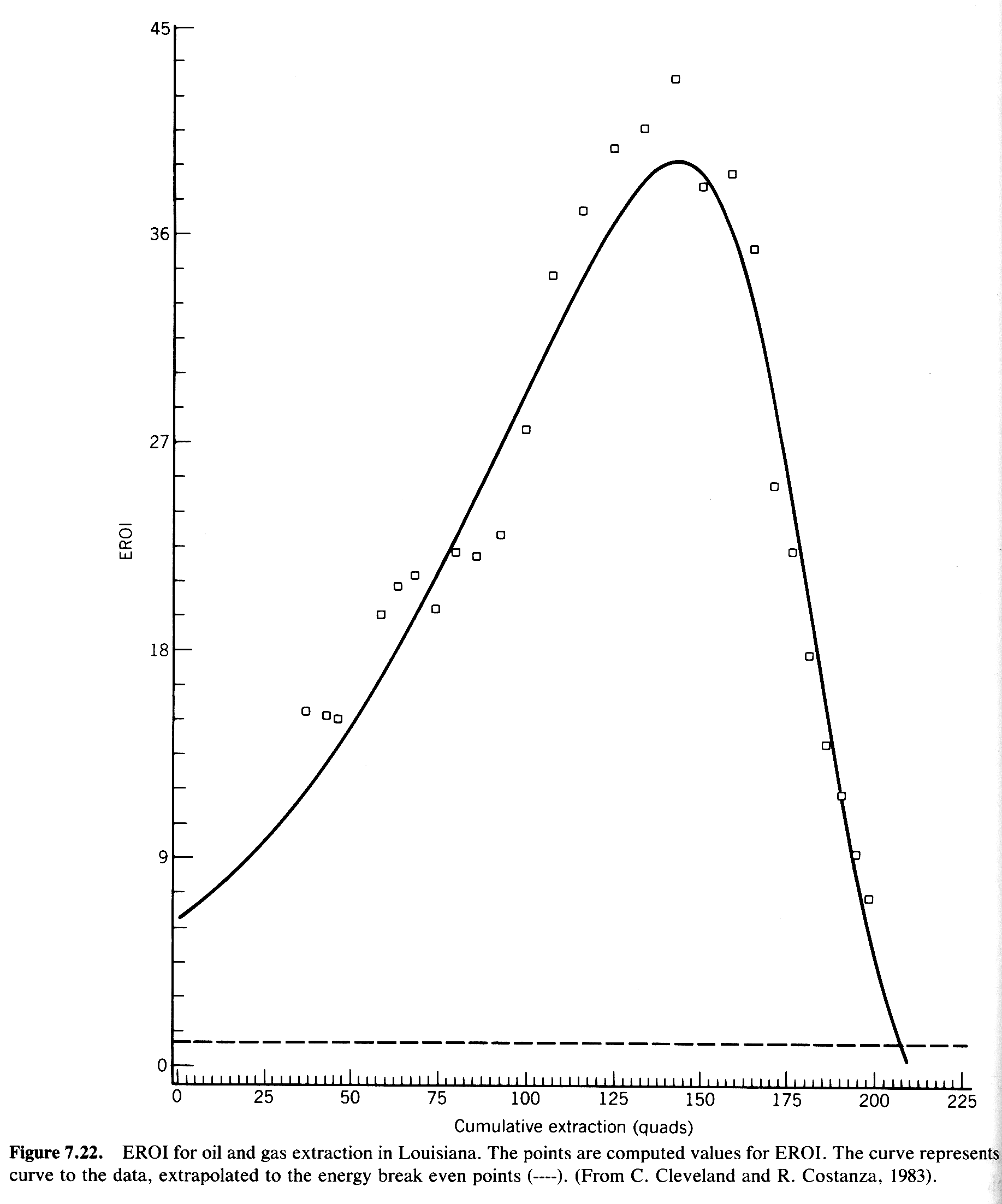
Summary: There's a lot of the stuff, but the logistics of turning it into real oil appear impossible to overcome. This is because the energy cost of extracting the stuff and converting it into a useful form is about the same as the energy one gets from it. "Shale Oil" seems to have a net energy gain of about 2:1 or 3:1, which makes it not really worth getting, regardless of the price of oil. In order for an energy source to provide useful net energy to society it needs to have a net energy gain better than 5:1, preferably 10:1 or better. For comparison:
- Early oil had a net energy gain of 100:1 (Free energy!)
- Oil from Iraq has an energy gain of 50:1 (Free energy, minus the cost of military occupation)
- Oil from Saudi Arabia is about 40:1 and falling (Ghawar is dying)
- Natural gas in Russia has a net energy gain of 40:1 (And there is a LOT of it! Not much use in North America, though
- Wind power and next generation nuclear fission power both have a net energy gain of about 15:1
- Natural gas from 'fracking' in North America has net energy gain of about 15:1 and falling (and it poisons the water supply)
- PV solar is 10:1 and increasing
- New oil finds in North America are about 5:1 and falling (which is why there's little exploration occurring)
- Tar sands at 5:1 (not counting environmental devastation, fresh water limits, and very high CO2 emmissions)
- --- Below this line and it's not worth getting ---
- Shale oil at 3:1 (low net energy AND very dirty)
- Corn ethanol is about 1:1 (can we say "boondoggle", boy and girls? I knew we could! )
- First generation nuclear power plants about 1:1 (plus a lot of fissile material for nuclear weapons during the Cold War)
Result: there's a lot shale oil in the ground. It is destined to stay there.
-
Re:The nature of theory...
With people, its just a complex mathematical model, people are after all, just chemical reactions.
I think that's actually a really important point: in this our 21st century, if we don't adapt to a socio-economic model based on transition from exponential growth fueled by dead dinosaurs to maximum extractable energy (EROEI, Energy returned on energy invested) from sunshine(*) upon our one planet, we're screwed.
And I don't think the 18th and 19th century economists like Smith and Marx were on to this thought (I fear Malthus got it spot on).
The reason is that Earth is a closed thermodynamic system for all practical intents and purposes except for the influx of sunshine, a bit of geothermal energy in places, a bit of fissible heavy metals, and maybe a bit tidal energy from the Moon.
Sorry if this comes over a bit like a confused ramble, it wasn't meant that way, but I'm tired.
For a funny and much more sensible story on this, read: Galactic-scale energy: Part 1
(*) for "energy from sunshine" read: renewable energy sources such as solar thermal, solar photovoltaic, wind, biogas -
Re:Russia approves?
Russia exports oil, US imports oil. Sky high oil prices (courtesy of peak oil) mean lots of money coming in to pay for this. As for selling the oil to china, that's the point. Selling Alaska oil to china will pay more once the US defaults.
The problem is that high oil prices tend to be unsustainable in the decades long time frame necessary for infrastructure projects such as this. Think Colorado oil shale (and others). If prices go too high, demand collapses and prices go lower, thus making it very hard to support the financing on big projects. Besides, if you just want to push oil, it's a lot easier to build a pipeline than a railroad.
-
Re:The Oil Drum
The Oil Drum
That was the first thing that popped into my mind too when I saw this topic, but AC beat me to it.
I don't have any mod points to bump him high enough to get past other people's filters. He has an excellent link.
Maybe someone else can bump him up?
The Oil Drum is a site which attracts geologists and petroleum engineers much like Slashdot attracts IT professionals. It runs on Drupal software.
You will find a lot of energy related concerns addressed in the forums there. -
theoildrum has good coverage
of oil related news stories like this.
This link has the Big Oil article link and discussion on TOD: http://www.theoildrum.com/node/8214
-
theoildrum has good coverage
of oil related news stories like this.
This link has the Big Oil article link and discussion on TOD: http://www.theoildrum.com/node/8214
-
Re:Very early speculation
Or perhaps it was fundamental environmentalists that tried to take down the department for oil and energy.
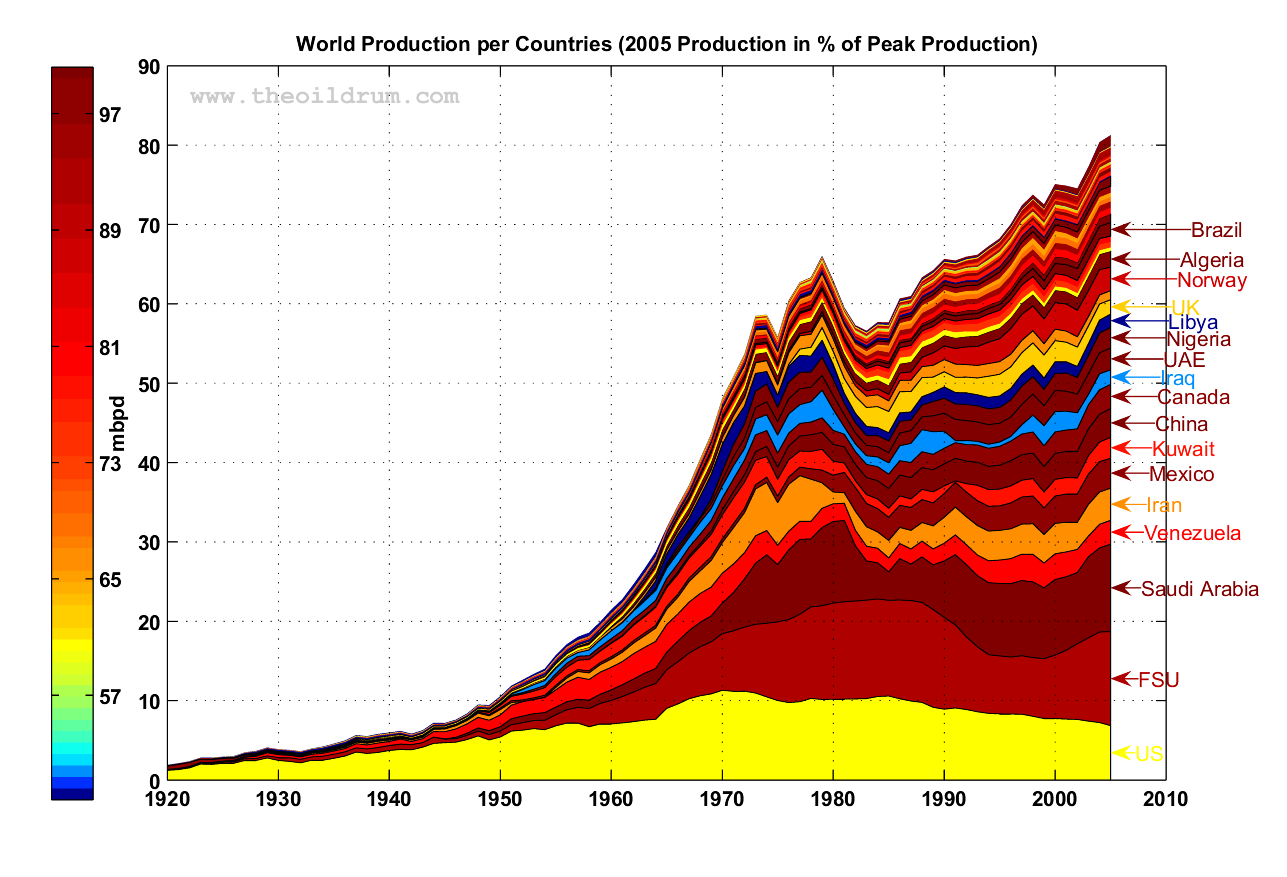
That's silly. If they'd just wait 15 years, they wouldn't need a car bomb, see the graph: Norway and the Parabolic Fractal law.
I'd bet the Norwegian oil ministry already knows for quite a while what's going to happen to the North Sea fields. So they probably look at diversifying their energy production *right now*, being Norwegians and all. Why would fundie environmentalist hippies want to blow it up then? -
Two alternative ways to collect solar power
There are two ways I know of to collect dilute solar energy that might be economic, i.e., lower than the price of coal.
First is over 40 years old, go into space and beam energy down as microwaves.
Zero gravity and no wind means the collecting structures can be far lighter than anything on earth. They are still way too expensive to haul up by current or projected developments in chemical rockets. The cost must come down by a factor of 200 for current rockets and a factor of 40 for the projected cost of the Falcon Heavy. $100 per kg is what's needed..
That looks possible (at 500,000 tons per year) by using partly air breathing vehicles for the first stage and beamed energy (lasers) for the second. Details here: http://www.theoildrum.com/node/7898.
The second way is to float the collectors at 20 km where you can avoid clouds and the cosine effect by pointing a 2 km parabolic reflector at the sun. This works as far north as Stockholm. You bring the energy down in a 50 meter diameter light pipe, convert to heat which can be efficiently stored at high temperature.
Based on materials cost, the investment looks to be around $1.2 B/GW and the power cost between one and two cents per kWh. The storage system (35,000 cubic meters of firebrick) costs a tenth of a cent per kWh. I worked on this for a year and a half. We found no showstoppers, but the engineering detail got beyond what could be done with a small unpaid team. More here www.stratosolar.com -
Re:Say waht you will about MS
Bill Gates is a megalomaniac and probably insane (advocating mass murder).
Besides the occasional disaster, man made or otherwise, there will always be organized warfare. If we seen anything, these plants are fragile, easy to destroy targets.
The amount of radionuclides stored in each of these nuclear power plants is enough to make even the largest nuclear weapons ever built look like pop-guns. Once the contents are spread thoughout the country side it will be many centuries before a long lived mammals (like humans) can repopulate the affected region.
Oh, the rich have a plan in case of another World War. They will all fly down to Southern hemisphere, while anything larger than a house cat left behind in the Northern Hemisphere will suffer horrible, unspeakable, ugly deaths, and deformities.
Some important references and obscure but very important observations/calculations you may have missed.
Fukushima: Prestigious doctor: US nuclear 'Baby valley of death,' Millions to die
Bioconstration of radioactive I-131 in thyriod gland
Relative radioactivity of Cs-137 verses natural potassium (K-39, K-40, K-41)
Let's not forget.. LFTR, or Thorium only reactors don't exist, nor will they ever exist.