Slashdot Mirror
Domain: thespacereview.com
Stories and comments across the archive that link to thespacereview.com.
Comments · 192
-
Re:Why Bother
Yep, and the most efficient way to do that is to provide a launch subsidy for the next 10 years.
-
Let's all write a Bill
Let's call it the Cheap Space Access Subsidy Act. We don't need a space elevator or some new technology to get cheap access to space. Sure, these technologies would be a boon but we don't need to get the government involved in their construction, and if we do we probably end up paying 100x as much for it. The only level of involvement that government needs to play in bootstrapping access to space is a subsidy. Sam Dinkin proposes a ten-year, $150-billion federal subsidy. With upcoming American commercial launchers like the Falcon V expected to offer service at $2,600/kg, a $1,500/kg subsidy would at least double the amount of stuff being launched into space up to a limit of ten million kilograms a year. After ten years the industry that has sprung up to offer services to people who want to claim the subsidy will have so much momentum they won't need the subsidy to halve the cost of their service. Ten years after that and we'll see the costs halve again, and so on. Something like a space elevator will become commercially viable when it's the only way to undercut the competition.
Now all we have to do is get some congress criters to endorse it. -
Re:1/r^2 kills this
Nope.
The fact that the Sun's magnetic field is large isn't what protects us from cosmic rays. The Sun's magnetic field encourages particles to orbit the Sun. That doesn't help us. What helps is when a dipole field gets closer to you - like when the Sun sloughs off a bunch of plasma that drifts near you. Hence a Forbush decrease. What protects us on Earth is the Earth's magnetic field, and the atmosphere.
Anyway, it's relatively easy to craft magnetic fields to any shape you want. So high magnetic field on the outside, zero magnetic field on the inside. We're really good at that. And 5 tesla (50,000 gauss) should be about enough. It has been studied.
The reason it's not ideal is because cosmic rays aren't all charged. Gamma rays make up a component of solar cosmic rays, and okay, there may (should) be a few neutrons from the Sun as well (though that part is really new and not well studied).
But magnetic shielding is very actively being looked at. It's just not an easy problem - we don't have very much experience with superconducting magnets in space, for instance.
Interestingly, one of the best things about this is that you don't really have to worry about the highest energy particles which will get through. Not only is the flux far, far lower, but they deposit less energy than lower energy particles which stop in your body. So it's pretty easy to figure out how high a magnetic field you need.
And smartass comment: magnetic fields don't drop like 1/r^2. Electric fields do. For a simple magnetic dipole, the field strength drops like 1/r^3. Different configurations drop differently, as well. -
Re:What a waste
You know, at first I was really pissed off when I saw this post...I mean, for those of us who actually dream of and even have been involved in having a permanent and ongoing human presence in space, what you said was just plain nasty.
However...You did get me thinking...what is my reason for wanting to go to the moon? Why am I so passionate about something so big and so far fetched?
You know what I realized...I don't NEED a REASON (at least not one that you happen to approve of)...
It is real simple...
I am passionate about the possibilities available for humanity spreading out among the planets and even the stars...
I am passionate about the possibilities for our planet, once humanity gets a chance to really look down on our planet and sees it as a whole...
I am passionate about the possiblilties in the realm technology, once we get to a place where gravity doesn't interfere with crystal growth, where a vaccum can be a real vaccum, and where I could launch a space probe by openning a door...
They may have no reason for going to the moon.
They may have bad reasons for going to the moon.
So what...I can give them some good reasons...and I suspect so can you (and in the process you might just get your orbital hotel, etc).
Hell, so can these guys:
http://www.space.com/news/moon_top10_031208-1.html
http://www.enterprisemission.com/top-ten.htm
http://www.thespacereview.com/article/82/1
http://www.nssnyc.org/amillionreasons.html
http://www.famousquotes.me.uk/speeches/John_F_Kenn edy/3.htm -
Re:Maybe they'll discover oil or uranium
How about platinum? It's a lot closer too. Might be a good target once something like America's Space Prize has been won.
-
Re:Hey
The shuttle may be "flawed" as you put it. Or maybe spaceflight is just dangerous? Do we really have reason to believe the next generation craft is going to be safer? If so, how much safer?
A lot of people tend to assume that space travel is inherently dangerous, but that isn't necessarily true. Just look at the Russian Soyuz, which hasn't had a fatality since 1971.
The shuttle IS set to be scrapped, but we have to complete the space station before that can happen.
Why? There's no way that the benefit we'll get from the ISS will be worth the cost. Although it's been great for pork-barrel politics, the benefits of the ISS to science and exploration are rather dubious:
http://www.thespacereview.com/article/391/2
If the main concern is keeping the promises we've made to our international partners, I'm fairly certain that we can offer them other things which will cost us far less than completing the ISS with the shuttle. -
Re:Why Mars?
You're incorrect. The mining of most of the rare metals on earth are done at the sites of meteor hits (the notable exception being gold). The earth simply doesn't have any of these resources naturally. Most of the material from these meteor hits has been eroded away. The moon, on the hand, is covered with craters which experience no erosion. If we set out now to obtain this material and bring it back to earth, yes, it would be prohibitively expensive. However, if we have a large volume of people visiting space every year, the cost of launching materials like water and oxygen from earth will become a dominating cost. At that point taking these resources from the moon will become economical when combined with the metal resources that can be extracted. Dennis Wingo spelt it all out in his book Moonrush, which was painstakingly researched and addressed all the different earth-lunar systems to acheive it.
-
Re:Space travel - no kidding
Ok, so now that you're interested I'm going to direct you to the book Moonrush where Dennis Wingo spells out a solution to the oil crisis by jump starting the hydrogen economy by collecting platinum-group metals from the Moon where they are vastly more common than here on earth. With the people of earth's energy needs refocused on electrical power we would immediately see the technological advance of fusion power accelerated such that CO2 production over the next 50 years is dramatically reduced. And the final icing on the cake, is that once commercially viable fusion reactors are online we can begin sending helium3 from the moon to earth.. the cleanest, most efficient fuel known to human kind.
All the other problems of earth stem from energy production. -
Manned Space Flight
I recently read M o o n r u s h. The renouned commercial spaceflight author Dennis Wingo makes the argument that for a $20 billion investment humans could return to the Moon perminately, mine precious metals needed to kickstart the hydrogen economy and eventually turn a profit. That much investment includes all the launches and all the equipment needed. Of course, it won't happen with some angel investor handing over that much capital at once with some vague hope of a return on investment. No, the way it will happen is with small incremental missions with each returning an investment. Dennis Wingo's current project is Orbital Recovery. They're developing a space tug to station keep satellites when their fuel runs out to keep them operational beyond their designated decommission dates. The space tug that is developed as a result is an integral part of the return to the moon system. How long? Give it 20 years.
-
Nice to see an Ares stack finally getting props
This memo could be a photocopy of something circulating thirty years ago. Sounds like they're finally going to take advantage of the modular parts of the shuttle the way they talked about when the shuttle stack design was being originally being funded twenty-five to thirty years ago. One nice change is that the rumor mill believes the heavy lift stack bears a striking resemblance to Robert Zubrin's Ares stack (a.k.a. Shuttle-Z).
The "Shuttle-C" cargo stack (and variations) were originally publically discussed in the early '80s as reasons why the shuttle was worth all we were spending (you don't just get the shuttle, you also get a "normal" heavy-lift launcher). Those variants, however, have had problems that could only be resolved by massive cultural change at the NASA level. One of the biggest issues was payload capacity of the side-slung configuration. Since then variations including the Ares stack and the more recent Shuttle-B have appeared and pretty much gone nowhere.
I suspect that the United Space Alliance's (USA's) "risk averse" culture will actively hinder and ultimately frustrate all of these plans. If you've ever worked for a government contractor, you'll understand the culture I'm talking about. They (Boeing and Lockheed-Martin, the companies in the USA partnership) don't have to compete in markets, and are positively allergic to any hint that they may have to compete with other companies for revenue. If NASA's hoping for bargains, they won't find them when dealing with USA.
Regards,
Ross -
Has the Space Station met its objectives?
The Space Review has an article by Dwayne Day, titled "Twenty-five gigabucks of steel: the objectives of the International Space Station." Basically, it discusses the objectives of the space station, and whether or not it has met those objectives.
Although NASA of course never directly stated it like this, here are the ISS (official and unofficial) objectives the article mentions:
# demonstrating leadership in space
# forging international cooperation with Cold War allies
# conducting human biological research to benefit biology and medicine on Earth
# conducting materials research to benefit Earth
# serving as a construction platform for Lunar and Mars missions
# supporting ex-Soviet aerospace workers and institutions, and symbolizing post-Cold War US-Russian cooperation
# learning how to construct large structures in space
# learning how to operate in space
# providing an engineering testbed for space equipment
# conducting human biological research to support future long-duration space missions
# pork barrel politics
Some of these it's succeeded at, but for most of them it hasn't. -
loo training??
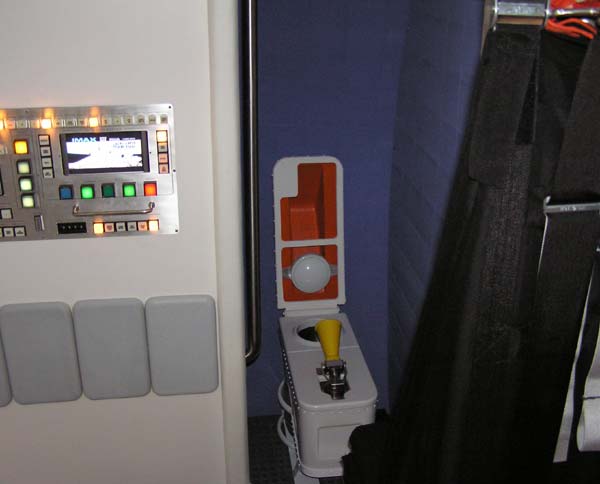
i wonder how many days (weeks?) are spent on training astronauts to use this throne?
-
Re:Bring back the Saturn rockets!Actually they are looking at using the ASRB from the shuttle as the primary booster. This makes a lot of sense. I wrote the editor for the documentation system for the ASRBs. The amount of documentation needed for stuff that is man-rated is immense. Given that the ASRBs are all we've got that is man rated, it makes sense to continue using them.
-
Re:Not so outdated
As others have noted its not exactly the same technology, its just the same name a company and team used over decades for a family of launchers as are Delta and Atlas.
And as others have noted much of the technology really was good and didn't need to evolve.
But it should also be noted there is a good reason expendable booster evolution has been slow in the U.S.
In particular the Space Shuttle completely decimated and paralyzed expendable booster development in the 70's and early 80's and set it back for at least a decade if not two in the U.S. If you recall there was a NASA mandate during the Shuttle's heyday that all NASA satellites would be launched on it, the DOD similarly, though somewhat more reluctantly, put all its eggs in the shuttle basket which nearly wiped out the business for expendable boosters for a long period.. It wasn't until the Challenger disaster that everyone in the U.S. remembered unmanned expendable boosters were really way better for launching satellites.
At that point Delta, Titan and Atlas went from nearly dead to rebirth but it took years to revive the expendible boost production lines and just get them back where they were before the Shuttle nuked them.
Delta in particular was the team which was given a charter to build new booster technology, there is a pretty good writeup on Space Review. The Delta Heavy is one candidate for launching the CEV. Unfortunately just about every launch vehicle we have compares poorly to the Saturn V if you ware serious about going to the Moon or Mars. All the CEV plans I've seen require multiple launches and docking all the components in LEO to get to the Moon versus the Saturn V doing it all in one shot. Delta 4 Heavy is a slight improvement over the Saturn 1B which was the last U.S. man rated expendable booster used in Skylab and Apollo-Soyuz but pales against Saturn V.
All in all its kind of sad commentary on how little America's space program has progressed since it peaked during Apollo.
The CEV program is going to take a good 10 years, if a miracle occurs and it stays on schedule, until there is a manned launch and then its going to be putting a tiny conical capsule in to LEO. It will be a disappointment to anyone who remembers Apollo. In most respects they would be better served if they just dust off all the Apollo plans and reverse engineer that hardware systems, update things like the computers that have progressed dramaticly, and pick up where Apollo left off versus spending 10 years and a lot of money to design something less capable than Apollo. -
Beagle 2This article is interesting and worth reading:
The author, Dwayne Day, is a highly recpected historian of space exploration. He concludes that Beagle 2 was a excellent example of how not to manage a space project. He appears to think that Professor Colin Pillinger should never again be put in charge of large amounts of tax-payers money.
-
Re:Is society ready?
It's a good question but I don't think there's a need for worry. There will always be a small minority of adventurous people willing to take the risks.
But what if others, such as Rep. James Oberstar (D-Minn), wish to pass laws preventing others from taking those risks? -
Hubble repair alternatives
Those interested in the various alternatives to repairing or replacing the Hubble Space Telescope may be interested in this article from a few weeks ago that reviews an interim "Analyses of Alternatives" report by a third party, the Aerospace Corporation. This report concludes that a robotic repair mission would cost about the same as a shuttle repair mission or building and launching replacement telescope(s), but carries a far lower probability of success. It should be noted that this is an interim report, and according to one source the final report may look more favorably on robotic repair options.
-
Re:Stratoshperic ArcheologyInteresting post!
Running your "Big Bird" & "KH" references through Google produced:http://www.thespacereview.com/article/263/1
and
http://www.randomhouse.com/features/spybook/spy/96 1115.htmlGreat stuff!
R3
-
Robots and Hubble: a bad idea?
The Space Review has an article called "Robots and Hubble: a bad idea?", which argues that repairing Hubble with robots is both risky and expensive.
The article discusses two alternatives: "Alternative One: Bring back the shuttle" and "Alternative Two: Replace Hubble with spacecraft". Both alternatives would be expensive but with a better chance of high scientific value.
Other people have proposed "Alternative Three: Replace Hubble with ground telescopes". NASA could give funding to the astronomy community to build a ground telescope with adaptive optics. It's not a perfect solution because Hubble can detect some wavelengths that ground telescopes cannot, but it's a very cost-effective solution and would be a good compromise until the next-generation space telescopes are launched. Alternative three would be low cost, high scientific value. The University of Arizona's $120 million Large Binocular Telescope is the world's most powerful optical telescope, with images about 10 times as sharp as the Hubble's.
-
Rutan and orbit; SpaceX
In the recent Discovery Channel documentary, "Black Sky: The Race for Space," Burt Rutan revealed one of his preliminary designs for an orbital craft. Basically, it looked like SpaceShipOne, except it had a huge rocket roughly twice it's length sticking out its rear. I'm guessing Rutan has some tricks up his sleeve to deal with the reentry issue.
However, I'm not sure if we'll see Rutan launching such an orbital craft in time for this prize. From a recent speech he gave:
I put out there that before I die I want to see affordable travel to the Moon, that's essentially where I'm going. What I mean by affordable is not what Houston talks about affordable; I'm talking about where a third of the people in this room can afford to go to the Moon when I finally kick off. That's my vision.
Now, when you do that, you can draw a schedule back to show this above low Earth orbit stuff, and this low orbit stuff, and this suborbital stuff. Tier One is suborbital manned spaceflight, Tier Two is low Earth orbit manned spaceflight, and Tier Three is what we do above low Earth orbit, and it does have to start very soon after we have affordable Earth orbit stuff. I drew a schedule for all of that about three and a half months ago, and I decided what had to happen at every point to get to that. As of the 27th of September, I'm already six months ahead three months into the schedule. I did not think that there would be a major investment by a major guy who can and will do it. Can anyone here think of a better guy that will actually go out and build a spaceline [than Richard Branson]? I couldn't.
Can anyone here think of a better guy that will actually go out and build a spaceline [than Richard Branson]? I couldn't.
I could move directly on to orbital ops from a research standpoint, but I decided that since I didn't seem to have a real close competitor to the X Prize, that maybe I ought to stay with suborbital and make damn sure that there's a successful, certified, safe system out there flying many passengers every day suborbitally before I lose interest in it and go on to orbital. And that's what I'm going to do. Is it going to be tough? Yeah, there's some tough things. Are the regulatory issues going to be tough? Yeah. But I'm not as scared of that program that is in front of me right now as I was scared of the SpaceShipOne program that was in front of me in 2001.
Personally, I'm guessing that to win this prize somebody will end up designing a capsule to launch on SpaceX's reusable Falcon V rocket, which, starting next year, will be launching 4200kg payloads (enough for a manned capsule) to orbit for $12 million. -
Re:That is NOT correct.
In comparison, NASA developed and flew three X-15 prototypes with similar capabilities for a cost of $300 million in 60's dollars (which incidentally was considered a cheap program).
You've got good points. But you're being unfair on this one. Even the Rutan notes that the X-15's capabilities far outstrip Spaceship One. That, and X-15 provided some of the basic building blocks in aero and astronomics on which Spaceship One could be built. Furthermore, Spaceship One enjoyed numerous high-performance off-the-shelf materials that didn't exist during the X-15's time. Comparing the two provides some interesting historical perspective. But the two programs are apples and oranges. -
Space != Science
Science is a crucial part of any space program, and this should continue. But space has never been exclusively for science, and it never should be.
If we divide up the universe between the space scientists and space colonists:
Science: The universe
Colonization: Earth, Earth orbit, Moon
(Mars is disputed territory.)
Now, the colonists want to return to the moon and go to Mars, with robots and humans, with the aim of colonizing both worlds. The scientists want to understand the universe. Both goals are worthwhile.
I'm in favor of repairing the Hubble telescope, but any deaths will give Congress an excuse to shut down the space program. Robotic repair is a good compromise. -
Earth-Moon L-1? RiiiiightInteresting to note that in this slide they allude to the possibility of making some kind of permament "depot" at the Earth-Moon L-1. Which makes great PR, but also leads me to wonder just how much real analysis has gone into their mission concepts.
Libration point mission are hard. Manned libration point missions - if we ever do one - would be harder, since they tend to be much more susceptible to last-minute changes in trajectory. Then add the complications of trying to do proximity maneuvers, let alone rendezvous-and-docking, in such a complex dynamic environment (the cutting edge in L-point research right now is formation flying - not close maneuvers, but just trying to maintain any kind of coordinated trajectory between multiple spacecraft). Finally, throw in the fact that the Earth-Moon libration points are tenuous at best, with dynamics that are seriously warped by the Sun's gravity (libration "points" are an artifact of three-body dynamics, such as Earth-Moon-Spacecraft), and you have a recipe for a severe difficulties or a serious cost explosion. Not to mention the propellant costs incurred by attempting to station-keep for any appreciable period of time in the vicinity of their "depot". As I said, it makes me wonder about the quality and/or depth of their analysis...
-
The Space Station is in the wrong orbitSimply put, ISS is in the wrong orbit as a stopping point for cargo or people on the way to the moon. I stole this from an article on SpaceReview,
For the ISS, its lack of usefulness as a base for lunar exploration is due to the fact that it is in the wrong orbit. In order to make the station accessible from both Cape Canaveral and Baikonur, it is in a skewed orbit, suitable for doing useful earth observation but not for much else. The Clinton administration saw it as a symbol of US-Russian friendship and for keeping the large aerospace contractors happy, but that was about it.
The article goes on to say it's feasible if ISS is moved to an equatorial orbit, which simply won't happen unless it occurs 50 years from now.
The reason it's not useful as a lunar stop-over base is the same reason that Columbia could not have docked at ISS. Changing from one orbit to another is extremely costly (in terms of fuel), and any lunar mission has to be essentially on the equatorial plane.
Of course, the idea could still work, but the Soyuz would have to be launched to an equatorial orbit from a suitable launchsite. -
Bigelow Aerospace inflatable habitats
Thankfully Bigelow Aerospace is working on inflatable space habitats (using former TransHab technology). They'll start in-space tests next year, on the maiden flight of SpaceX's (ultra-cheap) Falcon V rocket. With any luck we'll have a privately funded ISS-equivalent in a few years anyways, for a fraction of the cost.
-
Why build a space station?
"Why build a space station? Since the beginning of the Space Age the stations that have flown have fallen short of the ideals of space advocates and science fiction writers, who foresaw orbiting hubs of transportation and commerce--the giant spinning station from 2001: A Space Odyssey, complete with Pan Am shuttles and a Hilton hotel, being perhaps the best-known example. Instead, the space stations that have been built have been, at best, modest conglomerations of modules and solar arrays, serving as cramped homes for two or three people who spend much of their time simply keeping their station operating. The justification for such facilities has been rooted primarily in geopolitics--first Cold War competition, now international cooperation--coated with a thin veneer of science."
"Yet there is a far more important purpose for a space station, argues Robert Zimmerman in his book Leaving Earth. Space stations, he believes, are essential proving grounds for the eventual human exploration of the solar system. Space stations allow scientists to find out how people can handle extended periods of weightlessness, as well as how they can--or sometimes can't--get along with fellow crew members in cramped quarters. Stations also offer an opportunity to develop and test key technologies needed for interplanetary journeys, particularly life support systems, as well as test the resourcefulness of crews to carry out repairs in space. While politicians may have been motivated to fund space stations for foreign policy or other political reasons, the various space stations built and flown to date have gone a long ways towards achieving those exploration goals."
The full article is on the web: Review: Leaving Earth by Jeff Foust, The Space Review.
-
Re:Why?
Customers are actually pushing the envelope on the other end. Maybe a 25 ton launcher...
There is actually not much demand for vehicles as large as described above. The growth in communications satellite mass has levelled off given technical issues with the latest series of large satellites (notably the Boeing 702), as well as overcapacity in the satellite communications market in general. (In fact, there is a small but profitable niche market for small communications satellites, like Orbital's STAR series.)
The article "The myth of heavy lift" offers some strong arguments against the development of heavy-lift vehicles, particular those that could only serve NASA's exploration programs. ("The cost of medium lift" offers a counterpoint.)
-
Re:Why?
Customers are actually pushing the envelope on the other end. Maybe a 25 ton launcher...
There is actually not much demand for vehicles as large as described above. The growth in communications satellite mass has levelled off given technical issues with the latest series of large satellites (notably the Boeing 702), as well as overcapacity in the satellite communications market in general. (In fact, there is a small but profitable niche market for small communications satellites, like Orbital's STAR series.)
The article "The myth of heavy lift" offers some strong arguments against the development of heavy-lift vehicles, particular those that could only serve NASA's exploration programs. ("The cost of medium lift" offers a counterpoint.)
-
Re:Don't worry, the "fix is in"
What are you doing up so early in the morning besides posting to slashdot? Or haven't you gone to bed yet?
1) The scientific community is largely based on recognition of accomplishment. You may feel that the taxpayers should get the data, but you'd be acting in haste. You're paying the scientists salaries so that *they* can make important discoveries, not *you*.
I don't see how publishing the data realtime for this important experiment would hurt anybody except for maybe a few scientists who want to climb the scientific career totem pole. I'm sure that if there was enough concern about this, scientists could be found who were less "territorial," and wouldn't mind publishing a paper even though the data was made available realtime.
Considering that $700 million dollars of the public's money was spent on this thing, maybe a compromise could be made. Maybe they could find somebody like the late Carl Sagan to show up in six months and tell us whether the probe is finding frame dragging or not. They should be able to spot a trend by then.
It's easy to plot out mean values of raw data and compare them to theory. In that case, you're right. There are many, many people out there that would love to determine for themselves if they understand the mathematics of this experiment enough to analyze the data. However, The real experiment is determining to what extent their data can be 'trusted'. In order to do this, they must factor in the sensitivity of *every* piece of equipment used to collect any portion of the data, as well as all of the natural statistical errors that coincide with an experiment of this nature.
Yes and no. First, this satellite has been designed at great expense a thousand different ways of left and right to prevent noise. The builders have have even advertised that the space inside the gyros is going to be the quietest place anywhere, acoustically and electrically. It has been advertised as equivalent to being able to measure the width of a human hair at ten miles and frame dragging to an accuracy of 1%. That's their words, not mine.
If the probe is going to be that accurate, then it should be pretty obvious what forces are acting on the gyros (if there are any).
I would imagine that most of the data collected in experiments of this nature would look like noise to any scientist who did not also have (possibly classified) knowledge of the nature of the instruments being used to collect the data
This is my point. If the data from the probe looks like noise, and given the fact that it should easily detect frame dragging, what is there to be afraid of? Do they need to "statistically massage" the data to get the desired result? What are they protecting? Does the public need protecting from the natural phenonema of the universe? Are they using alien technology from area 51? Or maybe Einstein is right no matter what.
Maybe they spent that 700 million on keggers every saturday for fourty years and all they are sending up is some neat looking nickel plated ping pong balls. After all, it was a bunch of naked guys at the pool who invented it.
Admittedly I'm being difficult. And every scientist on the planet is going to be watching this thing anyway. It will be an understatement to say that it will be interesting to see what will happen.
Anyway, I never said mine was the majority opinion. You obviously have faith in the scientific profession as it currently stands. In many instances it works and it produces important and useful results.
But occasionally the method and the results leave something to be desired. -
So Many Strong Inicators...
...so little actual exploration happening now.
Seriously, I applaud the efforts of the rovers and the orbiters. They're doing a lot of good science, and we should be proud of what they've shown us. But at the same time, human explorers could do so much more, for not a heck of a lot more money (this $1 Trillion price tag that's been floating around is bad journalism at its finest). I say that all of this good news should serve as impetuous to get people on the surface of the Red Planet as soon as possible!
To all those people who worry about cross-contamination, come on...the two environments are so different, the chances that a microbe from one could survive in the other are basically nonexistent. Besides, it's been proven that unsterilized meteorites have been moving from one planet to another for several billion years now, so if cross-contamination was ever going to happen, it already would have. -
Re:Some errors or omissionsGot my figures from 03-Multi-Year_Budget.pdf, but these are always subject to change, obviously.
From that, I got 5.868 billion for Human Space Flight out of 15.690 billion budget for 2004. I checked this some months ago, and it took a bit of finding again. I remembered "5 billion and something out of 15 billion and something" for next year, which is why I called it "Roughly" above.
Your figures are obviously later than mine (and they break down into more detail - thanks for the link). I note that the 2004/05 estimates for the Space Station are up from 1.2 billion to 1.7, the Shuttle is up from 3.301 to 3.968. Total Human Space Flight (including Ops Support, Payload and ELV support is up to 6.1 billion.
You can add in X-37, OSP, PAD and DART, for an extra 550 million, taking Manned Space Flight Ops and research to 6.65 billion out of 15.469 billion. Not really a majority of their resources - the 7.7 billion figure that you mention includes general (unmanned) launcher research and engineering and Robot systems research (which you really can't put down against the Manned Space Flight side of the ledger
Solar Systems exploration weighs in at 1.3 billion, Mars Exploration at 570 million, Astronomy at 877 million. Including other Space Science programmes, Space Science is just over 4 billion. Earth Science is at 1.5 billion, Biological and Physical research at a hair under 1 billion, Aeronautics also at a shade under 1 billion. Total Science expenditure is totalled as 7.66 billion.
You could well argue that manned flight gets more than unmanned flight - it does cost more. There's more to the science than the launcher and probe costs, though, and the largest chunk of NASAs budget goes to science.
You don't have to guess at my meaning for Quote: Not to mention that the program of Lunar Base plus Manned Mars program will be unlikely to be anywhere near one thousand times the price of Spirit and Opportunity, and I didn't mean that it would be a lot more. The bit in my post breaking down the trillion dollar claim (which is far better done at The Space Reviewbreaks it down far better. The estimated price in using the 1989 price (inflation adjusted for 2004 dollars) for a Mars mission is $276 billion (including development of a new manned launcher of noticeably greater capacity than the Saturn V). Using ISRU techniques and lesser launchers, and benefiting from improvements in the launcher field, this figure could be drastically reduced. The moon missions and Lunar Base (including operating costs and support over 20 years) should also be far less than the (inflation adjusted) $336 billion for the gold plated solution of the SEI).
So your contention that "It can't possibly be less [than 1000 times the price of Spirit and Opportunity, i.e. $820 billion]" puzzles me. If the gold-plated solution for everything comes in at about $500 billion (over 30 years), and we're planning on using more intelligent, far cheaper approaches, why do you feel that this cheaper solution has to be more than $820 billion?
-
He does...Mr Weinstein may be a Nobel Prize winner in physics, but I'd venture he's not an expert in the state of the art of robotics.
The state of robotics for doing short-range geological/paleontological investigation work, as demonstrated by Spirit and Opportunity, is a heck of a long way behind what a human with a few tools would do. If a manned mission was there, the cycle of collect/analyse/design new experiment is so much faster because you've got decision-making capabilities right there rather than twenty light-minutes away. A human with a small lab could also conduct a much wider variety of investigations than a robotic mission could.
Not to mention that humans could drive across the surface of Mars far faster than autonomous vehicles can. The current rovers are quite a ways off the state of the art, certainly. However, as the latest DARPA challenge has demonstrated, the state of the art in autonomous vehicle design is not great in absolute terms - and that's on Earth under a better-known set of conditions. You might argue that instead of moving around by ground a robotic mission could be designed to move through the air, but aside from the question of how the heck you're going to power such a mission you're then left with trying to land it autonomously a large number of times on undulating, rocky terrain.
Now, the question is whether the greatly increased cost of crewed missions is worth the greatly increased science return. I would argue that one crewed mission could achieve as much as hundreds of robotic missions, on the basis of the area they could cover, and the variety and dynamic nature of the investigations they could undertake. I would fully agree with Weinstein that the Shuttle and the ISS have been a gross waste of time, and would not be sad if they were cancelled. But that doesn't mean a future crewed Mars mission will be.
It's a makeable argument that you'd get a better science return over the next couple of decades from a combination of unmanned space probes and other scientific experiments (like funding ITER, the Superconducting Supercollider, and so on), than funding a Mars mission.
However, seeing the US government is prepared to waste hundreds of billions of dollars on a missile defence that's not going to work, and is spending over 200 billion dollars to install what looks like a Shiite theocracy in Iraq, and will spend 300 billion in the next decade on propping up the otherwise unsustainable property values of America's farmers (that works out to US $20,000 annually per farm job), I would argue that 100 billion over a decade or two (see this article for a discussion of why it's not going to cost a trillion dollars) is a heck of a lot better investment.
-
1 Trillion Dollars
Ah, yes, once again we see that famous 1 Trillion Dollars figure. That's 1 Trillion Dollars using technologies and methodologies that are 15 years out of date to be spent over 30+ years and including missions that have already been accomplished and other missions not directly related to the Moon or Mars. This is becoming the stuff of Urban Legend. If you haven't read http://www.thespacereview.com/article/119/1, I highly encourage it. It appears to be a very thorough debunking of that whole misinformation campaign and clearly points the finger for bad numbers at media outlets as opposed to real accountants who are directly involved.
-
Re:FIX HUBBLE FIRST!The thing is - regardless of the safety issues, is it the most cost effective solution?
As Jeff Foust points out in Life after Hubble, we could get one brand new Keck sized ground based observatory plus 2 Explorer sized missions for the price of that one Shuttle servicing mission.
Adaptive optics systems have gone a long way to closing the gap between image quality on the ground and above the atmosphere. There are some advantages for Hubble - seeing frequencies that the Keck can't see, no weather restrictions, etc.
However, a ground based telescope can be far larger, far cheaper, and far easier to maintain. We've got to weigh it up in terms of science return, and the ground based systems are definitely catching up.
-
Mars Direct
There's no need for a one way trip, there is Mars Direct.
Mars direct was devised by an aerospace engineer called Robert Zubrin a few years ago in response to the previous Bush's original estimate of the cost of sending humans to Mars. Bush's administration devised a plan whereby a giant spaceship would be constructed in Earth orbit. This spaceship would package together everything required for a trip to and from Mars, and a stay of a few months.
Mars Direct proposes a multi-stage approach whereby the required supplies, infrastructure etc. are sent over several years. It is safer, has more redundancy, allows a longer stay on the surface, and best of all, it's cheaper. Much cheaper. The cost of the original plan was estimated by NASA to be $400 billion (1989, unadjusted.) When researchers at NASA's Johnson Space Center considered Zubrin's Mars Direct proposal, they decided to be generous, and scale it up by a factor of 2. The ultimate cost still only came out at $50 billion dollars.
Mars direct can be implemented now, using current technology, with no need to leave people on Mars, and no exotic propulsion methods. Of course, with the development of more exotic nuclear propulsion methods, the cost can probably be brought down even further, and the travel times reduced.
Mars Direct could constitute as little as 20% of NASA's annual budget if implemented. This means that by retiring the Space Shuttle, and ending the commitment to the ISS, Mars Direct could probably fit within NASA's current budget.
Any NASA plans to send humans to Mars will almost certainly emcompass elements of Zubrin's Mars Direct plan.
For more info
For a more recent critique of the plan -
Not new, and not necessarily accurate
While the National Review article might be news to most Slashdotters, this is not news for those who have been following the ongoing space policy review by the Bush Administration. In late October SpaceRef.com first reported that a likely outcome of the policy review would be a call for resuming human flights to the Moon, with a Presidential statement on the issue coming as early as the Wright Brothers centennial speech at Kitty Hawk. On Monday SpaceRef.com followed up that original report with a new one, stating that "the return to the Moon by U.S. astronauts possibly by the end of the next decade" had become the "default" position of those planning the new policy. The National Review article doesn't add anything these two SpaceRef reports already provided.
There is no guarantee, though, that these reports are accurate. On Sunday the Orlando Sentinel reported (alternate link) that any new national space policy would differ little from current plans. This report was based on an analysis of internal NASA documents obtained by the newspaper along with interviews with those in the know. This report is actually not necessarily contradictory with the new SpaceRef report: if you're not planning to send people back to the Moon until the end of the next decade, there's little you need to do differently in the near term.
If you're curious about the current interest (or obsession) some have with crafting a new "vision" for NASA, I recommend the articles "The vision thing" and "Vision revision" at The Space Review. (Disclaimer: I'm the author.
-
Not new, and not necessarily accurate
While the National Review article might be news to most Slashdotters, this is not news for those who have been following the ongoing space policy review by the Bush Administration. In late October SpaceRef.com first reported that a likely outcome of the policy review would be a call for resuming human flights to the Moon, with a Presidential statement on the issue coming as early as the Wright Brothers centennial speech at Kitty Hawk. On Monday SpaceRef.com followed up that original report with a new one, stating that "the return to the Moon by U.S. astronauts possibly by the end of the next decade" had become the "default" position of those planning the new policy. The National Review article doesn't add anything these two SpaceRef reports already provided.
There is no guarantee, though, that these reports are accurate. On Sunday the Orlando Sentinel reported (alternate link) that any new national space policy would differ little from current plans. This report was based on an analysis of internal NASA documents obtained by the newspaper along with interviews with those in the know. This report is actually not necessarily contradictory with the new SpaceRef report: if you're not planning to send people back to the Moon until the end of the next decade, there's little you need to do differently in the near term.
If you're curious about the current interest (or obsession) some have with crafting a new "vision" for NASA, I recommend the articles "The vision thing" and "Vision revision" at The Space Review. (Disclaimer: I'm the author.
-
Re:Thank you for your supportWell, at least some of the Microsoft money may be helping out.
Rumour has it that Paul Allen is backing Rutan and SpaceShipOne...
-
Re:There is no incremental development path to orb
The problem with incremental development of RLVs is that there's a huge leap between the size and difficulty of putting something into space for five minutes (as in the current X-prize contenders) and putting it into orbit (as in the shuttle). That will make it difficult to evolve our way into a commercial space program.
If you attempted to go directly from an X Prize-class suborbital RLV directly to an orbital RLV, I would agree with you. However, there are intermediate steps along the way, notably suborbital RLVs with varying amounts of crossrange. Most of the X Prize vehicles are designed to take off and land at or very near the same place. Following generations of suborbital RLVs could be designed to travel downrange hundreds or thousands of kilometers, perhaps as incremental/scaled-up versions of X Prize-class vehicles. (Indeed, the X Prize organizers have discussed having, as a follow-on to the X Prize, a "Y Prize" that would require vehicles to also travel some distance downrange.) This opens up new markets, like rapid cargo delivery, and also pushes the designs of the vehicles closer to what's required for an orbital RLV. There will still be a leap from suborbital to orbital vehicles, but with careful design it need not be a huge one.
This incremental approach is also applicable beyond suborbital RLVs. Elon Musk's SpaceX has a similar incremental approach for its orbital launch vehicles, from the Falcon to the Falcon Heavy to an even larger vehicle that would use the two Falcon stages as upper stages. Note that Musk also has an interest in human spaceflight, and those requirements are being incorporated into the design of the Falcon and its successors.
Jeff Foust
The Space Review -
Re:Suborbital reusable vehicles are toys
A suborbital flight is short, expensive, and not very interesting. A trip to Mir was a real experience, but suborbital flight? It's like a really good roller coaster, with a really expensive ticket.
Market studies would tend to disagree with you: there is considerble interest in suborbital spaceflight among people with the means to pay for the experience. Is there a flaw you see in these studies?
It's possible right now to charter the "Vomit Comet" KC-135, and experience zero G for a minute or so.. You even get to unstrap and move around. Very few people do this. Penn and Teller, the magicians, did once. That gives a sense of the size of the market.
NASA's "Vomit Comet" cannot be chartered by the public, although there is one company, Zero G Corporation, working to provide such flights in the US, similar to what's commercially available in Russia. They haven't started commercial service (although the home page of the site claims an early 2003 introduction date), but they have made progress on the business and regulatory fronts.
Jeff Foust
The Space Review -
Re:To boldy go...
About the only use for this would be tourism. The military does its own research and the microgravity research can be better done on ISS, which is subsidized and already in place.
One of the interesting applications of suborbital RLVs is the testing and qualification of microgravity experiments designed to be flown on the ISS. The several minutes of microgravity that a suborbital RLV provides time to make sure an instrument works as planned in microgravity. It's much better to know that the experiment isn't working as you thought it would -- or that a loose bit of solder is floating around, shorting out electronics -- on the ground, and not after installing it on the station! There are also circumstances when an experiment only needs a few continuous minutes of microgravity: far more than what you can get today on aircraft like the Vomit Comet, but for which the station is overkill.
Jeff Foust
The Space Review -
Re:There is no incremental development path to orb
Launching from 100,000 feet and Mach 3 will help even more - there was a proposal to build the third B-70 to support this kind of mission. There are also a couple of advantages of a very high altitude launch - for a given altitude, the velocity will be lower than a ground launch (lower aerodynamic pressure) and the nozzle can be configured for vacuum. The latter allows for a good expansion ratio with moderate pressure - smaller pumps for liquids or thinner cases for solids.
DARPA is currently funding a project called RASCAL (Responsive Access, Small Cargo, Affordable Launch) that would use such a high-altitude, high-speed aircraft to launch small (on the order of 100 kg) spacecraft into LEO quickly and cheaply. Earlier this year they awarded a contract to a startup, Space Launch Corporation, to continue design work on RASCAL. First flight is tentatively scheduled for 2006.
Jeff Foust
The Space Review