Slashdot Mirror
Domain: trailing-edge.com
Stories and comments across the archive that link to trailing-edge.com.
Comments · 92
-
"digital" dilemma
Are these PDP-11s or VAXen or what? And what type?
In any case, they're certainly trailing edge...
-
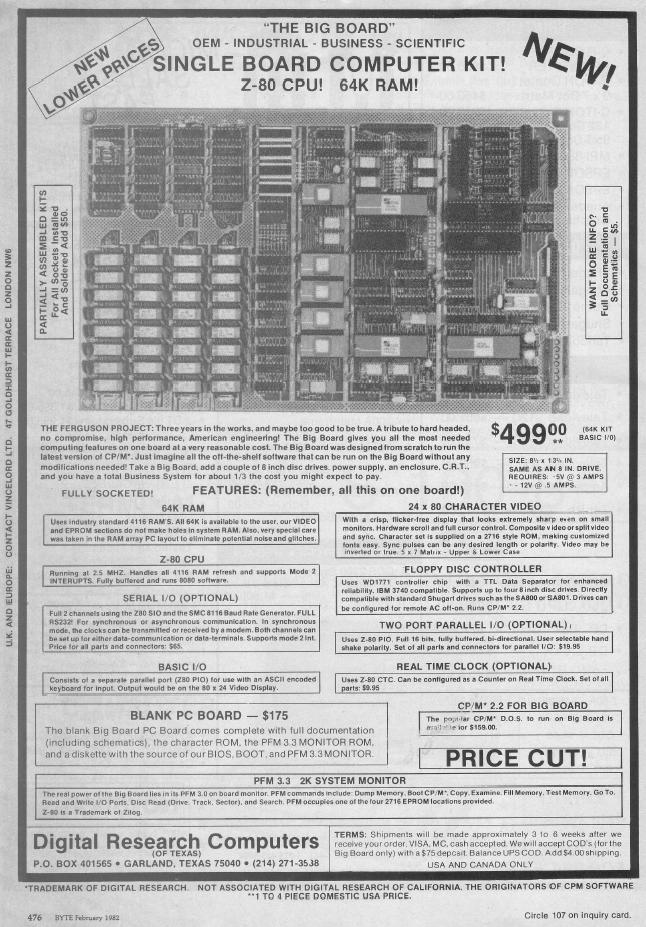
Re:Potetntial HackI love the fact that the last four digits of the above (3741) post happen to match an IBM system from 1974 that used the same diskettes described in TFA. The floppy was formatted to the standard described in the 3740 format. This format was later used on the first CP/M computer systems. My first real computer (a Ferguson Big Board II) used Shugart 850 8" floppy drives that used this same disk format. My second computer (an IMSAI 8080) used 851 drives that supported double sided floppy diskettes.
The standard 3740 diskette held 241kiB of data and was very slow. We've come a long way since then.
-
Re:Footprints of old systems
The DR11-W was not a printer interface, but a computer-to-computer interface for the PDP-11. Details are here.
-
Welcome to the 1980's
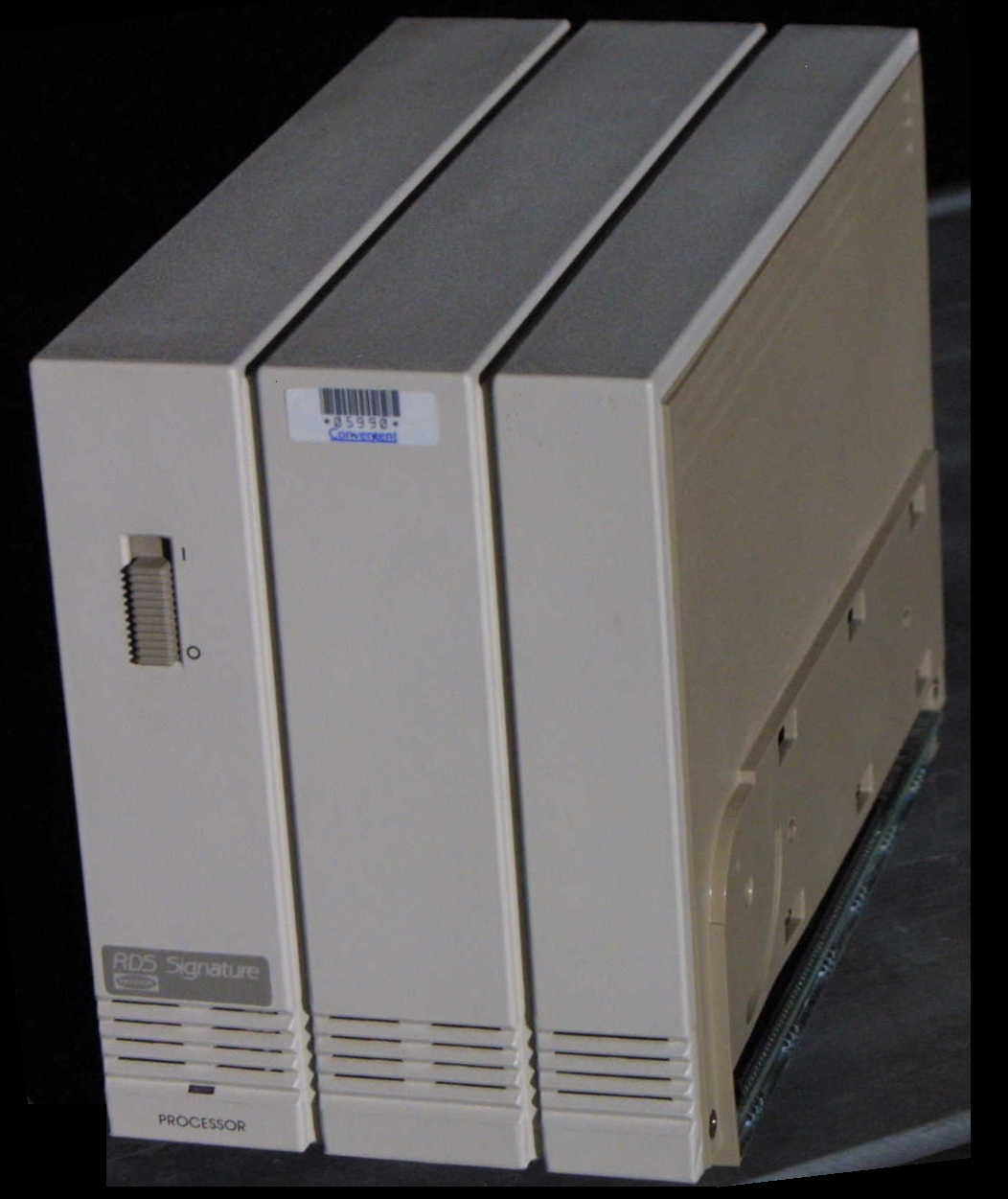
In the 1980's there was a company "Convergent Technologies" that made a snap-together systems with separate boxes for CPU, Disk, graphics cards etc.
Here's some pictures:
http://www.computinghistory.or...Some history:
https://en.wikipedia.org/wiki/...
https://en.wikipedia.org/wiki/...And their patents:
http://bitsavers.trailing-edge...However, the Microsoft patents are for stackable components that use a flux fountain.
The Convergent Technologies component boxes are side-by-side and aren't held together by magnets. -
Re:The reason it's thought of as a boy's field
But seeing as you want to use the 70s, how many females are prepared to sit at home and learn to code? Not many. Girls / woman have just as much access to the same tools, tech and information as those born with a penis, they choose not to access it.
In the '70s nobody had a PC. The original PC - the IBM 5150 - was only released in 1981. Before that, most consumer computers were pretty much sold as expensive toys. So pretty much NOBODY was learning how to do serous coding except at the universities. There was no Internet, and CompuServe was expensive at $10/hr (more like $30/hr In today's terms) for 1200/2400 baud dial-up. So the vast majority of the population had zero access to sit at home with a computer and learn programming in the '70s.
So spare us your stereotyping bullshit. Five decades of school, college and business data shows us the choices made by most females is that they aren't interested in learning how stuff works, and how to pull it apart, change it and rebuild.
So all the female surgeons who patch people together just don't exist? Female doctors? They'll outnumber men in a couple of years. They make a mistake, you can die. A programmer makes a mistake
Also, in the 70s, the gender divide in uni computer classes wasn't that big. Ditto for programmers in industry - it was a woman who gave me a copy of the manuals for the IBM 360 she programmed at work. Yes, programmed. Not "operated." You know, assembler, a real programmers language?
So what happened between 1970 and today that made the field unattractive to women? Deteriorating work conditions, the "macho" attitude of new entrants into the field, worsening pay discrimination, the toxic "death march" that has become the norm
The interesting thing is that men are now experiencing the same "out by 40" problem thanks to ageism and cheap younger workers eager to do whatever it takes to "live the dream."
-
Re:Blast from the past!
Reminds me of this old article:
Bringing Up A Surplus 68000 Board - Micro Cornucopia, p. 28
I miss that magazine and the old Byte.
-
Re:Oh, fantasitc...
Originally, I was going to say RSX-11, but I didn't think enough people would get it.
It is hard to find, but you can get RT-11 here... http://simh.trailing-edge.com/...
-
Re:Free Emulators for PDP-11 and VAX
This isn't a bad time to post a link to SIMH, too. It simulates:
Data General Nova, Eclipse
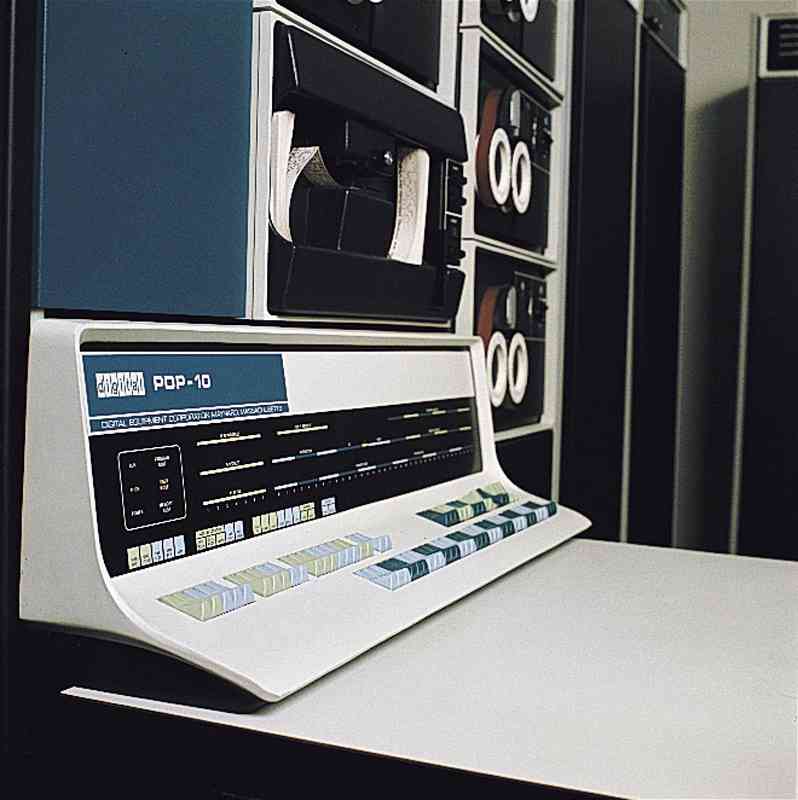
Digital Equipment Corporation PDP-1, PDP-4, PDP-7, PDP-8, PDP-9, PDP-10, PDP-11, PDP-15, VAX
GRI Corporation GRI-909, GRI-99
IBM 1401, 1620, 1130, 7090/7094, System 3
Interdata (Perkin-Elmer) 16b and 32b systems
Hewlett-Packard 2114, 2115, 2116, 2100, 21MX, 1000
Honeywell H316/H516
MITS Altair 8800, with both 8080 and Z80
Royal-Mcbee LGP-30, LGP-21
Scientific Data Systems SDS 940
SWTP 6800 -
Re:About time
DEC introduced some very handy and useful extensions to FORTRAN and had an awesome compiler, and these non-standard extensions ended up getting supported by non-DEC compilers. They also had an outstanding language reference manual. In my experience, almost everyone who used a VAX for programming did so in FORTRAN while almost all the C programmers did their work on the Sun workstations.
-
Re:No line numbers!
> Before anyone makes a lame joke along the lines of "10 GOTO 10", keep in mind that the BASIC from Dartmouth had no line numbers
> and it had structured control flow (for/while loops, etc.).You don't know what you're talking about.
http://bitsavers.trailing-edge.com/pdf/dartmouth/BASIC_Oct64.pdf
http://bitsavers.trailing-edge.com/pdf/dartmouth/BASIC_4th_Edition_Jan68.pdf -
Re:No line numbers!
> Before anyone makes a lame joke along the lines of "10 GOTO 10", keep in mind that the BASIC from Dartmouth had no line numbers
> and it had structured control flow (for/while loops, etc.).You don't know what you're talking about.
http://bitsavers.trailing-edge.com/pdf/dartmouth/BASIC_Oct64.pdf
http://bitsavers.trailing-edge.com/pdf/dartmouth/BASIC_4th_Edition_Jan68.pdf -
Re:LOLOLOL
Why? Just get this http://simh.trailing-edge.com/ and compile it.
-
Re:Serious Questions about OpenBSD infrastructure
One wonders if simply compiling and running on a SimH virtual machine might be a better use of electricity, especially considering that even an Atom-powered server is going to be much faster than a real VAX.
-
Links on the subject
The patent: http://www.google.com/patents/US7986426
Another view: http://stop-project-paperless.com/wp-content/uploads/2012/04/Patent-US7986426.pdf
Analysis of the patent: http://www.patentbuddy.com/Patent/7986426
The dispute of the patent: http://www.ricoh-usa.com/news/news_release.aspx?prid=1052&alnv=pr
Dispute filing: http://www.sutherland.com/portalresource/Ricoh_institution_decision.pdf
Possible prior art:
http://en.wikipedia.org/wiki/Xerox_DocuShare
http://bitsavers.trailing-edge.com/pdf/xerox/xns/XNSG058504_XNS_Introduction.pdf (1985)
-
Re:Everything old is new again - EmplantI remember the Zenith Z-100 had dual processors, but I don't recall if you could get them going simultaneously. There were ISA cards for PCs (one of them was the Baby Blue card) that allowed CP/M to run on a PC.
Of course, the IBM mainframes running VM ran multiple OSes. Definitely not a new idea.
-
Re:It's still using propritary code
Some DEC customers had the microcode listings and tools for the PDP-10, PDP-11, and VAX so they could add their own instructions. An extensible microcode was considered a feature. IBM S/360 and S/370 had editable microcode too, and there was an APL Assist written in microcode. Just because something has microcode doesn't mean the microcode has to be closed source. Intel, on the other hand, doesn't even document the format of their microcode blob. We have to take Intel's word for it that the microcode is fixing bugs, not adding new bugs, and doesn't contain any backdoors, which could be as simple as putting a certain value in a specific register to allow a user-mode program to execute privileged instructions.
-
Re:Sell it to Intellectual Property Law Firms
-
Re:The Onion said it best
I'm not sure. I'd have to read the manual
-
Re:Don't Freak! Prolly A PCI Card Emulator
And if you want to learn the assembly dialect, just fetch SIMH - the greastest thing since the bit-slice microprocessor.
-
Re:What about swap?
;-) Well, that depends on who you get your memory from and what server you're talking about but yes prices have come down a bit. I remember when 8MW on a DECsystem 20 was hella expensive. $50,400 for 265K Words.. http://bitsavers.trailing-edge.com/pdf/dec/pdp10/lcg_catalog/LCG_Price_List_Jan82.pdf That would come out to be $1,612,800 for 32 modules not including the expansion cabinets necessary to hold it all.
SO for a DL360-G6... (not too old.)
8GB module, $75... From here.
Same module $162... From here.With an MSRP of $850.. so 128GB at the low end $1200... at the price listed above about $2600. Forget sucker MSRP... LOL
-
Re:Availability.
That emulator is proprietary, but this one http://simh.trailing-edge.com/ isn't, and emulates a couple of dozen different minicomputers. Seems like a good candidate for porting to the RasPi.
-
Re:Bah
expands like LEGO
Ah, step back into the past, stackable, networked, and able to expand right off the edge of your desk. Come complete with a power brick feeding dual dc to dc (re)converters internally and with multitasking all on a 80186. A small monument (ok doorstop) to proprietary hardware and vendor lockin. I was forced to service these back in the early 90's and Lego style connections are unstable after a short time in use.
http://bitsavers.trailing-edge.com/pdf/convergent/ngen/pictures/80186_processor_1.JPG
-
Re:Cool beans.
There's a KI and a KL.
...and a KS, which used AMD 2901's in the data path.
-
Re:Cool beans.
Well, the DEC-10 is mainly discrete logic chips and Transistors. Depending upon its exact vintage I expect that there would be lots of 74xxx IC's.
There's a KI and a KL. From reading the KI10 schematics and pages such as the one for the M133 NAND gate module (the schematics referred to module names such as that), I infer the KI10 had DEC-proprietary ICs. The KL10 was ECL, so it wouldn't use 74xxx's (unless there was an ECL variant).
-
Re:Sure
The original S/360 and S/370 architectures did not have a distinct "Clear Register" instruction.
Yes, which is why the idiom for clearing the register would be a "subtract from self" or "XOR with self".
I'd have to go back and RTFM (Principles of Operation), but unless I was mislead, there is, in fact, a single case where subtracting 2 numbers could throw an Arithmetic Exception (0C4), due to overflow in the sign bit.
The Principles of Operation says, for the subtract instruction:
Subtraction is performed by adding the one's complement
Of course, it also says:
Programming Note
When the same register is specified as first and second operand location, subtracting is equivalent to clearing the register.
Subtracting a maximum negative number from another maximum negative number gives a zero result and no overflow.
which at least implicitly says that, whilst there are cases where subtracting two different numbers can result in a fixed-point overflow (e.g., subtracting anything non-zero from the least possible negative number, -2^32), subtracting a number from itself will not do so. That should not be a surprise, as the result of such a subtraction is zero, and zero fits quite nicely in 32 bits.
And, if we look at it from the point of view of how overflow is detected, i.e. "carry out of the sign bit != carry out of the high-order magnitude bit", then, if we're subtracting something from itself, we're adding something to the bitwise complement of itself and adding 1 in. Adding something to the bitwise complement of itself yields something with all bits set (with no carries, as, in every bit position, we're adding a 1 and a 0, yielding 1), and adding 1 to that converts each 1 to a 0 with a carry, so all carries are 1, and are thus all equal.
So the instruction:
SR 15,15
Could fail in extremely rare cases.
Yes, but the cases where it could fail generate an exception called a "machine check".
-
Re:Let's get these out of the way
Here’s TECO EMACS version 170 from MIT, circa the mid 1980s I think: http://pdp-10.trailing-edge.com/mit_emacs_170_teco_1220/index.html To use it you need a working PDP-10 (or an emulator), with an appropriate OS (ITS, TOPS-10, or Twenex), and a working TECO. Emacs was originally a bunch of Editing MACroS implemented in TECO, the world’s most difficult text editor: http://en.wikipedia.org/wiki/TECO_(text_editor)
I don’t know if you could get TECO EMACS working in other versions of TECO, but TECO is still lovingly ported to modern systems like Mac OS X and Windows. Learning to use it will make your brain hurt.
Multics Emacs was the first port away from TECO, thoroughly described by its author Bernie Greenberg: http://www.multicians.org/mepap.html There’s a link to the source in that paper, dating to the early 1980s.
Other flavours of Emacs were ZWEI (ZWEI was EINE Initiailly; EINE Is Not Emacs) for the MIT CADR Lisp Machine (http://www.heeltoe.com/retro/mit/mit_cadr_lmss.html) and its descendants like ZMACS on the LMI Lambda and on Symbolics Genera systems.
-
Playing with simh and OLD unices
There's nothing like playing with simulated old gear, e.g. with simh, using old operating systems; but playing with old Unices also has its charm.
-
Let the PC play!
Is there a device that can be connected to a PC that will read punch cards? Does the iPhone have an app yet? I have simh! http://simh.trailing-edge.com/ I need to feel the smell expensive cardboard and heard grinding noises (make sure that app does sound effects!)
I started on the C-64. My only nostalgia is for the sound of a non-audio processing tape drive!
-
Re:They'll just use them to play Elite all day
Emulation works great for slower system. MESS emulates a lot of old computers, SIMH http://simh.trailing-edge.com/ also does a great job with old systems, PDP-1 though PDP-15 and some other old systems. You see there resources out there so you don't need to run the Old systems, but I guess it more fun to use the old computers...
-
Re:Factors of 10
Wrong.
A word is architecture specific.
A byte is ALWAYS 8 bits.A byte can't possibly "always" be 8 bits, when a byte means a single character.
This is the definition of 'byte' from 1959. People only started getting confused recently (Recently being the past 20 years) since the IBM 360 systems which first introduced the 8 bit byte and then became a defacto standard in the 80s. Then as new computer users moved into the front, such as yourself, you assume a byte must be 8 bits because that is all you have seen a byte to mean.There are systems that encode a single byte with 7, 8, 9, and 10 bits still today.
The only time a byte is 8 bits is when the system is structured around 8 bit units.
Hop on a PDP or Cray system and you will see a byte is 7 or 9 bits respectively.Origins of the word 'byte':
http://www.trailing-edge.com/~bobbemer/BYTE.HTM -
Re:FreeVMS
Instead of FreeVMS which isn't ready for prime time... Get the OpenVMS hobbiest edition, load up SimH and run OpenVMS on a real emulated Vax. For fun you could boot OpenBSD, NetBSD or BSD4.x on the emulated Vax.
As far as Solaris vs. BSD -- I run 'em both here. Solaris mostly on Sparc and BSD on x86. I've done Solaris x86
and it's ok, but it's really fun to set up a jumpstart server and load up some old Sparcs.I've even got SunOS 4.1.4 up...
Take a look at the software available on the http://www.openvmshobbyist.com/ site. A ton of VMS languages including C, ADA, Pascal, Macro32... TCP/IP and Clustering.
-
Re:Redundancy!
Since this is a Data General system, they could achieve instantaneous, cheap redundancy by utilizing the open source minicomputer emulator SIMH. http://simh.trailing-edge.com/.
This software allows modern microcomputers running Windows, Linux or MacOS to transparently emulate many legacy minicomputer and mainframe systems, including Data General NOVA and ECLIPSE environments.
They could slap in a couple of Xeon server blades, replicate their existing software environment and not have to spend a cent to reinvent the wheel (pun intended). It's not like traffic control technology has made major scientific strides in the last 30 years. If it had, we'd be building light rail instead of offramps... -
SIMH
SIMH is a hardware emulator for a lot of the machines Unix ran on (PDP-8, PDP-11, etc.). They also have some original Unix versions along with some other software for the other hardware they support.
I have run Unix V5 on a SIMH-based PDP-11, and it worked well, though it was strange to realize how fast it was running, in emulation, on a machine 1/16 its original size (Mac laptop).
-
SIMH
SIMH is a hardware emulator for a lot of the machines Unix ran on (PDP-8, PDP-11, etc.). They also have some original Unix versions along with some other software for the other hardware they support.
I have run Unix V5 on a SIMH-based PDP-11, and it worked well, though it was strange to realize how fast it was running, in emulation, on a machine 1/16 its original size (Mac laptop).
-
Re:Shows how vulnerable computer systems are
-
Know your history, nerds.
Is this news or ignorance? Over ten years ago a physical version of the "first" computer, the Manchester Baby, was rebuilt. This simulation is interesting, but it isn't "news" compared to some other projects in the history of computing or even the simulation of the history of computing. See computer50.org for more about what happened at Manchester 60 years ago, the Computer History Museum computerhistory.org, for a general overview and some really impressive displays and reconstructionos, or even the Computer History Simulation Project http://simh.trailing-edge.com/ for a hint at how simulation can be done.
-
Re:Real programmers do bigger on smaller
Reproducing a PDP-11 simulator on modern hardware would be relatively trivial,
-
Re:what?
-
Re:too lazy to rtfa, but...
That was only the case on a few machines, like, I believe, the KS-10, and the KL-10. The KA-10 and KI-10, for example, did not have such a console, and had a proper 36 bit wide blinkenconsole, wired straight into the CPU.
http://simh.trailing-edge.com/photos/pdp10.jpg has a picture of the KA-10. -
Re:Original Zork Source Code in MDL
Well, I said I wanted an account on DM to learn MDL, but I actually only wanted to play Zork. I tried to find the source code at the time, to help me solve the harder puzzles, but not until years later did I stumble across it thanks to google. Finding the source code was a grand adventure in itself!
MDL is basically just a fancy dialect of Lisp, with data types and angled brackets. Now days, the best way to learn MDL is to read the Zork source code!
Where did you find the MDL binary on Twenex.org? I wonder if the binary version of MDL you found would run under the KLH10 PDP-10 emulator, like the one you can telnet to at its.svensson.org. Probably not, since ITS is a lot different than Twenex. Maybe Devon could pull it off of an old DM dump tape! Good luck with your open source MDL interpreter!
I've had a hard time finding the tech reports about MDL online. Here is a thread about locating those and other MIT LCS Tech Reports. It mentions this place to find TR's. That links to this catalog, which lists several MDL publications. Those listings say you can purchase them from MIT Document Services.
MIT-LCS-TR-292: The MDL Programmig Language Primer, by M. Dornbrook, M. Blank.
MIT-LCS-TR-293: The MDL Programming Language, by S. W. Galley, G Pfister.
MIT-LCS-TR-294: The MDL Programming Environment, bu P. D. Lebling.You might try asking Gerald J Sussman, Hal Abelson, Stu W. Galley or Steve Meretzky. I wonder who owns the copyright, and if they'd be willing to make it GPL and put the original Zork source code up on Google Code for people to read and search and learn from? The version I found is the latest greatest PDP-10 ITS version, just before Infocom took it and ported it to microcomputers.
-Don
-
Re:Cool a mincomputer
Of course... Here you go. And this although ethernet support under Windows requires WinPCAP, which suggests that it might have been around for some time.
With a bit of work, they could probably be compiled for Linux on something portable, or even Windows Mobile and you *could* have a PDP-11 on your phone. -
I submit the following 1975 programs as Prior Art
The following hyperlink shows a program source code that was part of the Decsysten-20 Pascal compiler suite which was distributed by the Digital Equipment Corporation Users Society as Decus 20-0003. That program is a Pascal debugger, written in Pascal, written in 1975, and uses both single and double-linked lists. Linked lists are also used in the source code listing shown in the following link of the Decus Decsystem 20/PDP 10 Pascal Compiler, written in December, 1974, and part of the same distribution.
I knew this technique was old, I didn't realize it's more than 32 years old! And that's just what can be proved; it might be even older. -
I submit the following 1975 programs as Prior Art
The following hyperlink shows a program source code that was part of the Decsysten-20 Pascal compiler suite which was distributed by the Digital Equipment Corporation Users Society as Decus 20-0003. That program is a Pascal debugger, written in Pascal, written in 1975, and uses both single and double-linked lists. Linked lists are also used in the source code listing shown in the following link of the Decus Decsystem 20/PDP 10 Pascal Compiler, written in December, 1974, and part of the same distribution.
I knew this technique was old, I didn't realize it's more than 32 years old! And that's just what can be proved; it might be even older. -
Re:VMs
OH, man. Thanks for reminding me. I need to set up my POWER2 replacement box. (My original POWER2 had its 700W power supply start reporting error codes, and then start dying randomly, and then no longer boot.) Unfortunately, I haven't been able to find my AIX media in about two years
I have a bunch of different machines running different OS's, but I'd never have the resources to have a compile farm. Also, the OS licenses for many of my boxes are "procesor/hardware" licensese, meaning the basic OS that 'comes with' an SGI machine, a Sun machine, an HP machine, etc. Usually, you can't use these for commercial development without upgrading to a 'real' license.
Somewhere there's an R3000 emulator which you can actually get permission to run a free (as in beer) copy of SGI IRIX5 on. (You can get last year's version of IRIX, without a full development system, from SGI for free-as-in-beer if you have a physical box, as well.) You can also get a free (as in beer) version of OpenVMS if you have the physical hardware, thanks to the VMS Hobbyist project. I want to see more vendors offering things like this. Also, SIMH has a ton of old platforms emulated (like, 1960s and 1970s old). There are a number of free disk images you can download and play with, as well. Good luck finding compilers that old, though... [ you used to be able to find lots of precompiled gcc2.7 packages on the web, but most of those pages are only found via the Wayback machine now, if at all! -
Re:hey, the guy stepped up and did something.
I wonder whether SIMH would run on my Zaurus...
-
Re:Phew!
LOL,
My laptop came with M$-Win, whacked it, installed Linus (funny how he can fit into such a small box eh?), then SIMH available here: http://simh.trailing-edge.com/ and 'lo and behold? I've ALSO got a VAX 11/780 running at nearly 30 VUPS....Linux and VMS running on the same box? what could be better???.....(yep, the VMS install disks work just fine)....Now if I could just get my IMSAI 8080 running again......... -
Re:Sounds like a nice GUI for versioning though
I was running it under SIMH on a K6-3/550 running Linux:
http://simh.trailing-edge.com/
http://www.wherry.com/gadgets/retrocomputing/vax-s imh.html
I never got networking to work, though - VMS kept rejecting my licenses -
Re:How about...
I too started out (at school) on a PDP-8/e with paper tape and teletypes and you are correct - it and the PDP-11 were minicomputers. Witness the fact that rather than containing a microprocessor they had multiple-board processors: "The first 6 cards is the CPU". (Don't blame me for the grammar, folks; I'm quoting.)
DEC did produce a PDP-11-on-a-chip called the T-11. For a while in the mid-80s I had a system based on it, which a friend who had a combination of too much scrap hardware and too much free time put together for me, together with a VT-05 terminal. Eventually he replaced it with his PDP 11/34, once he'd found himself a VAX...
-
XML mode and a little history
As for history, I started using EMACS in 1979 at about version 134, when it was written in TECO on DEC PDP-10s. When RMS stopped maintaining it to move on to the GNU project he had just started, I took over its maintance for a year or so. One of the things I added in 1981 was M-$ (which I called "correct word spelling") and m-x check buffer spelling (which is a much better name than the present m-x spell-buffer).
If you use XML you should try James Clark's NXML Mode which uses Relax NG schemas. It gives you on-the-fly validation and completion when editing XML. Relax NG is very easy to use, especially in its Compact RNC form, which looks a lot like BNF but is isomorphic to the XML representation of the RNG Schema.
At work, I find it easy to develop Emacs-lisp scripts or even simply keyboard macros to do large refactoring jobs in Emacs. I often find that I'm the only person who can accomplish tasks that cut across programming language boundaries.
I used Emacs for several years to take real-time minutes for various W3C working groups, and made great use of the dabbrev-expand function (which I bound to meta-space). I like to think of it as an approximation to a Hidden Markov Model. In fact, at a Face-to-Face meeting in Cambridge, MA, I was able to type an entire sentence that the person sitting next to me spoke by typing only Meta-Space (and judiciously using only one or two letters to redirect the completions), a feat that lead many to believe that some form of magic was involved...Thereafter when others asked how our group had such complete minutes, people always responded, "Oh, he uses Emacs." -
M-$
It's nice to see they have a download for the windows version of ispell to make M-$ work. I wrote the original M-$ code in TECO for the PDP-10 in 1981, and it used ISPELL (ITS SPELL) for ITS, the PDP-10 OS, which itself came from some other TOPS-10 SPELL program. The Lisp EMACS implementation is wholly new, though, and I had nothing to do with writing it. (My M-X command for the buffer was m-x Check Buffer Spelling, which I think is less awkward than M-X spell-buffer).