Slashdot Mirror
Domain: twitter.com
Stories and comments across the archive that link to twitter.com.
Stories · 1,968
-
CopperheadOS Fights Unlicensed Installations On Nexus Phones (xda-developers.com)
An anonymous reader writes: Earlier this week security-hardened Android build CopperheadOS temporarily blocked Nexus updates on its servers after finding out that other companies have been flashing the ROM onto Nexus phones and selling them commercially in violation of the CopperheadOS licensing terms. The incident highlights an inherent problem in getting open source to be used by the masses: the difficulty of organizations being able to build and monetize a successful, long-term open source business model...
"We've enabled over-the-air updates again," CopperheadOS tweeted Saturday, "to avoid impacting our remaining customers on Nexus devices and other legitimate users. However, downloads on the site will no longer be available and we'll be making changes to the update client for Nexus devices."
In an earlier series of tweets, they explained it's an ongoing issue. "It's not okay to disrespect our non-commercial licensing terms for those official builds by flashing and selling it on hundreds of phones... This is why we've been unable to sell access to Pixel images. There are people that are going to buy those and flash + sell devices in direct competition with us in violation of the licensing terms. Needing to deal with so many people acting in bad faith makes this difficult.
"It's not permitted for our official Nexus builds and yet that's what's happening. We do all of the development, testing, release engineering and we provide the infrastructure, and then competitors sell far more devices than us in violation of our licensing terms. Ridiculous." -
Researchers Run Unsigned Code on Intel ME By Exploiting USB Ports (thenextweb.com)
Slashdot user bongey writes: A pair of security researchers in Russia are claiming to have compromised the Intel Management Engine just using one of the computer's USB ports. The researchers gained access to a fully functional JTAG connection to Intel CSME via USB DCI. The claim is different from previous USB DCI JTAG examples from earlier this year. Full JTAG access to the ME would allow making permanent hidden changes to the machine.
"Getting into and hijacking the Management Engine means you can take full control of a box," reports the Register, "underneath and out of sight of whatever OS, hypervisor or antivirus is installed."
They add that "This powerful God-mode technology is barely documented," while The Next Web points out that USB ports are "a common attack vector." -
Alphabet's Project Loon Delivers Internet To 100,000 People In Puerto Rico (engadget.com)
Google announced that its Project Loon internet balloons have delivered internet service to over 100,000 Puerto Ricans who were knocked offline by Hurricane Maria. Engadget reports: It's not a total success, which isn't to be expected after Puerto Ricans' communications infrastructure suffered so much damage. But the team was able to work with AT&T and T-Mobile to get "communication and internet activities like sending text messages and accessing information online for some people with LTE enabled phones," head of Project Loon Alastair Westgarth wrote in a blog post. The team launched their balloons from Nevada and used machine learning algorithms to direct them over Puerto Rico, where they've been relaying internet from working ground networks over to users in unconnected areas. In the post, Westgarth noted that Project Loon has never fired up internet from scratch this rapidly, and will improve their ability to keep balloons in place (and deliver sustained connectivity) as they become familiar with the air currents. -
Twitter Officially Expands Its Character Count To 280 Starting Today (techcrunch.com)
Twitter is rolling out an update around the world to allow users to post 280-character tweets. The company first announced the controversial plan to move beyond its traditional 140 characters back in September, noting at the time how a longer character count allowed users to express more of their thoughts without running out of room to tweet. TechCrunch reports: At the time of its original announcement, the company cited data backing up its decision that referenced how the character constraints impacted users differently, depending on their language. Twitter said that those who tweeted in languages like Japanese, Korean and Chinese were able to express around double the amount of information in a single character, compared with users who spoke English, Spanish, Portuguese or French, for example. In today's blog post about the public launch of 280 characters, Twitter aims to assuage people's fears that their timelines will fill with expanded tweets. The company said that during the trial period, people continued to tweet below 140 characters most of the time -- after the novelty of being able to use more characters wore off. Specifically, Twitter found that only 5 percent of tweets were sent out with more than 140 characters and of those, only 2 percent were over 190 characters. -
SpaceX Lands the 13th Falcon 9 Rocket of the Year In Flames (theverge.com)
SpaceX launched a Falcon 9 rocket from Florida this afternoon and, while the rocket successfully delivered the Koreasat-5A to its designated orbit, it managed to catch fire after landing on one of SpaceX's autonomous barges. The Verge reports: That rocket's mission [was] to send a satellite known as Koreasat-5A into space, where it will hang above Earth for 15 years while providing communications bandwidth for Korea and Southern Asia. SpaceX's Falcon 9 rocket successfully delivered Koreasat-5A to its designated orbit, marking the the company's 16th successful mission of the year -- twice the number of successful missions in 2016. Shortly after liftoff, the first stage of the rocket returned to Earth and landed (flamboyantly) in the Atlantic Ocean on one of SpaceX's autonomous barges. (The fires eventually went out.) It was the 13th successful landing of a Falcon 9 rocket this year, the 15th in a row, and the 19th overall. -
SpaceX Lands the 13th Falcon 9 Rocket of the Year In Flames (theverge.com)
SpaceX launched a Falcon 9 rocket from Florida this afternoon and, while the rocket successfully delivered the Koreasat-5A to its designated orbit, it managed to catch fire after landing on one of SpaceX's autonomous barges. The Verge reports: That rocket's mission [was] to send a satellite known as Koreasat-5A into space, where it will hang above Earth for 15 years while providing communications bandwidth for Korea and Southern Asia. SpaceX's Falcon 9 rocket successfully delivered Koreasat-5A to its designated orbit, marking the the company's 16th successful mission of the year -- twice the number of successful missions in 2016. Shortly after liftoff, the first stage of the rocket returned to Earth and landed (flamboyantly) in the Atlantic Ocean on one of SpaceX's autonomous barges. (The fires eventually went out.) It was the 13th successful landing of a Falcon 9 rocket this year, the 15th in a row, and the 19th overall. -
Indiana Is Purging Voters Using Software That's 99 Percent Inaccurate, Lawsuit Alleges (thedailybeast.com)
An anonymous reader quotes a report from The Daily Beast: More than 99 percent of voter fraud identified by a GOP-backed program is false, a study by Harvard, Yale, and Microsoft researchers found. Now Indiana is using the faulty program to de-register voters without warning. In July, Indiana rolled out a new law allowing county officials to purge voter registrations on the spot, based on information from a dubious database aimed at preventing voter fraud. That database, the Interstate Voter Registration Crosscheck Program, identifies people in different states who share the same name and birthdate. Crosscheck has long been criticized as using vague criteria that disproportionately target people of color. Now Indiana voters who share a name and birthdate with another American can have their registrations removed without warning -- a system ripe for abuse, a new lawsuit claims. Crosscheck's premise is simple. The program aims to crack down on people "double voting" in multiple states, by listing people who share a first name, last name, and birthdate.
Indiana has used Crosscheck for years. But until July, the state had a series of checks on the program. If Crosscheck found that an Indiana resident's name and birthdate matched that of a person in another state, Indiana law used to require officials to ask that person to confirm their address, or wait until that person went two general election cycles without voting, before the person's name was purged from Indiana voter rolls. Under the state's new law, officials can scrub a voter from the rolls immediately. That's a problem for Indiana residents, particularly people of color, a Friday lawsuit from Common Cause and the American Civil Liberties Union argues. -
Portuguese ISP Shows What The Net Looks Like Without Net Neutrality (boingboing.net)
"In Portugal, with no net neutrality, internet providers are starting to split the net into packages," argues a California congressman -- retweeting a stunning graphic. An anonymous reader quotes BoingBoing's Cory Doctorow: Since 2006, Net Neutrality activists have been warning that a non-Neutral internet will be an invitation to ISPs to create "plans" where you have to choose which established services you can access, shutting out new entrants to the market and allowing the companies with the deepest pockets to permanently dominate the internet... the Portuguese non-neutral ISP MEO has mistaken a warning for a suggestion, and offers a series of "plans" for its mobile data service where you pay €5 to access a handful of messaging services, €5 more to use social media; and €5 more for video-streaming services.
The congressman notes this arrangement offers "a huge advantage for entrenched companies, but it totally ices out startups trying to get in front of people, which stifles innovation." -
Portuguese ISP Shows What The Net Looks Like Without Net Neutrality (boingboing.net)
"In Portugal, with no net neutrality, internet providers are starting to split the net into packages," argues a California congressman -- retweeting a stunning graphic. An anonymous reader quotes BoingBoing's Cory Doctorow: Since 2006, Net Neutrality activists have been warning that a non-Neutral internet will be an invitation to ISPs to create "plans" where you have to choose which established services you can access, shutting out new entrants to the market and allowing the companies with the deepest pockets to permanently dominate the internet... the Portuguese non-neutral ISP MEO has mistaken a warning for a suggestion, and offers a series of "plans" for its mobile data service where you pay €5 to access a handful of messaging services, €5 more to use social media; and €5 more for video-streaming services.
The congressman notes this arrangement offers "a huge advantage for entrenched companies, but it totally ices out startups trying to get in front of people, which stifles innovation." -
Facebook Exec: 'Just Not True' That We Listen To Your Phone's Mic (theoutline.com)
Adrianne Jeffries, writing for The Outline: Facebook executive stepped outside of official channels of communication last night by tweeting about a negative rumor that seems to keep resurfacing no matter how many times the company denies it. "I run ads product at Facebook. We don't - and have never - used your microphone for ads. Just not true," tweeted Rob Goldman, vice president of ads products at Facebook. That includes Facebook-owned Instagram, he said. Goldman was responding to a tweet from PJ Vogt, one of the co-hosts of the tech podcast Reply All, which is producing a segment about the persistent belief that Facebook spies on users through the microphone. Vogt had asked people to call in to share their stories of why they think Facebook may be using the microphone to collect information for advertisers. -
Tesla Turns Power Back On At Children's Hospital In Puerto Rico (npr.org)
Elon Musk took to Instagram yesterday to announce the "first of many solar+battery Tesla projects going live in Puerto Rico." Tesla has used its solar panels and batteries to restore reliable electricity at San Juan's Hospital del Nino (Children's Hospital) after the country was devastated by two powerful hurricanes in September. NPR reports: Musk's company announced its success in getting the hospital's power working again less than three weeks after Puerto Rico Gov. Ricardo Rossello tweeted on Oct. 6, "Great initial conversation with @elonmusk tonight. Teams are now talking; exploring opportunities." Tesla's image of the project's solar array, in a parking lot next to the hospital, has been liked more than 84,000 times since it was posted to Instagram Tuesday. The hospital's new system allows it to generate all the energy it needs, according to El Nuevo Dia. The facility has 35 permanent residents with chronic conditions; it also offers services to some 3,000 young patients, the newspaper says. As for who is paying for the power system, the head of the hospital tells Nuevo Dia that for now, it's a donation -- and that after the energy crisis is over, a deal could make it permanent. Both Rossello and the tech company tweeted about the project this week, with Tesla saying in a post, "Grateful to support the recovery of Puerto Rico with @ricardorossello" -- and Rossello stating, "A major contribution of @Tesla to the Hospital del Nino." -
Justice Department Demands Five Twitter Users' Personal Info Over an Emoji (techdirt.com)
An anonymous reader quotes a report from Techdirt: Back in May, the Justice Department -- apparently lacking anything better to do with its time -- sent a subpoena to Twitter, demanding a whole bunch of information on five Twitter users, including a few names that regular Techdirt readers may be familiar with. If you can't see that, it's a subpoena asking for information on the following five Twitter users: @dawg8u ("Mike Honcho"), @abtnatural ("Virgil"), @Popehat (Ken White), @associatesmind (Keith Lee) and @PogoWasRight (Dissent Doe). I'm pretty sure we've talked about three of those five in previous Techdirt posts. Either way, they're folks who are quite active in legal/privacy issues on Twitter. And what info does the DOJ want on them? Well, basically everything: [users' names, addresses, IP addresses associated with their time on Twitter, phone numbers and credit card or bank account numbers.] That's a fair bit of information. Why the hell would the DOJ want all that? Would you believe it appears to be over a single tweet from someone to each of those five individuals that consists entirely of a smiley face? I wish I was kidding. Here's the tweet and then I'll get into the somewhat convoluted back story. The tweet is up as I write this, but here's a screenshot in case it disappears. The Department of Justice's subpoena is intended to address allegations that Shafer, who has a history of spotting weak encryption and drawing attention to it, cyberstalked an FBI agent after the agency raided his home. Vanity Fair summarizes the incident: "In 2013, Shafer discovered that FairCom's data-encryption package had actually exposed a dentist's office to data theft. An F.T.C. settlement later validated Shafer's reporting, but in 2016, when another dentist's office responded to Shafer's disclosure by claiming he'd violated the Computer Fraud and Abuse Act and broken the law, the F.B.I. raided his home and confiscated many of his electronics. Shafer was particularly annoyed at F.B.I. Special Agent Nathan Hopp, who helped to conduct the raid, and who was later involved in a different case: in March, he compiled a criminal complaint involving the F.B.I.'s arrest of a troll for tweeting a flashing GIF at journalist Kurt Eichenwald, who is epileptic. Shafer began to compile publicly available information about Hopp, sharing his findings on Twitter. The Twitter users named in the subpoena had started a separate discussion about Hopp, with one user calling Hopp the "least busy F.B.I. agent of all time," a claim that prompted Shafer's smiley-faced tweet." -
Justice Department Demands Five Twitter Users' Personal Info Over an Emoji (techdirt.com)
An anonymous reader quotes a report from Techdirt: Back in May, the Justice Department -- apparently lacking anything better to do with its time -- sent a subpoena to Twitter, demanding a whole bunch of information on five Twitter users, including a few names that regular Techdirt readers may be familiar with. If you can't see that, it's a subpoena asking for information on the following five Twitter users: @dawg8u ("Mike Honcho"), @abtnatural ("Virgil"), @Popehat (Ken White), @associatesmind (Keith Lee) and @PogoWasRight (Dissent Doe). I'm pretty sure we've talked about three of those five in previous Techdirt posts. Either way, they're folks who are quite active in legal/privacy issues on Twitter. And what info does the DOJ want on them? Well, basically everything: [users' names, addresses, IP addresses associated with their time on Twitter, phone numbers and credit card or bank account numbers.] That's a fair bit of information. Why the hell would the DOJ want all that? Would you believe it appears to be over a single tweet from someone to each of those five individuals that consists entirely of a smiley face? I wish I was kidding. Here's the tweet and then I'll get into the somewhat convoluted back story. The tweet is up as I write this, but here's a screenshot in case it disappears. The Department of Justice's subpoena is intended to address allegations that Shafer, who has a history of spotting weak encryption and drawing attention to it, cyberstalked an FBI agent after the agency raided his home. Vanity Fair summarizes the incident: "In 2013, Shafer discovered that FairCom's data-encryption package had actually exposed a dentist's office to data theft. An F.T.C. settlement later validated Shafer's reporting, but in 2016, when another dentist's office responded to Shafer's disclosure by claiming he'd violated the Computer Fraud and Abuse Act and broken the law, the F.B.I. raided his home and confiscated many of his electronics. Shafer was particularly annoyed at F.B.I. Special Agent Nathan Hopp, who helped to conduct the raid, and who was later involved in a different case: in March, he compiled a criminal complaint involving the F.B.I.'s arrest of a troll for tweeting a flashing GIF at journalist Kurt Eichenwald, who is epileptic. Shafer began to compile publicly available information about Hopp, sharing his findings on Twitter. The Twitter users named in the subpoena had started a separate discussion about Hopp, with one user calling Hopp the "least busy F.B.I. agent of all time," a claim that prompted Shafer's smiley-faced tweet." -
Justice Department Demands Five Twitter Users' Personal Info Over an Emoji (techdirt.com)
An anonymous reader quotes a report from Techdirt: Back in May, the Justice Department -- apparently lacking anything better to do with its time -- sent a subpoena to Twitter, demanding a whole bunch of information on five Twitter users, including a few names that regular Techdirt readers may be familiar with. If you can't see that, it's a subpoena asking for information on the following five Twitter users: @dawg8u ("Mike Honcho"), @abtnatural ("Virgil"), @Popehat (Ken White), @associatesmind (Keith Lee) and @PogoWasRight (Dissent Doe). I'm pretty sure we've talked about three of those five in previous Techdirt posts. Either way, they're folks who are quite active in legal/privacy issues on Twitter. And what info does the DOJ want on them? Well, basically everything: [users' names, addresses, IP addresses associated with their time on Twitter, phone numbers and credit card or bank account numbers.] That's a fair bit of information. Why the hell would the DOJ want all that? Would you believe it appears to be over a single tweet from someone to each of those five individuals that consists entirely of a smiley face? I wish I was kidding. Here's the tweet and then I'll get into the somewhat convoluted back story. The tweet is up as I write this, but here's a screenshot in case it disappears. The Department of Justice's subpoena is intended to address allegations that Shafer, who has a history of spotting weak encryption and drawing attention to it, cyberstalked an FBI agent after the agency raided his home. Vanity Fair summarizes the incident: "In 2013, Shafer discovered that FairCom's data-encryption package had actually exposed a dentist's office to data theft. An F.T.C. settlement later validated Shafer's reporting, but in 2016, when another dentist's office responded to Shafer's disclosure by claiming he'd violated the Computer Fraud and Abuse Act and broken the law, the F.B.I. raided his home and confiscated many of his electronics. Shafer was particularly annoyed at F.B.I. Special Agent Nathan Hopp, who helped to conduct the raid, and who was later involved in a different case: in March, he compiled a criminal complaint involving the F.B.I.'s arrest of a troll for tweeting a flashing GIF at journalist Kurt Eichenwald, who is epileptic. Shafer began to compile publicly available information about Hopp, sharing his findings on Twitter. The Twitter users named in the subpoena had started a separate discussion about Hopp, with one user calling Hopp the "least busy F.B.I. agent of all time," a claim that prompted Shafer's smiley-faced tweet." -
Justice Department Demands Five Twitter Users' Personal Info Over an Emoji (techdirt.com)
An anonymous reader quotes a report from Techdirt: Back in May, the Justice Department -- apparently lacking anything better to do with its time -- sent a subpoena to Twitter, demanding a whole bunch of information on five Twitter users, including a few names that regular Techdirt readers may be familiar with. If you can't see that, it's a subpoena asking for information on the following five Twitter users: @dawg8u ("Mike Honcho"), @abtnatural ("Virgil"), @Popehat (Ken White), @associatesmind (Keith Lee) and @PogoWasRight (Dissent Doe). I'm pretty sure we've talked about three of those five in previous Techdirt posts. Either way, they're folks who are quite active in legal/privacy issues on Twitter. And what info does the DOJ want on them? Well, basically everything: [users' names, addresses, IP addresses associated with their time on Twitter, phone numbers and credit card or bank account numbers.] That's a fair bit of information. Why the hell would the DOJ want all that? Would you believe it appears to be over a single tweet from someone to each of those five individuals that consists entirely of a smiley face? I wish I was kidding. Here's the tweet and then I'll get into the somewhat convoluted back story. The tweet is up as I write this, but here's a screenshot in case it disappears. The Department of Justice's subpoena is intended to address allegations that Shafer, who has a history of spotting weak encryption and drawing attention to it, cyberstalked an FBI agent after the agency raided his home. Vanity Fair summarizes the incident: "In 2013, Shafer discovered that FairCom's data-encryption package had actually exposed a dentist's office to data theft. An F.T.C. settlement later validated Shafer's reporting, but in 2016, when another dentist's office responded to Shafer's disclosure by claiming he'd violated the Computer Fraud and Abuse Act and broken the law, the F.B.I. raided his home and confiscated many of his electronics. Shafer was particularly annoyed at F.B.I. Special Agent Nathan Hopp, who helped to conduct the raid, and who was later involved in a different case: in March, he compiled a criminal complaint involving the F.B.I.'s arrest of a troll for tweeting a flashing GIF at journalist Kurt Eichenwald, who is epileptic. Shafer began to compile publicly available information about Hopp, sharing his findings on Twitter. The Twitter users named in the subpoena had started a separate discussion about Hopp, with one user calling Hopp the "least busy F.B.I. agent of all time," a claim that prompted Shafer's smiley-faced tweet." -
Justice Department Demands Five Twitter Users' Personal Info Over an Emoji (techdirt.com)
An anonymous reader quotes a report from Techdirt: Back in May, the Justice Department -- apparently lacking anything better to do with its time -- sent a subpoena to Twitter, demanding a whole bunch of information on five Twitter users, including a few names that regular Techdirt readers may be familiar with. If you can't see that, it's a subpoena asking for information on the following five Twitter users: @dawg8u ("Mike Honcho"), @abtnatural ("Virgil"), @Popehat (Ken White), @associatesmind (Keith Lee) and @PogoWasRight (Dissent Doe). I'm pretty sure we've talked about three of those five in previous Techdirt posts. Either way, they're folks who are quite active in legal/privacy issues on Twitter. And what info does the DOJ want on them? Well, basically everything: [users' names, addresses, IP addresses associated with their time on Twitter, phone numbers and credit card or bank account numbers.] That's a fair bit of information. Why the hell would the DOJ want all that? Would you believe it appears to be over a single tweet from someone to each of those five individuals that consists entirely of a smiley face? I wish I was kidding. Here's the tweet and then I'll get into the somewhat convoluted back story. The tweet is up as I write this, but here's a screenshot in case it disappears. The Department of Justice's subpoena is intended to address allegations that Shafer, who has a history of spotting weak encryption and drawing attention to it, cyberstalked an FBI agent after the agency raided his home. Vanity Fair summarizes the incident: "In 2013, Shafer discovered that FairCom's data-encryption package had actually exposed a dentist's office to data theft. An F.T.C. settlement later validated Shafer's reporting, but in 2016, when another dentist's office responded to Shafer's disclosure by claiming he'd violated the Computer Fraud and Abuse Act and broken the law, the F.B.I. raided his home and confiscated many of his electronics. Shafer was particularly annoyed at F.B.I. Special Agent Nathan Hopp, who helped to conduct the raid, and who was later involved in a different case: in March, he compiled a criminal complaint involving the F.B.I.'s arrest of a troll for tweeting a flashing GIF at journalist Kurt Eichenwald, who is epileptic. Shafer began to compile publicly available information about Hopp, sharing his findings on Twitter. The Twitter users named in the subpoena had started a separate discussion about Hopp, with one user calling Hopp the "least busy F.B.I. agent of all time," a claim that prompted Shafer's smiley-faced tweet." -
Justice Department Demands Five Twitter Users' Personal Info Over an Emoji (techdirt.com)
An anonymous reader quotes a report from Techdirt: Back in May, the Justice Department -- apparently lacking anything better to do with its time -- sent a subpoena to Twitter, demanding a whole bunch of information on five Twitter users, including a few names that regular Techdirt readers may be familiar with. If you can't see that, it's a subpoena asking for information on the following five Twitter users: @dawg8u ("Mike Honcho"), @abtnatural ("Virgil"), @Popehat (Ken White), @associatesmind (Keith Lee) and @PogoWasRight (Dissent Doe). I'm pretty sure we've talked about three of those five in previous Techdirt posts. Either way, they're folks who are quite active in legal/privacy issues on Twitter. And what info does the DOJ want on them? Well, basically everything: [users' names, addresses, IP addresses associated with their time on Twitter, phone numbers and credit card or bank account numbers.] That's a fair bit of information. Why the hell would the DOJ want all that? Would you believe it appears to be over a single tweet from someone to each of those five individuals that consists entirely of a smiley face? I wish I was kidding. Here's the tweet and then I'll get into the somewhat convoluted back story. The tweet is up as I write this, but here's a screenshot in case it disappears. The Department of Justice's subpoena is intended to address allegations that Shafer, who has a history of spotting weak encryption and drawing attention to it, cyberstalked an FBI agent after the agency raided his home. Vanity Fair summarizes the incident: "In 2013, Shafer discovered that FairCom's data-encryption package had actually exposed a dentist's office to data theft. An F.T.C. settlement later validated Shafer's reporting, but in 2016, when another dentist's office responded to Shafer's disclosure by claiming he'd violated the Computer Fraud and Abuse Act and broken the law, the F.B.I. raided his home and confiscated many of his electronics. Shafer was particularly annoyed at F.B.I. Special Agent Nathan Hopp, who helped to conduct the raid, and who was later involved in a different case: in March, he compiled a criminal complaint involving the F.B.I.'s arrest of a troll for tweeting a flashing GIF at journalist Kurt Eichenwald, who is epileptic. Shafer began to compile publicly available information about Hopp, sharing his findings on Twitter. The Twitter users named in the subpoena had started a separate discussion about Hopp, with one user calling Hopp the "least busy F.B.I. agent of all time," a claim that prompted Shafer's smiley-faced tweet." -
Facebook Tests Removing Publishers From News Feed -- Unless They Pay (mashable.com)
According to a report via Mashable, Facebook is removing posts from Pages in the original News Feed and relegating them to another feed, forcing users to "pay to play" in order to have their content back in the News Feed. The setting is only available in Slovakia, Sri Lanka, Serbia, Bolivia, Guatemala, and Cambodia for now, but it could be rolled out to other countries later. From the report: The social network last week officially launched its secondary news feed called Explore. The feed generally features posts from Facebook Pages users don't follow. News Feed, meanwhile, hosts posts from friends and Pages users do follow. But that's not true for everyone. In six markets, Facebook has removed posts from Pages in the original News Feed and relegated them to another feed, Filip Struharik, editor and social media manager at Dennik N, wrote. That means Facebook's main feed is no longer a free playing field for publishers. Instead, it's a battlefield of "pay to play," where publishers have to pony up the dough to get back into the News Feed. It's a stark change from how media outlets have grown with Facebook. Publishers like BuzzFeed's Tasty and NowThis grew via distributing viral posts and videos on News Feed, as Ziad Ramley, former social lead at Al Jazeera English, wrote. While companies had to employ social media managers, they could generally rely on them sharing content without paying to boost it. -
Twitter Plans To End Revenge Porn Next Week, Hate Speech In Two (arstechnica.com)
An anonymous reader quotes a report from Ars Technica: In the beginning of 2017, Twitter said it would take on harassment and hate speech. CEO Jack Dorsey said the company would embrace a "completely new approach to abuse on Twitter" with open dialogue along the way. For months, though, the company has offered few details about what it would do, or when. That changed late yesterday, when Twitter posted a timeline with specific promises on actions it will take. The changes begin next week. On October 27, Twitter will expand what types of "non-consensual nudity" (aka "revenge porn") that it takes action against. The company will already act when a victim complains, but Twitter will soon act even in cases where the victims may not be aware images were taken, instances like upskirt photos and hidden webcams. "Anyone we identify as the original poster of non-consensual nudity will be suspended immediately," the October entry reads. On November 3, Twitter will ban hate imagery in profile headers and avatars, and the service will start suspending accounts "for organizations that use violence to advance their cause." The same day it will institute a policy of stopping "Unwanted Sexual Advances," although the company says it has already been taking enforcement actions on this front. Later in November, Twitter will ban "hateful display names." -
Twitter Plans To End Revenge Porn Next Week, Hate Speech In Two (arstechnica.com)
An anonymous reader quotes a report from Ars Technica: In the beginning of 2017, Twitter said it would take on harassment and hate speech. CEO Jack Dorsey said the company would embrace a "completely new approach to abuse on Twitter" with open dialogue along the way. For months, though, the company has offered few details about what it would do, or when. That changed late yesterday, when Twitter posted a timeline with specific promises on actions it will take. The changes begin next week. On October 27, Twitter will expand what types of "non-consensual nudity" (aka "revenge porn") that it takes action against. The company will already act when a victim complains, but Twitter will soon act even in cases where the victims may not be aware images were taken, instances like upskirt photos and hidden webcams. "Anyone we identify as the original poster of non-consensual nudity will be suspended immediately," the October entry reads. On November 3, Twitter will ban hate imagery in profile headers and avatars, and the service will start suspending accounts "for organizations that use violence to advance their cause." The same day it will institute a policy of stopping "Unwanted Sexual Advances," although the company says it has already been taking enforcement actions on this front. Later in November, Twitter will ban "hateful display names." -
On the Google Book Scanning Project and the Library We Will Never See (theatlantic.com)
For a decade, Google's enormous project to create a massive digital library of books was embroiled in litigation with a group of writers who say it was costing them a lot of money in lost revenue. Even as Google notched a victory when a federal appeals court ruled that the company's project was fair use, the company quietly shut down the project. From an article published in April this year: Despite eventually winning Authors Guild v. Google, and having the courts declare that displaying snippets of copyrighted books was fair use, the company all but shut down its scanning operation. It was strange to me, the idea that somewhere at Google there is a database containing 25-million books and nobody is allowed to read them. It's like that scene at the end of the first Indiana Jones movie where they put the Ark of the Covenant back on a shelf somewhere, lost in the chaos of a vast warehouse. It's there. The books are there. People have been trying to build a library like this for ages -- to do so, they've said, would be to erect one of the great humanitarian artifacts of all time -- and here we've done the work to make it real and we were about to give it to the world and now, instead, it's 50 or 60 petabytes on disk, and the only people who can see it are half a dozen engineers on the project who happen to have access because they're the ones responsible for locking it up. But Google seems to be thinking ways to make use of it, it appears. Last month, it added a new feature to its search function that instantly connects you with eBook data from libraries near you. From a report: Now, every time you search for a book through Google, information about your local library rental options will be easily available. Yeah, that's right. Your local library not only still exists, but it has eBooks, which are things you can totally borrow (for free) online! Before, this perk was hidden somewhere deep within your local library's website -- assuming it had one -- but now these free literary wonders are all yours for the taking. -
Amazon Battles Google for Renewable Energy Crown (bloomberg.com)
Readers share a report: Even in the age of coal enthusiast President Donald Trump, clean-energy developers are finding plenty of interest in wind and solar power from businesses with sustainability targets, especially technology companies. That was on display in a video tweeted Thursday by Amazon.com Chief Executive Officer Jeff Bezos, as he christened the 253-megawatt Amazon Wind Farm Texas in Scurry County. Amazon has bought more than 1.22 gigawatts of output to date from U.S. clean-energy projects, second only to Alphabet's Google, with 1.85 gigawatts. Corporations have agreed to buy 1.9 gigawatts of clean power in the U.S. this year, according to Bloomberg New Energy Finance, and are on pace to match the 2.6 gigawatts signed last year. -
Julian Assage Taunts US Government For Forcing Wikileaks To Invest In Bitcoin (facebook.com)
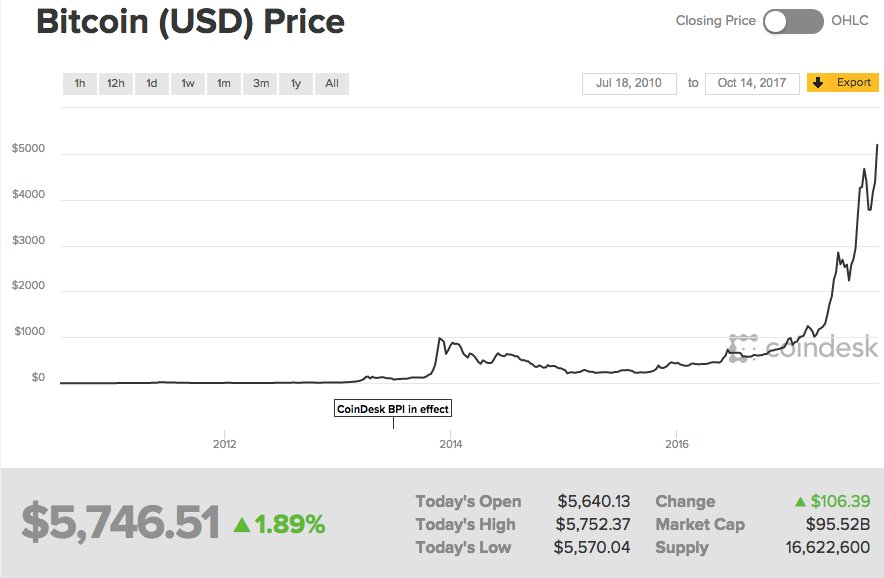
Saturday's tweet from Julian Assange says it all: "My deepest thanks to the US government, Senator McCain and Senator Lieberman for pushing Visa, MasterCard, PayPal, AmEx, Moneybookers, et al, into erecting an illegal banking blockade against @WikiLeaks starting in 2010. It caused us to invest in Bitcoin -- with > 50000% return."
Assange's tweet was accompanied by a graph showing the massive spike in the price of bitcoin -- though most of that growth occurred in the last year. -
Pizza Hut Leaks Credit Card Info On 60,000 Customers (kentucky.com)
An anonymous reader quotes McClatchy: Pizza Hut told customers by email on Saturday that some of their personal information may have been compromised. Some of those customers are angry that it took almost two weeks for the fast food chain to notify them. According to a customer notice emailed from the pizza chain, those who placed an order on its website or mobile app between the morning of Oct. 1 and midday Oct. 2 might have had their information exposed. The "temporary security intrusion" lasted for about 28 hours, the notice said, and it's believed that names, billing ZIP codes, delivery addresses, email addresses and payment card information -- meaning account number, expiration date and CVV number -- were compromised... A call center operator told McClatchy that about 60,000 people across the U.S. were affected.
"[W]e estimate that less than one percent of the visits to our website over the course of the relevant week were affected," read a customer notice sent only to those affected, offering them a free year of credit monitoring. But that hasn't stopped sarcastic tweets like this from the breach's angry victims.
"Hey @pizzahut, thanks for telling me you got hacked 2 weeks after you lost my cc number. And a week after someone started using it." -
OxygenOS Telemetry Lets OnePlus Tie Phones To Individual Users (bleepingcomputer.com)
An anonymous reader quotes a report from Bleeping Computer: OxygenOS, a custom version of the Android operating system that comes installed on all OnePlus smartphones, is tracking users actions without anonymizing data, allowing OnePlus to connect each phone to its customer. A security researcher going by the pseudonym of Tux discovered the abusive tracking in July 2016, but his tweet went largely unnoticed in the daily sea of security tweets sent out each day. The data collection issue was brought up to everyone's attention again, today, after British security researcher Christopher Moore published the results of a recent study on his site.
Just like Tux, Moore discovered that OxygenOS was sending regular telemetry to OnePlus' servers. This is no issue of concern, as almost all applications these days collect telemetry data for market analytics and to identify and debug application flaws. The problem is that OnePlus is not anonymizing this information. The Shenzhen-based Chinese smartphone company is collecting a long list of details, such as: IMEI code, IMSI code, ESSID and BSSID wireless network identifiers, and more. The data collection process cannot be disabled from anywhere in the phone's settings. When Moore contacted OnePlus support, the company did not provide a suitable answer for his queries. -
100K Lose Power As America Faces Its Third Hurricane In Three Weeks (go.com)
An anonymous reader writes: The good news: Hurricane Nate was eventually downgraded to "a tropical storm" at 4:30 Sunday morning (EST), moving north-northeast with maximum winds of 70 mph. The bad news: 100,000 people don't have power in Mississippi and Alabama, and a tornado watch is in effect until 11 a.m. "Even though Nate has made landfall and will weaken today, we are still forecasting heavy rain from Nate to spread well inland towards the Tennessee Valley and Appalachian mountains," ABC News meteorologist Daniel Manzo said Sunday morning. Saturday the Gulf Coast near Biloxi, Mississippi was hit with 85 mph winds and a storm surge of between four to five feet. "Gulf Coast residents are waking up to a wet, windy -- and in some cases, powerless -- Sunday morning," reports ABC News, "but it's still not as devastating as they expected." -
YouTube Alters Algorithm To Promote News, Penalize Vegas Shooting Conspiracy Theories (usatoday.com)
An anonymous reader quotes USA Today: YouTube has changed its powerful search algorithm to promote videos from more mainstream news outlets in search results after people looking for details on the Las Vegas shooting were served up conspiracy theories and misinformation. YouTube confirmed the changes Thursday... In the days after the mass shooting, videos abounded on YouTube, some questioning whether the shooting occurred and others claiming law enforcement officials had deceived the public about what really happened...
Public outcry over YouTube videos promoting conspiracy theories is just the latest online flap for the major U.S. Internet companies. Within hours of the attack, Facebook and Google were called out for promoting conspiracy theories... Helping drive YouTube's popularity is the "Up next" column which suggests additional videos to viewers. The Wall Street Journal found incidents this week in which YouTube suggested videos promoting conspiracy theories next to videos from mainstream news sources. YouTube acknowledged issues with the "Up next" algorithm and said it was looking to promote more authoritative results there, too.
At least one video was viewed over a million times, and Slashdot reader Lauren Weinstein writes that "I've received emails from Google users who report YouTube pushing links to some of those trending fake videos directly to their phones as notifications." He's suggesting that from now on, YouTube's top trending videos should be reviewed by actual humans. -
Russian Hackers Exploited Kaspersky Antivirus To Steal NSA Data on US Cyber Defense: WSJ (wsj.com)
An NSA contractor brought home highly classified documents that detailed how the U.S. penetrates foreign computer networks and defends against cyberattacks. The contractor used Kaspersky antivirus on his home computer, which hackers working for the Russian government exploited to steal the documents, the WSJ reported on Thursday (the link could be paywalled; alternative source), citing multiple people with knowledge of the matter. From the report: The hackers appear to have targeted the contractor after identifying the files through the contractor's use of a popular antivirus software made by Russia-based Kaspersky Lab, these people said. The theft, which hasn't been disclosed, is considered by experts to be one of the most significant security breaches in recent years. It offers a rare glimpse into how the intelligence community thinks Russian intelligence exploits a widely available commercial software product to spy on the U.S. The incident occurred in 2015 but wasn't discovered until spring of last year, said the people familiar with the matter. Having such information could give the Russian government information on how to protect its own networks, making it more difficult for the NSA to conduct its work. It also could give the Russians methods to infiltrate the networks of the U.S. and other nations, these people said. Ahead of the publication of WSJ report, Kaspersky founder Eugene Kaspersky tweeted, "New conspiracy theory, anon sources media story coming. Note we make no apologies for being aggressive in the battle against cyberthreats." -
According To Star Trek: Discovery, Starfleet Still Runs Microsoft Windows (theverge.com)
AmiMoJo shares a report from The Verge: The third episode of Star Trek: Discovery aired this week, and at one point in the episode, Sonequa Martin-Green's Michael Burnham is tasked with reconciling two suites of code. In the show, Burnham claims the code is confusing because it deals with quantum astrophysics, biochemistry, and gene expression. And while the episode later reveals that it's related to the USS Discovery's experimental new mycelial network transportation system, Twitter user Rob Graham noted the code itself is a little more pedestrian in nature. More specifically, it seems to be decompiled code for the infamous Stuxnet virus, developed by the United States to attack Iranian computers running Windows. -
Google Is Latest Company To Ditch Headphone Jack In Its Newest Smartphones (cultofmac.com)
When launching its original Pixel smartphone, Google mocked the iPhone 7's missing headphone jack in its marketing material. According to Cult of Mac, Google won't be doing the same for the Pixel 2. "The company has decided to remove the aging port from its latest handsets," reports Cult of Mac. "A new leak reveals that the lineup will rely solely on USB-C for wired connectivity." From the report: Incredibly reliable leaker Evan Blass has published pictures and details of Google's upcoming Pixel 2 smartphones on VentureBeat. He has also confirmed that neither device will feature a headphone jack, which means users will have to rely on a USB-C adapter or Bluetooth. It also means Google will no longer be able to put out Pixel ads that take sly swipes at the iPhone's missing port. Blass says both Pixel handsets will be powered by a Snapdragon 835 chipset -- the same one found in the Galaxy S8, the LG V30, and other 2017 flagships -- not a faster Snapdragon 836 processor as originally planned. Other features are said to include 12-megapixel cameras, 4GB of RAM, and 64GB or 128GB storage options. The smaller Pixel will pack a 5-inch 1080p display with a 16:9, while its larger sibling will pack a 6-inch Quad HD display with an 18:9 aspect ratio. Is the lack of a headphone jack a deal-breaker, or do you think the Pixel's other features, like stock Android and front-facing stereo speakers, will make up for it? -
Apple Investigating Reports of iPhone 8 Plus Devices 'Splitting Open' (9to5mac.com)
Apple is currently investigating reports of the iPhone 8 Plus splitting open while being charged with the included cable and plug adapter. The first claim comes from a Taiwanese iPhone 8 Plus owner, who posted photos which show damage consistent with a swollen battery. The second claim is from a Japanese owner who posted similar photos of his device, which he says arrived in this state. The Next Web reports: The phone belonged to a Ms. Wu, who recently renewed her phone contract and purchased a 64GB rose gold iPhone 8 Plus. The issue emerged five days after purchasing the phone. Wu placed her phone on charge, using the supplied cable and adaptor. After three minutes, she reported seeing the front panel bulge, and eventually lift completely from the device. According to multiple Taiwanese outlets, the phone was later recovered by the carrier, and has since been shipped to Apple for analysis. 9to5Mac adds: While any incident affecting a new iPhone model is bound to attract media attention, it's worth noting the usual disclaimers. First, any device manufactured in the millions will include some faulty models -- the real news would be if this were not the case. Second, investigations into charging-related incidents often reveal that a third-party charger was used, even when an owner initially claims to have used the supplied Apple one. -
Twitter Suspends Hundreds of Accounts Linked To Russian Operatives (usatoday.com)
An anonymous reader quotes a report from USA Today: Twitter says it found some 200 accounts linked to the same Russian groups that bought $100,000 worth of ads on Facebook to sow political unrest and manipulate U.S. voters during the presidential election. The Twitter accounts, which were taken down over the last month, were linked to 470 accounts and pages that Facebook traced to the International Research Agency, a Russian troll farm. According to a blog post released by Twitter Thursday after briefing staffers on the House and Senate Intelligence Committees, the groups on Facebook had 22 Twitter accounts. Twitter found an additional 179 accounts connected to those 22. Twitter also shared information on Russian news outlet Russia Today, or RT, which has ties to the Kremlin, according to U.S. intelligence agencies. -
Internet Explorer Bug Leaks Whatever You Type In the Address Bar (arstechnica.com)
The latest version of Internet Explorer has a bug that leaks the addresses, search terms, or any other text typed into the address bar. The flaw was disclosed Tuesday by security researcher Manual Caballero. Ars Technica reports: The bug allows any currently visited website to view any text entered into the address bar as soon as the user hits enter. The technique can expose sensitive information a user didn't intend to be viewed by remote websites, including the Web address the user is about to visit. The hack can also expose search queries, since IE allows them to be typed into the address bar and then retrieved from Bing or other search services. The proof-of-concept makes it transparent that the attacking website is viewing the entered text. The hack, however can easily be modified to make the information theft completely stealthy. A proof-of-concept site shows the exploit in action. -
Twitter Tests Doubling Character Limit For Tweets To 280 (theverge.com)
Twitter announced today that it has started testing 280-character tweets for select users. The new limit doubles the current 140-character limit, and is said to help users be more expressive. The Verge reports: "Our research shows us that the character limit is a major cause of frustration for people tweeting in English," the company said in a blog post. "When people don't have to cram their thoughts into 140 characters and actually have some to spare, we see more people Tweeting -- which is awesome!"
About 9 percent of all tweets today are exactly 140 characters, Twitter says. It's tough to do that on accident, suggesting that users frequently have to edit their initial thoughts to get them under the limit. (It's certainly true for me.) Now Twitter hopes to ease that burden by doubling the character limit in what it calls "languages impacted by cramming," which includes every language except for Japanese, Chinese, and Korean. The report goes on to note that the "140-character limit was originally established to reflect the length of SMS messages, which was how tweets were distributed prior to the development of mobile apps. SMS messages are limited to 160 characters; Twitter reserved the remaining 20 for the username," reports The Verge. -
Adobe Security Team Accidentally Posts Private PGP Key On Blog (arstechnica.com)
A member of Adobe's Product Security Incident Response Team (PSIRT) accidentally posted the PGP keys for PSIRT's email account -- both the public and the private keys. According to Ars Technica, "the keys have since been taken down, and a new public key has been posted in its stead." From the report: The faux pas was spotted at 1:49pm ET by security researcher Juho Nurminen. Nurminen was able to confirm that the key was associated with the psirt@adobe.com e-mail account. To be fair to Adobe, PGP security is harder than it should be. What obviously happened is that a PSIRT team member exported a text file from PSIRT's shared webmail account using Mailvelope, the Chrome and Firefox browser extension, to add to the team's blog. But instead of clicking on the "public" button, the person responsible clicked on "all" and exported both keys into a text file. Then, without realizing the error, the text file was cut/pasted directly to Adobe's PSIRT blog. -
Twitter Suspends 300,000 Accounts Tied To Terrorism In 2017 (bloomberg.com)
According to a new transparency report, Twitter said it suspended nearly 300,000 accounts globally linked to terrorism in the first half of the year. The company is improving automation tools used to help block accounts that promote terrorism and violence. Bloomberg reports: Of [the nearly 300,000 accounts that were suspended], roughly 95 percent were identified by the company's spam-fighting automation tools. Meanwhile, the social network said government data requests continued to increase, and that it provided authorities with data on roughly 3,900 accounts from January to June. Twitter said about 75 percent of the blocked accounts this year were spotted before a single tweet was sent, and that 935,897 accounts had been suspended since August 2015, with two-thirds of those coming in the past year. American authorities made 2,111 requests from Twitter from January to June, the most of the 83 countries tracked by the company. Twitter supplied information on users in 77 percent of the inquiries. Japan made 1,384 requests and the U.K. issued 606 requests. Turkish authorities continued a trend of aggressively policing Twitter, making 554 requests for account data and issuing court orders to remove 715 pieces of content. Other governments made only 38 total content-removal requests. -
Ethereum Will Match Visa In Scale In a 'Couple of Years,' Says Founder (techcrunch.com)
Ethereum's founder, Vitalik Buterin, believes that his cryptocurrency has the potential to replace things like credit card networks and gaming servers. He even goes as far to say that Ethereum will replace Visa in "a couple of years," though he later clarified that "ethereum *will have Visa-scale tx capacity*, not that it will 'replace Visa.'" TechCrunch reports: "There's the average person who's already heard of bitcoin and the average person who hasn't," he said. His project itself builds upon that notion by adding more utility to the blockchain, thereby creating something everyone will want to hear about. "Where Ethereum comes from is basically you take the idea of crypto economics and the kinds of economic incentives that keeps things like bitcoin going to create decentralized networks with memory for a whole bunch of applications," he said. "A good blockchain application is something that needs decentralization and some kind of shared memory." That's what he's building and hopes others will build on the Ethereum network.
Right now the network is a bit too slow for most mainstream applications. "Bitcoin is processing a bit less than 3 transactions per second," he said. "Ethereum is doing five a second. Uber gives 12 rides a second. It will take a couple of years for the blockchain to replace Visa." Buterin doesn't think everything should run on the blockchain but many things can. As the technology expands it can grow to replace many services that require parallelization -- that is programs that should run at the same time. -
T-Mobile To Increase Deprioritization Threshold To 50GB This Week (tmonews.com)
After raising its deprioritization threshold to 32GB in May, it looks like T-Mobile will bump it up to 50GB on September 20th, according to a TmoNews source. The move will widen the gap between T-Mobile and its competition. For comparison, Sprint's deprioritization threshold is currently 23GB, while AT&T and Verizon's are both 22GB. TmoNews reports: It's said that this 50GB threshold won't change every quarter and no longer involves a specific percentage of data users. As with the current 32GB threshold, customers that exceed this new 50GB deprioritization threshold in a single month may experience reduced speeds in areas where the network is congested. T-Mobile hasn't issued an announcement regarding this news, but the official @TMobileHelp account recently tweeted "Starting 9/20, the limit will be increased!" in response to a question about this news. -
Linux Foundation President Used MacOS For Presentation at Open Source Summit (itsfoss.com)
Slashdot reader mschaffer writes:It appears that Jim Zemlin, President of the Linux Foundation, was using MacOS while declaring "2017 is officially the year of the Linux desktop!" at the Open Source Summit 2017. This was observed by several YouTube channels: Switched to Linux and The Lunduke Show. Finally it was reported by It's FOSS.
if, indeed, this is the year of desktop Linux, why oh why cannot people like Zemlin present a simple slide presentation -- let alone actually use a Linux distro for work.
A security developer at Google has now "spotted Jim Zemlin using Apple's macOS twice in last four years," according to the article, which complains the Foundation's admirable efforts on cloud/container technology has them neglecting Linux on the desktop.
Ironically, in March Zemlin told a cloud conference that organizations that "don't harvest the shared innovation" of open source "will fail." -
Warning: 'MetalKettle' Repository For Kodi Becomes Vulnerable After GitHub Takeover (betanews.com)
BrianFagioli shares a report from BetaNews: Unfortunately, there can apparently be security issues with repositories when they shut down. For example, when the metalkettle repo ended, the developer deleted its entry on GitHub. This in itself is not a cause for concern, but unfortunately, GitHub's allowance of project names to be recycled is. You see, someone re-registered the metalkettle name, making it possible for nefarious people to potentially serve up malware to Kodi users. The warning came from the metalkettle developer over on Twitter. He warns that devices with the repository installed could be in danger from a security standpoint. If a user was to search that repo, and the new owner of the GitHub name was to share malware, the user could assume it is safe and install it. We do not know 100 percent if the person that re-registered the metalkettle name on GitHub is planning anything evil, but it is better to be safe than sorry. If you still have the repository installed, you should remove it immediately. Not to mention, if you know someone using Kodi, such as a friend or family member, you should warn them too. -
South Park's Season Premier Sets Off Everyone's Amazon Echo (maxim.com)
SonicSpike writes: It's hard to believe that Trey Parker and Matt Stone didn't know exactly what they were doing with Wednesday night's season premiere of South Park. This episode marked the beginning of the show's 21st season and as usual, South Park took on current issues like tiki torch-wielding white supremacists and... home digital assistants. The latter meant lots of gags in which Cartman and other characters addressed Amazon Echo's Alexa and Google Home as well. And that ended up being a problem for viewers who own those devices. (Editor's note: example 1, 2) South Park writers absolutely knew their lines would do this and probably had a hilarious time coming up with funny commands for the home assistants. -
South Park's Season Premier Sets Off Everyone's Amazon Echo (maxim.com)
SonicSpike writes: It's hard to believe that Trey Parker and Matt Stone didn't know exactly what they were doing with Wednesday night's season premiere of South Park. This episode marked the beginning of the show's 21st season and as usual, South Park took on current issues like tiki torch-wielding white supremacists and... home digital assistants. The latter meant lots of gags in which Cartman and other characters addressed Amazon Echo's Alexa and Google Home as well. And that ended up being a problem for viewers who own those devices. (Editor's note: example 1, 2) South Park writers absolutely knew their lines would do this and probably had a hilarious time coming up with funny commands for the home assistants. -
Leaks Reveal New Features In Apple's Next iPhone
Though Apple officially unveils their newest iPhone on Tuesday, information is already leaking on the internet.- Mashable: "Physically, it's expected to be about the same size as an iPhone 7, but with an edge-to-edge OLED display that's bigger than what is currently on the iPhone 7 Plus. It won't have a home button or Touch ID, and will likely use some kind of facial recognition tech to unlock."
- MacRumors cites a report from KGI Securities analyst Ming-Chi Kuo suggesting facial recognition may just be one feature of a complex front camera with 3D sensing hardware, including a proximity sensor, ambient light sensor, and a structured light transmitter (using a surface-emitting laser) and receiver.
- CNET: "Irish iPhone programming guru Steve Troughton-Smith now feels sure he has the names of the three phones to be launched by Apple on Tuesday.... they'll (probably) be called the iPhone 8, iPhone 8 Plus and -- ta-da -- the iPhone X."
- Troughton-Smith also predicts a 3x screen at 1125x2436 resolution
- Fortune: "Apple's iPhone line is expected to catch up with Android phones in the area of wireless charging this year... just lay the phone down on a compatible charger mat or base or dock, and watch the battery fill up."
- 9to5Mac: "We've found a brand new feature called 'Animoji', which uses the 3D face sensors to create custom 3D animated emoji based on the expressions you make into the camera. Users will be able to make Animoji of unicorns, robots, pigs, pile of poo and many more."
-
TechCrunch: Equifax Hack-Checking Web Site Is Returning Random Results (techcrunch.com)
An anonymous reader quotes security researcher Brian Krebs: The web site that Equifax advertised as the place where concerned Americans could go to find out whether they were impacted by this breach -- equifaxsecurity2017.com -- is completely broken at best, and little more than a stalling tactic or sham at worst. In the early hours after the breach announcement, the site was being flagged by various browsers as a phishing threat. In some cases, people visiting the site were told they were not affected, only to find they received a different answer when they checked the site with the same information on their mobile phones.
TechCrunch has concluded that "the checker site, hosted by Equifax product TrustID, seems to be telling people at random they may have been affected by the data breach." One user reports that entering the same information twice produced two different answers. And ZDNet's security editor reports that even if you just enter Test or 123456, "it says your data has been breached." TechCrunch writes: The assignment seems random. But, nevertheless, they were still asked to continue enrolling in TrustID. What this means is not only are none of the last names tied to your Social Security number, but there's no way to tell if you were really impacted. It's clear Equifax's goal isn't to protect the consumer or bring them vital information. It's to get you to sign up for its revenue-generating product TrustID.
Meanwhile, one web engineer claims the secret 10-digit "security freeze" PIN being issued by Equifax "is just a timestamp of when you made the freeze." -
TechCrunch: Equifax Hack-Checking Web Site Is Returning Random Results (techcrunch.com)
An anonymous reader quotes security researcher Brian Krebs: The web site that Equifax advertised as the place where concerned Americans could go to find out whether they were impacted by this breach -- equifaxsecurity2017.com -- is completely broken at best, and little more than a stalling tactic or sham at worst. In the early hours after the breach announcement, the site was being flagged by various browsers as a phishing threat. In some cases, people visiting the site were told they were not affected, only to find they received a different answer when they checked the site with the same information on their mobile phones.
TechCrunch has concluded that "the checker site, hosted by Equifax product TrustID, seems to be telling people at random they may have been affected by the data breach." One user reports that entering the same information twice produced two different answers. And ZDNet's security editor reports that even if you just enter Test or 123456, "it says your data has been breached." TechCrunch writes: The assignment seems random. But, nevertheless, they were still asked to continue enrolling in TrustID. What this means is not only are none of the last names tied to your Social Security number, but there's no way to tell if you were really impacted. It's clear Equifax's goal isn't to protect the consumer or bring them vital information. It's to get you to sign up for its revenue-generating product TrustID.
Meanwhile, one web engineer claims the secret 10-digit "security freeze" PIN being issued by Equifax "is just a timestamp of when you made the freeze." -
TechCrunch: Equifax Hack-Checking Web Site Is Returning Random Results (techcrunch.com)
An anonymous reader quotes security researcher Brian Krebs: The web site that Equifax advertised as the place where concerned Americans could go to find out whether they were impacted by this breach -- equifaxsecurity2017.com -- is completely broken at best, and little more than a stalling tactic or sham at worst. In the early hours after the breach announcement, the site was being flagged by various browsers as a phishing threat. In some cases, people visiting the site were told they were not affected, only to find they received a different answer when they checked the site with the same information on their mobile phones.
TechCrunch has concluded that "the checker site, hosted by Equifax product TrustID, seems to be telling people at random they may have been affected by the data breach." One user reports that entering the same information twice produced two different answers. And ZDNet's security editor reports that even if you just enter Test or 123456, "it says your data has been breached." TechCrunch writes: The assignment seems random. But, nevertheless, they were still asked to continue enrolling in TrustID. What this means is not only are none of the last names tied to your Social Security number, but there's no way to tell if you were really impacted. It's clear Equifax's goal isn't to protect the consumer or bring them vital information. It's to get you to sign up for its revenue-generating product TrustID.
Meanwhile, one web engineer claims the secret 10-digit "security freeze" PIN being issued by Equifax "is just a timestamp of when you made the freeze." -
Some Instagram Employees Sell Verification For Thousands of Dollars (mashable.com)
An anonymous reader shares a report from Mashable, written by Kerry Flynn: "I mean if Mashable wants to pay for it, I can get you a blue check over night," reads a recent Twitter direct message. This is a guy who knows a guy, a middleman in the black market for Instagram verification, where anyone from a seasoned publicist to a 22-year-old digital marketer will offer to verify an account -- for a price. The fee is anywhere from a bottle of wine to $15,000, according to a dozen sources who have sold verification, bought verification for someone else, or directly know someone who has done one or the other. "These guys pay all their bills from one to two blue checks a month," another message from the middleman added later. The product for sale isn't a good or a service. It's a little blue check designated for public figures, celebrities, and brands on Instagram. It grants users a prime spot in search as well as access to special features. More importantly, it's a status symbol. But it's clear from people who spoke on the condition of anonymity, many of whom have their own blue checkmarks, that a black market for Instagram verification is alive and well. "Instagram has helped create this underground market," the report adds. "While anyone can apply for verification on Facebook and on Twitter, Instagram has made itself exclusive and therefore rather elitist. Influencers who have press clippings and work with big brands on sponsorship deals often can't manage to get that elusive blue checkmark, according to several verified and unverified influencers and people who have sold verification." -
Dozens Of Drones Surveil Houston For Damage After Hurricane Harvey (usatoday.com)
An anonymous reader quotes MIT Technology Review: AT&T is using drones to inspect its cellular towers for damage, while insurance companies like Allstate and Farmers are rolling out their own fleets to follow up on claims... Rescue operations are benefitting, too. According to Axios, the company DroneDeploy is sending out vehicles to produce detailed 3-D maps that can help navigate the watery chaos. The company claims it can speed up rescue operations by providing imagery that allows rescuers to see around buildings and beneath tree cover.
The drones can fly high-definition cameras, and there's now dozens of them flying over Houston, reports USA Today: By Thursday, the Federal Aviation Administration has authorized 43 drone operators in Harvey's wake, for recovery efforts and for news organizations covering it... Eight approvals went to a railroad company to survey damage along tracks running through Houston. Five went to oil or energy companies to look for damage to fuel tanks, power lines and other facilities. Emergency-management officials are checking damage to roads, bridges and water-treatment plants... The FAA has also prohibited private drone pilots from flying in a broad area around Houston to avoid areas where emergency aircraft such as rescue helicopters are plucking people from rooftops or searching for survivors. -
Terry Pratchett's Hard Drive Destroyed By Steamroller (nytimes.com)
WheezyJoe writes: In accordance with his wishes, a hard drive formerly belonging to author Terry Pratchett has been crushed by steamroller. According to friend and fellow author Neil Gaiman, Pratchett (who died at 66 in 2015) wanted "whatever he was working on at the time of his death to be taken out along with his computers, to be put in the middle of a road and for a steamroller to steamroll over them all."
According to the article, on August 25, two years after the author's passing, Mr. Pratchett's estate manager and close friend, Rob Wilkins, posted a picture of a hard drive and a steamroller on an official Twitter account they shared. The pictures posted suggest the steamroller was one powered by actual steam.
Minutes later they tweeted a photo of the crushed hard drive -- which will soon be displayed at the Salisbury Museum in England as part of their new exhibit on the life and work of Terry Pratchett. -
Terry Pratchett's Hard Drive Destroyed By Steamroller (nytimes.com)
WheezyJoe writes: In accordance with his wishes, a hard drive formerly belonging to author Terry Pratchett has been crushed by steamroller. According to friend and fellow author Neil Gaiman, Pratchett (who died at 66 in 2015) wanted "whatever he was working on at the time of his death to be taken out along with his computers, to be put in the middle of a road and for a steamroller to steamroll over them all."
According to the article, on August 25, two years after the author's passing, Mr. Pratchett's estate manager and close friend, Rob Wilkins, posted a picture of a hard drive and a steamroller on an official Twitter account they shared. The pictures posted suggest the steamroller was one powered by actual steam.
Minutes later they tweeted a photo of the crushed hard drive -- which will soon be displayed at the Salisbury Museum in England as part of their new exhibit on the life and work of Terry Pratchett.
.jpg.img.fullhd.medium.jpg)