 Slashdot Mirror
Domain: ucla.edu
Stories and comments across the archive that link to ucla.edu.
Comments · 1,051
-
Re:Always nice to collect money for no work
The nature of the way patents are written is that they *are* hidden from public view -- while in plain sight.
And are they necessary? Economists Michele Boldrin and David Levine make a *very* compelling case that they are not. The purpose of patents and copyright is to provide incentive to cause creators to create ("Promote progress" in the words of the Constitution), but the evidence that they show makes a really strong case that intellectual property actually retards progress.
And Gates made that point himself in an internal Microsoft memo many years ago. "If people had understood how patents would be granted when most of today's ideas were invented and had taken out patents, the industry would be at a complete standstill today."
-
Re:Do it to Venus first
That requires quite a few citations.
1. magnetic field generated by the atmosphere - CITATION NEEDED
2. solar wind eroding atmosphere - well, if you are implying in timespan shorter than 10,000,000 years, then CITATION NEEDED.
3. "no internal dynamo" - insufficient data to prove that - you'd need soil samples to know history of Venus and when things disappeared.Currently Venus does NOT have a magnetic field. So maybe it is really absent or maybe it is in process of pole reversal? No soil samples, so who knows.
http://www-ssc.igpp.ucla.edu/p...
The most definitive measurements of the magnetic moment of Venus were obtained during the Pioneer Venus Orbiter mission in its first years of operation (1979-1981). Repeated low-altitude (~ 150 km) passes by that spacecraft over the antisolar region, coupled with dayside observations to the same altitude, proved the insignificance of a field of internal origin in near-Venus space. The observed fields for the most part could be explained as solar wind interaction-induced features, to be described below. The new upper limit on the dipole moment obtained from the Pioneer Venus Orbiter wake measurements placed the Venus intrinsic magnetic field at ~ 10-5 times that of Earth.
-
Re:That's why nobody sensible wants them
Further, at-rest encryption means you can't search for shit.
Yep, that's a major issue we have with the encryption technologies we use at the moment. That's where the need for homomorphic encryption and other similar searchable encryption comes from.
-
Re:If everything started from a point in space/tim
If everything is moving away from us, perhaps we -are- the center of the Universe! Sounds like there are still things we dont understand about the observable universe if we cant get the red/green shift stuff to make consistent sense.
Get a rubber balloon and a marker, or just use your imagination. Put a bunch of dots on the balloon. Now choose one dot as a reference and inflate the balloon--all of the other dots move away as the balloon expands. Try using a different dot as the reference and you get the same result. Note that there are limitations to this analogy, but I found it helpful.
P.S. It's red/blue shift, not red/green.
-
Jane/Lonny Eachus goes Sky Dragon Slayer
Feel free to cite the actual scientific papers predicting global cooling, as opposed to media hype about some speculation at the time. [david_thornley]
... the National Academy of Sciences itself was convinced enough of the "Global Cooling" scare to actually publish a call for immediate action (Science News, Jan. 25 1975, p. 52).
As for the mentioned announcement it is in THIS issue of Science News, in the article "NAS Warning On Climate Changes". Exactly as mentioned in the "Chilling Possibilities" article that is linked to in the page that I originally linked to, and EXACTLY as I stated it. The "NAS Warning On Climate Changes" article itself is behind a paywall. If it weren't, I would have linked to it directly. [Jane Q. Public, 2014-12-16]
Okay, so you read a blog which linked to an article which mentioned an announcement by the NAS. Then you responded to David Thornley's request for actual scientific papers predicting global cooling by saying "the NAS was convinced enough of the "Global Cooling" scare to actually publish a call for immediate action."
Did you ever think it might be educational to actually read that NAS report first-hand rather than relying on third-hand interpretations of interpretations? If you did, you'd discover that the 1975 NAS report (PDF) "Understanding Climate Change: A Program for Action" doesn't predict global cooling. Quite the opposite! Read their words:
"Of the two forms of pollution, the carbon dioxide increase is probably the more influential at the present time in changing temperatures near the earth's surface (Mitchell, 1973a)."
"The corresponding changes of mean atmospheric temperature due to CO2 [as calculated by Manabe (1971) on the assumption of constant relative humidity and fixed cloudiness] are about 0.3C per 10 percent change of CO2 and appear capable of accounting for only a fraction of the observed warming of the earth between 1880 and 1940. They could, however, conceivably aggregate to a further warming of about 0.5C between now and the end of the century."
How ironic! Instead of predicting global cooling, the NAS actually predicted "about 0.5C" of CO2-based warming between 1975 and 2000. To see how their prediction fared, let's plot HadCRUT4 over that timespan. The raw data shows warming of 0.47C from 1975 to 2000, which rounds up to 0.5C.
So that 1975 NAS report wasn't predicting global cooling! Its warming prediction was actually fairly accurate, and was certainly within the statistical uncertainties.
Again, that's probably why the National Academy of Science’s 1979 Charney report estimated climate sensitivity as 1.5C to 4.5C and said “If carbon dioxide continues to increase, [we] find no reason to doubt that climate changes will result, and no reason to believe that these changes will be negligible.”
While Jane tries to explain why that NAS report predicting about 0.5C of
-
Re:No one gets the oil!
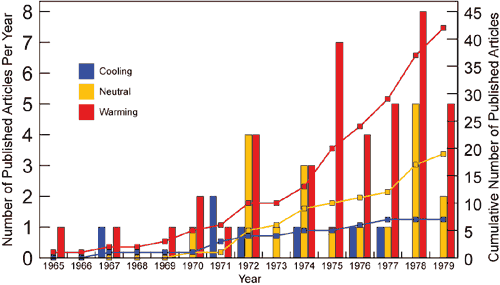
You're regurgitating complete nonsense. Once again, here’s figure 1 from Peterson et al. 2008. Notice that papers predicting warming vastly outnumbered those predicting cooling, even in the 1970s. Ironically:
- The term “global warming” was first used in a 1975 Science article by Wally Broecker called “Are we on the brink of a pronounced global warming?”.
- Sawyer 1972 estimated climate sensitivity as 2.4C, and Schneider 1975 gave a preliminary range of 1.5C to 3.0C.
- Manabe and Wetherald, 1975: “The Effects of Doubling the CO2 Concentration on the climate of a General Circulation Model.”
- In 1977, Freeman Dyson wrote that the “prevailing opinion is that the dangers [of the rise in CO2] greatly outweigh the benefits.”
- In 1977, Robert M. White, the head of the National Oceanic and Atmospheric Administration, wrote a report for the National Academy of Sciences that said “We now understand that industrial wastes, such as the carbon dioxide released in the burning of fossil fuels, can have consequences for climate that pose a considerable risk to future society.” [White, Robert, 1978, Oceans and Climate Introduction, Oceanus, 21:2-3]
- The 1979 JASON report “The long-term impact of atmospheric carbon dioxide on climate” estimated climate sensitivity as 2.4C to 2.8C.
- The National Academy of Science’s 1979 Charney report estimated climate sensitivity as 1.5C to 4.5C and said “If carbon dioxide continues to increase, [we] find no reason to doubt that climate changes will result, and no reason to believe that these changes will be negligible.”
While Jane is reading those papers, he should also consider addressing this issue with his basic thermodynamics:
Your own insistence that power in = power out (assuming perfect conversion and no entropic losses) belies this argument. You are arguing against yourself and you refuse to see that. If power in = power out (your own stipulation)
I'm not the only one insisting that power in = power out through any boundary where nothing inside is changing. Once again, that's a fundamental principle called "conservation of energy". Here are some introductions: example (backup), example (backup), example
-
Re:No one gets the oil!
No,no. Global cooling. Haven't you read the scientific papers from top agencies and researchers from the 70's. Sheesh
You're regurgitating complete nonsense. Once again, here’s figure 1 from Peterson et al. 2008. Notice that papers predicting warming vastly outnumbered those predicting cooling, even in the 1970s. Ironically:
- The term “global warming” was first used in a 1975 Science article by Wally Broecker called “Are we on the brink of a pronounced global warming?”.
- Sawyer 1972 estimated climate sensitivity as 2.4C, and Schneider 1975 gave a preliminary range of 1.5C to 3.0C.
- Manabe and Wetherald, 1975: “The Effects of Doubling the CO2 Concentration on the climate of a General Circulation Model.”
- In 1977, Freeman Dyson wrote that the “prevailing opinion is that the dangers [of the rise in CO2] greatly outweigh the benefits.”
- In 1977, Robert M. White, the head of the National Oceanic and Atmospheric Administration, wrote a report for the National Academy of Sciences that said “We now understand that industrial wastes, such as the carbon dioxide released in the burning of fossil fuels, can have consequences for climate that pose a considerable risk to future society.” [White, Robert, 1978, Oceans and Climate Introduction, Oceanus, 21:2-3]
- The 1979 JASON report “The long-term impact of atmospheric carbon dioxide on climate” estimated climate sensitivity as 2.4C to 2.8C.
- The National Academy of Science’s 1979 Charney report estimated climate sensitivity as 1.5C to 4.5C and said “If carbon dioxide continues to increase, [we] find no reason to doubt that climate changes will result, and no reason to believe that these changes will be negligible.”
-
Re:Opinion On Basic Income
3) What makes you think that anyone is entitled to someone else's money? The problem with Socialism is eventually, you run out of other people's money.
It's always funny when conservatives say that while giving welfare to big corporations. Are there any Republicans who don't support the current ubiquitous practice of forcing property owners to build more parking [pdf], which benefits Big Oil, than the market wants? Or who think the roads should pay for themselves 100% from gas taxes and user fees instead of today's current average of 50-60%, which also benefits Big Oil?
Good luck finding such a person!
-
Meat is in 2nd Link
The blog about the second link (2013 in particular http://www.heri.ucla.edu/brief...) doesn't really add much value.
The UCLA report, however, is pretty interesting. Many of the application strategies described were the same my daughter (entering college in September) and wife and I adapted. We told her that the mortgage crisis of 2008 was triggered by a bunch of adults who were told at 17-18 that signing student debt notes for university was rational and wise, and that it so confused people that it's no surprise they never saved to buy cars or houses and brought the whole economy down. We figured that more and more applicants were coming from overseas, which is a good thing as otherwise the middle tier colleges in the USA will collapse. Like the averages in the report, we told her to apply to many more colleges, as the cost of the application (about $100 per college) was probably less than the standard deviation between financial aid offers from the 1/4-1/3 of institutions she'd get admitted to.
If you are going to apply to college, or have kids headed that way, the report is definitely worth reading. We managed to find a way to get the full cost down to about $15K including room and board. All the things people were told to consider in choosing a college 20-30 years ago don't matter. You can choose based on selectivity, class size, strength of degree programs, etc. but aside from geography the only thing you will remember is people - roomates, classmates, bandmates, workmates, and professors - and there's no way to analyze that in advance, so just take the deal you can afford.
-
Re:you can't explain b/c you don't know
And if you are going to reference the CMB, try plugging in the CMB redshift, z=~1090, into a redshift to distance calculator. If you play around with it, you will see that anything with a redshift of over z=1.5 will have a comoving distance of more than 14 billion light years away, and there is a long list of galaxies and quasars that are further away than that (going out to a z=8 at least). Astronomers and cosmologists have been dealing with distances over c*age of universe for some time now.
-
Re:New person in the distribution, new fee require
There are some similarities between "IP" and real property, but too many fundamental differences to call it property. Then there's the fact that the term "intellectual property" is an umbrella term that could refer to trademarks, copyrights, patents, or some combination of those. It's a propaganda term designed to trick people into believing that these things are real property, and to confuse them as to exactly what's being talked about.
then go get its equivalent somewhere else for less...
Like TPB.
-
Re:His 'role in the site'
Sure, it is
The first article is just an opinion from someone much like yourself, while the second link is a propaganda piece that only applies in very limited scenarios to begin with. You have not shown that copyright infringement is legally (i.e. by the courts) considered theft. Government agencies can say whatever they want.
If you derive benefit from someone's work, whether it's tangible or intangible, you have to pay their selling price, otherwise it's stealing.
It's copyright infringement.
No, wait, it's actually rape. Copyright infringement is rape. Meanings are irrelevant; whether or not a certain use of a term causes confusion is irrelevant. All that matters is that you're as inflammatory as possible. You remind me of the "for the children" crowd who blow everything out of proportion and use inflammatory language and 'logic' to get everyone to agree with them.
Because you see, when you say "stealing," I have no idea if you're equating copyright infringement to actual theft (i.e. someone stole a TV) or using that stupid common definition ("You stole my idea!"). I've seen examples of both. It also doesn't help that people who don't understand copyright might very well become confused when such incorrect terminology is used.
The only thing that protects ideas are patents, not copyrights, and even patents don't technically protect ideas: they only protect apparatus or method for an invention.
Yes.
Using words like monopolies is completely wrong in the context of copyrights.
Since linking to random articles written by people you agree with is acceptable to you, you may find this acceptable.
It is not "completely wrong"; you have a monopoly over something very specific, but that doesn't mean it's not a monopoly.
I will hereby refer to all copyright proponents as child molesters. For dramatic effect, of course.
-
Re:But the real question is..
According to this article, there are roughly twice as many gay men than there are lesbians. Regardless, the argument of homosexuals skewing the results is nearly baseless. The number of homosexuals in the US is about 3.4% so that for every 100 people, less than four would be homosexual. Granted San Francisco has a higher homosexual population per capita, but I am not sure that there are more homosexuals applying for jobs with Amazon.
-
Re:next 50 to 100 years?
Actually an infinite universe does not contradict the Big Bang theory.
One explanation with a handy diagram (authored by an astrophysicist) http://www.astro.ucla.edu/~wri...
Another more comprehensive answer is here https://answers.yahoo.com/ques...
And something from NASA for shiggles http://wmap.gsfc.nasa.gov/univ...I'm certain there are plenty of other discussions of the topic. AFIK we are not yet certain that the universe is('nt) infinite, we don't even know its shape, but it is possible for it to be infinite.
Currently observational evidence points to an extremely flat universe (as flat as we can measure as yet), implying its size is tremendously larger than the Hubble Volume and allowing for an infinite universe (but obviously doesn't require it).
-
Re:Gun nuts
but the interpretation you take as obviously incorrect was settled law for 70 years.
Actually, it wasn't, the Supreme Court had never ruled on it before. More to the point, if you look at the more than two hundred years of precedent in lower Courts (State and Federal), the State level 2nd Amendment equivalents written around the same time, and the writings of the Framers it's clear as day that the Amendment always referred to an individual right. The 'militia' argument is a losing one and we both know it.
A couple more reactionaries retiring or dying and being replaced by moderates or liberals will likely cause the court to return to the old interpretation
Be careful rooting against stare decisis for I think you'll find that Roe is in a lot more danger than Heller, and Roe is near and dear to the hearts of most of the anti-gun crowd.
You also might consider the political reality of the United States, where even traditionally blue States remain staunchly pro-gun. In fact, I can name only five States that are openly hostile towards guns (New York, Hawaii, New Jersey, California, and Maryland) and even in those States you'll find a solid consistency that's pro-gun (all of Upstate New York for example). In fact, I live in one of those States (New York) and have an unrestricted pistol license that allows me to carry a concealed firearm almost anywhere I deem it appropriate.
Best of luck with your dream of doing away with the 2nd Amendment when you can't even win the issue here in New York.
-
Re:LOL ...
I'm amused by how you're critical of stereotyping humanities students, then move onto stereotyping business students.
You're right that a subset of humanities students would also be successful in a tech field. But there are plenty of tech people who could happily pursue humanities too. There is solid data that STEM majors are more difficult to complete than other fields. A good example is the UCLA Bachelor's Degree study, with figure 3 there being a particularly telling one. If parts of the humanities stepped up their critical thinking difficulty level to where many more students struggle to even absorb it and complete the degree in four years, then you could make a stronger case for the degree teaching those skills. There surely are humanities programs that emphasize that, but you can't really take having a degree as proof that happened.
-
Re:Surprised?
Communism is an economic theory that can't work in theory - it centralises economic planning leading to an insoluble information processing scaling problem, while at the same time destroying precisely the information (prices) that are needed to make sensible decisions - and has been proven not to work in practice. There have been plenty of Communist states. They all failed spectacularly, generally displaying massive corruption and brutal oppression as they did so.
They may not have looked like you imagine Communism should look, but that's because Communism cannot function at the scale of a nation-state, not in the real world, not with real people. And an economic theory that doesn't work unless people stop acting like people is not a very good theory.
-
Expand your peripherals
Why, when analyzing the 2nd Amendment, do these so-called "scholars" mince commas and words explicitly in the text as written in the Constitution to derive the intent of the authors?
Why do they not read the Federalist papers, in which the founding fathers mention an individual right numerous times? (28, 29, 46, which I won't quote because you can find a much better summary here.)
Why do they not read the state constitutions written around the time, that reflect, in similar language, also an individual right?
1776 Pennsylvania: That the people have a right to bear arms for the defence of themselves and the state; and as standing armies in the time of peace are dangerous to liberty, they ought not to be kept up; and that the military should be kept under strict subordination, to, and governed by, the civil power.
1777 Vermont: That the people have a right to bear arms for the defence of themselves and the State -- and as standing armies in time of peace are dangerous to liberty, they ought not to be kept up; and that the military should be kept under strict subordination to and governed by the civil power.
1792 Kentucky: That the right of the citizens to bear arms in defense of themselves and the State shall not be questioned.
See the entire timeline here.
Listen, I get it. Stevens wants to amend the Constitution to revoke the explicit ordained right to possess firearms. Why lie about it and claim that it was never intended for individual protection?
-
Re:where is the controversy?
Why are they dumb?
The earth IS the center of the universe. To say any other point in the universe is the center of the universe is equally as dumb, if not more so.
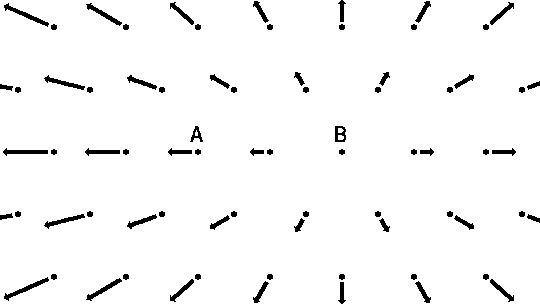
We can observe from here that the earth is the center of the universe. If we measure the expansion of the universe, EVERY SINGLE THING IN THE FUCKING UNIVERSE IS MOVING AWAY FROM THE EARTH AT ALMOST PRECISELY THE SAME RATE AS EVERY OTHER THING. This is because the universe is expanding.
Allow me to illustrate. This is what it looks like from Earth. If point A is Earth, and point A is where you are, that's what the universe looks like. See?
By contrast, This is what it looks like from Alpha Centauri Bb. If point B is Alpha Centauri Bb, and point B is where you are, this is what the universe looks like. See?
Because we are only able to measure from fairly close to "on the Earth", the only observable reality is that the Earth is the center of the universe.
Do you get it now? Or does a more compact diagram help?
-
Re:Do electric cars actually produce CO2?
This has been studied extensively as well. While specific chemistries have their own pollution issues, most EV batteries are made in Japan, Korea and the U.S., with relatively strong pollution controls. There is general agreement that the manufacturing impact is relatively small compared to the operating costs of both electric and gasoline cars.
It's easy to be skeptical of electric vehicles until you realize just how bad even the best gasoline cars are. All those tailpipe emissions are making you and the people around you sick. All the money you spend on gas goes back to the oil companies, and you know how they treat the environment... Not mention all the motor oil, frequent maintenance and potential breakdowns, and subconscious stress induced by the constant engine noise in a gas car. Whereas EVs are perfectly silent, never smell like gas or exhaust, have no routine mechanical maintenance and far fewer parts to break. And powering it with grid electricity costs between 1/3 and 1/5 of what a 35mpg car costs in gas, coming from power plants which are under constant pressure to improve their emissions. Or just put solar panels on your house and be carbon neutral.
-
Re:Phase changes
Yeah, almost a metre across!
-
Interesting open book on the opposite side
This book argues quite convincingly, based on current and historical examples, that copyrights and patents are a net negative to society.
-
Re:Socially accepted uses of a prison:
two-parent households. That made me laugh. In the US the highest divorce rates are in the conservative "Christian" communities.
You know, the same group of people that's supposedly all about "traditional" families and marriages.
What has Christianity to do with anything? I'm opposed to many of the principles of conservative Christians (abortion, pre-marital sex, homophobia, etc)....that doesn't mean they are wrong on everything. They are also against murder....does that mean murder is good?
Studies have shown that children of stable two-parent households do better than otherwise e.g. see here.
That being said, perhaps the best solution is work on stable households without concentrating specifically on one parent or two. I agree there are many circumstances where children is much better off with one parent than two (alcoholism, abuse, etc...)
-
Contract disputes between developers and marketers
What a mess they are, and always will be.
Like the one between Software Arts and Visicorp over Visicalc.
-
Re:yes!
A great victory for the blogosphere
Very much so. And I will also point out that Eugene Volokh is quite an interesting fellow with a great blog. Lots of interesting commentary there. Legal Insurrection is another great legal blog.
Volokh worked for 12 years as a computer programmer. He graduated from UCLA with a B.S. in math-computer science at age 15, and has written many articles on computer software. Volokh was born in the USSR; his family emigrated to the U.S. when he was seven years old.
Because child prodigy is no longer in Soviet Russia, free speech comes to you!
-
Re:Abolish it.
But is that copyrighted?
-
Abolish it.
No, seriously. Copyright does more harm than good. Just get rid of the whole damn thing.
-
Old News
This is old news. If you were not aware that a camera could be turned on without the indicator light saying it is on then you are not as big of a geek, nerd or whatever you thought you were. For example the Logitech sdk has had the ability to control the indicator light for at least 13 years Check the doc here This does not really meet the newsworthy standard to me... although it proves that many don't know or have forgotten.
-
Using Metadata to Find Paul Revere
This post titled Using Metadata to Find Paul Revere is very insightful (and very basic in terms of collected data compared to phone metadata):
http://kieranhealy.org/blog/archives/2013/06/09/using-metadata-to-find-paul-revere/
There's a previous and more mathematically detailed analysis of the same data here (the author above didn't know about this analysis until after publishing, but the link above is a much easier read):
http://www.sscnet.ucla.edu/polisci/faculty/chwe/ps269/han.pdf -
Re:Game design is hard
But why should you??? There is no silver lining to copyright. Its intentions aside, there is absolutely no proof
that it spurs innovation or creativity, whichever industry you look in, whatever the term, and however you quantify
the goods. And economists looked into this
many times by now. So our best economics research tells us that the ONLY perceptible effect of copyright is censorship,
which is a BREAK on creativity and innovation, and an infringement on our rights as humans, as outlined in the UDHR.Could you clarify exactly what you mean? Are you suggesting that copyright be abolished? That is, if I released a new videogame, there would be no legal mechanism to prevent anyone from copying it across the net for free, or even selling it themselves? Sorry, just trying to understand where you're coming from.
I'll say this as an independent game developer who's currently living off my savings while developing new game and a new company: There's no way I'd spend two full years with zero income developing a new game if I knew it wasn't going to be protected with copyright and trademark law. I'm taking a huge financial risk with many years worth of my life savings. It's all going into a product which can be copied and downloaded quite easily (I won't use DRM), and I accept that. But at the very least, I'd like the government to acknowledge that I have an exclusive right to sell and distribute copies of my game to try to earn a living from my labors.
BTW, I do think software patents are absurd and need to be abolished. But I can't see how authors retaining control over their works is a bad thing for creativity. Like it or not, self-interest is a powerful motivator that shouldn't be dismissed.
-
Re:Game design is hard
I could live with the long copyrights if we also had big social safety nets and Basic Income
But why should you??? There is no silver lining to copyright. Its intentions aside, there is absolutely no proof that it spurs innovation or creativity, whichever industry you look in, whatever the term, and however you quantify the goods. And economists looked into this many times by now. So our best economics research tells us that the ONLY perceptible effect of copyright is censorship, which is a BREAK on creativity and innovation, and an infringement on our rights as humans, as outlined in the UDHR.
The only good part of copyright is the right to attribution. Authors, and authors only should be able to compel people who distribute their work to attribute it correctly, as long as it does not raise distribution costs too much. This right shouldn't be perpetual, but could last as much the current copyright: lifetime + some more. In other words, the only type of license enforceable by copyright should be a BSD-style license.
Copyleft enforcement would not hurt too much, but it wouldn't be needed either, given just one thing. There should be a law which mandates free software use for all government, all education, all healthcare. Other public goods may be added to this list as needed. As long as we have that (and I can argue UDHR implies we should), non-free software will live on the fringes (hi-fi games), and things like GPL simply won't make any impact. Reckless fools will still pay for spyware masquerading as appliances, toys, and games, but I am just not convinced we should ever legislate to save individuals from their own stupidity.
-
Re:BBC reported correctly
actually the BBC's story reports correctly -
"The BBC understands that during an experiment in late September, the amount of energy released through the fusion reaction exceeded the amount of energy being absorbed by the fuel - the first time this had been achieved at any fusion facility in the world.Actually, no. It still isn't correct.
So, not only is it not the breakthrough we were looking for, at best it replicated a feat achieved with a different technology nearly 20 years ago.
-
Re:Seems simple to me
-
Historical example of patents blocking competition
Patents slowing down progress by discouraging use and hindering competitors is not new, but has been going on since the beginning of the patent system. The beginning chapter of Against Intellectual Monopoly details the case of the steam engine, where progress in efficiency and adoption of the steam engine was effectively halted for the duration of Watt's patents, only to take off right after they expired.
Once Watt’s patents were secured and production started, a substantial portion of his energy was devoted to fending off rival inventors. In 1782, Watt secured an additional patent, made “necessary in consequence of
The above is just a short section, they go through the case very thoroughly (with references), and it is worth a read. Interestingly, the steam engine is often quoted by patent proponents as an example of patents working like they are supposed to.
-
Re:I'd query one of his suppositions
I am just paraphrasing the research. If you want an unsubstantiated claim, look no further than your own post, where you fail to identify a single weak point in my argument.
-
Re:one small problem
The 2nd amendment is because we didn't have a standing military at the time,
That is false two respect. First, the US Army as a force in being predates the Constitution, which is where the 2nd Amendment is found.
The U.S. Army as a permanent institution began on 3 June 1784, when the Confederation Congress approved a resolution to establish a regiment of 700 officers and men. Intended as a force to assert federal authority in the Ohio River Valley, the regiment deployed at a string of posts along the Ohio where it functioned as a frontier constabulary during the last years of the Articles of Confederation era.
Congress adopted this tiny force after the reorganization of the government under the Constitution in 1789. Responding to the outbreak of Indian war in the Old Northwest—and especially to St. Clair's defeat in 1791, the worst setback at Indian hands in the army's history—the government expanded the military establishment to over 5,000 in 1792. Organized as the “American Legion” and commanded by Maj. Gen. Anthony Wayne, the army defeated the northwestern tribes at Fallen Timbers in 1794. During the same year, in response to European threats, the government launched a program of seacoast fortifications and added a corps of artillerists and engineers to build and man them. -- more
Second, the 2nd Amendment rights were not intended to be time limited.
Some people suggest the justification clause provides a built-in expiration date for the right. So long as a well-regulated militia is necessary to the security of a free state (or so long as the right to keep and bear arms contributes to a well-regulated militia, or so long as the militia is in fact well-regulated), the argument goes, the people have a right to keep and bear arms; but once the circumstances change and the necessity disappears, so does the right. 12
This reading seems at odds with the text: The Amendment doesn't say "so long as a militia is necessary"; it says "being necessary." Such a locution usually means the speaker is giving a justification for his command, not limiting its duration. 13 If anything, it might require the courts to operate on the assumption that a well-regulated militia is necessary to the security of a free state, since that's what the justification clause asserts. 14
--------
Having those firearms at that time served a legitimate need.
They still do. Besides, whether you recognize it or not, if you are an American man you have almost certainly been a part of the militia.
Sec. 311. Militia: composition and classes
-STATUTE-
(a) The militia of the United States consists of all able-bodied males at least 17 years of age and, except as provided in section 313 of title 32, under 45 years of age who are, or who have made a declaration of intention to become, citizens of the United States and of female citizens of the United States who are members of the National Guard.
(b) The classes of the militia are -
(1) the organized militia, which consists of the National Guard and the Naval Militia; and
(2) the unorganized militia, which consists of the members of the militia who are not members of the National Guard or the Naval Militia.--------
Nice to see that you're pretty much completely ignorant of the reasons behind the 2nd amendment.
If I have more to learn I don't think you have anything to teach. What you "know" about the matter seems to be wrong.
-
Re:What is patentable?
Sincerely, I doubt it would work. First, you are adding yet another middleman, increasing practical costs and bureaucracy for no reason. Second, there is a huge incentive for the USPTO to reject things to cash the fee. Third, it would imply a process of appeal that will never be used by the little guy.
I mean, the end result might well be less patents, but the mechanism is equally flawed and a burden for those who should get one. I would love to see less patents around, hell, after reading this long paper on the topic I'm convinced no patents are needed at all, even for pharmaceuticals. But unless you abolish patents completely, you need some system that minimizes abuse.
-
Re:Really?
After 21 years have we still not discovered proof of black holes?
Proven? Well yes. Unless your requirement of proof is for someone to go out and fly into one.
To prove they do not exist, you would still need to explain stuff such as this:
http://www.astro.ucla.edu/~ghezgroup/gc/pictures/orbitsMovie.shtmlPlus explain what hubble saw in galaxy NGC4261.
Plus explain the already measured speed, size, and weight of M87.
Plus explain the xrays from Cygnus X-1.Not to mention explain the past 300 years worth of what we know about gravity.
Doing so would also pretty much disprove a ton of existing fields of science, which means you need to provide alternate theories for all of them.
So it's technically possible to do, just not practically possible for all intents and purposes.
-
Re: Why not? This proves Warmists are wrong.
Interesting, I hadn't thought about soil erosion. What I was thinking about was rock weathering where CO2 is consumed by silicate weathering which results in calcium carbonate. This page shows it pretty well, http://dilu.bol.ucla.edu/home.html. There are vast amounts of carbon sequestered as calcium carbonate, maybe half that has ever been released from the mantle. Wiki mentions that erosion also transports dissolved CO2 to the ocean where various organisms convert it to calcium carbonate, think shells falling to the bottom of the ocean to form limestone.
In geological time frames this has a large impact on global climate. When the continents are in one mass there is little rainfall in the interior and little erosion. Global CO2 levels increase along with temperature. And the opposite also happens, lots of continents, especially with mountain ranges in the right places so lots of rainfall on land causing erosion and CO2 levels go down. This is perhaps the current situation. -
Re:How far away is it, really?
Go on the Cosmology Calculator, put in the red shift (z = 0.34) and (for the default cosmological model, which is pretty good now-a-days) you get
The light travel time was 3.751 Gyr.
The comoving radial distance, which goes into Hubble's law, is 1330.7 Mpc or 4.340 Gly.
The angular size distance DA is 993.0 Mpc or 3.2389 Gly.
One big question is, how far back can we see. We cannot see back to the big bang, so there is a limit, if we confine the question to seeing events within the mass that emerged from the big bang. And how far away is that?
If by "seeing" you mean "with photons" I do not believe that you can see before the Cosmic Microwave Background (CMB). With the standard model, the universe is 13.666 billion years since inflation, and the CMB was ~ 300,000 years since inflation, so we can see back (13.666 billion - 300,000) years.
Note that inflation may not be quick (search on "eternal inflation"), and happened very early, so I think it is better to say that "X happened N years after inflation" instead of "X happened N years after the Big Bang." If inflation was quick, then we are talking about a difference of much less than one second, out of all of those billions of years,
-
The irony is delicious!
First of all, you misspelled "Murdoch".
Secondly, the Supreme Court didn't "rule" anything of the sort.
1. It wasn't the Supreme Court.
2. That wasn't the ruling.
3. "FOX News" wasn't involved.It was a 2003 ruling by a Florida appeals court dealing with a local network affiliate in Florida, WTVT, which happened to be a FOX affiliate. It had NOTHING to do with the Supreme Court, NOTHING to do with saying 'Fox News only had to have some "news" in their programming', and NOTHING to do with FOX News (the cable network channel). (Here's the background, if you care.)
Further still, NO opinion/op-ed/editorial shows on ANY of the 24/7 cable news networks can really be characterized as "news". There are precious few hours of strictly "news" programming on the cable news channels. Depending on your personal politics, you'll claim that some particular channels are worse than others -- and be no more or less correct than people at the other end of the spectrum making the opposite claims. (See also...)
Also funny is that you think that only "American news agencies" are beholden to profits and other interests, or that anything fundamental has really changed in the last 5, 10, 25, 50 or more years. What has changed is there is more editorial content and all the ridiculousness that the 24 hour news cycle has brought us...but more information, in more detail, is out there in a variety of sources -- INCLUDING the traditional print and television US "mainstream media" -- for those willing to look.
A truly dizzying array of completely incorrect information from someone who thinks they are informed...
-
Ultracaps
Um... yeah. No. I appreciate that what you have are considerably better than regular caps, but they're nowhere *near* the performance of what we keep being offered. Nanotube infused designs with power to weight ratios around that of batteries, graphene designs, etc. There's a huge wealth of applications waiting for them to hit somewhere around those marks. Electric cars, actual car battery replacements, cellphone power supplies that never die, backup systems for the house with peak powers far in excess of anything we have now but with comparable storage... the ultracap "breakthroughs" are as regular as any other kind (memristors, etc.) and the consistent no-show of actual commercially available units is also consistent. It's the flying car of electronic components, sigh. High voltage, high capacity, high vapor factor, lol.
Believe me, I've been following the whole ultracap thing for a while. I even keep an eye on EEStor, which I can assure you has been a stupendous exercise in fruitless waiting. As a ham with a full boat of offline powered goodies and the beginnings of a household able to run off backup systems, and more than a little willingness to buy an electric car, actual availability of ultracaps in what I call "the battery range" would truly light me up.
But that carrot is well and truly still out on the stick.
-
Re:idiocy
Furthermore, there's a growing body of evidence that hormesis is vital for health and so a low level of exposure to radiation (ionizing and non ionizing), toxins and harmful biological entities in the environment is a good thing that promotes health.
Some fun links because I'm too lazy to find proper citations on a Saturday morning..
http://blog.sethroberts.net/2012/04/01/moderate-alcohol-consumption-associated-with-less-cirrhosis/
http://www.lewrockwell.com/miller/miller12.html
http://newsroom.ucla.edu/portal/ucla/tiny-amounts-of-ethanol-dramatically-221986.aspx
http://newscenter.lbl.gov/news-releases/2011/12/20/low-dose-radiation/ -
Could have been....
Could have been....
One aspect of the possibility of life on Mars that is rarely discussed is the fact that there are still a couple of other characteristics of Mars in it's current state that preclude life, as we know it--a lack of a strong magnetic field and the permanent sequestration of CO2 in the ground.
Mars is dead. The core of Mars has long since cooled, leaving it with a much thicker solid mantle then Earth currently has. It may have similar "ingredients" to Earth, but those ingredients on Mars have stopped flowing--much of the magnetic field on Earth is a result of not only the ferrous content, but the motion of that content within the Earth, motion that can only occur in non-solids.
Why is this important? Without a swirling interior, you have a much weaker magnetic field protecting the planet from solar radiation, radiation that is harmful to life. Another more important aspect is the effect of a magnetic field in terms of solar pressure (the same pressure that propels a "solar sail") on the atmosphere of Mars. Here on Earth, our magnetic field counters that pressure from solar winds and literally keeps our atmosphere from "blowing" away. There are other things that keeps our atmosphere around (ha!), like gravity, but protection from solar pressure is important--the solar pressure exerted on Mars is greater then the countering effect generated by Mars' magnetic field.
There is nothing to keep Mars' atmosphere from blowing away.
http://www-ssc.igpp.ucla.edu/personnel/russell/papers/mars_mag/
All of that being said, any CO2 released from the ground--CO2 that would create a greenhouse effect--doesn't stay in the atmosphere. The idea of Terra-forming Mars wouldn't work--we could bring the entire atmosphere of Earth along with us to Mars and it would simply blow away into space.
But, Tardigrades have survived in space a very long time...
-
Re:Sorry, little retro rockets won't work for that
It may not be much, but those little tiny bits of acceleration add up.
-
Re:The problem with Red Dwarf planets...
It isn't like they can tell if it has a magnetic field. If it does, and it's Earth's mass more or less, it should have an atmosphere.
Its not a given that a magnetic field is necessary for a planet to have an atmosphere.
Venus has a pretty dense atmosphere, but virtually no magnetic field. -
Re:Look at the data
* is the World is warmer than it has been for the last two thousand years? Why is the answer to this question relevant? There are many variables that affect climate (forcing factors). It's entirely possible that we've experienced cooling over the first 1700 of the last 2000 years; that has nothing to do with what degree (ha!) of change we should expect from our cranking CO2 up past any level we've seen in the last 15 million years. http://newsroom.ucla.edu/portal/ucla/last-time-carbon-dioxide-levels-111074.aspx * is the warning of the last three hundreds years (which is undeniable) human induced? You quote Watts. He (unsurprisingly) gets the science wrong: http://grist.org/climate-energy/co2-doesnt-lead-it-lags/ * why are scientists who use the Scientific Method and go against the narrative being vilified? and 1. Who is being vilified? Names, please, of climate scientists who have been vilified for arguing against AGW. I know of very few -- Lindzen and Singer, perhaps, the latter being entirely deserving of vilification to the point of outright dismissal from the conversation, given his enthusiastic and utterly disingenuous defense of the asbestos and tobacco industries and the former appearing to simply be a contrarian in general. http://www.realclimate.org/index.php/archives/2012/03/misrepresentation-from-lindzen/ Meanwhile, climate scientists who report that we're headed in a dangerous direction are receiving death threats. No, really: http://www.popsci.com/science/article/2012-06/battle-over-climate-change 2. Controversial research results are a dream. Anybody who could come up with a data-driven defensible argument disproving AGW would have their career made for them. * global climate models "Much of the global warming information is based on 'extrapolations' (projections) of short-term trends." Hm. Seems like lots of folks are running tests of current GCMs against paleo data, which undermines if not invalidates your point. http://www.research.noaa.gov/climate/t_modeling.html#figure4 http://www.giss.nasa.gov/projects/gcm/ http://www.ipcc.ch/pdf/assessment-report/ar4/wg1/ar4-wg1-chapter6.pdf I know that climate change, as a global problem, is painful for libertarians to consider. However, as Feynman said, nature cannot be fooled. In a battle between physics and philosophy, I bet on physics. Apologies if the formatting is broken in this post; apparently Safari on a Mac doesn't want to insert line breaks.
-
Re:Read the Stern Report.
Looks like the concept of "Dark Energy" that many physicists have been so fond of, is dead. bit.ly/S7dwQv [Lonny Eachus]
No, Lonny. The gizmag article you linked just shows that one type of dark energy (the cosmological constant) is more consistent with long-term observations showing that the proton to electron mass ratio (PEMR) has remained roughly constant over billions of years. Even wikipedia makes it clear that the cosmological constant is a type of dark energy:
In the standard model of cosmology, dark energy currently accounts for 73% of the total mass–energy of the universe.[2] Two proposed forms for dark energy are the cosmological constant, a constant energy density filling space homogeneously,[3] and scalar fields such as quintessence or moduli, dynamic quantities whose energy density can vary in time and space.
Because dynamic types of dark energy like quintessence tend to imply changes in the PEMR over billions of years, these observations suggest that physicists now have enough evidence to prefer a static type of dark energy- the cosmological constant. So why is Lonny once again wrongly claiming that dark energy is dead?
One reason might be these curious sentences in that gizmag article:
The concept of "dark energy" with a negative pressure was introduced to describe this acceleration.
A casual reader might conclude that dark energy's negative pressure distinguishes it from a cosmological constant, but both types of dark energy have negative pressure. In fact, I've explained to Jane Q. Public that "vacuum energy has pressure equal and opposite to its energy density" which is why its equation of state is w = -1. I continued, explaining why the universe's expansion accelerates for any w < -1/3.
Because -1 < -1/3, the cosmological constant's negative pressure accelerates the expansion of the universe. It is a type of dark energy, which accounts for roughly 3/4 of all the mass-energy in the universe.
-
Re:Solution: No patents on connectors!
Without patents, a significant number of products we see today would not exist. Very few people would spend research and development on something that someone else could just simply copy. Companies would spend more time and money developing products that couldn't be copied, opened, backward engineered. NOT giving a monopoly is economically counterproductive, morally suspect, and intellectually perverse. I say the last because a lot of people would say... oooh I have a cool idea, but it isn't worth investigating it, cause someone will just steal it from me.
A citation on economically counterproductive - your citation please.
-
Re:Don't innovate, litigate!
I'm not stating any opinion in this particular case. It just seems dangerous to me how the arguments in favor of "creators" seem to include a legal "right to profit", despite any (positive or negative) consequence to society.
Otherwise, your argument is sound and well-intended, although I doubt the real-world outcome is the one you present. I'm personally very skeptical of monopolies and restrictions as a solution. The reasons why we avoid them (or prosecute them) in the first place is because they tend to work the complete opposite, and IP seems to me no exception. I find this book to be particularly compelling in detailing the history and actual impact of IP: (warning, it's 300 pages long, but and interesting read nonetheless you can at least skim the conclusions).
On a side note, I'm also not a US citizen (I'm from Chile), but I mention the US constitution for three reasons: Because the origins in IP in England are much more about power-grabbing and censorship than anything, thus not a valid point for the discussion. Because the US founder fathers addressed the issue in a much more relevant and interesting way (and were great thinkers, especially Jefferson). And finally because, whether we like it or not, that is were global law and enforcement is coming from these days. As most people outside, I abhor the current US foreign policy and general hypocrisy, although most individuals are just fine people.

.png)