Slashdot Mirror
Domain: ucsusa.org
Stories and comments across the archive that link to ucsusa.org.
Comments · 504
-
Re:Not Allowed in the US
Doesn't that have more to do with wildlife and habitat protection than whether hydroelectric is renewable?
Well, renewable so long as the water doesn't dry up anyway.
Here's a whole article on it:
Environmental Impacts of Hydroelectric Power
It seems the environmentalist complaints boil down to 3 things:
* impact on wildlife
* impact on the land (in and around the dam as well as downstream)
* carbon emissions which they say "can also be significant"But aside from that, it's all good.....as long as the water doesn't dry up.
Comparing it to money, it would be more like you get a fixed income every month, but if you don't spend it, it just flows downstream (presumably in the form of bank fees). Barring any unforeseen catastrophe however the money is completely renewable as well as transient.
-
Re:Well that solves one problem
The older study is of hybrid cars, not battery EVs. Hybrid cars have an IC engine and only marginal electric use.
More relevant studies of BEVs vs ICE shows a slight increase in manufacturing CO2 (15-45% depending on model) which is quickly eliminated by electric efficiency and reduced CO2. Electric cars emit about half the CO2 over their lifetime compared to an ICE car.
http://www.ucsusa.org/clean-ve...
http://www.greencarreports.com... -
Re: Good news for a change
The medical term for what you're doing is called "projection".
http://www.factcheck.org/2009/...
http://www.ucsusa.org/global_w...
http://rationalwiki.org/wiki/C...The messages, which span 13 years, show a few scientists in a bad light, being rude or dismissive. An investigation is underway, but there’s still plenty of evidence that the earth is getting warmer and that humans are largely responsible.
Some critics say the e-mails negate the conclusions of a 2007 report by the Intergovernmental Panel on Climate Change, but the IPCC report relied on data from a large number of sources, of which CRU was only one.
E-mails being cited as “smoking guns” have been misrepresented. For instance, one e-mail that refers to “hiding the decline” isn’t talking about a decline in actual temperatures as measured at weather stations. These have continued to rise, and 2009 may turn out to be the fifth warmest year ever recorded. The “decline” actually refers to a problem with recent data from tree rings.The "trick," which was used in a paper published in 1998 in the science journal Nature, is to combine the older tree ring data with thermometer data. Combining the two data sets can be difficult, and scientists are always interested in new ways to make temperature records more accurate.
Tree rings are a largely consistent source of data for the past 2,000 years. But since the 1960s, scientists have noticed there are a handful of tree species in certain areas that appear to indicate temperatures that are warmer or colder than we actually know they are from direct thermometer measurement at weather stations.
"Hiding the decline" in this email refers to omitting data from some Siberian trees after 1960. This omission was openly discussed in the latest climate science update in 2007 from the IPCC, so it is not "hidden" at all.
Why Siberian trees? In the Yamal region of Siberia, there is a small set of trees with rings that are thinner than expected after 1960 when compared with actual thermometer measurements there. Scientists are still trying to figure out why these trees are outliers. Some analyses have left out the data from these trees after 1960 and have used thermometer temperatures instead.
Techniques like this help scientists reconstruct past climate temperature records based on the best available data.
Much has been made about emails regarding a certain paper that some scientists did not think should have been published in a peer-reviewed academic journal. These emails focus on a paper on solar variability in the climate over time. It was published in a peer-reviewed journal called Climate Research, but under unusual circumstances. Half of the editorial board of Climate Research resigned in protest against what they felt was a failure of the peer review process. The paper, which argued that current warming was unexceptional, was disputed by scientists whose work was cited in the paper. Many subsequent publications set the record straight, which demonstrates how the peer review process over time tends to correct such lapses. Scientists later discovered that the paper was funded by the American Petroleum Institute.
In a later e-mail, Phil Jones references two other papers he didn't hold in high esteem. "I can't see either of these papers being in the next IPCC report. Kevin and I will keep them out somehow - even if we have to redefine what the peer-review literature is!"
Yet, the papers in question made it into the IPCC report, indicating that no restrictions on their incorporation were made. The IPCC process contains hundreds of authors and reviewers, with an e
-
Re:Well that solves one problem
Just... wrong.
Even if you get all of your electricity from dirty coal (like Colorado), it is still cleaner to drive an electric vehicle than a 35 mpg gas car because coal fired power plants are much more efficient than gas or diesel car engines and electric cars are much more efficient in using that electricity.
Plus, as we retire dirty coal plants, electric cars get even cleaner.
http://www.ucsusa.org/clean-ve... -
Re:Not the point
-
Re:Once again, hydrogen looks to be the future
Watts' headline is based on comparing Scenario A to observations but in reality Scenario B is closest to reality but slightly higher than observations.
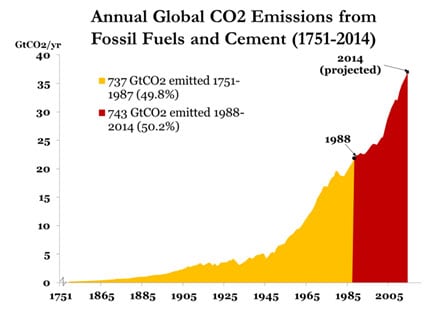
Hansen's scenario A has mankind's CO2 output rising exponentially at 1.5% per year (see the second paragraph on page 5 of the original paper) since 1988, but the actual rate of increase has been substantially higher - about 2% per year based on this graph from the Union of Concerned Scientists.
Hansen's scenario A has the average global surface temperature rising over 1 C between 1988 and 2014 (see figure 3 on page 7 of Hansen's paper). The actual temperature rise during that period was somewhere between 0.2 C and 0.4 C depending on which of the many data sets you believe.
Since Hansen's basic hypothesis was "more CO2 emissions = faster warming", scenario B certainly was not "closest to reality"; in fact none of his scenarios is at all realistic, since (empirically) he completely failed to accurately predict the relationship between CO2 and temperature - which was the entire point of his paper.
Hansen's model also had too high a value for climate sensitivity (around 4.2 IIRC) while subsequent research came up with a value around 3.2.
[1 C] * [3.2/4.2] = [0.76 C], which is still about double the observed temperature rise.
There is a reason that so much effort has been invested by alarmists into trying to make excuses for the lower-than-predicted temperatures - it's because temperatures have been lower than they predicted! That's still true, even if you use more recent models with less dramatic sensitivity to CO2.
There are already cities like Miami and Norfolk, VA that are flooding in areas when the king tides occur.
Don't be ridiculous - Miami (1.8 m) and Miami Beach (1.2 m) were both built practically at sea level to begin with; they have always been highly vulnerable to flooding since their founding. The sea level has only risen perhaps 0.25 m since that time, whereas the natural range of tides + waves + storm surges is 5+ m (especially in hurricane country!).
Norfolk, Virginia is likewise built at such a low elevation (2.1 m) that flooding problems are inevitable, although in their case the founding was long enough ago (1682) that the danger may be due to subsidence and pre-AGW sea level rise, rather than it originally being an obviously bad location.
If you look closely that EPA graph does show some acceleration.
Hardly, unless you want to count the little bump at the end which is too short to be statistically significant given how chaotic the climate system is.
In the Guardian article I think you misread "several meters" as "7 meters".
No, the original paper contains numerous statements along these lines: "Sea level reached 6–9 m in the Eemian, a time that we have concluded was probably no more than a few tenths of a degree warmer than today."
The introduction also makes reference to an earlier paper: "This uncertainty is illustrated by Pollard et al. (2015), who found that addition of hydro-fracturing and cliff failure into their ice sheet model increased simulated sea level rise from 2 to 17 m, in response to only 2 C ocean warming and accelerated the time for substantial change from several centuries to several decades."
Several meters of sea level rise this century is impossible to rule out. We don't know much about the dynamics of ice
-
Re:Not thought through.
No, he's trying to make incentives to have people replace coal or natural gas power plants with solar, wind, and maybe even nuclear. People say switching to renewable is too expensive. One of the reasons for that is the fossil fuel industry's freedom to pollute. IF the cost of that pollution were included in the sale price of the electricity or gasoline, people would have more accurate data when making the decision of renewable vs. fossil fuel. As an example, if we switched entirely to renewables, we'd save $300-800 billion a year on reduced health costs:
http://www.ucsusa.org/clean_en...
And that doesn't include property damage from harsher storms or rising sea levels. -
Entergy reckless
No, that plant was crashing all the time too. Entergy is demonstrably reckless. http://www.ucsusa.org/nuclear-...
-
Re:Fuck the rest of the world.
http://www.ucsusa.org/global_w...
Check your numbers, the US is already below 18 tons/yr/person as of 2011.
Who is going to tell the Saudis or the Australians though?
https://en.wikipedia.org/wiki/... is a good one to loook at to, but only goes to 2009.
-
Re:Fuck the rest of the world.
https://www3.epa.gov/climatech...
It is starting to happen, and with solar, wind, and nat gas becoming cheaper than coal, it will happen quicker. Now that China is on board as well, maybe some real change will happen.
What I wonder is, who will stop those horrible polluters in Australia and Saudi Arabia?
-
Re:Slashdot continues to spiral towards bankruptcy
Bullshit, inbred: http://www.ucsusa.org/our-work... the world's scientific community has zero reason to care about your political views.. other countries don't have to care about your political views... as Neil deGrasse Tyson said last night, the US is one of the worst countries in the world in science deniers... and you and your high school diploma fighting against PUBLISHED scientists with doctorates are the reason.
-
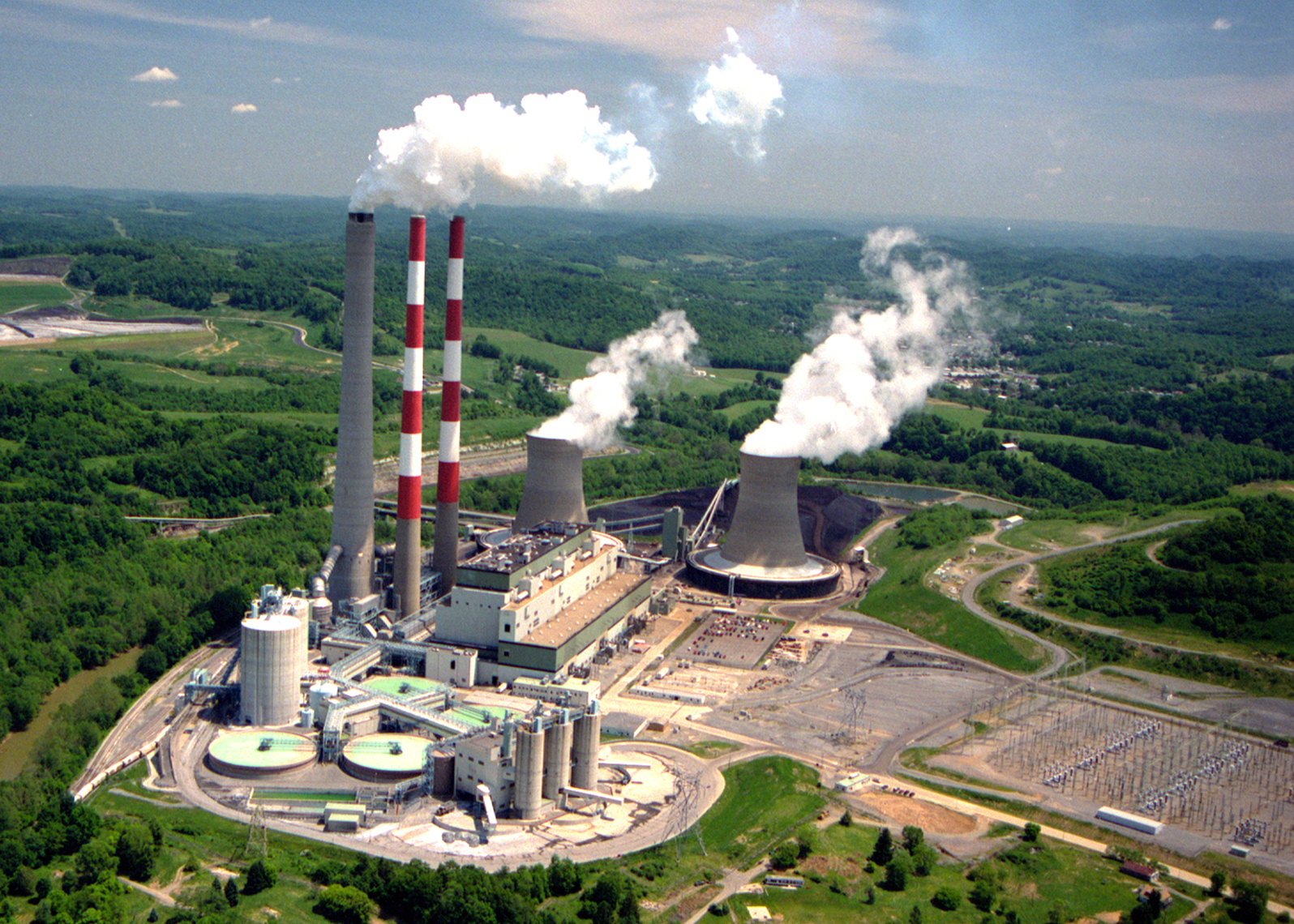
Is Mojokid redefining power plants?
Last time I checked, a Snapdragon 820 was a System-on-Chip semiconductor.
This is a picture of a semiconductor
This is a picture of a power plant
And another power plant, which is actually a power plant within a bigger... power plant
Its important that we all speak the same language. That or I'm gonna start calling every square computer I see a "Hard disk" -
Re:Risk
Or we could spend "$trillions" on renewable (your wild-assed guess) and save $600 Billion per year on health care costs alone (an actual estimate from experts). Spend $3 Trillion once to save $600 Billion a year for say 20 years? You should be able to do that math.
I'll also back my numbers up with a citation:
"The aggregate national economic impact associated with these health impacts of fossil fuels is between $361.7 and $886.5 billion, or between 2.5 percent and 6 percent of gross domestic product (GDP)."
http://www.ucsusa.org/clean_en... -
Re:No tax breaks ?
It's going to see if this continues without the tax breaks
Aren't you also interested in seeing if the coal industry and the oil industry are able to continue without tax breaks?
http://www.taxpayer.net/librar...
http://www.usnews.com/opinion/...
http://www.investopedia.com/ar...
And that's a wrap! AC down below has forgotten - or refuses to account for the huge amount of subsidies received by Coal, Oil and Natgas.
Now of course, the crowning acievement of subsidized energy Nookyalar! http://www.ucsusa.org/nuclear-...
https://lucian.uchicago.edu/bl...
I'm not even anti-nuc, but dammit, I'll wager a cup of crap that they are "free market" advocates. Those billions for that, and the taxpayers bearing the reisks of nuc plants sounds like the invisible hand of the free market is giving a reach around hand job to the nuc industry.
-
Re:Science Denial on Slashdot...
Personally, I have been advocating phasing out coal in favor of nuclear for over 40 years. The vast majority of people who claim to be oh so very very concerned about CO2, on the other hand, have been among those obstructing nuclear for over 40 years. Warming is their chickens coming home to roost. Unfortunately, those chickens are crapping all over those of us who do not deny arithmetic, too.
"I am not so much pro-nuclear as I am pro-arithmetic." -- Stuart Brand
Repeating what I have posted previously when the topic has come up, many of the environmentalists worried about the climate do advocate nuclear power.
James Hansen, for example, is probably the most well known person warning about climate change. He is strongly in favor of nuclear power. He stated:
We call on your organization to support the development and deployment of safer nuclear power systems as a practical means of addressing the climate change problem.... in the real world there is no credible path to climate stabilization that does not include a substantial role for nuclear powerhttp://grist.org/news/more-nuk...
http://dotearth.blogs.nytimes....
http://www.takepart.com/articl...
http://www.ucsusa.org/nuclear-... -
Re:Government should not pick winners and losers.
The amount of subsidies, on kWh produced basis, is tiny compared to solar. The coal subsidies, assuming they even exist, look huge because they produce 30% or more of our electricity. Same for nuclear and natural gas as they also each produce roughly 30% of our electricity. That last 10% that is not produced by oil, coal, and nuclear is largely from wind. The fraction of a percent of the electricity that solar power produces gets them HUGE subsidies.
Several comments on this thread pointed out that solar energy gets 1000x the amount of subsidies that coal gets based on kWh produced.
I have no issue with the subsidies that nuclear, oil, gas, and hydroelectric get because those subsidies are miniscule compared to solar. I will agree that all energy subsidies must end, but solar subsidies are on a whole different level than the others.
Stop complaining about how much oil get subsidized, IMHO, it makes you look like a fool.
Here you go spunky. My research from another post. Some of it is based on a reply to another person, so hte beginning will be a little redundant.
You mean like nuclear power? http://www.ucsusa.org/sites/de... [ucsusa.org]
Or petroleum? Or NatGas? Or Hydroelectric?
From another article:
http://www.misi-net.com/public...
On energy incentives, and an tl;dr version from Wikipedia:
A 2011 study by the consulting firm Management Information Services, Inc. (MISI) estimated the total historical federal subsidies for various energy sources over the years 1950–2010. The study found that oil, natural gas, and coal received $369 billion, $121 billion, and $104 billion (2010 dollars), respectively, or 70% of total energy subsidies over that period.
The percentage is higher for renewables, which given the much smaller percentage of use, and of course the fact that renewables wasn't even on the map during that time. cite https://en.wikipedia.org/wiki/... [wikipedia.org]
Corn based Ethanol production and the Alcohol credit for the FET is subsidized to the tune of almost 17 billion a year, renewable is 5 billion.
My point is that it's all subsidized. That the government subsidizes new power production isn't anathema to me in principle, but it would seem that the well established technologies shouldn't be getting subsidies. If you need to be subsidizing oil, natural gas, or coal for 60 plus years, they should be abandoned, right?. Or perhaps something else at play? Regardless, calling this "regressive political income redistribution in support of a putatively progressive cause." while apparently finding all of the others just fine is hypocricy at t's finest.
Back to the present:
I don't really care if you find subsidies for all of the other energy sources just fine, while the 5 billion per year for all of renewables a thing to difficult to suffer. It merely shows your politics, It's like the free market Republicans working to ban Tesla dealerships in their states.
But the numbers speak for themselves.
-
Re:Government should not pick winners and losers.
Well your 'little more' is x4.23 as much. Instead of selling at the market price for supplying power at 2.6, they were selling it at the customer purchasing price of 11. Now they are being dropped back down to normal supply pricing. It was inevitable. Those kinds of premiums are only temporary to jump start an industry. Once they get large enough, the premium is removed and they then have to compete with everybody else in the market. After all, a market that makes nothing can't afford maintenance and other costs and collapses.
You mean like nuclear power? http://www.ucsusa.org/sites/de...
Or petroleum? Or NatGas? Or Hydroelectric?
From another article:
http://www.misi-net.com/publications/NEI-1011.pdf
On energy incentives, and an tl;dr version from Wikipedia:
A 2011 study by the consulting firm Management Information Services, Inc. (MISI) estimated the total historical federal subsidies for various energy sources over the years 1950–2010. The study found that oil, natural gas, and coal received $369 billion, $121 billion, and $104 billion (2010 dollars), respectively, or 70% of total energy subsidies over that period.
The percentage is higher for renewables, which given the much smaller percentage of use, and of course the fact that renewables wasn't even on the map during that time. cite https://en.wikipedia.org/wiki/...
Corn based Ethanol production and the Alcohol credit for the FET is subsidized to the tune of almost 17 billion a year, renewable is 5 billion.
My point is that it's all subsidized. That the government subsidizes new power production isn't anathema to me in principle, but it would seem that the well established technologies shouldn't be getting subsidies. If you need to be subsidizing oil, natural gas, or coal for 60 plus years, they should be abandoned, right?. Or perhaps something else at play? Regardless, calling this "regressive political income redistribution in support of a putatively progressive cause." while apparently finding all of th others is hypocricy at t's finest.
-
Re:Hogwash
source
So if you lived in upstate New York or even California you are doing well, but in much of the Midwest driving an electric is like driving an efficient gas vehicle at least with regards to co2 per mile. It's obvious as the majority of power comes from coal and natural gas in this region and not hydro, nuclear and other renewables which makes up a bigger part of the better areas. Also given that new power plant installations take decades it's certain these numbers are relatively predictable over the life of any vehicle. Perhaps you could use a custom solar install yourself but this adds to the already overwhelming cost of full electrics. Many owners of electrics have battery replacement anxiety around year 8 of the vehicle. It will be interesting to see if electrics go to the landfill faster due to this lump sum repair issue. But thats another issue.
While it's true you can't effectively use regenerative braking on a fully charged vehicle, the process itself is generally 60-70% efficient and fufils 99% of the braking needs of the vehicle. It's true overall that this amounts to about 15% savings as most of the energy dissipated goes to wind resistance. However regenerative braking and the lack of a need to power the vehicle down hill means inclines and vehicle mass also don't impact electrics nearly as much as gas vehicles. That's good because the battery packs make electrics far far heavier than thier gas counterparts for any kind of realistic range. Unless of course you are trying to school me uphill both ways. -
Re:eGolf is agreat car
Lifecycle analysis shows that electric cars produce 25% less emission than plug-in hybrids that use a drive train similar to the kind you are advocating for.
Environmentalists have always been for more efficient cars but pure gasoline powered cars just aren't necessary. And there are a TON of engineering benefits to an electric car: the center of mass is super low, you double the storage capacity, you get rid of the vast majority of the maintenance cost, and the performance is really phenomenal.
-
Re:Idiot
Renewables are winning against everything on economic grounds... as long as they're *massively* subsidized, yes. And as long as they're backed up with non-renewables that can pick up the slack when renewables can't supply the energy needed from them, which is constantly. But otherwise they're great, yeah.
Right. And nuclear isn't subsidized?
-
Re:Economically feasible
Bigelow was just one of examples of possible future markets. Some of the things I mentioned will take off, some will not, but each of them are potentially big.
Lets look at current stuff in space 1,305 active satellites they combined use 525,781 kilograms of fuel in their lifetime (for the ones that we have data for (467 satellites or 35.8%)) averaging to the rest of satellites we get 1,468,662 kilograms of fuel used by all currently operational satellites.
So lets assume average lifetime of 12 years (about 15 for geosynchronous and 1-10 for the rest) we get about 122,389 kilograms of fuel per year of required fuel to keep all current satellites flying.
Assuming average price to orbit of $10,000 per kilogram we get a market of 122,389 * 10,000 = $1,223,890,000 per year for fuel alone. One hell of a market if you ask me especially if you consider that number of satellites is only going to grow with time.
Obviously none of the current satellites (except ISS) can be refuelled, but there are already companies working on refuelling in space and you can bet your socks off that all commercial satellites in the future will have refuelling capacity since currently all satellites have to be more than 50% fuel just to keep flying for 10-15 years.
-
Re:I don't understand.... what was preventing them
Ignorant cunt.
-
Re:Science is Settled
The big problem is that nobody has a clear, and widely agreed-upon idea about what to do about it.
A few clear, viable, and widely agreed-upon solutions:
- Stop burning coal
- Increase energy efficiency (buildings, appliances, vehicles, etc.) as much as possible
- Stop Deforestation
- Slow population growth
- Eat more plants and reduce production of meat
- Switch to non-fossil energy sources as quickly as possible
With a simple search, you can find plenty of lists like this all over the web:
http://www.scientificamerican....
http://www.ucsusa.org/global_w...
The whole "carbon credit" trading scheme has already proven totally shady, since it's a carte blanche license to pollute.
It would probably work great if there was one global program. But without universal participation, a more aggressive standard will only penalize participants, while rewarding outsiders. Faking it and putting in-place a system that does nothing is the only option.
-
Re:Science is Settled
Really? Because you said, 'Ice loss in the Antarctic is causing sea level rise.'
As we go on, we learn. Do you question the fact that sea level rise is happening at all? That would be an extraordinary statement.
That was a big one, as far as why and how everybody is going to die.
Histrionics much? you got the quotes for everybody is going to die?
You woke up my lecture gene this morning.....
Exhibit 1. Scenario - I was supervising a video crew that came up from Washinton D.C. a few years ago. The location was several hundred miles north of D.C.
part 1.This was a winter when the area around Washington was hammered badly by snow and cold weather. Shut the place down, and the camera crew had a hell of a time getting to us.
part 2. They arrived at the place we were working at, and the sun was shining, it was about 52 degrees in the middle of winter. They were pretty shocked at going several nudred miles north to reach springlike conditions in mid-winter.
So was the unusually cold weather in the D.C area proof that AGW didn't exist, or was the unusually warm weather in Northern Pennsylvania proof that it did exist.
The answer is neither. Those anomalous conditions were weather not climate.
And while the ice accumulation in areas of the arctic are interesting, they still belong in the local weather subgroup.
And if they are not at the moment contributing to the sea level rise, it does not mean the rise is not happening.
Here is a tough one for the deniers:
http://www.scientificamerican....
And the guns - they kinda do smoke:
http://www.ucsusa.org/sites/de...
They even used groups and tactics of the tobacco industry to do their dirty work - I always knew smoking was actually good for you - you have to agree, eh? So now that the lid is off of Exxon's and other's scandal, are they tools of the liberals and commie scientists because they were convinced AWG was happening?
Or are they good citizens because after knowing all this, they set off on a P.R. campaign using tobacco industry tactics to sow doubt?
Perhaps I exaggerate your position slightly, but is it really 'just news?' It changes nothing? I guess it wouldn't, if saving the planet from the deadly effects of AGW was never the goal in the first place.
-
Re:Hooray!
So what? A coal plant burns *3000 tons* of fuel every day. THAT'S LIKE A MILLION TASR BOMBAS!
Please think of the stray dogs. -
Re:Climate Conflict of Interest
But any sceptic today is immediately suspected of being on Big Oil's payroll anyway.
Not doing so would be failing to take into account the existence of all the groups funded by ExxonMobil, the Koch foundations and others: American Enterprise Institute, American Legislative Exchange Council, Competitive Enterprise Institute, Manhattan Institute for Policy Research, Americans for Prosperity, Beacon Hill Institute, Cato Institute, DonorsTrust, Heartland Institute, Heritage Foundation, Institute for Energy Research, , National Center for Policy Analysis, and hundreds more.
The $1.5 bln would buy a lot of scientists — especially those, who already think AGW is a real concern and whose conscience would thus be a lot cheaper.
So you would have us believe that the thousands of scientists who contributed to the IPCC report are all corrupt and not one of them spilled the beans. Not only that but since the report is reviewed by the governments of over 120 countries with competing interests you would also have us believe that they are all in on the conspiracy and that none saw fit to expose it to discredit their adversaries! And all these scientists would be producing bogus results without anyone in the organizations and countries financing them noticing something fishy?
Well, as they say, extraordinary claims demand extraordinary proof and all you have are unsubstantiated accusations.
I do not doubt, that you share the concerns over the fabled "Military-Industrial Complex" influencing the government towards "perpetual war" so it can forever sell the armaments.
Wow! Aren't you a bit quick putting people you disagree with into neat little boxes! What will you accuse me of next?
-
Re:How patriotic! Criminalizing decent
Simply saying you're against it is just speech, so I'm trying to figure out what they're going to RICO them for.
Fraud. The cigarette companies were damaging people by intentionally deceiving them (and advertising to kids). So, to get a settlement from this, you'll need to show that:
1) Oil companies (or whoever) intentionally lied about what their scientists told them, or told their scientists to produce studies with the 'correct' result. I've skimmed through some of the documents provided by the link, and I'm not sure I see evidence of that.
2) They have to prove that someone was damaged. The cigarette companies didn't lose because they lied, they lost because their lies damaged people. The link says there are threats of future damage, but doesn't present evidence of any actual damage. That's something they will have to fix.
It's not illegal, unethical, or wrong to fund science. It's a good thing, even if oil companies do it. It's only unethical when they require a specific result, or otherwise pressure the scientist. The more funding we have for science, the better. -
Re:Lies, big lies, and statistics
Good point. the consensus has been measured many times using different methods ranging from literature reviews to polls of scientists.
That's nice. I live in a funny kind of world where science isn't a matter of agreement so much as making predictions, then having them happen.
So when Hansen says NYC is supposed to be under water by now
http://www.salon.com/2001/10/2...
And it's not, that's fail.When the prediction is for more and more intense Hurricanes and they don't occur
http://www.ucsusa.org/global_w...
That's fail.So I someone with an agenda doing a survey, to determine "Consensus" looks like someone with an agenda that wants to use "Consensus" to bludgeon people that disagree.
I also look at anyone who says Consensus as a counter to failed predictions as an idiot.
-
Re:"...need to be prepared..."
Bingo. Mod up.
the problem with sea level rise that deniers miss (willfully ignore) isn't the (roughly) steady state level of the water (a threat, but a much more long term threat for all but the low lying island peoples).
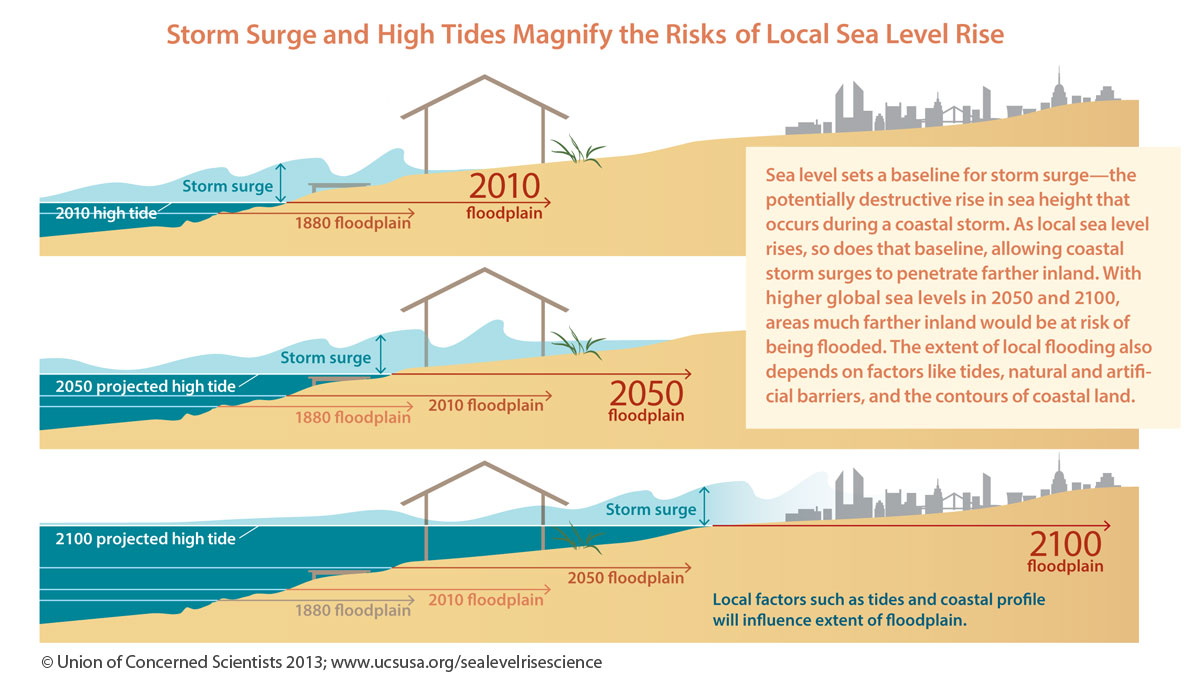
The much more immediate short term problem is surge, both normal and storm. Particularly storm.
Some places have more surge than others and will experience rising sea levels more quickly.But everyplace is susceptible to storm surge, and rising seas make storm surge many many times more damaging and dangerous.
Already we've seen this with both Katrina and Sandy in our own country. It's been estimated that Sandy caused nearly 40% more damage that it would have without sea level rise being a factor, contributing to a much larger storm surge. Think about it: you have a massive storm front, hundreds of miles across. Just adding an inch of height to the volume of surge equates to many millions of gallons of extra volume, not to mention extra momentum, able to penetrate far futher inland. And we've seen the seas rise nearly 8 inches in the past 120 years or so. Storm surge risk evaluations, done every ten years, have been increasing. As well as the number of events and severity, and the actual damage caused.
These images describe quite well, what we are already seeing happen:
http://climatecommission.angry...
http://ian.umces.edu/imagelibr...
http://www.ucsusa.org/sites/de... -
Re:the battle of the selfless
This is why you are called a denialist. All data is incomplete (as we can not measure everything in the universe, or every atom in the planet), some models are doing very well (see here, for example), and "hidden consequences" doesn't mean anything as if they are hidden you don't know about them, meaning you can't use them in your argument. If you'd said "consequences", you'd have to tell us what they are. You are clearly intelligent - how you can selectively ignore the scientific method is beyond me, especially when your entire life is predicated on it being effective.
-
Wicked hard problem
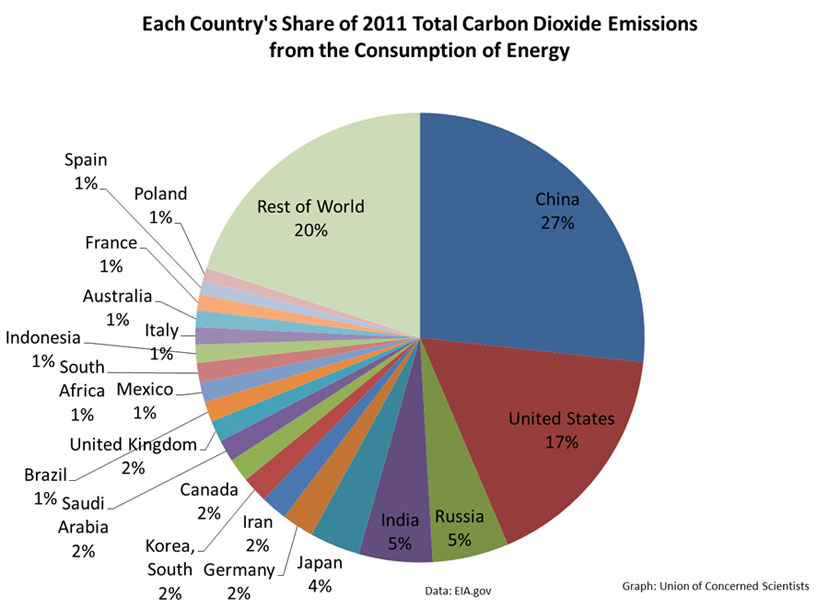
What is this another case of beat up random people that you can because you can't get the ones you want ? http://www.ucsusa.org/sites/de... There you go, as of 2011 China is at 27% of the emissions and still growing in both percentage and absolute amount. Maybe these people need to disinvest in China and stop buying Chinese products ? Or maybe they just have some sort of a grudge they are pursuing by other means.
(I will point out that this large number is only because China has such a large population. In terms of emission per person, USA beats them hands down)
Can't do that. China is, at this point, decades ahead of the US in renewable energy tech. There's no way we can address climate change in any reasonable timeframe without using Chinese products, at least in the near term. I don't know if China's huge investment in renewable tech is related to the fact that they don't have a Chamber of Commerce over there, I'll leave that for you to consider.
That is why climate change is a wicked hard problem: you can't solve it on your own-- it has to be a collaborative solution involving multiple countries.
And that, in turn, is why some people would rather deny that the problem exists rather than find a way to solve it: they have an ideology that says the US should never work in collaboration with other nations, not ever, not for any purpose. They don't have any mechanism in their ideology to solve the problem, so the only choice is to deny it exists.
-
Re:Oh please U.S. Chamber of Commerce ?
What is this another case of beat up random people that you can because you can't get the ones you want ?
http://www.ucsusa.org/sites/de...
There you go, as of 2011 China is at 27% of the emissions and still growing in both percentage and absolute amount.
Maybe these people need to disinvest in China and stop buying Chinese products ? Or maybe they just have some sort of a grudge they are pursuing by other means.
Can't do that. China is, at this point, decades ahead of the US in renewable energy tech. There's no way we can address climate change in any reasonable timeframe without using Chinese products, at least in the near term. I don't know if China's huge investment in renewable tech is related to the fact that they don't have a Chamber of Commerce over there, I'll leave that for you to consider.
-
Oh please U.S. Chamber of Commerce ?
What is this another case of beat up random people that you can because you can't get the ones you want ?
http://www.ucsusa.org/sites/de...
There you go, as of 2011 China is at 27% of the emissions and still growing in both percentage and absolute amount.
Maybe these people need to disinvest in China and stop buying Chinese products ? Or maybe they just have some sort of a grudge they are pursuing by other means.
-
Re:No, but your own choices are.
I see nothing in the form of facts to support virtually anything you claim. In fact you cite an article about 'defriending' which, in fact, supports the opposite view than what you express. Liberals defriend conservatives more often over political views. 13% more. What you conveniently left off your comment was the fact that liberals have many more conservative friends to start with than conservatives.
47% of conservatives said they only see conservative posts on Facebook. Only 32% of liberals say they see only liberal posts. So obviously, if you're a conservative you don't need to defriend as many people because you're not exposed to varying viewpoints nearly as much as liberals are. In other words, conservatives were 15% more likely to never view posts that didn't share their point of view. You tried to make it sound like liberals don't want to hear the other side. The truth, yes the truth is this. We at least listen more to the other side. Then we make our decision. Whereas your crowd has much more of a closed mindset and never listens to opposing views. Now do you get it? You don't need to defriend as many people because you're not listening to begin with if you are a conservative. Versus defriending based on listening. So who's throwing out the straw man? You make the claim that "If you de-friend someone (or large groups of someones), their stories are basically not going to be on your feed in the first place, and liberals have been shown to be more likely to de-friend conservatives". On first glance and second glance you are apparently trying to make it look like liberals never listen to the conservative argument. No,no my friend. You're going after the straw man. In reality, many more liberals than conservatives listen to opposing views and then they make a decision whether or not they will defriend someone. Conservatives actively avoid defriending by never listening in the first place! And irregardless of what your ideas are, it is liberals who listen more. And we like to read entire articles, not just home in on the 'facts' that support us.
The rest of your post is crap. Rehashing the same old tired song and dance. Trying to make it sound like liberals are the ones with closed minds. Oh yeah, we plod along listening to our heart instead of the facts. Refer to the above paragraphs again. We do listen. We listen for facts. Something not always in demand by your side apparently.
Here's a fact for you. Fox News coverage of global climate change was inaccurate in 72% of the segments covering it during 2013. MSNBC had only 8% of its segments contain inaccurate information. http://www.ucsusa.org/global_w...
To have so many people listen to what is an essentially misinformation campaign is pretty pathetic. And one wonders if that isn't the reason for the scarcity o those 'real life' conservative arguments. Could it be because they don't exist? Or is it because I have made a concerted effort to never listen to Sarah Palin?
-
Re:Does This Make Sense?
Start with a few facts rather than opinions pulled from the nether regions:
Coal accounted for 35% of electricity production in the US in 2014. This is down from 50% in 2005.
http://www.eia.gov/electricity...Thermodynamics:
Efficiency: Large power plants (such as coal powered plants) are very efficient. Internal combustion engines are very inefficient.
"According to a range of studies doing a ‘well to wheels’ analysis, an electric car leads to significantly less carbon dioxide pollution from electricity than the CO2 pollution from the oil of a conventional car with an internal combustion engine.[1][2][3] In some areas, like many on the West Coast that rely largely on wind or hydro power, the emissions are significantly lower for EVs. And that's today. As we retire more coal plants and bring cleaner sources of power online, the emissions from electric vehicle charging drop even further. Additionally, in some areas, night-time charging will increase the opportunity to take advantage of wind power -- another way to reduce emissions."
[1] Union of Concerned Scientists. “State of Charge: Electric Vehicles’ Global Warming Emissions and Fuel-Cost Savings Across the United States.” April, 2012. http://www.ucsusa.org/assets/d...
[2] MIT Energy Initiative. "The Electrification of the Transportation System." April, 2010.
[3] Electric Power Research Institute and Natural Resources Defense Council. "Environmental Assessment of Plug-in Hybrid Electric Vehicles." 2007. Cited February 16, 2011.
I charge my electric car from solar panels... YMMV -
Re:Scientifically driven politics
I have to waste some mod points to give the reasons. The legislation bans consideration of research where all data is not publicly available without regard for which data is available - like public health studies with anonymized data.
This bill would make it impossible for the EPA to use many health studies, since they often contain private patient information that can’t and shouldn’t be revealed. Studies based on confidential business information would also be off-limits. Studies of human exposures to toxics over time and from a variety of locations likely cannot be reproduced. Neither can meta-analyses, looking at the results of hundreds of scientific studies to assess their conclusions. Such studies provide critical scientific evidence in many fields of research. This legislation wasn’t designed to promote good science—it was crafted to prevent public health and environmental laws from being enforced.
-
Re:Is anyone really surprised?
NASA is about flight/space, not about earth science
NASA's mission-statement used to include earth science (in the context of aeronautical and space platforms.) That changed in February 2006, during the Bush administration.
-
Re:1000 times
You are ignoring how economies of scale affect efficiency and pollution.
Because of their large scale, power plants achieve efficiency levels that are far above and pollution levels far below what could never be achieved in a tiny internal combustion engine, even when you account for the losses incurred by the transport of electricity.
Even when coal is used to generate electricity, electric cars are still on par with gasoline cars.
http://www.ucsusa.org/clean_ve...
A charging infrastructure is far cheaper to build out that an CNG refueling infrastructure and the great thing about electric is that it doesn't matter what is being used to generate the power on the back-end.
In the mean time, while the limitations to battery technology are addressed, the most logical bridge is not some other fuel; it's hybrid and plugin hybrid cars which leverage existing gasoline infrastructure.
-
Re:wildfires?
The Union of Concerned Scientists says that increasing wildfires comes from climate change.
I'm going to go with the science, rather than Random Internet Guy.
-
Not viable without subsidies
Most countries allow nuclear power operation with insurance caps. That means in case of an accident the taxpayer foots most of the bill (as in Fukushima).
If you were to include the full cost of insurance nuclear power would be completely unviable.
http://www.ucsusa.org/nuclear_... -
Re:We should stop using the word renewable
CO2 generation isn't an impossible challenge. Since the concrete production is centralized, it can be sequestered on site, and concrete naturally re-absorbs that carbon over the decades. Even if you don't address the immediate emissions, since concrete production is a mere 1% or so of total CO2 output by the US and the entire lifecycle emissions (including construction, operation and decommissioning) for hydro is a tenth that of natural gas, you're still coming out way ahead.
=Smidge=
-
Re:Has anyone studied?Okay first off, I just wanna say whoever modded the parent up is walking evidence that this site has become a complete shithole. It's not just Dice's fault, folks. The community moderates unadulterated feces to the top these days.
Has anyone studied the effect on the environment of taking all of that energy out of the wind? What if seeds and dust aren't carried as far?
This is such an unfounded concern, I'm not even sure where to start. I grew up in the prairie of Minnesota and I could only hope that the wind is reduced there. It is absolutely brutal at times and causes erosion and top soil loss. Why do you want dust carried far? What seeds are you concerned about falling too close to the parent plant? I just, this hasn't been studied because there's nothing to argue about. Like solar there's a lot of energy to be harvested. There's no way to harvest all of it, a lot of it is dissipated as friction against water and earth and I can't think of one positive purpose of that friction.
How does that affect terraforming?
How does that affect our ability to transform the planet into a more livable human environment? I can't even parse this or apply it to the topic at hand. "How does that affect X?" when X has nothing to do with the discussion just sounds like fear mongering.
What about migratory birds? Has anyone bothered to solve the problem of mass kills during migration season?
This is well documented and researched but I am constantly confused as to why "migratory birds" are the stipulated losses. It's any birds. Migratory or not. And the numbers have been scientifically estimated to be 140,000 to 328,000 per year. But we're getting smarter about designing these windmills to prevent avian death.
These questions will never be answered
Well, the first two are just too fucking vapid and inane to be answered. The latter, I've answered for you.
, I don't think, because the politics that drive wind power are the same as those that drive anthro climate change - "We're right, shut up if you disagree?"
You know, that could be said about any politics anywhere because modern politics are about inaction and hot air. Companies and scientists are trying hard to expand our energy portfolio away from fossil fuels. And that's smart whether it's biofuel algae, solar, wind or even failed corrupt initiatives like corn ethanol. In the end there are going to be regionally localized energy productions that will account for a large amount of that local populace's consumption. This will likely still be augmented by fossil fuels -- maybe as emergency or backup but I don't think we'll ever see them completely removed from the equation.
The Earth is going to be destroyed by people (on both sides of the political aisle) who refuse to take a reasoned approach to our energy crisis. The root causes of our energy shortage, climate change, starvation, hunger, crime, and disease, are all one in the same: OVERPOPULATION.
We're 7 times as numerous as the Earth can sustain. Unless and until we fix that problem, our habitable climate WILL be destroyed.
Scientifically, can you explain how you came to calculate the multiplier of "7 times as numerous as Earth can sustain?" Because the idea that the Earth can only sustain a nice round even number like a billion people raises suspicions. But it's pretty evident that nothing is going to talk sense into you, Malthus. Science and human ingenuity has gotten us past radical adj
-
Re:Why is this great big lie so appealing?
Here is a site which refutes your claims and does cite courses. Enjoy.
-
Re:I have said it before
Right. Having the government cover all of your major liabilities, getting to write off massive debts, pass all of your cost overruns onto local consumers without them having a say in the manner, and so on, that's all "paying their own way", right? In nuclear power, the gains have always been privatized while the costs and risks socialized. And it's *still* been very difficult to find investors. Nuclear has always been more popular on K-Street than Wall Street.
Here's a paper going into the various massive ways nuclear has been subsidies. And they still can't bloody manage to stay afloat. It's one of the few industries with a negative growth curve - where technology gets more expensive with time, not cheaper.
The US government collects about $750 million in fees each year for nuclear waste disposal. Utilities have paid these fees for decades. The fund has 25 billion dollars in it. "Actions by both Congress and the Executive Branch have made the money in the fund effectively inaccessible to serving its original purpose." When it comes time to retire plants, utilities are forced to store the waste on their sites at their cost.
And consumers do have a choice in the matter. They are welcome to go off the grid. Electricity in the US is among the cheapest in the world, while also being one of the safest for workers and the environment. There is always room for improvement but electricity in Japan and Europe costs 2-4 times as much, and electricity production in poorer countries is often very unsafe for workers and the environment. The US does a fairly decent job at providing safe, reliable electricity at a low cost. -
Re:I have said it before
Right. Having the government cover all of your major liabilities, getting to write off massive debts, pass all of your cost overruns onto local consumers without them having a say in the manner, and so on, that's all "paying their own way", right? In nuclear power, the gains have always been privatized while the costs and risks socialized. And it's *still* been very difficult to find investors. Nuclear has always been more popular on K-Street than Wall Street.
Here's a paper going into the various massive ways nuclear has been subsidies. And they still can't bloody manage to stay afloat. It's one of the few industries with a negative growth curve - where technology gets more expensive with time, not cheaper.
-
Re:Airports underwater? Maybe 3025...
>Let's say the politically revised figures are correct. That means in 30 years (2045 being only 30 years away now) sea level rise will have been 3.6 *inches*.
You got many things plainly wrong..
First, the sea level grows at a non-linear rate. The formula level(time)=time*actual_rate is plain wrong. The rate is accelerating.
>Which airport is that going to put "underwater"? Please explain.
Second, the sea-level is an average. What about the variance? Higher tides, higher waves,
>You warming alarmists are worse than the anti-vaccers in terms of just chucking reality out the window, even when you get to make up your own rules!
Third, you are relying on ad hominen fallacious argument.
-
Re:Reads like a consiracy theory
-
Re:Sadly yes
Strange, the news than China passed America (USA) was around 2011 or 2012 even, it was big news even here on
Interesting read about 2014
However I see now clear numbers are not easy to get: http://www.ucsusa.org/global_w... here it says China produced 27% of the worlds emissions in 2011 (USA 17%)!
And here it says USA and China changed leadership 2006 (as you said): http://en.wikipedia.org/wiki/G...
Here it is even claimed that basically all nations (except the eU in total, no breakdown by country however) increased their CO2 output in the recent years: http://co2now.org/Current-CO2/... -- which I find hard to believe.
Anyway, the USA still seem to be around 16% share of world wide CO2 production, not 14%, interesting read about various changes the recent years: http://edgar.jrc.ec.europa.eu/... -
Re: Established science CANNOT BE QUESTIONED!
if you're not willing to build a bunch of nuclear power plants and shut down a bunch of coal plants, then yes you ARE arguing global warming to advance a political agenda
Some of the most prominent AGW scientists are strongly in favor of nuclear power: http://www.scientificamerican....
Others are a little more cautious, but still think nuclear is an important part of an overall strategy to reduce global warming: http://www.ucsusa.org/our-work...
-
Re:Is Nuclear going to be acknowledged?
There is a not-so-little thing called science.
While some supporters of a U.S. reprocessing program believe it would help solve the nuclear waste problem, reprocessing would not reduce the need for storage and disposal of radioactive waste. Worse, reprocessing would make it easier for terrorists to acquire nuclear weapons materials, and for nations to develop nuclear weapons programs.