Slashdot Mirror
Domain: uiowa.edu
Stories and comments across the archive that link to uiowa.edu.
Comments · 277
-
Re:What is truly appalling...
Uhm, you want the same programmers who couldn't keep track of their pointers to add validity checks? Yeah, that'll work.
This kind of error is actually nothing new. The business with all those 0x20s (do they really store dollar values in 64-bit integers?) Is reminiscent of a snafu I read about back when punched cards where the main data input medium.
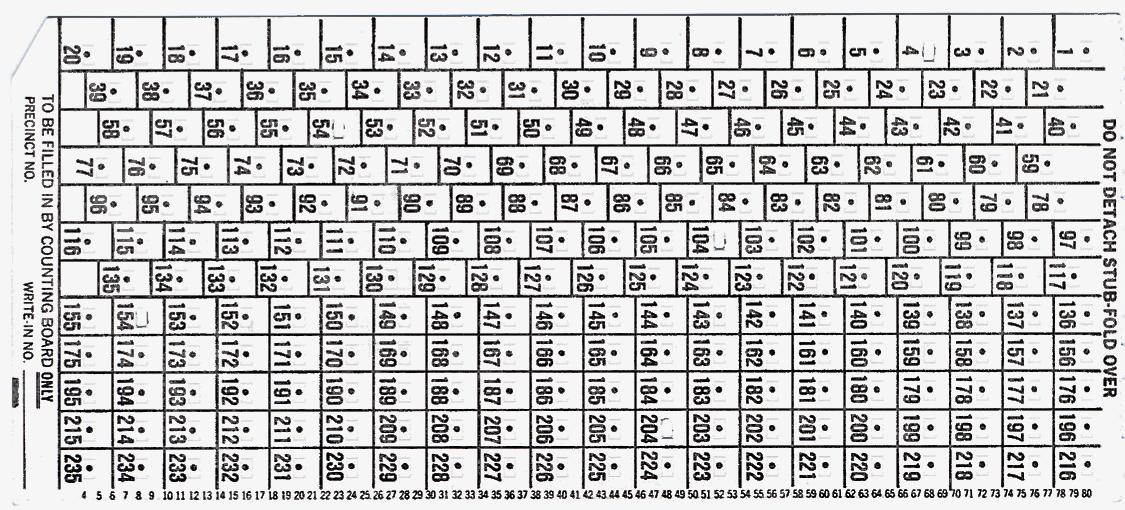
To understand what happened you need to know how 80-column IBM punched cards worked. (Here's a picture of such a card. It's printed to show how the columns are allocated for FORTRAN source code, but that doesn't affect how the card actually works.) Each column represents an alphanumeric value. A single punch in the numbered rows meant a numeric digit. Other characters were encoded by combinations I won't go into (more details here); suffice to say that the letters A through R were represented by a punch in the zone rows (the top two rows above the numeric rows) combined with a numeric punch. In particular, the later A is represented by a punch in the top row combined with a punch in the 1 row.
Now then, one fine day a keypunch operator is inputting data for a town that taxes personal property. (I don't remember the specific figures, so I'll make some up to illustrate what happened.) A guy owns a car valued at $200. In the card used for inputting the tax data for the car, ten columns are set aside for the assessed value. The operator should have punched "_____20000" (using _ to represent blank columns with no punch). But his finger slipped, and he input "A____20000".
Any properly designed language runtime would have choked on this input (alphabetic data in a numeric field). The language runtime (FORTRAN I think, or maybe COBOL) was not properly designed. In a numeric field, any blank column in a numeric field was assumed to represent 0 — and the zone punches were simply ignored! End result: the value of the car was recorded as $10,000,200.00. With a 0.5% tax on personal property, the guy was sent a bill taxing his $200 car at $50,001. (Like I said, these figures are imaginary, but they're in the ballpark.) He didn't have to pay, of course, but by the time he protested his bill, the city budget had already been drawn up, and had to be hastily revised based on $50K (about $300K in today's money) suddenly evaporating.
-
Not exactly a new theory: The Big Splash
The theory of comets as a source of water was also published in 1990, by Louis A. Frank.
Not exactly your average crack-pot scientists, Frank was the designer of something like 13 payloads on various launch vehicles in the 80s and 90s.
Frank posits that that small comets still hit the moon and earth almost daily, delivering water virtually every day. These small comets are more like fluffy snowballs, and are small enough not to have much if any radar signature, but their effects upon impact with the atmosphere are visible from above.
http://en.wikipedia.org/wiki/The_Big_Splash_(book)
Excerpt from The Big Splash
by Louis A. Frank with Patrick Huyghe
Published by Birch Lane Press, 1990.
ISBN 1-55972-033-6 -
Re:People just don't understand Linux
My favorite "useless feature" is track changes in Word. Do you have any idea how surprised people get when they send me a Word document and I send them back all my edits with cute little bubble comments next them? Does OO support track changes? Cause if they dont, that is a shame... it is a damn useful feature once somebody drops change-tracked document on your lap and you go "wow, I never knew this existed!".
That is indeed a useful feature, and I have not found a way to do exactly that in OOWriter. However, I generally make do with a combination of strikethrough, font color, and footnotes. I only edit documents that way as an ESL tutor, but it works just fine for that purpose, with the additional benefit of never being asked "How do I make your mark-ups go away so I can print this revision and turn it in?"
However, what I actually find a lot more useful is a spreadsheet that's reliable for statistical analysis. Can Excel do that yet?
-
No GPU caustics and refractions??
I wonder if anyone has told these guys.... Or these guys?
-
Re:It is most certainly true
Excel charts are a liability for anyone who really cares about presenting statistics reliably. They encourage users to shoot everyone in the face by suggesting charts that use false third dimensions, to name but one problem.
-
old news
Astrophysicist Dr. Louis Frank first proposed the existence of small dark comets in 1986. In 1990 he wrote 'The Big Splash' where he theorized that most of the Earth's oceanic water, and probably life itself, resulted from small comets that enter the atmosphere at the rate of more than 20 per minute. It's an intriguing read that needs to be taken with many large grains of salt. He was roundly criticized and ridiculed for his theory and these days he doesn't talk much about it anymore. His current profile at the University of Iowa makes no mention of his dark comet research.
The guy is no lightweight. He worked with James Van Allen and co-wrote with him several papers describing what we now know as the Van Allen radiation belts that circle the Earth. Is he about to be vindicated?
-
Re:Only for certain kind of analyst...
The folks I know who use Excel for analysis use it because it's the package that everyone gets in their organization
That's a shame, because Excel has some serious deficiencies when it comes to statistics and analysis. You simply can't trust any of the numbers it gives you. It's just flat out wrong a lot of the time.
http://www.cs.uiowa.edu/~jcryer/JSMTalk2001.pdf
http://pages.stern.nyu.edu/~jsimonof/classes/1305/pdf/excelreg.pdfAlso, searching the interwebs will dig up all kinds of articles about problems with Excel doing odd things. Excel is the wrong tool for the job.
-
I speak for many when I say..
At last! Hallelujah! I'm European so this isn't my money that's involved, therefore a bailout is better for me and the world's economy than no bailout, and it doesn't cost me a thing anyways. Sorry you guys have to pay the cost, but look at the good side of things. Thanks to this whole thing happening at the right time it only makes you more likely to get a decent administration this time.
Seriously, I look at this chart as if it was the temperature curve of this election, and if you rely on it then this whole crisis made Obama's estimated odds of being elected skyrocket. All the Diebolds in the world couldn't save the day for John "I was a P.O.W. for 5.5 years" McCain and Sarah "I'll make you keep your foetus even if the father is your uncle" Palin.
-
DEC FOCAL
Yay! Another eccentric language from the past that I'd like to hear from. FOCAL was a bit like Fortran or Basic in its statements. However, line numbering was significant and implied program structure, so that every routine could also be treated as a collection of nested subroutines by cunning line numbering. http://www.cs.uiowa.edu/~jones/pdp8/focal/ brings back memories of bootstrapping a PDP-8 (many toggle switches and muttered incantations).
-
Market predictions are based off polls
When there is reward or penalty for getting the answer wrong or right people are more inclined to tell you what they expect to happen than what they want to happen. That is why markets, such as the IEM outperform surveys
Right, because $5-10 is a huge motivator.
You realize that another explanation is just as likely? The people making those markets work look at MULTIPLE polls and use their critical thinking to see which seem reasonable, what sorts of biases there may be, etc. Otherwise, where do you think they are getting their information?
-
Market prediction would have been better
This kind of survey is a horrible predictor of actual outcomes because it confounds the political biases of the respondents with their expectations.
There is a good way to tease those motives apart and force respondents into the domain of prediction: grant financial rewards and penalties according to the accuracy of predictions. When there is reward or penalty for getting the answer wrong or right people are more inclined to tell you what they expect to happen than what they want to happen. That is why markets, such as the IEM outperform surveys
-
Re:prediction markets; race and polls
The February Scientific American had an article that treated prediction markets with skepticism. Some of the evidence that people have been quoting in favor of prediction markets is apparently bogus, and nobody has the faintest clue how they really work.
Well the basic idea behind the Iowa Electronic Markets is that people, anyone, can bet money (a limited amount) on who they think will win an election. Basically, polls ask people who they want to vote for, but arguably you'd have a better idea of the outcome of an election if you ask people not who they want to vote for but who they think will win. It's called the wisdom of crowds. Show a certain amount of people a jar full of pickles and they'll tell you about how many pickles are in, the more people you ask the more precise the results get (if I'm not mistaken under ideal conditions with a lack of a bias in their judgment 100 times more people should get it 10 times more precisely, that's like coherent averaging).
That's the idea behind the IEM. With a twist, instead of just asking people who they think is gonna win, they make them bet on it, as becoming more interested in it makes them be more serious about it. And in case you're wondering, Obama is so winning!
-
earth recordings
aurora recordings on earth is known many years already. even when you can't see auroras, you can hear them in VLF range. for example http://www-pw.physics.uiowa.edu/mcgreevy/
-
Iowa State has a good election market too
Iowa state university has a really good prediction market also.
You can see it here. . they have 2 differenent election markets.. one is winer take all and the other is vote percentage.. -
Re:Excel can't handle real scientific data sets
> I agree that Excel isn't enough, but don't dismiss Excel as a tool.
I think it is pretty well documented why Excel should not be used as a serious scientific tool - it will corrupt data, it is incorrect, and inconsistent (pdf) - all bad for science. I am surprised accountants are allowed to use it.
And it does not seem to be getting better either. So why should scientists be encouraged to use such an incorrect tool? Because it is easier?!? -
Re:I wish this one wasn't killed....
Apparently other people are also interested in weather markets can predict things:
http://www.biz.uiowa.edu/iem/
http://www.intrade.com/
http://www.google.com/search?q=political+markets
Notice at Google that major media outlets are running them now. UIowa was pretty early if they weren't the first. -
Re:What about an 80-column card?
(If you get that, I know how old you are...)
I didn't get it, because I'm too old.
And it turns out I can produce 80-column cards on my Apple computer.
-
Re:"tackel the problem" == "make it not NP-hard"?
ObDisclosure: I am a graduate student doing research into heuristic approximation algorithms. I'm more the implementation side of the crew than the research side of the crew, but hey.
For a very large portion of the problem space, TSP is really quite tractable once you use a proper heuristic. I've seen damn near perfect approximations to a 100-city TSP problem computed in under ten seconds.
Good heuristics are just frighteningly good.
If you want to see an example of this, take a look at Djinni, which implements simulated and compressed annealing algorithms. Once built there's a nice little GTK+ app that shows you a path through a 100-city TSP. (ObDisclosure: I'm one of Djinni's authors.) -
Re:Not every candidate
note that I've never seen a butterfly ballot
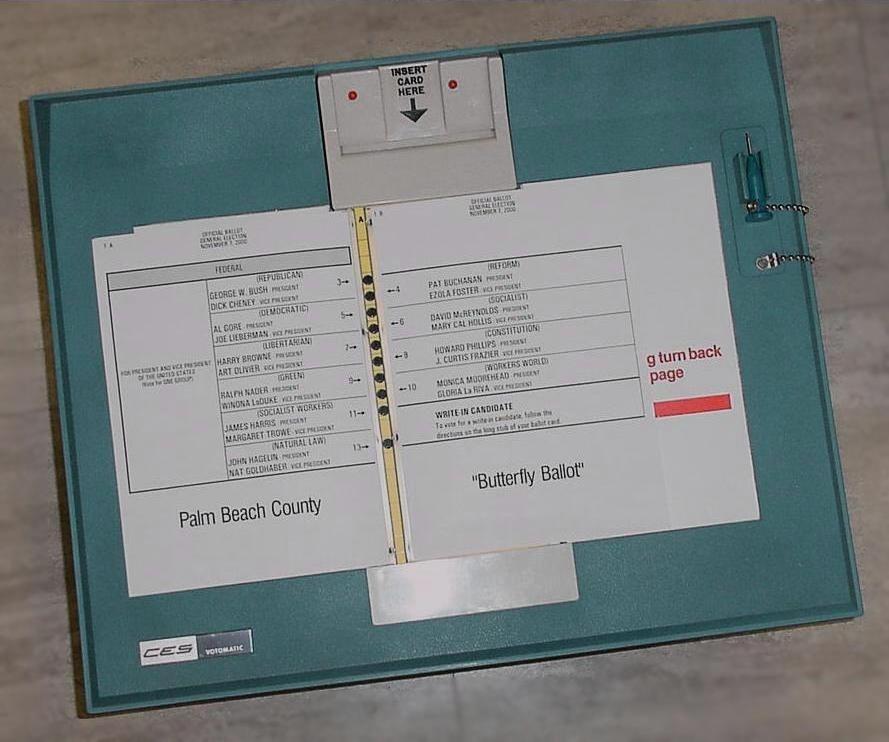
I have used butterfly ballots before, and I do not think that it is confusing at all. The biggest problem I could see is that people did not check their ballot before handing it in.
Here is a picture of a ballot.http://www.cs.uiowa.edu/~jones/voting/pictures/bal235.jpg
Here is a picture of the machine.http://www.cs.uiowa.edu/~jones/voting/pictures/votomat.jpg
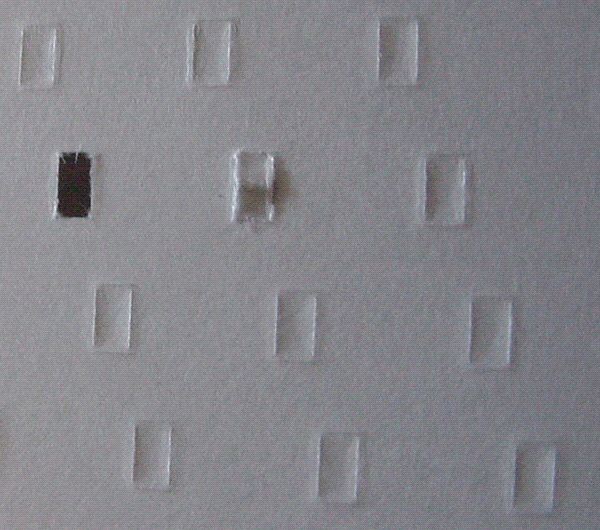
At the top of the ballot there should be two holes that go over the pegs on the machine to align the ballot( that is the stub they reference at the top of the card). If you look close enough at the machine each choice has a number on it which corresponds to a number on the ballot. When you are done voting you can remove the ballot and verify by hand that it is marked correctly. If you notice a chad that is not completely removed you can correct it before handing it in. In the event that you punch a spot incorrectly you can ask for a new ballot, and the bad one will be destroyed so you can try again.
If you check your ballot before handing it in you could notice something like this, and either finish punching it or ask for a new ballot to remove doubt as to the intention of the punch.
http://www.cs.uiowa.edu/~jones/voting/pictures/votocard.jpg -
Re:Not every candidate
note that I've never seen a butterfly ballot
I have used butterfly ballots before, and I do not think that it is confusing at all. The biggest problem I could see is that people did not check their ballot before handing it in.
Here is a picture of a ballot.http://www.cs.uiowa.edu/~jones/voting/pictures/bal235.jpg
Here is a picture of the machine.http://www.cs.uiowa.edu/~jones/voting/pictures/votomat.jpg
At the top of the ballot there should be two holes that go over the pegs on the machine to align the ballot( that is the stub they reference at the top of the card). If you look close enough at the machine each choice has a number on it which corresponds to a number on the ballot. When you are done voting you can remove the ballot and verify by hand that it is marked correctly. If you notice a chad that is not completely removed you can correct it before handing it in. In the event that you punch a spot incorrectly you can ask for a new ballot, and the bad one will be destroyed so you can try again.
If you check your ballot before handing it in you could notice something like this, and either finish punching it or ask for a new ballot to remove doubt as to the intention of the punch.
http://www.cs.uiowa.edu/~jones/voting/pictures/votocard.jpg -
Re:Not every candidate
note that I've never seen a butterfly ballot
I have used butterfly ballots before, and I do not think that it is confusing at all. The biggest problem I could see is that people did not check their ballot before handing it in.
Here is a picture of a ballot.http://www.cs.uiowa.edu/~jones/voting/pictures/bal235.jpg
Here is a picture of the machine.http://www.cs.uiowa.edu/~jones/voting/pictures/votomat.jpg
At the top of the ballot there should be two holes that go over the pegs on the machine to align the ballot( that is the stub they reference at the top of the card). If you look close enough at the machine each choice has a number on it which corresponds to a number on the ballot. When you are done voting you can remove the ballot and verify by hand that it is marked correctly. If you notice a chad that is not completely removed you can correct it before handing it in. In the event that you punch a spot incorrectly you can ask for a new ballot, and the bad one will be destroyed so you can try again.
If you check your ballot before handing it in you could notice something like this, and either finish punching it or ask for a new ballot to remove doubt as to the intention of the punch.
http://www.cs.uiowa.edu/~jones/voting/pictures/votocard.jpg -
Re:Good Enough for College
You have never had me as an instructor.
Here (the University of Iowa's Department of Computer Science), the general policy is that Wikipedia is not an academic reference and citing it will get you dinged hard. Reading the Wiki is fine, but you have to go to print media for citations--even preprints of journal articles are considered suspect and only accepted grudgingly.
In my experience talking to people at various institutions, very few places accept Wikipedia as a reference. I would suggest that you talk to your professors and ask them outright whether Wikipedia is an accepted reference in the department. It may prevent some unpleasant surprises in the future. -
Re:Good Enough for College
You have never had me as an instructor.
Here (the University of Iowa's Department of Computer Science), the general policy is that Wikipedia is not an academic reference and citing it will get you dinged hard. Reading the Wiki is fine, but you have to go to print media for citations--even preprints of journal articles are considered suspect and only accepted grudgingly.
In my experience talking to people at various institutions, very few places accept Wikipedia as a reference. I would suggest that you talk to your professors and ask them outright whether Wikipedia is an accepted reference in the department. It may prevent some unpleasant surprises in the future. -
The Monster Study at the Univ. of Iowa
The University of Iowa supported research, later dubbed "The Monster Study," that involved teaching young orphans how to stutter in an attempt to prove that stuttering is a learned behavior. While none of the children picked up stuttering, many began to exhibit the same mannerisms as stutterers (low self-esteem, hesitations, etc.)
The study's main researcher, Wendell Johnson, has a campus building named after him (the Wendell Johnson Speech & Hearing Center). Apparently the Univ. of Iowa still doesn't see anything wrong with conducting research on non-consenting children... -
Re:Every Department of the US has SBIR
One was even Cheneys little betting scheme, Predictive Markets.
I have no clue how you've come to associate predictive markets with Vice President Cheney. These predate the G. W. Bush administration by a considerable margin. For example, stock options are predictive markets. Insurance is a predictive market. Options come from the early 20th century, I think, and insurance is centuries old. More recently we have pure examples of predictive markets. These predate the Bush administration by years. For example, the Iowa Election Market was created sometime in the 80's. The Foresight Exchange was created in 1994. The Hollywood Stock Exchange was created in 1996. -
Re:Wrong kind of abstraction
"A mathematician thinks in terms of numbers and functions, which naturally helps in creating numeric algorithms."
Expand your definition of maths: http://en.wikipedia.org/wiki/Predicate_calculus
". . . if there are any numbers involved, we do it in Excel."
If you are doing any serious statistics, please consider using gnumeric instead.
http://www.stat.uiowa.edu/~jcryer/JSMTalk2001.pdf
http://developers.slashdot.org/article.pl?sid=04/0 2/23/068219 -
Make yourself top tier instead.
I'm a thirtysomething Ph.D. candidate in computer science. I travel a lot for conferences and meet a lot of undergraduates, both from top-tier schools and from small places nobody's ever heard of. I have yet to see any substantial difference in the undergraduate programs.
Let me repeat that: I have yet to see any substantial difference. On the other hand, I've seen tons of difference in undergraduates themselves.
When I was a high school senior I wanted to get into MIT. When I didn't get into MIT, I was crushed. After all, MIT was the place to be, right? It was a dynamic environment, it was the world leader in everything I wanted, it had luminaries like Ron Rivest, it was... etcetera. But I didn't understand the reason why MIT was all those things. MIT is what it is primarily because they do an excellent job of recruiting dynamic students, hard chargers who will self-organize, who will aggressively pursue excellence, who will do their own outside research, who don't settle for just getting good grades, who are willing to put in the hard work required to make all of this a reality.
And guess what? There are hundreds of thousands of highly dynamic students in undergraduate programs across the nation. All that you have to do is (a) be highly dynamic, and (b) seek out other highly dynamic students. Then you'll form the nerdcore of your department, and as long as you keep that nerdcore alive, great things can happen.
I started off at the University of Houston before transferring to a small liberal-arts college in the Midwest (Cornell, which is older than Cornell University). From there I got into the graduate program at the University of Iowa. None of these sound like top-tier schools, right?
And yet I've spoken at Black Hat, at CodeCon, at OSCON. I've been recognized by international organizations as a first-class expert in my field. My cell phone speed dial reads like a Who's Who of computer security. Not once has anyone, anyone, given a damn where I did my studies. All they've ever cared about is whether I'm dynamic, whether I've done my research, and whether I've got integrity.
You say you got into CMU? Congratulations. It's a good school. Here's what you should do to begin a path to success. First, figure out who your advisor is going to be. Send him or her an email as soon as you find out and ask for a meeting. At this meeting, talk to your advisor about your interests, about what you'd like to do, about things you know you don't like, about the whole nine yards. Your advisor will probably smile and nod and give you some good, if generic, advice.
Then come back two weeks later and do it again. This time, show your advisor something you've done in the last couple of weeks, something that wasn't assigned to you for class. Repeat this process every couple of weeks. Sooner or later your advisor will say "you know... you seem to really be interested in this. There's a research project I'm working on which could use some help. Would you be interested?"
And once that happens, brother, you are in. Throw yourself into the research. Ninety-five percent of the time it'll be boring crap, but five percent of the time it can be truly excellent. Plus, the lab will give you the chance to get practical, hands-on experience with the stuff that your classmates will only know from books. By the time you're a senior, you'll have your name on a couple of academic papers. You'll have traveled to a few conferences. You'll have met a lot of interesting people and you'll have some good contacts.
And then one day at a conference you'll bump into this little gnome of a man with an impish grin and a very quiet, friendly demeanor, and you'll talk shop for twenty minutes. He'll smile--he never stops smiling, really--and during small talk over lunch you'll mention something about your undergraduate days at Slippery Rock U -
Re:regulations
Mercifully, the US is the only jurisdiction (as far as I know, at least) where the law is broken in this way.
Agreed! The mercy part at least. But in other countries the law works for big business or wealthy not for the people.
And this, fundamentally, is where we disagree. What you do as a private individual on your own private property is your business, and I agree that governments should be heavily against interfering in such matters. But when you open a business to the public, the rules change. In the catering trade, you are required to meet basic food hygiene standards, for example. You have certain health and safety obligations, certain concessions you must make to those with disabilities, restrictions on misleading advertising, and so on. These things are the price of doing business in a society that has decided the interests of the people outweight the interests of profit-makers. I fail to see why this law is any different in principle to the others, or any less justified.
As I haven't thought of it that way, you've given me soemthing to think about. I probably won't but you may of given me info that will change my mind.
As a business owner, you have no legal rights and freedoms in most places. Get over it.
I was afraid I'd see this. After how you made the statement wherein I said you gave me something to think about, in which you used reasoning, you then come up with an antaganistic remark like "Get over it." All that does is provoke the defensive response and shuts down thinking.
Another straw man. The cost to society of banning smoking is a little inconvenience to a minority of people, who will get over it, while the benefit is a much healthier society. The cost to society of banning road transport would be staggering, and not just in financial terms. The cases aren't even remotely comparable.
Motorized vehicles are insignificant compared to secondhand smoke? Let me see if I can find statistics on the rate of death compared to vehicles versus the same rate for secondhand smoke.... Guess I didn't take long enough tyme to find actual statistics but I didn't find any that actually stated how many people die from secondhand smoke, just things like "thousands" and "more than 3000". But out of the those numbers how many deaths can actually be atributed directly to secondhand smoke versus say lung cancer from Radon gas? Now for vehicles: According to the government's National Center for Statistics and Analysis more than 43,443 people died in vehicular accidents(pdf) in 2005. I bet that's a hell of a lot more people than the number who died from secondhand smoke.
Falcon -
favor betting markets
I favor betting markets like TradeSports, the Iowa Election Markets, or the Foresight Exchange. But they don't cover everything and they can be just as wrong as anything else. For example, the markets were predicting a 75% or so chance in the not so distant past that the Republicans would keep a majority in the Senate. That didn't happen, of course.
-
Doug Jones website:
I have posted links to Doug Jones' website on numerous occasions here on Slashdot and this seems like another good time to post them. His reports on the history and theory of voting are excellent.
In particular, I recommend his essay on Paper Ballots.
A Brief Illustrated History of Voting is another excellent essay.
There are dozens of technical essays on voting systems on Jones' main Voting and Elections site. -
Doug Jones website:
I have posted links to Doug Jones' website on numerous occasions here on Slashdot and this seems like another good time to post them. His reports on the history and theory of voting are excellent.
In particular, I recommend his essay on Paper Ballots.
A Brief Illustrated History of Voting is another excellent essay.
There are dozens of technical essays on voting systems on Jones' main Voting and Elections site. -
Doug Jones website:
I have posted links to Doug Jones' website on numerous occasions here on Slashdot and this seems like another good time to post them. His reports on the history and theory of voting are excellent.
In particular, I recommend his essay on Paper Ballots.
A Brief Illustrated History of Voting is another excellent essay.
There are dozens of technical essays on voting systems on Jones' main Voting and Elections site. -
Re:Paper ballots
My ballot today had 30 separate races/questions on it, and this was a light year. In 2008 it will be around 50. There's no way you're going to record all of that information in five seconds.
A scanatron can fix that, and give a preliminary result within that time. The official counting can be done later, handled similar to a mass-production chain.
Of course, a properly designed ballot is as simple as possible - if you need to fill in around 30 questions, then that's a lot more overhead that the voter had to do - unless he strictly follows party lines. Since most voters are going to do that, you might as well simply have a box that chooses between "Republican" or "Democrat" rather than these 30+ votes. While there are some cases where a person might vote against their normal party affiliation, these are the exception rather than the rule. -
Re:Not a Bad IdeaSuch stockmarkets already exist, and prove to be fairly accurate. Basic idea is to open a futures market for two events, say 'Rebs/Dems will obtain the majority in congress in November'. Set the liquidation value (profit) for the winning contract to 1 buck, and 0 for the losing side. Now let the trading begin: the market value for the contracts will determine the perceived odds for those events. Current situation:
Rebs more than 231 seats: last trade 4 cents
Rebs between 217 and 231 seats: last trade 29 cents
Rebs less than 217 seats: last trade 67.9 cents
Note it adds up to close to one buck although there is no explicit synchronization present. Arbitration. It doesn't add up exactly as the 'Rebs win' contract is very illiquid at the moment, i.e., no-one wants to buy (bid price 2.7 cents).
-
Re:Not a Bad IdeaSuch stockmarkets already exist, and prove to be fairly accurate. Basic idea is to open a futures market for two events, say 'Rebs/Dems will obtain the majority in congress in November'. Set the liquidation value (profit) for the winning contract to 1 buck, and 0 for the losing side. Now let the trading begin: the market value for the contracts will determine the perceived odds for those events. Current situation:
Rebs more than 231 seats: last trade 4 cents
Rebs between 217 and 231 seats: last trade 29 cents
Rebs less than 217 seats: last trade 67.9 cents
Note it adds up to close to one buck although there is no explicit synchronization present. Arbitration. It doesn't add up exactly as the 'Rebs win' contract is very illiquid at the moment, i.e., no-one wants to buy (bid price 2.7 cents).
-
Re:Exactly! Why Software DRM?
Simple hardware hack to reverse the polarity of the disc motor in the DVD drive.
Actually, it won't work. Drive motors aren't like the simple DC-brush type motors that you're thinking of. They're stepper motors that have to be "controlled" by an external circuit. A big advantage of this design is the speed can be precisely set, allowing for faster RPM speeds while the head is near the hub, but slower speeds when it's near the rim, permitting "constant velocity" reading. You'd have to reverse the polarity of each field winding, which might be tricky depending on how they're brought out to the controller.
Oh, it was a joke. Nevermind.
-
30 years ago ...30 years ago I was working in a physics lab at a major university. The man in charge of the support teams that were helping the scientists bought a set of tires on his gasoline company credit card. He paid the entire amount for the tires the next time he got a statement. But the tires had been put on an automatic payment plan stretched out over four months so the company only charged him for one tire that first month and gave him a positive balance for the other three tires. He didn't use the card for anything else and at the end of the four months he had an outstanding balance due to the interest that had accrued even though he had paid off the amount in full when he got the first statement.
Repeated phone calls to the company got him nowhere (which just goes to show we have no need to out-source customer service since we are perfectly capable of providing terrible customer service domestically). Back in those days the billing systems were just getting computerized which was why this mistake was made and also why this man was having a hard time getting his problem solved.Back in those days the companies actually sent all of their customers a punched card in each monthly statement and the customers were supposed to send this card back with their payment. Well, this man knew all about punched cards since he was in charge of several computers that still used them. So he simply punched in an end-of-file on a blank card and sent that back instead of the card the company sent him.
A couple of weeks later he got a phone call from the company asking him what he did and why he did it. He explained and they said they would correct the problem as long as he promised not to tell anyone else about the trick he had pulled.
-
Re:Money more important than a fair vote?
I still want to know why mechanical voting machines were phased out.
Don't we all.
There are at least two "legitimate" shortcomings that the electronic machines improve upon, but those are fairly superficial, and you get deep into conspiracy territory after that.
One is speed. (We) Americans are so lazy, that they want their election results the night of, and any voting system that takes too long to count and prevents them from getting a clear winner right away is clearly flawed and needs to be replaced. Note the that furor about the Florida recounts in 2000 was not so much about accuracy or the will of the people so much as just getting on with it, already.
The other is complexity. The real problem in Florida was not that old people couldn't figure out how to work the punch cards, it was that poll workers forgot (or were too lazy) to empty the "catch drawers" on the voting machines. If poll workers are not office-equipment-savvy enough to empty a hole puncher when its full, how is a more complicated technology going to help?
But the real bottom line is money. Diebold (et al) latched onto the business model of:
1. Find a fake problem and blow it out of proportion.
2. Cobble together a half-baked solution to said problem.
3. Lobby congress to create a market for your solution.
4. Profit!
In all fairness, the Election Systems Division of Diebold is a company the Diebold acquired, rather than a portion of Diebold proper. But the fact remains that this whole ill-advised movement toward electronic voting is being pushed by the entities that stand to make money from it. -
Re:Re-Count?
My understanding of the theory of voting systems is that some of your ideas would be illegal. Specifically, it would be illegal to keep records of which voter used a specific e-ballot. This would allow precinct staff to track a single vote to a single voter. This is specifically illegal, as it would allow "pay for vote" scams where a politician (perhaps in collusion with precinct staff) would pay voters upon proof they voted for him.
For more explanation of the theory of voting systems, I highly recommend Computer Science professor Douglas Jones' fine paper "Voting on Paper Ballots." There are rational reasons for some of the obscure aspects of our voting system, all of them could be solved by scrapping the high-tech crap and just using paper ballots. -
Re:Uh, the shareholders?
Most options that are granted are backdated to some degree. The real problem is granting vested options, and then not communicating this fact. Many tech companies that give options do this to some degree. It is abuse that is the problem. As long as the terms are available to investors, I have no problem with backdating, or options. Backdating can be somewhat fair if it's meant to shield the recipient from excessive fluctation. This can be done as simply as setting the option price as the average price over the last 3 months. This isn't done to hand out millions to a few execs. It's done for all the employees that receive options. Stock benefit plans can operate in a similar way. I'm not an executive, I'm an engineer. Dammit. I've gotten stock options both ways. I prefer the averaging method. I've been issued stock just as the stock value peaked on a bs rumor/speculation, then dropped it's value by %40 between date of issue actual reciept of unvested option.
I don't think granting stock options themselves are evil, but they are easily abused. They were originally devised as a form of employee ownership of a company, to encourage active employee interest in a companies performance. When used this way, it is a good tool.
good info on backdating.
http://www.biz.uiowa.edu/faculty/elie/backdating.h tm -
Van Allen did so much more...
Dr. Van Allen made so many more contributions to space science than just his discovery of the radiation belts. He was one of the founding fathers of the field of magnetospheric physics. He was also involved in the first satellite missions to visit Venus and Mars, as well as the Pioneer missions to the outer planets. Much of his opposition to manned space flight was motivated by the success of these early satellite missions and the enormous scientific return from them. He believed that unmanned missions like Pioneer could contribute much more to our scientific knowledge than manned missions. He also argued that unmanned missions were more cost effective than manned missions. For more information, I suggest reading his autobiography.
-
Re:No real money involved?
The Iowa Electronic Markets is one of the oldest futures markets of this nature. It's real money (though you can only 'invest' $50), and completely legal. Most of the markets are related to major elections, but there are a few others (like fed. policy and MSFT price). I'm been an active trader since the 2000 election and it's been pretty interesting. http://www.biz.uiowa.edu/iem/
-
The furure of Flash
pictured here (Flash not required for viewing).
-
The article didn't mention the flu market...
-
Re:Step by step
Incorrect. Backdating options is illegal, that's what people will go to jail for. That is also what Apple hasn't done.
No, you are wrong. Backdating options is not illegal provided you account for it properly. The scandals currently unfolding are largely related to improperly backdated options (in other words, the reporting requirements were not met), but also to other irregularities in the reporting of option grants. Whether Apple are guilty of improper manipulations (and what those manipulations might have been) is yet to be determined - that's what the inquiry is for. But the seriousness of what they have announced today implies that they are pretty certain they did something pretty wrong.
Regulators are not involved in this at all. This is an Apple internal inquiry.
Not for long. The SEC have been notified and a major company are restating 4 years of figures - there's a 0% chance they won't get involved at least at a high level. -
More info
Recently a grant was rewarded to several universities to discover if and how E-Voting can be secured, but like previously stated e-voting is as secure as the people who run it, just as paper ballots are. More info at one of the involved professors websites:
http://www.cs.uiowa.edu/~jones/voting/ -
Re:Does anyone have more info?
As bfizzle notes, just about every other company is being investigated, and those that aren't being investigated are doing some scrambling to investigate themselves.
The reason is a study published by Eirk Lie. The short story is he found that executives in many companies "happened" to receive stock options dated to the most recent low in the stock price. This "happened" at a much higher rate than dictated by chance alone. IOW it looked like many companies were backdating the date the options were granted to favor the grantee -which may be a violation depending on whatever rules the company has in place regulating such things. Lie's study showed this may be a very widely used method of granting options -thus many company's are being investigated. -
Re:Not again
There are quite a few comments to this effect, so I will just reply here.
There is plenty of discussion of "a" vs "the" ambiguity on the web, so I will just
point to the first link I found on google:
http://www.uiowa.edu/~resmeth/miscellaneous/articl e-usage.html
Scroll down to the exceptions, or search the page for "the use of articles in English
is essentially idiomatic". -
Re:Any information at all?
"It is true that Jan used proprietary software. The purpose of Orange was to prove the capability of opensource for the 3D content creation. While it would have been nice to use open source tools for the sound it just wasn't deemed feasible (Jan did investigate the various open source audio tools for suitability). Also the orchestral scores that were done, there are not any open sound libraries that could be used for doing orchestral scores."
Fair enough. I was mislead by the gushing slashdot headline as to the intent of the project.
There are some good equivelents to apps like Reaktor. One thing not lacking in the open source world is software modulars. I know as I own both Reaktor and many free modulars too.
There are also thousands of free orchestral samples and libraries out there to use...
http://theremin.music.uiowa.edu/MIS.html for a start. Google brings up millions.
To say it couldn't be done is like saying you could not make the film as you did not have access to all the 3dstudioMax models and adobe whatever effects to make your film with. I bet there were loads of limitations and workarounds you had to do that could have perhaps been done quicker with propriatory tools. To say nothing of all the textures, plugins etc.
I reackon Jan just stuck with what he knew, and with the system he does his normal everyday commercial work on. I would have probably done the same. He could have made a least a single post on one of the audio mailing lists or free audio software places asking for help though. you never know what people are reading.
(Same AC troll) -
The Original Clockwork OrangeAnthony Burgess, author of the book "A Clockwork Orange" was the artist in residence while I was in the undergraduate program at the Iowa City Writer's Workshop back in 1974. I think he based his book on the work of Jose M.R. Delgado, M.D. published under the book with the damn spooky title: "Physical Control of the Mind: Toward a Psychocivilized Society".
I managed to get a copy of the book finally, and discovered wonderful passages such as the following on page 115:
ESB [electrical stimulation of the brain -- JAB] may evoke more elaborate responses. For example, in one of our patients, electrical stimulation of the rostral part of the internal capsule produced head turning and slow displacement of the body to either side with a well-oriented and apparently normal sequence, as if the patient were looking for something. This stimulation was repeated six times on two different days with comparable results. The interesting fact was that the patient considered the evoked activity spontaneous and always offered a reasonable explanation for it. When asked, "What are you doing?" the answers were, "I am looking for my slippers," "I heard a noise," "I am restless," and "I was looking under the bed." In this case it was difficult to ascertain whether the stimulation had evoked a movement which the patient tried to justify, or if an hallucination had been elicited which subsequently induced the patient to move and to explore the surroundings.
This passage is eerily reminiscent of a passage from Richard Dawkins' "The Extended Phenotype" chapter titled "Host Phenotypes of Parasite Genes":
"Many fascinating examples of parasites manipulating the behavior of their hosts can be given. For nematomorph larvae, who need to break out of their insect hosts and get into water where they live as adults, '...a major difficulty in the parasite's life is the return to water. It is, therefore, of particular interest that the parasite appears to affect the behavior of its host, and "encourages" it to return to water. The mechanism by which this is achieved is obscure, but there are sufficient isolated reports to certify that the parasite does influence its host, and often suicidally for the host... One of the more dramatic reports describes an infected bee flying over a pool and, when about six feet over it, diving straight into the water. Immediately on impact the gordian worm burst out and swam into the water, the maimed bee being left to die' (Croll 1966)."