Slashdot Mirror
Domain: uiuc.edu
Stories and comments across the archive that link to uiuc.edu.
Comments · 1,476
-
Re:Free software?
Firstly, that's a quote from Wired, so Slashdot didn't say it was free software.
Secondly, some people still use the term "free software" to mean something other than the meaning chosen by RMS/FSF.
Thirdly, yes, you could get the source for early versions of NCSA Mosaic under terms of a license agreement.
-
Re:Going to be one of these stories
There's something wrong with the data stream on that site:
-
Going to be one of these stories
science via cnn
http://arctic.atmos.uiuc.edu/c...
http://arctic.atmos.uiuc.edu/c...
Chicken little alive and well
-
Going to be one of these stories
science via cnn
http://arctic.atmos.uiuc.edu/c...
http://arctic.atmos.uiuc.edu/c...
Chicken little alive and well
-
I like my GM food made the old fashioned way
Modified over tens, hundreds, or thousands of years of selective breeding for the desired traits.
Just kidding, kinda.
I do wonder a bit though when we start putting arctic fish genes into plants to make them frost tolerant[1]
Or "insecticides" into food crops[2]
I do want plenty of testing before it starts showing up grocery store shelves.
[1] http://www.public.iastate.edu/...
[2] http://www.aces.uiuc.edu/vista... -
Re:The walls of the Walled Garden get a little hig
So you're saying it's a garden of pure ideology?
-
Re:They don't make 15-year-olds like they used to
Remember it? You can still download it ftp://ftp.ncsa.uiuc.edu/Mosaic...
-
Re:Chirality: important. Doing (R)Thalidomide just
To dispense with the jargon of chemistry in favor of the delightful aphorism of Richard Feynman, "Nature is screwy," so-called organic molecules can have left and right handed "threads". He introduces handed-ness or chirality, in his his lecture on symmetry in physical laws [youtube.com] as he describes a simple experiment where sugar is dissolved in water... (astoundingly, almost precisely!) only abut half of it is taken in by bacteria.
Point of clarification oops --- Feynman is referring not to natural sugar here that is a result of biological process such as beet or cane sugar, but artificial sugars built in the laboratory from constituent carbons, hydrogens and oxygens. The mixture has roughly even numbers of (R) and (S) molecules so it does not 'block' one polarization of light.
Other interesting snippets on chirality: a great 2006 student term paper, How did protein amino acids get left-handed while sugars got right-handed? which gives an overview of the physics and fronts the possibility of biological evolutionary advantage... and a recent Newsweek article that introduces 'Allulose' one laboratory creation of Feynman's "wrong-handed sugar" --- the stuff bacteria doesn't eat --- as the perfect sugar substitute. "Exactly why allulose doesn't have as many calories as fructose isn't completely understood, but studies show that rats don't gain any weight when fed a diet of allulose, but do when given the same amount of fructose. When humans eat it, we basically piss most of it out. They said 'piss'! Heh heh. Then "Allulose has already passed a review by the U.S. Food and Drug Administration, which deemed it "generally recognized as safe" in January 2014, making it eligible for use in food."
So... why would they say "why allulose doesn't have as many calories as fructose isn't completely understood"? A journalist picking up on a scientific hedge? Biologically actionable calories as opposed to mere energy potential? Unexplored effects of recombination in the liver? Inquiring minds aware of Thalidomide horrors would do well to tread carefully with industrial-scale production of 'wrong'-handed organic molecules.
Pointing out that the (R)(S) notation of handed-ness is R=right=Rectus, S=left-Sinister, it is revealed that chemists are insensitive clods.
-
Strangely mixed signals here
The post accepted by Slashdot cites European Space Agency's satellite as evidence of ice-loss.
And earlier submission citing NASA's satellites leading to the opposite conclusion was not accepted. Kind a strange for a normally unabashedly US-centric Slashdot to so openly favour European satellite-data over American — makes one suspect a certain pre-existing bias...
I don't see any substantial changes here, do you?
-
Re:Let's see
http://arctic.atmos.uiuc.edu/c...
Are you running an over under on how long it takes you to forget this graph and start repeating the pure B.S. you have been fed ?
-
Re:Never used recursion
Write simple code and let the compiler find a faster way to run it. It's a problem that is being actively worked on.
-
Re:Bias: but for them - not me!
Bottom line, it is simplistic and wrong to say that there has been no warming since 2000. In fact, it is very unlikely that this is true.
As far as a simple linear trend is concerned, it is unlikely that there has been no warming since the beginning of the century, based on GISS data. But it is not at all unlikely if you use any of the other data sets. (GISS is an outlier. Maybe it has to do with the +2degC of warming they are known to add via adjustments.)
As for sea ice, it's about average. http://arctic.atmos.uiuc.edu/c...
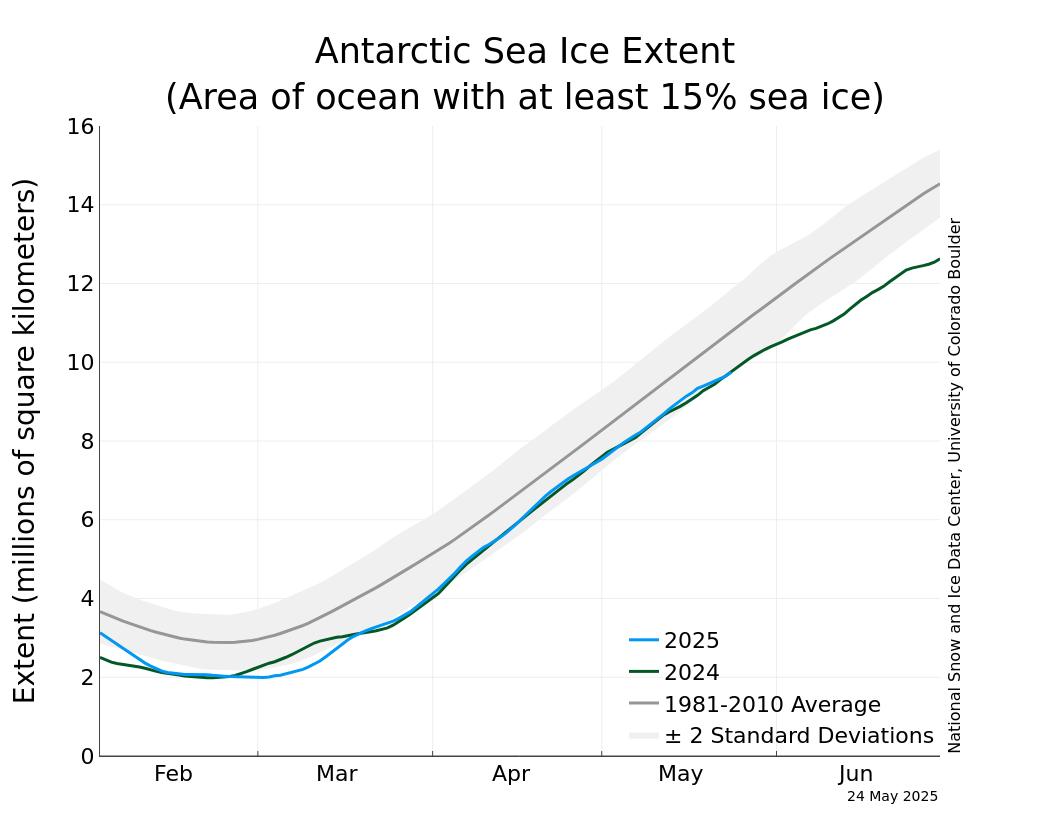
Antarctic sea ice was at record highs until just recently: http://nsidc.org/data/seaice_i...
And finally, the properties of CO2 do not change, but only a small portion of the predicted warming is due to CO2 directly. MOST of the predicted warming is due to "climate sensitivity" estimates, which are all over the map. Climate scientists claim that the climate reacts to the heating caused by CO2 by amplifying it 3 times. (The range is much wider. I've seen climate sensitivity estimates as low as 0.9C and as high as 7 or 8C.) However, there is little evidence to support high climate sensitivity estimates and the uncertainty in this area is vast. If the climate is not as sensitive to CO2 heating as scientists have assumed, then global warming is not a serious threat.
Regardless, like many other skeptics I actively support innovative nuclear designs and fusion projects, since fossil fuels are expensive, dirty and finite. If AGW proponents weren't allergic to the word "nuclear" then the AGW scare might serve a useful purpose. Unfortunately the pro-AGW crowd will likely continue to impede the only viable solution to their non-existent problem: nuclear.
-
Re:Stop trying to win this politically
Re Ice Melting
http://arctic.atmos.uiuc.edu/c...This chart begs to differ with you.
-
Re: It's still reacting carbon and oxygen...
CO2 is causing problems, right now. Real problems.
Actually Crop production is at near record highes [fao.org] , in part because the necessary nutrient CO2 is available in increased amounts. Both Arctic [uaf.edu] and Antarctic [uiuc.edu] sea ice is increasing, and there hasn't been any statistically significant Global Warming/Climate Change for 18 years; so please feel free to be more specific. If you'd go outside and actually experience some enviroment, you'd realizes that it's pretty fucking cold outside and we still have 4 weeks to go before winter starts.
I always blame Global Warming for cold weather. PC name may be Climate Change, but the only real 'change' that is ever talked about is how the planet is warming up.
-
Re: It's still reacting carbon and oxygen...
CO2 is causing problems, right now. Real problems.
Actually Crop production is at near record highes, in part because the necessary nutrient CO2 is available in increased amounts. Both Arctic and Antarctic sea ice is increasing, and there hasn't been any statistically significant Global Warming/Climate Change for 18 years; so please feel free to be more specific. If you'd go outside and actually experience some enviroment, you'd realizes that it's pretty fucking cold outside and we still have 4 weeks to go before winter starts.
-
Re:Whoah, wait a minute...
The article barks at the wrong tree. The cryosphere page at University of Illinois-Champagne shows that we are currently seeing 1.3 million sq. km more sea ice than the average, and the levels have been sharply rising the last few years.
There is a fine balance between trying to increase awareness and being a downright propagandist. Unfortunately, this article doesn't help the cause. This is exactly the kind of thing that make people believe environmentalists are exaggerating and grasping at straws.
Wired: Stop. You are not helping.
Before you go on you really should learn the difference between ice sheets, ice shelves and sea ice. They are not the same thing. Talking about sea ice in response to this article about the West Antarctic Ice Sheet is a non-sequitur.
-
Whoah, wait a minute...
The article barks at the wrong tree. The cryosphere page at University of Illinois-Champagne shows that we are currently seeing 1.3 million sq. km more sea ice than the average, and the levels have been sharply rising the last few years.
There is a fine balance between trying to increase awareness and being a downright propagandist. Unfortunately, this article doesn't help the cause. This is exactly the kind of thing that make people believe environmentalists are exaggerating and grasping at straws.
Wired: Stop. You are not helping.
-
Re: Apple not in my best interests either
Some has contributed a nontrivial amount of work to LLVM and especially the clang project.
To be clear: Apple aren't just a contributor, they created Clang and employ one of the LLVM project's founders to work on LLVM, Clang, and Swift.
-
Re:Or upgrade to llvm ...
And yet again you uncritically take promotional language as true. As someone who actually uses one of the languages supposedly supported by Dragonegg, I would say it would behoove you to look beyond the advertising copy.
Interesting, so you knew non-C languages were supported when you claimed otherwise. From dragon egg's current status, it works very well with Fortran and works well with Ada when using gcc 4.6. http://dragonegg.llvm.org/
Some benchmarks from 2011, so working with Fortran isn't a recent achievement. http://lists.cs.uiuc.edu/piper...
MacRuby (Apple is a contributor to the project) would be another example. http://macruby.org/Me calling you a dumb fanboi is not angry name calling. It's a statement of fact, which you thankfully keep proving with every post.
As unreliable a "fact" as your "fact" of not being able to use non-C languages. Seriously, what gets you so outraged over the idea of being able to use either gcc or llvm, over the idea that llvm is usable with Fortran, Ruby, etc?
-
Re: The Heartland Institute
everything you said has been debunked by actual facts.
No, it is NOT true that temperatures have been essentially flat.
Well, putting it in bold clearly means you're right...not.
Try looking at actual data. That's the RSS data, which is inherently better than spotty surface station coverage in that it directly integrates the entire lower troposphere. That's a slightly negative trend that's going hard on twenty years...all with CO2 levels worth panicking over according to some.
The sea ice is only a "rebound" because its being compared to the previous year which was THE LOWEST SEA ICE EVER RECORDED.
2012 was the lowest (due mainly to a weather phenomenon, not climate in particular. 2013 was the rebound year, and this year looks to be continuing the trend. Will the long-term decline resume? Personally, I doubt it based on solar activity, but we'll see...
Thank you for the public service of displaying your ignorance, now go away.
I'll leave it to the readers to decide who's ignorant (or brainwashed:).
http://www.slate.com/blogs/bad...
As for your Slate link, it's addressing one specific article. It makes the tired "the heat is hiding in the ocean" claim, which has not been verified whatsoever. How has the ocean been heating (imperceptibly) for almost 20 years while the atmosphere stays the same temperature, pray tell?
You might also want to reflect on the fact that while the Arctic ice has been generally on the decline, Antarctic sea ice has been at record extent this year, and global ice as a whole is around average...
-
Re: The Heartland Institute
So, you like them because they're untainted by facts? Good point. No, great point, wouldn't want to be led astray by facts.
Actually the summary is fairly untainted by facts. For instance:
Arctic sea ice is trending near record lows for this time of year, abnormally warm ocean water helped spawn the earliest hurricane ever recorded to make landfall in North Carolina, and a rash of heat waves have plagued cities from India to California to the Middle East.
Yikes, that all sounds alarming right?
Except...
1) Arctic sea ice is actually currently above last year's level, which was already a rebound of over 25 million square km more than the previous year at the minimum extents.
2) The ocean waters in the North Atlantic hurricane region are right around average for this time of year, by no means "abnormally warm".
3) "Rashes of heat waves plague" various places every summer, and always have. NOAA recently reinstated 1934 as the hottest year in the US on record.
The article attacking the Heartland data does have a minor point, but it is absolutely true that temperatures have been essentially flat for around 17 years, while CO2 has been at the highest levels in history. There have been quite a few peer reviewed papers trying to explain this pause, so it's clearly a real phenomena. We'll see if it continues, the El Nino this year is now expected to be a fairly minor event.
At this time, the forecasters anticipate El Niño will peak at weak-to-moderate strength during the late fall and early winter (3-month values of the Niño-3.4 index between 0.5oC and 1.4oC).
-
Re:Weather is NOT climate
So where's the warming? Both poles have more ice than usual.
-
Re:So they still find their way?
Hmn. My link didn't work, so let's try it here. This is a study on avian electromagnetic vision, with a simulation of what a bird sees when looking at the magnetic field of the Earth. http://www.ks.uiuc.edu/Researc...
-
Re:On it! (link)Mosaic Link
Of course, it is a bit dated, and some of the bits may be rusty.
-
You mean the C way ...
-
Re:RMS needs to get over the GPL
WRONG
Look at the email for the very first clang commit.
-
Re:An ode to wankery
After reaching a reasonable equilibrium point, in a glass containing water in a ratio of ~9:1 solid to liquid, what temperature is the liquid water?
Just above freezing. You know, rather unlike the actual oceans - which are far from uniform.
After several hours under a heat lamp, with a ratio of 1:99, what is the temperature of the liquid water? Now what happens once all of the ice is gone?
Now, what was that you were saying about not knowing where the excess heat energy was going?
Well, that would be a more meaningful question if the total amount of sea ice were decreasing... Actually 2013 was rather a banner year for antarctic sea ice.
Aside from that, the Earth's climate is a highly chaotic and complex entity. It has numerous long-term cycles and feedback mechanisms. As the latest IPCC report points out, the actual climate sensitivity to CO2 isn't known with good accuracy. We'll have a much better idea over the coming decades, but my hunch is that it will be a good bit lower than the current centerline IPCC estimate.
-
Re:An ode to wankery
After reaching a reasonable equilibrium point, in a glass containing water in a ratio of ~9:1 solid to liquid, what temperature is the liquid water?
Just above freezing. You know, rather unlike the actual oceans - which are far from uniform.
After several hours under a heat lamp, with a ratio of 1:99, what is the temperature of the liquid water? Now what happens once all of the ice is gone?
Now, what was that you were saying about not knowing where the excess heat energy was going?
Well, that would be a more meaningful question if the total amount of sea ice were decreasing... Actually 2013 was rather a banner year for antarctic sea ice.
Aside from that, the Earth's climate is a highly chaotic and complex entity. It has numerous long-term cycles and feedback mechanisms. As the latest IPCC report points out, the actual climate sensitivity to CO2 isn't known with good accuracy. We'll have a much better idea over the coming decades, but my hunch is that it will be a good bit lower than the current centerline IPCC estimate.
-
Re:Mission accomplished
Jane Q. Public writes "Christ Turney, a climate researcher at University of New South Wales, and some other researchers chartered a ship to go to Antarctica to further their Anthropogenic Global Warming ("climate change") research. The expedition, consisting of 74 researchers and crew, radioed for help on Christmas day, stating that they are trapped in the ice. A chinese ice breaker called "Snow Dragon" came within a few miles of the stuck ship but had to turn back. The researchers and crew are now hoping that the ice breaker Aurora Australis, out of Australia, will be able to reach them." [Jane Q. Public, 2013-12-28]
As Tom Curtis noted:
"There is an irony about the various sailors, scientist, reporters and tourists currently being trapped in sea ice. They are not trapped because of the growth of Antarctic Sea Ice. Although the current Antarctic SI is 1.5 million square kilometers greater than 1979-2008 mean for this time of year, it is nonetheless melting rapidly, including just north of Commonwealth Bay where the Shokalskey is trapped. Rather, it is trapped as a consequence of portions of ice shelves breaking of the Antarctic coast line. Specifically, in 2010, Iceberg B-9B, a remnant of a calving event on the Ross Ice Shelf in 1987, collided with the tongue of the Metz Glacier, breaking it of. The debris from that collision, it appears, has remained more or less in situe for the last three years, until b winds shifted out from the terminus of the Metz Glacier towards Commonwealth Bay, trapping the Shokalskey. This is described in more detail on the mission blog."
Tom also noted that the mission's 2nd goal was to "explore changes in ocean circulation caused by the growth of extensive fast ice and its impact on life in Commonwealth Bay."
For some strange reason, the CFACT link Jane provided tells a different story.
-
Re:Mission accomplished
Go take a look at the actual data and you will discover that sea ice levels in antarctica has been steadily increasing for decades now and last few years have had record high amounts of sea ice.
But sadly we only hear about the localized regions of ice loss and never about the total increase of sea ice at the south pole.
Even global sea levels have recovered quite a bit and has been pretty much normal this year, which is something that has not happened since mid-late 90s.I really recommend you take a look at the actual satellite data found here: http://arctic.atmos.uiuc.edu/cryosphere/
It is not strange that people become "deniers" when the media coverage is so one sided and biased.
-
Re:Seems there's more ice than usual in the antarc
mc6809e wrote:
There's about 1.53 million more square km of ice than what is usual.Ol Olsoc wrote:
allow me to post the rest: http://arctic.atmos.uiuc.edu/mc6809e noted that in the SOUTHERN hemisphere, there is a +1.53 million square km ice anomaly.
However, in the follow-on post, it shows that in the NORTHERN hemisphere, there is a -0.63 million square km ice anomaly.
So, +1.53 - 0.63 = +0.9 net global ice difference over the past 3 years. And this is relative to the mean from 1978-2008.
Personally, it does make sense to me that there is AGW, but these graphs indicate a net global sea ice increase over the past 3 years. Is it the last word in the discussion? No, but it is an interesting data point.
-
Re:Seems there's more ice than usual in the antarc
mc6809e wrote:
There's about 1.53 million more square km of ice than what is usual.Ol Olsoc wrote:
allow me to post the rest: http://arctic.atmos.uiuc.edu/mc6809e noted that in the SOUTHERN hemisphere, there is a +1.53 million square km ice anomaly.
However, in the follow-on post, it shows that in the NORTHERN hemisphere, there is a -0.63 million square km ice anomaly.
So, +1.53 - 0.63 = +0.9 net global ice difference over the past 3 years. And this is relative to the mean from 1978-2008.
Personally, it does make sense to me that there is AGW, but these graphs indicate a net global sea ice increase over the past 3 years. Is it the last word in the discussion? No, but it is an interesting data point.
-
Re:Seems there's more ice than usual in the antarc
mc6809e wrote:
There's about 1.53 million more square km of ice than what is usual.Ol Olsoc wrote:
allow me to post the rest: http://arctic.atmos.uiuc.edu/mc6809e noted that in the SOUTHERN hemisphere, there is a +1.53 million square km ice anomaly.
However, in the follow-on post, it shows that in the NORTHERN hemisphere, there is a -0.63 million square km ice anomaly.
So, +1.53 - 0.63 = +0.9 net global ice difference over the past 3 years. And this is relative to the mean from 1978-2008.
Personally, it does make sense to me that there is AGW, but these graphs indicate a net global sea ice increase over the past 3 years. Is it the last word in the discussion? No, but it is an interesting data point.
-
Re:Seems there's more ice than usual in the antarc
There's about 1.53 million more square km of ice than what is usual.
This completely disproves the idea of Global warming.
Perhaps not though, what it does prove is the complete intellecutual bankruptcy of the deniers. You cherry pick the data, and only choose what seems to allow you to take the Ancient Aliens approach of "Oooh, an anomaly - Ancient Aliens."
And since you were dishonest enought to post only what you wanted, allow me to post the rest: http://arctic.atmos.uiuc.edu/
So now do you try to discredit the people you were using as proof of your denialism? Or is everything they do wrong except for the stuff you like?
Science is not like politics. Scientists allow things to be discussed that need further explanation, or do not fit. But when people are of a mind to get their science education from politicians, then everything that doesn't fit must be denied.
-
Re:Seems there's more ice than usual in the antarc
There's about 1.53 million more square km of ice than what is usual.
This completely disproves the idea of Global warming.
Perhaps not though, what it does prove is the complete intellecutual bankruptcy of the deniers. You cherry pick the data, and only choose what seems to allow you to take the Ancient Aliens approach of "Oooh, an anomaly - Ancient Aliens."
And since you were dishonest enought to post only what you wanted, allow me to post the rest: http://arctic.atmos.uiuc.edu/
So now do you try to discredit the people you were using as proof of your denialism? Or is everything they do wrong except for the stuff you like?
Science is not like politics. Scientists allow things to be discussed that need further explanation, or do not fit. But when people are of a mind to get their science education from politicians, then everything that doesn't fit must be denied.
-
Seems there's more ice than usual in the antarctic
There's about 1.53 million more square km of ice than what is usual.
-
Re:News for nerds or not
So did you read the two paragraphs that followed? And in case you think I'm imagining these compilers, flip to PDF page 129 (page 119 in the text) and see:
High-level optimizations (HLO) exploit the properties of source code constructs, such as loops and arrays, in the applications developed in high-level programming languages, such as C++. They include loop interchange, loop fusion, loop unrolling, loop distribution, unroll-and-jam, blocking, data prefetch, scalar replacement, data layout optimizations, and others. The option that turns on the high-level optimizations is -O3.
The optimizations I highlighted all will affect the data access pattern, especially loop interchange, blocking and data layout optimization. Next, check the date on the document: 2003. That's a decade ago. It's reasonable to expect they've only gotten more aggressive since then.
This much shorter survey of modern compilers also goes into optimizations that might change access order. They even call this reordering out: "Since loop interchanging may change the access pattern, care must be taken to not introduce non-unit stride access."
Welcome to modern compilers.
-
Re:GNU excitement
I thought LLVM won't implement OpenMP because OpenMP could not scale to hundreds of cores nicely. LLVM was looking for something better than OpenMP. Has the wind changed?
No LLVM developer has said any such thing. Here is the llvm mailing list. Feel free to point a where they said they were won't implement it.
-
Re:Question
You *can* run without an OS. For example, consider older computers where the software is usually run directly on the hardware. "Drivers" for the hardware aren't always separate enough to be identified (register manipulations being directly coded in the binary), there isn't necessarily a file system implemented, there's no process scheduling, no memory management beyond directly accessing areas of the memory map, etc. Basically, you can run a program that doesn't have any of the common features of an OS. Granted, I don't know the details of this specific program, but the possibility exists that it's just running on the bare hardware.
As an example, this "OS" just prints out "Hello world" by writing directly to the video hardware on a PC. I wouldn't really call it an "OS", though, even though it can run as the sole software on a modern computer. -
Why only the Northern Hemisphere?
And sea ice in the Southern Hemisphere is growing:
http://arctic.atmos.uiuc.edu/cryosphere/IMAGES/seaice.anomaly.antarctic.png -
Re:visualizations to put these numbers in context
Arctic is shrinking and Antarctic is growing. Global mean appears flat to me.
http://arctic.atmos.uiuc.edu/cryosphere/IMAGES/global.daily.ice.area.withtrend.jpg/
I thought we were going to all be killed by global warming hurricanes? Or is that off topic?
-
Re:Short on details
I don't know where you're getting your data about Antarctica melting, see for example this.
-
Re:Thank you, Apple!
Apple supports OpenCL compilation using Xcode.
1. Fixed that for you.
2. Tanya Lattner works for Apple. Here is her committing code for the opencl stuff. -
Re:Thank you, Apple!
The auto vectorization support is being developed mainly by Apple.
-
Re:Let's ignore the fact that arctic ice is normal
Let's do only pick this one particular time when the ice is still below normal, but not by the much, and pretend like there's absolutely nothing going on. That's a winning strategy!
Take a look at the two year trend. At no point has it ever been at normal, much less above it, and many times it's been significantly below normal for significant periods of time. The trend is unmistakable.
http://arctic.atmos.uiuc.edu/cryosphere/IMAGES/seaice.recent.arctic.png
http://arctic.atmos.uiuc.edu/cryosphere/IMAGES/seaice.anomaly.arctic.pngI'm not surprised that ice recovers in the winter when it's still quite cold. The Earth's tilt hasn't changed. The summer trends are unmistakable, though, and not be ignored.
-
Re:Let's ignore the fact that arctic ice is normal
Let's do only pick this one particular time when the ice is still below normal, but not by the much, and pretend like there's absolutely nothing going on. That's a winning strategy!
Take a look at the two year trend. At no point has it ever been at normal, much less above it, and many times it's been significantly below normal for significant periods of time. The trend is unmistakable.
http://arctic.atmos.uiuc.edu/cryosphere/IMAGES/seaice.recent.arctic.png
http://arctic.atmos.uiuc.edu/cryosphere/IMAGES/seaice.anomaly.arctic.pngI'm not surprised that ice recovers in the winter when it's still quite cold. The Earth's tilt hasn't changed. The summer trends are unmistakable, though, and not be ignored.
-
Re:Edge of space?
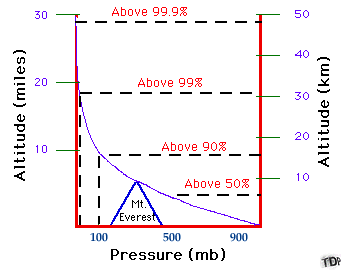
Perhaps. But 100km is a pretty arbitrary number. When I was growing up (and where I live everything was still in miles, especially anything written by or about the US space program), space was "100 miles" up. Funny how it's a neat round number like that.
http://ww2010.atmos.uiuc.edu/guides/mtr/prs/gifs/hght2.gif
He's above 99% of the atmosphere. That's good enough for me. "Edge" -- how do you define that? He's not IN space, certainly. I wouldn't compare it to a beach, a beach is only 10-100 feet wide. I'd make the argument that the "Edge" of space is a "beach" that's around 50km wide
Related question - what would make a good fundamental "minimum altitude" to say "space"?
50% odds of making one orbit (if you had sufficient tangential velocity at that altitude) without orbital decay? How much orbital decay? ALL orbits decay "a bit". 50% odds of making one orbit and being able to make a second orbit without touching the ground "underneath" your starting point?
And THEN on top of that, there's the fluctuating undulating atmosphere, that line is going to change day to day and year to year and place to place. Of course, if the tide rises and your boat is floating "closer to shore", you're still "on the ocean"
-
Re:Senior citizen Canadian, me.
http://www.isgs.uiuc.edu/research/glacial-geology/images/ic_large.gif
Then the ice melted.
-
Re:13.3 billion in one direction?
Standing on the surface of the balloon, what do you see when you look up? Does the skin have any 'thickness'?
-
Re:Press coverage
Well, it sure looks to me like the amount of ice at the other pole has been growing.
That is a good link, and if you remove the "ant" from the URL you can see the opposite graph. Open them both up and toggle between the two. Which graph do you think has the more dramatic trend?