Slashdot Mirror
Domain: unc.edu
Stories and comments across the archive that link to unc.edu.
Comments · 912
-
you're 2 years off -- try March 1997
The Servlet developer's kit was originally released in beta on March 4, 1997 (see timeline), with the 1.0 release of the Java Web Server on June 5, 1997. I remember putting a servlet-based application into production in Autumn 1998.
Even JavaServer Pages was released before that date, on June 2, 1999 -- and there was JHTML before that from ATG. -
Re:Encyclopedia != Community
First off, not all sides must be represented.
Let me ask a series of questions.
Are you human? I'm going to presume the answer is "yes", though it may be an unsafe assumption.
Are humans fallible? Are they capable of making mistakes? Again, I'll assume yes. Err, you're not the Pope, are you? If you are, I beg your pardon, your pontificalness.
If you are both human and fallible, how can you be certain beyond all doubt that the side that you happen to favor is correct? And if you are not certain, by what authority can you silence someone else's opinion?
Furthermore, even if the opinion you hold is true -- can you be certain that it is the whole truth? Might the opinion that you have silenced have some grain of truth that's missing from your opinion? By silencing that opinion, however false you might believe it to be, have you not denied yourself the opportunity of finding some nugget of truth in it?
Supposing that your opinion is not only true, but the whole truth, and that the suppressed opinion is completely false, have you not still lost the opportunity for sharpening your understanding of your own opinion in the process of debating whomever might hold that suppressed opinion? And even if that lost opportunity does not move you, are you not afraid that in the absence of opposition, your opinion will soon ossify, and become meaningless, an empty creed rattled off numbly day after day without any passion or conviction to animate it?
Because we are human -- because we are fallible -- because we need conflict both to hone our understanding and to fire our passions, we need every opinion to be expressed freely and fiercely. Bring the inane! Bring the illogical! Bring the offensive, and the crude! Bring also the thoughtful, and the insightful, and offtopic! It is in the mixture of all these that we forge our opinions -- and if we deny any one of them a hearing, then we have injured ourselves as much as we have injured our opponents.
The page on Earth doesn't talk about the "Is it flat?" controversy.
*coughyesitdoescough*
-
Crap! FIXED MY BROKEN LINK! (sorry)
-
Re:But will they digitize PD works from after 1922In the US, that is only true of works published after 1978.
When U.S. works pass into the Public Domain is a good summary of the U.S. issues.
Me, I just want 14+14 back.
-
Re:Most biased Slashdot article ever?
Hardly.
The linked article (a piece of legitimate journalism) should be unbiased, the headline need not be. Perspective is important as it creates an environment in which intelligent discussion can gestate. Rather than merely squelching what you perceive as bias with a random slew of generalizations, perhaps you should understand the issue at hand:
P2P filesharing. The two stances? Copyright infringement vs. legitimate music acquisition.
Why isn't it a big deal? The smaller labels aren't complaining about filesharing...independent artists aren't complaining...it seems only major labels care. Most artists on those labels make only 7 to 8 points on CD sales anyway, so they don't profit. If music sales decline (and a number of studies have shown that P2P does not harm, and may even boost sales, as shown here, here (PDF), and here, just to name a few) then the artists really don't feel the hurt, as they profit mostly from merchandising and live shows. Both of those require fans. Thus, the more people to hear their music, the more likely they'll sell out a show, or sell more merchandise, and thus profit. This is why more and more artists are endorsing file sharing. If you understand the real issue of corporate control (Infinity, Clearchannel, and Viacom control the vast majority of radio in America, as well as venues, and where I live in Cleveland, Clearchannel owns all of the billboards), then you will notice that a bias here isn't so bad.
Arists need an audience to exist. If they are not on a major label and thus can't get airplay, how can they find an audience? (hint, the answer is filesharing).
Rash generalizations and non-sequitors do little to address the issues and, rather than bias, are what paints Slashdot in a poor light and keeps it from being taken seriously as more than a niche geek site with very rigid agendas and a strict groupthink policy. -
Re:THEY HAVE YOU COLD
Sure you may have a right to that MP3, BUT they downloaded a copy from you! You didn't check to see if they had the right did you? So you broke the law. Here is more on the digital fingerprint idea. The digital fingerprints of each file can be use to identify a pirated song or movie. The industries use a collection of digital fingerprints (hashes) that uniquely identify copyrighted files traded over file sharing services. The RIAA or MPAA compares the hash of a music file on the infringer's computer to those in its collection to determine whether the file originated from a CD or DVD or a file-sharing service http://www.unc.edu/courses/2005spring/law/357c/00
1 /projects/getz/individual%20liability.htm -
Re:rast reaction, but how?
"There just happened by chance to be a deep space optical telescope available for chasing after this event? I've always thought one needed to book time at observatories due to the high ratio of astronomers to available telescopes. How is it they can just take over an expensive instrument like this? What happens to anyone unfortunate enough to have reserved an observation run during this event?"
You are mostly right. All major telescopes are scheduled. Some operate in a classical observing mode (you are granted x number of nights, you go to the telescope and use them when you are scheduled to), some operate in a queue based mode (your observation is approved, the coordinates are put into a list and a computer automatically observes them when conditions are right) and some operate in a mixed mode (some nights classical, some nights queue). Because of this, one type of time award that you can be granted is called "target of opportunity" or interrupt time. Dr. Reichart's team (who I work with and will be joining full time in a few weeks) has interrupt time on both SOAR and Gemini South.
The basic chain of events is this: SWIFT sees a gamma ray burst go off and immediately relays the position of the of the burst to the ground. Reichart et. al. has a set of robotic telescopes in Chile called PROMPT. These telescopes (still being built, 3 are mostly operational right now, all six should be up and running later this year) are always running in queue mode. When a burst comes in, it goes to the top of the queue. If it is observable from Chile (if the Sun is down and the object is high enough in the sky) and if the weather is good, the PROMPT telescopes stop whatever they were doing and immediately slew to the position of the burst and start taking data. This all can happen in less than a minute from the initial burst. Meanwhile, folks on the ground have recieved email and text message notification of the burst and are deciding if they want to interrupt on the big telescopes. In the case of SOAR, it is currently in engineering and is not yet running in full scheduled mode. So if the telescope isn't being worked on, they can observe the target. In the case of Gemini South, it was operating in classical mode, so it couldn't be used until two days later. If you have real interrupt time, you can bump someone who is using it in classical mode. Since UNC (where Reichart is) is a partner in SOAR, he has true interrupt time. If he bumps an observer, he is charged for the time and the person who was bumped gets a time credit.
While the "burst" only lasts for a short time (usually tens of seconds) that doesn't mean the show is over. After the initial burst, the light output decays over a period of days. So while getting on them as quickly as possible is important, there is also a need for getting data in the days and weeks that follow. -
Re:rast reaction, but how?
Perhaps because UNC was the founding member of the SOAR telescope consortium? http://www.physics.unc.edu/research/astro/observa
t ories.php
Seriously, for most telescopes, time may be granted or purchased in modest quantities. Depending on the observations, an astronomer may need this time consecutively or distributed over a long period of time. Regardless, most of the observations are not so time-critical that they must occur at an EXACT given moment, so when a time-critical event, such as a GRB, is detected, there are procedures in place to preempt, or bump if you will, the current observation and observe the GRB (assuming that the original observation wasn't time-critical).
Probably the same usage pattern you'd utilize for most other limited resources. -
Re:What about lefties?
Hitting the key under your thumb doesn't take fine motor control, so it's nothing like having to use, say, the mouse with your non-dominant hand. Would it really be that hard to relearn? Maybe a little harder than learning something like the various positions of the \ key, since you use it a lot less than space and delete, but then again maybe a little easier for the same reason.
It's my impression that we backspace a lot more on the computer than anyone ever did on typewriters. When you're hacking away on an old Underwood, you're careful about the keys you hit. Not quite so much these days when you don't have to X out all your typos. -
Done already in 1999
Similar research was already conducted in 1999 by Larry Hodges.
Here's an overview. And for a relaxed Sunday afternoon read: check out the related research paper (PDF).
I saw Larry and fellow Virtual Reality Exposure Therapy researchers at a talk in 2000. Larry showed a video of a Vietnam Vet suffering from PTSD who was exposed to a virtual Vietnam war scenario. Within a short time the Vet totally forgot that he was in a simulation and started to yell out to his virtual comrades, trying to warn them of an imminent attack. Watching this video was both fascinating and appalling at the same time. On the one hand I was proud to see how far VR research has come. On the other hand I realized how horrible the Nam war experience must really have been for the Vet. -
New n-body calculation algorithm
There's a new approach to the n-body problem part of this. They're using quantities related to impulse instead of time to step between iterations of simulations. This can yield O(N) computational cost.
http://www.cs.unc.edu/Research/nbody/ -
Re:Why is it so easy?
From http://www.unc.edu/~rowlett/units/usmetric.html:
In 1893, Congress adopted the metric standards, the official meter and kilogram bars supplied by BIPM, as the standards for all measurement in the U.S. This didn't mean that metric units had to be used, but since that time the customary units have been defined officially in terms of metric standards. Currently, the foot is legally defined to be exactly 0.3048 meter and the pound is legally defined to equal exactly 453.59237 grams.
What more do you need?
Oh, you want us to use the official system of weights and measure?
On another tangent, I find it amusing that the English or whatever they are called units have been changed to be in reference to the international standards as well. Actually, I believe that the "English" system does not make internal sense anymore. I think that 5280 * 12 _inches does not equal one mile like it should. Humorous. Didn't a NASA Mars thing crash because of the confusion too? -
Toolsmiths not Scientists
Computer Scientists do not grow trees, it is like any other physical science it requires a certain aptitude to study the subject. People who study any science do not do it for their worth in the market, yes that is a concern but not the main reason I would study a subject.
The real dearth in my opinion is mainly in Phd side, not that many ppl are willing to spend 5 yrs doing one. But again its a question of aptitude.
A seminal article was written by Fred Brooks, of the role of computer scientists as "Tool Smiths". As he says computer science is not a science but an engineering, we apply the field to help solve problems in other fields. http://www.cs.unc.edu/~brooks/Toolsmith-CACM.pdf
This is where the field is maturing, and we are in the most exciting period where more and more people are realizing this. Just look at computational biology or physics.
Wait for the surge in another 2-3 years where the field will start hitting its peak!!! -
Graphics ProgramsA good starting place for information is this little document by Mike Gleicher who is a graphics prof at the University of Wisconsin. He gives a lot of general advice, but also some specific stuff for graphics which is helpful and otherwise hard to find.
Here's his list of places where major graphics research is going on in North America:
The "Big" Places for Graphics: (all of these places have LOTS of graphics students)
He also of course adds Wisconsin to the list too. I'd personally place it in the last category, since they have a small, young but respectable program. Generally, I agree with this list although there are probably a whole bunch of other places with just one faculty member doing good work.- Washington
- Stanford
- Georgia Tech
- UNC
- Utah
- MIT
- Brown
- British Columbia
Other Really good groups (smaller, more personable):
- Princeton
- Caltech
- NYU
- CMU (was big, but lots of people left)
- Toronto
Up and Coming Groups (newer groups with a small number of newer faculty in graphics)
- Berkeley
- Virginia
- Illinois
- USC
Having spent time studying and researching in Europe, there are some good graphics groups there too. In the UK, I know of two places off hand: Cambridge (Malcolm Sabin doing stuff with surfaces and geometric modeling) and Bath (Phil Willis and some others). In Germany, there is the Max Planck Institute (which does everything in English and is a very strong group although I admit I used to work there, so I'm probably biased), TU Darmstadt (Alexa), RWTH Aachen (Kobelt) and Tuebingen (Strasser). In Switzerland, there is the ETH in Zuerich (Markus Gross), the EPFL in (I think) Lausanne (Nadia and Daniel Thalmann) and Basel (Thomas Vetter who not so long ago left Freiburg to start a new graphics group there). In France, there is a group at the INRIA in Grenoble (Marie-Paul Cani). The above is certainly not an exhaustive list, just names that come to mind off the top of my head.
Most of these programs in continental Europe probably require you to already have your MSc before beginning PhD studies, but some have MSc programs as well. I know the MPI has one and awards scholarships even to foreign students. Generally, it's easier to get funding with only a Bachelor's degree in the US than in most of Europe. I've also heard the funding situation in the UK is not really very good, which is probably another reason to consider places like the US, Canada, Germany or Switzerland.
Competition for admission to US schools is fairly intense and is a time consuming and expensive process, but there are some really amazing opportunities here. I'm currently a grad student (graphics, visualization and scientific computing) at UNC and we probably have the largest number of graphics and imaging faculty and grad students under one (academic) roof in the world. We're not as hard to get into as a lot of the top schools like Berkeley, MIT, Stanford or CMU, but we still only take about 1 in 7 applicants or something. The key is to apply to as many places as you can afford, but only apply to places you'd actually attend.
Happy searching!
-
If you're interested in Graphics:
You might want to check out UNC - Chapel Hill. Their CS department has a strong bias towards graphics, visualization, virtual reality, etc.
Check the Department News Headlines and you'll see how a lot of the interesting stuff that comes out of UNC is graphics related. Likewise, look into their Major Research Areas page and you'll see Graphics and Image Analysis as one. Look at some of the stuff they're doing.
I'm not a big graphics guy myself (I'm more interested in AI, Distributed Computing and Software Engineering) so I can't really comment in much depth on what kind of stuff they're doing. But I know that they have a strong reputation as a good school for the folks who want to do research that's graphics and visualization related.
HTH. -
If you're interested in Graphics:
You might want to check out UNC - Chapel Hill. Their CS department has a strong bias towards graphics, visualization, virtual reality, etc.
Check the Department News Headlines and you'll see how a lot of the interesting stuff that comes out of UNC is graphics related. Likewise, look into their Major Research Areas page and you'll see Graphics and Image Analysis as one. Look at some of the stuff they're doing.
I'm not a big graphics guy myself (I'm more interested in AI, Distributed Computing and Software Engineering) so I can't really comment in much depth on what kind of stuff they're doing. But I know that they have a strong reputation as a good school for the folks who want to do research that's graphics and visualization related.
HTH. -
If you're interested in Graphics:
You might want to check out UNC - Chapel Hill. Their CS department has a strong bias towards graphics, visualization, virtual reality, etc.
Check the Department News Headlines and you'll see how a lot of the interesting stuff that comes out of UNC is graphics related. Likewise, look into their Major Research Areas page and you'll see Graphics and Image Analysis as one. Look at some of the stuff they're doing.
I'm not a big graphics guy myself (I'm more interested in AI, Distributed Computing and Software Engineering) so I can't really comment in much depth on what kind of stuff they're doing. But I know that they have a strong reputation as a good school for the folks who want to do research that's graphics and visualization related.
HTH. -
If you're interested in Graphics:
You might want to check out UNC - Chapel Hill. Their CS department has a strong bias towards graphics, visualization, virtual reality, etc.
Check the Department News Headlines and you'll see how a lot of the interesting stuff that comes out of UNC is graphics related. Likewise, look into their Major Research Areas page and you'll see Graphics and Image Analysis as one. Look at some of the stuff they're doing.
I'm not a big graphics guy myself (I'm more interested in AI, Distributed Computing and Software Engineering) so I can't really comment in much depth on what kind of stuff they're doing. But I know that they have a strong reputation as a good school for the folks who want to do research that's graphics and visualization related.
HTH. -
Re:Difficult to paint comfortably with a pad or mo
And here are a few more urls where you can find videos and publications about that work:
here
here
here
and
here
[Disclosure -- I'm the author. That's my dissertation research].
The work Chu and Tan have done to put MoXi together looks very nice. I'll definitely be checking out their paper session at SIGGRAPH. -
Re:Difficult to paint comfortably with a pad or mo
And here are a few more urls where you can find videos and publications about that work:
here
here
here
and
here
[Disclosure -- I'm the author. That's my dissertation research].
The work Chu and Tan have done to put MoXi together looks very nice. I'll definitely be checking out their paper session at SIGGRAPH. -
Re:Difficult to paint comfortably with a pad or mo
And here are a few more urls where you can find videos and publications about that work:
here
here
here
and
here
[Disclosure -- I'm the author. That's my dissertation research].
The work Chu and Tan have done to put MoXi together looks very nice. I'll definitely be checking out their paper session at SIGGRAPH. -
Re:Difficult to paint comfortably with a pad or mo
And here are a few more urls where you can find videos and publications about that work:
here
here
here
and
here
[Disclosure -- I'm the author. That's my dissertation research].
The work Chu and Tan have done to put MoXi together looks very nice. I'll definitely be checking out their paper session at SIGGRAPH. -
Re:GPUs, and Floating Point Numbers General Questi
-
Re:GPUs, and Floating Point Numbers General Questi
-
Let's get an Nvidia fanboy response.
Why I am really, really tempted to post this on an NVidia fansite with the caption
LOL NVidia suxxorz ATI ownz j00! -
Not an OS, but
Some ideas about an audio multitasking environment: http://www.cs.unc.edu/~parente/clique/
-
Re:The link is definitely there.Your post is misleading. You are lumping in exposure well after Autism starts with exposure prior to birth. Autism is a disorder linked to pervasive developmental problems in the brain that start prior to birth, or _immediately_ after:
http://www.unc.edu/~cory/autism-info/orgautsa.htm
l -
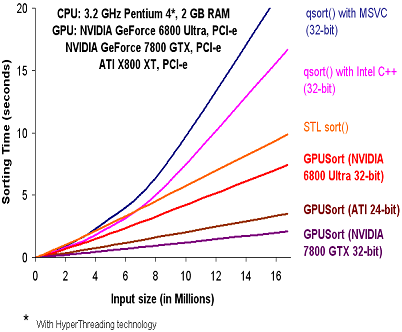
Doing math on graphics cardsThere have been a few posts complaining (accurately) that the majority of the response to this story has been all jokes and no thinking. The reason for the Beowulf clusters we all joke about is to do big math problems, including simulations of proteins and other big molecules, weather and climate, cosmology stuff like supernovae, etc. FLOPS are our friends, and we should make better use of them, especially cheap ones like the FLOPS in graphics cards (see http://www.eet.com/showArticle.jhtml?articleID=55
3 00904). Discussions on the beowulf.org mailing list (http://www.beowulf.org/archive/2001-March/thread. html#2579) indicate those guys think the overhead of communication between CPU and GPU is too expensive, and graphics hardware becomes obsolete too quickly.The people in TFA are part of a larger group (see http://www.gpgpu.org/) that thinks about how to use graphics cards for a wide variety of math problems. Here's an abstract from one of their papers:
In our experiments we compare the execution on a midclass GPU (NVIDIA GeForce FX 5700LE) with a high-end CPU (Pentium 4 3.2GHz). The results show that to achieve high speedup with the GPU you need to: (1) format the vectors into two-dimensional arrays; (2) process large data arrays; and (3) perform a considerable amount of operations per data element.
Apparently GPU architecture is so quirky that it's hard to write a general-purpose API to exploit it. Consequently there tend to be entirely seperate efforts for different classes of computational problems. If graphics cards weren't such a commodity, this kind of bad engineering practice would be unacceptable.I'll repeat a cool link posted by somebody else: http://www.cs.unc.edu/~ibr/projects/paranoia/ - this is a program, originally written in the 80s, to characterize the performance and idiosyncracies of a floating-point processor. Recent work at UNC Chapel Hill has been done on Windows platforms. (Twenty years ago, UNC Chapel Hill was one of the hotbeds of computer graphics development that eventually gave us Shrek and The Incredibles.)
-
Re:What about precision???
NVIDIA's GPUs are only one or two bits short of perfect 32 bit IEEE floats. (ATI's are still at 24 bit floats.)
See Karl Hillesland and Anselmo Lastra's cool work on measuring this error on current GPUs, GPU Floating-Point Paranoia for much more information.
-matt -
Re:Images?
Mirror. (They'll be there for a week or so)
-
Dumb People also Defend bad IdeasAnd the bad ideas aren't always obvious.
To a great extent this issue reminds me of the observations made of those more and less likely to believe in the supernatural. Sceptics are likely to miss pattern that exists, and believers are likely to invent non-existent pattern (or so we believe). To spot counter-cultural pattern, then, is also to be more likely to invent pattern that isn't there.
The trouble being that there are many conclusions that the informed or observant can make that differ from "common sense", and the brain being what it is, we don't necessarily know the steps of how to get there. This doesn't make us wrong... or right; our perception is different.
I'll pick an example that generates more heat than light on slashdot: how do illegal downloads effect aggregate sales of music and movies? The common man is sure that IP infringement must lead to reduced sales, yet many slashdotters believe this not to be the case, and a few even believe the opposite.
What is the truth? The form of the question can affect the outcome. For example: restrict your study to (relatively poor) students, and you get the "common sense" result. Aggregate sales using a detailed and sophisticated economic analysis, and you get no effect. But maybe our intellect is misleading us: if we get goods for free, although it might shift our spending onto other music and movies, are we perhaps less motivated to work in the first place? with this larger frame of reference, it appears that the intelligent individual has quite possibly picked a convenient intermediate-sized frame of reference, when a frame of reference that was larger still would (perhaps) reveal 'theft' from the economy as a whole. This is a bit of a conconcted 'counter-example', though: our greed is such that we're likely to keep working to own more, regardless of how much we have.
What about software patents? Most of us here (myself included) are anti. Assuming (for the moment) that the 'anti' stance is right, why then do so many lawyers believe the converse? I doubt that it's wholly because of their self-interest (although that might bias them); it's because of a particular view of the business of business, of the value and importance of contract and of property, and of incentives and defined rights that meld, to the lawerly mind, with morality, and the natural way of things. To break with this, brings them to presuppose harm, and their experience with the concrete (case by case), rather than the systemic effects reinforces this way of thinking. Is the abstract argument really wrong? That it's harm to think of examples of avenues that will be impeded (they haven't been thought of yet!) doesn't make them any less real. Here, then, the emphasis upon concreteness is itself misleading.
Another example: minimum wages. I believe that one of my own JEs illustrates this well. I don't think that I (arguing for a minimum) argued at my best, and Red Warrior applied some experience, but neither of us "won", I feel. However, one thing's for sure; most of the pro-free-market intellectuals ignore the 'monopsony' effect of deliberately cartelising the labour force, so that the first level of abstraction is misleading as to the degree of the effect on unemployment. To some extent, then, here the 'simple' reaction that it redistributes wealth the the relatively poor has a lot of truth to it. The intellectual's love of pristine, perfect, simple systems can and does mislead. My stance might itself be flawed. The intellectual's stance often comes from a deeper analysis or intuition, and they could easily be at a loss to explain it. From this difficulty, it's difficult to decide which way is the truth. Not all difficulty is denial.
-
already exists
VRPN has a wide support for a lot of 6DOF tracker and is commonly used in VR/Immersive system
http://www.cs.unc.edu/Research/vrpn/
it's userland C++ classes -
Re:Netscape's Original 8.0 Release
-
So whats that really weigh?for reference:
carat (ct or c) [1]
a unit of mass used for diamonds and other precious stones. Originally spelled karat, the word comes from the Greek keration, a carob bean; carob beans were used as standards of weight and length in ancient Greece in much the same way barleycorns were used in old England. Traditionally the carat was equal to 4 grains. The definition of the grain differed from one country to another, but typically it was about 50 milligrams and thus the carat was about 200 milligrams. In the U. S. and Britian, the diamond carat was formerly defined by law to be 3.2 troy grains, which is about 207 milligrams. Jewelers everywhere now use a metric carat defined in 1907 to be exactly 200 milligrams.
From
http://www.unc.edu/~rowlett/units/dictC.html -
Re:Concrete Roads
The one caveat is that in Northern Areas it was discovered that asphalt roadways were not holding up as long as their concrete breathern. Many asphalt roads were having to be torn up and replaced every other year due to extensive freeze damage. Many cities went back to using concrete for their roads, until better techniques of preparing the roadbeds were discovered. Which were to compress and smooth the roadbed as much as possible, then lay a barrier layer of aggregate *gravel* on top of that to help with drainage and settling, then to finally slope the finished road from the middle to the edges for increased water run-off.
"Discovered". Feh. Until the cities were willing to cough up the money to prepare the roadbed correctly, a practice which had been in use two millennia earlier, but which fell out of use because of the lack of civic incentive to build and maintain good roads.
-
Re:Tech Limitations, & some interesting phenom
That sounds like Redirected Walking
-
Re:Sounds like they were right after all.
I do miss religion and the comforts that it brought. I liked singing in church, I liked feeling like I would go to heaven when I died, I liked the sense of purpose and mission my life had.I'm not real clear to me how any of that stuff is supposed to be bad for you - sounds pretty healthy to me.
But it's all lies. Comfortable, well-meaning lies, but also hurtful, destructive lies, too. I just couldn't stand it. Better to know the truth, even if it isn't what you want to hear, than to waste your life.
Can you prove that "it's all lies"? As an aside, a fellow named Kurt Gödel believed that he was in possession of a proof that they were not all lies. And plenty of other geeks, like Donald Knuth, and Fred Brooks, don't think they're lies. Who knows - maybe even John McCarthy, as well.
I'm glad I'm a scientifically-minded geek who can appreciate the numinous in this universe without having to also believe in a white-bearded old man who condemns every human being who doesn't follow his bizarre, evil rules to an eternity of torture and suffering.
Which of his rules are evil? There's a rather succinct summary of them here:
The Rules, Part I
The Rules, Part II
The Rules, Part III
-
Re:It's annoying...On the contrary the reason I like the commercial is how over the top it is. One one hand I feel offended that a pair of tits attached to annoying voice passes as a spokesperson, on the other hand I have to give them points for unabashedly appealing to the base instincts of their audience. Its like Howard Stern or those Coors commercials, the first couple times its hilarious and appalling just how absurd it is. They better not try to run a whole strings of these though, then it would just get stupid.
Either way I find it far less controversial and creepy than those Burger King commercials.
-
PS.
"Napster Helps RIAA Again; RIAA Still Ungrateful (Updated)"
http://slashdot.org/article.pl?sid=01/02/26/181221 3
"Napster Spurs CD Sales; Gets Sued Again Anyway"
http://slashdot.org/article.pl?sid=01/05/31/163720 2
"RIAA Almost Down To Pre-Napster Revenues"
http://slashdot.org/article.pl?sid=02/02/27/021325 2
"RIAA's Statistics Don't Add Up to Piracy"
http://www.azoz.com/music/features/0008.html
"The Effect of File Sharing on Record Sales, An Empirical Analysis"
http://www.unc.edu/~cigar/papers/FileSharing_March 2004.pdf
which found:
"We find that file sharing has no statistically significant effect on purchases of the average
album in our sample. Moreover, the estimates are of rather modest size when compared
to the drastic reduction in sales in the music industry. At most, file sharing can explain a
tiny fraction of this decline. This result is plausible given that movies, software, and
video games are actively downloaded, and yet these industries have continued to grow
since the advent of file sharing."
So, yes, let's be real for more than a second. -
Re:Did you ever notice....?
Hehe, that was pretty funny.
I assume you've seen this? -
this is the same in philadelphia
this is true in philadelphia as well, where an even larger percent of workers live outside the city
http://www.unc.edu/~cigar/PhilInqEIT.htm -
Mod me redundant but....
I know somebody has probably already said this, but I'll reiterate:
1. check with the University you want to transfer too, *before* taking classes somewhere else (including another University) regading transfer credit.
2. What transfers ultimately depends on the school accepting the would-be transfer credits, but some observations:
a. "general ed" courses from CC's usually transfer with no problem. That is, the courses that you would typically take in the first two years of a "liberal arts" degree. Stuff like English, Literature, History, Political Science, Physical Geography, Biology, Maths courses, etc.
b. Usually *some* maths courses will transfer, but check **ahead of time** to find out exactly which ones.
c. The University may have a cap on the total number of hours they will accept, and it may vary based on where the transfer classes were taken.
d. "trade" classes usually don't transfer, sometimes classes will count for hours but not for specific course credit, etc. Again, check with your target university (or universities) beforehand.
e. But a "trade" course may still be useful, even if you don't get course credit for it. For example, if you have taken 3 semesters of Java programming at a CC, you may be able to argue your way out of taking "Intro to Programming" at the University, which would free you up to take another elective in that spot. This would vary by case though.
To use my own example, I'm currently taking classes at Wake Technical Community College, and Durham Tech, and planning to transfer to UNC - Chapel Hill. I found this and this while browsing the section of UNC's website that talks about transfer admissions. Look for similar material on your University's website, or call them and ask to speak to an admissions counselor.
3. Taking classes at a community college can be a great thing. You usually pay less (sometimes much less), and usually have smaller classes - which is especially nice for challenging classes where you may want more one on one interaction with the instructor. -
Mod me redundant but....
I know somebody has probably already said this, but I'll reiterate:
1. check with the University you want to transfer too, *before* taking classes somewhere else (including another University) regading transfer credit.
2. What transfers ultimately depends on the school accepting the would-be transfer credits, but some observations:
a. "general ed" courses from CC's usually transfer with no problem. That is, the courses that you would typically take in the first two years of a "liberal arts" degree. Stuff like English, Literature, History, Political Science, Physical Geography, Biology, Maths courses, etc.
b. Usually *some* maths courses will transfer, but check **ahead of time** to find out exactly which ones.
c. The University may have a cap on the total number of hours they will accept, and it may vary based on where the transfer classes were taken.
d. "trade" classes usually don't transfer, sometimes classes will count for hours but not for specific course credit, etc. Again, check with your target university (or universities) beforehand.
e. But a "trade" course may still be useful, even if you don't get course credit for it. For example, if you have taken 3 semesters of Java programming at a CC, you may be able to argue your way out of taking "Intro to Programming" at the University, which would free you up to take another elective in that spot. This would vary by case though.
To use my own example, I'm currently taking classes at Wake Technical Community College, and Durham Tech, and planning to transfer to UNC - Chapel Hill. I found this and this while browsing the section of UNC's website that talks about transfer admissions. Look for similar material on your University's website, or call them and ask to speak to an admissions counselor.
3. Taking classes at a community college can be a great thing. You usually pay less (sometimes much less), and usually have smaller classes - which is especially nice for challenging classes where you may want more one on one interaction with the instructor. -
Mod me redundant but....
I know somebody has probably already said this, but I'll reiterate:
1. check with the University you want to transfer too, *before* taking classes somewhere else (including another University) regading transfer credit.
2. What transfers ultimately depends on the school accepting the would-be transfer credits, but some observations:
a. "general ed" courses from CC's usually transfer with no problem. That is, the courses that you would typically take in the first two years of a "liberal arts" degree. Stuff like English, Literature, History, Political Science, Physical Geography, Biology, Maths courses, etc.
b. Usually *some* maths courses will transfer, but check **ahead of time** to find out exactly which ones.
c. The University may have a cap on the total number of hours they will accept, and it may vary based on where the transfer classes were taken.
d. "trade" classes usually don't transfer, sometimes classes will count for hours but not for specific course credit, etc. Again, check with your target university (or universities) beforehand.
e. But a "trade" course may still be useful, even if you don't get course credit for it. For example, if you have taken 3 semesters of Java programming at a CC, you may be able to argue your way out of taking "Intro to Programming" at the University, which would free you up to take another elective in that spot. This would vary by case though.
To use my own example, I'm currently taking classes at Wake Technical Community College, and Durham Tech, and planning to transfer to UNC - Chapel Hill. I found this and this while browsing the section of UNC's website that talks about transfer admissions. Look for similar material on your University's website, or call them and ask to speak to an admissions counselor.
3. Taking classes at a community college can be a great thing. You usually pay less (sometimes much less), and usually have smaller classes - which is especially nice for challenging classes where you may want more one on one interaction with the instructor. -
Mod me redundant but....
I know somebody has probably already said this, but I'll reiterate:
1. check with the University you want to transfer too, *before* taking classes somewhere else (including another University) regading transfer credit.
2. What transfers ultimately depends on the school accepting the would-be transfer credits, but some observations:
a. "general ed" courses from CC's usually transfer with no problem. That is, the courses that you would typically take in the first two years of a "liberal arts" degree. Stuff like English, Literature, History, Political Science, Physical Geography, Biology, Maths courses, etc.
b. Usually *some* maths courses will transfer, but check **ahead of time** to find out exactly which ones.
c. The University may have a cap on the total number of hours they will accept, and it may vary based on where the transfer classes were taken.
d. "trade" classes usually don't transfer, sometimes classes will count for hours but not for specific course credit, etc. Again, check with your target university (or universities) beforehand.
e. But a "trade" course may still be useful, even if you don't get course credit for it. For example, if you have taken 3 semesters of Java programming at a CC, you may be able to argue your way out of taking "Intro to Programming" at the University, which would free you up to take another elective in that spot. This would vary by case though.
To use my own example, I'm currently taking classes at Wake Technical Community College, and Durham Tech, and planning to transfer to UNC - Chapel Hill. I found this and this while browsing the section of UNC's website that talks about transfer admissions. Look for similar material on your University's website, or call them and ask to speak to an admissions counselor.
3. Taking classes at a community college can be a great thing. You usually pay less (sometimes much less), and usually have smaller classes - which is especially nice for challenging classes where you may want more one on one interaction with the instructor. -
Re:Good Use for Importing Stationary Objects"...but science is not quite there yet"
Actually, it is. Well, since you said "uncalibrated" I suppose you are mostly correct, though I don't mind calibrating my camera, that's relatively easy to do. But as far as 3D-from-motion (single camera) I have (and have read) the literature and examples from both of the referenced sources, and just 3 weeks ago we got a demo here of working 3D-from-motion system from one of our research partners. It's actually quite impressive, about on par with the stereo system we have and with similar limitations (lighting sensitivity, sensitivity to calibration, etc).
It's true stereo isn't a "done deal", but from all the research we've been monitoring it seems we're over the hump of the curve and everything from now is likely to be minor improvements with a lot of work. There are fundamental limitations of stereoscopy (and 3D-from-motion) that I think we're very near to.
But, I should also correct the inference. By "everyone and their dog" I meant that it's been (and being done) by lots and lots of people. There are very few people doing the 3D-from-motion.
-
Re:Good Use for Importing Stationary Objects
Actually, now I'm even less impressed. The MDRobotics iSM uses a stereo camera system. I had thought it was a 3D-from-video method (particularly since it uses SIFT). I find those much more useful because I can use it with my home video cam. Making 3D models from a stereo-cam requires special equipment and has been done by everyone and their dog. I'm not so clear on why this is new or that interesting.
-
Re:Interesting idea
This is actually a debatable point. When I used to work on collision detection, we generally acknowledged that the actual detection of collisions was easier than the generation of accurate collision responses. There are lots of software speedup techniques (based on space partitions and hierarchies) to reduce the work in figuring out where the intersections occur. Computation of "penetration distance" as well as doing the physics with realistic friction forces makes the problem harder. (see software packages like I-Collide, V-Collide, RAPID, etc. for computing collisions, distance compuatations, penetration distances, etc.)
-
Re:Just wait.
US Congress adopted the metric system in 1893. What more could anyone want? http://www.unc.edu/~rowlett/units/usmetric.html
-
Re:Anyone Else?Explanation...
In summary, the kilogram is the basic metric unit of weight, not the gram. The gram will be defined by the kg standard.