Slashdot Mirror
Domain: uni-bremen.de
Stories and comments across the archive that link to uni-bremen.de.
Comments · 36
-
Re:First Time
I think readers of this thread will find this (pdf) thesis very interesting. I stumbled upon it while looking for works by Frederick Soddy.
-
Re:Signs of Grand Minimum
Except that Piers Corbin is not a climatologist, is a borderline quack, and none of his "research" in this area is backed up by peer reviewed articles.
Now add to this that the past three winters have actually been some of the warmest winters (especially in the arctic) we've had, there is nothing very "harbinger" about it. Warmer winters mean more precipitation, which is what we've been seeing. Currently, there are wide swaths of the arctic that are as much as 20F warmer than their average, hence for the first time on record there has actually been an arctic ice REDUCTION in winter which you can see for yourself here http://www.iup.uni-bremen.de:8084/amsr/amsre.html, or you can go by ice volume here http://psc.apl.washington.edu/ArcticSeaiceVolume/IceVolume.php . In addition, global temperatures have still been rising even during a solar minimum. Even with the moderate La Nina we're still having near record warmth for the globe.
I think I'll continue following the consensus of the body of climate science, thanks.
-
Re:Out of curiosity...
Don't know why they included it. However I've seen PDF documents with buttons and forms. There's even a style file for pdflatex called pdfanim which allows you to do animations with Javascript in your PDF document. However I noted that it behaves slightly different under GNU/Linux and Microsoft Windows.
-
Re:Statistics?
My quick Google search couldn't find the paper with the exact algorithm, but this paper describes a related algorithm. Skimming it, I can't tell what the error bars on 1-day deltas are. I do see from that paper that the biases between different data products can be larger than 4% (although they seem to be most likely more like 2%). I would imagine that time deltas are more accurate than absolute estimates. Anyway, bottom line is I don't know if it is significant, but you could probably dig up the algorithm if you searched more than I.
-
Re:Beamer
The one argument I've heard against it is that it can't do animations
One of my happiest moments in grad school (which shows just how depressing grad school is if something like this makes me happy) was learning how to add animations in LaTeX Beamer.pdfanim lets you add animations in. The only downside is that xpdf doesn't currently support them (but it does fail gracefully). I've done several talks using this, both on my own laptop and on random machines at conferences and it always works flawlessly (wish I could say the same about my part of the presentation, but at least when you know the tech will work, you can concentrate on the more important parts).
-
Re:Lazy employees
PDF doesn't always cut it as one often uses animations.
I use animations in pdfs (made from LaTeX) for all my presentations. pdfanim is pretty damned reliable. Sadly the results don't quite work with xpdf at the moment, but Acrobat or Acrobat Reader have been available for every talk I've given. -
Re:Lack of a specification language!
Home builders have architectural plans. Machinist have blueprints. Electronic equipment builders have schematics. Software specifications are uniformly deplorable.
Software does have robust specification languages. Try Z, JML, SPARK, CASL etc. or things like CSP or CCS for specifying concurrent systems. Specification languages exist, and they provide sufficient power to nail down very specific specifications against which implementations can be verified. Sure, some of them are rather technical, but then you have to spend some time learning how to read complex electronic schematics too. For a variety of reasons such specfication languages are rarely used. -
Re:static_analysis++
Also, back on topic, try writing financial software some time. It's like a different world. Everything is unit tested, and the unit tests don't so much check for bugs as prove that your code works.
Unit tests don't prove your code works any more than drawing a few right angled triangles and measuring the sides proves Pythagoras' theorem. If you want to prove your ode works you use a theorem prover. To do tht you usually need to provide more detailed specification (beyond just type signatures) about how your code is intended to function. That tends to be more work, though if you really need to know your code is going to work it can often save time in the long run (over ridculously long and exhaustive testing). There are things out there that provide toold support for theorem proving aout your code: SPARK Ada along with the SPARK tools provides a powerful theorem prover, and HasCASL with CASL tools (including the HOL theorem prover) provides string theorem proving for Haskell. Even ESC/Java2 utilises a theorem prover (called Simplify) to provide extended static checking of Java code. I'm sure there are more examples.
My point is not that Unit testing is bad (it's very good), but that you shouldn't overstate its effectiveness. Unit tests are a great way to provide a reasonable degree of assurance that your code will hopefully ork as intended. It isn't a substitute for actual assurance however. It really depends on exactly how sure you need to be - how much an error will cost, and whether that can be tolerated.
Jedidiah, -
Re:static_analysis++
If you want a truly powerful Java static analysis tool consider ESC/Java2 which includes not just the usual extra static checking you would expect, but also includes a theorem prover which can provide warnings for all kinds of deep and subtle errors. Read through this presentation (warning PDF) to get an idea of exactly how many things ESC/Java2 can catch, including warnings about race conditions and deadlocks. If you want powerful statsic analysis of Java code ESC/Java2 is definitely the way to go.
Jedidiah. -
Re:Ah. Dynamic typing. Again.
Most static type systems suck, which is why people don't like them, but people who have used, say, SML or Haskell, tend to agree that static types can be something very natural and useful (the SML community has a saying which goes, roughly, "if it compiles, it's almost certainly correct").
If you interested in cutting out more bugs statically and not having to worry about corner cases in testing then I suggest you check out Extended ML and HasCASL which provide expressive language additions for more clearly defining intent and tools that can catch far more busg statically than even Haskell or ML's type systems can.
Jedidiah. -
Re:maybe in another lifetime
I RTFA to the point where they started putting restrictions on languages of choice and then I stopped. I don't disagree. I just realize the article applies less to my work than I thought.
Well there are options you can take that aren't the whole hog of SPARK Ada with it's restrictions and formality. If you just want to make things clearer and get some of the benefits then for Java there's JML which provides similar annotation syntax to SPARK and comes with some freely available tools to convert annotations into JUnit tests, runtime assertions, and include them in JavaDoc documentation. There's also ESC/Java2 which provides extended static checking based on JML annotations.
If you are using C# then there's Spec# which, again, provides similar annotation and basic tool support to C#, kindly provided by Microsoft. If you're using C++ mostly there's C2, or if you don't want payware then you could look into D which provides Design by Contract - it is a language shift, but not too huge a one. Then there's always Eiffel.
If you are more of functional programmer then there's Extended ML or HasCASL which both seek to being some of the benefits of algebraic specification to functional languages (in this case Standard ML and Haskell).
So all up you aren't as pinned to a language as it might first appear - depending on how important correctness is there are a variety of options in a wide variety of languages.
Jedidiah. -
Re:I have to wonder....
Thanks for a thoughtful post.
And why are softwares so buggy and have such a lousy reputation anyway? Not to start a flamewar, but let's just list a few possible "reaons" here:
I think, to be honest, that it is a combination of a number of the factors you mention.
Why aren't schools teaching this methodoly thoroughly? Why aren't this toolset and programming language taught in school by default?
To do proper formal specification, one of the key parts of Praxis' Correct by Construction approach, does require a decent solid mathematical background. I think a lot of CS departments, facing students who want vocational training, struggle to demand the sort of mathematical requirements that are needed. As to SPARK - it is something that Praxis developed themselves, and it is proprietary (the toolset at least, the annotation language is well documented). You can pick up a book and learn the language, but the tools cost money if you want to use them commercially. On the other hand, the base specification language Praxis uses, Z, is entirely open, and there are a variety of freely available tools for it. There are also other specification langauges (I quite like CASL which has a number of useful extensions) that have freely available tools associated with them. There's also JML and ESC/Java2 which are freely available and seek to provide the same sort of functionality or Java that SPARK adds to Ada. There are places that teach JML, but they are still few and far between.
Programmers are asked to do the impossible.
I think this is a big part of it in some ways. Partly this is because, for a large number of software projects, the degree of exactness and quality just isn't required. I don't need a professional architect to help me build a doghouse in my backyard (though I'd certainly want one if I was building a skyscraper), and I don't need assurances of bug free software for a simple web front-end to a database. At the same time programmers are often unwilling to let customers know exactly what the limits are when developing software. To quote you: "If a customer dares to ask a civil engineer to add 2 more stories between the 3rd and 4th floor after the custom-built building is finished, guess what would the civil engineer say?"; if software engineers aren't prepared to stand up for quality and tell customers that somethings can't be done without sacrificing the quality of the product the problem will remain. In part I think this is due to the fact that software development is a young industry, and programmers are still of the mentality that they need to do everything they possibly can to please a customer. Partly it's because software projects are diverse (as are building projects!) and sometimes it's okay to make late changes; sometimes it's how things ought to be done - the key is to identify exactly what sort of project it is as early as you can. Are you building a treehouse for your kids, which doesn't require exactness and benefits from incremental design and feedback, or are you building a 4 story building where quality is important, and late changes will jepordise that?
Programmers are a bunch of bozos who know shit about proper engineering.
Sadly this is partly the case. There are an awful lot of cowboys out there when it comes to software engineering. There are, of course, a lot of fantastic programmers as well who are otherwise beset by some of the other points mentioned. There is, however, a remarkable degree of tolerance for cowboys, sloppiness and lack of quality in software engineering that you don't see in other engineering disciplines. Partly I thin -
Re:The right programming language helps hugely
Praxis uses SPARK Ada, which is a subset of the Ada programming language and annotations that provide for extended static checking, and theorem proving. You can find more about SPARK at the Praxis website, or the Wikipedia article isn't too bad. It's a very nice language, and has fantastic tool support.
If you find that interesting, but Ada isn't to your taste, you can try JML for Java which provides similar (but lacking quite the same robustness and tool support) annotations. JML lets you automatically generate JUnit tests based on your annotations, and with ESC/Java2 allows for extended static checking.
If, as you appear, you are more of a fan of functional languages then I'd suggest you check out Extended ML and HasCASL which provide similar sorts of formal specification capabilities for ML and Haskell. Tool support for these is still a little limited, but they are both quite powerful and provide very expressive specification syntax.
Jedidiah. -
As Silly as that sounds...
As silly as that sounds it is true...
About six months past I read in a German paper that in the North where the windmill parks have changed the local climate (http://www.msr.uni-bremen.de/werner/rw/RWOffshore .htm not the real article). Essentially the windmills act like a wind dam and that changes the weather on nearby beaches. I think what the report said is that the beach received more sunlight than it usually would. -
Re:another longhorn?
This is just a research OS written in C#.
No, it's written in Sing# which is an extension of Spec# which is an extension of C#. People really ought to pay more attention to Spec# - it's a nice extension of C# that allows for more formality if and when you require it. It's in the same class of language as SPARK which is an extension of Ada, JML which extends Java with specification semantics, BitC, Extended ML, HasCASL, and I guess to a lesser extent things like Eiffel and D.
Think of it this way: static types and type signatures for functions allow you to specify things about the software that the compiler can statically check and make sure there aren't any silly errors. The languages listed above (to varying degrees) allow for more exacting specification about the software, and hence you can (with the right tools) do far more comprehensive static checking and ensure various properties of the software. The difference is that, with most of these languages, the amount of specification is optional - you can be as exacting as you want where you need it, and not bother where you don't. It's like a dynamically typed language that lets you declare and use static types (and check them)just for those areas of code where it matters (except you start with static types and can provide more exacting specification where it matters). It's well worth checking out.
Jedidiah. -
Re:Try Foxit PDF Reader
This is interesting. On Windows, you have Foxit. On OS X the Preview, on X11, ghostscript, xpdf, gpdf, kpdf and evince, at least. None of these does evrything Adobe Reader does, but they are all faster and smaller. I wonder how is this going to affect the pdf format.
Pdf files can do a lot of things. You can create interactive documents, with animations, scripted with javascript, you can embed movies into documents. Few examples, just from the top of my head:
a calculator
Lorenz Attractor
I have seen much more and better ones, I just don't seem to be able to find them right now.
Most of these things will not work in any of the small pdf viewers. I wonder if as the small viewers become more common, authors will have to avoid using any advanced features of pdf, therefore effectively dumbing down the format.
There is another great feature of adobe reader, a feature most people don't know about. In adobe reader, you can annotate, comment, and even draw on pdf files. That is great, because I could send my pdf files to proofreaders, all they need to do is open them in reader and write their comments. Why don't people know about that? Because Adobe made it in such a way that you have to specifically enable it in each frigging document using the newest vestion of the frigging Acrobat Professional!
That means if I make my document using pdflatex, it cannot be annotated, if you make your document using OpenOffice, it cannot be annotated. If you made your document using an older version of Acrobat, it cannot be annotated. And even if you used the right version of Acrobat but forgot to enable the annotation, it still cannot be annotated. As a result, very few documents you come across will have this enabled. So you have this great feature in reader which you can never use!
I wonder if competition from all these small pdf viewers will force Adobe to reconsider this IMHO very stupid decision and if they will enable annotations by default, disabling them perhaps only for encrypted/digitally signed documents. -
Re:We need a way to avoid duplicating work
A programming method that involves designing an application such that you break each top level logical component/ability down until you a) know that you have to impliment it or b) it is found to have already been done.
That already exists, and the specification is indeed amenable to proof tools (several specification languages use HOL as their proof assistant even!). Check out B-method, HasCASL, SPARK, Extended ML, or even Z and VDM. There are tools like Perfect Developer. There are specification extensions to Java like JML that support extended static checking and proof via other tools.
Uptake has been slow, and the tools associated with this stuff are still maturing (despite the fact that formal specification is a relatively old field - tracing it's way back to Djikstra and Hoare in the late 60's). Doing specification properly tends to require a little more math background, and does take some work. More importantly, for a great many projects, it simply isn't suitable. There is no magic process you can follow that makes everything work, and there is no "final" programming model. There are whatever mix of techniques and models suit the project at hand. Good developers are ones who know lots of models and techniques and adapt them to best fit the problems at hand.
That said, specification is sorely underrated and underused as a programming technique. Too few people are well acquainted with it, and almost all the complaints that often get raised are based on myths and misnomers. It's not right for everything, but there are plenty of places where perhaps it could and should be used. Knowing how to do proper formal specification is simply another weapon in a good developers arsenal, and I wish more people spent the little extra time required to learn something about it.
Jedidiah. -
Re:Why $4.2 million?
Lots of data storage, antenna time, but
the real reason they are cancelling it is because of the "Pioneer Anomaly" which is/may be a major upset in current understanding of the Laws of Physics. -
We like FreeCiv
FreeCiv is a very addictive game that can be controlled soley through the mouse.
Depending on what version you get, you may need to control the server manually (a bit of typing), but if you get Andreas Kemnade's version of 1.14.0, all of the server control is done with the mouse.
I hope you enjoy that game as much as we have! -
Hobbits in Indonesia
-
Better ask the Psychologists ...
... and why not learn a little more about communication in general ?
Theme Centered Interaction (Ruth C. Cohn) immediately comes to mind, and the article also links to CSCW.
CC. -
Re:So does the US.
>The next time you do that, I'm going to assume that you are too stupid to understand that Canada is not the US and that you are incapable of rational discussion on this subject.
Your inability to realize that contrast and comparison are a valid writing format seriously makes me wonder if YOU are capable of rational discussion.
>You might want to note the part about "Telephone harassment" and "Use of racial slurs" and "Verbal abuse" in there.
To quote from your book, "I don't really care what Washinton DC law says". This isn't about individual US cities. It's about the US as an entire country. That includes places like Hawaii and Alaska, and heck, Puerto Rico too.
Tell me, if I go on speakers corner in the US (in general, not just in a few handpicked territories) [I'm sure there's a US version of that show] and say "All Jews are faggots" *how* are you going to sue? *How*? What for? The other poster has explained you'll need to prove some form of personal financial loss. What loss? How? I'd love to be in that courtroom!
I've heard people doing this before (the joys of "Voice of America's" more eclectic programming) and they don't go to jail. They don't get sued. At worst they get angry callers and hate mail. At worst.
If I can get away with that then libel/slander don't cover hate speech in the general sense, do they? Just in the specific sense, such as me saying an untruth like "khasim is a faggot". -
Re:Thought of evaluating the data, not the biases?We may not have reached the peak temperature after coming out of the last ice age, but there's no reason to accelerate the process.
After all, do we really need to repeat THIS:
Given a warm climate, it is unlikely that there was any extensive continental glaciation.
Sea level was perhaps 200-300 meters higher than today.
This caused large areas of the continents to be inundated by broad shallow seaways.
Central North America from the Rockies to the Appalachians was an ocean connecting the Gulf of Mexico with Hudson's Bay.
Source: here . We already know the polar ice caps are shrinking.
-
Re:FUDThey are, and it goes without saying that Greek is the superior tongue.
S.C. Woodhouse, English-Greek Dictionary
Henry George Liddell, Robert Scott, A Greek-English Lexicon -
Re:I wonderLet's see about your list:
Iran Hostage crisis ---> Started under Carter. Ended under Reagan.
Actually it started in 1953 when Eisenhower ordered the CIA to overthrow the popularly elected (as in a real democratic election) prime minister of Iran, Mossadegh, by pushing Reza Pahlava, the Shah, to expel him. Riots ensued, the Shah fled, the CIA put the riots down, brought the Shaw back, and trained SAVAK; who went on to earn Amnesty International's award for "worst human rights record on the planet" in 1976. That's the year Carter was elected, he didn't take office 'till 77. I'm not sure how you can imply he was responsible for the revolt in 79 to overthrow a brutal and repressive regime.
As for Reagan's illustrious involvement in the hostage crisis: He traded weapons to the Ayatollah Khomeini, the forces of darkness, to secure their release. Even Reagan admitted it. A very clever move, now known as the October Surprise, which was significant in defeating Carter.Star Wars ---> Dreamed up in the 70's continues today. Even Clinton continued to fund it.
"When President Reagan first issued his challenge to America's scientific community to find a defense against ballistic missiles..." Clinton did continue funding, but then Clinton governed as a moderate republican, unfortunately.
Grenada ---> Warehouses full of Soviet weapons seized just before the 'rebellion' was to start. Talk to 82nd airborne vets about what they found and saw before you think it was a joke.
Greneda was no joke for the Grenadines. They had made the mistake of electing Maurice Bishop who, alas, was mildly socialist. CIA destabilization began shortly thereafter under Carter in '79, actually, but given the animosity and outright betrayal of Carter by the UberRight in the defense organization (Ollie et al, see above), it's not clear he knew anything about it. Given that Grenada was a managed news event, you should be careful of any "news" you read about it, and the dangerous weapons they had. Remember pfc Lynch's "Rescue."
War on drugs ---> Bush Sr., Nancy was "Just say No to drugs." Not to mention drug use DID decline through the end of the 80's and early 90's. The war is 'lost' because we (people and government) lost focus not because it could not be won.
US prohibition has quite a long history, all of it embarrassing. Reagan did declare the "War on Drugs," but what that really meant, and continues to mean is difficult to ascertain. One thing is for sure, it is not about helping people. Mentioning Gary Webb's careful and exceptionally well documented journalism runs contrary to the charade, but the evidence is strong that under Reagan the CIA was supporting the sale of cocaine in the US to fund the Contras after congress confronted the CIA's arms sales underwritten funding.
Central America ---> What part? And no fair bringing up Nicaragua. You already have Iran-Contra on the list. And if you thing the Sandinistas were better than the Contras you're frikin' nuts.
The difference is the Sandinistas were the popularly elected government and the Contras were the private army of Samoza, evacuated, rearmed, retrained, and reinserted
-
It has been for almost a decade
Xlib was made thread safe in the X11R6 release in 1994, but only if you initialize the locks it needs to do it properly via XInitThreads.
-
Reminds me of an awesome Dilbert
In this one, Dilbert doesn't read the "EULA" and unknowingly signs his life away to be "Bill Gates' Towel Boy". Awesome stuff: Click here for the comic
-
Reminds me of...
the Choose Your Own Adventure books I used to read, at least in the non-linear navigation aspect.
I'm not too familiar with blogging, but to set up a blognovel, wouldn't you need to write something where the concept of "what happens next" is unimportant? Can one write an story without chronology? I suppose Naked Lunch was pretty devoid of a timeline. -
Check out medusa
If you're interested in learning about Distributed Operating System concepts, you could also check out medusa.
-
Use a Trusted OS.
Script kiddies don't have enough bandwidth to DoS a major provider, so they use rootkits to crack systems and then use the cracked system as a launchpad for their DDoS attacks, right? Well, maybe a solution is for companies to use a Trusted OS like Argus PitBull, Trusted BSD, (admittedly incomplete) OB1, Trusted Solaris, HP's virtual vault, or find a better match for yourself.
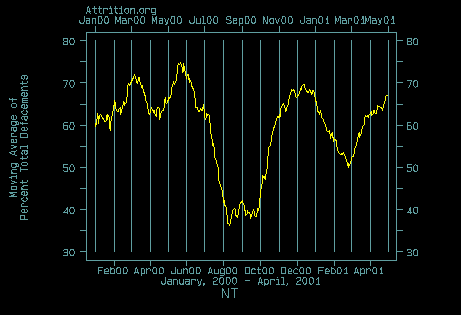
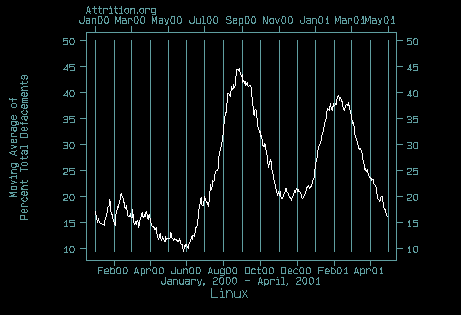
Why people use WinNT as a server platform is beyond me. Something like 65% of web-site defacements listed at Attrition.org are WinNT based. That's insane. Linux is something like 20%. I was very surprised at HOW MANY sites are hacked. The internet's infrastructure needs to be improved, sure. But how about securing your system properly?! Argus has even announced a Linux port for their products; it's the only TOS that I've seen even mention Linux. And, maybe someone should push the Linux Kernel developers to finish implementing the Capabilities and ACL stuff that at least partially exists in the kernel (or in patches); this would allow application coders to write non-suid programs that would still have some of the root capabilities (just the ones they need).
I'm not saying that the sys admins are to blame. These decisions are generally not simple technical ones. However, everyone needs to be educated about the products that are available to protect themselves and others (in the case of DDoS's). If you're a sys admin, educate yourself and pass it on to your boss. They may not get it, but you should at least try.
Just my $0.02.
$ flames > -
Humor - Dilbert strips on shrink-wrap licenses
There's a classic set of Dilbert strips parodying shrink-wrap licenses:
Bill Gates' Towel Boy -
I'm confused -- isn't this just Capabilities + ACL
I'm a little confused. While I've looked for details on how to verify that a system is B1 compliant, I only seem to find vauge references.
I don't see the practical difference between a system that's B1 compliant and one where ACLs are added (1) (2) and all accounts including root are severly restricted -- and both of these security measures avaiable under Linux.
I realize that verification testing is done on a per-installation basis, so many of the details will be specific to that installation.
The general goals including many specific "the system shall" type directives, should be readily available...but where?
Tools like LIDS under Linux and other kernel patches to handle ACLs seem to do the job...so what's missing?
-
Humor: _Dilbert_ on UCITACheck out the Dilbert strip series Bill Gates' Towel Boy
I didn't read all of the shrink-wrap license agreement on my new software until after I opened it.
Apparently I agreed to spend the rest of my life as a towel boy in Bill Gates' new mansion
-
Document VisualizationWhat I wouldn't give for a document management system with some real power. Even for a single user, a comprehensive document storage system would be a killer app.
Perhaps everybody has seen The Brain which has an interesting visualization system, to say the least. I would love to see a more integrated solution under linux, with Web Browsing and Searching, plus link managment/browsing using something like DaVinci , which has an excellent (soon to be improved) API which could create/browse highly structured document links.
This would make an excellent concept like Everything useful for everyone...
-
Java, Sysconfig, Testing/LSB
- Java
There seems to have been something of a "trainwreck" with respect to Java. There are lots of "nearly done" Java environments out there, including Kaffe, GCJ, Jikes, "Blackdown," and likely others.
Unfortunately, none are truly useful without some combination of classes (ala GNU Classpath) and some combination of AWT/Swing. And that has been rather less rapidly forthcoming in the "reasonably free form" that is necessary in order for it to be ubiquitous enough for people to really use it to deploy applications, or to use it as a layer on which to build further infrastructure like EJB.
Is anybody near to deploying a complete "libre" Java for Linux?
- System Config Tools
There's Linuxconf. There's COAS. There's cfengine. And Ganymede (tho it needs Java; see above...) and bunches of other system config tools one one degree of incompleteness or another.
Big, expensive things like UniCentre are also getting ported, although they're not likely of great interest on the home front.
Is there any intent to try to have some useful protocols to allow intercommunications of some of these systems, or to perhaps pick an existing one rather than recreating the wheel?
- Testing/Standards
There has been some lipservice about Linux Standard Base (LSB), but it is not evident that anyone has either deployed substantially changed systems as a result of attempting to conform to some common guidelines, nor to actually provide ways of conforming systems to standards.
There are lots of tools out there to run systems through automated test suites; that is apparently one of the major tasks of one ACLs for Linux project. In other contexts, we find ANSI Common LISP Conformance Tests. The folks at Cygnus run EGCS through testing, and provide EGCS Test Suite Results. Greg is being used to validate that GnuStep conforms to its documentation.
And then there's the Extreme Programming approach (particularly associated with Smalltalk) where one of the core requirements is of Continuous Integration Tests that are integrated in with the development process.
But it is, often enough, not clear that people are depending in much more than merely the notion that Because it's Open Source, naturally bags of people will want to spend their weekends testing my code.
We badly need to have some regression tests so that some testing takes place as distributions are constructed. Debian does some of this with dpkg-related tools; it is highly unfortunate that similar tools have not cropped up around RPM.
Question: What are you doing to help contribute to the public body of test suite code?
- Java
-
ACL in Linux
Actually I brought this up on linux-kernel recently and inspired a long thread about the "right way" to implement them. As it turns out, there already is a patch that gives you working ACLs in ext2. Haven't yet tried it myself, though